Working memory is a skill we need for everything we do! From answering the phone to shopping at the grocery store; working memory is happening at every given moment. Kids who struggle with executive functioning skills often times have working memory challenges.
Working memory Examples
the best way to explain working memory is by looking at examples of working memory in action! We split these examples into sections based on age, because, remember executive functioning skills are developmental. We don’t fully develop executive functioning until mid 20’s so an example of working memory in a young child will look much different than in a middle school aged student.
Preschool Working Memory Examples (Ages ~3–5)
Working memory at this age helps children hold and use small pieces of information for short tasks.
- Remembering two-step directions (“Get your shoes and your jacket.”)
- Repeating a short sentence back to an adult
- Remembering where a toy was placed
- Following directions in a simple game like Simon Says
- Remembering the next action in a pretend play sequence
- Remembering the rules of a simple game
- Holding a short story in mind while answering a question
- Remembering which color block to stack next
- Copying a pattern with blocks
- Remembering the location of puzzle pieces
- Finding matching cards in a memory game
- Remembering which crayon they were using
- Listening to a short instruction while beginning the task
- Remembering which cubby belongs to them
- Repeating numbers or words in a sequence
- Remembering which snack they chose earlier
- Remembering what item to bring to the table
- Keeping track of a turn in a game
- Remembering a simple song or rhyme
- Following a classroom routine sequence
Elementary School Working Memory Examples (Ages ~6–10)
Working memory becomes more important for academic tasks and classroom participation.
- Remembering multi-step instructions from the teacher
- Holding spelling words in mind while writing them
- Copying sentences from the board
- Remembering math steps while solving a problem
- Remembering story details during reading
- Keeping track of place while reading a paragraph
- Remembering homework instructions
- Listening to directions while gathering materials
- Following directions during art projects
- Remembering the next step in a science activity
- Recalling vocabulary words during discussion
- Remembering math facts while solving problems
- Holding numbers in mind during mental math
- Writing sentences while remembering punctuation rules
- Remembering classroom rules during group work
- Keeping track of materials needed for a task
- Following instructions during PE games
- Remembering characters and events in a story
- Completing worksheets with multiple directions
- Remembering teacher expectations for assignments
Middle School Working Memory Examples (Ages ~11–13)
Working memory supports more complex learning, organization, and reasoning. We also have a resource on middle school occupational therapy.
- Remembering steps in multi-step math equations
- Keeping track of information during lectures
- Following multi-step science experiments
- Remembering reading assignments across chapters
- Writing essays while holding ideas in mind
- Remembering discussion points during group work
- Keeping track of homework from multiple classes
- Remembering locker combinations
- Managing materials for different subjects
- Remembering instructions for technology tasks
- Taking notes while listening to a teacher
- Remembering rules during team sports
- Keeping track of steps when solving word problems
- Remembering writing prompts while composing responses
- Holding multiple ideas during class discussions
- Organizing ideas during brainstorming
- Remembering steps while editing writing
- Managing schedules for classes and activities
- Remembering expectations for long-term projects
- Keeping track of multiple assignments
High School Working Memory Examples (Ages ~14–18)
Working memory becomes essential for complex reasoning, studying, and planning. Also check out our resource on high school occupational therapy.
- Remembering lecture information while taking notes
- Holding multiple steps in advanced math problems
- Remembering information during test-taking
- Managing long reading assignments
- Organizing ideas for essays or presentations
- Remembering study materials across subjects
- Planning steps for projects and reports
- Holding information while solving complex problems
- Managing schedules with multiple classes
- Remembering deadlines and due dates
- Taking notes while analyzing information
- Remembering instructions for lab experiments
- Managing multiple pieces of information during debates
- Holding research points during presentations
- Remembering study strategies for exams
- Managing information during group projects
- Following complex directions in technical classes
- Remembering driving rules during learning
- Tracking information during problem-solving tasks
- Planning multi-step tasks for assignments
Young Adult Working Memory Examples
Working memory supports independence, decision-making, and job tasks. Here is more on adults and executive functioning.
- Remembering instructions from supervisors
- Managing multiple tasks at work
- Following steps in cooking recipes
- Holding directions in mind while driving
- Managing schedules and appointments
- Keeping track of financial tasks and bills
- Remembering details during meetings
- Managing information while studying in college
- Following multi-step workplace procedures
- Holding ideas in mind while problem-solving
- Organizing information for reports or presentations
- Managing tasks during busy workdays
- Remembering steps when assembling items
- Keeping track of items needed for errands
- Remembering conversation details during discussions
- Holding instructions while completing projects
- Managing academic deadlines
- Remembering passwords or codes temporarily
- Following instructions during training
- Planning and executing daily routines independently
working Memory
Let’s talk about what working memory is and how to improve working memory in kids so they can be successful in those everyday tasks.
What is Working Memory?
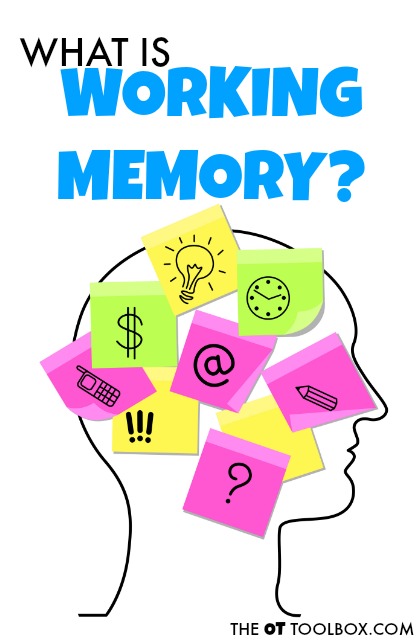
Working Memory is the ability to act on past memories and manipulating the information in a new situation.
Processing short term memories and using it allows us to respond in new situations.
Working memory allows us to learn. Using working memory skills we can use past information in reading in order to read sight words.
We can remember math facts, state capitals, mnemonics, phone numbers, addresses, and friends’ names. We can then use that information to answer questions based on what we know and apply that information in new situations.
Executive functions are heavily dependent on attention. Read about the attention and executive functioning skill connection and the impact of attention on each of the executive functioning skills that children require and use every day.
In order for working memory to be used in daily tasks, we need a few key items. Our brain might be considered a memory soup and the key ingredients to working memory are attention, focus, auditory memory and visual-spatial memory.
Read more about visual memory and how to incorporate strategies into play.
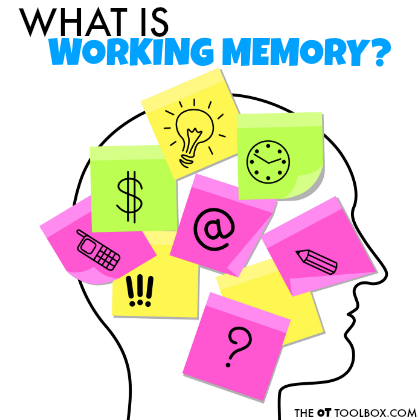
Mix all of those ingredients together and you will end up with working memory that can be used to problem solve any given situation.
You can see how children who struggle with the underlying “ingredients” of attention, concentration, auditory processing, and visual processing will be challenged to pull that information into an unrelated event. The child with sensory processing disorder who is also struggling with social emotional issues might end up in meltdown mode. The child who can not generalize facts to a new environment might withdrawal.
Read more about attention and how to help kids improve attention with easy strategies for home and school.
All of these situations can potentially lead to difficulty with problem solving. Children are developmentally growing every day in relating past information. Yes, we say thank you EVERY time someone holds the door for us, not just that one time last week. By going through our day, kids learn these things!
The child who is struggling with any of the key ingredients related to working memory, it can be really hard to generalize.
How to Improve Working Memory
Try these working memory strategies to help improve this executive functioning skill:
- Take notes
- Daily Journal- The Impulse Control Journal is a great tool for keeping track of day to day events
- Notebook with times for daily tasks
- Practicing the ability to stop and think in practice and in real-life situations. This skill allows one to complete tasks or respond using past experiences.
- Writing down information (opposed to typing or tracking on an app)
- Setting an alarm for tasks
- Second set of school books for home
- Dry erase board notes to be used in tasks like cleaning a room
- Mnemonics
- Guided imagery
- Mental rehearsing
- Imagine a task in pictures (like a cartoon strip of a day’s event)
- Analyzing problem areas
- Practice through rehearsal
- Routines
- Rewards
- Reminder messages including verbal, picture, or app-based
- To-do lists with physical action (pull off a post-it note when completed)
- Task sequencing lists
- Play memory games, such as matching games or memory card games.
- Use mnemonic devices to help remember information, such as acronyms or visual cues.
- Repeat information to yourself multiple times to help solidify it in your memory.
- Use visualization techniques to create mental images of information you need to remember.
- Break down complex information into smaller chunks to make it more manageable to remember.
- Use repetition and rehearsal to help remember important information.
- Practice active listening by summarizing and repeating back what someone has said to you.
- Write down important information or ideas to help reinforce them in your memory.
- Use technology, such as digital reminders or voice memos, to help you remember important information.
- Practice mindfulness exercises to improve focus and concentration, which can help with working memory.
- Engage in regular aerobic exercise, which has been shown to improve working memory.
- Play strategy-based games, such as chess or Sudoku, to help improve working memory skills.
- Use self-testing or quizzing techniques to help reinforce information in your memory.
- Break tasks down into smaller steps to make them more manageable to remember.
- Use different sensory modalities, such as sight and sound, to help reinforce information in your memory.
- Practice relaxation techniques, such as deep breathing or meditation, to help reduce stress and improve working memory.
- Engage in activities that challenge your working memory, such as learning a new language or musical instrument.
- Use context cues or associations to help remember information, such as associating a person’s name with a visual cue or location.
- Prioritize and focus on the most important information to remember.
- Get enough sleep, as lack of sleep can negatively impact working memory skills.
- Repeat complex instructions
- Break down complex instructions into step-by-step directions with pictures, such as a more detailed version of a visual schedule
Working Memory Activities
In addition to the working memory strategies listed above, there are specific activities you can do to build working memory. Try these ideas:
Digit Recall Activities- Work on repeating numbers in a series. The individual can repeat back numbers in 2 to 3 digit series in both forward and reverse. Then, you can add on additional digits. Continue to grade the digit activities in greater difficulty by adding digits to the thread of numbers or adding letters. To increase the difficulty of this activity even further, ask the individual to write down the series of numbers and letters, and add time in between the given number and when they are asked to recall the series.
Word Sequences- Similar to the number sequences described above, you can use visual pictures of words, or auditory word sequences. Ask the individual to repeat back the series of words.
Ordering Activities- Another great working memory activity is sequential ordering of images or objects by size. You can target this activity to meet the interests of the individual. Think about ordering animals, sports balls, toys, or other items by size. Offer a specific number of items and challenge the individual to remember all of the objects in the series. Increase the difficulty by asking the individual to order objects by largest to smallest and then by smallest to largest.
Instructional Sequencing Activities- This working memory activity focuses on functional tasks and can target goals of the individual. For example, a child working on brushing their teeth can order the steps of the activity from memory. Then, you can ask the child to list the steps in reverse.
More tools for addressing attention needs in kids
The Attention and Sensory Workbook can be a way to do just that.
The Attention and Sensory Workbook is a free printable resource for parents, teachers, and therapists. It is a printable workbook and includes so much information on the connection between attention and sensory needs.
Here’s what you can find in the Attention and Sensory Workbook:
- Includes information on boosting attention through the senses
- Discusses how sensory and learning are connected
- Provides movement and sensory motor activity ideas
- Includes workbook pages for creating movement and sensory strategies to improve attention
A little more about the Attention and Sensory Workbook:
Sensory processing is the ability to register, screen, organize, and interpret information from our senses and the environment. This process allows us to filter out some unnecessary information so that we can attend to what is important. Kids with sensory challenges often time have difficulty with attention as a result.
It’s been found that there is a co-morbidity of 40-60% of ADHD and Sensory Processing Disorder. This workbook is an actionable guide to help teachers, therapists, and parents to help kids boost attention and focus in the classroom by mastering sensory processing needs.
You will find information on the sensory system and how it impacts attention and learning. There are step-by-step strategies for improving focus, and sensory-based tips and tricks that will benefit the whole classroom.
The workbook provides tactics to address attention and sensory processing as a combined strategy and overall function. There are charts for activities, forms for assessment of impact, workbook pages for accommodations, and sensory strategy forms.
References:
Gentry, T. (2015, September). Mobile technologies as vocational supports for workers with cognitive-behavioral challenges. Technology Special Interest Section Quarterly, 25(3), 1–4.

Colleen Beck, OTR/L has been an occupational therapist since 2000, working in school-based, hand therapy, outpatient peds, EI, and SNF. Colleen created The OT Toolbox to inspire therapists, teachers, and parents with easy and fun tools to help children thrive. Read her story about going from an OT making $3/hour (after paying for kids’ childcare) to a full-time OT resource creator for millions of readers. Want to collaborate? Send an email to contact@theottoolbox.com.