As therapists, we often times see clients with vision needs that impact functional skills. Visual processing is a complex topic and convergence insufficiency is just one area. Read below to find out more about convergence in kids, to understand exactly what is convergence insufficiency, and how convergence plays into functional skills and learning.
**DISCLAIMER** I am not an optometrist, ophthalmologist or vision therapist. All information in this post is informational in nature only and should not be utilized in place of the appropriate professionals treatment and evaluations.
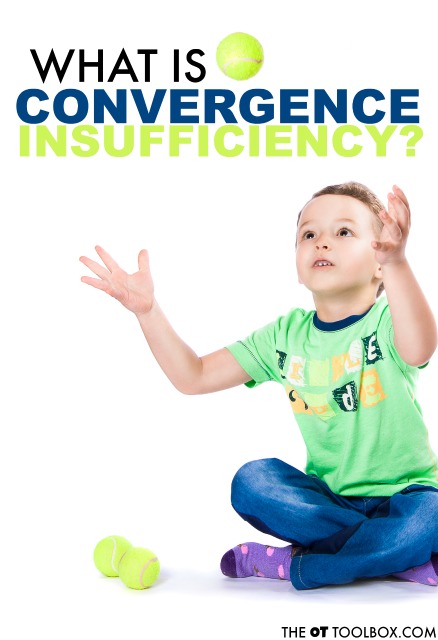
What is Convergence Insufficiency?
Vision is a hot topic among therapists these days. It’s a foundational skill that we often overlook, or don’t have a clue where to start even if we know that we need to address it. When our vision is impaired, so is our learning.
Need help addressing visual problems in the classroom? Here are classroom accommodations for visual impairments.
Vision screenings done in the school nurses or pediatricians office only addresses acuity, resulting in other underlying vision concerns being missed.
These concerns can go unaddressed for long periods of time until the child has received remediation services, OT and other services to address the child’s deficits. By the time we realize that vision needs to be re-addressed the child is struggling and does not find academic work enjoyable.
Underlying vision concerns are often hard to detect, with convergence insufficiencies being one of the most common issues.
What is Convergence
Before we can talk about convergence insufficiencies, we need to address what typical, intact convergence patterns look like. Simply put, convergence is our eyes ability to smoothly follow a moving target as a team, from a distance to a very near point, such as the tip of our nose.
Convergence is not only an active motor pattern, it is also a sustained motor pattern. Sustained convergence is utilized for the completion of near point work tasks. Intact convergence skills allow us to read, write, draw and catch a ball, and similar tasks with relative ease. When the system experiences difficulties, it can result in a convergence insufficiency.
Convergence insufficiency (CI) is an eye condition where the eyes have difficulty working together to focus on nearby objects. This can result in blurred or double vision, headaches, or eye strain—especially during near work like reading or using smartphone screens. In childhood, this condition may impact school performance and is sometimes mistaken for ADHD due to shared attention and visual symptoms.
Convergence Insufficiency
A convergence insufficiency is caused when the dynamic system of convergence/divergence is impaired or experiences stress. The impairment hinders the child’s ability to move their eyes in synchronized, coordinated, and smooth movements from a far point to a near point or near point to far point.
The ability to assume, and maintain sustained convergence patterns may also be significantly affected.
Causes of Convergence Insufficiency
Impairments to this system can stem from several different causes, with the most common reason being an eye muscle imbalance or weakness. Muscle imbalance and weakness can occur in one or both eyes. It is very dependent upon the child.
Other causes of a convergence insufficiency may be due to congenital neurological reasons, traumatic events, or other physical impairments that affect the eye. These are NOT the usual suspect for why a child experiences a convergence insufficiency and should be ruled out by an optometrist or ophthalmologist if there is a reason to believe this is the case.
Contributing Factors
Convergence insufficiency may be linked to eye muscles not coordinating properly. In some cases, nerves sending the proper message to the muscles may be delayed, especially after illness, lack of sleep, or a brain injury. Constant exposure to smartphones, tablets, and digital devices can also strain the eyes. Tasks requiring focusing at different distances, like switching between a board and a notebook, can further challenge a child’s visual system.
Screening for a Convergence Insufficiency
The most recognizable form of a convergence insufficiency found during a vision screening, is when the child is unable to follow the tracking item to within one half inch of their nose. When this happens, the child’s eyes may appear to “bounce” or “snap” back to a midline position despite the child’s best effort to find the item. This can happen with one or both eyes, and it is important to note in your screening what happened. In more severe cases, the child is unable to move their eyes to follow the tracking item to their nose.
More commonly, the child may be able to complete the convergence/divergence patterns, but experiences headaches, complains about their eyes hurting or frequently rubs their eyes with sustained convergence activities such as reading and writing.
It is also important to note, if the child is unable to sustain convergence at the end of the convergence/divergence pattern screening for more than a few seconds. This can also be an indicator that the child has a convergence insufficiency. This is one of the hardest skill deficits to identify as it is very subtle and difficult to see at times. If you suspect a convergence insufficiency, look for other red flags to support your observations.
Diagnosing Convergence Insufficiency
A standard eye exam may not be enough to detect convergence insufficiency. Instead, specific testing performed by an eye doctor trained in binocular vision assessments is needed. This can include evaluating eye movements, testing convergence ability, and reviewing the history of the patient, especially after a concussion or brain injury. Diagnosis often involves identifying the symptoms of CI and determining whether there is a result of true convergence weakness.
Red Flags of Convergence Insufficiency
A convergence insufficiency is often hard to identify in screenings alone. Below are a list of skills that may be affected if a child is experiencing difficulties with convergence.
● Frequent headaches
● Rubbing of the eyes
● Covering one eye consistently
● Red or bloodshot eyes
● Distress with reading tasks
● Distress with near and far point copying tasks such as copying from the board
● Difficulty with catching a ball
● Use of a finger to track their place when reading
● Sleepiness or fatigue during near point work
● Motion sickness
● Blurred and/or double vision
● Words appearing to “jump” or “move” on the page
If the child is experiencing any of these signs, have their vision checked by an optometrist to rule out an eye muscle imbalance that may be causing a convergence insufficiency.
Symptoms of Convergence Insufficiency
Some of the most common symptoms of convergence insufficiency include eye fatigue, double vision (diplopia), headaches, and poor depth perception.
Children may demonstrate frequent mishaps, like tripping on uneven surfaces, frequent spilling, or a misjudgment of physical distances like missing stairs. They may also struggle with eye contact or seem to lose focus during tasks. In more rare cases, issues like vertigo and suppression of vision may occur.
Treatment of Convergence Insufficiency
Convergence insufficiencies are diagnosed by an optometrist or ophthalmologist. It is important to note that an OT cannot diagnose a convergence insufficiency. She/He can only report their observations and recommend follow up with the appropriate health care provider.
Upon seeing an optometrist, corrective lenses or vision therapy may be recommended based on the child’s needs. It is VERY important that the child wear his/her glasses and complete vision therapy if recommended as prolonged convergence insufficiencies can result in permanent eye strain and damage.
Once the child has received their corrective lenses, and if vision therapy has not been recommended, OT can help provide foundational skill remediation and exercises to promote the development of the child’s convergence skills.
One way to identify any convergence issues is with a screening tool like the Visual Screening Packet. This resource contains tools for occupational therapy practitioners to identify visual convergence challenges. The therapy provider can then offer activities and supports for any issues that are identified. The screening resource can then be used to assess improvements following therapy sessions.
Be on the lookout for my next post, Activities to Improve Convergence Skills to further fill your vision tool box. Also be sure to check out my OT Vision Screening Packet for useful forms and handouts to help you identify convergence insufficiencies and other vision concerns.
Treatment Options for Convergence Insufficiency
Convergence insufficiency treatment may involve active treatment methods such as pencil push-ups, computer programs, or in some passive treatment plans, prism glasses or prism lenses. In rare cases, surgery may be required, such as for intermittent exotropia.
However, most treatment is non-invasive and focuses on improving convergence ability over time. Getting enough sleep and reducing screen time can also support recovery. Therapy may be customized depending on whether the individual struggles with stationary objects, close object focus, or near work tasks.
Supporting Children with Convergence Insufficiency
When working with children in therapy or classroom settings, it’s important to recognize symptoms of CI and consider how they affect academic and physical performance. Poor posture, stumbles, and struggles with stairs may indicate visual difficulties.
Classroom accommodations, proper lighting, and breaks from screen time can reduce symptoms. Collaboration with caregivers and vision professionals ensures a comprehensive approach to care.
Occupational Therapy Vision Screening Tool
This visual screening tool was created by an occupational therapist and provides information on visual terms, frequently asked questions regarding visual problems, a variety of visual screening techniques, and other tools that therapists will find valuable in visual screenings.