The Pyramid of Learning helps explain how higher-level skills like attention, emotional regulation, problem solving, organization, and executive functioning are built on a foundation of sensory, motor, and nervous system development. For example, executive functioning skills do not develop in isolation. Before the brain can consistently plan, focus, regulate emotions, manage time, or complete tasks, it first needs a strong foundation of body awareness, sensory processing, movement, postural control, and regulation.
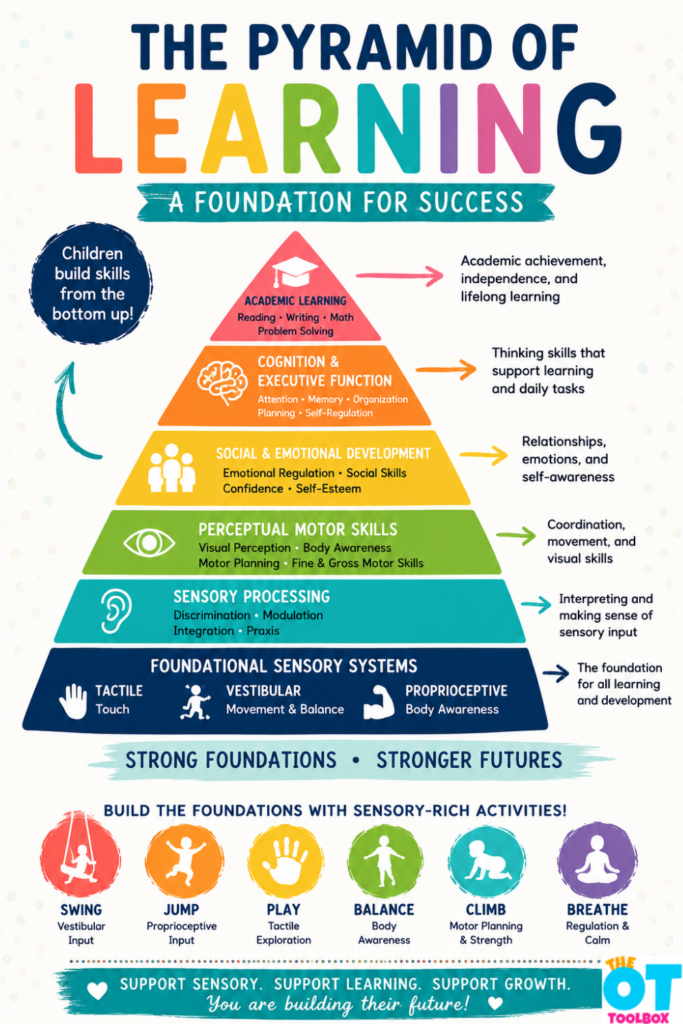
When lower levels of the pyramid are unstable or overwhelmed, higher-level thinking skills can become more difficult to access. Understanding executive functioning through the lens of the Pyramid of Learning reminds us that learning and behavior are deeply connected to the nervous system, and that supporting the foundation often strengthens the skills at the top.
What is the pyramid of learning
The sensory Pyramid of Learning is a helpful visual framework often used by occupational therapists, educators, and parents to better understand how children develop the foundational skills needed for learning and participation. The pyramid illustrates the idea that higher-level skills such as reading, writing, attention, emotional regulation, and academic learning are built upon a strong sensory and motor foundation. Rather than viewing learning as isolated academic performance, the Pyramid of Learning helps us see how the nervous system, movement, sensory processing, and regulation all work together to support development.
The Pyramid of Learning was developed by occupational therapist Kathleen Taylor and special educator Maryann Trott. Their work was heavily influenced by the sensory integration theories of A. Jean Ayres, who emphasized the importance of sensory processing in child development. The pyramid serves as a developmental road map, helping adults understand how foundational sensory systems support the growth of more complex skills over time.
The Pyramid of Learning is a developmental framework often used in occupational therapy and education to explain how foundational sensory and motor skills support higher-level learning and participation. The idea behind the pyramid is that children build skills from the “bottom up.” Before children can successfully complete complex academic tasks, they first need strong foundational systems that support attention, regulation, movement, and processing.
At the base of the pyramid are the sensory systems, including:
- Vestibular processing (movement and balance)
- Proprioception (body awareness and force)
- Tactile processing (touch)
- Visual and auditory processing
- Interoception (internal body awareness)
These sensory systems help children understand and respond to the world around them. When these foundational systems are well organized, children are better able to develop motor coordination, postural control, body awareness, and emotional regulation.
The middle levels of the pyramid include:
- Visual motor integration
- Bilateral coordination
- Motor planning
- Attention and focus
- Language processing
- Emotional regulation
These areas support participation in daily activities and classroom tasks.
At the top of the pyramid are higher-level academic and functional skills such as:
- Reading and writing
- Problem-solving
- Executive functioning
- Organization
- Behavioral regulation
- Social participation
From an occupational therapy perspective, the Pyramid of Learning reminds us that when a child struggles with attention, handwriting, behavior, or learning, it is important to consider the underlying foundational skills first. For example, a child who has difficulty sitting still during class may actually be struggling with sensory processing, postural control, or body awareness rather than motivation or behavior alone.
This framework helps parents, teachers, and therapists understand that learning is connected to the nervous system, sensory processing, movement, and regulation. Supporting foundational skills through movement, sensory experiences, and meaningful activities can improve participation and functional performance across home, school, and community environments.
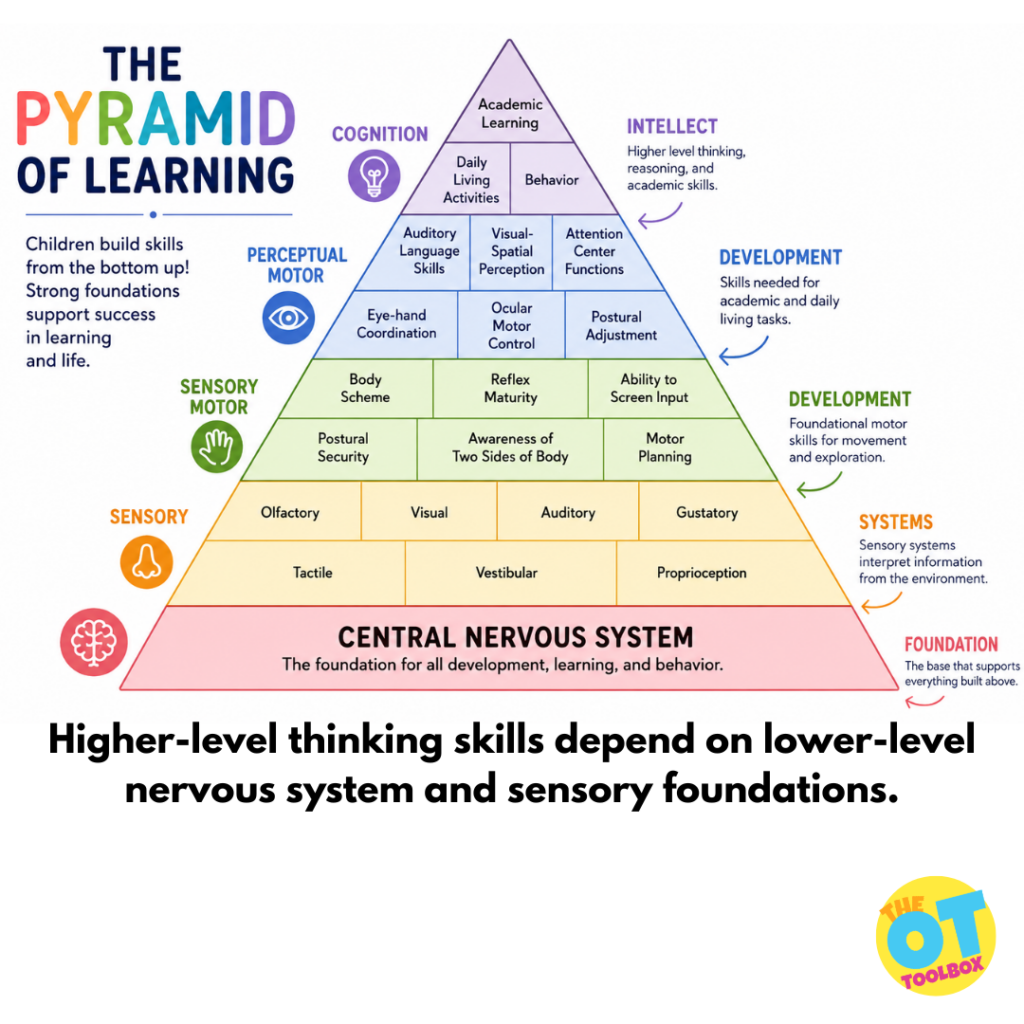
pyramid of learning occupational therapy
In occupational therapy, the Pyramid of Learning is used as a framework to understand how foundational sensory and motor systems support a child’s ability to participate in everyday activities. Occupational therapists often use this model to look beyond the surface of a child’s challenges and identify the underlying skills that may be impacting function.
From an OT perspective, higher-level skills like handwriting, attention, emotional regulation, reading, and classroom participation do not develop in isolation. These abilities are built upon a strong sensory and motor foundation. If the foundational systems at the bottom of the pyramid are not well developed, children may struggle with more advanced tasks at the top of the pyramid.
The lower levels of the pyramid include sensory processing systems such as:
- Vestibular processing (movement and balance)
- Proprioception (body awareness)
- Tactile processing (touch input)
- Visual and auditory processing
- Interoception (awareness of internal body signals)
These systems support body awareness, postural control, motor planning, and regulation. Occupational therapists often address these foundational areas through movement-based and sensory-rich activities that help organize the nervous system.
As children build stronger foundational skills, they are better able to develop:
- Bilateral coordination
- Fine motor control
- Visual motor integration
- Attention and focus
- Self-regulation
These middle layers support successful participation in school, play, self-care, and social activities.
At the top of the Pyramid of Learning are higher-level functional skills such as:
- Academic learning
- Executive functioning
- Emotional regulation
- Problem-solving
- Behavioral organization
Occupational therapists use this framework to help explain why children may struggle with tasks like sitting still, handwriting, or following directions. For example, difficulty with attention may actually be related to sensory processing challenges, weak postural control, or a nervous system that is not fully regulated.
The Pyramid of Learning also supports a strengths-based and developmental approach to intervention. Rather than focusing only on correcting behavior or academic performance, occupational therapists work to strengthen the underlying systems that support participation and independence.
This framework helps parents, teachers, and therapists understand that learning and behavior are deeply connected to sensory processing, movement, and nervous system regulation. When foundational skills are supported, children are often better able to engage, learn, and participate successfully across environments.
Base of the Pyramid of Learning
At the base of the pyramid are the primary sensory systems: tactile, vestibular, and proprioceptive processing. These systems form the foundation for all higher learning and participation. The tactile system involves touch and helps children understand their body and environment through sensory experiences. The vestibular system processes movement and balance and plays an important role in body awareness, posture, and attention. The proprioceptive system provides information about body position, force, and movement, helping children coordinate their actions and navigate their environment efficiently.
A child’s nervous system requires sensory input in order to grow, organize, and mature. Sensory experiences provide the brain with critical information that supports neural development and learning. The more opportunities children have to move, explore, touch, climb, swing, and engage with their environment, the more input the brain receives to build strong neural pathways. This is why sensory play, movement activities, and hands-on experiences are so important in early childhood development.
As the sensory systems develop, they support the middle layers of the pyramid. These layers include skills such as postural control, bilateral coordination, body awareness, motor planning, visual perception, and auditory processing. These foundational motor and perceptual skills allow children to participate more successfully in everyday activities. For example, a child with good postural control and body awareness is better able to sit upright in a classroom chair, manipulate school tools, and focus on learning tasks.
Higher up on the pyramid are advanced skills such as attention, emotional regulation, academic learning, executive functioning, social participation, reading, and handwriting. These are often the skills adults notice first when a child is struggling. However, the Pyramid of Learning reminds us that challenges with attention, behavior, or academics may actually reflect difficulties in the foundational sensory systems lower in the pyramid.
Bottom Up Approach to Intervention
From an occupational therapy perspective, this framework supports a “bottom-up” approach to intervention. This means therapists often address foundational sensory and motor skills before expecting success in more advanced tasks. For example, if a child struggles to focus during handwriting tasks, the underlying issue may not be motivation or behavior alone. The child may need support with sensory processing, postural stability, body awareness, or regulation in order to fully engage in learning.
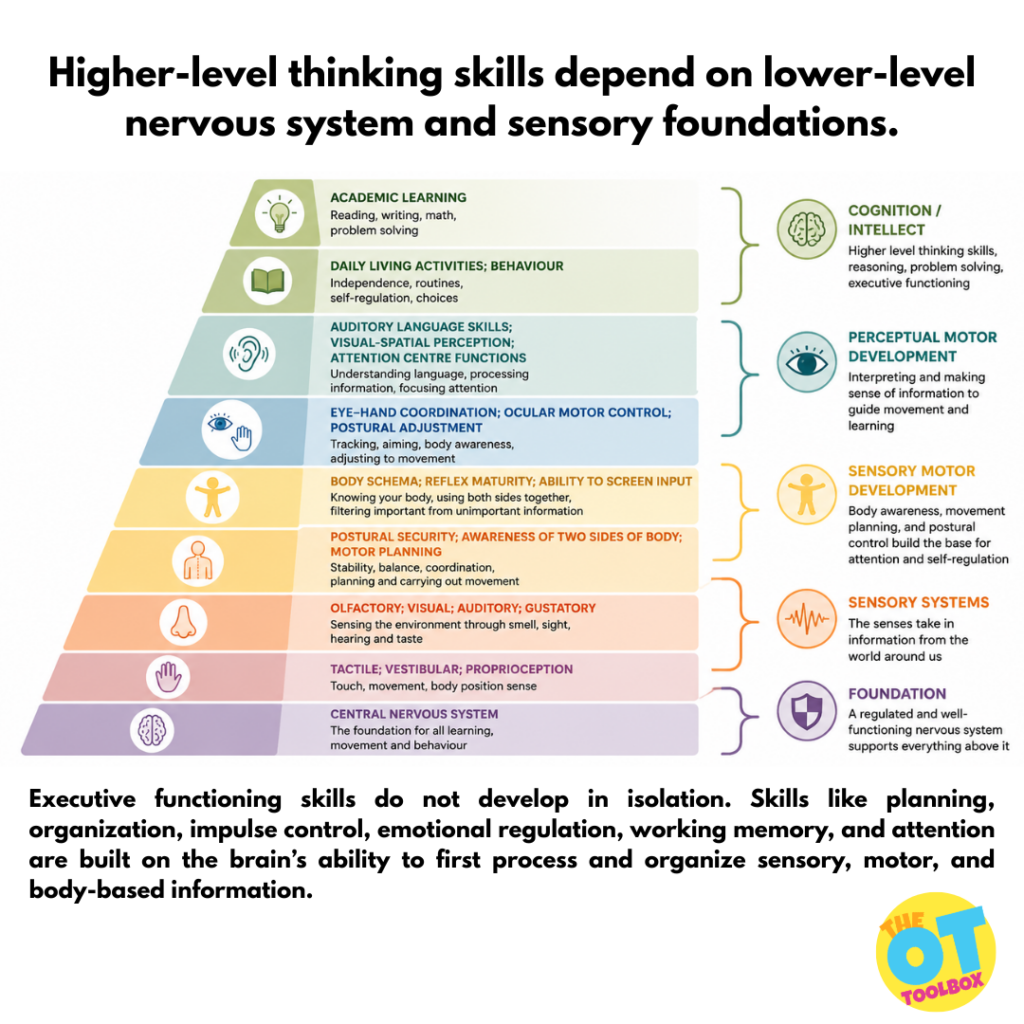
higher level thinking
This image connects very closely to executive functioning skills because it demonstrates a foundational developmental concept:
Higher-level thinking skills depend on lower-level nervous system and sensory foundations.
Executive functioning skills do not develop in isolation. Skills like planning, organization, impulse control, emotional regulation, working memory, and attention are built on the brain’s ability to first process and organize sensory, motor, and body-based information.
Here’s how this pyramid relates to executive functioning:
Executive Functioning Is Built From the Bottom Up
The top of the pyramid represents:
- Academic learning
- Cognition
- Intellectual functioning
This includes executive functioning skills such as:
- Planning
- Organization
- Attention
- Working memory
- Task initiation
- Cognitive flexibility
- Self-monitoring
But the brain cannot consistently access these higher-level skills when the lower levels of the pyramid are unstable.
The Lower Levels Support Executive Function
Central Nervous System
This is the brain-body communication foundation.
If the nervous system is dysregulated, stressed, or overwhelmed:
- attention decreases
- emotional regulation becomes harder
- impulse control weakens
A dysregulated nervous system directly impacts executive functioning performance.
Sensory Systems
Includes:
- vestibular
- proprioceptive
- tactile
- auditory
- visual
The brain must process sensory input efficiently in order to:
- sustain attention
- filter distractions
- regulate arousal levels
- maintain focus
When sensory processing is difficult, executive functioning can appear inconsistent.
Example:
A child struggling to process background noise may look inattentive or disorganized when the issue is actually sensory overload.
Sensory Motor Development
Includes:
- postural control
- motor planning
- bilateral coordination
- reflex integration
These skills influence:
- sitting upright for attention
- coordinating actions
- sequencing tasks
- sustaining effort
Executive functioning requires physical regulation as well as cognitive regulation.
Sensory activities play a major role in supporting the Pyramid of Learning. Tactile activities such as sensory bins, messy play, and texture exploration help children process touch input and develop body awareness. Vestibular activities like swinging, spinning, climbing, and obstacle courses provide movement experiences that support balance, coordination, and attention. Proprioceptive activities, often called “heavy work,” include pushing, pulling, carrying, climbing, and resistance-based tasks that help organize the nervous system and improve body awareness.
Children who need additional foundational sensory support may demonstrate signs such as difficulty sitting still, poor coordination, weak body awareness, emotional dysregulation, handwriting challenges, or sensory seeking and sensory sensitivity behaviors. Understanding these signs through the lens of the Pyramid of Learning helps adults move beyond simply addressing behavior and instead focus on supporting the nervous system and developmental foundation beneath the behavior.
Perceptual Motor Development
Includes:
- visual perception
- visual-spatial skills
- eye-hand coordination
- auditory language processing
These systems support:
- following directions
- organizing information
- reading and writing
- remembering steps
Weaknesses in these areas often impact working memory and organization.
Executive Functioning Emerges From Integration
Executive functioning develops when:
- sensory systems are regulated
- movement systems are organized
- attention systems are stable
- emotional systems feel safe
This is why:
- movement breaks improve focus
- heavy work supports attention
- co-regulation improves problem solving
- sensory supports can improve organization and behavior
The brain develops executive functioning through integrated nervous system experiences.
Clinical Takeaway
This pyramid reminds us that executive functioning challenges are not always “behavior problems” or “motivation problems.”
For parents and educators, the Pyramid of Learning provides a powerful way to understand the connection between sensory experiences and learning. It reinforces the idea that children learn best when their nervous systems are supported through movement, sensory exploration, play, and meaningful experiences. Learning is not just about academics at the top. It’s is deeply connected to the body, brain, and environment working together.
Supporting the foundational layers of the pyramid through sensory-rich experiences can improve participation, regulation, and functional performance across home, school, and community settings. By recognizing the importance of sensory processing and movement in development, we can better support children as they grow, learn, and engage with the world around them.
Sometimes the brain is working so hard to:
- process sensory information
- regulate emotions
- maintain posture
- filter input
…that fewer resources remain available for higher-level executive functioning skills.
Supporting executive functioning often means supporting the nervous system first.
Executive functioning sits at the top of a developmental foundation.
Attention, organization, planning, and self-regulation depend on the brain first feeling:
- regulated
- organized
- safe
- connected
- sensory stable
When we support the lower levels of the pyramid, we strengthen the foundation for executive functioning growth.

Colleen Beck, OTR/L has been an occupational therapist since 2000, working in school-based, hand therapy, outpatient peds, EI, and SNF. Colleen created The OT Toolbox to inspire therapists, teachers, and parents with easy and fun tools to help children thrive. Read her story about going from an OT making $3/hour (after paying for kids’ childcare) to a full-time OT resource creator for millions of readers. Want to collaborate? Send an email to contact@theottoolbox.com.