One tool we can use in occupational therapy is an eco map. This visual graphic organizer is a way to explore relationships that can impact our clients’ functional performance of occupational therapy.
Relationships influence nearly every aspect of daily life. The people around us can support our success, create opportunities for participation, provide emotional encouragement, help us complete daily tasks, or sometimes create challenges that make participation more difficult. In occupational therapy, understanding these relationships is an important part of understanding the whole person.
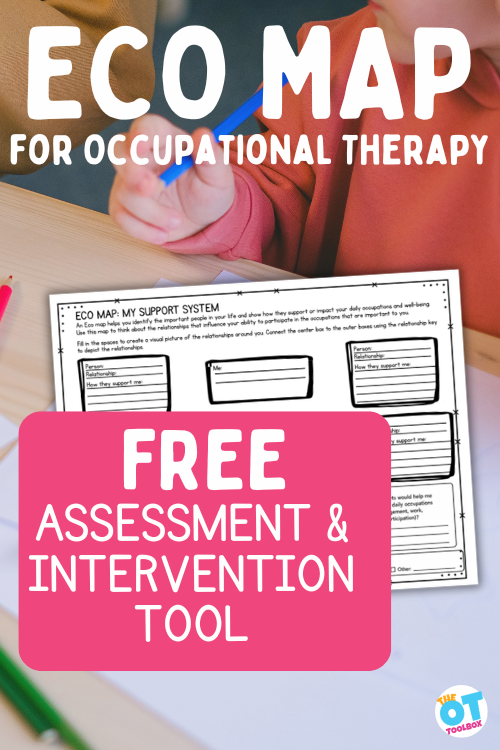
This free Eco Map Worksheet helps individuals identify the people in their lives, explore how those relationships influence daily activities, and recognize areas where additional support may be beneficial. Whether used with children, adolescents, adults, or older adults, an ecomap provides a visual representation of the social environment that surrounds an individual and impacts occupational performance.
What Is an Eco Map?
An ecomap is a visual tool, much like a mind map, that helps a person identify important relationships and connections within their environment. The individual places themselves in the center of the map and then identifies people, groups, organizations, and support systems that play a role in daily life.
Unlike a family tree or genogram, an ecomap focuses on current relationships and how those relationships affect participation, well-being, and functioning. It helps illustrate both supportive and stressful connections while highlighting resources that may strengthen occupational engagement.
We can use an eco map in OT sessions to help our clients recognize how the people in their lives help them, support them, or maybe impair function. This gives them a visual snapshot of the person’s support network and the environmental factors that influence daily occupations.
Why Relationships Matter in Occupational Therapy
The Occupational Therapy Practice Framework, Fourth Edition (OTPF-4), identifies supports and relationships as an environmental factor that can significantly influence participation and performance. Environmental factors include the physical, social, and attitudinal environment in which people live and engage in occupations.
We can use an eco map with our clients AND we can use it on ourselves to help identify supportive relationships to target burnout as a professional.
In functional occupations, supports and relationships include:
- Immediate and extended family
- Friends and peers
- Neighbors and community members
- Teachers and educational personnel
- Coworkers and supervisors
- Healthcare providers
- Personal care assistants
- Community groups and organizations
- Online communities and virtual supports
- Service providers and support professionals
These relationships can act as facilitators that support participation or barriers that limit engagement in meaningful activities.
Social Participation as an Occupation
The Occupational Therapy Practice Framework identifies social participation as an occupation. Social participation includes activities involving interaction with family, friends, peers, coworkers, community members, and other social groups.
Examples include:
- Community participation
- Family participation
- Friendships
- Intimate partner relationships
- Peer group participation
These occupations are often overlooked when discussing daily functioning, but they play a critical role in overall health, quality of life, and participation.
The ability to establish, maintain, and navigate relationships affects educational participation, work performance, leisure activities, self-care routines, and emotional well-being.
Relationships and Activities of Daily Living
Many individuals rely on support systems to successfully complete Activities of Daily Living (ADLs) and Instrumental Activities of Daily Living (IADLs).
Supportive relationships may help with:
Activities of Daily Living (ADLs)
- Bathing
- Dressing
- Feeding
- Grooming
- Functional mobility
- Personal hygiene
Instrumental Activities of Daily Living (IADLs)
- Meal preparation
- Household management
- Transportation
- Medication management
- Financial management
- Shopping
- Community participation
For example, an older adult may depend on adult children for transportation to medical appointments. A teenager may rely on caregivers to establish routines that support independence. A college student may depend on peer support while learning independent living skills.
The ecomap helps identify these relationships and the ways they support participation.
Relationships and Work Performance
Relationships also influence occupational participation within work environments.
When we look at the task of “work”, it’s important to understand the things that impact participation. This is important for burnout that happens in the therapy professions. These components can include:
- Creating, producing, and distributing products and services
- Maintaining work skills and patterns
- Managing time use
- Managing relationships with coworkers, managers, and customers
- Following leadership and supervision
- Initiating and completing work tasks
- Complying with workplace expectations
- Seeking and responding to feedback
Success in work environments often depends on social interaction skills, communication abilities, problem-solving, collaboration, and support from others.
An ecomap can help individuals identify:
- Workplace mentors
- Supervisors
- Coworkers
- Job coaches
- Professional supports
These relationships may significantly impact work performance and job satisfaction.
Using an Eco Map to Screen for Strengths and Areas of Need
One of the most valuable uses of an ecomap in occupational therapy is as a screening and discussion tool.
While it is not a standardized assessment, it provides insight into a client’s social environment and support systems.
As clients complete the map, therapists can observe:
- Availability of support systems
- Diversity of social connections
- Community involvement
- Social participation opportunities
- Areas of isolation
- Relationship strengths
- Sources of stress
- Potential barriers to participation
Patterns often emerge quickly. Some individuals may have strong family support but limited community involvement. Others may have extensive social connections but lack practical supports for daily activities.
These observations can guide intervention planning and goal development.
How to Use the Eco Map Worksheet
Begin by placing the name of the client in the center circle of the map.
Next, identify important people and supports within the individual’s life. These may include:
Family
- Parents
- Siblings
- Grandparents
- Extended family
Friends and Peers
- Close friends
- Classmates
- Teammates
- Social groups
School and Work Supports
- Teachers
- Supervisors
- Coworkers
- Mentors
- Job coaches
Healthcare and Service Providers
- Occupational therapy providers
- Counselors
- Physicians
- Support staff
Community Supports
- Faith communities
- Volunteer organizations
- Clubs
- Recreational groups
Online Supports
- Virtual communities
- Support groups
- Online learning communities
For each relationship, the individual can record:
- Who the person is
- Their relationship to the client
- How they provide support
- Whether the relationship feels supportive, neutral, or stressful
Reflection Questions for Occupational Therapy
Eco maps are common in the social work field. However, we don’t really use them much in the OT profession. Yes, we look at relationships in our assessments. But really working through how these supports impact our clients with an eco map worksheet isn’t a common practice. That’s why we wanted to make one that has reflection questions related to function. We wanted to create an eco map that’s specifically designed for occupational therapy.
After completing the ecomap, reflection questions can help deepen insight and guide treatment planning.
Consider discussing:
- Who supports you the most?
- Who helps you participate in daily activities?
- What occupations are easiest when support is available?
- Where do you wish you had more support?
- Which relationships create stress?
- What community resources might strengthen participation?
- What supports would help you reach your goals?
These discussions often reveal intervention opportunities that might otherwise be overlooked.
Supporting Occupational Performance Through Relationships
Occupational therapy recognizes that participation does not occur in isolation. People engage in occupations within environments that include relationships, expectations, supports, and social systems.
The Eco Map Worksheet provides a practical way to explore those connections and understand how relationships influence daily life. By identifying strengths, barriers, and opportunities for support, therapists and clients can work together to build stronger pathways toward participation in meaningful occupations.
Whether the goal is increased independence, improved social participation, greater success at work or school, or stronger community engagement, understanding the role of relationships is an important step toward achieving meaningful outcomes.
References
American Occupational Therapy Association. (2020). Occupational Therapy Practice Framework: Domain and Process (4th ed.). The framework identifies supports and relationships as environmental factors and recognizes social participation, work, education, ADLs, and IADLs as occupations influenced by social contexts and interpersonal relationships.
Free Eco Map
Want a free printable eco map? Print off this worksheet and use it to analyze supports in your clients’ lives.
This worksheet is inside The OT Toolbox Membership. Log in and use the orange search bar inside the membership to search for “eco map”.

Colleen Beck, OTR/L has been an occupational therapist since 2000, working in school-based, hand therapy, outpatient peds, EI, and SNF. Colleen created The OT Toolbox to inspire therapists, teachers, and parents with easy and fun tools to help children thrive. Read her story about going from an OT making $3/hour (after paying for kids’ childcare) to a full-time OT resource creator for millions of readers. Want to collaborate? Send an email to contact@theottoolbox.com.