
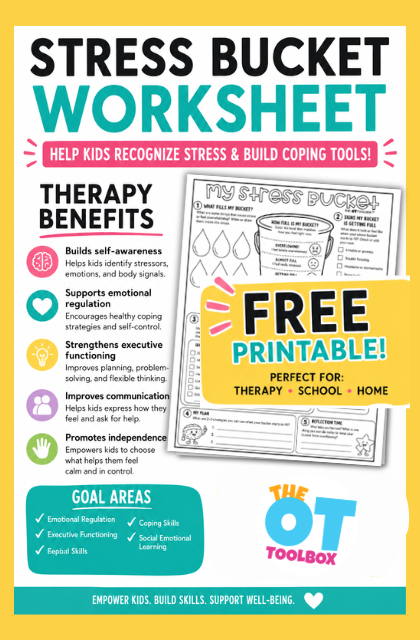
Helping children recognize stress and develop healthy coping strategies is an important part of supporting emotional regulation and participation in daily activities. This free stress bucket worksheet helps kids identify stressors, notice body signals, reflect on emotional responses, and build personalized coping tools that support regulation across home, school, and community settings.
Free Stress Bucket Worksheet
The idea behind a “stress bucket” is simple and meaningful for children. Everyone has stress that builds throughout the day. When too many stressors pile up without healthy ways to release them, the bucket begins to overflow. For children, this overflow may look like emotional outbursts, meltdowns, shutdown behaviors, irritability, avoidance, impulsivity, trouble focusing, or difficulty participating in daily routines.
Using a visual model like the stress bucket can help children better understand what is happening inside their body and brain while developing awareness of the tools that help them feel more regulated and successful.
Looking at Stress Through a Holistic Lens
Here’s the thing; stress does not come from one single source. Many factors contribute to a child’s ability to regulate emotions, maintain attention, and cope with daily demands. A holistic approach considers the whole child, including sensory processing, emotional experiences, executive functioning, physical needs, environmental supports, and social participation.
Some children experience stress because of academic pressure, transitions, social conflict, or difficulty managing expectations. Others may feel overwhelmed by sensory input such as noise, crowded environments, clothing textures, movement, or unpredictable routines. Executive functioning challenges can also contribute significantly to stress when children struggle with organization, task initiation, time management, flexible thinking, or emotional control.
Physical and environmental factors matter as well. Poor sleep, hunger, illness, overstimulation, fatigue, lack of movement, or inconsistent routines can all contribute to a child’s stress bucket filling more quickly.
This stress bucket worksheet encourages children to begin identifying the different experiences, feelings, and situations that contribute to stress while helping adults recognize patterns that may impact participation and regulation.
Using the Stress Bucket Worksheet in Occupational Therapy and the Classroom
This worksheet can be used in occupational therapy sessions, counseling groups, classrooms, SEL lessons, or at home. It works well as both a teaching tool and a reflective activity.
The stress bucket worksheet supports:
- Emotional awareness
- Interoception
- Self-monitoring
- Coping skill development
- Executive functioning
- Emotional regulation
- Sensory regulation
- Communication skills
- Problem-solving
Because the worksheet combines visual supports, checklists, and reflection prompts, it can also support handwriting, visual motor integration, and written expression goals during therapy sessions.
The activity naturally opens conversations about how stress affects learning, behavior, attention, relationships, and participation in daily tasks.
Executive Functioning and the Stress Bucket
Stress and executive functioning are closely connected. When stress increases, executive functioning skills often become less efficient. Children may have greater difficulty organizing thoughts, focusing attention, controlling impulses, or managing emotions when their stress bucket becomes too full.
At the same time, executive functioning challenges themselves can create stress. A child who struggles to start assignments, keep track of materials, transition between tasks, or manage frustration may feel overwhelmed throughout the day.
This stress bucket worksheet can help children:
- Recognize early signs of dysregulation
- Build self-awareness
- Develop planning strategies
- Identify calming routines
- Practice flexible thinking
- Learn when to ask for help
Helping children understand the connection between emotions, stress, and executive functioning can improve carryover into real-life situations and increase independence with self-regulation.
Screening for Needs and Strengths
Although this worksheet is not a formal assessment, it can provide valuable insight into emotional regulation patterns, coping abilities, and executive functioning challenges.
As children complete the worksheet, therapists, educators, and parents can observe:
- Emotional vocabulary
- Ability to identify stressors
- Awareness of body signals
- Self-reflection skills
- Coping strategy knowledge
- Perspective taking
- Problem-solving abilities
- Flexibility in thinking
- Emotional insight
The worksheet may also reveal strengths. Some children can identify stressors clearly but need support developing coping tools. Others may already use effective calming strategies independently but struggle recognizing stress before reaching overload.
Patterns within responses can help adults determine whether additional support may be needed in areas such as:
- Emotional regulation
- Sensory processing
- Anxiety management
- Executive functioning
- Social emotional learning
- Self-advocacy
- Interoception
This information can guide intervention planning while helping adults better understand the child’s daily experiences.
Helping Kids Develop Coping Tools
One of the most important parts of the stress bucket worksheet is helping children identify coping tools that actually work for their individual needs. Not every strategy is effective for every child, and coping tools should match the child’s sensory preferences, emotional needs, environment, and regulation style.
The worksheet can help children begin exploring strategies connected to:
- Sensory regulation
- Movement
- Emotional expression
- Executive functioning
- Social support
- Cognitive reframing
- Relaxation
For example, children who report feeling physically restless or overwhelmed by sensory input may benefit from movement breaks, heavy work activities, stretching, or calming sensory supports. Children who struggle with racing thoughts or worry may benefit from journaling, visual schedules, breaking tasks into smaller steps, or talking through concerns with a trusted adult.
Children who become overwhelmed during transitions may need environmental supports, visual reminders, or advance preparation strategies. Others may need help identifying calming activities they can realistically use within the classroom environment.
The goal is not simply to teach coping tools but to help children understand:
- When they need a strategy
- Which strategies help
- How to use them independently
- How stress affects participation and behavior
Grading the Stress Bucket Worksheet
This worksheet can easily be adapted for different developmental levels and support needs.
For younger children or children with communication challenges, adults can:
- Read questions aloud
- Use drawing instead of writing
- Provide visual choices
- Complete the activity verbally together
- Use role-play or examples
- Focus on simple body signals and emotions
For students who need more support with executive functioning:
- Break the worksheet into smaller sections
- Complete one section at a time
- Use sentence starters
- Provide examples of coping tools
- Add movement breaks during the activity
For older students or adolescents, the worksheet can be expanded through:
- Journaling
- Deeper reflection questions
- Stress pattern tracking
- Discussion of social stressors
- Goal setting
- Planning personalized coping routines
- Identifying triggers and preventative strategies
The worksheet can also be revisited over time to help students notice patterns and build self-awareness as they develop stronger regulation skills.
Supporting Functional Participation Through Emotional Regulation
Emotional regulation impacts every part of a child’s daily life. Stress can affect attention, learning, social participation, transitions, sleep, self-care, and overall well-being. Helping children recognize stress and develop coping tools supports greater participation across environments.
This stress bucket worksheet provides a visual and approachable way for children to explore emotions, understand stress responses, and begin building personalized regulation strategies that support success in meaningful daily activities.
Research supports the important relationship between emotional regulation, executive functioning, and participation in school and daily occupations. Executive functioning and self-regulation skills are foundational for learning, emotional well-being, and social participation. Occupational therapy practitioners also recognize the importance of supporting emotional regulation and participation through holistic, occupation-based approaches that consider the whole child and their environment.
Free My Stress Bucket Worksheet
Enter your email address into the form below to get the Stress Bucket worksheet. This item is also found inside The OT TOolbox Membership. Go into the membership and search Stress Bucket Worksheet.

Colleen Beck, OTR/L has been an occupational therapist since 2000, working in school-based, hand therapy, outpatient peds, EI, and SNF. Colleen created The OT Toolbox to inspire therapists, teachers, and parents with easy and fun tools to help children thrive. Read her story about going from an OT making $3/hour (after paying for kids’ childcare) to a full-time OT resource creator for millions of readers. Want to collaborate? Send an email to contact@theottoolbox.com.
Comments are closed.