This is an online version of our email Lunch and Learn newsletter all about eye movement.
Eye movement skills play a major role in reading, writing, attention, classroom participation, and play. These are the functional tasks we target as goal areas in occupational therapy. When children struggle to keep their place while reading, skip words, lose items on a busy worksheet, or become visually overwhelmed, the challenge may be connected to visual tracking, scanning, or saccadic eye movements. These foundational visual processing skills help the eyes move efficiently across a page, shift between targets, and locate important visual information in the environment.
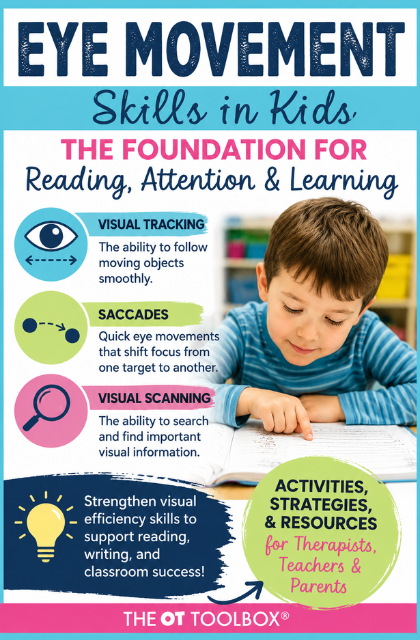
In this week’s Lunch & Learn, we’re taking a closer look at eye movement skills, why they matter for learning, and practical activities, tools, and resources that therapists, educators, and families can use to support visual attention and visual efficiency in kids.
Why Worry about Eye Movement?
We often hear concerns like:
- “My student loses their place while reading.”
- “They skip words or lines.”
- “Copying from the board takes forever.”
- “They can find items in the classroom, but worksheets are overwhelming.”
- “Reading comprehension is impacted even though they know the material.”
Many times, these challenges are connected to visual eye movement skills.
Today’s Lunch & Learn focuses on three important visual processing abilities that impact reading, attention, handwriting, and classroom participation:
- Visual Tracking
- Visual Scanning
- Saccades
- Convergence
These are foundational visual efficiency skills that allow children to gather information from their environment and use it effectively during learning tasks.
What Are Eye Movement Skills?
Eye movement skills help the eyes move efficiently while reading, writing, copying, scanning, and navigating environments.
These skills allow us to:
- Follow moving objects
- Shift attention between targets
- Find information visually
- Maintain place while reading
- Move the eyes smoothly across a page
When these skills are difficult, children may appear inattentive, distracted, slow, or frustrated during academic tasks. Vision has a huge impact on learning!
Q1: What is visual tracking?
Visual tracking is the ability to smoothly follow a moving object with the eyes.
This skill is important for:
- Following words across a page
- Watching a ball during sports
- Copying from the board
- Reading fluently
Children with tracking difficulties may:
- Lose their place while reading
- Use a finger excessively when reading
- Skip lines
- Complain of eye fatigue
Learn more about visual tracking.
Try visual tracking activities here to incorporate play into developing visual tracking skills.
Q2: What are saccades?
Saccades are quick eye movements that shift focus from one target to another.
We use saccades constantly during:
- Reading
- Copying work
- Looking between objects
- Completing worksheets
During reading, the eyes do not move smoothly across text. Instead, they jump from word to word using saccadic eye movements.
Children with saccadic difficulties may:
- Skip words
- Read slowly
- Lose their place
- Have trouble copying accurately
Learn more about saccades and learning.
Try some of these visual saccades activities.
Q3: What is visual scanning?
Visual scanning is the ability to search for and locate visual information efficiently.
This skill impacts:
- Finding information on worksheets
- Completing word searches
- Locating classroom materials
- Reading charts and graphs
- Organizing written work
Children with scanning difficulties may:
- Miss information on a page
- Appear disorganized
- Take extra time completing tasks
- Overlook visual details
Try visual scanning activities.
Try scanning activities for reading.
Why These Skills Matter for Attention & Learning
Eye movement skills directly impact:
- Reading fluency
- Attention to task
- Visual attention
- Writing accuracy
- Visual endurance
- Classroom participation
When eye movement skills are inefficient, children may use more energy simply trying to visually manage the task, leaving less cognitive energy available for comprehension and learning.
These visual efficiency skills are often connected to:
- Visual motor integration
- Executive functioning
- Visual perception
- Postural control
- Attention and regulation
Explore the full Visual Motor Resource.
Activities That Support Eye Movement Skills
Try incorporating:
- Mazes
- I Spy games
- Hidden picture tasks
- Tracking flashlights or bubbles
- Word searches
- Ball activities
- Spot-the-difference games
- Reading guides or trackers
You can also use movement-based activities to support visual attention and regulation at the same time.
More visual perceptual activities.
Strategies for visual perception challenges.
Shop Resources for Visual Processing
Looking for ready-to-use activities and tools?
These OT Toolbox resources support visual tracking, scanning, perception, and visual motor development:
⭐ Visual Processing Bundle
The Visual processing Bundle is a bundle of materials to support therapy providers in treating visual processing skills.
⭐ Tangram Shapes Visual Perception Packet
The Tangrams Shapes Visual Perception Packet are Printable Puzzles to Strengthen Visual Processing & Spatial Awareness. The Tangrams Shapes Visual Perception Kit is a fun, hands-on way to develop essential visual processing skills through engaging, screen-free play. Whether you’re an occupational therapist, teacher, or parent, this printable kit supports children in building the foundational skills they need for handwriting, reading, and math.
Join the Visual Processing Lab
If visual processing is an area you work on often in therapy or the classroom, come join us inside the: Visual Processing Lab
Inside the Lab, you’ll find:
- Visual processing activity ideas
- Printables and worksheets
- Visual motor tools
- Visual perception strategies
- Therapy planning ideas
- Hands-on intervention resources
Free Email Series: https://www.theottoolbox.com/visual-processing-lab/
Action Step
This week, observe a child during a reading or worksheet task.
Ask yourself:
- Are their eyes moving efficiently?
- Are they skipping lines or words?
- Is visual scanning impacting accuracy?
- Does the task require more visual support?
Sometimes what looks like attention difficulty is actually a visual efficiency challenge.
Share This Lunch & Learn
New this month, our Lunch & Learn newsletters are now available on The OT Toolbox website so you can easily share them with:
- Families
- Teachers
- Therapy teams
- Colleagues
Feel free to share the link to this article with anyone supporting children’s learning and development.

Colleen Beck, OTR/L has been an occupational therapist since 2000, working in school-based, hand therapy, outpatient peds, EI, and SNF. Colleen created The OT Toolbox to inspire therapists, teachers, and parents with easy and fun tools to help children thrive. Read her story about going from an OT making $3/hour (after paying for kids’ childcare) to a full-time OT resource creator for millions of readers. Want to collaborate? Send an email to contact@theottoolbox.com.