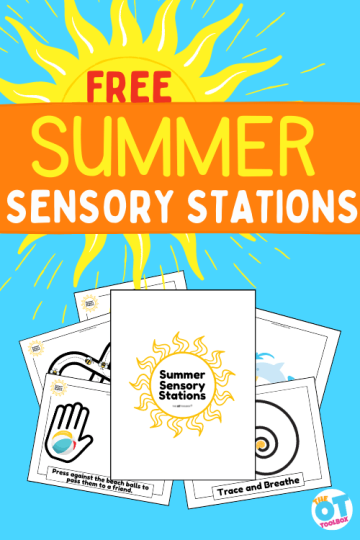
Summer is a time when we sometimes need to alter our sensory processing input options. In this blog post, we’ve updated the information to include Summer themed sensory play activities parents can use at home. We also wanted to include ideas for educators and therapy providers running Summer school classrooms or Summer camps. This includes info on sensory circuits. Also check out our Summer occupational therapy activities for more ideas.
I wanted to share a bit about this resource, the Summer Sensory Activity Guide. Therapists know the importance of incorporating therapeutic and developmental activities into the everyday activities that a child and family experiences. From a trip to the playground to a day at the beach, there are so many sensory-rich experiences that summer life has to offer!
Summer Sensory Activities
First off, when you think of Summer, don’t you think of certain types of play and activities…
- Blowing bubbles
- Pool days
- Lemonade stands
- Sidewalk chalk
- Bean bag toss
- Wheelbarrow walks
- Riding bikes
- Climbing trees
- Visiting new playgrounds
- Water balloons
Parents often think they need expensive equipment to create sensory activities, but simple, everyday activities do the job! You can also use household items work just as well. Pair your daily sensory input strategy with easy movement activities like:
- Carrying a laundry basket
- Pushing a full laundry basket across the floor
- Rolling up in a blanket burrito
- Crab walks to the next station
- Animal walks down the hallway
- Pillow jumps
- Marching while carrying stuffed animals
These simple additions provide proprioceptive and vestibular input while encouraging active play all summer long.
Then, our therapy providers and educators who are working Summer School might need activities that alert, organize, and calm. This is where a sensory circuit might come in handy. More on sensory circuits below…
Summer Sensory Activities by Sensory System
We have a lot of posts here on The OT Toolbox that focuses on lists of ideas. There’s a reason we do that. When I started out as a pediatric OT, my best handouts were the ones that had lists of activities that I could highlight or check off as ones that the parent should do at home with the child.
Parents liked these list handouts because it was like a menu of specific occupational therapy tasks that they could see was tailored to meet the specific needs of their child.
So, that’s why I wanted to put together lists of specific Summer activities that meet various needs. Some other places on The OT Toolbox that have Summer activities for sensory processing include our resources like: Sensory activities for the backyard, and these ideas for specific sensory systems using the backyard as an environment:
Below is a huge list of outdoor sensory activities, but to focus on each sensory system, check out these resources:
- Outdoor sensory activities for proprioception
- Outdoor sensory activities for vestibular
- Outdoor sensory activities for visual processing
- Outdoor sensory activities for oral motor skills
- Outdoor sensory activities for auditory processing
- Outdoor sensory activities for tactile input
We have the Summer Sensory Activity lists below in handout format inside The OT Toolbox Membership.
Proprioceptive Summer Activities
Summer is a wonderful time to build proprioceptive skills through play. Proprioception is the body’s sense of where it is in space and helps children develop body awareness, coordination, motor planning, and self-regulation.
During the summer months, familiar school routines disappear, and many children spend more time on phones, tablets, or video games. Adding proprioceptive activities like carrying buckets, digging in the sand, pushing wagons, climbing playground equipment, or helping with yard work provides the heavy work input that helps organize the nervous system.
These movement opportunities support attention, emotional regulation, and readiness for learning while encouraging children to spend more time actively exploring their environment.
- Wheelbarrow walks in the grass
- Pulling a wagon
- Carrying beach buckets
- Digging in the sandbox
- Filling watering cans
- Pool noodle push races
- Beach towel tug-of-war
- Garden work
- Building a stick fort
- Shoveling mulch or dirt
Vestibular Summer Activities
The vestibular system helps us understand movement, balance, and head position. Summer offers endless opportunities to strengthen this system through fun outdoor play. Swinging, spinning, rolling down grassy hills, jumping through obstacle courses, scooter board races, swimming, and playground activities all provide valuable vestibular input.
Because summer schedules are often less structured, children may miss the natural movement they receive throughout the school day. Replacing some screen time with active movement experiences helps support balance, coordination, visual attention, and postural control while giving the brain the movement it needs for healthy sensory processing and regulation.
- Slip and slide
- Swinging
- Playground spinning
- Scooter board races
- Hammock swinging
- Rolling down grassy hills
- Log rolling on towels
- Obstacle courses
- Hopscotch
- Jump rope
Tactile Summer Activities
The tactile system helps children interpret information they receive through touch and plays an important role in fine motor development, body awareness, and emotional regulation.
Summer naturally provides countless opportunities for tactile exploration through sand, water, grass, mud, shaving cream, finger paint, bubbles, gardening, and nature play.
Incorporating tactile summer activities encourages hands-on exploration while strengthening sensory processing, finger dexterity, and confidence with new experiences. Activities like digging in the sandbox, washing toys, creating mud kitchens, exploring a sensory bin, or collecting nature treasures provide meaningful tactile input while making summer play both fun and developmentally beneficial.
- Mud kitchen
- Water table
- Ice cube painting
- Finger painting outside
- Sand play
- Shaving cream play
- Washing toy cars
- Flower petal sensory bin
- Garden dirt exploration
- Sponge squeeze station
Oral Sensory Summer Activities
Summer is also a great season to support oral motor development through fun foods and outdoor play. Drinking smoothies through straws, blowing bubbles, eating crunchy fruits and vegetables, enjoying frozen treats, or blowing whistles and pinwheels all strengthen the muscles used for eating, drinking, speech, and breathing.
Oral motor activities also provide calming sensory input for many children and can become an easy part of summer routines. During long summer days, it’s easy for snacking and screen time to replace active play and meaningful sensory experiences. Adding oral motor activities throughout the day encourages children to engage their bodies, regulate their sensory systems, and build skills that support feeding, communication, and attention.
- Frozen fruit
- Smoothies
- Popsicles
- Crunchy vegetables
- Drinking through crazy straws
- Blowing bubbles
- Whistles
- Pinwheels
- Frozen yogurt bark
- Watermelon tasting
Sensory Circuit for Summer
A sensory circuit is a different version of a sensory diet. While we love the sensory lifestyle, for some, having a set routine is really helpful. This is true for meeting sensory needs, or even having a nighttime routine or morning routine.
What is a Sensory Circuit?
Think of a sensory circuit as a predictable, structured “plan” to help kids find their balance. Instead of feeling overwhelmed by a traditional, complex sensory diet, a sensory circuit simplifies everything into a quick, 10 to 20 minute routine using a simple activity menu.
The secret is all in the order. By intentionally moving through specific types of sensory input, you help a child’s nervous system step-by-step:
- Alert the brain and body to wake up and tune in.
- Organize focus, coordination, and body awareness.
- Calm and center the system so they are regulated and ready for the day.
It delivers all the incredible, regulating benefits of a sensory diet, but in a streamlined, bite-sized format that is much easier for busy families and classrooms to actually stick with!
A sensory circuit is a short, structured sequence of physical activities designed to help children regulate their sensory processing. The goal is to achieve the “just right” level of alertness so they can focus, learn, and handle transitions smoothly.
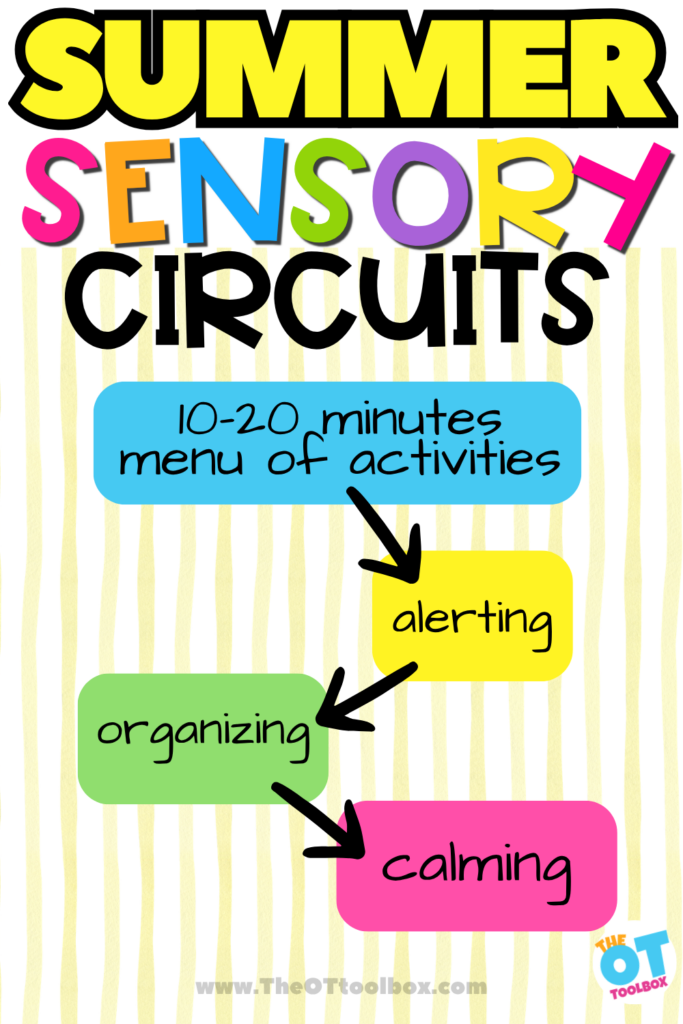
Summer Sensory Circuit Menu
Moving through these activities in a specific, 3-step order creates a natural neurological progression that helps kids settle into a calm, focused state—perfect for anchorless summer days. Spend about 5 minutes on each phase.
1. Alerting Activities (Wake Up the System)
The goal is to provide controlled vestibular (movement) and proprioceptive (muscle/joint) input to energize the brain and body.
- Water balloon toss & catch: Moving dynamically to catch water balloons or tossing them against a target.
- Playground swings & slides: Going high on the swings or sliding down a fast slide to get that vestibular system moving.
- Running through the sprinkler: Fast, high-energy movement combined with the sudden, refreshing sensory splash of cool water.
- Running in the grass barefoot or jumping jacks/dance, etc.: Jumping and running barefoot on grass gives an extra layer of tactile feedback.
- Jump along a sidewalk chalk obstacle course, hopscotch, etc.: Draw a line of lily pads or stars on the driveway for them to jump across as fast or as high as they can.
2. Organizing Activities (Build Focus & Coordination)
These activities require motor planning, balance, and timing to help children organize their bodies and thoughts.
- The “Floor is Lava” challenge: Play the floor is lava with couch cushions at home. You can also do this at a park using a playground structure. Move from one end to the other without touching the ground, forcing them to balance, plan their grip, and step carefully.
- Water bucket relay: Carry a full cup or bucket of water on a specific path (weaving through lawn chairs or stepping over pool noodles) without spilling a drop.
- Pool noodle balance walk: Place pool noodles on the grass and walking across them like a tightrope. Or make a balance beam using a jump rope or items at home, like a rolled up blanket balance beam.
- Target practice with a water hose or spray bottle: Use a spray nozzle or a spray bottle to hit specific sidewalk chalk targets on a fence or wall.
- Ride a bike or scooter along a line or path: Ride a scooter or bike strictly along a designated path or driveway seam, practicing steering control and spatial awareness. You can use sidewalk chalk to draw a path in a driveway.
3. Calming Activities (Center & Ground)
These deep pressure and resistance activities ensure children finish the circuit regulated, centered, and ready to transition into a calm afternoon or quiet time.
- “Heavy Work” summer chores: Pushing a full wheelbarrow, carrying heavy watering cans to the garden plants, or pushing a lawnmower (toy or real, depending on age). Here is a chores checklist you can use.
- Pool float “squashes”: Lye on a beach towel on the grass while a parent gently presses a large, semi-deflated pool float, beach ball, or yoga ball over their back and legs for deep pressure.
- Tug-of-war or dig in sand: A heavy resistance game of tug-of-war with a thick rope, or digging deeply in dry/wet sand using big muscle movements.
- The “blanket burrito” using a beach towel: Wrap up tightly up in a big beach towel after water play for a calming, cozy deep-pressure hug.
- A slow, grounded walk: A mindful walk where they hold a heavy backpack or focused, steady stepping along a path or sidewalk, or marching to notice specific sensory sights and sounds in nature.
Why does the order of activities matter in a sensory circuit?
The order is the most critical part of a sensory circuit! Moving from alerting activities to organising activities to calming activities builds a natural neurological progression.
- Skipping or mixing up the order can have the opposite effect, leaving a child feeling dysregulated, hyperactive, or irritable instead of centered.
What are some more easy examples for each phase of a sensory circuit?
- Alerting: Controlled bouncing on a yoga ball, jumping jacks, skipping, or drinking ice water, crunchy foods, or dancing to music.
- Organizing: Balancing on a line or board, catching a ball while balancing, weaving through cones, or heavy animal walks (like bear crawls).
- Calming: Deep pressure yoga ball squashes, crawling through a tight play tunnel, wall push-ups, deep breathing, or relaxing under a weighted blanket.
When is the best time of day to do a sensory circuit?
Completing a circuit first thing in the morning is fantastic for setting up the day, and right after lunch is perfect for resetting after a chaotic midday break. However, it can be used anytime a child is on a break from routines, like during summer vacation, and needs an organizing anchor for their day.
Example of a Sensory Circuit for Adults
It’s basically having a “plan” in place. This can look like just a 10-20 minute circuit of specific sensory activities (picking from a menu). The goal with a sensory circuit is to move through specific sensory input that alerts, then organizes, then calms the individual. It’s a version of a sensory diet that is likely easier to follow through than what we are used to with true sensory diets that adults may use. It’s also more clearly outlined than a sensory lifestyle may be.
For example, I know that when I wake up and go through a routine, my day usually starts off better than a day when I jump out of bed and immediately need to “put out fires” in the family. This doesn’t need to be complicated. Personally, for me, a morning sensory diet or sensory circuit that includes a couple of minutes of stretching, a drink of water, going outside for sunlight, avoiding my phone for the first hour of my day, a walk outside, eating a small healthy breakfast, and even making it to the gym or doing some type of exercise. Then I can check my calendar or planner to see what’s on the schedule for the day.
This example starts with alerting activities: waking up and stretching followed by water and sunlight.
Then organizing input: walk, chewing offers proprioceptive input through the jaw and mouth.
Then calming input: exercise.
Then, I am able to go through my schedule and make decisions for the day.
When this routine happens, it’s usually a great start to the day. This routine doesn’t always happen, and some days I can pick just a few tasks from this list. But when you take an activity analysis and look at the movement and sensory input that’s happening, it’s all very calming and regulating input that helps to organize my nervous system.
So, for our kids, having a few activities that offer input to organize the nervous system, we can put them into a place where they are regulated so when different scenarios or inputs happen, it’s a bit easier to respond.
For kids, it’s good to have a visual in place. We have a visual guide page like this in The OT Toolbox Membership.
1 minute jumping jacks
↓
Jump through sensory path
↓
Carry heavy bucket or basket of clothes
↓
Bubble blowing
↓
Balance challenge
↓
Wall push ups/chair push ups
↓
Joint compressions
↓
Deep breathing
This is just one example. You can pick just 3-4 items or you can switch them out. Pick out the coping strategies that work for your specific child and build out a circuit.
How is a sensory circuit different from a traditional sensory diet?
While a traditional sensory diet weaves different sensory strategies throughout the entire day, a sensory circuit groups specific activities into a single, continuous 15-to-20-minute block. Because it follows a repeatable, menu-style plan, it is often much easier for parents and teachers to consistently implement.
Heavy Work Activities
We love using heavy work activities because they are powerful tools to support needs. We actually have a whole blog post on Summer heavy work ideas that really breaks this down.
Summer ideas include:
- Carrying coolers
- Pulling beach wagons
- Watering flowers
- Digging holes
- Moving patio cushions
- Washing windows
- Sweeping porch
- Raking grass clippings
- Pulling weeds
- Filling bird feeders
Summer Obstacle Course Ideas
An obstacle course is a great activity for Summer sensory input. The best thing is that you can do this anywhere: in the backyard, a chalk obstacle course, inside, or using playground equipment. Use movements like:
- Hop
- Jump
- Balance
- Crawl
- Throw
- Push
- Pull
- Spin
- Run
- Walk backwards
- Use pool noodles, chalk, cones, buckets, towels.
Summer Brain Breaks
We also have many tools related to brain breaks here on The OT Toolbox.
Summer is the perfect season to keep kids moving with quick, engaging brain breaks that support both the body and the brain. Brain breaks are short movement activities that help children reset their attention, improve focus, and regulate their energy levels throughout the day. During the summer months, daily schedules often become less predictable, making it helpful to intentionally include movement opportunities between reading, crafts, learning activities, chores, or quiet play.
From an occupational therapy perspective, brain breaks also provide valuable sensory input that supports executive functioning, motor planning, balance, coordination, and emotional regulation. Whether you’re at home, at summer camp, or working with children in therapy sessions, adding a few minutes of purposeful movement throughout the day helps children return to activities feeling more organized, engaged, and ready to learn or play.
Ideas:
- Flamingo stand
- Crab walk to the tree
- Hop like a frog
- Walk like a bear
- Windmill arms
- Jump over towels
- Pick flowers by color
- Simon Says outside
Beach Sensory Activities
We actually have a resource on sensory diet activities for the beach. You can pull pieces of that when on vacation, or use those ideas at the pool or in the yard in the backyard.
Sensory ideas might include:
- Shell hunts
- Carry wet sand
- Build sand castles
- Dig moats
- Barefoot walking
- Water bucket relay
- Seashell sorting
- Ocean animal walks
Pool Noodle Activities
Pool noodles activities are one of the most versatile and inexpensive tools you can add to your summer sensory activities. Lightweight, colorful, and easy to cut into different sizes, they can be used to create movement games that support sensory processing, balance, coordination, and body awareness. From an occupational therapy perspective, pool noodles provide opportunities to target multiple sensory systems while encouraging active play and creative problem-solving.
Try these easy pool noodle sensory ideas throughout the summer:
- Create a balance beam by placing a pool noodle on the grass and encouraging children to walk heel-to-toe.
- Set up jumping hurdles by laying noodles across small cones or buckets for children to jump over.
- Build an obstacle course that includes crawling under noodles, stepping over them, weaving between them, and hopping through noodle circles.
- Use two pool noodles for “horse reins” while children gallop, skip, or complete animal walks.
- Hold noodles horizontally for children to crawl under or climb over, encouraging motor planning and body awareness.
- Practice bilateral coordination by having children hold a noodle with both hands while twisting, reaching overhead, or making large figure-eight movements.
- Use pool noodles as targets for bean bag tosses or ring toss games to develop hand-eye coordination.
- Create giant letters or shapes on the ground with noodles for children to jump along while practicing letter recognition or following directions.
- Have children push a pool noodle across the yard while balancing a lightweight ball on top to encourage visual tracking and graded motor control.
- Pair noodles with water balloons or sponges for relay races that add tactile and proprioceptive input.
These activities provide rich sensory experiences that support several developmental areas, including:
- Proprioceptive input through pushing, pulling, lifting, and carrying
- Vestibular input through jumping, balancing, and changing body positions
- Bilateral coordination by encouraging both hands to work together
- Motor planning during obstacle courses and movement sequences
- Visual motor integration while aiming, catching, and following movement paths
- Executive functioning through remembering directions, sequencing activities, and problem-solving
One of the greatest benefits of pool noodle activities is that they can easily be adapted for children of different ages and abilities. Younger children may simply enjoy stepping over noodles or carrying them around the yard, while older children can complete more challenging obstacle courses or team games. Because pool noodles are soft and lightweight, they also provide a safe way to encourage movement confidence in children who may be hesitant to try new gross motor activities.
More ideas are:
- Pool noodle sensory bin
- Balance beam
- Hurdles
- Ring toss
- Giant letters
- Push races
- Bowling
- Obstacle course
- Partner carries
Water Play OT Activities
Water play is one of the easiest ways to provide rich sensory experiences during the summer months. Beyond simply cooling off on a hot day, water naturally engages multiple sensory systems while encouraging children to move, explore, problem-solve, and build developmental skills through play. From an occupational therapy perspective, water activities can support tactile processing, hand strength, visual motor integration, bilateral coordination, and executive functioning, all while feeling like play instead of therapy.
The resistance and movement of water also provide calming proprioceptive input while helping children develop body awareness and motor control. Water play can be especially helpful for children who seek sensory input or become overwhelmed by the heat and activity of summer.
Easy Water Play Sensory Activities
Try these simple water activities using materials you may already have at home:
- Fill and pour water between different-sized cups and containers.
- Transfer water using turkey basters, eyedroppers, or squeeze bottles.
- Wash toy cars, dolls, or plastic animals with sponges and soapy water.
- Paint sidewalks or fences with water and paintbrushes.
- Rescue frozen toys from blocks of ice using warm water and droppers.
- Set up a sponge squeeze relay by transferring water from one bucket to another.
- Create a floating and sinking investigation using household objects.
- Practice aiming skills by spraying targets with spray bottles or water squirters.
- Scoop floating toys with nets or slotted spoons.
- Wash windows, outdoor tables, or patio furniture using spray bottles and cloths.
- Fill water balloons and sort them by color or size before tossing them into buckets.
- Build a simple water wall using recycled containers and tubing.
Occupational Therapy Benefits of Water Play
Many water activities naturally target multiple developmental skills at once. Children strengthen their hands while squeezing sponges or spray bottles, improve bilateral coordination while pouring water between containers, and develop visual motor skills as they aim, scoop, and transfer objects.
Water play also supports:
- Fine motor coordination
- Hand strength
- Finger isolation
- Bilateral coordination
- Crossing midline
- Eye-hand coordination
- Visual tracking
- Motor planning
- Executive functioning through sequencing and problem-solving
- Sensory processing and self-regulation
Water provides continuous tactile input that many children find calming. The temperature, movement, and resistance encourage children to notice how their bodies move while exploring different textures and sensations. Because water activities are naturally motivating, they also encourage longer periods of attention and engagement.
For occupational therapists, parents, and teachers, water play offers countless opportunities to adapt activities for different ages and ability levels. Younger children may simply enjoy scooping and pouring, while older children can complete water obstacle courses, timed challenges, or cooperative games that encourage planning, teamwork, and flexible thinking.
Best of all, water play requires very little setup, making it an easy addition to summer therapy sessions, home programs, camps, or backyard play while supporting important developmental skills all season long.
Ideas:
- Sponge relay
- Turkey baster races
- Spray bottle painting
- Water balloon target toss
- Eyedropper transfer
- Floating/sinking experiment
- Cup pouring station
- Ice rescue
Nature Sensory Activities
Collect:
Leaves
Rocks
Sticks
Flowers
Pinecones
Feathers
Acorns
Seeds
Make:
Nature collage
Nature bracelet
Leaf rubbings
Stick letters
Rock balancing
Fairy houses
Summer Sensory Bin Ideas
Include 20-30 ideas.
Examples:
- Beach
- Ocean
- Camping
- Watermelon
- Ice cream
- Lemonade
- Bugs
- Garden
- Pond
- Farm
- Picnic
- Fireflies
- Patriotic
- Construction
- Dinosaur dig
- Pirates
- Sharks
- Mermaid
- Pool party
- Sunshine
Need even more summer ideas?
~Add these hula hoop activities to therapy sessions.
~Use sidewalk chalk to support fine motor skills.
~ Print off and send home this list of 100 things to do this Summer. It’s a therapist-approved list of Summer activities!
~Print off these Summer Writing Lists to work on handwriting skills.
~Grab some of the materials in The OT Toolbox Member’s Club. There is something for everyone and Summer themed activities to support all skill levels.
~ Do some or all of the activities listed here in this Sensory Summer Camp at Home plan. All of the activities and ideas are free and use items you probably already have.
~ Sneak in handwriting practice while traveling with these motivating and authentic ideas. HERE are a few MORE natural writing experiences for summer that keep those pencils moving.
~ Try some of the activities in this Summer Activity Guide designed to encourage play and creativity in activities for the whole family.
~ Practice the motor planning and fine motor skills needed for handwriting and with a sensory twist using the ideas outlined in this Sensory Handwriting Backyard Summer Camp.
~ Try these Backyard Vestibular Activities for Summer to encourage movement and sensory experiences right in the backyard.
~ Print off this June Occupational Therapy Calendar for ideas to last the whole month. (It’s from a couple of years back so the dates are off, but the activities still work!)
~ These no-prep, basically free summer activities won’t break the bank and boost the underlying skills kids NEED, in fun ways.
~ Use sidewalk chalk to boost fine motor skills.
~Make a summer time capsule with the whole family and create memories that can be looked back on years from now.
~Create a summer kick-off bucket filled with toys and items for months of sensory play.
~The kids will love these frozen fruit kabob snacks. It’s a great alerting sensory snack that doubles as a healthy summer treat.
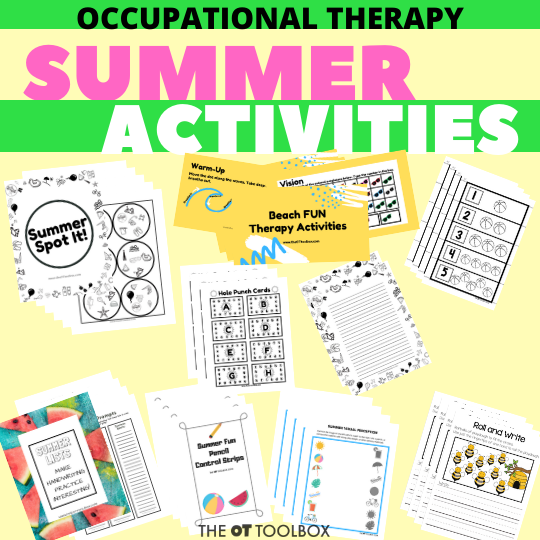
One tool to support Summer OT home programs, OT tutoring sessions, or occupational therapy summer camps is our Summer Occupational Therapy Activities Packet.
These Summer sensory ideas encourage movement while keeping activities fresh and motivating during summer therapy sessions or brain breaks.
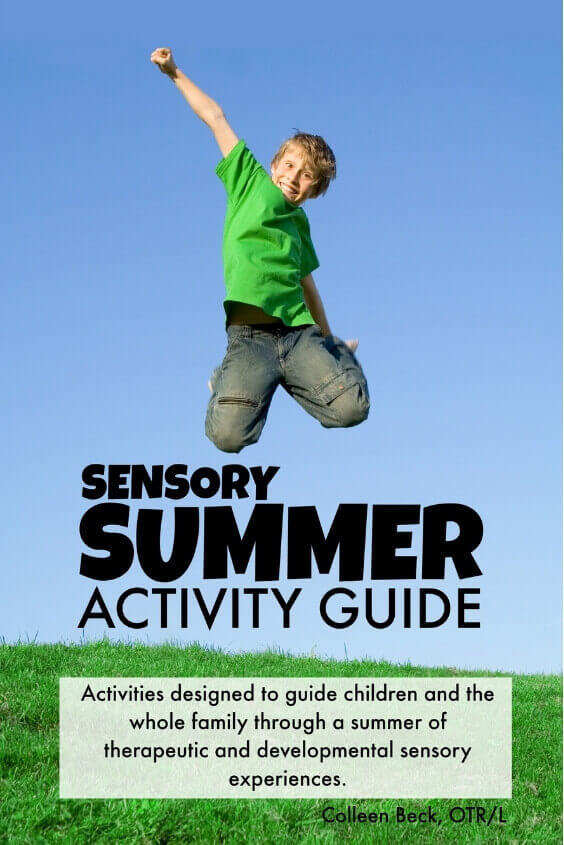
Summer Sensory Activity Guide
What if you could add a few activities to the summer bucket list that would promote developmental skills while encouraging the integration of sensory tasks that help with behavior, attention, self-regulation, development, and more?
The activities outlined in this Sensory Summer Activity Guide do just that!
Looking for more summer occupational therapy activity ideas? We’ve got a lot here on The OT Toolbox!
This guide book is perfect for parents who are looking for summer activities based on sensory input. It’s the perfect summer program for therapists to send home for activity ideas that will last all summer long. The best news is that you can access the summer sensory guide as a special bonus to the Summer OT Activity kit.
You’ll also be interested in our new Summer Occupational Therapy Activities Packet. It’s a collection of 14 items that guide summer programming at home, at school, and in therapy sessions. The summer activities bundle covers handwriting, visual perceptual skills and visual motor skills, fine motor skills, gross motor skills, regulation, and more.
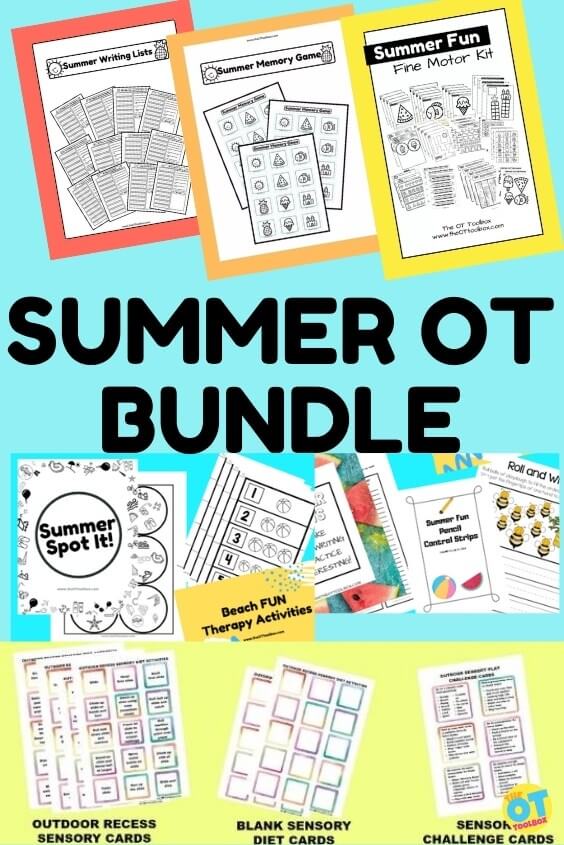
Or, you may want to grab this massive Summer OT Bundle, instead. The 18 product collection includes $90 worth of occupational therapy resources for just $20. When you use the Summer OT Bundle in your therapy planning, OT sessions, or home programing, you can set kids up for success in handwriting, fine motor development, regulation, motor skills, and so much more. Check out the Summer OT Bundle Here.
You’ll find ideas to use in virtual therapy sessions and to send home as home activities that build skills and power development with a fun, summer theme. Kids will love the Summer Spot It! game, the puzzles, handouts, and movement activities. Therapists will love the teletherapy slide deck and the easy, ready-to-go activities to slot into OT sessions. The packet is only $10.00 and can be used over and over again for every student/client!
Grab the Summer OT Bundle HERE.

Colleen Beck, OTR/L has been an occupational therapist since 2000, working in school-based, hand therapy, outpatient peds, EI, and SNF. Colleen created The OT Toolbox to inspire therapists, teachers, and parents with easy and fun tools to help children thrive. Read her story about going from an OT making $3/hour (after paying for kids’ childcare) to a full-time OT resource creator for millions of readers. Want to collaborate? Send an email to contact@theottoolbox.com.