For many adults and children with executive functioning challenges, getting started can feel like the hardest part of any task. Even when a person knows what needs to be done, the brain may struggle with the mental shift required to begin. Trouble getting started is not simply procrastination or lack of motivation; it is often related to the executive functioning skill of task initiation. Individuals may experience trouble starting homework, work projects, daily routines, or even simple tasks around the home. Understanding why task initiation is difficult and learning practical strategies to support the starting process can help reduce overwhelm and build momentum toward completing tasks.
We also have a resource on how to teach task initiation, which is a great read.
Task initiation is one of the many executive functioning skills that can be a big problem for kids. It happens to all of us. We procrastinate. From the youngest toddler to the oldest among us, we all procrastinate in one way or another. Hey, that stack of bills mixed with junk mail over there on the counter has been calling my name for a couple of weeks now. But procrastination can be a real issue when it gets out of hand or affects every part of life. One of the essential skills that make up executive functioning skills is task initiation.
Task Initiation Challenges
This skill is apparent when you just can’t start a task. Nothing feels urgent and getting started feels impossible!
Task initiation is the executive functioning skill that allows a person to begin a task without excessive procrastination or avoidance. For many adults with executive functioning challenges, starting is often the hardest part of completing anything.
The difficulty is not always motivation. In many cases, the brain simply struggles to shift from thinking about a task to actually doing it.
We’ve all been there, though. Haven’t you felt some of these experiences before:
- Feeling mentally “stuck”
- Knowing what needs to be done but not starting
- Waiting until a deadline creates urgency
- Feeling sluggish or unmotivated even when the task is important
This experience is sometimes called activation difficulty or task inertia. Maybe it’s a sink full of dirty dishes or a MESSY car that has you stalled. The problem though, is when every task feels impossible. It’s when nothing feels urgent. You have home tasks and other ADLs and IADLs stacking up, homework consistently undone, bills unpaid, and you are actually not functioning. It’s then that task initiation is a real problem.
Executive functioning research suggests that initiation requires coordination between several cognitive processes including:
- motivation
- working memory
- emotional regulation
- attention control
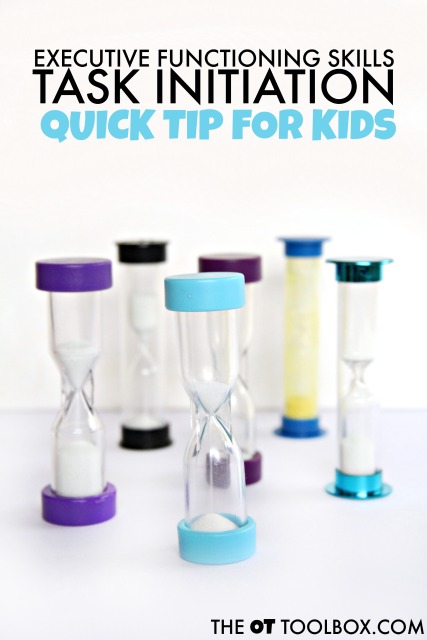
Task Initiation Executive Functioning Strategies
Task initiation for non-preferred activities might show up with your child when they are told to clean their room or put on their shoes. As parents, we know the struggle that is getting kids to get moving! However, there is a point when procrastination is normal for kids and when it becomes a problem that influences functional skills.
Task Initiation is one Executive Functioning Skill
These easy strategies are tips and tricks that can help kids get started on a task. Either a big job or a small task can seem overwhelming at times. Try using these strategies to help with task initiation.
Signs of Task Initiation Difficulties
Those who struggle with task initiation skills may experience:
-
Procrastinating until the last possible moment
-
Difficulty starting large or complex projects
-
Feeling overwhelmed before beginning a task
-
Waiting for pressure or urgency to create motivation
-
Getting stuck in “thinking about doing the task”
-
Starting multiple small activities instead of the needed task
-
Feeling mentally drained before beginning work
Many of us know when we feel stalled or stuck. When this happens we report that once we begin a task, we can continue working. The challenge lies in the transition from intention to action.
What to Do when you have trouble getting started
This is one strategy that can help kids with task initiation. Sometimes, the strategies that you see outlined for procrastination are aimed at older children or high school aged students up through adults.
But what about the kids who struggle with procrastination at a younger age? The kids who are beyond age-appropriate levels of not wanting to initiate tasks can be too young developmentally for the procrastination tips that are typically recommended.

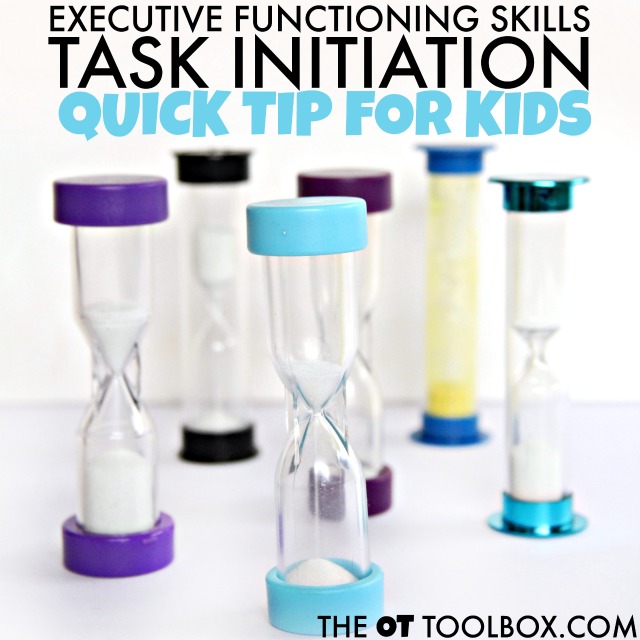
Use a timer to help kids with task initiation
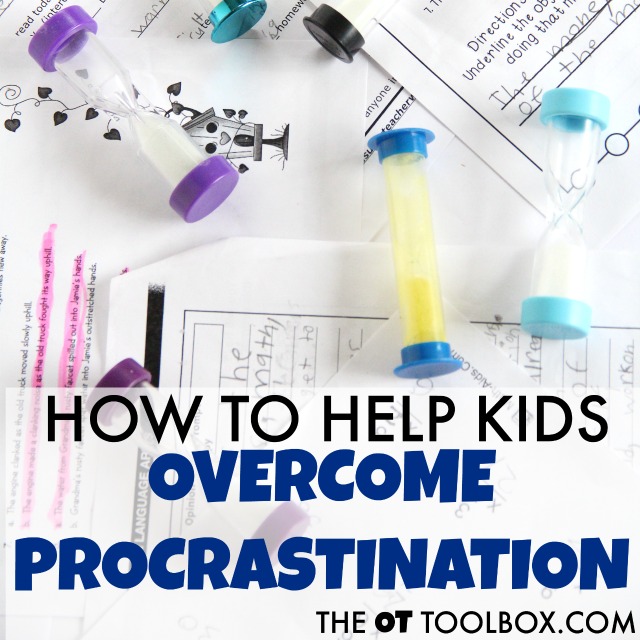
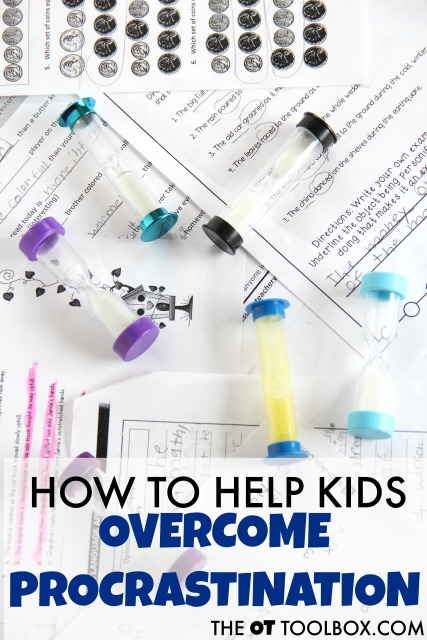
More tips to help kids get started and overcome procrastination
This is a menu of strategies to help when you have trouble getting started on a task. I like to pair these with the framework I use below (lower in the post).
- Break down tasks
- Identify the task
- Make mini goals
- Create a habit tracker
- Make a goal journal
- Tell someone else what you’ll accomplish
- Use a picture schedule for younger kids
- Create a contract
- Use a timer for the whole task
- Reward systems
- Visual schedules
- Designated time slot to do specific tasks (like a set homework time)
- Checklist
- Impulse Control Journal
- Use digital timers (on a smart phone or an app)
Looking for more information on executive functioning skills? Like my new Facebook page, Executive Functioning Toolbox for informative posts and resources from around the web.
You can check out our Attention page and Organization page here on the site for more executive functioning skill activities.
Executive functions are heavily dependent on attention. Read about the attention and executive functioning skill connection and the impact of attention on each of the executive functioning skills that children require and use every day.

The key to helping with task initiation is using a framework for getting started…not just picking random strategies.
Task initiation framework
When nothing feels urgent, it’s easy to look at the list above and think, “Ok, I’ll set a timer.” But then that doesn’t really help if you can’t actually get started and move from inactivity to completing a multi-step task. That’s where I like to add a strategy. These are concepts viewed through a neuroscience lens, that we can apply to support children or adults to get started with any task where they feel stuck.
You will notice that these concepts build on each other, and that is intentional. This is not a list of disconnected strategies like the list above. That is an important list to have in your therapy toolbox for sure! However, sometimes the menu of strategy ideas need a little more of a framework. Then, you can pick through the strategy list above to find actions tasks that fit in with the individual’s needs.
Helping the Brain Move From “Stuck” to “Started”
Task initiation is not simply a productivity problem. It is a brain-body process involving the prefrontal cortex, motivation systems, and nervous system regulation. When a task feels overwhelming or unclear, the brain may interpret it as a stressor. The nervous system can shift into a protective state that delays action, even when the person wants to begin.
Supporting task initiation means helping the brain move from inertia to activation in a way that feels manageable. Repeating supportive strategies helps the brain form new neural pathways for starting tasks more efficiently over time.
Let’s walk through this framework…
Step 1: Regulate the Nervous System First
If you’re stuck and can’t get started, ramping up to activity is the first step, and the key is letting your nervous system know that it’s safe and able to do the task.
This comes from the polyvagal theory in part. If you’re stuck in a fight/fright/flight/fawn status, you can’t do activity.
When we can’t start a task, there is most likely some aspect of the “fawn” state happening.
When the brain perceives a task as stressful or overwhelming, the nervous system may shift into a protective state, reducing motivation and mental flexibility. The prefrontal cortex, which is responsible for planning and initiating tasks, works best when the nervous system is in a regulated and alert state.
Strategies that regulate the nervous system help restore access to the brain’s executive systems. Activities such as movement, deep breathing, sensory input, or rhythmic activities can increase alertness and readiness for action.
When the body feels safe and regulated, the brain is better able to engage the networks needed for planning and prioritizing steps, attention, and actually making the first step to initiate the task.
Repeated experiences of regulating before starting tasks help build neural associations between calm activation and productive engagement, supporting long-term neuroplastic change.
Step 2: Create Activation Through Movement
Many adults describe feeling mentally “frozen” or sluggish before starting tasks. Movement can help activate the brain’s arousal systems and increase alertness.
Physical movement stimulates neural pathways involved in dopamine production, which plays a key role in motivation, attention, and task engagement. Even brief bursts of activity such as stretching, walking, heavy work, or rhythmic vestibular movement can increase blood flow to the prefrontal cortex.
Other ideas:
- quick walk
- stretching or jumping jacks
- cold water on the face or hands
- breathing exercises
- rhythmic music
Movement also helps the nervous system shift from a passive state into a ready-to-act state, making it easier to transition into cognitive work.
When movement becomes a consistent part of the process before beginning tasks, the brain begins to associate activation with action, strengthening pathways involved in initiation.
Step 3: Reduce Cognitive Load
One of the most common reasons people struggle with starting tasks is cognitive overload. When a task feels too large or complex, the brain must hold many pieces of information in working memory at once.
The prefrontal cortex can only manage a limited amount of information at one time. When that capacity is exceeded, the brain may delay action as a protective response.
Breaking tasks into smaller steps reduces the mental load required to begin. Writing down the first step or simplifying the task helps the brain shift from overwhelm to clarity.
This can be as simple as making a list, or a brain dump. Get all of the thoughts swirling in your mind out and onto paper (or your notes app).
Some of our kids prefer using a mind map sheet to get everything out of their thoughts and onto paper.
Repeated experiences of breaking down tasks strengthen neural pathways that support problem solving, planning, and goal-directed behavior.
Step 4: lower activation energy
The brain naturally prefers tasks that require the least effort to begin. When the starting point of a task feels too demanding, the brain may delay initiation.
Definition: lower activation energy- Lowering the energy means making the first step extremely small and accessible. In simplest terms, this means breaking the task into steps. Instead of thinking about completing an entire project, the focus becomes opening a document, gathering materials, or writing one sentence.
OTs are really good at activity analysis so we can help to find the first and easiest step of a task. We can teach our kids and clients to do this. Here are tips to help with prioritization.
Small actions help the brain move from intention to do a task to actually DOING, which activates reward pathways associated with progress. (Love this pathway in neuroplasticity as an OT!)
To do this in a task that needs done, you can try:
- 5 minute start rule
- Pomodoro technique (25 minutes work, 5 minute break)
- 10 minute “activation window”
Each small step provides feedback to the brain that starting is possible, strengthening neural circuits that support task initiation over time.
Step 5: Create Artificial Urgency
Many people find that they are able to begin tasks when a deadline creates pressure. This is where the timer idea we have above comes into play. This is such a helpful tool because urgency activates the brain’s alertness and motivation systems.
Creating artificial urgency can replicate this effect in a healthy way. Setting a timer for a short work period signals to the brain that the task has a clear beginning and end.
There are executive functioning apps to help with this. We have some listed on our resource on occupational therapy apps.
Timers help shift attention away from the perceived size of the task and toward immediate action.
Other ideas for urgency include:
- Set a 10 minute timer to “just start”
- Use a visible countdown timer
- Tell someone you will check in with them after beginning
- Schedule a short work sprint
When individuals repeatedly start tasks during short timed intervals, the brain begins to associate starting with manageable effort rather than overwhelming demand.
Step 6: Pair the Task With a reward
One of the main ideas that help with neuroplasticity in creating positive routines is habit stacking. When we try to get something done that is not as enjoyable to us, we can “stack the habit” with something we DO enjoy.
Motivation systems in the brain are strongly influenced by dopamine, which increases when we engage with things that feel interesting, rewarding, or enjoyable.
Pairing a task with a positive stimulus can increase engagement. Listening to music, working in a pleasant environment, or having a preferred drink nearby can make the starting process feel less demanding.
These small rewards help shift the brain’s perception of the task from threat to opportunity, making it easier to begin.
This will be unique to everyone, but some ideas include:
- Play music you enjoy while starting the task
- Work near a window or comfortable space
- Drink a favorite beverage while beginning
- Listen to a podcast during simple tasks
Over time, this pairing can create new associations where the brain connects starting tasks with positive emotional experiences, supporting neuroplastic learning.
Step 7: Build Momentum Through Repetition
Task initiation improves through repeated practice. Each time a person successfully moves from intention to action, neural pathways supporting initiation become stronger.
Momentum is a powerful neurological driver. Once the brain begins a task, it often becomes easier to continue because attention networks and motivation systems are already activated.
The key to building momentum is consistency. When the brain repeatedly experiences the sequence of regulate → activate → start → continue, it begins to automate the process.
Through repetition, the brain gradually becomes more efficient at initiating tasks, supporting long-term changes in executive functioning.
The “Unstuck Loop”
Over time, these strategies create a repeatable pattern:
Regulate → Activate → Simplify → Start → Sustain
This sequence helps the nervous system move from inertia to action, strengthening the neural pathways involved in task initiation and completion.
With repeated practice, the brain becomes more comfortable with starting tasks, making it easier to move from thinking about a task to actually doing it.
A Helpful Perspective
Many adults with executive functioning challenges are not lacking motivation. Instead, the brain may require structure, cues, and activation strategies to initiate tasks.
Once momentum begins, productivity often follows.
Task initiation is a skill that can be supported through environmental design, behavioral strategies, and awareness of how the nervous system influences motivation.
The Impulse Control Journal…a printable resource for helping kids strategize executive functioning skill development. When saying “calm down” just isn’t enough…
When a child is easily “triggered” and seems to melt down at any sign of loud noises or excitement…
When you need help or a starting point to teach kids self-regulation strategies…
When you are struggling to motivate or redirect a child without causing a meltdown…
When you’re struggling to help kids explore their emotions, develop self-regulation and coping skills, manage and reflect on their emotions, identify their emotions, and more as they grow…
Grab the Impulse Control Journal to build organizational strategies, planning, prioritization, habits, and mindset in kids.

Colleen Beck, OTR/L has been an occupational therapist since 2000, working in school-based, hand therapy, outpatient peds, EI, and SNF. Colleen created The OT Toolbox to inspire therapists, teachers, and parents with easy and fun tools to help children thrive. Read her story about going from an OT making $3/hour (after paying for kids’ childcare) to a full-time OT resource creator for millions of readers. Want to collaborate? Send an email to contact@theottoolbox.com.