This Making Friends Worksheet was designed to support social emotional learning and executive functioning skills, for use in therapy or at home. We have other friendship activities on our website that you’ll also want to check out.
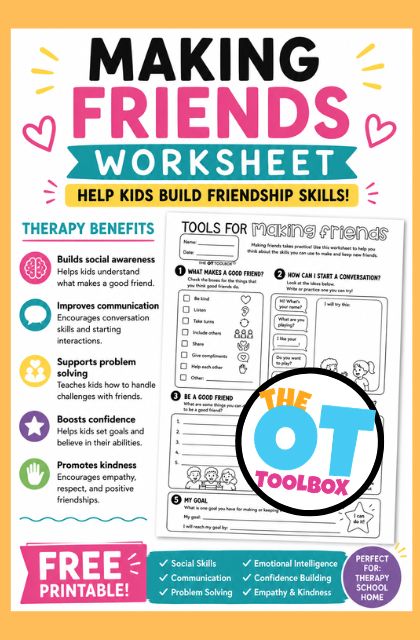
Helping children develop friendship skills is an important part of supporting participation in school, community, and daily life. This free making friends worksheet is designed to help kids build social awareness, and the social skills needed for communication skills, emotional regulation, and problem-solving abilities through simple and meaningful reflection activities. Whether you are a therapist, teacher, counselor, or parent, this printable can be used in many different ways to support social emotional learning across settings.
Making Friends Worksheet
Friendship skills are often connected to much more than simply “being social.” Children use executive functioning skills, emotional regulation, perspective taking, flexible thinking, and self-monitoring when interacting with peers. For some students, making and keeping friends can feel overwhelming because of anxiety, impulsivity, difficulty reading social cues, or trouble initiating conversations. These are very real examples of using self regulation skills in social situations.
This worksheet helps break those skills into manageable pieces while encouraging positive social participation.
The making friends worksheet can be used as an individual activity, small group discussion, classroom counseling tool, or therapy warm-up. Students can reflect on what makes a good friend, practice conversation starters, identify ways to solve social problems, and create personal friendship goals. The simple format allows children to explore friendship-building skills without the pressure of direct social interaction in the moment.
This is a great tool for social emotional development that I like to use in OT sessions because we can also sneak in handwriting and coloring!
Using a Making Friends Worksheet in Occupational Therapy
Occupational therapy practitioners often address social participation as part of functional performance in school, play, and community engagement. Friendship skills impact recess participation, classroom collaboration, group projects, self-confidence, and emotional well-being. Social participation is recognized within the American Occupational Therapy Association Occupational Therapy Practice Framework as an important occupation for children and adolescents.
This making friends worksheet can support occupational therapy sessions by helping students:
- Develop social problem-solving skills
- Practice emotional awareness
- Improve self-reflection
- Build communication strategies
- Increase participation in peer activities
- Strengthen self-regulation skills during social interactions
The worksheet also naturally supports handwriting, visual motor skills, and pencil control when students complete written responses, checklists, and drawing activities.
Executive Functioning and Friendship Skills
Many social challenges are closely connected to executive functioning. Children rely on executive functioning skills during nearly every social interaction. For example, students use working memory to remember conversation details, inhibition to avoid interrupting, cognitive flexibility to handle disagreements, and emotional control to manage frustration during peer interactions.
A child who struggles with executive functioning may appear shy, impulsive, overly controlling, withdrawn, or emotionally reactive during social situations. Sometimes these students want friendships but lack the planning, initiation, or flexible thinking needed to maintain interactions successfully.
This making friends worksheet can help support executive functioning by encouraging children to:
- Think through social situations before reacting (and using coping strategies when needed)
- Generate possible conversation starters
- Reflect on social outcomes
- Identify calming strategies during conflicts
- Practice perspective taking
- Develop self-monitoring skills
Pairing social emotional learning activities with executive functioning supports often creates more meaningful carryover into real-life situations.
Screening for Social Emotional Needs
This worksheet can also help therapists and educators informally observe social emotional needs. While it is not a standardized assessment, it can provide valuable insight into how a child thinks about friendships, communication, and emotional responses.
As students complete the worksheet, observe:
- Ability to identify positive friendship qualities
- Emotional vocabulary
- Perspective taking skills
- Problem-solving responses
- Frustration tolerance
- Self-awareness
- Ability to generate flexible solutions
- Social confidence
Students who have difficulty answering open-ended social questions, identifying emotions, or generating social strategies may benefit from additional support in social emotional learning, self-regulation, or executive functioning intervention.
Therapists can also compare verbal responses versus written responses. Some children demonstrate stronger social understanding verbally but struggle to organize thoughts on paper due to executive functioning or written expression difficulties.
Ways to Use the Making Friends Worksheet
This making friends worksheet works well across a wide range of ages and ability levels because it can easily be adapted and graded based on student needs.
For younger children or students with developmental delays, adults can read the questions aloud and complete the worksheet together through discussion. Students may circle answers, draw pictures, or role-play responses instead of writing full sentences.
For older students, the worksheet can become part of deeper conversations about friendship challenges, emotional regulation, peer pressure, conflict resolution, or self-advocacy. Therapists and teachers can expand the activity by practicing real-life social scenarios or creating role-play situations connected to classroom routines, recess, group work, or extracurricular activities.
The worksheet also works well in:
- Lunch bunch groups
- Counseling sessions
- Push-in classroom support
- Social skills groups
- SEL centers
- Executive functioning intervention groups
- Speech and occupational therapy co-treatment sessions
Because the activity is flexible, it can be used repeatedly while targeting different social goals.
Grading the Activity for Different Needs
One of the easiest ways to grade this activity is by adjusting the level of support provided.
For students who need more support:
- Use visual examples
- Provide sentence starters
- Complete responses together verbally
- Use role-playing instead of writing
- Limit the number of questions completed
For students who need a greater challenge:
- Ask for multiple solutions to social problems
- Encourage perspective taking
- Have students explain why a strategy works
- Practice real-life social scripts
- Add writing prompts or journaling extensions
Therapists can also incorporate movement, sensory supports, or regulation breaks while completing the worksheet to help students maintain attention and emotional regulation during social discussions.
Supporting Functional Participation Through Friendship Skills
Friendship development affects much more than social interaction. Positive peer relationships influence classroom participation, emotional well-being, confidence, self-advocacy, and school engagement. Children who feel successful socially are often more willing to participate in learning activities, collaborative tasks, and group problem-solving situations.
This making friends worksheet provides an approachable way to begin conversations about social participation while supporting executive functioning, emotional regulation, and communication skills in a functional and meaningful context.
Whether used in occupational therapy sessions, counseling groups, classrooms, or at home, this printable can help children build greater confidence in navigating friendships and social interactions.
Research supports the connection between social emotional learning, executive functioning, and school participation. Emotional regulation and executive functioning skills contribute significantly to peer relationships and classroom success. Social participation and self-regulation are also recognized as foundational components of child development and occupational performance within pediatric occupational therapy practice.
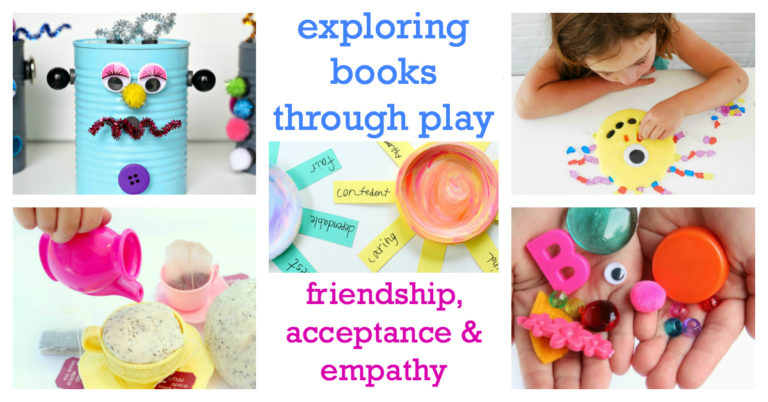
We have a great resource that was developed by therapists and early childhood educators, Exploring Books Through Play, that supports friendship.
This digital, E-BOOK is an amazing resource for anyone helping kids learn about acceptance, empathy, compassion, and friendship. In Exploring Books through Play, you’ll find therapist-approved resources, activities, crafts, projects, and play ideas based on 10 popular children’s books. Each book covered contains activities designed to develop fine motor skills, gross motor skills, sensory exploration, handwriting, and more. Help kids understand complex topics of social/emotional skills, empathy, compassion, and friendship through books and hands-on play.
Click here to get your copy of Exploring Books Through Play.