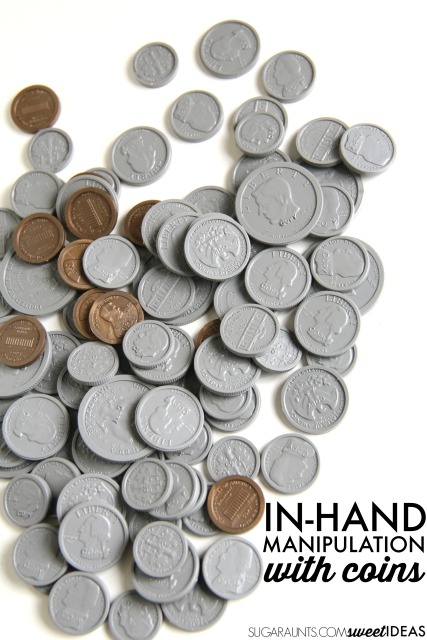
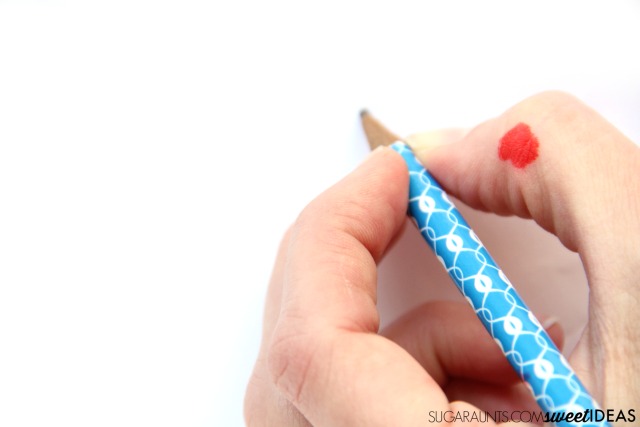
Moving the pencil within the tips of the fingers to switch from writing to erasing. Passing small beads from the palm of the hand to the finger tips. Holding a stack of coins in the palm while counting out the amount needed to pay for an item.
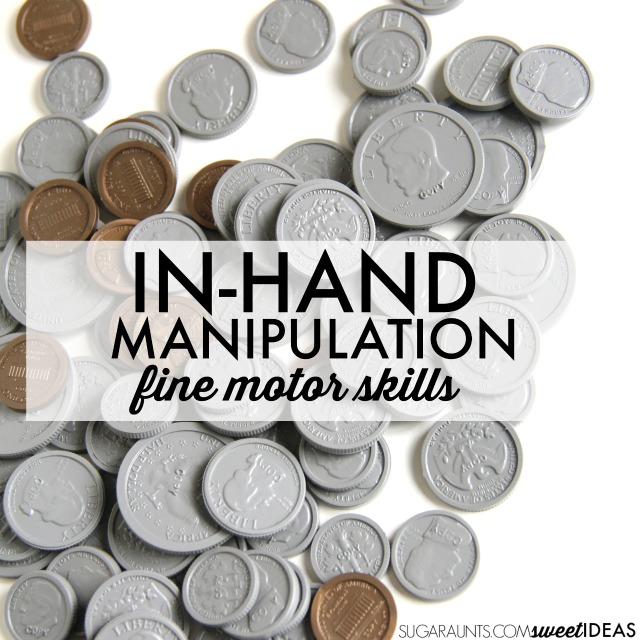
These are all in-hand manipulation tasks, and can be a problem when it comes to performing functional tasks related to these fine motor tasks. Sometimes a child appears clumsy with their small motor movements. They use two hands for tasks that normally require just one. Today, I’ve got a fun way to help with these difficulties by working on in-hand manipulation skills using coins.
The Three types on In-hand Manipulation
There are different types of movements which allow us to manipulate objects within the hand. Every task that we do within the hand uses a combination of these movements. These are the three different types or components of in-hand manipulation:
Translation
Shift
Rotation
Translation is using your fingers to moving a little item from your palm to your finger tips (or your fingertips to squirrel the item into the palm). When you hold a coin in your palm and manipulate it to your finger tips to push it into a piggy bank or vending machine, you are demonstrating palm-to-finger translation.
Shift is moving an object using the pads of your fingers…adjusting the pencil grip is demonstrating finger shift. Another example might be manipulating a button or a zipper with the finger tips.
Rotation is rolling an object using the fingertips. Examples of rotation are rolling a pencil in your fingertips, turning a pencil over to use the eraser, or opening a bottle top by rotating the lid on your finger tips.
These fine motor skills are needed for functional tasks like managing a pencil or crayon during handwriting, opening containers, managing coins or small items, manipulating a spoon/knife/fork, adjusting the paper when cutting with scissors, and fastening buttons or shoe laces.
In-Hand Manipulation Activity with Coins
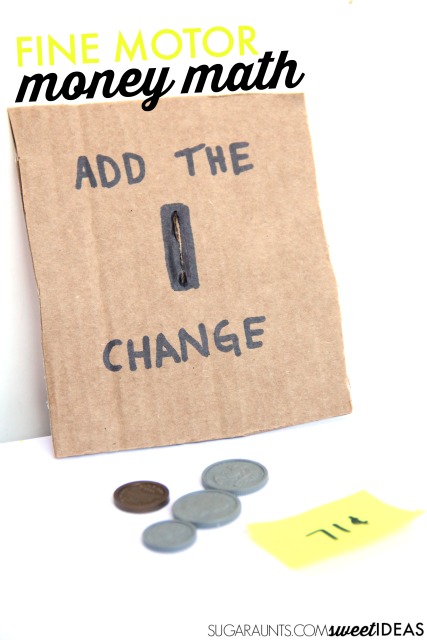
I grabbed a piece of cardboard from a pizza box lid. Cut the cardboard into a manageable sized rectangle and use a sharp knife to cut a slit. Make sure the slit is vertical as this is similar to a coin machine and encourages efficient positioning of the wrist and fingers for functional use.
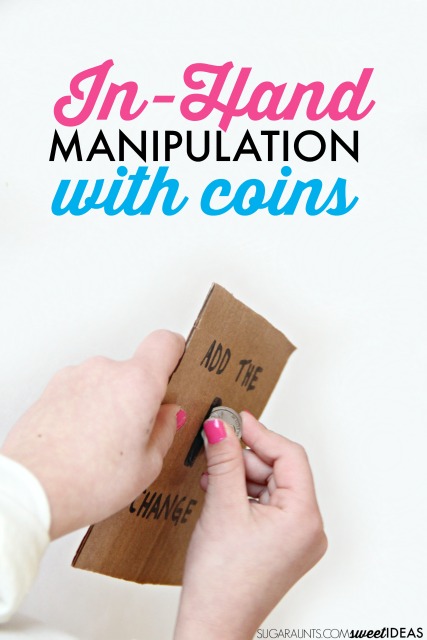
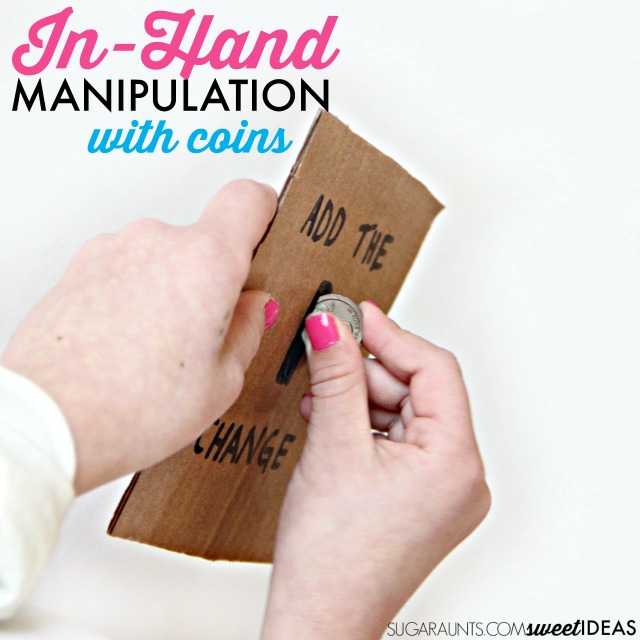
To work on in-hand manipulation needed for functional tasks, use play money to press the money through the slot. Ask your child to grab up a handful of the coins and push them through the slot one at a time. Using the non-dominant hand to hold the cardboard is an exercise in bilateral hand coordination, making this a great pre-handwriting exercise. (Use this activity as a writing warm-up exercise!)
How to use coins to work on in-hand manipulation:
Rotate the coins between the pads of the thumb and pointer finger/middle finger.
Grab a handful of coins and place them into a slotted container.
Pick up coins one at a time and “squirrel away” into the palm.
Push coins into a piggy bank or slotted lid (Slice a hole in a recycled plastic container like a yogurt container)
Slice a slit in a piece of cardboard like we did below. Using a small piece of cardboard allows you to hold the cardboard when pushing the coin through the slot. Read on:
When a person writes, they need to hold the paper steady with their non-dominant hand while manipulating the pencil with only their dominant hand. They need to adjust the pencil motions, twirl it around to erase, pinch and “crawl” up the pencil to adjust small movements in the hand as they write on the paper. Holding the cardboard in the non-dominant hand prevents the child from managing the money with both hands.
While pressing the coins into the cardboard, work on money and change making skills like we shared here.
This post contains affiliate links.
More Fine Motor activities you will LOVE for working on handwriting, pencil grasp, and manipulating small items:
3 Fun & Practical Coin-Based Fine Motor Exercises
All you need is a handful of coins to start working on fine motor skills, including in-hand manipulation. Here are some ideas:
1. Coin Flip and Store– Place a pile of coins on the table. Have the child pick up one coin at a time, flip it from palm to fingertips (translation), and place it into a small container.
Challenge upgrade: Use smaller coins or require the child to sort coins by size after flipping.
2. Coin Stack Race– Give the child a handful of coins to hold in their palm. Using just one hand, have them move each coin to their fingertips (one by one) and stack them into a tower without dropping any.
Skills targeted: In-hand manipulation, precision control, fine motor endurance.
Therapist tip: Time the child or challenge them to beat their own record.
3. Coin Slot Shoebox Game– Cut narrow slots into the lid of a shoebox labeled with coin values. Have the child sort and insert coins using only one hand, pulling them from their palm to fingertips before dropping into the correct slot.
Skills targeted: Translation and rotation, finger strength, visual-motor integration.
Home version: Use piggy banks or DIY coin banks made with containers and lids (a yogurt container or small butter container works well.
Here are more ideas to work on in-hand manipulation skills:
Besides using just coins, you can add other fine motor ideas to improve the coordination and dexterity needed for the three types of movements of in-hand manipulation. In our Yearlong Fine Motor and Data Collection Bundle, we have a full year of activities.
Looking for a consistent way to support fine motor skills all year? This yearlong fine motor system includes seasonal activity kits and monthly data collection tools to support planning and progress monitoring.
If fine motor planning and data collection feel overwhelming, you’re not alone. This done-for-you yearlong bundle organizes seasonal activities and monthly screening tools in one system.
Colleen Beck, OTR/L has been an occupational therapist since 2000, working in school-based, hand therapy, outpatient peds, EI, and SNF. Colleen created The OT Toolbox to inspire therapists, teachers, and parents with easy and fun tools to help children thrive. Read her story about going from an OT making $3/hour (after paying for kids’ childcare) to a full-time OT resource creator for millions of readers. Want to collaborate? Send an email to contact@theottoolbox.com.
We’ve shared much information on visual processing over the last few months. You’ve seen tips for addressing convergence insufficiency, visual tracking concerns, and other visual skill areas. Today we are talking about saccades and activities to improve saccades. These are the eye movements that allow the tracking skills necessary for reading comprehension, handwriting, and so many other areas. The saccade activities listed below are eye exercises that can help enhance visual processing skills. These visual tracking exercises can help with smooth pursuit of vision, in order to improve learning problems and other visual therapy concerns.
Visual Saccades Activities
You’ve identified impaired saccadic movements, the child has seen a developmental optometrist and maybe has corrective lenses, but is still struggling. Now what? Check out the activities below to incorporate into therapy and home programs that address poor saccadic movements directly.
This activity addresses saccadic movements on a large scale and challenges the child to stretch their eye muscles into the peripherals and back again. The objective is to hit the first target, catch the ball and hit the second target while moving only your eyes. This pattern is completed for as many times in row the kiddo can without dropping the ball or missing the target.
The larger the distance between the targets, the harder the challenge is. Wall Ball also doubles as a dissociation activity of the eyes from head movements.
All you need for Wall Ball is a ball, two targets and a wall or solid structure to bounce the ball off of. The ball can be any size as long as it bounces back directly to the child. Tennis balls and kick balls work the best. The smaller the ball, the more challenging the task is. Grade the activity to meet the kiddo’s needs and abilities as he/she progresses.
How to Play Wall Ball
Begin with the target approximately four feet apart at eye level on the wall. Start with a horizontal line progressing to vertical, and then diagonal.
The kiddo should be standing approximately 3 feet from the wall so that they can see both targets without having to turn their head. This part is important as we want to work only the eye muscles. If the child cannot see both targets without moving their head, adjust the distance of the targets first and then the position of the child as needed.
Increase the challenge by adding paired colored targets and calling out what pair to hit one at a time or in a sequence. As the kiddo’s saccadic patterns become better and smoother, the time needed to complete the task will be shorter.
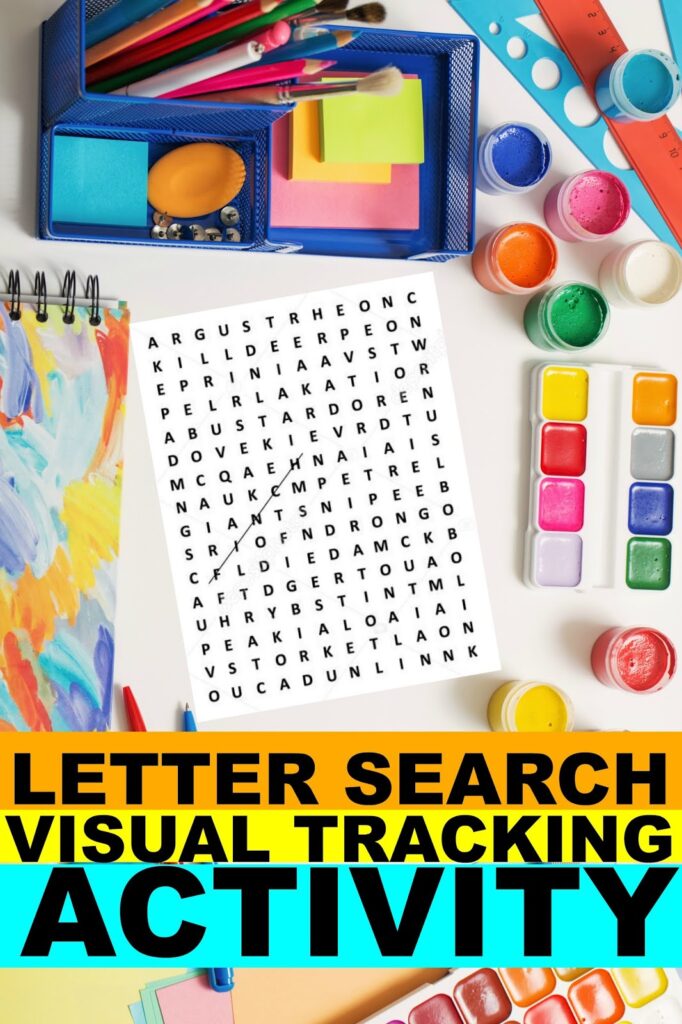
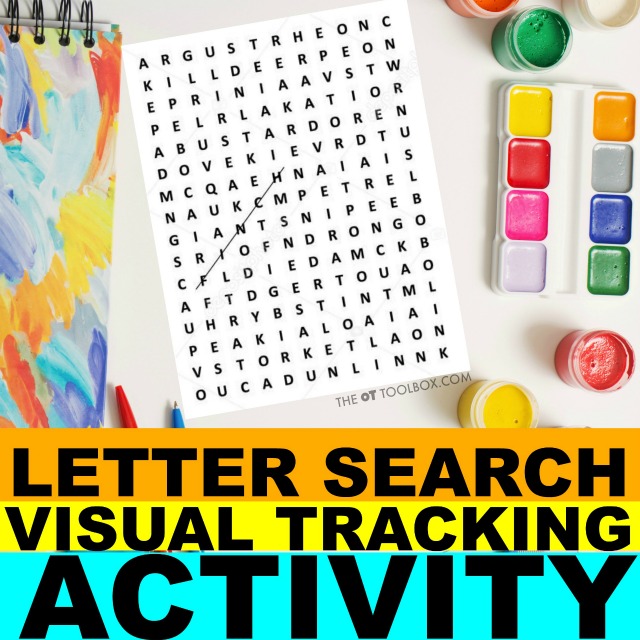
Read Word Searches to work on Saccades
Reading requires very precise and accurate eye movements. When these patterns and muscle movements are not natural, they have to be taught and can be a significant challenge for children with impaired saccadic movements.
The objective of Word Search Reading is to have the kiddo read the letters or symbols of the word search out loud without deviating from the line, or skipping a line once back at the beginning of the pattern.
Word Search Reading Directions:
Begin with a simple word search to establish the child’s abilities. A 4×4 line word search is usually a good place to start. As the child’s skills increase or this is too easy, increase the size of the word search. The larger the word search, the harder the child has to work to move their eyes in a smooth movement across the page and back to the next line.
Word search reading can be completed as a table top task, or a vertical surface. It is good to practice both skills as saccadic movements are needed in a variety of settings, not just for reading and writing.
Word Search Reading patterns can be left to right/top to bottom, or top to bottom/ left to right. There should be an emphasis on left to right patterns initially as this is the way that we read and write. As the child’s skills increase, patterns can be reversed right to left/top to bottom and top to bottom/right to left. The more patterns that the child’s eyes are exposed to, the easier fluid movements between any given set of points will become.
While I have listed very set patterns for this activity, it is important to remember that saccades is the fluid, coordinated movement of both eyes between ANY given set of points in ANY plane or position.
Modifications for Word Search Reading to Address Visual Tracking Needs
Word Search Reading activities can be very difficult and result in the kiddo being frustrated as it is making their eyes work in ways that they are not used to. However, there are a few modifications outside of the size of the word search that you can utilize to develop the just right challenge for each kiddo.
The first modification is blocking out lines they are not supposed to be looking at. A ruler or a sheet of paper is a great place to start with this modification. If this is still not enough support and they are skipping letters in the line or reversing letters, try having them track with their finger or a special “tracking tool” (pencil with topper, fun pen, etc.).
Sometimes, even utilizing a finger or tracking tool is not enough and there is still too much visual input and their eyes are trying to jump ahead. In this case, an index card with a slot cut to fit one to five letters at a time can help keep their eyes moving in a nice line.
While word searches are great, if you have a child that is struggling with letter recognition, this task can be completed with numbers or symbols. The main premise is that whatever items you use, are in a grid pattern.
Adjust the challenge and supports as the kiddo gets better at reading the letters in the given pattern to create the just right challenge.
Saccadic Eye Movement exercises
Below are some scanning exercises to work on visual saccadic eye movements.
1. Letter Stick Scanning
Materials: Craft sticks, marker How-to: Write random letters or numbers down a craft stick. Hold two sticks up and have the child call out each letter as they jump their eyes back and forth between sticks. You can also use colored dots or shapes to make this easier. Goal: Promotes left-right eye jumping and visual accuracy.
2. Wall Sticker Walk
Materials: Stickers, index cards, masking tape, flashlight How-to: Place one sticker on each index card. Tape the index cards to the wall. Use a flashlight to highlight a letter or word for the child to find. Have them “jump” their eyes from one target to the next while standing or walking between the cards. Goal: Combines gross motor and eye movement coordination.
3. Pyramid Saccade Challenge
Materials: Printed saccade pyramid (e.g., letter A to D, F to G, etc.) How-to: Print a saccadic pyramid with non-linear letter patterns. Call out letter pairs and have the child find and track them quickly across the page. Goal: Strengthens diagonal and complex saccade patterns.
4. Visual Scanning Tape Lines
Materials: Masking tape, wall space, marker How-to: Create two vertical tape lines on a wall with random letters spaced down each line. Call out letter pairs and have the child visually scan between them without moving their head. This is a larger version of the craft stick scanning activity mentioned above. You can also position the tape strips in different planes. Try putting one on a slight diagonal. Or place both in a horizontal line. Mix it up. Goal: Encourages head stability and horizontal saccades.
5. Letter Ball Toss
Materials: Ball, marker How-to: Write letters or shapes on a ball. Toss it to the child and ask them to name two shapes or letters as their eyes land on them. Goal: Engages saccades under dynamic, moving conditions.
6.Word Search Scan
Materials: Word search page, pen How-to: Circle random letters on a word search page. Ask the child to scan from circle to circle and name the letters. Goal: Boosts scanning, attention, and accuracy.
9. Paint Dot Tracker
Materials: Dot art worksheet page, paint daubers or dot markers, pencil How-to: On a dot art worksheet, use a pencil or pen to write in letters of the alphabet in random order. Kids must scan and name the alphabet letters in order as they jump from dot to dot to fill in the worksheet. Goal: Adds a visual discrimination and color recognition element.
10. Emoji Eye Movements
Materials: Printable eye emoji picture, mirror How-to: Have the child copy different eye directions or mimic eye movements while watching themselves in a mirror. Goal: Increases awareness of eye position and movement range.
Visual Saccades Activity: Timed Copying Tasks
One of the best activities to work on saccades is to complete table top activities. This simulates what kids do in school the best, and allows you to find where the breakdown is, and provide supports as needed.
Start with a small activity like a spelling list or site words on table next to the child and have them copy the words onto a piece of paper. Once they are able to do this in a reasonable amount of time increase the challenge to 3-4 words in sequence or short sentences, and then eventually a whole paragraph or short story. This set of activities is referred to as near point copying and is the foundation block for other copying tasks.
When they have mastered near point copying, it is time to move onto far point copying. This is when the items that are being copied are more than 18 inches from the child. Examples include copying from a SmartBoard or whiteboard, or off posters around the classroom. Eventually, this translates into taking notes in higher level education.
The same premise of starting small and building into larger tasks applies to far point copying as well. Utilize a timer to challenge the child to beat their best time and also to track progress. As they become stronger at looking between the two points without losing their spot, the faster the activity will go.
Visual Saccade Exercise: Speed Popsicle Sticks
Like Word Search Reading, this activity challenges the precise movements needed for efficient saccadic movements. Speed Popsicle Sticks is more exercise based then the other activities presented in this post and should be monitored for fatigue and strain like other exercise based activities. This activity is challenging and should be done with children who are able to follow directions and verbalize feelings of discomfort in their eye muscles.
The premise of this activity is to have the child look as quickly as they can between two points without losing focus or deviating from the path in a given amount of time. Popsicle sticks with stickers at the end of them work great at points to focus on.
1. Begin with the child sitting in front of you with their feet grounded.
2. Hold the popsicle sticks approximately 12-15 inches apart, and 15-18 inches away from the child’s face.
3. Then instruct them to look at first one sticker, bring it into focus, and look at the next sticker bringing it into focus before moving back to the first sticker.
Start with a short amount of time, such as 10 seconds to begin, and 2-3 repetitions with a break in between each repetition. Increase the amount of time to complete the activity as the kiddo’s eyes get stronger and they are not complaining of fatigue. Set a cap on time around 45 seconds for this exercise, and keep repetitions low.
Be sure that you listen to the child if they are complaining or are requesting a break. You do not want to cause eye fatigue or strain accidently.
Games to Encourage Saccades
There are some great ready-made games on the market these days that challenge saccadic movements. Below is a list of a few of my favorites to utilize in therapy or for gift ideas for parents and home programs.
Frequently Asked Questions About Saccadic Eye Movements
Here are some of the most common questions that come up about visual saccades:
What is a visual saccade? A saccade is a quick movement of the eyes that allows us to shift our gaze from one point to another. These precise eye movements are essential for reading, scanning, and daily tasks that require eye tracking and visual perception. Poor saccadic control can impact coordination, reading fluency, and attention.
What controls saccadic eye movements? Saccadic movements are controlled by the visual system and areas of the brain responsible for motor planning and cognitive skills. Healthy saccades rely on the integration of proprioception, oculomotor skills, and central processing.
Can saccades be trained or improved? Yes! Vision therapy guided by an eye care professional or vision therapist can strengthen saccadic movements. Training exercises improve accuracy of eye movements, hand-eye coordination, and overall visual perception.
How do you treat saccadic eye movement problems? Treatment may include a comprehensive approach using vision training, toys, and puzzles to target eye tracking. Activities like flashlight tag, reading grids, or even scanning games help retrain saccades with professional guidance.
What are saccadic and smooth pursuits exercises? Saccadic exercises involve shifting the gaze quickly between two or more targets—like reading alternating letters or tracking flashing lights. Smooth pursuit exercises help eyes glide smoothly to follow a moving object. Together, they build strong oculomotor coordination and support academic and daily activities.
How to perform saccades at home? Try holding two targets (like stickers or pencils) about 12 inches apart. Have your child move their eyes back and forth quickly without turning their head. Keep sessions short and fun, and include activities in their daily routine for consistency.
What causes poor saccadic eye movements? Issues like delayed oculomotor development, concussion, or visual perception disorders can lead to poor control of tracking. Children with reading difficulties or attention issues may struggle with saccades, often needing professional evaluation and support.
What do saccadic eye movements indicate? They reflect how well the brain and visual system are working together. Inaccurate or jerky saccades may signal challenges in coordination, attention, or underlying visual field concerns.
Are there recommended tools or toys to improve saccades? Yes! Activities like flashlight tag, puzzles, and tracking games help. You can also use printables, reading strips, or worksheets that guide the eyes between targets. Some families benefit from apps or computer-based vision training programs.
How can I get more guidance on this topic? Talk to a qualified vision therapist or eye care professional for individualized support. You can also sign up for our newsletter to get related resources, exclusive offers, and in-depth information on topics like saccades, smooth pursuits, and the future of eyewear.
Final Note on Activities to Improve Saccades
Practice, practice, practice! That is one of the biggest parts in helping a child develop motor patterns, and saccades are no different. With the just right challenge in place and encouragement, the kiddo’s saccadic patterns should become stronger and more fluid leading to increased success with visual tasks.
Looking for more information on vision deficits? Check out my OT Vision Screening Packet for useful handouts, checklists and a screener tool.
This visual screening tool was created by an occupational therapist and provides information on visual terms, frequently asked questions regarding visual problems, a variety of visual screening techniques, and other tools that therapists will find valuable in visual screenings. Click here to read more about the Visual Screening Packet. This is a digital file. Upon purchase, you will be able to print the 10 page file and print off to use over and over again in vision screenings and in educating therapists, teachers, parents, and other child advocates or caregivers.
This article was written by The OT Toolbox Contributor, Kaylee:
A little about Kaylee:
Hi Everyone! I am originally from Upstate N.Y., but now live in Texas, and am the Lead OTR in a pediatric clinic. I have a bachelors in Health Science from Syracuse University at Utica College, and a Masters in Occupational Therapy from Utica College. I have been working with children with special needs for 8 years, and practicing occupational therapy for 4 years. I practice primarily in a private clinic, but have experience with Medicaid and home health settings also. Feeding is a skill that I learned by default in my current position and have come to love and be knowledgeable in. Visual development and motor integration is another area of practice that I frequently address and see with my current population. Looking forward to sharing my knowledge with you all! ~Kaylee Goodrich, OTR