Early Intervention for Sensory Differences

sensory seekers and intervention for early intervention in occupational therapy

Our sensory system is very complicated. A lot of times when we hear about sensory, we think about our 5 senses (taste, touch, sight, smell and hearing.) This blog will take us into a deep dive of early intervention for sensory differences and the definition of different sensory processing areas. Early Intervention services provide supports for children birth through age three who demonstrate developmental delays.

These delays could be caused by a variety of reasons, from autism, chromosome abnormalities, drug exposure, prematurity, motor impairments, language delays and more. 

Early intervention for sensory differences

Early Intervention for Sensory Differences

One of the areas that is always assessed when determining if a child is eligible for Early Intervention services is the area of sensory processing. These areas include Low Registration, Sensation Seeking, Sensation Sensitivity, and Sensation Avoidance. Also addressed are the areas of Sensory and behavioral including general, auditory, visual, touch, movement, oral and behavioral differences.

We will explore these areas in more detail throughout this blog post. Sensory diets are one of the most common and impactful ways to support children with sensory differences.

This article describes sensory diets as “A sensory diet is a set of activities that make up a sensory strategy and are appropriate for an individual’s needs.  These are specific and individualized activities that are scheduled into a child’s day and are used to assist with regulation of activity levels, attention, and adaptive responses.  Sensory diet activities are prescribed based on the individual’s specific sensory needs.”

There are four quadrants in a sensory profile. This visual clearly defines the similarities and differences between seeking, sensitivity, registration and avoidance.

The infant/toddler sensory profile is a common assessment used to determine the needs of a child in the following areas If a child is over-responsive to sensory input, they would fall in the sensory seek or slow to register sensory input sections. If a child is under responsive to sensory input, they would fall in the sensory sensitive or sensory avoider sections. 

What are sensory differences  and neurodiversity? This article explains.

What are sensory differences?

These areas of sensory diversity make up the term sensory differences. Beyond the four quadrants, however, there are other sensory differences to consider. These are described below.

All of these sensory differences described are part of the neurodiversity of human life. We all are different when it comes to sensory, and we are all sensory. Just like the diversity of physical attributes, personal preferences, characteristics, sensory differences are just one more difference that makes us who we are.

Sensory seekers

Sensory Seeking

This area determines if a child seeks out sensory input. If a child is scored higher than most in this area, you may see them move around more, look at items that spin (such as fans or toys with wheels) be attracted to fast paced and brightly colored television shows.

Sensory Seeking Patterns

Children with sensory seeking patterns often appear highly active, impulsive, or constantly in motion. These children are not simply “busy.” Their nervous systems may require stronger or more frequent sensory input to feel regulated and organized. As the quote reminds us, “Some children need more input to feel organized.” When sensory input is insufficient, children may increase their movement or intensity to meet that internal need. In early intervention, the goal is not to suppress movement but to structure it in ways that promote regulation and participation.

A child who seeks sensory input may:

  • Move constantly or have difficulty sitting still
  • Jump, crash, spin, or climb frequently
  • Touch objects and people often
  • Use excessive force during play or writing

Early intervention may include:

  • Planned heavy work activities (carrying, pushing, pulling)
  • Structured movement breaks
  • Animal walks or obstacle courses
  • Teaching body awareness and graded force

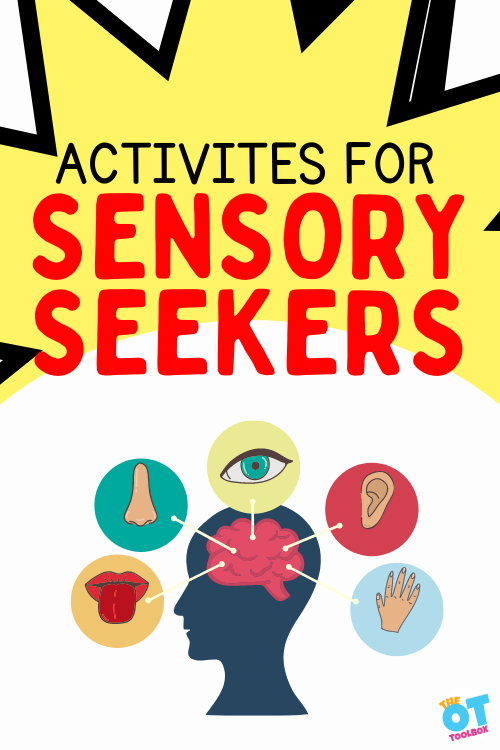
Here are some wonderful home ideas for children who are sensory seekers.

Sensory Sensitivity

This area determines a child’s ability to notice different senses. If a child scores higher than most in this area, you may see a child always needing a routine to stay calm, startle to certain sounds, become upset during routine hygiene activities (such as getting hair brushed or nails trimmed) and significant preferences on types and textures of foods.

Here are some ways to support children in a controlled way, who show needs in the sensitivity area.

Sensory Registration

This area determines how a child responds to sensory input from others or their environment. This article by the pediatric development center explains how important registration is for a child’s functioning and learning.

It describes registration as: “Sensory registration is the process by which children respond or attend to sensory input in their environments.  The nervous system must first notice the sensory information, once registered the memory compares it to things they have heard or seen, and thus gives new information meaning.  Children who fail to respond or have delayed responses to sensory information have diminished sensory registration.  Diminished sensory registration is often associated with one or two weaker sensory systems, such as the auditory or vestibular system.  Without sensory registration, no other learning can take place.”

If a child scores higher than most in this area, you may see a child miss sensory input more than others do. A child in this section may miss eye contact, pay attention to only specific tones, and ignore most sounds. These children are harder to engage or seem uninterested in activities. They may need tactile, auditory and visual cues to initiate engagement in conversation or an activity.

Low Sensory Registration

Children with low sensory registration may not consistently notice or respond to sensory input in their environment. They are not ignoring directions; they may not be fully perceiving them. As the quote states, “Sometimes the world needs to be turned up.” These children often benefit from clearer, stronger, or repeated input to support engagement and responsiveness. Early intervention focuses on increasing the salience of sensory information to improve participation.

A child with low registration may:

  • Not respond when their name is called
  • Seem unaware of food or dirt on hands and face
  • Appear slow to respond to instructions
  • Seem lethargic or difficult to engage

Here are some ways to support children with low registration:

Early intervention may include:

  • Gaining eye contact before giving directions
  • Pairing verbal cues with visual supports
  • Increasing movement before seated learning
  • Using clear contrast and structured materials

Sensory Avoidance

This area determines how a child’s need to control the amount and type of sensations at any given time. If a child scores higher than most in this area, you may see a child resist playing with other children due to overwhelm, resist being cuddled when it’s not on their terms, frequently become upset if their hands are messy, have a hard time calming down in new settings and isn’t interested in trying new foods.

Sensory Avoiding Patterns

Children with sensory avoiding patterns may experience ordinary sensory input as overwhelming or unpredictable. Avoidance behaviors are protective responses, not oppositional behaviors. As reflected in the quote, “What feels small to us can feel overwhelming to them.” Their nervous systems may quickly shift into fight, flight, or freeze in response to certain sounds, textures, or busy environments. Early intervention focuses on creating safety and predictability while gradually increasing tolerance.

A child who avoids sensory input may:

  • Cover ears in noisy environments
  • Refuse messy play or certain foods
  • Resist specific clothing textures
  • Withdraw in crowded or stimulating settings

Early intervention may include:

  • Environmental modifications to reduce sensory load
  • Predictable routines and visual schedules
  • Gradual, supported exposure to new sensory experiences
  • Co-regulation and emotional support

Here are some tips on how to support an avoider.

General Processing

General Processing items measure the child’s responses related to routines and schedules. This could include daily schedules, routine schedules or task related routines including how children respond to questions, others actions, busy situations, sleeping routines, eating patterns and hygiene needs, daily transitions and other schedule related activities.

These first/then visual boards are a wonderful tool in supporting routines and schedules.

Tactile and Auditory Sensitivities

Tactile and auditory sensitivities are common in early childhood and can significantly impact emotional regulation and participation. The nervous system may interpret certain textures or sounds as threatening rather than neutral. As emphasized in the quote, “Regulation begins with feeling safe.” When a child feels safe, learning and social engagement become more accessible. Early intervention prioritizes environmental adjustments, gradual desensitization, and parent education to support comfort and resilience.

A child with tactile or auditory sensitivities may:

  • Refuse specific clothing fabrics
  • Gag or refuse foods due to texture
  • Cover ears in loud environments
  • Cry or startle easily with sudden sounds

Early intervention may include:

  • Providing softer clothing options
  • Using noise-reducing headphones when appropriate
  • Gradual introduction to new textures
  • Teaching calming and coping strategies

Auditory Sensitivity

This area addresses how children respond to things they hear. Auditory input includes responding to their name,  how easily it is for someone to get their attention and how distracted they become in noisy settings. The brain processes the sounds in our environment and according to this article, sensitivity to sound could be a reaction to a part of our brain that pays more attention to sounds then it needs to. One article explains it this way:

When there is no medical reason to explain the auditory sensitivity, researchers think that the brain is not processing sounds adequately. Researchers suggest that the part of the brain that receives and filters noise and sound, the amygdala, is working differently.  The amygdala decides on how important noises are.  It decides and which sounds we should attend to and which ones to ignore. When someone experiences sensitivity to sounds, it is thought the amygdala pays more attention to sounds than it needs to.

Visual Sensitivity

This area addresses how children respond to things they see, including bright objects, such as lights and toys. It describes how they respond to reflections in mirrors and their responses to objects that spin or move suddenly. According to this article our brains interpret the light we see through our eyes, and:

“The visual system uses light to detect information through our eyes and then interprets or makes sense of that information in the brain. It works closely with our vestibular and auditory systems to help us safely navigate our environment by orienting us to where we are in relation to other objects. The ability to cognitively process information we take in through our eyes can be broken down into several categories, called visual perceptual skills. Those with trouble in one area of visual perception may present with strong skills in another area, meaning that deficits in processing of visual information can take on many forms.”

Tactile/Touch Sensitivity

This area addresses how children respond items that touch their skin. This includes bath/water play, getting their nails trimmed and hair brushed, touching different sensory rich objects, being messy and receiving hugs. When children have a tactile sensitivity, their skin reactors are feeling the object more intensely. According to this article:

The tactile system, or sense of touch, refers to the information we receive though the receptors in our skin. It alerts us to pain and temperature and helps us discriminate the properties of things we come in contact with, i.e. texture, shape, size, and weight. From very early on in development this sense plays a crucial role in helping us gain awareness of our own bodies and understand everything we come in contact with. And how frustrating it must be to learn new skills when you can’t adequately feel the objects you’re using!”

Movement Seeker

This area describes how children move within their environment, including if they enjoy movement activities, seem accident prone or clumsy, seek out spinning and/or preferring to walking on their tip toes. Movement is how our bodies know where we are in space and how we respond to a variety of movement activities. This article explains movement seekers as “someone who has a high threshold for vestibular input. The vestibular system is housed in our inner ear, and is responsible for sending messages to our brain about the position and movement of our head. The vestibular system is activated anytime our head is tilted, upside-down, inverted, if we spin, if we run fast or run slow, when we’re on a swing or going down a slide.

We need vestibular activation and an efficient vestibular processing system in order to maintain an upright position, feel balanced, have a full sense of our body in space and focus. Some people have low thresholds, in which they perceive vestibular activation at much higher rates (e.g. hypersensitive to movement). Others have high thresholds, which means that they need more intense, more frequent and longer duration of movement in order to register it and activate their vestibular system.”

Oral

This are addresses how children respond to new foods and different textures, if they tend to overstuff their mouths, how they control chewing/swallowing foods and liquids and if they tolerate their teeth being brushed. Our oral system is based on how our sensory receptors in our mouth recognize what is in our mouth. Some people have increased sensitivities for foods while others have decreased sensitivities to food. There are differences and optional interventions explained in this article:

“We have sensory receptors in our mouths that allow us to recognize information about temperaturetexture (e.g. smooth like yogurt, hard like chips/pretzels, or a mixture of textures like cereal with milk), and taste (e.g. sweet, salty, bitter, sour). They may be over responsive or have increased sensitivity to oral input, causing them to be resistant to oral sensory experiences like trying new foods or brushing their teeth.

Other children may have decreased sensitivity to oral sensory input and therefore seek more oral input in order to help them organize their behavior and pay attention. Our brains receive further proprioceptive input from the joint of the jaw as we bite and chew on foods with different types of resistance (e.g. a crunchy carrot or a chewy sweet/gum).  Oral sensory processing also contributes to the way we move our mouths, control our saliva, and produce sounds for clear speech.”  

Behavioral Differences

This area describes children’s behaviors such as how frequently they have meltdowns, if they are clingy, how hard it is to redirect them, if they are upset in new surrounds and how hard it is to help them calm down.  Teaching children how to calm down using a variety of sensory input, will benefit every child. Soothing Sammy provides opportunity for a child to create their own behavior support tool that is tailored to their specific needs. Weather they respond better to auditory, visual, tactile or others, Sammy the Golden Dog can make redirection to a calm down corner a positive experience for the child and the adult.

Creating a sensory diet is one of the most important ways to support children with any type of sensory difference. These sensory diet cards is a must have resource if you are working with or have a child with a sensory need. 

If you are concerned about your child, you can contact an Early Intervention provider to complete an evaluation from the day they are born all the way until they turn three years old.

Early intervention occupational therapy services support children in all areas of sensory needs, and can help caregivers create sensory diets that will help children in a variety of situations. Visual, tactile, auditory, oral and movement interventions that are supported in a controlled environment, can help every child learn how to adapt and respond to different situations and environments.

Jeana Kinne is a veteran preschool teacher and director. She has over 20 years of experience in the Early Childhood Education field. Her Bachelors Degree is in Child Development and her Masters Degree is in Early Childhood Education. She has spent over 10 years as a coach, working with Parents and Preschool Teachers, and another 10 years working with infants and toddlers with special needs. She is also the author of the “Sammy the Golden Dog” series, teaching children important skills through play.

Lemon Battery Science Fair Project

Lemon STEM activity

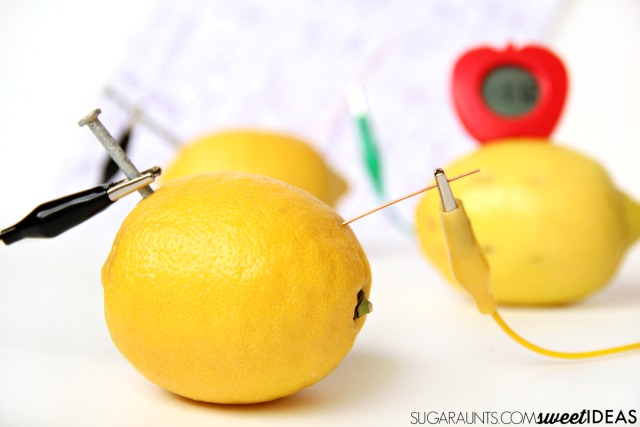
Lemon STEM is such a fun way to explore concepts and this lemon battery science fair project is a winner! By using a lemon and a few other materials, you can discover the chemical process of moving electric current through a lemon to create a lemon battery. This lemon battery is a discovery activity that makes a great science fair project because the experiment is a powerful tool for discussing science and exploration in kids. Plus, this lemon science experiment is easy to do (and clean up)!

lemon  lightbulb experiment

Lemon Battery Science Fair Project

One of the best benefits to making this lemon battery science fair project is that it’s an easy way to learn about electrodes, electrons, and the chemical reaction required to fire up a battery. As an occupational therapist and mom, I love the other skill-building opportunities with this project too:

When kids build the lemon battery, they are building so many skills!

Introduce them to creativity through STEM?  Sounds great! Encourage my children to get excited about science and math? YES! Unleash natural potential in my girls by experiencing science projects? I like it.

lemon battery science fair project

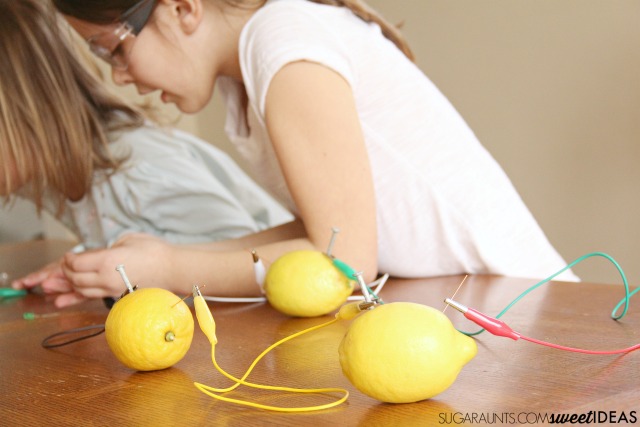
And the best for me, was watching my girls do this together.  The baby saw her big sister in safety goggles as she learned about cathodes and electrolytes…and has been wearing the goggles every day since.  Seeing them inspire each other was just awesome.

We were making lemon powered batteries! 

What is a lemon battery?

A lemon battery is a simple science experiment kids can do to explore concepts of conduction and reaction.

In the lemon-powered battery experiment, kids can see how electrolytes are conducted through the lemon and wires in order to power a light or clock. 

The experiment is simple set up, easy, and a fun way to explore science!

 Lemon Battery Light Bulb Science Experiment

The lemon lightbulb experiment is a classic hands-on activity that demonstrates how citrus fruits can generate electricity. This lemon and light bulb science project is a powerful way to engage kids in STEM learning by transforming a simple lemon into a working fruit battery.

By inserting zinc and copper electrodes (such as a galvanized nail and a penny) into a lemon and connecting them with wires, you create a small electric current. Connect enough lemons in series, and you can even power a small LED light bulb, showing how chemical energy is converted to electrical energy in a tangible, visual way.

How the Lemon Electricity Experiment Works

In this lemon electricity experiment light bulb setup, the lemon juice acts as an electrolyte. When the copper and zinc electrodes are inserted into the lemon, a chemical reaction occurs that releases electrons.

This flow of electrons is electricity, and when wired correctly, it can power a low-voltage light source. This process demonstrates core concepts in physical science, including circuits, voltage, current, and chemical energy.

It’s a great introduction to alternative energy and an excellent lemon battery science fair project idea for elementary or middle school students.

Using the Lemon Battery for STEM Learning

This lemon STEM activity supports multiple domains of science, technology, engineering, and math.

Students can experiment with variables like the number of lemons, the size of the electrodes, or the type of fruit used to observe changes in voltage output. Try comparing a lemon battery to other fruit battery options such as potatoes, limes, or oranges to expand learning through data collection and hypothesis testing.

This type of lemon science experiment is engaging, messy, and memorable. 

Making the Lemon Science Project Work for You

To get the most out of this lemon electricity project, document your steps with photos and a results chart. Use a multimeter to measure voltage between lemons in series versus parallel configurations.

This makes your lemon battery science fair project more advanced and competitive for older students. Encourage kids to write a conclusion reflecting on why the light bulb did or didn’t light up, and how changing variables influenced the outcome.

This critical thinking component strengthens understanding of cause-and-effect and scientific inquiry.  

Food Battery Experiment

When I first showed the girls the items and explained what we were doing, they were very excited about lemon electricity!

I was surprised to read that only 1 in 1,000 girls pursue STEM careers, especially considering that out us us three sisters, two of us are in the health/science field.  

Encouraging my girls to explore interests in science is important to me and I was super pumped to get my girls excited about our science experiment…and the enthusiasm was catchy!

We used a lemon in our fruit battery, but you could use any citrus fruit to make a citrus battery…oranges, grapefruit, lemons, and limes all work equally well in this kid-made battery experiment. 

More Lemon Science Experiments to Try

Beyond lighting a bulb, try creating a lemon clock, powering a digital watch, or exploring how long your lemon battery will last. These lemon science experiments promote engineering design skills, allowing students to improve upon their models and test new solutions. Whether you’re creating a lemon and light bulb science project or just doing a fun weekend activity, this is a great entry point into electricity and circuitry.

Other fruits and vegetables can be used in this experiment too. It might be fun to explore which food is the best conductor for passing electrical energy. Try these fruits and veggies:

  • Lemons
  • Oranges
  • Grapefruit
  • Limes
  • Potatoes
  • Tomatoes
  • Cucumbers
  • Apples
  • Bananas

Which food battery works fastest? Which is the strongest conductor? Which food battery will work the quickest? These are all fun science fair experiments to try!

Lemon Battery Science Experiment

We created the lemon-powered battery, but then used the battery in a STEM activity by adding engineering and math to the mix. 

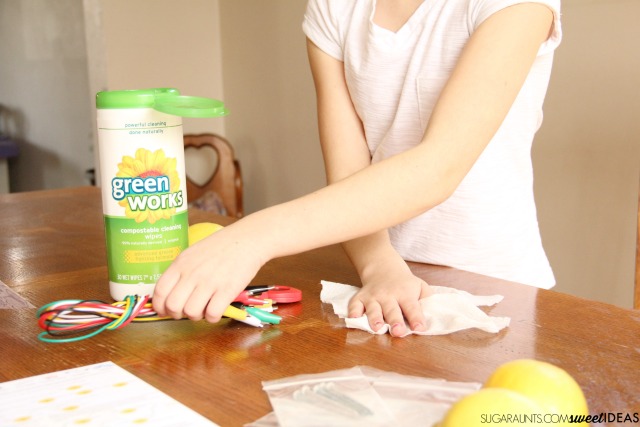
Lemon Battery Materials List

To get started with your lemon battery experiment, you’ll need a few simple materials:

  • LED Bulb or a small clock, light bulb, etc.
  • 4 Lemons 
  • Knife to cut the lemon
  • Alligator Clips on Lead wires
  • Zinc Nails 
  • Copper Wire (or a penny)
  • Goggles
  • Gloves
  • Alcohol wipes
  • Recording sheet

You can also try different metals instead of the copper penny. Try a galvanized nail, copper electrodes, Aluminum foil, metal strip, or other types of metal material.

Also note that you should have adult supervision for this activity because cutting the food with a knife can be tricky!

lemon battery science fair project to make a lemon battery

And we got started on our STEM project.  The instructions are easy to follow images below.  

Make a lemon battery for a science fair project

How to make a lemon battery:

  1. Start with a clean surface.
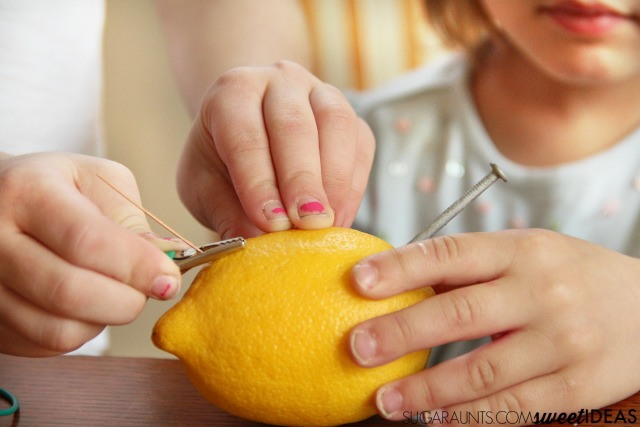
  2. Use the knife to make a small cut in the lemon’s surface. This will be used to push the nail and copper penny into the lemon more easily.
  3. Use an alcohol wipe to clean off the lemon or other food item used for the battery. 
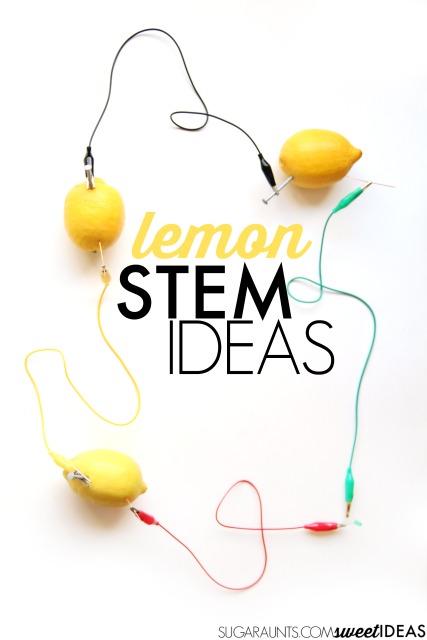
  4. Press the nail and copper item (penny, copper wire, etc.) into the lemon. Make sure the metal goes all the way past the peel if using a citrus fruit. You can use more than one lemon too: Push a nail into one lemon and the copper into the other lemon. 
  5. Attach the alligator clips to the nail and to the copper item. Connect the ends of one alligator clip wire to a galvanized nail in one lemon and then the other end of the alligator clip wire to a piece of copper in another lemon.  When you are finished you should have one nail and one piece of copper unattached.
  6. Finally, connect the unattached piece of copper to the unattached nail to the positive and negative connections of your light. The lemon will act as the battery. 
Lemon battery project for kids
  • Following the instructions, my eight year old build a lemon powered battery that lit up a light bulb.  We tried a few more experiments, like the mini fruit clock that came in the kit.  We used it to make a lemon clock with the circuits!
Lemon battery project is a STEM for girls activity

Lemon Stem

This Lemon STEM activity is a great fine motor STEM idea. By pushing the nails and pennies into the lemon, cutting with a knife, and clipping alligator clips, you are building fine motor strength in a functional task.

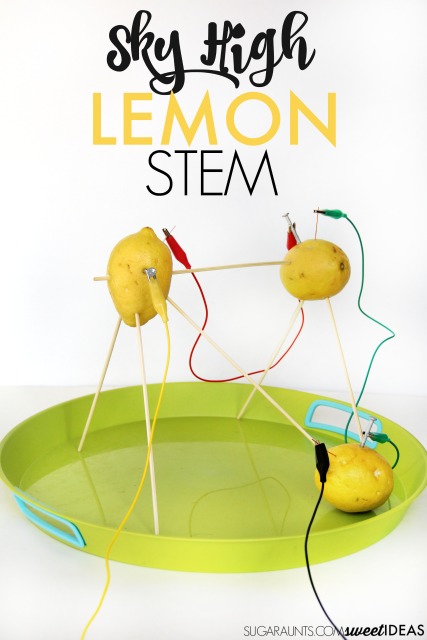
Add a few other ways to support lemon stem too: Use wooden skewers to build an elevated lemon battery.

Provide a handful of wooden skewers and ask the children to build a contraption that is strong enough to hold a lemon up off the ground. This can take a bit of creativity and trial and error, so be sure use plenty of paper towels or a wash cloth to wipe off lemon juice.

  • We pulled out some bamboo skewers and created a sky high lemon battery and lit up the light bulbs using engineering in our STEM activity.
  • Try building a clock tower with the skewers and a lemon. Explore how to make electricity run the clock even when it’s elevated or in different weather conditions like rain or freezing temperatures.
  • With all of the zinc nail-punctured holes in our lemons, we HAD to squeeze the juice.  We tried to see if we could create a lemon clock using just the lemon juice in a cup.  It worked!  
  • After the lemons were juiced, we tried to make another light bulb glow using the rinds.  This time the lights did not brighten and we decided it was because the electrolytes were squeezed away into our lemon juice and the current stopped at the rind.  

Next, we used wooden skewers to create a clock tower. Press the skewers into the lemons and create a tower. You’ll need to figure out how to get the clock tower to stand without toppling, and using lemons as the base or at the connecting points. These lemons can also be connected to one another with the alligator clips, wires, and pennies or nails to conduct through the whole tower. 

After all of these experiments, we were feeling a little thirsty.  Non-lemon powered light bulbs went off and so my four year old had a bright idea to make lemonade.  We added water and sugar and drank away the electrolytes!

It was so much fun to see my girls working together, encouraging each other, (not fighting), and being inspired in science.  Someday they might look back at our experiment day and laugh at drinking their science experiment, but I’ll remember the sticky crumbs on the table, the goggles on the one year old, and the fun we all had learning together.

Colleen Beck, OTR/L has been an occupational therapist since 2000, working in school-based, hand therapy, outpatient peds, EI, and SNF. Colleen created The OT Toolbox to inspire therapists, teachers, and parents with easy and fun tools to help children thrive. Read her story about going from an OT making $3/hour (after paying for kids’ childcare) to a full-time OT resource creator for millions of readers. Want to collaborate? Send an email to contact@theottoolbox.com.