Letter Formation Motor Planning Carpet Square

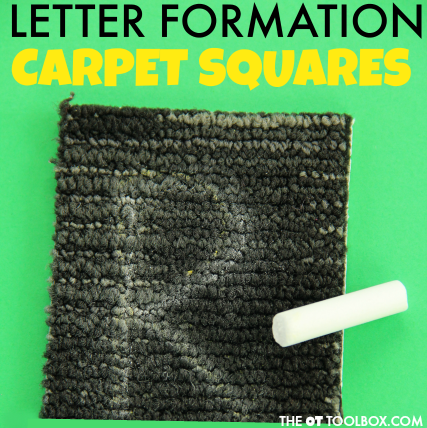
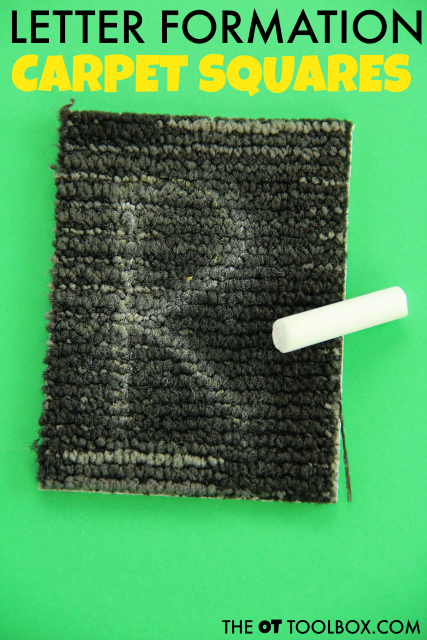
Teaching kids to write letters can be fun when you add creative ways to practice letter formation.  Adding feedback to letter letter formation when handwriting can help kids develop a motor plan that “sticks” when they write letters with paper and pencil.  This easy-set up activity is a creative way to add a proprioceptive sensory component to handwriting with small carpet squares.  This letter formation activity adds motor planning.  Because it’s such an frugal way to practice letters, it would be easy to set up an entire classroom with mini-carpet squares to practice letter formation and motor planning in handwriting.

Try this letter formation activity to improve motor planning when teaching kids to write letters.

Letter Formation Activity 


This post contains affiliate links.

To set-up this activity, you’ll need just a couple of items.  We have a handful of small carpet squares that we’ve used for a few different activities.  These were remnants of other projects but many carpet suppliers provide excess carpet squares that can be used.  Becasue many teachers have access to carpet squares in the classroom for circle time, this activity can be especially frugal.

Kids can work on hand strength, pencil grasp, and letter formation with this letter formation motor planning activity for helping kids learn to write letters.
Cut a carpet piece into small, 4 inch by 4 inch squares.  You’ll want carpet pieces this size to allow kids to use the small motor muscles for forming letters.  This is essential for proper letter formation when progressing to paper/pencil.  

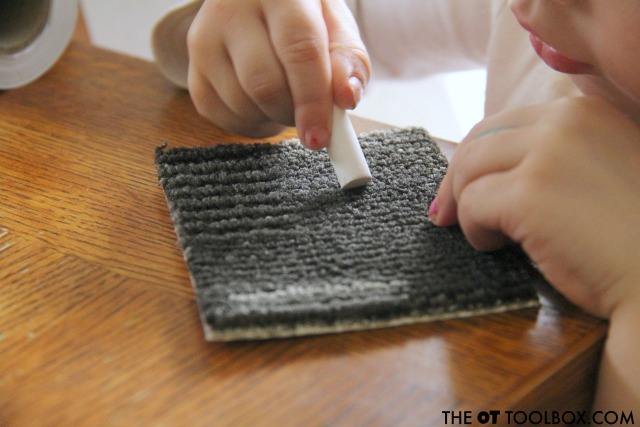
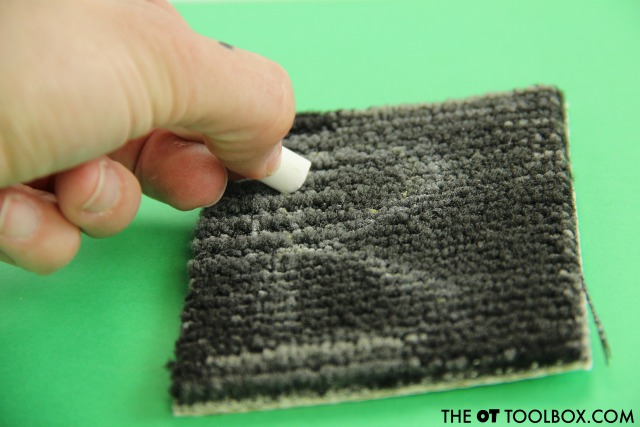
Use a small piece of chalk to write the letters on the carpet pieces.  Using a small piece of chalk boosts many skills such as pencil grasp and hand strength.  We talked about using a small pencil to help with handwriting before.  

And with that, start writing!

For my preschooler, I wrote the letter on the carpet first with chalk.  This way, she would have a letter to trace and copy.  As she traced the letter, we talked about proper letter formation with simple verbal cues such as: “strait line down” and “line across”.  

Adding the auditory component boosts retention along with the motor plan of forming the letter.


Motor Planning Letter Formation Activity


When they trace the chalk on the carpet square, kids get the feedback of proprioceptive input as they push and pull the chalk through the carpet.  It’s a great workout for the small muscles of the hand and is a nice way to address the motor plan of forming each letter.  Ask your child/student/client to continue tracing over the lines of the letter several times.  This boosts the motor plan needed for forming the letter and helps with carryover.  Read more about handwriting and motor planning activities here. 
Kids can work on the motor planning needed for letter formation with this handwriting activity.

My toddler got in on the writing with chalk on carpet action too. 


Sensory Handwriting Activity


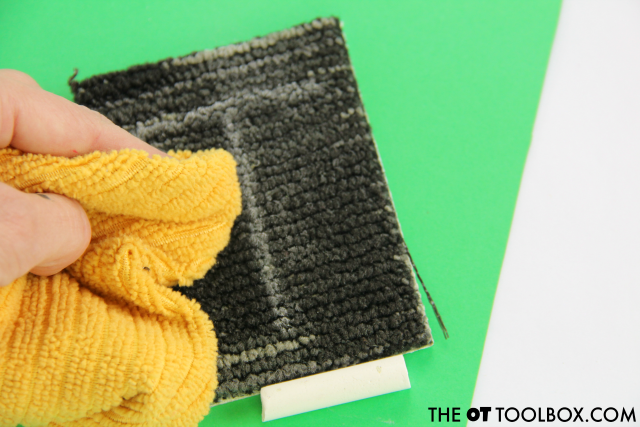
Then, after writing the letter, have the child erase the chalk letter with a wash cloth.  This is a great way to add more heavy work through the hands! 

The chalk and carpet texture add a nice bit of tactile sensory input to handwriting.  

Use carpet squares to work on letter formation and motor planning in handwriting with sensory input.

For more sensory handwriting activities, try these ideas.
Use carpet squares to work on letter formation and motor planning in handwriting

Thank you Evidence Based Practice Worksheets

By now, you should have an email in your inbox containing a link to download the Evidence-Based Practice Worksheets. 


When you download that file, you’ll see two worksheets:


Appraisal of the Evidence worksheet


and 


Review of the Evidence worksheet


These worksheets can be used in your practice to assess or audit the evidence for validity and effectiveness in creating best-practices and informed decision making. Read more about using these worksheets in development of evidence-based practice here.


Be sure to stay tuned for the opening of The OT Toolbox Community, happening on November 8th.


After that, the worksheets above will no longer be available for free. 


We are excited for The OT Toolbox Community to go live and hope to see you there!


Additional Evidence-Based Practice resources you may be interested in: 


Affiliate links are included below.

Research Methods: A Framework for Evidence-Based Clinical Practice

The Evidence-Based Practitioner: Applying Research to Meet Client Needs 

Kielhofner’s Research in Occupational Therapy: Methods of Inquiry for Enhancing Practice

Evidence-Based Rehabilitation: A Guide to Practice

How to Teach Kids Impulse Control

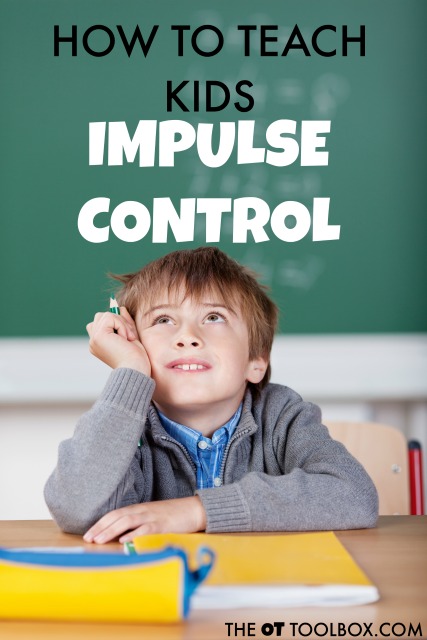
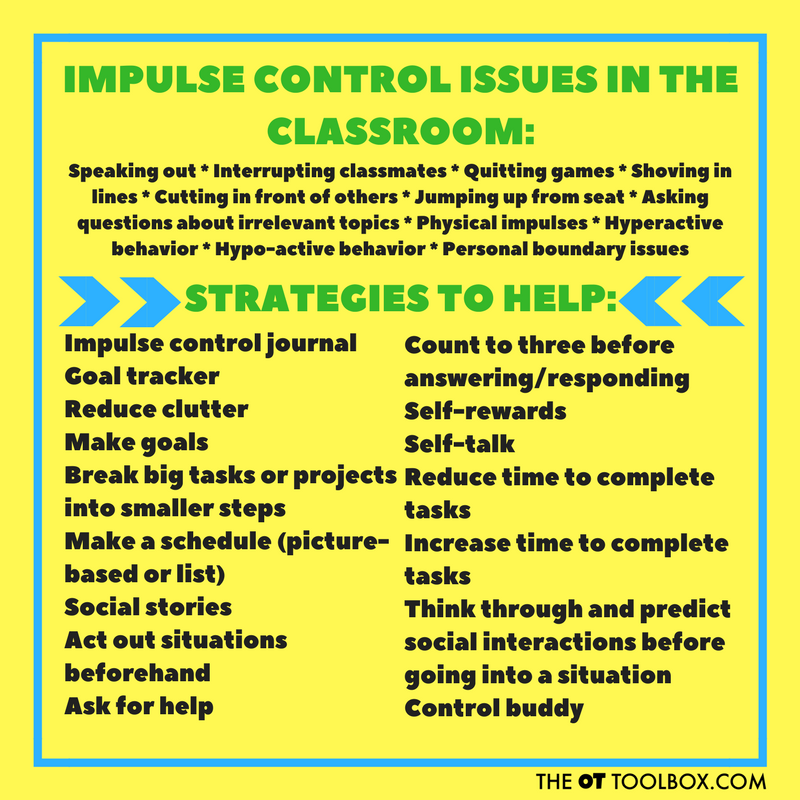
Kids with executive functioning skill challenges may suffer from impulse control difficulties.  The strategies indicated in this post are guides to help teach kids impulse control for improved attention, self-regulation, and learning in the classroom.  


You might know of a child who just can’t help themselves in the classroom. They are the ones who are speaking out, interrupting, jumping up from their seat, and distracting their classmates.  There are underlying reason behind these behaviors and it is important to consider those causes for impulse-related behaviors.  It may be there are unmet sensory needs, difficulty with self-regulation, trouble expressing oneself, emotional causes, or other underlying areas.  

More than likely, the kids that need help with impulse control are being addressed in some way by the child’s teacher or team in one way or several. But if impulses are something that need addressed, try the impulse control strategies outlined below.

You’ll be interested in all of our executive functioning skill activities.

Use these strategies to teach kids impulse control in the classroom for better learning, focus, attention, and self-control.


Impulse control strategies for Kids


Parents, teachers, and therapists can use these strategies in different ways.  Consider that every child is unique and what works for one child may not work for another.  Likewise, it is very important to specifically design a strategy based on individualized assessment of the child.

Why is it difficult for kids to manage their impulses?

Children develop controlled impulses as part of their overall development.  The very young child does not have these skills.  In fact, there are those of us who have difficulty refraining from a second cookie as adults.  

Impulse control requires will power, delayed gratification, and self-control.  For the child who struggles with development, sensory processing, attention, physical limitations, cognitive delays, or social impairments, the ability to control ones impulses is very difficult.  

These individuals are cognitively and automatically focused on the underlying needs.  When other needs such as sensory or balance are the primary focus, it can be quite difficult to refrain from impulses.

Impulses seen in the classroom

Impulse control is part of development. Even adults with fully developed executive functioning skills struggle with impulse control skills. Examples include not going into the kitchen to grab a cookie when you know you have a bag of your favorite treats. Another example is controlling your urge to lounge and scroll social media for hours on end. Impulse control is hard!

But for kids, there is developmentally appropriate impulse control, and challenges in this area. 

By developmentally appropriate impulse control, I’m talking about the student that knows it’s not appropriate to reach out and hit another student. That requires impulse control. In the classroom, there are many examples of impulse control (and lack of impulse control) that we see day in and day out.

Some of these are more reactive examples that occur in response to specific to situations, and others are common occurrences, simply because we are talking about kids here. 

All of these examples of impulse issues in school can impact learning, safety, and education.

  • Speaking out
  • Interrupting classmates
  • Quitting games
  • Shoving in lines
  • Cutting in front of others
  • Jumping up from seat
  • Asking questions about irrelevant topics
  • Physical impulses
  • Hyperactive behavior
  • Hypo-active behavior
  • Personal boundary issues
  • Blurting out answers without waiting to be called on
  • Interrupting teachers or classmates during discussions
  • Difficulty waiting their turn in group activities or games
  • Engaging in off-task behaviors instead of staying focused on assignments
  • Acting without considering consequences, such as grabbing items without permission
  • Difficulty following classroom rules or instructions
  • Making impulsive decisions without thinking through the options
  • Talking or socializing excessively when they should be working
  • Difficulty staying seated during lessons or at their desk
  • Being easily distracted by external stimuli or other students’ actions
  • Overreacting emotionally to minor frustrations or setbacks
  • Engaging in risky behaviors without considering safety, like climbing on furniture
  • Struggling to regulate emotions, leading to outbursts or tantrums
  • Being unable to resist the temptation of distractions like toys or electronic devices
  • Experiencing challenges in transitioning between activities or tasks

Have you seen any of these examples of impulse control in the classroom?

How to teach kids impulse control:

Certainly! Here’s the rewritten list focusing on supporting kids with impulse control challenges:
 
  1. Reflective Drawing Journal Pages- Provide drawing journal pages for children to reflect on and pinpoint individual strategies for managing impulses effectively.
  2. Checklist Journal Lists- Offer journal lists for kids to create quick checklists focusing on their strengths, qualities, supports, areas of need, and insights related to impulse control.
  3. Coping Skills Worksheets- Utilize journal worksheets to help children pinpoint coping skills, feelings, emotions, and strategies that work best for them in managing impulses.
  4. Task and Goal Tracking Sheets- Supply daily and weekly tracking sheets for children to monitor tasks and goals, emphasizing progress in impulse control-related activities.
  5. Mindset, Vision, and Habit Pages- Incorporate pages focused on mindset, vision, and habits to assist kids in making a positive impact on their impulse control skills.
  6. Self-Evaluation Sheets- Provide self-evaluation sheets for children to reflect on instances when inhibiting impulses was challenging and to identify what alternative choices could have been made.
  7. Daily Tracker Pages- Offer daily tracker pages for children to record and monitor their daily activities, including instances where impulse control was exercised effectively.
  8. Chore and Task Lists- Create task lists to help children monitor chores and daily tasks, encouraging consistent practice of impulse control in everyday activities.
  9. Habit Improvement Journal Pages- Design journal pages specifically aimed at helping children improve new habits related to impulse control.
  10. Impulse Control Monitoring Charts and Guides- Provide charts and guides for monitoring impulse control behaviors, supporting children in building self-confidence through progress tracking.
  11. Strategy Journal Pages- Offer journal pages focused on strategies for self-reflection and self-regulation, empowering children to succeed both at home and in the classroom.
  12. Goal Setting Sheets- Supply goal sheets for children to set targets related to impulse control and work towards achieving them, fostering persistence and self-discipline.
  13. Mindset Improvement Tools- Introduce tools for improving mindset, helping children develop a set of coping strategies tailored to their needs and conducive to effective impulse control.
  14. Impulse control journal
  15. Goal trackers with themes
  16. Reduce clutter
  17. Make goals with actionable steps for short term (daily tasks)
  18. Break big tasks or projects into smaller steps
  19. Make a schedule (picture-based or list)
  20. Social stories- Here is information on how to write a social story
  21. Act out situations beforehand
  22. Count to three before answering/responding. 
  23. Teaching kids to stop and think on a regular basis
  24. Self-rewards
  25. Self-talk- Here are tools for positive self talk.
  26. Reduce time to complete tasks
  27. Increase time to complete tasks
  28. Think through and predict social interactions before going into a situation
  29. Control buddy
  30. Ask for help
  31. Habit tracker
  32. Teach about problem solving.
  33. Use a strategy checklist
  34. Carry a goal list
  35. Positive thought notebook


Executive functions all require the ability to pay attention.  Read about the attention and executive functioning skill connection and the impact of attention on each of the executive functioning skills that children require and use every day.
Impulse control issues in the classroom and strategies to help


Looking for more ways to address executive functioning needs?  Try these strategies to help with organizationattention, or task initiation.

Use these strategies to teach kids impulse control in the classroom for better learning, focus, attention, and self-control.


More tools for addressing attention needs in kids

When saying “calm down” just isn’t enough…

When a child is easily “triggered” and seems to melt down at any sign of loud noises or excitement…

When you need help or a starting point to teach kids self-regulation strategies…

When you are struggling to motivate or redirect a child without causing a meltdown…

When you’re struggling to help kids explore their emotions, develop self-regulation and coping skills, manage and reflect on their emotions, identify their emotions, and more as they grow…
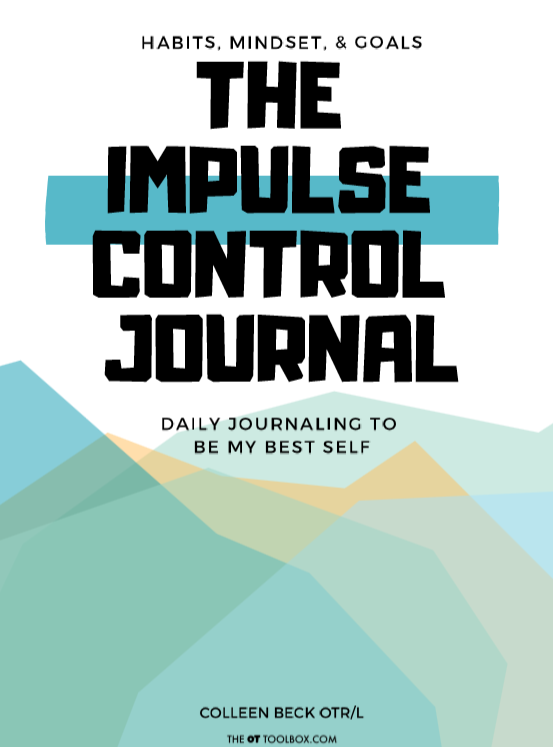
That’s why I created The Impulse Control Journal.


The Impulse control journal is a printable journal for kids that helps them to identify goals, assess successes, and address areas of needs.  The Impulse Control Journal is a printable packet of sheets that help kids with impulse control needs.

The Impulse Control Journal has been totally revamped to include 79 pages of tools to address the habits, mindset, routines, and strategies to address impulse control in kids. 
 
More about the Impulse Control Journal:
  • 30 Drawing Journal Pages to reflect and pinpoint individual strategies 
  • 28 Journal Lists so kids can write quick checklists regarding strengths, qualities, supports, areas of need, and insights 
  • 8 Journal worksheets to pinpoint coping skills, feelings, emotions, and strategies that work for the individual
  • Daily and Weekly tracking sheets for keeping track of tasks and goals 
  • Mindset,Vision, and Habit pages for helping kids make an impact 
  • Self-evaluation sheets to self-reflect and identify when inhibition is hard and what choices look like 
  • Daily tracker pages so your child can keep track of their day 
  • Task lists to monitor chores and daily tasks so it gets done everyday  
  • Journal pages to help improve new habits  
  • Charts and guides for monitoring impulse control so your child can improve their self-confidence  
  • Strategy journal pages to help kids use self-reflection and self-regulation so they can succeed at home and in the classroom  
  • Goal sheets for setting goals and working to meet those goals while improving persistence  
  • Tools for improving mindset to help kids create a set of coping strategies that work for their needs  
  
This is a HUGE digital resource that you can print to use over and over again.  


There are so many strategies to address attention in kids and activities that can help address attention needs. One tactic that can be a big help is analyzing precursors to behaviors related to attention and addressing underlying needs. 

Know a child who struggles with impulse control, attention, working memory or other executive functions?Let’s talk about what’s going on behind those impulses!
FREE Email Mini-Course


    We won’t send you spam. Unsubscribe at any time.

    Colleen Beck, OTR/L has been an occupational therapist since 2000, working in school-based, hand therapy, outpatient peds, EI, and SNF. Colleen created The OT Toolbox to inspire therapists, teachers, and parents with easy and fun tools to help children thrive. Read her story about going from an OT making $3/hour (after paying for kids’ childcare) to a full-time OT resource creator for millions of readers. Want to collaborate? Send an email to contact@theottoolbox.com.
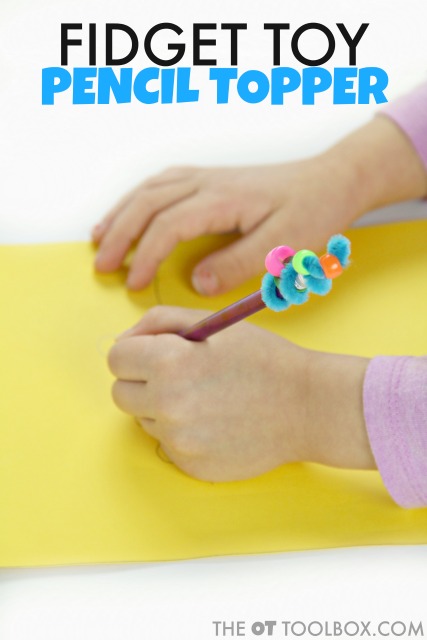
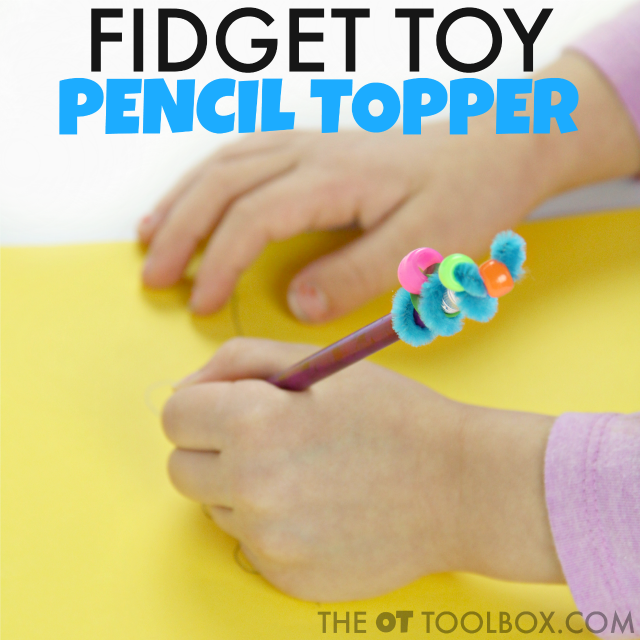
    DIY Pencil Topper Fidget Toy

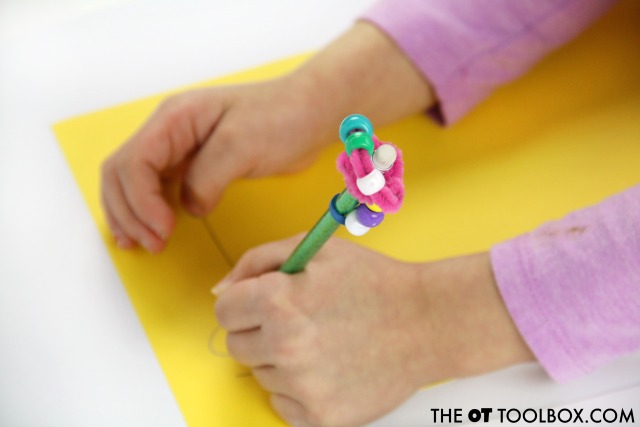
    Today, we have a DIY pencil topper fidget toy. This DIY pencil topper fidget toy is an occupational therapy toy that can be just the tool to help kids write and focus on their writing assignment or the classroom activities.  

    Sensory needs may impact a child’s ability to attend or a child may present with a typically developed sensory system and show signs of fidgeting during classroom work.  

    Whether your child has sensory needs or not, a fidget tool is many times just the tool for helping with extra wiggles and movement needs that interfere with handwriting and therefor learning in the classroom. is actually a tool that supports handwriting and self-regulation, but also other areas like fine motor skills. Sometimes handwriting difficulties stem from lack of attention to the task at hand.  

    This DIY pencil topper fidget toy can be just the tool to help kids write and focus on their writing assignment or the classroom activities.  

    Sensory needs may impact a child’s ability to attend or a child may present with a typically developed sensory system and show signs of fidgeting during classroom work.  Whether your child has sensory needs or not, a fidget tool is many times just the tool for helping with extra wiggles and movement needs that interfere with handwriting and therefore learning in the classroom.


    Kids can make a DIY pencil topper fidget toy to help pay attention and focus in the classroom with sensory feedback.

    DIY Pencil Topper Fidget Toy

     
    This post contains affiliate links.
     
    There are many fidget toy pencil toppers available on the market.  Kids use them to keep their fingers busy and their mind’s engaged in the classroom environment.  From the wingnut, nut, and bolt variety to the simple ball-type toppers, pencil topper fidget toys are a classroom tool for providing sensory feedback in a non-distracting way.
     
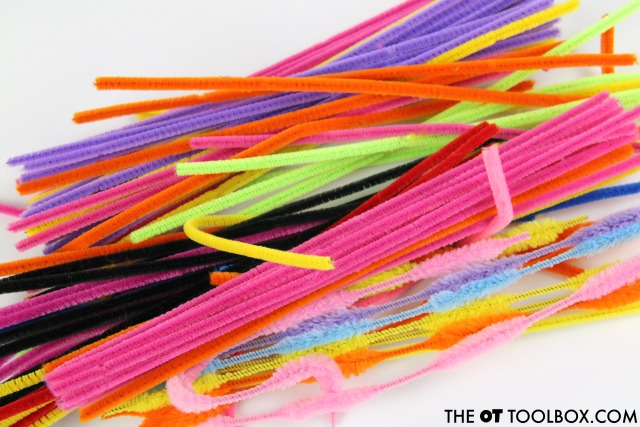
    We decided to make a couple of our own pencil toppers using materials from our craft bin.  This would be a great activity for the whole class and a way to sneak fine motor skills into the day.  Kids can use the pipe cleaner and bead fidget toy as a way to help with attention and movement needs.


    Use this attention tool is a DIY fidget toy in the classroom or in the home. 
     

    To make the DIY fidget toy pencil toppers:

    You’ll need just a few materials.
    Pipe cleaners (We received ours from www.craftprojectideas.com)
    Pony beads (also from www.craftprojectideas.com)
    Rubber bands

    Kids can make a DIY pencil topper fidget toy to help pay attention and focus in the classroom with sensory feedback.


    Use rubber bands and beads in a DIY pencil topper fidget toy to help kids pay attention when writing at school.
     
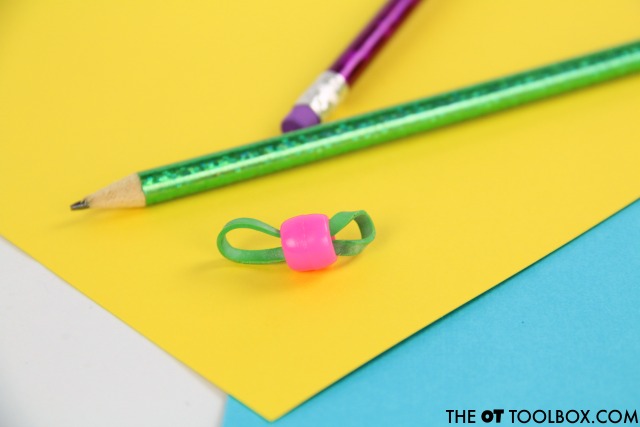
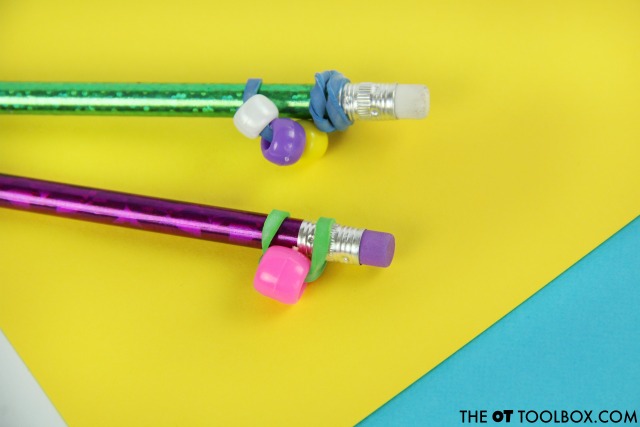
    First, thread a rubber band through one of the pony beads.  You can show your student’s how to do this task to promote a tripod grasp and bilateral hand coordination.  Kids can add as many pony beads as they like to the rubber band.  Then, wrap the rubber band around the pencil topper. 

    Help kids pay attention and focus with a pencil topper fidget toy.
     
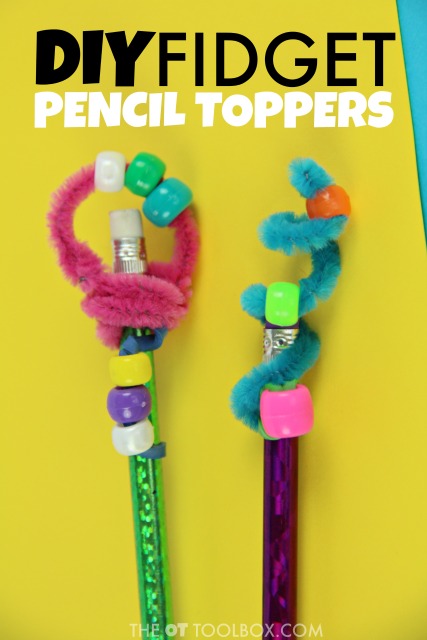
    Next, add pipe cleaners.  Kids can be as creative as they like with the pipe cleaners, beads, colors, and other embellishments. 

    Help kids pay attention and focus when writing at school with a DIY pencil topper fidget toy.
    Threading the beads onto the pipe cleaners and bending them to stay on the pencils is a great way to boost those fine motor skills in kids.  Try making these pencil toppers as a classroom project that the whole class can use.

    Use a pencil topper fidget toy to help kids focus and attend at school


    Want to try some of the pencil toppers that are on the market?  Here are some great ones:

    amzn_assoc_placement = “adunit0”;
    amzn_assoc_tracking_id = “sugaun-20”;
    amzn_assoc_ad_mode = “manual”;
    amzn_assoc_ad_type = “smart”;
    amzn_assoc_marketplace = “amazon”;
    amzn_assoc_region = “US”;
    amzn_assoc_title = “My Amazon Picks”;
    amzn_assoc_linkid = “90497b1110e8a6d7aa1fccbf27148561”;
    amzn_assoc_asins = “B01FJ8S9L4,B0043O7JD0,B0042ST1EM,B008A5P7BY”;
    amzn_assoc_search_bar = “true”;


    Students can make a DIY pencil topper fidget toy to focus and pay attention during handwriting given sensory input.
     
    Need more fidget ideas for the classroom?  Try these:


    Desk Fidget Toy


    Key Chain Fidget Toys


    Fidgeting During Homework


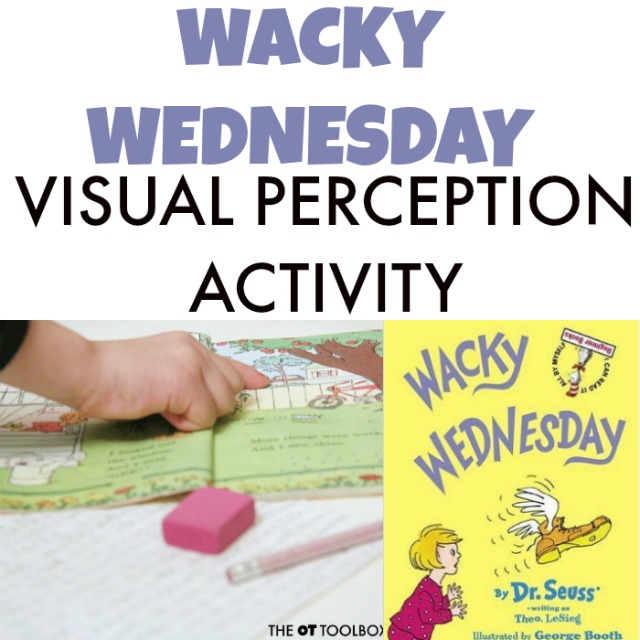
    Wacky Wednesday Visual Perception Activity

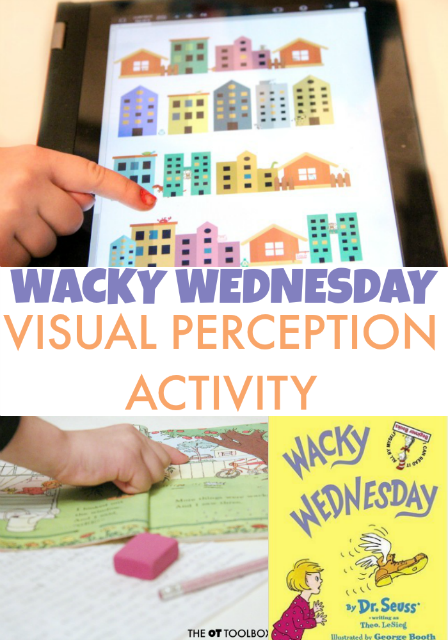
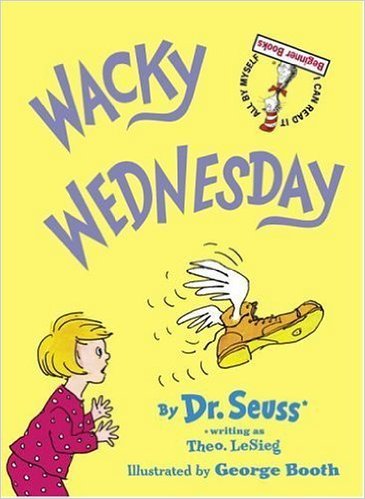
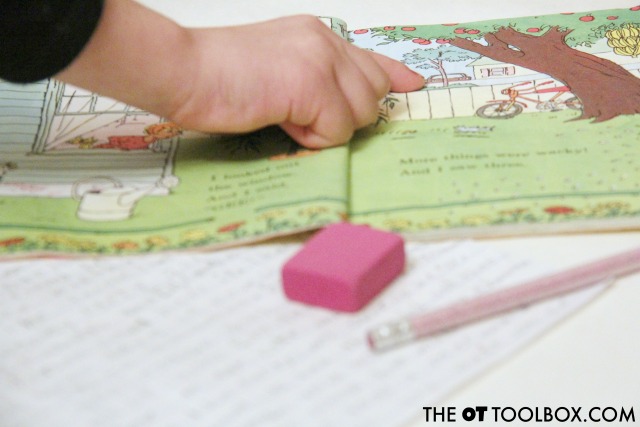
    Sometimes you have a book that is just so loved.  We have a few VERY loved books in our house and one of those books with the dog-eared corners is Dr. Seuss’ Wacky Wednesday.  We used the book in a visual perceptual activity and worked on the skills needed for handwriting.  Visual perception is made up of many different skill areas that are used in virtually every functional task we perform.  Handwriting is just one of those tasks that relies on appropriate development of visual perception.  Kids can use creative activities like hidden pictures and books like Wacky Wednesday to improve visual perception.  Try this Wacky Wednesday Visual Perception Activity and have fun working on handwriting skills in a wacky way!


    Kids love this Wacky Wednesday Visual Perception activity while working on visual perceptual skills.


    Wacky Wednesday Visual Perception Activity

    This post contains affiliate links.
     
    Wacky Wednesday visual perception activity based on Dr. Seuss books
     
     
    Dr. Seuss writes as Theo LeSieg in his book, Wacky Wednesday.  It is perfect for developing visual perception.  The book uses humor through hidden pictures to encourage readers to visually scan and locate weird, wacky, and out-of-place items.  Each page is like a puzzle that will have your kids pouring over the pictures until they find all of the wacky images.  

    Visual Perceptual Skills Developed by Completing Hidden Pictures

    Hidden pictures and visual scanning activities like the pages of Wacky Wednesday are great ways to encourage the development and strengthening of visual perception skills.  
     
    When kids complete hidden picture puzzles, they strengthen many of the visual perceptual skills needed for handwriting and other functional tasks:
    Visual Memory
    Visual Closure
    Form Constancy
    Visual Figure-Ground


    Visual Perception Skills

    Visual perceptual skills are addressed by completing hidden picture puzzles. Kids visually scan pictures and find hidden items, locate unusual images, and store those pictures in their mind’s eye.  Hidden pictures are a valuable tool for addressing the visual perception skills needed for handwriting.

    Build these Visual Perception Skills by working on hidden picture puzzles

    Visual Memory– This is one’s ability to store visual information in short term memory.  This skill allows us to recall visual information.  When completing hidden picture puzzles, kids visually store images of items they are looking for when scanning to locate a specific shape or image.  This skill is necessary for handwriting tasks when copying information from a source, such as lists of words, homework lists, and copying sentences. 
     
    Visual Closure– This visual perceptual skill allows us to see part of an object and visualize in our “mind’s eye” to determine the whole object.  When we see part of an item we use visual closure to know what the whole item is.  This skill requires the cognitive process of problem solving to identify items.  Visual Closure is used to locate and recognize items in a hidden picture puzzle.  In written work, we use visual closure to recognize parts of words and letters when reading and copying work.
     
    Form Constancy– This skill allows us to visually recognize objects no matter their orientation.  When completing a hidden picture puzzle, children can recognize the missing object whether it is upside down or sideways.  In handwriting skills, we use this ability to read and know letters and numbers no matter which direction we see them. 
     
    Visual Discrimination–  This visual perception skill enables us to determine slight differences in objects.  In hidden picture activities, this skill is needed to determine and locate different hidden objects.  When writing and reading, visual discrimination allows us to perceive the difference between “p” and “d”.
     
    Visual Figure-Ground–  This skill enables us to locate items in a busy background.  Finding hidden items in a hidden pictures puzzle works on this skill by visually scanning and identifying items within a busy scene.  In handwriting, visual figure ground is necessary for copying written work from a model and locating the place left off when shifting vision.
    Try this wacky Wednesday visual perception activity to address the skills needed in handwriting.


    Wacky Wednesday Visual Perception 

    The book is one that we were handed down in a bin of clothes and toys that another child had outgrown.  It was apparent that the copy of Wacky Wednesday was a favorite book for this other child.  When we started reading it, we were hooked too!


    Use the book to visually scan and locate funny items while addressing the visual perceptual skills needed for handwriting.  Then, ask kids to use those funny items they’ve found to work on handwriting skills.  Kids can list out the funny items that are wacky.  So, while searching and finding the funny images on each page, they can build the visual perceptual skills needed for handwriting.  Then, they can visually shift to write lists while addressing neatness and legibility in written work.  

    Address visual perception with the book Wacky Wednesday.


    Many times, a motivating subject or activity can be just the thing that helps kids want to practice handwriting.  Use the funny book that is Wacky Wednesday as a motivator.

    If you are looking for more creative ways to work on the visual perception skills addressed in hidden pictures and relay them into handwriting skills, you are in luck! 

    Work on visual perception with hidden pictures.


    Hidden Pictures Handwriting Workbook

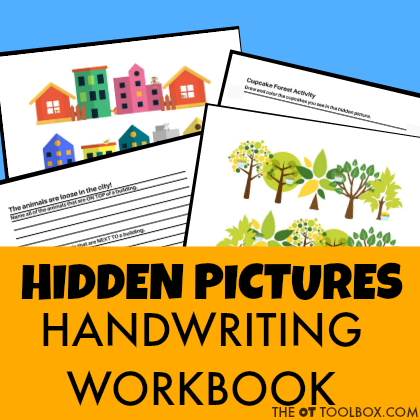
    I’ve created this Hidden Pictures Handwriting Workbook to address visual perceptual skills through hidden pictures.  In this workbook, you’ll find two separate puzzles and related handwriting activities that can help kids address the visual perceptual skills noted above.  By completing this 11 page workbook, kids can use creative handwriting activities and themed writing prompts to practice written work in a fun way.  

    Hidden pictures visual perception workbook to help kids work on the visual perceptual skills needed in handwriting


    What’s in the Hidden Pictures Handwriting Workbook?

    • 11 pages of activities
    • 2 hidden pictures puzzles
    • 8-9 themed writing prompts for each puzzle
    • Activities to promote visual shift, visual memory, visual discrimination, visual-figure ground, and form constancy
    • Digital file that you can print or use on your tablet


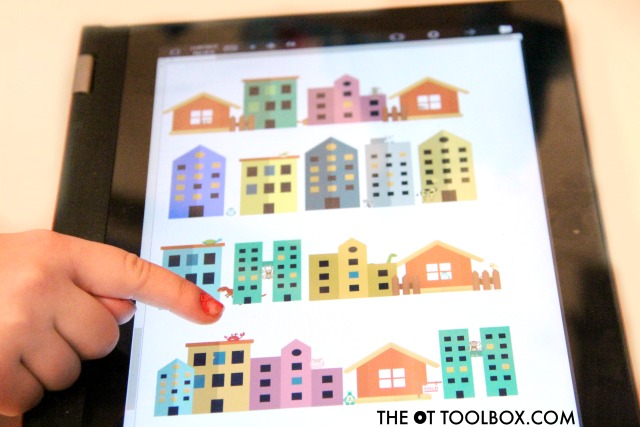
    We used the Hidden Pictures Handwriting Workbook on our touch laptop screen. Using the workbook on a tablet or touch device allows kids to visually scan and address those visual perception skills without printing out the color images.  


    This would be a great activity for a group in the classroom or for kids who need an at-home activity.

    Visual perception hidden pictures printable workbook for kids who are working on handwriting.


    This is a digital file.  


    Get your copy of Hidden Pictures Handwriting Workbook for $4.99.


    Hidden pictures visual perception handwriting workbook for helping kids address the skills needed in handwriting.


    Looking for more ways to celebrate Dr. Seuss?  Try the books in the Virtual Book Club for Kids series:


    Green Eggs and Ham Letter Practice from Still Playing School

    Alphabet Puzzles from Sea of Knowledge

    Would You Eat This? A Green Eggs & Ham Activity from Sunny Day Family

    Horton Hears a Who Listening Activities from JDaniel4’s Mom
    Dr. Seuss Sensory Play with Kinetic Sand from The Educators’ Spin On It
    Lorax Cause and Effect Matching Game from Inspiration Laboratories

    Ten Apples Up on Top Printable Math Activity from The Moments at Home


    Cat in the Hat Inspired Popsicles from View from a Step Stool


    VPFree


    If you are looking for ways to work on visual perceptual skills and visual motor skills, you are in the right place.  You should have an email in your inbox right now with a link to access your free visual perceptual printable sheet, but if you would like to grab it from this page, just click on the link below.  


    This page will be updated soon with lots more creative ways to work on visual perceptual and visual motor skills.  For now, try some of our favorite visual motor activities.  


    Get your resources here:

    Visual Perception Match-Up Sheets:  

    Impulse Control Freebies

    Congratulations! You’ve been registered for our Impulse Control Mini-Course! 


    Here is what you’ll discover in the mini-course:

    ++ The “why” behind impulsive acts like hitting, running through a busy parking lot, biting, acting out, interrupting, or other impulse control issues.

    ++ Actionable ways to help the child with self-control difficulties

    ++ Strategies can be used to provide guidance in appropriate impulse control techniques


    ++ Tips and tools for incorporating impulse control strategies into the classroom, home, or community for better learning, transitions, task completion, and safety


    Check your email for the first email in this mini-course. That email will have a link to access the free impulse control resources.

    This email course and the free printable tools in this series will include information related to understanding and addressing impulse control challenges. 


    You’ll access helpful techniques that can help kids (and adults) with self-monitoring, controlling urges, and resisting impulsiveness that gets them in trouble in the classroom, with behaviors, talking out, inappropriate words, or other impulse control issues.  


    If you landed here by accident and missed the chance to enter your email for the free email mini-course and free impulse control tools, be sure to do that HERE.


    You’ll love some of our other impulse control strategies, including how to teach impulse control  and strategies to teach impulse control in the classroom.


    Here are the free offers we’ve got on the site so far.  More will be added to this library.


    FREE Resource: Strategies for Impulse Control in the Classroom

    FREE Resource: Impulse Control Handy Chart

    Because impulse control is deeply connected to the other executive functions, you’ll want to visit our executive functioning skills page where all of those activities and strategies are located.  

    You can always follow our Executive Functioning Skills Toolbox Facebook Page for lots of resources related to impulse control and other executive functions.


    See you in the email mini-course!
    Colleen

    Free Classroom Sensory Motor Ideas

    When it comes to classroom learning ideas, free and cheap ways to help kids learn are the way to go. I’ve seen many teachers who use their own income to purchase supplies to better their classroom or help their student’s educational needs.  Most teachers that I know love any tricks that will help their students learn, focus, and pay attention during the school day.  Adding movement and sensory input into the classroom is a way to help kids pay attention through multi-sensory experiences.  Kids respond to sensory input and motor-based learning and may retain information better when learning new information.  Try these free classroom sensory motor ideas and inexpensive ways to add sensory motor input into the classroom.


    Free classroom sensory motor ideas for helping kids learn and pay attention with motor movement and sensory input.


    Free and Cheap Classroom Sensory Motor Ideas


    These activities are easy to add into classroom lesson plans.  Most of these free classroom sensory motor ideas use tools that are already in the classroom or don’t require any extra items at all!


    Affiliate links are included in this post.


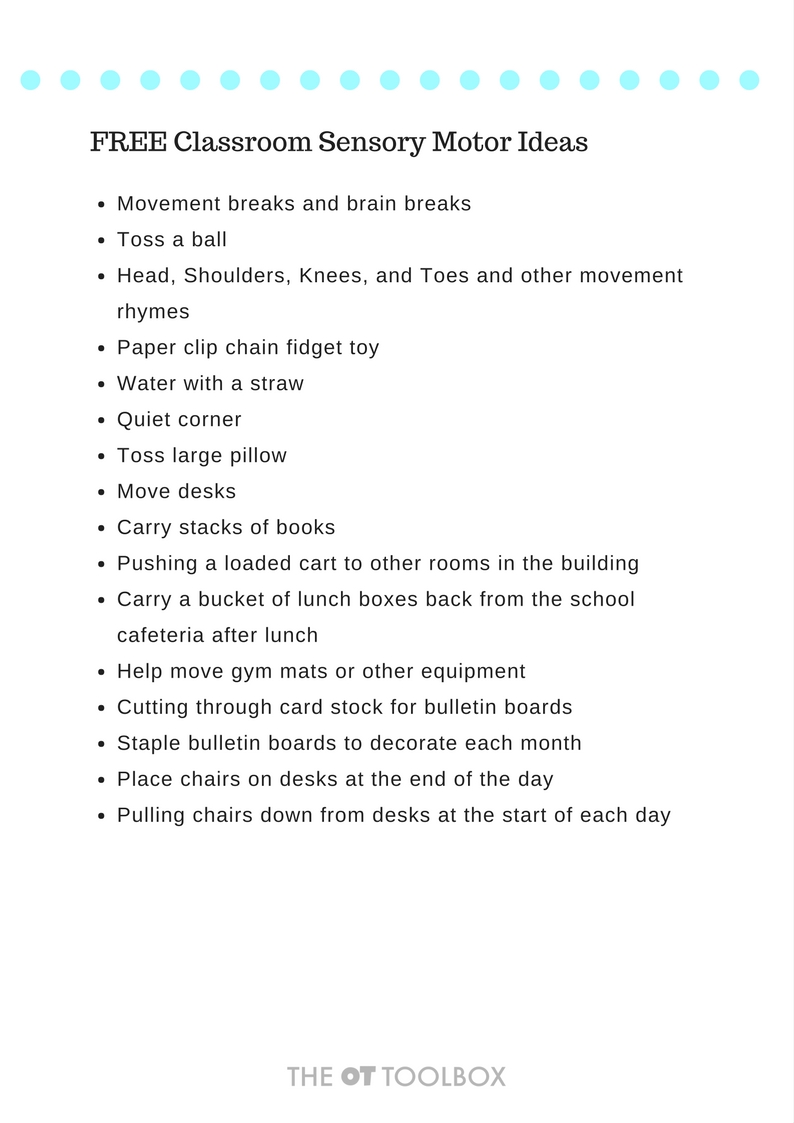
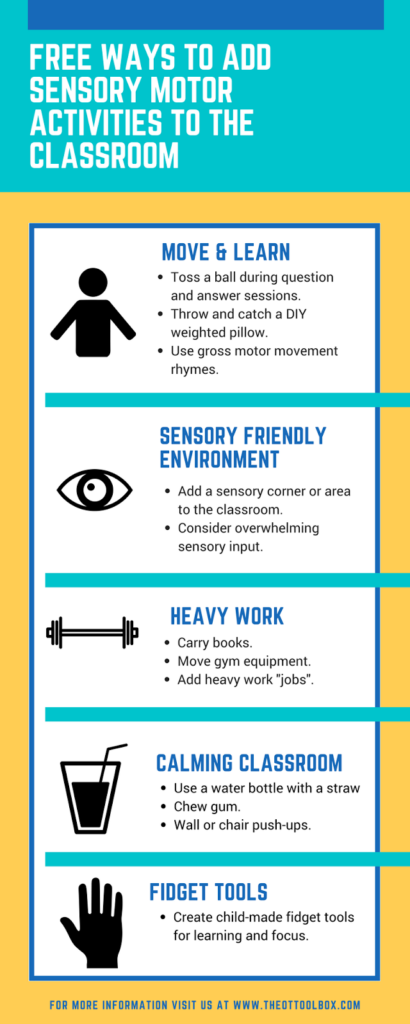
    Movement breaks–  Schedule brain breaks or movement between activities, before handwriting.  Try these handwriting warm-up exercises.


    Toss a ball–  When kids are answering questions, toss them a soft ball.  Then can catch it and then answer the question.  Stand close (tossing a ball across the room might not be a great idea).  Use a soft ball like these water balls. Dollar stores have these types of balls available during summer months.  Or, use a ball from the school’s gym/recess supplies. 


    Head, Shoulders, Knees, and Toes–  The movement song “Head, Shoulders, Knees, and Toes” makes a great learning rhyme.  They words can easily be substituted for math facts, vocabulary words, or other terms that need to be memorized.  Add the movements to the song to make it a gross motor activity.


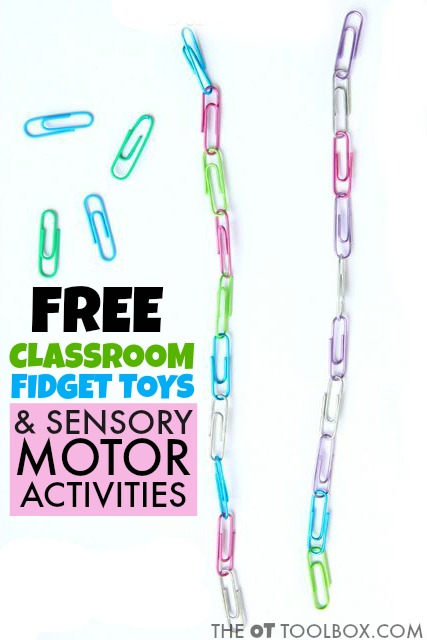
    Paper clip chain fidget toy–  Kids can make a short paper clip chain fidget toy that can be used as a learning tool and as a sensory fidget tool.  The paper clips can be stored in the students’ desks or pencil boxes and used as a fidget toy during learning.  They can serve another purpose as math manipulatives or for hands-on sight word activities with play dough.  Use the paper clip to hold sight word flash cards and press them into play dough.  When children make their own paper clip chain, they are building fine motor skills, too.


    Try any of these DIY fidget toys as an option that would work in the classroom or in the home. 

    Water with a straw–  The whole class can benefit from the calming oral motor benefits of sucking from a straw.  Add ice cubes for an alerting tool.  This is certainly not easy to accomplish in most classrooms, but something to keep in mind.


    Try these alerting snack ideas.


    Quiet corner–  Use a cardboard box to create a quiet corner that students can climb into.  Add blankets, soft pillows, and twinkle lights.  A small bin of books and a box of calming sensory tools are great additions.  This can be a place that kids go to whether they have sensory issues or not.


    Toss large pillows–  Use bed pillows with a pillow case and light weights added inside the pillow case.  A bag of dry beans or rice work well as weight.  Sew the pillow case shut and then place the whole weighted pillow case inside another pillow case that can be washed as needed.  This weighted pillow can be used during question and answer sessions like the first example above.  Tossing the pillow back and forth is a great way to add heavy work into the classroom.  Students can even line up in two lines and toss the pillow back and forth to other students during the lesson.  When not being used in learning activities, the DIY weighted pillow can be used in the calm down corner of the classroom or placed on student’s laps who need a little more calming proprioception during the school day.


    Chew gum–  Chewing gum is an inexpensive way to add calming proprioception to learning activities.  Chewing gum has been shown to increase alertness.  Use sugar-free gum.  While this isn’t a completely free activity, it is an inexpensive tool for sensory input in the classroom.


    Heavy work jobs–  Students can be an active part of the classroom, helping out to keep the room in order.  Proprioception activities that can easily be added to the classroom include: moving desks, carrying stacks of books, pushing a loaded cart to other rooms in the building, bringing a bucket of lunch boxes back from the school cafeteria after lunch, helping to move gym mats or other equipment, cutting through card stock for bulletin boards, stapling bulletin boards to decorate each month, placing chairs on desks at the end of the day, and pulling them down at the start of each day.

    Free ideas to add sensory motor ideas into the classroom


    Get the above list in a printable version for the classroom.  This is a free resource for parents, teachers, and therapists.  Click Here to Get the Free Printable sheet.


    Click the image above to get your free printable sheet.  This is perfect for adding to school recommendations, handing out to teachers, and using in consultation services.  

    Free classroom sensory motor ideas for school


    Sensory Pre-Handwriting Activity Rice Table

    Getting kids to learn to write (or want to practice handwriting skills) can be a tricky task.  It’s important to start off younger kids on a positive foot when it comes to handwriting practice.  What child wants to trace slant after slant or letter after letter on a worksheet?  This sensory pre-handwriting activity is great for younger children who are learning and developing the skills needed for written work.  From tracing lines to forming simple forms, a sensory medium can make fine motor work fun.


    We used a rice table for this activity.  It was VERY easy to set up and an activity that we will be doing again and again.  The nice thing about creating sensory modalities with items like dyed rice is that you can save them for a while and re-use them over and over again.


    Rice sensory table for pre-handwriting activity


    Sensory Pre-Handwriting Activity Rice Table

    You can make a sensory writing table with a variety of materials.  We used dyed rice.  To make the rice, simply pour a few cups of rice into a plastic bag.  Add food coloring and a few drops of water.  Seal up the baggie.  Shake it, roll it, and toss it to cover the rice with color.  This is a fantastic gross motor activity for kids.  When the rice is coated with color, spread it out on a paper towel on a counter top and allow it to dry.  

    Once the rice is dry, spread it out on a table surface.  Now, start playing!  We’ve done a bunch of writing trays in the past.  The nice thing about playing on a table top is there is no lip to a container to worry about.  An edge of a tray can interfere with hand and wrist positioning, making grasp and letter formation awkward.  if you are worried about the mess, lay a sheet down on the floor under the table.  You can also work on a large sheet of poster board.  That way, when your child is done playing, use the poster board to gently fold the rice back into the baggie. 


    Kids love this sensory pre-handwriting activity rice table for improving fine motor skills.


    Use this sensory table to work on many skills:

    Click the links below to read more about each sub-skill needed for development of pencil grasp and pre-handwriting skills:
    Bilateral coordination
    Hand grasp
    Pinch strength
    Dexterity
    Visual motor integration
    Finger isolation
    Tactile tolerance
    Letter formation
    Arch development

    Kids can spread the rice around with both hands.  Ask them to create symmetrical patterns with their hands and ask that they look at their hands and not the shape that is being made.  This activity requires peripheral vision and encourages visual motor integration.


    Sensory Pre-Handwriting Activity

    To work on pre-writing skills, write lines and shapes on a piece of paper and slide it under the rice.  Kids can seek and find the line or you can find the starting point of the form and ask them to create it.  Watch the video below for more information on this activity.


    Use a sensory pre-writing activity rice table to work on pre-writing pencil strokes.


    Pinch and grip strength pre-handwriting activity

    Use the rice to build those little muscles!  Squeezing the rice with both hands is a grip exercise with a tactile component.  Let the rice slip through the fingers and from one hand to another with a “hand funnel” (Check out the video to see this in action!).  This is a fantastic way to work on arch development in the hands.  

    Address pinch grip by squeezing the rice between the fingers and thumbs.  You can address neat pincer grasp to pinch and move individual pieces of rice, too.  

    There are so many ways to use this easy rice table in pre-handwriting activities!  The kids will love the open-ended play that doesn’t seem like handwriting practice. 


    See this handwriting sensory activity in action! Click to watch the video: 


    This sensory pre-handwriting activity rice table is perfect for kids working on fine motor skills.


    Try these sensory-based activities to work on letter formation, pre-writing handwriting, and play-based writing activities:


    Use Writing Trays for Handwriting


    Pencil Control Worksheets You Can Make At Home uses the sense of sight with bright and high-contrast lines for working on line awareness, pencil control, and motor planning when writing.

    Tracing Letters: Letter Formation Handwriting Practice with Chalk uses the proprioceptive and tactile senses to write with chalk on a bumpy and hard sidewalk.  Up the textures by using wet chalk!

    High-Contrast Letter Formation is one of my favorites from this blog!  Use a black material (do you know what we used?) on a white surface for high visual contrast with an olfactory power punch!