Activity Analysis

Activity analysis

Oh, the activity analysis.  If you’re an OT practitioner you know exactly what we’re talking about.  If you’re not, let us enlighten you with this blog post. Occupational therapy and activity analysis go hand in hand and the process of breaking down a functional task into components and underlying factors is a skill that is developed long before the graduation cap and gown are donned by the OT practitioner! Let’s cover this very skilled concept so that analyzing activities is a breeze to grasp.

Activity Analysis

Let’s break down what activity analysis means. We can separate this term into two components (therefore completing an analysis of the very topic).

  1. First, an activity analysis is a process of breaking an activity down into its individual steps and its detailed subparts while examining all of its components with each activity being evaluated skillfully to determine its therapeutic value. Occupational therapy providers complete an activity analysis as part of evaluations, but also during and within every OT intervention and therapy session.

2. Second, the process of analyzing an activity in therapy is a highly involved process and requires the occupational therapy practitioner to be skilled in the analysis of all activities for their potential therapeutic value for every client. 

The analysis allows OT practitioners to consider the person (meaningfulness and motivation), task (along with supports or adaptations), and environment (the place the activity is occurring) to accurately address the barriers of a given activity and essentially gives us a path to follow when addressing the skills, demands, and access.

Another term for activity analysis is task analysis. Whether you’re analyzing a functional activity or a functional task, the important thing is breaking down the components of a functional skill (getting dressed, catching a ball, completing a specific exercise, sweeping with a broom, etc.) into all of the cognitive, motor, sensory, emotional, etc. components.

What does this mean?

Each activity and task is looked at with a critical OT eye, analyzed, and then determined if it is an appropriate activity or task for each client. Then the OT practitioner, who is skilled in implementing the task or activity, provides an ongoing analysis of the client’s reaction and performance and determines if changes need to be made to increase the therapeutic value or benefit.

So, if you see an OT practitioner playing toss and catch with a kiddo just know that the practitioner is targeting a plethora of skill areas and could be very different for each child. 

What does an Occupational Therapy Activity Analysis Look At?

So, what exactly is looked at in this process? Well, let’s say A LOT. There are many different formats for activity analysis and the therapist chooses the format and intervention approaches based on what they hope to elicit from each client.

Overall, each analysis should touch on the various activity components, any areas of occupation, client factors, activity demands, performance skills and patterns, and contexts and environments.

How to do an Activity Analysis

With this post, we will show you the basic format of such analysis to help you see the larger to smaller components of the process. At the end of the post, we will provide you links to sites that provide examples of activity and task analysis and other resources to help you gain an even better picture of the process and to facilitate your work as an OT practitioner.

The basic analysis components are detailed, but relevant to many activities utilized during therapy sessions.

Although it is time-consuming, most experienced OT practitioners can do an initial mental analysis with ongoing analysis throughout the session. This is important to be able to do but to get back to the roots of what makes our profession unique, the true activity analysis includes a slow, detailed approach to ensure factors are not missed and each component is considered carefully. 

Activity Analysis

The general factors for an activity analysis are:

  • activity name and description
  • supplies and space needed with any noted special considerations
  • any preparation work that is needed
  • determine the relationship the activity has with a major life occupation and/or role
  • age and gender appropriateness
  • make note of any special precautions that may be necessary
  • adaptation and grading consideration

The time factors for an activity analysis are:

  • activity length
  • number of major steps
  • length of time and number of sessions needed for each stage of the activity
  • determine if there is any potential for delays in the process
  • determine if the sequence of the stages in the activity is fixed or can be flexible
  • note if the speed of the activity is fixed or can be flexible

The sensory factors for an activity analysis are:

  • visual input or need for discrimination such as color or texture
  • auditory input or need for discrimination such as sounds or language
  • tactile input or need for discrimination such as temperature or texture
  • olfactory input or need for discrimination of different smells
  • gustatory input or need for discrimination of different tastes
  • proprioceptive input as necessary for positioning and movement
  • vestibular input as necessary for positioning and movement 
  • any pain considerations

The perceptual factors of an activity analysis include:

The position factors of an activity analysis include:

  • determining how the activity is usually performed 
  • consider all positioning needs of the activity to include the client, the activity, the tools, and materials
  • determine what is the most comfortable and most functional position
  • is it a bilateral or unilateral activity
  • consider if any standing or sitting balance is needed 
  • can the activity can be completed while lying down if needed

The motor aspects of an activity analysis include:

  • determine if the activity is primarily gross or fine motor and explain
  • list all types of movement needed and the repetition of each
  • identify any resistance to these movements and specify which
  • identify all fine motor or manual skills that are needed to complete the activity

Physical Considerations in an Activity Analysis

Here is a list of some of the physical aspects to consider:

Cognitive Components of an Activity Analysis

The cognitive aspects of an activity analysis include:

  • determine the different steps involved and if the directions are simple or complex and explain
  • level of comprehension needed
  • determine if any memory skills are needed
  • determine how much concentration and attention is needed
  • level of arousal needed
  • recognition skills needed
  • what cognitive motor skills are necessary
  • are any problem-solving skills needed and explain
  • are any time management skills needed
  • any other executive functioning skills required
  • sequencing skills needed

Social and Emotional Skills in an Activity Analysis

The social and interpersonal aspects of the activity analysis include:

  • determine if there are opportunities to learn from others, cooperate with others, compete with others, and/or socialize with others
  • determine if there are opportunities for self-expression
  • is it a dependent or independent activity
  • can the activity be adapted to promote or encourage more group relatedness

The emotional and psychological aspects of an activity analysis include:

  • determine if coping skills and frustration tolerance are needed
  • determine if any emotional control is necessary
  • does the activity provide for the expression of cultural values and interests, different feelings, and/or needs
  • does the activity provide for control of feelings
  • does the activity build trust
  • does it build independence
  • does it allow for creativity or is it a replication of a model

The summary of the activity analysis includes:

  • Describe what function the activity serves in daily life occupations and/or role performance
  • Note any therapeutic benefits the activity addresses
  • Note anything note previously mentioned, but needs to be stated

Now you can see the scrutiny that each activity and task can go through to be used for therapeutic intervention.  There are many tasks and activities out there with some being of more therapeutic value than others. The activity analysis is vital to the OT profession and we all need to make sure we give this process the time it deserves to ensure our services are of the most benefit to our clients. 

Activity Analysis Example

One way to better understand the task analysis process as a tool and a means to improve functional performance of skills is through an activity analysis occupational therapy example. This blog post covers a task analysis of the task of creating a wooden birdhouse. An activity like working with wood to create a craft can support development of goal areas.

Using an activity analysis example of a functional task can help further your understanding of the analysis process needed for therapeutic value in all settings.

Below are a few resources that can facilitate your journey and advance your therapy services, as an OT practitioner. They will help guide you in your efforts for determining the appropriateness of an activity or task for individual clients in particular settings. 

Regina Allen

Regina Parsons-Allen is a school-based certified occupational therapy assistant. She has a pediatrics practice area of emphasis from the NBCOT. She graduated from the OTA program at Caldwell Community College and Technical Institute in Hudson, North Carolina with an A.A.S degree in occupational therapy assistant. She has been practicing occupational therapy in the same school district for 20 years. She loves her children, husband, OT, working with children and teaching Sunday school. She is passionate about engaging, empowering, and enabling children to reach their maximum potential in ALL of their occupations as well assuring them that God loves them!

Theories of Play

theories of play

Occupational therapy practitioners study the theories of play extensively in their occupational therapy programs, and there is a reason why. Play is the occupation of a child.  Therapy models are based on play. It is the foundation for occupational therapy treatment. In order to truly understand and appreciate the value of play, it is important to understand the different theories of stages of play.  This article will review the more popular concepts among theory of play, to enhance your treatment methods and rationale. 

theories of play

Theories of play

What is the function of play?

Play is fun!  It is an important part of child development. Children’s play usually comes naturally, but for some, the concept of recreation needs to be enhanced, guided, or taught. This important occupation builds strength, balance, coordination, motor planning, cognitive development, and important social skills in young children.  Socially, play works on building confidence, problem resolution, turn taking, sharing, frustration tolerance, waiting, and about fifty other important skills.

OT practitioners know the basis for learning is through play age and stage by stage. There’s a reason why early childhood education is centered around play as a learning tool. It’s through pretend play, use of toys, and interaction with others that the work of the child is developed. 

The theories of play outlined below support play progression as it develops from individual exploration, to symbolic play, to parallel play, to group play. All of these different types of play are important to a child’s development, and foster mastery of cognitive skills, motor skills, social emotional learning, and more.

Let’s walk through each of the play theories outlined below and discover the role of play on children’s development. Each of these classical theories of play help to give us a bigger picture of the overall understanding of play. Not only that, but as occupational therapy providers working with children and families, we can grasp functional play based on psychoanalytic theories.

Occupational therapy practitioners can use an activity analysis to determine the components that are utilized in any given play activity.

Parten’s six stages of play

Some theories such as Piaget and Parten propose that children develop skills in steps.  Other theories look at overall play as a mechanism for learning, relying on culture and social skills.

  1. Unoccupied play. This stage is typically babies and toddlers.  They are relatively still, and their play is scattered. Children in this stage of play are typically exploring their environment, trying to make sense of their surroundings and their own environment.
  2. Solitary play. This type of play occurs when children entertain themselves without any other social involvement. Children in this stage might not notice others around them.  This worries adults, however this is a normal stage of development. Worry is warranted when a child does not move past this stage to engage socially with others.  Solitary play allows children to explore, master new skills, and practice before adding a difficult social element.
  3. Onlooker play.  Children in this stage learn by watching others play.  They are people watchers and this is a tool in their own learning. This is a natural stage of development where information is gathered about materials, social play, and their environment.  These are the children who often look as if they are not learning, then suddenly sing all of the songs once they get home. 
  4. Parallel play. Children in this stage play near each other, but not with each other. It can seem as if they are playing together, however they are often playing the same type of game, but not interacting socially.  Again this is a normal stage of development to be learned and moved through. Read about the development of parallel play in more detail.
  5. Associative play. This is the shift from playing near another person, to engaging with them.  Children start to become interested in the other players, and test the waters by engaging with them. This is not the final stage, as it is not organized and perfected yet. 
  6. Cooperative play. The last stage is about cooperative play between people. Interestingly, much of the play between young learners is anything BUT cooperative!  Part of the learning involves conflict, turn taking, sharing, disagreements, learning the rules, reading body language, and social cues.  During this stage, young learners may need guidance in understanding and navigating critical social skills.

These are stages of play development, however learners do not always move in the same direction as their peers, or stay in one stage.  A well developed child who is mastering cooperative play, may often find themselves being an onlooker at times, or engaging in parallel play. Adults do the same. This is expected, as long as learners are mastering all of the stages rather than becoming “stuck”.

Piaget’s Theory of Play

Jean Piaget developed his theory of play in 1936.  Over 75 years later therapy professionals still use his theory as the foundation for their treatment.   Mr. Piaget broke his theory of play into four components; the sensorimotor stage, the pre-operational stage, the concrete operational stage, and the formal operational stage. 

  1. The sensorimotor stage – ages 0-2 years. Children at this stage explore their world through their senses.  They use various senses to understand and make sense of their world.  Some children develop slower than others, still relying on this stage of development much later than two years.
  2. Pre-operational stage – ages 2-7 years. Children in this stage often engage in parallel play, near, but not with others.  They are very ego-centric at this stage, not understanding the feelings or behavior of others. Dolls, dress up clothes, blocks, fine motor manipulatives, constructive play, and books are engaging at this stage.
  3. Concrete operational stage – ages 7-11 years. At this stage children become problem solvers, asking many questions. They understand same/different, and that something can look different but be the same. Lego sets, model building, putting things together, and cooking are great activities to build this stage.
  4. Formal operational stage – ages 11 to adult.  People in this stage understand and engage in abstract thought.  They start to use strategy, thinking ahead, and multi-step projects. Chess, Sudoku, Rubiks cube, chapter books, and strategy games are popular at this stage.

Vygotsky Theory of Play

Lee Vygotsky developed his theory around the same time as Piaget.  He disagreed with Piaget’s theory.  Vygotsky believed development was only gained through language, community, and social development with other people. He theorized that babies are born with four necessary components of development: attention, sensation, perception, and memory.  

Vygotsky limited his scope of play to imaginative or pretend play as a method of learning. Pretend play is a way for learners to explore their world that is not directly in front of them, while developing critical language skills.

Adlerian Play Theory

“Adlerian theory is a holistic approach to psychology that emphasizes the importance of overcoming feelings of inferiority and gaining a sense of belonging in order to achieve success and happiness.”

Unlike the other theories described above, the Adlerian theory is a technique to work with individuals on development. There are four stages of the therapeutic process:

  • Engagement – the therapist (or another person) builds a relationship with the learner
  • Assessment – in this stage one tries to get information about their learner through an interview.  It might be taking family history, providing assessments, or talking through memories
  • Insight – this stage helps the learner gain insight about their thoughts and behavior. The therapist may offer interpretation, but it is important for the learner to draw their own conclusions
  • Reorientation – now that the learner has some insight into themselves, this last stage works on helping them develop new skills, habits, and behaviors

Play based therapy, or learning through play

While there are several theorists who believe in the power of play, some educators believe in learning and teaching through play.  Montessori and Froebel are two of these people.

Play-based learning supports the child as they explore different roles in pretend play, use imitation in learning new concepts, and incorporating multisensory learning as a tool for evolution of skill.

Montessori Theory

The Montessori theory is based on child-led play, in which the child is given opportunities to play.  The environment is adapted based on the level of the child.  The Montessori theory promotes sensory experiences as a tool for learning through play.

Children are grouped into age ranges of 3-4 years to promote learning from others.  While some children are conducive to this method of learning, critics suggest others need a more structured, direct approach. 

This article explores the Pros and Cons of Montessori Education.

Froebel’s Theory of Play

The basis of Froebel’s theory was that play is child-led.  Children are given “gifts” or tools to use such as blocks or crayons, to spark their play.  He developed many key principles for his theory:

  • Childhood should be valued as its own stage, not just a stepping stone to adulthood.
  • Play is vital to helping children learn how things work and about the world around them.
  • Children will all develop at different rates, and this should be respected.
  • Education should focus on what children can do, not what they cannot do.
  • Children’s emotional, mental and physical states are all of vital importance.
  • Children are heavily influenced by those around them, both adults and other children.

According to this site, Froebel’s play theory is made up of these principles:

  • Learning through play: Free play encourages the child to discover how things work, through purposeful activities which are active, hands-on and of interest to the individual child
  • Respect the individual’s developmental pace: Children learn at different paces.  Their development is more effective when allowed to learn at their own pace
  • Practitioners serve as a guide: Caregivers serve as a guide rather than a teacher, to help lead a child.  He believed children should make mistakes and learn through trial and error.
  • The classroom should be a prepared environment: Though free play is at the heart of Froebel’s play theory, the learning environment is carefully designed with the appropriate resources that are optimal for each child’s level of development.
  • The importance of movement: Froebel believed in movement. Outdoor play, running games, and large body movements are critical to learning

Other Theories of Play:

There are numerous methods and theories of play, beyond the ones highlighted above. A few of these include:

  • Susan Isaacs’ theory on play and the psychology of child development
  • Bronfenbrenner
  • Sigmund Freud
  • Erik Erikson’s Stages of Psychosocial Development
  • John Dewey’s theory on play being a catalyst to develop mentally and socially
  • Mildred Parten’s Social Behavior Theory of Play
  • Jerome Bruner’s Learning Theory in Education

The OT Toolbox has resources!

The Incredible Power of Play

Book – Exploring through Play

Beach Play for Kids

Play with Household Items

Floor Play for Babies

After reading through these, ask yourself, which theories do I follow?  My opinion of certain methods has changed over the years, as I have realized one size definitely does not fit all.  All learners grow at different rates and levels.  The importance is to understand the function of play, recognize if your learner is “stuck,” and promote growth.  

Victoria Wood, OTR/L is a contributor to The OT Toolbox and has been providing Occupational Therapy treatment in pediatrics for more than 25 years. She has practiced in hospital settings (inpatient, outpatient, NICU, PICU), school systems, and outpatient clinics in several states. She has treated hundreds of children with various sensory processing dysfunction in the areas of behavior, gross/fine motor skills, social skills and self-care. Ms. Wood has also been a featured speaker at seminars, webinars, and school staff development training. She is the author of Seeing your Home and Community with Sensory Eyes.

What Do Pediatric Occupational Therapists Do?

what do pediatric occupational therapists do

Pediatric occupational therapy (OT) is a branch of occupational therapy that focuses on helping children with various physical, cognitive, and developmental disabilities or delays to perform daily activities and tasks. Pediatric OTs and OTAs support children of all ages, from infants to adolescents, but also the families, caregivers, and, in the school-based occupational therapy environment, educators, paraprofessionals, and anyone that is on the child’s support team.

Pediatric Occupational Therapy

What is a pediatric occupational therapist is a question that comes up a lot. “Pediatric occupational therapist” may be a term you have come across before. But what does it mean, exactly? You may be one of many people thinking to themselves, my kid doesn’t need a job, so what do you do?

Related: Have a child in therapy? Read more about specific activities your child may do in occupational therapy sessions.

What do pediatric occupational therapists do


Occupational therapy can seem like a misnomer, because these therapists don’t necessarily help people maintain careers. Although – they can! Allow me to explain.

When you search the word ‘occupation’ on Merriam-Webster, the first definition they provide is “an activity in which one engages”. For ease of explaining, many occupational therapists choose to define occupations as activities, or as meaningful activities, that you regularly engage in.

Occupational therapists seek to improve one’s engagement with their
occupations, which does include the work that they do in their career.
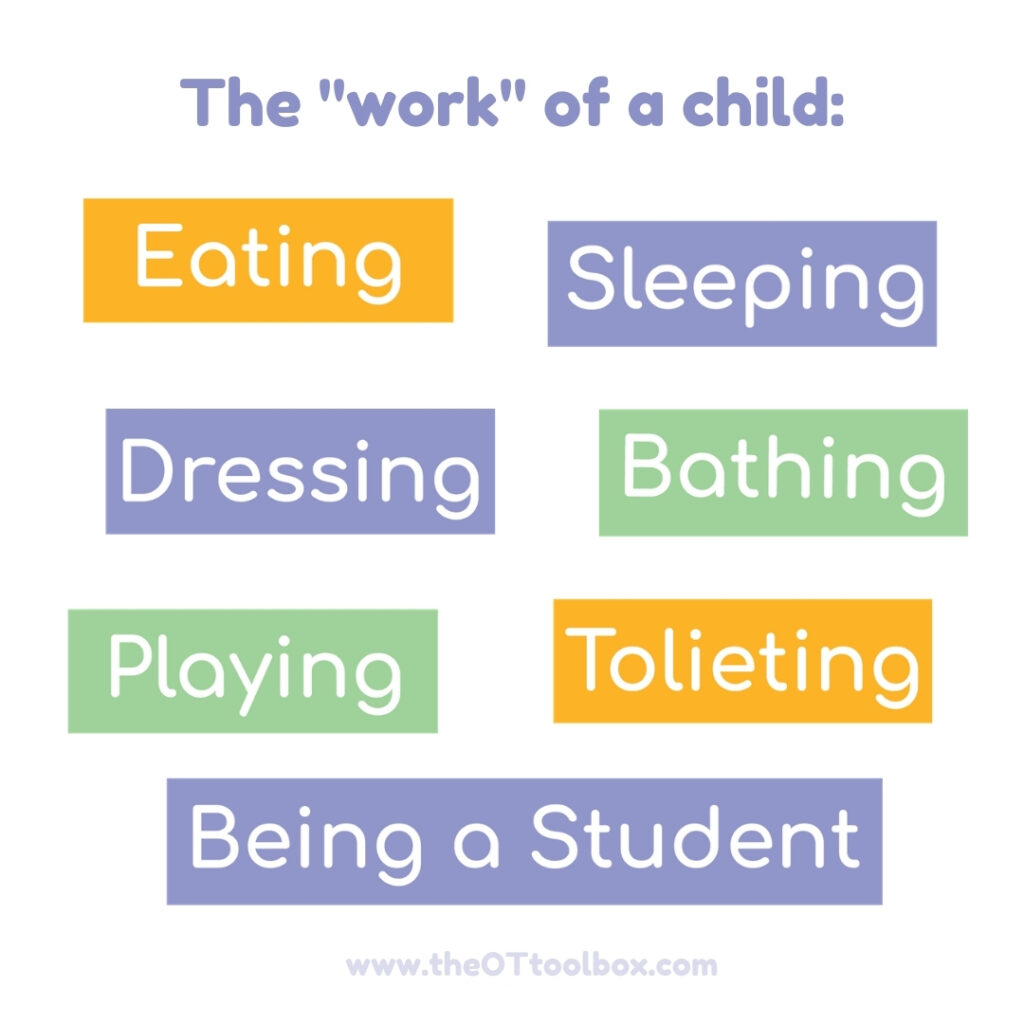
Pediatric occupational therapists do just the same, but for kids! They ensure that your child can best perform the occupations in their life. Below is a list of occupations that most children engage in.

All these occupations require many skills and abilities to successfully complete. To the untrained eye, it can be difficult to break down these everyday activities into their separate skills.


Occupational therapy practitioners complete something called an activity analysis to analyze the components of a single task.

They take something that can often feel automatic, like writing our names or putting on a shirt, and break it down into the smaller steps and skills that are required to complete the actions. The examples given, writing
one’s name or putting on one’s shirt, require gross motor skill, fine motor skill, intact cognition, and more.

Pediatric occupational therapists will evaluate a child for their fine motor skills, for example, so that they can determine their abilities to feed themselves, write in their role as a student, or manipulate small objects for play.


Additionally, your pediatric occupational therapist may address social and mental wellness needs of your child, as social and mental health is just as important to the engagement in occupations as physical health.

Pediatric occupational therapists help children achieve skills in functional tasks or their daily occupations. These are the things that occupy their time.

Does MY CHILD NEED OCCUPATIONAL THERAPY?


Your child may be recommended occupational therapy if they are showing signs of developmental delay in physical, social, emotional or mental domains. They may also benefit from occupational therapy to improve their handwriting , attention, or self-regulation.

Although each case is unique, occupational therapy is usually recommended to help your child become more independent. If your pediatrician or another health care professional suggests looking into
occupational therapy for your child, they will likely tell you why.

WHERE CAN MY CHILD RECEIVE PEDIATRIC OCCUPATIONAL THERAPY?

Pediatric occupational therapists provide their services in a number of settings. Many of them work in schools, outpatient therapy clinics, or in hospitals. Others work in community and home settings.

Occupational therapists provide interventions for people of all ages, and typically pediatric occupational therapists will serve newborns to age 18.

For those who are over 18, they are able to receive school-based occupational therapy services while they are still in high school, which can be up until age 21 or 22, depending on what state you live in.


WHAT Does an occupational therapy SESSION LOOK LIKE?


When your child first meets their pediatric occupational therapist, they will be evaluated. Typically, the first appointment is a bit longer than the ones that follow, so that a thorough evaluation can be done.

During that time, the therapist will use standardized and non-standardized assessments to determine where your child is physically, socially, emotionally, and/or mentally. Assessments may be done by the child on paper, or through a parent survey, or through therapist direction and observation.


Occupational therapists always strive to be evidence-based and client-centered in their practice. This means that whatever assessments and treatments they use with your child are backed by research and experience (evidence-based) and are specifically geared toward your child’s interests and needs (client-centered). Depending on the child’s age, interests and abilities, pediatric therapy can often look and feel like playing.

Read about occupational therapy play here.


In order to keep a child motivated, familiar tools are often used in therapy. Things like blocks, Legos, trampolines, Play-Doh, puzzles, scooters, beads, and gym mats can be found in just about any pediatric therapy clinic. The therapy that your child receives depends on the following factors: their therapeutic needs, your goals for therapy, the treatment setting and available materials, and the reimbursement coverage.


WHAT do PEDIATRIC OCCUPATIONAL THERAPISTS DO?

Now that we have laid some groundwork for what occupations are, where pediatric occupational therapists work and why a child may receive treatment, we can discuss all that pediatric therapists do. They help kids gain skills in functional tasks.

The goal of pediatric OT is to help children achieve independence and improve their quality of life by addressing their unique needs and challenges.

Pediatric OTs use a variety of techniques and tools, such as sensory integration therapy, play-based therapy, fine motor skill development, and adaptive equipment to help children achieve their goals.

This includes:

  • Play
  • Self-care skills- getting dressed, grooming, bathing, caring for oneself and the tasks associated with self-care
  • Feeding and eating
  • Learning and being a student
  • Leisure activities
  • Sleep
  • Toileting and potty training

And all skills or aspects that allow kids to perform these “jobs”:

  • Motor development and motor planning
  • Feeding and oral motor skills
  • Cognitive development
  • Visual processing skills
  • Sensory processing
  • Self-regulation
  • Social and emotional skills
  • Emotional-regulation
  • Social participation
  • Executive functioning skills- organization, attention, working memory, planning, prioritization, impulse control, and other skills
  • Fine and gross motor skills
  • Safety in the home and community
  • Balance and coordination
Occupational therapists work with kids on daily occupations or daily skills that make up the child's day.

Pediatric occupational therapy providers do all of this and more. They screen and evaluate clients, write treatment plans and achievable goals, educate families and teachers, consult with other therapists and social workers, supervise Certified Occupational Therapy Assistants (COTAs), and determine the best possible path for your child. And then, when that path doesn’t work, they modify and try again.


What do pediatric occupational therapists do? They do all that they can to help your child be as successful as possible.

Pediatric Occupational Therapy FAQ

A few key and important points about pediatric occupational therapy can help to better explain pediatric OT.

Who does pediatric occupational therapy providers work with? Some of the conditions that pediatric OTs may treat include autism spectrum disorders, cerebral palsy, developmental delays, Down syndrome, sensory processing disorders, and more. Pediatric OTs also work closely with those who support their clients, including: parents, caregivers, teachers, and other healthcare professionals to create individualized treatment plans that address the child’s specific needs and goals.

In addition to helping children with physical and developmental disabilities, pediatric OTs also assist with emotional and behavioral issues that may affect their ability to function and participate in daily activities.

Where do pediatric occupational therapy providers work?

Pediatric OTs may work in a variety of settings, such as schools, early intervention settings in homes, hospitals, clinics, outpatient clinics, and private practices.

In the school setting, pediatric OTs and OTAs may support clients in the classroom (also called a push in model of therapy service) or in a pull out setting, depending on the needs. School based OT providers support students with education so that they can reach their full capacity.

Common areas addressed includes:

  • Handwriting
  • Fine motor skills impacting pencil grasp, cutting with scissors, manipulating school materials
  • Self-regulation needs
  • Clothing fasteners and self-care related to toileting or changing clothing for gym class
  • Eating and managing food containers in the school lunch room
  • Organizational needs related to executive functioning issues
  • Other areas

School based OT can include early intervention in the preschool setting, early school years (kindergarten through primary school), middle school OT, high school OT, and even transitions post-high school

In the outpatient setting, a medical model of therapy can be addressed in the pediatric occupational therapy setting. These areas may include:

  • Physical dysabilities impacting functional tasks
  • Sensory processing needs/sensory integration
  • Feeding skills
  • Fine motor skills impacting functional performance
  • Gross motor development
  • Balance, coordination, mobility, etc.
  • Executive functioning skills
  • Social emotional development
  • Sleep
  • Behaviors impacting functional participation
  • Many other goal areas!

What does a pediatric occupational therapy professional do in therapy sessions? Pediatric OTs often focus on helping children develop daily functional areas, and depending on the setting (school based OT or outpatient), this can differ vastly with the educational model of OT vs. the medical model of occupational therapy. Common areas addressed in pediatric occupational therapy includes: self-care skills, such as dressing, eating, and toileting, which can have a significant impact on their daily lives.

Finally, pediatric OT is an important part of a child’s overall daily functioning and life and can help children with a wide range of needs achieve their full potential.

Regenerate response

Sydney Thorson, OTR/L, is a new occupational therapist working in school-based therapy. Her
background is in Human Development and Family Studies, and she is passionate about
providing individualized and meaningful treatment for each child and their family. Sydney is also
a children’s author and illustrator and is always working on new and exciting projects.

Transition Services

Transition services

When learners are young, first starting kindergarten, it seems hard to imagine they will ever require transition services following graduation from high school. Time flies, and before you know it, they are getting ready to graduate. However, for students to move from the school system and special education services into adult services, there is a ton of preparation involved in transitioning out of high school, or a life skills program. This post will highlight the importance of transition services, what is available for special needs students after high school, and the process of developing an individual transition plan.

Part of the transition period may include an activity analysis with focus on the aspects of functional tasks an individual may need to complete with increasing independence so that there is a movement toward supports or modifications.

Transition services to help students who have disabilities and/or special education needs prepare for life beyond high school.

Transition Services

For neurotypical learners, preparation for graduation might look very different than those in a special education curriculum. Neurotypical learners may take SAT, or ACT tests, research and apply to colleges, begin choosing a career or job path, and make plans for their independent future. 

Their special education counterparts have different work to do in order to be prepared for transitioning out of high school.  

Following high school, students move from an individualized education program (IEP) to post-school adult work, or post-graduate education. Adult education can look like many different things, and determining that course of action is part of the transition plan while in high school. 

However, there are other considerations, for transitional support for post-high school, too:

  • Postsecondary education
  • Community participation
  • Acquisition of daily living skills (including shopping for food, cooking meals, paying bills, managing funds, home management tasks such as laundry, cleaning, etc.)
  • Development of employment skills including filling out forms, completing work resumes and applications, completing an interview process, time management, following a schedule, etc.
  • Related services needed, including vocational training, day care support, day school, functional vocation evaluations, etc.
  • Vocational rehabilitation, including a functional vocational evaluation
  • Other post-school activities

Types of Diplomas

Well before determining transition services, the IEP team will determine what type of diploma track the student is working on.  

There are different options that need to be weighed carefully as early as elementary or middle school. This consideration is part of the pre-graduation transition support.  These types of diplomas that are part of the transition from high school to post-high school include:

  1. High school diploma
  2. Certificate of completion
  3. Career readiness degree

Traditionally students were eligible for a high school diploma or a certificate of completion.  In the past few years, students can receive a third type of diploma, a career readiness degree.  

The career readiness degree type of diploma is more valuable than a certificate of completion, as it demonstrates students have job readiness skills.  Certain students with mild intellectual disabilities may qualify for this diploma track.

Types of Transition Services

When it comes to identifying various levels of support following the high school setting, individuals can explore various options. The services depicted below take into consideration the individual child’s needs.

A common question is what are examples of transition services. There are many varied post graduation paths students can take:

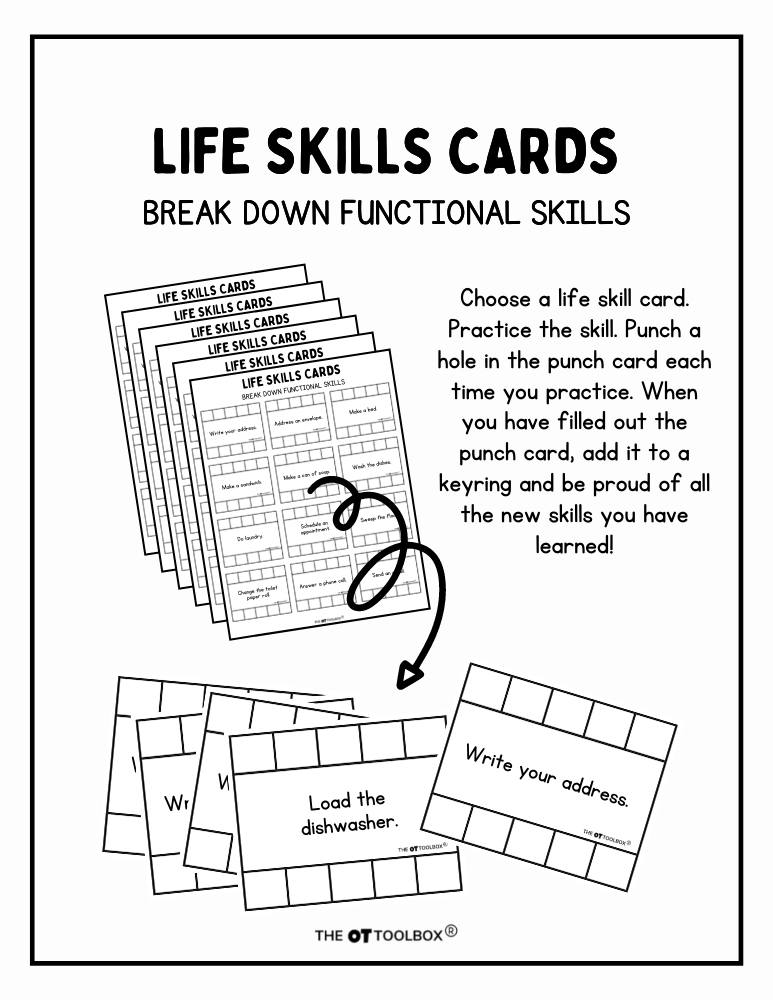
  • Life skills programs – Life Skills programs are educational programs designed to help young people learn the skills necessary for independent (or semi-independent) living. Most programs are found in residential environments and provide training in: social function, time management, personal hygiene, career exploration, money management, and life skills training.  Paperwork and waitlists are often extensive and long, it is recommended families start this process early. Life skills cooking activities are one strategy. These Life Skills task cards are another tool.
  • Adult day programs or care centers
  • Job shadowing – these can be done through a vocational or life skills program or provided independently through private employers.  Several companies and industries have created an entire model surrounding hiring learners with disabilities.
  • Adapted college programs-  This article on college planning for students with disabilities is a good resource and place to start
  • Vocational education – These programs provide counselors who can help learners explore interests, skills, and abilities, determine support needs, develop employment goals, and provide an Individual Plan for Employment (IPE).  The program may provide job placement assistance, supported employment services, job coaching, skills training, and guidance.
  • Post-secondary education- This type of transition service supports students aged 18-22 years old who have aged out of typical high school graduation age (18 years) and have completed the high school education portion of their programs, but may still have needs in various areas: provision of functional vocational evaluation, vocational rehabilitation services, life skills employment needs, post secondary education/training, skills in independent living, and community connections.
  • Another idea is to do community service using these service ideas. This can be a great way to practice practical life skills while serving others.

Transition Services on an IEP

Each state in the US may have differences in transition services that are outlined on an IEP while still in the school system. 

In South Carolina, for example, once a student is thirteen (this may be different depending on each district), a transition program is added to their Individualized Education Program (IEP).  

This begins the process of developing career readiness skills, identifying interests, and making plans for post graduation.  A Special Education Transitions Coordinator will often be added to the IEP team. 

Why start a Transition Plan early?

It is important to start transition services as early as in middle school or early high school for some students. One main reason is to include transition supports in the IEP to support the transition out of the high school setting. 

There are many reasons why this is important.

  • The waiting lists for programs and services are very long.  It may take years to get into a residential program or adult daycare.  The need far outweighs the resources. While it might seem ridiculous to put a 12 year old on a list for post high school services, waiting lists may be this long where you live.  Have conversations early with families.
  • There is a lot of planning that goes into preparing a young adult for life after graduation. Funding sources need to be in place, placement, programs, etc., all take time with many moving parts.
  • The individual child’s needs can be addressed while in the high school setting, including offering courses of study that meet the student’s interests. Some ideas include peer buddy programs for activities or sports. Other ideas include participation in pre-employment transition services in the high school setting: participating in a school store, an in-school coffee shop, job shadowing in the cafeteria or library for example. Each opportunity can foster the student’s strengths.
  • While neurotypical students learn life skills through observation and limited instruction, learners with special needs take a significant amount of training and practice to master certain skills. For example, managing laundry may take months to learn the basics.
  • While it is difficult to predict the future when talking about the future of an 11 year old, it does not hurt to start preparation early, and leads to a smoother transition.
  • Mentoring opportunities can progress for several years and offer an opportunity to learn over the course of the high school education. 
  • In some cases, guardianship changes may need to be considered.

Transition Services for Middle School to High School Special Education

How does the curriculum change for middle and high school students in special education?

This is a difficult transition and conversation to have with families.  There is a distinct shift when a student in a special education program enters middle and high school.  

The focus moves away from a traditional curriculum, toward a life skills based program.  This can be hard for families to accept that the goals will not be weighed as heavily on reading, writing, and math, but geared toward job training, self help skills, community awareness, safety readiness, and more independent living.  

Families feel as though the educational system has given up on their child learning to do algebra, write a research paper, or something as simple as writing their address and phone number.  

As mentioned earlier, life skills training takes a significant amount of training and practice.  There is not enough time in a school day to focus fully on both standard curriculum and self help skills.  The decision is made with the team to determine the best course of action for the student.  

While there will still be educational skills and objectives addressed, they may be more focused toward life skills.  For instance, instead of traditional math, the goal may be centered around money management, telling time, sorting, and counting.  

Writing goals might focus on writing essential safety information, or having a name stamp to produce this.  Reading can be channeled toward reading safety signs, filling out an application, reading a menu, or following basic recipe directions.

This blog post on the OT Toolbox about occupational therapy for teenagers explains this concept more in depth.

Activities To Help Students With Disabilities Get Used To A New School

Supporting individual student’s strengths with transitions to a new school can be a consideration, too. Students typically move from elementary to middle school to high school and they post high school environments. 

The transition supports in this post can help with this process as well.

Part of that is helping kids fit in at a new school with peer supports and a plan.

Transition Iep Goals

Transition IEP goals need to include a coordinated set of activities with a target goal in mind. The process to move toward transition should be based on the student’s strengths, personal interests, and facilitate movement toward post-graduation and community integration.

Being that the process is so individualized, transition IEP goals may include versions of this: 

  • Counting Money- At the end of each school day, student will count and record the amount of money earned that day from the classroom token economy, with % accuracy in X of X trials. 
  • Job application goal- Student will fill in the personal information section of a job application registration form, with % accuracy in X of X trials.
  • Work research goals- Student will research jobs and complete a job application with % accuracy in X of X trials. 
  • Job interview goal- Student will prepare for, dress appropriately for, and participate in a mock interview with % accuracy in X of X trials. 
  • Medical Forms-Given a medical form (printed or website), Student will fill out the form in X of X trials with % accuracy. 
  • Fine motor/Handwriting: Signature goal- Student will sign his/her first and last name in cursive, with % accuracy in X of X trials.
  • Life skills goals- Given X recipes, student will write a grocery list for ingredients needed (with no more than X ingredients needed) with % accuracy in X of X trials. 
  • Self-care goals
  • Communication goals
  • Technology goals
  • Community goals
  • Independent functioning goals
  • Pre-vocational goals
  • Vocational goals- Given a job task, Student will complete # tasks within # minutes with % accuracy over X out of X opportunities. 
  • Study skills goals
  • Social skills goals
  • Work habits goals

How Families Can Help

Families can support the child’s movement from school to post-education services by supporting the transition. The Life Skills Task Cards are one tool to work on various aspects of life skill work with a punch card type of strategy to offer motivation and meaningfulness. Some ways that families can help is by:

1. Do work-related and household chore tasks at home as part of a family team: making a simple meals like sandwich, setting the table, running the laundry, folding laundry, sorting utensils, loading the dishwasher, cutting the lawn, etc.
2. Provide opportunities to practice skills in the community (ordering a meal, scheduling an appointment, paying a bill, purchasing groceries, etc.)
4. Work on communication skills (phone, e-mail, social media), including safety issues
5. Talk about and go through meal prep together. Plan meals, purchase groceries for meals, making healthy choices, storing food, etc.

6. Make and cancel medical appointments
7. Teach student about any medications she/he is taking
8. use a calendar to keep a schedule of important dates.
9. Teach money skills.
10. Give the student and family a copy of “What you should know about Wisconsin LAW Booklet”
and talk about what changes when the student turns 18 years of age
11. Practice community navigation: crossing roads safely, taking abus,calling anUber,etc.

Final thoughts on Transition Services

This information is the tip of the iceberg in terms of readying students for a life after secondary school. The child’s movement through services does not need to be complicated. Some final tips for a successful transition after high school include:

Focus is on the functional achievement of the child and ensuring a successful transition for the student. 

Create a good team of professionals to help with these transition services. 

Consider the community experiences. There may be many opportunities in the community for job shadowing, and learning on the job for a results-oriented process. 

The following are a couple of other general resources to start the journey.

Consider provision of a functional vocational evaluation as part of the process.

Victoria Wood, OTR/L is a contributor to The OT Toolbox and has been providing Occupational Therapy treatment in pediatrics for more than 25 years. She has practiced in hospital settings (inpatient, outpatient, NICU, PICU), school systems, and outpatient clinics in several states. She has treated hundreds of children with various sensory processing dysfunction in the areas of behavior, gross/fine motor skills, social skills and self-care. Ms. Wood has also been a featured speaker at seminars, webinars, and school staff development training. She is the author of Seeing your Home and Community with Sensory Eyes.

Life Skills task cards
Life Skills Task Cards offer practice opportunities for everyday tasks in the home or life skills classroom.

Transitions for Children

transitions for children

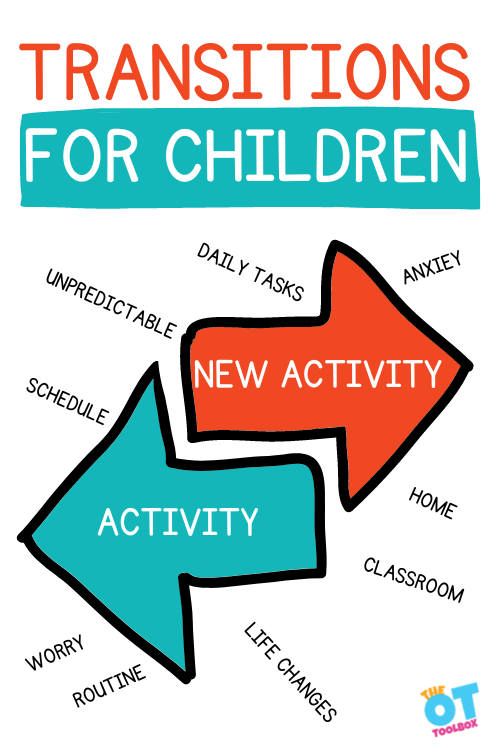
This blog discusses transitions for children, including specific strategies to make transitions easier. When young children struggle with transitioning between activities, stopping a preferred task, and beginning a non-preferred activity, a transition struggle can occur. It’s important to support children with smooth transitions, including knowing how to encourage listening. We have also included some fun transition games reduce anxiety and ensure transitions for children are less stressful, especially at the preschool and toddler age.

Here, we’re getting specific on all things transition activities for preschoolers to support learning and play. 

Transitions for Children

What is a ‘transition’ referring to in the preschool classroom (or home setting)? A transition is when we change from one activity to another. This could be a task that is completed as part of a routine, a change from a play activity to another or a change in location. Children are asked to participate in a variety of transitions everyday, and sometimes they just don’t want to.

Transitions happen many times throughout the day (morning, snacks, bathroom, clean ups, naptime, and so many more), and sometimes children don’t always want to comply with transitions. There are times during the day which require movement from one space to another, or a specific task to stop and another to begin. 

Transition periods for children include:

  • Bedtime
  • Mealtime
  • Naptime
  • Morning routine (getting to school, daycare, etc.)
  • After mealtime
  • First day of school or a special day of school (field trip, holiday party, class assembly, etc.)
  • Leaving a preferred activity or space (play space, playground, etc.)
  • New life component: new sibling, moving to a new home, starting a new school or daycare, starting a new classroom, changing teachers or acquiring a new personal aide or therapy practitioners, medical provider, etc.
  • New skill component: Moving from a toddler bed to a big kid bed, starting toilet training, teething, losing teeth, medical changes, etc.
  • Leaving the home for an appointment

Transitional Anxiety in Kids

The slower processing speed of young ones as well as fixed mindsets can lead to refusal, meltdowns, and tantrums.

For some children, the prescence of challenging behaviors is a form of communication. Screaming, yelling, hitting, biting, or crying are the form of communication that means, “I don’t want to stop doing what I’m doing”.

For other children, transition-related behaviors become part of the transition. By this, I mean that they are routinely used to the meltdown or behavior as way to add controlled predictability to the situation.

Whether it’s changes to daily routines or life transitions, these can be a cause for confusion in kids. The early years are about predictability in learning. This begins with babies and toddlers who drop a toy over and over again from their high chair. The predictable nature of cause and effect supports that when one thing happens, another identifiable thing occurs as a result.

The challenge with transitions is that when one preferred activity or event is occurring, the young child does not want to stop or change because there is a sense of unknown about what will happen next. Even when a teacher or caregiver explains what will happen as a result of the transition, the young child can’t grasp the verbal description, or if they are in the middle of a meltdown, the words are lost and not even heard. 

Another component to this is that when a known change is happening to a habit such as a change in routine, moving to a new home, experiencing a new teacher, or experiencing a new activity that is different than what the child expects or is used to, anxiety can result. 

The worry that occurs with the upcoming transition or change in routine can put the child into a sense of limbic response. Fight, flight, and other responses occur without actual thought. We cover this extensively in our post on the limbic system and function.

Contributing factors to transitional anxiety include:

  • Perseveration- The child can’t stop thinking about the upcoming event. This is particularly when a child knows a change in their routine is coming up.
  • Rumination- The child can’t stop telling themselves with their internal voice that some bad is going to come as a result of the unknown change to their predictable routine.
  • Loss of control- Given a change in a situation, the transition can cause a feeling of lost control.
  • Feedback loop- The limbic system alerts the child to unknown stressors in the form of a change in a stable environment (the current situation or an upcoming unknown change to a routine) and they are in a fight, flight, freeze pattern that is hard to get out of.

Early childhood transitions can be especially difficult for some children:

  • Those with communication challenges: Autism, delayed verbal skills, other childhood diagnoses
  • Individuals with sensory processing challenges
  • Those with auditory processing considerations
  • Children of younger age: infants, toddlers, preschoolers, and even kindergarten aged children
  • Children with experience of previous difficult transitions
  • Children without a stable home situation
  • Those with executive functioning needs (see below)

It’s important to explain to  young children in language that they can relate to during these periods. Equally important, is allowing enough time for the child to cognitively process the verbal commands in order to prepare for an upcoming transition using transition activities for preschoolers that work. 

By phrasing a new activity in a positive light, we can make the transition fun and how to praise them when they have followed through with the transition tasks.

The Role of Executive Functioning Skills in Transitions

Individuals with executive functioning challenges often encounter significant difficulties when transitioning between tasks due to deficits in specific skills.

Working memory, responsible for manipulating information, becomes a significant obstacle. Those struggling with executive functioning may find it challenging to retain relevant details from one task and transfer them to another, resulting in fragmented focus and increased cognitive load during transitions.

Planning and prioritizing tasks– Planning a task can be a daunting task for those with executive functioning challenges. The ability to break down a task into smaller, manageable steps is compromised, leading to a sense of overwhelm and uncertainty when faced with switching to a new activity. This lack of clear planning may exacerbate the difficulties during transitions, making it harder to smoothly shift from one task to another.

Self-control becomes an essential factor in task transitioning between tasks. Individuals with executive functioning challenges may experience difficulties in inhibiting impulses (impulse control) and distractions, leading to unintended time-wasting or pursuing irrelevant activities instead of smoothly transitioning to the next task. This lack of self-control can further impede their ability to manage their time effectively and maintain productivity.

Mental dexterity is another critical skill impaired in those with executive functioning challenges. Difficulty in mentally switching gears can lead to a reluctance or inability to shift focus between unrelated tasks, resulting in resistance to change and heightened stress during transitions.

Multitasking between unrelated tasks, a common requirement in today’s fast-paced world, adds to the mental workload during transitions. The inability to effectively juggle multiple tasks due to executive functioning deficits can cause feelings of frustration, mental fatigue, and reduced overall performance.

Transition Strategies for Kids

Use the strategies listed below in transition planning for kids.

Preparing a child for a change can be a huge help when it comes to big life events or simply moving from one activity to another in the classroom or therapy session. The strategies below can support those in early intervention, special education classrooms, educators, professionals, and parents.

There are ways to support a child through these stages, especially when focusing on the transition activities for preschoolers with some simple tips listed below.

Keep in mind these four tips when giving a child a transition direction:

1.Visual Schedules- Use a visual schedule and auditory cues help give children concrete expectations. Using a timer on a phone paired with a visual schedule or these first then visual boards, give children a multi-sensory approach to directions. 

2.Allow extra time- Give plenty of time for the child to finish what they are currently doing. Children tend to put their whole self into an activity. They are not great at multitasking, especially children under five years old. If you are asking a child to stop an activity so that they can move onto a new one, make sure you give them a few warnings before helping them with the transition. Giving a 5 minute and 2 minute warning (paired with some audio and visual cues) will give a child plenty of time to finish what they are currently working on. 

3.Make sure the timing of the transition is appropriate. When giving a transitional direction to a child, consider the time of day and the task you are asking them to complete. Are they tired or hungry? If so maybe going to the grocery store isn’t the best idea. Are you asking them to put on their shoes by themselves when they haven’t had a lot of practice doing this independently yet? Consider the time of day and the child’s developmental skills when giving a direction. This blog discusses the developmental skills of receptive language development for children birth to age five.

4.Schedule for Transition Time- If you are running a preschool classroom, make sure to build enough time in for transitions during the school day, so you can add the transitions to your visual schedule. By including transition times into your routine, children will expect each transition. 

5. Stop, Breath, Reset- One strategy that works for older children is to use deep breathing techniques as a tool for self-regulation. When the child indicates they are stuck in a anxious or worried state, they can identify a regulating and calming tool to stop and breathe. This period of reset allows them to restart and move onto the next task, even if they initially felt overwhelmed by the change.

Here is an example daily schedule for a preschool classroom:

8:00-8:50  Free Play

8:50-9:00 Clean Up Song

9:00-9:30 Circle Time

9:30-10:35 Interest Center Time

10:35-10:45 Clean Up Time

10:45-11:15 Snack Time/Bathroom Time

11:00-12:00 Outdoor Play

Simple ways to phrase the transition

Transition activities for preschoolers can support the movement from one scheduled task to the next. Sometimes it’s not about the task we are asking a child to do, but it’s how we ask them to do it. 

When working with young children, say their name, tell them what you want them to do, give them a “why” answer in the direction, and tell them what they will be doing next. Young children don’t always want to complete a task because they don’t know that something more exciting is coming up. 

Fill in the following blanks when giving a transition:

  • “Hi, _(name of child_). It’s time to (task you are asking them to do) so that we can (what you are going to do next.)”
  • If what you are doing next isn’t favorable (like going to the bathroom) tell them what will happen after they go to the bathroom (such as going outside to the sandbox afterwards. 

Not all activities are exciting to do, especially nap time. But when we make what happens after the next activity sound exciting, then the child may be more compliant. We are a lot more motivated to so an undesirable task if something more enjoyable happens after.

Transition Games for Children

The next task is to make the transition more enjoyable (so that a child, or group of children will participate.) These four games have worked wonders in my preschool classroom.

1.Pretend you are something else. One of my favorite ways to encourage children to move from one place to another is to have them pretend they are something different, and do the action of that new person/animal. For example “Fly like a bird to the snack table by flapping your wings.” or “Hurry! Put the fire out with the hose as you walk to the car (encouraging children to use their hands like a hose as they put out the pretend fire.)

2.How fast can you ________? Our kids love to compete against their times, especially during clean up! We keep track of how quickly they were able to put items away every day. Each day, they try to “beat” the time they had done the previous day. 

3. I Spy. You can play “I spy” anywhere, including clean up time (I spy a yellow truck!) or while going to the bathroom (I spy a pictures of a fish.) Children love to have attention and be part of something more then just completing the unwanted tasks asked of them. Using “I spy” can help keep a child’s mind off of what they are doing while also getting very important tasks completed. 

4. Transition Songs. You can create a song on your own or change the words of many other songs created to the task that you are asking a child to do. This list has a song for almost all types of transitions that you are asking your preschooler to do. There are several clean up songs that are popular (including the Barney clean up song found here.

Simple ways to praise a child during and after a transition

When children are participating in the transition activity and after they have made it to the next activity, using praise statements will show children that you are paying attention to them and are grateful with their participation. You can manipulate the following five praise statements for a variety of different transitions:

1.Wow! You are doing a great job _____________.

2.Look at how you are____________.

3. You __________ so quickly. 

4. Thank you for helping ___________.

5. I see how gently you are ___________.

When Childhood Transition are still a challenge

When children still don’t follow through with transitions…

Of course there are always those times, where no matter what we do, a child may not want to transition. Instead, they may become frustrated, yell, scream or run the other way. When children seem like they need some time to calm down, having a calm down area in your home or classroom ahead of time makes redirecting children to needed calming activities much easier. The Soothing Sammy Emotions Program  is a wonderful way to encourage children to take part in creating their own calm down corner through a story and wonderful character, Sammy, the golden retriever. As children help build Sammy’s calm down area to use when they are overwhelmed, they are gently taught how to calm down, talk about their feelings and problem solve. 

successful transitions for kids

Transitions don’t need to be stressful. Every child and every situation is different. When children are busy completing a preferred task, they don’t always want to leave that task to do something else.

With adequate warning, simple explanations, positive praise and a fun transition game, most of the time, children are willing to comply with what an adult is requesting with effective transitions.

Staying consistent in the transition process can transform transitions from a headache to peace.

transitions in the classroom

These transition tips are important for all ages, and at any time of the school year. One key time to set up transition strategies, however, may be the back-to-school season. This is an important step to successful transitions in the classroom.

Why? As kids head back into the classroom, transitioning from summer mode to classroom mode can be a real challenge. Setting up effective transition strategies in the classroom from the start of the school year supports students as they move from the summer mode to the classroom mode.

Transitions in the classroom is just one of our tips for back to school sensory activities, because classroom transition tools support the related emotional regulation and self-regulation needs that arise as a result of unexpected requirements and changes. Setting up transition routines in the classroom from the start is so effective with every level of student.

Jeana Kinne is a veteran preschool teacher and director. She has over 20 years of experience in the Early Childhood Education field. Her Bachelors Degree is in Child Development and her Masters Degree is in Early Childhood Education. She has spent over 10 years as a coach, working with Parents and Preschool Teachers, and another 10 years working with infants and toddlers with special needs. She is also the author of the “Sammy the Golden Dog” series, teaching children important skills through play.

Metacognitive Skills

metacognitive skills

The term, “metacognitive skills” sounds and feels lofty, and beyond our scope of practice, however once it is broken down, it makes sense.  This post hopes to demystify Metacognitive Skills, understand the meaning, and explain the relationship metacognition has to executive function.

Metacognitive skills

Metacognitive Skills

“The function of metacognition and self-reflection is to make meaning. The creation of meaning is at the heart of what it means to be human” – Marilyn Price-Mitchell.  Metacognition Skills involve thinking about thinking.  It is a momentary awareness of what you do or do not know.  

This self-awareness process allows one to have feedback through action and learning as one takes in information and processes that input. This is an essential skill in learning strategies where a learner processes information in order to utilize the information. 

We see this especially in comprehension of information and studying for tests or exams: Thinking about and adjusting as one self-reflects on the information learned can be adjusted in study strategies through self-assessment. A student studies information to prepare for a test, but if they are not comprehending that information, they may fail the test. They then can see proof that their study skills weren’t enough to pass the test. The student can then make learning goals that includes studying in a different way so they can process the information better for the next exam.

metacognitive skills definition

What are metacognitive skills?

Metacognitive skills is defined as the ability to plan, monitor, and evaluate one’s thinking. 

When professionals say metacognition is “thinking about thinking” they are talking about the ability to plan, monitor, and evaluate one’s work in order to improve.  Instead of spoon feeding answers to learners, the approach is built in self evaluation and reflection.  

Metacognition allows learners to move forward in their thinking and processing skills.  Learners who are “stuck” can get “unstuck”.  This leads to a growth mindset, or the power of yet.

“In 1928, Margaret Mead, an American Cultural Anthropologist, was famously reported saying, “Children should be taught how to think, and not what to think.” It turns out she was way ahead of her time and was already tapping into a theory that educational psychologists would later term ‘Metacognition’.” – Kathryn Rawson.

How to Develop Metacognition Skills

Research has shown metacognition starts around the age of eighteen months, but is in full swing by the ages of three to five. Parents and caregivers can take an active role in helping develop metacognition skills.

  • Ask reflective questions – open ended questions lead to self reflection, non-blaming questions allow learners to think about their behavior, process oriented questions help learners understand their own thought process, and solution-oriented questions encourage learners to understand how their thinking can change future outcomes.  Asking reflective questions may get more answers out of learners, or it may still result in eye rolling and shrugging.  At least it is a start!
  • Explain your own behavior – telling learners why you are doing something, or the thought process behind your decision making, such as turning the television off during dinner time, may not change the level of complaining, but might get the internal wheels turning.  
  • Apologize for your own choices – letting learners know when you have made a mistake or error in judgment is powerful. It shows self-reflection, and models the type of behavior you might like to see from them.
  • Let them struggle – correcting and fixing things for your children may reduce their anxiety in the short term, but does give them the long term skills they will need to survive adulthood.  Natural consequences (within safety reasons) are an excellent way to teach reflection and metacognitive skills.

Metacognition is a higher-order skill and one that requires critical thinking, so it’s not a skill that young children are able to achieve without guidance. 

We can support younglearners, however, in obstacles that they experience inage appropriate ways.

Stages of Learning and Metacognition

There are four distinct stages of learning that play into metacognitive skills.  While they are painful in the process, these stages develop greater understanding and knowledge. These cognitive processes exist with various learning styles.

  • Stage one: unconscious incompetence – In this stage of learning, you are unaware of what you don’t know and your lack of proficiency.  Think about a skill you have mastered over the years.  When you look back at your skill level (or lack of it) in the beginning, it is comical to see how bad you were at it, and had no idea! One example of this stage of metacognitive learning: As a new clinician, you may have thought your documentation skills were excellent, even though they lacked clinical experience and the wide range of experiences to back the documentation process.
  • Stage two: conscious incompetence – At this stage of cognition, you are aware of how little you know and your lack of proficiency.  Referring back to the example of a new graduate therapy provider, at this stage of you are suddenly aware of how bad your documentation is, but don’t have the skills to make it great yet. So in this case, you may make the appropriate strategies to improve your skills and seek out a mentor or take refer to resources on documentation for a deeper understanding. This is a planning phase to prepare for automaticity in skills.
  • Stage three: conscious competence – In this stage of the learning process, you are able to use your skills but only with continued constant effort. Referring to the new graduate example, you are able to document well, but it takes a tremendous amount of time and cognitive effort. You know the areas that you need to consciously put in effort for successful documentation, and you recognize that higher levels of thinking is needed.
  • Stage four:  unconscious competence – In the last stage of metacognitive skill development, you are able to use your skills with ease and very little conscious effort.  Referring to our therapy practioner example, at this stage, now your documentation comes easily without much forethought. Prior knowledge is applied freely and without much effort.

While it is not easy to watch someone else struggle through the learning curve, it is interesting to see the progression of their learning.  People often attack a new task with such confidence, only to quickly become discouraged and set down a peg or two.  

Learning this on their own without being spoon fed this information, builds metacognition and executive function skills for use in everyday tasks as well as during new things like novel tasks. It’s all part of the cognitive strategies being put into place.

How is Metacognition Related to Executive Function?

Executive function is a set of processing skills, many of which originate in the prefrontal cortex. 

Executive function skills develop in infancy, and include attentional control, working memory, inhibition, self-control, problem-solving, planning and prioritization, task completion, compliance, work tolerance, and monitoring, many of which are thought to originate in the brain’s prefrontal cortex. It is interesting to note that the prefrontal cortex is late to develop, often when a learner is in their mid to late 20’s.  

Metacognition skills are broken down into three strategies, all of which require executive function skills to complete:

  1. Planning – students learn to think about and plan their ideas.  They might ask questions or hypothesize about the strength and weaknesses of their plan.  Questions such as “I predict…”, “the question I am trying to answer is….” or, “the way I will solve this problem will be….”.  Teachers often help students learn this skill through graphic organizers, hypothesizing, and creating outlines.
  2. Monitoring – reflecting and realizing while in the midst of the project.  It is the alarm clock inside that lets you know something is amiss.  Suddenly you might realize the numbers are not adding up, or your writing went off on a tangent.  I call this going down the rabbit hole. Self-monitoring is necessary for self-regulation, self-awareness, and self-reflection.
  3. Evaluation strategies – at the end of a project or task, learners take a moment to reflect on what was completed.  They might realize mistakes that need to be corrected next time, accomplishments, or ways to tweak their skill to make it more efficient.  It is the equivalent of looking at something under a microscope, and then taking a self-directed attempt to support one’s own learning through metacognitive strategies.

Metacognition is vital in any kind of project or task, not just school based assignments.  Something simple, like doing loads of laundry, takes metacognition skills.  There is planning involved, monitoring during the middle of the task, and evaluation at the end to determine how the task went, and what modifications might need to be made.

While this seems complicated and wordy, the good news is you are likely to already have metacognitive skills, and are developing it in the learners around you, without being conscious of it.  Hopefully you have “unconscious competence” regarding your metacognitive skills.  

We also know the relationship between execitive functioning skills and self-regulation. This is especially apparent in the metacognitive process in thinking about behaviors, emotions, and the actions one has as a result of emotional regulation. It’s important to include metacognitive awareness when supporting students in self-regulation. 

The thinking processes in self-regulation strategies can become more natural over time, allowing children to succeed in self-correcting and using specific strategies in the moment.

Follow up question: do you think people with anxiety disorders have increased metacognition skills? 

Victoria Wood, OTR/L is a contributor to The OT Toolbox and has been providing Occupational Therapy treatment in pediatrics for more than 25 years. She has practiced in hospital settings (inpatient, outpatient, NICU, PICU), school systems, and outpatient clinics in several states. She has treated hundreds of children with various sensory processing dysfunction in the areas of behavior, gross/fine motor skills, social skills and self-care. Ms. Wood has also been a featured speaker at seminars, webinars, and school staff development training. She is the author of Seeing your Home and Community with Sensory Eyes.

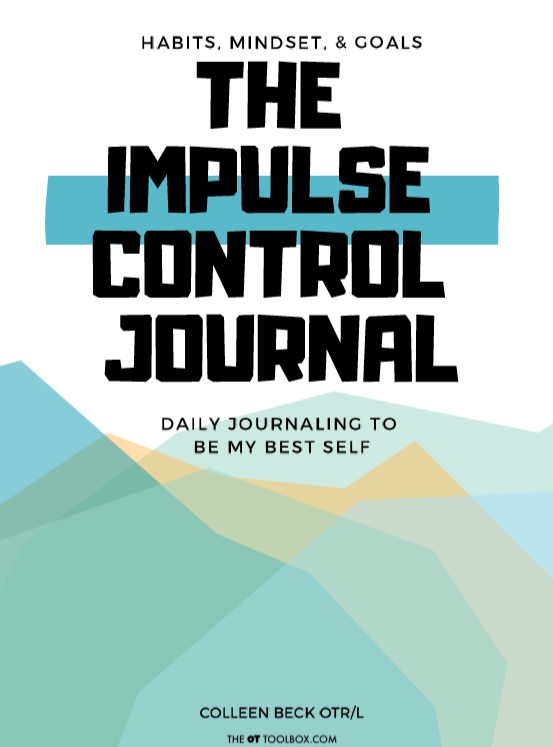
Impulse Control Journal the OT Toolbox

The Impulse Control Journal…a printable resource for helping kids strategize executive functioning skill development. When saying “calm down” just isn’t enough…

When a child is easily “triggered” and seems to melt down at any sign of loud noises or excitement…

When you need help or a starting point to teach kids self-regulation strategies…

When you are struggling to motivate or redirect a child without causing a meltdown…

When you’re struggling to help kids explore their emotions, develop self-regulation and coping skills, manage and reflect on their emotions, identify their emotions, and more as they grow…

Grab the Impulse Control Journal to build organizational strategies, planning, prioritization, habits, and mindset in kids.

Ping Pong Bounce Game

ping pong bounce

This ping pong bounce game is a fun way to build skills in eye-hand coordination, fine motor skills, bilateral coordination, visual scanning, visual tracking, and more. We used a fun DIY ping pong bounce game to work on reading fluency but you could use this activity for any multisensory learning.

Ping pong bounce

Ping Pong Bounce Game

A ping pong bounce game is exactly as it sounds, a game where you bounce ping pongs! You’ll need a target to bounce the ping pongs into, and this target can be any container which the player can use.

Older children, occupational therapy high school students, or middle school OT students might use a smaller bowl.

Younger children or those working on motor control and hand-eye coordination may use a larger bowl or a basket.

To play a ping pong bounce game, you’ll need just a few items:

  • Ping pongs
  • Container
  • Marker (to write on the ping pong balls)
  • Water (to put in the target bowl to make the task easier)

Ping Pong Bounce Skills

Playing a ping pong bounce activity like this one builds several skill areas at once:

  • Hand eye coordination
  • Motor planning
  • Fine motor control
  • Grasp and release
  • Visual tracking
  • Visual scanning
  • Visual convergence
  • Crossing midline
  • Force modulation

Ping Pong Bounce Game Ideas

We’ve been doing a bunch of tricky word games and activities recently as we practice Big Sister’s words for school.  It’s fun to come up with creative ways to practice sight words and decodable words. 

Manipulating Sight Words without flash cards really helps when it comes to encouraging new readers to go over (and over and over) novel words.  Adding a different component (even taking the words outside for a Sight Word Scavenger Hunt) can make the learning easier. 

Tricky Word Games


We made this tricky words ping pong ball bounce game one afternoon when we were practicing sight words and had a little fun bouncing our words around as we practiced. 

This isn’t the first time we’ve used ping pong balls in our sight word practice…Sight Word Scooping and Matching was a lot of fun and part of the inspiration to get a little active with our sight words.

Sight Word Ping Pong Ball Bounce Game


Amazon affiliate links are below.


We started with a handful of paper roll rings we’ve been using for all kinds of crafts and activities.  The paper roll rings came in handy for this activity.
 
We used some of our pin pong balls (affiliate link) and I wrote words onto them with a permanent marker.


The ping pong balls were the perfect size to fit in the paper roll rings.  We played for a while with this, just putting the ping pong balls into the rings, moving them around, and reading the words.

It was ping pong bounce fun!


The bouncing part was hard to photograph, but we would bounce the ping pong balls toward the tray and try to get them into the rings.  Little Guy really liked this part and he got pretty good at bouncing the balls into the rings.

Looking for more tricky word activities?  Try one of these:


Granola Superfood Recipe

Granola superfood

This granola superfood recipe is a staple in our house. It’s one of the occupational therapy recipes we love to make with kids as a life skill cooking tool, but it’s also got superfood powers (more than you may think when you think of granola as a superfood…) We’re talking about the calming benefits of heavy work through the jaw and crunching this granola superfood is one way to achieve that regulation technique!

granola superfood

Granola Superfood

This mama has been on a granola kick recently.  We shared a picture on our Instagram feed not too long ago about a yummy pregnancy craving involving granola, peanut butter, and apples.  When the granola ran out, there was nothing to do but make a batch from scratch!

This granola recipe has some major super food ingredients and is one of the many batches I’ve been experimenting with.  I wanted to share this recipe because it is SO good, and the kids have been gobbling it up.  Every mom wants Healthy snacks for kids and this one hits the mark! They’ve even choosing it over all of the boxed cereals we’ve got for breakfast choices.

Granola is a Calming Sensory Food

When we say that granola is a superfood, I’m not just talking about the ingredients.

Chewing crunchy and chewy foods offers calming heavy work through the jaw and mouth. This is a self-regulation tool that offers regulating and calming input. We talk about this in our resource on oral motor exercises.

Granola as a calming food can be used in a sensory diet that includes food as a tool for adding in the sensory input an individual needs throughout the day. We all need calming and organizing sensory input in the form of heavy work tasks that provide proprioceptive input through the muscles and joints. 

Heavy work snacks like this granola superfood can also be incorporated into lunchboxes, breakfasts, and after school snacks to help the sensory system feel calm and restful. At school, heavy sensory input for the whole class can be incorporated at regular intervals during the day during snack time.

Incorporating heavy work (and other sensory system input) into daily functional tasks, or setting up a sensory lifestyle, are all concepts covered in the book The Sensory Lifestyle Handbook.


Granola recipe with super foods


Granola Superfood Ingredients

What ingredients go into granola superfood? There are several and many of them are the typical super foods you think of when it comes to healthy eating with brain benefits: almonds, flaxseed, wheatgerm, walnuts, etc.


For this particular recipe, you’ll need:

  • 2 cups of uncooked Oats
  • 3/4 cup almonds
  • 1/2 cup cranberries
  • 1/4 cup uncooked quinoa
  • 2 tablespoons of dark brown sugar
  • 2 teaspoons Ground Cinnamon (affiliate link)
  • 1/2 teaspoons Ground Nutmeg (affiliate link)
  • 1/2 cup ground flax seed
  • 1/2 cup wheat germ
  • 3 teaspoons of vanilla
  • 2 teaspoons of olive oil
  • 1/2 cup honey
 
This granola recipe includes super foods like almonds.
 
Almonds!  These little buggers were chopped up and one of the super foods in this recipe.  
 
I went with ingredients we had on hand.  The cool thing about granola recipes is that you can adjust so many ingredients based on what you’ve got handy or individual tastes, and you get totally different (YUMMY) results.
 
Kids will want to eat this granol recipe before it's even done!


There was some stealing happening.

Very healthy granola recipe you can make at home
 

How to make granola superfood

 
  1. Spread 2 cups of uncooked Oats (another super food!) on a large cookie sheet. 
  2. Mix in 3/4 cup almonds.
  3. Add in 1/2 cup cranberries (super food!)
  4. Mix in 1/4 cup uncooked quinoa (super food!)
  5. Combine 2 tablespoons of dark brown sugar, 2 teaspoons Ground Cinnamon (affiliate link),  and 1/2 teaspoons. Ground Nutmeg (affiliate link). Mix those spices into the granola mixture.
  6. Add 1/2 cup ground flax seed (super food!) and 1/2 cup wheat germ (super food!) to the mix.
  7. Toss all of these super foods together and drizzle 3 teaspoons of vanilla, 2 teaspoons of olive oil (super food!), and 1/2 cup honey (…super food on some lists, although not the link I shared above…). 
  8. Mix it all up and throw into the pre-heated oven set at 250 degrees F for 45 min.  Keep an eye on your granola and stir it all up at least 3 times.  Watch it towards the end of the 45 minutes. 
 
This granola recipe has healthy ingredients like bran and flax seed.
 
Now for the super super food part…I added  How pretty does this look?  The flax seed will give your granola a nutty taste, but it’s not overpowering and goes well with the almonds. 


Easy homemade granola recipe


Yumminess.  Try not to eat it while it’s still hot.  Let the goodness sit on the cookie sheet until cooled and then scoop it up with a spatula into a container.

 
The kids gobbled up this banana-peanut butter-granola snack! 
 
We’ve been loving our granola over Greek yogurt, with apples and peanut butter, and with milk as cereal.  I love all of the healthy foods that the kids are getting with this snack/breakfast. 
 
What other alternatives can you think of to add or substitute to your granola recipe?
 

Granola Superfood Substitutes

 
We’ve also done some of these substitutes and are definitely going to try some others. These granola add-ins also offer chewy and crunchy input through the jaw, which are calming sensory movements that activate the joint receptors and the proprioceptive sensory system.
 
Each of these chewy ingredients support the calming benefits of granola!
 
  • raisins
  • chopped walnuts
  • without quinoa
  • without brown sugar
  • coconut oil
  • maple syrup
  • agave syrup
  • puffed rice
  • sunflower seeds
  • chopped pecans
  • peanut butter
  • chocolate chips
  • white chocolate chips
  • dark chocolate chips
  • dried fruit
  • Almonds
  • Walnuts
  • Cranberries
  • Pepitas
  • Flaxseed
  • Honey
  • Olive oil
  • Quinoa
  • Oats


105 Creative Painting Ideas

creative painting

This list of 105 creative painting ideas is a fun way to build skills through creative art. We’ve pulled together creative painting to support child development through creation play! Whether you are looking for painting ideas for toddlers, preschoolers, for the classroom, or for the occupational therapy clinic, these creative paint activities will get your brain ticking with ideas to support creative expression, emotions, sensory play, fine motor skills, and more! 

Add these ideas to your list of occupational therapy crafts that build skills. We also love these ideas for helping our parents that ask us how they can help their child “how to learn colors” with kids of all ages.

Creative painting

Creative Painting

In Occupational Therapy interventions, OTs and OTAs love to support their clients through creative outlets, specifically those that are meaningful to the client. For some children, art and painting is just that: a tool that inspires movement, sensory challenges, visual motor integration, crossing midline and more. OTs can use creative painting as a motivating strategy to develop skills…and maybe add in a bit of creative expression at the same time! Some of these are sensory paint ideas but most involve problem solving and creativity expression through creative paint!

Why Use Creative Painting?

Creative painting with clients develops skills. When painting in creative ways, you’ll see movement and sensory experiences that they typical canvas and brush don’t allow:

  • Fine motor skills
  • Gross motor skills
  • Crossing midline
  • Problem solving
  • Executive functioning skills
  • Motor planning
  • Tactile exploration
  • Sensory experiences
  • Bilateral coordination
  • MORE!

Creative Painting materials

The ideas listed below will get your creative juices flowing for your next paint project. Kids love when a creative painting idea is presented to them because it’s a bit of the unexpected! Out-of the box thinking when it comes to painting ideas is part of the magic.

Gather some of these materials for your next painting adventure:

  • Paints– tin of watercolors, washable paints, acrylics, finger-paints, etc.
  • Painting surfaces– canvas, cardboard box, paper, newspaper, paper towel, clothing, paper plates, styrofoam, bubble wrap, piece of paper, watercolor paper, etc.
  • Sensory mediums to mix paint into– shaving cream, sand, salt, dough, bubbles, etc.
  • Tools to paint with– brushes, paintbrushes, rolling pin, flowers, feathers, forks, ice, crayons, cotton swabs, pencils erasers, etc. You can even go on a nature walk to gather items to use to paint with.

This list is just a starting point…the creative ways to paint is literally in your imagination. Take these ideas and run with them to make your next creative painting masterpiece.

The Mess of Creative Painting

It can be common to immediately think about the mess involved with all of this creative art making, however there is therapeutic benefit as well, and focusing on those aspects can help with the mess issue.

Plus, the clean up portion of painting is a great time to work on those OT self-care goals that aren’t some of the more fun parts of childhood: 

  • hand washing – a paint activity is great motivation for washing little hands!
  • cleaning the body
  • scrubbing hard enough to remove the paint
  • cleaning up one’s surroundings
  • wiping down a table
  • cleaning out a sink
  • washing paintbrushes
  • drying a table

Creative Painting Ideas

There are so many fun ways to explore color, texture, and creativity through paints listed here. We can not wait to try them ALL!   There is just something about painting that is relaxing and satisfying…

  1.  Textured Paint Sensory Play
  2. Paint with Bottle Caps
  3. DIY Shape Stamps 
  4. Paint with kitchen utensils
  5. Paint with feathers
  6. Paint cardboard boxes
  7. Painting Bubble Wrap
  8. Feather Flower Craft
  9. Paint snow
  10.  Paint snow painting with watercolors
  11. Paint with flowers
  12. Stamped Art Flower
  13. Noodle Garland
  14. Goop Painting
  15. Paint with water on a sidewalk or driveway
  16. Gift Bow Stamp Art
  17. Painting With Yarn
  18. Paint a shower stall or bathtub using bath paints
  19. Paint a driveway with liquid chalk paint
  20. Concentric Circles Stamp Art
  21. Sparkle Collage Art
  22. Creative Painting Art Ideas
  23. Concentric Circles Stamp Art
  24. Paint your body with body paints
  25. Sparkle Collage Art 
  26.  Creative Painting Art Ideas 
  27.  Monster Cupcake Liner Craft
  28. Paint your hair with hair chalk (watered down hair chalk works best for this)
  29. Paint an old egg carton
  30. Baking Soda Paints 
  31. Painting With Pinwheels
  32. Fireworks Art
  33. Paper Roll Apple Stamps
  34. Paint a brick wall with the hose
  35. Paper Roll Turkey Stamp Art
  36. Paper Roll Pumpkin Stamps
  37.    Glitter Paint Snowman Craft
  38. Paint newspaper
  39. Snowflake Stamp Art
  40. Fine Motor Sparkle Craft
  41. Paint with a comb and hairbrush
  42. Noodle Garland
  43. Goop Painting
  44. Shamrock Thumbprint Art
  45. Feather Flower Craft
  46. Stamped Art Flower
  47. Make Your Own Textured Paint
  48. Make Your Own Colored Sand
  49. Stamp Roll Painting
  50. Clay Rocks Outdoor Decoration Craft
  51. 3D Drip Paint
  52. Make flour paint
  53. Mix baking soda and food coloring and then add vinegar for science art
  54. Paint toilet paper rolls
  55. Paint paper towels
  56. Paint toilet paper
  57. Paint recycled materials
  58. Scrape painting on a canvas
  59. Ice painting with ice cubes
  60. Fingerpainting with watercolours
  61. Make a paint pendulum with an erector set or tinker toys
  62. Preschool Paint Decorating from From ABCs to ACTs
  63. Painting with Trains from Where Imagination Grows
  64. Number Painting Boards from Left Brain Craft Brain
  65. Color Theory Activity from Gift of Curiosity
  66. Paint with Carrots from Stir the Wonder
  67. Paint pumpkins
  68. Paint rocks
  69. Paint sticks
  70. Paint using a cotton ball in a clothes pin
  71. Paint with toothpicks
  72. Paint with a plastic fork
  73. Paint a paper plate
  74. Paint on a window with soap paint
  75. Paint bark on a tree
  76. Paint with dirt paint (painting outdoors is a good idea with this one! And keep the hose handy!)
  77. Paint on styrofoam for beaded paint
  78. Paint with a turkey baster
  79. Pour paint to work on bilateral coordination
  80. Paint with string
  81. Paint with tweezers holding a craft pom pom
  82. Paint using a rolling pin
  83. Paint with homemade water colors
  84. Paint wooden crafts using acrylic paints
  85. Paint on a swing
  86. Paint with your body
  87. Paint a ball and roll it on paper
  88. Paint on Easter eggs
  89. Paint on coffee filters
  90. Mix up marbled milk paint
  91. Make homemade puffy paint
  92. Paint sand
  93. Paint on an easel or vertical surface
  94. Face paint on a baby doll
  95. Paint your hand and make handprint art
  96. Paint with a potato
  97. Paint with magnets by moving one magnet under a box and the other magnet moving through paint on the inside of a box
  98. Paint on large paper using a broom
  99. Paint a cardboard box using a paint roller
  100. Paint DIY cardboard bricks
  101. Paint with cotton swabs (Qtips)- Here is a cotton swab painting activity for Spring
  102. Paint a rubber duck
  103. Paint inside a plastic baggie
  104. Make 3D drip paint
  105. Paint on a train table or water table

These creative painting ideas are fun crafts to build skills through fantastic fun! Which self-expression activity are you going to choose first? 


Check out these great ideas for creative ways for kids to paint!


40. Pour Painting with Pixie Stix from Fantastic Fun and Learning
 
41. Outdoor Window Painting from Simple Fun for Kids


Some of our favorite ways to paint from past blog posts: