Today’s post on sensory rooms in schools is part of a series focusing on sensory rooms. We are going to explore the rules, protocols, and guidelines to using your sensory room. Other posts in the sensory room series highlight benefits, why have one, things to consider, cleaning materials, supervision, use by teachers and aides, building a sensory room on a budget, and sensory room equipment.
Sensory Room Ideas for the Classroom or School Setting
Sensory rooms don’t have to be large spaces or a whole classroom space. They simply need to meet the sensory regulation needs of the students who use them. Thoughtful sensory room ideas might include calming lighting (like string lights or dimmable lamps), soft textures (bean bags, floor cushions, or weighted blankets), and sensory tools (fidget bins, noise-canceling headphones, or resistance bands). Visual schedules or picture symbols help guide kids through activities like wall push-ups, deep breathing, or swinging, depending on what’s available in your space. Keep it flexible, what works for one student may not work for another.
Why do we need sensory room rules, protocols, and guidelines?
Did you know that a sensory room is considered a controlled and intentionally created space that provides multi-sensory resources to support a student’s sensory needs? This space is used in the school environment to help students with regulation and sensory needs to help them engage in learning.
Because of this, it’s important to have some sensory room rules and guidelines in place. The therapy providers reading this might be thinking, “Oh yes. We need to definitely regulate and maintain the integrity of the sensory room as a therapeutic tool”. It’s an option for supporting self-regulation.
Unfortunately, chaotic and unpredictable environments are sometimes created when a room is poorly designed, or personnel are not trained how to properly use the room. It is essential that the support personnel like teachers, teacher aides, and other staff understand how to use the room itself, not just the equipment inside it.
In the sensory rooms that I’ve seen in place, some of the issues that come up include:
- Something that we often see is that the paraprofessional takes their student to the sensory room for scheduled sensory breaks throughout the school day.
- Items in the room might be used incorrectly, or the student wandering around and trying a few things.
- Items are broken
- Materials are not put back into place, leaving the space a mess
- Students might be taken into the sensory room as a reward
- Students are taken into the room after they are in a state of dysregulation.
- Students use equipment like sensory swings very aggressively or unsafely
- Students might be in the room unsupervised
- There might be too many students in the room at once.
- Staff haven’t been trained on the “why” behind the sensory input.
This list is just the beginning of the iceberg! So many therapy providers have experienced different things when it comes to a calming space.
People who do not understand sensory processing difficulties, may see the sensory room as a playground or free-for-all space. While it is designed for some freedom of movement, your sensory room is best used with some direction and instruction.
The last thing you want to have happen in your sensory space, is for your student to feel/act worse than when they came in. Instructors who are given some rules, protocols, and guidelines, are better equipped to use the space to benefit each student’s unique needs.
It is more important how you use the space not what you have in it. One of the most common mistakes is to go into a sensory room and turn on every piece of sensory equipment. This can be very over stimulating for some. If used incorrectly students can exhibit self-injurious or aggressive behavior.
Remember the equipment is only as good as the person using it.
Creating a Calming Space for Kids
One of the most important things to remember is the goal of the space. A well-designed sensory room is more than just a break area where kids can go to chill out. The space should be a calming space for kids that teaches lifelong regulation strategies. This environment should support a child’s ability to reset and return to the classroom feeling focused, safe, and in control. Include elements that support proprioceptive input (like pushing, pulling, or heavy work), vestibular movement (like gentle rocking or swinging), and tactile experiences (such as bins filled with dry rice, fabric swatches, or play dough).
Keep the space quiet and predictable, with clear boundaries so kids know this is a place for self-regulation and not playtime.
What your sensory room should not be
There are many positives of having and using a sensory room in a school setting. It is important to use the space well, so it does not get a bad name. People might complain they sent their kids to the sensory room and they came back more out of control than before. You may have heard that Johnny acts out so he can get sent to the sensory room. Maybe teachers say their kids never “earn” their chance to use the sensory room.
These are common misconceptions and results of a poorly controlled space.
What to avoid when Setting up Sensory Room Guidelines
There are some things we’ve seen in the school settings that are actually counterproductive when it comes to setting up a sensory room. Some things that might be ineffective for students and staff include:
- Don’t let the sensory room become a free for all space to send students to. The time needs to be planned and structured to work well.
- Don’t make the sensory space a punishment for students. Getting the explosive student out of your classroom is important at times for the safety of the other students, going to the sensory room is not considered a punishment. It is a space to work on self-regulation and feel better so they can learn. Students who feel this is a punishment may avoid the sensory room when they can benefit from it, or may act out to get a change to go to the sensory room.
- Don’t let the space be used incorrectly. When not used correctly, some students are demanding a sensory break every 20 minutes because it is fun to get out of class.
- Don’t make the sensory room a reward or something that must be earned. While the sensory room space is usually a positive experience and a reward, students who are out of control are not going to be able to earn this sensory break. It needs to be recognized by the staff that your student needs a break, and explained that they need to work on their Zones of Regulation, or slow their engine down (Alert Program).
- Don’t let the sensory room be a babysitter. We’ve all seen it; Teachers and staff need a break too. However, this space is not for students to be dropped off and left. It is a supervised space with direct coaching.
- Sensory rooms must not be used for the purpose of separating students from their peers, either during class or break times.
- This space is not an alternative curriculum or alternative to formal education.
- Sensory rooms are not alternative play spaces for students who prefer not to play outside.
- A school sensory rooms must only be used for students who have been assessed by an occupational therapist as having sensory needs, and in accordance with the occupational therapist’s recommendations.
Knowing what NOT to make from a sensory room can help to define the guidelines that allow us to use the space effectively…
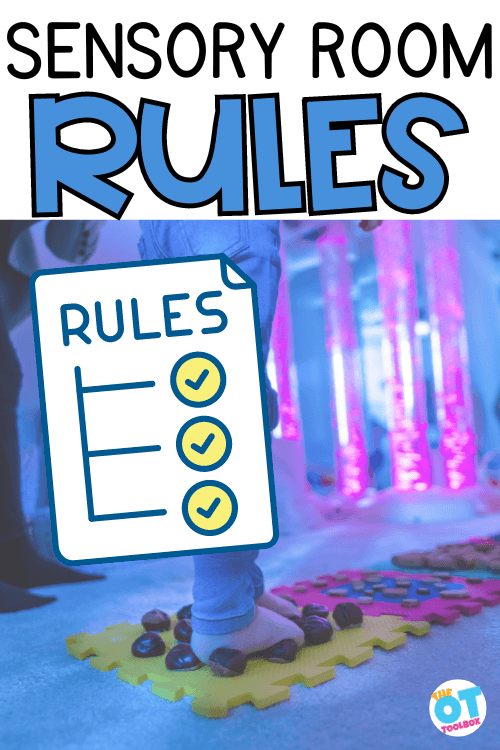
Sensory Room Rules
Each space is going to be unique and have a different set of rules, however, there are some basic rules staff can follow:
- If your kid makes a mess, clean it up
- During cold and flu season it is best practice to wipe down equipment after using it, or use a sanitizing spray
- When you must leave a mess behind, due to time constraints, or some other circumstance, leave a note and your plans to return. Example: this swing is soiled, please do not use it. I will take it home and wash it.
- Keep fingers out of drawers, cabinets, closets, desks, or other “off limits” spaces. Restrict access to the sensory bin if your student is likely to throw birdseed all over the room.
- Keep all sensory room materials in the sensory room.
- Children should stay a safe distance from other kids on swings, being careful not to run or walk in front of or behind moving swings.
- Limit visits to 20 minutes. Be prepared to leave the room if an emergency student needs to come in.
- Limit the number of students in the sensory room to a certain number. This will depend on the size and space available in the room.
- Be considerate of the equipment and space. Some items are expensive and budgets are small. Schools with limited budgets do not replace equipment quickly.
- Supervision -Students using the room should be supervised at all times. Without one-on-one direct input, equipment can be damaged very easily. When you are on a tight budget, it is painful to see something broken.
Guidelines for your sensory space
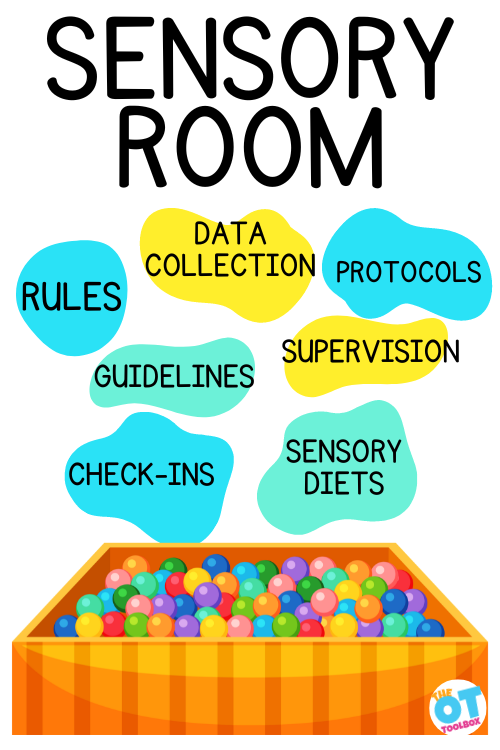
If you are a therapy provider that was consulted to set up a sensory room in a school or if you are helping to create the sensory space, it’s a good idea to come up with some guidelines to help define how the room will be used.
These are things to consider to help keep the space effective for the students that truly need it.
- Decide if the room is going to be exclusively used by therapists and their students, or accessible by teachers (who may not have the skilled training, or supervision) to bring their class.
- Decide how items will be labeled or classified. It can be really helpful to itemize the items
- Who has priority over this space? Is it an equal space for anyone, or does a treating therapist working with a student have the right to refuse more students coming in.
- Scope out the room before bringing your class in there. If a child is out of control, or having a meltdown, it is best to wait before bringing your ten students into the sensory room. Our teachers often call down to the sensory room (also inhabited by therapists) to see who is in there, and if the time is appropriate.
- Adult supervision should be a given when working with children with special needs. They may have poor impulse control, muscle movement, and reaction times.
- Use the room as proactively as possible by incorporating sensory escape/space time into their daily routine
- Determine the desired outcome for the student. Is it to give them an escape from the busy sensory filled classroom or a sensory break? Would the student benefit from a calming or alerting activity? What equipment are you going to use to meet the student’s needs?
- Guide the student towards either calming or alerting activities, depending on what he/she needs. If the student needs alerting activities, ensure to do some calming, organizing activities afterwards before they return to class, so they are ready to focus and concentrate. Please see our movement break booklet and video here for more information
- Explain how the prescribed item will be used, including the goals that the item will help to achieve, how long the item can be applied for and when it must be removed based on that assessment.
- Consider the data. How will you keep track of who has used the space? How will you determine who needs what equipment? How will you know if something helped a student?
- Equipment tracking- One guideline to consider is the status of the items in the sensory room. One thing we know for sure is that items that are used by kids tend to be used to their very end. So who will be responsible for making sure the sensory swings are working properly and that the ceiling attachment is still safe and secure? Who will monitor the items to make sure nothing has broken and to fix or replace them when they are?
- How will you move kids through their time in the space? Will you use a visual schedule? A choice board? Timers?
Sensory Room Guidelines: Understanding Who Benefits Most and Who Doesn’t
It’s important to remember that the sensory room is not for everyone.
Sensory rooms look like great play spaces. It’s the engaging items that look like toys. There are fun play things, lights, and items that might not be seen all that often. However, these are sensory tools. They are not for everyone to use, and for good reason.
There are expensive pieces of therapy materials and equipment in there that can easily cause harm. It is also a dedicated space for sensory processing and regulation.
Just like everyone does not get to hang out in the Nurse’s office every day, they do not get to go to the sensory room either.
One of the most important guidelines is to regulate who goes in there, so there is not a constant flow of students going in and out. Teachers will need to count on this space being free and available when they need it.
Sensory Room Protocols
These sensory room protocols are not steadfast laws or rules. They are good guidelines to follow to be compliant with least restrictive environment.
- There needs to be a system in place to monitor and ensure regular cleaning and disinfection of equipment and surfaces to prevent the spread of infections.
- Check your equipment. Make sure your hanging device is secure and rated for the weight and size of your participant. This is important on a regular basis.
- Accidents will happen, even if you are standing right there, but these will be easier forgiven if you were supervising your student when this happened. Have paperwork in the room for documenting any incidents.
- The sensory room should have a phone or overhead system in order to call either the main teacher, the front office, or for staff to call into the room.
- Provide some sort of floor padding or crash pad. Concrete floors are not forgiving.
- Supervision- This is both a rule and a protocol because it’s so important. There needs to be constant supervision of clients, particularly those at risk of falls or those using heavy or complex equipment.
- Equipment must stay in the sensory room. This is a rule you can use, or decide to have a borrowing system for certain items. Loaning equipment is nice; however, it comes with risks, and takes away from the use of everyone. If you have a large budget, you may be able to have multiples of certain items to loan.
- Setting up a staff in-service is important. Providing proper training on the correct use of the equipment is a must for any school staff that will be in the room.
Supervision in a Sensory Room
One factor that we’ve mentioned over and over again in this blog post is the supervision aspect. It’s SO important for the safety of the students using the room that the time is supervised.
But, for busy therapy providers and busy teachers, there’s just not a moment to spare in the school day.
So, the question remains: Who is “in charge” of this space? And then, how do you keep the room from becoming a free-for-all where the items in the room are misused and broken or misplaced and kids are using equipment without supervision?
We came up with a few ways to go about this. Some of these are strategies that we’ve seen in place in various schools. Others are things you can try. Not every school building will see success with these strategies. There are different student needs, different levels of support from administration and educators, and there is different levels of buy-in. The main thing to do is consider the options and think about what might work in the specific school ecosystem that you are servicing as a provider.
How to structure a sensory room for success (supervision and usage)
- Hang rules for usage in the sensory room.
- Have a sign in sheet on the door.
- Make a rule that anyone using the room MUST clean up before they leave the room. When they check out, put a box to mark that they cleaned up the room.
- Limit the number of occupants at any one time. Depending on the size of the building and number of students that benefit from the room, that might be as little as 2 students to up to 6-7. Remember that co-regulation occurs even from a distance and that if a student is in a state of dysregulation, that can throw off others in the room. Consider having a station outside the room, like sensory paths or posters hanging on the wall that can be a transition space or an area where students can go if the room becomes inefficient because one individual is having a meltdown. This might lead to using the room with only one individual at a time. It all depends and should be a fluid status.
- Students might benefit from using the sensory room at a specific time in their day. A paraprofessional might be the one to take them to the room.
- Ensure staff is trained on the items in the sensory room.
- Color code the items in the room for type of sensory input. Students will have colors associated with their needs/regulation states and can select from one of those options.
- Use a check in/check out system where students can rate their levels of regulation (either with Zones of Regulation or Alert program for example). Then they can check out. Keep track of the data.
- Consider having students take off their shoes when entering the room.
- Consider limiting usage of the room to 10-15 minutes.
- Consider setting up a sensory diet for students who use the room often. They can have a checklist of items that meet their needs and use a rating system for marking off how they feel before using sensory room items and then after.
- Post a stop and breath sign at the door so that there is a period of deep breathing before entering the room and before leaving the room.
- Educate the staff that the sensory rooms should not be used with students who are in an agitated state. They should not be used as a punishment (i.e. in replacement of recess or as a time out.)
- Educate the staff that students should be used appropriately when the student asks for a sensory break or as part of a planned sensory diet. Here is information on how to create a sensory diet.

Sensory Room Rules for Back-to-School Success
The start of the school year is the ideal time to review or establish clear sensory room rules. Just like classroom expectations, sensory room routines help kids use the space effectively.
Consider posting a simple visual chart with steps like: “Enter quietly, choose one tool, set the timer, use the tool safely, return to class.” Take time in the first few weeks of school to teach and model sensory room routines, even for kids who used the space last year. Routines can be forgotten over the summer.
Reteaching & Regulating Throughout the Year
Sensory room use isn’t “set it and forget it.” Sometimes you need to touch back on the rules again. Here are some tips:
- Plan to reteach rules throughout the year, especially after breaks or if usage becomes inconsistent.
- Build in proactive check-ins during transitions or after lunch when regulation needs spike.
- If you notice kids treating the sensory room like a reward or play zone, revisit your classroom’s regulation strategies and work with the team (OT, SLP, and teachers) to reinforce the space’s purpose.
With consistent expectations, the sensory room becomes a trusted tool for calming, organizing, and supporting students in the classroom.
A final thought on using a sensory room
A sensory environment is a working/changing type of space. It will change depending on the needs of the current students, as well as staff. Rules and protocols may change over time, depending on the space, and who is using it. We have added several different protocols this year at our school based on experiences that have gone well, and not so great.
Ideally, a school would have several different sensory rooms. One that is quite safe with padded walls, floors, and soft everything, and another with more equipment for active regulation and heavy work. Until then, make sure you are supervising your students in this space, and training those you work with to do the same.
For additional information, check out this article for additional information on sensory needs. Here is a great resource on sensory rooms.

Victoria Wood, OTR/L is a contributor to The OT Toolbox and has been providing Occupational Therapy treatment in pediatrics for more than 25 years. She has practiced in hospital settings (inpatient, outpatient, NICU, PICU), school systems, and outpatient clinics in several states. She has treated hundreds of children with various sensory processing dysfunction in the areas of behavior, gross/fine motor skills, social skills and self-care. Ms. Wood has also been a featured speaker at seminars, webinars, and school staff development training. She is the author of Seeing your Home and Community with Sensory Eyes.