Attention Activities for Kids

When it comes to boosting attention in kids, there is a lot going on. Attention is aligned with executive functioning, sensory processing, self-reflection, and so much more! Below, we are chatting about a few attention activities for kids. These are the ones that develop attention through games, activities, and fun. Being that a child’s primary occupation is play, why not develop the skills they need (like attention!) through active participation in an interest-based activity?


Use these attention activities for kids to address attention and the underlying needs that impact attention in kids, perfect for parents, teachers, and occupational therapists looking for ideas to improve attention.


Attention Activities for Kids


There is a lot of information out there on addressing attention needs in kids. Parents can become easily overwhelmed by the shear amount of tactics and treatment approaches for attention


We’ve shared a lot of activities that develop and grow attention here on The OT Toolbox. You can check them out on our Attention page.


You may want to grab a few of these games and tools that boost attention and focus. These are the games and toys out there on the market that make great gift ideas for kids…fun activities that develop attention at the same time!


One thing that stood out in our list of games and toys that develop attention is the sensory aspect.


When it comes to boosting attention in kids, there are a few things that stood out. First, games are huge part of boosting attention! Games like DIY memory games can be adjusted to meet the interests of each child and can be modified based on ability or age.


Kids love target games. Using an item like weighted bean bag games add proprioceptive input that is calming. These snowflake bean bags or ice cream cone bean bags are easy DIY ideas. 


Adding sensory supports that reduce overwhelming input can be helpful in addressing attention needs, too. This article explains a lot about the sensory aspect of attention


Adding some gross motor activities into a routine through outdoor play, or via brain breaks in the classroom, or with simple games can be a big boost when it comes to helping with attention and focus. This dinosaur movement game is a big hit. It can be adjusted based on the child’s interests, too. Have a little one who is more interested in Shopkins than dinosaurs? No problem! Just make the game based on those tiny figures! 


If you’re needing more movement ideas, this list of monthly movement activities is a good start. You can get ideas for the whole year in this one post. 


Working on mindfulness is another approach to addressing attention needs in kids. Here are YouTube videos that address mindfulness and are appropriate for kids.


It can be helpful to work on identifying and expressing emotions with kids of any age. For the child with attention challenges, emotional regulation and working on strategies to manage big emotions can be a huge help. 


Teaching kids about coping skills and self-regulation is a good strategy for addressing attention during tasks, too. 


There are so many strategies to address attention in kids and activities that can help address attention needs. One tactic that can be a big help is analyzing precursors to behaviors related to attention and addressing underlying needs. 


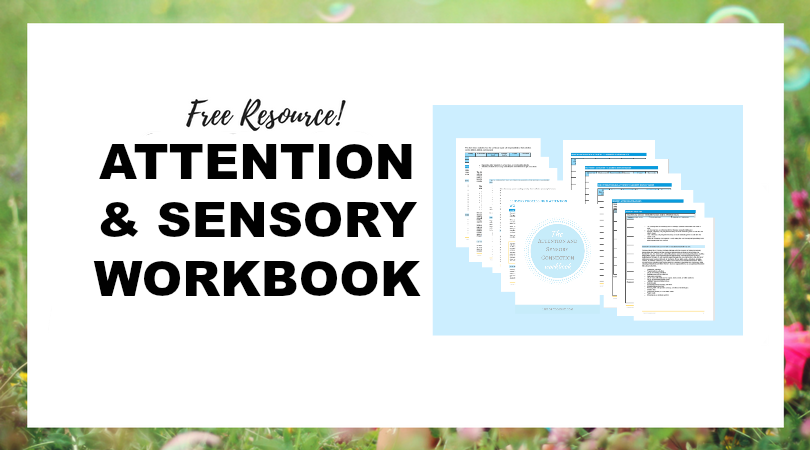
The Attention and Sensory Workbook can be a way to do just that. 


The Attention and Sensory Workbook is a free printable resource for parents, teachers, and therapists. It is a printable workbook and includes so much information on the connection between attention and sensory needs. 


Here’s what you can find in the Attention and Sensory Workbook: 

  • Includes information on boosting attention through the senses
  • Discusses how sensory and learning are connected
  • Provides movement and sensory motor activity ideas
  • Includes workbook pages for creating movement and sensory strategies to improve attention


A little more about the Attention and Sensory Workbook: 


Sensory processing is the ability to register, screen, organize, and interpret information from our senses and the environment. This process allows us to filter out some unnecessary information so that we can attend to what is important. Kids with sensory challenges often time have difficulty with attention as a result.


It’s been found that there is a co-morbidity of 40-60% of ADHD and Sensory Processing Disorder. This workbook is an actionable guide to help teachers, therapists, and parents to help kids boost attention and focus in the classroom by mastering sensory processing needs. 


You will find information on the sensory system and how it impacts attention and learning. There are step-by-step strategies for improving focus, and sensory-based tips and tricks that will benefit the whole classroom.


The workbook provides tactics to address attention and sensory processing as a combined strategy and overall function. There are charts for activities, forms for assessment of impact, workbook pages for accommodations, and sensory strategy forms.
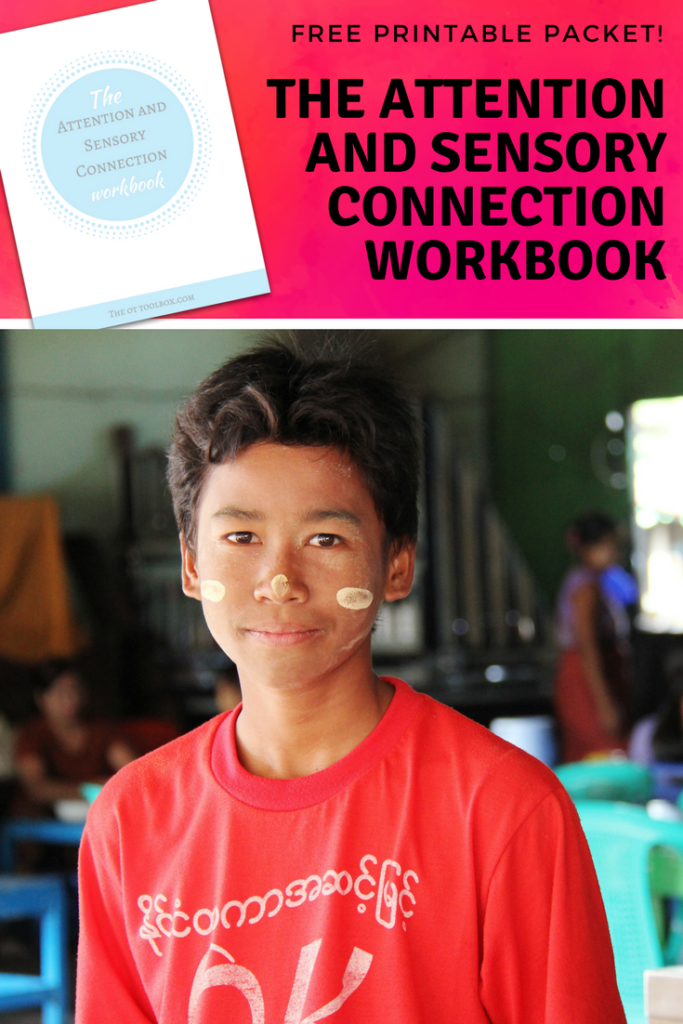


Grab the Attention and Sensory Workbook by clicking HERE or on the image below.
 
Attention and sensory workbook activities for improving attention in kids
 
Use these attention activities for kids to address attention and the underlying needs that impact attention in kids, perfect for parents, teachers, and occupational therapists looking for ideas to improve attention.


FREE Attention & Sensory Workbook

    We respect your privacy. Unsubscribe at anytime.

    Colleen Beck, OTR/L has been an occupational therapist since 2000, working in school-based, hand therapy, outpatient peds, EI, and SNF. Colleen created The OT Toolbox to inspire therapists, teachers, and parents with easy and fun tools to help children thrive. Read her story about going from an OT making $3/hour (after paying for kids’ childcare) to a full-time OT resource creator for millions of readers. Want to collaborate? Send an email to contact@theottoolbox.com.
    Sensory Strategies in Schools

    Here on The OT Toolbox, we’ve shared a lot of information about addressing sensory processing needs in the classroom environment. We’ve shared sensory strategies for the school-based OT. We’ve talked about sensory diets in the classroom. So often, kids with sensory processing challenges struggle in the school environment. And, we’ve talked about calm-down strategies that can be used in the classroom.
     
    Today, we’ve got a big resource for anyone who lives with, loves, or works with a child with sensory processing needs. These sensory strategies can be used in schools by occupational therapists, teachers, parents, administrators, or anyone who advocates for a child with sensory needs.
     

    Use these classroom sensory strategies to help kids with sensory processing needs to learn, pay attention, self-regulate, focus, and address sensory needs within the classroom or learning environment to address educational goals and sensory needs. Perfect for occupational therapists in the schools..


    Sensory Strategies in Schools

    As a caregiver or parent, it is exhausting to see the challenges your child faces, while ticking through the laundry list of strategies and still witnessing the sensory breakdowns. Parents are the advocate for addressing their child’s needs. They are looking for resources to share.


    Therapists are challenged to find tactics that will be carried over while meeting functional goals. We strive to create streamlined suggestions that will be used at home and in the midst of a busy classroom.


    Often times, teachers are the middleman when it comes to sensory issues. They are dealing with curriculum requirements, little time, and demands of a full classroom. Time, space, and resources are limited in the classroom. Teachers struggle with meeting sensory needs and children who “feed off” other students.


    Strategies for addressing or preventing sensory meltdowns are needed before they happen!
     
    Use these classroom sensory strategies to help kids with sensory processing needs to learn, pay attention, self-regulate, focus, and address sensory needs within the classroom or learning environment to address educational goals and sensory needs. Perfect for occupational therapists in the schools. Use these classroom sensory strategies to help kids with sensory processing needs to learn, pay attention, self-regulate, focus, and address sensory needs within the classroom or learning environment to address educational goals and sensory needs. Perfect for occupational therapists in the schools.


    Because of these challenges, the classroom can be a tricky environment for addressing the needs of students, incorporating strategies, and addressing behaviors related to sensory needs. If any of these struggles sound familiar, know that you are not alone!


    You’re striving to find and use the sensory strategies that students need and to put them into place in easy-to-understand handouts where recommended tools can be highlighted. You’re seeking information about why students are acting the way they are and how to help them to improve learning, attention, regulation, and emotional needs so that educational needs are met.


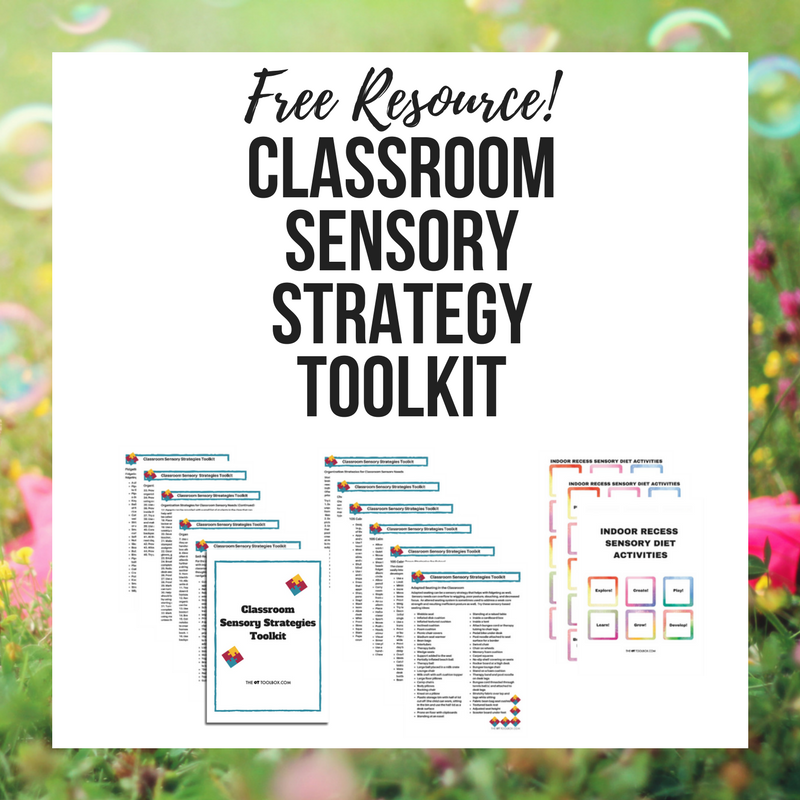
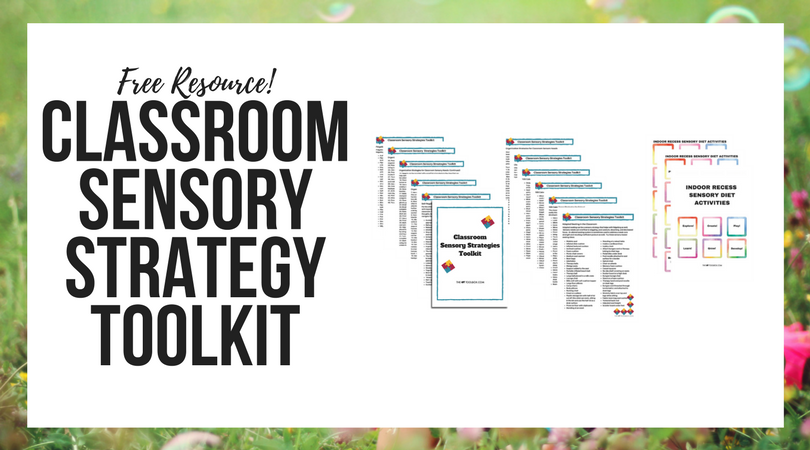
    That’s where the Classroom Sensory Strategy Toolkit comes in.
     
    Use these classroom sensory strategies to help kids with sensory processing needs to learn, pay attention, self-regulate, focus, and address sensory needs within the classroom or learning environment to address educational goals and sensory needs. Perfect for occupational therapists in the schools. Use these classroom sensory strategies to help kids with sensory processing needs to learn, pay attention, self-regulate, focus, and address sensory needs within the classroom or learning environment to address educational goals and sensory needs. Perfect for occupational therapists in the schools.


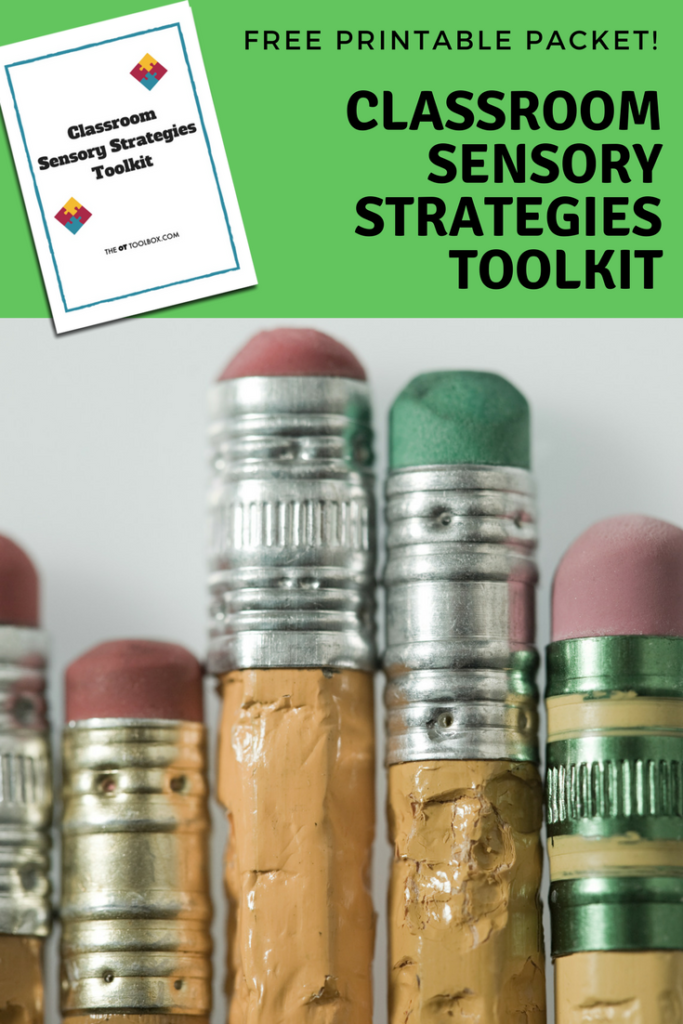
    The Classroom Sensory Strategy Toolkit is a printable packet of resources and handouts that can be used by teachers, parents, and therapists. Whether you are looking for a handout to explain sensory strategies, or a tool for advocating for your child, the Classroom Sensory Strategy Toolkit has got you covered.


    And it’s free for you to print off and use again and again.


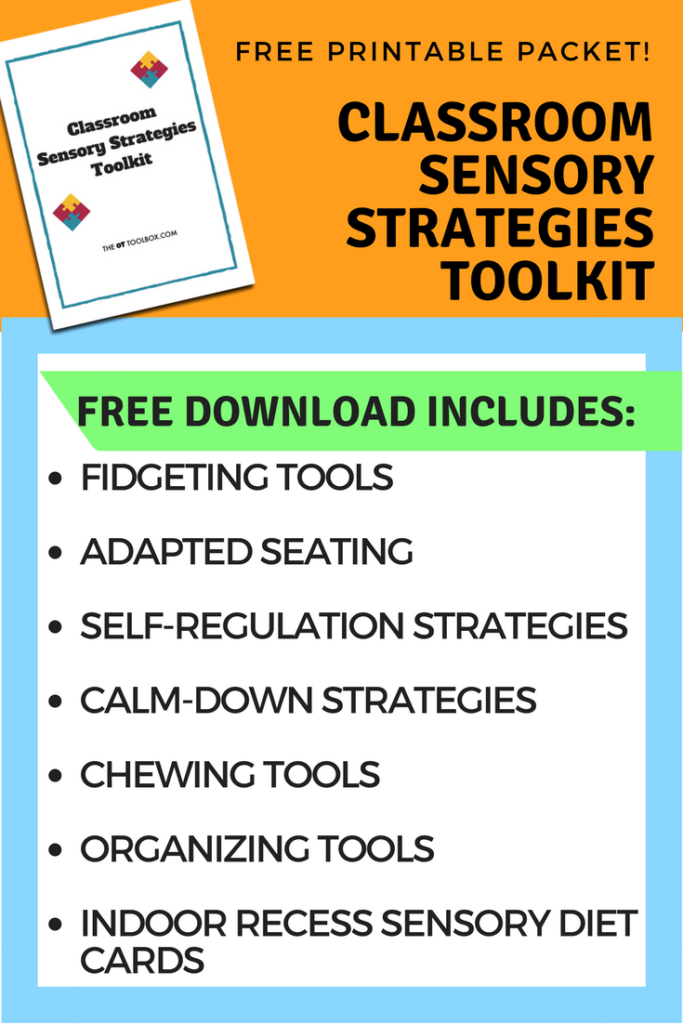
    In the Classroom Sensory Strategy Toolkit, you’ll find:


    • Fidgeting Tools for the Classroom
    • Adapted Seating Strategies for the Classroom
    • Self-Regulation in the Classroom
    • 105 Calm-down Strategies for the Classroom
    • Chewing Tools for Classroom Needs
    • 45 Organizing Tools for Classroom Needs
    • Indoor Recess Sensory Diet Cards
     
    Use these classroom sensory strategies to help kids with sensory processing needs to learn, pay attention, self-regulate, focus, and address sensory needs within the classroom or learning environment to address educational goals and sensory needs. Perfect for occupational therapists in the schools.


    Here are a few ways that the Classroom Sensory Strategy Toolkit can address much-needed skills of our children/students/clients with sensory needs:


    • Science tells us there are more kids with processing needs than ever before. Schools are responding with a better understanding of how to help students using sensory input within the school day.
     
    • The Sensory Strategy Toolkit is a helpful tool for incorporating sensory needs within the educational environment as supports and tools that kids need.
     
    • Sensory processing challenges in kids are baffling! Having a set of sensory tools that can be used in the classroom is powerful to teachers, parents, and therapists.
     
    • Sensory processing issues cause stress, motivation, and challenges for the whole family. Having a toolkit of sensory strategies for the classroom can help.
     
    • Self-regulation in the school environment can derail the whole classroom from effective learning. Use the calm-down strategies and self-regulation pieces in the toolkit and have the information you need to address these challenges.
     
    • Those who work in the school environment struggle with a limited budget for addressing sensory needs. These strategies use equipment that is on hand in the classroom.
     
    • The toolkit is appropriate for preschool through teenage years and older and the strategies can be modified to meet the needs of each individual.


    Use these classroom sensory strategies to help kids with sensory processing needs to learn, pay attention, self-regulate, focus, and address sensory needs within the classroom or learning environment to address educational goals and sensory needs. Perfect for occupational therapists in the schools.
     
    Be sure to grab the Classroom Sensory Strategy Toolkit and start addressing those classroom sensory challenges!
     
    CLICK HERE to get the Classroom Sensory Strategy Toolkit.


    Use these classroom sensory strategies to help kids with sensory processing needs to learn, pay attention, self-regulate, focus, and address sensory needs within the classroom or learning environment to address educational goals and sensory needs. Perfect for occupational therapists in the schools.
     
    P.S. Stay tuned because in just a couple of days, we’ll have another free resource for you. It’s all about sensory activities like those in a sensory diet and how they can be used to address attention and focus in kids. And what’s awesome is that the free printable resource coming your way will help the kids you parent, teach, or serve in therapy to work on attention using sensory strategies, even if they don’t have a sensory diet in place.


    Free Classroom Sensory Strategies Toolkit

      We respect your privacy. Unsubscribe at anytime.

      Colleen Beck, OTR/L has been an occupational therapist since 2000, working in school-based, hand therapy, outpatient peds, EI, and SNF. Colleen created The OT Toolbox to inspire therapists, teachers, and parents with easy and fun tools to help children thrive. Read her story about going from an OT making $3/hour (after paying for kids’ childcare) to a full-time OT resource creator for millions of readers. Want to collaborate? Send an email to contact@theottoolbox.com.
      Quiet Fidget Toys for School

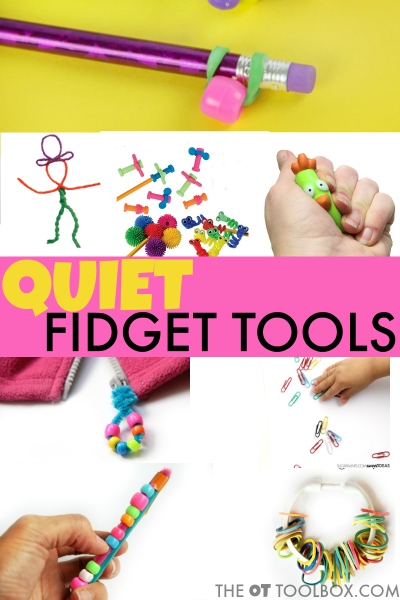
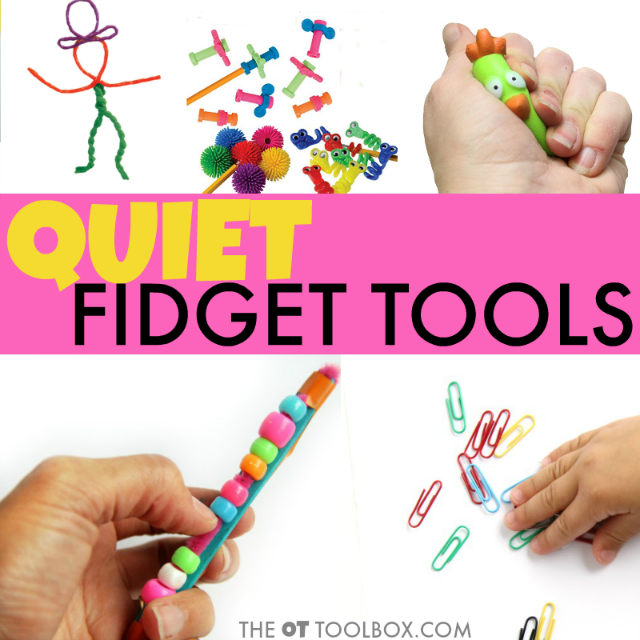
      Looking for quiet fidget toys to support self regulation needs in a classroom setting? These quiet fidgets are the perfect occupational therapy toy that supports needs through play.

      The fidget tools listed below are those that are quiet in nature. You’ve probably spun a fidget spinner or two in your days (the last year or so that fidget spinners where a “thing”, anyway). They make a noise, right? Those fidget clicker boxes? They make a noise too. For the classroom environment where a click or a spin can be distracting to others, quiet fidget tools are a must. 


      Scroll on to find out more about quiet DIY fidget tools for school that can be a valuable tool for kids with attention challenges, regulation needs, sensory processing issues, or other needs that require a fidget tool for concentration and inclusion in the classroom setting. 


      Note that fidgets of any type should be used with caution and based on the individual skills and level of each child. It’s up to the educator/therapist/etc. working with the child to select appropriate and safe fidget tools for the child. Also note that The OT Toolbox is not liable for any fidget or recommendation used with children.


      Quiet fidget tools for kids in the classroom to help with attention, fidgeting, or sensory needs.


      Quiet Fidget Tools for School


      Here’s the thing about fidget tools in the classroom setting. They can get a bad rap. But, have you ever stopped to think that we ALL need a fidget tactic of some sort when we need to really concentrate? We jiggle our leg. We tap the desk. We doodle. We talk with our hands. We mess with a pen. We tap our phone. We twirl our hair. We all do something that is an overflow of motor actions with concentration. 


      So, when we ask our kids (who are getting less time outdoors, less recess, and are experiencing more sensory processing needs) to sit still at their desk and NOT fidget, wiggle, twirl, move, slouch, or jump…it’s a messy classroom!


      Fidget tools for students in a classroom don’t need to be a pricey. 


      They don’t need to be obtrusive. 


      They don’t need to be a tool that is unnatural in the classroom. 


      Fidget tools can be used by any student and can be items that are a natural part of the classroom. 


      Try using some of these quiet fidget tools in a classroom. It may be helpful to go over rules of fidget tools with the whole class. Do that before handing over the fidget. Set up guidelines for use, and inappropriate use of fidget tools. Instruct students that they are to be used when concentrating and at all other times should be placed in pencil box or pencil pouch, with crayons, scissors, and other “tools”. Just like those items have a place and a use in the classroom, the fidget tool should be used at certain times and in certain ways!

      Quiet Fidget Tools for School


      Affiliate links are included below. 


      Fun pencil topper
      DIY pencil topper
      Small koosh ball (tuck this in the palm of the hand for younger students to encourage a functional pencil grasp and separation of the sides of the hand.)
      Two or three paper clips linked together
      Paper brad with paperclip clipped into a folder or notebook cover
      Pencil grip
      Beads on a pipe cleaner
      Keychain
      Small stress ball
      Marble sewn into a cotton glove
      Sliced pool noodle (Very cost efficient! A whole class can be outfitted with a quiet fidget tool for about $1)
      Wikki Stix (an effective tool for a writing or reading guide too. Read about all of our favorite Wikki Stix activities)
      Rubber bands on a ring 
      Craft pom poms
      DIY Zipper pull

      Sensory strategies like these can be a big help for many children. 


      You may also be interested in the free printable packet, The Classroom Sensory Strategy Toolkit.

      The Classroom Sensory Strategy Toolkit is a printable packet of resources and handouts that can be used by teachers, parents, and therapists. Whether you are looking for a handout to explain sensory strategies, or a tool for advocating for your child, the Classroom Sensory Strategy Toolkit has got you covered.


      And it’s free for you to print off and use again and again.


      In the Classroom Sensory Strategy Toolkit, you’ll find:


      • Fidgeting Tools for the Classroom
      • Adapted Seating Strategies for the Classroom
      • Self-Regulation in the Classroom
      • 105 Calm-down Strategies for the Classroom
      • Chewing Tools for Classroom Needs
      • 45 Organizing Tools for Classroom Needs
      • Indoor Recess Sensory Diet Cards
       
      Sensory Strategies for the Classroom
       

      Quiet fidget tools for kids in the classroom to help with attention, fidgeting, or sensory needs.

      Outdoor Sensory Diet Activity Cards

      Outdoor sensory diet cards

      The outdoors are the ultimate sensory experience for kids! It is possible to create the “right kind” of sensory experiences to improve regulation, attention, focus, body awareness, motor development, and sensory processing. Outdoor play provides sensory input in all planes, directions, and with multiple senses.  This printable packet all about taking sensory diet activities into the outdoors. Outdoor sensory diets are the perfect way to add sensory input that kids need!

      Be sure to grab the Outdoor Sensory Diet Cards and use them with a child or when creating a sensory diet for an adult with sensory processing needs!

      Outdoor sensory diet cards for families

      Outdoor Sensory Diet Activity Cards

      Research tells us that outdoor play improves attention and provides an ideal environment for a calm and alert state, perfect for integration of sensory input. In fact, outdoor play provides input from all the senses, allows for movement in all planes, and provides a variety of strengthening components including eccentric, concentric, and isometric muscle contractions. The outdoors are a vestibular, proprioceptive, tactile, and overall sensory-enriched goldmine!
       
      There’s more: Providing opportunities for sensory diet activities in the outdoors encourages open-ended play, imagination, creativity, body awareness, learning skills, self-confidence, gross and fine motor development, attention, and social-emotional skill development.
       
      It can be a real struggle to help kids manage tricky sensory-related challenges.
       
      Parents find it  difficult to weed through all of the information and pull out what will work for their child.
       
      Teachers may struggle with kids who fall out of their chairs, can’t focus, and feed off other students. They may feel compelled to help these students but lack resources, time, or tactics.
       
      Therapists may search for fresh ideas that provide the right kind of sensory input and will be carried over at home and at school, all while fitting into the child’s occupational performance sweet spot.


      Do one or more of the categories described above sound familiar?
       
      Maybe you are trying sensory strategies, searching for information, and creating sensory diets that just aren’t working. You’re doing all of the right things, but struggle to meet the sensory needs of an individual child.
      outdoor sensory diet activity cards
       
      That’s where the Outdoor Sensory Diet Cards and Sensory Challenge Cards come into play.
       
      They are a printable resource that encourages sensory diet strategies in the outdoors. In the printable packet, there are 90 outdoor sensory diet activities, 60 outdoor recess sensory diet activities, 30 blank sensory diet cards, and 6 sensory challenge cards. They can be used based on preference and interest of the child, encouraging motivation and carryover, all while providing much-needed sensory input.
       
      Here’s a little more information about the Outdoor Sensory Diet Cards:
       
        • 90 outdoor sensory diet activities
        • 60 outdoor recess sensory diet activities
        • 30 blank sensory diet cards, and 6 sensory challenge cards
        • They can be used based on preference and interest of the child, encouraging motivation and carryover, all while providing much-needed sensory input.
        • Research tells us that outdoor play improves attention and provides an ideal environment for a calm and alert state, perfect for integration of sensory input.
        • Outdoor play provides input from all the senses, allows for movement in all planes, and provides a variety of strengthening components including eccentric, concentric, and isometric muscle contractions.
        • Great tool for parents, teachers, AND therapists!
       
      Here’s the thing: Outdoor play is the ideal setting for incorporating the “right kind” of sensory input. A child who uses a therapy band in the classroom receives just one direction of proprioceptive input. Outdoor play provides sensory input in all planes, directions, and with multiple senses. The sensory diet cards in this free printable pack can be used in SO many ways to help individuals with specific sensory needs.


      Check out more about outdoor activities…like play…and sensory diets:

      There’s more:
      • Outdoor sensory diet activities are easy, fun, and motivating…and they make memories for the whole family while meeting the needs of a child with sensory processing challenges.
      • Outdoor sensory activities can be completed as a group or on an individual basis, and learning can be incorporated right into the tasks.
      • Teachers will find the outdoor recess sensory diet cards appropriate for the right kind of sensory-based brain breaks throughout the day.
      • The great outdoors is the biggest sensory gym you can imagine…and all of the sensory equipment is already there! From tree stumps, to hills, to pebbles, to pavement…outdoor sensory diet strategies can occur with little or no equipment.
      • Parents will love these outdoor sensory strategies that make memories for the whole family.
      • The whole family can join in on these sensory brain breaks! They provide the best kind of calming proprioceptive input, alerting movement, and sensory-based play that we ALL need!
      • The outdoor sensory diet strategy cards include a section of outdoor recess activities. These are perfect for the parent advocating for more sensory input for their child at school. The school playground is a powerful source of calming and organizing input!
      • Therapists will find the Outdoor Sensory Diet Cards a valuable tool in creating home programs. Every child needs more of this type of play!
       
      • Sometimes therapists run into issues with sensory diet carryover at home or in the classroom. These are sensory-based activities that kids will love and WANT to do!
       
      • As an added bonus, the Outdoor Recess Sensory Diet Cards included in this free packet can be used at any neighborhood playground, making a quick stop at a park a motivating means of incorporating much-needed sensory exercise.
       
      • The Sensory Diet Challenge Cards incorporate all of the senses and are a quick checklist of activities that can be used for easy sensory activities.


      Colleen Beck, OTR/L has been an occupational therapist since 2000, working in school-based, hand therapy, outpatient peds, EI, and SNF. Colleen created The OT Toolbox to inspire therapists, teachers, and parents with easy and fun tools to help children thrive. Read her story about going from an OT making $3/hour (after paying for kids’ childcare) to a full-time OT resource creator for millions of readers. Want to collaborate? Send an email to contact@theottoolbox.com.
      Recess Sensory Diet Activities

      Here, we’ll discuss how to make a recess sensory diet for school. Kids are spending less time playing outdoors. From after-school schedules to two working parents, to unsafe conditions, to increased digital screen time, to less outdoor recess time…there is just less time for kids to get outside and PLAY! 
       
      Teachers and school based occupational therapy professionals know the profound power of a recess break on the daily functioning of students. But, even as the adults in the school, we know how essential a break to walk on the recess area, or to sit and relax with a cup of tea during a (albeit still busy) planning period can be. A sensory diet for adults is just the same as a child’s need for movement or sensory input within the day!


      When it comes to sensory play, using the outdoors in meeting sensory needs and through sensory challenges is perfect for those looking for easy and fun ways to meet sensory needs in kids!


      Use these outdoor recess sensory diet activities for kids who need sensory input throughout the school day or crave sensory activities. The sensory diet activities can be used in various settings in the school environment, providing sensory challenges and activities that occupational therapists might recommend.


      Recess Sensory Diet


      For the child in school, it’s known that recess time helps with attention, sensory needs, motor development, learning skills, language, executive functioning, and so much more. In fact, research about outdoor play tells us a lot about development in kids! 


      The activities below are just some ways to encourage sensory input through outdoor recess. The fact is that plain old outdoor play will expand a child’s developmental needs and provide the kind of sensory input that kids need to learn and grow. 


      But sometimes, a child who has a need for a specific sensory diet will benefit from a prescribed list of sensory diet activities. And using the playground at the school is a great way to do this! 


      We’ve talked about sensory integration on the playground before and also sensory diet activities that can be used on a playground or park setting. 


      But the sensory diet activities listed below are those that can be combined with other outdoor sensory diet activities and completed on a blacktop surface or a schoolyard setting. 

      Outdoor Recess Sensory Diet Activities


      These outdoor recess sensory diet activities can be used at a recess setting or within a sensory diet that allows for an outdoor movement break. 


      Using the natural setting of the playground is perfect for allowing a student to use the setting within the school to get the sensory input he or she needs. 

      The Outdoor Sensory Diet Cards are activities that can be done with little or no special equipment, making carryover easier.


      The outdoor sensory diet activities below are GAMES and PLAY that kids naturally love! That means other students can participate in activities that come natural to recess time…while providing the much needed sensory diet activity that is necessary for meeting sensory needs of specific students. 


      These activities are part of our Outdoor Sensory Diet Cards packet. It’s a resource that uses natural and therapeutic play activities that can be done in the great outdoors. 


      The Outdoor Sensory Diet Cards packet includes sensory diet cards that meet a variety of needs and can be used for any child, based on specific needs. Therapists will love the variety of cards that can work for any child and can be adjusted to meet specific needs of clients. 


      Part of the packet is outdoor recess sensory diet activities that come in card form for easy scheduling and recommendation of activities.


      This is a free resource. Just click on the link below, enter your email, and access the file that is delivered to your inbox. 


      If you use these sensory diet cards, share it with others! Share the link so others can grab it too. Be sure to catch a pic of your use of the cards and tag @theottoolbox on social media! 

      Outdoor Recess Sensory Diet Activities

      Teach the child to ask if they can push another child on the swing
      Utilize playground equipment 
      Walk or run on the perimeter of the playground area.
      Bounce balls
      Kickball
      Stress ball in hand during playground play
      Chewing tool for sensory overload
      Running games
      “I Spy” scavenger hunts for colors or shapes
      Keychain fidget tool
      Obstacle courses
      Tug of war activities
      Carry equipment bins onto playground area and back in after recess
      Organize one-on-one play with a buddy


      The Outdoor Sensory Diet Cards printable packet includes A TON more ideas for outdoor sensory diet activities and outdoor recess sensory diet activities. 


      In fact, there are 90 outdoor sensory diet activities, 60 outdoor recess sensory diet activities, 30 blank sensory diet cards, AND 6 sensory challenge cards.


      They can be used based on preference and interest of the child, encouraging motivation and carryover, all while providing much-needed sensory input.


      Get the Outdoor Sensory Diet Activity Cards HERE.

      Use these outdoor recess sensory diet activities for kids who need sensory input throughout the school day or crave sensory activities. The sensory diet activities can be used in various settings in the school environment, providing sensory challenges and activities that occupational therapists might recommend.


      Sensory diets and specific sensory input or sensory challenges are a big part of addressing sensory needs of children who struggle with sensory processing issues. Incorporating a schedule of sensory input (sensory diet) into a lifestyle of naturally occurring and meaningful activities is so very valuable for the child with sensory needs. 
       
      That’s why I’ve worked to create a book on creating an authentic and meaningful sensory lifestyle that addresses sensory needs. The book is now released as a digital e-book or softcover print book, available on Amazon. 
       
      The Sensory Lifestyle Handbook walks you through sensory diet creation, set-up, and carry through. Not only that, but the book helps you take a sensory diet and weave it into a sensory lifestyle that supports the needs of a child with sensory processing challenges and the whole family.
       
       
      The Sensory Lifestyle Handbook is a resource for creating sensory diets and turning them into a lifestyle of sensory success through meaningful and motivating sensory enrichment.
       

      Colleen Beck, OTR/L has been an occupational therapist since 2000, working in school-based, hand therapy, outpatient peds, EI, and SNF. Colleen created The OT Toolbox to inspire therapists, teachers, and parents with easy and fun tools to help children thrive. Read her story about going from an OT making $3/hour (after paying for kids’ childcare) to a full-time OT resource creator for millions of readers. Want to collaborate? Send an email to contact@theottoolbox.com.
      Sensory Diet Activities at the Playground

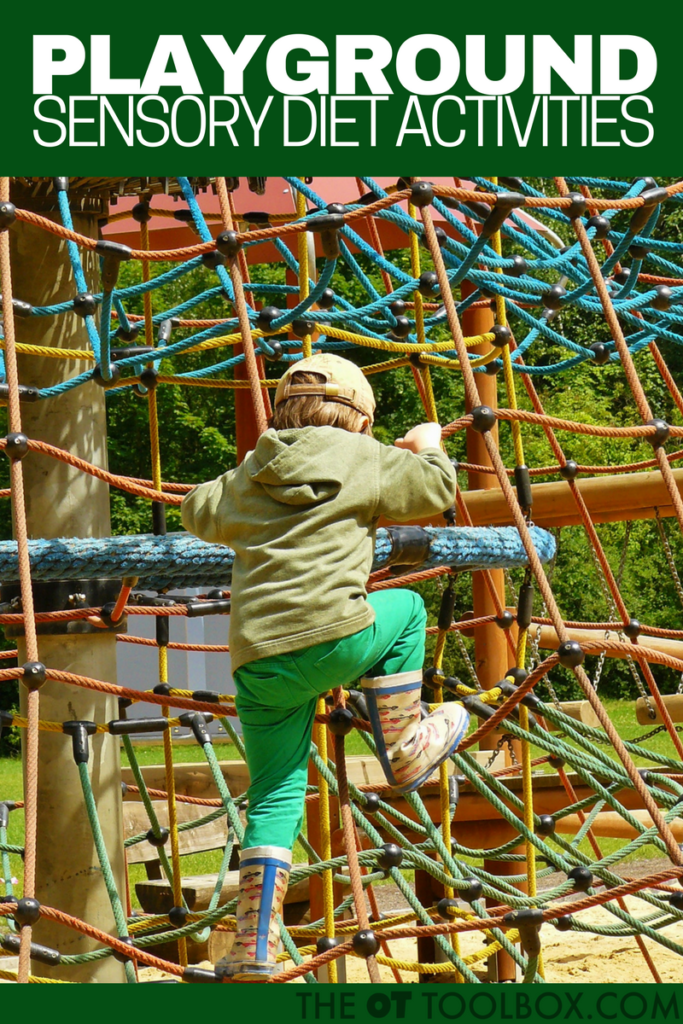
      The outdoors is a goldmine for play! Kids can be creative, build healthy bodies, and develop the skills that they NEED through playing outdoors. For the child who requires a sensory diet, the outdoors is a goldmine for acquiring the right kind of sensory input. The activities below are those sensory diet activities that can be accomplished through play at the playground. Also check out our resource on playground therapy.

      Even a sensory diet for adults can include a walk in the park as a movement and sensory break!


      Playground sensory diet activities that kids can use for sensory needs, perfect for occupational therapists who are creating sensory diets for kids with sensory processing needs.


      A while back, we shared information about sensory processing at the playground and sensory input that can be provided at the playground. Today, we wanted to share a few quick lists for sensory diet activities that can be implemented at an outdoor (or indoor) playground or play area. 


      These are sensory diet activities that an occupational therapist can prescribe based on evaluation of a child’s specific sensory needs. Use the playground sensory diet activities listed below as part of a list of specific activities and sensory tools that meet certain sensory processing needs or a home program for children with sensory processing challenges. 


      There is a lot of research on playing outdoors and about the benefits of just playing outside! 


      Disclaimer: When therapists develop a specific and highly individualized sensory diet, it’s not just throwing together a day filled with sensory input. A sensory diet  is a specific set of sensory tools used to meet and address certain needs of the individual based on sensory need and strategizing. Each of the sensory diet activities above should meet specific needs of the child. Every child is different so applying sensory input to one child may look very different than that of another. Parents should use the tactics below along with your child’s occupational therapist.


      Playground Sensory Diet Activities


      Climb the slide
      Swing on the swings (side to side, forward-back, twist, superman fly, or even upside down!)
      Go down the slide (forward, backwards, on belly, on back)
      Roll a ball up the slide and catch it before it hits the cround
      Ramps
      Balance beams
      Monkey bars
      Rope equipment
      Elevated surfaces
      Uneven surfaces
      Sound tubes and equipment
      Teeter totters or bouncy equipment
      Merry go rounds or spinning equipment
      Climbing walls
      Sandbox play
      Playground scavenger hunt
      Tunnels (Crawl through, army crawl through)
      Playground “I Spy”
      Bouncing a ball against a wall
      Textured sensory scavenger hunt
      Climbing surfaces

      Accommodations for addressing sensory needs in the backyard

      For kids with sensory needs, it can be overwhelming on a playground with running children, background noises, or other sensory input. Try these accommodations for addressing sensory needs in backyard play:
       
      Proprioceptive input such as firm touch to the shoulders


      Calming vestibular sensory input such as side to side or forward-front slow swinging


      Throw and play catch with a weighted ball 


      Baby wipes to clean hands if child is sensitive to messy hands or dirt
      Sheltered area if child is sensitive to wind blowing on skin
      Wear a lightweight wind jacket
      Hat with brim to reduce bright light or intense light in eyes or on face
      Sunscreen with firm touch before going outdoors
      Wear sunglasses
      Wear headphones to reduce background noise
      Sports bottle with straw
      Calming, chewy snacks


      More about outdoor sensory diet activities


      Sensory diets and specific sensory input or sensory challenges are a big part of addressing sensory needs of children who struggle with sensory processing issues. Incorporating a schedule of sensory input (sensory diet) into a lifestyle of naturally occurring and meaningful activities is so very valuable for the child with sensory needs. 

       
      That’s why I’ve worked to create a book on creating an authentic and meaningful sensory lifestyle that addresses sensory needs. The book is now released as a digital e-book or softcover print book, available on Amazon. 


      The Sensory Lifestyle Handbook walks you through sensory diet creation, set-up, and carry through. Not only that, but the book helps you take a sensory diet and weave it into a sensory lifestyle that supports the needs of a child with sensory processing challenges and the whole family.


      The Sensory Lifestyle Handbook is a resource for creating sensory diets and turning them into a lifestyle of sensory success through meaningful and motivating sensory enrichment.


      Colleen Beck, OTR/L has been an occupational therapist since 2000, working in school-based, hand therapy, outpatient peds, EI, and SNF. Colleen created The OT Toolbox to inspire therapists, teachers, and parents with easy and fun tools to help children thrive. Read her story about going from an OT making $3/hour (after paying for kids’ childcare) to a full-time OT resource creator for millions of readers. Want to collaborate? Send an email to contact@theottoolbox.com.
      Bird Play Dough Mat Thank You

      Thank you for grabbing our Bird Play Dough Mat! You should have an email in your inbox right now with a link to access the file. 

      Did you find this page accidentally and want to know what the fuss is about? Go to our outer space play dough mat page to get your free bird play dough mat!

      The email also includes some instructions and the “why” behind play dough mats like this one. There is a lot of development going on when a little one uses a play dough mat like the one you just accessed! Scroll below to to find some additional instructions to best use the play dough mat to increase hand strength of the intrinsic muscles of the hands.


      How to use your Bird Play Dough Mat and General Housekeeping Information on your Free Printable:

      You are going to build so many small muscles of the hand with this activity!

      1. To use this play dough mat, you will first want to cover it with a plastic surface so you can use it over and over again. Some ideas to do this include (Amazon affiliate links are included below):


      • Cover it with clear contact paper. Click the link to purchase a large roll of clear contact paper.
      • Slide the play dough mat into a clear plastic page protector sleeve. Add it to a folder workbook or binder booklet of play dough mats for quiet time or a busy bag-type of activity.
      • Use a laminator to cover the play dough mat with a laminated surface that can be used over and over again. This is a great price on a quick laminator and laminating pouches.
      • Use pocket sleeves to create a quiet time or fine motor center activity.


      2. Once the play dough mat is covered, provide the child with play dough, clay, foam dough, or other moldable material.


      3. Ask the child to roll small balls of play dough using just the fingers and thumb of one hand. They should use their dominant hand to roll small balls of play dough with the tips of the fingers and thumb. This is an AWESOME hand strengthening exercise for kids. 

      4. Ask the child or children to roll various sizes of play dough so the balls of dough fit into the various circle sizes on the play dough mat. 


      If you do not see the email right away, check back within 30 minutes. Be sure to check your SPAM folder.  Other subscribers using an email hosted on a school system’s email provider may have security restrictions in place that block the email. If you still don’t see the email, shoot me a message at contact@www.theottoolbox.com and I will send the file to you directly.

      If you arrived here by accident and would like to receive a free outer space themed play dough mat to improve hand strength, check out this post that shares information on the Outer Space Play Dough Mat.


      How to use a Play Dough Mat to Improve Fine Motor Skills

      Your kids or therapy clients are going to build so many small muscles of the hand with this activity! Follow the directions below to maximize intrinsic muscle strengthening. Start with play dough of any kind and the printable playdough mat.

      Rolling play dough within one hand promotes development of a variety of areas: 


      • Strengthens the arches of the hands, helps awareness and coordination in separation of the two sides of the hand
      • Promotes finger isolation for improved control and dexterity
      • Encourages dexterity and coordination of the thumb and index finger which are important in pencil grasp
      • Strengthens the intrinsic muscles for improved endurance in fine motor tasks such as maintaining hold on a pencil, manipulating clothing fasteners, managing and using scissors, coloring, and many other tasks.


      Looking for more play dough activities to boost fine motor strengthening?


      Play Dough Farm Activity | Play Dough Activity Color Match  | Play Dough Cupcakes

      The OT Toolbox Contributor Author Spotlight-Regina

      Meet Regina!


      Regina Parsons-Allen is a school-based certified occupational therapy assistant. She has a pediatrics practice area of emphasis from the NBCOT. She graduated from the OTA program at Caldwell Community College and Technical Institute in Hudson, North Carolina with an A.A.S degree in occupational therapy assistant. She has been practicing occupational therapy in the same school district for 20 years. She loves her children, husband, OT, working with children and teaching Sunday school. She is passionate about engaging, empowering, and enabling children to reach their maximum potential in ALL of their occupations as well assuring them that God loves them!


      Contributor Posts by Regina on The OT Toolbox:
      Occupational Therapy Activity Toolkits
      MORE Themed Occupational Therapy Toolkits
      Dragonfly Occupational Therapy Activities
      Fine Motor Craft: Soap Holder Animal Craft

      Regina has an e-book you may want to check out. Recently, she’s written an e-book called Fine Motor Stations. 


      Follow Regina on social media:
      Instagram: COTA Life 
      Twitter: COTALife1 
      Pinterest: COTA Life


      Disclaimer Statement: 
      Regina Parsons-Allen is a certified occupational therapy assistant, but is in no way representing herself as a certified occupational therapy assistant in the publication of any post. The information, ideas or activities presented here are not intended to provide medical advice or physician/therapist instruction nor should they be used as a substitute for occupational therapy or other medical services. The information, activities, and ideas do not replace any relationship with a child and their therapist nor do they provide one to one treatment or consultation for a child with an established plan of care based on an assessment. Consult with a qualified occupational therapist if you have questions regarding the information or ideas presented or how to implement them with a child. If concerned about your child’s development, consult your child’s physician or a licensed occupational therapist regarding specific concerns or other medical advice. Any information, ideas or activities presented here are designed for complete adult supervision. Never leave a child unattended during implementation of any ideas or activities. Always follow and be aware of any age recommendations when using all of the products contained in any activities or ideas. The adult implementing and preparing the ideas or activities is ultimately responsible for using their best judgement when choosing and providing activities to best meet a child’s skill and safety level. Do not provide objects or materials that would pose as a choking hazard to a child. Regina Parsons-Allen  is not liable for any impairment, damage, accident or loss arising out of the use or misuse of the information, ideas, and activities suggested in the publication of any post.  

      Zipper Pull Craft

      When kids are learning to manage a zipper, it can be frustrating if fine motor skills or visual motor skills are delayed. Even children who are developing fine motor and visual motor skill work at an age-appropriate level can have difficulty with using a zipper. When kids learn to zipper up a coat or jacket, children can have difficulty with all of the steps that go into zippering. Using a zipper pull on a coat zipper can be a helpful tool in independence. 

      You will find more information about teaching kids how to zipper here on The OT Toolbox. In fact, zippering is an important part of self-dressing and functional independence that toddlers can begin with. 


      Make this DIY zipper pull craft to help kids learn how to zipper their own coat or jacket, while working on fine motor skills and self-dressing skills in kids.
      When small children are able to pull up their zipper or pull down their zipper, they can feel a sense of self-confidence that makes them want to try harder to work on the skills involved in zippering: engaging the zipper into the zipper chamber, holding both sides of the zipper in a coordinated way, and holding down the edge of the coat while pulling up the zipper pull. 
      Other children who are more challenged with physical abilities benefit from a zipper pull. 

      Try this DIY zipper pull craft that is not only functional, it’s also fun to create! It’s a real fine motor power-craft for kids. 

      Click here to see the directions to make this craft over on our guest post at Craft Project Ideas!
      Make this DIY zipper pull craft to help kids learn how to zipper their own coat or jacket, while working on fine motor skills and self-dressing skills in kids. This fine motor craft is great for teaching kids how to zipper!

      Looking for more ways to teach kids how to zipper? Try these ideas:

       Teach kids how to use a zipper and Help kids learn how to zipper clothing using recycled materials that you probably have in your house. This activity works on all of the individual skills needed for the motor planning of zippering a zipper and uses just a ribbon and plastic bread ties.