Executive Functioning Resources on Therapy Thursday

executive functioning resources

Below, you will find a collection of executive functioning resources and tools for improving executive functioning skills that can be used in the home, school, therapy clinic, or anywhere!

Use these executive functioning resources to improve and develop executive functioning skills at home or in the classroom.
 

This week, we’re about Executive Functioning Skills!

If you follow The OT Toolbox, then you know we have a lot of resources on executive functioning skills. In fact, we even have an Executive Functioning Skills Toolbox Facebook Page! (Follow along for lots of resources curated from around the web!)

Here are strategies to help the adult with executive function disorder. Many of these tips and strategies are great for teens as well.

Let’s start at the beginning:

What are Executive Functioning Skills?

Executive Functioning Skills guide everything we do, from making decisions, to staying on track with an activity, to planning and prioritizing a task.  The ability to make a decision, plan it out, and act on it without being distracted is what allows us to accomplish the most mundane of tasks to the more complicated and multi-step actions.

Children with executive functioning issues will suffer in a multitude of ways.

Some kids have many deficits in EF and others fall behind in several or all areas. _Everyone_ needs to develop and build executive functions as they grow.  Functional adults may still be struggling with aspects of executive functioning skills. These cognitive skills are an interconnected web of processing that allows for self-regulation, planning, organization, and memory.

Executive Functioning Skills are essential for learning, behavior, and development.  All of these skills work together and impact other areas.

Executive Functioning Skills include:

  • Emotional Control
  • Task Initiation
  • Task Completion
  • Working Memory
  • Planning
  • Prioritizing
  • Processing Speed
  • Organization
  • Attention
  • Self-Monitoring
  • Impulse Control
  • Cognitive Flexibility
  • Foresight
  • Hindsight
  • Self-Talk
  • Problem Solving
  • Persistence
  • Shift

Executive functioning skills development begins at a very early age. Click here to read more about executive functioning skill development.

Resources for Improving Executive Functioning Skills

Executive functions are heavily dependent on attention.  Read about the attention and executive functioning skill connection and the impact of attention on each of the executive functioning skills that children require and use every day.

Check out these fun games to help improve executive function skills.

Another area of interest to you might be the impact executive functioning skills have on handwriting.

Here are strategies for improving task initiation.

Read about tips for improving working memory.

Here are tons of tips for addressing organization issues at home or in school. These are great for younger kids through adult!

 
Here are many activities and loads of information on improving attention in kids.
 
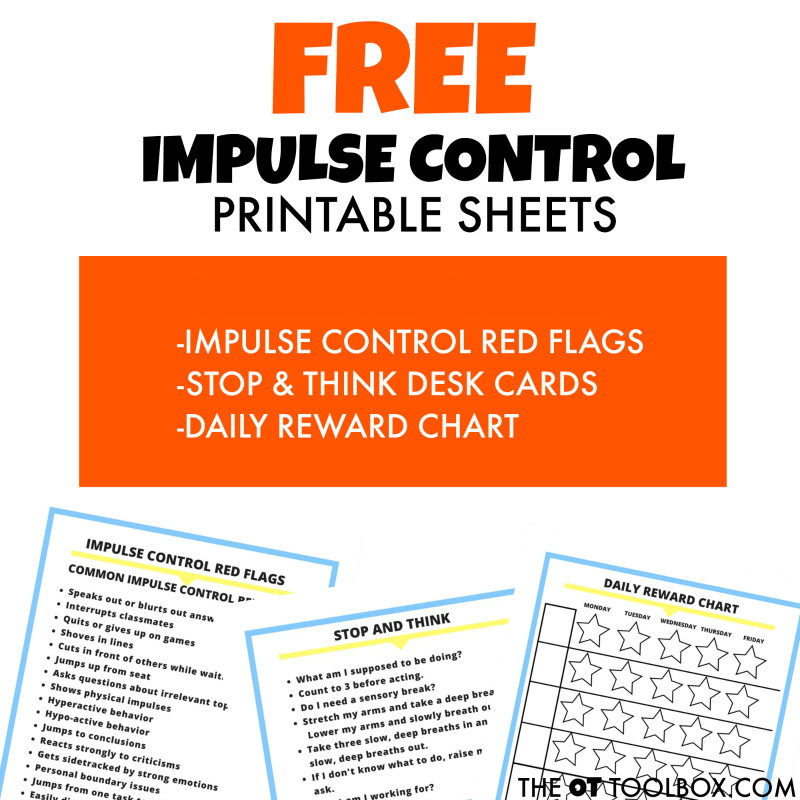
Helping kids with impulse control can be a big challenge! Here are tips that can help.
 
 
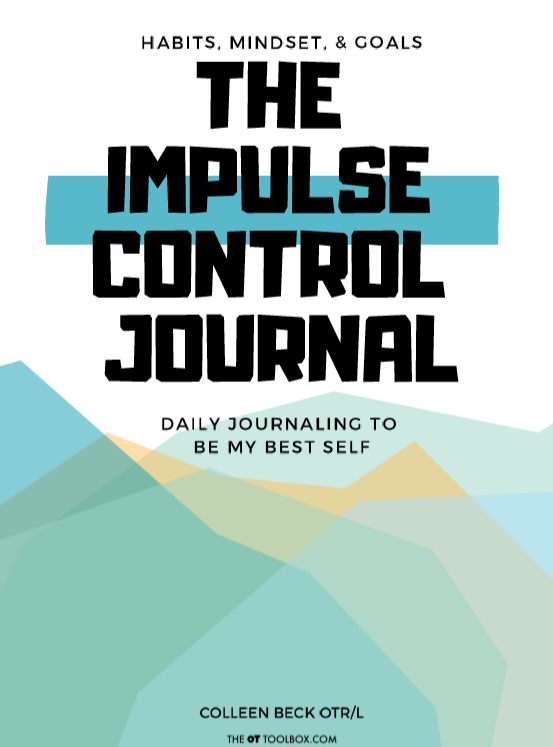
That’s why I created The Impulse Control Journal.

The Impulse control journal is a printable journal for kids that helps them to identify goals, assess successes, and address areas of needs.  The Impulse Control Journal is a printable packet of sheets that help kids with impulse control needs.

Read more about The Impulse Control Journal HERE

The Impulse Control Journal has been totally revamped to include 79 pages of tools to address the habits, mindset, routines, and strategies to address impulse control in kids. 
  •  
  •  
  
This is a HUGE digital resource that you can print to use over and over again.  


Try these executive functioning resources to improve executive function in kids.

Executive Function Resources

Here are some accessible and user-friendly resources that can be beneficial for individuals, including students and professionals in the field of occupational therapy, to learn more about executive functioning:

  1. Understood.org – Executive Functioning Issues:
    • Website: Understood.org
    • Description: Understood.org provides articles, videos, and practical tips on understanding and supporting individuals with executive functioning challenges.
  2. CHADD – Children and Adults with Attention-Deficit/Hyperactivity Disorder:
    • Website: CHADD
    • Description: CHADD offers resources on ADHD and executive functioning, including articles, webinars, and support groups. Their resources are helpful for both professionals and parents.
  3. Smart but Scattered by Peg Dawson and Richard Guare:
    • Book: Smart but Scattered (Amazon affiliate link)
    • Description: This book provides practical strategies for improving executive skills in children and adolescents. It’s written in an accessible style, making it useful for parents, educators, and therapists.
  4. The Executive Functioning Workbook for Teens by Sharon A. Hansen:
    • Book: The Executive Functioning Workbook for Teens (Amazon affiliate link)
    • Description: Geared towards teenagers, this workbook offers engaging activities and exercises to develop executive functioning skills. It can be a helpful resource for both therapists and teens.
  5. ADDitude Magazine:
    • Website: ADDitude Magazine
    • Description: ADDitude Magazine provides articles, webinars, and expert advice on various topics related to ADHD and executive functioning. It’s a valuable resource for staying informed on the latest research and strategies.
  6. National Center for Learning Disabilities (NCLD) – Executive Function 101:
    • Ebook: Executive Function 101
    • Description: NCLD’s Executive Function 101 article offers an overview of executive functioning and practical tips for supporting individuals with executive function challenges.

These resources are designed to be accessible to a broad audience, and that means that the supports or suggestions won’t be appropriate for every individual. They provide a foundation for understanding and implementing strategies to enhance executive functioning skills.

Know a child who struggles with impulse control, attention, working memory or other executive functions?Let’s talk about what’s going on behind those impulses!
FREE Email Mini-Course


    We won’t send you spam. Unsubscribe at any time.

    Colleen Beck, OTR/L has been an occupational therapist since 2000, working in school-based, hand therapy, outpatient peds, EI, and SNF. Colleen created The OT Toolbox to inspire therapists, teachers, and parents with easy and fun tools to help children thrive. Read her story about going from an OT making $3/hour (after paying for kids’ childcare) to a full-time OT resource creator for millions of readers. Want to collaborate? Send an email to contact@theottoolbox.com.

    More about the Impulse Control Journal:

    • 30 Drawing Journal Pages to reflect and pinpoint individual strategies 
    • 28 Journal Lists so kids can write quick checklists regarding strengths, qualities, supports, areas of need, and insights 
    • 8 Journaling worksheets to pinpoint coping skills, feelings, emotions, and strategies that work for the individual 
    • Daily and Weekly tracking sheets for keeping track of tasks and goals 
    • Mindset, Vision, and Habit pages for helping kids make an impact
    • Self-evaluation sheets to self-reflect and identify when inhibition is hard and what choices look like 
    • Daily tracker pages so your child can keep track of their day 
    • Task lists to monitor chores and daily tasks so it gets done everyday  
    • Journal pages to help improve new habits  
    • Charts and guides for monitoring impulse control so your child can improve their self-confidence  
    • Strategy journal pages to help kids use self-reflection and self-regulation so they can succeed at home and in the classroom  
    • Goal sheets for setting goals and working to meet those goals while improving persistence  
    • Tools for improving mindset to help kids create a set of coping strategies that work for their needs

    Read more about The Impulse Control Journal HERE

    More Themed Occupational Therapy Activity Toolkits

    his blog post by contributor author Regina Parsons-Allen describes occupational therapy activity kits that can be used to address a variety of occupational therapy goals using themed OT kits, saving time and planning for therapy. 


    Another Look at Occupational Therapy Themed Tool Kits

    This is part two of the blog post regarding themed occupational therapy activity tool kits.
    Many people have contacted me to ask if I have other themed therapy tool kits that I use in my practice as a school-based COTA. This is part two of my original post where I will share more information regarding additional kits. Like I said, I have so many kits it is hard to share them all in one or even two posts.

    What is an Occupational Therapy Activity Toolkit?

    Let’s review, pediatric and school-based occupational therapy practitioners are busy people. Racing from school to school or site to site serving children of many ages all in a single day.

    Having portable tool kits saves the therapists’ valuable time in planning, preparing, organizing and documenting for assessment and intervention. To sum up tool kits, they are portable, all inclusive, and can be separated by themes to support the different needs of the individual therapist and/or child.

    There can be many types of tool kits using a variety of designs and sizes. Tool kits can be separated by many types of themes to address a therapists’ particular needs.

    Please refer to the original blog post on occupational therapy activity toolkits as it contains lots of great information with the complete details regarding specific types of tool kits, valuable tips on how to make a tool kit, and some other examples of kits that I use in practice to include an Easter tool kit, a grab and go kit, and a strengthening kit.

    More Occupational Therapy Activity Toolkit Ideas

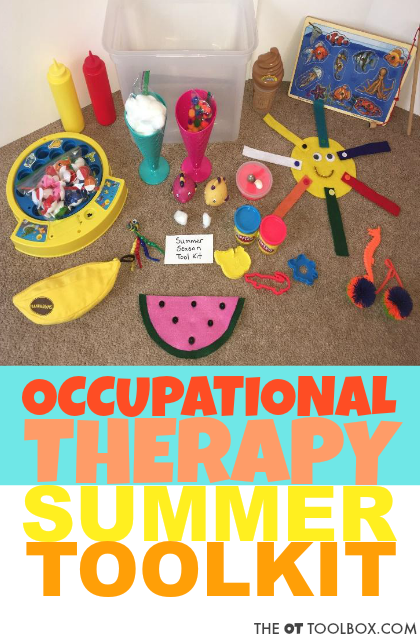
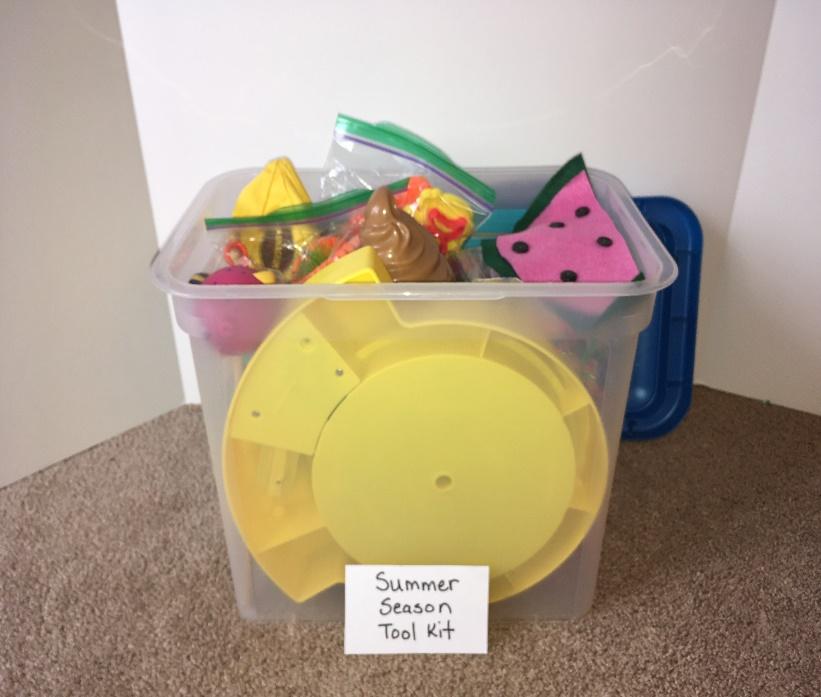
    Below is an example of a Seasonal Tool Kit – Summer:

    Use these themed occupational therapy activity toolkit ideas to create a themed summer OT activity kit for on-the-go treatment.

    Seasonal or holiday kits contain fun activities that can reach a vast majority of kiddos with many types of needs. Splashing the activities with some genuine OT creativity can really transform the impact of these kits.

    “Dump and Run” Seasonal Therapy Tool Kit

    Create a summer themed occupational therapy activity toolkit for pediatric occupational therapy treatment.

    (Check out why I call it a “dump and run” kit in the original post.)

    Tools of the Trade Occupational Therapy Activity Toolkits

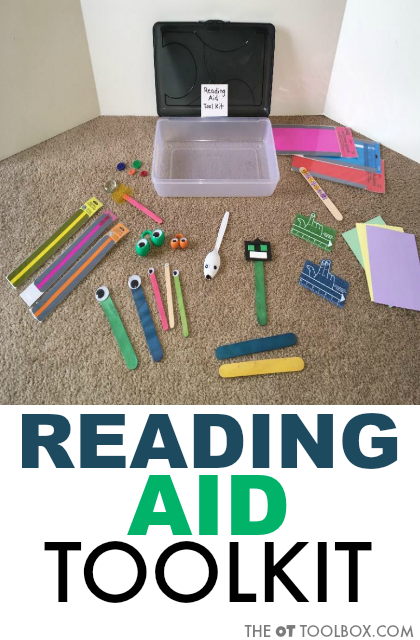
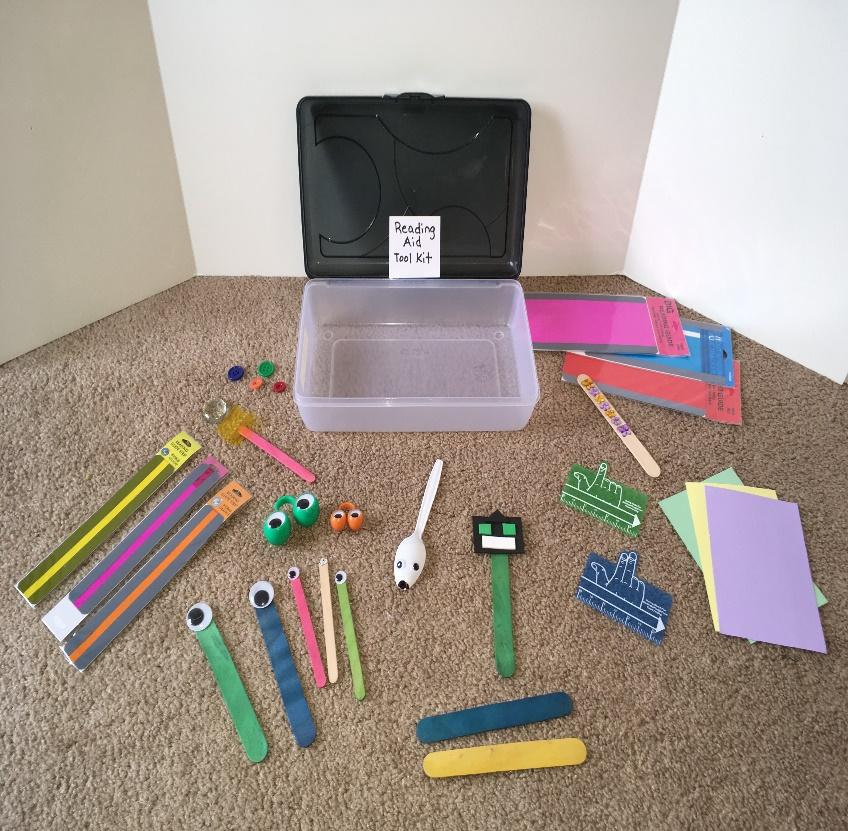
    Below are two examples of Tools of the Trade Kits – Pencil and Reading Aid Tool Kits:

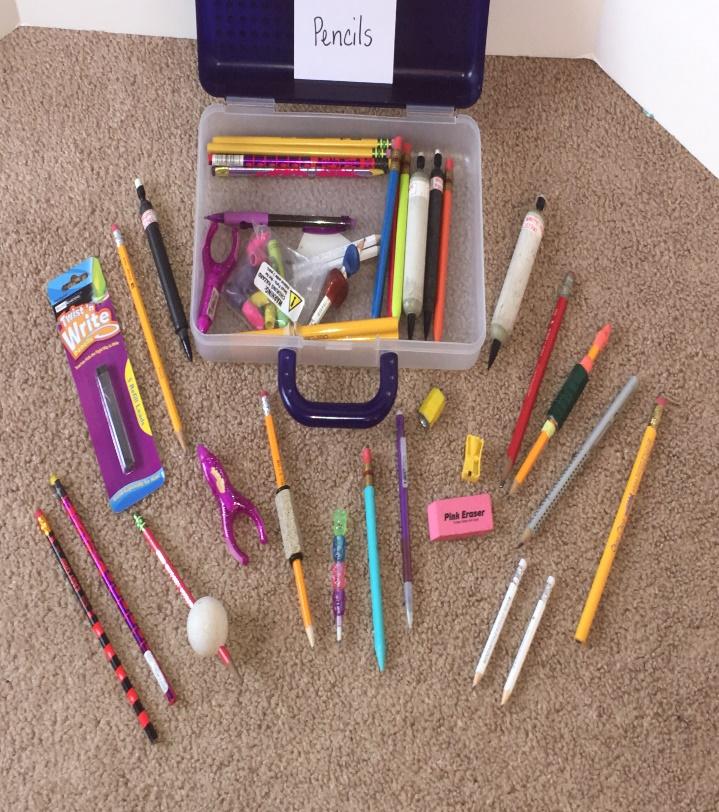
    Tools of the trade kits contain standard to adaptive tools, devices, or materials with items being either purchased or DIY. These tools can be used for treatment, trial, loan, or assessment and are useful to determine skill level, formulate therapy plans, and provide intervention.

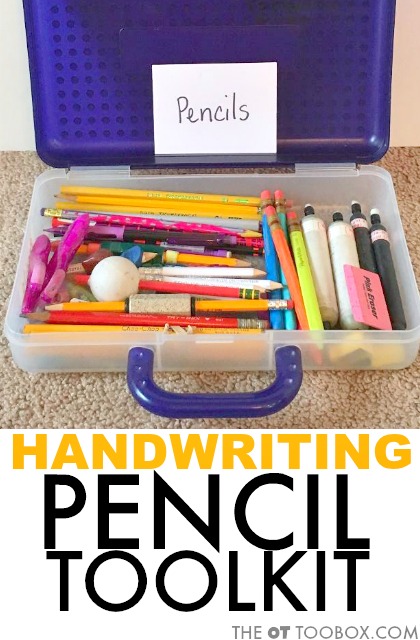
    Handwriting Pencil Toolkit:

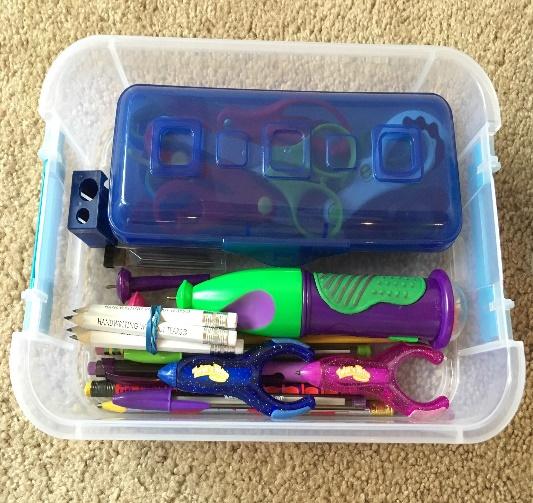
    Create a themed occupational therapy activity toolkit to address handwriting and pencil grips to address common handwriting issues in pediatric occupational therapy.

    Create a themed occupational therapy activity toolkit to address handwriting and pencil grips to address common handwriting issues in pediatric occupational therapy.
    This coban pencil grip can be added to the handwriting toolkit. Another addition that can benefit many students is this easy DIY pencil grip that uses balloons. 
    Add a mechanical pencil to address proprioception needs or pencil pressure issues. Read about how a mechanical pencil can help with pencil pressure here. 

     Reading Aid Therapy Toolkit:

    Create a reading aid toolkit for occupational therapy treatment of reading issues in pediatric occupational therapy activities.
    Create a reading aid toolkit for occupational therapy treatment of reading issues in pediatric occupational therapy activities.

    This visual tracking tool can make a nice addition to the reading aid toolkit.

    Targeted Skill Area Tool Kits

    Targeted skill area kits contain specific tools of the trade and other assorted materials that address the development of a targeted skill area.

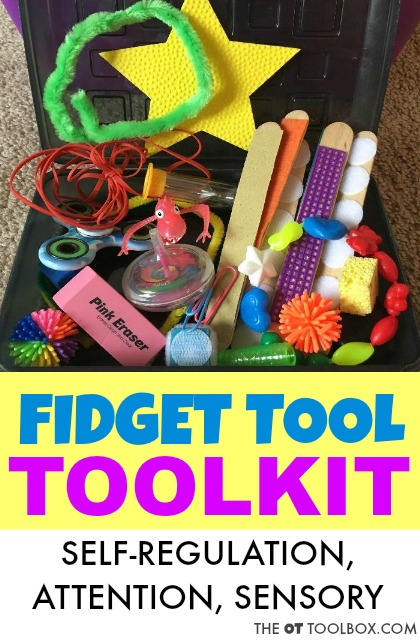
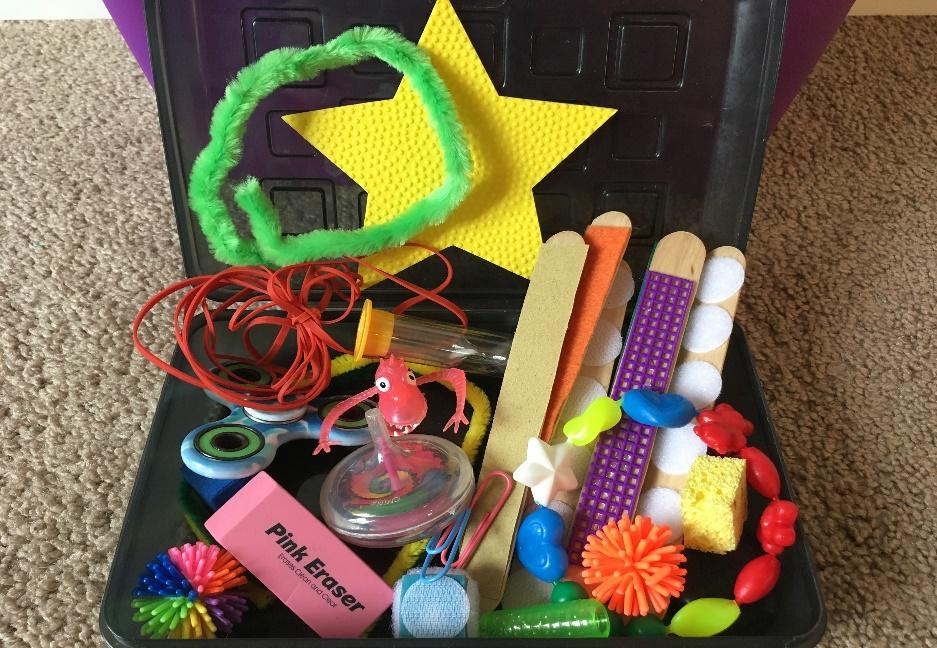
    Below are two examples of targeted skill area kits designed to address Self-regulation, Sensory, and Attention:

    Make an occupational therapy activity toolkit to address attention or self-regulation needs using sensory fidget tools and other items used in pediatric OT.

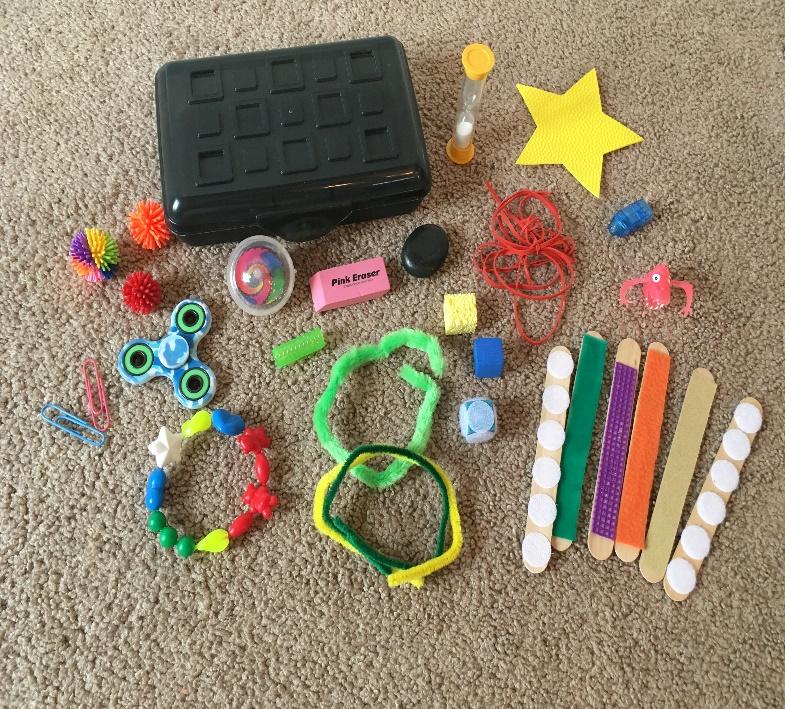
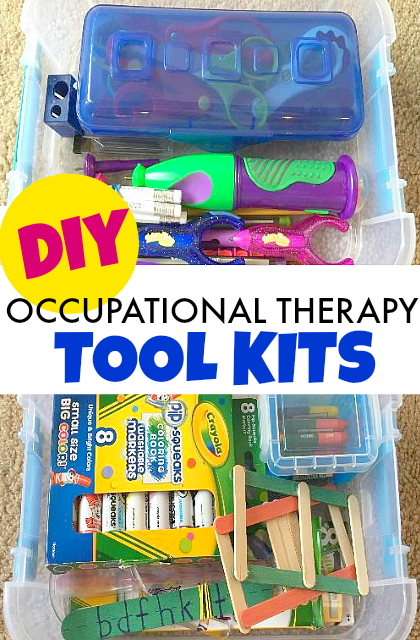
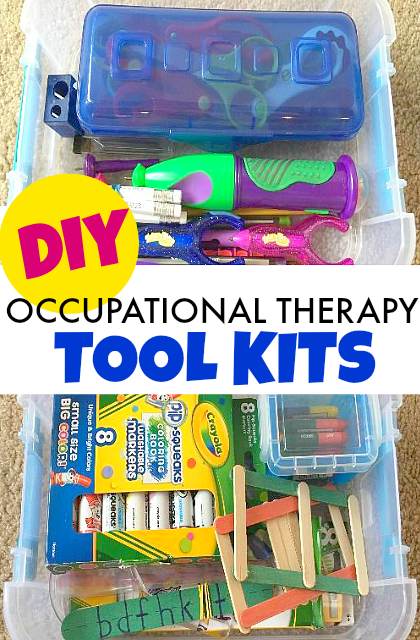
    Create a Pencil Box Fidget Tool Kit using a pencil box to store items.

    Some of these quiet fidget tools can be a nice addition. Here are some DIY fidget tools that can be added, too.

    Make an occupational therapy activity toolkit to address attention or self-regulation needs using sensory fidget tools and other items used in pediatric OT.

    Make an occupational therapy activity toolkit to address attention or self-regulation needs using sensory fidget tools and other items used in pediatric OT.

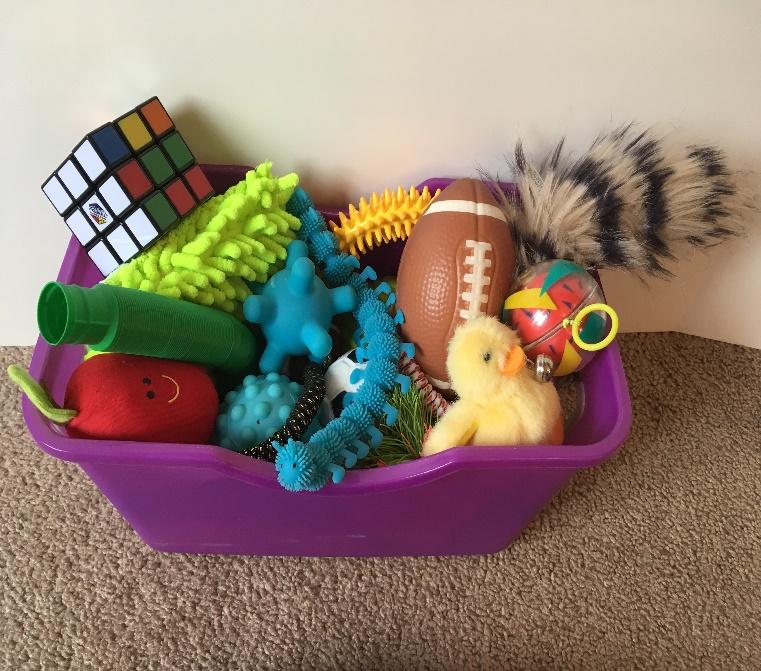
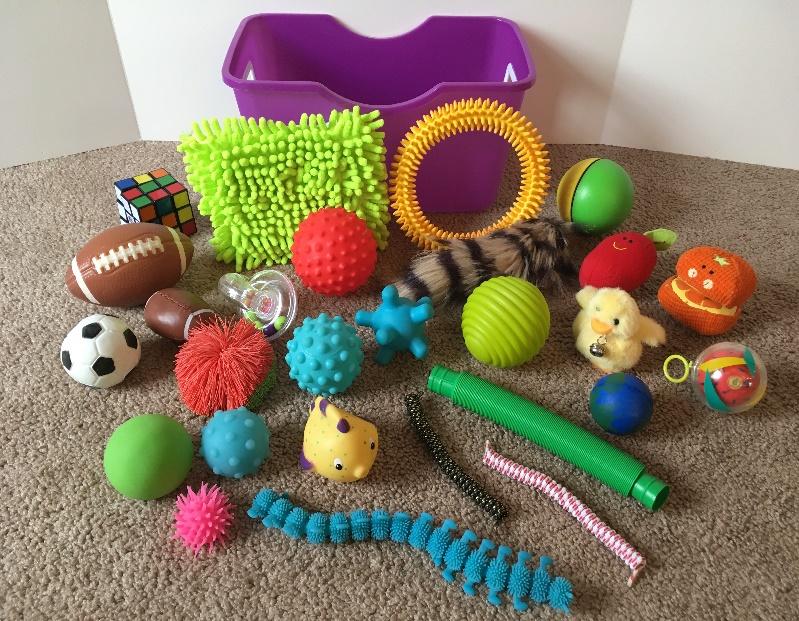
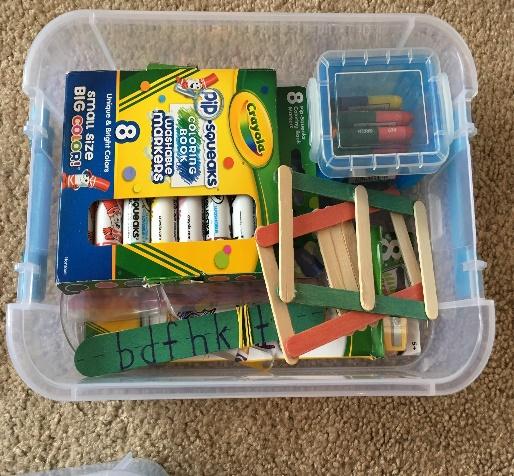
    Create an Open Top Fidget or Sensory Tool Kit in a small bin or crate.

    Make an occupational therapy activity toolkit to address attention or self-regulation needs using sensory fidget tools and other items used in pediatric OT.

    Make an occupational therapy activity toolkit to address attention or self-regulation needs using sensory fidget tools and other items used in pediatric OT.

    Themed therapy kits address the therapist’s desire for ease in program planning, preparation, organization and documentation. Invest the time now and enjoy the time later by simplifying your work as a pediatric therapist.

    Children will be excited to see the kits coming and you will be better prepared to enjoy the time you spend providing intervention with the child.

    This post was written by Regina Allen. Read about Regina in her Contributor Author Spotlight.

    Privacy Policy

    This policy was last updated 7-11-18.

    Your privacy is important to The OT Toolbox (www.theottoolbox.com) and The OT Toolbox Community (http://community.www.theottoolbox.com/). The policy below outlines how your personal information is collected and how it is used when you use our website.

    You agree to the terms of this policy when you use this website. This privacy policy may change from time to time. If any changes are made, then you will be notified by revising the date at the top of this policy.

    About The OT Toolbox
    Founded in 2011 and based in The United States, The OT Toolbox and its community is an independently operated blog run by Colleen Beck, OTR/L. This website strives to share information related to childhood development and creative activities designed to promote, strengthen, and improve healthy development in children.How Information is Collected
    Here is how your information is collected on The OT Toolbox:

    • if you subscribe to the newsletter
    • if you leave a comment on the blog (see below)
    • if you purchase a product via the The OT Toolbox store
    • through website cookies and log files
    • through Google Analytics
    • if you post a comment, initiate a thread, share resources, or write a blog post on http://community.www.theottoolbox.com/ (The OT Toolbox Community)

    Newsletter
    If you decide to join the newsletter via any of the many sign up forms located throughout this website, then your first name and email address are required. We require your email address in order to send you the emails and we require your first name so that my emails to you will include a friendly personalized note. Occasionally, biggest problem areas or age ranges of your children are requested, only in order to send you information related to that age range and to provide information geared toward your specific needs.

    At the bottom of every email I send, you will find a link to unsubscribe. You may unsubscribe from the newsletter at any time. If you are having trouble unsubscribing or would like to be removed from the newsletter, then simply send me an email at theottoolbox@gmail.com asking to be removed.

    I currently use Convert Kit as my email service provider. Your data is collected and then passed to them. Tags are used within Convert Kit to track your actions and page visits so that future emails can be better tailored to meet your needs.Currently, I send a minimum of one email per week. However, I will occasionally email you about products and other promotions that may be relevant to your interests.

    Free printables are sent directly to your email with a link via a third party application called Leadpages (read their privacy policy here).

    Your email and name are never sold or given away to a third party.

    All emails you receive are CAN-SPAM compliant. At the bottom of every email, you will find information on how to contact the sender, as well as information on how to unsubscribe.

    Blog Comments
    Currently comments are turned OFF on TheOTtoolbox.com. At some point, comments may be turned back ON, and if/when that occurs, readers will be able to leave comments on individual blog posts. If you choose to leave a comment on a blog post, then please be aware that the comment is then public and visible to anyone who reads the comment section. Your email address is never shared or disclosed, but your name and comment will be visible to others.

    It is highly recommended that you avoid leaving detailed personal information in your comments.

    I reserve the right to remove comments deemed as inappropriate, threatening, profane, or spammy without notice.

    Store Purchases
    Products in the The OT Toolbox Store are sold via GumRoad. Your name, email address, and country are required during the checkout process. This information is required in order to send you the purchased product and to determine whether or not the EU VAT tax should be applied to your purchase.

    The details you enter are stored by the third party applications. All payments are made through PayPal, which does not store your financial information once the transaction has been processed.

    I also sell products via affiliate programs. Each program collects and retains their own data. I do not have access to the personal information that is collected by these affiliate programs. It is best to read their individual privacy policies for more information on how your data is collected and used.

    Cookies

    Cookies store user-specific information into a log. I use the following cookies on The OT Toolbox and The OT Toolbox Community:

    The OT Toolbox and The OT Toolbox Community uses Google Analytics to track website performance and user behavior. It provides information on pageviews, referral sources, and other valuable information that helps me adapt the content I write for this website. Google Analytics does capture anonymous data about location, age, gender, and interests, but I have no way to connect that information and specifically identify you. Google Analytics may also capture your IP address as you make your way around this website. User and event data is retained for 26 months and then is automatically deleted. You can read more about that here.

    Advertising Privacy Statement

    This Site is affiliated with AdThrive, LLC (“AdThrive”) for the purposes of placing advertising on the Site.  AdThrive uses standard and widely-available tools for the placement and serving of ads, including those provided by Google, Inc. and its affiliates. We publish interest-based advertisements on the Site; that is, ads that are tailored to reflect your interests. To help understand your interests, AdThrive, Google and our other advertising partners will track your behaviour on our website and on other websites across the Internet using cookies.  
    A cookie is a file containing an identifier (a string of letters and numbers) that is sent by a web server to a web browser and is stored by the browser. The identifier is then sent back to the server each time the browser requests a page from the server. Cookies may be either “persistent” cookies or “session” cookies: a persistent cookie will be stored by a web browser and will remain valid until its set expiry date, unless deleted by the user before the expiry date; a session cookie, on the other hand, will expire at the end of the user session, when the web browser is closed.  Cookies do not typically contain any information that personally identifies a user, but personal information that we store about you may be linked to the information stored in and obtained from cookies.
    By using this Site, you consent to the use of such cookies and the sharing of data captured by such cookies with AdThrive, Google, and our other third party partners. You can view, delete or add interest categories associated with your browser by visiting: https://adssettings.google.com. You can also opt out of the network cookie using those settings or using the Network Advertising Initiative’s multi-cookie opt-out mechanism at: http://optout.networkadvertising.org. However, these opt-out mechanisms themselves use cookies, and if you clear the cookies from your browser your opt-out will not be maintained.  
    For European Economic Area Residents
    If you reside in a country in the European Economic Area (EEA), then under the GDPR and applicable data protection laws you have the rights, among other things, to access your personal data, have us erase it, and/or restrict its further processing.  If you wish to access or delete your personal data (if any) maintained by us or AdThrive related to advertising on the Site, you can contact AdThrive at info@adthrive.com. If you wish to see a list of the advertising partners we work with or change which of those partners track your behavior using cookies, click the ad preferences icon. (Available in the EU.)

    Social Media Privacy
    The OT Toolbox uses various social media platforms. The OT Toolbox is not responsible for what you post on The OT Toolbox social media channels.

    Parental Consent
    If you are under 16 years old, you must first have parental permission before using our website or entering personal information.

    Final Notes on this Privacy Policy
    You have the right to access your personal data and know how it is being processed. Hopefully, the policy above adequately explains how your data is used.

    Personal information will not be transferred unless we are legally obligated to do so. If you would like your information to be removed from our systems, please contact theottoolbox@gmail.com. You can request to be removed at any time.

    The OT Toolbox, it’s social media channels, newsletter, and The OT Toolbox Community contains links to other websites. As such, The OT Toolbox is not responsible for the privacy policies of other websites or the third party applications it uses.

    If you have questions or concerns about this privacy policy, please feel free to contact us at theottoolbox@gmail.com.

    Kinesthetic Learning Fine Motor Activity

    The Kinesthetic Sense is needed for almost every task. Read on for more information on kinesthetic learning, exactly what is kinesthesia, how the kinesthetic sense plays a part in fine motor skills, and kinesthetic fine motor activities that can help with motor planning and learning through play.


    What is Kinesthetic Learning?


    The Kinesthetic sense is a huge part of every action we do.  When we pick up a toothbrush and brush our teeth, we “know” the motion and amount of pressure that is needed to move the toothbrush and polish teeth without poking the side of mouth with the toothbrush. 

    The Kinesthetic sense allows us to zipper a jacket without looking at the zipper. It allows us to tie our shoes while looking up at a friend on the playground.  It allows us to have a conversation and look around at our table mates while using a fork, wiping our mouth, and picking up a cup during dinner. It enables a student to flip the pencil and erase a mistake without looking at the pencil and thinking through each step of moving the pencil within the hand. 

    Kinesthesia allows us to participate in actions with motor planning, appropriate motor actions, and effective proprioception. 


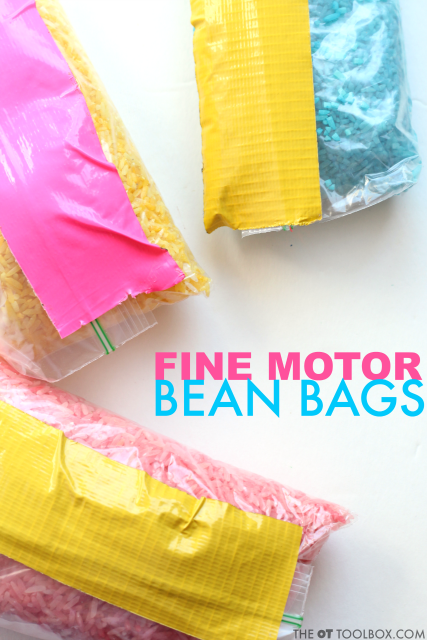
    These kinesthetic learning fine motor activities use homemade bean bags.


    Praxis, or
    kinesthesis
     help
    us understand how to move our bodies. 
    The praxic system is also known as the kinesthetic system. The kinesthetic system essentially “puts it all
    together” when it comes to motor responses to sensory information that has been
    perceived by the other senses.  

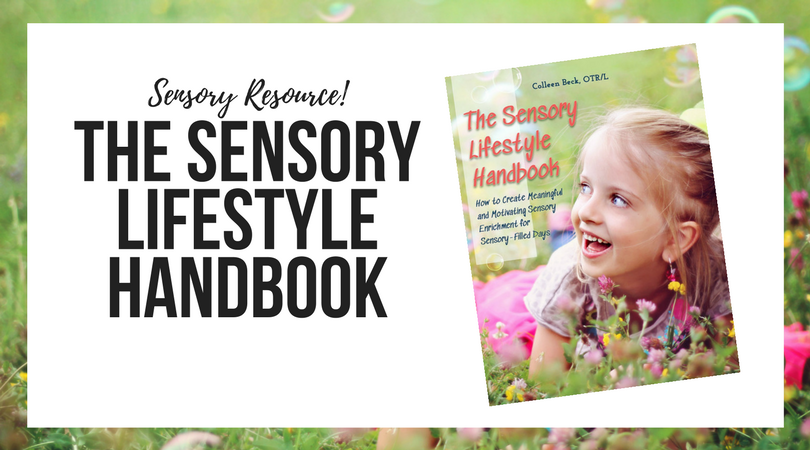
    Knowing how to move our body and how those actions are to be performed is a big part of sensory processing, including a combination of many senses! Read more about sensory processing and how all of the senses are part of a big puzzle in our recent book, The Sensory Lifestyle Handbook


    All of this processing movements and knowing how to move the body within an action make up kinesthetic learning


    Kinesthetic learners need to move their bodies, manipulate materials, and really interact with learning materials.  These children tend to fidget, wiggle, slouch, or get up out of their seats when in the classroom setting.  This site has a lot of great information on kinesthetic learning. 


    Adding movement opportunities involving multiple senses into learning opportunities benefit the kinesthetic learner. 


    Kinesthetic learning has also been called three dimensional learning. 


    Kinesthetic learning occurs during learning experiences where a student feels, touches, hears, moves, and overall “experiences” in learning. 

    Kinesthetic Learning and Motor Planning in Activities


    Having a motor plan for an action can help with tasks that
    are performed again and again. This is true for the motion needed to open and
    close scissors while using both hands in a coordinated manner. 

    Motor planning
    is necessary for formation of letters and numbers (Consider being able to jot
    down notes very quickly or writing a quick fill-in-the-blank word when looking
    up at a Smartboard.) Motor planning allows us to manage clothing fasteners
    without looking. This is the “muscle memory” that allows movements to be performed in a
    smooth and coordinated manner.

    Addressing the kinesthetic sense in learning can be helpful for many children, particularly those who are kinesthetic learners. 

    Proprioception and the kinesthetic sense

    Linked to motor planning and kinesthetic motions is
    proprioception. The ability for muscles and joints to manage weight and
    position in space are necessary for movements to occur with appropriate force
    modulation.

    The Proprioception Sensory System is the recognition and response to the body’s
    position in space with an internal feedback system using the position in space
    of the joints, tendons, and muscles. 
    This sensory system allows the body to automatically react to changes in
    force and pressure given body movements and object manipulation.  The body receives more feedback from active
    muscles rather than passive muscle use.  

    Related to the proprioceptive system is kinesthetic motor actions, or praxis.  Individuals are able to plan and execute
    motor tasks given feedback from the proprioceptive system. Praxis allows us to
    utilize sensory input from the senses and to coordinate hat information to move
    appropriately. 

    Kinesthetic Learning Fine Motor Activities 

    Kinesthetic actions occur in both gross and fine motormovements. When a child is able to complete jumping jacks with coordinated
    upper and lower body movements they are utilizing gross motor kinesthetic
    movements. 


    When a child manages buttons on their pajamas without looking and
    with a coordinated manner, they are utilizing fine motor kinesthesia (among other skills! This is an overgeneralization.) 

    These outdoor kinesthetic learning activities can be as fun as they are helpful for kids!


    Kinesthetic Fine Motor Activity

    Kids can work on kinesthetic learning and kinesthetic fine motor skills with this bean bag activity that helps to address motor planning needs.
    There are ways to develop and strengthen kinesthetic fine
    motor actions. These activities can be used to help develop muscle memory,
    motor planning, and the ability to recognize and respond to various levels of
    weight and kinesthetic input.

    One way to develop kinesthetic fine motor skills is to use
    weighted bean bags in various weights.

    These simple DIY bean bags use brightly colored sand in
    see-through plastic baggies. Different styles of DIY bean bags can be used to
    provide more a more lasting bean bag.

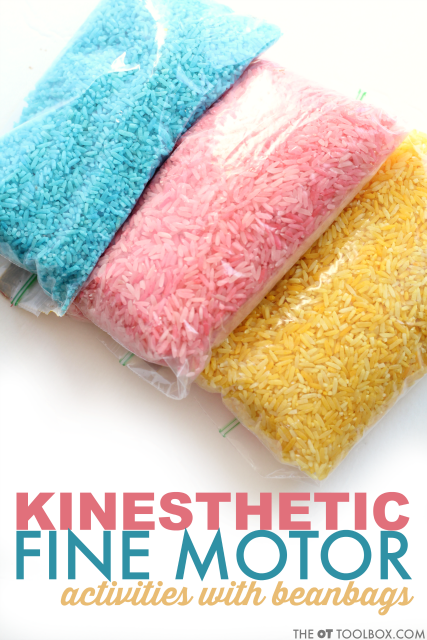
    Use these DIY bean bags to address kinesthetic learning needs and boost fine motor skills.
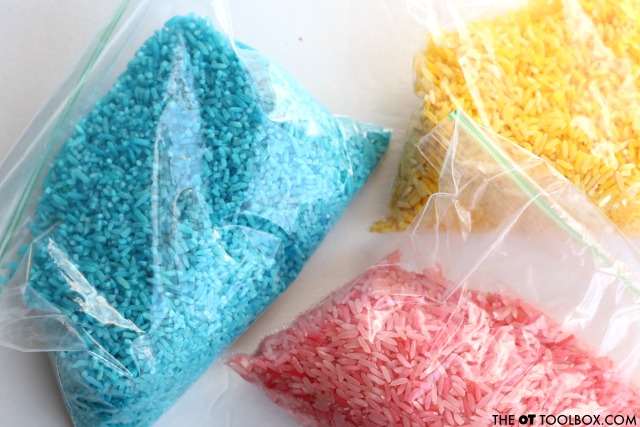
    Use dry rice and liquid food coloring to create colored
    rice. When the rice is completely dry, fill varying amounts into plastic bags.
    (Cloth pockets can be used and then sewn up for a more lasting version.)

    Use colored duct tape to secure the bean bags.

    Occupational therapists will love this bean bag activity to build kinesthetic learning and fine motor skills by addressing motor planning needed for tasks.

    Students can then use the weighted bean bags to practice and
    develop kinesthetic fine motor skills.

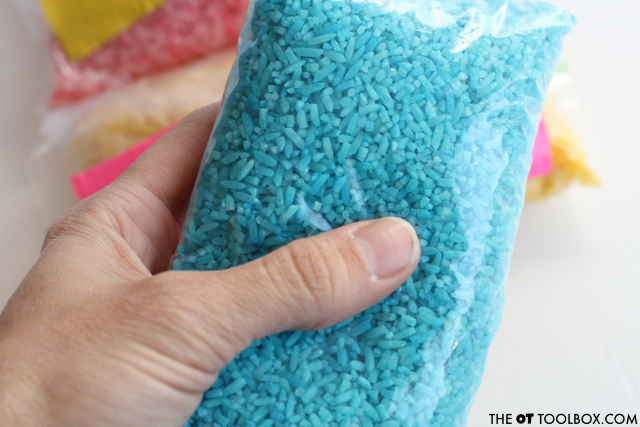
    Weighted bean bags may be sized appropriately to fit the
    child’s hand to address arch development and closure of the hands.

    The weighted objects can be dropped from one hand and caught
    with the other supinated hand. Trial this activity in various positions and
    distances. Then, switch hands so the non-dominant hand is dropping the bean bag
    and the dominant hand catches the bean bag.

    Have the child close their eyes and drop the bean bag from one hand to the other. This encourages and challenges the kinesthetic sense without input from the visual sense. More practice with the eyes open will make this exercise easier as the child’s muscle memory is built. 

    Various weights and sizes of objects should be trialed in
    the various positions and distances.


    Try this activity while sitting and standing.

    There is more input from heavier objects and less input from
    lighter weight objects.


    Be sure to limit throwing of these bean bags, unless you enjoy sweeping up lots of dyed rice! 

    Other weighted objects can be used for this activity too,
    including marbles, small balls, stress balls, etc.

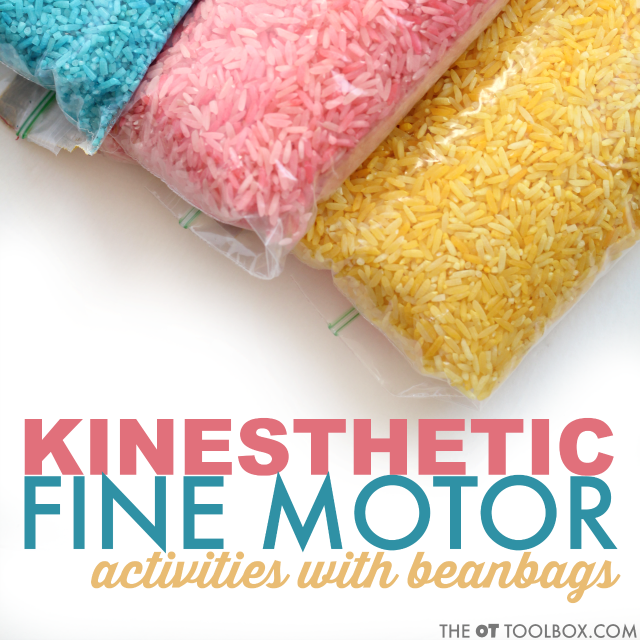
    This kinesthetic learning fine motor activity uses DIY beanbags made with colored rice. Use them in learning activities where kids move and learn.

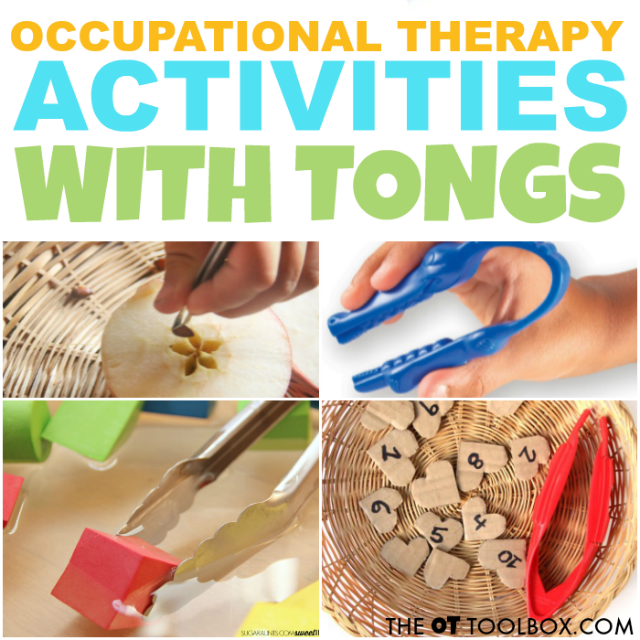
    Occupational Therapy Activities Using Tongs

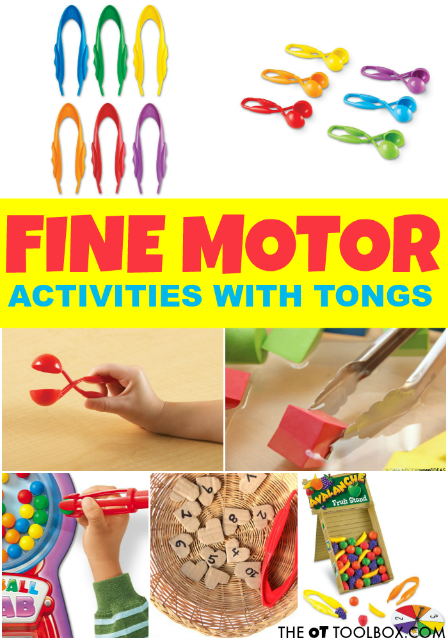
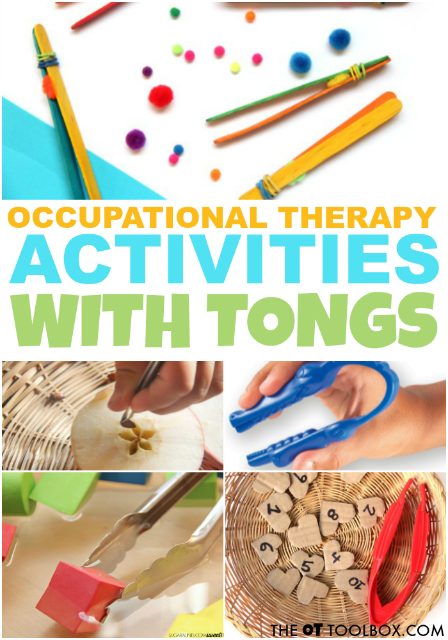
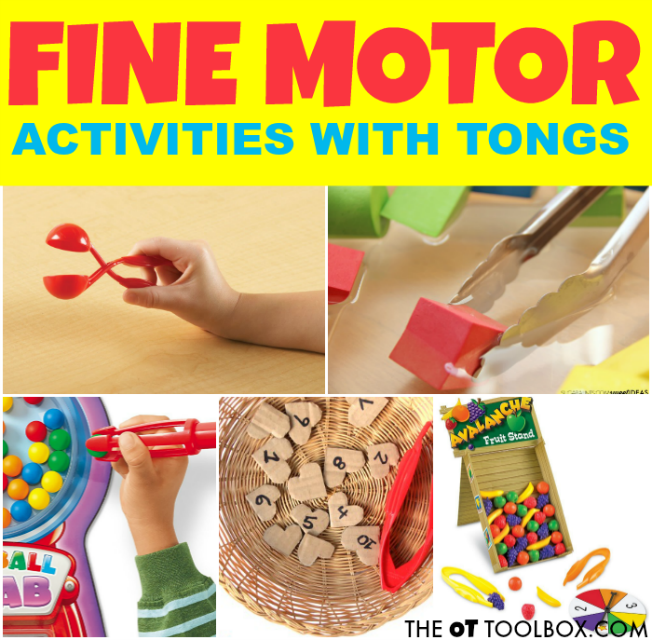
    If you are looking for ways to help develop fine motor strength, coordination, pencil grasp, and endurance in functional tasks using the hands, these tong activities are the way to go. One item that a pediatric occupational therapy practitioner always has is a pair of tongs. That’s because there are so many ways to support sensory motor skills with this one fine motor tool.

    Tong Activities

    One of the most popular posts here on The OT Toolbox is our 31 Days of Occupational Therapy Activities. It was a couple of years back that we shared 31 different occupational therapy activities using free or inexpensive materials. Since then, so many of you have checked out that list of activities. I wanted to expand on that series and add to your therapy toolbox using items you probably already have in your therapy bag. For that reason, we’ll be sharing lots more lists of therapy ideas using common items.

    Today, we’ll be talking about tong activities…or occupational therapy activities using tongs.

    Tongs are a great tool for promoting and improving fine motor skills! Occupational therapy activities using tongs can strengthen fine motor skills!

    Occupational Therapy Activities Using Tongs 

    Most therapists probably have a pair of tongs in their therapy closet or therapy bag. There’s a reason why! Tongs are so very versatile when it comes to occupational therapy activities. They can be used in a variety of tasks and play activities that develop strength, an open thumb web space, bilateral coordination, crossing midline, shoulder and wrist stability, arch development, separation of the sides of the hand, visual motor skills, eye-hand coordination, direction-following, and SO much more!

    Check out the activity ideas using tongs below for fresh ideas that can be used in treatment with many individuals.

    These tong activities would be a great addition to summer occupational therapy activities and home programs!

    Occupational Therapy Activities With Tongs

    Use tongs to work on intrinsic hand strength and visual motor skills.

    Make your own DIY Tongs with craft sticks! So fun and always a hit in our house.

    Tongs can be helpful in increasing the graded grasp and release needed for controlling scissors when cutting. These bunny tongs were used to promote scissor skills.

    Kids can work on eye-hand coordination with tongs. The nice thing about an activity like this one is that a variety of tongs can be used based on the child’s age, fine motor skills, development, or the goal of the activity.

    Go small-scale and use a set of tweezers or mini tongs to remove seeds from apple slices.

    Tongs can be added to an occupational therapy activity kit depending on the needs of children on a caseload. Use those tongs to address many different needs and underlying skills!

    Incorporate tongs into play to address fine motor skills. Use the fine motor tool in a variety of play experiences.

    Use mini erasers in counting, sorting, and learning like The Crafty OT.

    Use tongs to manipulate and move strands of yarn in a pasta pretend play activity like Ever Never Again. What a fun activity!

    Use cut straws and tongs to strengthen fine motor skills like Mess for Less.

    Try these occupational therapy activities using tongs to improve many fine motor skills needed for tasks like handwriting, clothing fasteners, and scissor skills!

    How can Occupational Therapy Activities Using Tongs Help with Development? 

    Adding a few tong activities to your therapy line up can help in SO many ways!

    Motoric Separation of the Two Sides of the Hands- Separation of the two sides of two sides of the hand is important for tasks like holding a pencil while stabilizing the hand along the table, cutting with scissors, and managing coins, among other activities.   

    Refinement of fine motor skills in the hand (the radial side) happens when the power half (the ulnar side) is stabilized.  A functional fine motor grasp and manipulation of objects is more accurate when the ring and pinky fingers are flexed (bent) into the palm.    This positioning stabilizes the MCP arch and allows for control of the pointer and middle fingers. Separation of the two sides of the hand allow for more precise use of the thumb. Hand separation starts when a baby bears weight through their arm and ulnar side of the hand while carrying a toy in the radial side.     This simple activity developmentally lengthens the muscles of the ulnar side.   

    Hand Dominance-Hand dominance in children is important for refining the skills needed  to perform functional tasks.  While Toddlers begin to show a hand preference, a true hand dominance doesn’t typically develop until 2 to 3 1/2 years.  A toddler can show a hand preference, however hand usage is many times, experimented with during different activities throughout the Toddler and Preschool years.  There is typically variability in hand preference as toddlers and young preschoolers poke, pick up, throw, color, and play.    Another consideration is that oftentimes, kids of this age are influenced in which hand they choose by position of toy, location of the adult or playmate, method materials are presented, and sitting position of the child.    

    Lateralization refers to the brain’s ability to control the two sides of the body.  Each hemisphere of the brain controls different tasks and functions.  When a child shows difficulties with laterality, they might switch objects between the two hands in functional tasks.  As a child grows, they are challenged to become more efficient with tools in school.    True hand dominance may not be completely integrated in the child until around 8 or 9 years of age. Occupational therapy activities using tongs can help to build consistency with the child’s preferred hand dominance.     If your child shows a preferred hand, set up the activity to work on tong use with the typically used hand.    

    Open Thumb Web Space- An open thumb webspace is essential for true 
    opposition of the thumb to the precision side of the hand.  A round “O” shape 
    allows the thumb to rotate and oppose the pointer finger in pincer grasp activities.     When kids write or color with that web space area squashed shut, it’s a sign of problems. There may be compensation for thumb instability, underdeveloped hand arches, and/or poor strength.  Each of these problem areas will lead to difficulties with handwriting, dexterity, manipulation of small items like beads, and pencil grasp.    Activities using tongs can help with development of an open thumb web space.   

    Precision of Grasp- Precision skills allow a person to manipulate and release of small objects.  Precision provides efficient grading movements in very small dexterity patterns like threading a string through a needle.    

    Difficulty with precise motor movements of the hand may cause fumbling with zippers and buttons and trouble with advancing the pencil on small lines of paper. Precision occurs with development of grasp when child to use the pads of the index finger, middle finger, and thumb to manipulate objects with opposition.    Occupational therapists can promote precision of grasp with activities using tongs in occupational therapy activities.  

    Pinch Strength and Control- There are a few different grip positions of the 
    hand and fingers that are used in play with children.  Difficulties in using and 
    maintaining any certain grasp may interfere with tasks that require using the 
    hands.  Types of grasp patterns that can be addressed using tongs include:   

    • Lateral Pinch Grip (aka Key Pinch Grip)- The thumb opposes the lateral side of the pointer finger.  This grasp is used when holding and and using a key. A sub group of this type of pinch is the 
    • Lateral Prehension Grip– The thumb is flexed (bent) and it’s pad opposes the lateral side of the tip of the pointer finger. This grip is used to hold an index card or paper, sometimes.
    • Three jaw Chuck Pinch Grip– The thumb is flexed (bent) and opposes the pads of the pointer finger and middle finger. Holding a small cap like a toothpaste lid uses this grip. This is the grip used in holding a pencil.
    • Tip to Tip Grip– The tip of the thumb touches the tip of the pointer finger.  The thumb and pointer finger form an circle (or open thumb web space). This grasp is also called a pincer grasp.  It is used to pick up small items like cereal or beads.  If very small items are picked up (like a needle), a Neat Pincer Grasp is being used.
    • Lateral Grip– Pinching an item between the pointer and middle fingers use this grip.  You would use this grip in holding a cigarette.  While this is not a functional grasp for kids (obviously), you might see kiddos fiddle with a pencil by holding it between two fingers.

    Gross Hand Strength and Grasp- Gross grasp is used when squeezing all of the fingers shut around an object, like when holding the handle of a suitcase.  Gross grasp is important in tasks like handwriting and scissor use.  To do these activities, you need to squeeze your whole hand shut and maintain endurance to complete the activity.    

    Development of hand arch and thumb web space is important for these functional skills and gross grasp plays a part.    

    Occupational therapy activities using tongs can address hand strength by increasing repetitions or smaller object manipulation with a variety of tongs.  

    Thump Opposition- Thumb opposition occurs when the thumb is rotated at the
    carpometacarpal joint.  Opposition of the thumb to the fingertips is essential 
    for tasks such as holding a hairbrush, managing buttons, and even grasping a door 
    knob.   Thumb opposition coincides with an open web space in functional tasks.   Tongs can be used to address thumb opposition by ensuring rotation of the base of the thumb and curving of the palmar arches. Occupational therapy activities using tongs can promote  these skills.  

    Palmer Arches- In the palm of the hand, there are arches that shape the hand’s grasp on objects of all shapes and sizes.  There are two transverse arches that cross the hand at the carpals and at the metacarpals.  There is a longitudinal arch for each finger. These arches allow for skilled movements of the hands and first develop during crawling.  Arch development is essential for manipulating small objects such as a writing utensil.  

    Bilateral Coordination- Bilateral coordination is the functional use of the two hands together in a coordinated manner.  It’s coordinating both hands together and is closely related to hand dominance. When a child has an established hand dominance, there needs to be a fluid use of the two hands together.    

    In development of the child, children use both hands together then progress to using  one hand at a time and finally using both hands together.  
    Refined bilateral coordination skills allow a child to use both hands in separate tasks fluidly.   Use tongs to promote bilateral coordination by asing kids to support a bowl or cup while manipulating or moving small items with tongs with the dominant hand.     

    Wrist and Hand Development- A prerequisite to controlled movements of the hand and fingers are strength and stabilization of the wrist.  Control in the wrist allows for manipulation of small items and grasps with the fingers.   

    A functional position for the wrist  in most activities requiring fine motor skills is slight extension and neutral positioning.  


    This is an optimal position for handwriting or tasks such as manipulating tongs.  
    Other activities like using a toothbrush or managing a utensil during feeding require slight ulnar deviation. Stabilization of the wrist is essential in play and learning activities. 


    In order to allow precision of fine motor tasks, the wrist should be stabilized in extension with precision tasks performed on a vertical surface, putting the wrist into optimal positioning and facilitating thumb abduction for distal work to the fingers.

    Use tongs to promote fine motor skills like these occupational therapy activities using tongs.

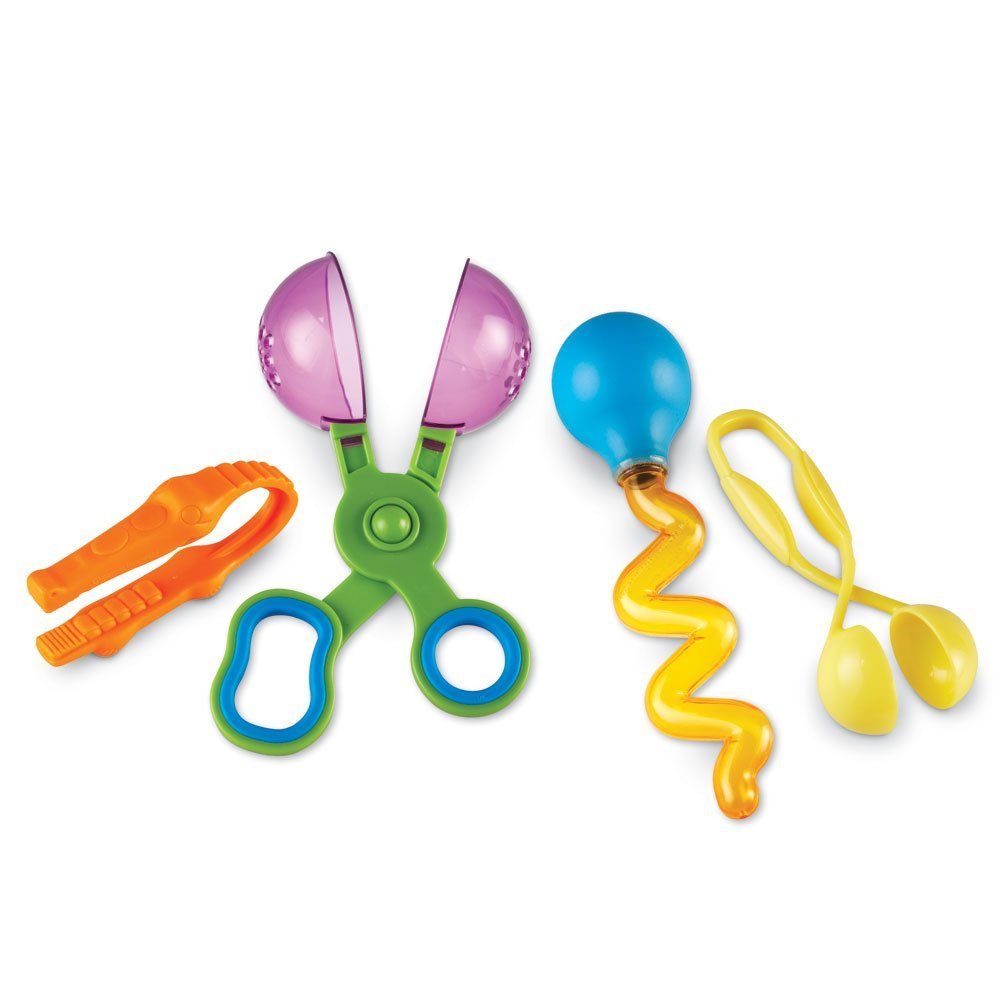
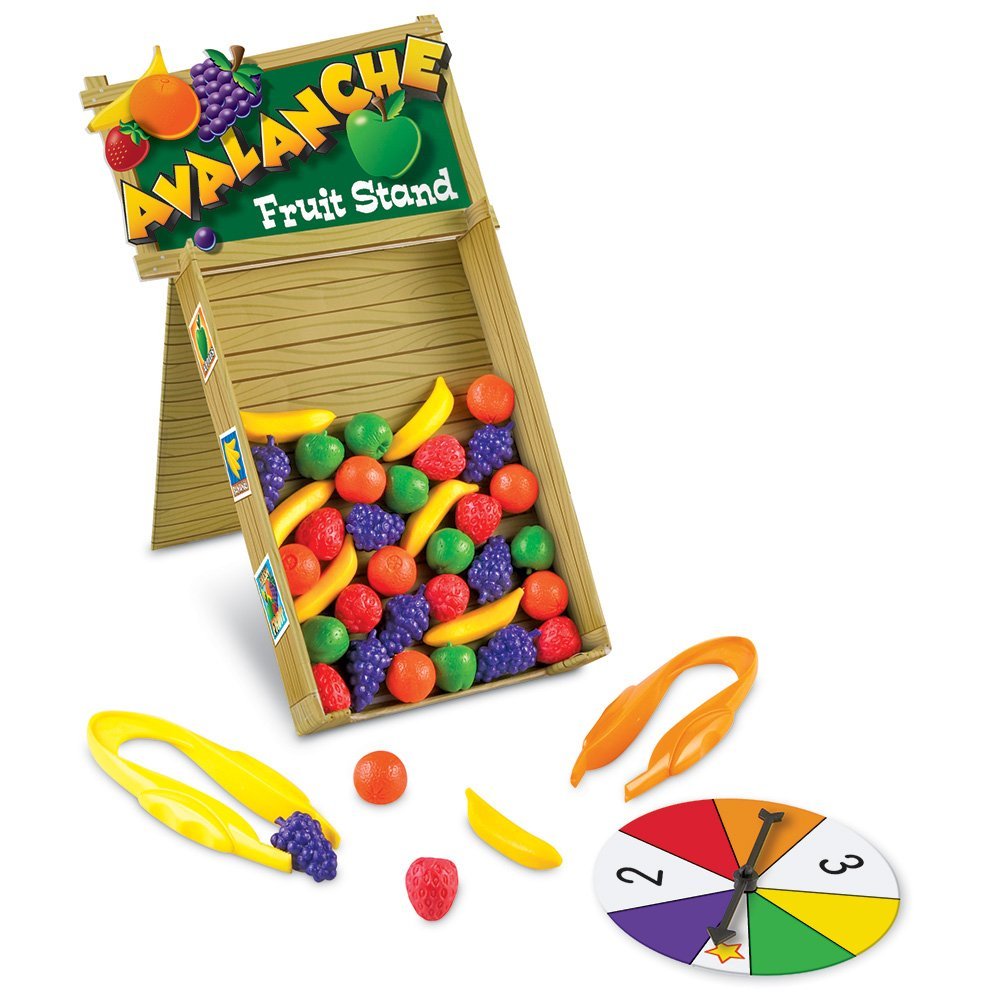
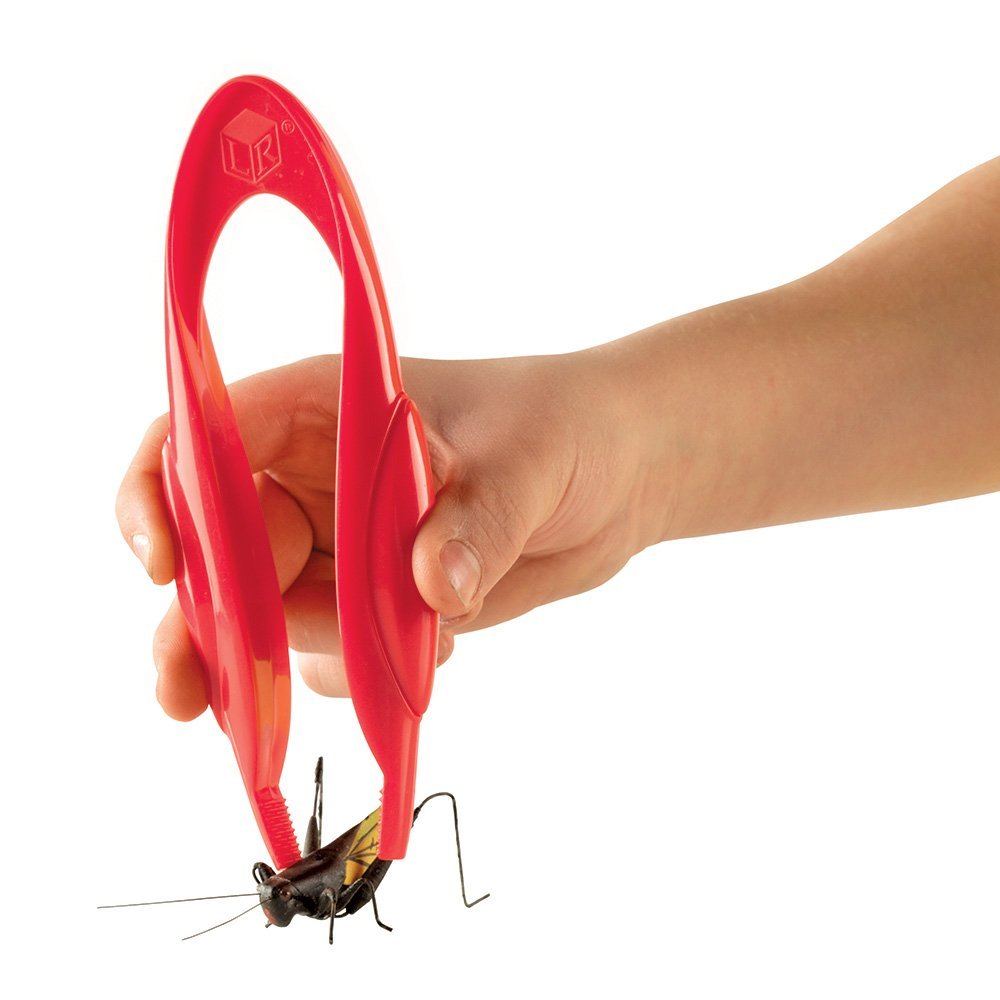
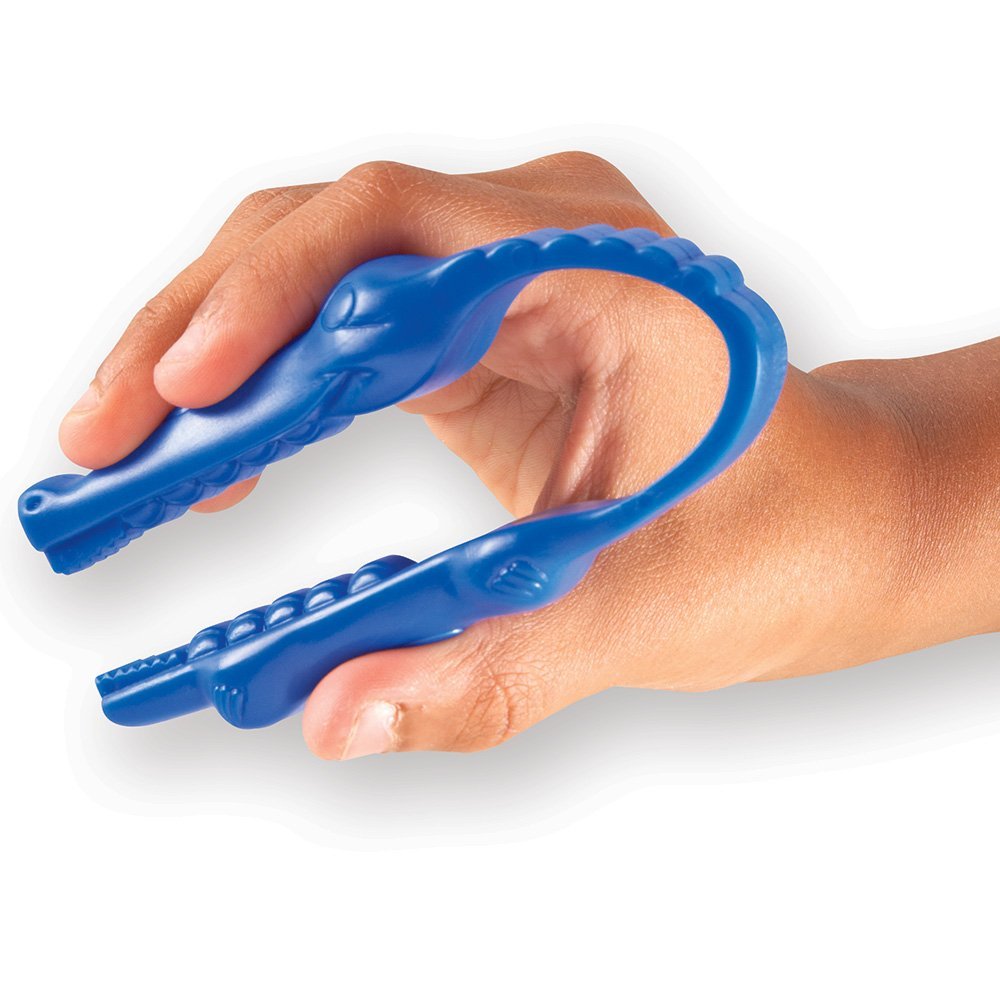
    Best tongs for promoting fine motor skills in Occupational Therapy Activities


    Amazon affiliate links are included below.


    Occupational Therapy Activities Using Tong Games


    Use tongs to promote fine motor skills like these occupational therapy activities using tongs.
     

    Thank You Astronaut Play Dough Mat

    Thank you for downloading the Astronaut Play Dough Mat! You should have an email in your inbox right now with a link to download the file. 


    The email also includes some instructions and the “why” behind play dough mats like this one. THere is a lot of development going on when a little one uses a play dough mat like the one you just accessed! Scroll below to to find some additional usage instructions.

    Housekeeping Information:

    If you do not see the email right away, check back within 30 minutes. Be sure to check your SPAM folder.  Other subscribers using an email hosted on a school system’s email provider may have security restrictions in place that block the email. If you still don’t see the email, shoot me a message at contact@www.theottoolbox.com and I will send the file to you directly.


    If you arrived here by accident and would like to receive a free astronaut themed play dough mat to improve hand strength, check out this post that shares information on the Astronaut Play Dough Mat.

    How to use Improve Intrinsic Hand Strength with a Play Dough Mat

    You are going to build so many small muscles of the hand with this activity!


    Rolling play dough within one hand promotes development of a variety of areas: 


    Strengthens the arches of the hands, helps awareness and coordination in separation of the two sides of the hand.


    Promotes finger isolation for improved control and dexterity


    Encourages dexterity and coordination of the thumb and index finger which are important in pencil grasp


    Strengthens the intrinsic muscles for improved endurance in fine motor tasks such as maintaining hold on a pencil, manipulating clothing fasteners, managing and using scissors, coloring, and many other tasks

    Occupational Therapy Kits

    occupational therapy kits
    This blog post describes occupational therapy kits that can be used to address a variety of occupational therapy goals using themed OT kits, saving time and planning for therapy. 

    Pediatric and school-based occupational therapy practitioners are busy people. Often times, they see many children and can work with preschoolers to young adults in a single day. They are challenged with keeping children actively participating in therapy while building skills to achieve their OT goals. Pediatric and school-based OTP’s must analyze, plan, prepare, implement, modify, adapt, grade, problem-solve, reflect, research, document, collaborate and consult for each child they serve. To say the least, they are busy, busy, busy and the “OT” never turns off!

    These are great tools to add to your therapy bag!

    Occupational Therapy Kits

    Edit: This is part TWO of a series on occupational therapy toolkits. You can find more OT activity  toolkit ideas here.

    Having a pre-planned set of occupational therapy activities in mind can be a huge help when it comes to addressing fine motor skills, visual motor skills, sensory processing needs, or other underlying areas interfering with function in the school, home, or community.
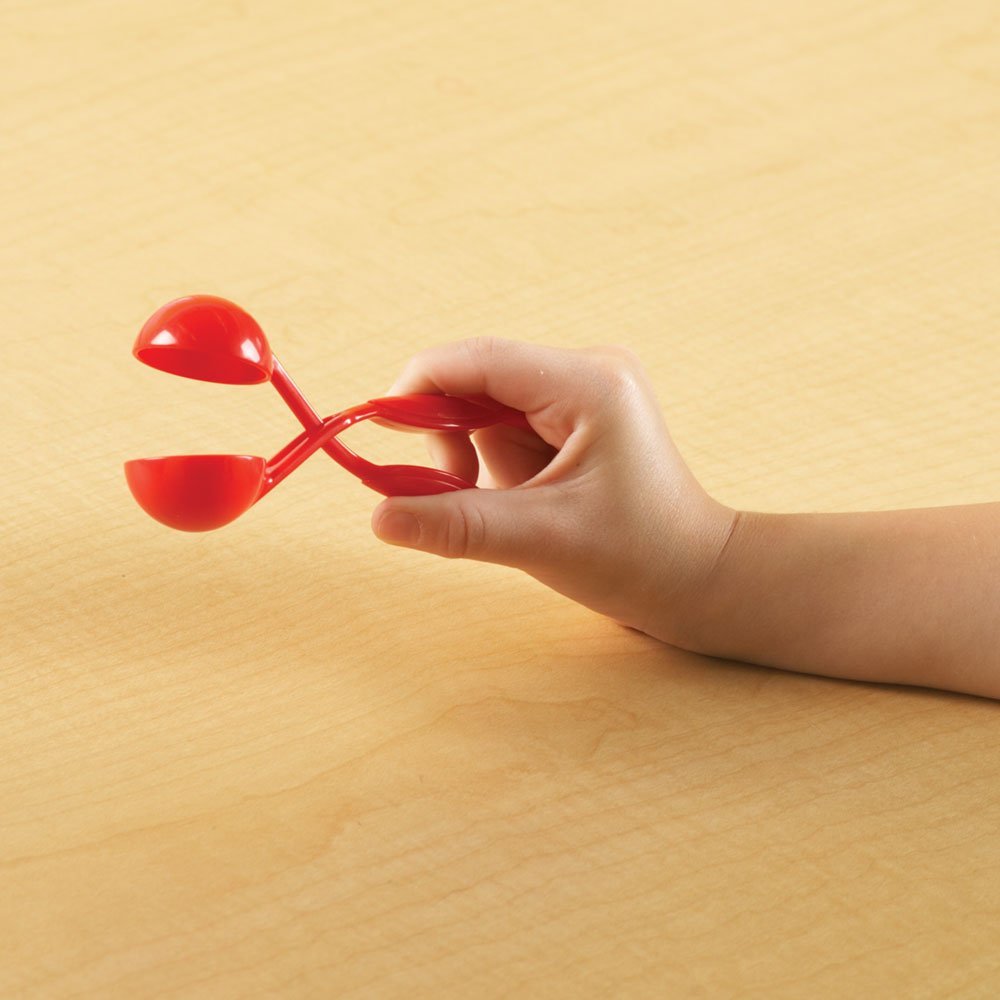
    These occupational therapy activity kits are perfect for incorporating into a bin rotation system, much like these fine motor binsMake these grab and go occupational therapy toolkits to use in school based OT services or by mobile therapists working on fine motor skills or occupational therapy activities with kids.
    Themed Occupational Therapy Activity Tool Kits

    What is a themed occupational therapy therapy activity tool kit and how do I make one?
    Themed occupational therapy tool kits are a great way to invest some time now, but save a ton of time later. They help make a therapist’s job easier when planning, preparing and documenting.
    Tool kits are a great way for therapists to have what they need in an organized kit and ready to use with many kids at any given time. They are portable, all inclusive, and separated by a theme. Grab and go kits are the goal!

    Holiday or seasonal themed tool kits contain activities that allow for “celebration” of holidays or events while heaping fun and play into a single session. Let’s face it, children love the holidays and these themed tool kits keep kiddos engaged and help them build skills for development and success. Kiddos love to see one coming their way! They know fun and surprise are inside while therapists know kiddos will be motivated to “work” on their therapy goals.

    Tools of the trade kits may contain the staples for pediatric or school-based OT practice. More specifically, tools that are used during most OT sessions to include scissors, pencils, grips, paper, etc.

    The kits have specific tools that are essential for intervention, assessment, progress review, or trial. These grab and go kits always contain a variety of tools, graded in nature, standard or adaptive, which are utilized by a wide range of kiddos with various levels of skill.

    Other tools of the trade kits may contain therapy tools or materials that develop a targeted skill area such as fine motor, gross motor, strengthening, sensory processing, self-regulation, etc. The kits contain specific tools or materials that are needed mostly for specific intervention programming.

    Types of Occupational Therapy Activity Kits

    Let’s talk types of tool kits. There are many kinds of possible therapy tool kits that can be created for pediatric and school-based OT. Generally, they are separated into certain types while some may even be combined to meet the needs of the child and/or the therapist. Examples include:

    Types of OT Activity Kits

    Seasonal – spring, summer, fall, or winter

    Holidays – Easter, Christmas, Fourth of July, Thanksgiving, Halloween, Valentine’s Day, St. Patrick’s Day, etc.

    School Celebrated Times – Back to School, Dr. Seuss Day, Fire Safety, etc.

    Skills – fine motor, gross motor, sensory, visual motor/visual perception, strengthening, prewriting, handwriting, dressing, oral motor, self-care, reading, etc.

    Tools – scissors, writing/coloring implements, grips, tongs, feeding tools, fidgets, etc.

    Size – small, medium, large or combination

    Purpose – therapy session, screening, assessment, classroom inclusion, trial, therapy homework, etc.

    Design – material, sectioned or non-sectioned, handled or non-handled, portable or non-portable, lid or no lid, stackable and/or slidable, etc.

    How to Make an Occupational Therapy Activity Kit

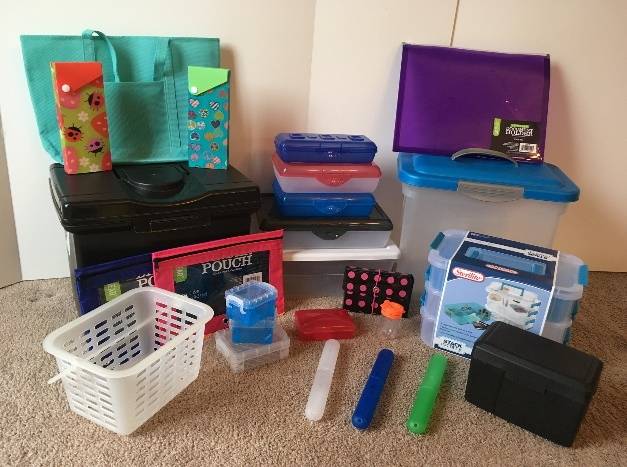
    Here are some size and design examples of types of tool kits and possible storage containers for inside:

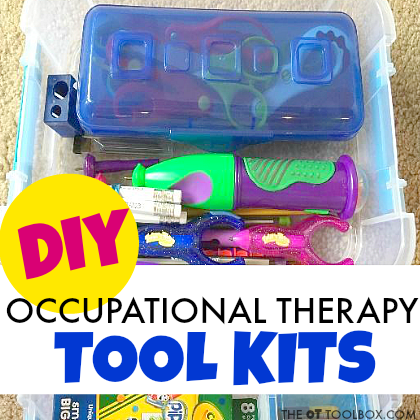
    Create an occupational therapy toolkit using a variety of containers to address underlying skills like fine motor skills, visual motor skills, or other OT goals.

    Let’s talk tips on how to make one. Building tool kits for therapy can be done over time or immediately depending on the purpose, availability of items or materials, and funds for purchasing.

    Below are some helpful tips for building your own tool kits for therapy:

    Gather all tools, materials or items you already have and simply start developing your tool kits based on what you already have.

    Then make a list of tools, materials or items you would like to add. Start small so that it doesn’t get overwhelming.

    Know that your kits may, and probably will, start small and change over time. This is okay and sometimes better when you are first starting out in the field of OT.

    Don’t be afraid to ask colleagues if they have some extra tools or items they would be willing to part with to help you stock your tool kit. OTP’s are generous people and willing to offer help. Just ask!

    Look for items at the big retail chains such as Wal-Mart and Target. Look in the clearance, dollar, and seasonal sections. Check out weekly sales. Shop for items after the season or holiday is over to prep for the next year. You can get awesome deals such as 50-80% off of the regular price. Even check the craft sections for deals!

    Search dollar stores for fun activities or ideas. Think outside of the box with items!!

     Hint: try to pick items that have versatility so that you can reach a larger age range or items that can be combined to address a variety of needs.

    Go to thrift stores and take a peek, you can find some great one-of-a-kind or classic items that will work great in a tool kit.

    Shop garage or yard sales and go to the toy sections or even those miscellaneous trinket boxes and look, look, look.

    Get on email lists for some of the therapy companies that sell products so you can keep “in-the-know” when products go on sale or when new products are available.

    Pick a kit container that best fits the objects you have, the design you like, the clients on your caseload (clear containers peak the most interest) and the portability and durability that you need.

    Buying stackable containers keeps the storage, organization, and the ‘grab and go’ approach easier. Also, consider if you like handles for single hand carry or if handles are not necessary.

    Shop a variety of stores to find the type of containers you want or need. Check office, craft, and storage departments in bargain stores, big chain stores, dollar stores, online stores, and craft stores. Sometimes craft stores have great containers with many organizational possibilities.

    Store items in your kit using various containers, especially if you have a large drop-in container vs. a sectioned container.

     Consider using zipper baggies, twist top or flip top containers, button or snap containers, zipper pencil bags, squeeze containers, and other recyclable containers, etc. Build fine motor skills with the containers inside!

    Consider keeping a few staples in each container such as writing or coloring tools, scissors, glue and paper. Or maybe you want to have those in a separate tool kit to ‘grab and go’ with your other kits. It’s your personal preference with this one!

    Types of Themed Occupational Therapy Tool Kits

    Below are examples for a few types of themed tool kits:

    Seasonal and holiday kits are fun activities contained in one kit which can reach a huge range of kiddos with many types of needs. OTP’s can splash the activities with a little creativity and modification to hit it out of the park during therapy sessions.

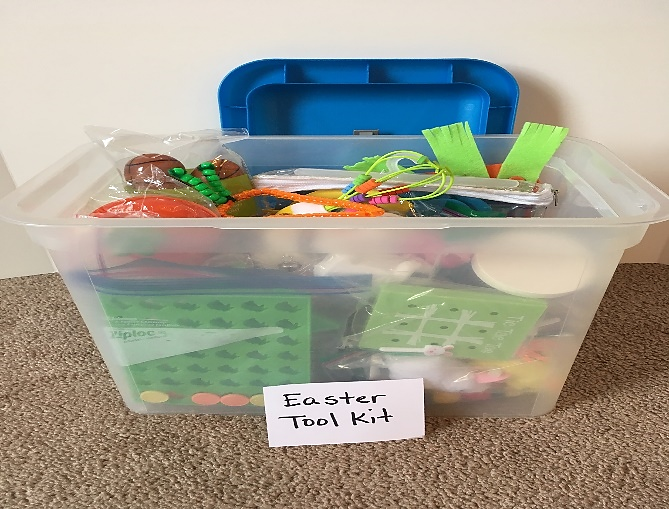
    Below is an example of an Easter holiday themed tool kit and its contents. I lovingly refer to this kit as a “dump and run” kit because I can dump in the contents and run from session to session or site to site with little organization other than the use of some baggies.

    Create a holiday themed Occupational Therapy Tool Kit

    Create an Easter themed occupational therapy activity kit with a holiday theme to address underlying skill areas like strength, fine motor skills, visual motor skills, and other OT goals.
    Create an Easter themed occupational therapy activity kit with a holiday theme to address underlying skill areas like strength, fine motor skills, visual motor skills, and other OT goals.

    Easter Holiday Occupational Therapy Tool Activity Kit:

    Tools of the trade kits contain specific tools, devices, or materials which are all inclusive from standard to adaptive and may either contain purchased or DIY contents. OT’s need these essential tools for treatment, trial, loan, or assessment to determine level of performance, therapy plans, and interventions.

    This Easter activity is a great addition to an Easter-themed occupational therapy toolkit, as it requires scissors you already have in your occupational therapy supplies but requires some Easter items you can find at the dollar store.

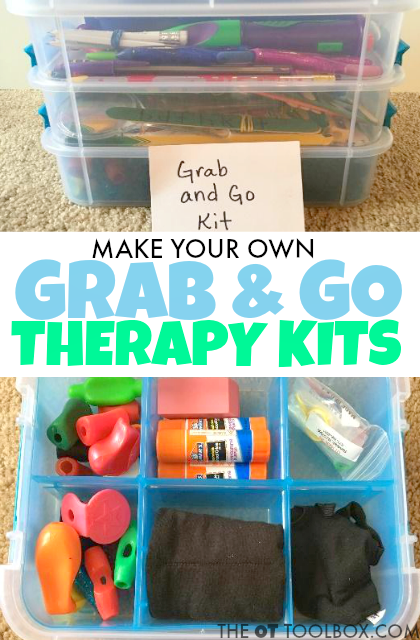
    Make these grab and go occupational therapy toolkits to use in school based OT services or by mobile therapists working on fine motor skills or occupational therapy activities with kids.

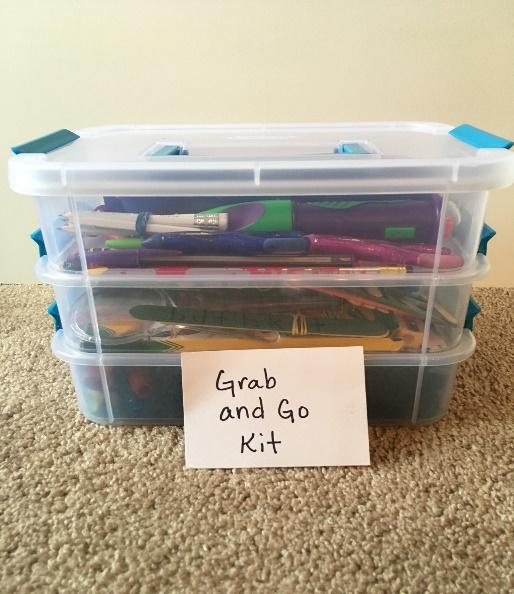
    Grab and Go Occupational Therapy Tool Kit to address a variety of needs

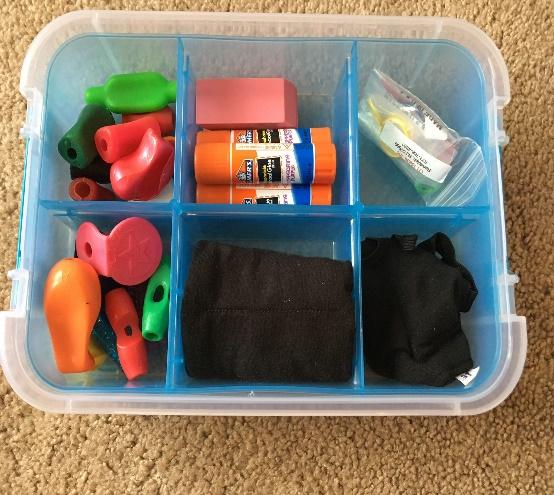
    Below is one example of a small, tiered container with a combination of regularly used OT tools for use during treatment sessions. It is a simple tools kit that stays organized so I can grab it and go from similar sessions with all of my therapy staples in one kit.

    OT Tools Tool Kit:

    A grab and go occupational therapy toolkit helps the school based OT with organization while meeting a variety of OT goals to address therapy goal areas.A grab and go occupational therapy toolkit helps the school based OT with organization while meeting a variety of OT goals to address therapy goal areas.

    Create an Occupational Therapy Activity Kit to address targeted skill areas

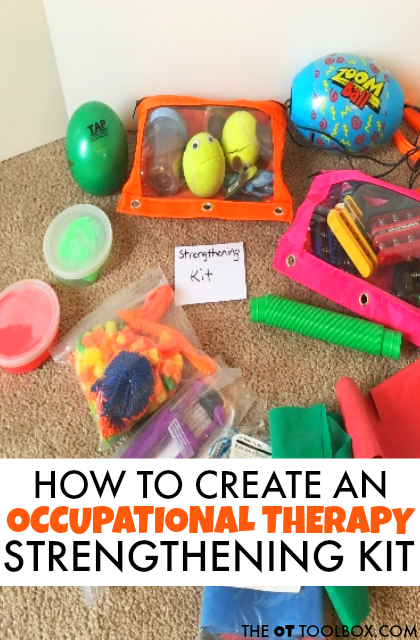
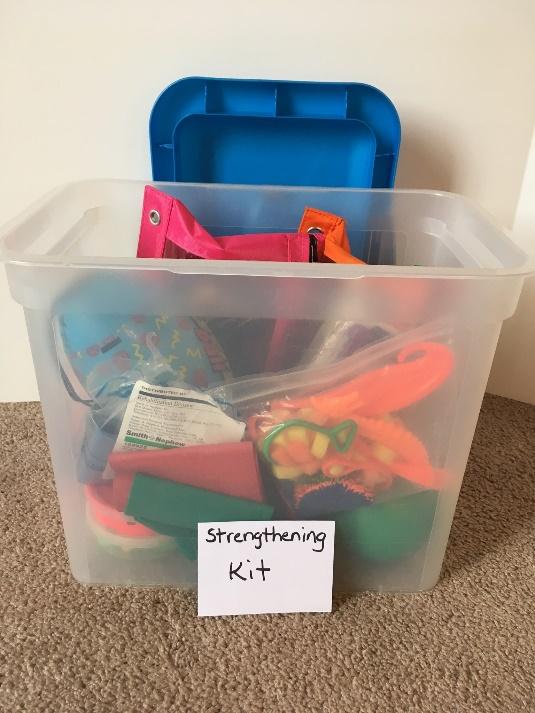
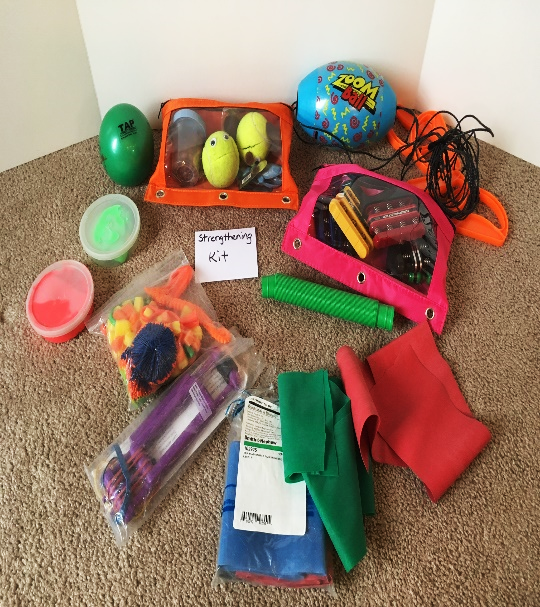
    Below is an example of a targeted skill area kit which contains therapy tools and other materials that develop the targeted skill of strengthening. It contains specific tools of the trade and other miscellaneous materials.

    Occupational therapists will love these occupational therapy activity toolkits for addressing skills like strengthening.

    Strengthening Skills Kit:

    Create an occupational therapy activity toolkit designed to address hand strengthening and strengthening goals for students or clients in pediatric occupational therapy.
    Create an occupational therapy activity toolkit designed to address hand strengthening and strengthening goals for students or clients in pediatric occupational therapy.
    Create an Occupational Therapy Tool Kit to address areas like handwriting or scissor skills.
    Make an occupational therapy activity toolkit to address skills like handwriting or scissor skills, perfect for the school based OT.
    Make an occupational therapy activity toolkit to address skills like handwriting or scissor skills, perfect for the school based OT.

    Themed therapy kits will make your life as a pediatric or school-based therapist easier and more enjoyable allowing you to focus on the intervention with the child!

    Create occupational therapy activity kits to address a variety of occupational therapy goal areas.

    Regina Parsons-Allen is a school-based certified occupational therapy assistant. She has a pediatrics practice area of emphasis from the NBCOT. She graduated from the OTA program at Caldwell Community College and Technical Institute in Hudson, North Carolina with an A.A.S degree in occupational therapy assistant. She has been practicing occupational therapy in the same school district for 20 years. She loves her children, husband, OT, working with children and teaching Sunday school. She is passionate about engaging, empowering, and enabling children to reach their maximum potential in ALL of their occupations as well assuring them that God loves them!

    How to Schedule Sensory Diet Activities

    Below, you’ll find a selection of sensory diet strategies to use when presenting sensory diet activities. Read on to find various ways to present sensory diet tasks for use within a child’s day. These strategies can work to schedule sensory diets for adults as well as children.
     
    Sensory diet activities that are appropriate for an individual child should be presented after analyzing and identifying the child’s specific needs. Just as a sensory diet uses specific sensory activities based on the child’s needs, the WAY a sensory diet is presented needs to be used according to the child’s strengths,  abilities, and needs. Presenting a sensory diet activity in a way that the child understands is very important for carryover. 
     
    Understanding exactly what is a sensory diet is a good starting point for addressing sensory needs. 
     
    Try these strategies to present sensory diet activities to kids with sensory needs. They are quite effective strategies when getting started with setting up a sensory diet. If you are wondering where to start with addressing sensory processing needs in kids or wondering HOW to set up a sensory diet, start with the links below.
     
    If you are just getting started with setting up a sensory diet, start with How to Create a Sensory Diet
     
    For understanding why a sensory diet is important, you’ll want to read more about the goals of a sensory diet.


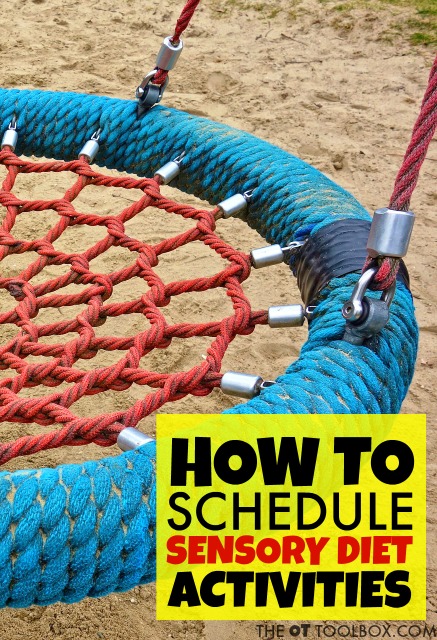
    Use these tips and strategies to schedule sensory diet activities and to set up a sensory diet to address sensory processing needs in kids.
    Sensory Diet Activity
    Selection Strategies
    (How to present sensory diet activities)

    First, a few tips for starting a sensory diet:

    Once sensory diet strategies are developed, it’s important to present them to the child in a clear manner. This will ensure carryover and success.

    There are many ways to set up a sensory diets scheduled activities. Each child may prefer an entirely different strategy for organizing sensory activities in their individualized sensory diet. The child who responds well to visual schedules in their classroom may use a picture schedule for their sensory diet.

    A schedule of sensory activities based on specific needs is an important part of a sensory diet and a sensory lifestyle.

    Scheduling sensory diet activities is important for carryover and use of appropriate sensory activities throughout the day and not after sensory overload or sensory seeking behaviors has occurred. Sensory diet strategies can help prevent or address a sensory meltdown, so it’s good to have the information and tools you need ahead of time and to better understand what causes a sensory meltdown and how to help.

    Use these tips and strategies to schedule sensory diet activities and to set up a sensory diet to address sensory processing needs in kids.

    Sensory Diet Scheduling Strategies

    1.Picture Schedule- Take photos of sensory activities. Print them out and laminate them. The photos can be added to a pocket in the front of each sensory bin or container. When the child takes out that activity, they can place the photo in a bowl or stick it to a wall planner using Velcro.

    2. Clip Schedule- Use clothes pins to clip onto a schedule list of activities. When the child chooses a specific sensory activity, they can clip next to the words on their list.

    3. Use PECS (Picture Exchange Communication System) or other pictures of sensory activities to create a keychain flip booklet of sensory diet activities.

    4. Create strips of paper with sensory diet activities written out on strips of paper. Laminate the strips for sturdiness. Attach a self-sticking Velcro tab to the back of the laminated strip. The schedule of activities can then be attached to a felt board or schedule board with Velcro tabs. Once the activity is performed, the child can drop the strips into a cup. For a more durable system, use foam craft sticks or wooden craft sticks.

    5. Create a sensory diet binder using page protectors. Children can mark off activities with a dry erase marker.

    6. Visual Supports- Dry erase boards, Velcro board, flip picture schedule, felt boards are all ideas. Use visual supports in the simplest way possible with reduced visual distractions. A single color is best. Meeting the needs of the child is essential as well.

    7. “First, Then” Strategy- Children with sensory processing challenges, particularly those on the Autism spectrum struggle with excessive instructions. It is hard for them to pull out the important words from a paragraph of instructions. Simplifying directions is key for these children. The “First, Then” strategy breaks down tasks into the simplest form. This is an effective mechanism for challenging behaviors and transitions.

    8. Keychain schedule- Create a schedule that can go with the child. These can be clipped to belt loops, jackets, binders, necklaces, or backpacks. The options are limitless with a keychain schedule system. Use whatever strategy works best with the child. Some ideas are picture schedules, First/Then strategy, or even a dry erase schedule with words. A reward at the end of the schedule is a great reinforcer for children.

    9. Special Interest Schedulers- Using the interests of the child as a motivator and as a scheduler can have great results. For the child who is interested in vehicles, they can attach a “wheel” onto a picture of a monster truck when each task is completed. The sky is the limit when it comes to using special interests in the form of schedules.

    10. Apps and Technology- For some children, the use of a screen is the motivating tool that can help kids transition through their day. Special interests can be used in this manner as well. There are apps that utilize a form of the “First/Then” strategy combined with special interests such as characters like Sponge Bob.

    11. Communication Center- Sensory diet activities can be created with visual images or words and made into magnets that are stuck to the refrigerator. Other ideas for a sensory diet center include a dry erase board or laminated paper that is used at a student’s desk in the classroom or on the dining room table at home.

    Use these tips and strategies to schedule sensory diet activities and to set up a sensory diet to address sensory processing needs in kids.

    More sensory diet resources

    Sensory Diet Activities for the Classroom

    Looking for more resources on how to set up and create a sensory diet? The Sensory Lifestyle Handbook walks you through sensory diet creation, set-up, and carry through. Not only that, but the book helps you take a sensory diet and weave it into a sensory lifestyle that supports the needs of a child with sensory processing challenges and the whole family.

    The Sensory Lifestyle Handbook is a resource for creating sensory diets and turning them into a lifestyle of sensory success through meaningful and motivating sensory enrichment.
    Use these tips and strategies to schedule sensory diet activities and to set up a sensory diet to address sensory processing needs in kids.

    Attention and Sensory are Connected

    Recently here on The OT Toolbox, we’ve talked a lot about sensory processing needs and how strategies can be incorporated into the child’s environment. These tactics provide an authentic and meaningful sensory strategy for incorporating much-needed sensory input right into a child’s environment. It’s all part of creating a sensory lifestyle for a child!


    Today, we’re talking about the connection between attention and sensory.


    Attention and Sensory are Connected

    Attention is a big challenge for kids. Distractions occur in the home, community, classroom, and everywhere a child goes! When attention interferes with learning, performance of functional tasks, or creates unsafe situations, it can be a real problem. But did you ever stop to think about how attention is so very related to sensory processing?


    Related read: Here are more executive functioning resources to fill your therapy toolbox!
     
    This free printable workbook is a helpful tool in explaining how attention and sensory are connected and can help parents, teachers, and therapists to address attention through sensory processing strategies.


    Our children with sensory challenges know the struggle of inattention. Parents, teachers, and therapists know that sensory processing challenges interfere with a child’s ability to attend.  They may be so focused on a specific sensory input or need that they don’t notice when someone has called their name. Or, they may be so fearful in anticipation of a light touch that they miss what’s happening right in front of them.


    Sensory meltdowns can happen in the blink of an eye. They don’t always look like a flurry of kicking, hitting, or yelling. A sensory meltdown can look like distraction or inattentiveness, too.


    You may have seen this video floating around on Facebook. Here’s the thing: Attention and sensory challenges are connected. Sound familiar?


    This free printable workbook is a helpful tool in explaining how attention and sensory are connected and can help parents, teachers, and therapists to address attention through sensory processing strategies.


    As a parent, teacher, or therapist working with these children, we can find it difficult to address the underlying needs so that a child is able to pay attention to their classroom, or to a passing car.


    We need to figure out strategies that meet the child’s needs in motivating and natural ways within the environment. Lack of attention span and undesirable responses to sensory input can lead to frustrated teachers, and challenged parents. Distractions from external and internal stimuli can lead to responses that look a lot like behaviors.


    What if we could treat the underlying issues, resulting in increased focus and attention?


    That’s where the Attention and Sensory Connection Workbook can help.
     
    It’s a FREE one-stop spot for information on the basics of how attention is related to sensory processing. It provides tips to boost attention through the senses so that kids can learn, focus, and pay attention when they need to.
     
    This free printable workbook is a helpful tool in explaining how attention and sensory are connected and can help parents, teachers, and therapists to address attention through sensory processing strategies.
     
    The workbook covers information about how impaired sensory processing relates to attention issues in a variety of ways and provides movement and sensory-motor activities that can help boost attention.
     
    There are specific activity ideas and tactics to address attentiveness. You’ll also find workbook pages that can be used to identify underlying sensory-related areas that impact attention and tools for addressing those needs.


    This workbook is a guide for better focus at home or in the classroom. The Attention and Sensory Workbook contains:


    • How Sensory and Attention are Connected
    • The Impact of Sensory Processing on Learning
    • Movement and Sensory-Motor Activities to Improve Attention
    • Sensory Activity Ideas
    • Sensory Processing Workbook Pages
    • Attention and Sensory Activity Workbook Pages
    This is an ideal tool to add to any sensory lifestyle! And it’s free!


    Using specific and prescribed sensory strategies like those in a sensory diet can be a huge help for the child who struggles with attention and sensory issues. A sensory diet can be the ticket to improved attention when the strategies work and are carried over appropriately.
     
    This free printable workbook is a helpful tool in explaining how attention and sensory are connected and can help parents, teachers, and therapists to address attention through sensory processing strategies.
     
    A sensory diet that focuses on organizing vestibular and proprioceptive input can help a child regulate in order to focus in a classroom lecture. An outdoor recess with calming and alerting input can help a child focus in their afternoon classes. When sensory strategies are incorporated into a child’s environment in meaningful manners, a sensory lifestyle occurs.


    Here are a few ways that The Attention and Sensory Connection Workbook can address much-needed skills of our children/students/clients with sensory needs:


    • Sensory processing is the ability to register, screen, organize, and interpret information from our senses and the environment. This process allows us to filter out some unnecessary information so that we can attend to what is important. Kids with sensory challenges often time have difficulty with attention as a result.
     
    • It’s been found that there is a co-morbidity of 40-60% of ADHD and Sensory Processing Disorder. This workbook is an actionable guide to help teachers, therapists, and parents to help kids boost attention and focus in the classroom by mastering sensory processing needs.
     
    • You will find information on the sensory system and how it impacts attention and learning. There are step-by-step strategies for improving focus, and sensory-based tips and tricks that will benefit the whole classroom.
     
    • The workbook provides tactics to address attention and sensory processing as a combined strategy and overall function. There are charts for activities, forms for assessment of impact, workbook pages for accommodations, and sensory strategy forms.


    This free printable workbook is a helpful tool in explaining how attention and sensory are connected and can help parents, teachers, and therapists to address attention through sensory processing strategies.


    It’s been fun sharing all off these free resources with you recently. What’s awesome is that the tools you’ve accessed can be used to create a sensory lifestyle that is meaningful, authentic, and motivating for kids, in all aspects of a child’s day!
     
    Click here to grab the Attention and Sensory Workbook.


    FREE Attention & Sensory Workbook

      We respect your privacy. Unsubscribe at anytime.

      Colleen Beck, OTR/L has been an occupational therapist since 2000, working in school-based, hand therapy, outpatient peds, EI, and SNF. Colleen created The OT Toolbox to inspire therapists, teachers, and parents with easy and fun tools to help children thrive. Read her story about going from an OT making $3/hour (after paying for kids’ childcare) to a full-time OT resource creator for millions of readers. Want to collaborate? Send an email to contact@theottoolbox.com.