Colleen Beck, OTR/L is a pediatric occupational therapist and the owner and author of The OT Toolbox website. She manages all of The OT Toolbox social media accounts and runs the popular newsletter.
Read about Colleen's experience and career as an occupational therapist, including how The OT Toolbox began on our About The OT Toolbox page: https://www.theottoolbox.com/about-us/
Colleen created The OT Toolbox in 2011 and since then has written thousands of blog posts designed to support therapy providers, educators, parents, counselors, admin, and caregivers in promoting the healthy development of kids.
Check out Colleen's blog posts below:
When kids are learning to manage a zipper, it can be frustrating if fine motor skills or visual motor skills are delayed. Even children who are developing fine motor and visual motor skill work at an age-appropriate level can have difficulty with using a zipper. When kids learn to zipper up a coat or jacket, children can have difficulty with all of the steps that go into zippering. Using a zipper pull on a coat zipper can be a helpful tool in independence.
You will find more information about teaching kids how to zipper here on The OT Toolbox. In fact, zippering is an important part of self-dressing and functional independence that toddlers can begin with.
When small children are able to pull up their zipper or pull down their zipper, they can feel a sense of self-confidence that makes them want to try harder to work on the skills involved in zippering: engaging the zipper into the zipper chamber, holding both sides of the zipper in a coordinated way, and holding down the edge of the coat while pulling up the zipper pull.
Other children who are more challenged with physical abilities benefit from a zipper pull.
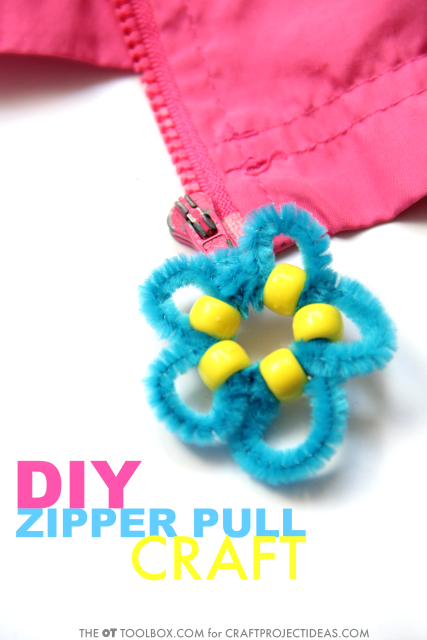
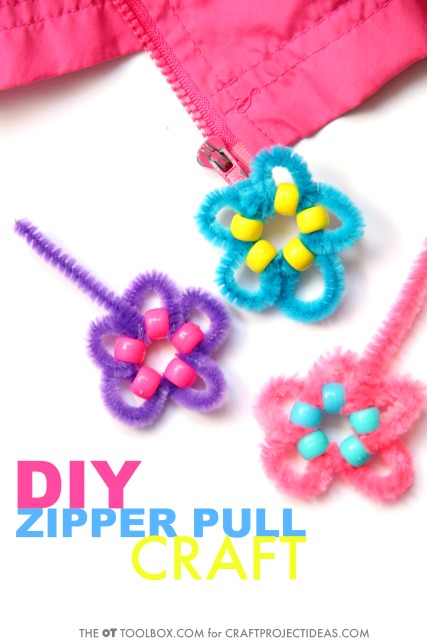
Try this DIY zipper pull craft that is not only functional, it’s also fun to create! It’s a real fine motor power-craft for kids.
Click here to see the directions to make this craft over on our guest post at Craft Project Ideas!
Looking for more ways to teach kids how to zipper? Try these ideas:
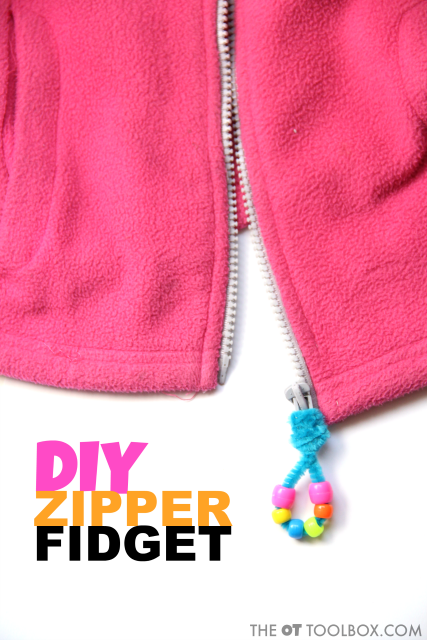
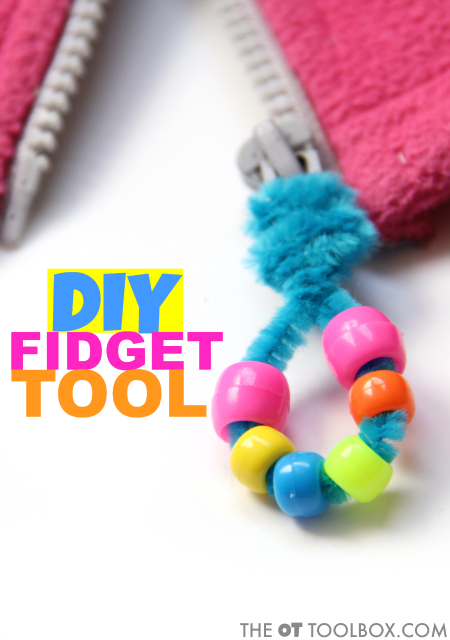
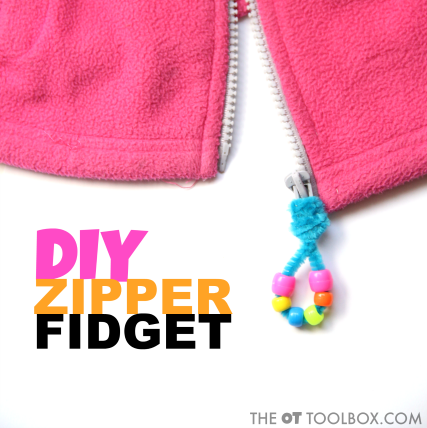
This DIY Fidget Tool is a good one to add to your therapy toolbox! A fidget tool attached to a zipper pull can be helpful for kids who struggle with wiggles, over or under responsiveness to sensory input, those who have worries or sensory challenges on the school bus or while out in the community. Using a zipper fidget tool can be helpful when waiting in line and it’s hard to keep little hands to oneself.
This DIY fidget tool is also a fine motor powerhouse for kids to make. I love adding crafts like this one to the therapy line up because not only does it work on essential fine motor skills, it also creates a functional tool that kids can wear and be proud of. When they have made a colorful and fun zipper pull fidget tool, they will be proud to wear it, show it off, and use it to address needed sensory processing struggles!
DIY Fidget Tool Zipper Pull
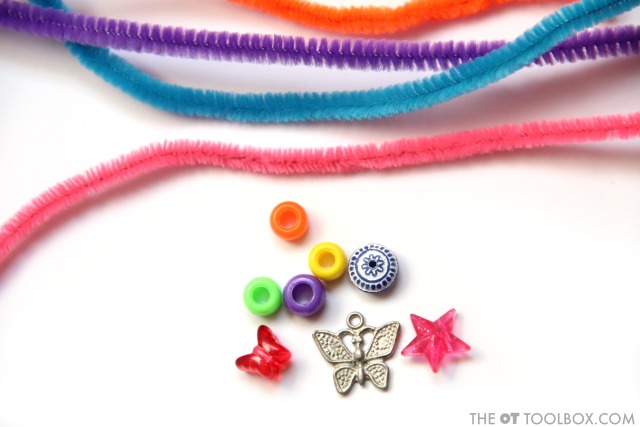
This DIY Fidget Tool Zipper Pull is very easy to make. You’ll need just a couple of materials:
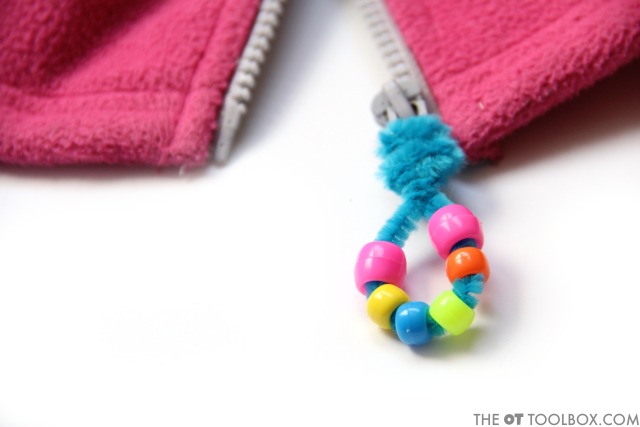
To make the fidget tool, thread the beads onto a whole pipe cleaner. Bend the pipe cleaner in half and create a small loop. There should be enough space between each bead and at the top of the loop to allow for movement when the bead is wiggled.
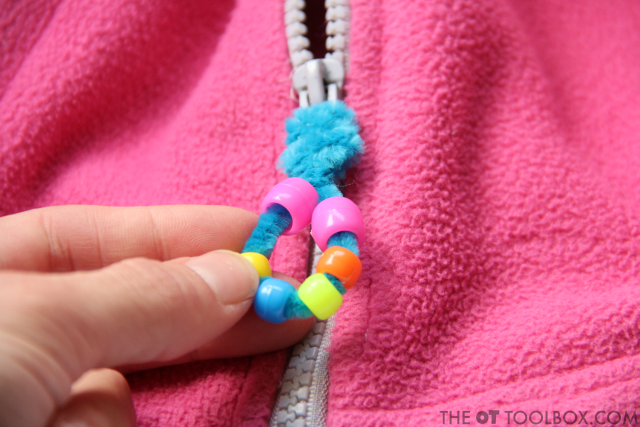
Twist the top shut and loop the end through a zipper pull. Use the ends of the pipe cleaner around the zipper pull.
And that’s it! The diy fidget tool zipper pull is done!
So, why would a child need a fidget tool on their jacket?
When kids have difficulty with self-regulation, emotions, anxiety, sensory processing, or other concerns, they may act out or end up in meltdown mode. This can be especially true in settings where environmental stimulation is on overload.
A situation such as on the noisy school bus where students are jostled around among other loud students and a lot of other children sitting nearby can be overwhelming to the child with sensory needs.
Standing in line at school as students wait to go outside to recess or to come indoors after recess can be a time when students have trouble keeping their place or keeping their hands to themselves.
A child who becomes overwhelmed by worry and anxiety heading into new situations can find comfort in movement that a fidget tool offers.
All of these are situations when a zipper pull fidget tool would be a great sensory diet accommodation to keep on hand.
A Fidget Tool is a Sensory Diet Tool
Children who have a sensory diet in place or utilize sensory strategies to address specific needs may have other accommodations or tools in place such as a fidget tool. A keychain fidget tool can be just the item that provides children with a grounding point and gives them the ability to focus, attend, or participate in activities.
This DIY Fidget Tool would be great alongside our DIY Fidget Tool for School, allowing kids to wiggle and move those fingers!
This jacket fidget tool is inconspicuous, making it a great fidget tool for school, much like this DIY weighted fidget tool.
Want to know more about what a sensory diet is or how to implement one? Check out some of our recent posts on sensory diets and be on the watch for our upcoming book, The Sensory Lifestyle Handbook.
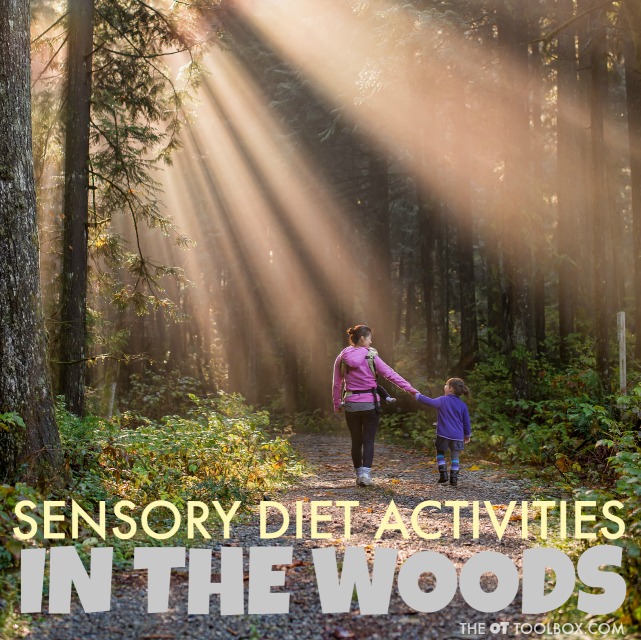
Kids just don’t get much time to play outdoors anymore. We talked about the impact that reduced outdoor play has to do with sensory processing needs in kids in our recent Outdoor Sensory Diet Activities post. We chatted about the benefits of outdoor play in a typically developing child as well as those with sensory processing needs. This post covers the benefits of playing in the woods or a wooded area of a backyard or park. This might be a great recommendation for families who are going camping this summer and need some sensory strategies. Playing in the woods offers so many opportunities for sensory input, movement, gross and fine motor work. Not only that, but playing in the woods is a calming and organizing way to play!
These activities can be used as part of asensory diet of specific activities and sensory tools designed to meet specific needs of an individual.
This will help when explaining about what a sensory diet is and what a sensory diet looks like for kids with sensory needs.
Disclaimer: When therapists develop a specific and highly individualized sensory diet, it’s not just throwing together a day filled with sensory input. A sensory diet is a specific set of sensory tools used to meet and address certain needs of the individual based on sensory need and strategizing. Each of the sensory diet activities above should meet specific needs of the child. Every child is different so applying sensory input to one child may look very different than that of another. Parents should use the tactics below along with your child’s occupational therapist.
Wooded Area Sensory Diet
Fallen tree balance beam Jump in leaves Climb small trees Look Up scavenger hunt Bird watch Touch tree trunks Natrue collection Picnic in the woods Magnifying glass to find bugs Lift rocks and inspect what’s underneith Hike Climb rocky areas Play in streams Climb steap hills Ride bikes on a trail Bug hunt Collect sticks Build a fort Climb trees Scent scavenger hunt Carry a backpack full of supplies
Accommodations for addressing sensory needs in a wooded area
For kids with sensory needs, the sensations of the outdoors and a wooded area can be too much for the child to tolerate. Try these accommodations for addressing sensory needs in backyard play:
Calming snacks for a picnic
Drink water from a sports bottle with a straw
Wear sunglasses
Wear a brimmed hat
Wear high top shoes or shoes that provide proprioceptive input
Wear shoes that the child is able to tolerate
Compression clothing
Wear a lightweight wind jacket
Be cognizant of the scent of bug spray
Recognize early signs of sensory overload and head back to the house or car before a meltdown occurs (Leave on a happy note)
How to incorporate sensory play into playing outside
Sensory diet activities can be specific to sensory system like these vestibular sensory diet activities. Sensory activities can be prescribed according to need along with environment in order to maximize sensory input within a child’s day such as within the school day. Using authentic sensory input within the child’s environment plays into the whole child that we must understand when focusing on any goal toward improved functional independence.
Many sensory diet activities can naturally be found outdoors. In fact, outdoor sensory diet activities are a fun way to encourage sensory input in a child’s environment and without fancy therapy equipment or tools.
It’s a fact that kids are spending less time playing outdoors. From after-school schedules to two working parents, to unsafe conditions, to increased digital screen time, to less outdoor recess time…kids just get less natural play in the outdoors. Some therapists have connected the dots between less outdoor play and increased sensory struggles and attention difficulties in learning.
Knowing this, it can be powerful to have a list of outdoor sensory diet activities that can be recommended as therapy home programing and family activities that meet underlying needs.
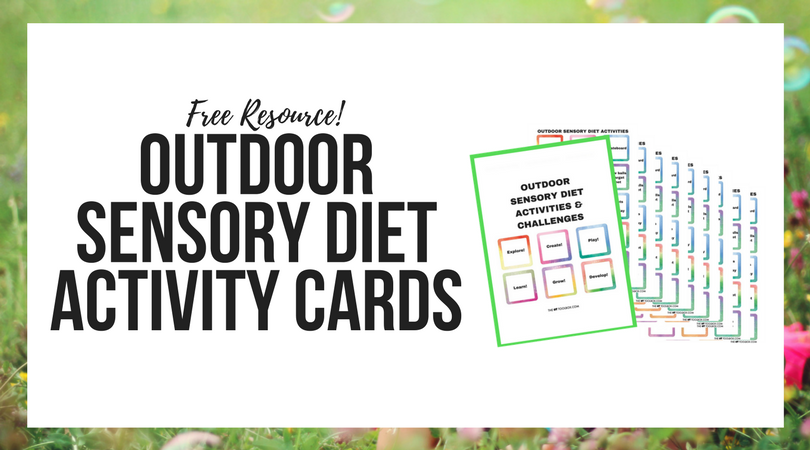
That’s where the Outdoor Sensory Diet Cards and Sensory Challenge Cards come into play.
They are a FREE printable resource that encourages sensory diet strategies in the outdoors. In the printable packet, there are 90 outdoor sensory diet activities, 60 outdoor recess sensory diet activities, 30 blank sensory diet cards, and 6 sensory challenge cards. They can be used based on preference and interest of the child, encouraging motivation and carryover, all while providing much-needed sensory input.
30 blank sensory diet cards, and 6 sensory challenge cards
They can be used based on preference and interest of the child, encouraging motivation and carryover, all while providing much-needed sensory input.
Research tells us that outdoor play improves attention and provides an ideal environment for a calm and alert state, perfect for integration of sensory input.
Outdoor play provides input from all the senses, allows for movement in all planes, and provides a variety of strengthening components including eccentric, concentric, and isometric muscle contractions.
Great tool for parents, teachers, AND therapists!
Be sure to grab the Outdoor Sensory Diet Cards and use them with a child (or adult) with sensory processing needs!
More about outdoor sensory diet activities
Sensory diets and specific sensory input or sensory challenges are a big part of addressing sensory needs of children who struggle with sensory processing issues. Incorporating a schedule of sensory input (sensory diet) into a lifestyle of naturally occuring and meaningful activities is so very valuable for the child with sensory needs.
That’s why I’ve worked to create a book on creating an authentic and meaningful sensory lifestyle that addresses sensory needs. The book is now released as a digital e-book or softcover print book, available on Amazon.
The Sensory Lifestyle Handbook walks you through sensory diet creation, set-up, and carry through. Not only that, but the book helps you take a sensory diet and weave it into a sensory lifestyle that supports the needs of a child with sensory processing challenges and the whole family.
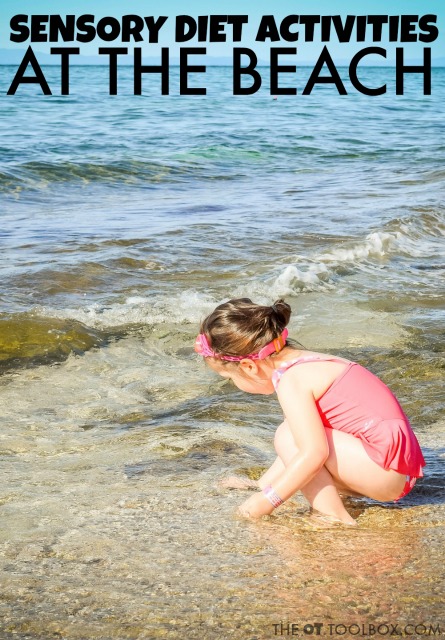
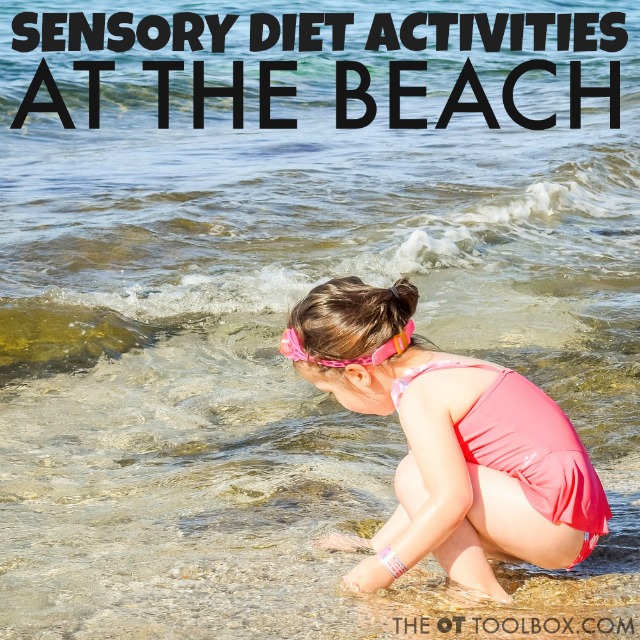
Whether you live at the beach or just travel to the beach for an annual family trip, it can be overwhelming for a child with sensory needs to cope with the sensory input that a trip to the beach can cause. The beach has so many sights, sounds, scents, and textures that can be used to meet sensory needs. For the family that is travelling with a child with sensory processing challenges, the beach can be both a blessing and a source of sensory overload. Use the strategies listed below to address sensory needs on a trip to the shore and the tactics to address hypersensitivity during a beach trip. These sensory diet activities at the beach can be a powerful tool or recommendation by occupational therapists and part of an outdoor sensory diet.
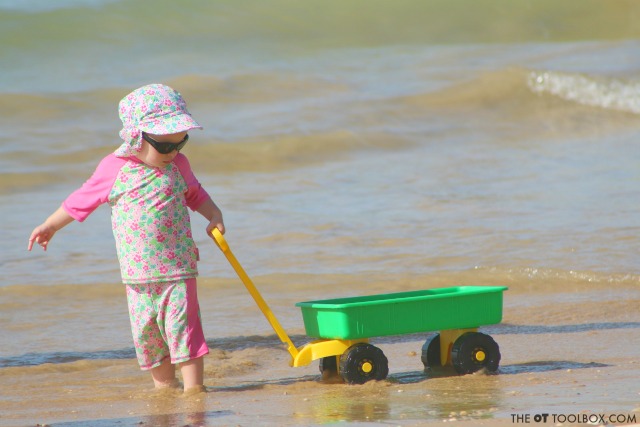
Make a sandcastle Rake the sand (for pulling and pushing proprioceptive input) Bury feet or hands Sprinkle sand on hands or toys Fill a bucket with water Carry water from the shore to dry sand Dig wet sand Dig dry sand Make a “wet castle” using wet sand Firm pressure massage with sunscreen Carry a bucket of sand Scoop and pour sand Scoop and pour water Inspect tide pools Pick up, scoop, and carry pebbles Jump low waves Sit at water’s edge for sand play Bury a toy and then find it Play visual discrimination games with sand toys: Child can look at a collection of toys then one is removed and the child needs to determine which is missing Play beach “I Spy” Roll up in a beach towel burrito with heavy input Fill a gallon sized bag with sand for a DIY weighted lap pad or shoulder pad Pull or push a bin or wagon of beach toys Carry a beach bag Fly a kite (great for visual motor skills, visual scanning, and proprioception) Catch and toss a beach ball Play beach ring toss Chase waves Look for seashells Rinse and clean seashells
Accommodations for addressing sensory needs at the beach
Children with sensory processing challenges can be overwhelmed given all of the sights, sounds, scents, and textures that the beach provides. Try these accommodations for addressing sensory needs in backyard play:
Play in a baby pool to enjoy water without the waves Use a large beach blanket and weight down edges Be cognizant of hot sand Provide calming snacks Wear long sleeved sun clothing
Wear water shoes instead of sandals or bear feet
Proprioceptive input such as firm touch to the shoulders
Bucket of water to rinse hands if child is sensitive to sand
Sheltered area such as a wind tent or low umbrella if child is sensitive to wind blowing on skin
Wear a lightweight wind jacket
Use baby powder to remove sand
Hat with brim to reduce bright light or intense light in eyes or on face
Wear sunglasses
Wear headphones to reduce background noise
Be aware of certain sunscreens which as a strong scent
Bring extra dry towels
How to incorporate sensory play into playing at the beach
Sensory diet activities can be specific to sensory system like these vestibular sensory diet activities. Sensory activities can be prescribed according to need along with environment in order to maximize sensory input within a child’s day such as within the school day. Using authentic sensory input within the child’s environment plays into the whole child that we must understand when focusing on any goal toward improved functional independence.
Many sensory diet activities can naturally be found outdoors. In fact, outdoor sensory diet activities are a fun way to encourage sensory input in a child’s environment and without fancy therapy equipment or tools.
It’s a fact that kids are spending less time playing outdoors. From after-school schedules to two working parents, to unsafe conditions, to increased digital screen time, to less outdoor recess time…kids just get less natural play in the outdoors. Some therapists have connected the dots between less outdoor play and increased sensory struggles and attention difficulties in learning.
Knowing this, it can be powerful to have a list of outdoor sensory diet activities that can be recommended as therapy home programing and family activities that meet underlying needs.
That’s where the Outdoor Sensory Diet Cards and Sensory Challenge Cards come into play.
They are a FREE printable resource that encourages sensory diet strategies in the outdoors. In the printable packet, there are 90 outdoor sensory diet activities, 60 outdoor recess sensory diet activities, 30 blank sensory diet cards, and 6 sensory challenge cards. They can be used based on preference and interest of the child, encouraging motivation and carryover, all while providing much-needed sensory input.
30 blank sensory diet cards, and 6 sensory challenge cards
They can be used based on preference and interest of the child, encouraging motivation and carryover, all while providing much-needed sensory input.
Research tells us that outdoor play improves attention and provides an ideal environment for a calm and alert state, perfect for integration of sensory input.
Outdoor play provides input from all the senses, allows for movement in all planes, and provides a variety of strengthening components including eccentric, concentric, and isometric muscle contractions.
Sensory diets and specific sensory input or sensory challenges are a big part of addressing sensory needs of children who struggle with sensory processing issues. Incorporating a schedule of sensory input (sensory diet) into a lifestyle of naturally occurring and meaningful activities is so very valuable for the child with sensory needs.
That’s why I’ve worked to create a book on creating an authentic and meaningful sensory lifestyle that addresses sensory needs. The book is now released as a digital e-book or softcover print book, available on Amazon.
The Sensory Lifestyle Handbook walks you through sensory diet creation, set-up, and carry through. Not only that, but the book helps you take a sensory diet and weave it into a sensory lifestyle that supports the needs of a child with sensory processing challenges and the whole family.
Colleen Beck, OTR/L has been an occupational therapist since 2000, working in school-based, hand therapy, outpatient peds, EI, and SNF. Colleen created The OT Toolbox to inspire therapists, teachers, and parents with easy and fun tools to help children thrive. Read her story about going from an OT making $3/hour (after paying for kids’ childcare) to a full-time OT resource creator for millions of readers. Want to collaborate? Send an email to contact@theottoolbox.com.
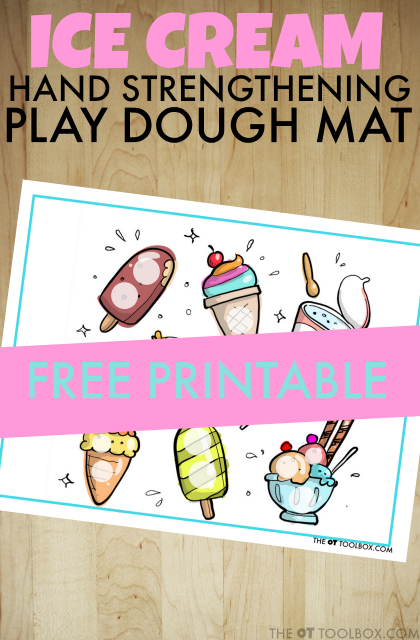
Thank you for grabbing the Ice Cream Play Dough Mat! You should have an email in your inbox right now with a link to access the file. The email also includes some instructions and the “why” behind play dough mats like this one. There is a lot of development going on when a little one uses a play dough mat like the one you just accessed! Scroll below to to find some additional usage instructions.
Housekeeping Information:
If you do not see the email right away, check back within 30 minutes. Be sure to check your SPAM folder. Other subscribers using an email hosted on a school system’s email provider may have security restrictions in place that block the email. If you still don’t see the email, shoot me a message at contact@www.theottoolbox.com and I will send the file to you directly. If you arrived here by accident and would like to receive a free ice cream themed play dough mat to improve hand strength, check out this post that shares information on the Ice Cream Play Dough Mat.
How to use Improve Intrinsic Hand Strength with a Play Dough Mat
You are going to build so many small muscles of the hand with this activity! 1. To use this play dough mat, you will first want to cover it with a plastic surface so you can use it over and over again. Some ideas to do this include (Amazon affiliate links are included below):
Cover it with clear contact paper. Click the link to purchase a large roll of clear contact paper.
Slide the play dough mat into a clear plastic page protector sleeve. Add it to a folder workbook or binder booklet of play dough mats for quiet time or a busy bag-type of activity.
Use pocket sleeves to create a quiet time or fine motor center activity.
2. Once the play dough mat is covered, provide the child with play dough, clay, foam dough, or other moldable material.
3. Ask the child to roll small balls of play dough using just the fingers and thumb of one hand. They should use their dominant hand to roll small balls of play dough with the tips of the fingers and thumb. This is an AWESOME hand strengthening exercise for kids. 4. Ask the child or children to roll various sizes of play dough so the balls of dough fit into the various circle sizes on the play dough mat. Rolling play dough within one hand promotes development of a variety of areas:
Strengthens the arches of the hands, helps awareness and coordination in separation of the two sides of the hand.
Promotes finger isolation for improved control and dexterity
Encourages dexterity and coordination of the thumb and index finger which are important in pencil grasp
Strengthens the intrinsic muscles for improved endurance in fine motor tasks such as maintaining hold on a pencil, manipulating clothing fasteners, managing and using scissors, coloring, and many other tasks.
Be sure to try some of the other fine motor activities that we have here on the website:
If you are following The OT Toolbox, then you know I love handwriting. While it’s true that OTs are not “handwriting teachers”, it’s the underlying skills that go into handwriting that have a special place in my heart.
As therapists, we are specialists in development, motor skills, visual processing, self-awareness, spatial concepts, kinesiology, sensory processing, regulation, and all of the other areas that really make a big difference in a child’s functional ability to write. There are many skills that kids need for handwriting!
Skills Kids Need for Handwriting
Handwriting is SO much more than crossing t’s and dotting i’s.
Here are some important facts about the skills kids need for handwriting:
1. Handwriting development starts at birth. Yep, it’s true! When babies are swaddled, reach for mama’s face, and crawl, they are developing the postural stability and visual motor skills needed waaaaay down the road when they write their ABCs.
2. Visual processing skills are key. The perceptual skills of knowing the difference between a b, d, p, and q are essential for written work. Addressing the basics in form copying at a young age (and in a variety of sensory-motor manners) can be a huge asset for kids as they head into the school-age years.
3. Letter formation starts before learning to make a letter! This is important: when kids learn improper formation of letters like starting letters at the bottom or “building” the parts of a letter, it can be hard to break those habits. When kids teach themselves because they just pick up a crayon and copy their name, they might not form letters properly, using developmental strokes of top to bottom. Letter formation habits are HARD to break. And proper formation is important for legibility, speed, spatial use, letter recall, organization, and functional written work.
4. Bilateral coordination is essential. When we write, we need to easily coordinate both sides of your body for effective posture, holding the paper, moving the pencil, erasing, using margins, and filling in given spaces on worksheets. Forming letters requires pencil strokes that involve moving to the midline. Think about it this way: A new writer forms letters very large in size. As they develop coordination and motor skills, letter size decreases. But those letter strokes continue to remain the same. A pencil still needs to move to the midline when crossing an uppercase T or adding the middle line to an uppercase A, right?
>5. Visual memory is a must! Especially as kids age, they are required to write faster and faster. But functional writing at all ages requires a visual picture in the mind to ensure formation. Starting with beginning strokes using developmental concepts ensures success down the road with kids as they develop handwriting skills.
6. Fine Motor Skills are a powerhouse when it comes to handwriting! From pencil control to an efficient grasp, to endurance in writing…fine motor skills are required. Working on fine motor skills can be a huge help for many kids who struggle with handwriting.
These are just a few of the skills needed for handwriting. There are so many:
Eye-hand coordination
Sensory processing and filtering out unnecessary information
Visual perceptual skills
Attention
Executive functioning skills
Organization
Posture
What would you add to this list?
Colleen Beck, OTR/L has been an occupational therapist since 2000, working in school-based, hand therapy, outpatient peds, EI, and SNF. Colleen created The OT Toolbox to inspire therapists, teachers, and parents with easy and fun tools to help children thrive. Read her story about going from an OT making $3/hour (after paying for kids’ childcare) to a full-time OT resource creator for millions of readers. Want to collaborate? Send an email to contact@theottoolbox.com.
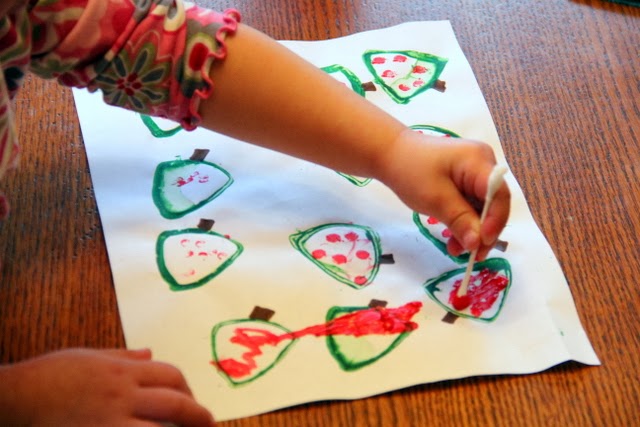
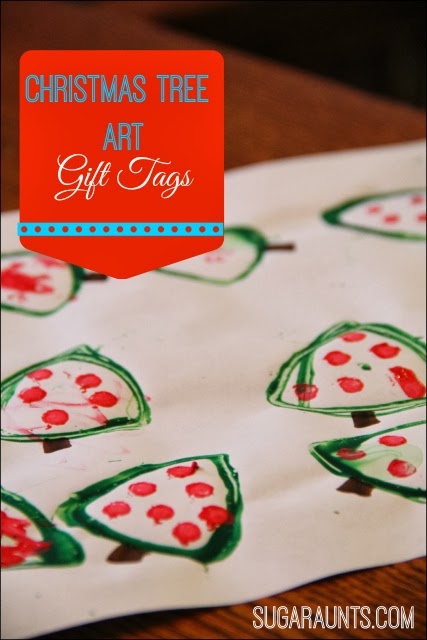
We’ve made our own Christmas tree gift tags last year. This version was just as much fun to make and we can’t wait to wrap a few presents with our DIY Gift tags! This Christmas tree art was great for preschoolers and toddler. All it took was a little stamping and cotton swab painting. If you’re not into making gift tags, this Christmas tree craft needs just a little stamping as a nice piece of holiday art to decorate with this Christmas!
Christmas Tree Gift Tag Craft
Note: This post contains affiliate links.
Christmas Tree Gift Tags
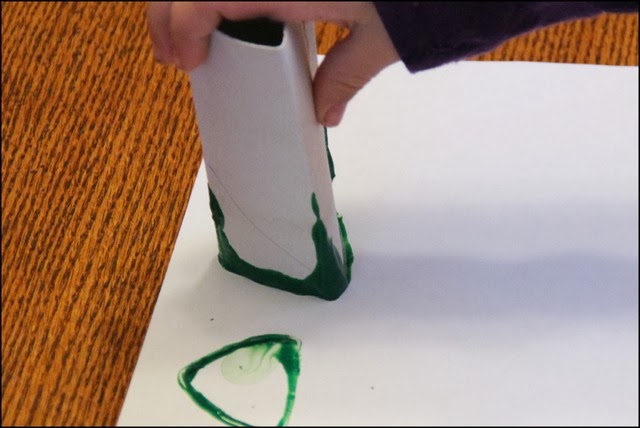
We started with a recycled paper tube that was bent into a triangle shape. This was dipped into green paint and ready for stamping all over the paper. Little Guy liked this part best, and made a ton of little trees on his paper.
A brown marker to draw little tree stumps on each triangle and it started to look more like Christmas trees. We used our Spill Proof Paint Cups and some cotton swabs to decorate our Christmas Trees.
Now this was Baby Girl’s favorite part of the painting! She reeeally got into dotting little decorations on her Christmas trees. Painting with the cotton swabs is such a good way to work o n tripod grasp for new pencil users and pre-handwriters. They were able to dab a little red paint in the spill proof cup and dot it onto the paper with a tripod grasp on the cotton swab.
Once the trees and the decorations were dry (and this took a while after Baby Girl painted…!) We snipped our papers into little gift tags and hole punched a place to tie a pretty ribbon.
Christmas Handwriting Activities
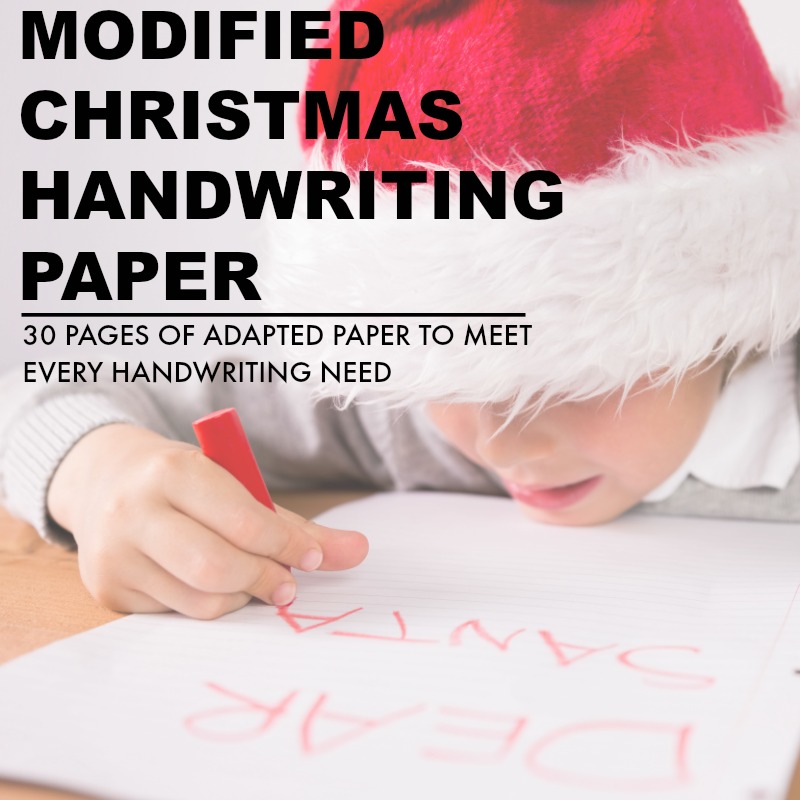
Writing out that Christmas wish list is a difficult task that brings out tears instead of holiday excitement. I’ve got a solution for your kiddo with handwriting difficulties: a packet of modified paper for all of the Christmas handwriting tasks that come up each year. Use this handwriting pack to help kids who struggle with handwriting to participate in holiday traditions while even working on and developing their handwriting skills! Working on handwriting with kids this Christmas season? Grab your copy of the Christmas Modified Handwriting Packet. It’s got three types of adapted paper that kids can use to write letters to Santa, Thank You notes, holiday bucket lists and much more…all while working on handwriting skills in a motivating and fun way! Read more about the adapted Christmas Paper here.
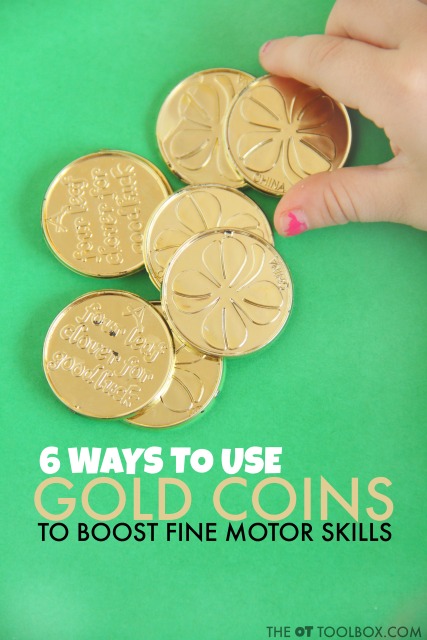
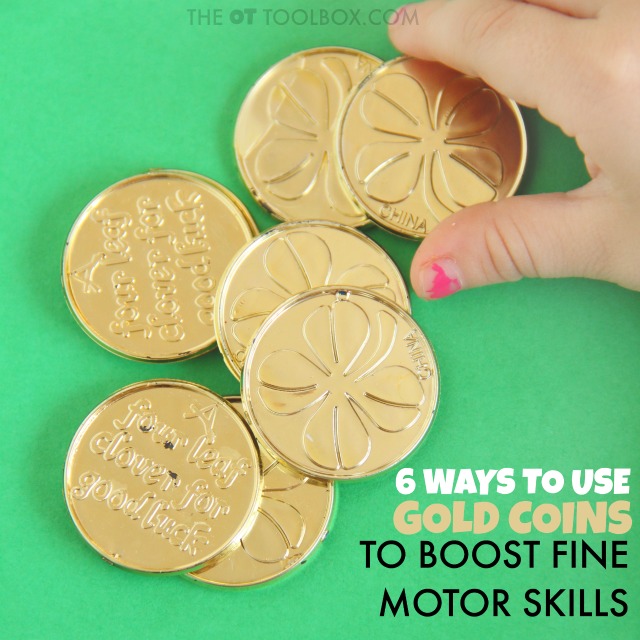
This time of year, you may have a few plastic gold coins laying around. If not, these are those gold coins you see around March in dollar stores or in the party aisle of the store. They might be used in party decorating or as a fun addition to St. Patrick’s Day activities. We had a handful of gold coins in our house and decided to use them in some fine motor activities. Below are 6 quick and easy ways to improve fine motor skills using gold coins.
We’ve used coins to work on fine motor skills like in-hand manipulation before. Coins are a great way to encourage a skill needed for so many tasks!
Want these printable sheets in handout form? Grab the printable sheet by clicking the button below. You can use these exercises and activities in a home program or part of themed activities in the time leading up to St. Patrick’s Day. OR, use regular coins and use this printable sheet of exercises all year long!
Scroll to the bottom of this post for a handout on how to use St. Patrick’s Day gold coins to build fine motor skills.
It’s a great handout to send home with kids for a home program!
You may also like this St. Patrick’s Day balance beam for a themed way to encourage gross motor skills and vestibular sensory input.
First, you will need a handful of gold coins. You can grab them here. You could also use play money like we did here or just use regular real money coins!
1. In-Hand Manipulation- Transfer the coins one at a time from the palm of the hand into the fingertips to drop them into a bank. don’t have a coin bank that’s big enough for the gold coins? No problem! Use a knife to slice an opening in the top of a cardboard box or container with a plastic lid such as a recycled raisin container. Younger children can drop the coins into an empty tissue box. In-hand manipulation activities can help with tasks like clothing fasteners, shoe tying, and pencil grasp.
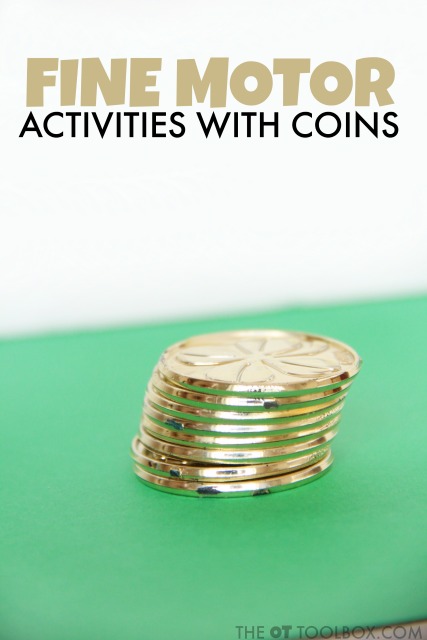
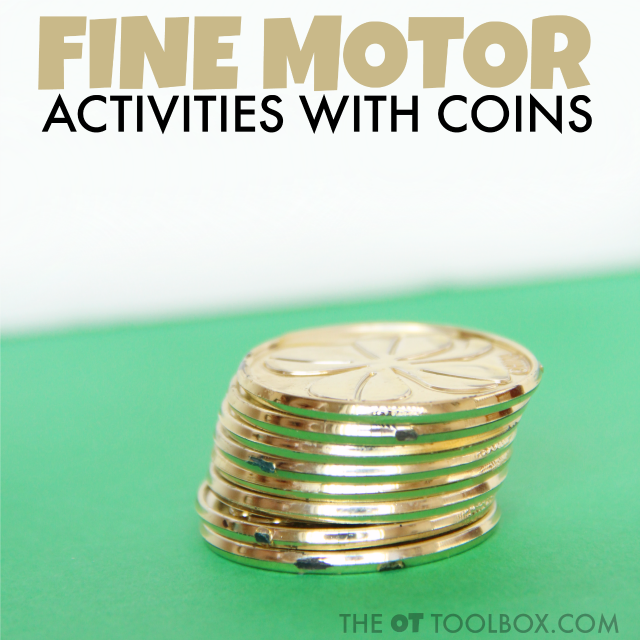
2. Fine Motor Precision- Use the coins to practice fine motor precision and graded movements by stacking the coins. The more, the better, especially with older students. Stack the coins, one at a time, onto one another in a stack. Don’t let the coins fall! Precision is an important fine motor skill needed for many fine motor tasks.
3. Open Thumb Webspace- Make a “sandwich” with the coins and improve that thumb webspace to use in pencil grasp, scissor use, and activities such as managing clothing fasteners. Kids can hold three coins in a tip-to-tip grasp as they oppose the thumb to the pointer finger while ensuring the thumb is open in an “O” shape. Activities to improve an open thumb web space are important for pencil grasp and manipulation of small items.
4. Finger Translation- Another in-hand manipulation activity, this one helps kids work on the ability to rotate items like a pencil or a coin (a real one!) between the pad of the thumb and the pad of the pointer, middle, and ring fingers. This in-hand manipulation activity can be practiced by holding the edge of the coin and rolling it in a circular motion along the finger pads. Try these ideas to improve translation using small water beads and a plastic bottle.
5. Finger Isolation- Place several gold coins on the table in a line. Use the fingers of one hand to tap them one at a time as the child “plays” a tapping tune on the coins. Just like tapping out keys on a piano, this activity allows the child to improve finger isolation and dexterity needed for skills like shoe tying or typing. Finger isolation activities can be a helpful way to improve fine motor skills needed for tasks like typing, shoe tying, pencil grasp, and more.
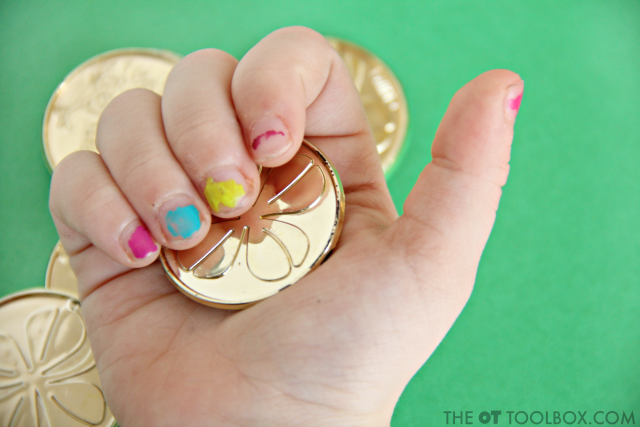
6. Hand Grip Strength– Ask the child to place one or more coins in the palm of their hand. They should curl their fingers over the coin and SQUEEZE! You may want to ask them to try to squeeze the plastic gold coin into real gold! Squeezing the fingers into a gross grasp in a sustained grip is a fun way to work on hand strength needed for so many skills. Hand strengthening is one of the biggest needs for a functional pencil grasp, endurance when writing or coloring, and tool use of all kinds!
How would you use these fun gold coins to improve hand strength and fine motor skills?
You can grab the gold coins here and use them over and over again over the next month and the days leading up to St. Patrick’s Day!
Want to send these activities home as a home program? Print off this sheet and add a couple of gold coins for a creative home exercise program!
Here are more fine motor activities you will love:
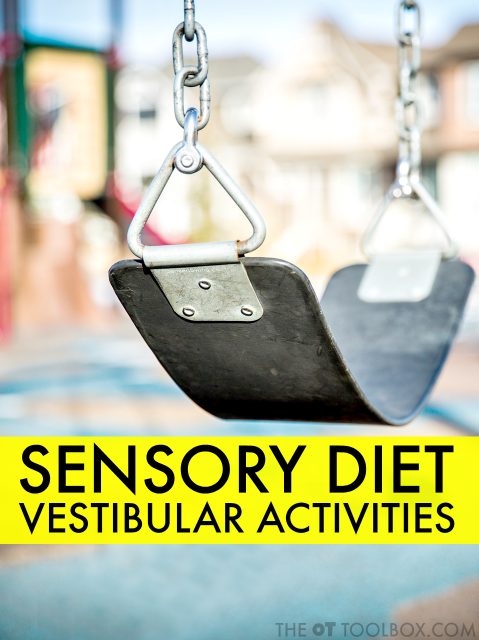
The vestibular system is a powerful one! It can be a confusing one when we consider how it impacts our body’s ability to regulate. The vestibular system is one of the three systems that impact all of the others and therefore all learning, cognition, and occupational performance. the vestibular system develops early in life and plays a very important role in early development. for these reasons, today we’re talking about Sensory Diet Vestibular Activities. These are vestibular activities that can be used in a sensory diet and a sensory lifestyle full of meaningful sensory activities. The vestibular activities listed below are those that impact an individual in many ways.
The Vestibular System
Understanding the vestibular system can help explain how and why we need to incorporate vestibular activities into our daily life.
Here is an explanation of the vestibular system from a neurological focus.
Here are vestibular red flags indicating a problem with the vestibular system and how that looks in a child’s day.
Check out those two links above to get a good background on the vestibular system and how it impacts every activity and function that we perform. In fact, the vestibular system plays a huge part in coordination of our head movements with the stimulation in the environment.
+ We are then able to copy words and phrases from the board in the classroom by shifting our vision from the table surface to the overhead board without losing our place.
+ We are able to watch a moving object like a soccer ball as it travels across a field.
+ We are able to read a speech while looking up at our audience, without losing our place on the cue cards.
+ We are able to hold our body in a specific position such as a downward dog yoga position while concentrating on deep breathing.
+ We are able to maintain our head positioning while cutting with scissors or while riding a bicycle.
The vestibular system plays such a huge part in our daily tasks in a manner that happens naturally and without effort!
It is easy to see how a problem with the vestibular system could result in major issues with functioning!
Sensory Diet Vestibular Activities
The sensory vestibular activities listed below are playful ways to promote performance and tolerance to movement activities. They are also challenges against gravity to help kids with difficulties in equilibrium, balance, self-regulation, and adjusting to typical sensory input. The vestibular system operates through receptors in the inner ear and in conjunction with position in space, input from the eyes, and feedback from muscle and joint receptors, is able to contribute to posture and appropriate response of the visual system to maintain a field of vision. This allows an individual to detect movement and changes in the position of the head and body. Dysfunction in the vestibular system may result in hypersensitivity to movements or hyposensitivity to movements.
When
providing vestibular input as an intervention strategy for sensory needs,
various movement patterns should be considered. Depending on the individualized
needs of the child, activities can be designed to include movements such as:
Prone swinging
Seated swinging
Standing swinging
Linear movements
Vertical
movements
Rotary movements
Angular movements
Upside down
movements
Horizontal
movements
Challenges to
balance
Inverted head
Unstable base of
support
Starts and stops
in motion
Changes in
direction
Changes in speed
Vestibular Hyperresponsiveness
Some children may present with vestibular hyperresponsiveness.
This looks like a variety of things in children. As we know, every child is uniquely different. The indicators of sensory hyperresponsiveness listed here are only just a few ways that vestibular hyperresponsiveness may present in kids:
Overly dizzy with motions
Resistant to moving activities such as
swings, slides, elevators, or escalators
Fear of unstable surfaces
Unable to tolerate backward motions
Unable to tolerate side to side motions
Illness in moving vehicles
Avoids swings or slides
Gets motion sick easily
Gravitational insecurity
Challenges with unstable surfaces
Dislike of moving surfaces
Try adding some of these vestibular activities into a sensory diet or sensory lifestyle. (These are just a FEW activities that can be used by children. Activities can be modified to include all of the movement planes listed above.)
Sensory Diet Vestibular Activities for Hyperresponsiveness:
Skipping
Prone activates with arms supporting the upper body at the shoulders and elbows
Slowly adding activities in the quadruped positioning
Adding a support for jumping, hopping, balance activities
Crawling
Walking
Sliding
Rolling
Being pulled on a blanket or sled (indoor works, too!)
Throwing bean bags at a target
Throwing/catching a ball
Movement obstacle courses
Wheelbarrow races
Vestibular Hyporesponsiveness
On the flip side, a child can present with hyporesponsiveness of the vestibular system. Hypo-responsiveness of the vestibular sense may present in a child as an under-responsiveness or underreaction to vestibular sensation. This may look like the actions listed below. Remember that every child is different. This list is only a sample of the various ways a child can present when they are impacted by hyporesponsive vestibular system.
Hyporesponsiveness of the vestibular system examples:
Constant movement including jumping,
spinning, rocking, climbing
Craves movement at fast intervals
Craves spinning, rocking, or rotary
motions
Poor balance on uneven surfaces
Constantly fidgeting
Increased visual attention to spinning
objects or overhead fans
Bolts or runs away in community or group
settings, or when outdoors or in large open areas such as shopping malls
Difficulty maintaining sustained
attention
Impulsive movement
Constantly getting up and down from desk
in the classroom
Walks around when not supposed to (in the
classroom, during meals, etc.)
Loves to be upside down
Sensory Diet Vestibular Activities for Hyporesponsiveness:
Children with hyporesponsiveness of vestibular input may benefit from a variety of activities. Below are just a jew of these ideas. Try using these sensory diet vestibular activities when addressing hyporesponsiveness of vestibular sensation:
Therapy ball
Fidget tools
Cushion or partially deflated beach ball on the floor under feet at a desk or chair.
Tie therapy band (TheraBand) or a resistive cord around the legs of a student’s chair for use as a foot fidget
Provide appropriate play-based opportunities for movement needs (sit and spin toy, see saw toy, rocking chair, trampoline)
Weave vestibular input throughout the day and prior to fine motor/visual motor activities
Ensure the feet touch the ground or have support when seated in a chair or on the toilet
Sensory diets and specific sensory input or sensory challenges are a big part of addressing sensory needs of children who struggle with sensory processing issues. Incorporating a schedule of sensory input (sensory diet) into a lifestyle of naturally occuring and meaningful activities is so very valuable for the child with sensory needs. That’s why I’ve worked to create a book on creating an authentic and meaningful sensory lifestyle that addresses sensory needs. You can watch for more information on this book coming very soon. If you would like to be the first to know more about this book (and want to grab some upcoming freebies related to sensory lifestyles and sensory diet activities, sign up here. You’ll be the first to get some awesome tools for addressing sensory needs in motivating and meaningful ways.




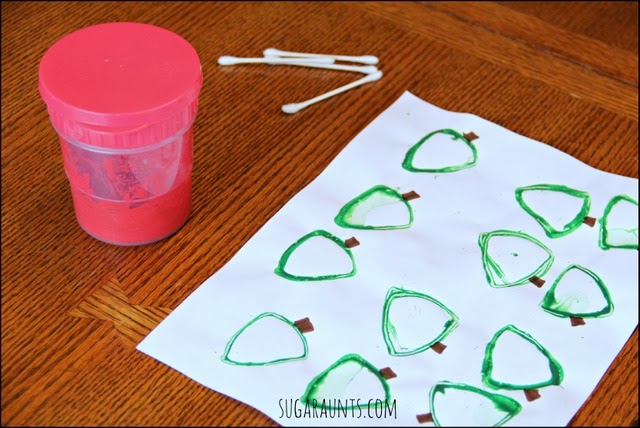
 and some
  to decorate our Christmas Trees.