Tangrams and Visual Perception in Handwriting

I kind of love to share tricks for improving handwriting.  There are so many “parts” to written work. There’s fine motor dexterity, pencil grasp, strength, endurance, visual perceptual skills, cognitive skills among other parts to handwriting.  You can see more about these topics on our Handwriting page.  One big way to develop the skills needed in written work is to address visual perception.
 
Kids love to play.  It’s in their soul.  Play is the primary occupation of a child and so it only makes sense to work on functional skills like handwriting though play.  Practicing writing over and over again sounds pretty boring to me and I can bet that any kiddo will agree.  Today’s activities are designed to work on the visual perceptual skills needed for handwriting using tangrams.
 
Get ready to play and build your way to neater handwriting!
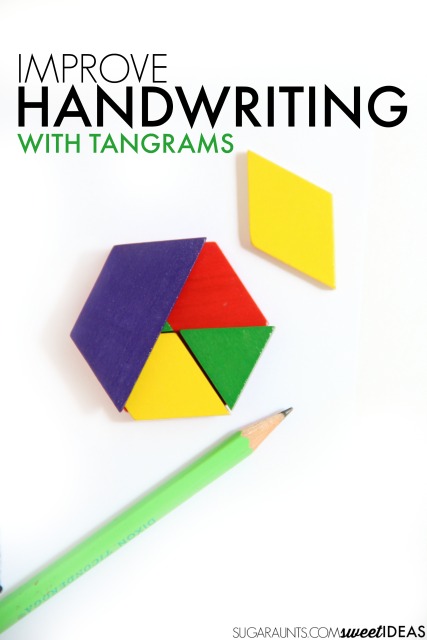
Work on handwriting skills using tangrams to address the visual perception skills needed for written work.

This post contains affiliate links.


Visual Perception and Tangram Activities

 
If you’re looking for fun ways to work on handwriting, these activities are the way to go.  I’ve come up with creative puzzles, drawing activities, and building challenges that will work on all of the skills needed for improving line awareness, letter formation, and neatness in written work.  
 
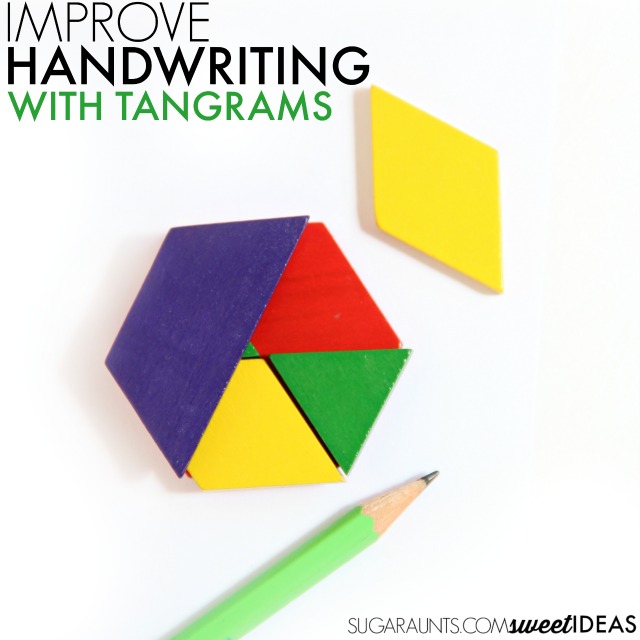
Our Melissa and Dough tangram set is used a lot in our house.  It’s a great open-ended toy that doubles as a therapy tool for building skills such as eye-hand coordination.  
 
RELATED IDEA: Try DIY Sponge Tangrams for these hands-on learning activities. 
 
We created these file folder activities using the tangrams and came up with activities that will work on all of the areas of written work.  Building skills like Position in Space and Visual Discrimination are important when it comes to improving neatness in written work.  
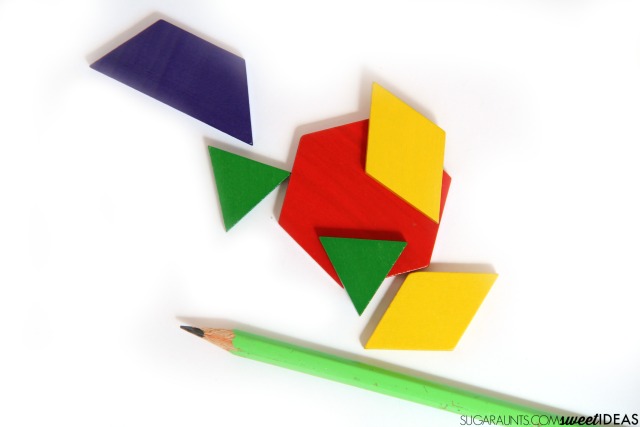
 
Work on handwriting skills using tangrams to address the visual perception skills needed for written work.
We printed off some worksheets and attached them to a file folder with paper clips.  I set out the tangram shapes and showed my kindergartner and preschooler how to copy the forms.  While they built shapes, they were developing and refining skills like Eye-Hand Coordination and Sequential Memory.  
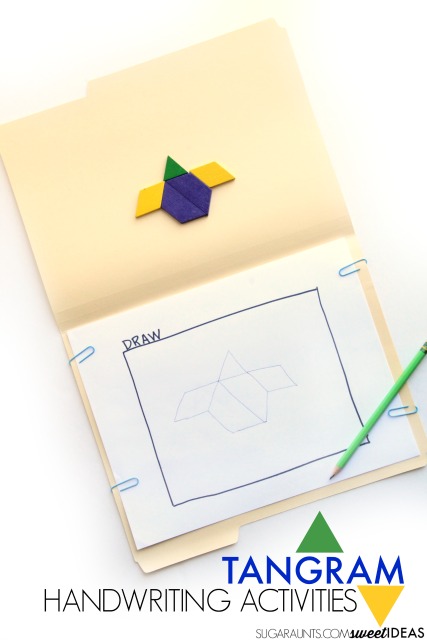
 
Work on handwriting skills using tangrams to address the visual perception skills needed for written work.
We set up a few different activities using the file folder station.  It’s a nice activities because all of the pages can be attached to the same file folder using the paper clips.  The pages can be rotated out and more complex sheets added in.  When you’re done, simply close the file folder and slip it away with the tangram box to play another day. 
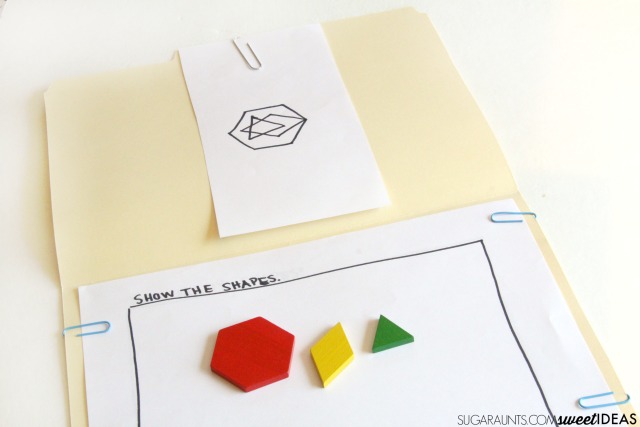
 
Work on handwriting skills using tangrams to address the visual perception skills needed for written work.

Visual Perceptual Skills and Handwriting

This activity workbook has information on all of the visual perceptual areas necessary for written work: 
  • Visual Spatial Relations
  • Visual Discrimination
  • Visual Figure Ground
  • Form Constancy
  • Visual Memory
  • Eye-Hand Coordination
  • Sequential Memory
  • Visual Closure
Work on handwriting skills using tangrams to address the visual perception skills needed for written work.
 
It’s available in our Shop for $6.
 
All printable sheets in the workbook were created with design creation tools (The handdrawn examples in the images in this post are just a mock-up for a visual example of the activity.)
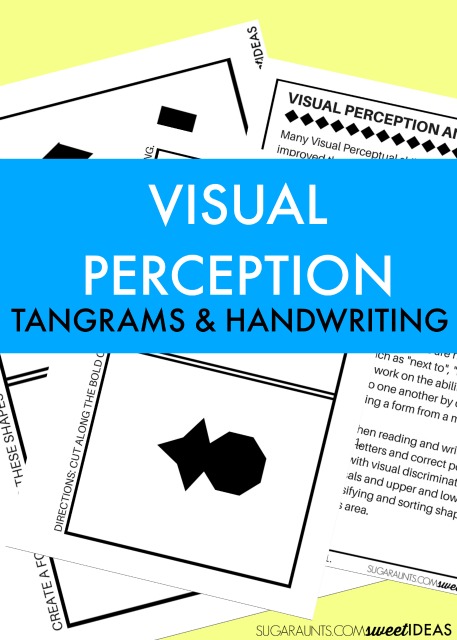
Work on handwriting skills using tangrams to address the visual perception skills needed for written work.Work on handwriting skills using tangrams to address the visual perception skills needed for written work.
Work on handwriting skills using tangrams to address the visual perception skills needed for written work.
Looking for more ways to learn and play with Tangrams?  Try these:

 
Work on handwriting skills using tangrams to address the visual perception skills needed for written work.
Visual Closure Activity Bugs Theme

Free Visual closure worksheets
There is a lot that goes into reading and writing.  One of the skills that makes up the ability to read words and form letters in handwriting tasks with fluency is visual closure.  Visual Closure is the ability of the eyes to visualize a complete image or object when only a portion is seen.  A child can see just part of a letter or number when reading and recognize how to write that figure.  They can read a word or sentence without focusing on each letter and how it is made.  Visual Closure is an essential skill for reading with fluency.  It’s necessary for written work to happen without concentrating on each letter’s lines and curves. Visual Closure allows us to comprehend words and letters without actively assessing each line. 
 
Children with difficulties in visual closure may have trouble completing mazes, puzzles, or worksheets.  They might have difficulty identifying items that are partially obscured by other items, such as finding a serving spoon hidden in a draw full of items.  They might have difficulty with spelling or math tasks or concepts.
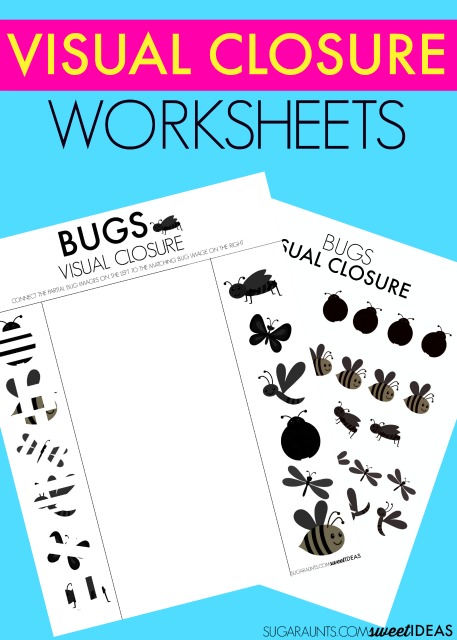
Free visual closure worksheets with a bug theme.

Visual Closure Worksheets

This post contains affiliate links.
These visual closure worksheets can help work on the skills needed to develop visual closure.  You can get these worksheets as a FREE resource if you join our newsletter subscriber list.  These worksheets and tons others are included in our subscriber-only library.
Free visual closure worksheets with a bug theme.
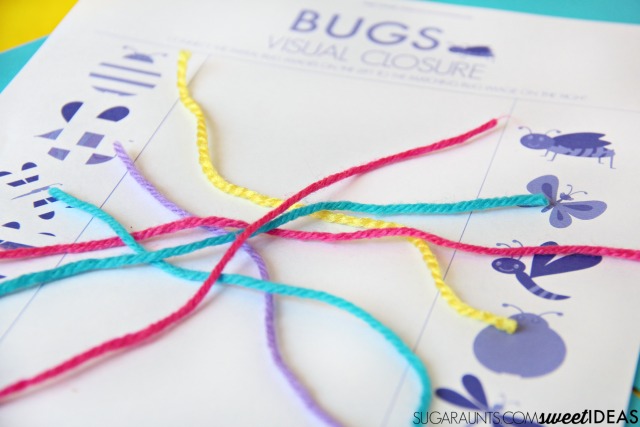
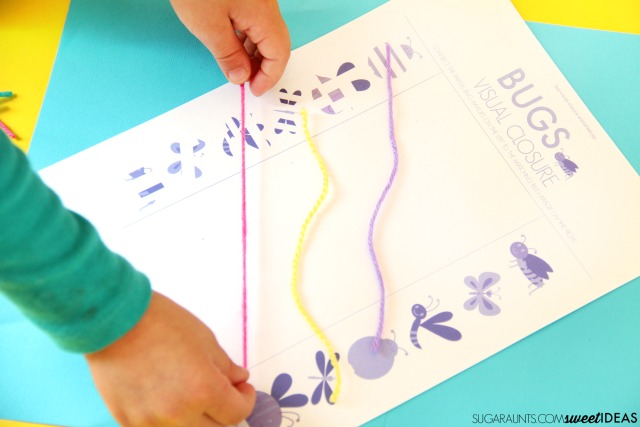
To use these visual closure worksheets:  Match up the bug on the left with the bug on the right.  We used yarn to complete the match so that we could re-use this sheet.  You could also laminate these to re-use.  
 
For the second worksheet, match up the broken bug image with the rotated bugs.  Have your child circle the bug that matches the broken bug exactly.  
Free visual closure worksheets with a bug theme.

Looking for more bug activities?  Try these:

Free visual closure worksheets with a bug theme.
 
Looking for more visual perception activities for kids? Try these: 

Create your own race track

                                  Visual Tracking with Cardboard Tubes

Intrinsic Hand Muscle Strengthening with Tongs

Handwriting legibility and hand strength are closely tied.  You might say they go hand-in-hand.  (I had to go there!)  

 
This easy fine motor tong activity is designed to build some of the muscles needed for managing a pencil.  The intrinsic muscles are the muscles in the hand that define the arches of the hands, bend the knuckles, and oppose with the thumbs.  


Among these muscles are a group called the lumbricals.  The lumbrical muscles have a job to bend (flex) the MCP joints and extend (straighten) the PIP and DIP joints.  When the lumbricals are in action, the hand might look like it is holding a plate with the big knuckles bent and the fingers extended.  


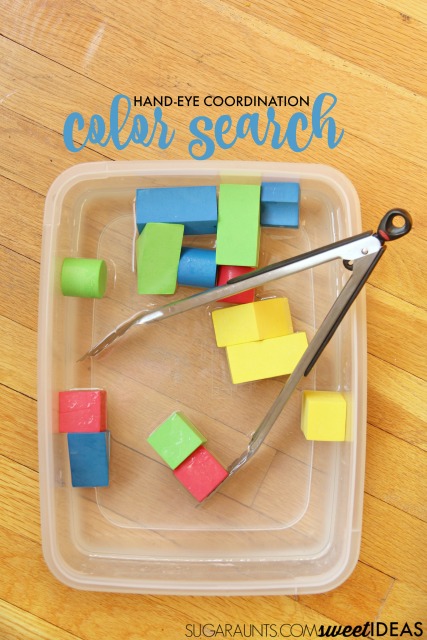
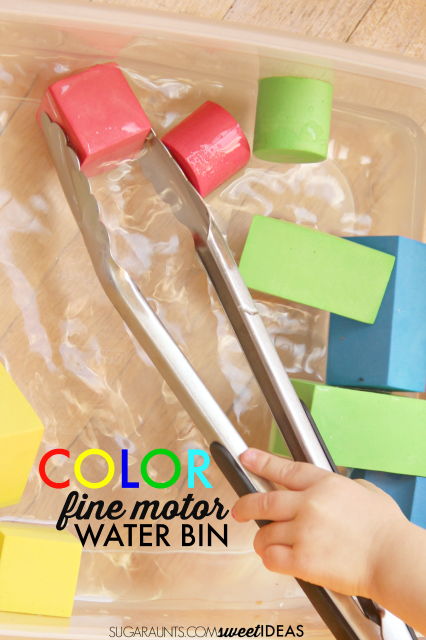
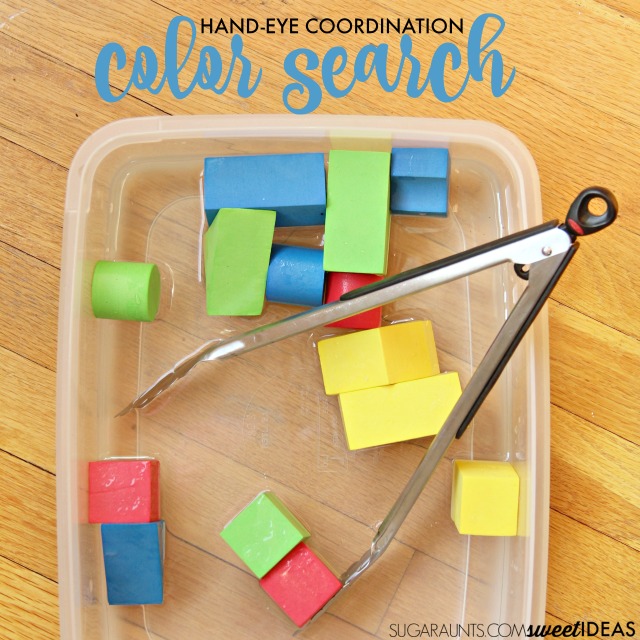
Use kitchen tongs to work on the lumbrical intrinsic muscles of the hands to build strength in handwriting, using tongs for this color search and hand eye coordination activity for kids.


Lumbrical Muscles of the Hands and Handwriting 

This post contains affiliate links.


The lumbrical muscles of the hands are important in handwriting.  They are used to hold the pencil in a functional grasp.  Advancing the pencil in an upward motion using the joints of the fingers require strength and endurance of the lumbrical muscles.  Forming letters like upstrokes in cursive letters and the re-trace of letters like a, d, g, h, m, n, p, q, r, u, v, and w require upward pencil strokes.


Hand strength can be developed through many creative, hands-on activities, like blocks and rubber bands or rolling balls of play dough.  This kitchen tong activity is another fun way to work on important skills. 
 
Use kitchen tongs to work on the lumbrical intrinsic muscles of the hands to build strength in handwriting, using tongs for this color search and hand eye coordination activity for kids.
 
 
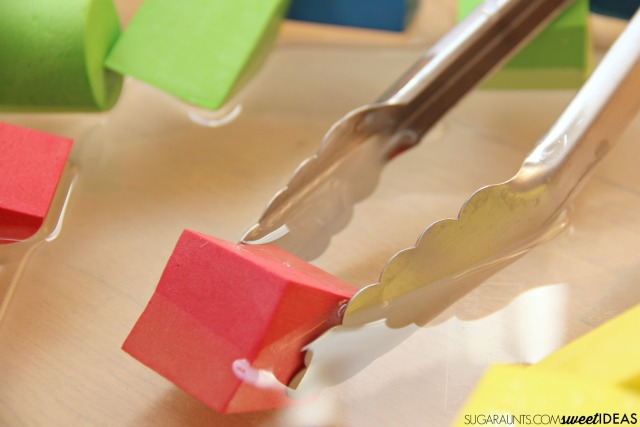
A quick and easy way to develop and strengthen the lumbricals is a tong activity like this one.  Use a large kitchen tong utensil to grasp items.  We used this kitchen tong, but any large tong would work for this strengthening activity.  Foam blocks are a nice size and make a great hand-eye coordination exercise for children with the tongs.  Fill a bin with water and add in the foam blocks.  Ask your child to grab the blocks as you call out colors for a color identification activity.


Idea:  Re-use the blocks to build MORE fine motor skill development like we did here.

Use kitchen tongs to work on the lumbrical intrinsic muscles of the hands to build strength in handwriting, using tongs for this color search and hand eye coordination activity for kids.


Using tongs to work on handwriting

It is important to notice the position of your child’s hand on the tongs in activities like this one.  You want to see a slightly extended wrist and tongs UNDER the hand to work on lumbrical muscle strength.  This is different than a task geared toward building precision and thumb intrinsic muscle strength. 

Use kitchen tongs to work on the lumbrical intrinsic muscles of the hands to build strength in handwriting, using tongs for this color search and hand eye coordination activity for kids.


More intrinsic muscles needed in handwriting

The muscles used in handwriting can be broken up into two actions.

The muscles: 
  • flexor digiti minimi, abductor digiti minimi and opponens pollicis & digiti minimi are referred to as the hypothenar muscles work to stabilize the ulnar side of the hand during handwriting. 
 
The muscles:
  • abductor pollicis brevis, flexor pollicis brevis, and opponens pollicis work to rotate the thumb for manipulation of the pencil.  
  • Adductor
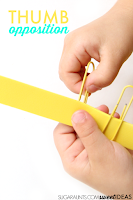
    pollicis strengthens thumb opposition.
 
Looking for more ways to use tongs and fine motor tools in learning?  Try these:


Use kitchen tongs to work on the lumbrical intrinsic muscles of the hands to build strength in handwriting, using tongs for this color search and hand eye coordination activity for kids.Use kitchen tongs to work on the lumbrical intrinsic muscles of the hands to build strength in handwriting, using tongs for this color search and hand eye coordination activity for kids.


Looking for more strengthening exercises for hands?  Try these:
 

 fine motor writing activity Pencil Grasp Activity Pencil Grasp Exercise Thumb opposition activity
 

Colleen Beck, OTR/L has been an occupational therapist since 2000, working in school-based, hand therapy, outpatient peds, EI, and SNF. Colleen created The OT Toolbox to inspire therapists, teachers, and parents with easy and fun tools to help children thrive. Read her story about going from an OT making $3/hour (after paying for kids’ childcare) to a full-time OT resource creator for millions of readers. Want to collaborate? Send an email to contact@theottoolbox.com.

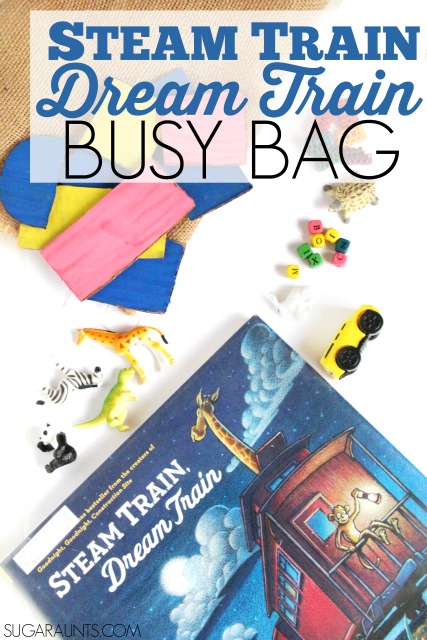
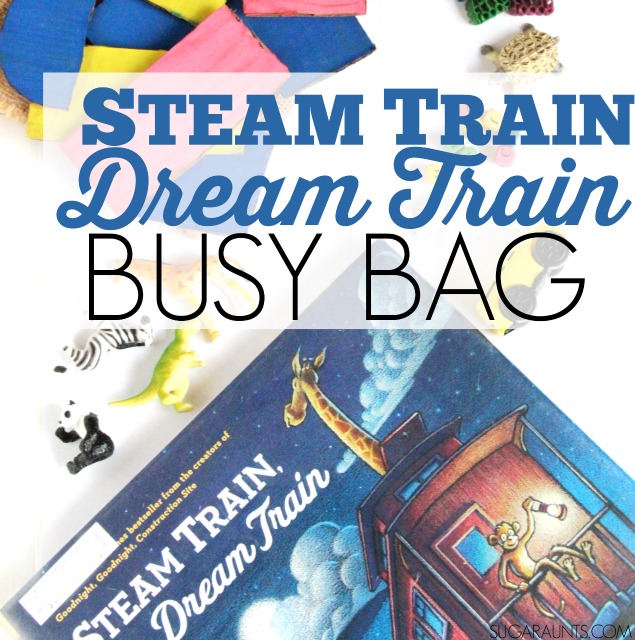
Steam Train Dream Train Busy Bag

Great books for preschoolers need a fun activity to extend the fun.  We’ve shared a bunch of our favorite books and activities here on the blog and this Steam Train, Dream Train busy bag activity is another great book and play idea.  
 
Busy bags are a playful way to get kids involved in creative and independent learning through play and are many times, a DIY craft for the moms to make.  If you’ve got a child who loves trains, this preschool book and busy bag activity is for you!


Try these train themed sensory activity ideas for more ways to play with a train theme.


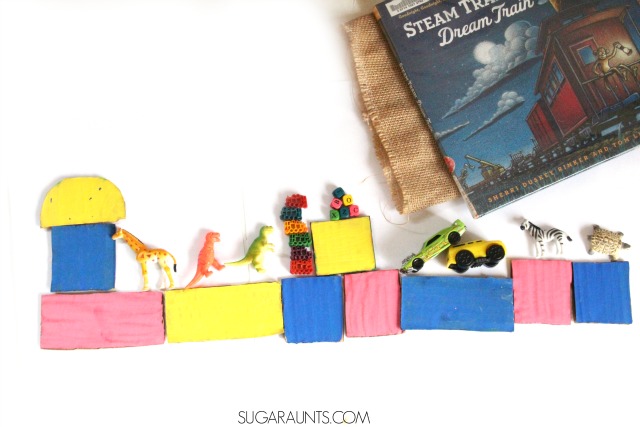
Steam Train Dream Train book and busy bag activity. This is a great idea for preschoolers and beginner readers who need to wait at a restaurant or doctors office!  Make this busy bag to go along with the book and inspire creative and imagination play and learning as kids re-tell the story through play.

“Steam Train, Dream Train” Book and Busy Bag Activity

This post contains affiliate links.
 
“Steam Train, Dream Train”
is a fun book to read.  My kids loved the rhymes and details in the gorgeous pictures.  In the book, a train is rumbling to a stop where it fills it’s cars with toys of all kinds.  The train workers are playful animals who rest in the trains cars after they’ve filled it.  At the end of the book, we see the train is a playset in a child’s bedroom and you can just imagine all of the creative play that happens with that train!
 
We decided to make our own playful train set that can be carried along to places where waiting is difficult.  This book-related busy bag would be a fun way to pass time while waiting at a restaurant.  Slip the book
into a bag along with a few play items and you’ve got a busy bag that will inspire creative play of limitless capacities.
Steam Train Dream Train book and busy bag activity. This is a great idea for preschoolers and beginner readers who need to wait at a restaurant or doctors office!  Make this busy bag to go along with the book and inspire creative and imagination play and learning as kids re-tell the story through play.
 
You’ll need a few items to fill your busy bag.  We used items that correspond with the book
that we had in out house, but if you’re needing a few items, it would be easy to replace them with other toys.
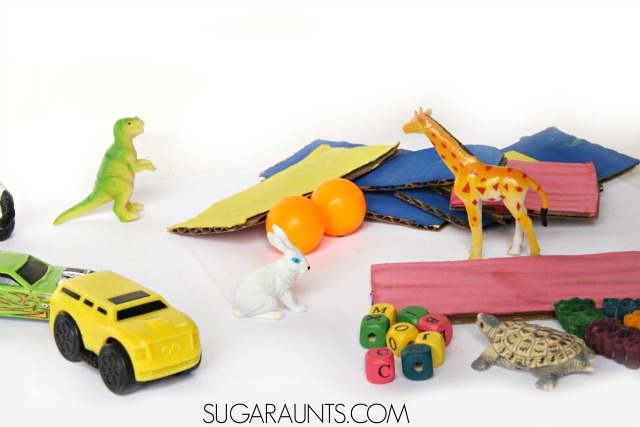
We added these items to our busy bag:
 
Cardboard shapes (See how to make them here.)
burlap bag
Small alphabet beads
(We received ours from www.craftprojectideas.com)
Steam Train Dream Train book and busy bag activity. This is a great idea for preschoolers and beginner readers who need to wait at a restaurant or doctors office!  Make this busy bag to go along with the book and inspire creative and imagination play and learning as kids re-tell the story through play.
Read the book together and as you read, play along and build your dream train!
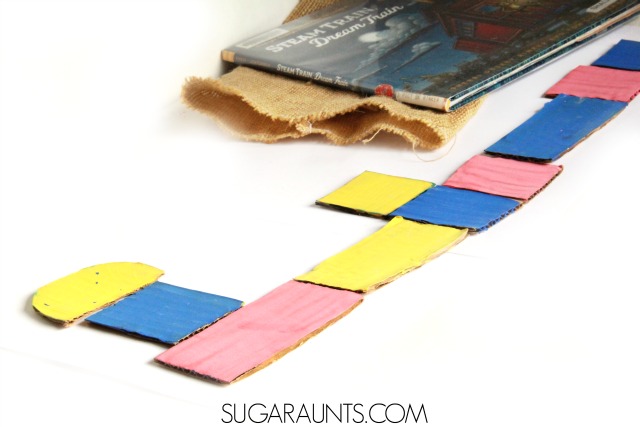
We used the cardboard shapes to build a shape train.  Now is a great time to discuss the shapes that can be used to build a train.  Talk about colors, too!
Steam Train Dream Train book and busy bag activity. This is a great idea for preschoolers and beginner readers who need to wait at a restaurant or doctors office!  Make this busy bag to go along with the book and inspire creative and imagination play and learning as kids re-tell the story through play.
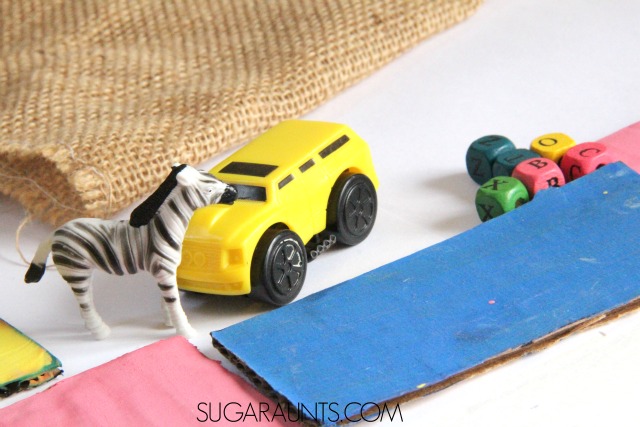
Use the toys to add to the train as you go through the story.  
Steam Train Dream Train book and busy bag activity. This is a great idea for preschoolers and beginner readers who need to wait at a restaurant or doctors office!  Make this busy bag to go along with the book and inspire creative and imagination play and learning as kids re-tell the story through play.


When you’re child is playing independently with their busy bag, they can recall the story or create parts of their own.
Steam Train Dream Train book and busy bag activity. This is a great idea for preschoolers and beginner readers who need to wait at a restaurant or doctors office!  Make this busy bag to go along with the book and inspire creative and imagination play and learning as kids re-tell the story through play.
Play with your shape train busy bag over and over again!
 
Want to find more “Steam Train, Dream Train”?  Stop by and see what the other bloggers in the Book Club Play Dates series have come up with for this book:
 
Make an Egg carton steam train craft based on the book, like Craftulate did.
Play a Number matching game with a printable from Fun-a-Day.
Steam Train Dream Train book and busy bag activity. This is a great idea for preschoolers and beginner readers who need to wait at a restaurant or doctors office!  Make this busy bag to go along with the book and inspire creative and imagination play and learning as kids re-tell the story through play.
Love this post?  Share it on Facebook!
 
More preschool books you and your child will love:
   
hands-on activities to explore social emotional development through children's books.

Love exploring books with hands-on play?

Grab our NEW book that explores friendship, acceptance, and empathy through popular (and amazing) children’s books!  It’s 50 hands-on activities that use math, fine motor skills, movement, art, crafts, and creativity to support social emotional development.

GET THE E-BOOK 

Get the PRINT BOOK 

Kindergarten Sight Words with Winter Tic Tac Toe

I love to make homework fun.  At the end of a long school day, the last thing my kids want to do is worksheets.  They do it, because the are hard workers and want to do what they need to do.  So, when my kids are hit with a new concept that makes for homework grumbles, I try to get creative and make the extra practice fun.


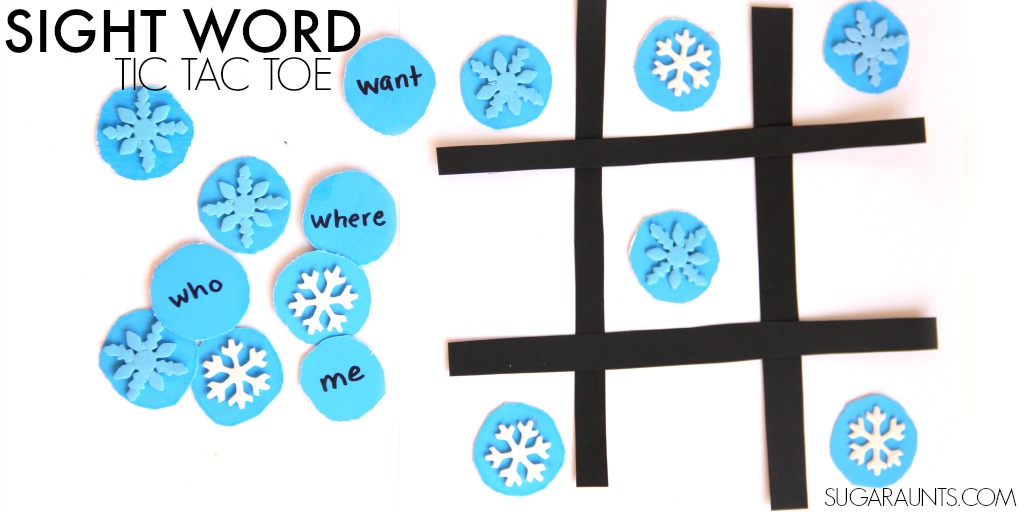
This Sight Words Winter Tic Tac Toe game is just that.  It’s a fun and creative way to practice sight words.  When pain old flashcards are just boring. (And, we’ve done a few sight word activities in our day!)


My Kindergarten boy LOVES tic tac toe.  So, when we needed to practice a bit more on some sight words, that adding a tic tac toe component would make him perk up to practice!


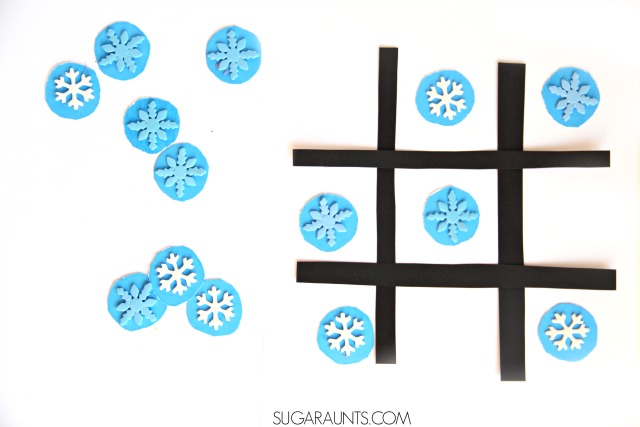
And, when he came home from school and saw this winter snowflake tic tac toe game waiting for him, he was so excited to start playing.


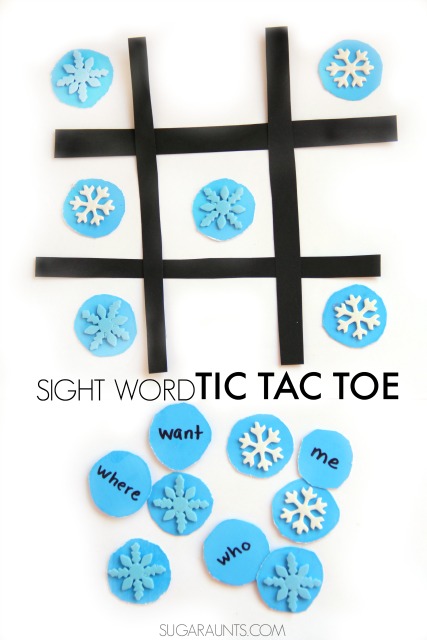
Play this sight word tic tac toe game with a winter snowflake theme. This is perfect for Kindergarten and early childhood education.

Winter Sight Words Tic Tack Toe Game


This post contains affiliate links.


To make this game, you’ll need a few materials:
Black cardstock

Snowflake foam shapes
(sticky-back or not, but you’ll need glue if yours are not stickers)

Blue cardstock

Black marker


Play this sight word tic tac toe game with a winter snowflake theme. This is perfect for Kindergarten and early childhood education.

It is easy to make this sight word game:
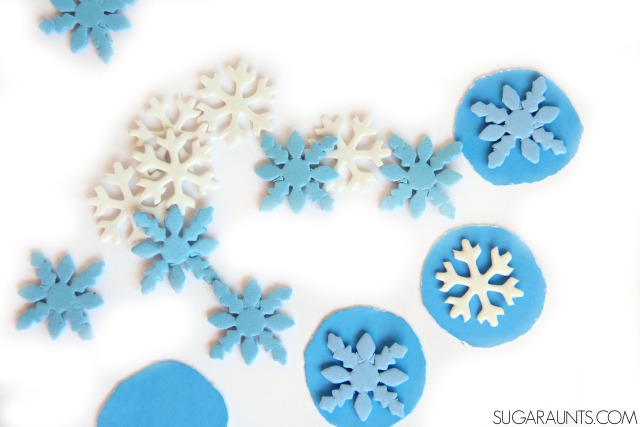
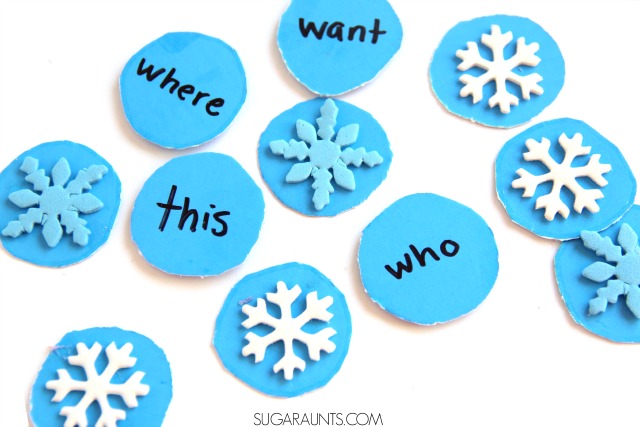
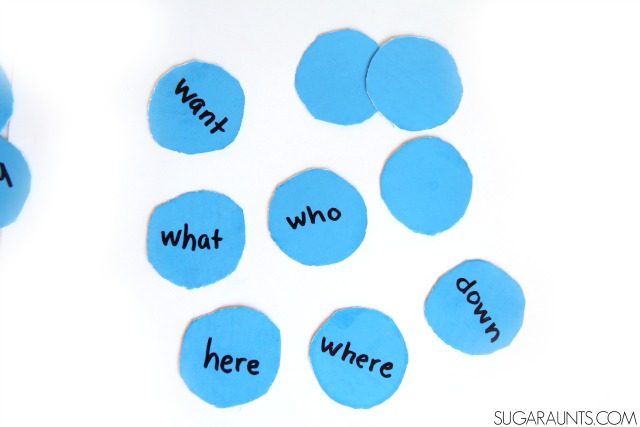
Cut circles from cardstock.  On one side, write sight words.  On the other side, stick snowflake stickers or glue foam shapes.


Tic Tac Toe Game and Visual Skills for handwriting and functional tasks

From the black cardstock, cut four long, thin strips.  Build a tic tac toe board with the strips.  We glued ours together.  Building the form was a fun task for my kindergartner.  He has drawn tic tac toe boards so often, that he could easily build and glue the shape together.  But, for kids who might need more help with this part, draw or make an example.  This is a great way to work on visual perceptual skills which are needed for forming and writing letters.

You could expand this activity by adding a word scavenger hunt component. Hide the word cards around the room or in an obstacle course. The players can find the words they need for their tic tac toe game.

Related, is our resource on name practice in kindergarten. These snowflake markers could be made with letters on each back, creating a hands-on activity for supporting sequencing of letters in writing names or kindergarten spelling words.

Play this sight word tic tac toe game with a winter snowflake theme. This is perfect for Kindergarten and early childhood education.

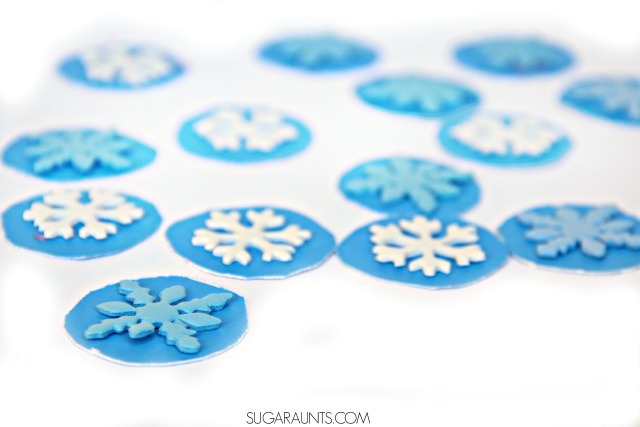
I had my son scan the pile of snowflakes and search for matching shapes. Looking for a particular snowflake within a jumble of shapes is a fun way to work on visual scanning, figure ground, and visual form discrimination. These are skills needed for tasks like handwriting, reading without losing their place, finding a page in a book, reading charts and graphs, scissor skills, and many other skills.


Scanning a tic tac toe board for an open spot is a great way to incorporate visual scanning into a hand-eye coordination game.

Play this sight word tic tac toe game with a winter snowflake theme. This is perfect for Kindergarten and early childhood education.


Sight Word Tic Tac Toe Game

We started playing using the snowflake side.  When we placed it on the board, I had my son turn the snowflake over and read the sight word.  He wanted to play again and again, and I was fine with that!


Alternative ways to play:
Have your child pick up 3-5 snowflakes and read the words.  Then play tic tac toe.
Create matches for each word and play memory.
Play tic tac toe with the sight words.  Take turns placing sight words on the tic tac toe board.  When the whole board is filled, turn the snowflake over to see if you’ve got three in a row.

Play this sight word tic tac toe game with a winter snowflake theme. This is perfect for Kindergarten and early childhood education.

Looking for more winter activities to do with your Kindergartner?  Try these:

Chocolate Snowflake Pretzels by Something 2 Offer
Snowflake Rhyming Activity by Books and Giggles
Skating Penguin Small World by Adventures of Adam
Stick Man Story Sack by Play & Learn Everyday

Winter Writing Prompts – by Mrs. Karle’s Sight and Sound Reading

Love this post?  Share it on Facebook!

Share on Twitter!
 
More sight word activities your child will love:

Sight Word Scavenger Hunt | Sight Word Sensory Bin | I Spy Sight Word Sensory Bottle 

2nd Grade Mental Math Adding 10s and 100s with a Harvest Theme

Worksheets and kids are a tough mix.  My second grader plows through a long school day and then brings home a math wroksheet (among other homework items) almost every weekday.  We do the worksheet, but sometimes it’s hard to practice the math concepts when she needs to just practice new math ideas.  One of the strategies she’s learning in second grade is Mental Math. 


Mental Math is simply doing math in one’s head, mentally (makes sense, right?) It’s the way that we figure out answers to math problems quickly, and without pencil and paper.  So, in second grade, my daughter’s been learning how to add 10’s and 100’s to single and double digits using mental math as a strategy.


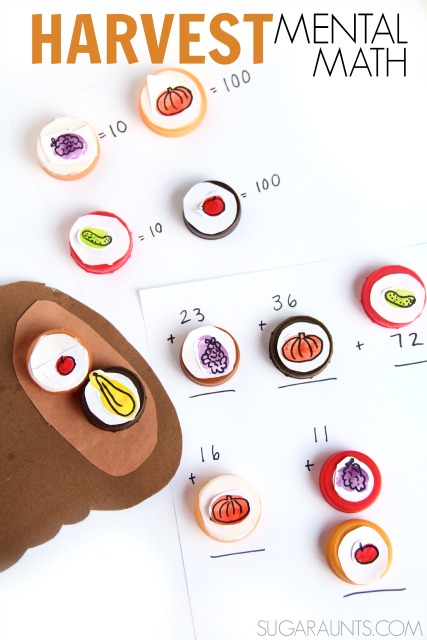
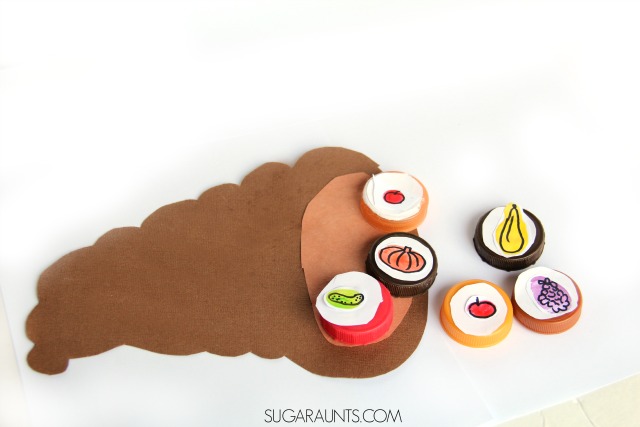
This Harvest themed Mental Math activity was a fun one to create and even more fun to use.  We made harvest-themed fruits and vegetables and a cornucopia craft to go along with the math practice.


Second grade mental math strategy to add 10s and 100s to digits with hands on learning in this creative Harvest-themed activity. I love the cornucopia craft!

Harvest Themed Mental Math Activity

You’ll need just a few materials to make this activity. (Affiliate links are included in this post.)
Brown cardstock

Recycled bottle caps
Glue
Label Sheets

Fingerpaints

White printer paper
Black permanent marker
Scissors


Second grade mental math strategy to add 10s and 100s to digits with hands on learning in this creative Harvest-themed activity. I love the cornucopia craft!


Make a cornucopia shape from the Brown cardstock.  On the printer paper, use the finger paints to make fingerprints in red, yellow, orange, green, and purple.  You can read all about the importance of creating fingerprint art over here.  It’s a great fine motor activity that really works on a child’s finger isolation skills and helps with tasks like handwriting, shoe tying, typing, and more.

Second grade mental math strategy to add 10s and 100s to digits with hands on learning in this creative Harvest-themed activity. I love the cornucopia craft!


Allow the fingerprints to dry and use the black marker
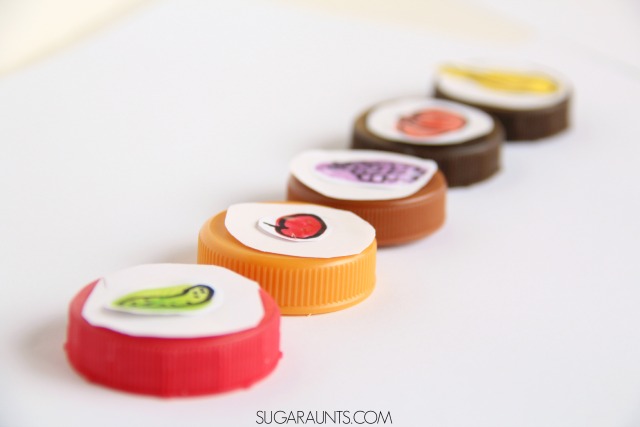
to turn them into fruits and veggies.  We made tomatoes, pumpkins, squash, grapes, and a pickle. 


Every cornucopia needs a pickle, right?


Cut out the harvest crop into small circles.  This was a great scissor skill activity for my preschooler.  We also cut circles from the Label Sheet
and stuck them onto the bottle caps.  Then, glue the fingerprint circles onto the bottle caps.  You could certainly skip the bottle cap step and just use the fingerprints, if you like.


Second Grade Math: Adding 10’s and 100’s

Second grade mental math strategy to add 10s and 100s to digits with hands on learning in this creative Harvest-themed activity. I love the cornucopia craft!


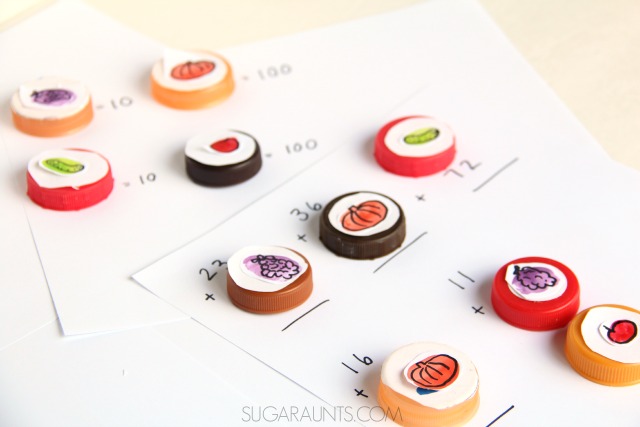
Adding digits while lining up the tens and hundreds column is a little tricky for some kids.  This activity was a way to help with that and make it a little fun with a harvest theme.


I made a code for my second grader to figure out.  Each fingerprint fruit or vegetable equaled either 10 or 100.  We then chose numbers to add to the pumpkins, tomatoes, grapes, squash, and pickles.


Adding tens and hundreds this way made it a little more fun to practice mental math!


NOTE: I wasn’t able to get any pictures of my second grader doing this activity because of the dark light we’ve got after 4:30 pm.  Fall means yummy harvest fruits and vegetables and gorgeous colored leaves…but it also means darkness at 5:00 pm!  Yuck!


Looking for more HARVEST themed activities for your second grader?   Try these from the 2nd Grade Blogger Team:

 
Harvest Vegetable Soup from Crafty Kids at Home


Saving Seeds Science from Rainy Day Mum
Scarecrow Glyphs Patterns from Still Playing School


We love creative math activities!  Here are some of our favorites: 


Make Your Own Pick-Up Sticks and Work on Developmental Skills

Do you ever look around the house and think, “Why do we have so many toys??!!” 
 
If your house is like mine, your kids play with couch cushions, old cardboard boxes, and piles of paper, and cardboard tubes waaaay more than they play with toys.  Sometimes, it’s the simple things that are just more fun.

DIY Pick Up Sticks

 
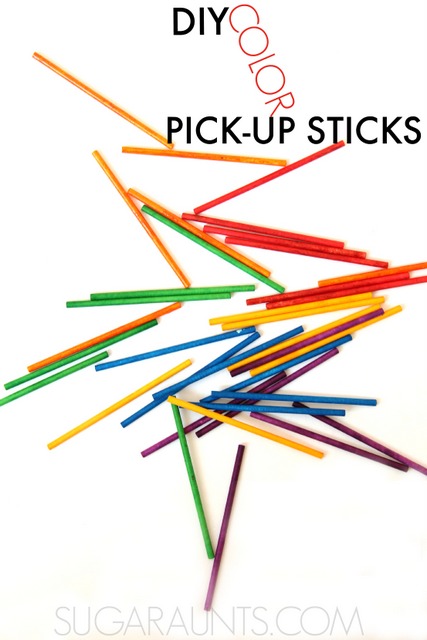
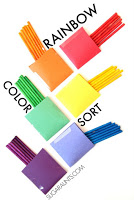
These DIY Pick-Up Sticks are one of those items.  It’s a homemade toy that is just so simple, it’s simply appealing.  Not only are these bright and colorful pick-up sticks fun, they are easy to make, and are used in so many play and functional skill areas. 


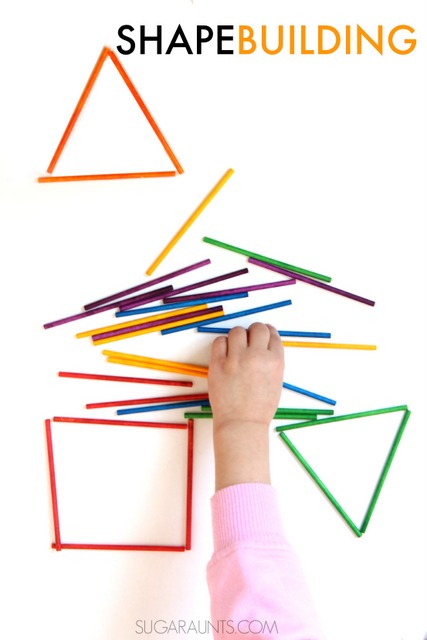
DIY pick up sticks for kids (and adults!) You can make these any color and using items you probably already have at home, while working on fine motor skills like open web space, pincer grasp, precision grasp and release, in-hand manipulation, and visual perceptual motor skills like eye-hand coordination, visual motor, visual scanning, and visual memory.
 
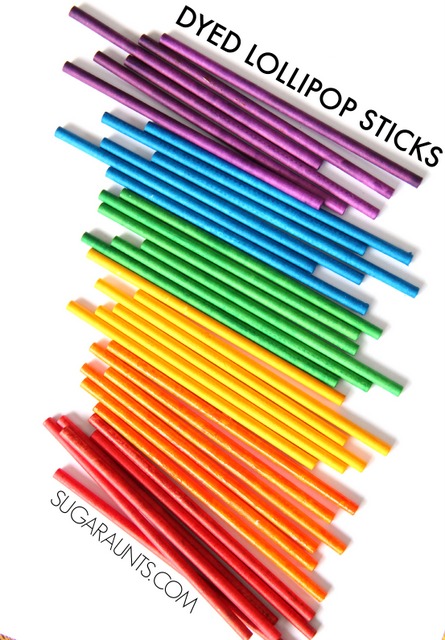
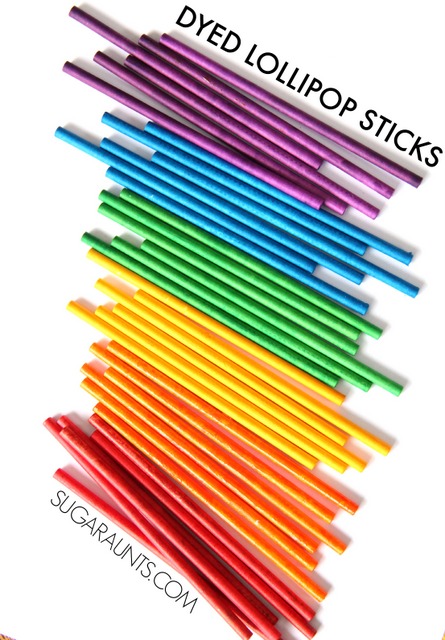
Making these colorful pick-up sticks is easy peasy.  Read how we made them here.  Do you know what we used to make them?  Lollipop sticks.  Yep!  A simple lollipop stick is the perfect accessory to play dough, the ultimate letter building tool, counting manipulative, fine motor workout, and a fabulous visual motor item.
 
Today, you’ll see how we use them to play pick-up sticks.
 

How do you play Pick-Up Sticks?

It is super easy to play pick-up sticks.  Dump the sticks out on a table.  Attempt to pick up a stick without moving any other stick.  You can slide, pull, tug, or wiggle a stick, but you can not move any other stick.  If another stick moves, your turn is over.  The player with the most sticks at the end of the game winds.  
 

Skills worked on when playing pick-up sticks:

Ohhh, this is an Occupational Therapist’s dream tool.  If you know an OT, he or she probably has a set of pick-up sticks in her treatment bag or clinic supply closet.  There are so many skill areas worked on while playing pick-up sticks!
 
  • Hand-Eye Coordination
  • Visual Scanning Visually scan the pile and each player can pick up only one or two certain colors to make the game harder.
  • Visual Motor
  • Pincer Grasp is encouraged by picking up the sticks.  Children need a pincer grasp for managing items like zippers, buttons, and snaps.
  • Color recognition
  • Precision grasp and release is a needed skill for fine motor tasks and manipulating small items.
  • Open Web Space Picking up the sticks encourages an open space between the thumb and pointer finger, needed for handwriting.
  • Figure Ground
  • Spatial Relations
  • Visual Discrimination

If your child loves playing Pick-Up sticks, try these modifications and ideas:

Affiliate links are included.

  1. Play with Pipe Cleaners.  The fuzzy, bendable sticks make dexterity more difficult.  Don’t move any other pipe cleaners!
  2. Play with Glow Sticks.
    for a glow in the dark game of pick-up sticks.
  3. Try this set
    for a gift idea.
  4. This Melissa & Doug Suspend
    game builds sticks upward for a unique twist on the game of pick-up sticks. 
  5. Younger kids will love this Play Visions Pick Up Snakes
    with flexible snakes instead of sticks.
  6. Children that need a challenge will love this Playroom Entertainment Catch a Falling Star
    that is on a vertical plane. This game really works on the precision of grasp and release while encouraging an extended wrist. It’s an OT winner! 
  7. For more precision and fine motor fun, try Ker Plunk Game.
Make your own pick-up sticks with this DIY toy idea for kids.  There is so much leaning and developmental areas that you can work on with this simple idea: fine motor, dexterity, hand-eye coordination, open web space, precision of grasp and release, visual perceptual skills, and so many more ways!  Your Occupational Therapist will love this!


You will love to use your DIY Pick-Up Sticks like this:

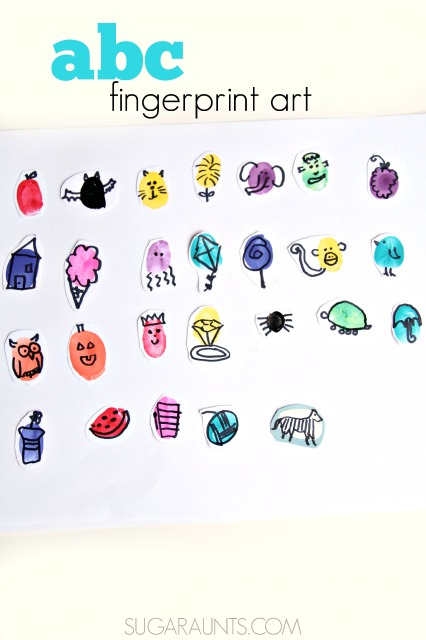
Fingerprint Art from A-Z Fine Motor Finger Isolation

Fine motor fingerprints to help with finger isolation and dexterity in kids
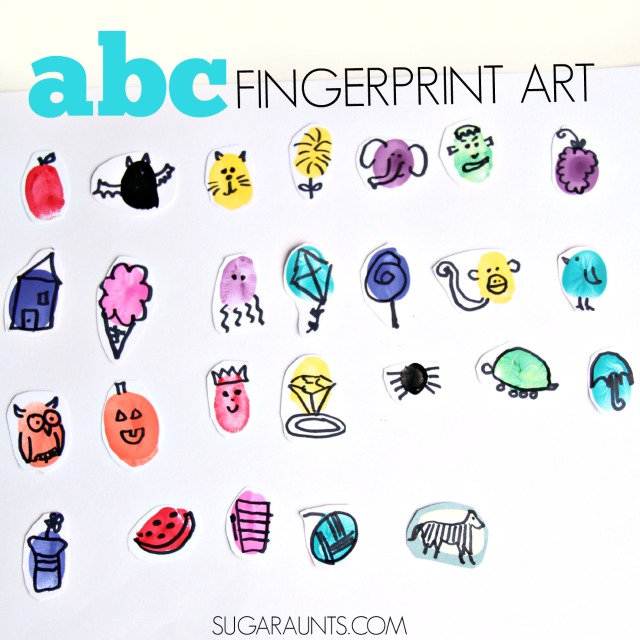
Fingerprint art is a fine motor powerhouse.  These cute little Letter of the Week Alphabet finger print crafts don’t really show how many fine motor skills are bring addressed!
 
Four kids in eight years make a lot of fingerprints. Fingerprints on the fridge, fingerprints on the sink, and fingerprints on the windows.  Then, there are the bins of artwork that I’ve got saved in the attic.  We all have a couple of those bins of memories that a mama has got to save.  The fingerprint and handprint Mother’s Day gifts, preschool crafts, and memorabilia.
 
As an Occupational Therapist who spent years working with kids, I can now practice the finger isolation needed in fine motor skills with my own kids, while creating fun artwork!
 
Finger isolation activities and fingerprint fine motor activities for kids to work on developing fine motor skills needed in functional tasks like handwriting, playing instruments, shoe tying, and typing.
 
This post contains affiliate links.  
 
It is not only fin to make fingerprint artwork, but educational too.  Use fingerprints in fine motor patterns, addition, multiplication, and so many more ways…all while working on finger isolation.


What is Finger Isolation? 

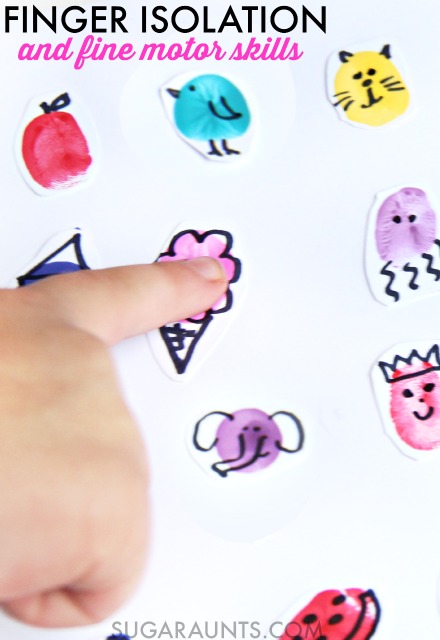
Finger isolation is using one finger to perform a task.  Pointing with the index finger, wiggling all of the fingers individually, and counting out the fingers on your hand are finger isolation.  This finger isolation is needed for many functional activities, like dexterity in managing pencils, paintbrushes, and other tools, typing on a keyboard, tying shoes, and many other skills.
 
 
Fine Motor Fingerprints
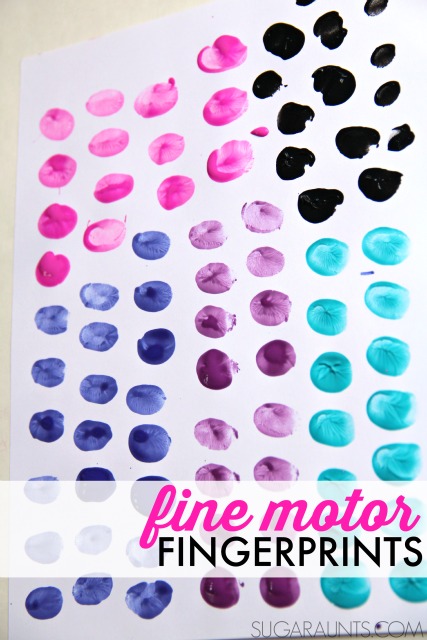
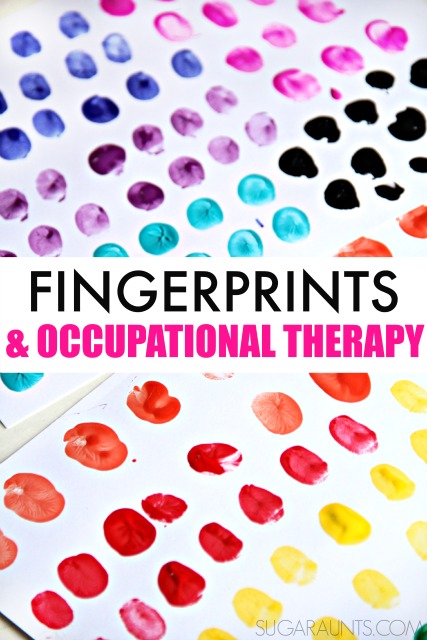
Many Occupational Therapists suggest fingerprint activities to their students for the fine motor benefits that the simple task allows.  To create a fingerprint, a child needs to isolate one finger and bend  (flex) the rest of the fingers into a fist.  This is refinement from the fisted hand and “raking” motion that babies and young toddlers demonstrate.  To create a fingerprint, the ulnar (pinkie side of the hand) are stabilized with the pinkie and ring fingers bent into the palm, or are positioned with the pinkie finger extended and abducted (spread apart). 
This positioning allows the knuckle joints (metacarpals) to stabilize and allow the pointer and middle fingers to be used with more control. The separation of the radial and ulnar sides of the hand allows for more skilled fine motor manipulation.
 
So, how can you use fingerprints in activities? 
  • Use fingerprints like you would a dobber.
  • Fingerprint math patterns.
  • Fingerprint pointillism art.
  • Draw circles and ask your child to add their fingerprints to each circle.
  • Fingerprint onto sight words, spelling words, or vocabulary words.
 
Finger isolation activities and fingerprint fine motor activities for kids to work on developing fine motor skills needed in functional tasks like handwriting, playing instruments, shoe tying, and typing.


Finger Isolation Activities to Improve Fine Motor Dexterity:

Try these fine motor activities to work on finger isolation:
  • Fingerprints!  Make a whole alphabet of fingerprint artwork, using the guide below.  These are perfect for letter of the week letter learning or for just creating a A-Z art with fingerprints.  Each fingerprint represents a letter of the alphabet.  Simply show your child how to print in different colored paints.  When the paint dries, use a black permanent marker to add details.
Finger isolation activities and fingerprint fine motor activities for kids to work on developing fine motor skills needed in functional tasks like handwriting, playing instruments, shoe tying, and typing.


More Finger Isolation Activities

    • Squeeze a spray bottle using just one or two fingers.
    • Spin coins on their edges.
    • Roll small balls of play dough between the thumb and index finger.  Repeat between the thumb-middle finger and thumb-ring finger.
    • Try sign language.
    • Play finger games like “Where is Thumbkin” and “Itsy Bitsy Spider”.
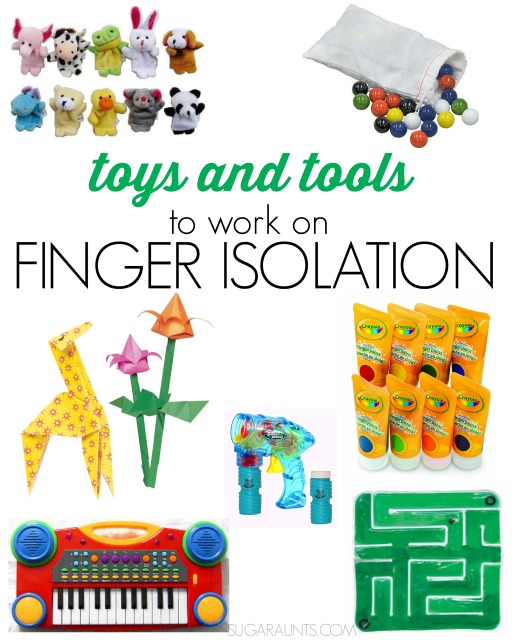
    • Shoot Marbles .
    • Finger pattern games.  Ask your child to rest their fingers on the edge of a table.  They can copy your hands as you lift individual fingers, separate, bend, and tap your fingers in patterns.  Ask them to copy using both hands at the same time, then work to copying patterns with just one hand at a time.
    • Play paper football.
    • Finger Puppets allow kids to imagine and pretend while working on finger dexterity and movement of individual fingers in isolation of others. This is a great precursor to typing. Play with these puppets as a hand warm-up before working on keyboarding tasks.
    • Finger Painting This is a sensory and messy texture and wonderful for sensory feedback while working on finger isolation.
Fold Origami
Squeeze a Bubble gun
and pop the bubbles between fingers.
  • Practice tying knots and shoe tying.
  • Play a keyboard
  • Play mazes with the fingers. This Sensory Gel Maze
    is perfect for finger isolation.
  • Pick up stick games
  • Screw/Unscrew bottles, lids, nuts, and bolts
Toy ideas for working on finger isolation Occupational Therapy tips
 
Finger isolation activities and fingerprint fine motor activities for kids to work on developing fine motor skills needed in functional tasks like handwriting, playing instruments, shoe tying, and typing.
Use the activities in this post to work on the skills needed for so many fine motor tasks.  Hopefully, you don’t end up with too many more fingerprints on the windows with all of this finger isolation practice!
Finger isolation activities and fingerprint fine motor activities for kids to work on developing fine motor skills needed in functional tasks like handwriting, playing instruments, shoe tying, and typing.
Did you like this post?  Share it on Facebook!
 
This post is part of our 31 Days of Occupational Therapy series.  You can find more creative fine motor activities here:

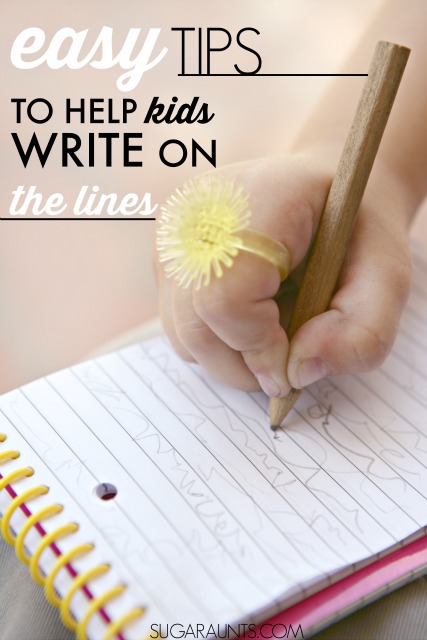
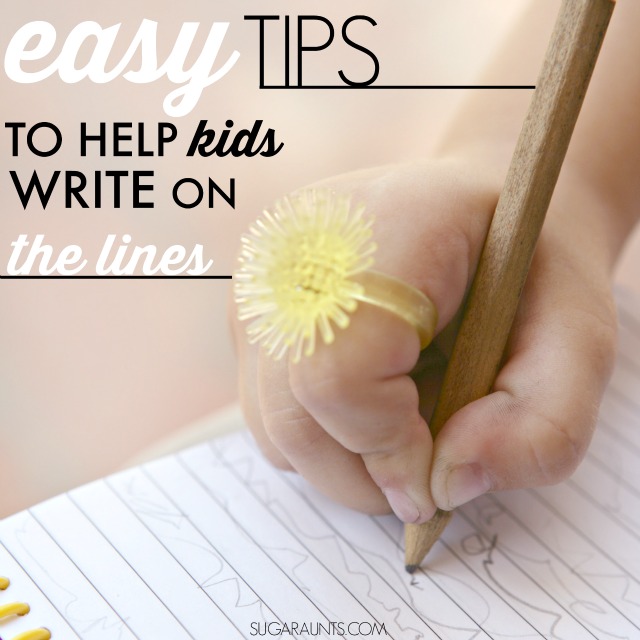
Easy Tips to Help Kids Write On the Lines

Today’s blog post is all about helping kids with writing on the lines (and coloring in the lines!)  You know those pesky places we are told to write and color to keep our papers neat and legible.  As adults, it’s typically an automatic thing to write on the lines.  But for kids who are just learning to write on lines, write longer strings of letters, and sit in one place when what they really feel like doing is wiggling and singing at the top of their lungs…writing on lines is HARD!  I’ve got easy tips to help with writing on lines until it becomes more of, “Oh, so the letters are always that tall and have to rest ON the lines!” automatic writing.
Tips for helping kids to write on the lines in handwriting problems. Ideas to help kids with sloppy handwriting from an Occupational Therapist.


Tips and Ways to Help Kids Write on the Lines

We’ve all been there.  You start filling out a form and misjudge the amount of space you have to fill in the info and you run out of space.  Then you start writing in the area above the line to try to get all of the important stuff in there.  Then, you notice that your form looks more like a Kindergarten kiddo who’s just started writing on lined worksheets.  The letters sort of float in places and sink down below the lines in others.  It happens.  And when a child is introduced to letter formation, letter size, and lines, it can get a little messy.  But, sometimes poor handwriting will extend beyond the kindergarten years and small-spaced-forms.  Kids with visual perceptual difficulties will have even more frustration as they try to keep their letters neat and on the lines.  

Some typical handwriting problems you might see include:
  • Floating letters
  • Letters sinking down below the lines
  • Letters written in all the same sizes.
  • Letters with various size (a lower case letter is the same size as an upper case letter).
So how can you work on these areas with your kids?  And, how can you help your child write on the lines in fun and stress-free ways?  Raise your hand if you’ve got a kiddo who despises writing.   Try some of the ideas below for creative help in the line writing area.


Handwriting Tips: Writing on the Lines

(Affiliate links are included in this post.)
  • Highlight the line with a marker.  A bright color can be a visual cue of where to write.  Letters should rest on the line.  You can start with a nice thick and brightly colored highlighter like this one and move to a thinner pen like these ones. Sometimes the visual cue of that bright line is enough to keep letters placed correctly.
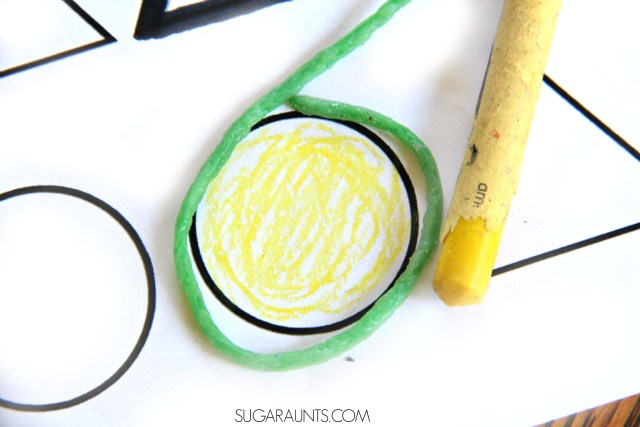
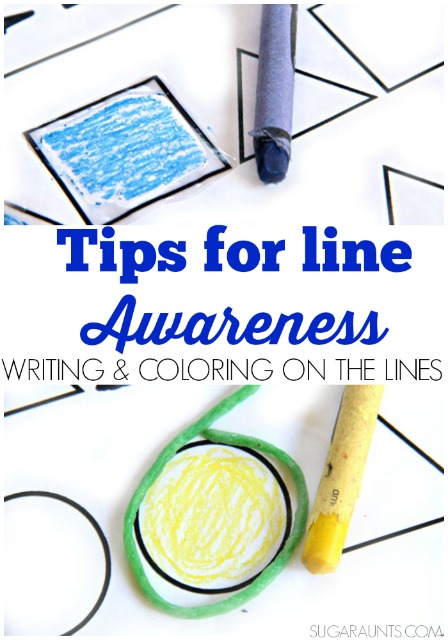
  • What if the bright fluorescent color is too much for your child?  Or if your kiddo needs a bolder line with more contrast?  Try underlining the writing lines with a black marker.  This is also a great way to keep coloring in the lines.  Simply outline the shape with a black marker for a visual prompt.
  • Match the size of your child’s writing with the size of the lined paper.  Most Kindergarten aged kids are given a bottom base line for worksheets and one inch lined paper for handwriting practice.  This size typically continues throughout first grade.  Second graders are typically required to write their letters one space tall and gradually work down to 3/8 inch sized paper in grades 4 and 5. Typically, kids develop more accurate fine motor skills and improved dexterity in pencil control so the smaller size is appropriate for smaller handwriting.
   Tips for helping kids to write on the lines in handwriting problems. Ideas to help kids with sloppy handwriting from an Occupational Therapist.
                                                 
                                                 Move and bend those borders.
  • Use a tactile border like WIKKI STIX.  This works for coloring and handwriting tasks by providing a movable, physical border.
  • For children learning to form letters and working on letters sized one inch and two spaces high, create names for the lines.  You can use “dirt” for letters containing tails (y, j, g), grass for for the midline (a, e, o, r), and sky for tall letters (t, f, l).  Use the terms consistently and when working on letter formation.  You can say, “Letter t starts up in the sky and drops down to the grass.  But it doesn’t go into the dirt!”)
  • Draw pictures of these terms on the lines.  Draw grass and clouds at the start of the lined paper.  Other ideas are shoe line/belt line/hat line, or basement/first floor/upstairs lines.
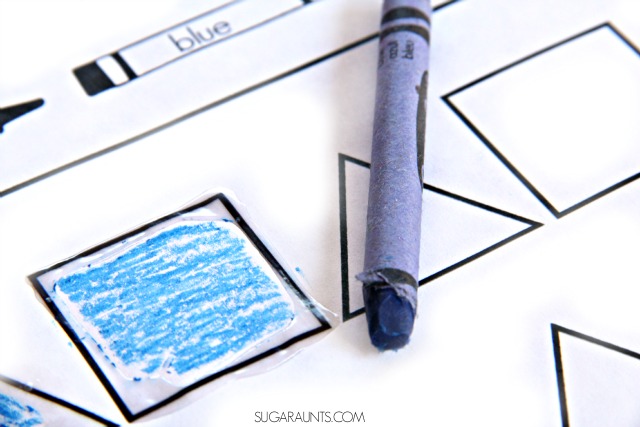
  • Try Raised Lines Paper  or make your own using glue.  Simply trace the lines with glue and allow it to dry.  The dry glue provides a nice tactile reminder of where to stop writing or coloring.
Tips for helping kids to write on the lines in handwriting problems. Ideas to help kids with sloppy handwriting from an Occupational Therapist.
Raised lines with dry glue.  It’s easy and fun. Try it!

  • For kids that show a great deal of difficulty with writing in a given space, use a stencil made from a thing cardboard like a recycled cereal box.  Cut out a rectangle and place it over the given writing space.  This will help to remove distractions of the rest of the page and proved a designated space to write within.
Tips for helping kids to write on the lines in handwriting problems. Ideas to help kids with sloppy handwriting from an Occupational Therapist.
Love this post?  Share it!  

Looking for more handwriting tips and tools?  You will find a bunch over on our Handwriting Pinterest board.  We’ve also go these ideas you will love:

http://www.sugaraunts.com/2015/10/visual-tracking-tips-and-tools-for.html 

What is Visual Spacing
Visual Tracking Tips and Tools
Handwriting Spacing Tool and Spatial Awareness Tips and Tools