Child in therapy? Start Here

Have a child in therapy? This resource for parents of kids in occupational therapy is a great starting point for OT resources parents need.

Understanding therapy for kids can be overwhelming for the parents. Now especially, with distancing requirements, hybrid learning, or teletherapy, occupational therapy services might look different than you expected. Let’s break down pediatric occupational therapy so your questions and concerns are answered and the overwhelm dissipates a little. If you have a need for some sort of child therapy, then you are in the right place.

Ok, so you’ve received a recommendation to have your child screened or evaluated by occupational therapy. So what next? What does that mean? When there is an apparent need to take your child to therapy, it can be helpful to know what to expect. You might have a lot of questions about getting started with your child in therapy. I want to create a space where your questions are answered when it comes to occupational therapy. So, sit back, relax, and read on…
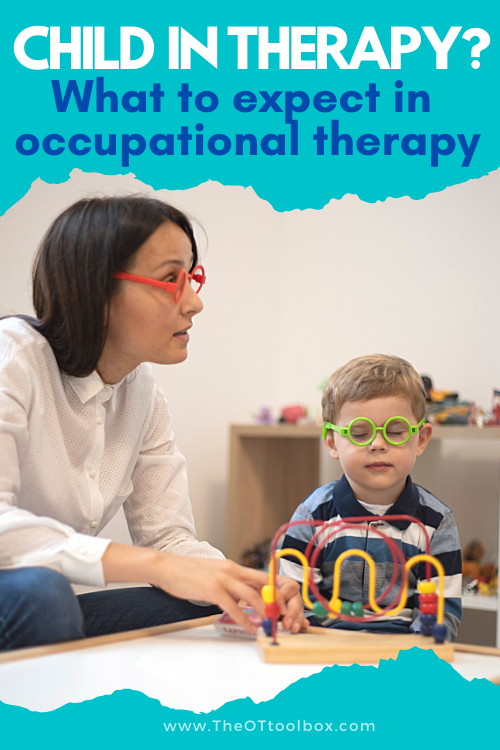
Have a child in therapy? This resource for parents of kids in occupational therapy is a great starting point for OT resources parents need.

What is occupational therapy?

Occupational therapy is a service that helps people achieve function and independence in the things that are important to them…in the things that occupy one’s day. OTs do this by offering adaptations, modifications, and by addressing underlying factors that impact independence.

Let’s take it a step further; Think about what you do in a single day: getting out of bed, brushing your teeth, getting dressed, making the bed, making and eating breakfast, getting out the door on time and with everything you need for the day, doing your job at work and everything that entails, driving, shopping for groceries, setting the table, balancing your checkbook. This list could go on and on and on!

All of these skills are your daily occupations, or things that occupational therapists can help one accomplish so they are as independent and functional as possible. But there’s more to it than just the daily tasks. There’s also the ability to physically accomplish these jobs. There’s the ability to staying focused on the task at hand, prioritize what’s important, and to stay organized. There’s safety and higher level thinking involved. There’s tolerance to one’s senses and the world around you. There’s balance, vision, coordination, and endurance involved. Essentially, every system in your body needs to be working optimally so that you can be as functional as possible during each and every task that you accomplish during the day.

Kids in therapy can accomplish so much! Occupational therapy works on all of these things!
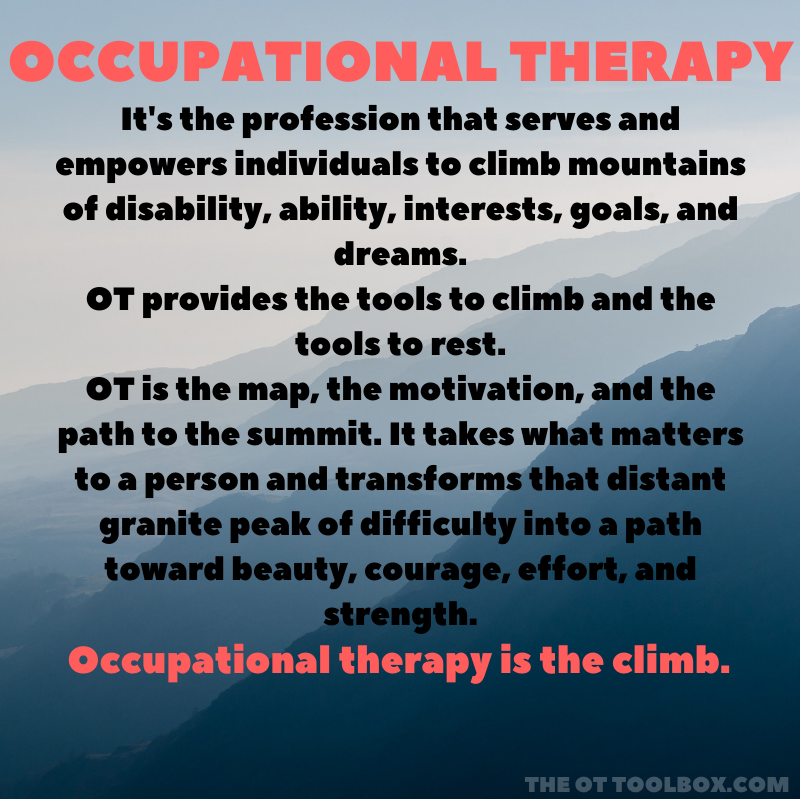
Occupational therapy is the climb quote.

What do occupational therapists work on with kids?

Occupational therapists can work on many different things with kids.

Occupational Therapy In Schools:

  • Any need that impacts education or learning
  • Fine motor skills
  • Cutting with scissors
  • Handwriting
  • Assistive technology to improve education or learning
  • Managing containers in the lunch room
  • Keyboarding or typing as an accommodation to learning
  • Sensory needs that impact education
  • Staying organized
  • Cognitive processing
  • Attention
  • Visual processing
  • Executive functioning
  • Motor abilities
  • Self-regulation
  • Participation in the classroom

Occupational therapy In the Home or Outpatient Settings:

  • Play
  • Self-care skills- getting dressed, grooming, bathing, caring for oneself and the tasks associated with self-care
  • Leisure activities
  • Sleep
  • Toileting and potty training
  • Safety in the community
  • Feeding and oral motor skills
  • Addressing food texture issues or picky eating
  • Sensory processing
  • Self-regulation
  • Emotional-regulation
  • Social participation
  • Executive functioning skills- organization, attention, working memory, planning, prioritization, impulse control, and other skills
  • Fine and gross motor skills
  • Eye-hand coordination
  • Balance and gross motor coordination

Occupational therapy can also work with children in early intervention or birth though 3 years of age on development of skills. This can occur as a result of a disability or difficulty in developing certain skills. Still other aspects of care can be related to autism, sensory integration needs, mental health, and specific diagnoses.

Who Needs occupational therapy?

The above lists might help explain the question of who OTs service, but it can be helpful to have a list of those who benefit from occupational therapy. This diagnosis list should give you a starting point, but know that OT works with anyone struggling to achieve functional skills or independence in an aspect of any task! This page is referring to pediatric occupational therapy interventions.

  • Autism Spectrum, Asperger’s syndrome
  • Sensory processing disorders
  • Auditory processing disorders
  • Visual processing impairments
  • PANDAs
  • Birth injuries or birth defects
  • ADHD/ADD
  • Behavioral or mental health impairments
  • Visually impaired
  • Traumatic injuries to the brain or spinal cord
  • Traumatic injuries to the body- amputation’s, etc.
  • Learning disabilities or learning problems
  • Developmental delays
  • Brachial plexus injuries
  • Down Syndrome
  • Rett’s Syndrome
  • Spina Bifida
  • Cerebral palsy
  • Childhood stroke
  • Pediatric rheumatoid arthritis
  • Cognitive disorders
  • Broken bones, injuries, surgical impairments, or other orthopedic injuries
  • Post-surgical impairments or conditions
  • Motor or coordination impairments
  • MUCH, much more!

How does occupational therapy work?

When it comes to occupational therapy, one thing is for certain. There are no two treatment plans that are alike. That’s because OT is so specialized! What is important for one child may be goals for them in occupational therapy while another child with similar needs will have completely different goals to address.

Parents can work closely with occupational therapists and occupational therapy assistants to implement strategies and home programs in the home.

Identifying specific needs and progress toward goals requires contact between parents, caregivers, and the occupational therapist professional.

Many times, OTs work with the family as a whole to address challenges faced by the family of a child with needs.

In most states, occupational therapists require a doctor’s order in order to administer evaluation and intervention services. In the schools, typically, the child’s educational recommends a need for occupational therapy evaluation.

How will my child receive teletherapy?

If your child has received occupational therapy services in the past, you might be wondering how teletherapy works. Or, maybe your child is new to therapy and the thought of having a child in therapy via a computer screen seems impossible. You have valid concerns! Occupational therapy is very much centered on hands-on interaction with the therapist who strives to help your child build skills and accommodate for adjustments needed in positioning, motor skills, etc. and that service is very much an in-person skilled service.

Ask any occupational therapist and they will say they WANT to be face-to-face with your child, physically playing with your sweet kiddo, and interactiving in a hands-on ways.

However, occupational therapists are skilled at problem solving, adjusting to needs and the environment, and pivoting on a dime. OTs have got the requirements of social distancing as a result of a global pandemic in the bag!

Therapists are excelling at providing fun, engaging, and skill-building services through digital, virtual therapy, and through motivating and encouraging hybrid versions of therapy that needs to be done during these strange times.

Teletherapy is just one more hat that occupational therapists have had to wear and they are excelling at it! Here is more information on teletherapy and what it looks like.

How to Explain Occupational Therapy to a Child

Starting occupational therapy (OT) can feel like a big unknown, not only for kids, but for parents, too. One of the first questions many families have is: How do I explain occupational therapy to my child in a way that makes sense, and doesn’t feel scary? If you’re wondering where to begin, you’re not alone.

Occupational therapy for kids is all about helping them do the things they need and want to do in daily life, from brushing teeth to holding a pencil, from joining recess games with peers to managing big emotions. OT helps kids build the skills they need for success in daily activities, school tasks, and social participation.

Here’s how to explain it in kid-friendly terms:

“Your OT helps you get better at things that are tricky for you. They do this through games, crafts, obstacle courses, and sometimes even using swings or tools that make your muscles stronger. It’s kind of like having a helper-coach who makes hard things easier, and a lot of fun, too!”

What Is Occupational Therapy for Kids?

When parents ask “What is OT for kids?” the short answer is: OT helps children become more independent in their daily activities, also called activities of daily living (ADLs). These may include getting dressed, using utensils, writing at school, or following instructions in a classroom.

Children might see an occupational therapist if they struggle with:

  • Sensory overload in busy environments
  • Trouble with fine motor skills (like holding a pencil or tying shoes)
  • Delays in gross motor skills, like balance and coordination
  • Difficulties with social skills, emotional regulation, or attention
  • Using adaptive equipment or tools that support independence

In a typical OT session, your child might climb through an obstacle course, squeeze putty to build hand strength, or practice zipping their coat. An OT session is often play-based, but every part is working toward a goal outlined in your child’s treatment plan.

What Does an Occupational Therapist Do for a Child?

An occupational therapist (or OTD, if they hold a doctorate) helps children with different needs improve their ability to participate in their daily lives. OTs evaluate how your child plays, learns, moves, and connects with others, and then create a plan to support skill development across those areas.

Here are some things an OT might help with:

  • Using utensils at lunch
  • Putting on socks or managing fasteners
  • Writing neatly and following classroom instructions
  • Playing with peers and navigating social interactions
  • Managing textures, sensory input, or emotions

An OT may work in different settings, like a school environment, home, or OT clinic, and may collaborate with other providers like physical therapists, teachers, and speech-language pathologists to support your child’s quality of life.

What Should Parents Expect from OT for Their Child?

Parents play a huge role in the success of OT for kids. Whether your child receives OT services at school or in a clinic, you can expect collaboration, check-ins, and ideas to carry over into home routines.

Here’s what to expect:

  • A treatment plan based on your child’s strengths and challenges
  • A blend of structured tasks and play-based activities
  • Support for tasks like getting dressed, focusing during class, or calming down after a meltdown
  • Strategies for siblings, family routines, or school tasks

You may notice changes in your child’s confidence, independence, and even how they interact with siblings or new people. OT is designed to support the whole child, emotionally, socially, and physically.

How to Help Your Child Feel Comfortable with OT

Starting something new can cause anxiety for some children, especially if they’ve struggled in other settings. Here are some ways to ease that transition:

  • Explain OT in positive, simple terms: “It’s a place where you get to work on things you want to be better at, with fun games and friendly helpers.”
  • Practice visiting the OT clinic or look at photos of what it looks like
  • Role-play the first session so your child knows what to expect
  • Involve siblings or peers in supportive conversations
  • Let your child bring a comfort item if they feel nervous (like a fidget or stuffed animal)

OT Is a Team Effort

Every child deserves support that meets their unique needs, and that’s what occupational therapy for kids is all about. Whether your child is working on handwriting, managing emotions, or tolerating textures, OT helps build a foundation that supports success across their day.

If you’re starting this journey, know that collaboration between your family, the OT, teachers, and the school team will be key. And most importantly, OT is often a place where your child will feel seen, supported, and celebrated, while having a lot of fun along the way.

Frequently Asked Questions About Explaining Occupational Therapy to Kids

What is occupational therapy in simple terms?
Occupational therapy helps people do everyday things more easily. For kids, that might mean learning to hold a pencil, get dressed, follow directions, or feel calmer in busy places. OT helps children build skills so they can succeed at home, school, and play.

What is the best way to explain occupational therapy?
You can tell your child, “An occupational therapist helps you get better at things that are tricky, like using scissors, sitting still, or making friends. They do it with fun games and tools that help your body and brain work together.”

What is the definition of occupational therapy for kids?
Occupational therapy for kids is a health service that supports children’s development by improving how they move, think, feel, and take part in daily life. It addresses everything from fine motor skills to emotional regulation, attention, and independence.

How do you explain therapy to a child?
Try saying, “Therapy is a special time where someone helps you practice things that are hard. You’ll play games and do fun activities that make your muscles stronger, your thinking faster, and your feelings easier to handle.”

How do you describe occupational therapy to a child?
Say something like, “Your OT helps you learn new skills through play, art, movement, and fun tools. They’re like a coach who helps your body and brain work better together.”

What are age-appropriate ways to explain the evaluation process to kids?
You can say, “We’re going to meet someone who will play games and do fun activities with you to see what you’re really good at and what might be a little tricky. They want to learn how to help you feel stronger, calmer, and more confident.” For older kids, add: “It’s like a check-up for how your body and brain are working together.”

How do I prepare my child for OT?
Talk positively about the experience. Explain that OT is a fun and helpful place where they get to move, play, and try new things. You might say, “You’ll meet someone kind who helps kids practice things like getting dressed, using their hands, or staying focused.” Let them know you’ll be nearby and that it’s a safe, supportive space.

How to explain OT to a 4-year-old?
Use very simple language: “We’re going to see someone who helps kids get better at things like using their hands, staying calm, and having fun doing crafts or games.” Emphasize play and familiarity: “They have swings, toys, and games to help you grow strong and smart.”

How to explain therapy to a child?
Therapy helps your body and brain learn new things. Say, “Therapy is where you go to practice stuff that’s hard for you, like using scissors or tying your shoes. You’ll play, move, and do fun activities that help make those things easier.”

What does therapy mean for kids?
Therapy is a way to help kids feel better, learn new skills, and handle things that might feel hard. It might involve movement, games, crafts, or practicing everyday routines with a helper.

What is therapy in simple terms?
Therapy is when someone helps you get better at something. For kids, it often looks like playtime with a purpose, building strength, focus, or emotional skills in a fun and safe way.

How to explain treatment to a child?
You can say, “Treatment is something we do to help your body or brain feel stronger or work better. It might mean playing games, using cool tools, or learning ways to stay calm or move more easily.”

What is the main purpose of occupational therapy?
The main goal of occupational therapy is to help kids become more independent and successful in their daily lives. That means building the skills they need for school, home, play, and relationships, all while supporting their development in a personalized and engaging way.

Resources for parents of a child in therapy

Your child’s occupational therapist will be the biggest advocate on your child’s team. Use them as a resource! However, I wanted to offer resources here as well. These are great places to start when it comes to discovering tools, strategies, and specific activities that can help your child. I’ve had many parents of kids receiving therapy tell me that they’ve passed information and resources from this site onto their therapists. I’ve also had many therapists tell me that they’ve found this site because of a parent’s recommendation or request to work on specific areas of need. This is your starting space to find the resources and tools that will best serve your child.

Occupational Therapy Home ProgramsSTART HERE for activities to work on occupational therapy goals or specific skills at home, so kids can do the very activities that your child’s OT might suggest to supplement or support therapy services.

Executive Function Resources for Parents

Executive Functioning ResourcesSTART HERE for resources, activities, and strategies to address attention, impulse control, planning, prioritization, organization, problem solving, and other brain-related challenges that impact learning and accomplishing chores or daily tasks at home.

Fine Motor Resources for parents

Fine Motor SkillsSTART HERE for specific activities designed to help kids develop stronger hands so they can manipulate toys and clothing fasteners…or have enough endurance to color a picture without complaining their hands are tired…or have strong fingers that can hold the pencil so they can write neatly and so you can read their handwriting.

Occupations of Kids…resources for Parents to Help Kids Become More Independent

Occupations– START HERE to help your child build independence in their daily tasks like getting themselves dressed, tying their shoes, learning to type, potty training, staying safe in the community, and all of the exact ways that parents want their children to grow and learn.

HandwritingSTART HERE to understand what’s going on behind sloppy handwriting. You’ll find resources and specific strategies to help kids write on the lines, space between words, form letters accurately, learn cursive writing, so they can write independency and so you and others can read their writing.

Sensory Resources for parents

Sensory– START HERE to help your child manage their behaviors, emotions, and all things “sensory”. OTs help kids tolerate and accommodate for sensory input like that scratchy tag on their clothes or their hatred for the sock seam on their feet. They can help kids with the tools they need for picky eating, specific sounds, or other sensory issues. Therapists can help you create a sensory diet that works and that kids actually want to do. There is so much to sensory and you can find activities and tools to help.

Vision– START HERE for information on what’s going on behind trouble with reading, coordination troubles, or even math. Did you know that vision is related to all of these things? It’s true! Here, you’ll find your way on how to help your child with visual perceptual skills, visual motor skills, eye-hand coordination, and even motor planning! Wondering what these words even mean and how they relate to your kiddo? We’ve got you covered!

A final note to parents of a child in therapy

There is a lot to consider when it comes to occupational therapy for your child. One thing is for certain, though: in occupational therapy, dreams and that far-reaching goal does become possible. Whether it’s getting your child to follow morning routines, banishing picky eating, or helping your kiddo to regulate their emotions, occupational therapy can help.

Occupational therapists use play, activities, and strategies that address underlying areas so that your child can accomplish the goals they have for themselves, too. From learning to ride a bike, learning cartwheels, or mastering climbing that tree.

One thing is for certain; having a child in therapy that is led by an occupational therapist will lead to organizing, motivating, and fun play that drives independence in your child!

Be sure to reach out to your child’s occupational therapist with specific questions!

Colleen Beck, OTR/L has been an occupational therapist since 2000, working in school-based, hand therapy, outpatient peds, EI, and SNF. Colleen created The OT Toolbox to inspire therapists, teachers, and parents with easy and fun tools to help children thrive. Read her story about going from an OT making $3/hour (after paying for kids’ childcare) to a full-time OT resource creator for millions of readers. Want to collaborate? Send an email to contact@theottoolbox.com.

Middle School Occupational Therapy

middle school occupational therapy

Occupational therapy in middle school can bring about a lot of questions. When is OT appropriate for middle school students? What should OT focus on in middle school? And how can occupational therapy services support transition to middle school and further levels of education? This post will explore the tricky transition from elementary to middle school occupational therapy. We’ve previously covered occupational therapy for teens, but this article goes deeper into the middle school years.

Occupational therapy in middle school

Prior to the middle school years, occupational therapy in schools is pretty straight forward. In the younger grades, school based OT practitioners go into the school setting armed with playdough, scissors, pencils, crayons, glue, fidgets, and a few games/puzzles. 

What about the middle school occupational therapy population? These teenagers are not motivated by crayons, Candyland, letter formation exercises, or cut and paste activities.  Nor should they be. 

Unless your middle school caseload is in a self contained classroom functioning at a preschool level, these games and activities are not appropriate or practical.

One thing that comes up a lot at the middle school age is that we might need to use our creative thinking cap as OT practitioners. There might be a little push back from the middle school student. They think they are too old for the therapy session, especially if they had OT in primary school. You can find some strategies and our experience in supporting middle schoolers and tips for how to engage a resistant child in therapy.

Middle School Occupational Therapy 

Many therapists assist with transitions for children as their caseload moves from a direct to indirect, or consultative therapy model at this time, especially if they have been working with a particular student for several years.

Why? There are several valid reasons for doing so.  According to APEX occupational therapy, the primary reasons for transitioning to a consultative model are:

  • Teenagers are self conscious and do not care for a therapist coming into their general education classroom to sit by them, observe, or ask questions
  • Middle school schedules are busy.  Pulling a student for individual therapy weekly means they are missing valuable learning time
  • Handwriting habits are set and unlikely to change at this age.  Pencil grasp and letter formation skills are often formed by the age of eight, making adjustments in middle school difficult
  • Visual perceptual skills are often developed by age 11
  • Students do not want adaptations that make them stand out from their peers. They will resist noise cancellation headphones, a scribe for written notes, alternative seating, weighted items, or noticeable fidgets
  • Executive function – many middle schools already incorporate these skills into their program through schedules, planners, online classrooms, and reminders
  • Students at this age are most likely using technology to do much of their school work by this point, or accommodations have been made in their IEP already
  • Students have often been receiving services since early elementary school.  Changes are less likely to happen at this stage, if they have not already

Middle school occupational therapy is not a one size fits all model

There are several reasons to keep a student on a direct therapy service model during middle school:

  • Self contained students work at a different pace than their mainstreamed counterparts. They may continue to need more intervention
  • Lower level learners will need to be transitioning to a life skills or self help model, if they have not already. This means new objectives and goals to address
  • Middle schoolers are a different breed of people. There are new social expectations, hormonal changes, levels of independence, and increased demands for self help skills
  • It may take time to educate families and caregivers about this change in service model, and expectations. Automatically moving everyone to an indirect model, or discharging them, may be too abrupt for anxious parents or overwhelmed teachers

Barrier of Participation in therapy

One thing to consider in the role of occupational therapy in the middle school setting is the barrier of participation that occurs during the middle school years.

During school-based therapy in the younger school settings (early intervention, primary school years, elementary school years), students enjoy occupational therapy sessions. They are fun and exciting. Kids typically love to participate in therapy during these years.

In the middle school years, the school-based OT can start to see a barrier to participation that impact therapy sessions.

Barriers to participation in middle school occupational therapy can vary depending on individual circumstances and individual needs. These barriers can impact the middle school student’s goal achievement.

Specifically, middle schoolers may experience a social barrier to using the tools OT practitioners promote to support their needs.

The student might experience a social stigma and cultural barriers. surrounding their peers and the middle school culture. They may not want to participate in therapy sessions and this can impact the use of therapeutic supports.

Another barrier to participation in the middle school setting may be the issue of time constraints and scheduling conflicts. Middle school students participate in a full schedule, busy hallways, academic and activity commitments, and other responsibilities can make it challenging for students to participate in therapy sessions.

The Role of the middle school occupational therapist

Seruya and Ellen write about the Role of the Middle School Occupational Therapist.  They highlight several important factors or strategies to intervention.

  • Involve your learner in decision making about goals and objectives. These will be more meaningful and motivating to your students
  • Transition away from typical handwriting goals to more functional goals
  • Teach typing and word processing using a typing program
  • Provide adaptations if your learner is not able to complete work in an effective manner. A scribe to write notes for them, word processing versus written documentation, lessen the workload if writing is too labor intensive, preferential seating to improve attention
  • Address any lingering or new sensory concerns.  Provide adaptation for these with preferential seating, alternative seating, gum or fidgets for self regulation, ear plugs to reduce incoming sounds, and organizational tools
  • Address important life skills – learners need to know their emergency contact information, effectively groom themselves, take care of feminine hygiene issues, advocate for themselves, and follow a schedule
  • Some interventions may require private therapy to be more appropriate such as meal preparation, laundry, ordering from a menu, shopping, budgeting, or filling out an application. These would be appropriate goals for students in a self contained classroom
  • Incorporating brain breaks into a natural and functional movement needs. We talk about this more in our article on middle school brain breaks.

Some additional ways that occupational therapy can support students in grades 6, 7, and 8 include:

  • Working on organization, particularly when it comes to using different books, folders, and materials for each class
  • Managing a schedule with classroom changes, including hallway navigation and reading the schedule as well as sensory needs in a busy hallway
  • Lunch considerations-making meal selections, using money to purchase various meal options, and other mealtime considerations
  • Locker use including use of a combination lock, locker organization for obtaining needed materials for different times of day
  • Self-care including clothing management for gym class or swimming
  • Educate middle school teachers, parents, and other caregivers may not understand the role of the occupational therapist in middle school.  It may be time for a little education on the services provided and the therapeutic model. 
  • Empathy – reducing therapy minutes may feel like the student is not going to improve, or they are being given up on.  It is tough for parents to imagine their learner may never write a sentence, read independently, or live alone.  This is the time to gently begin this conversation.
  • Tool use including: rulers, protractors, calculators, graph paper, three ring binders, smaller desks, etc.
  • Social awareness and behavioral challenges as a result of sensory, self-regulation, or emotional needs
  • Changes in schedules, including bell ringing between classes, navigating between classrooms, short or lack of recess times, larger cafeteria, assemblies, etc.
  • Supporting sensory needs in the cafeteria due to the larger sized room and more students in the area
  • Collaborate with middle school teachers- work with educators and families to determine what are appropriate ADLs or functional goals and needs in the classroom, and how they can be addressed
  • Communicate with family of middle school students on appropriate occupational therapy goals and interventions.
  • Motivate middle school students- There may be a need for direct therapy intervention. Keep your students motivated with relevant and important treatment activities. 
  • Life skills in middle school occupational therapy- This may be the time to address life skills, depending on the needs of the student.  The OT Toolbox has a series of life skills posts including cooking, laundry, filling out forms, and social stories.
  • Keep goals and objectives focused on relevant and functional skills.
  • Educate staff and caregivers about the role of the OT in schools.
  • Provide resources, and make adaptations to the educational environment to help students better access their curriculum. 

Still working on handwriting in middle school occupational therapy?

There are times when therapists are called to continue to address handwriting in their middle school population.  Intervention needs to be functional, beyond basic letter formation. One tool is to use these middle school journal prompts to target handwriting skills, executive functioning skills, social emotional skills, and more.

Miss Jamie, a school based OT, has written a post about Addressing Handwriting in Middle Schoolers.  She has gone so far as to write a second post here.   One goal may be; this student will be able to independently write identifying information (name, address, phone number) without a model with 80% legibility. 

Or;  the student will be able to write or access information to fill out a form independently.  In The Member’s Club, we have several form practicing pages to work on the life skill of filling out forms.

Middle School Occupational Therapy Activities that Build Skills & Confidence

Middle school brings a whirlwind of changes: more complex academics, shifting social groups, growing independence, and rising expectations. Occupational therapy in middle school plays an essential role in helping students successfully navigate these challenges. OT supports students through both direct services and consultation with teachers, staff, and families. These middle school occupational therapy activities are designed to help students with disabilities, including autism, ADHD, and other learning differences stay engaged in daily activities and grow their independence.

As part of special education, OT is considered a related service, meaning it supports the educational goals identified by the IEP team. 

The role of OT at this level also often includes collaboration with other professionals, including occupational therapy assistants, teachers, and school counselors. Whether supporting mental health, developing organizational skills, or promoting social participation, the school OT helps students succeed in both academics and life skills. These strategies and recommendations are tailored to each student’s unique needs, goals, and disability profile.

Middle School OT Goals

These middle school OT goals target key areas often addressed in school-based services and can be adjusted depending on the student’s level of support. They’re designed to align with IEP objectives, classroom expectations, and real-world success.

Executive Functioning & Organizational Skills for Middle School OT

  • Student will use a planner to record assignments with 90% accuracy across 3 consecutive weeks.
  • Student will organize materials for each subject using a color-coded system or binder labels with visual prompts.
  • Student will initiate class routines (like unpacking, turning in homework) with fewer than 2 verbal cues per day.

These skills are especially important for students with ADHD or executive function challenges, and are often addressed through both direct and consultation-based OT services.

Self-Regulation & Mental Health for Middle School OT

  • Student will use a self-selected coping tool during transitions to remain calm in 4 out of 5 observed opportunities.
  • Student will identify emotional triggers and demonstrate appropriate regulation strategies in the classroom.
  • Student will participate in a sensory strategy routine to support emotional regulation and reduce stress during work tasks.

Many students with autism, sensory differences, or mental health challenges benefit from personalized routines that support their self-awareness and self-control in the school setting.

Fine Motor Skills, Writing & Daily Activities for Middle School OT

  • Student will demonstrate correct pencil grasp and maintain legibility during a 10-minute writing task.
  • Student will complete scissor-based assignments (cutting, folding) with accuracy in 3 out of 4 trials.
  • Student will complete locker organization or classroom prep tasks using checklists or visual cues.

Fine motor skill development directly supports academics, note-taking, and participation in school-based routines.

Visual Motor & Sensory Processing

  • Student will accurately complete copying tasks from the board or screen using appropriate spacing and alignment.
  • Student will participate in visual perceptual games or strategies to improve attention to detail in worksheets and tests.
  • Student will recognize sensory overload and use pre-taught calming strategies to re-engage in classwork.

These modifications often support visual processing, spatial awareness, and focus, especially important for students with sensory processing differences or visual stress.

Social Participation & Life Skills for Middle School OT

  • Student will participate in 1:1 or group-based activities to build peer interaction and conversation skills.
  • Student will follow social problem-solving steps with visual prompts during role-play or real scenarios.
  • Student will demonstrate responsibility for personal belongings (e.g., backpack, lunchbox, planner) with 80% independence.

These school OT goals promote confidence, peer connection, and independence—all crucial for the middle school years and beyond.

Frequently Asked Questions about Occupational Therapy in Middle School

Next, let’s cover some of the FAQ about occupational therapy in middle school.

What is the role of occupational therapy in middle school?

In middle school, occupational therapy (OT) supports students as they navigate increased academic demands, growing independence, and complex social expectations. 

The role of OT includes helping students participate in daily routines, improve organizational skills, develop executive functioning, and support emotional regulation. OT can address challenges related to handwriting, sensory needs, transitions between classes, or even managing materials like lockers and binders. Services may be delivered through direct OT sessions, consultation, or a collaborative approach with teachers and other school professionals.

Why would a child need occupational therapy in school?

A student may need occupational therapy in school if difficulties in areas like fine motor skills, attention, self-regulation, or sensory processing interfere with their ability to access the curriculum or participate in school routines. 

Students with autism, ADHD, or other disabilities may benefit from OT support. The IEP team, which includes special education staff and related service providers, determines eligibility and appropriate OT services based on the student’s educational needs—not just their diagnosis.

How do I move from 1:1 OT to a consultation model for middle school students?

Transitioning from 1:1 OT to a consultation model is common in middle school. This shift reflects the student’s growing independence and the increased need for support in natural classroom settings. To make this change:

  • Start by reviewing IEP goals and assessing progress.
  • Collaborate with the IEP team to determine readiness for consultation.
  • Set up a plan to fade direct services while increasing teacher support and classroom strategies.
  • Provide visual supports, checklists, and recommendations the student can use across their day.
    This model emphasizes real-time problem-solving, supports carryover of strategies, and encourages student self-advocacy.

What does an OT consult on with middle school teachers?

An OT consultation with middle school teachers might include:

  • Strategies for improving executive functioning (e.g., managing binders, using planners)
  • Classroom modifications for students with sensory processing needs
  • Tools to support handwriting and note-taking
  • Promoting self-regulation with movement breaks, sensory strategies, or calming routines
  • Helping students navigate transitions, such as changing classes or participating in group projects
  • Addressing mental health concerns with structured supports that build confidence
    Consultation ensures that strategies are integrated across classes and aligned with student goals.

How can OT help with self-regulation in middle school students?

Middle schoolers experience an explosion of emotional, cognitive, and physical changes, which can challenge self-regulation. 

Occupational therapy can support students by teaching sensory strategies, creating regulation toolkits, building awareness of emotions, and integrating movement or sensory activities into the day. 

OTs may also provide visual supports or check-in systems that help students recognize and respond to their internal states. This is especially helpful for students with ADHD, autism, or mental health diagnoses.

How does OT help with transition services in middle school settings?

OT plays an important role in transition planning, especially in the middle school years, when students begin preparing for high school and future independence. OT support may focus on:

  • Building daily living skills (e.g., organizing materials, self-advocacy)
  • Teaching self-determination and participation in IEP meetings
  • Supporting the development of routines at school and home
  • Collaborating with transition coordinators, special education teams, and related service providers
    By addressing barriers early, OT helps students build the foundational skills they’ll need for success in high school and beyond.

transition from elementary to middle school

Students that attend occupational therapy services in the elementary grades may move on through their school career with a continued need for occupational therapy support.

What can you do to help this transition to middle school occupational therapy? This article on AOTA covers transitions to middle school and includes ideas for groups in the middle school transition period.

Ideas include:

  • Consulting with various teachers throughout the day
  • Consult with parents
  • Meeting with students in a small group setting to cover transition issues that are similar for several students
  • Working with students in a group in life skills or support rooms for group therapy interventions.
  • Consulting with student aides (if the individual has this level of support)
  • Creating small groups as extracurricular activities to address areas such as social skills, emotional needs, worries, or intermural types of heavy work activity

Depending on the needs of the individual, therapy interventions for the above areas may move to a consult basis.

Working with middle schoolers can be challenging. They are suddenly big and somewhat awkward as they navigate the changes of adolescence. There is a lot more going on than just navigating a bigger school!

One last tip as an occupational therapy provider in the middle school setting: Try not to be in the hallways when they are transitioning between classes…it can be like walking through a stampede!

Victoria Wood, OTR/L is a contributor to The OT Toolbox and has been providing Occupational Therapy treatment in pediatrics for more than 25 years. She has practiced in hospital settings (inpatient, outpatient, NICU, PICU), school systems, and outpatient clinics in several states. She has treated hundreds of children with various sensory processing dysfunction in the areas of behavior, gross/fine motor skills, social skills and self-care. Ms. Wood has also been a featured speaker at seminars, webinars, and school staff development training. She is the author of Seeing your Home and Community with Sensory Eyes.

Handwriting Without Tears Letter Order

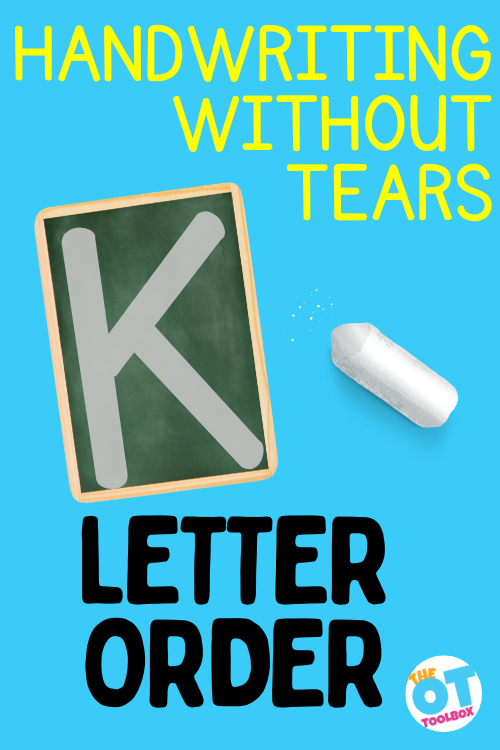
"Handwriting Without Tears letter order" with letter K on a chalkboard and a small piece of chalk

In this blog post, we’re covering Handwriting Without Tears letter order, or the specific order to teach letter formation based on the handwriting curriculum, Handwriting Without Tears (Learning Without Tears). We’ve previously covered the cursive HWT order so this is a nice resource to have on hand.

Have you noticed most teachers teach letters in alphabetical order? The first thing they teach is name writing, then writing the alphabet. This seems like a logical progression, but is not the most effective or efficient method. There are several different handwriting programs out there to address this important skill. Many of them do not teach letters in order.

One program specifically is; Handwriting without Tears (now called Learning without Tears). The Handwriting without Tears letter order is vastly different than writing letters in sequential order.

handwriting without tears letter order

The Handwriting without Tears program is popular among therapists for good reasons:

  • It’s a research-backed curriculum
  • The program is designed to be easy to teach and easy to learn
  • Developmentally appropriate sequence
  • It uses explicit instruction combined with guided practice
  • Promotes handwriting automaticity
  • Multisensory learning to support a variety of learning styles, including kinesthetic learners, visual learners, and auditory learners
  • Uses hands-on tools and activities in handwriting lessons
  • Uses intuitive lesson booklets to promote learning

According to the folks at Learning without Tears, “Pre-K–5 students move through a developmentally appropriate teaching order from capital, to lowercase, and cursive letters. This design helps children master handwriting skills in the easiest, most efficient way. Instead of teaching 52 letter symbols with a mishmash of different sizes, positions, and confusing starting places, we divide and conquer.”

what is handwriting without tears letter order?

If you have used the HWT program, you may have noticed the letters are not in sequential order. In other words, the Handwriting Without Tears program does not teach letter formation in order from A-Z.

This sounds counter intuitive, as students are generally taught letters in order. Child development skills, as found in the Peabody Developmental Motor Scales, demonstrates the visual motor progression of fine motor skills. We cover some of this in our post on drawing milestones.

When developing writing skills, pre-writing lines emerge. This begins when the stages start at scribbling, vertical and horizontal lines, then circular forms. After these are mastered, more difficult designs such as a cross, square, and triangle are developed.

Learners who are still mastering the basics of writing lines, do not have the necessary skills to form more complex designs such as the letter A which relies on diagonal lines, or B which requires semicircles. Students often get stuck at this stage if they are unable to form these letters.

The Handwriting without Tears letter order promotes success, focusing on letters that use the preliminary pre-writing strokes. This is why letters with straight lines are taught first and in a group, known as letter families.

HWT Letter Order Groups

The Handwriting Without Tears letter order progresses like this:

  1. L, F, E, H, T, I
  2. U, C, O, Q, G, S, J, D, P, B, R
  3. K, A, N, M, V, W, X, Y, Z

Handwriting Without Tears Straight Line Letters

The first letters are L, F, E, H, T, I. Notice all of these letters require only vertical and horizontal lines.

This is the first developmental skill mastered. Imagine the success of learning six letters right away, rather than struggling on A and B!

handwriting without tears Circular Letters

The second set of letters are circular: U, C, O, Q, G, S, J, D, P, B, R. The letters within each section progress in level of difficulty from U to R.

Notice that letter B is 16th on the list! This is vastly different than the traditional method of teaching it as letter number two.

While R, is a circular letter, it also contains a diagonal, which segues into the third uppercase letter formation group.

Grab our Letter B Worksheet for sensory motor practice to form the semicircles that make up this circular letter.

We also have a Letter C Worksheet for improving the circular motion of the pencil which carries over to other letters (Also known as magic c and is helpful for forming the lowercase letter counterparts).

Further down the list is letter D, and you can use our Letter D Worksheet to work on the straight line followed by a rotated semicircular motion that then carries over to the remaining letters with the same motor pattern: P, B, and R.

handwriting without tears Diagonal Letters

The third and final set of letters are the diagonals. Copying a triangle is one of the last basic shapes to learn as a developmental progression.

Forming diagonals is tricky. Not only are students crossing midline, they are doing so in a top to bottom fashion.

The letters in this series are: K, A, N, M, V, W, X, Y, Z. A is number 18 on the list. Now you can see why students struggle to learn the very first letters of the alphabet. They are not developmentally ready for this skill at the time we are insisting on teaching it.

Try using our Letter A Worksheet for sensory motor practice to form the diagonals and starting the letter in the middle.

Starting Position for handwriting without tears letters

An additional method HWT uses to group uppercase letters is their starting position. This is not my personal method of teaching, as I prefer the developmental sequence.

When focusing on the starting point for letters, Handwriting Without Tears groups the upper case letters into three catagories, depending on where the pencil starts:

  • Frog Jump Capital Letters – F, E, D, P, B, R, N, M
  • Corner Starting Capital Letters – H, K, L, U, V, W, X, Y, Z
  • Center Starting Capital Letters – C, O, Q, G, S, A, I, T, J

Take a look at the Frog Jump Capitals that start at the left corner (F, E, D, P, B, R, N, M). Notice several of these letters are more complex with diagonal lines. This can be a challenge for some students that struggle with the pre-writing lines, specifically diagonals. Additionally, this grouping of letters includes several different pencil stroke patterns, which can also be a challenge for some students.

Their second grouping is the starting corner capitals (H, K, L, U, V, W, X, Y, Z). This grouping of letters also includes a mix of straight line letters, diagonals, and curves.

Lastly, the center starters (C, O, Q, G, S, A, I, T, J) are addressed. Again, this group of letters includes more curved lines, but again, a mix of straight lines, curved lines, and diagonals. Notice how many of the last letters are commonly used letters. This is another reason why this particular HWT letter order might be a challenge for some.

uppercase or lowercase letter order first?

There has been some discussion on whether it is better to teach upper or lowercase letter formation first. We cover the developmental reasons in our linked blog post.

The research has been inconclusive, as there are benefits to both.

  • While lowercase letters are everywhere, capital letters are the first introduced in toddler books and puzzles.
  • Lowercase letters will be used much more than capital, but uppercase letters are much easier to form due to the simple straight lines.
  • There is no retracing or letters that sit below the line in uppercase letters
  • B/D are not as confusing as lowercase b and d when writing capital letters
  • When reading, many agree that teaching letter sounds is more important than their names, therefore teaching lowercase letter sounds first, may be more beneficial than teaching the letter names
  • Consider the age of your learners – preschooler should write uppercase first, as that is their developmental progression stage. Kindergarten and later students may be able to start in alphabetical order, however for delayed students, this can cause frustration

handwriting without tears lowercase letter order

For the same reason we teach uppercase letters in a progressive order, Handwriting without Tears lowercase letter order is important also. These letters are formed in developmental progression as with the uppercase.

  • Just like their capital letters – c, o, s, v, w, t (just like uppercase only lower cross)
  • Magic C – these high frequency letters (a, g, d) start with a magic “c”. This helps differentiate between b and d. While “q” is a “magic c” letter, it is taught later to avoid confusion with g
  • The rest of the vowels – u, i, e
  • Familiar from capitals – l, k, y, j
  • Diving letters – these letters dive down (p, r, n, m, h, b)
  • Tricky leftovers – f has a tricky start, letter q is taught here to avoid confusion with g, x and z are familiar but infrequently used
  • Once these are learned, I add another group: the drop down letters. These are the most difficult to write correctly as all of the other letters sit on the line. When I am teaching correct letter formation, j, g, p, q, y are stressed as their own group, after the others have been learned

cursive handwriting letter order

As with upper and lowercase letter formation, cursive letters are formed in groups. While HWT has their way of presenting the cursive letters, I prefer (Amazon affiliate link) “Loops and other Groups“.

This system groups the letters into the way they are formed. There are the clock climbers, kite strings, loop groups, then hills and valleys. Capital letters are taught last, as they are tricky and not used as frequently.

Here is an interesting post from the OT Toolbox about teaching cursive writing.

How to Teach Cursive Writing is another great resource.

Handwriting Without Tears Letter Order: Why It Matters for Young Writers

When teaching young children how to write, the Handwriting Without Tears letter order offers a thoughtful, developmental teaching order that sets students up for success. Instead of following the traditional A-Z sequence, this method begins with letters that are easiest to form (like L, F, E, H), and builds confidence with correct formation from the very beginning. This intentional capital teaching order is backed by research and clinical observation, helping kids avoid common challenges like reversals and handwriting fatigue.

As an occupational therapist, I’ve seen how this method supports literacy skills and improves alphabet knowledge in a way that’s functional and developmentally appropriate. The progression of letters aligns with how children gain motor control and visual-motor integration skills. This gives kids a way to learn with success and confidence.

Why the Handwriting Without Tears Letter Order Works

The beauty of this approach is that it focuses on multi-sensory writing experiences using hands-on materials like wood pieces, chalkboards, and the ever-popular mat. These tools offer multisensory activities that integrate touch, sight, and movement. This helps with creating a motor plan for developing both muscle memory and motor planning. By breaking letters into meaningful categories (such as “Frog Jump Capitals” or “Starting Corner Capitals”), the method helps children internalize consistent patterns of movement.

The result? Better posture, improved pencil grasp, and fewer instances of letter formation confusion or reversals. Kids develop strong muscle memory for correct formation, which leads to more automatic writing and fluent sentence construction down the road.

Letter Formation Strategies that Support Real Learning

Handwriting Without Tears activities also include rich vocabulary support, songs, and movement-based games. These reinforce learning while making it fun and meaningful. Using visual cues, auditory repetition, and tactile feedback all at once gives young writers multiple ways to engage with each letter. These letter formation strategies aren’t just good for OT sessions—they’re practical for classroom teachers, homeschoolers, and parents too.

The curriculum’s commitment to hands-on materials like magnetic boards, wooden letter pieces, and roll-a-dough letters ensures that instruction is rooted in movement and exploration, not just pencil-and-paper tasks. When we combine these tools with consistent routines, movement breaks, and guided support, we empower young writers to feel successful and build foundational literacy skills that last.

Frequently Asked Questions about Handwriting Without Tears

Why Handwriting Without Tears?
Handwriting Without Tears is a developmentally appropriate approach that breaks down handwriting into manageable, multisensory steps. It supports young children with letter formation strategies that are backed by research in motor development and learning. This program uses a developmental teaching order, hands-on materials, and movement-based learning to reduce frustration, avoid reversals, and build strong alphabet knowledge and literacy skills from the start.

What are corner starter letters?
Corner starter letters are capital letters that begin at the top left corner of the writing space or chalkboard. Examples include F, E, D, P, and B. These letters follow a consistent movement pattern, helping children learn correct formation with fewer motor planning challenges. Teaching these letters first reinforces a top-to-bottom, left-to-right writing habit, which is essential for fluent writing.

What are center starter letters?
Center starter letters begin in the middle of the top line or writing space. Examples include C, O, Q, and G. These letters often involve curves and circular movements, making them slightly more complex. Teaching these after corner starters allows children to develop the control and coordination needed for more advanced motor tasks.

Why teach letters in groups?
Teaching letters in developmentally appropriate groups (instead of alphabetical order) allows children to master foundational strokes and patterns before moving on to more complex shapes. We call these letter families. This strategy promotes correct formation, reinforces muscle memory, and supports multi-sensory writing by allowing for repetition and confidence-building. Grouped teaching also reduces the likelihood of reversals and helps build smoother transitions into writing words and sentences.

resources to support handwriting without tears letter order

Everyone is different, as are their learning styles. Ultimately the goal is success. Whether that means using the Handwriting Without Tears Letter Order, or another teaching method, whatever helps and motivates your student is the correct choice. Nothing we teach is one size fits all. That is what makes our job so exciting and dynamic!

Victoria Wood, OTR/L is a contributor to The OT Toolbox and has been providing Occupational Therapy treatment in pediatrics for more than 25 years. She has practiced in hospital settings (inpatient, outpatient, NICU, PICU), school systems, and outpatient clinics in several states. She has treated hundreds of children with various sensory processing dysfunction in the areas of behavior, gross/fine motor skills, social skills and self-care. Ms. Wood has also been a featured speaker at seminars, webinars, and school staff development training. She is the author of Seeing your Home and Community with Sensory Eyes.

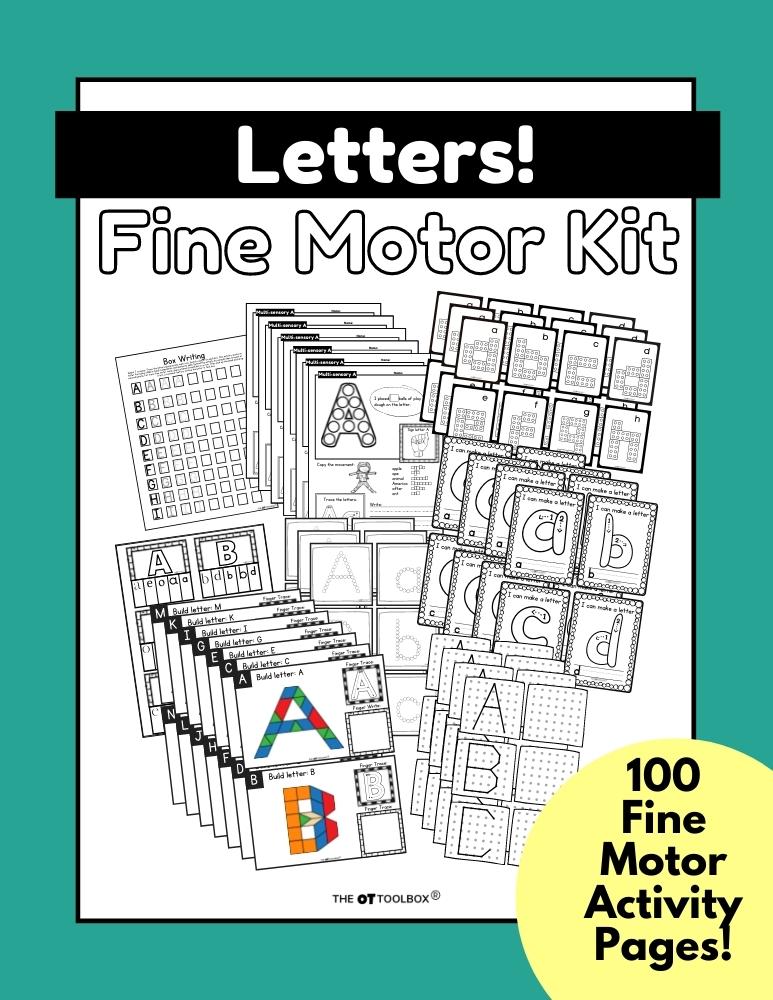
The Letters Fine Motor Kit is a supplement to any handwriting curriculum and uses hands-on, multisensory strategies to support letter formation.

Want printable handwriting and sensory motor activities to target the visual motor skills needed for letter writing? Grab a copy of our Letters! Fine Motor Kit. The printable PDF contains 100 pages of hands-on letter writing practice for multisensory handwriting!

Letters Fine Motor Kit

Inside the Letters Fine Motor Kit, you’ll find:

  • A-Z Multisensory Writing Pages: Roll a ball of dough letters, ASL sign language letters, gross motor movement, small-scale letter box writing task, finger isolation letter trace, and writing practice area
  • Alphabet Fine Motor Clip Cards– Clip clothespins or paper clips to match letters with various fonts to strengthen the hands and focusing on eye-hand coordination, bilateral coordination, visual processing skills, and more.
  • Cut and place Fine Motor Mazes– Cut out the letter pieces and trace the maze with a finger to work on eye-hand coordination and finger isolation. Place a small letter on the letter spots to address in-hand manipulation and dexterity skills.
  • A-Z Cotton Swab Cards– Includes upper case and lower case letters. Dot the cards using a cotton swab or laminate the cards and use them over and over again.
  • A-Z Pattern Block Cards– These cards include a section for tracing with a finger tip for separation of the sides of the hand, eye-hand coordination, and finger isolation during letter formation. There is also a space to “finger write” the letter using the fingertip. This multisensory letter formation activity can be a great brain break during handwriting or literacy tasks. Learners can then form the letter using parquetry blocks.
  • Fine Motor Letter Geo-Cards– These geo board cards include A-Z in upper case forms. Users can copy the letter forms in a variety of multi-sensory strategies.
  • A-Z Color and Cut Letter Memory Cards– These upper case and lower case letter cards can be used to color for letter formation. Then use them in fine motor matching tasks or in sensory bins.
  • Color By Size Sheets– Help learners discriminate between tall letters, small letters, and tail letters. This visual perception activity invites learners to color small areas, using hand muscles for strengthening and handwriting endurance.
  • A-Z Building Block Cards– These LEGO block cards invite users to copy the cards to form letters using small building blocks. Users can place the blocks on the cards or copy the letter to address visual shift and visual memory. This activity set comes in upper case and lowercase letter forms.
  • A-Z Play Dough Letter Formation Cards– Print off these cards and laminate them to create play dough mats. Learners can form the letters using the arrows to correctly form letters with play dough while strengthening their hands and visual motor skills. Each card includes a space for practicing the letter formation, using a dry erase marker if the cards are laminated.
  • Graded Lines Box Writing Sheets– Users can trace and form letters in boxes to work on formation of letters, line awareness, starting points, and letter size.
  • Alphabet Roll and Write Sheets– Roll a dice and form the letter associated with the number of dots on the dice. This is a great way to work on letter formation skills using motivation. Which letter will reach the top first? This activity is easily integrated with a rainbow writing task to increase number or repetitions for letter practice.
  • Pencil Control Letter Scan– Use the letter bubble tracks to scan for letters. Users can fill in the letters of the alphabet to work on pencil control skills.
  • Color and Cut Puzzles– Color the pictures to work on hand strength and letter formation skills. Then cut out the puzzles and build visual perceptual skills.

Get your copy of the Letters Fine Motor Kit today!