Colleen Beck, OTR/L is a pediatric occupational therapist and the owner and author of The OT Toolbox website. She manages all of The OT Toolbox social media accounts and runs the popular newsletter.
Read about Colleen's experience and career as an occupational therapist, including how The OT Toolbox began on our About The OT Toolbox page: https://www.theottoolbox.com/about-us/
Colleen created The OT Toolbox in 2011 and since then has written thousands of blog posts designed to support therapy providers, educators, parents, counselors, admin, and caregivers in promoting the healthy development of kids.
Check out Colleen's blog posts below:
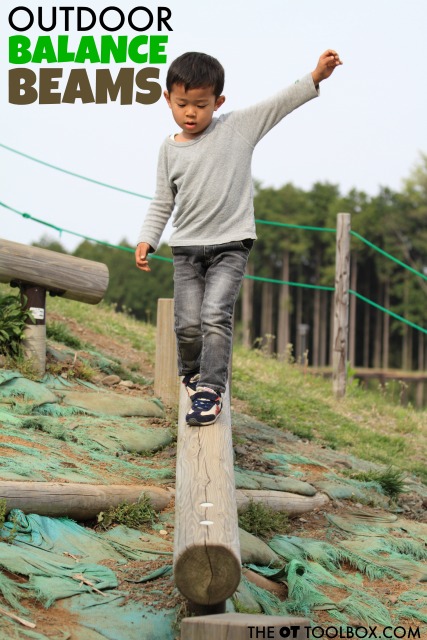
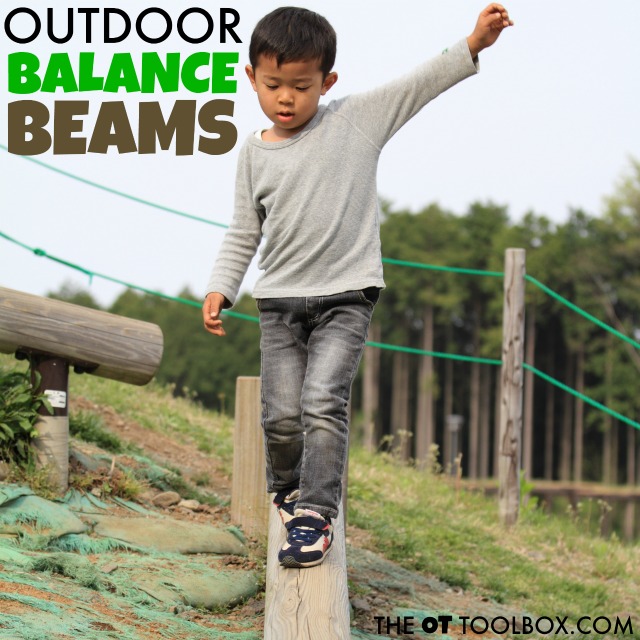
Balance beams are a great tool for addressing areas like vestibular sensory input, core strength, balance, visual motor skills, and attention. Here are outdoor balance beams and balance beam ideas that don’t require a playground or fancy equipment. These balance beams for kids are helpful in building the skills needed for reading, writing, visual processing, sensory processing, self-regulation, and more. Read more about balance beams and how they sneak in so many skill areas in a post we wrote on how balance beams help with sensory needs.
Recently, I shared ideas for indoor balance beams. The indoor balance beam ideas are perfect for adding movement and core strengthening to those rainy days that keep the kids inside but the kids are bouncing off those very walls that keep them cozy and dry? I wanted to share some outdoor balance beam ideas that you may not have thought of.
This post contains affiliate links. You don’t need fancy equipment! Use sticks to make a balance beam.
Use 2x4x16 feet or 2x4x8 feet wooden planks to create a large-sized balance beam in the lawn or on the driveway. Large pieces of wood can be found at hardware stores. Moving those large pieces is a workout for kids that can be calming with all of that proprioceptive input!
Not interested in moving big pieces of wood? Try using rocks, patio pavers, bricks.
Try chalk drawn on a driveway or sidewalk. Make the balance beam lines bend and curve to really challenge balance.
Skip the chalk and make a balance beam with the cracks that are already in the sidewalk or driveway!
Use a jump rope or long rope to create a balance beam line.
Use sticks and twigs to make a balance beam in the grass.
Make a narrow balance beam using leaves or wildflowers like dandelions.
Create a balance beam with leaves.
Walk along a fallen log.
Use commercial versions of balance beams that are available, including a portable foam balance beam. This would be perfect for outdoor obstacle courses.
Other ideas include: Make a portable roll-up balance beam using a yoga mat cut into strips (easily add it to your therapy bag!) and balance pods.
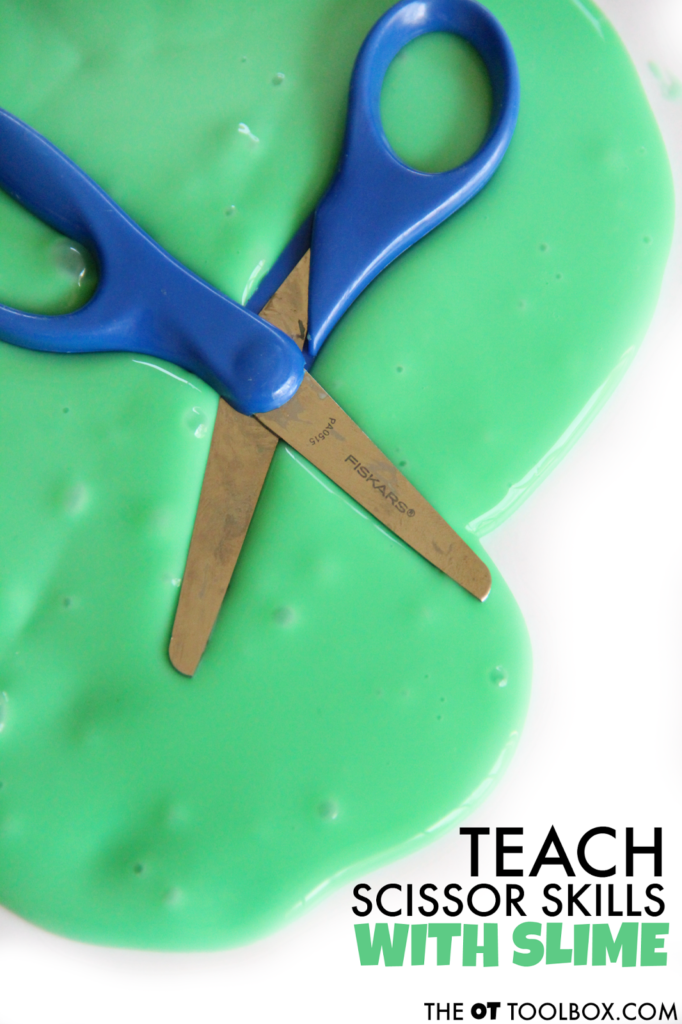
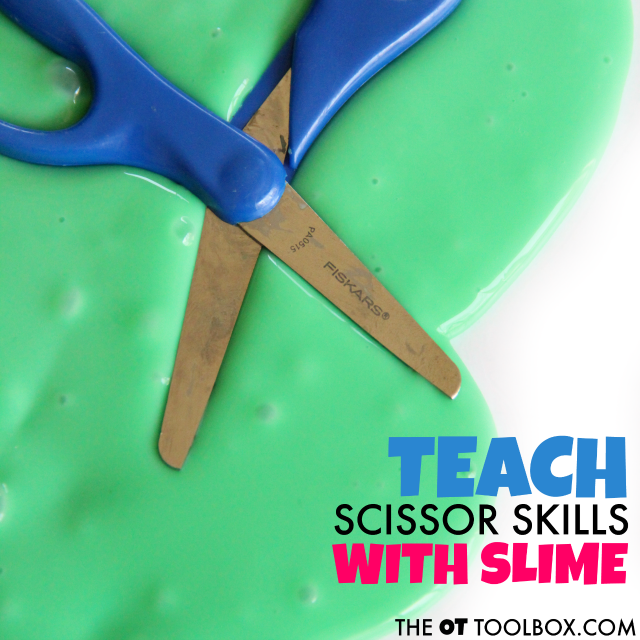
If your house is like mine, slime, making slime, and playing with slime is a daily activity and conversation piece. Slime is all the rage right now in the school-aged kids. So, you might be like me and wonder what to do with those six batches of slime that are sitting around the house. Why not use slime to work on scissor skills? It’s a nice texture for practicing scissor use and teaching kids how to snip with scissors. We shared fun ways to use slime for fine motor skills and adding scissors to the mix is one more way to use that slime!
Teach Scissor Skills by Playing with Slime
Affiliate links are included in this post.
First, you’ll need a batch of slime. Here are directions to make slime. Be sure to use caution with ingredients and research the best options for your family. Some recipes can cause inflammation to the hands.
Next, pull out your scissors. When teaching kids to use scissors, you’ll want a great pair that helps with scissor control and positioning. These are my favorite type of scissors as a therapist.
To work on scissor skills, you’ll need to have an understanding of how scissor skills develop. The new book by the Functional Skills for Kids therapy team is an excellent resource for promoting healthy development of scissor skills.
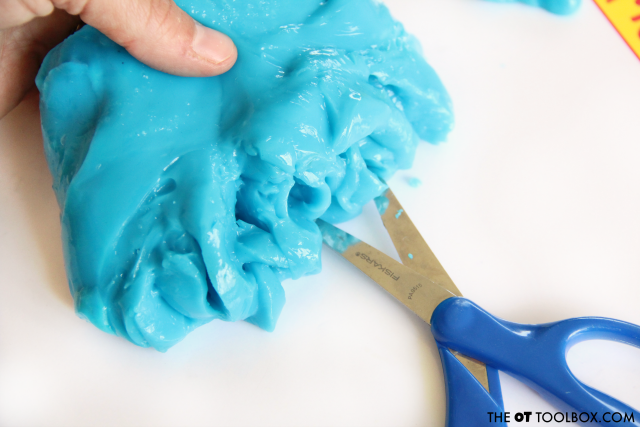
Use the slime to promote graded opening and closing of the scissor blades in order to cut across strips of slime. There are several other ways to address scissor skill development with slime:
Bilateral coordination to hold the slime with one hand while cutting it with another.
Cut snips into a lump of slime.
Roll a band of slime and cut one snip across.
Pull the slime into a thin sheet. Cut across the slime with forward motions.
Create a wide band of slime. Cut lengthwise down the slime, promoting bilateral coordination and forward cutting motions.
Affiliate links are included in this post. Ten Occupational Therapists and Physical Therapists have gotten together to write The Scissor Skills Book. It’s a book with resources for every underlying area needed for scissor use. It’s got tons of motor activities to address the areas needed for scissor skills. There are pages and pages of accommodations and creative ways to work on scissor use. This e-book is a giant resource for anyone who works with kids on cutting with scissors!
The therapists behind the Functional Skills for Kids series include a team of 10 pediatric physical and occupational therapists with years of experience in the field. Together, we have created the ultimate resource for tips, strategies, suggestions, and information to support scissor skill development in children. Read more about The Scissor Skills Book here.
Most parents have wondered at one point of another if they should allow their child to cut with a pair of scissors. But what if they decide to cut their hair off? Or what if they snip a hole in their best jeans? It can be a real struggle to allow your child to hold and use a pair of scissors!
Scissor skills are not easy skills to master! Many children start out holding and using scissors with an awkward grasp. They might switch hands when they hold the scissors or they might nip their crafts into a billion pieces because they can’t control or grad the force needed to snip and cut.
That’s why I’m excited to bring you The Scissor Skills Book!
(Affiliate links are included in this post.)
This book was written by a team of pediatric OTs and PTs who support the underlying skills that impact development.
Challenges with Scissor Skills
You might have seen kids struggle with scissors before:
The child who struggles with holding scissors again and again.
The child who holds the scissors up in the air to attempt to gain control.
The child who snips their cutting worksheets into a million pieces.
This child who tears the paper as they cut and seems to plow the scissors through the paper.
The child who can not grade their cuts and over cuts lines or has jagged cutting lines.
The child who snips corners from shapes.
There are many different ways that kids struggle with scissor use and accuracy when cutting with scissors. Kids with underlying developmental difficulties need to go through the process of learning to use scissors and can experience struggles during that development, too.
Children who have developmental or neurological difficulties that impact scissor use will experience difficulty coordinating fine motor skills, gross motor skills, visual perceptual skills, visual motor skills, sensory processing skills, attention and behavior, and cognitive functions while cutting with scissors.
All of these areas are addressed in the new book by the Functional Skills for Kids therapy team.
The Scissor Skills Book
Ten Occupational Therapists and Physical Therapists have gotten together to write The Scissor Skills Book. It’s a book with resources for every underlying area needed for scissor use. It’s got tons of motor activities to address the areas needed for scissor skills. There are pages and pages of accommodations and creative ways to work on scissor use. This e-book is a giant resource for anyone who works with kids on cutting with scissors!
The therapists behind the Functional Skills for Kids series include a team of 10 pediatric physical and occupational therapists with years of experience in the field.
Together, we have created the ultimate resource for tips, strategies, suggestions, and information to support scissor skill development in children. Read more about The Scissor Skills Book here.
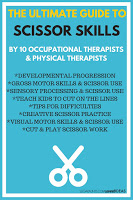
The Scissor Skills Book is an 81 page PDF document that is delivered electronically. The book includes the following chapters:
Chapter 1: Developmental Progression of Scissor Skills Chapter 2: Teaching Your Child to Use Scissors Chapter 3: Gross Motor and Scissor Skills Chapter 4: Fine Motor and Scissor Skills Chapter 5: Visual Perceptual and Scissor Skills Chapter 6: Sensory Processing and Scissor Skills Chapter 7: Attention Challenges and Scissor Skills Chapter 8: Helping Kids who Struggle with Scissor Skills Chapter 9: Creative Ways to Practice Scissor Skills with Kids Resources for Typical and Adaptive Scissors, Cutting Materials, and Further Information References
Colleen Beck, OTR/L has been an occupational therapist since 2000, working in school-based, hand therapy, outpatient peds, EI, and SNF. Colleen created The OT Toolbox to inspire therapists, teachers, and parents with easy and fun tools to help children thrive. Read her story about going from an OT making $3/hour (after paying for kids’ childcare) to a full-time OT resource creator for millions of readers. Want to collaborate? Send an email to contact@theottoolbox.com.
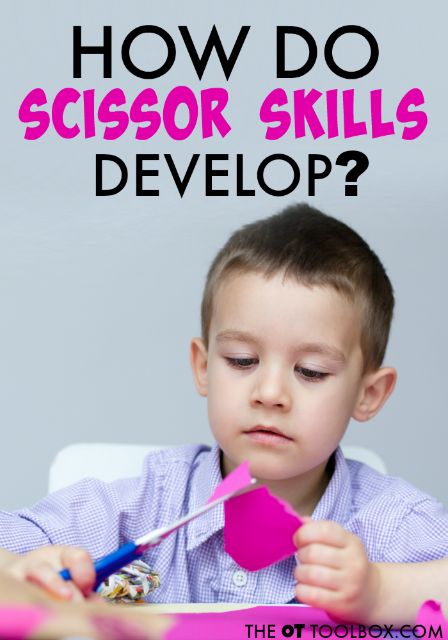
Cutting with scissors is fun for many children. When a child starts to show an interest in learning to cut with scissors, it is possible that they have already started the developmental progression of skills needed for scissor use. The steps of scissor skills development typically happens through play. So how do you know how a child learns to cut with scissors? And you may be wondering just how to teach a child scissor skills. In this post, I’m sharing the progression of development that allows a child to understand what scissors are to allowing them to use scissors accurately in order to cut complicated shapes.
How do scissor skills develop
They might see older siblings or a parent using scissors on a regular basis and be familiar with how the scissors fits on their hand (although they may position them incorrectly at first). Or they might only know that that shiny tool can cut paper into two!
There are many skills needed for cutting with scissors:
Because these skills develop both individually and in coordination with one another, and because the progression of scissor skill accuracy greatly depends on practice, I am not going to include typical age-ranges in this particular scissor skill post.
What you will see below is the general progression of scissor use. This development is important because we can see where accuracy and skill may breakdown with scissor use, safety, positioning, and accuracy when the underlying developmental stages are skipped or not successful.
Another huge impact relating to successful scissor use is practice time. Kids that head into kindergarten without ever having held or used a pair of scissors will struggle more greatly with the cut and paste learning activities that happen in the typical kindergarten classroom.
So, when it comes to helping kids learn to successfully use scissors, the greatest tip may be more practice!
Of course, when there are underlying areas that hinder successful scissor use such as fine motor control, visual motor integration, cognitive impairments, or other areas, then adaptations and accommodations to scissor tasks should be made.
But how can we know if kids are on the right track when cutting with scissors? The steps of development below are one way to put together the big pieces of the scissor use puzzle!
Child understands that scissors are used to cut paper
Child is able to hold scissors (incorrect hand placement)
Child is able to maintain a correct grip on scissors when positioned by an adult
Child is able to hold scissors in a correct grip without assistance
Child begins to open and close scissors
Child is able to open and close scissors using a controlled action (precision of grip begins to develop)
Child is able to hold paper and make small and random snips
Child is able to make consecutive cuts with a forward motion of the scissors, tearing the paper
Child is able to make consecutive cuts with a forward motion of the scissors, without tearing the paper
Child is able to cut straight lines forward across a page, while moving the helper hand forward (moving the paper with the scissors as in raising the shoulders/extending the elbows)
Child is able to cut straight lines forward without experiencing forward movement of the helper hand
Child is able to cut simple curves and angled lines (one direction change) without moving the assisting hand on the paper to re-position
Child is able to cut simple curves and angled lines (one direction change) while moving the assisting hand on the paper to re-position
Child is able to cut out simple lines with more than one direction change
Child is able to cut circles
Child is able to cut complicated shapes with straight and curved lines
For MORE information on scissor skills, you will want to check out The Scissor Skills Book, an e-book by myself and other pediatric Occupational Therapists and Physical Therapists. It contains everything you need to know about scissor skill development, practice, modifications, underlying challenge areas, and more! Check out The Scissor Skills Book.
The Scissor Skills Book
Affiliate links are included in this post.
Ten Occupational Therapists and Physical Therapists have gotten together to write The Scissor Skills Book. It’s a book with resources for every underlying area needed for scissor use. It’s got tons of motor activities to address the areas needed for scissor skills. There are pages and pages of accommodations and creative ways to work on scissor use. This e-book is a giant resource for anyone who works with kids on cutting with scissors!
The therapists behind the Functional Skills for Kids series include a team of 10 pediatric physical and occupational therapists with years of experience in the field. Together, we have created the ultimate resource for tips, strategies, suggestions, and information to support scissor skill development in children. Read more about The Scissor Skills Book here.
The Scissor Skills Book is an 81 page PDF document that is delivered electronically. The book includes the following chapters:
Chapter 1: Developmental Progression of Scissor Skills Chapter 2: Teaching Your Child to Use Scissors Chapter 3: Gross Motor and Scissor Skills Chapter 4: Fine Motor and Scissor Skills Chapter 5: Visual Perceptual and Scissor Skills Chapter 6: Sensory Processing and Scissor Skills Chapter 7: Attention Challenges and Scissor Skills Chapter 8: Helping Kids who Struggle with Scissor Skills Chapter 9: Creative Ways to Practice Scissor Skills with Kids Resources for Typical and Adaptive Scissors, Cutting Materials, and Further Information References
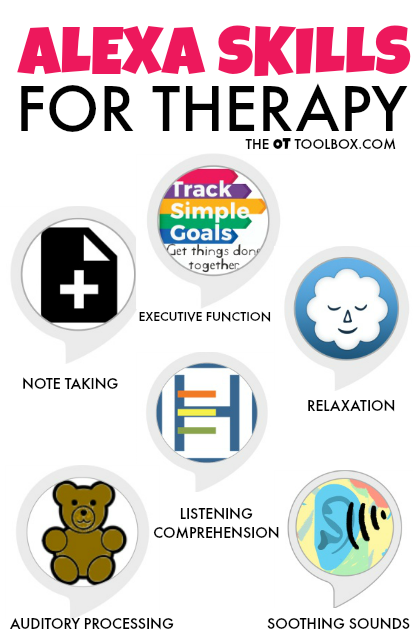
Many people have an Echo dot or an Amazon Echo device that has Alexa. The voice-controlled devices have a small built-in speakers and connects to the Alexa Voice Service to play music, provide information, news, sports scores, weather, and more. I discovered a few Alexa skills that are perfect for helping kids with therapy needs or with development of underlying skills that impact independence and safety. Use these as an occupational therapy tool! These Alexa skills are free to set up and use on your Echo Dot or Amazon Echo device.
Alexa skills to help with therapy needs
This post contains affiliate links.
There is so much that can be done with the Amazon Echo and other devices that connect to Alexa voice service! Click here to find out more about all that these devices can do.
They can be used in any room of your house using Bluetooth.
Alexa devices like the Echo Dot, Amazon Echo, and Bluetooth-enabled speakers are excellent tools for addressing the developmental needs of kids. You can use free Alexa skills to address needs such as safety, sensory processing, and executive functioning skills right at home.
Ask My Buddy is a free Alexa skill that lets you immediately alert someone in your Personal Alert Network that you need them to check on you. All you need to do is say, ‘Alexa, Ask My Buddy to alert Your Contact’ or ‘Alexa, Ask My Buddy to alert everyone’, and Ask My Buddy will immediately send an alert, notifying them to check on you right away. Alerts will be sent by text message / SMS, an email, and even a voice telephone call. Ask My Buddy is not a substitute for 911, but rather an additional tool offering the security of knowing help is just a shout away. This is perfect for older folks who live alone or young teens that are just starting to stay at home on their own. Click here for directions to set up this Alexa skill.
ASMR Sounds is a free Alexa skill that provides auditory sensory input to calm and relax you. ASMR stands for autonomous sensory meridian response. This app provides soothing sounds that relax your mind and body. It would be a great sensory break or perfect to use before bedtime. Click here to set up this Alexa skill.
Listening Comprehension Practice is an Alexa skill that is perfect for kids or adults who are working on auditory processing skills. The free app allows listeners to sharpen their comprehension of audio narrative content by providing a short audio narrative followed by interactive comprehension questions. The listener must respond to the questions and Alexa will verify if the response is correct.
Goal Tracker by Hoogalit is a free Alexa skill that tracks goals. From chores, to doing homework at a specific time, to completing parts of a sensory diet-this goal tracker will keep kids on target. It looks like the skill works best with simple goals, but it’s an option to try for kids with executive functioning problems.
My Note-taking Skill is a free Alexa skill that creates notes in note-taking services, such as Evernote and OneNote. This is a nice tool for kids with handwriting difficulties including dysgraphia. Use it to add items to your to-do list as soon as you think of them.
Meditation Timer provides timed soundscapes that evoke feelings of calm and relaxation. Sounds such as a peaceful forest, ocean waves, or falling rain are a calming auditory sensory tool to help kids relax.
This weighted fidget toy is a calming tool that can be used in the classroom or at home when kids need to calm down and focus to desk work. I love the fine motor benefits that kids get when making this calming fidget toy too. This is another occupational therapy toy that supports needs like attention and self-regulation!
diy weighted toy
You’ll use just a few materials to make this calming tool for boosting attention. The whole class or a group of kids can make them and use them to concentrate and focus in the classroom.
The DIY weighted toy supports sensory needs by offering heavy work through the hands, fingers, and lap if placed on a lap. Heavy work is a calming and organizing means of sensory input that supports sensory needs.
The calming and organizing sensory input in the form of heavy work tasks offer proprioceptive input through the muscles and joints. This input creates resistance input to the muscles and this feedback is ultimately what calms and regulates the sensory system.
A DIY weighted toy like this one supports the proprioceptive system and is a powerful regulator for our overall functioning. By working with the proprioceptive system you can even out disturbances in other sensory systems. You can increase energy levels if you need to and you can reduce high energy levels to help children reach a calm, comfortable space to interact with the world.
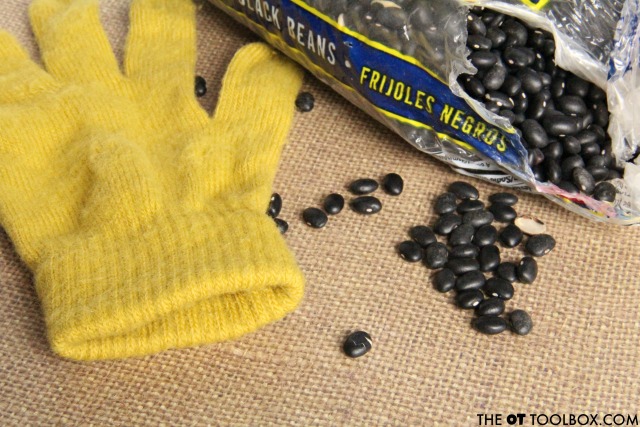
You’ll need these materials to make a weighted fidget tool:
Amazon affiliate links are included in this blog post.
A DIY weighted stuffed animal could be made in the same manner:
Tear apart the stitching of a stuffed animal plush.
Insert a glove filled with beans, plastic pellets, etc.
Sew up the stitching along the seam.
Use these materials to make a calming weighted fidget toy for helping kids attend and focus, with a calming weight. This is a great tool to use for kids who fidget during homework. I love that this attention tool is a DIY fidget toy option that would work in the classroom or in the home.
This post contains affiliate links.
How to make a DIY weighted Toy
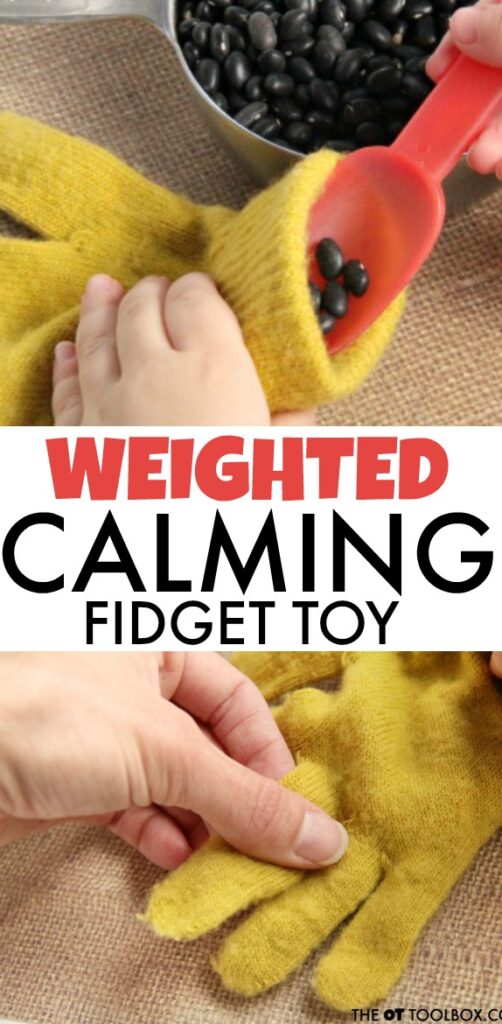
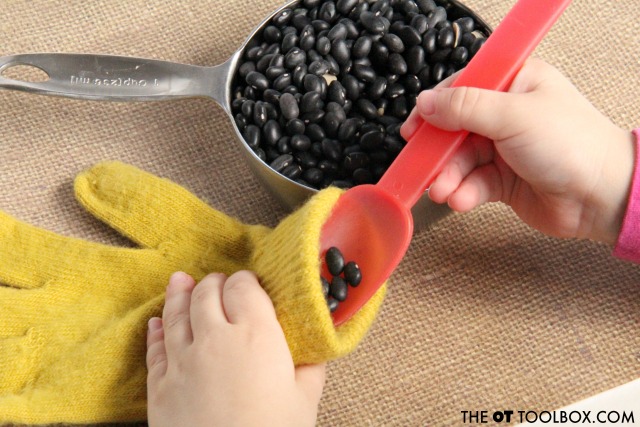
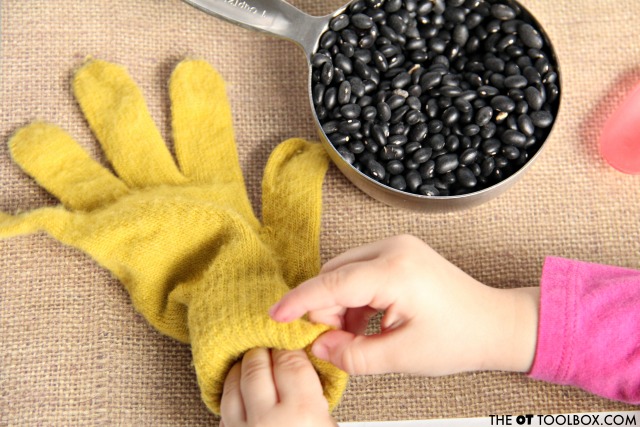
To make the weighted fidget toy, provide the kids with one cup of dry beans (or other material) and a single glove. This time of year, you can often times, find gloves on clearance. These are available in dollar stores as well.
2. Show the children how to use a spoon to fill the glove with beans. Scooping the beans into the glove is a great motor planning activity that encourages motor control, visual motor skills, and bilateral coordination.
3. Then, sew up the opening of the glove. This can be a job of an adult or teen.
And with that, your weighted fidget toy is complete.
Use this tool on a knee under a desk to provide some heavy weight input through the calf. Kids can place it on one knee and then the next. Adding the weighted input through the knee provides proprioceptive input that is calming for some children.
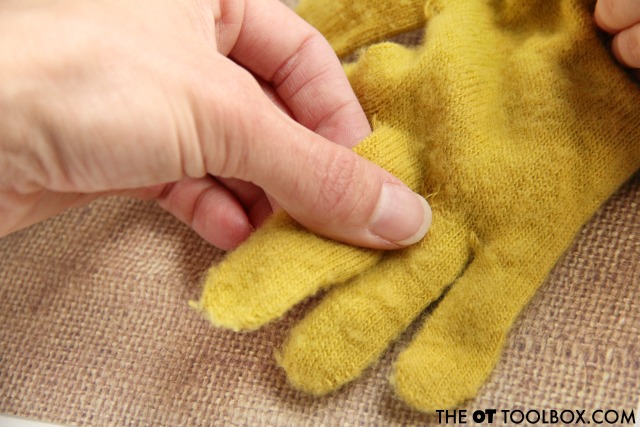
To use the weighted glove as a fidget toy, work the beans up and down the fingers of the glove. This is a calming and mesmerizing motor skill that is calming for some kids.
Combining the weighted input along with the fidget activity can be a powerful source of attention for children.
Fidget toys are an excellent way to boost so many important skills during school or at home. Try this pencil topper fidget toy for use when writing. It might be nice to combine with the weighted fidget toy.
Give this fidget toy a try! Let me know how it works for you!
Looking for more easy fidget toys? These keychain fidgets are perfect for kids in school or on-the-go!
The Sensory Lifestyle Handbook walks you through sensory processing information, each step of creating a meaningful and motivating sensory diet, that is guided by the individual’s personal interests and preferences.
The Sensory Lifestyle Handbook is not just about creating a sensory diet to meet sensory processing needs. This handbook is your key to creating an active and thriving lifestyle based on a deep understanding of sensory processing.
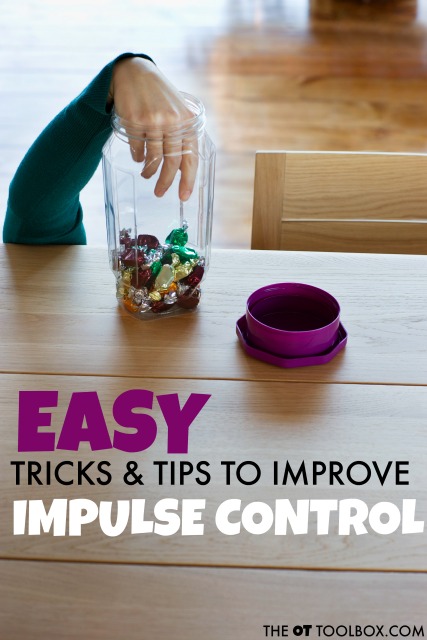
Here, you’ll find easy impulse control strategies. Use these tips and activities along with other resources on improving impulse control skills: These impulse control activities and how to teach impulse control. Use those resources in combination with the impulsivity tips in this post as intervention strategies for impulsive behavior.
Here on the site, we’ve shared a lot of information related to impulse control. This executive functioning skill is essential for most daily tasks! When kids struggle with prioritization, planning, time management, persistence, then impulse control can suffer.
Likewise, difficulties with sensory processing, modulation, or direction following can limit a child’s ability to utilize self-control in order to inhibit their impulses.
Easy Impulse Control Strategies
These easy ways to improve impulse control are quick tips and tricks that can help kids address impulsivity.
Easy Ways to Improve Impulse Control
▪ Use those real life situations to assess what worked, what didn’t work, and talk about it! Sometimes looking at a big picture can help kids.
▪ Research tells us that as the day progresses, it is harder for us to maintain and utilize self-control. Make smaller goals later in the day.
▪ Encouraging statements can boost and rally! Use imagery to picture successes in typical situations. Find an encouraging statement that really speaks to the child and ask them to repeat it, sing it, and dance to it! Get silly to make it stick in their minds.
▪ Rest, a healthy diet, enough sleep, physical exercise, and time of day all make a difference in willpower. The interoceptive system is a powerful sensory system when it comes to impulse control.
▪ Physical exercise also leads to changes in the function and structure of the pre-frontal cortex of the brain. Regular exercise such as mindful exercises like yoga and stretching as well as intense cardiovascular exercise helps us become more resilient to stress.
▪ Teach kids how to manage stress. When we experience stress, it means that our body’s energy is used up and we act instinctively. Decisions made under stress are often times based on short-term outcomes.
▪ Self-control and reining in those impulses requires monitoring. This includes keeping track of your thoughts, feelings and actions in any given situation. Help kids monitor their actions with quick self-checks.
▪ Write down the rules. A prerequisite to impulse control includes a knowledge of standards. These personal and assumed guidelines steer us in the “right direction” of following rules. This might include classroom rules, society’s rules, rules of communication, personal standards, and moral guidelines. For the child with sensory processing challenges, communication difficulties, executive functioning issues, these standards can be very difficult to perceive and know! It can be very stressful for these children to know there are rules, but they don’t know exactly what they are.
Easy Impulse Control Tips
The impulse control strategies listed above are techniques and tips that can help kids gain control of impulsivity. While development of self-control skills happens gradually and over time, the strategies for controlling impulses can be used to help kids develop self-control necessary for managing impulse control in a variety of settings.
Reaching impulse control strategies to kids doesn’t need to be boring or repetitive. While the number one strategy for helping kids become more aware of impulsivity in order to gain self-control is listed below, there are actually several more tools for impulse control that can help kids master their impulse control skills (at least on an age-appropriate level of expectation).
Practice- This is the biggest technique for working on impulse control in kids. Because self-control is a skill that develops over time, going over (and over) those skills can make all the difference.
Self regulation- We’ve talked about the connection between impulse control and sensory processing. The ability to inhibit an impulse can be exacerbated by emotions. Have strategies in place to self-regulate can make impulse control all the easier. There’s more; When kids act impulsively in an emotional situation, but then afterwards can explain what they should have done instead, they lack the self-regulation to notice in the moment what is happening. The ability to figure out in the moment that a sense of overwhelming thoughts or feelings are building requires self-regulation skills.
Mindfulness- Being aware of yourself and the world around you allows a person to focus on an awareness as opposed to emotions. Mindfulness is a strategy to improve impulse control by allowing us to control and handle our emotions as they are happening. This is a technique that takes practice (There’s that p word again!)
Stop and think- Teach a stop and think game to stop the action, activity, or conversation and pause to think about emotions and how the body feels. This is a way to stop and slow down to check in with themselves before impulsive actions happen.
Work through distractions- Sometimes, kids become so distracted by things happening in the classroom or out in the hallway that impulsive actions happen during those distracted moments. Science has found a link between impulse control and working memory, which is an important part of focus that lacks during periods of distraction.
Model good examples- Talking through examples and showing kids how to respond to common problems through modeling is one impulse control strategy that can make a big impact. By modeling and walking through a common self-control issue, kids can see exactly how to use other techniques in the moment. It’s a great way to problem solve and strategize together.
Make it fun! Games- Games that encourage delayed gratification or require a child to stop in the moment can be a good tool for practicing impulse control. Some examples include Red Light Green Light, Simon Says, or other turn-taking games.
Think of others- The ability to empathize plays a big part in impulse control. In fact, our ability to control our impulses and empathy are actually housed in the same part of the brain. The thing is though, that the part of the brain with impulse control and empathy reside is the last part of the brain to fully mature. The pre-frontal cortex doesn’t fully develop until our early twenties. But despite developmental considerations of development, we can promote impulse control by working on empathy. How would we feel if someone did a specific action against us? It can be helpful to ask kids specific questions that bring empathy and impulse control into light.
Some questions to inspire kids to think of others when it comes to impulsivity include:
How do you think a friend feels when you take a toy from them?
How would you like a friend to ask to play with you?
How can you ask a friend to play that would make them feel good and not bad?
How would you feel if a friend took a toy that you were playing with?
6. More practice- Finally, we come back to the first strategy on the list…practice! Take the opportunity to practice all of the strategies and techniques on this list. It will make a big difference!
These strategies are easy to address but can sometimes not carryover well into typical daily tasks.
The Impulse Control Journal is a printable journal for kids that helps them to identify goals, assess successes, and address areas of needs. The Impulse Control Journal is a printable packet of sheets that help kids with impulse control needs.
The Impulse Control Journal has been totally revamped to include 79 pages of tools to address the habits, mindset, routines, and strategies to address impulse control in kids.
More about the Impulse Control Journal:
30 Drawing Journal Pages to reflect and pinpoint individual strategies
28 Journal Lists so kids can write quick checklists regarding strengths, qualities, supports, areas of need, and insights
8 Journaling worksheets to pinpoint coping skills, feelings, emotions, and strategies that work for the individual
Daily and Weekly tracking sheets for keeping track of tasks and goals
Mindset,Vision, and Habit pages for helping kids make an impact
Self-evaluation sheets to self-reflect and identify when inhibition is hard and what choices look like
Daily tracker pages so your child can keep track of their day
Task lists to monitor chores and daily tasks so it gets done everyday
Journal pages to help improve new habits
Charts and guides for monitoring impulse control so your child can improve their self-confidence
Strategy journal pages to help kids use self-reflection and self-regulation so they can succeed at home and in the classroom
Goal sheets for setting goals and working to meet those goals while improving persistence
Tools for improving mindset to help kids create a set of coping strategies that work for their needs
This is a HUGE digital resource that you can print to use over and over again.
The impulse control journal is perfect for kids who:
Grab items from other kids
Lack a sense of personal boundaries
Show poor self-regulation of emotions and sensory input
Have difficulties with delayed gratification
Struggle with carryover of impulsivity strategies into general situations
Interrupt others or act out in the classroom
Colleen Beck, OTR/L has been an occupational therapist since 2000, working in school-based, hand therapy, outpatient peds, EI, and SNF. Colleen created The OT Toolbox to inspire therapists, teachers, and parents with easy and fun tools to help children thrive. Read her story about going from an OT making $3/hour (after paying for kids’ childcare) to a full-time OT resource creator for millions of readers. Want to collaborate? Send an email to contact@theottoolbox.com.
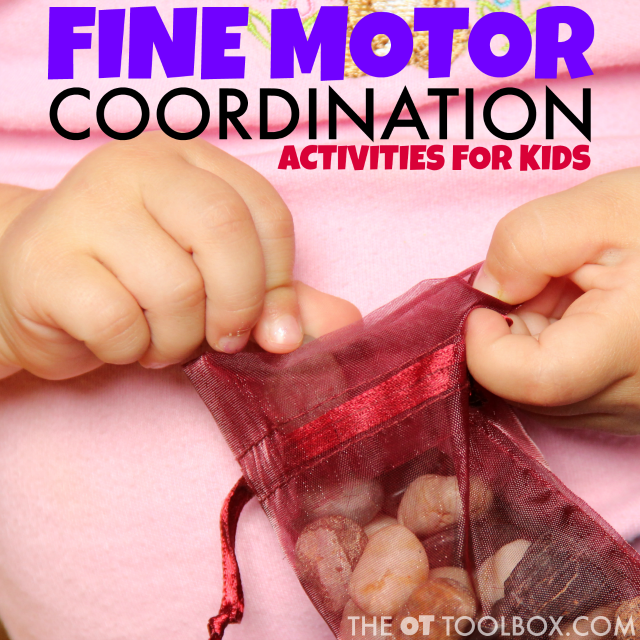
Fine motor skills are often times, the culprit behind problems you see in the classroom or at home. From opening a food container, to managing buttons on a jacket, to managing legos when playing, to tying shoes in the third grade, to keeping up with peers when writing with a pencil…fine motor skills play a huge part in the life of a child! It can be overwhelming to work on all of the specific areas that make up fine motor skills. And to be honest, it’s really not efficient to isolate particular fine motor skills when they all work together to manipulate and move items functionally.
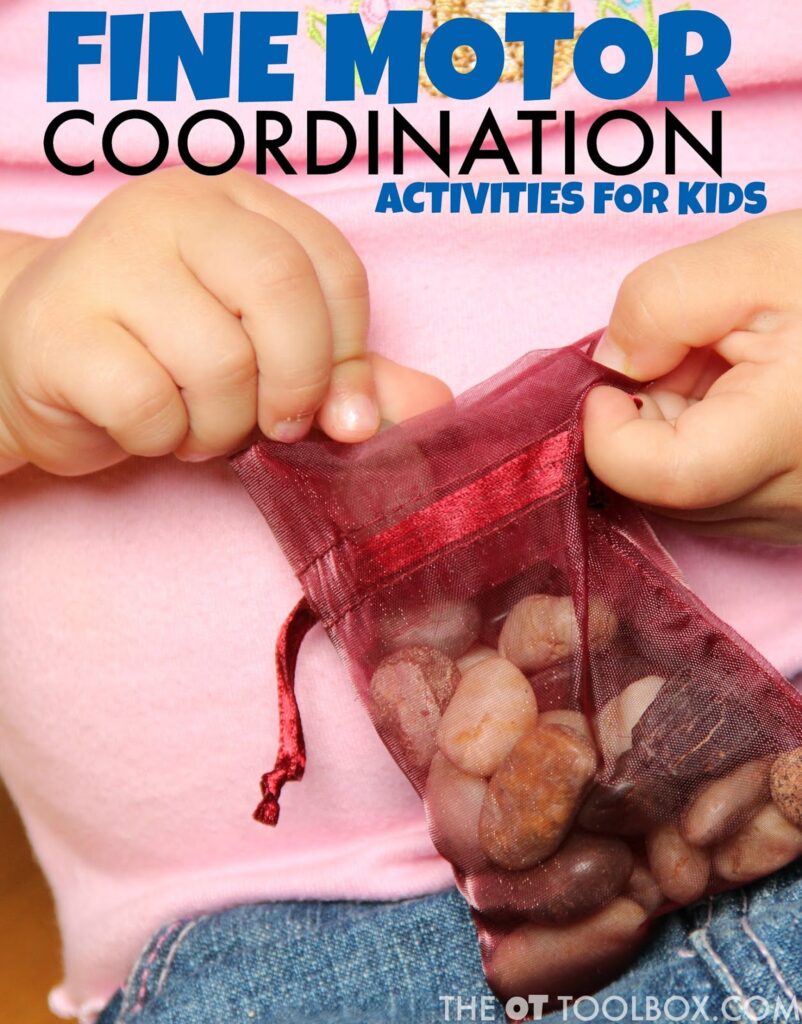
These fine motor coordination activities are perfect for developing a variety of specific fine motor skills in a coordinated manner. In fact, all of these activities develop and strengthen several specific fine motor skills. Use these activities as your “go-to” ideas for play and development when kids need to work on several fine motor areas.
Fine Motor Coordination Activities
Affiliate links are included in this post.
Try these activities to aid in development and coordination of fine motor skills:
Sort small objects such as screws, bolts, and paper clips into groups.
Use a water sprayer to mist water at paper, newspaper, or plants.
Crumble paper into small pieces. Try other ways to build fine motor skills with paper too: fold, cut, color, and tear paper.
Use a hole puncher to punch holes.
Tong activities. Use them to move cotton balls or crafting pom poms.
Open and seal shut plastic sandwich bags. Use them to store fine motor play items and have the child get them out and put them away.
Do you have a set of jacks? Press them into play dough for a resistive activity. Then, pull the play dough from the jacks.
Children accomplish so much throughout their day in play and at school as a result of proficiency in fine motor skills. What are your favorite ways to encourage fine motor coordination?
Looking to work on specific fine motor skills? Try these: