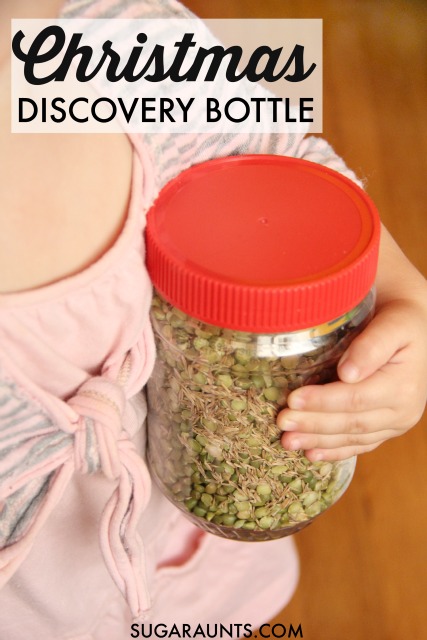
Calm the Holiday Overwhelm with a Christmas Discovery Bottle

This time of year, Moms need a backup plan.


A little tool that mom can pull out of a cupboard and hand over to a kiddo who needs a little bit of quiet time.


We all get overwhelmed by our environment.  The constant input of stimulation from people, schedules, work requirements, holiday activities, holiday clutter, school and activities that keep going (but then add the additional celebration activities to the already full schedule…)


It can take a lot to keep it together for an adult who is managing the day’s requirements, let alone a child who doesn’t quite know what is happening next.  Or why.


Sometimes a bit of a calm, slow, deep breath is in order.  And it can come in the form of sensory integration, including a discovery bottle!


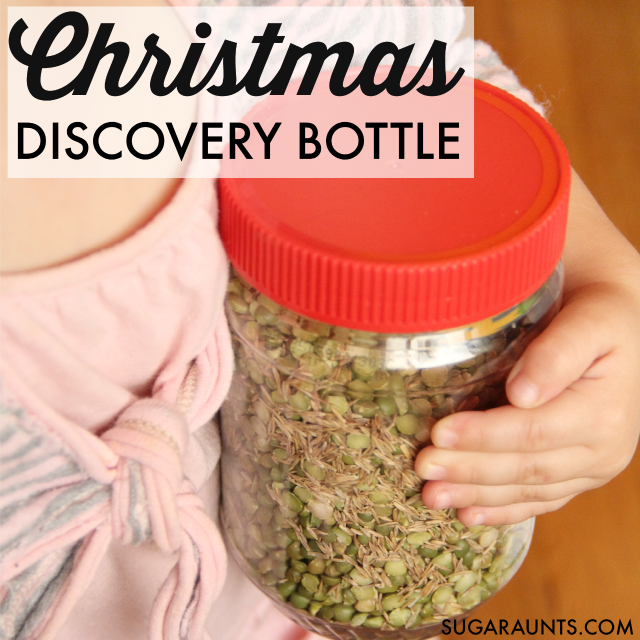
We made this Christmas themed discovery bottle very quickly and have been pulling it out every day since.  A sensory bottle like this is calming, relaxing, and may be just the thing to settle the feeling of holiday overwhelm.


Kids can calm their feeling of holiday overwhelm by relaxing with a Christmas themed sensory discovery bottle, while looking for shapes in their environment. Great learning tool for preschoolers!


Christmas Shapes Discovery Bottle

This post contains affiliate links.  See our full disclose here.

Make a sensory discovery bottle to keep in your purse for overwhelmed shopper helpers or excited cookie baker assistants and have a backup plan on hand!


Kids can calm their feeling of holiday overwhelm by relaxing with a Christmas themed sensory discovery bottle, while looking for shapes in their environment. Great learning tool for preschoolers!


To make this Christmas Themed Discovery Bottle

You’ll need just a few materials to make a discovery bottle with a Christmas theme:


Kids can calm their feeling of holiday overwhelm by relaxing with a Christmas themed sensory discovery bottle, while looking for shapes in their environment. Great learning tool for preschoolers!


This sensory bottle was fun for my preschooler and toddler to prepare together.  We scooped the split peas and grass seed into the bottle while they worked on fine motor skills with their scooping (I love giving them developmental training skills when they don’t even realize they are building skills!)


Cut up the Foam Craft Sheets
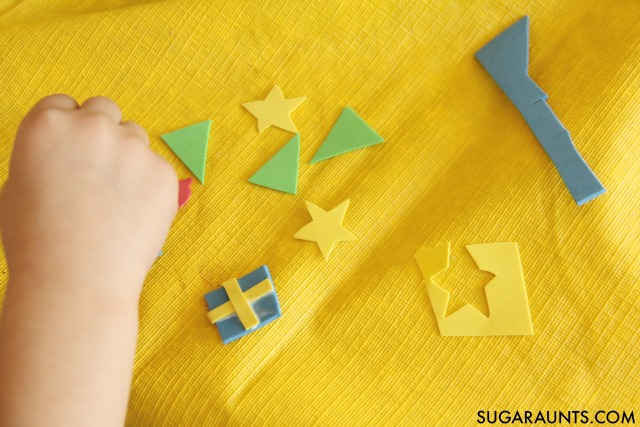
into basic shapes (More skill areas! This time, my daughter worked on her cutting skills, and is foam sheeting ever a great way to practice precision in learning to cut!)


Kids can calm their feeling of holiday overwhelm by relaxing with a Christmas themed sensory discovery bottle, while looking for shapes in their environment. Great learning tool for preschoolers!


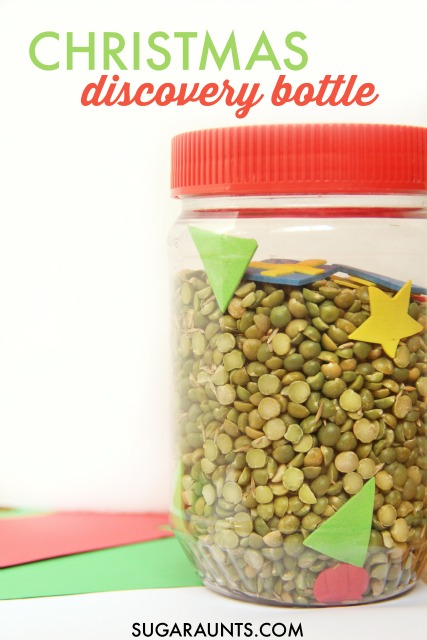
We made a circle that looked slightly like an ornament, a square that we turned into a present, a triangle (tree-ish looking thing?).  Pop the foam shapes into the discovery bottle.


Screw the lid onto the bottle with a bit of glue.  (The glue part is important for busy little hands!  Use super glue to keep the lid in place.)


Proprioception with a Sensory Bottle

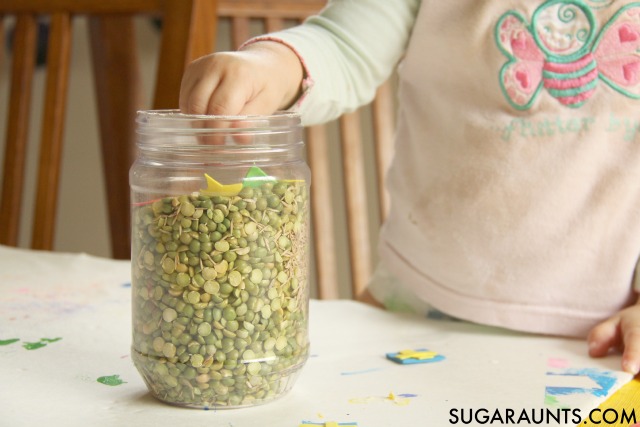
Now is the fun part!  Hand over the discovery bottle and encourage your kiddo to shake, shake, shake!  The proprioceptive input from a discovery bottle is calming heavy work and will provide a time of relaxing as they watch the falling peas or colored shapes.


READ MORE about Sensory Bottles HERE.


Shape Identification and I Spy Activity

Now, use your discovery bottle to work on a few learning skills.  Show your child how to shake up the bottle and look for shapes hidden in the green peas.  There are a few ways they can use this discovery bottle in learning:
  • Ask them to name the shape.
  • Name a shape and ask them to shake the bottle until they find that shape.
  • Ask them to shake the bottle and name an object in the room that matches the shape they’ve found in the bottle.  (This is a great activity to do while being carted around a grocery store or other busy shopping area!)
  • Name an item in the environment or room and ask them to find the matching shape in the bottle.
  • Work on colors and counting by asking them to find three red items in the bottle.
  • Ask them to find an item in their environment that matches the color of the shape they’ve found in the bottle.

I Spy is such a great way for kids to work on visual scanning and visual memory needed for handwriting, copying words and math problems, and reading.  Kids need to scan their visual field while pulling important information and finding needed items in a busy background.  When copying math problems from a vertical chalkboard at a distance, they are shifting their head and eyes from a horizontal to vertical (and sometimes rotating their head and neck) to copy written material.  Visual tracking allows a child to copy and place written work in the correct spots on their paper, while scanning back to the overhead position without losing their place.


Hopefully this Christmas Discovery bottle is helpful this overwhelming and busy Christmas season. May it be a backup plan that works for you and your little helpers!

Stop by and see more Christmas Discovery Bottle ideas from the discovery bottle blogger team:


Sunny Day Family | Christmas Tree in a Bottle
Preschool Inspirations | Jingle Bells Discovery Bottle

Christmas Handwriting Activities

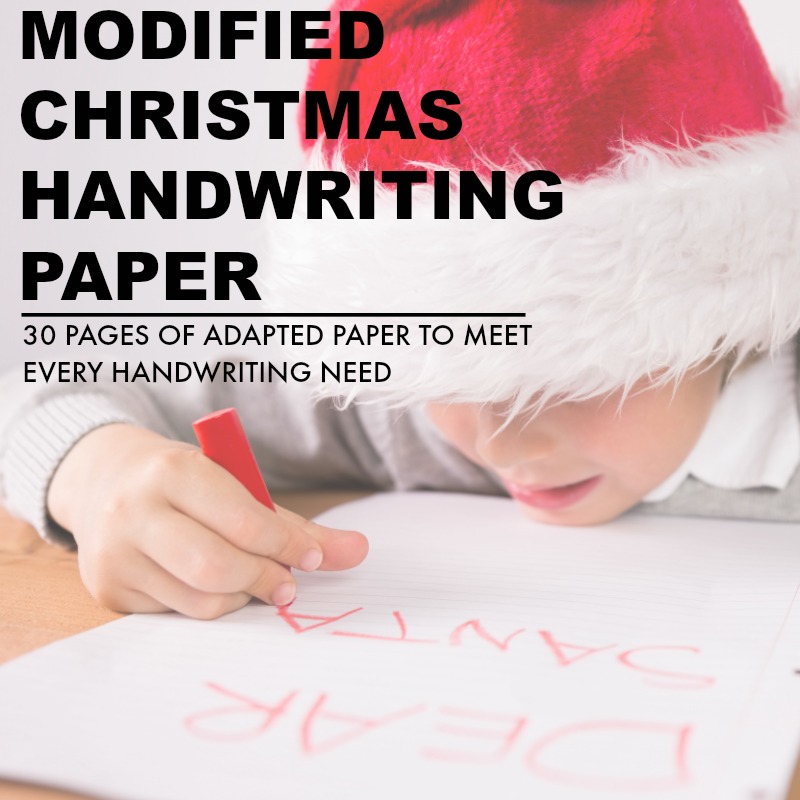
Writing out that Christmas wish list is a difficult task that brings out tears instead of holiday excitement.  I’ve got a solution for your kiddo with handwriting difficulties: a packet of modified paper for all of the Christmas handwriting tasks that come up each year.  Use this handwriting pack to help kids who struggle with handwriting to participate in holiday traditions while even working on and developing their handwriting skills!

Working on handwriting with kids this Christmas season? Grab your copy of the Christmas Modified Handwriting Packet. It’s got three types of adapted paper that kids can use to write letters to Santa, Thank You notes, holiday bucket lists and much more…all while working on handwriting skills in a motivating and fun way! Read more about the adapted Christmas Paper here


Kids can calm their feeling of holiday overwhelm by relaxing with a Christmas themed sensory discovery bottle, while looking for shapes in their environment. Great learning tool for preschoolers!


Love this idea? Share it on Facebook!

Some of our favorite Discovery Bottles for Sensory learning and calming input: 

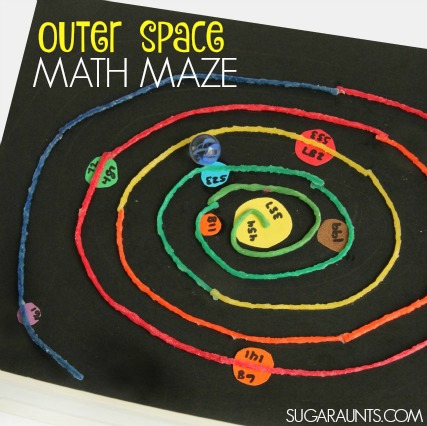
Outer Space Math Maze with ReGrouping

Space Maze

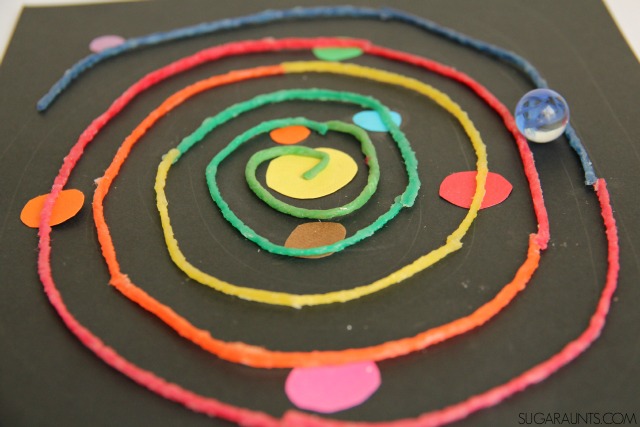
Today we have a Wikki stick maze that supports skills like bilateral coordination, motor planning, and visual motor skills. This is one of our favorite wikki stick activities!


Wikki Stix maze

Want to make learning math fun and creative when the kids just want to “be done?”


Sometimes we need to practice and build math concepts just a bit more.  It can be hard to find ways to get the extra practice in when the kids really just are over practicing math (again and again!)


The baby wants held, the green beans are boiling over on the stove, and the other kids are dumping bins of puzzles all over the living room.  But, the second grader needs to practice regrouping triple digits just a bit more.


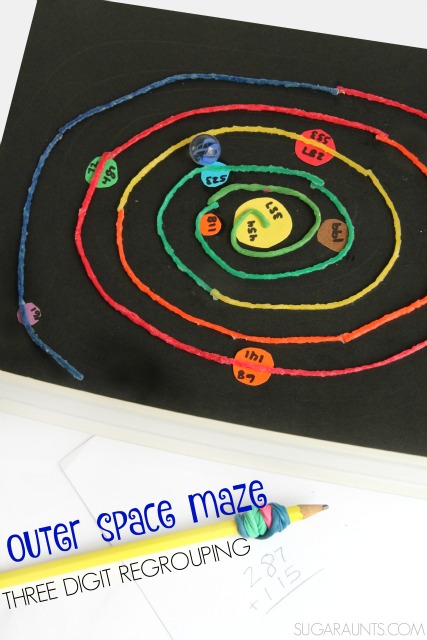
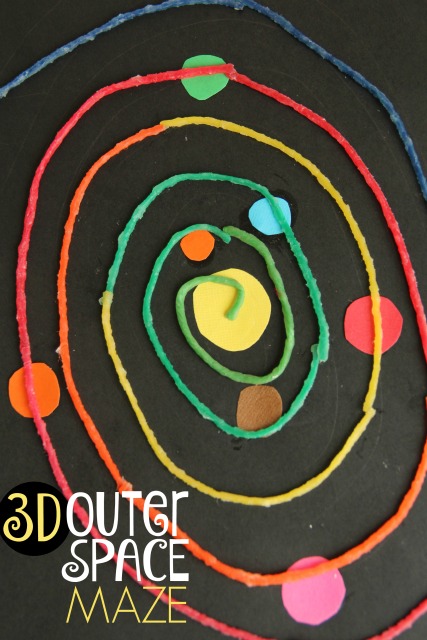
Practice regrouping three digit numbers with this 3D Outer Space math maze that kids can use for extra practice and with bilateral hand coordination.


Outer Space Maze

For kids that love all things outer space, this outer space maze is perfect for building math skills but also visual motor work.


My four year old and I made up this 3D Outer Space maze to practice re-grouping tens and hundreds columns in three digit numbers one day while my second grader was at school.  When she came home from school, she was all over it!


Mazes are a great way to practice skills needed in handwriting and math.  They are a puzzle for hand-eye coordination and a visual motor workout.  

Often times, kids have trouble aligning numbers in columns of ones, tens, and hundreds. A maze using hand-eye coordination like this one can help to work on that copying skill.


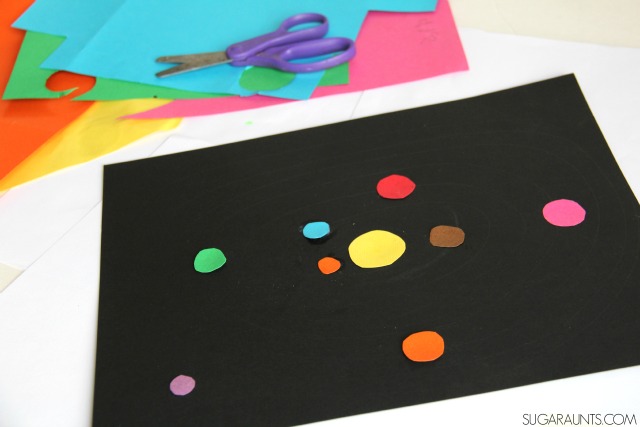
Materials you’ll need to make the Outer Space Maze:
(Affiliate links are included in this list and in this post.)

3D Outer Space Maze

This activity is actually a 3d Space project as well. You’ve probably seen 3D outer space projects in the past that focus on planet size, distance between planets, and rotation around the sun. Our 3D Space project is on paper, but you can also target rotation around the sun, planet size, etc.

Directions to make this 3D space project:

  1. Draw rings for planet’s orbits around the sun.  NOTE: We did this quickly and our outer space model is in NO way accurate in terms of size of planets or orbits.  Older kids could do this as a Science project.  

Practice regrouping three digit numbers with this 3D Outer Space math maze that kids can use for extra practice and with bilateral hand coordination.


2. Cut circles from Colored cardstock (Amazon affiliate link)
to represent planets.  
 
3. Glue them onto the orbits.

Practice regrouping three digit numbers with this 3D Outer Space math maze that kids can use for extra practice and with bilateral hand coordination.


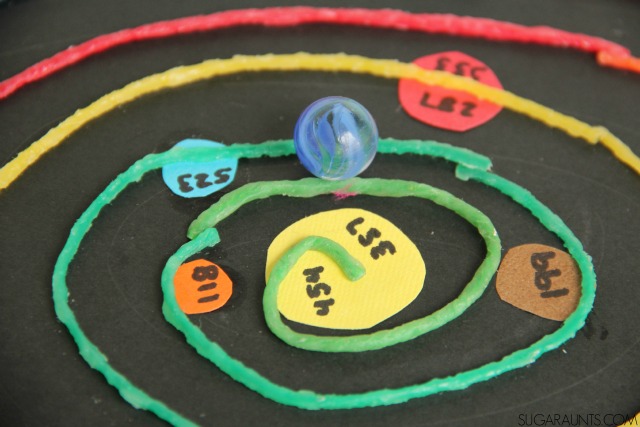
4. Press Wikki Stix (Amazon affiliate link) onto the orbits and over the planets.  Try to get them to stick right through the center of each planet.  
5. Then, use the Black marker to write three digit numbers on both sides of the planets.  
 
6. Place the paper into a bin with edges and move a marble along the 3D track.  

Practice regrouping three digit numbers with this 3D Outer Space math maze that kids can use for extra practice and with bilateral hand coordination.


Wikki Stix Maze

 
It takes coordinated and slow movements to get the marble to stay on the track and move along the path.  
 
You can read more about Bilateral Coordination and how it’s needed in so many functional tasks through play using lacing card activities.

Practice regrouping three digit numbers with this 3D Outer Space math maze that kids can use for extra practice and with bilateral hand coordination.


Math Maze

 
As your child moves the marble along the path, write down the numbers.  They can add the digits and work on adding with regrouping.  
Start the marble at different spots and tilt the tray in different directions to get different numbers.
 
Adding the bilateral coordination movement to this learning task made it a fun and hands-on activity that a worksheet simply isn’t.
 

So, hopefully this idea will help your hands-on learner.  Have fun playing and learning math…until the beans boil over!


The second grade blogger team have created hands-on learning activities with an Outer Space theme.  

See what they’ve been up to:


Practice regrouping three digit numbers with this 3D Outer Space math maze that kids can use for extra practice and with bilateral hand coordination.
 
 
More hands-on math activities you will love:
 
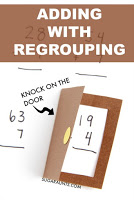
Make a paper door to introduce concepts in first grade math like regrouping in addition. 


Colleen Beck, OTR/L has been an occupational therapist since 2000, working in school-based, hand therapy, outpatient peds, EI, and SNF. Colleen created The OT Toolbox to inspire therapists, teachers, and parents with easy and fun tools to help children thrive. Read her story about going from an OT making $3/hour (after paying for kids’ childcare) to a full-time OT resource creator for millions of readers. Want to collaborate? Send an email to contact@theottoolbox.com.

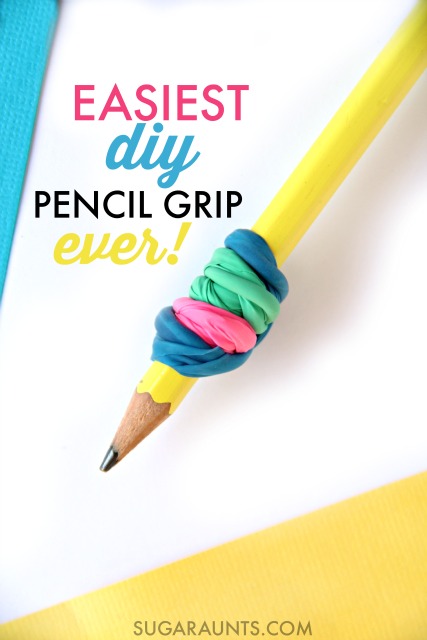
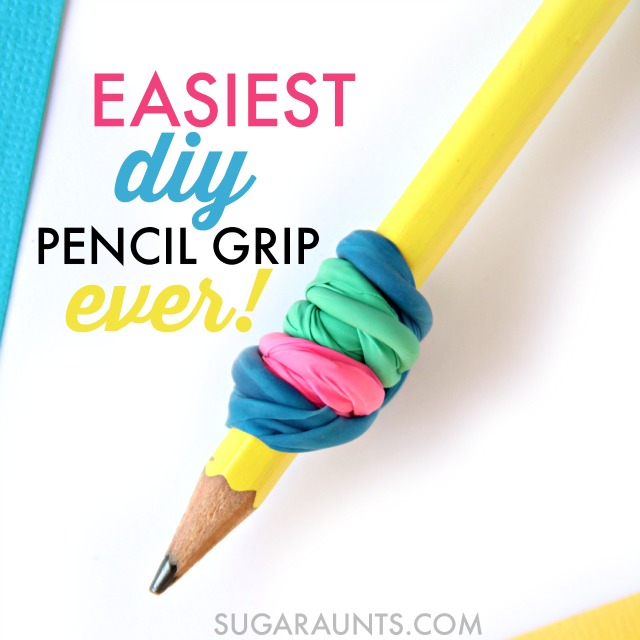
Easiest DIY Pencil Grip Ever!

You might have seen my kids around town with this brightly colored pencil wrapped in a crazy pencil gripper.  They have a new favorite pencil and have been carting it to the karate practice waiting area, the hallways of dance lessons, and even in the wagon during our daily trips to the school bus stop.  It’s our homemade pencil grip and they are loving it!


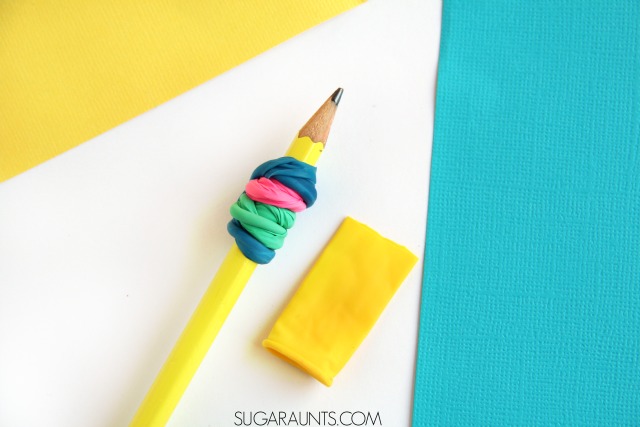
They’ve been drawing, writing, and scribbling away with a plain old pencil that I glammed up with bright colors and a delightfully press-y DIY pencil grip.


So what makes this pencil grip so appealing?  It’s soft, it’s squishy, it’s brightly colored, and it’s got a great scent that my kids can’t get enough of.  Handwriting has never been so fun!


Make a DIY Pencil Gripper with balloons to encourage a tripod grasp and proprioceptive input during handwriting.


This post contains affiliate links.

Homemade Pencil Grip

If you’ve got a kiddo who needs to work on their pencil grasp, you’ve probably tried about 2,000 pencil grips that are on the market.  There are some really great ones out there.  As an Occupational Therapist who worked in schools, I’ve tried them all.  And my kids are pretty excited that I still have a nice stock of pencil grips on hand for trying out.


Not all pencil grips are the same, and many times, a pencil grip that works for one child will not work for another.  This pencil grip is fun and easy to throw together.  It’s one that you can customize for what your child needs in the way of gripping a pencil…and best of all, it costs about 25 cents to make!


This post would be a perfect fit in our 31 Days of Occupational Therapy series. Head on over to see free and inexpensive ways to work on many Occupational Therapy goal areas.

So what is it that makes this brightly colored homemade pencil grip so fun that your kids will want to carry their pencil all over town? 

Balloons!


Make a DIY Pencil Gripper with balloons to encourage a tripod grasp and proprioceptive input during handwriting.

DIY PENCIL GRIP

Simply snip off the end of the balloon and wrap it around the pencil two or three times (depending on the size balloon and pencil).  You can add one, two, or five balloons around the tip of the pencil.  The nice thing is that they can be adjusted to fit the grasp of your child.  The rubbery feedback of this DIY grip provides proprioceptive feedback when a child is pinching the pencil.  This is perfect for kids who might press to darkly or lightly on their pencil when writing.


SAFETY NOTE: This homemade pencil grip should ONLY be used with kids who are supervised and will not remove and put small items in their mouth.  Balloons are a HUGE choking hazard and this should not be an experiment if your child might pull off the balloons. Put the pencil and gripper away in a safe place when not using the pencil.  Please use your best judgement in deciding to try this pencil grip with your child.

Just watch!  With such a fun pencil grip, your kid will want to write at karate practice, dance lessons, and the bus stop!

Make a DIY Pencil Gripper with balloons to encourage a tripod grasp and proprioceptive input during handwriting.

More grip and handwriting activities that you will love:

 
As with all posts on this blog, this activity is meant to be used as a resource.  This blog and it’s author(s) are not responsible for adverse effects of this or any activity that is found on this site.  

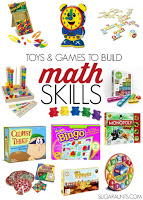
Math Toys and Games that Build Skills

math toys

Today we have a list of math toys that are some fun occupational therapy toys that build math skills. In OT sessions, we might not teach math, specifically, but we do support individuals in IADLs such as cooking, balancing a budget, shopping, and safety (among every other area of living!). And guess what, each of these areas require a knowledge and use of math!

Amazon affiliate links are included in this blog post. As an Amazon Influencer, I earn from qualifying purchases.

WHy Math Toys?

So when math impacts function and safety, occupational therapists might come up with adaptations and modifications for the functional task. However, we can also recommend PLAY (another functional area!) as a tool to develop and target the area of math so the individual can function.

In the schools, occupaitonal therapists support the education of students. When specific math toys might build on underlying areas through movement, OTs might recommend a specific toy.

These math toy suggestions can work for educators and parents looking for multisensory learning, as well!

Math toys support fine motor STEM skills. More schools and curriculum are incorporating STEM and STEM lessons into the school environment, and math is an essential piece of that equation. Occupational therapy can appreciate this because STEM and STEAM also involves fine motor skills!

If we can combine math skills with play, AND developing areas such as working memory and fine motor skills, we have a powerful math toy!

After a long day of school, kids just do not want to practice more math facts.  Their brains are exhausted from being “on” all day, and they need to relax with movement and fun.  But sometimes, kids need extra help with practicing math concepts.  So, how can you work on important skills when the kids are just over memorizing math facts and flashcards?

Math Toys


You play!  These are the best toys and games that build math skills and are not only fun, they are going to work on math concepts.  These math activities are playful and fun and will help with addition, subtraction, multiplication, division, sequencing, patterns, money, and time.  We’ve got math games to fit all ages and stages.  These are the toys I’m looking at this year and have more than a few on my shopping list!


These games and toys will sneak in the math and kids won’t even realize they are learning!


Toys and games for kids to build math skills: Patterns, shapes, addition, subtraction, multiplication, division, time telling, and money.


Math Toys and Games

This post contains affiliate links.

Money Games and Toys
These math activities work on many skills.  When a child counts money, they work on addition and subtraction facts, mental math, and real-life practice.  These games and toys are perfect or kids who are interested in money.
 
Clumsy Thief math game (affiliate link) is a fast paced money counting game. It’s a Best Toy award winner and on our list this Christmas!


Pattern Games and Toys 

 
Teddy Bear Counting (affiliate link) is a fun patterning and counting book. It’s hands on learning in a bright and colorful book. 


Use Baby Bear Counters (affiliate link) with the book. Although, my kids are fond of using Teddy Graham Crackers (affiliate link)with this book, too!


Sequencing Games and Toys

 
The Occupational Therapist in me loves this Melissa & Doug Bead Sequencing Set (affiliate link) for it’s fine motor and extended wrist components! Kids can work on first, second, third sequencing terms while threading beads and also patterns with this wooden toy.
 

Counting and Number Toys and Games 

One of my favorite math (and fine motor) recommendations is Avalanche Fruit Stand Game. (affiliate link) Kids can count and match fruit while using tweezers on an inclined surface. It’s an Occupational Therapist’s dream tool. 

Learning Resources One To Ten Counting Cans (affiliate link)
is perfect for preschoolers who are learning one-to-one correspondence, number identification, and counting skills. 


Every child loves cookies. This Counting Cookies (affiliate link)
game builds basic math counting skills with cookies and a cookie jar. 


Mini Muffin Match Up (affiliate link) is another fine motor math game that encourages sorting, counting, and matching. 

Shape Identification Toys and Games 

This Shape Sorting Cupcakes (affiliate link)
is another preschool game that will work on beginning math skills. Kids can practice shape identification while practicing fine motor skills.


Addition and Subtraction Games and Toys

 
ThinkFun Math Dice Jr. (affiliate link) helps kids with mental math and subsidizing. Dice games are a favorite in our house and there is a reason why: Kids love to throw dice! But what they don’t know is that when they are counting and adding the numbers on the die, they are practicing basic math skills.


Monopoly Junior (affiliate link) is great for kids aged 5-8. We just recently started playing Monopoly to work on addition and subtraction and it’s a hit!

Multiplication and Division Toys 

Sumoku (affiliate link) uses colorful tiles and requires players to figure out multiples of the number on the die.


Say Cheese (affiliate link) teaches multiplication skills in a mouse and cheese race game.

Time Telling Toys 

Teaching kids to tell time requires hands-on learning. This Telly the Teaching Time Clock (affiliate link) is a great beginner time telling tool and is perfect for a bedside clock for kids! (This is totally another gift I’m getting my kids this year!) 


We’ve got this Melissa & Doug Shape Sorting Clock (affiliate link)
and love it for the shape puzzle and for teaching time telling concepts.


Fractions Math Toys

Learning Resources Pizza Fraction Fun (affiliate link) introduces kids to fractions and has multiple ways to play for more fraction challenges including adding and subtracting fractions. 


Work on more fraction skills with Fractions Bingo Game. (affiliate link)


Did you find some new gift ideas?  What is on your shopping list this year?


2nd Grade Mental Math Adding 10s and 100s with a Harvest Theme

Worksheets and kids are a tough mix.  My second grader plows through a long school day and then brings home a math wroksheet (among other homework items) almost every weekday.  We do the worksheet, but sometimes it’s hard to practice the math concepts when she needs to just practice new math ideas.  One of the strategies she’s learning in second grade is Mental Math. 


Mental Math is simply doing math in one’s head, mentally (makes sense, right?) It’s the way that we figure out answers to math problems quickly, and without pencil and paper.  So, in second grade, my daughter’s been learning how to add 10’s and 100’s to single and double digits using mental math as a strategy.


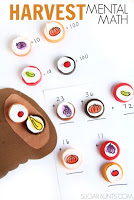
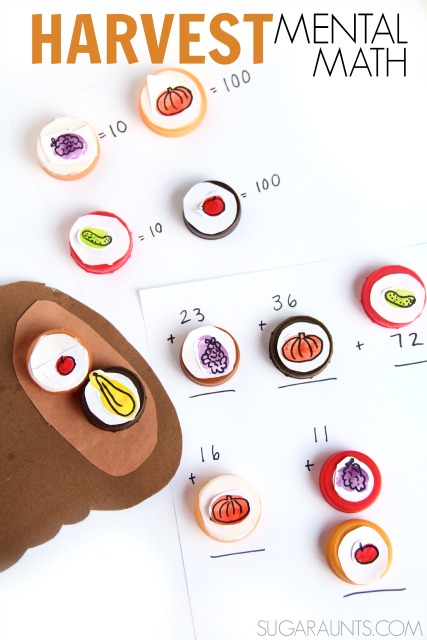
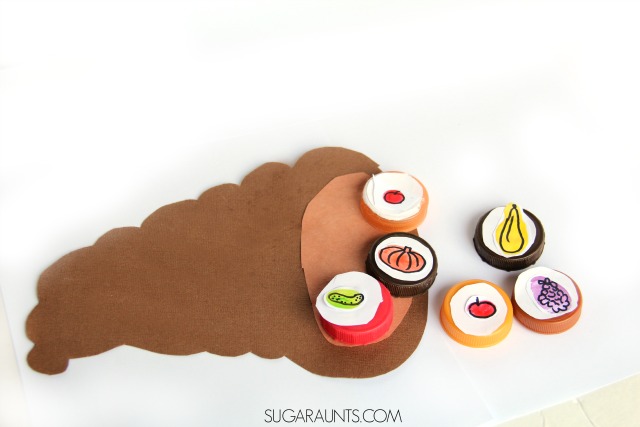
This Harvest themed Mental Math activity was a fun one to create and even more fun to use.  We made harvest-themed fruits and vegetables and a cornucopia craft to go along with the math practice.


Second grade mental math strategy to add 10s and 100s to digits with hands on learning in this creative Harvest-themed activity. I love the cornucopia craft!

Harvest Themed Mental Math Activity

You’ll need just a few materials to make this activity. (Affiliate links are included in this post.)
Brown cardstock

Recycled bottle caps
Glue
Label Sheets

Fingerpaints

White printer paper
Black permanent marker
Scissors


Second grade mental math strategy to add 10s and 100s to digits with hands on learning in this creative Harvest-themed activity. I love the cornucopia craft!


Make a cornucopia shape from the Brown cardstock.  On the printer paper, use the finger paints to make fingerprints in red, yellow, orange, green, and purple.  You can read all about the importance of creating fingerprint art over here.  It’s a great fine motor activity that really works on a child’s finger isolation skills and helps with tasks like handwriting, shoe tying, typing, and more.

Second grade mental math strategy to add 10s and 100s to digits with hands on learning in this creative Harvest-themed activity. I love the cornucopia craft!


Allow the fingerprints to dry and use the black marker
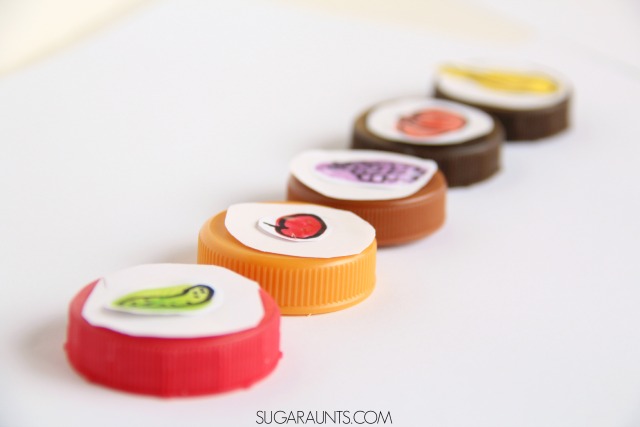
to turn them into fruits and veggies.  We made tomatoes, pumpkins, squash, grapes, and a pickle. 


Every cornucopia needs a pickle, right?


Cut out the harvest crop into small circles.  This was a great scissor skill activity for my preschooler.  We also cut circles from the Label Sheet
and stuck them onto the bottle caps.  Then, glue the fingerprint circles onto the bottle caps.  You could certainly skip the bottle cap step and just use the fingerprints, if you like.


Second Grade Math: Adding 10’s and 100’s

Second grade mental math strategy to add 10s and 100s to digits with hands on learning in this creative Harvest-themed activity. I love the cornucopia craft!


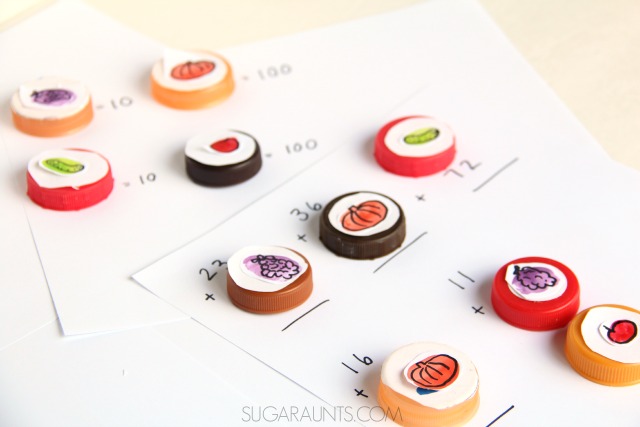
Adding digits while lining up the tens and hundreds column is a little tricky for some kids.  This activity was a way to help with that and make it a little fun with a harvest theme.


I made a code for my second grader to figure out.  Each fingerprint fruit or vegetable equaled either 10 or 100.  We then chose numbers to add to the pumpkins, tomatoes, grapes, squash, and pickles.


Adding tens and hundreds this way made it a little more fun to practice mental math!


NOTE: I wasn’t able to get any pictures of my second grader doing this activity because of the dark light we’ve got after 4:30 pm.  Fall means yummy harvest fruits and vegetables and gorgeous colored leaves…but it also means darkness at 5:00 pm!  Yuck!


Looking for more HARVEST themed activities for your second grader?   Try these from the 2nd Grade Blogger Team:

 
Harvest Vegetable Soup from Crafty Kids at Home


Saving Seeds Science from Rainy Day Mum
Scarecrow Glyphs Patterns from Still Playing School


We love creative math activities!  Here are some of our favorites: 


Kindergarten Sight Words Cloud Dough

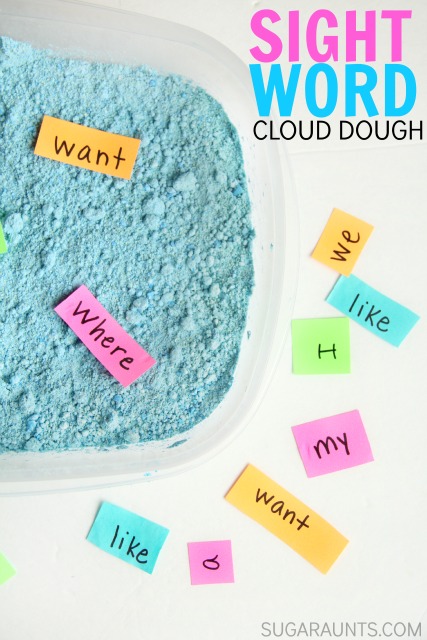
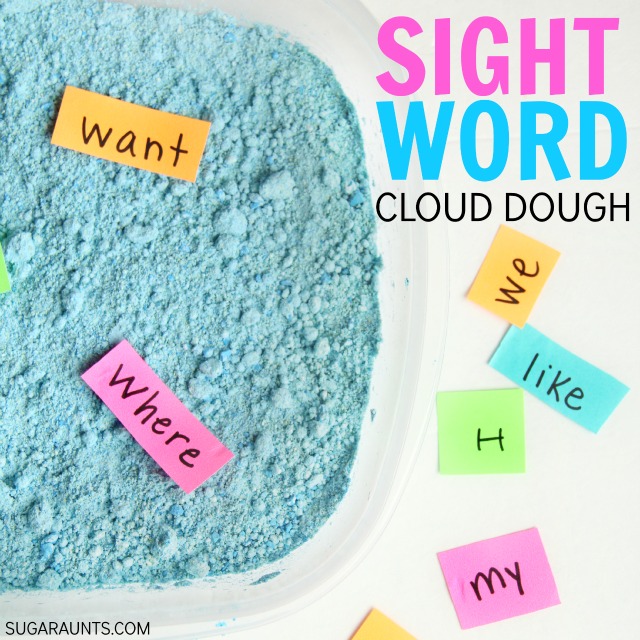
We’ve done quite a few sight words activities on this site.  What’s cool is that the activities that we did with my now second grade daughter are still fun and working great with my kindergartner son this year.  Today, I’ve got a sensory sight word activity using Cloud Dough.


Adding a tactile (and sensory) approach to sight words may just help the memorization of words “stick”.   We made this cloud dough that was brightly colored and smelled great using a few materials we had in the house.

Sight word sensory bin with cloud dough made with baby oil and baby powder

 Cloud Dough Recipe for Sensory Exploration

To make the cloud dough, we used just a few ingredients (Affiliate links are included in this post):
3 cups Baby Powder
1/2 cup Baby Oil
2 sticks of Sidewalk Chalk
 
Mix the baby powder and baby oil with your fingers.  Use a Kitchen Mallet to crush the chalk into dust.  
This is an EXCELLENT proprioceptive activity that the kids really got into.  Smashing that chalk into smithereens requires a lot of muscle power and “wakes up” the muscles to the heavy work of pounding that hammer.  Try this pounding activity before a quiet and calming activity like writing.
 
Sprinkle the chalk dust into the cloud dough and mix by hand.  You can play with the cloud dough without the chalk dust, but we wanted a bright blue color.  
 
It took us a little bit of experimentation, (and blue hands), but we found out that mixing liquid food coloring into the cloud dough (even mixed into water or mixed into extra oil) will not give this sensory dough a bright color.  Instead, you’ll end up with dyed hands.
 
Now, start playing!


Cloud Dough Sight Word Activity

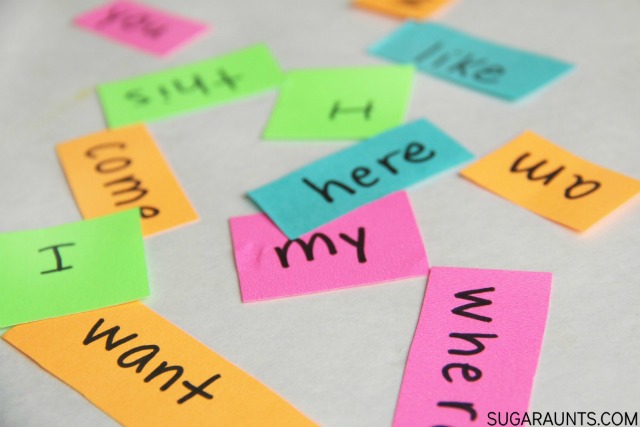
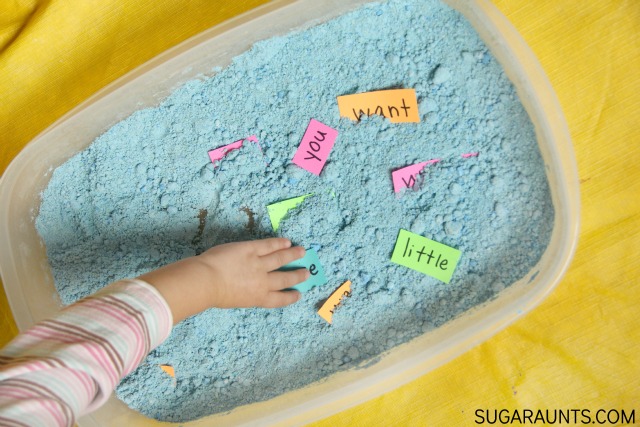
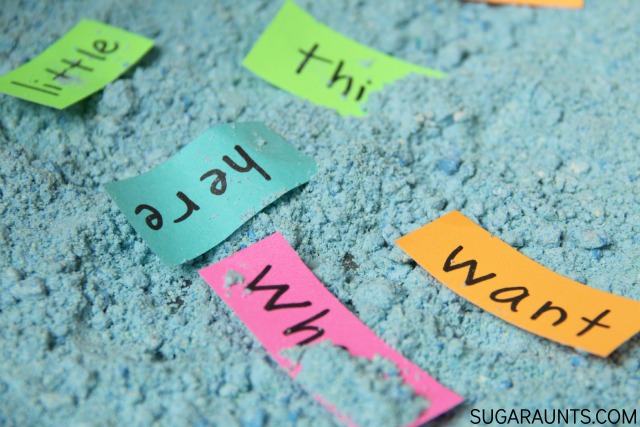
Cloud dough is very fun.  It’s moldable and a great sensory dough to explore.  We decided to add sight words to this sensory bin.  I used bright index cards to write out Kindergarten sight words.  We cut the words into smaller sizes and hid them in the cloud dough. 


To play sight word games with Cloud Dough:

Sight word sensory bin with cloud dough made with baby oil and baby powder
Write two sets of sight words.  Play different games.  Some of our favorite games to play with sight words can be done right in the cloud dough:
  • Play Memory with the sight words in the cloud dough.  Hide and turn the sight word cards in the dough.  Take turns looking for matches.
  • Scatter one set of sight words in the dough and the other set outside of the sensory bin.  Take turns quickly looking for matches of words.
  • Create small balls of cloud dough.  Push the cards into the dough and stand words up.  Ask your child to read the words and smash the cloud dough balls. This game is always a hit with the kids.
  • Play Hide and Seek for sight words in the cloud dough.
Sight word sensory bin with cloud dough made with baby oil and baby powder
 
We love creative sight words activities!  Here are some of our favorite ways to work on name practice in kindergarten through hands-on play.

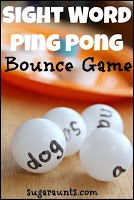
                                    Sight Words Ping Pong Bounce Game
                                                   Sight Word Scooping 
 
Sight word sensory bin with cloud dough made with baby oil and baby powder

Love this idea? Share it on Facebook!

Homemade Udon Noodles and Shrimp Dinner Recipe

Have you been following along as we cook our way through the alphabet? We’ve been cooking a recipe for each letter and are up to U for Udon noodles. “U” is a pretty difficult letter to cook around.  Urchins, anyone?  The cooking with kids team decided to give Udon noodles a try.  


The kids and I headed off to the grocery store but weren’t able to find udon noodles.  Now, I’m sure they were available somewhere in the city.  But, I’m not about to drag four kids around on a Udon noodle search.  We decided to make our own!


Homemade Udon Noodle Recipe

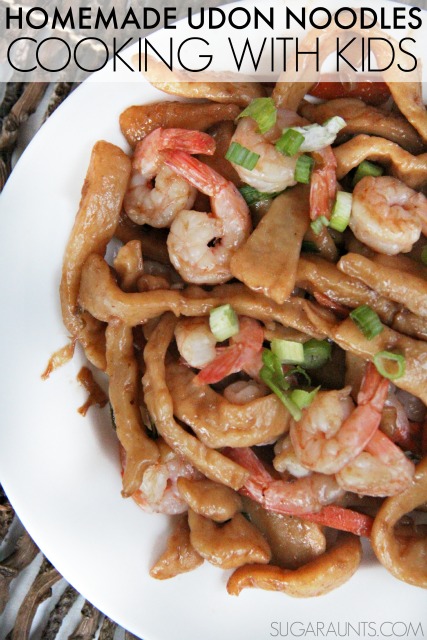
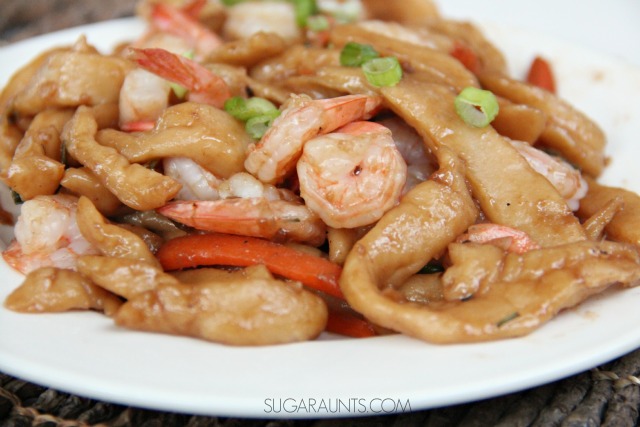
Homemade Udon Noodles Recipe and shrimp dinner. This si so good and easy to make. The kids will love this Cooking with Kids recipe and will eat up this Japanese dinner recipe!

This post contains affiliate links.  
I had to look up a recipe for udon noodles and based ours on this one.  I changed the amounts around, and I’m not sure how authentic our recipe ended up being, but the noodles sure were good! 

Ingredients needed to make udon noodles:

1 teaspoon salt
2/3 cup water
1.5 cups flour

Homemade Udon Noodles Recipe and shrimp dinner. This si so good and easy to make. The kids will love this Cooking with Kids recipe and will eat up this Japanese dinner recipe!
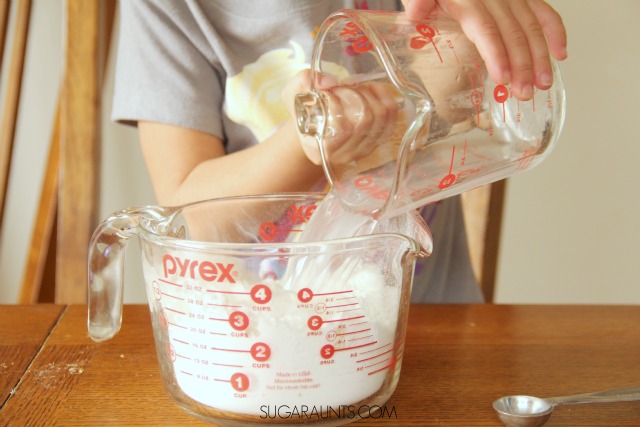
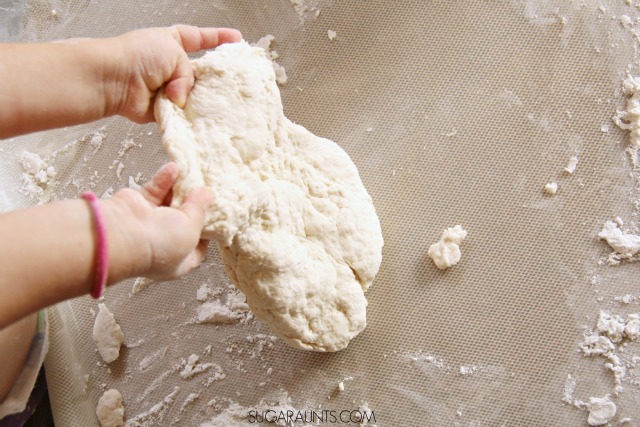
First, stir the salt into the water until dissolved.  Pour the salt water into the flour.  Combine with your fingers until the flour pulls together.  Knead the dough on a floured surface until smooth.  This dough will be lumpy and tough to knead, but keep at it. 

Homemade Udon Noodles Recipe and shrimp dinner. This si so good and easy to make. The kids will love this Cooking with Kids recipe and will eat up this Japanese dinner recipe!
The recipe we referenced above used a foot method to knead the dough.  We skipped that, and just kneaded with our hands on the floured surface like our Baking Mat
 It took a lot of oomph, but we had a lot of little hands that wanted a turn kneading. 


Homemade Udon Noodles Recipe and shrimp dinner. This si so good and easy to make. The kids will love this Cooking with Kids recipe and will eat up this Japanese dinner recipe!
Use a Rolling Pin
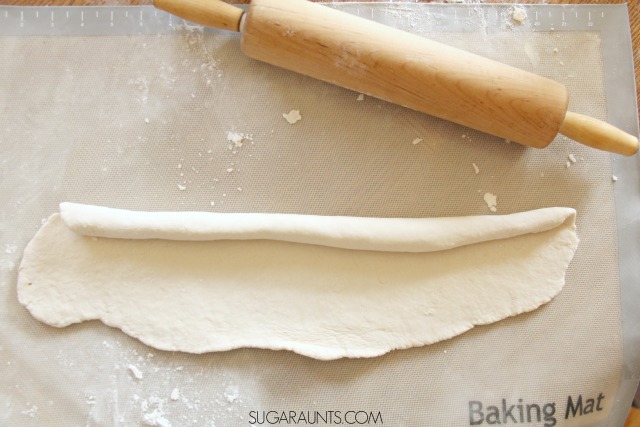
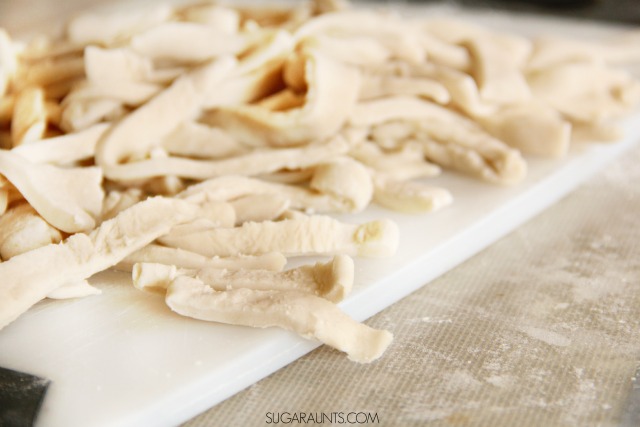
to roll out a rectangle of dough.  Roll or fold the dough over.  Use a knife to cut narrow strips of dough from the roll.  Unroll the noodles and separate them on a floured surface.


Homemade Udon Noodles Recipe and shrimp dinner. This si so good and easy to make. The kids will love this Cooking with Kids recipe and will eat up this Japanese dinner recipe!
Bring water to a boil in a large pan.  Drop the noodles in one by one.  Stir after a minute to keep the noodles from sticking together.  Allow the water to return to a boil and cook the dough until the noodles float. 

Once cooked, drain the water and rinse the noodles.

We used our udon noodles in a shrimp dinner.  

Shrimp and Udon Dinner Recipe

To make dinner with our udon noodles, we made the following recipe:
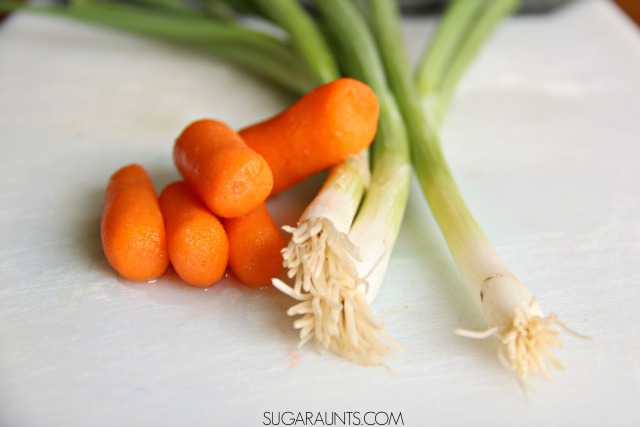
1 cup carrots, chopped into ribbons
3-4 green onions, sliced
1/4 cup low sodium soy sauce
1 clove garlic, chopped
1 pound shrimp, cooked

Homemade Udon Noodles Recipe and shrimp dinner. This si so good and easy to make. The kids will love this Cooking with Kids recipe and will eat up this Japanese dinner recipe!
Saute the garlic in olive oil.  Add the ribboned carrots and sliced green onions, saving some green onions for garnish.  Allow these to cook for 5 minutes until softened. Add the soy sauce, cooked udon noodles, and cooked shrimp.  Stir and toss all ingredients for 2 minutes.  Add green onion garnish and serve immediately.

This dinner was a hit with all four kids.  While our noodles didn’t look perfect (in fact, they looked pretty bad!), the dish was delicious.  Our udon noodles were thick and chewy.  This is a dinner we’ll be making again.

Homemade Udon Noodles Recipe and shrimp dinner. This si so good and easy to make. The kids will love this Cooking with Kids recipe and will eat up this Japanese dinner recipe!
Stop back to see what the other bloggers on the Cooking With Kids team have made using udon noodles:

You’ll love these other recipes from our cooking with kids series:

Vegetable Quesadilla Recipe   Honey Nut Popcorn  Antipasto Skewers


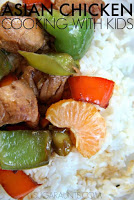
M is for MushroomsVeggie Quesadilla Recipe | N is for NutsHoney Roasted Nuts Popcorn | O is for OlivesAntipasto Skewer Kabobs | P is for Peppers: Asian Chicken

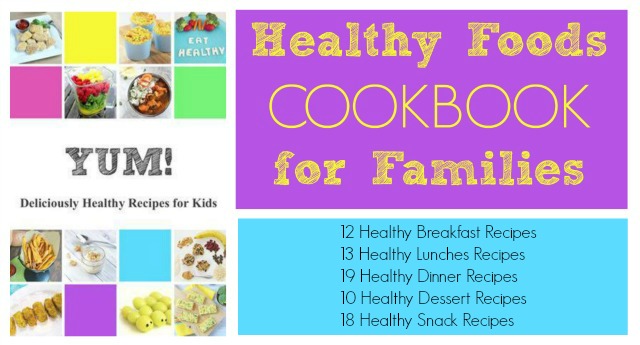
Want to cook healthy foods for your family?  Grab Yum! Deliciously Healthy Meals for Kids, a cookbook for busy families that want healthy meal ideas. 


Healthy recipes for kids

To-do Lists and Coffee

Sometimes the to-do list is overwhelming.  There’s preschool pick-up, after school dance class, grocery list, work duties, laundry, grocery shopping.  It can get overwhelming.  The oh, so very boring items on the list seem to always be there.  Whether you write out a list on sticky notes or keep an on-going checklist in your brain, it can get stressful!  Then there is the dishwasher that needs unloading. Again.  And that laundry basket that needs folding. Again.  


It seems like I’ve been in a flurry of rushing from list to list.  Because my lists seem to get lost before all of the to-dos are checked off.  And so then I write another one, but it is weirdly longer than the first one.


Life with four littles is busy.  Doing homework with the older two is an adventure.  I set up the second grader with her math worksheet while helping the Kindergartener with his new sight words.  They are learning so much. So fast!  And while I catch my breath that my 8 year old is adding three double digits with re-grouping, the 4 year old spills a cup of water and the 17 month old decorates the living room with baby wipes, finds and hides the van keys, colors on the wall with crayons, and slips in the water spill.


I wouldn’t change it at all.  The busyness of lists and the chaos of family life is a blessing.


There are the pretty pictures of fun stuff we do on Instagram and the cute crafts we share on Facebook.  But behind the pretty stuff is the busy, tired, always running, and happy mama.  I kind of think the snuggles overpower all of the mess and spills.  The cuteness of sleeping babies after 8:30 pm is also a secret re-charging time for overwhelmed moms. Ha!


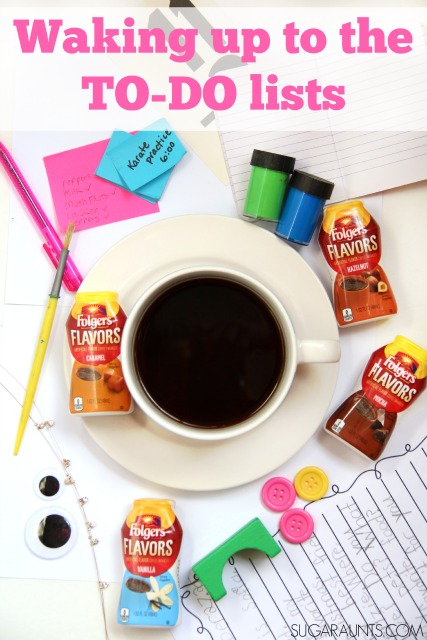
I am definitely going strong on the coffee when it comes to waking up with a full to-do list.  Tackling the day and wrangling four little kids is not easy!  The kiddos are charged and ready to go with just a bowl of cereal, but I have to admit that it takes a bit more for this sleepy mom.  Recently I was sent Folgers Flavors and was super beyond excited to try them all.


Do you wake up to more to-do lists?

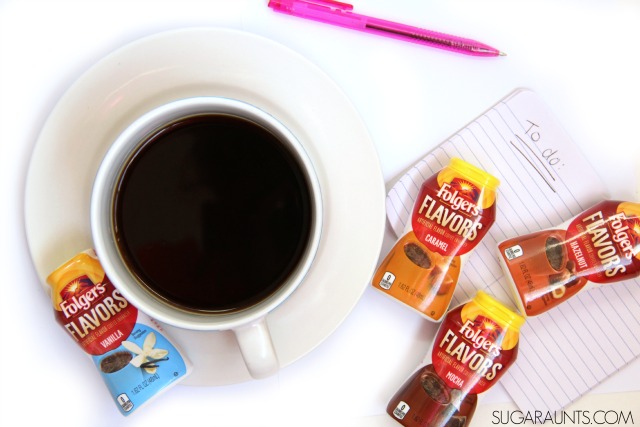
After the early (But why SO early??) morning snuggles from a certain 17 month old, there aren’t many things that trump my morning coffee.  I am a try-all-the-flavors of coffee creamer kind of girl, so the four flavors I was sent from Folgers Flavors was pretty awesome.  It was fun to try them all, and I felt like a kid in a caffeinated candy store.


So, what did I think of the flavored concentrates?


  • The squeezable bottle is conveniently small enough to fit in my over-full (but cleaning it is on my to-do list) cupboard.
  • I loved that I could stash a bottle of the concentrate in my bag for a weekend away and add flavor to my morning coffee.  The concentrates don’t need refrigerating, so it’s one less thing to worry about.  Bonus!
  • My favorite is the Mocha flavor (with both hot and cold coffee!) but the Vanilla, Hazelnut, and Caramel were really good, too.

Make Your Own Pick-Up Sticks and Work on Developmental Skills

Do you ever look around the house and think, “Why do we have so many toys??!!” 
 
If your house is like mine, your kids play with couch cushions, old cardboard boxes, and piles of paper, and cardboard tubes waaaay more than they play with toys.  Sometimes, it’s the simple things that are just more fun.

DIY Pick Up Sticks

 
These DIY Pick-Up Sticks are one of those items.  It’s a homemade toy that is just so simple, it’s simply appealing.  Not only are these bright and colorful pick-up sticks fun, they are easy to make, and are used in so many play and functional skill areas. 


DIY pick up sticks for kids (and adults!) You can make these any color and using items you probably already have at home, while working on fine motor skills like open web space, pincer grasp, precision grasp and release, in-hand manipulation, and visual perceptual motor skills like eye-hand coordination, visual motor, visual scanning, and visual memory.
 
Making these colorful pick-up sticks is easy peasy.  Read how we made them here.  Do you know what we used to make them?  Lollipop sticks.  Yep!  A simple lollipop stick is the perfect accessory to play dough, the ultimate letter building tool, counting manipulative, fine motor workout, and a fabulous visual motor item.
 
Today, you’ll see how we use them to play pick-up sticks.
 

How do you play Pick-Up Sticks?

It is super easy to play pick-up sticks.  Dump the sticks out on a table.  Attempt to pick up a stick without moving any other stick.  You can slide, pull, tug, or wiggle a stick, but you can not move any other stick.  If another stick moves, your turn is over.  The player with the most sticks at the end of the game winds.  
 

Skills worked on when playing pick-up sticks:

Ohhh, this is an Occupational Therapist’s dream tool.  If you know an OT, he or she probably has a set of pick-up sticks in her treatment bag or clinic supply closet.  There are so many skill areas worked on while playing pick-up sticks!
 
  • Hand-Eye Coordination
  • Visual Scanning Visually scan the pile and each player can pick up only one or two certain colors to make the game harder.
  • Visual Motor
  • Pincer Grasp is encouraged by picking up the sticks.  Children need a pincer grasp for managing items like zippers, buttons, and snaps.
  • Color recognition
  • Precision grasp and release is a needed skill for fine motor tasks and manipulating small items.
  • Open Web Space Picking up the sticks encourages an open space between the thumb and pointer finger, needed for handwriting.
  • Figure Ground
  • Spatial Relations
  • Visual Discrimination

If your child loves playing Pick-Up sticks, try these modifications and ideas:

Affiliate links are included.

  1. Play with Pipe Cleaners.  The fuzzy, bendable sticks make dexterity more difficult.  Don’t move any other pipe cleaners!
  2. Play with Glow Sticks.
    for a glow in the dark game of pick-up sticks.
  3. Try this set
    for a gift idea.
  4. This Melissa & Doug Suspend
    game builds sticks upward for a unique twist on the game of pick-up sticks. 
  5. Younger kids will love this Play Visions Pick Up Snakes
    with flexible snakes instead of sticks.
  6. Children that need a challenge will love this Playroom Entertainment Catch a Falling Star
    that is on a vertical plane. This game really works on the precision of grasp and release while encouraging an extended wrist. It’s an OT winner! 
  7. For more precision and fine motor fun, try Ker Plunk Game.
Make your own pick-up sticks with this DIY toy idea for kids.  There is so much leaning and developmental areas that you can work on with this simple idea: fine motor, dexterity, hand-eye coordination, open web space, precision of grasp and release, visual perceptual skills, and so many more ways!  Your Occupational Therapist will love this!


You will love to use your DIY Pick-Up Sticks like this: