Actividades para enseñar los colores

Enseñando los colores a niños en edad preescolar

Hay muchas maneras de incluir el juego multisensorial en la enseñanza de los colores a los niños. Aquí encontrarás formas prácticas y creativas de enseñar los colores del arco iris mediante juegos que ayudan a los niños a desarrollar sus habilidades, a moverse y a crecer. Utiliza estas actividades de colores en preescolar o para enseñar a los niños pequeños los colores. Es una forma divertida de desarrollar la capacidad de discriminación visual en los niños pequeños.
Enseñando los colores a niños en edad preescolar
Actividades multisensoriales para enseñar los colores a niños pequeños, preescolares y de jardín de infancia.

Incluyo actividades de color para niños de jardín de infantes y de edad escolar, también, porque estos temas de color pueden ser utilizados en actividades de terapia o para ayudar a los niños a desarrollar la escritura a mano, o las habilidades motoras visuales en los grados mayores. Aquí hay un montón de actividades divertidas y prácticas que ayudan a los niños a aprender los colores y a explorar a través del juego.
Actividades para enseñar los colores a los niños pequeños

Cómo enseñar los colores a los niños pequeños

El juego y el desarrollo de los niños pequeños consiste en la exploración práctica del mundo. Tenemos un montón de actividades para niños pequeños diseñadas para desarrollar las habilidades motoras y el aprendizaje aquí en el sitio web que usted querrá comprobar.

Para enseñar los colores a los niños pequeños, se trata de hacer las cosas divertidas. Estas actividades para niños pequeños le permitirán comenzar con actividades prácticas de desarrollo.

Muchas de las actividades relacionadas con los colores en los primeros años de vida implican la clasificación de colores, la identificación de colores y el señalamiento de colores. Todas estas actividades sientan las bases de la discriminación visual que los niños utilizarán más adelante en la lectura y la escritura.

Prueba estas actividades para enseñar los colores a los niños pequeños:

Esta actividad utiliza juguetes y objetos que se encuentran en el hogar, haciendo que la identificación de los colores forme parte de la vida cotidiana. Puedes utilizar elementos que el niño utilice y vea a diario.

Enseñar a clasificar los colores – Esta sencilla actividad de clasificación de colores es ideal para las familias que tienen un niño de preescolar y otro de corta edad. El niño de preescolar puede cortar láminas de espuma y trabajar la destreza de las tijeras y luego tanto el niño de preescolar como el pequeño pueden clasificar los restos de papel por colores. Esta es una bonita actividad que permite a los hermanos trabajar juntos para aprender conceptos y desarrollar habilidades juntos.

Bolsa de trabajo para clasificar por colores- A los niños pequeños les encanta dejar caer objetos en contenedores, y poner cosas en cubos, contenedores y bolsas… y luego volver a sacarlos. Todo forma parte del proceso de aprendizaje. Esta bolsa ocupada para clasificar colores les da a los niños pequeños palitos de colores para manualidades o palitos de piruleta teñidos y los hace clasificar por colores. También es una actividad estupenda para desarrollar la motricidad fina y la coordinación.

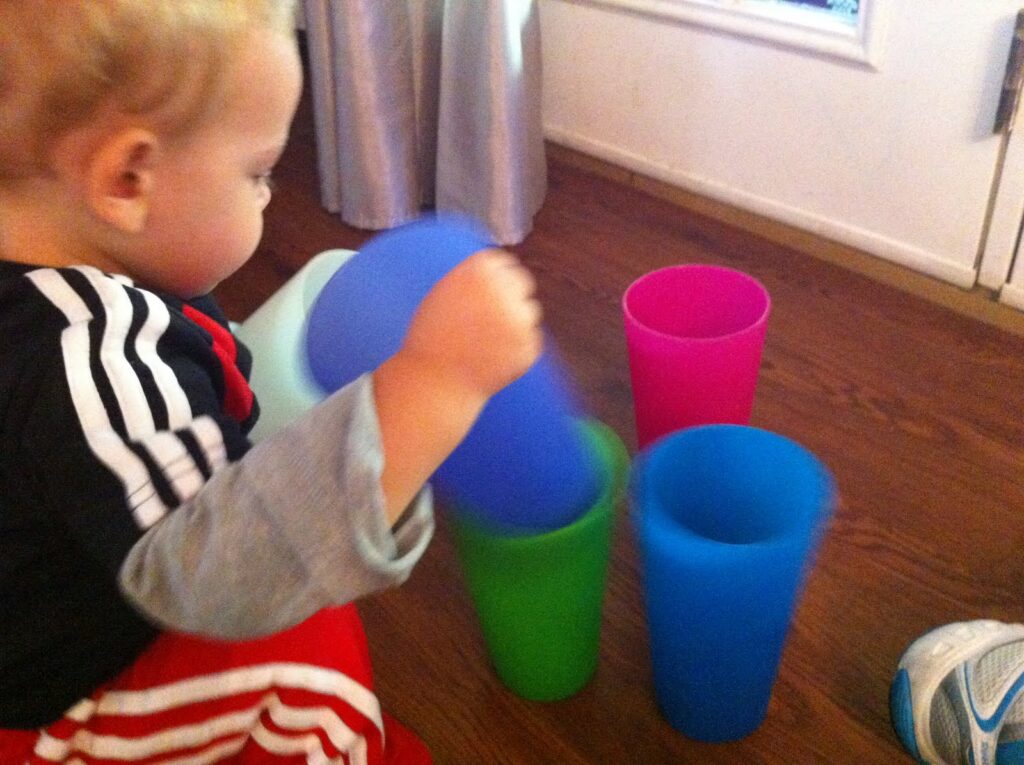
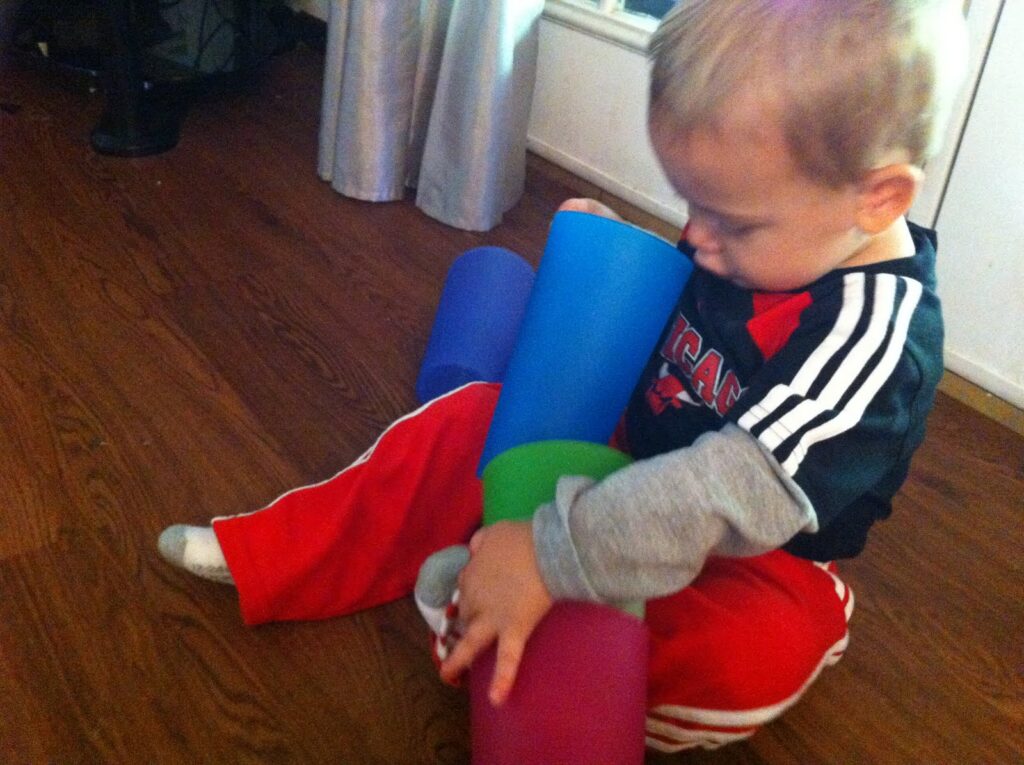
Clasificación de vasos para niños pequeños: esta actividad de clasificación por colores utiliza elementos del hogar, como los vasos de plástico para niños pequeños. Hay algo en los niños pequeños que juegan en la cocina con artículos seguros para el bebé… y éste construye habilidades de pre-alfabetización y pre-matemáticas que utilizarán durante mucho tiempo… ¡a través del juego!

Hablar de los colores – Señalar los colores durante el juego, la conversación, la lectura de libros y los paseos… hay muchas maneras de enseñar los colores a los bebés y a los niños pequeños a través de las conversaciones cotidianas. Es tan sencillo como decir “mira esa flor azul” para añadir términos descriptivos a los niños.

Colorear con la pintura: incorpore todos los colores del arco iris en actividades multisensoriales desde una edad temprana. Estas actividades de juego artístico incorporan los colores en el juego y el aprendizaje a través del arte con los niños pequeños.

Enseñar los colores con una piscina debolas- Utiliza las bolas de una piscina para bebés. Puedes llevar una piscina para bebés dentro de casa como una piscina de bolas para enseñar los colores.
Enseñar los colores a los preescolares con actividades de aprendizaje multisensorial

Enseñando los colores a niños en edad preescolar

En la etapa preescolar, los niños comienzan a desarrollar la capacidad de reconocer e identificar colores. En este momento del desarrollo, el enfoque está en la exposición, la repetición y la interacción significativa con los colores en actividades cotidianas.

Desde el punto de vista del desarrollo, los niños en edad preescolar están fortaleciendo:

  • Habilidades de percepción visual (notar diferencias entre colores)
  • Desarrollo del lenguaje temprano (aprender los nombres de los colores)
  • Atención y memoria (recordar información sobre colores)
  • Formación de conceptos (entender que el color es una característica de los objetos)

En esta etapa, es común que los niños puedan reconocer un color antes de poder nombrarlo. También pueden confundir colores similares o usar los nombres de los colores de manera inconsistente, lo cual es parte normal del desarrollo.

Por qué es importante enseñar los colores en preescolar

Enseñar los colores en preescolar apoya:

  • El desarrollo del lenguaje y la comunicación
  • La capacidad de seguir instrucciones simples
  • La participación en el juego y las rutinas diarias
  • La preparación para habilidades académicas futuras

El aprendizaje de los colores es más efectivo cuando se integra en el juego y en experiencias diarias, en lugar de enseñarse de forma aislada.

Cómo enseñar los colores a niños en preescolar

  • Usar repetición en las rutinas diarias (por ejemplo: “Aquí está tu vaso azul”)
  • Enfocarse en uno o dos colores a la vez
  • Relacionar los colores con objetos familiares
  • Utilizar actividades prácticas y sensoriales
  • Mantener el aprendizaje divertido y significativo

Actividades de colores para preescolar

  • Clasificar objetos por color
  • Emparejar bloques o juguetes de colores
  • Búsquedas de colores en el entorno
  • Pintura con los dedos usando pocos colores
  • Emparejar colores con pegatinas
  • Clasificar pompones por color
  • Emparejar objetos con vasos de colores
  • Cajas sensoriales con actividades de clasificación por color
  • Juegos de saltar al color indicado
  • Emparejar formas de colores
  • Usar marcadores de puntos para identificar colores
  • Clasificar crayones por color
  • Juegos de “Veo, veo” con colores
  • Emparejar piezas de rompecabezas por color
  • Rodar y emparejar pelotas de colores

Actividades de colores para kindergarten

En el nivel de kindergarten, los niños avanzan más allá de identificar colores básicos y comienzan a aplicar este conocimiento en actividades académicas. A esta edad, la mayoría de los niños puede nombrar colores con consistencia y utilizarlos en tareas estructuradas.

Desde el punto de vista del desarrollo, los niños en kindergarten están desarrollando:

  • Discriminación de colores (notar diferencias más sutiles)
  • Comprensión conceptual (entender que los objetos pueden tener diferentes colores)
  • Uso del lenguaje (describir y comparar colores)
  • Aplicación del conocimiento en actividades escolares

El aprendizaje de los colores en esta etapa apoya la lectura, las matemáticas y la participación en el aula.

Actividades de colores para kindergarten

  • Clasificación por color y forma
  • Gráficas de objetos por color
  • Creación de patrones con colores
  • Seguir instrucciones de varios pasos con colores
  • Búsquedas de colores con listas
  • Experimentos de mezcla de colores
  • Clasificar materiales del aula por color
  • Actividades de centros con códigos de colores
  • Emparejar tonos y degradados
  • Reconocimiento de palabras de colores
  • Resaltar palabras con colores
  • Dibujos dirigidos con colores específicos
  • Circuitos de movimiento con colores
  • Uso de materiales de colores en matemáticas
  • Clasificación por múltiples características (color y tamaño)

La enseñanza de los colores en preescolar

En la etapa preescolar, el aprendizaje se produce a través del juego. Estas actividades de aprendizaje del color están diseñadas para promover el aprendizaje a través de la exploración práctica, porque esas son las formas en que el aprendizaje “se pega”… cuando las manos están ocupadas y desarrollan las habilidades motoras que luego necesitarán para sostener y escribir con un lápiz. Veamos algunas formas de enseñar los colores en los años de preescolar:

Teaching Shapes and Colors with Rainbow Rocks by Fun-A-Day- Esta actividad es divertida porque utiliza el peso de las rocas para enseñar los colores y las formas. Pero, además, los niños fortalecen sus manos y obtienen información motriz sobre los objetos mientras exploran los colores y otros factores de discriminación como el peso y el tamaño.

Clasificación de colores y formas – Esta actividad preescolar de clasificación de colores ofrece a los niños experiencias de motricidad fina con wikki stix. Pida a los niños de preescolar que copien las formas, para que adquieran más habilidades motoras finas y la integración de la motricidad visual.

Ordenación de colores de motricidad fina – Coge un viejo recipiente de especias o de queso y unas pajitas. Esta actividad de clasificación por colores sienta las bases para el desarrollo de la motricidad fina y las habilidades matemáticas. Los niños pueden contar las pajitas a medida que caen en el recipiente y trabajar en la clasificación de colores mientras desarrollan el espacio de la red del pulgar abierto, la separación de los lados de la mano y la fuerza del arco.

Cubo de agua de colores – Esta actividad de aprendizaje de los colores es una actividad motriz sensorial que también enseña las letras. Es perfecto para el preescolar y el jardín de infancia o incluso para cursos superiores, ya que los niños se sumergen en el aprendizaje multisensorial con las letras y las habilidades de prelectura.

Combinación de colores con pinzas de la ropa – A los niños les encantará esta actividad de motricidad fina que desarrolla la fuerza de las manos a lo grande.

Libro y actividad “El oso ve los colores” – Aprovechamos la merienda para explorar los colores con un libro preescolar muy querido. Esto es el aprendizaje multisensorial en su máxima expresión.

Juegos de colores de motricidad gruesa – Hay muchas maneras de explorar y enseñar los colores usando juegos. Prueba algunas de estas opciones para añadir movimiento y juego al aprendizaje de los colores en el nivel preescolar:

  • Color I Spy- Diga un color y los niños pueden correr a tocar algo que sea de ese color. Añade variaciones de movimiento pidiendo a los niños que salten, salten, se arrastren o caminen como un oso para tocar los colores.
  • Colorea lo que dice Simón – Llama a las direcciones basándote en los colores de la ropa que llevan los niños. Añade tantas variaciones de movimiento como desafíos auditivos. Se trata de una actividad estupenda para desarrollar las habilidades de la memoria de trabajo en los niños de preescolar.
  • Color Tag- Los niños pueden jugar a la etiqueta y cuando marcan a otro jugador, tienen que decir un color para que esa persona vaya. Otra variante es hacer que los jugadores que son marcados corran hacia un color que el etiquetador llama.
Enseñar los colores a los niños de la guardería con actividades de aprendizaje multisensorial.

Enseñar los colores en el jardín de infancia y en los cursos superiores

Una vez que los niños están en edad escolar, la enseñanza de los colores no termina. En los años escolares, los niños exploran la mezcla de colores, el aprendizaje de los colores primarios y mucho más. Mira todas estas experiencias de color que los niños aprenden durante los años escolares:

  • Ortografía de los nombres de los colores
  • Aprender los colores primarios
  • Aprender los colores secundarios
  • Mezcla de colores
  • Teoría del color
  • Rueda de colores
  • Colores complementarios

Prueba algunas de estas actividades de color para niños mayores:

Color I Spy Esta búsqueda del tesoro con temática de colores hará que los niños se pongan en movimiento, utilizando los objetos que tienen en su casa mientras trabajan las habilidades de percepción visual, la escritura y mucho más. Los niños pueden escanear visualmente su casa para que coincida con los colores de la pizarra. Además, hay un componente de escritura a mano. Este es un gran paquete de diapositivas para cualquier persona que trabaje en las habilidades de escritura a mano con los niños, virtualmente.

Ejercicios de color – Utiliza ejercicios de motricidad gruesa y estiramientos, así como ejercicios de motricidad fina, para que los niños se muevan mientras trabajan en tantas áreas de habilidades: coordinación bilateral, planificación motriz, fortalecimiento, fuerza central, precisión, destreza, habilidades motrices visuales…

Ejercicio de respiración profunda del arco iris – Este PDF imprimible gratuito es muy popular. Hay una razón: a los niños les encanta la actividad de respiración profunda y a nosotros nos encantan los beneficios de la atención plena, las habilidades de afrontamiento, la calma y la regulación. Genial para todas las edades.

Manualidad de prismáticos arco iris – Los niños pueden utilizar los tubos de papel de cocina en una manualidad que les ayuda a buscar e identificar los colores. Utiliza estos prismáticos arco iris en la exploración visual, la discriminación visual, la figura-fondo visual y otras habilidades perceptivas.

Actividades con lápices de colores – Todo lo que necesitas es un par de lápices de colores (o sustituirlos por un lápiz normal si es lo único que tienes a mano) para trabajar el control del lápiz, la conciencia del trazo, la presión del lápiz y la formación de las letras.

Beneficios de colorear con lápices de colores – Basta con coger una caja de lápices de colores para desarrollar muchas habilidades motoras finas y visuales.

Hacer plastilina con crayones – Explorar los colores con un trabajo intenso a través de las manos y los brazos utilizando todos los colores del arco iris. Esta receta de plastilina con crayones es una receta sensorial muy popular aquí en el sitio web.

Colleen Beck, OTR/L has been an occupational therapist since 2000, working in school-based, hand therapy, outpatient peds, EI, and SNF. Colleen created The OT Toolbox to inspire therapists, teachers, and parents with easy and fun tools to help children thrive. Read her story about going from an OT making $3/hour (after paying for kids’ childcare) to a full-time OT resource creator for millions of readers. Want to collaborate? Send an email to contact@theottoolbox.com.
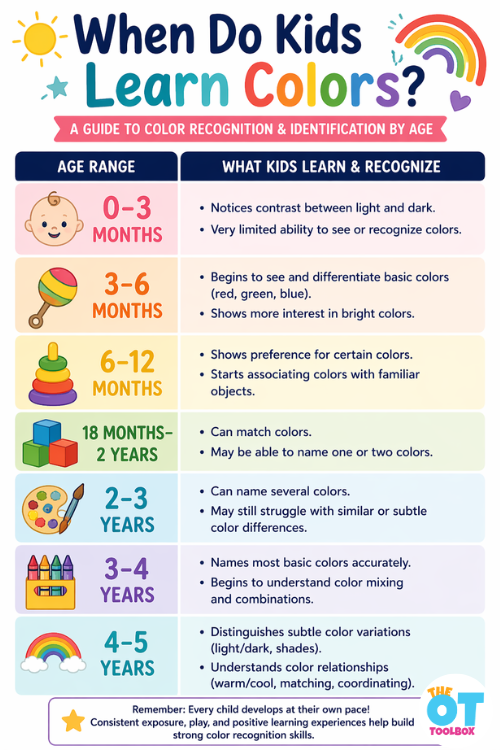
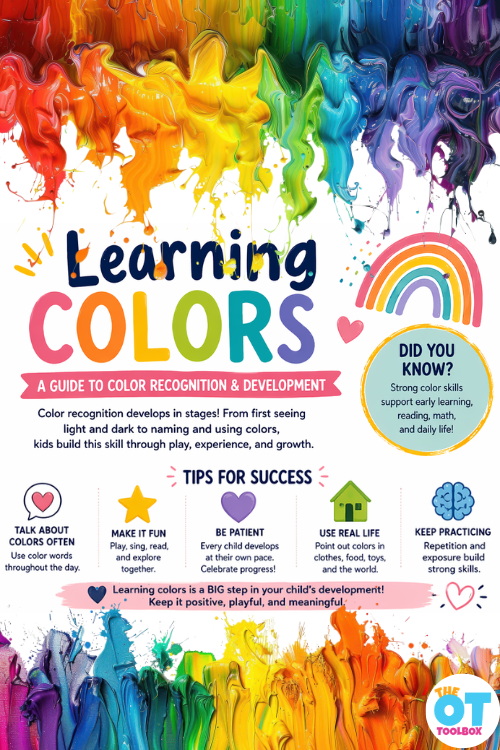
When do Kids Learn Colors? Color Recognition in Child Development

when do kids learn colors

As an occupational therapist, I look at color learning as more than just an early academic milestone. The ability to recognize colors, name colors, and use colors is directly connected to how a child participates in everyday activities. And, we use these skills in every therapy session! Think about a typical therapy session: pick up the green craft pom poms and sort them into the green cup. This is a visual perceptual skill and we use these multi-step directions as part of our skill therapy interventions. Or, maybe we use the colors of the Alert program when working on self-regulation. Then, we use color directions to work on handwriting skills (stop at the red baseline on modified paper).

These are just some of the ways that colors come into our therapy sessions.

Color recognition activities

This is a recently updated article where we’ve added a ton of information on color recognition, because it’s something we can use in occupational therapy as a tool to support development through play. (example: a color sorting activity for toddlers or a creative painting for our older kids)

Color recognition in child development

But, maybe the most important reason we need to address color recognition in occupational therapy is that when we work with children, we are working with the whole family, and parents have questions about child development! We are often-times the go-to expert within reach of that parent who has many questions about their child’s development. We might be the only professional a parent feels comfortable enough to ask questions like,

“When do kids learn colors?” Or,

“When do babies learn colors?”
“When should my child know their colors?”

Color learning shows up in daily routines more than we often realize. A child is expected to “grab the red folder,” “find the blue marker,” or “sort the toys by color.” These directions require not only color recognition, but also attention, expressive language processing, and the ability to act on that information. When a child struggles with color identification, it can impact independence, confidence, and overall task performance.

When children develop strong color recognition skills, they are better able to follow directions, engage in classroom tasks, and interact with their environment in meaningful ways.

We cover more on vision’s impact on learning in a related article. You’ll want to check that out as well.

In school settings, color is often used as a visual cue to support learning. Worksheets, charts, schedules, and early reading materials rely heavily on color coding. If a child has difficulty with color perception or identifying colors, they may miss important visual information, which can affect participation in learning activities.

As parents, we are constantly amazed by the curiosity displayed by our toddlers. Every day is an opportunity for them to discover something new, and what better way to nurture their inquisitive minds than by introducing them to the vibrant world of colors?

Learning colors is not only an engaging and exciting experience for toddlers, but it also plays a crucial role in their overall cognitive and sensory development.

Learning colors activities for color identification in child development

Learning Colors

In the toddler years, learning explodes. And when toddlers learn colors, it’s a great chance for them to show off their skills and expand their vocabulary.

We will share a few creative activities about teaching colors to toddlers, but also share a wonderful experience with one of our own little ones!

Here’s the thing: colors are everywhere around us, from the blooming flowers in the garden to the vibrant pictures in storybooks. For toddlers, grasping the concept of colors is a significant milestone in their early development. Describing the world around them is very much a part of their environment, and this is something we really focus on in occupational therapy.

Understanding colors helps children enhance their visual discrimination skills, develop language and communication abilities, and stimulate their creativity.

And, (this is important as an OT), learning colors supports cognitive growth by promoting executive functioning at an age-appropriate level, pattern recognition, and memory retention.

It also lays the foundation for more advanced concepts, such as color sorting, classifying, and categorizing objects based on their attributes.

Not to mention, we love the power of a simple pack of crayons as an OT tool…and naming and finding the colors in a box of crayons is a powerful eye hand coordination activity in itself!

when do kids learn colors

Color Recognition in Child Development

Color recognition is a foundational visual perceptual skill that develops gradually in early childhood. It involves both the ability to visually detect color differences (color perception) and the cognitive ability to label and categorize colors (color identification).

In child development color recognition, children move from simply noticing visual contrast (light vs. dark) to recognizing, naming, and applying colors in meaningful ways. This process is influenced by visual system maturation, language development, memory, and experience with the environment.

From an occupational therapy perspective, color recognition supports:

  • Early learning and reading colors in books and materials
  • Sorting, categorizing, and problem-solving
  • Following directions (e.g., “grab the red crayon”)
  • Participation in classroom tasks

Color Perception: The Early Foundation

First, let’s talk about vision in babies. There is a lot happening in this developmental process, from birth, especially with vision in general. Part of it is spatial awareness that babies develop, and the development of aspects of the eye, too.

Color perception begins in infancy as the visual system develops. Research shows that babies are not born with fully developed color vision. Instead, their ability to perceive color improves over time as the retina and visual pathways mature.

In early infancy:

  • Babies first detect light and dark contrast
  • Color vision emerges gradually as cone cells in the retina develop
  • Neural pathways between the eyes and the visual cortex strengthen

By around 3-6 months, infants begin to differentiate basic colors such as red, green, and blue. This early perception is the foundation for later color identification in child development.

So When Do Babies Learn Colors?

Parents often ask, “when do babies learn colors?” The answer is that babies begin seeing colors early, but understanding and naming colors comes much later.

  • 0-3 months: Detects contrast (light/dark), limited color perception. This is why we see so many baby toys or books that are black and white or black, white, red. These bold colors contrast and are appropriate for the babies’ vision at this stage.
  • 3-6 months: Begins to differentiate basic colors
  • 6-12 months: Shows preference for certain colors

At this stage, babies are developing visual awareness. They are not labeling colors yet. Exposure to colorful toys, books, and environments supports this early stage of color perception.

When Do Kids Learn Colors?

Another common question that comes up is, “when do kids learn colors?”

The quick answer is that kids learn colors at a really young age…even before they can speak! You can start to see young babies sorting colors.

This question is probably related to the toddler stage when kids are starting to follow directions like get your green boots, or pick a blue shirt, or find your other yellow sock. Or, we might see small kids starting to name various items like book, dog, ball, etc. At this point, parents can start expanding their child’s vocabulary by adding the adjective of a color. They can say, “pick up the red block” instead of just “Pick up the block”. In this way, we can help kids to start using a larger vocabulary, AND we are helping them build neural connections in the brain to expand their learning. It’s really cool when you think about how much a small child can and does learn, right?

Color learning happens over several years and depends on both cognitive and language development.

Most children begin:

  • Recognizing colors before they can name them
  • Learning color names through repetition and exposure
  • Using color words meaningfully between ages 2-4

Be sure to check out our article on baby brain building, because this is one of my absolute favorite activities to do with babies, especially at the 1-2 year stage. They are learning SO much and it’s really cool to see in action.

When Should Kids Know Colors?

So let’s rephase the question above to when SHOULD kids know colors. Because this is a different concept.

By preschool age, many children can identify and name basic colors, though consistency varies.

Parents and educators may wonder, “when should kids know colors?” While there is a developmental range, general expectations include:

  • 2-3 years: Begins naming a few colors
  • 3-4 years: Names most basic colors consistently
  • 4-5 years: Understands color relationships and variations

If a child is not recognizing or naming colors by age 4-5, it may be helpful to provide more structured opportunities for learning or consider underlying visual or language factors.

Color Identification in Child Development

Color identification child development involves more than just seeing color. It requires:

  • Visual discrimination (telling colors apart)
  • Memory (recalling color names)
  • Language (labeling colors)
  • Cognitive flexibility (understanding that objects can vary in color)

Children often learn colors best through meaningful experiences rather than isolated drills. For example, identifying the color of a favorite toy or choosing a color during play is more effective than rote memorization.

How to Learn Colors Through Play

If you’re wondering how to learn colors, the most effective approach is through play and daily interaction.

Try:

  • Sorting objects by color
  • Matching colored items
  • Reading books that highlight colors
  • Using art activities like painting and coloring
  • Playing games that involve color choices

From an OT perspective, multisensory learning (seeing, touching, moving) strengthens color learning and retention.

Engaging Activities to Learn Colors:

  1. Sensory Play: Encourage your toddler to explore colors through sensory activities like finger painting, playing with colored playdough, or sorting objects by color. These hands-on experiences not only stimulate their senses but also strengthen their fine motor skills.
  2. Color Walks: Take your little one on a family nature walk with a color-themed adventure outdoors. Spot colorful flowers, birds, or vehicles and engage them in identifying and naming each color they encounter. This activity not only encourages outdoor exploration but also helps them make connections between colors and the real world.
  3. Color Sorting Games: Set up simple sorting games using colored blocks, buttons, or toys. Your child can enjoy sorting objects into different color groups, enhancing their cognitive abilities while having fun.
  4. Rainbow Crafts: Engage your toddler in crafting activities that revolve around creating rainbow crafts. Whether it’s using colored paper, finger paints, or even recycling old magazines, these crafts provide an opportunity for creative expression and reinforce color recognition. A simple crayon activity is perfect! Try these best crayons for toddlers.
  5. Colorful Story Time: Explore children’s books that focus on colors. Read aloud and discuss the different colors with your toddler, allowing them to associate specific colors with familiar objects or characters in the stories.

Reading Colors and Early Learning

The next stage is connecting “knowing” to “reading” and “understanding”. Reading colors is an important early literacy skill. Before children can read words, they learn to recognize visual information like colors, shapes, and symbols.

Color recognition supports:

  • Identifying objects in books
  • Following visual cues in learning materials
  • Building vocabulary
  • Supporting comprehension

Books, visual schedules, and classroom materials often rely heavily on color cues, making this an essential developmental skill.

Developmental Progression of Color Recognition

Above we went into specifics for each age, but we wanted to put this all together into list format, so you can see how the progression happens.

Birth to 3 Months

  • Notices contrast between light and dark
  • Limited ability to perceive color
  • Visual system is still developing

3 to 6 Months

  • Begins distinguishing basic colors
  • Increased visual attention to bright objects
  • Strengthening visual pathways

6 to 12 Months

  • Shows preferences for certain colors
  • Starts associating colors with familiar objects
  • Improved visual clarity

18 Months to 2 Years

  • Begins matching colors
  • May label one or two colors
  • Early memory and language connections forming

2 to 3 Years

  • Expands vocabulary of color names
  • May confuse similar colors
  • Learning through repetition and play

3 to 4 Years

  • Identifies most basic colors consistently
  • Begins exploring color mixing and relationships
  • Improved categorization skills

4 to 5 Years

  • Recognizes subtle differences between shades
  • Understands how colors relate to each other
  • Uses color knowledge in learning tasks

Pretty cool to put it all into sequential development, right?

Color recognition is not just an academic skill. It supports participation in daily activities, classroom routines, and early learning experiences.

From an occupational therapy perspective, color recognition is connected to:

  • Visual processing
  • Attention and focus
  • Task completion
  • Functional independence

When children understand and use colors effectively, they are better able to engage in learning and everyday tasks.

Underlying Skills Needed for Color Recognition

So, when things don’t happen as expected, and your child gets colors mixed up, or can’t seem to remember the names of colors consistently, it’s helpful to know what’s really happening here.

Learning colors is not just about memorizing names. It is a complex skill that relies on multiple underlying systems working together. When a child is having difficulty with color identification, it is important to consider these foundational areas.

Visual Processing Skills

At the core of color learning is visual processing, specifically the ability to perceive and discriminate between colors. Children must be able to notice differences between shades, recognize similarities, and visually attend to color features in their environment.

This includes:

Remember above, how we said executive functioning skills at an age appropriate level? This is where those skills come into play. And the skills transfer and are practiced for other situations.

If these skills are not well developed, a child may confuse colors or struggle to consistently identify them.

Language Development

Color learning is closely tied to language. A child may be able to see and recognize a color but not yet have the vocabulary to label it. This is why some children can correctly match colors but cannot name them.

Language skills involved include:

  • Receptive language (understanding color words)
  • Expressive language (naming colors)
  • Concept development (understanding categories like “red” or “blue”)

This is an important distinction when considering color identification in child development.

Cognitive Skills and Memory

Children need working memory and attention to learn and retain color concepts. They must remember what a color looks like, connect it to a word, and apply that knowledge across different contexts.

Cognitive processes involved include:

  • Categorization (grouping items by color)
  • Concept formation (understanding color as a property)
  • Flexible thinking (recognizing that objects can change color)

These skills develop gradually and support higher-level learning tasks later on.

Sensory Processing and Attention

Some children may have difficulty with color recognition due to sensory processing differences. For example:

  • Visual sensitivity may make it harder to focus on certain colors
  • Difficulty filtering background input can reduce attention to visual details

Attention plays a key role in how to learn colors, as children need to focus on relevant features in their environment.

Fine Motor and Visual Motor Integration

Color learning is often paired with activities like coloring, sorting, and drawing. These tasks require fine motor skills and coordination between the eyes and hands.

When children color within lines, choose specific crayons, or complete color-based tasks, they are integrating:

Difficulties in these areas can impact participation in color-related activities.

This rainbow sorting activity is one way to combine fine motor and visual motor skills.

Why This Matters for Functional Performance

When we look at color learning through a functional lens, we see how it impacts real-life tasks:

  • Following classroom directions
  • Participating in art and play activities
  • Completing worksheets and early academic tasks
  • Engaging in sorting and organizing tasks
  • Building early literacy and reading skills

If a child struggles with color recognition, it can affect their ability to keep up with peers and participate fully in daily routines.

Color Recognition Activities

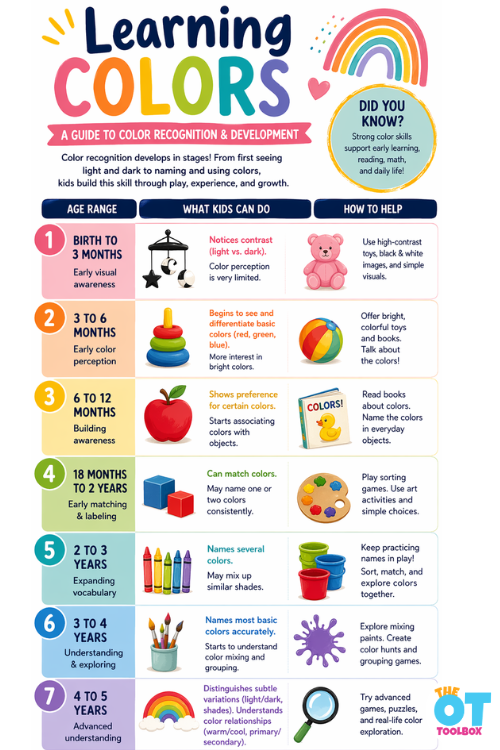
The image graphics we have in this article explain some ideas for helping kids learn colors. So, if you are wondering exactly HOW to learn colors, this list of activities is the way to go, from the perspective of a pediatric occupational therapist.

  • Color sorting with pom-poms, beads, or blocks
  • Matching colored clothespins to colored cards
  • Color scavenger hunt around the room or home
  • Sorting laundry by color
  • Color matching with stickers on paper
  • Painting with primary colors and mixing new colors
  • Using dot markers to match colors on worksheets
  • Color-coded obstacle course
  • Matching colored lids to containers
  • Building patterns with colored blocks
  • Color bingo
  • Sorting crayons or markers by color
  • Matching colored puzzle pieces
  • Color memory matching game
  • Sorting food by color during snack time
  • Threading beads by color pattern
  • Using colored tape lines for movement paths
  • Color hop game (jump to called color)
  • Matching colored shapes to outlines
  • Sensory bins with color sorting tasks
  • Coloring by color code worksheets
  • Matching socks by color
  • Sorting buttons by color
  • Color graphing activities
  • Using colored cups to sort small objects
  • Painting objects and matching to color cards
  • Color-themed I Spy activities
  • Matching colored magnets on a board
  • Sorting Legos by color
  • Using flashcards for color identification
  • Color stamping activities
  • Matching colored pegs on pegboards
  • Color sequencing activities
  • Sorting colored paper scraps
  • Color-coded task cards
  • Matching colored ribbons or strings
  • Sorting colored erasers
  • Using colored bins for cleanup tasks
  • Color tracing activities
  • Matching colored balls to targets
  • Sorting natural items (leaves, flowers) by color

One Day when we Learned Colors…

A Little Sponge
 
Today I had my 16 month old all to myself and we had so much fun playing together.  We played outside, went for a walk, rode in his red car, and tried to play basketball, or “bunga ball” as he calls it.  Now is the time his brain is like a little sponge, absorbing it all.  


We invented a fun game that we named “Find the Binky”(he is a binky addict and any game involving finding the binky he enjoys…hehe).  

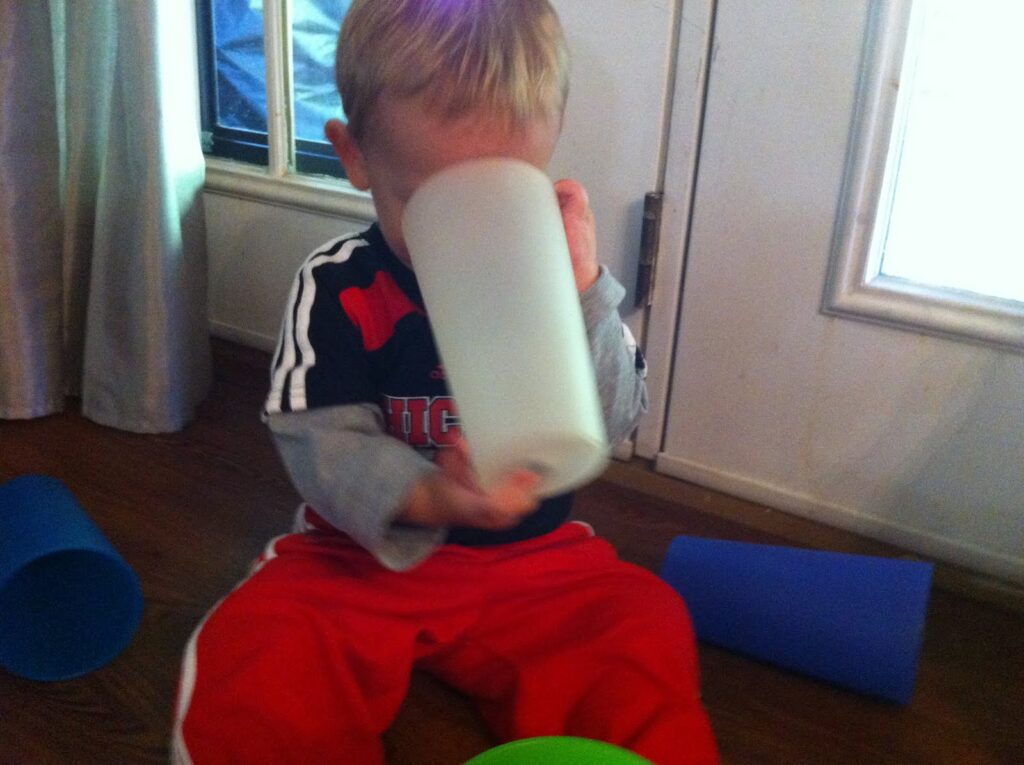
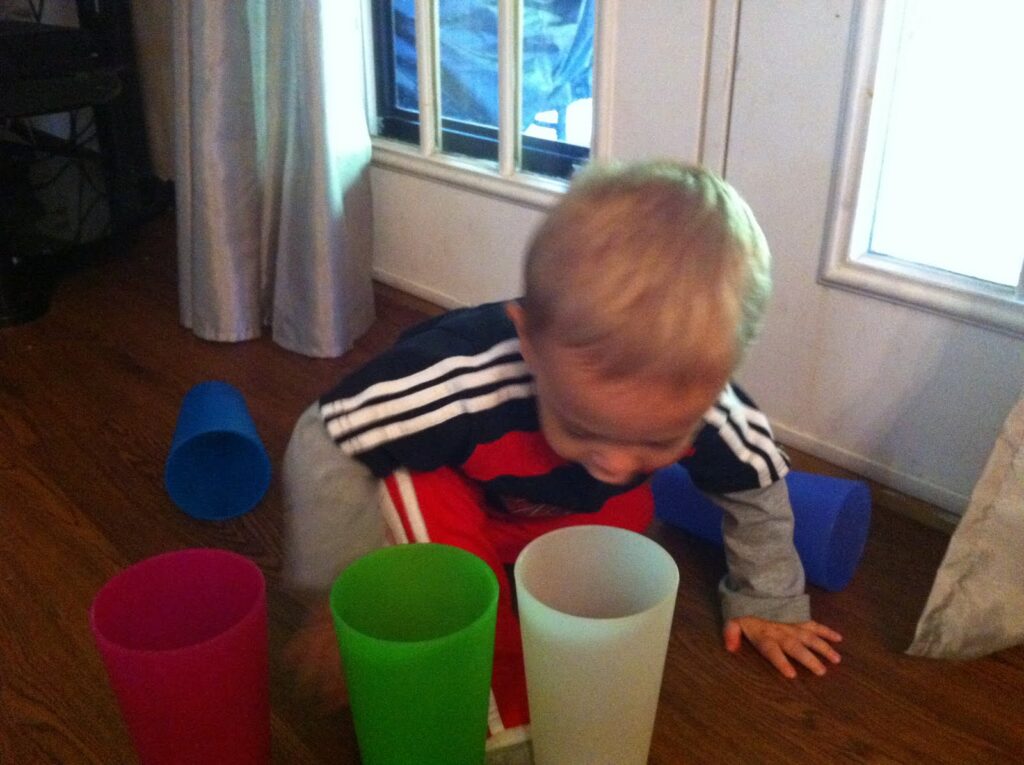
I pulled out these big plastic cups and separated them by color.  He would put the binky in a cup and I would say the color. 

He would try to repeat the color (or some word that kinda sounded like it).  Most of the time he was wrong and I would correct him.  He thought that was hilarious!  


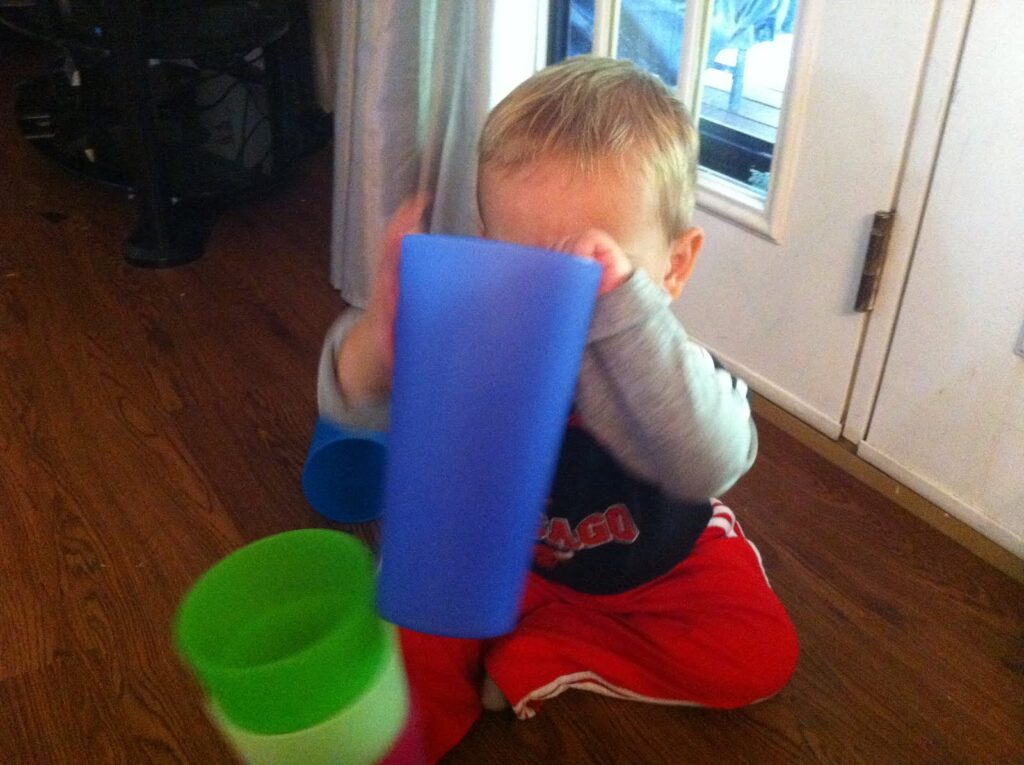
At this age, he loves stacking things and knocking them down.
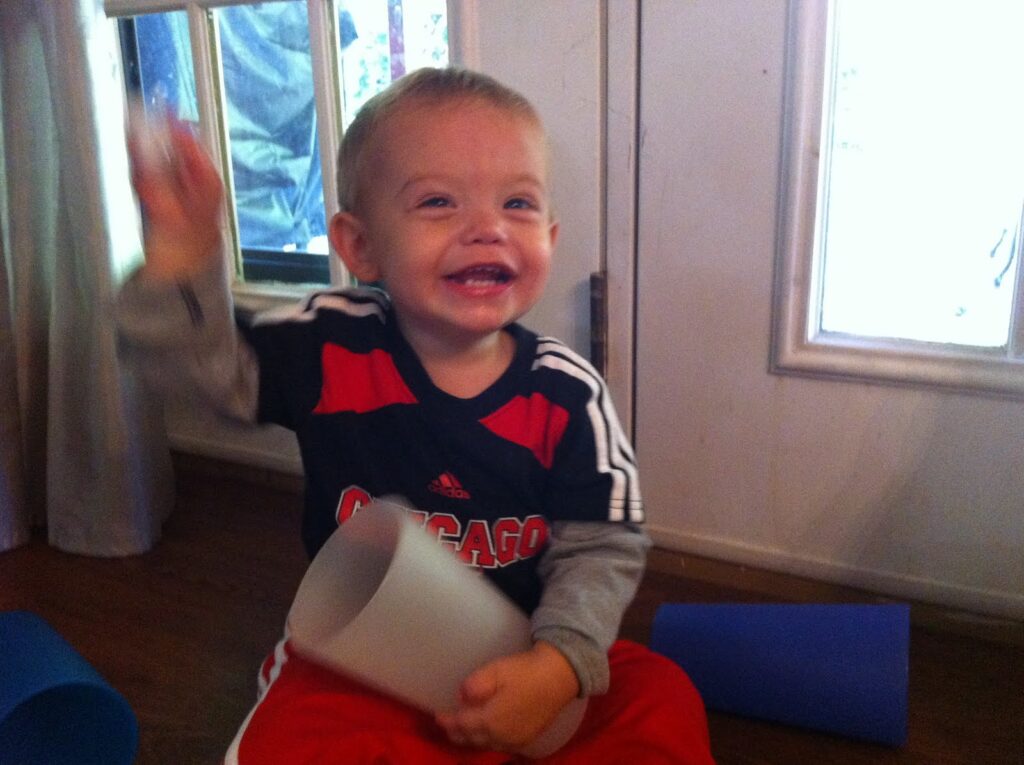
Found it!
 
Another fun thing to do is scream into the cups…this is a neat way to learn about sound and while holding the cup he feels the vibration. 

I later found him playing this game he made up by himself…he is such a boy.  He made a t-ball stand with the cup and was swinging at the soccer ball with another cup.  What a great imagination he has already.  I love watching him think.


Colors Handwriting Kit

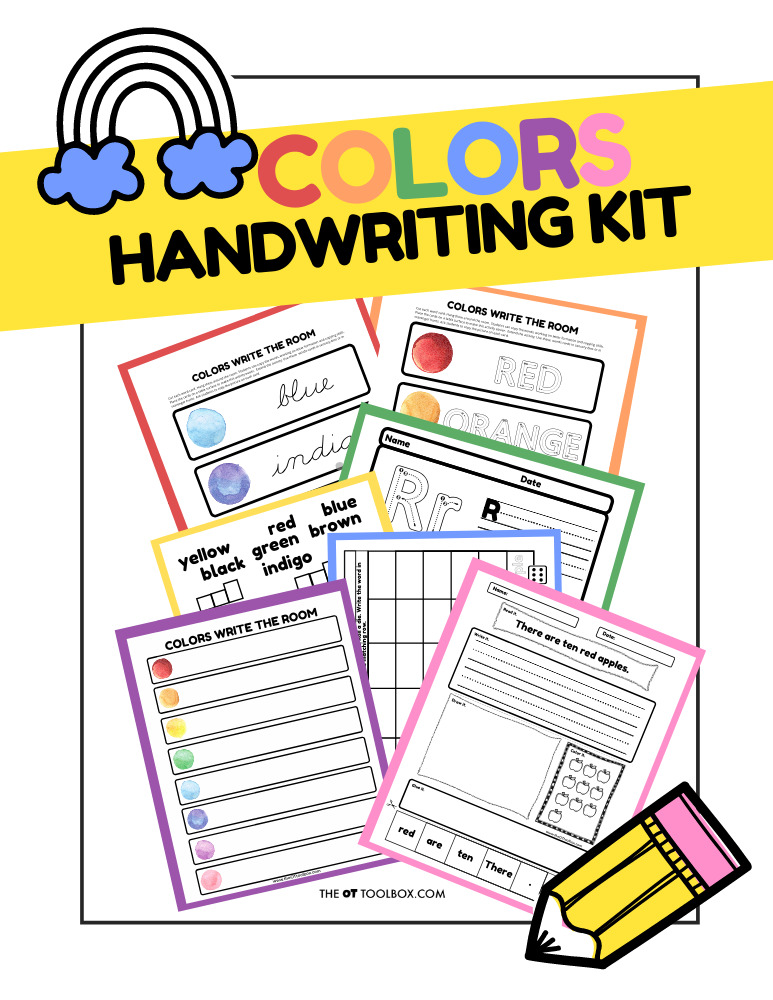
Rainbow Handwriting Kit– This resource pack includes handwriting sheets, write the room cards, color worksheets, visual motor activities, and so much more. The handwriting kit includes:

  • Write the Room, Color Names: Lowercase Letters
  • Write the Room, Color Names: Uppercase Letters
  • Write the Room, Color Names: Cursive Writing
  • Copy/Draw/Color/Cut Color Worksheets
  • Colors Roll & Write Page
  • Color Names Letter Size Puzzle Pages
  • Flip and Fill A-Z Letter Pages
  • Colors Pre-Writing Lines Pencil Control Mazes
  • This handwriting kit now includes a bonus pack of pencil control worksheets, 1-10 fine motor clip cards, visual discrimination maze for directionality, handwriting sheets, and working memory/direction following sheet! Valued at $5, this bonus kit triples the goal areas you can work on in each therapy session or home program.

Click here to get your copy of the Colors Handwriting Kit.

Colleen Beck, OTR/L has been an occupational therapist since 2000, working in school-based, hand therapy, outpatient peds, EI, and SNF. Colleen created The OT Toolbox to inspire therapists, teachers, and parents with easy and fun tools to help children thrive. Read her story about going from an OT making $3/hour (after paying for kids’ childcare) to a full-time OT resource creator for millions of readers. Want to collaborate? Send an email to contact@theottoolbox.com.
Activities for Teaching Colors

teaching colors

There are so many ways to include multisensory play in teaching colors to children. Here, you’ll find hands-on, creative ways to teach colors of the rainbow using play that helps kids develop skills, move, and grow. Use these color activities in preschool or to teach toddlers colors. It’s a fun way to develop visual discrimination skills in young children.

Teaching colors and coloring goes hand-in-hand. Our resource on the best crayons for toddlers is a huge help, especially when deciding on the type of crayon to use at the age of teaching colors to toddlers and young children.

Multisensory activities to teach colors to toddlers, preschoolers, kindergarteners.

I’m including color activities for kindergarten and school-aged children, as well, because this color themes can be used in therapy activities or to help kids develop handwriting, or visual motor skills in the older grades. There is a lot of fun, hands-on activities listed here that help children learn colors and explore through play!

Activities to teach colors to toddlers

Teaching Colors to Toddlers

Toddler play and development is all about the hands-on exploration of the world. We have a lot of toddler activities designed to develop motor skills and learning here on the website that you’ll want to check out.

To teach colors to toddlers, it’s all about making things fun. These toddler activities will get you started with hands-on development activities.

So many color activities in the toddler years involve sorting colors, identifying colors, and pointing out colors. All of these activities lay the building blocks for visual discrimination that kids will use in reading and writing down the road.

Try these activities for teaching colors to toddlers:

Toddler Color Sorting with Toys– This activity uses toys and items that are found around the home, making the color identification part of every day life. You can use items that the child uses and sees every day.

Teach Color Sorting Activity– This simple color sorting activity is great for families that have a preschooler and a toddler. The preschooler can cut foam sheets and work on scissor skills and then both the preschooler and toddler can sort the paper scraps by color. This is a nice activity that allows siblings to work together to learn concepts and grow skills together.

Color Sort Busy Bag– Toddlers love to drop items into containers, and put things into buckets, bins, and bags…and then take them back out again. It’s all part of the learning process! This color sorting busy bag gives toddlers colored craft sticks or dyed lollipop sticks and has them sort by color. It’s a great activity for developing fine motor skills and coordination, too.

Cup Sorting for Toddlers– This color sorting activity uses items in the home, like plastic toddler cups! There is just something about toddlers playing in the kitchen with baby-safe items…and this one builds pre-literacy and pre-math skills that they will use long down the road…through play!

Talk about colors– Pointing out colors during play, conversation, in reading books, and going for walks…there are so many ways to teach colors to babies and toddlers through everyday conversation. It’s as simple as saying, “look at that blue flower” to add descriptive terms to kids.

Color with painting– Incorporate all of the colors of the rainbow in multisensory activities from a young age. These art play activities incorporates colors into play and learning through art with toddlers.

Teach colors with a ball pit– Use ball pit balls in a baby pool. You can bring a baby pool indoors as a baby ball pit to teach colors. Here are other ball pit activities that can be used to teach colors.

Teaching colors to preschoolers with multisensory learning activities

Teaching Colors in Preschool

In the preschool stage, learning occurs through play! These color learning activities are designed to promote learning through hands-on exploration, because those are the ways that learning “sticks”…when hands are busy and developing motor skills that they will later need for holding and writing with a pencil. Let’s look at some ways to teach colors in the preschool years:

Color by Letter Worksheets– These are great for the preschool age because they are getting the exposure to letters in uppercase and lowercase format but not through writing. the coloring builds hand strength and fine motor skills needed in kindergarten and beyond.

Teaching Shapes and Colors with Rainbow Rocks by Fun-A-Day- This activity is fun because it uses the heavy weight of rocks to teach colors and shapes. But, kids are also strengthening their hands and gaining motor feedback about objects as they explore colors and other discriminating factors like weight and size.

Color and shape sorting– This preschool color sorting activity gives kids fine motor experiences with wikki stix. Ask preschoolers to copy the shapes, too for extra fine motor skill building and visual motor integration.

Fine Motor Color Sort– Grab an old spice container or cheese container, and some straws. This color sorting activity lays the groundwork for fine motor skill development and math skills. Kids can count the straws as they drop into the container and work on sorting colors while developing open thumb web space, separation of the sides of the hand and arch strength.

Color Matching Water Bin– This color learning activity is a sensory motor activity that also teaches letters. It’s perfect for preschool and kindergarten or even older grades as kids are immersed in multi- sensory learning with letters and pre-reading skills.

Clothespin Color Match– Children will love this fine motor activity that builds hand strength in a big way.

Bear Sees Colors Book and Activity– We used a snack to explore colors with a beloved preschool book. This is multisensory learning at its finest.

Gross Motor Color Games– There are many ways to explore and teach colors using games. Try some of these to add movement and play into learning colors at the preschool level:

  • Color I Spy- Call out a color and kids can run to touch something that is that color. Add variations of movement by asking kids to skip, hop, leap, crawl, or bear walk to touch the colors.
  • Color Simon Says- Call out directions based on clothing colors that kids are wearing. Add as many variations of movement and auditory challenges. This is a great activity for building working memory skills in preschoolers.
  • Color Tag- Kids can play tag and when they tag another player, they need to say a color for that person to go to. Another variation is having the players who are tagged run to a color that the tagger calls out.
Teaching colors to kindergarten children with multisensory learning activities.

Kindergarten Color Activities

At the kindergarten level, children are moving beyond basic color naming and into more advanced use of color in learning. At this stage of development, most children can consistently identify and name common colors, and they begin to understand how color relates to academic tasks such as sorting, categorizing, and following multi-step directions.

From a developmental perspective, kindergarteners are refining:

  • Color discrimination (noticing subtle differences between shades)
  • Conceptual understanding (recognizing that objects can be different colors)
  • Language use (describing and comparing colors)
  • Application of color knowledge in structured tasks

Color learning at this stage supports reading readiness, math concepts, and classroom participation. Children are often expected to follow directions such as “circle the green object” or “underline the word in red,” which requires both recognition and functional use of color.

Kindergarten Color Activities

  • Color-coded math sorting (by shape and color)
  • Graphing objects by color
  • Color pattern creation with blocks or beads
  • Following multi-step directions using color cues
  • Color scavenger hunts with written checklists
  • Color mixing experiments with paints
  • Sorting classroom objects into colored bins
  • Color-coded center activities
  • Matching shades and gradients
  • Color word recognition and labeling
  • Highlighting sight words by color
  • Directed drawing using specific colors
  • Color-coded obstacle courses
  • Using colored manipulatives for math problems
  • Sorting and categorizing by multiple attributes (color + size)

Teach Colors in Kindergarten and older grades

Once children are school-aged, teaching colors doesn’t end. In the school years, children explore color mixing, learning about primary colors, and more. Look at all of these color experiences that kids learn during the school years:

  • Spelling color names
  • Learning Primary Colors
  • Learning secondary colors
  • Color mixing
  • Color theory
  • Color wheel
  • Complimentary colors

Preschool Color Activities

Teaching colors in preschool is a huge part of the curriculum.

Teaching Colors to Preschoolers

In preschool, children are just beginning to develop the ability to recognize and name colors. This stage is focused on exposure, repetition, and meaningful interaction with color in everyday activities.

Developmentally, preschoolers are building:

  • Visual perception skills (noticing differences in color)
  • Early language development (learning color names)
  • Attention and memory (recalling color information)
  • Concept formation (understanding color as a property)

At this stage, children may recognize a color before they can name it. They also commonly confuse similar colors or use color names inconsistently. This is a normal part of development.

Why Teaching Colors Matters in Preschool

Teaching colors in preschool supports:

  • Early communication skills
  • Following simple directions
  • Participation in play and routines
  • Preparation for academic tasks

Color learning is most effective when it is embedded in play and daily experiences rather than taught in isolation.

How to Teach Colors to Preschoolers

  • Use repetition in daily routines (e.g., “Here is your blue cup”)
  • Focus on one or two colors at a time
  • Pair colors with familiar objects
  • Use hands-on, sensory-based activities
  • Keep learning playful and engaging
  • Color sorting with large objects
  • Matching colored blocks or toys
  • Simple color scavenger hunts
  • Finger painting with one or two colors
  • Color matching with stickers
  • Sorting pom-poms by color
  • Matching colored cups and objects
  • Color-themed sensory bins
  • Color hop games (jump to the color called out)
  • Matching colored shapes
  • Using dot markers for color matching
  • Sorting crayons by color
  • Color I Spy activities
  • Matching colored puzzle pieces
  • Rolling and matching colored balls

Try some of these color activities for older children:

Color I Spy free therapy slide deck- This color themed scavenger hunt will get kids up and moving, using the items they have in their home as they work on visual perceptual skills, handwriting, and more. Kids can visually scan around their home to match the colors on the slide deck. Then, there is a handwriting component. This is a great slide deck for anyone working on handwriting skills with kids, virtually.

Color Exercises– Use gross motor exercises and stretches as well as fine motor exercises to get kids moving while working on SO many skill areas: bilateral coordination, motor planning, strengthening, core strength, precision, dexterity, visual motor skills…

Rainbow Deep Breathing Exercise– This free printable PDF is super popular. There’s a reason why: kids love the deep breathing activity and We love the mindfulness, coping skills, calming, and regulation benefits. Great for all ages.

Rainbow Binoculars Craft– Kids can use paper towel tubes in a craft that helps them look for and identify colors. Use these rainbow binoculars in visual scanning, visual discrimination, visual figure-ground, and other perceptual skills.

Colored pencils activities All you need is a couple of colored pencils (or substitute with a regular pencil if that’s all you’ve got on hand) to work on pencil control, line awareness, pencil pressure, and letter formation.

Benefits of coloring with crayons Just grab a box of crayons and build so many fine motor and visual motor skills.

Make crayon play dough– Explore colors with heavy work input through the hands and arms using all the colors of the rainbow. This crayon play dough recipe is a popular sensory recipe here on the website.

Key Differences Between Preschool and Kindergarten Color Learning

  • Preschool focuses on exposure, recognition, and early naming
  • Kindergarten focuses on consistency, application, and use in academic tasks

Understanding this progression helps ensure that activities are developmentally appropriate and support functional skill development.

One activity book we love is our Colors Handwriting Kit:

Colors Handwriting Kit

Rainbow Handwriting Kit– This resource pack includes handwriting sheets, write the room cards, color worksheets, visual motor activities, and so much more. The handwriting kit includes:

  • Write the Room, Color Names: Lowercase Letters
  • Write the Room, Color Names: Uppercase Letters
  • Write the Room, Color Names: Cursive Writing
  • Copy/Draw/Color/Cut Color Worksheets
  • Colors Roll & Write Page
  • Color Names Letter Size Puzzle Pages
  • Flip and Fill A-Z Letter Pages
  • Colors Pre-Writing Lines Pencil Control Mazes
  • This handwriting kit now includes a bonus pack of pencil control worksheets, 1-10 fine motor clip cards, visual discrimination maze for directionality, handwriting sheets, and working memory/direction following sheet! Valued at $5, this bonus kit triples the goal areas you can work on in each therapy session or home program.

Click here to get your copy of the Colors Handwriting Kit.

Colleen Beck, OTR/L has been an occupational therapist since 2000, working in school-based, hand therapy, outpatient peds, EI, and SNF. Colleen created The OT Toolbox to inspire therapists, teachers, and parents with easy and fun tools to help children thrive. Read her story about going from an OT making $3/hour (after paying for kids’ childcare) to a full-time OT resource creator for millions of readers. Want to collaborate? Send an email to contact@theottoolbox.com.