100 Handwriting Tips and Tricks Free Printables

handwriting tips and tricks

This blog post on handwriting tricks from November 2016 has been updated to include more handwriting tips and tricks that school based OT professionals use every day. You’ll also have a handwriting email series and free handwriting handouts available in this blog post that you’ll want to grab.
Handwriting Tips Handouts

Handwriting is a struggle for many kids.  There are many handwriting tips  and  tips that can work for kids when they are completing written work.  The thing is that some strategies work for some children and something totally different is a success for other children.  Handwriting difficulties can be a result of many different issues.  From visual perceptual difficulties to pencil grasp concerns, to visual motor integration problems…handwriting is a complex task with many skills working together.  


Today, I have an exciting freebie for you.


I have compiled strategies, tips, and tricks for common handwriting concerns.  
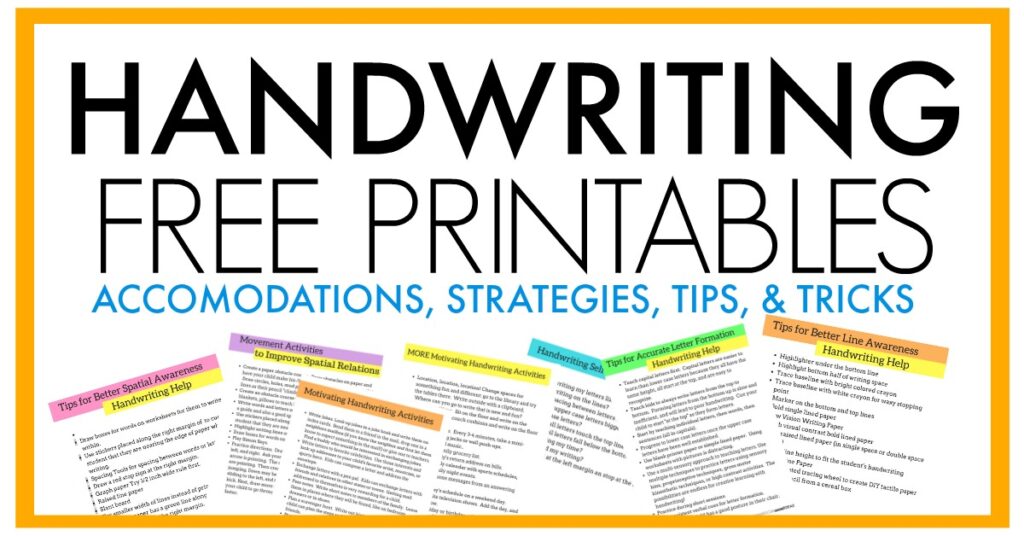


You might have seen our easy handwriting series recently.  If not, be sure to stop over and check out 30 easy strategies for helping with handwriting difficulties.


For more information on helping kids with handwriting issues, join us in the Sweet Ideas for Handwriting Help Facebook group.  I would love to see you there!

Free Handwriting Tips and Tricks Printables


These free handwriting printables are perfect for trying different strategies to help kids with handwriting needs.  


Each printable page can be copied and presented to teachers, parents, colleagues, and any one in the classroom or therapy setting who works with the kids with handwriting needs.


Try using these printable strategies to help with many different handwriting concerns.


Handwriting Help in your Inbox


The printables will arrive in your inbox over a 6 day period.  Each day, I will share specific tips related to common handwriting challenges.  There will be lins to address these problems in creative ways and Quick Tips for the targeted handwriting issue and Fine Motor Development.  

This is Handwriting Help for anyone who works with kids!
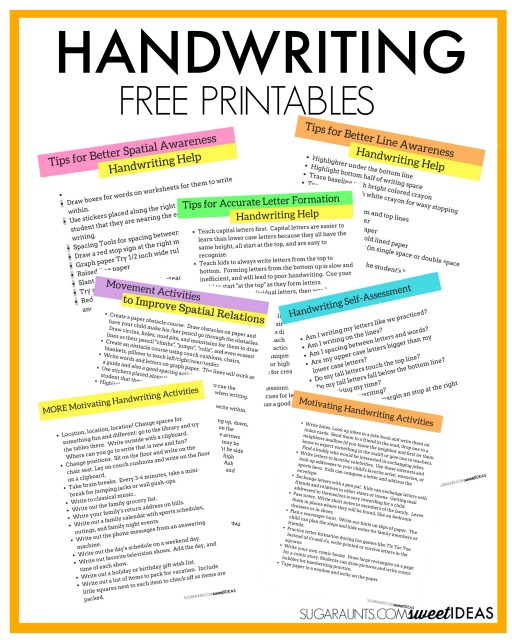
handwriting tips, tricks, and strategies for kids


In the FREE printable pack, you will get:


Tips for Better Line Awareness


Tips for Better Spatial Awareness


Tips for Accurate Letter Formation


Movement Activities to Help with Spatial Relations


Handwriting Self-Assessment


Motivating Handwriting Activities


MORE Motivating Handwriting Activities


Related Read: Try these handwriting accommodation strategies to address a variety of handwriting challenges. 
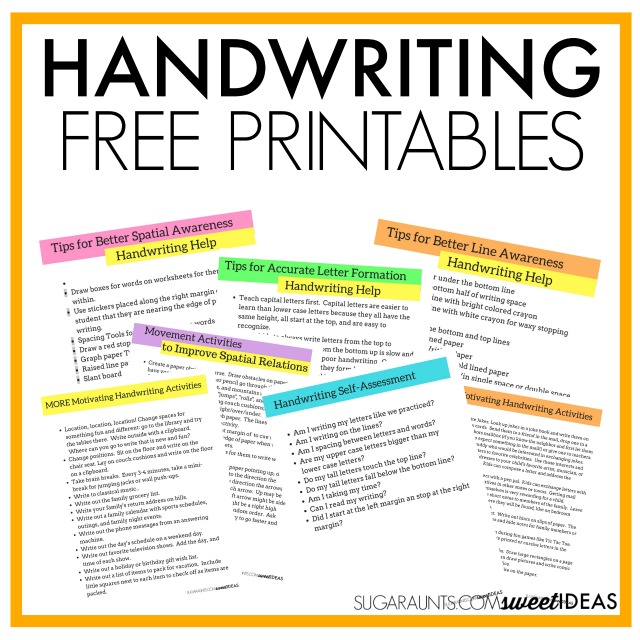


Try these handwriting tricks, tips, and strategies to help with handwriting.
 
I hope you join us for 6 days of handwriting help, delivered right to your inbox!


hand holding a pencil. Text reads "handwriting tricks for teaching messy handwriting"

You can use some occupational therapy handwriting tricks to help with common messy writing issues.

100 Handwriting Tips and Tricks

I wanted to put together a few handwriting tricks that we pediatric occupational therapists (and by that I mean OTs AND OTAs!) use day in and day out to support kids with handwriting challenges. These writing tips are some of the tricks you’ll see a school based OT pull out of “thin air”. Meanwhile, this is just the beginning of the OT tips and tricks we have up our therapy sleeves! I hope these help!

Hand Position and Pencil Grasp

  1. Use short pencils or broken crayons to encourage a tripod grasp.
  2. Place a small pom-pom under the ring and pinky fingers to promote hand separation.
  3. Try triangular pencils to support proper finger placement.
  4. Use pencil grips if a child fatigues quickly while writing.
  5. Encourage holding the pencil closer to the tip for better control.
  6. Practice picking up small beads to strengthen finger grasp.
  7. Use tweezers to build finger strength for handwriting.
  8. Draw small circles with fingertips to warm up writing muscles.
  9. Practice rolling small balls of play dough between fingers.
  10. Use clothespins to strengthen finger muscles.

Posture and Positioning

  1. Sit with feet flat on the floor for stability.
  2. Keep hips all the way back in the chair.
  3. Maintain a straight back while writing.
  4. Adjust chair height so elbows rest comfortably on the table.
  5. Use a slant board to support wrist positioning.
  6. Try writing on a vertical surface like a wall or easel.
  7. Encourage forearms to rest lightly on the table.
  8. Use a foot stool if feet don’t reach the floor.
  9. Practice writing on a clipboard while standing.
  10. Ensure the paper is placed slightly tilted.

Paper Position

  1. Tilt paper slightly left for right-handed writers.
  2. Tilt paper slightly right for left-handed writers.
  3. Stabilize paper with the helper hand.
  4. Use tape to keep paper from sliding.
  5. Use clipboards for stability.
  6. Draw margins to support spacing.
  7. Add highlighting to the writing line.
  8. Use raised line paper for tactile feedback.
  9. Practice writing inside boxes before writing on lines.
  10. Use graph paper for consistent letter sizing.

Letter Formation Tips

  1. Teach letters in developmental groups.
  2. Start letters at the top when possible.
  3. Use consistent starting points for letters.
  4. Practice large letters before small letters.
  5. Use verbal cues while writing letters.
  6. Practice tracing letters with fingers first.
  7. Write letters in shaving cream or sand.
  8. Trace letters on textured surfaces.
  9. Use chalk on sidewalks to practice letter shapes.
  10. Practice forming letters in play dough.

Motor Planning and Warm-Ups

  1. Do finger stretches before writing.
  2. Shake hands gently to loosen muscles.
  3. Trace shapes in the air with large arm movements.
  4. Practice drawing big shapes on a whiteboard.
  5. Use finger painting to warm up hands.
  6. Practice drawing loops and spirals.
  7. Do wall push-ups to activate arm muscles.
  8. Roll therapy putty before writing tasks.
  9. Practice drawing zig-zag lines.
  10. Do hand squeezes with a stress ball.

Visual Motor and Visual Perception

  1. Copy simple shapes before letters.
  2. Practice connecting dots to form shapes.
  3. Use mazes to build visual motor skills.
  4. Play “I Spy” games to build visual scanning.
  5. Complete puzzles to support visual perception.
  6. Practice tracing paths and lines.
  7. Use visual models for letter formation.
  8. Practice copying patterns.
  9. Draw shapes that gradually become letters.
  10. Use highlighting to guide writing lines.

Sensory Strategies

  1. Try writing in sand trays.
  2. Use textured writing paper.
  3. Write with chalk or crayons for resistance.
  4. Use weighted pencils for proprioceptive input.
  5. Do heavy work before handwriting tasks.
  6. Practice writing on vertical surfaces.
  7. Write with gel pens for smooth movement.
  8. Use vibrating pens for sensory input.
  9. Practice squeezing putty before writing.
  10. Try writing on a textured mat.

Motivation and Engagement

  1. Write secret messages to friends.
  2. Use fun colored pens.
  3. Write jokes or riddles.
  4. Create comic strips.
  5. Write lists about favorite things.
  6. Practice writing in games like “hangman.”
  7. Write treasure hunt clues.
  8. Make greeting cards.
  9. Write stories about favorite characters.
  10. Use stickers as rewards.

Classroom and Homework Strategies

  1. Break writing into short sessions.
  2. Use visual reminders for letter formation.
  3. Allow brain breaks during writing tasks.
  4. Provide examples to copy from.
  5. Encourage slow, controlled writing.
  6. Provide extra time for written work.
  7. Use checklists or desk letter strips for letter formation and self-correction.
  8. Encourage editing after writing.
  9. Reduce copying demands when needed.
  10. Provide alternative writing tools when appropriate.

Independence and Practice

  1. Encourage journaling daily.
  2. Practice writing grocery lists.
  3. Write notes to family members.
  4. Label drawings with words.
  5. Write directions for games.
  6. Practice writing menus for pretend restaurants.
  7. Write short thank-you notes.
  8. Copy favorite song lyrics.
  9. Write captions for photos.
  10. Practice handwriting during fun activities, not just schoolwork.

Even MORE handwriting tips and tricks that we share in OT consultations include:

  • Teach letters in groups, or families of similar letters. We talk all about letter families in another blog post. It makes total sense to teach letters this way because of the handwriting motor plan that is established in pencil movements.
  • Use consistent verbal and visual cues.
  • Use consistent patterns to form letters. By this I mean you should promote the automaticity and fluidity that kids establish when they are using the same models for letter formation.
  • Use progressive steps of handwriting instruction. This means that you will want to follow a predictable teaching pattern in handwriting. This will look like modeling the letter, tracing, fading of cues, copying, dictating letter formation, composing letters, and self monitoring the formation of letters.
  • Speaking of tracing, it has it’s time and place. Don’t just plop down a handwriting worksheet and expect kids to trace the letters correctly and then establish good handwriting skills. There’s more to it than that!
  • Match the size of lined paper with the student’s handwriting abilities. Here is a list of free handwriting paper to browse.
  • Use pictures or images as a visual cue on the writing lines. This gives a prompt for letter placement and letter size. Some examples are drawing a house in the double rule writing space. You might also see a cloud on the top line of writing paper and grass on the baseline. Or another example is a worm below the ground or baseline for tail letters.
  • Another example of a writing trick that offers a visual cue is to use a highlighter for the writing space for letter size and spacing. Or, you might see a school based OT practitioner use a highlighter to draw a rectangle for the word.
  • Position a visual cue like a letter strip, or the material the student is copying right above the writing paper so the student needs to shift their eyes up and down, and not their eyes and whole head. This is a near point copying trick.
  • Use our DIY letter strip hack to place the model very close to the writing area.

For more tips and tricks, check out our book, The Handwriting Book. We tried to cover all aspects of handwriting by addressing the underlying skills that play into writing.
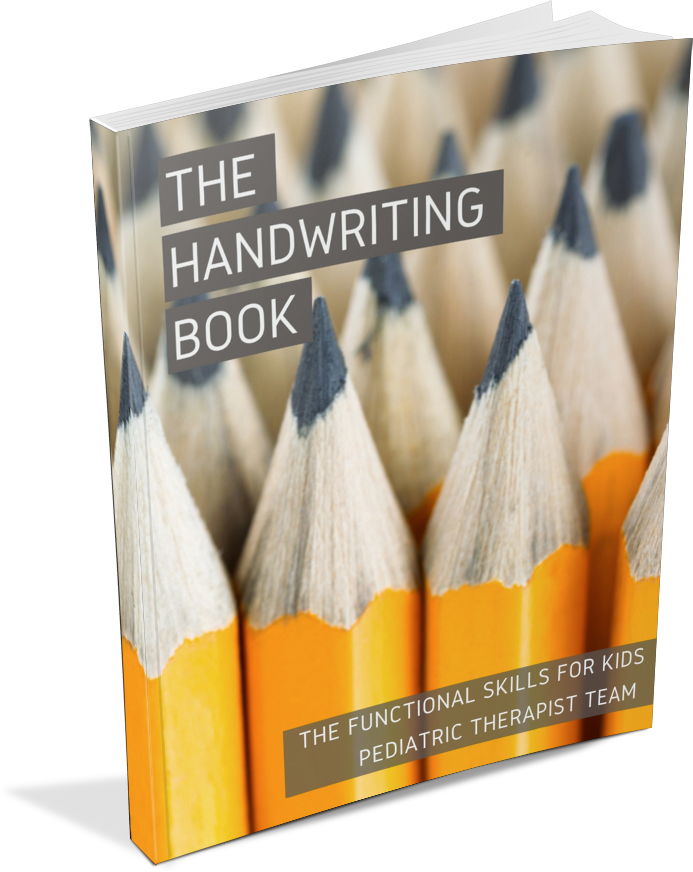
The Handwriting Book is a comprehensive resource created by experienced pediatric OTs and PTs.

The Handwriting Book covers everything you need to know about handwriting, guided by development and focused on function. This digital resource is is the ultimate resource for tips, strategies, suggestions, and information to support handwriting development in kids.

The Handwriting Book breaks down the functional skill of handwriting into developmental areas. These include developmental progression of pre-writing strokes, fine motor skills, gross motor development, sensory considerations, and visual perceptual skills. Each section includes strategies and tips to improve these underlying areas.

  • Strategies to address letter and number formation and reversals
  • Ideas for combining handwriting and play
  • Activities to practice handwriting skills at home
  • Tips and strategies for the reluctant writer
  • Tips to improve pencil grip
  • Tips for sizing, spacing, and alignment with overall improved legibility

Click here to grab your copy of The Handwriting Book today.

Colleen Beck, OTR/L has been an occupational therapist since 2000, working in school-based, hand therapy, outpatient peds, EI, and SNF. Colleen created The OT Toolbox to inspire therapists, teachers, and parents with easy and fun tools to help children thrive. Read her story about going from an OT making $3/hour (after paying for kids’ childcare) to a full-time OT resource creator for millions of readers. Want to collaborate? Send an email to contact@theottoolbox.com.

After School Meltdowns: Why Kids Fall Apart at Home and How to Help

After school sensory overload

After a long day at school, many children come home and seem to fall apart. You might see them come home and begin crying, yelling, shutting down, or refusing to do anything. This after-school meltdown (or sensory breakdown) isn’t just about being tired or hungry.

after school sensory breakdowns and information on sensory overload after school

For many kids, especially those with sensory processing challenges or executive functioning difficulties, school requires an enormous amount of self-regulation. It all becomes a fight or flight response at a certain point.

Why do After School Meltdowns Happen?

After-school meltdowns are often connected to nervous system dysregulation after a long day of managing expectations, sensory input, and social demands at school.

Many children spend the school day using a great deal of energy to stay focused, follow routines, and regulate their behavior. By the time they arrive home, their nervous system may be fatigued and less able to manage stress. From a nervous system perspective, this can mean the child shifts out of a calm, regulated state and into a more reactive state where emotions feel harder to control.

Polyvagal Theory helps explain why this happens. Throughout the day, a child’s nervous system is constantly scanning for cues of safety or stress. When a child feels safe and regulated, they are able to engage, learn, and interact with others.

However, after a long day of demands, their nervous system may move into a fight-or-flight response. This can show up as irritability, frustration, crying, or emotional outbursts when they finally reach the safety of home.

What is after school restraint collapse?

After-school restraint collapse is another term you may have heard of. This is another way to describe after school meltdowns.

It’s a pattern many families notice when children come home from school and suddenly seem overwhelmed, emotional, or exhausted. During the school day, children often work very hard to follow rules, manage sensory input, stay focused, and control their behavior in a structured environment.

This effort requires a great deal of self-regulation and energy. When the school day ends and the child returns to a safe and familiar space, the nervous system may finally release that built-up tension.

As a result, children may cry, become irritable, argue, or appear unusually tired. This response is not intentional misbehavior; rather, it reflects the body and brain decompressing after a long period of maintaining control and meeting expectations.

sensory overload after school

What’s happening here? Kids spend hours sitting still, following directions, managing transitions, and trying to fit in. By the time they get home, their emotional and sensory “cup” is empty. The meltdowns you see are often the result of holding it all together all day long. Understanding why this happens is the first step in helping kids decompress, reset, and build the tools they need to self-regulate at home.

After a long day at school, some kids come home dysregulated (in a state where regulation isn’t happening) and it can be easy to miss the signs. It might look like the child that crashes and takes a nap as soon as they walk in the door (hello, teenagers!) or the child that is clingy/whiny/jumping off the walls during the after school hours. These actions aren’t them having a “bad day” or “acting out.” It’s actually clues that the child’s nervous system is overwhelmed during daily tasks and the tasks of the day. (What we call occupations…like learning, playing, socializing, riding the bus, and managing new routines).

In today’s YouTube video and visual guide, we break down signs of dysregulation during occupation, including:

  • Trouble with organization, attention, or executive function
  • Sensory overload from sound, light, touch, or smell
  • Irrational, impulsive, or aggressive behaviors
  • Working memory difficulties
  • Panic attacks, sleep troubles, or toileting challenges
  • Poor fine motor skills or handwriting
  • A tendency to shut down, give up, or resist tasks
  • They might not hear you

Here’s the full list in our short video:


Next, let’s talk about some questions that come up from parents regarding sensory overload after school.

FAQ: After-School Meltdowns and Emotional Regulation in Kids

Why does my child melt down after school?

Many kids “hold it together” during the school day. They are working hard to suppress big emotions, masking sensory sensitivities, and meeting expectations. When they get home to their safe space, that built-up stress is released in the form of a meltdown. It’s a release of emotional pressure, not a sign of defiance or misbehavior.

How can I help my child decompress after school?

Create a predictable after-school routine with calming options: quiet time, a snack, deep pressure activities like a weighted blanket, or movement like swinging or jumping. Let your child have a choice in how they unwind. This gives them some control and supports regulation.
Try these after-school calming strategies.

What are the signs of emotional dysregulation in kids after school?

Some common signs include irritability, withdrawal, meltdowns, trouble transitioning, refusal to talk, or physical symptoms like headaches. These behaviors are often a sign that your child is overstimulated or emotionally drained.
Explore signs of dysregulation

Why does my child seem fine at school but fall apart at home?

This is known as “masking.” Many children, especially those who are neurodivergent, work hard to appear regulated in public. At home, where they feel safe, they release the emotions they’ve been suppressing. This isn’t manipulation. They are actually showing signs of emotional exhaustion.
Read more about masking and meltdowns

What calming strategies help with after-school meltdowns?

Try a sensory bin, a body sock, drawing/coloring, swinging, or deep breathing. Some children benefit from heavy work (proprioceptive) activities like wall pushes or carrying a backpack.
Check out these heavy work activities

What are after-school sensory needs and how can I support them?

Sensory needs after school may involve a need for quiet, movement, oral input (like chewing), or touch. Pay attention to your child’s behavior and give sensory-rich but calming input after school.
Use our calm down corner ideas

How can I prevent after-school meltdowns in my child?

Build in time for transition after school. Avoid rushing into homework or structured activities. Let your child decompress and refuel. Create a consistent routine, and reduce extra demands during that time.
Use a sensory-friendly visual schedule.

Why do ADHD kids hold it together at school and then crash at home?

ADHD brains are working extra hard to stay organized, focused, and quiet at school. That effort can be exhausting, and home becomes the place they release the stress. Support them with empathy and structure, not punishment.

What are some after-school routines that help neurodivergent kids?

Routines that include sensory breaks, low-demand time, a calming activity, and predictable structure help reduce meltdowns. Use visual schedules or simple picture cards to help kids know what’s next.

How do I support emotional regulation at home after school?

Normalize big feelings and teach self-regulation strategies. Use visual supports, sensory tools, and lots of co-regulation. Focus on connection before correction.
Browse self-regulation activities

How to help after school meltdowns

After-school meltdowns are common in kids who hold it together all day at school, only to release their emotions the moment they get home. If you’re wondering how to help a child who melts down after school, it starts with understanding that this behavior is a result of exhaustion from managing expectations, transitions, and sensory input throughout the day.

These after-school meltdowns in kids often happen because children are finally in a safe space where they can decompress.

One effective after-school meltdown strategy is to create a calming after-school routine with quiet time, a healthy snack, and sensory activities.

Parents searching for ways to help kids decompress after school can try setting up a predictable transition period with activities like deep breathing, stretching, or time in a sensory corner.

Knowing how to calm a child after school begins with giving them space, avoiding questions right away, and using consistent strategies that meet their unique sensory or emotional needs.

These calming techniques are not only effective in managing meltdowns after school, but also support emotional regulation in the long term.

Having a set strategy list is key. For developing kids, emotional regulation and executive functioning skills impact not just learning but function. When it comes to emotions, regulating behaviors, and the mental skills of executive functioning, you can see how all of these areas play a role in everything we do on a day to day basis. 

Some other ideas for educators include being proactive in the classroom. This actually helps the student during the day because short movement breaks support learning. Educators: Set up simple brain breaks or sensory corners.

The therapist on the team can help to share supportive strategies and tools with families to help them carry over regulation strategies at home.

And finally, the parent can bring it all together by creating a transition routine to help kids shift from school to home without becoming overwhelmed. A huge component is the impact of screens too. This screentime checklist can help.

This is where co-regulation becomes important. Children often need the support of a calm adult to help their nervous system return to a regulated state.

Instead of immediately asking questions about the day or moving into homework routines, it can help to first create a transition period that allows the child’s body to reset. Quiet connection, predictable routines, and a calm presence can help signal safety to the nervous system.

Short brain breaks after school can also support regulation. Movement activities, deep breathing, outdoor play, or sensory-based activities help the body release tension and organize sensory input from the day.

Basically, I tell my parents that they need to first focus on arousal level. They are coming from a highly stimulating environment. If they are bombarded with questions about their day, expectations for homework, and rushing into the after school activities, they don’t have a chance to reset.

We can help the child by offering different types of stimulation that typically decrease arousal (slow, rhythmic, and gentle sensations, heavy work, removal of excess sensory stimulation, and deep touch pressure and proprioception).

Then, after the child is out of this fight or flight state, you can offer opportunities for safe participation. This is things that make them feel safe to allow participation.

These breaks give the nervous system an opportunity to shift out of survival mode and back toward a calmer, more regulated state where conversation, homework, and family activities become easier to manage.

Start with these resources on The OT Toolbox:
What is Dysregulation?
​​What is Self-Regulation?​​
Self-Regulation Strategies
​​Sensory Processing Red Flags
​​Emotional Regulation Games​​
5 Ways to Support Emotional Vocabulary​​

After School Brain Breaks and Sensory Snacks

Self Regulation Support
Packed with visuals, charts, and strategies kids can use throughout the day, perfect for home or school.​
Get it in the shop.​
Members: get it here.

Sensory Diet Cards + Sensory Activity Lists
Build a sensory strategy system that helps meet individual needs, even in busy classrooms.​
Get it in the shop.​
Members: get it here.

Classroom + Home Connection
Many students hold it together all day… until they don’t. When kids walk through the door after school and instantly melt down, it’s often because of underlying sensory or regulation challenges that built up throughout the day.

P.S. All of these resources (plus more) are included in your OT Toolbox Membership. It’s your one-stop spot for back-to-school therapy tools!

The Sensory Lifestyle Handbook walks you through sensory processing information, each step of creating a meaningful and motivating sensory diet, that is guided by the individual’s personal interests and preferences.

The Sensory Lifestyle Handbook is not just about creating a sensory diet to meet sensory processing needs. This handbook is your key to creating an active and thriving lifestyle based on a deep understanding of sensory processing.

Colleen Beck, OTR/L has been an occupational therapist since 2000, working in school-based, hand therapy, outpatient peds, EI, and SNF. Colleen created The OT Toolbox to inspire therapists, teachers, and parents with easy and fun tools to help children thrive. Read her story about going from an OT making $3/hour (after paying for kids’ childcare) to a full-time OT resource creator for millions of readers. Want to collaborate? Send an email to contact@theottoolbox.com.


Saccades and Learning

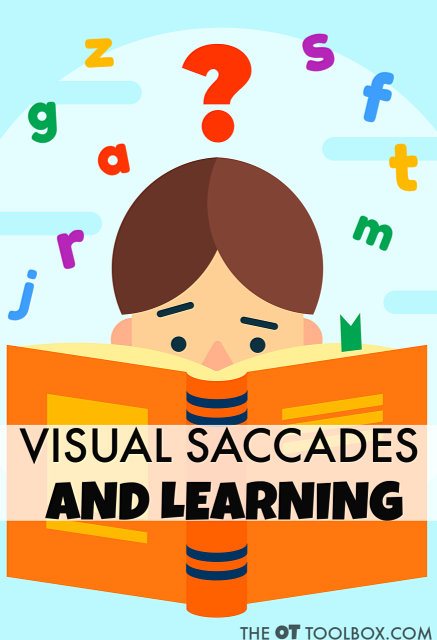
Read below to learn about visual saccades and learning in kids, including how saccades affect learning, more about what are visual saccades, or visual scanning, and what saccadic movement looks like. You’ll also find information on saccades and smooth eye movements and the visual processing needs that impact learning. This information on vision can be helpful for the occupational therapist working with a child or student with vision related learning challenges as a result of visual saccades.

What Are Saccadic Eye Movements?

Saccades are quick, precise eye movements that allow the eyes to jump from one target to another. These movements help the brain rapidly shift visual attention so we can scan words while reading, move between objects in the environment, or look back and forth between items during daily activities.

Instead of moving smoothly across the visual field, the eyes make these rapid jumps to bring new information into focus. Saccades work together with other visual skills like visual tracking, visual attention, and visual perception to help the brain process visual information efficiently.

Children rely heavily on saccadic eye movements during school tasks. Reading lines of text, copying from the board, solving math problems, and scanning worksheets all require accurate and well-controlled saccades.

What Is the Function of a Saccade?

The primary function of a saccade is to quickly shift the eyes from one visual target to another so the brain can gather new visual information. This ability allows a person to scan the environment, locate objects, and move their visual attention efficiently.

In children, this skill supports many important tasks, including:

  • Reading across a line of text
  • Copying information from the board to paper
  • Scanning worksheets for answers
  • Tracking moving objects during play
  • Shifting attention between visual targets

Efficient saccadic movements allow children to move their eyes quickly while maintaining accuracy and visual focus.

What Do Saccades Indicate?

Saccadic eye movements provide information about how well the visual system and brain are coordinating eye movement control. When saccades are accurate and well timed, they support efficient reading, visual attention, and learning.

However, when saccadic movements are poorly controlled, children may show signs such as:

  • Losing their place while reading
  • Skipping words or lines
  • Difficulty copying from the board
  • Slow visual scanning
  • Eye fatigue during schoolwork

These signs can sometimes be mistaken for attention problems when the underlying challenge may involve visual processing or oculomotor control.

Visual Saccades and Learning


Saccades and saccadic eye movements have a huge impact on learning and reading.


For more information on saccades, check out this post on what exactly is visual scanning.

As therapists, we are often asked to provide consultation services to a child who cannot copy from the board, from one paper to another, frequently loses their place while reading, and has frequent errors in spelling and writing tasks, along with sloppy handwriting. These children are typically in first or second grade, maybe even third. They are good students who appear to be struggling for some unknown reason.  An underlying vision concern may be the culprit of these student’s difficulties, with the underlying concern being impaired saccades, or visual saccadic movements. 

 
What are visual saccades? Saccadic eye movement is so essential for reading and learning!


What are Saccades?

Have you heard the term, visual saccades before? Maybe not! Let’s break this down into an explanation…

Saccades Definition: 

Saccadic movement, or more commonly known as saccades, is the ability of the eyes to move in synchrony from point A to point B rapidly WITHOUT deviating from the path. 


Typically, we look for these patterns to be established in left/right and top/bottom patterns as they are the easiest to identify. 


However, if the saccadic movement is not impaired, the eyes should be able to move in all directions in synchrony between two or more given points. 

Difference between Saccades and Pursuits


Before moving on, I want to clear up the difference between saccades and smooth pursuits. 

These two are often confused, but are really very difference. Saccades and smooth pursuits are the two parts of eye teaming. 

Smooth pursuits allow visual tracking of a moving item while saccades allow synchronized, rapid eye movement between two or more given points such as in visual scanning.

What are Impaired Saccades?

Impaired saccadic movement is when the eyes do not move in synchrony in a designated pattern such as left/right and top/bottom. 


They may jump randomly or move in uncoordinated patterns that can lead to confusion of where the child was previously in reading and written work. 

What Does it mean to have Problems with Saccades

Below is a simple passage that we would expect a first grader to be able to read and what they might read with an impairment of saccadic eye movement.

The black cat sat next to the pumpkin. The black cat liked the pumpkin. 
The black cat meowed at the pumpkin.


This is what a child with impaired saccadic eye movement may have read:

The cat sat to pumpkin. 
The black cat liked pumpkin. 
The cat meowed the pumpkin.

This example is a demonstration of the “jumping” that may occur when reading or copying a sentence. While the child was reading, they may have stumbled and corrected themselves realizing they were not in the right spot and missing words along the way. 

Children who present with impaired saccades ofen times are shy when reading out loud to peers and adults because of this. 

Identifying Saccadic Impairments

Impaired saccadic movements are very difficult to see in screenings. The most common presentation of impaired saccadic movement is slight jerks, or jumps at the midline or outer edges of field of vision. They are so small, that they can be missed or mistaken for a twitch. Despite their small outward appearance, impaired saccadic movement can have significant impacts on the child’s learning.


In therapy or a classroom setting, having a child read the letters of a simple word search from left to right and top to bottom can provide an indication if they are unable to follow structured patterns with supports such as pointing with a finger, or covering up the lines under the one the child is looking at.


Here are some helpful strategies that can accommodate for visual problems in the classroom.

What Causes Saccadic Impairments?

It is unclear what causes saccadic movement impairments in children. It is clear however, that the child’s eyes have not learned to move in structured patterns between two points rapidly, which can significantly inhibit the learning process.  

Why Visual Attention Matters for Learning

Visual attention is the ability to focus your eyes and brain on what matters while filtering out distractions. It plays a key role in how kids learn and function in the classroom. From reading across a line of text to copying from the board or tracking moving objects, visual attention is essential for school success.

This skill overlaps closely with saccadic eye movements. The quick jumps our eyes make from one visual point to another. When visual attention is weak, a child may lose their place while reading, skip lines, or struggle to copy from a distance. These issues often present as trouble with reading fluency, handwriting, or task completion, especially in fast-paced classroom settings.

The Impact of Shortform Video on Visual Skills

Many children today spend hours watching shortform video content like YouTube Shorts, Instagram Reels, and TikToks. These videos shift scenes rapidly, are designed to grab attention instantly, and rarely require sustained focus. While entertaining, they don’t promote the kind of prolonged visual engagement kids need for schoolwork.

Instead of training the brain to hold attention on a steady visual target, this kind of content encourages constant scanning and shallow focus. Over time, this can affect a child’s ability to engage in tasks that require visual endurance…needed for tasks like reading, writing, or completing a worksheet. The visual system becomes wired for quick novelty rather than sustained attention, which is a skill required for academic success.

What Parents and Teachers Can Do to Help

Parents, educators, and therapists can help by being intentional about building visual attention through meaningful activities. Set limits around passive screen time, especially shortform video content. Encourage games and play that involve scanning, searching, and visual tracking. Some ideas include: 

  • “I Spy,” memory games
  • Word searches
  • Flashlight tag
  • Scanning a wall for alphabet letters or shapes

In therapy sessions, focus on saccadic exercises that also build visual endurance. This can be activities like: 

  • Tracking a moving object with the eyes
  • Scanning for items in a cluttered scene
  • Using printable worksheets that require visual jumps between targets.
  • Simple adjustments like minimizing background clutter and increasing contrast in materials can also support attention and reduce fatigue

Finally, communicate with families about what you observe in therapy and how they can support visual attention at home. Offering structured breaks, reading together without distractions, and incorporating movement-based eye activities can help balance screen exposure and support the development of strong visual systems.

Signs of Saccadic Movement Impairments in the Classroom

Like many underlying vision concerns, screenings alone cannot determine impairments. 

Some supporting signs that a child may have a saccadic movement impairment can be found below: 

• Difficulties copying work from the board to a paper without errors or omission of words
• Difficulties copying work between two papers without errors or omission of words
• Difficulties reading passages of work, specifically 2 or more lines of text
• Losing place when reading frequently
• Utilizing a finger to track when reading 
• Frequent errors when spelling
• Poor spacing and orientation to the line when writing 

Final Note on Impaired Saccadic Movements


Saccades plays a crucial part in eye teaming, reading and writing. When it is impaired, the child may experience high levels of frustration, embarrassment and difficulties with their daily reading and writing tasks.  Like many underlying vision deficits, impaired saccadic movements has many variations in presentation, and should be monitored closely by therapists and educators to ensure referrals to the developmental optometrist are made when necessary. 


Free visual processing email lab to learn about visual skills needed in learning and reading.


Looking for more information on vision? Check out my OT Vision Screening Packet for helpful handouts and a screening tool.


Occupational Therapy Vision Screening Tool

This visual screening tool was created by an occupational therapist and provides information on visual terms, frequently asked questions regarding visual problems, a variety of visual screening techniques, and other tools that therapists will find valuable in visual screenings. 

 
This is a digital file. Upon purchase, you will be able to access the 10 page file and print off to use over and over again in vision screenings and in educating therapists, teachers, parents, and other child advocates or caregivers.
 
 
Saccades and learning, read more to find out what are saccades, how to screen for visual saccades, and what saccadic impairments look like.
 
More Visual Processing Posts you will love: 
 

More information on saccades:

For even MORE on visual saccades and the impact visual skills play in learning, you will want to join our free visual processing lab email series. It’s a 3-day series of emails that covers EVERYthing about visual processing. We take a closer look at visual skills and break things down, as well as covering the big picture of visual needs.

In the visual processing lab, you will discover how oculomotor skills like smooth pursuits make a big difference in higher level skills like learning and executive function. The best thing about this lab (besides all of the awesome info) is that it has a fun “lab” theme. I might have had too much fun with this one 🙂

Join us in visual processing Lab! Where you won’t need Bunsen burners or safety goggles!

Click here to learn more about Visual Processing Lab and to sign up.

Are Saccades Good or Bad?

Saccades are a normal and essential part of vision. They allow the eyes to gather visual information quickly and efficiently.

Problems arise only when the movements are inaccurate, slow, or poorly coordinated. When this occurs, children may struggle with tasks that require visual scanning, reading, or shifting visual attention.

With practice and targeted activities, saccadic eye movement skills can often improve, helping children become more efficient in school tasks.

What Is the Difference Between Saccades and Nystagmus?

Saccades and nystagmus are both eye movements, but they serve very different purposes.

Saccades are intentional, rapid eye movements that shift visual focus from one object to another. These movements are controlled and purposeful.

Nystagmus, on the other hand, involves involuntary eye movements that occur repeatedly and rhythmically. These movements are not under voluntary control and are often associated with neurological or vestibular conditions.

While saccades are necessary for everyday visual tasks like reading and scanning, nystagmus can interfere with visual stability and clarity.

What Causes Abnormal Saccades?

Several factors can contribute to difficulty with saccadic eye movements. In children, these challenges may be related to:

  • Immature visual motor development
  • Oculomotor control difficulties
  • Visual processing challenges
  • Neurological conditions
  • Vision disorders that affect eye coordination

Sometimes children develop compensatory strategies, such as moving their head instead of their eyes or using their finger to track words.

Symptoms of Saccadic Eye Movement Difficulties

Children with saccadic eye movement challenges may show signs such as:

  • Losing place while reading
  • Skipping words or lines
  • Difficulty copying from the board
  • Slow reading speed
  • Head movements instead of eye movements
  • Poor visual scanning in worksheets or games

Teachers may notice that the child appears inattentive during reading tasks or struggles to keep up with written work.

Saccadic Eye Movement Activities

Occupational therapists often use playful activities to help children strengthen visual scanning and eye movement control.

Here are some effective saccadic eye movement activities:

Letter Jump Activity

Write letters on two sides of a page or wall. Ask the child to quickly look from one letter to the next without moving their head.

Sticker Target Game

Place small stickers on a wall or paper. The child shifts their eyes quickly between targets as you call them out.

Flashlight Tag

In a dim room, shine a flashlight on different objects and have the child move their eyes quickly to locate each target.

Word Search Activities

Word searches encourage visual scanning and fast eye movements between letters.

Craft Stick Tracking

Write letters or numbers on craft sticks and hold two up at a time. The child looks quickly between them to identify each symbol.

A Pediatric Occupational Therapist’s Perspective

When I work with a child who has difficulty with saccadic eye movements, I often explain to parents and teachers that the child’s eyes and brain are simply having trouble coordinating quick visual jumps between targets.

For example, a child who struggles with saccades may lose their place when reading or have difficulty copying from the board because their eyes cannot efficiently move back and forth between visual targets. This can make school tasks feel slow, frustrating, and exhausting.

During therapy sessions, I use playful activities that strengthen the connection between the eyes and the brain. Games that involve scanning, searching, or quickly shifting visual attention help the child practice these eye movements in a fun and motivating way.

I also reassure parents and teachers that these challenges are not related to intelligence or effort. Instead, they reflect how the visual system is developing. With practice and the right supports, many children can improve their eye movement control and become more confident with reading and classroom tasks.

Colleen Beck, OTR/L has been an occupational therapist since 2000, working in school-based, hand therapy, outpatient peds, EI, and SNF. Colleen created The OT Toolbox to inspire therapists, teachers, and parents with easy and fun tools to help children thrive. Read her story about going from an OT making $3/hour (after paying for kids’ childcare) to a full-time OT resource creator for millions of readers. Want to collaborate? Send an email to contact@theottoolbox.com.

Looking for a consistent way to support fine motor skills all year?
This yearlong fine motor system includes seasonal activity kits and monthly data collection tools to support planning and progress monitoring.

If fine motor planning and data collection feel overwhelming, you’re not alone.
This done-for-you yearlong bundle organizes seasonal activities and monthly screening tools in one system.

Get the Yearlong Fine Motor and Data Collection Bundle today!

Jungle Animal Finger Puppets

jungle animal finger puppets

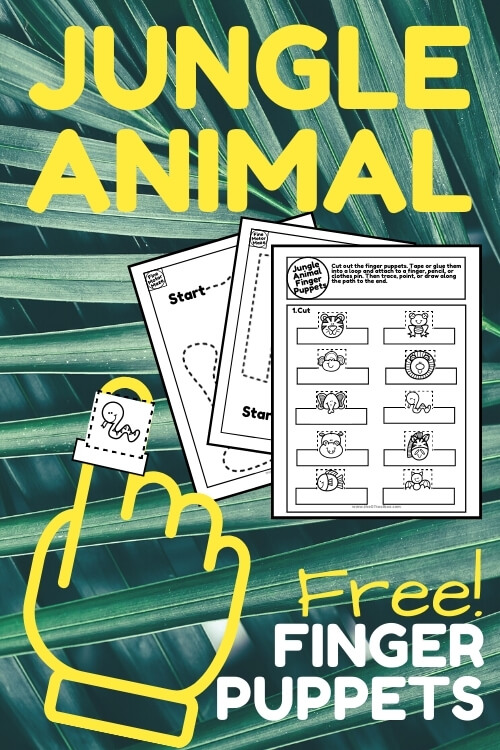
If you’re looking for a playful way to support fine motor skills, these jungle finger puppet printables are a fun activity for kids. Finger puppets are a favorite in occupational therapy because they encourage finger isolation, hand strength, and coordination while also promoting imaginative play. Simply print the free finger puppet pages, cut them out, and let kids bring jungle animals to life through storytelling, pretend play, or group activities. This simple jungle animal activity works well in therapy sessions, classrooms, or at home and is an easy way to combine creativity with skill-building.

jungle finger puppet printables

Today, we have a free printable set of paper finger puppets you can print off and start using in play activities to support fine motor skills. Finger puppets are a simple yet powerful tool for supporting fine motor development, especially in the areas of finger isolation and separation of the sides of the hand, two foundational skills needed for tasks like writing, buttoning, and manipulating small objects.

How Finger Puppets help with Finger Isolation

Using finger puppets encourages finger isolation, which is the ability to move one finger at a time while keeping the others still. When children animate each puppet with a different finger, they must consciously engage and control that finger’s movement. This is especially beneficial for improving dexterity and coordination, which are critical for functional tasks like pressing keys on a keyboard or forming legible letters.

How finger puppets help with Separation of the Sides of the Hand

Finger puppets also promote separation of the sides of the hand, which refers to the functional division between the thumb/index/middle fingers (used for precision tasks) and the ring/little fingers (used for stability). When kids wear puppets on their thumb, index, and middle fingers while the ring and pinky remain curled into the palm for support, they’re naturally strengthening this motor pattern. It mirrors the hand positioning needed for tasks like holding a pencil or tying shoes.

Use these jungle animal finger puppets to help kids develop fine motor skills through play! Finger puppets are a common tool in occupational therapy toolboxes and working on isolation skills is key to helping kids with dexterity. So, using these jungle animal finger puppets is a no-brainer when it comes to developing fine motor skills. Add these printable finger puppets to a jungle theme in therapy or learning.

Finger puppets are a great tool for incorporating into fun finger strength exercises!

Free printable jungle animal finger puppets to download and use with a jungle theme.

As always, if the information on finger puppets and finger isolation helps you, or you create similar activities please link to this page and tag The OT Toolbox on social media.

Improve Finger Isolation with Finger Puppets

Today, I’m sharing jungle animal puppets designed to promote finger isolation and dexterity. Finger puppets are a great way to develop and refine the skill of finger isolation.

Finger isolation refers to the ability to move one finger at a time. Within the action of isolating a finger from the rest of the hand, there are precise motor actions. This dexterous movement allows the finger to move on it’s own, separate from the rest of the hand. This refined motor skill is needed for functional tasks like typing, pointing, holding up one finger, and many other functional tasks.

It can be difficult for children to develop finger isolation and use refined motor movements during functional tasks such as pencil grasp, typing, or shoe tying. In fact, when these tasks are difficult, we often times don’t see a combined motor effort including separation of the sides of the hand, refined arch development, or finger isolation.

That’s where these printable Finger Puppets come into play!

When children use finger puppets, they are incorporating many motor skill areas into one activity:

  • Finger isolation (One finger moving in separation from the rest of the hand)
  • Distal joint flexion (bending the DIP and PIP joints in isolation from the MP joint)
  • Separation of the sides of the hand (Moving the thumb, pointer fingers while the middle, ring, and pinky fingers stabilize)
  • Arch refinement (Development of the arches of the hand, which are strengthened by individual finger use and hand side separation)
  • Eye-hand coordination (moving the fingers in coordination with visual input)
  • Visual convergence (Moving the eyes as a team from a far point to a near point)
  • Visual Tracking (Moving the eyes to follow a moving target)

Finger puppets help in so many ways that transfers not just to precise motor tasks, but the bigger picture, too: Reading, handwriting, learning, sports, tool manipulation (scissors, utensils, etc.) and much more!

I actually have created many versions of these finger puppets (you’ll see more here soon on the site), but they originated in our Fine Motor Kits, which work on many areas of fine motor development.

If you’ve grabbed one of our Fine Motor Kits, then you may have seen a version of these finger puppets in different themes. Check out the Fine Motor Kits to find tons of resources and activities to develop fine motor skills:

Other ways to work on finger isolation include with fingerprint activities like these finger isolation rings, or with fingerprint art and this clover craft. You’ll find more fun ways to work on this fine motor skill with these finger isolation activities.

Jungle Animal Finger Puppets

Today’s resource is a jungle themed activity. These jungle finger puppets go really well when using a jungle theme in preschool, kindergarten, or older grades. I love offering free occupational therapy resources, and these jungle animal finger puppets are just that!

You can grab these free finger puppet templates by entering your email address into the form below. They are print-and-go OT resources where each step builds skills:

  1. Color the small images on the animals. This is a great colored pencil activity that also builds skills. Talk about precision with pencil control!
  2. Cut out the jungle animal finger puppets. These finger puppets are designed to have simple shapes. You’ll find the squared shapes makes it a great scissor skills for little hands.
  3. Tape the finger puppets into a loop. Size the puppets to fit fingers of any size. If the loops are too large, just trim them with scissors.
  4. Slide the jungle animals onto fingers, and start playing! Get ready to build many different skills.

Ways to use these Jungle Animal Finger Puppets

There are several ways to use these jungle animal finger puppets. From fine motor mazes, to letter formation activities, to sensory play…the ways to improve finger isolation (and the other skill areas described above) are endless!

  1. Jungle Animal Fine Motor Maze– These printable finger puppets include two printable jungle themed fine motor mazes. Use the finger puppets to walk, crawl, creep, or fly through the jungle as fine motor skills are developed in finger isolation. Trace the line and work on eye-hand coordination, separation of the sides of the hand, and more.
  2. Make a Jungle Sensory Bin– Use the jungle finger puppet animals to trace and for letters or numbers in a sensory tray. Fill a low tray with salt, flour, rice, or sand. Use the finger puppets to form letters and numbers.
  3. Air Write Letters and Numbers– Put one of the jungle finger puppets on the pointer finger. Then, use big arm movements to “write” letters and numbers in the air.
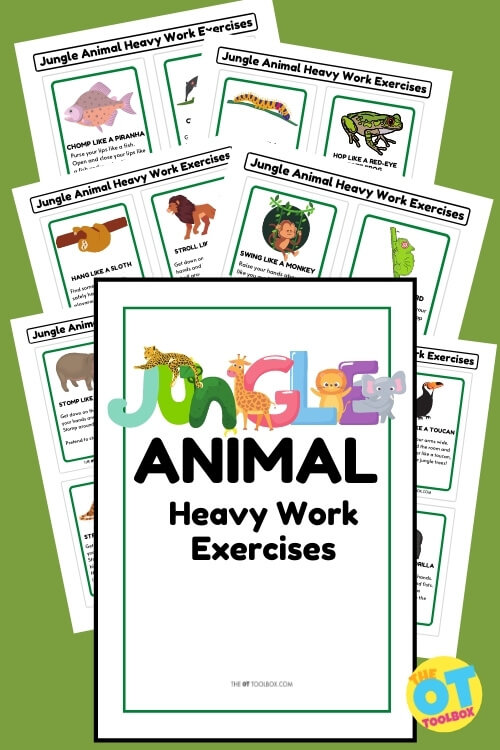
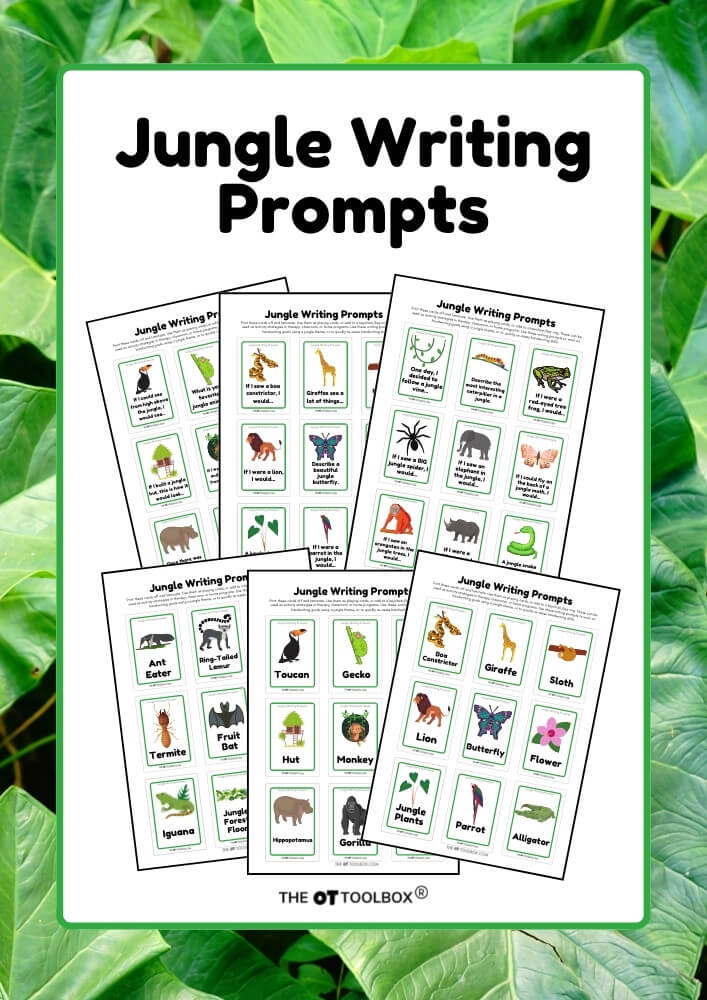
  4. Add these finger puppets to a jungle theme in therapy! Use these Jungle Writing Prompts and Jungle Heavy Work Exercises to meet every goal area.

Free Jungle Animal Finger Puppets

Want to grab this free printable set? Enter your email address into the form below!

Free Jungle Animal Finger Puppets

    We respect your privacy. Unsubscribe at anytime.

    Colleen Beck, OTR/L has been an occupational therapist since 2000, working in school-based, hand therapy, outpatient peds, EI, and SNF. Colleen created The OT Toolbox to inspire therapists, teachers, and parents with easy and fun tools to help children thrive. Read her story about going from an OT making $3/hour (after paying for kids’ childcare) to a full-time OT resource creator for millions of readers. Want to collaborate? Send an email to contact@theottoolbox.com.