Heavy Work in Teletherapy Slide Deck

Spring heavy work activities for teletherapy

Offering sensory, heavy work in teletherapy doesn’t need to be difficult. Wondering how to support sensory kids virtually? Need ideas to help with attention or focus in the classroom? This free teletherapy slide deck covers an area that is much needed for many children. We know that kids today need to move more. But did you know the part that heavy work plays into development and self-regulation strategies in kids?

We see it all the time: kids in teletherapy or in the virtual classroom that just can’t sit still or pay attention. And there’s a lot going on when screens are involved. The research on screen time is telling. But other times, kids are just being kids and movement is needed! Brain breaks and movement breaks are as necessary as hydration and eating healthy meals when it comes to learning.

What is Heavy Work?

Heavy work is a sensory strategy that helps children regulate so they are at a calm-ready state of learning and participation in tasks. For kids, heavy work helps them know where their body is in space by using the proprioceptive sensory system.

When deep heavy input is offered, the child challenges their proprioceptive system. Input in the child’s muscles and joints lets their brain know about body position, weight, pressure, stretch, movement and changes in position in space.  Then, the body is able to grade and coordinate movements based on the way muscles move, stretch, and contract. In this way, the proprioceptive system allows us to apply more or less pressure and force in a task.

Proprioception and that heavy work input occurs when we lift, jump, pull, carry, hug, snuggle, crash, climb, push, etc. All of these movements incorporate the muscles and joints and offer “heavy work” input.
Kids who may benefit from heavy work input might do some of these things:

  • Appear clumsy
  • Fidget when asked to sit quietly.
  • Show an increased activity level or arousal level.
  • Seek intense proprioceptive input by “crashing and bashing” into anything.
  • Slap their feet when walking.
  • Flap hands.
  • Use too much or too little force on pencils, scissors, objects, and people.
  • “No fear” when jumping or walking down stairs.
  • Or, are overly fearful of walking down steps/jumping.
  • Look at their body parts (hands/feet) when completing simple tasks.
  • Sit down too hard or miss chairs when sitting.
  • Fall out of their seat.
  • Fluctuates between over-reacting and under-reacting in response to stimulation.
  • Constantly on the move.

Heavy work is a huge part of sensory diets that are created to help kids organize their sensory systems and regulate those sensory needs.

Occupational therapists recommend heavy work to calm and help kids pay attention. And, if there were any time that heavy work was more needed, it might be during virtual learning.

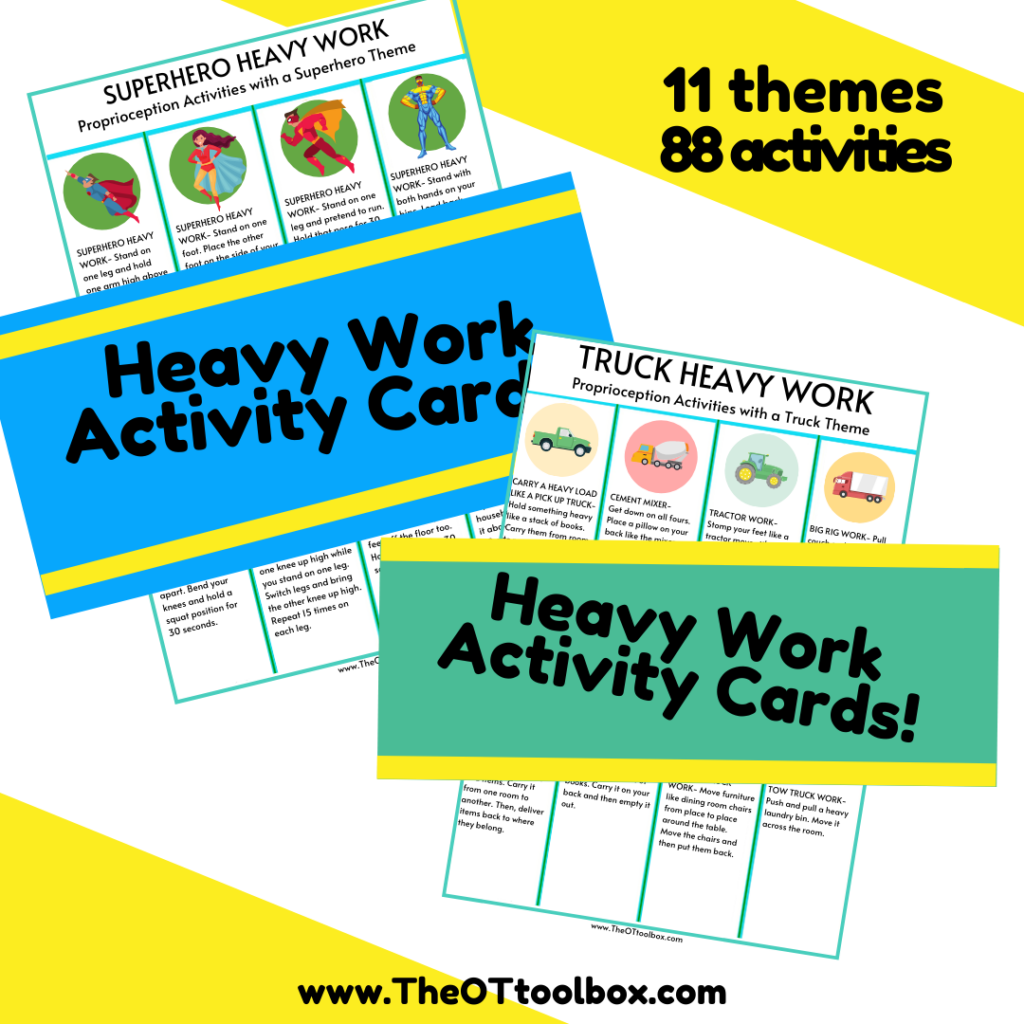
For more heavy work ideas that cover a variety of themes, grab a copy of the Heavy Work Movement cards.

Spring activities that offer heavy work sensor input

Heavy Work Teletherapy Activity

So how do you incorporate heavy work and all the benefits of proprioceptive sensory input into a teletherapy or virtual learning environment?

That’s where this heavy work virtual therapy slide deck comes into play. I created this slide deck as part of our free slides here on the site, as a support for therapists working with kids in virtual environments. We know that kids need movement to support learning and development of motor skills. They need to move and get that heavy work feedback so they can pay attention, focus, and learn.

This heavy work activity does just that.

Therapists (or teachers, or parents) can use this heavy work activity to help kids get the deep resistive input that they need.

Kids can go through the slide deck and complete each activity. The slides use Spring images and concepts to incorporate proprioception and to offer FUN ways to add heavy work and help kids calm or regulate their sensory needs.

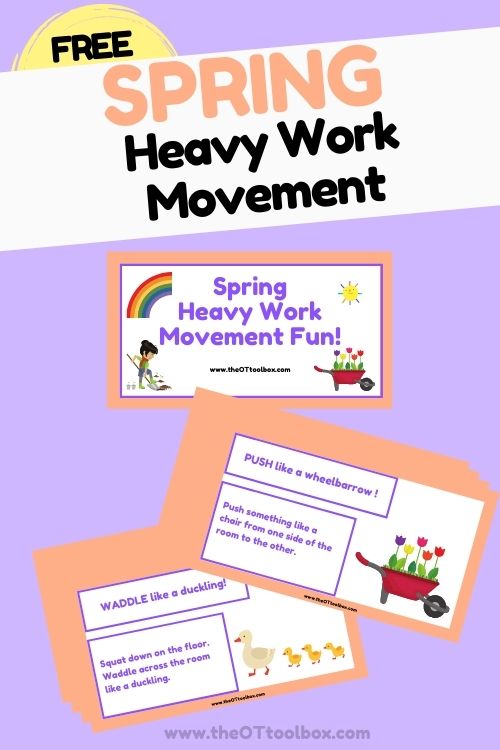
Spring heavy work activities for teletherapy include crawling like a bear that is waking up from hibernation.

Spring heavy work activities in the slide include:

  • Digging in dirt
  • Pushing a wheelbarrow
  • Crawling like a bear coming out of hibernation (Pair the activity with others from our collection of hibernation activities!)
  • Waddling like a duckling
  • MORE!

Users can act out each heavy work activity on the slides and work on motor planning, coordination, bilateral coordination, gross motor skills, AND gain the benefits of heavy work input!

Free heavy work slide deck

Want this slide deck in your therapy toolbox? Enter your email address into the form below to access this free slide on your Google drive.

Heavy Work Activities Slide Deck!

    We respect your privacy. Unsubscribe at anytime.

    Colleen Beck, OTR/L has been an occupational therapist since 2000, working in school-based, hand therapy, outpatient peds, EI, and SNF. Colleen created The OT Toolbox to inspire therapists, teachers, and parents with easy and fun tools to help children thrive. Read her story about going from an OT making $3/hour (after paying for kids’ childcare) to a full-time OT resource creator for millions of readers. Want to collaborate? Send an email to contact@theottoolbox.com.
    heavy work cards for regulation, attention, and themed brain breaks
    Heavy Work Movement Activity Cards

    Spring Emotions Matching Game Slide Deck

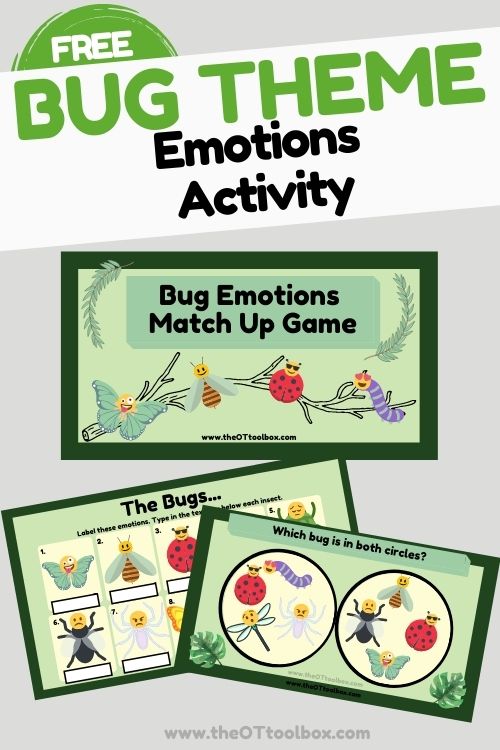
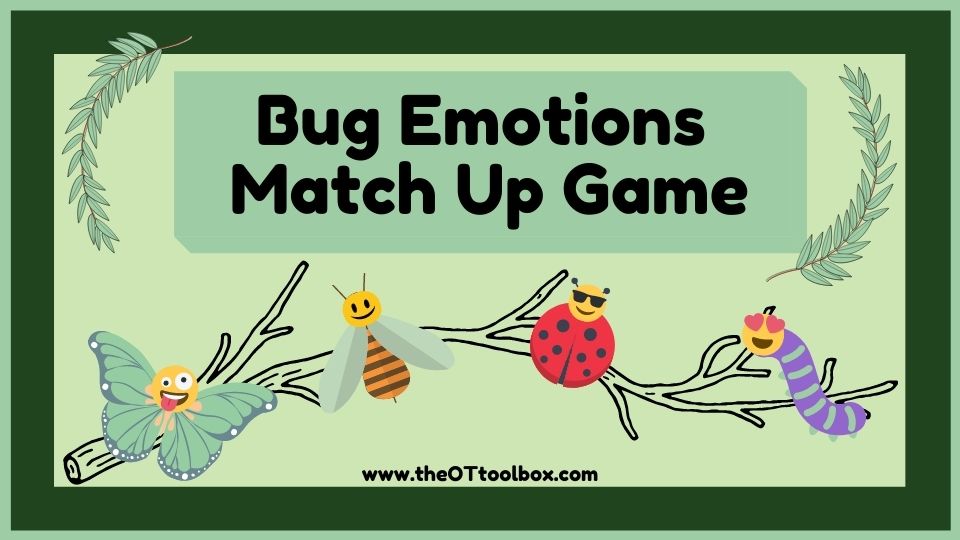
    Emotions Matching game with a bug theme for Spring

    Today, I have another free therapy slide deck for you to use in guiding teletherapy occupational therapy sessions. This activity is a Spring themed emotions matching game. The premise behind this emotions game is to help with teaching feelings to kids, as well as the social emotional learning involved in self-regulation. Because there are always other skill areas to work on, the occupational therapy activity addresses visual perceptual skills like visual discrimination and visual memory as well.

    This teletherapy slide deck is one of the many free slides we have here on the website. Use them in your teletherapy activities for occupational therapy.

    Emotions Matching game with a bug theme for Spring

    Emotions Matching Game

    This emotions matching game is a lot like our other spot it game activities. The idea is to work on teaching emotions by facial expression and to help kids with identifying different facial expressions that translate to feelings and emotions.

    Spring bugs emotions matching game for teaching feelings

    This slide deck has a bugs theme, making it a great activity for Spring (but anytime really…bugs are a fun theme to use in occupational therapy activities!)

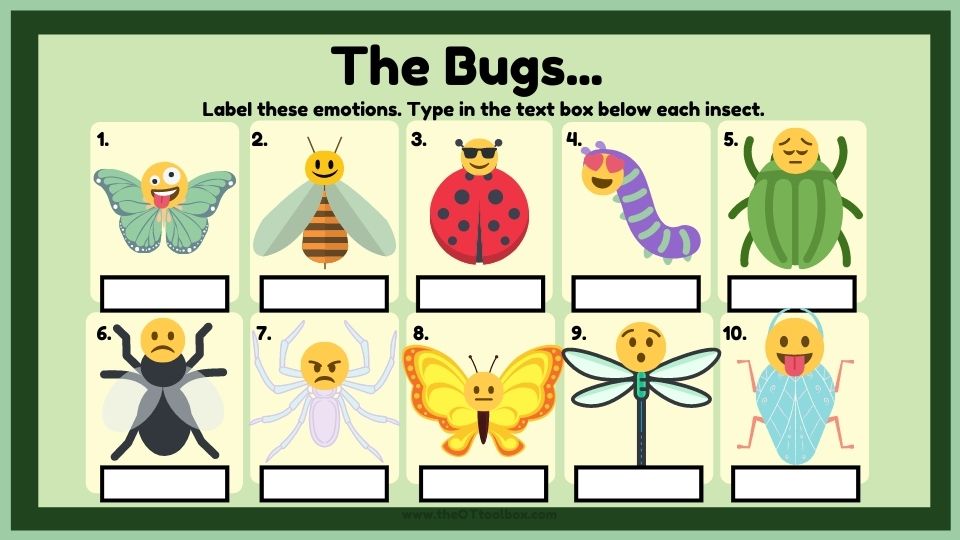
    When kids play this emotions matching activity, they can first, identify different emotions. On the slide deck children can actually type right into the space below each image.

    Teach feelings and emotions with this emotion matching game.

    The slides are set up so that kids can type the emotion they identify with each facial expression. Some kids might identify different emotions based on the images. Some of the bugs have silly expressions, and others have angry, worried, happy, or calm expressions. When kids go through this part of the emotional learning game, they can express the reasoning why they define each image as a specific feeling or emotion.

    When kids identify emotions, it goes a long way in teaching feelings to kids. This can help them with empathy for others and to better understand why and how they feel certain ways in specific situations.

    You can extend this part of the activity to further social emotional development and self evaluation. Help kids identify when they may feel that specific emotion, and what they have done about it in the past.

    Then, you can help them identify coping strategies if needed (for feelings of anxiousness, worry, or anger) and when feelings get “too big” or out of control. For example, as the child to describe how they might act when they feel that type of feeling. There are so many ways to extend this part of the emotions game that works on an individual basis; Make the social emotional learning online game work for the child you are treating.

    These kind of self-reflection strategies are addressed in the Impulse Control Journal, a printable resource for working on responses, coping mechanisms, and self-reflection that impacts our responses to specific situations in everyday situations. With the Impulse Control Journal, kids can journal their responses and identify ways they can respond and react differently in the future.

    Emotions Game for teletherapy

    Emotions Matching Activity

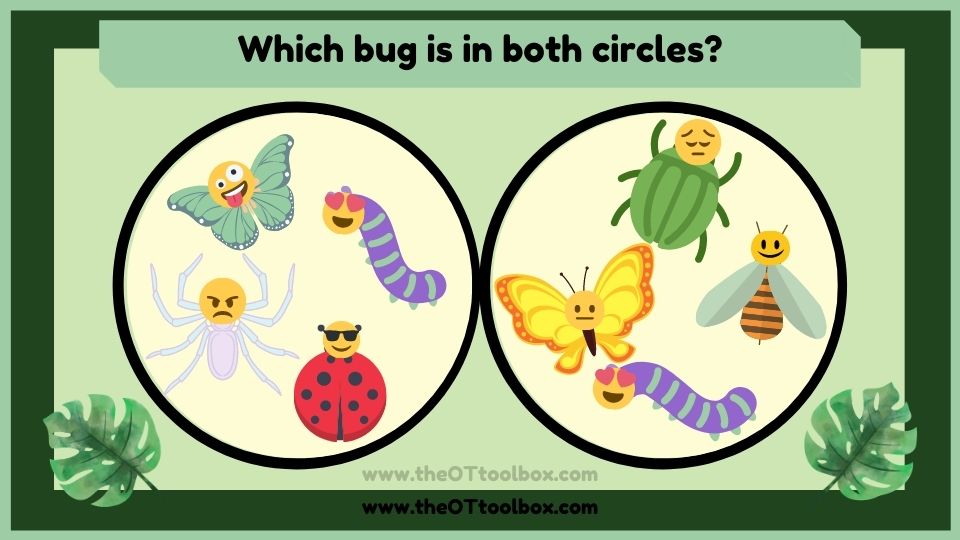
    The next part of the slide deck includes a spot it game with the emotions and facial expressions images.

    Kids will go through each slide and find two matching facial expression bugs that share the same emotion.

    This visual discrimination activity helps with more social emotional skills (picturing the expression in different sizes or positioning) and working memory as it relates to emotional learning. They can recall the emotion that they defined for that particular expression and then go back and identify the self regulation strategies that they came up with in the precious part to the slide activity.

    This part of the free slide deck is also interactive- Kids can click on the leaves on the slide and drag them over to cover the matching bugs.

    This free social emotional worksheet goes well with this slide deck. Print it off and use it with kids to write in different facial expressions.

    Visual Perceptual Skills with Matching Games

    When kids play matching games like this spot it activity, they are developing and refining so many visual perceptual skills that carryover to reading, writing, math, handwriting, and other aspects of learning.

    These are the visual perceptual skills and visual processing skills that this virtual game addresses:

    • Visual memory
    • Visual attention
    • Visual discrimination
    • Form constancy
    • Visual figure ground,
    • Visual scanning

    There are different ways to extend this emotions game as well:

    1. Use it to teach empathy- Identify how others might feel when they have the visual expressions described in this slide deck.
    2. Work on coping strategies- Use the facial expressions to practice coping techniques.
    3. Work on handwriting- write down the emotions and work on letter formation, spacing, sizing, and legibility.
    4. Use the activity as a writing prompt- Kids can write about a time that they experienced one of the emotions on the slide deck. They can describe what led to those feelings and what they did about it if coping tools were needed.

    How would you use this emotions game in teletherapy or to guide therapy sessions?

    Emotions Slide Deck

    Want to add this teaching feelings game to your social emotional skills toolbox? Need easy teletherapy activities that don’t require a ton of materials?

    You’ve got it!

    Enter your email into the form below. You’ll receive a link to add this slide deck to your Google drive. Then, start using it right away in therapy sessions.

    Spring
    Emotions Game Slide Deck!

      We respect your privacy. Unsubscribe at anytime.

      More Social Emotional Tools

      Need strategies to work on self-regulation and coping mechanisms? Try the heavy work activity cards for proprioceptive input that calms and helps to regulate.

      Or, try the social emotional learning crafts, activities, and play ideas in the resource, Exploring Books Through Play, 50 Activities Based on Books About Friendship, Acceptance, and Empathy.

      Emotional Learning information– Use these social emotional learning activities to help children develop positive relationships, teach concepts of behaving ethically, and how to handle challenging emotions and behaviors.

      Zones of Regulation Activities– Strategies and hands-on activities to incorporate into self-reflection of feelingsemotions, and our response to situations is the ability to use emotional regulation. 

      Colleen Beck, OTR/L has been an occupational therapist since 2000, working in school-based, hand therapy, outpatient peds, EI, and SNF. Colleen created The OT Toolbox to inspire therapists, teachers, and parents with easy and fun tools to help children thrive. Read her story about going from an OT making $3/hour (after paying for kids’ childcare) to a full-time OT resource creator for millions of readers. Want to collaborate? Send an email to contact@theottoolbox.com.
      Benefits of AOTA Membership)

      There are SO many reasons to have an AOTA membership! One of those reasons is the annual conference where members can learn, join in the community, and join in the excitement of thousands of professionals. Want a chance to WIN an All Access Pass to AOTA INSPIRE? Scroll to the bottom of this page and enter to win!

      AOTA Conference GIVEAWAY

      I am SO beyond excited to announce a NEW giveaway. This one is REALLY big. ONE winner will receive an all access pass to AOTA’s 2021 Annual Conference, Inspire!

      I love attending AOTA’s annual conference for the community, energy, and the education. This year brings us a new and innovative spin on the annual occupational therapy conference…it’s completely virtual, so you can attend any of the 500+ educational sessions from the comfort of your home, office, or classroom. The on-demand sessions will be available through June 30, so you’ll have lots of time to explore all that AOTA INSPIRE has to offer.

      AOTA membership and Inspire conference
      AOTA membership benefits and resources in the AOTA Inspire conference.

      AOTA Membership

      Today, we are talking about all of the benefits of an AOTA membership. This is one annual membership that I adore being a part of. So, what are the benefits of an AOTA membership for occupational therapists? Let’s chat!

      Benefits of AOTA membership for occupational therapists

      AOTA Membership Benefits…it’s Big!

      I absolutely love maintaining my AOTA membership. Here’s a few reasons why I make the effort to pay this annual expense.

      Occupational therapists gain so many benefits from being an AOTA member

      1. The massive number of resources on The AOTA Website

      The amount of resources, articles, worksheets, handouts, and special area resources are just some of the benefits of being an AOTA member. Members also have access to education, and research information via OT Practice magazine, OT Practice Online, American Journal of Occupational Therapy (AJOT), AJOT Online, the OT Practice Pulse, and AOTA Alerts e-newsletters, and even blog posts. Not only that, the Special Interest Sections (SISs) are options for customized resources that meet your specific needs. Membership appreciation events includes opportunities to access free webinars for continuing education credits as well as celebratory events.

      2. AOTA Membership Supports the Occupational Therapy Profession

      Through advocacy, research, and promotion, AOTA is a source of support for all OT professionals. When one of our fellow professionals makes their way into the news, AOTA shares and promotes this media, helping to make others aware of the OT profession. The association works toward public policy, scope of practice, and licensure issues. There is so much work being done behind the scenes, from advocacy for health care reimbursement to protect our profession. Here’s the thing: we NEED them to advocate for us. We NEED help to lobby for issues like Medicare changes or licensure concerns. In order to do these vital tasks, AOTA needs our our membership money or other funding to pay for lobbyists.

      One specific advancement of our profession is the development of an Occupational Therapy Compact, allowing therapists the privilege and opportunity to practice across state lines. What a fantastic advancement that will provide so many opportunities for OTs while keeping our profession current with the practice of other professions such as medical, physical therapy, nursing, and other health professions.

      3. Discounts Through AOTA Membership

      By being a member of AOTA, OTs gain discounts on continuing education opportunities, conferences, books, and retailer. Other discounts include deals on professional liability, disability, life, medical coverage, and student and personal loan refinancing. Want to branch out and start your own business or private practice? AOTA can support you with those insurance and financing opportunities.

      4. Connection and Collaboration with AOTA Members

      By being an AOTA member, occupational therapists have the opportunity to connect with others in the field on www.CommunOT.org. Have a question or want to connect with others in your field of practice? The social networking forum is your opportunity.

      As an AOTA member, you receive a discounted price on the annual AOTA conference…and with it, the prospect of meeting thousands of OTs from all over the country. The collaboration and networking is substantial. This conference is the highlight of my year…if you’re going, let me know! I would love to connect!

      5. Leadership Oppourtunities with AOTA

      Leadership is just one means of giving back to the profession and battling that therapy professional caregiver stress and burnout. It’s true! Volunteering has been proven to benefit individuals in both mental and physical health. Volunteers gain self-confidence, self-esteem as practitioners, and satisfaction in their life and job. The duties of a volunteer role provide a sense of purpose, pride and identity. As therapists, we KNOW the power in that! What better way to combat burnout and job fatigue than with a volunteer or leadership role that serves our profession?

      AOTA members have the opportunity to participate in volunteer roles on the Coordinated Online Opportunities for Leadership database; committees; and more. Want to see a change in the profession? You have a chance to step up and speak your voice!

      Students have the opportunity to take part as a volunteer for AOtA through the Assembly of Student Delegates as they represent their school on a national level.

      Sort through the vast number of leadership and volunteer roles that AOTA offers here.

      6. Student Resources

      Student members of the national OT association benefit from many resources and tools. Students can join at a discounted rate and gain all of the benefits listed above as well as resources to learn, become involved in the profession, stay up to date on research, prepare for fieldwork, study for the NBCOT examination, and even find a job.

      Find resources on fieldwork, job placement, leadership opportunities, exam prep tools, and more. Students will love the the OT Student Pulse, a monthly e-newsletter for AOTA student members created by the Assembly of Student Delegates. The resource is a newsletter written by students for students, and includes relevant and effective information on occupational therapy issues along with news, resources, and opportunities.Students even have the opportunity to submit an article idea or share a student accomplishment that will be blasted out in the newsletter. I wish the OT Student Pulse was around when I was a student!

      7. AOTA Provides Career Advancement Opportunities

      From professional development, specialty certifications, job placement or a change in area of practice, AOTA offers the tools and resources needed to advance one’s career. Clinicians can participate in board certifications or specialty certifications as a means to promote proficiency while highlighting your professional and personal accomplishments as an occupational therapy professional.

      For those therapists who want to advance their career through post-professional degrees or training, AOTA The association also offers its Fellowship Program as a means to cultivate and recognize post-professional training programs that advance the knowledge and skills of licensed occupational therapists in focused areas of practice.

      So, what do you think? Are you an AOTA member?

      Some of the smartest and most creative folks I know are the readers of The OT Toolbox. I asked readers to tell me the biggest value they personally find in having an AOTA membership. Scroll through the comments…you might just find a new reason to join the profession’s leading advocacy association! We can always learn from one another!

      Treadmills and Wellbeing

      Treadmills and wellbeing

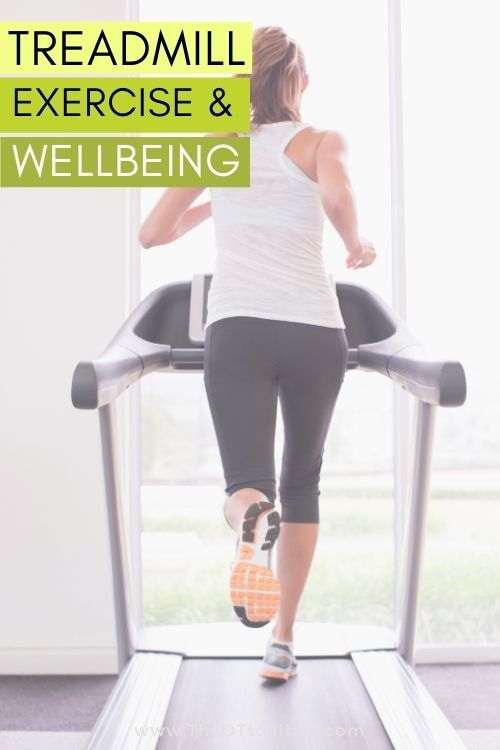
      There are so many benefits to running on a treadmill, for example the physical exercise, wellbeing, emotional response, and treadmill use can play a part in occupational balance when incorporated with leisure activities. And for many, a treadmill is a tool to incorporate exercise into daily routines. Let’s talk treadmills and wellbeing.

      Treadmills and wellbeing.

      Occupational therapists work with people of all ages on all aspects of occupation, or daily occupations of daily life, and include wellness and wellbeing to promote functional independence in daily occupations. From physical activity to performance of tasks, to a balanced lifestyle, to emotional and social wellbeing, physical activity plays an important role in all of these areas. Leisure activities such as entertainment and listening to music as entertainment are included in a balanced lifestyle, leading to overall wellbeing.

      Wellness and wellbeing are important for function in all areas. Today, we’ll explore how a treadmill is a powerful tool in promoting wellbeing through physical activity.

      Research on wellness tells us that there are many contributors to wellbeing and overall wellness. And in those contributors, you’ll see a similar thread of physical activity. Tools for promoting wellness include strategies such as mindfulness, deep breathing, yoga, guided imagery, and wellness programs and even rooms. But what about the treadmill as an option to improve wellbeing?

      Treadmills and wellbeing

      When you take a look at the wellness wheel, it’s easy to see how a lopsided wheel can lead to caregiver stress and burnout, lack of self-care, and a deflated state of being. Adding too much to one pie of the wheel, such as when there is a focus on schooling, work, caring for a children, or long work days can lead to burnout, especially when there is extended time involved in focusing on that one portion of the wellness pie.

      Exercise and the benefits that it has on emotional wellbeing, physical activity can be difficult for some. Those in cold or rainy environments, and places where outdoor exercise is difficult can be a detriment. In these situations, indoor running is the way to go.

      And, for some treadmill users, the time spent on a treadmill can be time to watch movies, television shows, or listen to music. This can be time that “rounds out” the wellness wheel and adds a much-needed time of entertainment.

      This article explains more on these concepts of emotional and physical wellbeing in treadmill use. In fact, treadmill users ran farther, and with higher heart rates when they watched self-selected entertainment during their treadmill run, compared to watching nature images (both a static image or a dynamic nature image).

      Treadmill use can also add benefits in emotional wellbeing. Participants in one study showed lowered levels of anger, dejection, and anxiety, as well as increased excitement after exercising on a treadmill.

      Preferred music also can have an impact on running performance, according to a different study.

      Treadmill Tools

      So when it comes to incorporating motivating and meaningful physical exercise into the health and wellness pieces of overall wellbeing, it is beneficial to incorporate entertainment and leisure activities like listening to preferred music or watching movies and television shows.

      When weather is bad or it’s too cold outdoors, I turn to my treadmill. I love to run along to music, podcasts, and even Netflix when running on the treadmill. What motivates you?

      With the Horizon Fitness treadmills and fitness equipment, there are a number of entertainment apps and streaming options, including Bluetooth speakers,  live or on-demand fitness apps, and other streaming fitness opportunities. All of these extras are designed to promote improved physical exercise and meaningful motivation.

      Check out the Horizon fitness deals, including free shipping that you can access now on the Horizon site.

      Affiliate links are included in this post, but I only recommend products that I own, and love!

      Colleen Beck, OTR/L has been an occupational therapist since 2000, working in school-based, hand therapy, outpatient peds, EI, and SNF. Colleen created The OT Toolbox to inspire therapists, teachers, and parents with easy and fun tools to help children thrive. Read her story about going from an OT making $3/hour (after paying for kids’ childcare) to a full-time OT resource creator for millions of readers. Want to collaborate? Send an email to contact@theottoolbox.com.
      St. Patrick’s Day Writing Slide Deck

      St. Patrick's Day writing prompts and activities

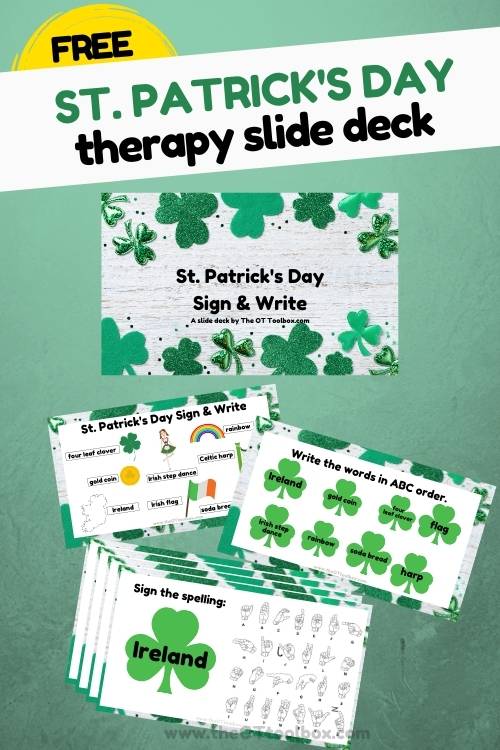
      Another free therapy slide deck in this week’s St. Patty’s Day theme is this St. Patrick’s Day writing activity. It’s an occupational therapy activity that addresses handwriting, legibility, self-correction in writing, and fine motor skills. Sometimes it can be hard to work on handwriting in teletherapy and this activity strives to make that fun and motivating for kids. Use the St. Patrick’s Day writing prompts as activities to get kids started on letter formation, sizing, spacing, and the motor skills needed to hold the pencil with a fun March theme.

      This slide deck goes really well with our recent freebies: Four Leaf Clover balance exercises and Shamrock Theme Visual Perception Activities.

      All are part of the free slides teletherapy resources here on The OT Toolbox.

      St. Patrick's Day writing prompts and activities

      St. Patrick’s Day Writing

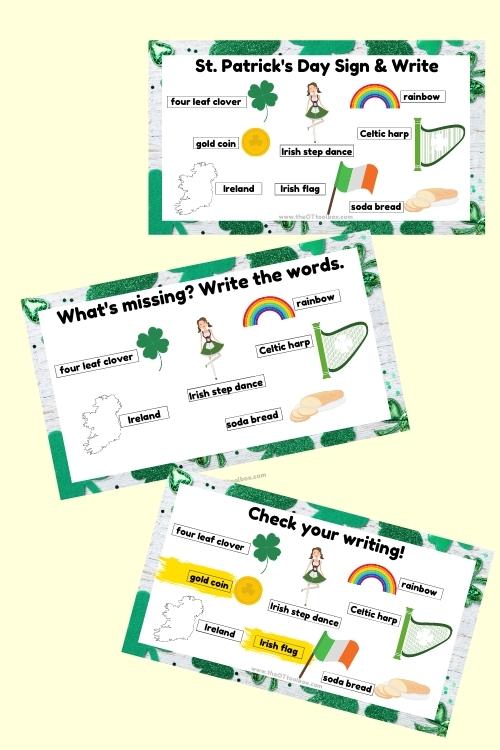
      Working on handwriting isn’t fun for a lot of children. That’s why the slide deck starts off with a writing “ice breaker” activity of sorts. Kids can check out the St. Patrick’s Day items on the slide and try to memorize the items. Then, you can move to the next slide and ask the child to tell you two items that are missing.

      This visual constancy exercise is a way to help kids notice details about what they see, and can be a powerful way to work on handwriting accuracy and formation of letters. Use this as a building block to work on self-correcting handwriting mistakes.

      When children write, that self-assessment piece is important to legibility and accuracy of writing, so when kids can notice and recall missing information or details, they can self-correct for legibility issues.

      As kids go through the slides, ask them to write down the items that are missing. This handwriting activity challenges kids to write without a model, so they are building letter formation skills.

      Then, the next slide shows the answer to the missing pieces. Kids can check their letter formation for accuracy and correct letter formation.

      St. Patrick's day writing prompt and puzzle

      There are two different exercises like this one.

      Depending on the child, you can then have them write down all of the St. Patrick’s Day items.

      Next, users are asked to write the St. Patrick’s Day words in alphabetical order. This activity challenges visual shift from the vertical plane to the horizontal plane and back again. This skillset is needed for copying material from a blackboard or classroom environment. Putting words into alphabetical order also challenges the visual attention and visual memory needed for reading and math work.

      The next several slides of the therapy deck include a fine motor piece where kids are challenged to spell St. Patrick’s Day words in American Sign Language. They will need to visually shift their attention from the word to the sign language sign and form that letter.

      Spelling several words with sign language is a fine motor exercise that helps with finger dexterity, precision, finger isolation, arch development, and motor planning skills.

      St. Patrick’s Day Writing Prompts

      Then, the final piece of the St. Patrick’s Day writing task is to use the words that have been used throughout the slide deck to write sentences. It’s an open-ended St. Patrick’s Day writing prompt that incorporates multisensory learning into the whole lesson.

      Encourage kids to self-check their writing for accuracy and to help with carryover of writing skills.

      Free Writing and Fine Motor Slide Deck

      Add this therapy slide deck to your toolbox. Enter your email into the form below and you will get a copy to use in teletherapy, home programs, or in the classroom.

      St. Patrick’s Day Writing and Fine Motor Activity

        We respect your privacy. Unsubscribe at anytime.
        Colors Handwriting Kit

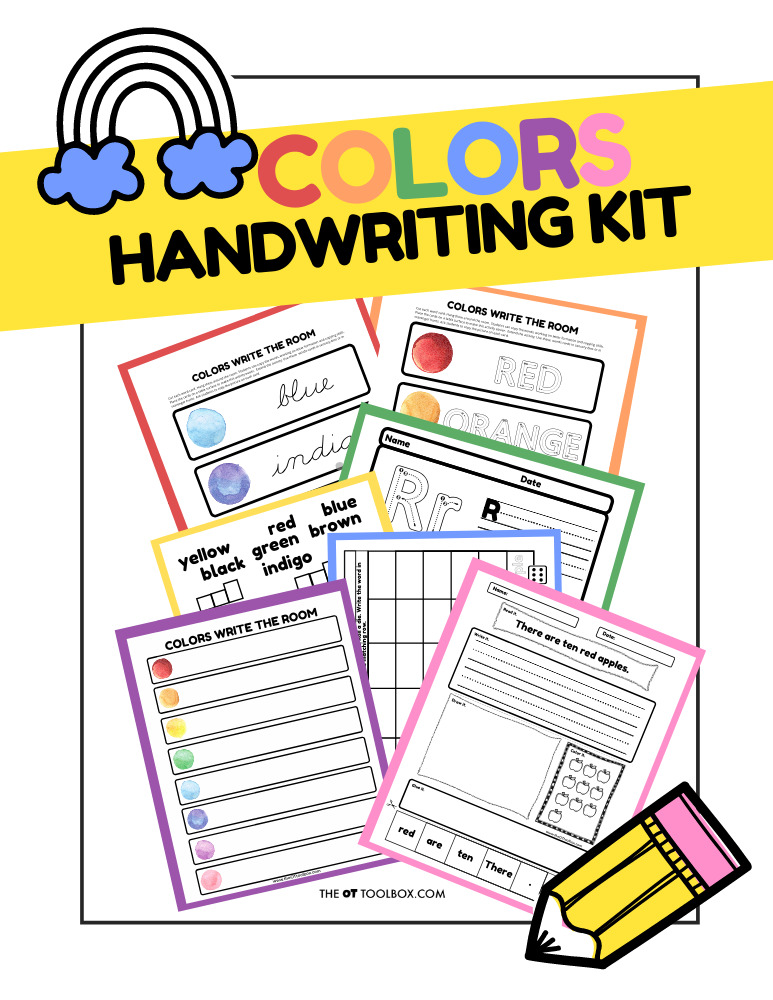
        Rainbow Handwriting Kit– This resource pack includes handwriting sheets, write the room cards, color worksheets, visual motor activities, and so much more. The handwriting kit includes:

        • Write the Room, Color Names: Lowercase Letters
        • Write the Room, Color Names: Uppercase Letters
        • Write the Room, Color Names: Cursive Writing
        • Copy/Draw/Color/Cut Color Worksheets
        • Colors Roll & Write Page
        • Color Names Letter Size Puzzle Pages
        • Flip and Fill A-Z Letter Pages
        • Colors Pre-Writing Lines Pencil Control Mazes
        • This handwriting kit now includes a bonus pack of pencil control worksheets, 1-10 fine motor clip cards, visual discrimination maze for directionality, handwriting sheets, and working memory/direction following sheet! Valued at $5, this bonus kit triples the goal areas you can work on in each therapy session or home program.

        Click here to get your copy of the Colors Handwriting Kit.

        Colleen Beck, OTR/L has been an occupational therapist since 2000, working in school-based, hand therapy, outpatient peds, EI, and SNF. Colleen created The OT Toolbox to inspire therapists, teachers, and parents with easy and fun tools to help children thrive. Read her story about going from an OT making $3/hour (after paying for kids’ childcare) to a full-time OT resource creator for millions of readers. Want to collaborate? Send an email to contact@theottoolbox.com.
        Shamrock Theme Visual Perception Slide Deck

        Shamrock theme visual perception

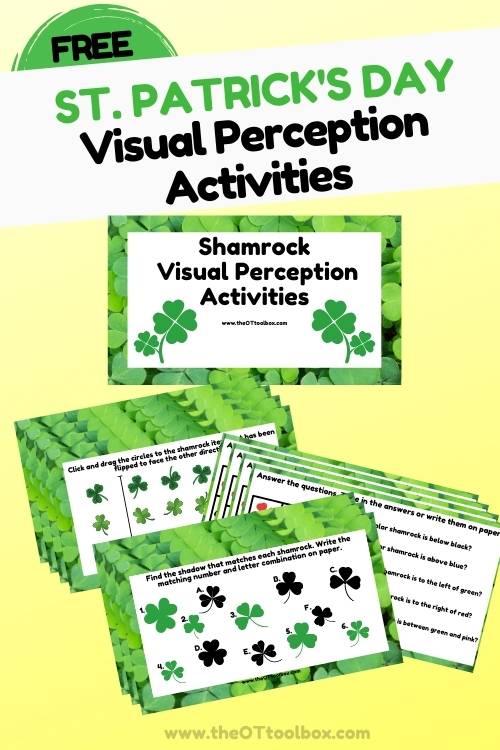
        This week’s free therapy slide decks are all about the shamrock theme! This visual perception slide deck covers all things shamrocks and is a fun way to help kids work on skills such as visual discrimination, figure ground, form constancy, visual memory, and visual spatial skills. So, grab this free slide deck and let’s get started!

        You’ll want to add the other shamrock themed activities to your therapy toolbox, too: Four leaf clover exercises and St. Patrick’s Day writing activities are sure to round out all of your therapy needs this time of year.

        Shamrock theme visual perception activities for vision therapy or OT teletherapy activities.

        These teletherapy activities are included in our massive collection of free slides, which is growing each week. Be sure to head over there to see the other therapy slide decks you’ve missed.

        Shamrock Theme

        This time of year, it’s fun to incorporate a shamrock theme into therapy and play. So, when I was thinking of therapy goal areas to address in this week’s slide decks, I knew visual perceptual skills was one of the essential areas.

        Visual perceptual skills are important to handwriting, hands-on play, math, reading, learning, and functioning. By visually scanning for differences in details, and being able to pull out visual discriminatory differences, children are building the skills they need for identifying words when reading…noticing different numbers in math problems, recognizing visual information they’ve read or seen before. All of this is connected to learning and functional participation in daily tasks. Read here on visual motor skills to see how all of these parts work together.

        So, the shamrock theme visual perception activities take what we know about visual processing, and make fun vision therapy exercises to work on these very skills.

        In the shamrock activities, you’ll find several different, but all equally effective vision activities…kind of like vision puzzles!

        Find the shamrock

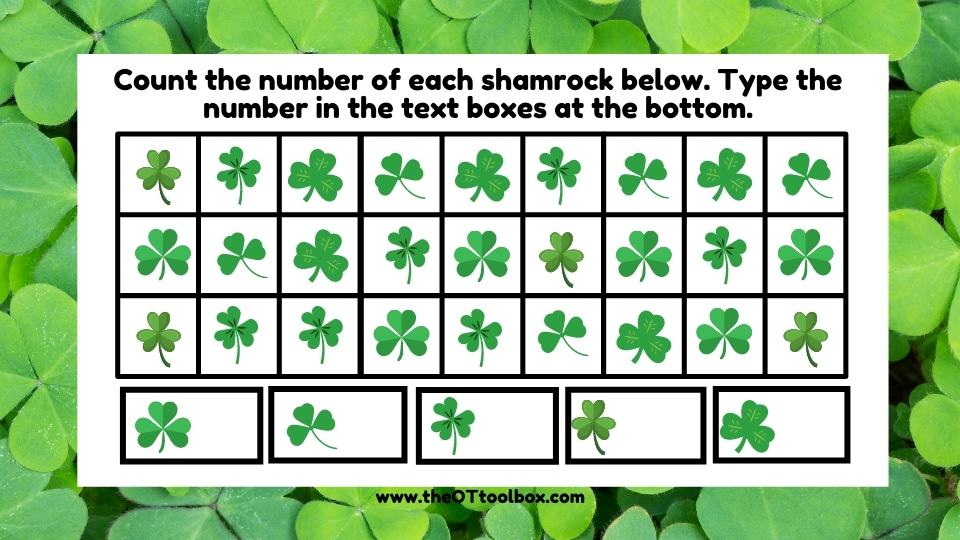
        On the first several slides of the therapy activities, you’ll see that users are challenged to count and identify matching shamrocks. These visual discrimination skills are powerful ways to work on form constancy, visual scanning, visual memory, and visual attention. When kids foster these skills, they work on the areas needed for reading and keeping their place in a reading passage. It’s a skill needed for reading fluency and comprehension.

        Shamrock visual perception exercise

        Users can count the number of each shamrock on the board and type that number into the slide deck. Students who are working on handwriting can write the number on paper.

        There are two different slides that work on these slills.

        You’ll also see a vision exercise where students can click and drag a circle to cover the shamrock that has been flipped. All of the other clovers in the row have been rotated. This form constancy skill is needed when reading so children know that letters are the same, not matter how they are written in different sizes or fonts.

        Shamrock activity to work on working memory, spatial relations, and directionality

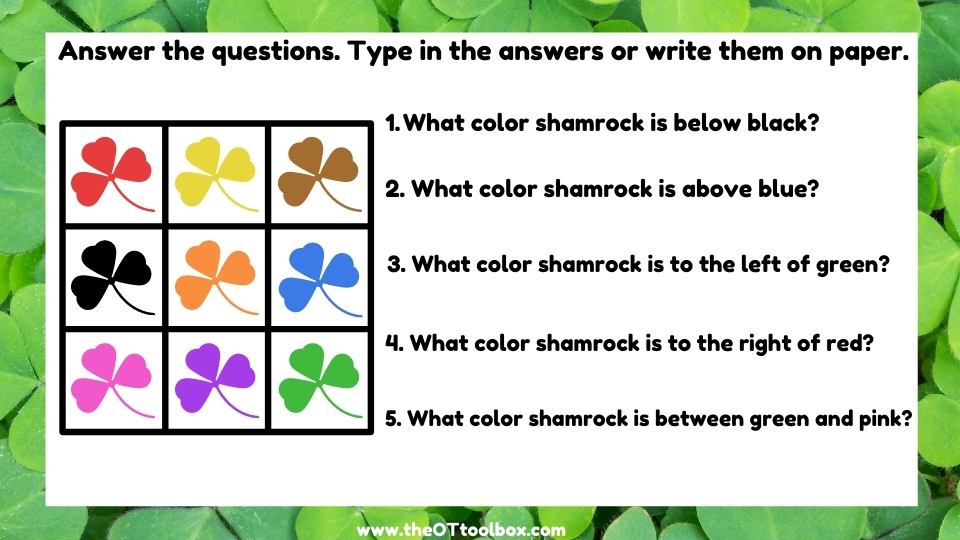
        There is another activity that might be my favorite. This one foster directionality and spatial awareness. Kids can identify the colors of shamrocks that are above, next to, or between others. This activity works on working memory and position in space skills. Teaching spatial relations with direction terms is an important way to help children with spatial awareness in handwriting, body awareness, and laterality.

        Other vision activities in the slide deck include a seek-and-find exercise that asks kids to find the four leaf clover hidden in a patch of shamrocks. This activity works on visual scanning, visual figure-ground skills, and visual attention. All of these skills are needed for a child to locate items in a busy background.

        Shamrock vision therapy exercise for visual discrimination

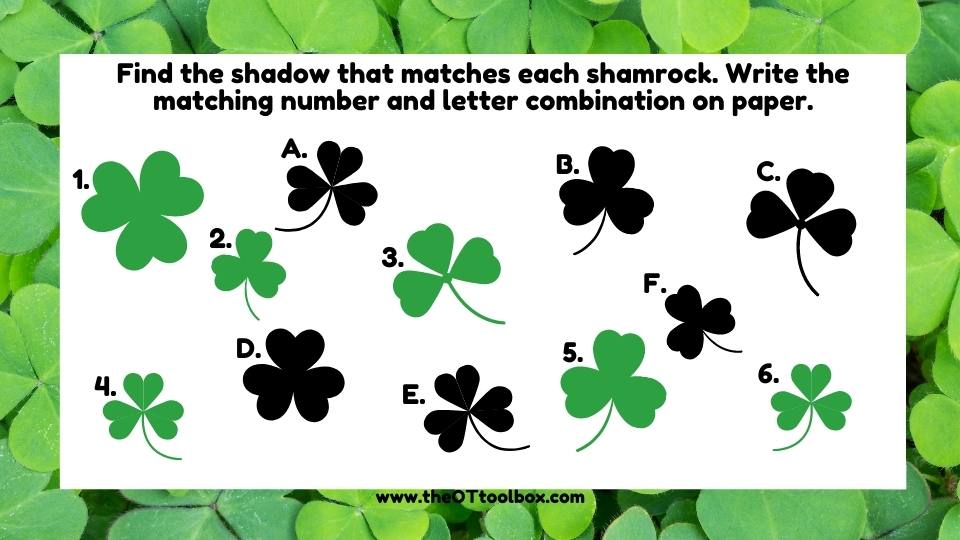
        There is a shadow matching activity that challenge kids to foster their visual discrimination and visual memory skills.

        Shamrock theme visual perception activity for visual scanning

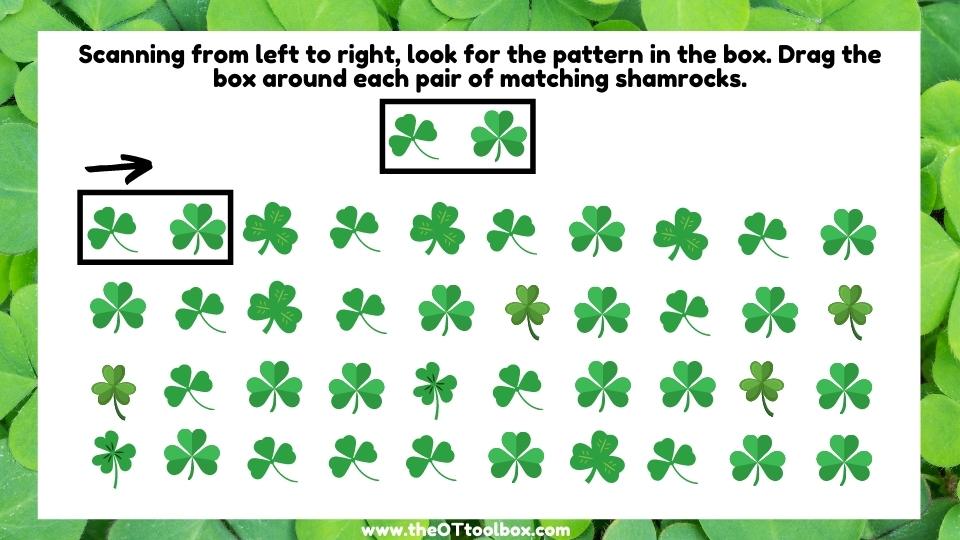
        Finally, there is a visual scanning and visual memory activity where kids can scan the shamrocks to find pairs that are the same, within a group. this is a powerful exercise to build skills needed for reading words and letters in a sentence or passage, and can build the skills needed for reading comprehension and fluency.

        Free Shamrock Therapy Slide Deck

        Want to add this shamrock theme activities to your therapy toolbox? Enter your email address into the form below and you can get a copy for yourself.

        Note: this free slide deck is interactive, so there are movable parts on the Google slides. You’ll need to use the slides in edit mode, as the parts won’t be moveable in present mode.

        Be sure to make a copy and NOT share the original slides. Other users will be moving the pieces, too so if you don’t make your own copy, you will have pieces that are not in the correct spaces.

        Finally, once you go through the slides and move items around, you can easily rest the slides to their original state and start over with another child on your caseload. Simply go to “history” and hit “reset slides” to get the movable pieces back.

        Shamrock Theme Visual Perception Exercises!

          We respect your privacy. Unsubscribe at anytime.
          Colors Handwriting Kit

          Rainbow Handwriting Kit– This resource pack includes handwriting sheets, write the room cards, color worksheets, visual motor activities, and so much more. The handwriting kit includes:

          • Write the Room, Color Names: Lowercase Letters
          • Write the Room, Color Names: Uppercase Letters
          • Write the Room, Color Names: Cursive Writing
          • Copy/Draw/Color/Cut Color Worksheets
          • Colors Roll & Write Page
          • Color Names Letter Size Puzzle Pages
          • Flip and Fill A-Z Letter Pages
          • Colors Pre-Writing Lines Pencil Control Mazes
          • This handwriting kit now includes a bonus pack of pencil control worksheets, 1-10 fine motor clip cards, visual discrimination maze for directionality, handwriting sheets, and working memory/direction following sheet! Valued at $5, this bonus kit triples the goal areas you can work on in each therapy session or home program.

          Click here to get your copy of the Colors Handwriting Kit.

          Colleen Beck, OTR/L has been an occupational therapist since 2000, working in school-based, hand therapy, outpatient peds, EI, and SNF. Colleen created The OT Toolbox to inspire therapists, teachers, and parents with easy and fun tools to help children thrive. Read her story about going from an OT making $3/hour (after paying for kids’ childcare) to a full-time OT resource creator for millions of readers. Want to collaborate? Send an email to contact@theottoolbox.com.
          Four Leaf Clover Balance Exercises

          four leaf clover teletherapy exercises

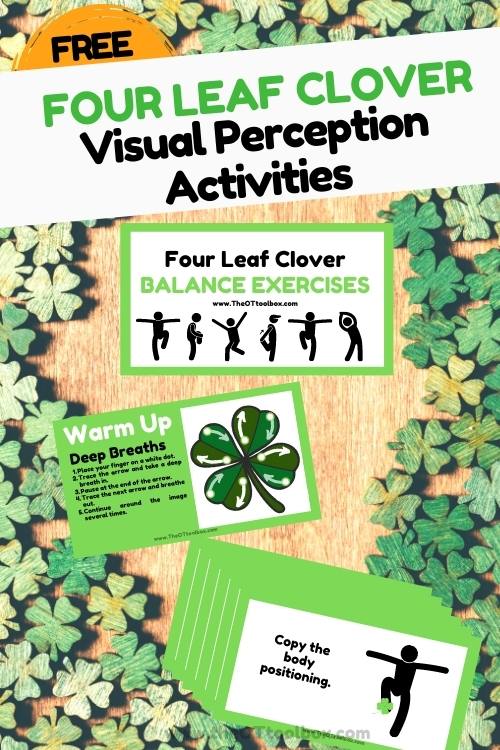
          This free teletherapy slide deck is a fun one; It’s a visual guide of four leaf clover activities for kids to work on balance and strength. The balance exercises are set up so kids can balance with a bean bag to work on core strength, coordination, stability, and motor planning skills. These balance exercises will get kids moving with St. Patrick’s Day therapy ideas!

          Try this four leaf clover exercises to challenge kids balance or use it as a brain break activity for St. Patrick's Day.

          Four Leaf Clover Activities

          If you need some activities to incorporated into virtual therapy sessions, or a fun brain break in time for St. Patrick’s Day, this four leaf clover activity is it.

          Like all of our free virtual therapy slide decks, this gross motor workout encourages kids to move and develop skills, with a fun theme.

          4 leaf clover activity includes a deep breathing activity and balance exercises.

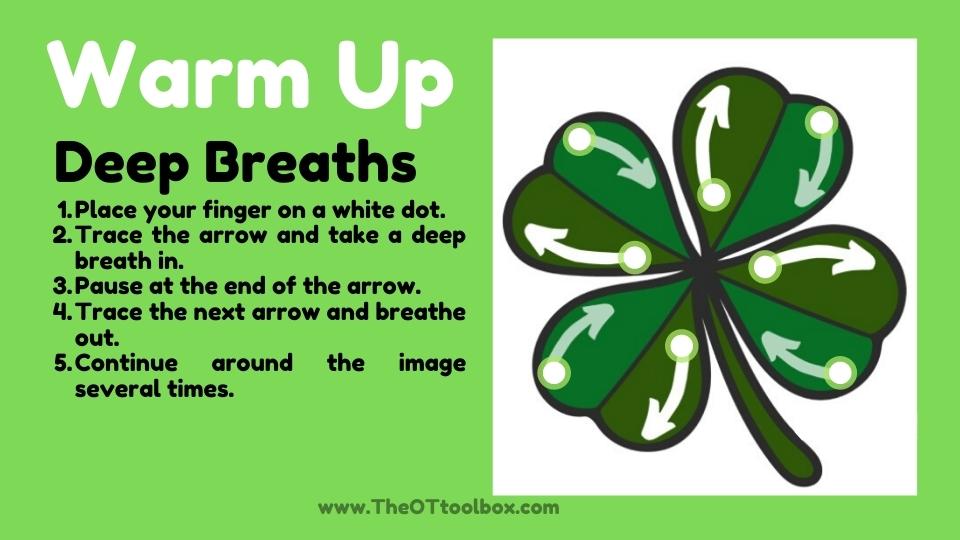
          Kids can start with the deep breathing warm up activity, using the clover image. Kids can start by taking deep breaths in and out and following the directions on the 4 leaf clover image.

          Deep breathing exercises are a powerful way to achieve a calm-alert state, so that children are ready to learn and participate in therapy. This self-regulation benefit, along with the mindfulness and relaxation benefits makes this four leaf clover breathing exercise a great way to start any therapy session.

          You can get a printable version of this four leaf clover deep breathing exercise here on our site. It includes a coloring page, too, so if that would add to your therapy session, be sure to print that off as well.

          Use these four leaf clover exercises for balance and sensory input.

          Next, kids can move onto the balance exercises. Kids can use a bean bag or a pillow with each exercise to really challenge balance and coordination.

          For kids in virtual therapy, a bean bag may not be available. In that case, kids can balance with a pillow in the place of the clover images. Other ideas include using rolled up socks or a stuffed animal.

          Each slide deck moves kids through a set of exercises to incorporate core strength and stability, movement changes, inverted positioning, and motor planning challenges. By completing the 4 leaf clover exercises, kids are also gaining vestibular, and proprioceptive sensory input.

          Free 4 Leaf Clover Slide Deck

          Want a copy of this free therapy slide deck?

          Enter your email address into the form below and this slide deck will be sent to your email. You can make a copy onto your Google drive and then use it in teletherapy sessions, in home programming, or as a classroom brain break activity.

          Four Leaf Clover Balance Exercises!

            We respect your privacy. Unsubscribe at anytime.
            Colors Handwriting Kit

            Rainbow Handwriting Kit– This resource pack includes handwriting sheets, write the room cards, color worksheets, visual motor activities, and so much more. The handwriting kit includes:

            • Write the Room, Color Names: Lowercase Letters
            • Write the Room, Color Names: Uppercase Letters
            • Write the Room, Color Names: Cursive Writing
            • Copy/Draw/Color/Cut Color Worksheets
            • Colors Roll & Write Page
            • Color Names Letter Size Puzzle Pages
            • Flip and Fill A-Z Letter Pages
            • Colors Pre-Writing Lines Pencil Control Mazes
            • This handwriting kit now includes a bonus pack of pencil control worksheets, 1-10 fine motor clip cards, visual discrimination maze for directionality, handwriting sheets, and working memory/direction following sheet! Valued at $5, this bonus kit triples the goal areas you can work on in each therapy session or home program.

            Click here to get your copy of the Colors Handwriting Kit.

            Colleen Beck, OTR/L has been an occupational therapist since 2000, working in school-based, hand therapy, outpatient peds, EI, and SNF. Colleen created The OT Toolbox to inspire therapists, teachers, and parents with easy and fun tools to help children thrive. Read her story about going from an OT making $3/hour (after paying for kids’ childcare) to a full-time OT resource creator for millions of readers. Want to collaborate? Send an email to contact@theottoolbox.com.

            Cherry Blossom Crafts

            Cherry blossom crafts

            Spring is finally upon us, and the flowers will be blooming soon – it’s the perfect time to introduce some springtime crafts! The ideas you’ll find here are Spring fine motor activities that help to develop hand strength and dexterity. Cherry Blossoms are one of the most famed blooms every year, and for good reason, too – they are gorgeous and short-lived. Cherry blossom trees only have flowers for about 14 days, and only for about a week of that time is when they are this beautiful:

            Cherry blossom crafts kids can make to develop fine motor skills.

            Cherry Blossom Crafts

            Get yourself and your kiddos into the springtime spirit with any of these Cherry Blossom crafts, and add these ideas to your Spring occupational therapy interventions.

            At the bottom of this post, you’ll also fine Cherry Blossom book ideas to incorporate into multisensory learning through play, so keep reading for story time ideas, too!

            Cherry blossom crafts for kids that develop skills, use in occupational therapy interventions or at home to help kids develop motor skills.

            Q-TIP CHERRY BLOSSOM CRAFT

            First, we have to talk about q-tip art. Just look at the creations you can make with a simple bathroom staple:

            • This Handprint Tree from Glued to my Crafts will keep your little ones entertained for a while!
            • Or this Spring Tree from A Little Pinch of Perfect, using the q-tips as the tree branches – brilliant!

            Why make art with a Q-Tip?

            • First of all – It’s fun and cheap!
            • Using objects in a way that is not their intended purpose teaches object fluidity, and encourages cognitive development through creative play.
            • Holding a tiny Q-tip stick strengthens fine motor skills and encourages the development of a tripod grasp which is a part of handwriting development

            Tissue Paper CHERRY BLOSSOM Craft

            Next on the list is tissue paper crafts, so simple yet so beautiful!

            We have to have one in here for developing mathematical skills! This is the perfect craft that challenges logical thinking and memory but doesn’t feel like learning to your young student.

            • Cognition and fine motor skills can be developed using felt and a tree branch in this cherry-blossom-themed Tactile Math Activity.
            Cherry blossom craft pattern craft for teaching patters
            • This Tissue Paper Tree from The Adventure Starts Here couldn’t be easier! You just need glue, tissue paper, and a printed (or drawn!) image of a tree. 
            • Or, glue some tissue paper on to a stick in this 3D Cherry Blossoms project, from Practically Functional. 
            Cherry blossom craft to develop fine motor skills in kids

            For even more fine motor development in a craft, check out these Fine Motor Cherry Blossoms

            Why use tissue paper in crafts?

            • Ripping tissue paper strengthens the muscles of the fingers, hands, and arms.
            • Touching the crinkly and smooth textures of tissue paper provides a gentle sensory experience that is good for sensory seekers or avoiders.
              • Depending on the papers that you use, you can offer various sensory experiences – the textures, the sounds, the colors!

            Why should I give my toddler a bottle of glue?

            • Squeezing a bottle of glue can take a lot of effort, which strengthens the muscles of the hands that are necessary for occupational skills like handwriting, zipping coats, etc.
            • Learning to control the pressure is a great way to teach fine motor planning skills.
              • Motor planning occurs before a voluntary movement happens, and when we are learning new physical skills, like squeezing a glue bottle, it requires some thinking beforehand to get it right.
              • The action-reaction that occurs with the amount of pressure from the squeeze (action) to the glue that is released (reaction) is a very tangible way to teach this skill. 

            CHERRY BLOSSOM Fingerprint crafts

            We can’t offer a craft without a finger painting option! Read on for why painting with your fingers is beneficial for your child’s development.

            Why use fingers when we have a paintbrush?

            • The answer is that both are great tools to teach different skills!
            • Using fingers as a tool in artistic play provides great sensory feedback to the brain.
              • The textures of the paint, the feeling of the paper, the pressure to place the pain down, and the colors that they can experiment with all provide learning experiences for their growing mind.
            • Using a paintbrush is great, too!
              • The paintbrush provides another way to interact with the paint and paper while using their little hands in a prehensile pattern. Prehensile = grasp, and using any utensil develops their general grasping skills necessary for many occupational skills that are coming their way (handwriting, opening bottles/jars, buttoning, zipping, the list is endless!). 

            Cherry blossom books

            Add a book to the craft activity to add dialogue and communication opportunities to craft time, while facilitating problem solving, social emotional learning, and more.

            I personally love the days when I am able to connect a craft with a story. It makes the simplest things feel so purposeful and well-thought-out – like you’ve won the parenting award for the day!

            Here is a list of cherry blossom themed books to go along with your craft: (Amazon affiliate links included below.)

            Pinkalicious: Cherry Blossom by Victoria Kann

            Sakura’s Cherry Blossoms  by Robert Paul Weston and Misa Saburi

            Cherry Blossom and Paper Planes by Jef Aerts and Sanne te Loo

            Cherry Blossoms Say Spring (National Geographic Kids) by Jill Esbaum

            Spring Blossoms by Carole Gerber and Leslie Evans

            Sydney Thorson, OTR/L, is a new occupational therapist working in school-based therapy. Her
            background is in Human Development and Family Studies, and she is passionate about
            providing individualized and meaningful treatment for each child and their family. Sydney is also
            a children’s author and illustrator and is always working on new and exciting projects.

            Bilateral Integration Activity Draw a Clover!

            Bilateral coordination visual motor integration

            This bilateral integration activity is a powerful way to help kids with a variety of skills. Add it to your line up of hands-on, St. Patrick’s Day theme activities for therapy and promoting child development. Kids can draw the four leaf clover but also work on developing bilateral coordination, eye-hand coordination, visual motor integration, visual scanning, visual convergence, core strength, and so much more. Integrating all of these areas into functional tasks involves many components of development, and this activity can help in so many ways.


            Kiddos with sensory or developmental problems might have trouble crossing mid-line.  You might know a child who has trouble making both hands work together to accomplish a task like handwriting, cutting with scissors, tying shoes, buttoning a shirt, or catching a ball.  Bilateral coordination is necessary for many functional activities! 


            Bilateral Integration and Functional Activities


            Bilateral coordination activity with a clover theme works on visual motor coordination, kinesthetic sense, peripheral vision for improved gross motor and fine motor bilateral activities.


            Bilateral integration is an area of child development that involves different movements and systems. Coordination of visual systems include visual tracking and scanning as well as depth perception and peripheral vision. All of these skills need to be integrated into movement so that coordinated movement patterns can occur.

            Then, there is the crossing midline component. Crossing the midline occurs developmentally, and this milestone is an important one that translates to laterality and coordinated use of both hands together in functional tasks.

            Then, visual motor integration, where the eyes and body works together to perform daily tasks is another piece of the puzzle. One part of the developmental progression of these skill areas is symmetrical bilateral integration.

            Symmetrical Bilateral Integration

            In this stage of development, children bring their hands together at the midline. You’ll see this in small infants that bring their hands to their mouth. They then start to hold toys together with their hands. Later down the road, symmetrical bilateral integration skills are needed to clap, zipper and button a coat, and gross motor tasks, too such as hopping, jumping, and completing tasks like jumping jacks. 

            Progression beyond symmetrical development relies on this developmental stage. And skills like asymmetrical bilateral integration, crossing the midline are founded on progression of this early developmental stage.

            Gross motor and fine motor activities are needed for activities where each hand does the same job (jumping jacks, movement games like the Hokey Pokey, and pulling up pants).  Other tasks require both hands to do different jobs in a coordinated way (holding the paper and writing with a pencil, holding paper and cutting with scissors, tying shoes, fastening a zipper, weaving a loom, or putting on a coat).

            Bilateral Integration Activity for Kids 

             
            This activity is one that’s been on my mind for a while.  As an OT, I’ve done versions of this activity many times with kids who have trouble with kinesthetic sense, visual perceptual skills, and bilateral coordination.  
             
            This post contains affiliate links.
             
            This activity is a version of the Brain Gym program, which uses whole body movements to improve skills, including learning and functional tasks.  Brain Gym can be just one tool in a toolbox of strategies to progress development of skills that kids need to function. 
             
            In Brain Gym, there is an activity called Double Doodles, which involves doodling with both hands, with a piece of crayon or chalk in each hand.  
             
            The activity encourages children to use both hands together.  The point of the activity is to establish direction and orientation relative to the child’s body.  The movement activity addresses hand-eye coordination in different visual fields, promotes spatial awareness and visual discrimination, addresses left and right awareness, improves peripheral vision, promotes body awareness and coordination with specialization of the hands and eyes, and works on gross motor movement skills.
             
            Brain Gym is just one way to promote whole body learning through simple and fun movement activities. 
             

            Four Leaf Clover Bilateral Activity

                                Bilateral coordination activity with a clover theme works on visual motor coordination, kinesthetic sense, peripheral vision for improved gross motor and fine motor bilateral activities.

            In our gross motor bilateral coordination activity, we’re using visual motor integration.  While creating a four leaf clover shape, the child is using his visual sense to guides movement through peripheral vision.  
             
            This is an easy activity to set up.  Tape a large piece of paper to the wall.  Poster board (like we used) works great, but that can get pricey.  A nice option is using a large roll of paper like easel paper or butcher paper.  You can also perform this activity at a large chalkboard or dry erase board in classroom settings. 
             
            First, draw a large and symmetrical four leaf clover shape on the paper.  Provide the child with a crayon, pencil, marker or chalk for each hand.
             
            Standing in front of the clover, ask them to stare at the center of the paper.  You can draw a dot for them to look at, if needed.
             
            Then, show them how to start both hands at the top center of the clover and to slowly trace the lines of the clover to meet at the bottom center.  
             
            We included a stem on our clover, but you can just draw the four leaves.  
             
            Tell the child to not worry too much about staying right on the lines.  The object is to have both hands move together doing symmetrical motions.  Repeat the lines again and again.  Add colored crayons/markers/pencils to create a rainbow four leaf clover. 
             
            A few things to watch for: 
            • While drawing, watch the child for stiffness in the hand, wrist, or arm.  
            • Be aware of whole body movements. Arm motions should come from the shoulders.
            • Remind the child to keep their eyes fixed on the dot at the center of the clover.
            • Remind the child to keep the writing utensils in contact with the paper.  They shouldn’t lift the crayons at all.
            • Watch for bilateral coordination, ensuring that both arms are moving at the same speed, distance, and positioning.
            Other ways to extend this activity:
            • Draw the four leaf clover on paper and have the child sit to perform the re-tracing activity.
            • Do this activity on a driveway or sidewalk using chalk.
            • Draw in the air with pointer fingers.
            • Draw in a sand table.
            • Use finger paints.
            • Use ribbon sticks in the air.
            • Use musical instruments like bells or maracas.
            Bilateral coordination activity with a clover theme works on visual motor coordination, kinesthetic sense, peripheral vision for improved gross motor and fine motor bilateral activities.


            Colors Handwriting Kit

            Rainbow Handwriting Kit– This resource pack includes handwriting sheets, write the room cards, color worksheets, visual motor activities, and so much more. The handwriting kit includes:

            • Write the Room, Color Names: Lowercase Letters
            • Write the Room, Color Names: Uppercase Letters
            • Write the Room, Color Names: Cursive Writing
            • Copy/Draw/Color/Cut Color Worksheets
            • Colors Roll & Write Page
            • Color Names Letter Size Puzzle Pages
            • Flip and Fill A-Z Letter Pages
            • Colors Pre-Writing Lines Pencil Control Mazes
            • This handwriting kit now includes a bonus pack of pencil control worksheets, 1-10 fine motor clip cards, visual discrimination maze for directionality, handwriting sheets, and working memory/direction following sheet! Valued at $5, this bonus kit triples the goal areas you can work on in each therapy session or home program.

            Click here to get your copy of the Colors Handwriting Kit.

            Colleen Beck, OTR/L has been an occupational therapist since 2000, working in school-based, hand therapy, outpatient peds, EI, and SNF. Colleen created The OT Toolbox to inspire therapists, teachers, and parents with easy and fun tools to help children thrive. Read her story about going from an OT making $3/hour (after paying for kids’ childcare) to a full-time OT resource creator for millions of readers. Want to collaborate? Send an email to contact@theottoolbox.com.