Colleen Beck, OTR/L is a pediatric occupational therapist and the owner and author of The OT Toolbox website. She manages all of The OT Toolbox social media accounts and runs the popular newsletter.
Read about Colleen's experience and career as an occupational therapist, including how The OT Toolbox began on our About The OT Toolbox page: https://www.theottoolbox.com/about-us/
Colleen created The OT Toolbox in 2011 and since then has written thousands of blog posts designed to support therapy providers, educators, parents, counselors, admin, and caregivers in promoting the healthy development of kids.
Check out Colleen's blog posts below:
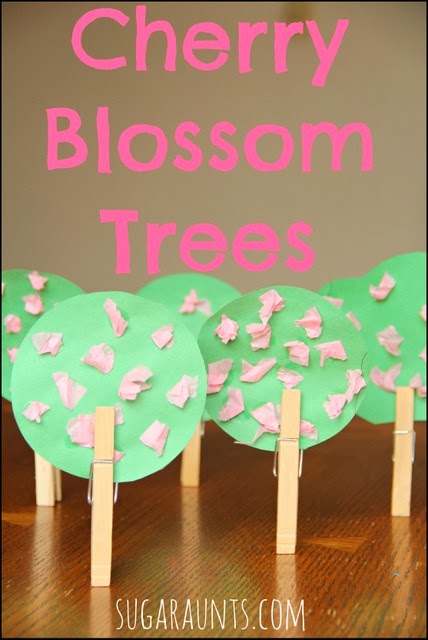
Spring is finally upon us, and the flowers will be blooming soon – it’s the perfect time to introduce some springtime crafts! The ideas you’ll find here are Spring fine motor activities that help to develop hand strength and dexterity. Cherry Blossoms are one of the most famed blooms every year, and for good reason, too – they are gorgeous and short-lived. Cherry blossom trees only have flowers for about 14 days, and only for about a week of that time is when they are this beautiful:
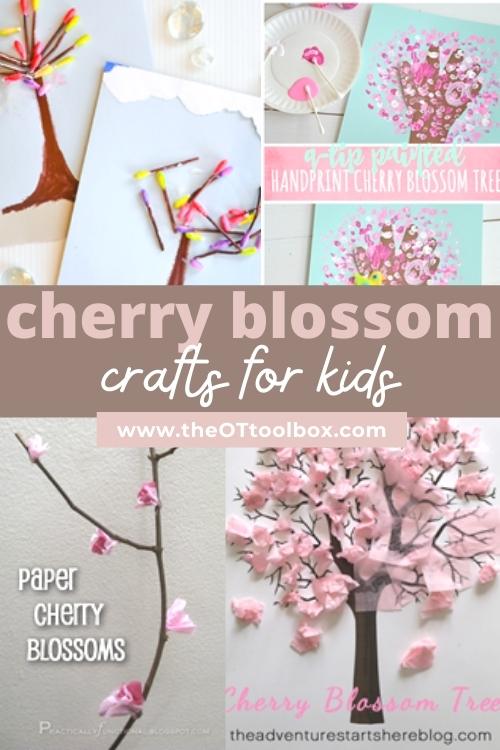
Cherry Blossom Crafts
Get yourself and your kiddos into the springtime spirit with any of these Cherry Blossom crafts, and add these ideas to your Spring occupational therapy interventions.
At the bottom of this post, you’ll also fine Cherry Blossom book ideas to incorporate into multisensory learning through play, so keep reading for story time ideas, too!
Q-TIP CHERRY BLOSSOM CRAFT
First, we have to talk about q-tip art. Just look at the creations you can make with a simple bathroom staple:
This Handprint Tree from Glued to my Crafts will keep your little ones entertained for a while!
Or this Spring Tree from A Little Pinch of Perfect, using the q-tips as the tree branches – brilliant!
Why make art with a Q-Tip?
First of all – It’s fun and cheap!
Using objects in a way that is not their intended purpose teaches object fluidity, and encourages cognitive development through creative play.
Holding a tiny Q-tip stick strengthens fine motor skills and encourages the development of a tripod grasp which is a part of handwriting development
Tissue Paper CHERRY BLOSSOM Craft
Next on the list is tissue paper crafts, so simple yet so beautiful!
We have to have one in here for developing mathematical skills! This is the perfect craft that challenges logical thinking and memory but doesn’t feel like learning to your young student.
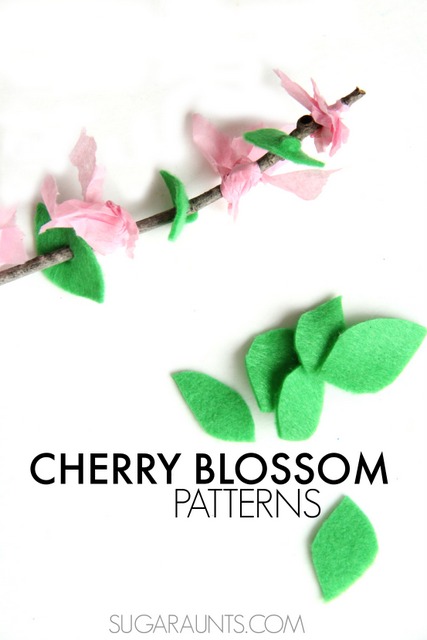
Cognition and fine motor skills can be developed using felt and a tree branch in this cherry-blossom-themed Tactile Math Activity.
This Tissue Paper Tree from The Adventure Starts Here couldn’t be easier! You just need glue, tissue paper, and a printed (or drawn!) image of a tree.
Or, glue some tissue paper on to a stick in this 3D Cherry Blossoms project, from Practically Functional.
Ripping tissue paper strengthens the muscles of the fingers, hands, and arms.
Touching the crinkly and smooth textures of tissue paper provides a gentle sensory experience that is good for sensory seekers or avoiders.
Depending on the papers that you use, you can offer various sensory experiences – the textures, the sounds, the colors!
Why should I give my toddler a bottle of glue?
Squeezing a bottle of glue can take a lot of effort, which strengthens the muscles of the hands that are necessary for occupational skills like handwriting, zipping coats, etc.
Learning to control the pressure is a great way to teach fine motor planning skills.
Motor planning occurs before a voluntary movement happens, and when we are learning new physical skills, like squeezing a glue bottle, it requires some thinking beforehand to get it right.
The action-reaction that occurs with the amount of pressure from the squeeze (action) to the glue that is released (reaction) is a very tangible way to teach this skill.
CHERRY BLOSSOM Fingerprint crafts
We can’t offer a craft without a finger painting option! Read on for why painting with your fingers is beneficial for your child’s development.
The answer is that both are great tools to teach different skills!
Using fingers as a tool in artistic play provides great sensory feedback to the brain.
The textures of the paint, the feeling of the paper, the pressure to place the pain down, and the colors that they can experiment with all provide learning experiences for their growing mind.
Using a paintbrush is great, too!
The paintbrush provides another way to interact with the paint and paper while using their little hands in a prehensile pattern. Prehensile = grasp, and using any utensil develops their general grasping skills necessary for many occupational skills that are coming their way (handwriting, opening bottles/jars, buttoning, zipping, the list is endless!).
Cherry blossom books
Add a book to the craft activity to add dialogue and communication opportunities to craft time, while facilitating problem solving, social emotional learning, and more.
I personally love the days when I am able to connect a craft with a story. It makes the simplest things feel so purposeful and well-thought-out – like you’ve won the parenting award for the day!
Here is a list of cherry blossom themed books to go along with your craft: (Amazon affiliate links included below.)
Sydney Thorson, OTR/L, is a new occupational therapist working in school-based therapy. Her background is in Human Development and Family Studies, and she is passionate about providing individualized and meaningful treatment for each child and their family. Sydney is also a children’s author and illustrator and is always working on new and exciting projects.
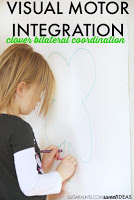
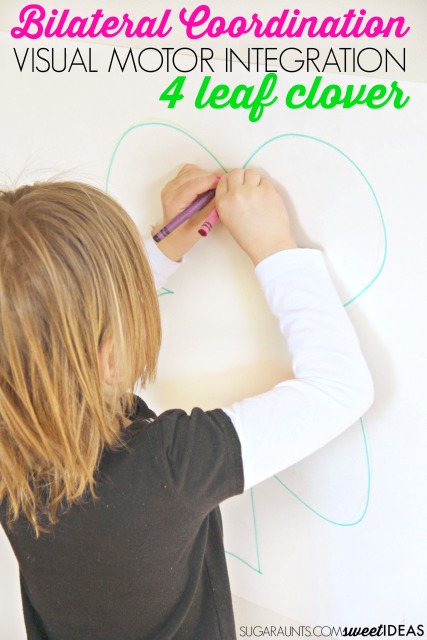
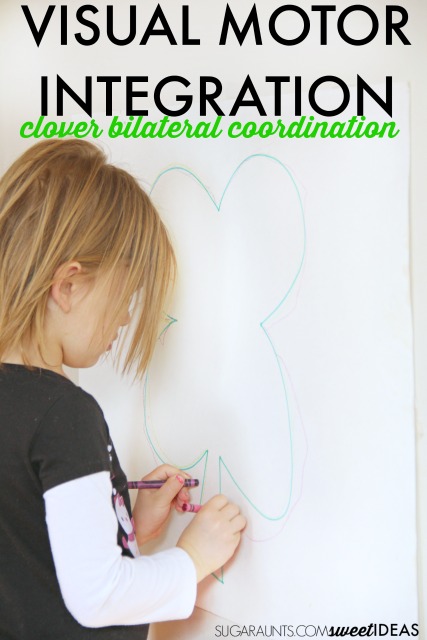
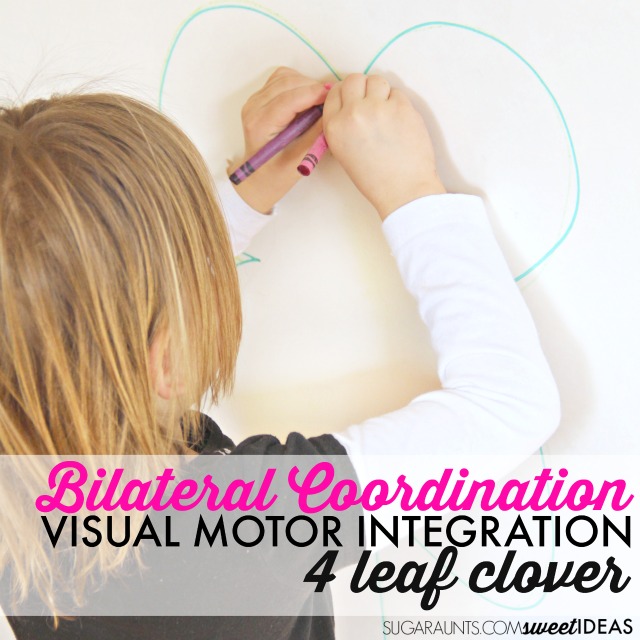
This bilateral integration activity is a powerful way to help kids with a variety of skills. Add it to your line up of hands-on, St. Patrick’s Day theme activities for therapy and promoting child development. Kids can draw the four leaf clover but also work on developing bilateral coordination, eye-hand coordination, visual motor integration, visual scanning, visual convergence, core strength, and so much more. Integrating all of these areas into functional tasks involves many components of development, and this activity can help in so many ways.
Kiddos with sensory or developmental problems might have trouble crossing mid-line. You might know a child who has trouble making both hands work together to accomplish a task like handwriting, cutting with scissors, tying shoes, buttoning a shirt, or catching a ball. Bilateral coordination is necessary for many functional activities!
Bilateral Integration and Functional Activities
Bilateral integration is an area of child development that involves different movements and systems. Coordination of visual systems include visual tracking and scanning as well as depth perception and peripheral vision. All of these skills need to be integrated into movement so that coordinated movement patterns can occur.
Then, there is the crossing midline component. Crossing the midline occurs developmentally, and this milestone is an important one that translates to laterality and coordinated use of both hands together in functional tasks.
Then, visual motor integration, where the eyes and body works together to perform daily tasks is another piece of the puzzle. One part of the developmental progression of these skill areas is symmetrical bilateral integration.
Symmetrical Bilateral Integration
In this stage of development, children bring their hands together at the midline. You’ll see this in small infants that bring their hands to their mouth. They then start to hold toys together with their hands. Later down the road, symmetrical bilateral integration skills are needed to clap, zipper and button a coat, and gross motor tasks, too such as hopping, jumping, and completing tasks like jumping jacks.
Progression beyond symmetrical development relies on this developmental stage. And skills like asymmetrical bilateral integration, crossing the midline are founded on progression of this early developmental stage.
Gross motor and fine motor activities are needed for activities where each hand does the same job (jumping jacks, movement games like the Hokey Pokey, and pulling up pants). Other tasks require both hands to do different jobs in a coordinated way (holding the paper and writing with a pencil, holding paper and cutting with scissors, tying shoes, fastening a zipper, weaving a loom, or putting on a coat).
Bilateral Integration Activity for Kids
This activity is one that’s been on my mind for a while. As an OT, I’ve done versions of this activity many times with kids who have trouble with kinesthetic sense, visual perceptual skills, and bilateral coordination.
This post contains affiliate links.
This activity is a version of the Brain Gym program, which uses whole body movements to improve skills, including learning and functional tasks. Brain Gym can be just one tool in a toolbox of strategies to progress development of skills that kids need to function.
In Brain Gym, there is an activity called Double Doodles, which involves doodling with both hands, with a piece of crayon or chalk in each hand.
The activity encourages children to use both hands together. The point of the activity is to establish direction and orientation relative to the child’s body. The movement activity addresses hand-eye coordination in different visual fields, promotes spatial awareness and visual discrimination, addresses left and right awareness, improves peripheral vision, promotes body awareness and coordination with specialization of the hands and eyes, and works on gross motor movement skills.
Brain Gym is just one way to promote whole body learning through simple and fun movement activities.
Four Leaf Clover Bilateral Activity
In our gross motor bilateral coordination activity, we’re using visual motor integration. While creating a four leaf clover shape, the child is using his visual sense to guides movement through peripheral vision.
This is an easy activity to set up. Tape a large piece of paper to the wall. Poster board (like we used) works great, but that can get pricey. A nice option is using a large roll of paper like easel paper or butcher paper. You can also perform this activity at a large chalkboard or dry erase board in classroom settings.
First, draw a large and symmetrical four leaf clover shape on the paper. Provide the child with a crayon, pencil, marker or chalk for each hand.
Standing in front of the clover, ask them to stare at the center of the paper. You can draw a dot for them to look at, if needed.
Then, show them how to start both hands at the top center of the clover and to slowly trace the lines of the clover to meet at the bottom center.
We included a stem on our clover, but you can just draw the four leaves.
Tell the child to not worry too much about staying right on the lines. The object is to have both hands move together doing symmetrical motions. Repeat the lines again and again. Add colored crayons/markers/pencils to create a rainbow four leaf clover.
A few things to watch for:
While drawing, watch the child for stiffness in the hand, wrist, or arm.
Be aware of whole body movements. Arm motions should come from the shoulders.
Remind the child to keep their eyes fixed on the dot at the center of the clover.
Remind the child to keep the writing utensils in contact with the paper. They shouldn’t lift the crayons at all.
Watch for bilateral coordination, ensuring that both arms are moving at the same speed, distance, and positioning.
Other ways to extend this activity:
Draw the four leaf clover on paper and have the child sit to perform the re-tracing activity.
Do this activity on a driveway or sidewalk using chalk.
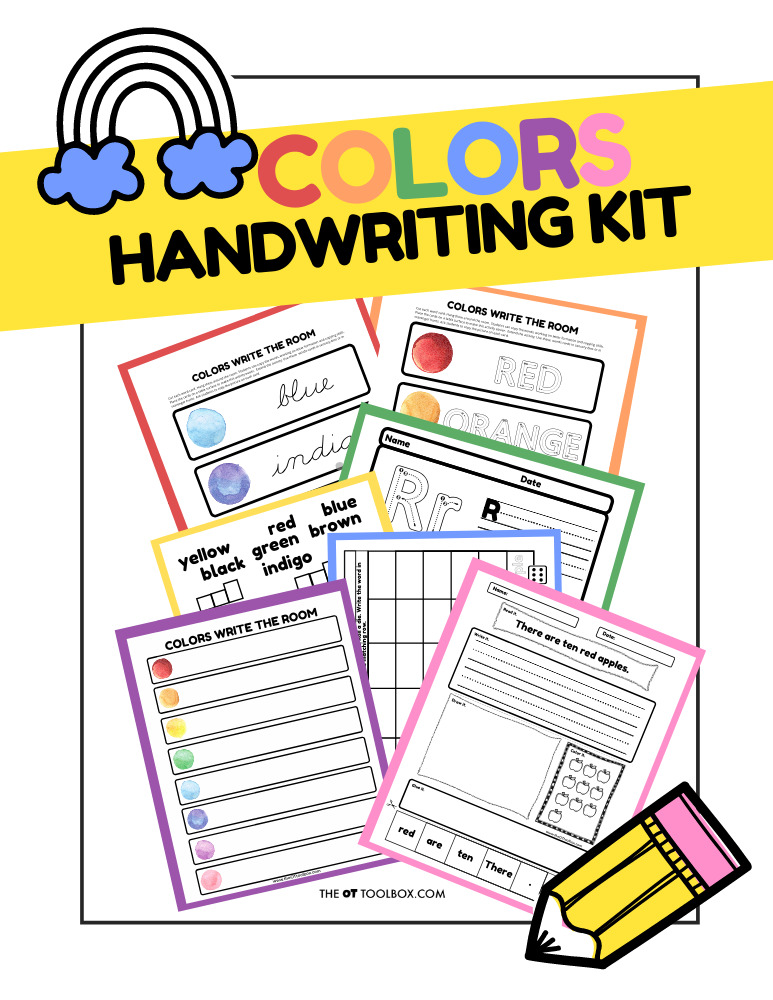
Rainbow Handwriting Kit– This resource pack includes handwriting sheets, write the room cards, color worksheets, visual motor activities, and so much more. The handwriting kit includes:
Write the Room, Color Names: Lowercase Letters
Write the Room, Color Names: Uppercase Letters
Write the Room, Color Names: Cursive Writing
Copy/Draw/Color/Cut Color Worksheets
Colors Roll & Write Page
Color Names Letter Size Puzzle Pages
Flip and Fill A-Z Letter Pages
Colors Pre-Writing Lines Pencil Control Mazes
This handwriting kit now includes a bonus pack of pencil control worksheets, 1-10 fine motor clip cards, visual discrimination maze for directionality, handwriting sheets, and working memory/direction following sheet! Valued at $5, this bonus kit triples the goal areas you can work on in each therapy session or home program.
Colleen Beck, OTR/L has been an occupational therapist since 2000, working in school-based, hand therapy, outpatient peds, EI, and SNF. Colleen created The OT Toolbox to inspire therapists, teachers, and parents with easy and fun tools to help children thrive. Read her story about going from an OT making $3/hour (after paying for kids’ childcare) to a full-time OT resource creator for millions of readers. Want to collaborate? Send an email to contact@theottoolbox.com.
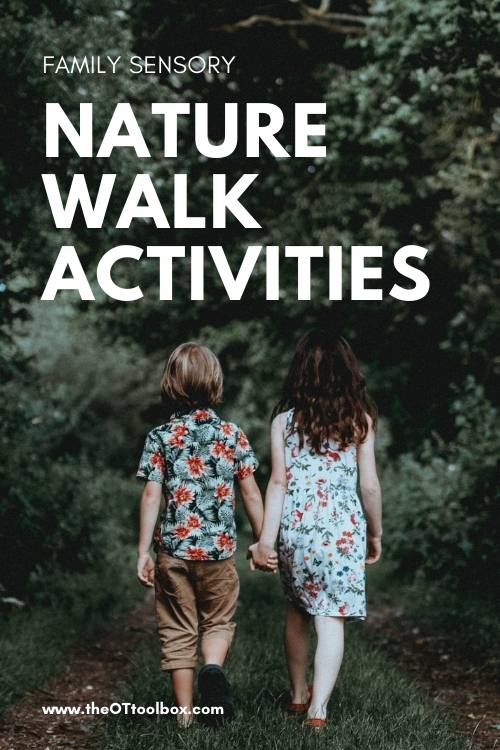
There are so many benefits to getting the whole family out for a family nature walk. Besides the physical exercise and family time, nature walks are powerful tools to incorporate all of the senses without any sensory equipment. Research tells us outdoor sensory play has many benefits. Use the sensory activities described here to learn and explore all of the senses (including the proprioceptive, vestibular, and interoceptive senses!) and add these sensory nature walk ideas to an outdoor sensory diet to help kids achieve an optimal sensory state so they can complete functional tasks and daily occupations.
Nature Walk Sensory Benefits
A nature walk and all of its colors, sights, and sounds make for a multi-sensory experience that can be easily shared as a family. There are so many sensory benefits when going on a nature walk or simply just by getting outdoors. The sensory input, learning and development, and simple family connection are just a few long-term benefits that can be provided by hiking in the woods.
Nature walks promote wellness by meeting many different needs:
Facilitate engagement and an alert state of regulation
Learning and cognitive benefits
Play and activity
Social interaction
Rest and sleep
All of these benefits make a family nature walk perfect for a family fun day! Or, pull out the flashlights and headlamps and go on a night walk as part of a family fun night.
Sensory Nature Walk
Stimulating the senses can help a child reconnect with their inner self, helping them identify how their body calms and relates to a free-flowing natural environment. Parents can help facilitate a child’s interaction in nature and the outdoors by simply being aware of a few activities that can be enjoyed as a family while experiencing the outdoors. Every sense can be utilized and engaged with a few fun ideas.
To help get you started, take look at the sensory components of a nature walk:
Nature Walks and the Visual Sense
The visual (sight) sense can be stirred by the abundance of colors with the trees and leaves and don’t forget to take some time to seek out a few outdoor critters or insects which can add a little element of fun while observing.
Try these visual processing activities during a family nature walk:
Play a game of I-Spy during your outdoor adventure. Think about playing using colors or items found in the environment. Take turns, and work on building vocabulary while playing this game.
Do a scavenger hunt and look for certain things found in the woods (you can find printable nature scavenger hunts on the internet).
Complete some nature rubbings with paper and crayons. Maybe rub some leaves within a notebook or complete rubbings of different types of tree bark.
Take a notebook and write down items you see in nature. It can be a nature journal that adds an opportunity to work on handwriting.
Auditory Processing and Sensory Walks
The auditory (hearing) sense can be jostled by the crunching of leaves under the feet as well as the snapping of twigs that can be heard while walking along a path or in the woods.
Snap twigs and listed to the cracks. Maybe even taking some time to build a few fun critter forts allowing for snapping of twigs to measure and build.
Also, try snapping twigs and building letters to add a little handwriting into the nature walk.
Listen for the birds and their chirping of songs and listen for some rustling of leaves when squirrels and other critters move about the woods.
Maybe the breeze is blowing, is it causing the trees and leaves to sway back and forth? Close your eyes and simply just listen to hear (it adds another fun element).
Gustatory Sense and Family Walks
The gustatory (taste) sense can be provided a little nudge, with adult supervision of course, if you find some wild blackberries or strawberries. They can be yummy to eat, but they do require cleaning so you may want to wait until you get back home to eat them so they can be properly cleaned for complete safety. If you are not that adventurous though, that’s okay you can still stimulate the gustatory sense on your walk if you work to prepare a fun trail mix before you leave the house so you can eat it on your outdoor adventure.
Bring a cold drink- A water bottle can be added to a backpack and brought along for a cold drink during a family walk. Remember the proprioceptive and oral motor benefits to drinking through a sports bottle, or a straw in a water bottle with a straw lid.
Nature walk snacks-Don’t have time to make trail mix, that’s okay too, you can just grab some granola or granola bars or maybe even some veggie sticks or beef jerky!
Tactile Sensory Nature Walk
The tactile (touch) sense can be heavily engaged with all of the different textures that can be explored and possibly gathered on your nature walk. Try some of these strategies on your nature walk:
Take some time to feel the leaves, moss, tree bark, rocks, dirt, and even a few fuzzy critters that can be given a little lift to their next destination.
Tossing rocks into small streams or even walking through puddles of water could provide a multi-sensory experience.
Write a few letters in the dirt with use of broken twigs as a pencil.
Take some time to feel the warmth of the sun or the breeze on your face as you walk.
Be sure to collect some nature items along the way though so you can explore them later either in a sensory bin or in an art project.
Play toss and catch with pine cones as appropriate. Toss and catch to each other or have kiddos toss to themselves including back and forth between their left and right hands.
The olfactory (smell) sense can be triggered by taking time to smell the dried leaves, flower scents, and even the smells that get blown as the wind or breeze lifts them through the air. Let’s face it, the wilderness has many smells that are unidentified and when mixed together create scents that are unusual kind of, musty. Even decaying wood has a very unique smell. Try these olfactory activities:
Smell flowers
Close your eyes and smell the air. Can you identify any scents?
Talk about scent words and the meaning of those terms. Some concepts to explore are: fresh, musty, moldy, sweet, sour, dry, etc.
Proprioception and Nature Walks
The proprioceptive (muscles and joints) sense can be impacted if you allow the child to lift heavy rocks, larger limbs and even just jump from higher elevations such as large rocks. All of the walking, climbing, and exploring adds heavy work input that tells the body where it is in space so the legs and body as a whole can move. Heavy work is a calming and regulating source of getting to a calm and alert state. Consider these opportunities for adding proprioceptive input on a nature walk:
Allow them to climb some trees and hillsides.
Explore trails with variations on elevation.
Consider the walking surface. Walking through a field, even trail, flat trail, or wooded hiking trail, or paved sidewalk offer different variants of heavy work though the legs and core.
Add hopping, jumping, bending, leaping, galloping, or skipping as you walk.
Even just the act of walking up and down the trail inclines can provide muscle and joint input that can be regulating for some kiddos.
Carrying water bottles in a backpack is an additional opportunity for heavy work.
Nature walks and the Vestibular sense
The vestibular (movement) sense can be activated as a child moves their body around the trees and rocks even while crawling up large rocks and trees. Incorporate vestibular input through these ideas:
Have them try some simple spinning with their eyes open and closed and arms outstretched to get a unique view of the outdoors maybe even doing some somersaults or cartwheels.
Allow them to try out their balance skills as they walk across a downed tree or along a trail of rocks.
Climb trees.
Run up hills.
Roll down grassy hills.
Nature walks and interoception
The interoception (inner body awareness) sense can be explored by the act of simply disconnecting from technology and other distractions and identifying how the body feels during this change of setting and heavy multi-sensory environment. An additional benefit of family walks is the connection to sleep (described more in detail at the bottom of this post.) Sleep has been noted to be included in the interoceptive processes much like hunger or thirst, as a brain process similar to other homeostatic processes.
Incorporate interoception in nature with these strategies:
Work on identifying their feelings and bodily responses to the sensory input such as noticing their breathing, heart rate, temperature, or possibly if they feel either tired, hungry, or thirsty.
How do you feel? A walk can change how you’re feeling. Maybe you feel re-energized and more alert. Talk about it.
Mindfulness is impacted by nature. Take deep breaths. Can you feel your heart rate slowing down?
Thirst inventory- How do you feel after a hike in nature? Thirsty? Dry mouth? These are signs that your body is thirsty. Some people struggle with this internal awareness. Talk about the signs of thirst and how the body reacts to this need and then afterwards once you’ve got a drink.
Nature Walk Activities
A nature walk is a fun time to collect items from nature for exploring. While out on family walk, collect items from nature such as rocks, pebbles, sticks, leaves, moss, etc. These items can be placed into a backpack or bag and brought home to explore and create. (Be sure to return items to nature, afterwards as long as they are free from paint or glue.)
After you’ve finished your outdoor adventure and you’ve collected some fun nature goodies from your walk, take those items home and create a sensory bin, fine motor craft kit, or maybe even use them in a fun art project. What can you collect?
Look for some of these items (and explore the visual sense as you seek and find items):
Acorns
Twigs
Leaves
Rocks
Feathers
Pine needles
Pine cones
Moss
Seeds
Grasses
Sand
Dirt
Sunflower seeds
Fallen tree bark
Nature Walk Sensory Bins
Use these materials to make a sensory bin. Add the items you’ve collected to a large bin, basket, or tray. Now it’s time to explore! Try these nature sensory bin ideas:
An added benefit of incorporating a nature walk into the family routine is that walks in turn promote rest. All of the physical activity of nature walks may be helpful in encouraging rest and as a result, sleep.
Additionally, research suggests a relationship between sleep difficulties and patterns of sensory processing issues in children.
Studies show that sensory processing differences, considerably including increased sensory sensitivities, sensory-avoiding patterns, sensory-seeking patterns, and poor sensory registration have been associated with changes in sleep quality. (Vasek, M., Williamson, J., Garden, J., Zwicker, J., 2015).
Occupational therapists play a role in sleep by offering tools and strategies to promote adequate and restful sleep. Because sleep is a necessary component of performing functional tasks and daily occupations, occupational therapists can assist with promoting adequate and healthy sleep by using evidence based methods, once of which can include physical activity such as family nature walks.
A final note about sensory walks
Take a seasonal nature walk to simply allow children to explore with their senses while building skills needed for learning and development! Allow children the freedom to explore at their own pace and to be creative. Give them the opportunity to come up with a fun, family activity outdoors. They’ll surprise you!
Don’t live near a colorful hiking area? Take some time to visit a farm, a pumpkin patch, a flower garden, a cornfield, or even the beach. Really, just get outdoors and explore anywhere! By being outside away from technology and other distractions, children can rejuvenate their bodies and minds while stimulating their senses.
Try these resources to incorporate the sensory system when in the great outdoors:
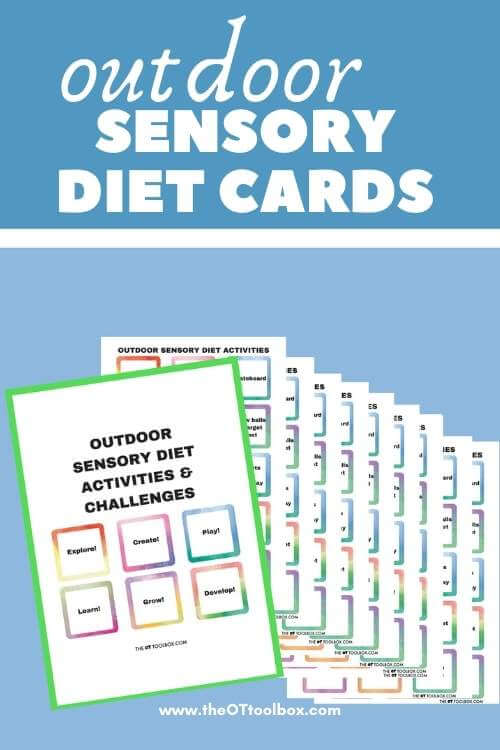
Create the “right kind” of sensory experiences to improve regulation, attention, focus, body awareness, motor development, and sensory processing.
90 outdoor sensory diet activities
60 outdoor recess sensory diet activities
30 blank sensory diet cards, and 6 sensory challenge cards
They can be used based on preference and interest of the child, encouraging motivation and carryover, all while providing much-needed sensory input.
References:
Mark Vasak, James Williamson, Jennifer Garden, Jill G. Zwicker; Sensory Processing and Sleep in Typically Developing Infants and Toddlers. Am J Occup Ther 2015;69(4):6904220040. https://doi.org/10.5014/ajot.2015.015891
Regina Parsons-Allen is a school-based certified occupational therapy assistant. She has a pediatrics practice area of emphasis from the NBCOT. She graduated from the OTA program at Caldwell Community College and Technical Institute in Hudson, North Carolina with an A.A.S degree in occupational therapy assistant. She has been practicing occupational therapy in the same school district for 20 years. She loves her children, husband, OT, working with children and teaching Sunday school. She is passionate about engaging, empowering, and enabling children to reach their maximum potential in ALL of their occupations as well assuring them that God loves them!
If you are looking for ways to work on handwriting legibility and pencil control, then you are in the right place. This Occupational Therapist loves to teach kids handwriting. Neatness counts when it comes to writing on the lines and being able to read that homework assignment a few hours into the nightly after-school ritual. Today, I’ve got one easy tip for helping kids to manage with pencil control in order to write on the lines at an age-appropriate speed. Add this pencil control activity to this list of pencil control exercises.
This activity is perfect for kids from Kindergarten on up through school-aged. Anyone who is writing with a pencil and trying to form letters on lines, copy written work, fill in worksheets, and take notes will love this handwriting exercise in pencil control.
Pencil Exercises
This post contains affiliate links.
Pencil exercises like this simple colored pencil activity are powerful ways to improve pencil control in handwriting.
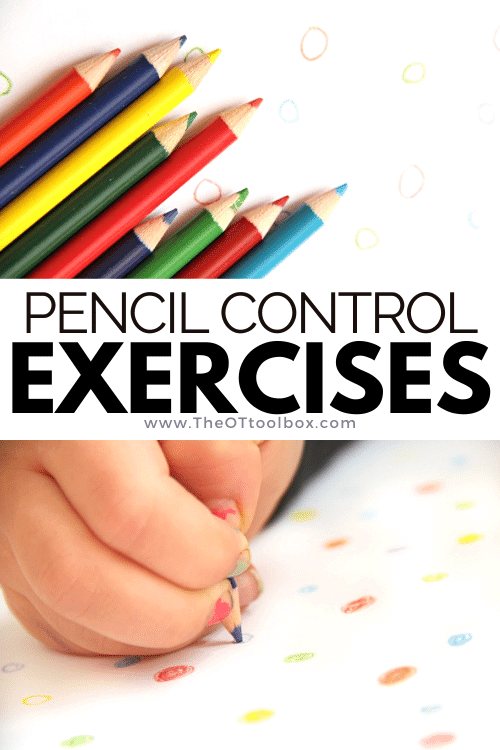
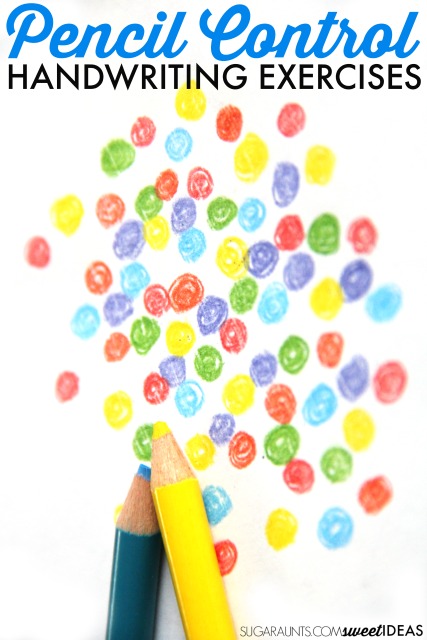
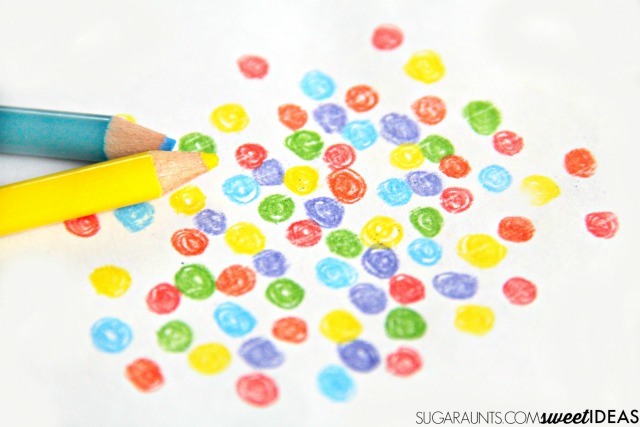
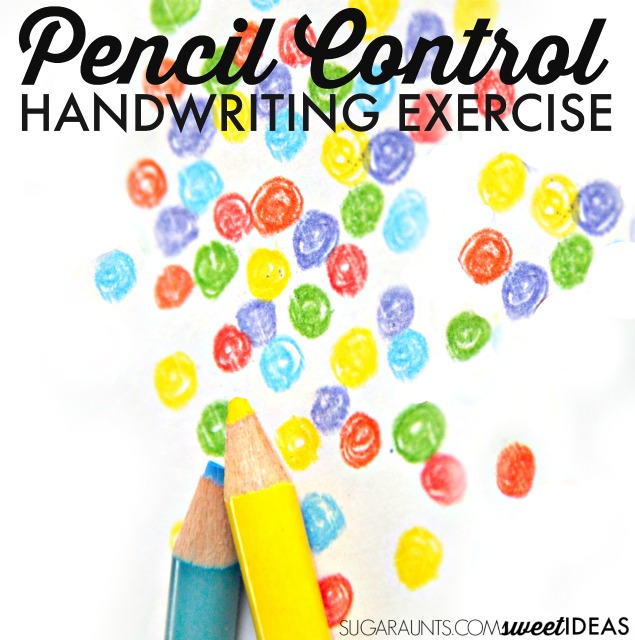
This activity is really, so simple. There is nothing you need more than a pencil and paper. We pulled out colored pencils to make our handwriting activity into a rainbow of color and to add a visual scanning component.
Rainbow Pencil Control Exercises
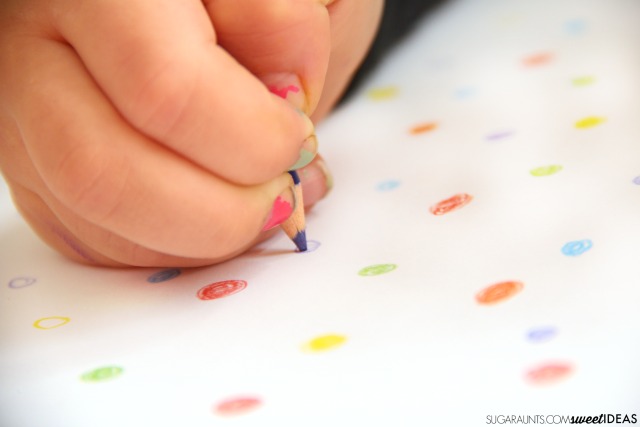
With this activity, we’re working on keeping the pencil strokes within the lines of a small circle.
First, draw a bunch of circles in different colors on a piece of paper. The circles should be 1/4 inch in diameter.
Ask your child to fill in the circle with the matching colored pencil. A red circle should be filled in with the red colored pencil.
The objective here is to fill in the whole circle without going over the lines. Because the circle is so small, filling it in with the colored pencil requires very small muscle movements of the fingers.
A child who uses their wrist or forearm to write (such as a child using a grasp such as the thumb wrap grasp, for example, are over compensating for weakness and lack of endurance of the intrinsic musculature in the hand and utilizing a stabilizing grasp. This rainbow pencil control exercise strengthens dexterity, including range of motion in the thumb IP joint. Read more about the thumb IP joint and handwriting in a previous post.
This overcompensation does not allow fluid motions of the fingers when moving the pencil in handwriting. Because the circles are so small, the child can focus more on using the small motor motions to fill in the color.
More Pencil Control Exercises
Extend this activity to further your child’s fine motor skills and pencil control in handwriting:
Ask your child to draw an “X” in each circle, without going over the lines.
Ask your child to draw horizontal or vertical lines within each circle, much like we did here.
Create a color coding activity: Match one circle color up with another pencil color. When you call out a color, your child can fill in that colored circle with a different, predetermined colored pencil. This is a test of visual scanning and quick thinking.
Draw larger circles and show your child how to fill them in with strait pencil strokes.
Rainbow Handwriting Kit– This resource pack includes handwriting sheets, write the room cards, color worksheets, visual motor activities, and so much more. The handwriting kit includes:
Write the Room, Color Names: Lowercase Letters
Write the Room, Color Names: Uppercase Letters
Write the Room, Color Names: Cursive Writing
Copy/Draw/Color/Cut Color Worksheets
Colors Roll & Write Page
Color Names Letter Size Puzzle Pages
Flip and Fill A-Z Letter Pages
Colors Pre-Writing Lines Pencil Control Mazes
This handwriting kit now includes a bonus pack of pencil control worksheets, 1-10 fine motor clip cards, visual discrimination maze for directionality, handwriting sheets, and working memory/direction following sheet! Valued at $5, this bonus kit triples the goal areas you can work on in each therapy session or home program.
Colleen Beck, OTR/L has been an occupational therapist since 2000, working in school-based, hand therapy, outpatient peds, EI, and SNF. Colleen created The OT Toolbox to inspire therapists, teachers, and parents with easy and fun tools to help children thrive. Read her story about going from an OT making $3/hour (after paying for kids’ childcare) to a full-time OT resource creator for millions of readers. Want to collaborate? Send an email to contact@theottoolbox.com.
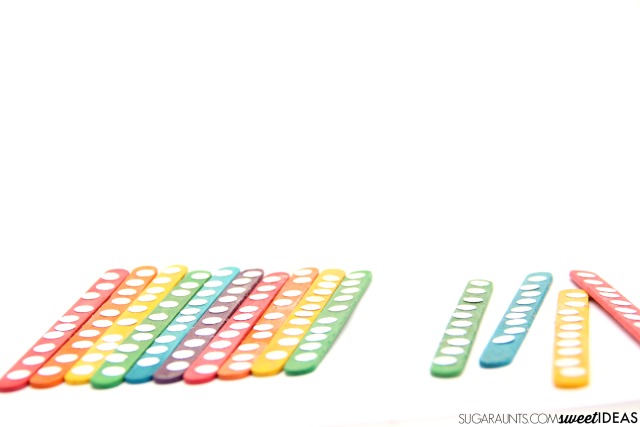
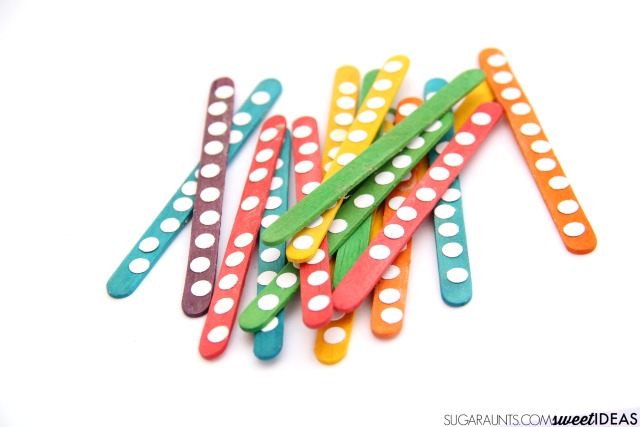
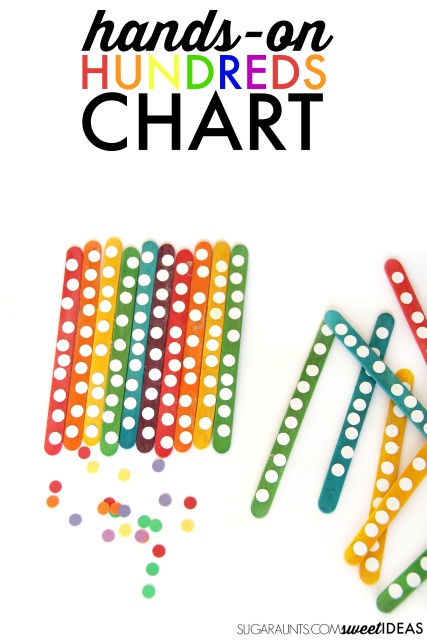
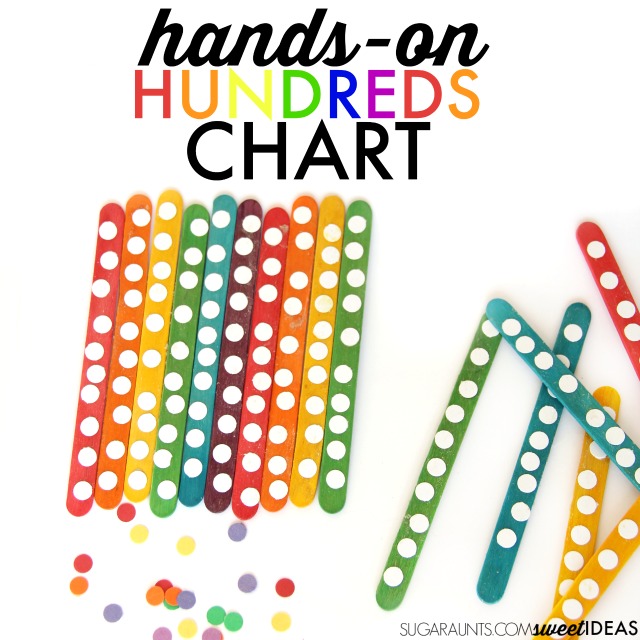
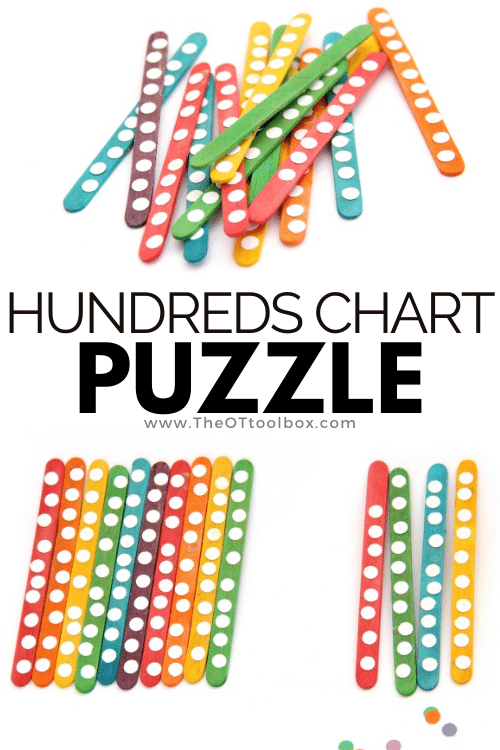
In this rainbow math activity, we used popsicle sticks to make a rainbow hundreds chart puzzle that was perfect for my kindergarten and second grade kiddos. (And, it would be a nice hands-on math activity for first grade, too.) This is a multisensory math idea that combines fine motors skills with the colors of the rainbow to teach kids about groups of tens in a hundreds chart.
Combining numbers into groups of ten and those tens into hundreds is a math concept that is so important for so many math concepts. We worked on fine motor skills to build the tens columns and combined them into hundreds to work on a few math skills.
A punch like this one is perfect for building gross hand grasp strength. BUT, if you want this crafting project to move by faster than a snail’s pace, use a 3 Hole Punch. It’s perfect for working proprioception to the arms. Fold paper into columns and slide it into the punch to get a bunch of holes punched at once.
To make the rainbow puzzle: Punch a ton of holes from the white paper.
Sort the popsicle sticks into rainbow order on the table surface. Kids can work on visual scanning and visual perceptual skills for this task as they look for colors of the rainbow.
Next, Swipe the glue along the craft sticks and count out ten holes from the white paper. This is a super counting activity for kids to practice counting ones and grouping into tens.
The fine motor work going on here is fantastic, too. Picking up those itty bitty paper holes is a precision grasp workout.
Punch extra holes from the colored construction paper.
And, you’re done! Practice counting the numbers using the tens craft sticks. Arrange them into groups of ten sticks to create a hundreds chart.
Multisensory Math activities
Use this rainbow hundreds chart puzzle for a variety of hands-on math activities:
Sort the popsicle sticks into rainbow order.
Count the dots by tens
Add up all of the colors that are the same, being sure to count by tens.
Build two and three digit numbers
Practice addition with and without regrouping using the manipulatives as counters.
Practice subtraction with and without regrouping using the craft stick manipulatives.
Build a two or three digit number and ask your child to name the number.
Ask your child to name a number and then build a two or three digit number.
How would you play and learn with this rainbow hundreds chart puzzle and math popsicle stick hundreds chart?
Take multisensory learning further with the rainbow theme. Try our new Colors Handwriting Kit. It now includes a bonus pack of fine motor, visual motor, and directionality pencil control activities.
Rainbow Handwriting Kit– This resource pack includes handwriting sheets, write the room cards, color worksheets, visual motor activities, and so much more. The handwriting kit includes:
Write the Room, Color Names: Lowercase Letters
Write the Room, Color Names: Uppercase Letters
Write the Room, Color Names: Cursive Writing
Copy/Draw/Color/Cut Color Worksheets
Colors Roll & Write Page
Color Names Letter Size Puzzle Pages
Flip and Fill A-Z Letter Pages
Colors Pre-Writing Lines Pencil Control Mazes
This handwriting kit now includes a bonus pack of pencil control worksheets, 1-10 fine motor clip cards, visual discrimination maze for directionality, handwriting sheets, and working memory/direction following sheet! Valued at $5, this bonus kit triples the goal areas you can work on in each therapy session or home program.
Colleen Beck, OTR/L has been an occupational therapist since 2000, working in school-based, hand therapy, outpatient peds, EI, and SNF. Colleen created The OT Toolbox to inspire therapists, teachers, and parents with easy and fun tools to help children thrive. Read her story about going from an OT making $3/hour (after paying for kids’ childcare) to a full-time OT resource creator for millions of readers. Want to collaborate? Send an email to contact@theottoolbox.com.
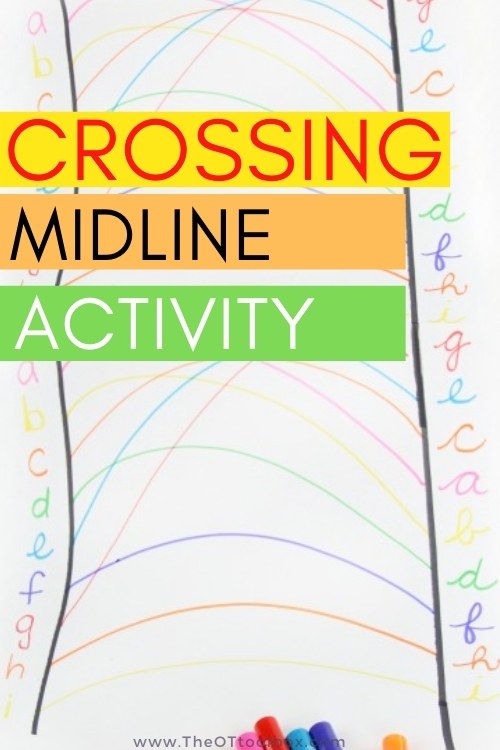
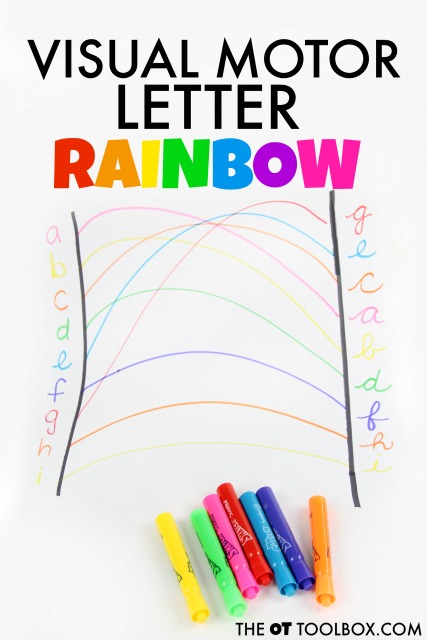
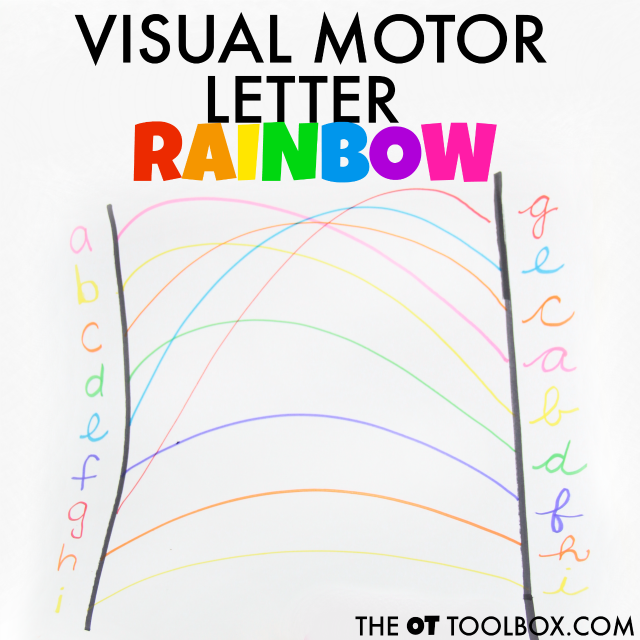
Thiscrossing the midline activity is a way to help kids with crossing midline skills, as well as letter identification, using a rainbow theme. In the simple midline activity, children create a rainbow while visually scanning from left to right to match letters with different colors of the rainbow. It’s a letter version of our rainbow ladder that is also instrumental in helping children with underlying handwriting skills including visual motor integration and crossing the midline. Read more about midline crossing in our cross crawl resource.
This particular Kids can work on so many skills with this simple visual motor rainbow. We worked on matching printed lower case letters to cursive letters but you could do this one with upper and lower case letter match-ups or just matching upper case to upper case. Some of the underlying skills that is necessary for kids to write legibly are visual motor integration and crossing midline. This visual motor integration letter rainbow works on those skills with a colorful result. We also used our rainbow of hues to work on the visual motor skills needed for pencil control. This activity also addresses the ability to coordinate visual input to the motor movements of the hands. Kids can work on their fine motor development with the simple rainbow activity described below.
Crossing the Midline
In another blog post, we cover more about crossing the midline, particularly with the lower body, in a midline marching activity for children.
So, what crossing the midline?
Midline of the body is an imaginary line that drops from the middle of the head, strait down over the nose, to the belly button and divides the body into left and right sides. Many movements and functional tasks occur with just one hand, like holding a phone. A user could hold the phone on one side of the body and turn their head to that direction. In that particular task and positioning, the activiy is localized to a side of the body and doesn’t cross the midline.
Other tasks occur at the midline. This includes activities such as reading a book or brushing the teeth. The dominant hand will do most of the work, like turning the pages of the the book or manipulating the toothbrush, while the nondominant hand assists in the task.
In our examples, the activity occurs mainly at midline, and there is not much crossing over of the middle of the body. However, the non dominant hand might assist by holding the book or by squeezing the toothpaste onto the tooth brush, (or holding the toothbrush while the dominant hand squeezes the toothbrush).
As a side note, many of these muscle movement patterns are not something that we think through throughout our day. The movement patterns are just automatic and natural.
That is part of muscle memory and motor planning that has been established and ingrained. Trouble occurs when there is a block to the automaticity such as difficulty with crossing the midline.
Still other activities require intense midline crossing. This includes activities where the midline must be crossed in order for the task to be completed. Activities exemplifying midline crossing include dressing the lower body or in play.
In the example of dressing, you notice that one arm reaches over the midline in order to feed the opposite foot into a pants leg. Similarly, with pulling on socks, both hands reach to one foot and the right arm crosses the midline when pulling on the sock of the left foot.
Crossing midline refers to moving the left hand/arm/foot/leg across this line to the right side (and vise versa). Crossing midline also refers to twisting the body in rotation around this imaginary line, and leaning the upper or body across the middle of the body.
Problems with Crossing the Midline
When crossing the midline is a problem, or it’s not been properly established as an automatic movement pattern, you may notice these movements instead of crossing midline:
Switching hands during an activity
Twisting the body to complete tasks- rotating the trunk to complete tasks
Preferring to use one hand over the other: Using the right hand for tasks on the right side of the body and using the left hand for tasks on the left side of the body
Mixed dominance
Trouble with fine motor tasks that require two hands: writing, coloring, cutting with scissors, manipulating utensils, cutting with a knife and fork, etc.
Trouble with gross motor tasks like jumping, skipping, hopping, crawling
Trouble with laterality
Trouble with keeping their place when reading across a page
Crossing the Midline Letter Activity
The midline letter activity described here is a beneficial way to work on crossing midline for several reasons:
The activity encourages children to cross midline with large motions across a page
The activity encourage visual shifting to scan across a page, incorporating crossing the midline into reading and writing tasks which can impact reading fluency and accuracy
The activity works on letter identification and challenges children to integrate visual skills with movements (hand eye coordination)
In the crossing the midline letter rainbow activity described here, we worked on cursive letter identification.
Many times when children practice cursive writing, they do so in isolated practice settings: practicing rows of cursive letters, one at a time, and then stringing that letter into words on a worksheet.
Crossing Midline Writing Activities
But sometimes, the cursive letter fluency piece is skipped. Reading a letter or a word pairs the cursive letter with orthographic patterns so that cursive writing and reading becomes fluent.
You could use this midline rainbow activity with any letter matching exercise:
Matching shapes or colors
Matching letters to images that start with that letter to incorporate phonological awareness
Matching lowercase printed letters to uppercase printed letters
Matching lowercase cursive letters to lowercase printed letters
Matching uppercase printed letters to uppercase cursive letters
Matching lowercase cursive letters to uppercase cursive letters
How to Create a Rainbow Arch
Set up a rainbow arch in occupational therapy as a crossing the midline activity:
This rainbow activity can be performed in several ways. Children can work on a large scale and address bilateral coordination and midline crossing with a large piece of easel paper or butcher paper taped to a wall. Another option is to set this rainbow activity up at a dry erase board or chalk board.
To make the midline board:
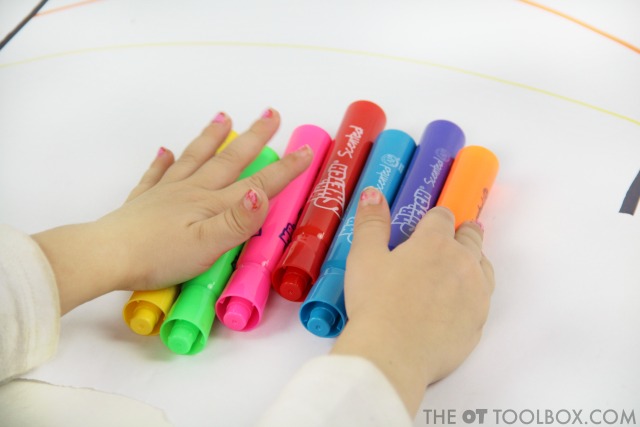
Colored markers/crayons/chalk/colored pencils-We used (affiliate link) Mr. Sketch scented markers to add multisensory learning components.
Next, draw two vertical lines on opposite sides of the paper, or about 2-3 feet apart.
Along the left vertical line, form letters in one format (print, cursive, lowercase, uppercase, etc.)
On the opposite line, form either matching letters in upper case/lower case/cursive. Ensure the letters are mixed in order, so the lines need to cross over one another.
Next, work on crossing midline skills:
To perform this visual motor letter rainbow, ask the child to start on the left side and draw an arching line to connect to the matching letter on the right side of the paper. Working on a large scale to perform this activity promotes crossing of the midline as well as visual motor skills.
2. Ask the student to start at the left line and stop at the right line when drawing their rainbow lines. When the child is making the arches, they should not start or go over the vertical lines by more than 1/4 inch. Ask them to connect the matching letters with matching colored markers.
Grade this activity by asking the child to start and end at the vertical lines without crossing over the lines. This is an excellent way to address pencil control and visual motor skills.
Rainbow Arch in Occupational Therapy
A similar version of a rainbow arch can be used in occupational therapy interventions to target a variety of skills. You can vary the activity in many ways, depending on the needs of the individual.
Try these rainbow arch ideas in OT sessions:
Complete the midline activity by completing the rainbow in a standing or seated position. Be sure to watch for the child to compensate for midline crossing by shifting weight, rotation of the body, pivoting of the trunk, or movement of the legs. The child should remain facing forward without any of these motions noted.
Kids can also complete this activity with diagonals of with strait lines to connect the letters.
Address visual motor skills with the letter rainbow on a small scale as a table-top activity.
Draw the lines on a smaller scale and ask kids to connect letters while touching but not going over the vertical lines with the colored markers.
Use different surfaces- dry erase board, chalkboard, asphalt or sidewalk with sidewalk chalk, working on a large piece of paper or cardboard on the ground, and paper hung on a wall are all options.
Use a variety of writing materials: If working on a dry erase surface, use Dry erase markers. You’ll need a rainbow of colors.
This activity works well on the ground too. In that case, use Rainbow colored chalk if working on a large piece of cardboard from an old box or on the sidewalk. This option adds resistance to the activity, providing proprioceptive feedback.
You could also use crayons, finger paints, colored pencils, sidewalk chalk, or water colors.
Need more ways to work on visual motor integration, crossing midline, handwriting, and functional skills? Grab the Colors Handwriting Kit. It comes with activities to promote functional handwriting, and multisensory learning. You’ll also get a bonus offer of fine motor activity pages.
Just print and go!
Rainbow Handwriting Kit– This resource pack includes handwriting sheets, write the room cards, color worksheets, visual motor activities, and so much more. The handwriting kit includes:
Write the Room, Color Names: Lowercase Letters
Write the Room, Color Names: Uppercase Letters
Write the Room, Color Names: Cursive Writing
Copy/Draw/Color/Cut Color Worksheets
Colors Roll & Write Page
Color Names Letter Size Puzzle Pages
Flip and Fill A-Z Letter Pages
Colors Pre-Writing Lines Pencil Control Mazes
This handwriting kit now includes a bonus pack of pencil control worksheets, 1-10 fine motor clip cards, visual discrimination maze for directionality, handwriting sheets, and working memory/direction following sheet! Valued at $5, this bonus kit triples the goal areas you can work on in each therapy session or home program.
Colleen Beck, OTR/L has been an occupational therapist since 2000, working in school-based, hand therapy, outpatient peds, EI, and SNF. Colleen created The OT Toolbox to inspire therapists, teachers, and parents with easy and fun tools to help children thrive. Read her story about going from an OT making $3/hour (after paying for kids’ childcare) to a full-time OT resource creator for millions of readers. Want to collaborate? Send an email to contact@theottoolbox.com.
Here are more rainbow activities to pair with ours:
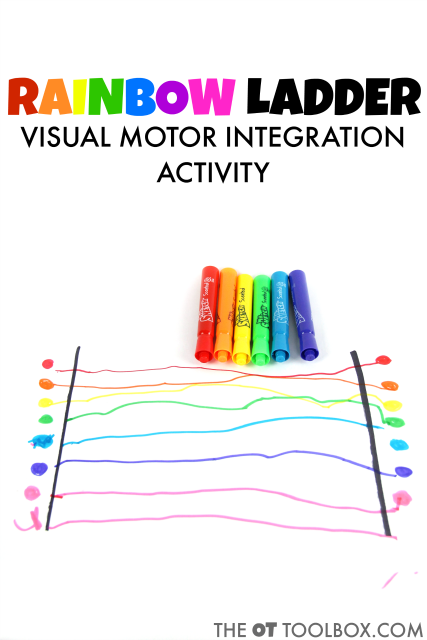
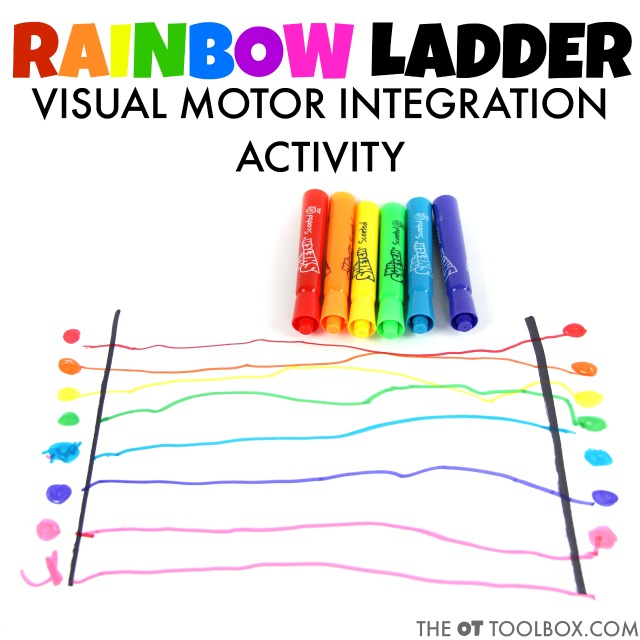
This rainbow ladder activity is a rainbow themed visual motor activity that is perfect for building visual motor integration skills needed in handwriting and reading. Visual motor integration activities like this one help kids to work on the skills needed to form letters and numbers correctly, to write on lines, and to copy words and sentences from a model, and make a great addition to rainbow activities that promote child development of essential skills. Kids will love to create a rainbow ladder with this scented marker activity as they work on skills they need in a creative and fun way!
Rainbow Ladder Activity
This post contains affiliate links.
You’ll need just a couple of materials for this visual motor integration activity:
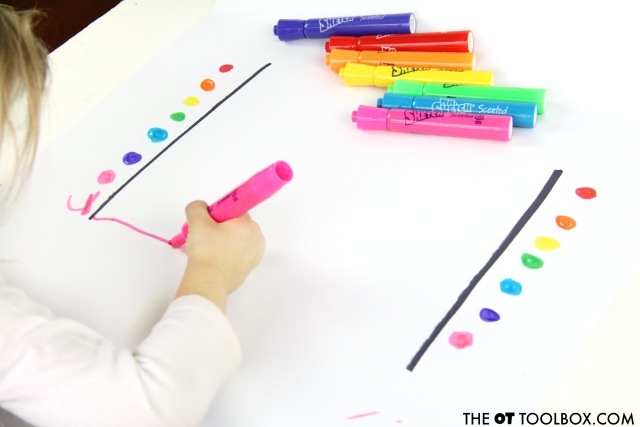
To prepare this activity, you’ll need to draw dots in a vertical column down the left side of the paper and matching dots in a column down the right side of the paper. Then, use a black magic marker to make vertical lines for the sides of the “ladder”.
Visual Motor Integration Activity
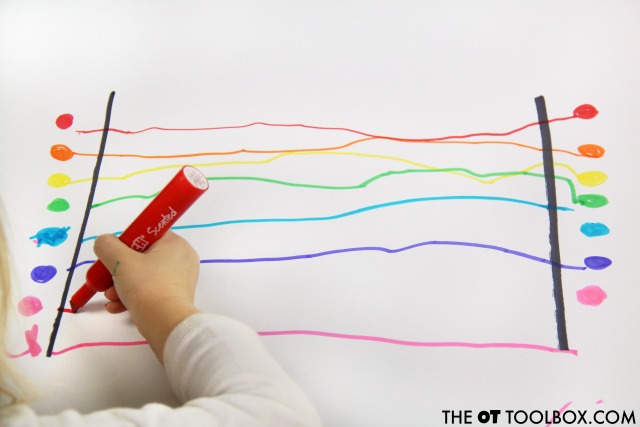
When doing this activity, be sure to ensure the child is connecting the dots from the left to the right. Try these tips to make sure the child is building those visual motor skills:
Ask the child to start the marker on the left dot. If they miss the dot, use verbal or visual cues to help them with the remaining dots.
Watch the child’s horizontal lines across the page. If the line goes up or down below 1/4″-1/2″ from an imaginary strait line, use verbal and visual cues for the remaining trials.
Ask the child to stop at the right dot. If the line stops before the dot or extends beyond the dot, use verbal or visual cues for the remaining trials.
Use the black vertical lines as a visual cue to slow down the marker stroke for improved accuracy.
More ways to extend this activity to address visual motor development:
Use large paper (easel paper or butcher paper) hanging on the wall.
Stand at an easel or dry erase board.
Try making diagonal lines or arched lines like in this occupational therapy slide deck for working on prewriting skills and line formation in a visual motor letter rainbow.
Try these visual motor activities for more fun ways to build skills needed for handwriting:
Rainbow Handwriting Kit– This resource pack includes handwriting sheets, write the room cards, color worksheets, visual motor activities, and so much more. The handwriting kit includes:
Write the Room, Color Names: Lowercase Letters
Write the Room, Color Names: Uppercase Letters
Write the Room, Color Names: Cursive Writing
Copy/Draw/Color/Cut Color Worksheets
Colors Roll & Write Page
Color Names Letter Size Puzzle Pages
Flip and Fill A-Z Letter Pages
Colors Pre-Writing Lines Pencil Control Mazes
This handwriting kit now includes a bonus pack of pencil control worksheets, 1-10 fine motor clip cards, visual discrimination maze for directionality, handwriting sheets, and working memory/direction following sheet! Valued at $5, this bonus kit triples the goal areas you can work on in each therapy session or home program.
Colleen Beck, OTR/L has been an occupational therapist since 2000, working in school-based, hand therapy, outpatient peds, EI, and SNF. Colleen created The OT Toolbox to inspire therapists, teachers, and parents with easy and fun tools to help children thrive. Read her story about going from an OT making $3/hour (after paying for kids’ childcare) to a full-time OT resource creator for millions of readers. Want to collaborate? Send an email to contact@theottoolbox.com.
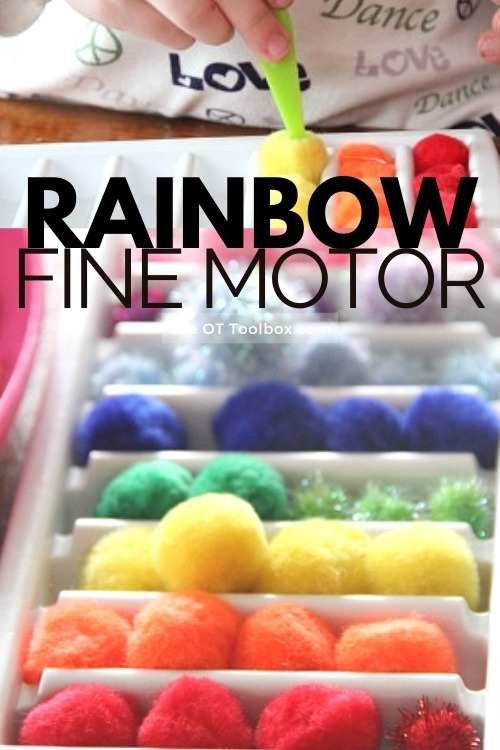
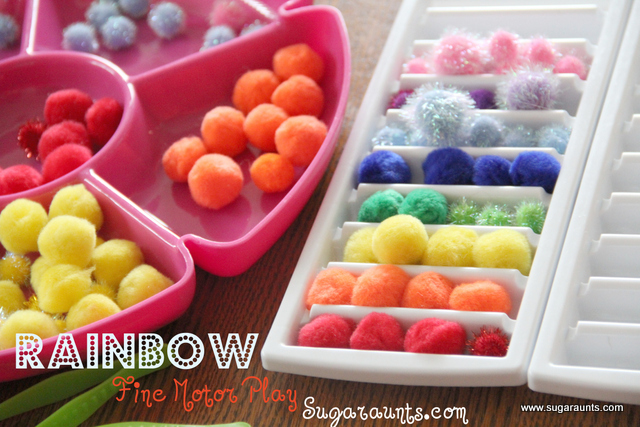
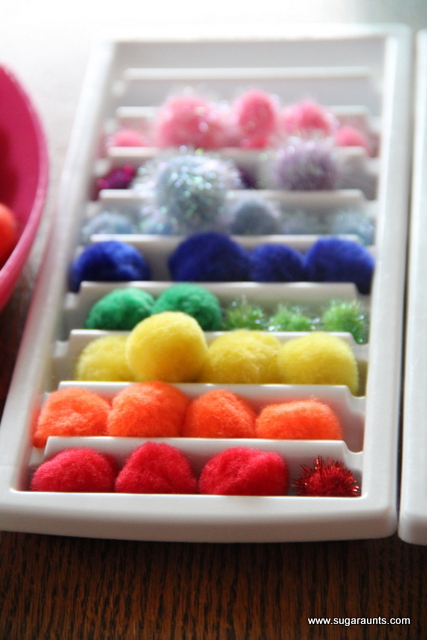
This rainbow sort activity is a fine motor skills idea to help kids sort colors while developing dexterity and precision and learning colors. By sorting the colors of the rainbow into small containers, a rainbow fine motor activity is a colorful way to help kids develop fine motor skills. Add this idea to your rainbow theme in therapy interventions, or home activities for developing motor skills.
Extend this activity and sort the rainbow colors to make a Fruit Loop rainbow craft for more fine motor and visual motor fun.
We have been on a rainbow kick recently and have a ton of rainbow projects going on right now. This color sorting activity was a fun one that the big kids and my toddler really got into.
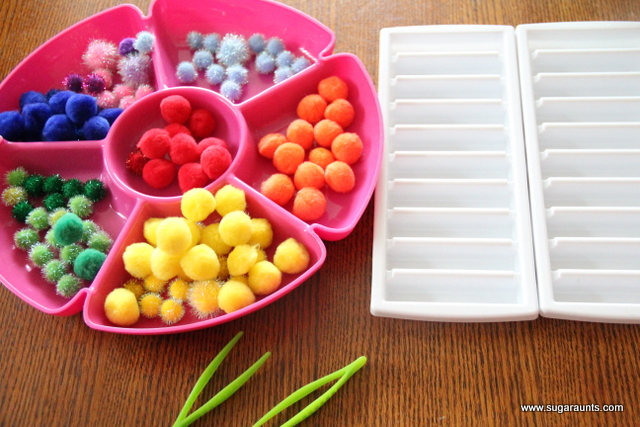
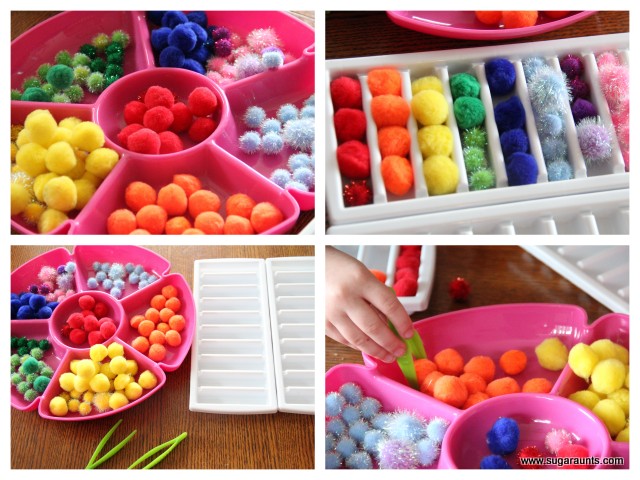
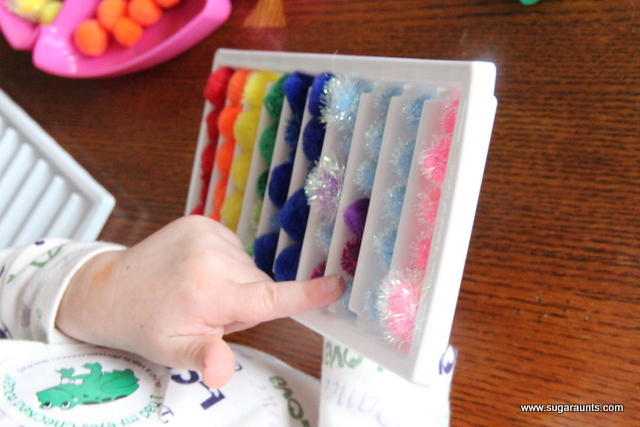
This rainbow sort activity is easy to set up. All you need is colorful craft pom poms and an ice tray or two. The ice trays are the perfect size for the crafting pom poms.
Preschool Rainbow Activities
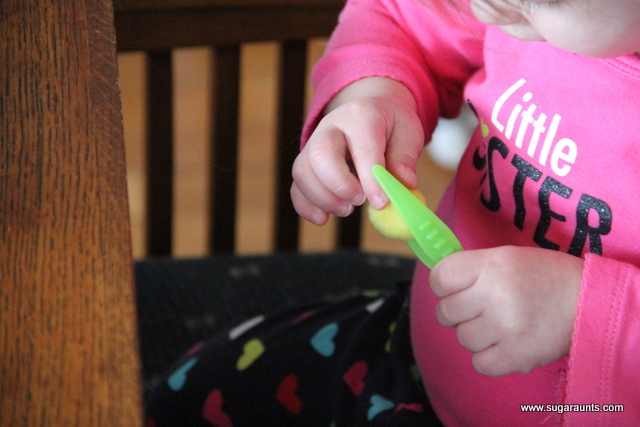
This color sorting activity is great for toddlers to develop fine motor skills in the preschool and toddler years. Baby Girl (17 months) got right in there.
In the preschool years, fine motor skills are a precursor for handwriting and pencil grasp. This pre-writing activity is perfect for preschool aged children.
Add this rainbow fine motor activity to the preschool classroom or home by adding tongs, tweezers, or scoops to help kids develop the precision, motor coordination, and eye-hand coordination skills kids need at the preschool age.
Plus, this rainbow sort activity is a great way to teach preschoolers colors, too.
To work on pre-writing skills in other ways, try this rainbow prewriting activity available on a free slide deck.
Tongs are a powerful fine motor tool to use in occupational therapy activities that develop fine motor skills. To elevate this fine motor activity, ask kids to make their own craft stick tongs to manipulate these colorful craft poms. Preschool children can sort the colors using different colored tongs that are easy to make.
She is ALWAYS watching the big kids and copies everything!
Look at that concentration. And that cute little baby belly!
I can’t stand the cuteness!
Rainbow Handwriting Kit– This resource pack includes handwriting sheets, write the room cards, color worksheets, visual motor activities, and so much more. The handwriting kit includes:
Write the Room, Color Names: Lowercase Letters
Write the Room, Color Names: Uppercase Letters
Write the Room, Color Names: Cursive Writing
Copy/Draw/Color/Cut Color Worksheets
Colors Roll & Write Page
Color Names Letter Size Puzzle Pages
Flip and Fill A-Z Letter Pages
Colors Pre-Writing Lines Pencil Control Mazes
This handwriting kit now includes a bonus pack of pencil control worksheets, 1-10 fine motor clip cards, visual discrimination maze for directionality, handwriting sheets, and working memory/direction following sheet! Valued at $5, this bonus kit triples the goal areas you can work on in each therapy session or home program.
Colleen Beck, OTR/L has been an occupational therapist since 2000, working in school-based, hand therapy, outpatient peds, EI, and SNF. Colleen created The OT Toolbox to inspire therapists, teachers, and parents with easy and fun tools to help children thrive. Read her story about going from an OT making $3/hour (after paying for kids’ childcare) to a full-time OT resource creator for millions of readers. Want to collaborate? Send an email to contact@theottoolbox.com.
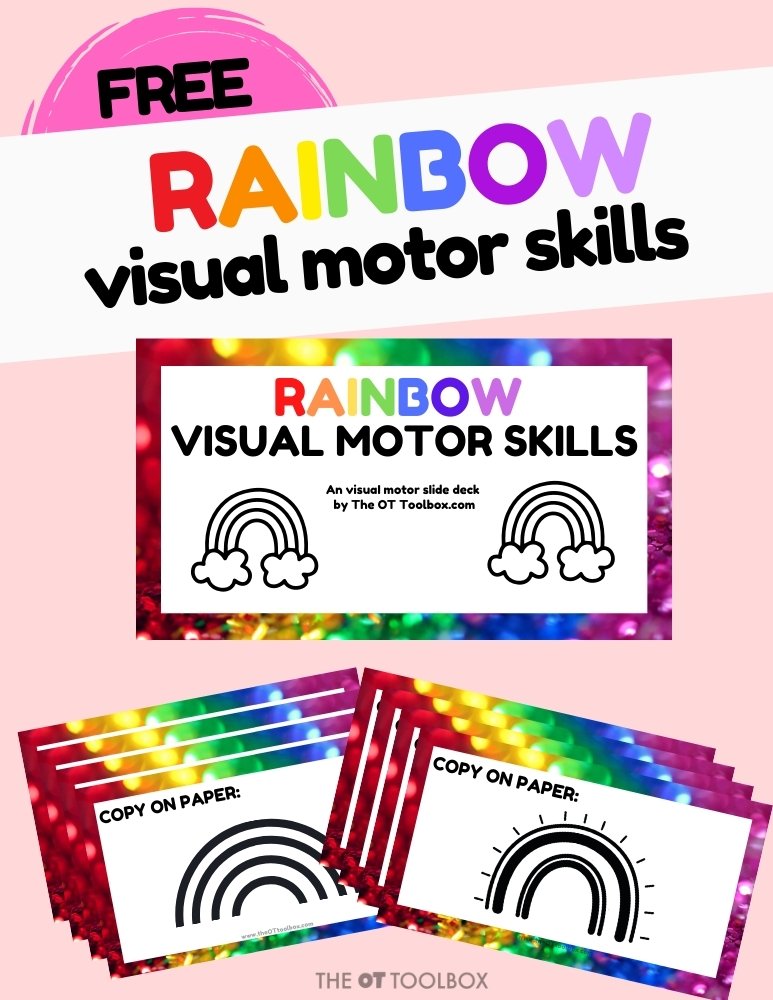
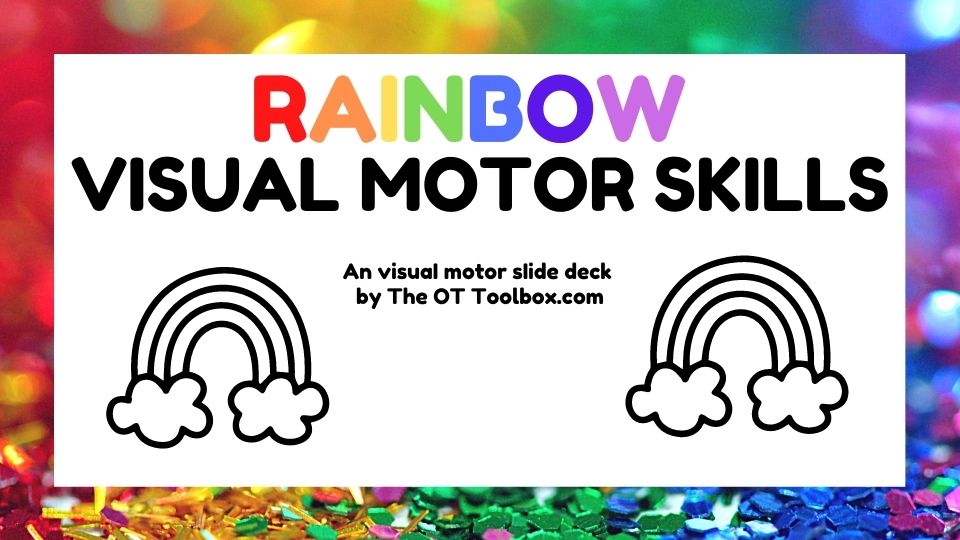
This rainbow art drawing help kids with visual motor skills of copying images and figures. When kids demonstrate the ability to copy shapes and forms, they are building the skills needed for copying words, letters, and sentences. This rainbow slide deck is a teletherapy activity that helps with visual motor skills needed for handwriting. Add this free Google slide deck to your occupational therapy teletherapy services (or home programs) and start building skills in visual motor integration.
Starting with drawing milestones is a good idea, especially if you are wondering about using this rainbow drawing activity with a range of ages.
If you take a scroll on YouTube, you’ll find a lot of directed drawing videos that walk kids through “how to draw a rainbow”… or how to draw hundreds of other images, cartoons, and drawing art ideas.
But, one thing that I have been looking for is simple forms that help kids with visual motor skills like copying simple and complex shapes…that are FUN and motivating.
Here’s the thing: when kids copy shapes, they are developing so many visual motor integration skills that translated to forming letters and numbers, copying sentences, and the eye-hand coordination needed to move a pencil in the way it needs to move so that letters and numbers are placed on lines. It’s all connected!
Copying simple lines and shapes are part of pre-writing skills. By the way, be sure to grab this rainbow pre-writing lines Google slide deck. It’s a freebie that you’ll want for your younger or lower level kiddos.
AND, when kids progress to copying more complex shapes, drawings, and forms, they are developing stronger skills in moving the pencil accuracy, spatial awareness, line awareness, and position in space. All of these skill sets are so necessary for handwriting.
Draw a Rainbow Activity
Kids can copy the different basic rainbow forms and develop these skills using our free rainbow drawing slide deck.
Each slide includes simple or more complex rainbow drawings that challenge kids to copy forms, making this a fun Spring activity that helps to build visual motor skills.
You can ask kids to copy the rainbows onto paper in different ways to extend this activity:
Ask kids to copy the shape in a specific space.
Ask kids to fold their paper into columns and rows. They can copy a rainbow form into each space on the paper.
Ask the child to copy the rainbow in a very large size on a dry erase board or large chalk board to use whole body movements and crossing midline. Air writing is another option.
Copy the forms with different sensory materials: chalk, water colors, paint, rainbow writing, writing on sandpaper, etc.
Copy the rainbow form from memory.
Copy the forms in a very small size.
Copy the forms into a sensory writing tray. Here are ideas for sensory writing trays.
Want this Rainbow Visual Motor Activity?
Enter your email into the form below to access this free Google slide deck.
Colleen Beck, OTR/L has been an occupational therapist since 2000, working in school-based, hand therapy, outpatient peds, EI, and SNF. Colleen created The OT Toolbox to inspire therapists, teachers, and parents with easy and fun tools to help children thrive. Read her story about going from an OT making $3/hour (after paying for kids’ childcare) to a full-time OT resource creator for millions of readers. Want to collaborate? Send an email to contact@theottoolbox.com.








 to make our handwriting activity into a rainbow of color and to add a
 . It’s perfect for working proprioception to the arms. Fold paper into columns and slide it into the punch to get a bunch of holes punched at once.