Visual Schedules

Visual schedules for kids

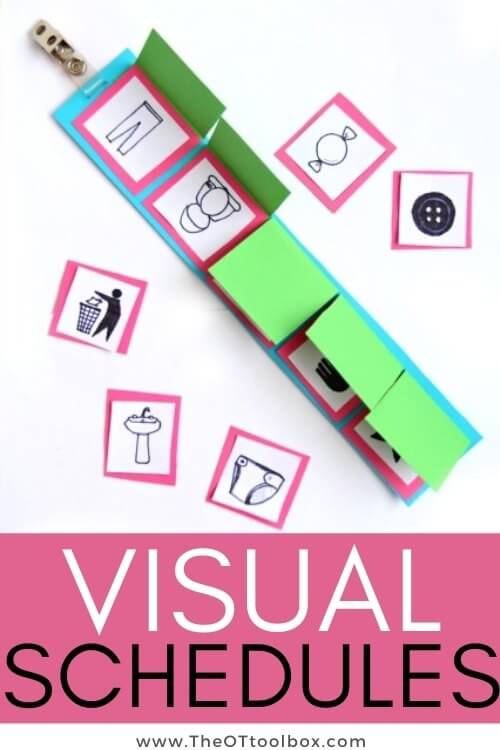
Visual schedules are a tool that help kids in so many ways. As an adult I am constantly writing notes on post it’s to remind me to do things. It helps to be organized. When a child is learning to sequence, they may forget steps. A visual schedule is a great way to increase a child’s independence with toileting, that way they don’t have to rely so much on you for every step. A visual schedule is used to help guide them in learning the sequence of steps.

Whether you are thinking about tools to support needs with sensory strategies at school or you are even thinking about back-to-school sensory activities, a visual schedule is a great addition to your toolbox.
Visual schedules for kids

What is a visual schedule?

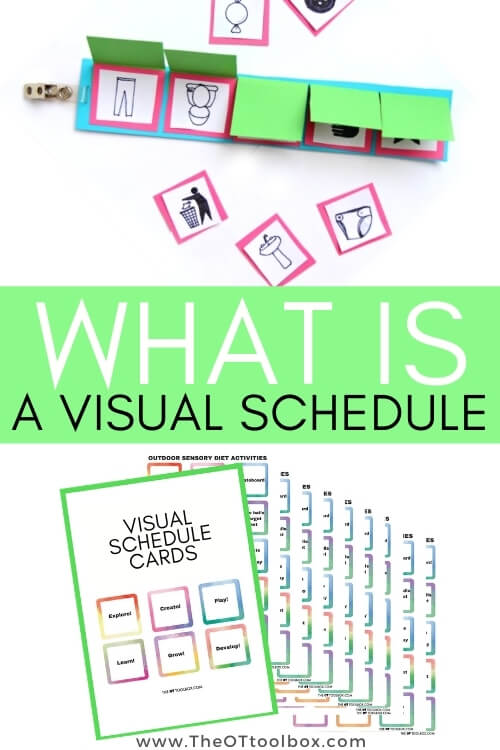
A visual schedule is just what it sounds like, a schedule or sequence, that uses pictures. Now the pictures used can by real photos, often I will take pictures with my phone an then print those out to use them. Or you can use clip art. A visual schedule is a way to show a child the beginning of a task and the end of the task. Visual cues that show a specic task can be beneficial for many children, of all ages, abiliies, and cognitive levels.

Visual prompts are helpful in teaching the steps of toothbrushing.

Visual schedules can help with toilet training.

Schedules can get kids organized an on time for morning routines.

Or, visual schedules can be used to plan and schedule sensory diet activities.

Visual checklists can be used for classwork, assignments, or chores.

Visual schedules can be used in specific ways like in a school sensory room.


You can use a visual schedule with any multistep functional task or during a series of tasks. Visual schedules are helpful in the classroom, home, in the community, or during therapy sessions. Other tasks such as homework assignments, projects, recipes, or multistep activities can work well with visual prompts.
What is a visual schedule

Reasons to use visual schedules

There are many reasons to use a visual schedule

  1. Visual schedules can be used with all levels and abilities.
  2. Visuals are consistent.
  3. Visual schedules can reduce worries and anxiety by offering a constant direction.
  4. Visuals allow time for language processing.
  5. Visual prompts can offer a visual image and written word to meet the needs of a variety of student’s abilities.
  6. Visual schedules can promote self-confidence after success
  7. Visuals can help your child with transitions and know “what’s next”.
  8. Visuals help your child see what you mean.
  9. Visual prompts offer a chance to order tasks to take away impulse control.
  10. Visual cues offer strategies to impact planning, prioritization, working memory, organization, attention, and other executive functioning skills.
  11. Visuals help to build independence.
  12. Visual prompts can be flexible.
  13. Visuals are transferable between different places.
  14. Visuals have no tone.

How to use a visual schedule

Other students benefit from a checklist of sorts. This can occur with a visual description of the activity or task or simply a list of actions that are to be completed. An example would be toileting. You can start with 2 visuals and work up to as many visuals as needed.

Pictures can be made into a visual schedule. You can cut the pictures out and then glue them to a piece of paper and have it in the bathroom, showing your child the exact sequence of steps.

Remember lots of praise and encouragement with visual schedules, especially when setting up a plan.


For functional tasks like shoe tying, getting dressed, or toilet training, you can have the child pull off the picture each time they complete a task and put it in the “all done” envelope or you can just point to the steps as they do them.


If you want to be more specific and break down a task even more you just add more pictures for the steps. Here is an example of a handwashing visual schedule, which is great for children who often forget all the steps to handwashing.


Another way to get a child to participate in toileting is to use a first then schedule. You put what the task is you want them to do, and the “then” would be the reward. For example, I would say, “First you go to the bathroom, then you get to play ball”.

If you have tried a visual schedule and your child is having some behaviors I would suggest reading this article Attention and Behavior considerations in Toileting and Potty Training the Child. Sometimes there many be other factors that contribute to difficulty with step-by-step tasks such as toilet training.

Visual Cards

If adding sensory processing activities to a sensory diet or just to incorporate calming and regulating sensory input into daily activities is necessary, try adding these visual schedule cards into the day-to-day.

Sensory Diet Cards - The OT Toolbox

About Christina: Christina Komaniecki is a school based Occupational Therapist. I graduated from Governors State University with a master’s in occupational therapy.   I have been working in the pediatric setting for almost 6 years and have worked in early intervention, outpatient pediatrics, inpatient pediatrics, day rehab, private clinic and schools. My passion is working with children and I love to see them learn new things and grow. I love my two little girls, family, yoga and going on long walks.
Flower Snacks

flower snacks

These flower snacks are fun and super easy to create with kids and build fine motor skills in the kitchen. If you are looking for creating ways to add healthy snacks into a child’s diet, these flower themed snacks are just that. Whether kids help in the kitchen for fun or for the benefits of building executive functioning skills or fine motor development, there are many reasons to make these flower healthy treats! This is just one of the many cooking with kids recipes here on the website.

Add these cooking with kids activities to your Spring occupational therapy toolbox.

Flower snacks that are healthy snacks for kids

Flower Snacks

The flower snacks you see below are creative ways to add fun healthy foods for kids. But, even better, kids can help to make these treats. When kids make these snacks, they are building many skills.

Getting kids involved in the kitchen helps to develop fine motor skills like eye-hand coordination, dexterity, and motor planning. All of these skills are refined through dicing, chopping, scooping, and pouring.

Cooking with kids also is a powerhouse task for developing executive functioning skills. Following recipes, direction following, impulse control, planning, prioritization, and working memory are all skills that are developed through meal preparation and recipe following.

Here are more cooking with kids recipes to get kids active in the kitchen to develop skills.


Flower snacks for cute healthy foods for kids
 

Let’s get started with those flower snacks…
 

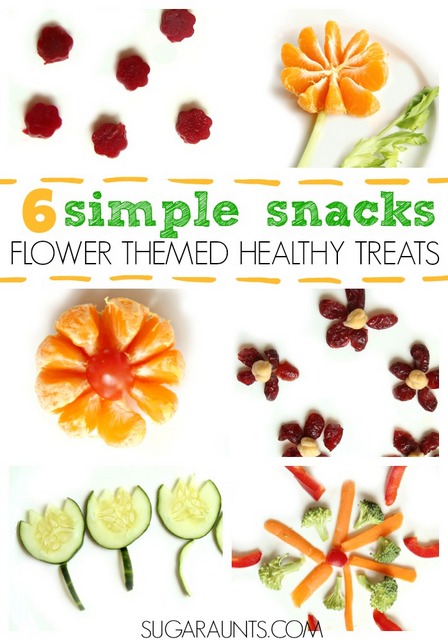
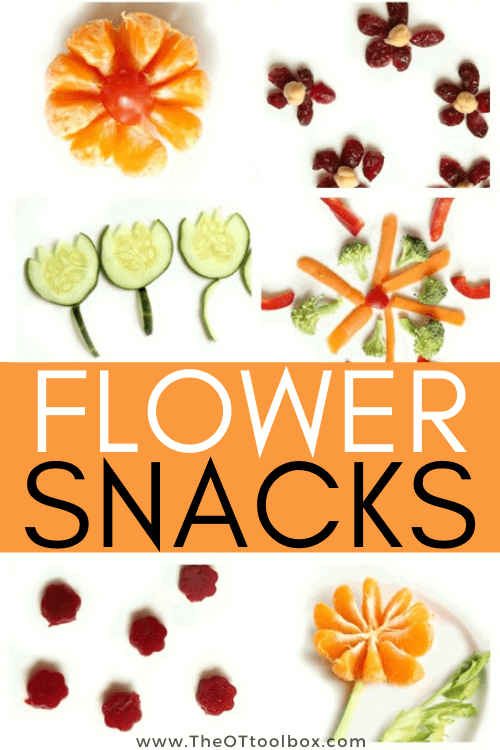
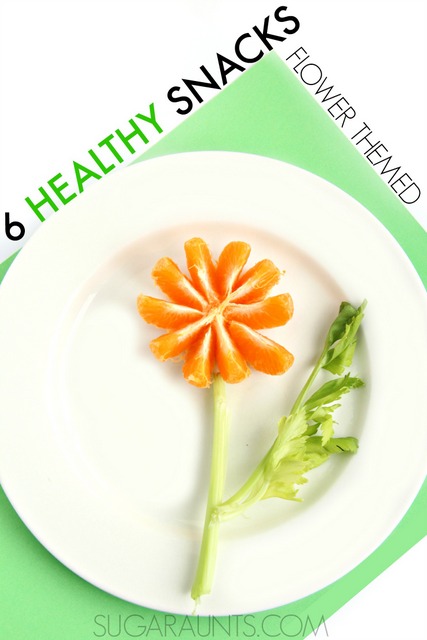
6 healthy flower snacks:

Beet slices flower snack– Use a flower shaped cookie cutter to cut beet slices (or other soft fruit/veggies: pineapple, apples, thin potatoes…
 
Mandarin orange flower– Peel an orange and open one end.  Add celery for a stem.
 
Orange with flair–  Add a grape tomato to the center of your orange to add a little color.  Other fruits could also be arranged into a flower shape: apple, pear, and banana slices would work.
 
Dried cranberry mini flowers– Arrange cranberries (or raisins) into petal shapes.  Add chickpeas for a center to each flower.
 
Tulip cucumbers– Cut a jagged line into cucumber slices.  Add a piece of the peel for stems for each flower.
 
Flower art–  Get the kids involved in this one!  Provide carrots, broccoli, red peppers, grape tomatoes and create a flower design as a family.  Enjoy!

Cute flower snack ideas for kids!  Kids can help make these flower themed healthy treats.

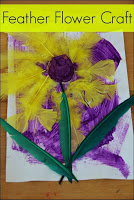
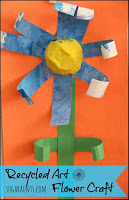
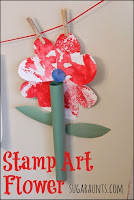
Make today special with a little bit of healthy flower fun!  While you’re at it, make a few flower crafts: 

Spring Fine Motor Kit

Score Fine Motor Tools and resources and help kids build the skills they need to thrive!

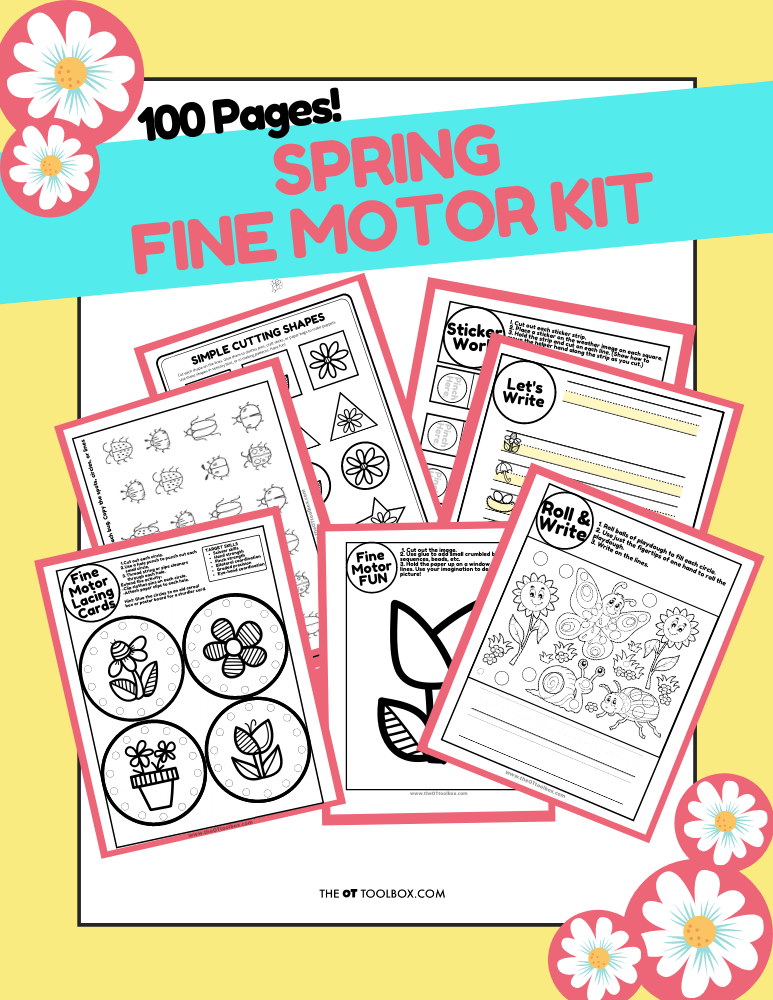
Developing hand strength, dexterity, dexterity, precision skills, and eye-hand coordination skills that kids need for holding and writing with a pencil, coloring, and manipulating small objects in every day task doesn’t need to be difficult. The Spring Fine Motor Kit includes 100 pages of fine motor activities, worksheets, crafts, and more:

Spring fine motor kit set of printable fine motor skills worksheets for kids.
  • Lacing cards
  • Sensory bin cards
  • Hole punch activities
  • Pencil control worksheets
  • Play dough mats
  • Write the Room cards
  • Modified paper
  • Sticker activities
  • MUCH MORE

Click here to add this resource set to your therapy toolbox.

Spring Fine Motor Kit
Spring Fine Motor Kit: TONS of resources and tools to build stronger hands.

Grab your copy of the Spring Fine Motor Kit and build coordination, strength, and endurance in fun and creative activities. Click here to add this resource set to your therapy toolbox.

Colleen Beck, OTR/L has been an occupational therapist since 2000, working in school-based, hand therapy, outpatient peds, EI, and SNF. Colleen created The OT Toolbox to inspire therapists, teachers, and parents with easy and fun tools to help children thrive. Read her story about going from an OT making $3/hour (after paying for kids’ childcare) to a full-time OT resource creator for millions of readers. Want to collaborate? Send an email to contact@theottoolbox.com.

Eye-Hand Coordination Activity

Eye hand coordination activity

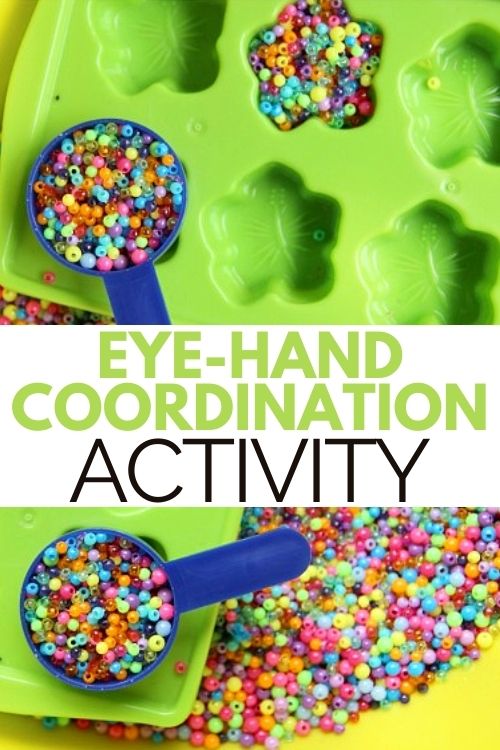
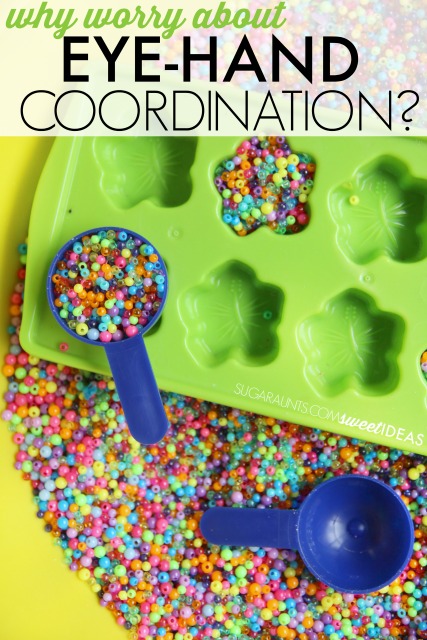
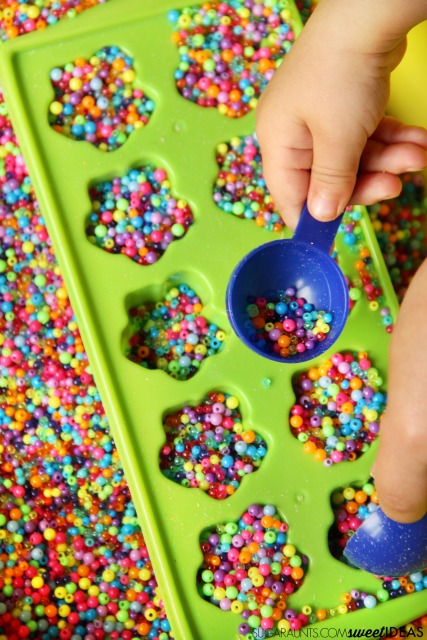
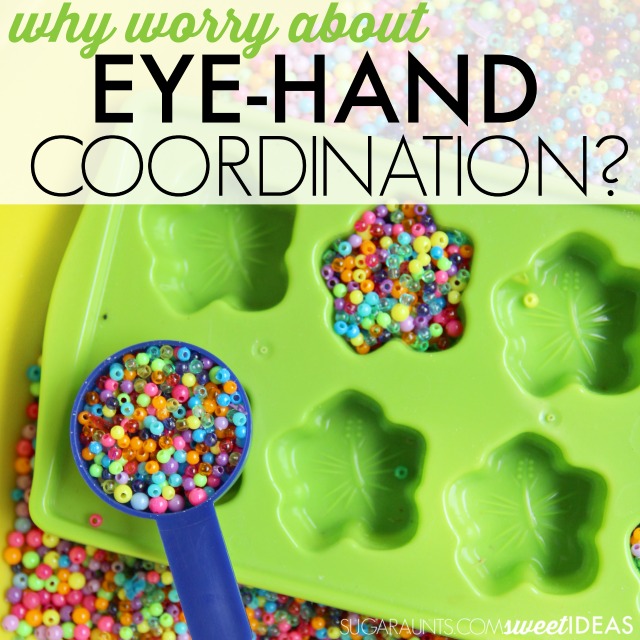
This eye hand coordination activity is an easy one to set up and can use the materials you have in your home. We used a flower ice cube tray and some craft materials, as well as a recycled scoop to work on eye-hand coordination skills, but the motor activity is very open ended. Let’s discuss hand eye coordination and a few ways to work on this skill area.

Development of hand-eye coordination is an important place to begin.

Our movements are guided by vision.  In order for our brains to coordinate a motor plan for a particular task, we need visual input for accuracy.  

Eye hand coordination activity to help kids with refined motor coordination skills.

Eye Hand Coordination Activity 

Visual motor skills or eye-hand coordination impacts our dexterity and motor movements for so many tasks:  handwriting, scissor use, threading beads, reading a paragraph, throwing a ball, placing a cup on a shelf, coloring in lines, and pouring milk into a bowl are just a few skills that require coordination of the vision and hands.    

If eye hand coordination skills are lacking, then these areas of function will be difficult to do with ease.  Learning, social interactions, and independence in tasks can be limited as a result.  That’s a pretty clear a reason to look at eye-hand coordination when there seem to be “bigger picture” problems. 

What is eye-hand coordination and how does this skill impact "big picture" tasks like reading, writing, fine motor skills, and gross motor skills?  This easy, low-prep eye hand coordination activity can help.
 

Scooping and Pouring and eye hand coordination

This scooping activity is a simple way to work on the eye-hand coordination needed for coordinated movements of the hands in relation to visual input.  An activity as simple as scooping beads can help children (and adults addressing physical disabilities!) to improve their visual motor integration.  

This post contains affiliate links.   We used  a HUGE bin of seed beads and a flower ice cube tray. This is a similar tray. It was a tray of 10 flowers, making it perfect for counting to ten with my toddler and preschooler and working on ten frame math facts with my kindergartner.    

What is eye-hand coordination and how does this skill impact "big picture" tasks like reading, writing, fine motor skills, and gross motor skills?  This easy, low-prep eye hand coordination activity can help.

I added a couple of small scoops to our beads.  These scoops came from dry laundry detergent and were the perfect size for scooping the beads into each flower.  

Scooping and pouring the beads into each flower, one at a time works on eye hand coordination to make sure the beads fall into the flowers and not over the edge of the ice cube tray.  

What is eye-hand coordination and how does this skill impact "big picture" tasks like reading, writing, fine motor skills, and gross motor skills?  This easy, low-prep eye hand coordination activity can help.

How to improve eye hand coordination

Scooping and pouring a material that “pours” is an eye hand coordination activity that helps to refine fine motor skills and motor planning. For children, setting up a scooping activity like the one described here can be graded to make the task more difficult, or easier. Different grades of scooping activities can be more difficult because there is less weight (pouring flour compared to sand) or more mobility ( scooping and pouring liquid compared higher viscosity of the materials.)

In our scooping and pouring eye hand coordination activity, the beads are smaller and rounder, adding more of a challenge in coordinating the scoop and accuracy of pouring. To further grade this activity, different sizes of scoops can be used, and different sizes of containers to pour the material into.

Make sure your child is scooping beads into one section of the ice tray at a time.  They need to intentionally fill one section while trying to keep the beads in that section.  If the beads are falling over the edge of the ice cube tray and into other sections, it’s not working on eye-hand coordination.   

More eye hand coordination activities

Looking for more creative ways to build eye hand coordination?

Spring Fine Motor Kit

Score Fine Motor Tools and resources and help kids build the skills they need to thrive!

Developing hand strength, dexterity, dexterity, precision skills, and eye-hand coordination skills that kids need for holding and writing with a pencil, coloring, and manipulating small objects in every day task doesn’t need to be difficult. The Spring Fine Motor Kit includes 100 pages of fine motor activities, worksheets, crafts, and more:

Spring fine motor kit set of printable fine motor skills worksheets for kids.
  • Lacing cards
  • Sensory bin cards
  • Hole punch activities
  • Pencil control worksheets
  • Play dough mats
  • Write the Room cards
  • Modified paper
  • Sticker activities
  • MUCH MORE

Click here to add this resource set to your therapy toolbox.

Spring Fine Motor Kit
Spring Fine Motor Kit: TONS of resources and tools to build stronger hands.

Grab your copy of the Spring Fine Motor Kit and build coordination, strength, and endurance in fun and creative activities. Click here to add this resource set to your therapy toolbox.

Colleen Beck, OTR/L has been an occupational therapist since 2000, working in school-based, hand therapy, outpatient peds, EI, and SNF. Colleen created The OT Toolbox to inspire therapists, teachers, and parents with easy and fun tools to help children thrive. Read her story about going from an OT making $3/hour (after paying for kids’ childcare) to a full-time OT resource creator for millions of readers. Want to collaborate? Send an email to contact@theottoolbox.com.

Flower Balance Activities

Flower balance activities

Want to help kids with balance, coordination, strength, and mobility? Need some core strengthening and stability activities to help with balance and vestibular integration? These flower balance activities are fun ways to help kids work on these very areas so they are able to move, play, learn, and function in day to day tasks. And, it’s all packaged up in a free Google slide deck so you can use these balance exercises in therapy sessions, at home, in the classroom, or clinic. These are Spring gross motor activities that really build skills!

Balance activities slide deck with a flower theme to use in teletherapy sessions.

Balance Activities

You’ll find a lot of balance activities and exercises here on The OT Toolbox. We’ve shared balance beams, obstacle courses, brain breaks, prone extension activities, movement activities, and vestibular activities before. you may have even seen this DIY wobble disk made from ice. All of these activities are so great to help kids develop strength, coordination, movement pattern skills, and get them moving through play.

Core strengthening is just one benefit of these balance activities kids can copy. We’ve talked before about core strength and it’s relationship to handwriting and other functional tasks.

Flower balance activities for kids

The free slide deck that I have available today, adds just one more balance tool into your therapy toolbox. It’s a fun way to challenge kids to move while copying visual images of body positioning. These exercises integrate visual processing to see the image and copy the positioning as well as motor skills as kids coordinate their body to move their arms or legs into the correct positioning.

I’ve tried to use both sides of the body in this flower balance activity, so they can work on left-right discrimination as well.

Flower balance activities

When kids incorporate one leg stance, and holding a body position in a squat or lunge, they are adding proprioceptive input, so they gain the calming regulatory benefits, too.

Flower balance exercises

And, the therapy slide decks use a flower icon in various positions on each slide. So the user can copy the form by placing a pillow, stuffed animal, roll of socks, or bean bag into different places while maintaining balance. This can be a real challenge for some children!

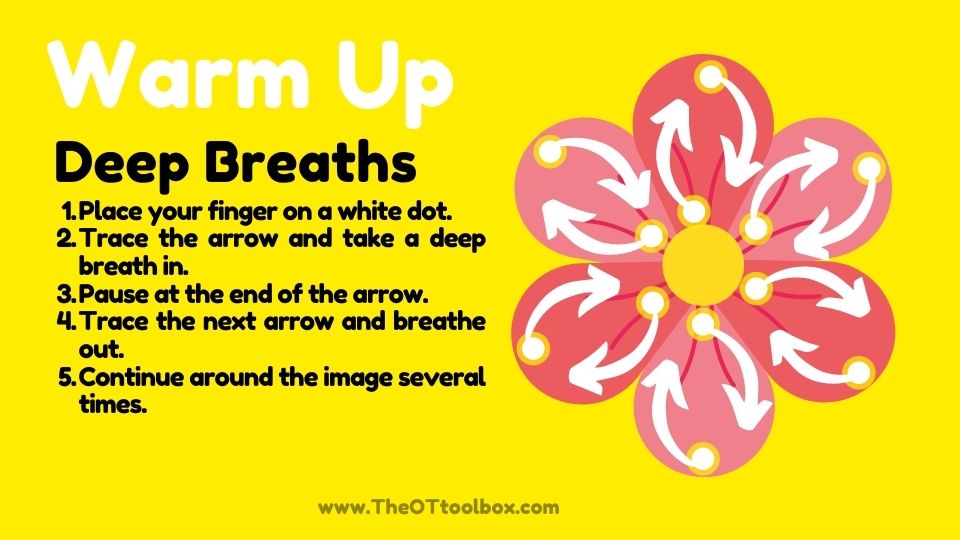
Flower deep breathing exercise

There is a fun flower deep breathing exercise in the slide deck as well.

Free Balance Exercise Slide Deck

Want to use this free slide deck in teletherapy, in home programs, or in the classroom as a brain break? Just enter your email address into the form below.

NOTE- Due to an increase in security measures, many readers utilizing a work or school district email address have had difficulty accessing free resources from the delivery email. Consider using a personal email address and forwarding the delivery email to your work account.

Flower Balance Activities Slide Deck!

    We respect your privacy. Unsubscribe at anytime.

    Spring Fine Motor Kit

    Score Fine Motor Tools and resources and help kids build the skills they need to thrive!

    Developing hand strength, dexterity, dexterity, precision skills, and eye-hand coordination skills that kids need for holding and writing with a pencil, coloring, and manipulating small objects in every day task doesn’t need to be difficult. The Spring Fine Motor Kit includes 100 pages of fine motor activities, worksheets, crafts, and more:

    Spring fine motor kit set of printable fine motor skills worksheets for kids.
    • Lacing cards
    • Sensory bin cards
    • Hole punch activities
    • Pencil control worksheets
    • Play dough mats
    • Write the Room cards
    • Modified paper
    • Sticker activities
    • MUCH MORE

    Click here to add this resource set to your therapy toolbox.

    Spring Fine Motor Kit
    Spring Fine Motor Kit: TONS of resources and tools to build stronger hands.

    Grab your copy of the Spring Fine Motor Kit and build coordination, strength, and endurance in fun and creative activities. Click here to add this resource set to your therapy toolbox.

    Colleen Beck, OTR/L has been an occupational therapist since 2000, working in school-based, hand therapy, outpatient peds, EI, and SNF. Colleen created The OT Toolbox to inspire therapists, teachers, and parents with easy and fun tools to help children thrive. Read her story about going from an OT making $3/hour (after paying for kids’ childcare) to a full-time OT resource creator for millions of readers. Want to collaborate? Send an email to contact@theottoolbox.com.

    Flower Visual Motor Therapy Slide Deck

    Flower visual motor exercises for therapy

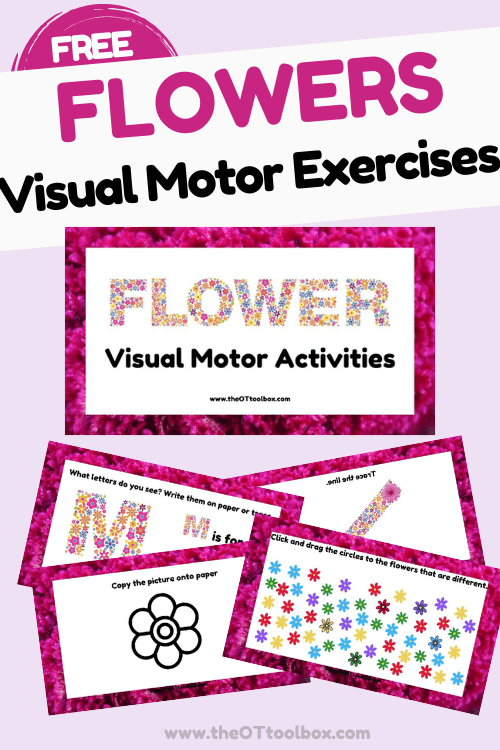
    This week’s occupational therapy theme is flowers and so today, I have a free flower visual motor therapy slide deck for you. In this free Google slide deck, you’ll find various aspects of visual motor skill work. With the official start of Spring, flowers are starting to pop up all over, so if the daffodils, lilies, and tulips make you smile, these visual motor flower activities are sure to brighten your therapy session!

    Flower visual motor therapy exercises for therapy

    Flower visual motor therapy activities

    If you are looking for Spring occupational therapy activities to help kids develop skills, this flower visual motor slide deck is it. Add this virtual therapy activity to some hands on flower activities and you’ve got a therapy plan for the week. It’s a great way to make a weekly occupational therapy plan and use the same activities again and again all week, saving yourself time and planning hours. Simply adjust each activity to meet the needs of each child on your therapy caseload to work on their specific goals.

    Flower visual motor activities for occupational therapy teletherapy sessions with a free Google slide deck for therapy.

    As you know, visual processing breaks down into smaller components that all work together to allow us to take in visual information, process that input, and complete motor operations so we can complete functional tasks. Visual motor skills include eye-hand coordination, visual perception, and visual skills like tracing, convergence, and other skill areas. All of these aspects of visual processing are important parts of performing day to day occupations.

    That’s why I created this flower theme therapy slide deck that includes different vison exercises.

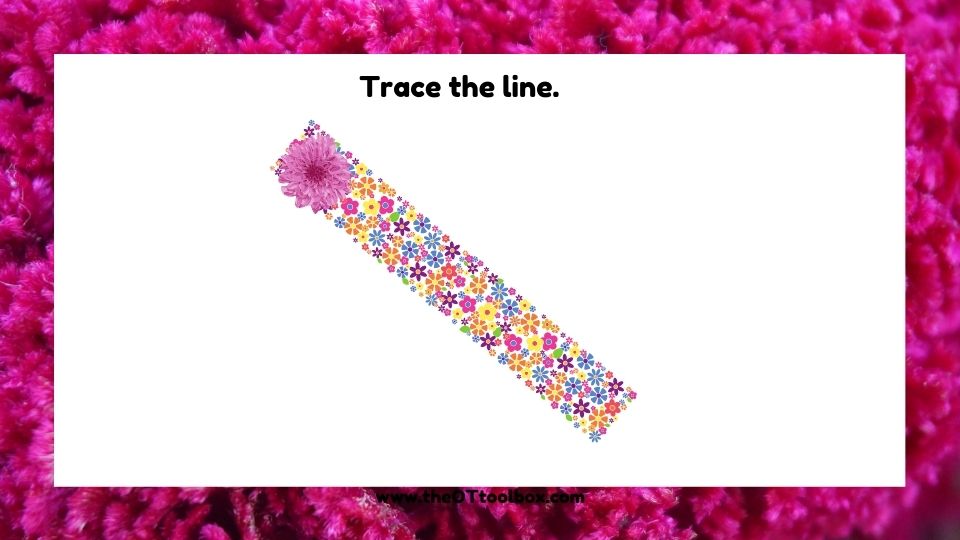
    In the slide deck, you’ll find pre-writing line activities that ask the user to trace along the forms using a movable flower icon. This eye-hand coordination task requires visual tracking, visual attention, and motor integration with visual input.

    Work on visual motor skills with this flower theme slide deck in occupational therapy.

    Also, the slide deck includes copying activities. Users can copy the simple and more complex flower forms as they challenge aspects of visual motor skills that are needed for handwriting and math tasks.

    There is a handwriting portion as well. Kids can trace the letters on the slide deck using the movable flower piece. This makes the slide deck interactive, as they can work on mouse work, use of a stylus, or finger isolation to trace the flower along the letter. Then, the slide asks them to write words or phrases so they can incorporate handwriting work.

    Then finally, the slide deck includes several visual perception activities. Kids can complete each slide, typing or writing out their responses as they work on skills like visual discrimination, form constancy, visual memory, figure-ground, etc. All of these visual perceptual skills play a role in visual motor tasks that we perform on a daily basis.

    Free Flower Therapy Slide Deck

    Want to add this free slide deck to your therapy toolbox? Use it in teletherapy sessions, home activities to work on visual motor skills and visual processing, and to make therapy planning easier!

    Enter your email address into the form below to add this slide deck to your Google drive account.

    NOTE- Due to an increase in security measures, many readers utilizing a work or school district email address have had difficulty accessing resources from the delivery email. Consider using a personal email address and forwarding the delivery email to your work account.

    Flower Visual Motor Activities Slide Deck!

      We respect your privacy. Unsubscribe at anytime.

      Spring Fine Motor Kit

      Score Fine Motor Tools and resources and help kids build the skills they need to thrive!

      Developing hand strength, dexterity, dexterity, precision skills, and eye-hand coordination skills that kids need for holding and writing with a pencil, coloring, and manipulating small objects in every day task doesn’t need to be difficult. The Spring Fine Motor Kit includes 100 pages of fine motor activities, worksheets, crafts, and more:

      Spring fine motor kit set of printable fine motor skills worksheets for kids.
      • Lacing cards
      • Sensory bin cards
      • Hole punch activities
      • Pencil control worksheets
      • Play dough mats
      • Write the Room cards
      • Modified paper
      • Sticker activities
      • MUCH MORE

      Click here to add this resource set to your therapy toolbox.

      Spring Fine Motor Kit
      Spring Fine Motor Kit: TONS of resources and tools to build stronger hands.

      Grab your copy of the Spring Fine Motor Kit and build coordination, strength, and endurance in fun and creative activities. Click here to add this resource set to your therapy toolbox.

      Colleen Beck, OTR/L has been an occupational therapist since 2000, working in school-based, hand therapy, outpatient peds, EI, and SNF. Colleen created The OT Toolbox to inspire therapists, teachers, and parents with easy and fun tools to help children thrive. Read her story about going from an OT making $3/hour (after paying for kids’ childcare) to a full-time OT resource creator for millions of readers. Want to collaborate? Send an email to contact@theottoolbox.com.

      Free Spring List Writing Prompts

      Spring Writing Lists worksheets

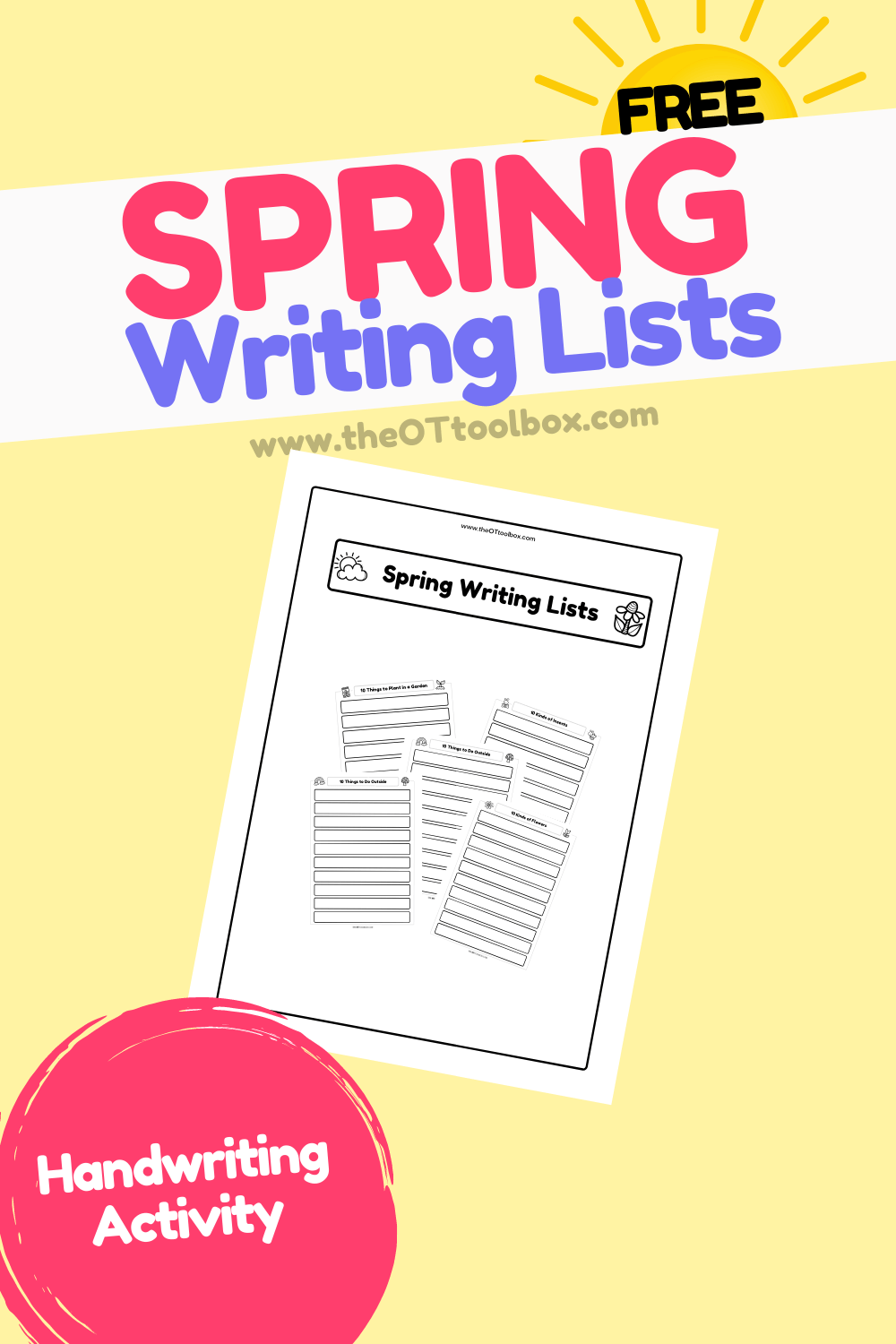
      Here, you can grab a free set of Spring list writing prompts to use in handwriting practice. If working on handwriting is a task you are focusing on with kids, then using list writing as a tool is the way to go. Writing in list format helps kids focus on a shorter writing task, so they can focus on the letter formation, space, size, and accuracy. While writing in sentences definitely is a necessary next step, using list writing in addressing handwriting issues can be motivating and fun way to work on difficult skills with kids.

      Spring Writing Prompts

      If you are like my kids, they start thinking about ice cream as soon as Spring hits. They love to see the local ice cream shop open after the winter break this time of year! So, a fun prompt like our ice cream writing is a perfect fit!

      Other Spring writing prompts can be lists of things or open ended prompts. Think about things like:

      • What do you like to do in the Spring?
      • What is your favorite Spring holiday and why?
      • What animals do you see in the Spring, and where do you see them?
      • Describe your ideal Spring day. What would you do?
      • What Spring flower do you find most beautiful or interesting?
      • How does the weather change in your area during Spring, and how does it affect you?
      • What are some Spring traditions or celebrations you know of or participate in?
      • Write about a memorable Spring experience from your past.
      • How do you see the community or environment changing around you during Spring?
      • What Spring foods are you most excited to eat, and why?
      Spring Writing Lists worksheets

      List Writing

      There are a few reasons why writing in lists can be beneficial to children working on handwriting skills. Let’s explore the concept of list writing a bit more.

      Writing lists is shorter! For kids that struggle with handwriting, it can be hard to get them to sit and concentrate on writing practice. Writing lists is a much shorter writing prompt, and kids see that they have only a certain number of items to actually write. This can help them focus on making those limited number of writing items in their neatest handwriting.

      List writing is organized! Children struggling with spatial awareness and other organizational issues might see a page of writing paper and visually fall apart at the sight of a page full of lines. An empty journal page or loose-leaf paper can be overwhelming! Where to start writing, where to end a sentence to fit the word in…how much to write…all of these are going through a child’s head when they have a page to fill in. So, you might get super quick and sloppy writing just so they can finish the job. Sound familiar?

      List writing is motivating! When kids write a list of words or phrases, they can come up with words to write on their own. They can complete the writing task as a sort of brain teaser. The nice thing about using lists as a writing prompt is that kids can choose the topic, too. Do they really like sports? Use that as a meaningful and motivating topic to write a list about. There are endless lists that can be written about.

      To take handwriting practice to the next level, check out our Interest-Based Writing Prompts Packet. It’s 150 interest-based list writing prompts that can focus on a child’s interests to make handwriting practice motivating and meaningful.

      List writing is progressive! By this, I mean that moving to the next step of words, to phrases, to sentences, to paragraphs is a progressive sequence. Kids can start at the beginning of this progression by writing lists of words while concentrating on legibility: letter formation, line use, spacing, sizing, and margin use. Then, you can ask them to write two word phrases. Then a longer phrase. Then a list of sentences. Now, can they put that list of sentences into paragraph form? The use of lists to practice handwriting can really help with carryover of skills, too!

      Free Spring List Writing Prompts

      So, what do you think? Would you like to try list writing as a tool to promote handwriting skill carryover?

      Below, you can grab a free printable set of writing lists with a Spring theme. These lists are formatted to include very basic writing spaces in the way of a rectangle block as the writing area. This way, you can use the writing pages with a variety of ages and writing abilities. Some kids might just need to work on writing in a given space. For others, you can add a middle line. Still others may need a highlighted lower line. You could even add a LegiLiner stamp lines to the blocks, or WooTape to the spaces.

      To grab this set of Spring writing prompts, enter your email into the form below.

      NOTE: Please use a personal email address. Emails on a school district or university server (emails ending with .org, .ed, .edu, .unv etc. may be blocked by your organizations security wall.

      FREE Spring List Writing Prompts

        Please enter a personal email. Emails to work and school emails may be blocked by your organization.

        ​

        We respect your privacy. Unsubscribe at anytime.

        Want more free Spring Printables? Try these:

        Colleen Beck, OTR/L has been an occupational therapist since 2000, working in school-based, hand therapy, outpatient peds, EI, and SNF. Colleen created The OT Toolbox to inspire therapists, teachers, and parents with easy and fun tools to help children thrive. Read her story about going from an OT making $3/hour (after paying for kids’ childcare) to a full-time OT resource creator for millions of readers. Want to collaborate? Send an email to contact@theottoolbox.com.

        Spring Fine Motor Kit

        Score Fine Motor Tools and resources and help kids build the skills they need to thrive!

        Developing hand strength, dexterity, dexterity, precision skills, and eye-hand coordination skills that kids need for holding and writing with a pencil, coloring, and manipulating small objects in every day task doesn’t need to be difficult. The Spring Fine Motor Kit includes 100 pages of fine motor activities, worksheets, crafts, and more:

        Spring fine motor kit set of printable fine motor skills worksheets for kids.
        • Lacing cards
        • Sensory bin cards
        • Hole punch activities
        • Pencil control worksheets
        • Play dough mats
        • Write the Room cards
        • Modified paper
        • Sticker activities
        • MUCH MORE

        Click here to add this resource set to your therapy toolbox.

        Spring Fine Motor Kit
        Spring Fine Motor Kit: TONS of resources and tools to build stronger hands.

        Grab your copy of the Spring Fine Motor Kit and build coordination, strength, and endurance in fun and creative activities. Click here to add this resource set to your therapy toolbox.

        Free Spring Memory Game

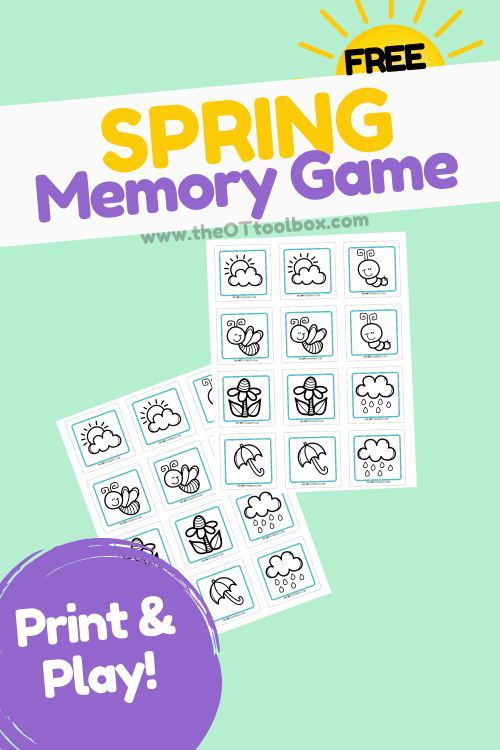
        Spring memory game

        Today, I’ve got a spring memory game that you can access for free. Fire up the printer because this printable game is a fun way to work on visual perceptual skills with kids. The bugs, butterflies, rain clouds, and other Spring images will keep the kiddos building visual memory, visual attention, and visual discrimination skills so they can learn and grow through play. And, check out our Spring visual perception activities for more fun.

        Spring memory game for kids is a free printable

        Benefits of playing Memory GameS

        Memory games are such a great way to help kids develop visual perceptual skills they use in reading, writing, and math. For another printable game, check out this Goodnight Moon memory game activity.

        Memory games boost skills in a lot of different ways:

        Visual discrimination- determining the difference between images uses visual discrimination skills. This translates to letter and number identification, reading sight words, and reading fluency and comprehension.

        Visual attention- Memory games require a lot of attention to keep those eyes on the game pieces. This ability to visually attend during game play then transfers over to attention during writing and reading tasks.

        Visual memory- a little different than actual memory of concepts and ideas, visual memory is the picture that the mind’s eye captures during situations or events. Visual memory allows us to file away information and recall it for future use, based on what we’ve seen. Visual memory plays a role in executive functioning skills and working memory.

        Executive functioning skills- speaking of executive functioning, visual skills have a large role in attention, focus, planning ahead, and other EF tasks. Read more about games to support and develop executive functioning skills, including the game of memory.

        Visual figure-ground– This visual perceptual skill allows us to pull out important information from a busy background. When playing memory, you need to see a specific image in a background of many other game cards. This skill can be developed in non-traditional game play. Turn all of the game cards over so the images are face up. Can you find the matches quickly when they are all showing? What if we turn on a timer? Can you beat the clock to find all of the matches? Visual figure ground skills play a role in reading fluency and comprehension.

        There are other skills that the game of memory develops as well: Skills like focus, attention, concentration, attention span, thinking skills, problem solving, self-confidence…these are just some of the ways that Memory assists with child development!

        Free Spring Memory Game

        In the printable, there are 12 different Spring images, so 24 total cards. You can adjust the number of cards to meet the needs of each child. Use it to play traditional memory, or adjust the activity with different memory and visual perception activities:

        • Play “what’s missing”
        • Match the cards on a dry erase board with a marker or string, like we did here.
        • Print them off, slide them into a page protector sheet and use them over and over again with a dry erase marker.
        • Work on pencil control and color in the images with colored pencils
        • Practice handwriting and write the names of the images.

        I’m adding this free printable to this week’s Spring occupational therapy activities. If you are looking for fun and easy ways to help kids develop skills in their therapy goals, or for ways to support child development in the home or classroom, be sure to check out the seasonal activity ideas.

        So? Want to print off this Spring game and add it to your therapy toolbox to help kids (and adults) play and build brain skills? Enter your email into the form below and you’ll receive the printable game pieces.

        The images on the Memory Game are similar and match a lot of the icons and graphics used in our NEW Spring Fine Motor Kit. Read more about this resource below.

        Free Spring Memory Game

          We respect your privacy. Unsubscribe at anytime.

          Spring Fine Motor Kit

          Score Fine Motor Tools and resources and help kids build the skills they need to thrive!

          Developing hand strength, dexterity, dexterity, precision skills, and eye-hand coordination skills that kids need for holding and writing with a pencil, coloring, and manipulating small objects in every day task doesn’t need to be difficult. The Spring Fine Motor Kit includes 100 pages of fine motor activities, worksheets, crafts, and more:

          Spring fine motor kit set of printable fine motor skills worksheets for kids.
          • Lacing cards
          • Sensory bin cards
          • Hole punch activities
          • Pencil control worksheets
          • Play dough mats
          • Write the Room cards
          • Modified paper
          • Sticker activities
          • MUCH MORE

          Click here to add this resource set to your therapy toolbox.

          Spring Fine Motor Kit
          Spring Fine Motor Kit: TONS of resources and tools to build stronger hands.

          Grab your copy of the Spring Fine Motor Kit and build coordination, strength, and endurance in fun and creative activities. Click here to add this resource set to your therapy toolbox.

          Colleen Beck, OTR/L has been an occupational therapist since 2000, working in school-based, hand therapy, outpatient peds, EI, and SNF. Colleen created The OT Toolbox to inspire therapists, teachers, and parents with easy and fun tools to help children thrive. Read her story about going from an OT making $3/hour (after paying for kids’ childcare) to a full-time OT resource creator for millions of readers. Want to collaborate? Send an email to contact@theottoolbox.com.

          Sensory Stations Free Spring Printables

          Sensory stations free printables

          This sensory stations printable set is a free resource that you can print off and hang up as an easy sensory path. You may have seen sensory walks in school hallways, or outdoor sensory walks on sidewalks. Sensory paths can even be done at home as a DIY sensory activity. The reason why we are seeing so many of these sensory strategies in place? They are a great way to get kids motivated and moving to incorporate the sensory input and motor planning that kids need.

          The Spring themed sensory paths in this blog post are just one of the popular seasonal sensory path printables you’ll find on this site. Try these other themed sensory walks: Winter Sensory Stations, Summer Sensory Stations, and Fall Sensory Stations.

          Free printable sensory stations for a sensory path with a Spring theme

          What is a Sensory Path

          First, let’s talk about what a sensory path is. You’ve probably seen the videos of kids completing motor activities in a hallway or even on a sidewalk. There are typically several sensory stations, or sensory and movement-based activities that kids can do as they move through the sensory walk.

          A sensory walk (or a sensory path) is a fun and engaging series of movements and activities designed to incorporate the senses and movements. They are designed to promote motor skills so kids get the sensory input they need in order to focus, pay attention, regulate their sensory systems so they can learn and function along with their peers. They are a fun and engaging way to incorporate sensory diet tasks into the school or home environment.

          When kids move through the colorful path, they are challenged to hop, jump, skip, tip toe, turn, spin, push, etc. All of these movements incorporate gross motor skills and sensory systems of vision, vestibular, and proprioceptive senses. You can read more here about heavy work of gross motor skills and sensory processing.

          What are Sensory Stations?

          In a sensory hallway or sensory pathway, there are typically “stations” or different movement activities that challenge different sets of muscles or actions. You might see a station where kids move through the letters of the alphabet as they hop along ABC images. You might see a sensory station that asks kids to tip toe along a spiral path, or complete wall push-ups. You may see a hopscotch board on the floor with numbers, letters, colors, or even sight words.

          Other sensory paths stations for deep breathing exercises, animal walks, or figure 8 visual motor activities.

          There are sensory pathways that incorporate different themes into the sensory stations. The sky is the limit when it comes to coming up with movement-based activities within a sensory walk.

          All of these sensory stations offer an opportunity for the child to engage the senses in a particular movement or activity.

          Free sensory stations printables

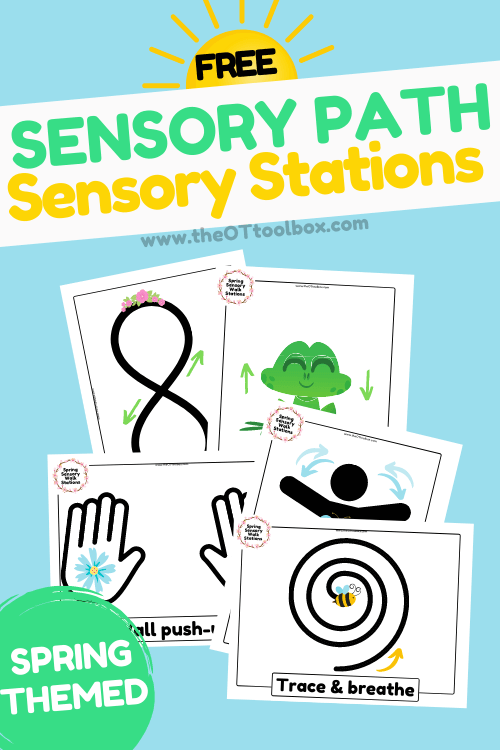
          Today, as part of our Spring Week, I have a free printable set of sensory stations for you. These are PDF sheets with several different sensory station activities. Print them off, hang them in a hallway, classroom, or in the home to engage vestibular, proprioceptive, and visual senses.

          The sensory stations included in this free resource include a figure 8 deep breathing activity. Kids can trace along the figure 8 as they take in deep breaths and then breathe them out.

          The next sensory activity in this DIY sensory path is a frog hop activity. Kids can hop like a frog and engage proprioceptive input as they hop up and down. The printable is open-ended so you can ask kids to complete as many from hops as you like.

          Next, you’ll find a wall push-up activity. Kids can complete wall push-ups against the hand visuals and engage heavy work input through their upper body as a calming motor activity.

          Then, there is a jumping jack activity that engages the vestibular sense and gets kids active, moving their whole body, and working on coordination, motor planning, and symmetrical and asymmetrical movements gross motor movements.

          Finally, the sensory path printables includes a spiral deep breathing activity with a buzzing bee. Kids can trace along the spiral and take deep breaths in and out. This calming activity can re-set kids and help with relaxation.

          All of these sensory station activities are open-ended so you can ask kids to say the ABCs or count as they complete the tasks. You can also rearrange the order of the sensory walk tasks or omit some of the activities is you like.

          Printable Sensory Stations

          Want to add these sensory path stations to your therapy toolbox? Enter your email into the form below and you’ll receive them in your inbox. Enjoy and happy sensory path planning!

          This handout is just one creative way to work on fine motor skills, precision, and dexterity this Spring? You’ll love these other free PDFs here on the website (all are available in our Member’s Club):

          Want to add this resource to your therapy toolbox so you can help kids thrive? Enter your email into the form below to access this printable tool.

          This resource is just one of the many tools available in The OT Toolbox Member’s Club. Each month, members get instant access to downloadable activities, handouts, worksheets, and printable tools to support development. Members can log into their dashboard and access all of our free downloads in one place. Plus, you’ll find exclusive materials and premium level materials.

          Level 1 members gain instant access to all of the downloads available on the site, without enter your email each time PLUS exclusive new resources each month.

          Level 2 members get access to all of our downloads, exclusive new resources each month, PLUS additional, premium content each month: therapy kits, screening tools, games, therapy packets, and much more. AND, level 2 members get ad-free content across the entire OT Toolbox website.

          Join the Member’s Club today!

          FREE Printable Sensory Stations for a Sensory Path

            We respect your privacy. Unsubscribe at anytime.

            Spring Fine Motor Kit

            Score Fine Motor Tools and resources and help kids build the skills they need to thrive!

            Developing hand strength, dexterity, dexterity, precision skills, and eye-hand coordination skills that kids need for holding and writing with a pencil, coloring, and manipulating small objects in every day task doesn’t need to be difficult. The Spring Fine Motor Kit includes 100 pages of fine motor activities, worksheets, crafts, and more:

            Spring fine motor kit set of printable fine motor skills worksheets for kids.
            • Lacing cards
            • Sensory bin cards
            • Hole punch activities
            • Pencil control worksheets
            • Play dough mats
            • Write the Room cards
            • Modified paper
            • Sticker activities
            • MUCH MORE

            Click here to add this resource set to your therapy toolbox.

            Spring Fine Motor Kit
            Spring Fine Motor Kit: TONS of resources and tools to build stronger hands.

            Grab your copy of the Spring Fine Motor Kit and build coordination, strength, and endurance in fun and creative activities. Click here to add this resource set to your therapy toolbox.

            Add these other Spring printables to your toolbox this time of year:

            This handout is just one creative way to work on fine motor skills, precision, and dexterity this Spring? You’ll love these other free PDFs here on the website (all are available in our Member’s Club):

            Spring Sensory Stations– These printable sensory stations are great for building a sensory walk anywhere: Print off these sensory station sheets and hang them in hallways, in a classroom, or even in the home.

            Spring Worksheets for Handwriting and Fine Motor Skills– Therapists love this resource because it includes a fine motor and visual motor warm-up that can be integrated right into the handwriting activity, using a fun theme.

            Spring Cootie Catcher– This printable resource is a fine motor, handwriting, and eye-hand coordination activity as well as bilateral coordination, and motor planning skill work.

            Cute Bugs Visual Closure Worksheets– These visual perceptual skills worksheets are perfect for Spring, and they are included in our free huge visual perception worksheet packet.

            Colleen Beck, OTR/L has been an occupational therapist since 2000, working in school-based, hand therapy, outpatient peds, EI, and SNF. Colleen created The OT Toolbox to inspire therapists, teachers, and parents with easy and fun tools to help children thrive. Read her story about going from an OT making $3/hour (after paying for kids’ childcare) to a full-time OT resource creator for millions of readers. Want to collaborate? Send an email to contact@theottoolbox.com.

            Free Heavy Work Activities Cards

            Heavy work activity cards Spring themed gross motor tasks

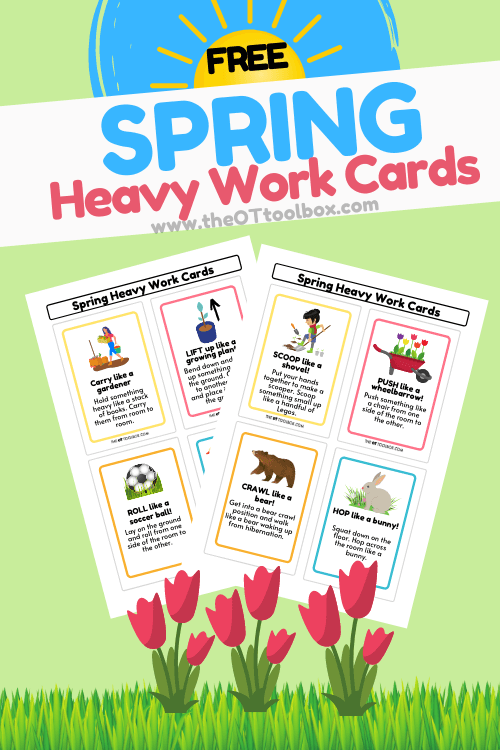
            Today’s free resource in the Spring Week tools are these free Heavy Work activities in printable card version, with a Spring theme! These are just the thing to get kids moving and adding much-needed gross motor movement into the classroom, home, or occupational therapy session. I modeled these printable exercise cards off our heavy work teletherapy activities freebie, so these are the perfect addition to your therapy toolbox.

            Heavy work activities with a Spring theme to add gross motor exercise and brain breaks as well as sensory processing input.

            Heavy Work Activities

            Heavy work activities help kids to incorporate balance, endurance, and motor planning into functional activities. By integrating the proprioceptive sense and vestibular sense, or balance, equilibrium, position in space, and movement, kids are able to better move their body with awareness of how their body moves. This body awareness is needed for most every activity.

            Adding resistance, or heavy work activates the muscles and joints in the body and “wakes them up”. Proprioception and calming vestibular work can have an organizing effect on kids. This enables a ready state for completing tasks.

            Getting kids to incorporate the whole-body movements that they need to regulate and develop strong, healthy bodies isn’t always easier, now more than ever. That’s where the Spring Gross Motor activities come into play. These are whole body activity, Spring-themed activities that make fun brain breaks.

            Functional Heavy Work

            Many heavy work activities can be incorporated right into the daily tasks. Things like pushing a vacuum, moving furniture, carrying a laundry basket are day-to-day chores that add a ton of heavy work input.

            Other heavy work tasks can integrate these senses as well.

            Tasks like using a moldable eraser, coloring with crayons vs. markers, or pulling on socks offer heavy work just as well, on a smaller scale.

            These are all strategies that play into a sensory lifestyle, or a sensory diet that is well ingrained into the day-to-day tasks. You can learn more about creating a sensory lifestyle into every day activities in my book, The Sensory Lifestyle Handbook.

            Heavy Work and Gross Motor Skills

            There’s more about heavy work than just sensory processing benefits.

            Heavy work tasks improve balance, core strength, motor planning, equilibrium needed for movement changes, stability, coordination, and movement patterns. All of these skills require equilibrium of the vestibular system for movement and changes in planes. They also require position in space changes. Heavy work has so many benefits!

            There’s more: Heavy work input also incorporates areas such as range of motion, flexibility, motor planning, crossing midline, muscle tone, and core stability.

            Free Heavy Work Activity Cards

            Would you like to get your hands on a set of free heavy work printable activities? This is a free resource that you can print off and use in therapy sessions, in home programs, as classroom brain breaks, and to just get those kids moving.

            To grab this free resource, enter your email address into the form below.

            FREE Spring Heavy Work Cards

              We respect your privacy. Unsubscribe at anytime.

              More heavy work brain breaks and Spring activities

              You can find more Spring brain breaks and heavy work activities in the Spring Occupational Therapy Activities Pack. Right now, it’s a BONUS add-on to our newly released Spring Fine Motor Kit!

              Spring Fine Motor Kit

              Score Fine Motor Tools and resources and help kids build the skills they need to thrive!

              Developing hand strength, dexterity, dexterity, precision skills, and eye-hand coordination skills that kids need for holding and writing with a pencil, coloring, and manipulating small objects in every day task doesn’t need to be difficult. The Spring Fine Motor Kit includes 100 pages of fine motor activities, worksheets, crafts, and more:

              Spring fine motor kit set of printable fine motor skills worksheets for kids.
              • Lacing cards
              • Sensory bin cards
              • Hole punch activities
              • Pencil control worksheets
              • Play dough mats
              • Write the Room cards
              • Modified paper
              • Sticker activities
              • MUCH MORE

              Click here to add this resource set to your therapy toolbox.

              Spring Fine Motor Kit
              Spring Fine Motor Kit: TONS of resources and tools to build stronger hands.

              Grab your copy of the Spring Fine Motor Kit and build coordination, strength, and endurance in fun and creative activities. Click here to add this resource set to your therapy toolbox.

              Colleen Beck, OTR/L has been an occupational therapist since 2000, working in school-based, hand therapy, outpatient peds, EI, and SNF. Colleen created The OT Toolbox to inspire therapists, teachers, and parents with easy and fun tools to help children thrive. Read her story about going from an OT making $3/hour (after paying for kids’ childcare) to a full-time OT resource creator for millions of readers. Want to collaborate? Send an email to contact@theottoolbox.com.