Visual Perception Info

Great! Thanks for grabbing the packet of Visual Perception Worksheets. 

Free visual perception packet and information
 

Check your email inbox to access your file. Don’t see it? Don’t fret! Check your spam folder or “other” file such as “promotions” in Gmail. Some users (especially those using an email system hosted by a school system, clinic, health system, etc.) may have this email blocked as a security measure. Send me an email at contact@www.theottoolbox.com and I will send you the file as an attachment. 

How to use your visual perception worksheets:

Use them to work on various visual perceptual skills in a variety of ways. Try using various tools to connect the items on the worksheets, such as string, marker, finger paints, Wikki Stix, etc. The options are endless.

Print them off, slide them into a page protector sheet and use them over and over again with a dry erase marker.

Work on pencil control with some of the pages by having students trace the lines to connect matching items or make matches.

MORE VIsion and Motor Activities

Try these activiteis and resources to build your therapy toolbox:

Visual efficiency and motor skills

Development of eye-hand coordination

Vision activities for kids

Activities to improve smooth pursuits

Vision accommodations and activities

Visual attention

AND…I promised you big news on a visual processing resource. Here it is!

For more info and fun activities geared toward all things vision, check out the Visual Processing Lab! Yep, a lab! This is an interactive lab activity that will be email based and delivered right to your inbox. This is a short series of emails (4-5 days) that covers everything you need to know about visual processing, detailed information on various aspects of visual processing, and strategies that work.       

Get ready to learn all the ins and outs of visual processing, and gain strategies, activities, worksheets, screening items, and so much more. This resource is huge!   

Come to this page by accident? Want to get in on the visual perception fun?

Get your copy of the free visual perception worksheets HERE.

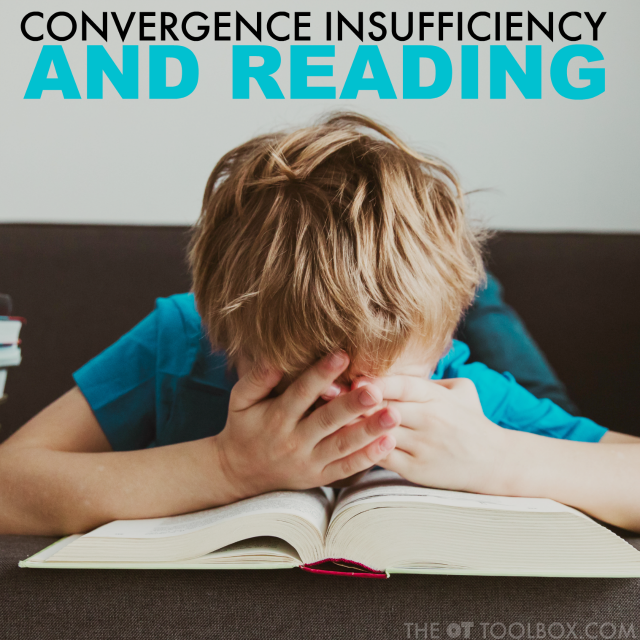
How Convergence Insufficiency Impacts Reading

This article describes how convergence insufficiency impacts reading. Have you ever stopped to wonder exactly how does convergence insufficiency impact reading? There are many ways that visual skills affect reading and learning in general. This article discusses areas like vision relates to decoding skills, reading comprehension, and visual attention in reading.

Convergence insufficiency impacts reading that interferes with reading comprehension, reading decoding skills, reading fluency, and other areas that impacts how a child reads.


How Convergence Insufficiency Impacts Reading

Reading. It’s one of the primary tasks school aged children complete EVERY DAY. We all know that child who hates reading, says it’s hard and avoids it all possible costs. We also have met the child who loves to read, but has poor comprehension and can’t tell you what they just read. Both of these kids may be experiencing difficulties with convergence insufficiency.


Here are some classroom accommodations that can help address visual problems in the classroom.

What is a Convergence Insufficiency?


Convergence Insufficiency is when a child’s eyes are unable to converge inside the midline, or are unable to maintain a position of convergence for an extended period of time. This can be due to eye muscle imbalances and weakness, weak supporting muscles in the neck and core, or neurological concerns.


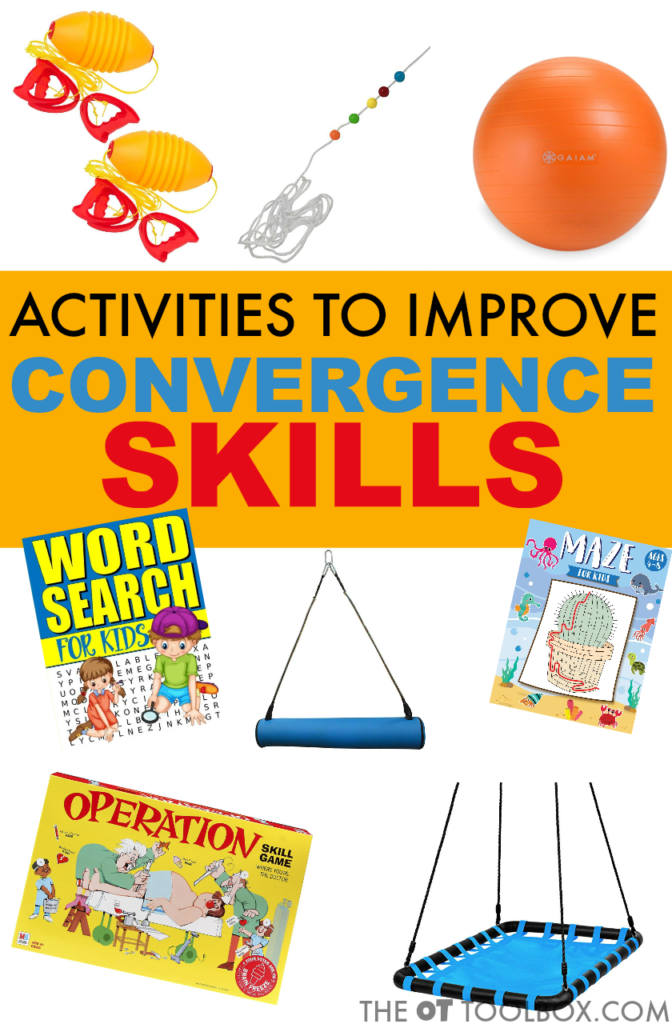
Here are activities to improve convergence insufficiency.

Convergence Insufficiency, Blurry Vision and Reading


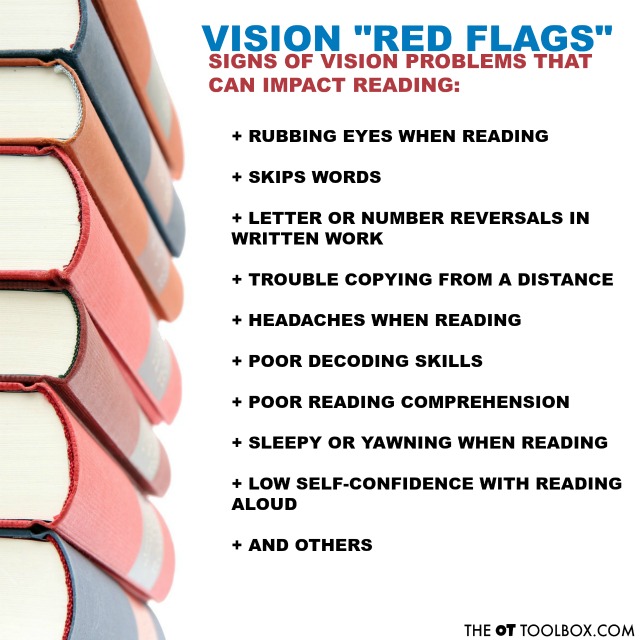
Avoidance of reading tasks is often a sign of an underlying vision deficit, with convergence insufficiency at the top of the list. Kids who avoid reading recognize the task is hard for them, but may be unable to tell you why.  Some red flags that a convergence insufficiency is affecting reading skills may include avoidance of reading tasks, poor comprehension of what has been read, sleepiness, headaches, blurred vision, poor recall of familiar words and letters, and poor decoding skills.


Most kids don’t know what they should be seeing, or that they are seeing differently than everyone else, as they don’t know it any other way. To add to the vision deficit, description words of what they are seeing such as “blurry” or “fuzzy” are abstract concepts for kids to understand. Especially, if they have only ever seen “fuzzy” or “blurry” letters and items.


Convergence Insufficiency Results in Poor Decoding Skills

Convergence insufficiency impacts reading that interferes with reading comprehension, reading decoding skills, reading fluency, and other areas that impacts how a child reads.

These patterns of “fuzzy” or “blurry” letters may result in difficulties with recognizing familiar words, letters and phrases, or being unable to decode the words on the page. Even when you know that they know the word or letter, and that is has been drilled frequently and consistently over time.


Unfortunately, despite drilled letters and sight words, if the child is not seeing them correctly, or consistently each time, their abilities to recognize them in various fonts, sizes and presentations significantly decrease. This further adds to a child’s resistance or avoidance of reading tasks. They are aware they should know the letters or site words, but are unable to recall them due to poor vision.


These difficulties can lead to overall low self-esteem with reading tasks and avoidance as a way to prevent further damage to their self-esteem.


Here is a screening tool to address visual processing needs related to handwriting.

Poor Reading Comprehension Due to Convergence Insufficiency


Convergence insufficiency symptoms are sometimes inconsistent may vary throughout the day and be exacerbated by overall general fatigue. Symptoms may result in headaches, blurry vision or strain of the eye muscles.  Inconsistency of symptoms is typically due to lack of strength in the eye muscles and like other muscle groups, performance is significantly impaired when fatigue sets in.


These patterns of inconsistency significantly affects a child’s abilities to recognize letters, words and phrases in a variety of fonts, sizes, spacing and process visual information on a page.  As fatigue increases, symptoms such as “blurriness”, “fuzziness”,  letters moving on the page or poor overall focus increase also, resulting in poor overall comprehension.


Children with poor comprehension typically enjoy reading, but because of the convergence insufficiency, may not get the most out of their reading experience.


Related Read: This is an insightful article on visual saccades and learning

Convergence Insufficiencies Can Present as Sleepiness While Reading


Yawning, rubbing of the eyes, and nodding off when reading can be the result of a convergence insufficiency. The sleepiness the child may be experiencing is due to the high level of concentration and muscle strength of the eyes that is required to read for extended periods of times.


When sleepiness occurs during reading tasks, the child may not be able to make it through age appropriate content for class-work and homework. This results in poor comprehension as the child typically attempts to compensate with speed reading, skipping key words, partially reading the content or dozing off throughout the reading task resulting in missing sections of the work.


Here is more information on visual processing and visual efficiency in reading and learning.

 A Final Note on Convergence Insufficiency and Reading


Whether the child is avoiding reading tasks, falls asleep when reading or has poor comprehension, it can be a sign of an underlying convergence insufficiency. Due to convergence insufficiencies inconsistent patterns and various presentations, it is imperative that these patterns are monitored closely by therapists and educators, and that referrals are made to developmental optometrists if a vision concern is suspected.

Reading problems can be a result of visual skills such as convergence insufficiency.

More visual processing activities

For even MORE information on oculomotor skills like convergence and divergence, to use in your occupational therapy practice, you will want to join our free visual processing lab email series. It’s a 3-day series of emails that covers EVERYthing about visual processing. We take a closer look at visual skills and break things down, as well as covering the big picture of visual needs.

In the visual processing lab, you will discover how oculomotor skills like smooth pursuits make a big difference in higher level skills like learning and executive function. The best thing about this lab (besides all of the awesome info) is that it has a fun “lab” theme. I might have had too much fun with this one 🙂

Join us in visual processing Lab! Where you won’t need Bunsen burners or safety goggles!

Click here to learn more about Visual Processing Lab and to sign up.

Free visual processing email lab to learn about visual skills needed in learning and reading.


Screening for Convergence Insufficiency


Looking for more information on vision? Check out my OT Vision Screening Packet for helpful handouts and a screening tool.


This visual screening tool was created by an occupational therapist and provides information on visual terms, frequently asked questions regarding visual problems, a variety of visual screening techniques, and other tools that therapists will find valuable in visual screenings. 

 
This is a digital file. Upon purchase, you will be able to access the 10 page file and print off to use over and over again in vision screenings and in educating therapists, teachers, parents, and other child advocates or caregivers.
A little about Kaylee: 
Hi Everyone! I am originally from Upstate N.Y., but now live in Texas, and am the Lead OTR in a pediatric clinic. I have a bachelors in Health Science from Syracuse University at Utica College, and a Masters in Occupational Therapy from Utica College. I have been working with children with special needs for 8 years, and practicing occupational therapy for 4 years. I practice primarily in a private clinic, but have experience with Medicaid and home health settings also. Feeding is a skill that I learned by default in my current position and have come to love and be knowledgeable in. Visual development and motor integration is another area of practice that I frequently address and see with my current population. Looking forward to sharing my knowledge with you all! ~Kaylee Goodrich, OTR

Looking for more information on visual convergence?

Click on the links below to read more about visual processing and convergence insufficiency:
   
  
Convergence insufficiency impacts reading that interferes with reading comprehension, reading decoding skills, reading fluency, and other areas that impacts how a child reads.

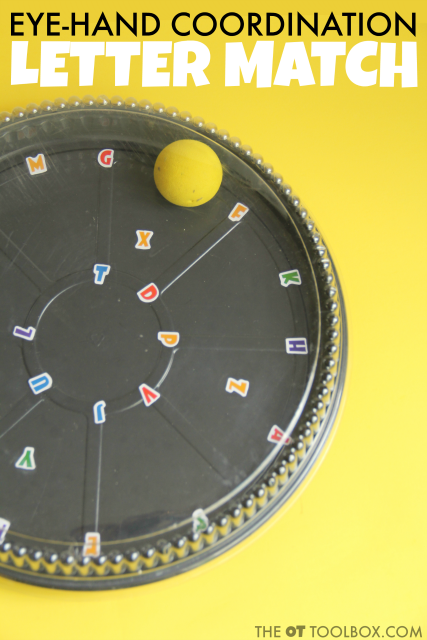
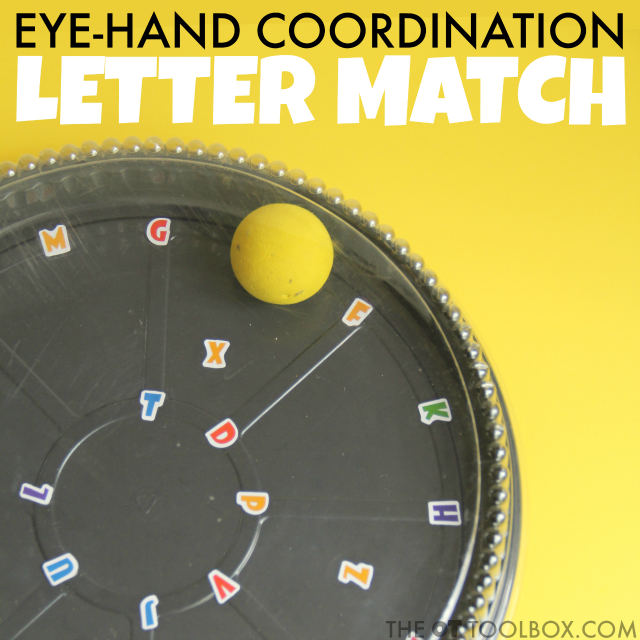
Eye-Hand Coordination Letter Match Activity

This hand-eye coordination activity is one that uses an item we had in the house (and you may too!) We love to use recycled and upcycled materials in occupational therapy activities and this eye hand coordination activity is no different! Working on the coordination skills needed for tasks like handwriting, self-dressing, managing clothing fasteners, and other skills. 
 
This hand-eye coordination activity doubles as a learning activity while matching letters and working on visual motor skills needed for tasks like handwriting, management of fasteners, coordination, and many functional tasks. Looking for more eye-hand coordination activities? 
 
For younger kids, this hand eye coordination activities for toddlers is a great resource, because skills like coloring or picking out a crayon from the crayon box is just one way to help them with color recognition and functional eye hand coordination skills.

Hand-Eye Coordination

This hand-eye-coordination activity is one that kids can use to work on the hand-eye coordination skills needed for motor planning, fine motor skills, and functional tasks like handwriting and other fine motor tasks.

 
First, let’s define hand-eye coordination. Coordination between the visual input our eyes perceive and process and the coordinated motor movements are an integration of the visual and motor systems. This is eye-hand coordination as it is used in functional tasks. Eye hand coordination is necessary for every functional skill. 

Hand-eye coordination activity

Amazon affiliate links are included below. 
 
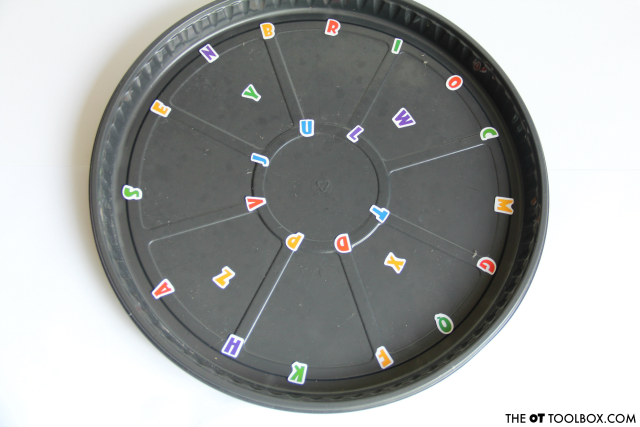
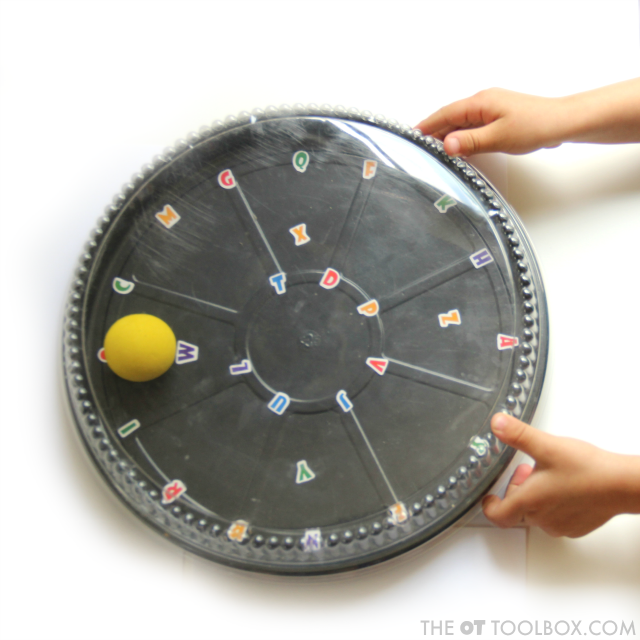
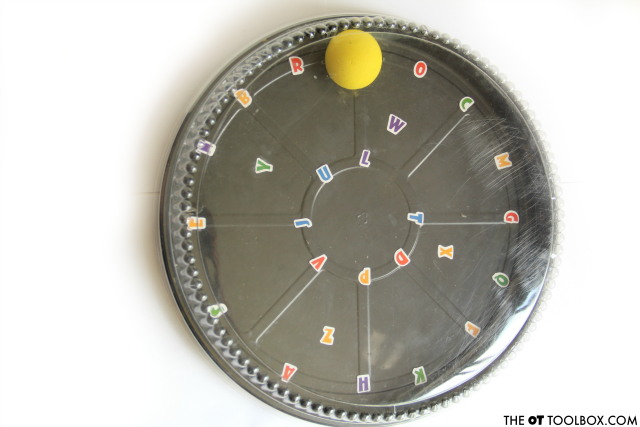
This activity used a recycled cookie cake pan that we washed out and used in a bilateral coordination eye-hand coordination activity. Besides the cake pan (save that lid, too!), we used just two other items:
 
Small foam ball (A sports ball works great, but a ping pong ball would work for this activity too.)
 
Can’t find a pan like we used? A disposable container with a clear lid (like this one) would work too!
 
Related: Need some indoor bilateral coordination activities like this one? Try our list of Winter Bilateral Coordination Activities that kids will love!
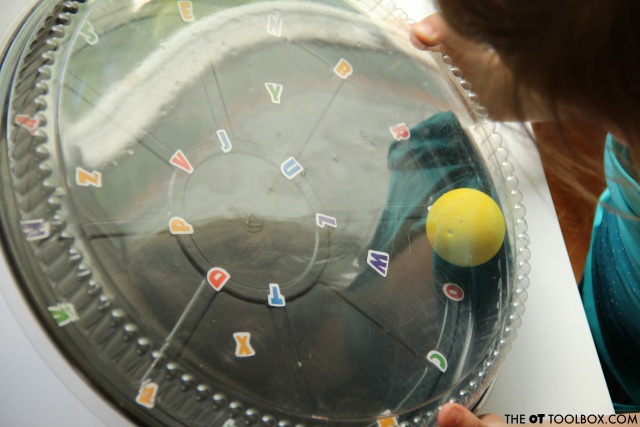
Use a disposable cake pan to work on hand-eye coordination in occupational therapy activities to work on visual motor skills, bilateral coordination, visual skills and so many other areas of child development.

How to set up the hand-eye coordination activity:

1. Peel the stickers from the sticker sheet and randomly place them around the cake pan. 
 
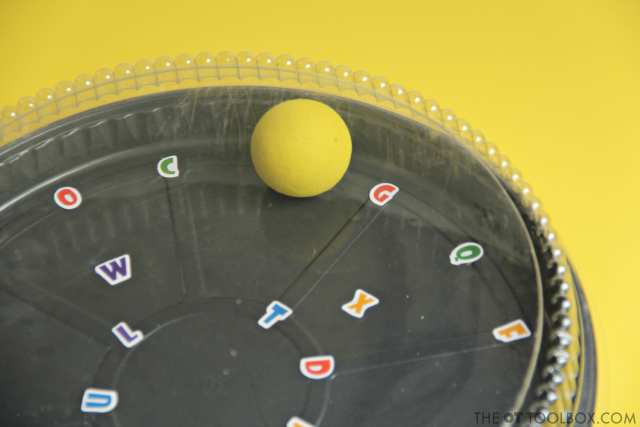
2. Place the foam ball in the cake pan and pop the lid into place. 
 
That’s it! This is a super quick set-up and an activity that can be used by so many clients or students to work on a variety of areas.
Kids can use a recycled cake pan to work on hand-eye coordination and visual motor skills needed for reading, writing, and many other functional skills in occupational therapy activities.
Kids can use this eye-hand coordination activity to work on fine motor skills, visual motor skills, bilateral coordination and other areas in occupational therapy to work on tasks like handwriting, reading, writing, and so many other areas.

Hand-Eye Coordination Activity with Letters

Ask students to roll the ball from letter to letter as they look for specific letters. 
 
Roll the ball to letters in alphabetical order or ask he child to spell out spelling words. 
 
Older students can spell words in sentences. 
 
Call out random letters as students roll the ball as they visually can for each letter.
 
Roll the ball from one letter to another to match letters.
 
Incorporate handwriting by asking the child to roll the ball for 4 seconds. When a timer goes off, they child can write a list of words starting with that letter.
This ball and letter activity helps kids develop hand-eye coordination needed for tasks like handwriting, reading and other occupational therapy activities.


Hand-Eye Coordination Activity for Kids

This eye hand coordination activity addresses so many other areas as well:
Gross motor skills
Form constancy
Visual discrimination
 
Looking to work on the visual skills that play into motor output, motor planning, and eye-hand coordination activities? Our Visual Screening Tool may help.
A simple occupational therapy activity uses just a ball and letter activities to work on hand-eye coordination and the visual motor skills needed for reading, writing, math, functional skills and so many other areas.

More on eye-hand coordination skills:

For even MORE information on eye-hand coordination and the visual skills needed to complete visual motor and eye-hand coordination, or to better understand visual processing, you will want to join our free visual processing lab email series. It’s a 3-day series of emails that covers EVERYthing about visual processing. We take a closer look at visual skills and break things down, as well as covering the big picture of visual needs.

In the visual processing lab, you will discover how oculomotor skills like smooth pursuits make a big difference in higher level skills like learning and executive function. The best thing about this lab (besides all of the awesome info) is that it has a fun “lab” theme. I might have had too much fun with this one 🙂

Join us in visual processing Lab! Where you won’t need Bunsen burners or safety goggles!

Click here to learn more about Visual Processing Lab and to sign up.
Free visual processing email lab to learn about visual skills needed in learning and reading.
 
 
If you are unsure when to refer or having a hard time getting a parent on board, check out my ​OT Vision Screening Packet ​for more information. It contains a screener for therapists and useful handouts for parents on why addressing vision is important to their child’s success.

 
This is a digital file. Upon purchase, you will be able to access the 10 page file and print off to use over and over again in vision screenings and in educating therapists, teachers, parents, and other child advocates or caregivers.
 
Use a visual screening tool like this occupational therapy screening tool to address visual processing skills like visual convergence and to guide visual convergence activities in therapy.
A hand-eye coordination activity for kids that helps with visual skills like convergence, visual tracking, visual scanning, and motor components like bilateral coordination, precision, and motor planning needed for the eye-hand coordination that are worked on in occupational therapy activities.

How Vision Problems Affect Learning

vision and learning problems

Did you know that vision and learning are closely related? It’s true! Vision problems impact learning in a big way. Here, you’ll discover how vision problems impact learning for children. With a new school year, it’s time to start thinking about kindergarten screenings, screenings for vision problems, and wondering how previously struggling kids will do in the next academic year. One of the largest challenges facing some of these kids may be unidentified vision problems. Read more to learn about how vision problems affect learning.

Typical vision screenings given by the pediatrician or school nurse test for acuity only. They do not look for any other underlying vision problems that a child may be experiencing that is hindering their overall development in reading and writing.

You’ll also want to check out these specific scanning activities for reading.

There are many ways that vision problems affect learning in kids.

What You Need to Know About Vision Problems and Learning

There are many causes of learning difficulties that a child may present with. However, the following list of difficulties may indicate underlying vision problems and the need for a more in-depth vision screening.

Learning Difficulties Implying Underlying Vision Problems

* Reversals
* Difficulty with handwriting
* Poor reading comprehension
* Difficulty copying from the board
* Difficulty transferring information from one page to the next
* Frequent falls or walking into things
* Difficulty spelling
* Difficulty with letter and number recognition


Vision is More the 20/20 

Vision is more than 20/20 acuity. It is the ability to move your eyes with smooth, coordinated and controlled movements. These movements can be broken down into tracking (pursuits), depth perception, teaming, saccades, convergence/divergence and nystagmus. When these skills are impaired, learning difficulties will arise.

Here is more detailed and specific information related to saccades and their impact on learning.

Common Vision Problems that Impact Learning

These visual processing skills are essential to learning:

TrackingVisual Tracking is the ability smoothly follow an item with your eyes while in a stabilized position. A child with tracking difficulties may be unable to dissociate their eye movement from their head, be unable to maintain visual focus on the target, or “skip” or “jump” when crossing midline. These patterns indicate difficulties with tracking that may hinder the development of reading skills. Read more about visual tracking here.

Teaming– Teaming or binocular vision, refers to the ability to move both eyes in a controlled, coordinated fashion. Children with teaming difficulties also frequently have trouble with reading, along with letter and number recognition. This vision difficulty can be hard to see during a screening, as it is related to an eye muscle imbalance that may be slight, or due to fatigue during longer activities. However, teaming difficulties should be considered if the child is having tracking difficulties, as tracking and teaming skills play into one another.

Depth Perception– Depth perception helps us to know where we are in relation to items in the world utilizing our visual system. Children with depth perception difficulties frequently fall, have difficulties with catching a ball (early closure of hands, or fail to catch at all), poor righting reactions and reflexes and frequent tendencies to readjust their bodies in relation to their work space.
Saccades Saccades is the ability to quickly look between a set of objects without losing focus. For children with difficulties with saccadic movements reading is a significant challenge. They frequently lose their place, are unable, to keep up or experience eye muscle fatigue and headaches.

Convergence/Divergence- Convergence is the ability to track an object from a distance into near point range with smooth movements. Divergence, is the opposite. It is the ability to track an object smoothly from near to far. Deficits in these skills often lead to difficulties with near and far point copying tasks. The child may skip lines, letters or even whole words with deficits in this area.

Nystagmus- Nystagmus is a visual response to circular vestibular input. After being spun, one’s eyes should oscillate before returning to a normal resting position. When a child does not have a nystagmus response, it can be an indicator of a vestibular deficit. However, in this post, if a nystagmus pattern is noted at rest without input, is abnormal and results in lowered overall vision.

Related Read: Need help addressing visual problems in the classroom? Here are classroom accommodations for visual impairments

Screening for Visual Problems

Screening for vision problems is an integral part to addressing visual motor integration concerns for school aged children. A simple screen during an OT evaluation can help make the difference in success or continued struggles with development, reading and writing.

What to Look for In Vision Screenings

A variety of simple tools can be utilized to complete screenings.

These tools include 2 pens or pencils with a fun end such as a character or cool eraser, H and X patterns, and ZigZag Patterns. H and X patterns look at tracking, while the ZigZag pattern looks at saccades, convergence/divergence.

The ZigZag Pattern is a series of movements that are not ZigZags, but were designed to be a fun way to explain to kids what you want them to do. Especially, as these movements are often difficult for them to complete resulting in frustration and non-compliance at times.

Screening for Visual Tracking

H and X Patterns When screening for tracking I tell the child that we are going to make H’s and X’s with our eyes only. It’s a fun way to engage the kiddo in a task that may seem challenging to them.

Have the child follow the tip of a pen or pencil approximately 12 inches from the face in an H and X pattern moving slowly. You are looking for smooth, controlled movements. Note any abnormal movements such as jumping, skipping or ticks. If the child is having a difficult time with following directions, complete the H and X patterns several times to get the best picture of the child’s skills.

Don’t forget to note if the child was unable to move his eyes in dissociation from his head/ body. This is a tell tale sign of a vision deficit.

Screening for Visual Saccades

“Zig” Pattern The “Zig” portion of the pattern assess saccadic movements. Hold 2 pens/pencils approximately 12 inches from the face, and 6 inches apart. Ask the child to look between the two items as fast as they can.

A child with difficulties with this skills will demonstrate slow, uncoordinated movements, attempt to move their head or say that they can’t do it.

Screening for Convergence Insufficiency or Divergence

Convergence/Divergence: “Zag” Pattern: The “Zag” portion of the pattern assesses convergence/divergence. Have the child watch the end of the pen/pencil all the way into their nose, and back out again.

Children with difficulties with convergence typically are unable to make their eyes move in towards their nose, or demonstrate jumping or extropic movement of one eye. The child may also be unable to remain in convergence for more than a few milliseconds before returning to a neutral position.

Difficulties with divergence are a little more difficult to spot. The child will typically have difficulty coming out of convergence with smooth movements, or may demonstrate one eye remaining in convergence before moving into a divergence pattern. The transition may also be uncoordinated and lack fluidity.

Learning Difficulties can Imply Underlying Vision Problems. Here are common vision problems that can affect learning in kids.

What if you suspect vision problems?

Now what?  When vision problems are suspected after a screening by the OT, it is best practice to refer the family to a developmental optometrist.

A developmental optometrist will complete a full evaluation and determine the need for corrective lenses, vision therapy or a home program to address vision concerns.

As occupational therapists, it is imperative that we rule out vision problems before treating handwriting or delays in visual motor integration, to ensure the best possible trajectory of development and success for the child.

Occupational Therapy Vision Screening Tool

Occupational Therapists screen for visual problems in order to determine how they may impact functional tasks. Visual screening can occur in the classroom setting, in inpatient settings, in outpatient therapy, and in early intervention or home care.
This visual screening tool was created by an occupational therapist and provides information on visual terms, frequently asked questions regarding visual problems, a variety of visual screening techniques, and other tools that therapists will find valuable in visual screenings.
This is a digital file. Upon purchase, you will be able to access the 10 page file and print off to use over and over again in vision screenings and in educating therapists, teachers, parents, and other child advocates or caregivers.

Looking for more information on visual problems and learning? Try these resources:

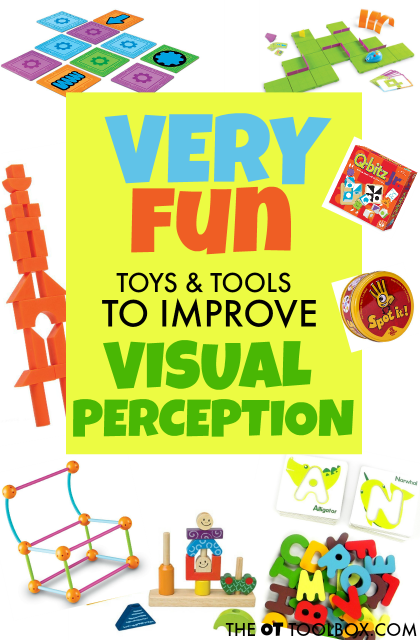
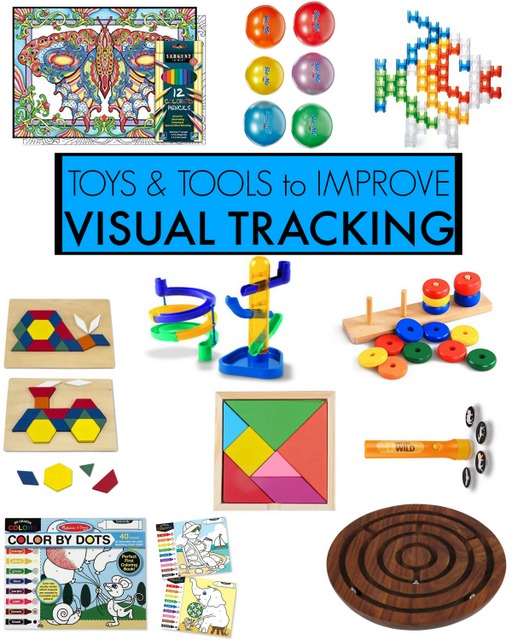
Try these toys to improve visual problems, tools for visual perception and other visual problems in kids.Read more about visual problems in kids and visual perceptual skills kids need for learning.
 
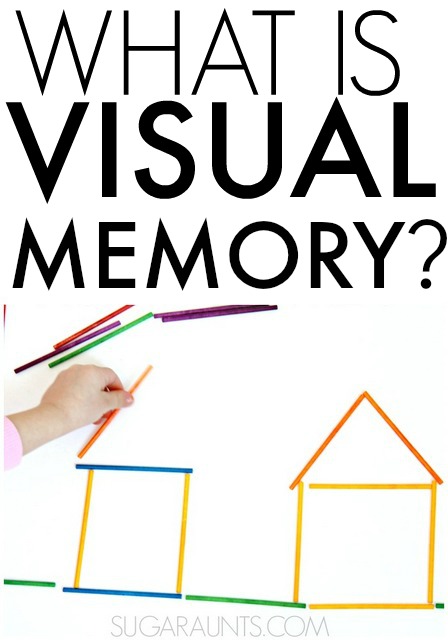
What is visual memory and how does problems with visual memory impact learning as a vision problem?What is visual tracking and how does visual tracking problems impact vision problems and learning?
A little about Kaylee: 
Hi Everyone! I am originally from Upstate N.Y., but now live in Texas, and am the Lead OTR in a pediatric clinic. I have a bachelors in Health Science from Syracuse University at Utica College, and a Masters in Occupational Therapy from Utica College. I have been working with children with special needs for 8 years, and practicing occupational therapy for 4 years. I practice primarily in a private clinic, but have experience with Medicaid and home health settings also. Feeding is a skill that I learned by default in my current position and have come to love and be knowledgeable in. Visual development and motor integration is another area of practice that I frequently address and see with my current population. Looking forward to sharing my knowledge with you all! ~Kaylee Goodrich, OTR

How do vision problems affect learning in kids and underlying visual processing problems that impact learning in kids.

What is Visual Tracking?

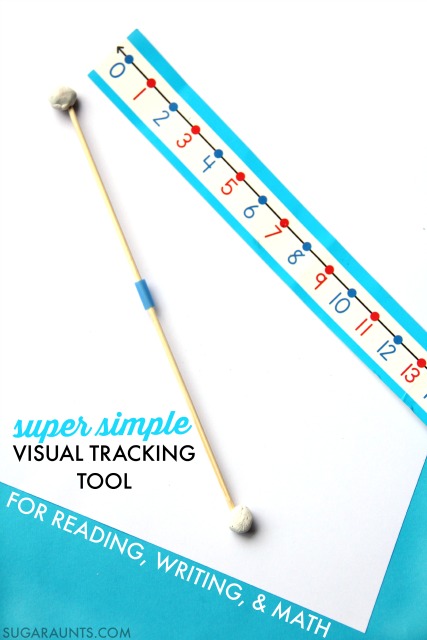
Visual problems can surface in many ways. Visual processing challenges present as difficulty in reading, handwriting, sports, navigating a hallway, or many other areas. Sometimes, the issue is a result of visual tracking challenges. Read on to find out exactly what is visual tracking and what an eye tracking problem looks like in kids, including common visual tracking difficulties that present in the classroom or during academic work. We’ve shared a few visual tracking tips and soon on the site, we’ll share a collection of visual tracking activities, too.

Wondering about visual tracking? This article explains what is visual tracking and what visual tracking difficulties look like, along with visual tracking problem areas and visual tracking red flags that can be used by occupational therapists to help kids having trouble with visual processing.

What is Visual Tracking?

You’ve probably seen it before: The child who struggles with letter reversals..the child who has challenges in navigating obstacles when playing…the child who labors with reading and commonly skips words or lines of words when reading.

These are all signs of a visual tracking problem. There are many more, in fact. The thing is, visual tracking is a part of almost everything we do!

Before we talk more about what visual tracking looks like and other common signs of visual tracking problems, let’s discuss what exactly visual tracking is.

Definition of Visual Tracking

Visual tracking is a visual processing skill that occurs when the eyes focus on an object as it moves across the field of vision. Visual tracking occurs with movement of the eyes to follow a moving object and not movement of the head. The eyes have the ability to track an object in the vertical and horizontal, diagonal, and circular planes. There should also be an ability to track across the midline of the eyes and with smooth pursuit of the object. Visual tracking requires several skills in order to efficiently occur. These include oculomotor control abilities, including visual fixation, saccadic eye movement, smooth pursuit eye movements, along with convergence, and visual spatial attention.

Here is more detailed information on saccades and their impact on learning.

Components of Visual Tracking

These are the visual processing skills that need to occur in conjunction with visual tracking. They are necessary to enable visual tracking in functional tasks.
Visual Fixation- The ability to visually attend to a target or object. Visual fixation occurs while maintaining focus on the object and typically occurs at a variety of distances and locations within the visual field. This is a skill that typically develops at about 4 weeks of age.
Saccadic Eye Movement- These eye movements are those that occur very rapidly and allow us to smoothly shift vision between two objects without turning or moving the heads. Saccadic eye movement, or visual scanning is necessary for reading a sentence or paragraph as the eyes follow the line of words. This skill also allows us to rapidly shift vision between two objects without overshooting. In copying written work, this skill is very necessary.
Smooth Pursuit Eye Movement- This ability allows us to steadily follow an object as it is visually tracked. When a smooth pursuit of eye movements occurs, the eyes do not lose track of the object, and occur without jerky movements or excessive head movements. Visual scanning occurs in vertical, horizontal, diagonal, and circular movements.
Convergence- This ability is the simultaneous shift of both eyes together in an adducted position toward an object. The eyes work together to shift inward toward a target object, with single vision occurring with fixation on the object. Convergence is needed to focus on an object with both eyes together.
Visual Spatial Attention- This skill includes awareness and attention in the body and the environment and allows us to attend to all visual fields. When visual spatial inattention occurs, visual neglect can occur.

Occupational Therapy Vision Screening Tool

Occupational Therapists screen for visual problems in order to determine how they may impact functional tasks. Visual screening can occur in the classroom setting, in inpatient settings, in outpatient therapy, and in early intervention or home care.
This visual screening tool was created by an occupational therapist and provides information on visual terms, frequently asked questions regarding visual problems, a variety of visual screening techniques, and other tools that therapists will find valuable in visual screenings.

This is a digital file. Upon purchase, you will be able to access the 10 page file and print off to use over and over again in vision screenings and in educating therapists, teachers, parents, and other child advocates or caregivers.
Visual tracking red flags can look like many different visual processing needs. Use this list of visual tracking problems and resulting visual needs to address visual tracking in kids.

What does a Visual Tracking Problem Look Like?

So many times, we may see kids who struggle with tasks like reading, writing, coordination, or other areas and miss the visual part of the difficulty. The ability to process visual information plays an important part in everything we do. The areas below are signs that a visual tracking problem may present and visual tracking skills should be assessed.

Visual Tracking Problem Red Flags

  • Incoordination when visual perceptual skills or visual motor skills are required
  • Difficulty with eye-hand or general coordination
  • Difficulty with sports including those that use a ball or target
  • History of delayed developmental milestones
  • Reverse letters or numbers when writing
  • Misjudges distances or heights related to orientation of the body or body parts in movement or activities
  • Difficulty following an object across their field of vision, especially when the object crosses midline
  • Difficulty reading
  • Difficulty writing
  • Trouble copying work from one place to a paper in single plane or multi-plane locations
  • Difficulty keeping up with peers
  • Difficulty managing body on uneven surfaces, including navigaing and managing bleachers, steps, or walkways
  • Difficulty drawing or coloring
  • Trouble shifting gaze in all planes
  • Skips words or a line of words when reading or re-reads lines of text
  • Must use finger to keep place when reading
  • Poor reading comprehension
  • Short attention span
  • Difficulty comprehending or remembering what is read
  • Confusion with interpreting or following written directions
  • Writing on a slant, up or down hill, spacing letters and words irregularly
  • Confusion with left/right directions
  • Errors when copying from a chalkboard or book to paper
  • Misalignment of horizontal and vertical series’ of numbers in math problems
These are just some of the problem areas that may be present when a visual tracking difficulty is present.
Looking for strategies to address a visual tracking problem? Try some of these:


This information on visual tracking skills explains what is visual tracking so occupational therapists, teachers, and parents can better understand common visual processing needs in kids.

Strategies to Address Visual Perception Needs and Handwriting

When visual perceptual skills interfere with handwriting, students can be limited in copying skills, placing letters and words on lines, and in given spaces on worksheets. There are other red flags related to visual processing and handwriting. These challenges really impact legibility, letter reversals, letter size, and overall neatness of handwriting.


While parents and teachers can be aware of these issues and the need for intervention in order to address underlying needs, it can be difficult to pinpoint exact strategies for improving problem areas.

Use these strategies to address visual perception needs for better handwriting.


Visual Perception Needs and Handwriting

Visual Perceptual Skills consist of several abilities that allow us to utilize the information we see visually. We process and use that visual information to interpret what we see. Visual perceptual skills include the following skill areas: 

Visual Memory
 
 
Form Constancy
 
Visual Spatial Relationships
 
 
Visual Attention
 
Visual Sequential Memory


Each of these visual perceptual skills is described further in this post that shares helpful visual perceptual tools for improving on these skills. 


Visual perceptual skills play an important role in letter formation, copying words and letters, spatial awareness, left-to-right orientation and organization on a page, line use, size awareness. 


When visual perceptual skills coordinate and integrate with motor skills, a child demonstrates functional visual motor integration and is able to copy and form letters appropriately when writing.

Strategies to Help with Visual Perceptual Needs and Handwriting

Try these handwriting accommodation strategies to address a variety of handwriting challenges. 


A common tool for therapists is to use modified paper when visual processing issues interfere with handwriting legibility and functional use.


One way to work on handwriting legibility is to add bold lines to the paper.  This is just one easy way to help kids attend to the lines on the page, visualize a stopping point for letter formation, and draw attention to the writing space.  


Adding bold lined paper into the classroom can be a struggle as well. Given a variety of worksheets, a simple marker can be one way to address this need for creating a bold baseline. 


Adding a highlighted space to the lines can be a way for students to form letters of appropriate size. 


Using color-coded lines as visual tools for starting and stopping points can be a valuable strategy to help kids with placement on lines accurately. One of the most impactful areas to address when working on overall legibility is to address letter size and spacing. When these two areas are addressed, written work can be much more legible handwriting overall. 


Given these three strategies for improved legibility, can can be difficult to know what works best for each individual student.  


Having options to trial with each student can make a big impact in success of the student and motivation to try handwriting tasks.


Read about the Visual Perception, Tangrams, & Handwriting Workbook


For the student who struggles with handwriting, practice can many times be a source for stress low confidence.


Working on visual perception in handwriting? Why not start a handwriting club for kids? Kids can work on handwriting skills in a fun way. Here’s how to start a handwriting club kids will WANT to join!


Use these strategies to address visual perception needs for better handwriting.

Visual Perception Apple Activity

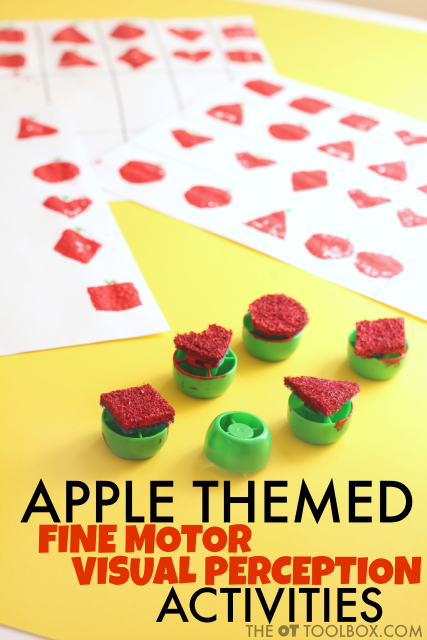
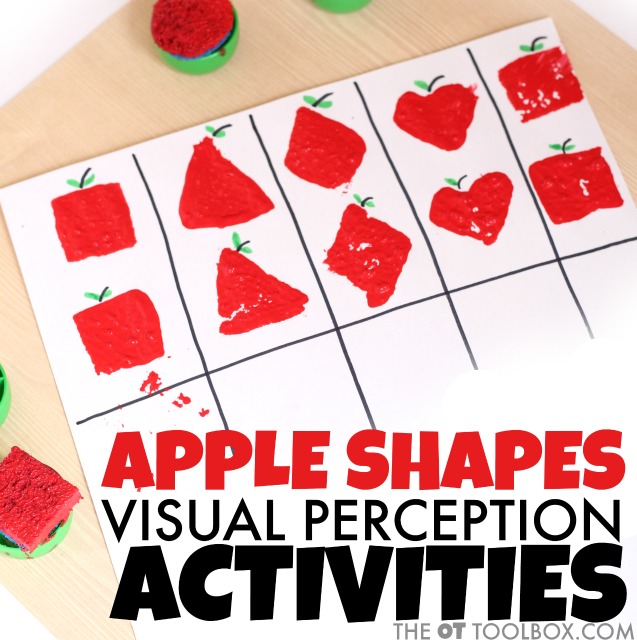
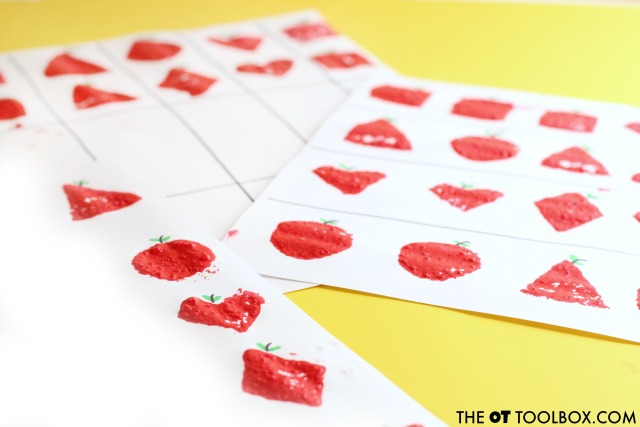
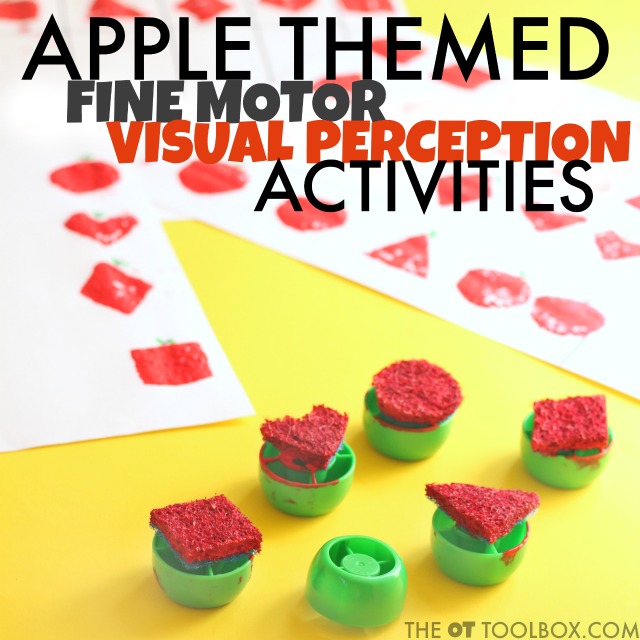
During the fall months, apple activities are a fun way to sneak in skills like visual perception development or fine motor strengthening.  This visual perception apple activity promotes both of those areas in a fun and creative way.  We used recycled pouch bottle caps to make DIY stamps that fit in with an apple theme.  If you are looking for more visual perception activities, there are a bunch on the site.  Check out the additional ideas at the bottom of this post.

The apple theme is perfect for the fall season and would fit in nicely with this apple theme gross motor activity.

Visual perceptual skills are needed for so many skills! Handwriting, reading, writing, math, spelling, shoe tying, cutting with scissors…everything! You’ll find easy and fun ways to work on visual perceptual skills through play here. 

Kids will love this visual perception apple activity using DIY apple stamps.

Visual Perception Apple Activity

This post contains affiliate links.
You’ll need just a couple of materials for this idea:
Scissors
Applesauce pouches (Eat the applesauce and then wash and dry the lid!)
Hot glue gun (I love this mini version for making quick projects like this one.)
Paper
Red paint

This activity goes along with the popular children’s book, Ten Red Apples. Grab the book and do this developmental activity with the kiddos.  You’ll love all of the book activities that combine children’s books with activities to promote development of functional skills and underlying skill areas here on The OT Toolbox.

Use DIY apple stamps to work on visual perception with an apple theme.
To make the apple stamps:
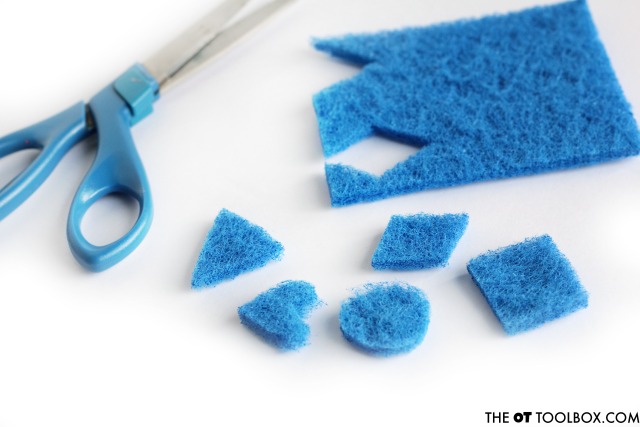
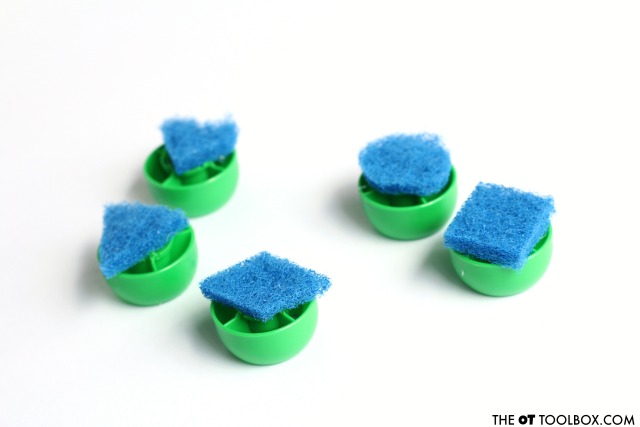
Cut the scrub pads into different shapes.  We made a square, circle, diamond, and heart.
Make your own foam stamps to work on visual perception and fine motor skills.
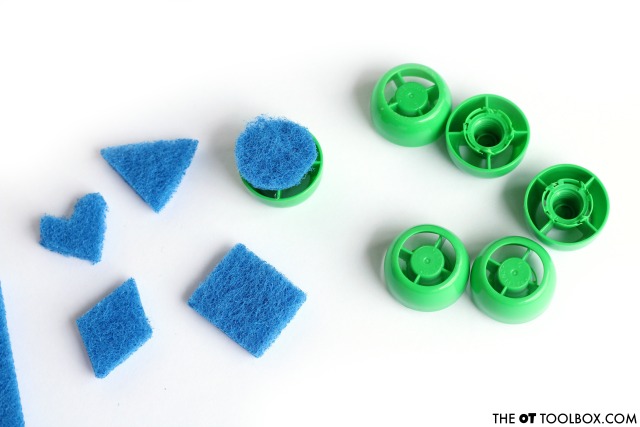
Use the hot glue gun to attach the shapes to the pouch lids. This is a job for an adult.

Kids can work on visual perception and fine motor skills using DIY stamps with an apple theme.
Once the foam shapes are attached and the glue is dry, you can start to work on those fine motor and visual perceptual skills.

Use these DIY stamps to work on visual perception and fine motor skills with kids.
This is a fun visual perception activity for kids to work on skills using DIY stamps.
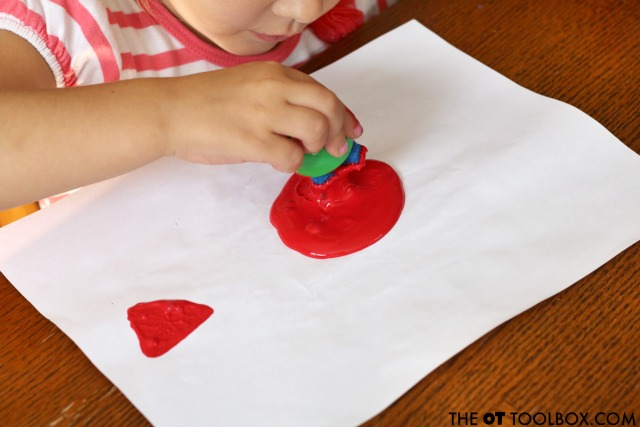
Pour a small amount of red paint onto scrap paper.  Kids can use the stamps to make different shapes by pressing the foam side into the paint and then pressing paint onto paper. There are several fine motor skills being addressed with these stamps:

Apple Theme Fine Motor Activity

Show your child how to hold the stamp using their thumb, pointer finger, and middle finger.  This positioning on the pouch cap encourages a tripod grasp and separation of the two sides of the hand.
Ask the child to use the stamper with their dominant hand.  By holding the stamp with to paint, they are also developing and strengthening the arches of the hand.
Additionally, the size of the stamp encourages an open thumb web space which is perfect for a functional pencil grasp during handwriting tasks.
These stamps are quite the fine motor power tool!
Apple stamps for helping kids work on visual perception and fine motor skills.

Apple Stamps and Visual Perception Activity

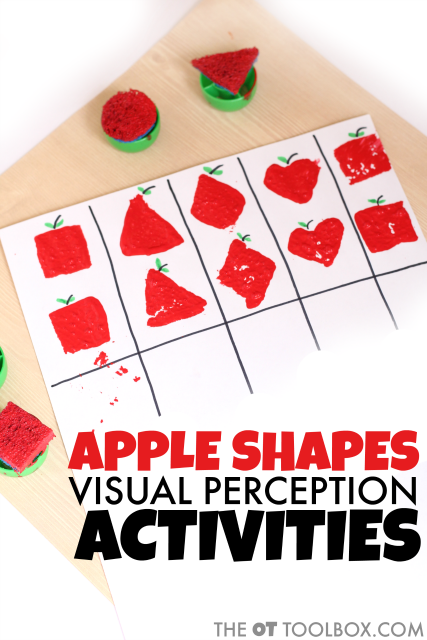
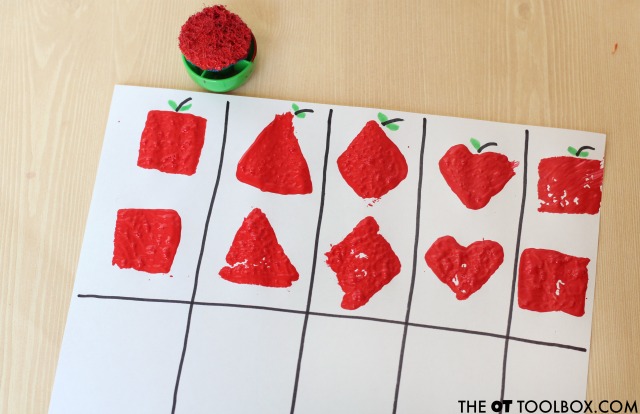
Next, kids can turn those shapes into apples by copying the different parts that make an apple.  We used black and green markers to add a stem and leaves to each apple shape.
To encourage development of visual perceptual skills, show kids how to copy the stem and leaves. They can then copy those parts onto their apples.  Try adding one or two leaves or making the stems go into different directions or with different lengths to encourage visual memory, visual discrimination, and visual motor skills.
Use these apple stamps to help kids improve visual perception and fine motor skills needed for handwriting, reading, and more.

Visual Perception Apple Activities

There are so many ways you can use these apple stamps to address visual perceptual skills!
Make copying sheets where kids copy the apple shapes in the correct sequence to address visual memory.
Make visual discrimination sheets where kids can identify the difference in shapes.
Work on visual spatial relations by stamping apples in different positions on a page.  Kids can then tell where they see a specific shape in relation to another shape.
Address visual discrimination by making an “I Spy” type of sheet.
Work on form constancy by covering up part of an apple shape and asking kids to make the apple shape that matches that shape.

Apple theme visual perception activity for kids
How would you use these apple stamps to address visual perception?

Kids love these visual perception apple activities that also work on fine motor skills
These apple stamps is a fun apple activity to use in coordination with a book.  If you have been a reader of The OT Toolbox for long, you know that we love to combine favorite children’s books with developmental activities.  For this apple activity, we joined the bloggers in the Virtual Book Club for Kids group in creating an apple themed activity that fits with the book, 10 Red Apples by Pat Hutchins.
We loved reading this book as we counted the apples on each page.  The book, Ten Red Apples is a fun way to address visual perceptual skills like visual discrimination, visual memory, and form constancy as each page contains the animals that eat an apple from the apple tree.  To address visual perceptual skills with this book, ask your child to scan the group of animals and pick out individual characters or animals on each page.  It’s a visual perceptual challenge that carries over to skills like reading and writing.

For more creative ways to address visual perceptual needs, try some of these ideas by clicking on the images below.

Looking for more ways to add apple themes into learning and play? Try these creative ideas from the Virtual Book Club for Kids team:

Apple Tree Alphabet Letter Match  Still Playing School
Apple Piece Names  Preschool Powol Packets
Sea of Knowledge    Apple Addition within 5 Dough Strips
Fingerprint Apple Counting Activity   Messy Little Monster
Apple Math: Counting & Fractions   Teach Beside Me
Red apple number bonds to 10   Rainy Day Mum
Apple Tree Playdough  Clare’s Little Tots
Apple picking sticky wall  Views from a Step stool
Baked Apples  Witty Hoots
Apple Stack Game and Snack  Toddler Approved
Jumping Apple Seeds  JDaniel4’s Mom
Apple Theme STEM Activity for Preschoolers  The Educators’ Spin On It
Glitter Apple Stamping  My Bored Toddler
Apple Tree Tracing Page
Apple Farm Song with Movement  My Storytime Corner
Ten Red Apples: Number Words Activities  Growing Book by Book
Apple Tree Gross Motor Game  Inspiration Laboratories
Apple Sewing  CrArty Kids

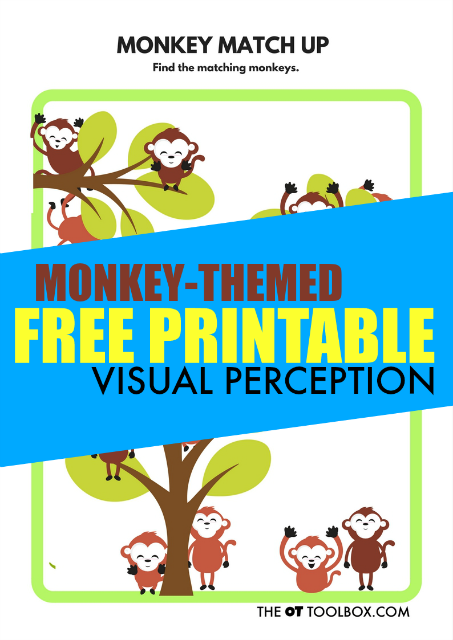
Free Visual Perception Worksheet Monkey Theme

Visual perceptual skills are needed for so many functional tasks!  Writing on lines, copying written work, reading without skipping words, walking in a crowded hallway, organizing materials, pouring water into a cup without spilling, searching for a paperclip in a junk drawer…everything done throughout the day requires the ability to visually process information.  For the child with visual perceptual difficulties, struggles persist in many areas!  
 
That’s why I wanted to share a series of free visual perception worksheets that can be used to address many visual perceptual skills.  This visual perception free worksheet has a monkey theme.  Find more visual perception worksheets like our free visual perception dinosaur worksheets and this space visual perception puzzle.
 
Visual perceptual skills are needed for so many functional skills. You’ll find easy and fun ways to work on visual perceptual skills through play here. 


Free Visual Perception Worksheet 

Print this free visual perception worksheet and laminate it or use it in a page protector sheet with a dry erase marker.  You can use the page over and over again.
 
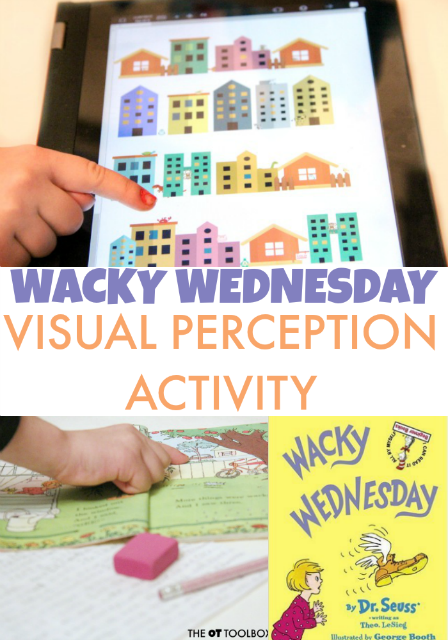
One tip to try is to use the page right on a tablet screen, like we did with this Wacky Wednesday visual perception activity.
 
 
Free visual perception worksheet with a monkey theme is great for addressing visual perception skills like visual figure ground.
 
How would you use this visual perception worksheet?
 
Related read: These visual perception apple theme shape stamps are a perfect way to work on visual perceptual skills and fine motor skills with DIY stampers.
 

Visual Perception Worksheet Activity

Using a visual perception worksheet like this one and the others on this site addresses skills like the ones listed below.  Click on each to find more creative, hands-on ways to address each skill.  The activities are perfect additions to add to your OT Toolbox and can accompany the free worksheets we have here on the site:
 
 
Visual perception free printable sheet for addressing skills like visual -figure ground, visual discrimination, visual memory and other perceptual skills.
 
 
Here is more information about strategies to address visual perceptual skills and handwriting.

Visual Discrimination 

Spatial Reasoning 

Visual Motor Skills

Visual Memory Visual-Figure Ground (scroll down on the page)

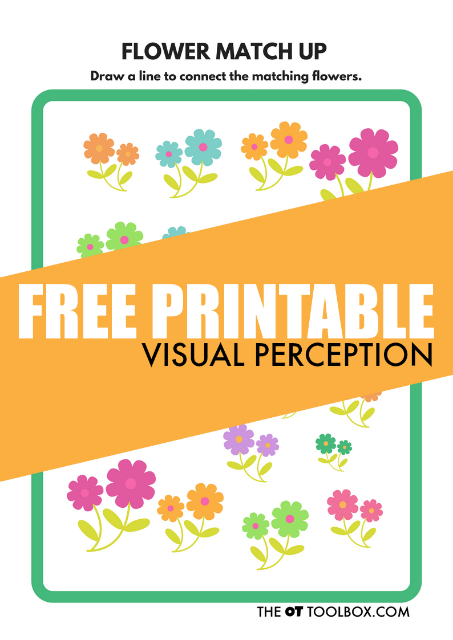
Free Visual Perception Worksheet- FLowers Theme

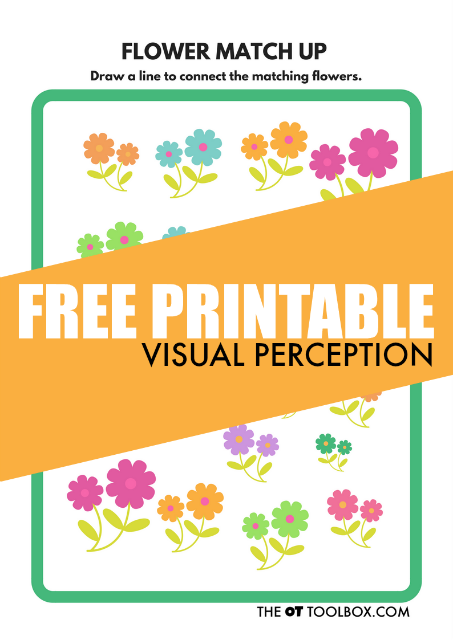
This flower theme free visual perception worksheet is one of many free visual perception worksheets here on The OT Toolbox.  Kids need to work on visual perceptual skills for many reasons. Skills like handwriting and scissor use are oftentimes, a result of difficulties with visual perceptual skills. This visual perception worksheet can be part of a set of activities that help address those needs.  In fact, this flower themed Visual Perception sheet helps kids develop and build skills such as visual discrimination, spatial reasoning, visual motor skills, and motor planning.  Add this printable activity to your Spring visual perception activities during the Spring months, or any time of year.


Flower theme free visual perception worksheet to help kids work on visual perceptual skills like visual discrimination, visual memory, visual attention, and pencil control needed for handwriting.
 
To get a copy of this flower visual perception printable page, grab the entire free visual perception packet, which contains 25 pages of visual discrimination, visual closure activities, and visual perceptual skills tasks.


Free Visual perception worksheet

This free printable sheet is much like our space theme visual perception puzzle which is also a freebie for you!

In a visual discrimination worksheet like this one, kids can work on pencil control and motor planning to connect matching flowers by making their pencil go around the other flowers that are in their path. Visual perceptual worksheets that challenge discrimination between space, object features, and coordination of the pencil in motor operations allows kids to foster eye-hand coordination for use in functional handwriting tasks. 

Activities like writing on a given space in a page require similar visual discrimination and visual spatial awareness. 


Visual perceptual skills are needed for so many functional skills. You’ll find easy and fun ways to work on visual perceptual skills through play here. 

Benefits of this Visual Discrimination Worksheet:

Visual Discrimination– Noticing and identifying subtle differences in shapes, colors, direction, and forms is a necessary skill for functional tasks like matching socks or silverware.  Visual discrimination is a skill that is essential for handwriting, reading, and math.  Children who struggle with visual discrimination may not notice small details or may confuse letters or numbers that are similar like b, d, 2, and 5. 

Spatial Reasoning– This skill is what allows us to walk around objects in our path with enough space.  Spatial reasoning is needed for handwriting when determining if a word will fit in a given space or if we need to write smaller or move to the next line at the end of the right margin.  

Encourage kids to draw pencil strokes around the planets so they don’t touch the other planets with their pencil.  Visual spatial relations is a spatial reasoning skill. 

Visual Motor Skills– Coordinating visual information with movements of the hands is a skill that is needed for handwriting.  Use a writing utensil to connect the matching planets and moons while working on visual motor skills needed for written work. 

Visual Memory–  Children need visual memory for handwriting, reading, math, and many tasks during the school day.  Visual memory is a skill that allows us to store a visual piece of information or a form in our mind and recall the characteristics of that form.  

More Visual Discrimination Activities

Spring Fine Motor Kit

Score Fine Motor Tools and resources and help kids build the skills they need to thrive!

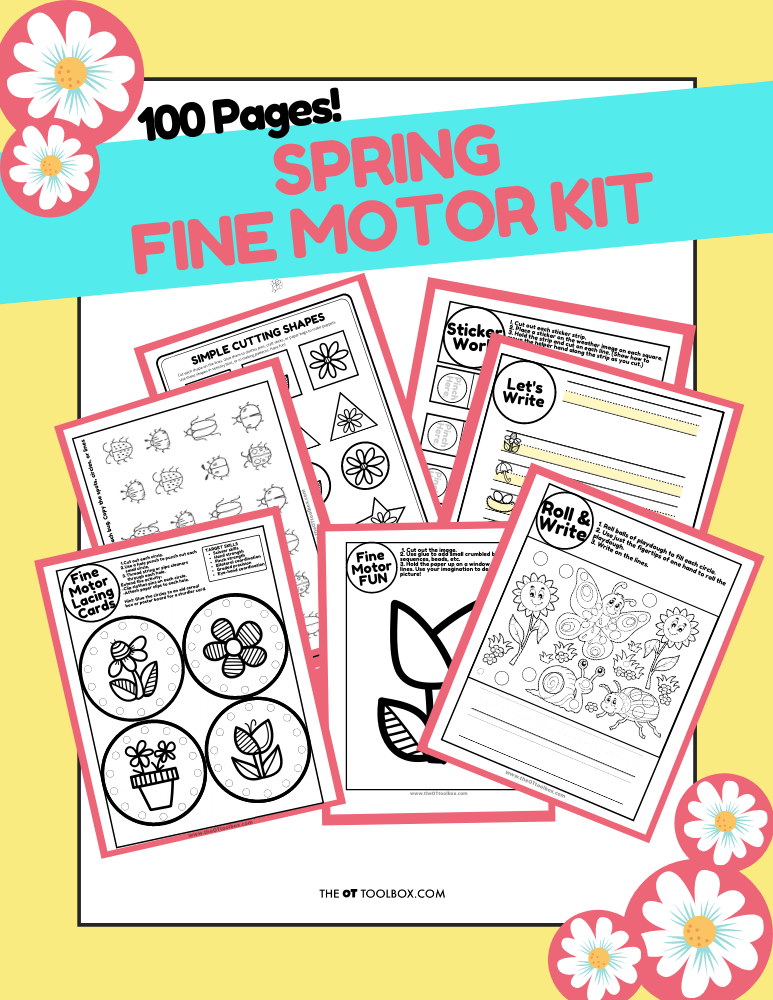
Developing hand strength, dexterity, dexterity, precision skills, and eye-hand coordination skills that kids need for holding and writing with a pencil, coloring, and manipulating small objects in every day task doesn’t need to be difficult. The Spring Fine Motor Kit includes 100 pages of fine motor activities, worksheets, crafts, and more:

Spring fine motor kit set of printable fine motor skills worksheets for kids.
  • Lacing cards
  • Sensory bin cards
  • Hole punch activities
  • Pencil control worksheets
  • Play dough mats
  • Write the Room cards
  • Modified paper
  • Sticker activities
  • MUCH MORE

Click here to add this resource set to your therapy toolbox.

Spring Fine Motor Kit
Spring Fine Motor Kit: TONS of resources and tools to build stronger hands.

Grab your copy of the Spring Fine Motor Kit and build coordination, strength, and endurance in fun and creative activities. Click here to add this resource set to your therapy toolbox.

Colleen Beck, OTR/L has been an occupational therapist since 2000, working in school-based, hand therapy, outpatient peds, EI, and SNF. Colleen created The OT Toolbox to inspire therapists, teachers, and parents with easy and fun tools to help children thrive. Read her story about going from an OT making $3/hour (after paying for kids’ childcare) to a full-time OT resource creator for millions of readers. Want to collaborate? Send an email to contact@theottoolbox.com.