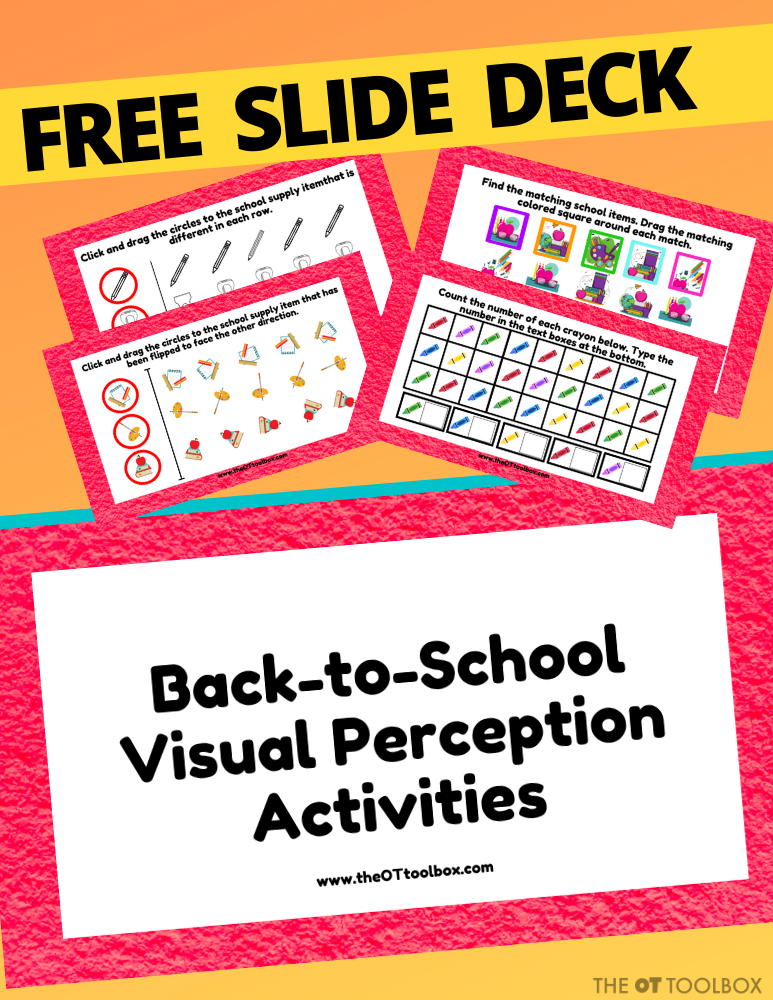
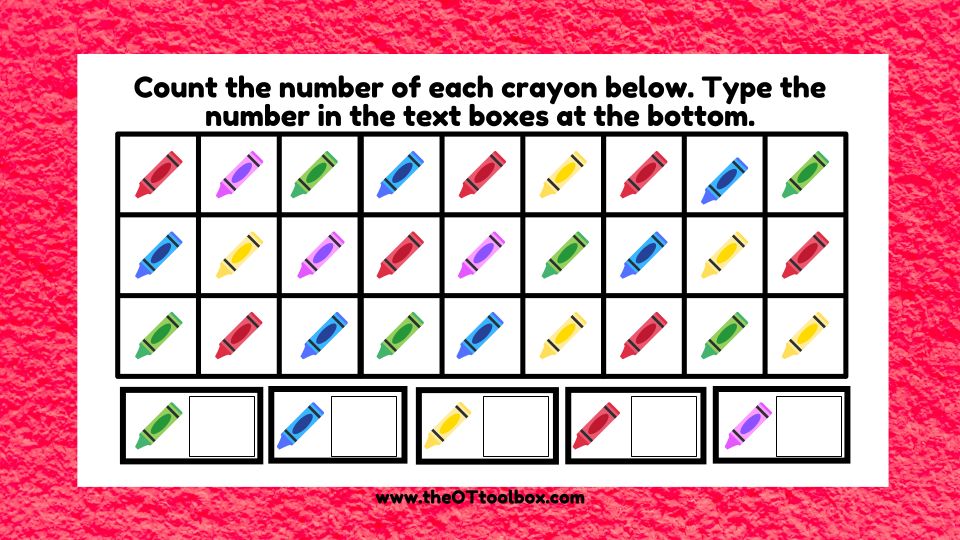
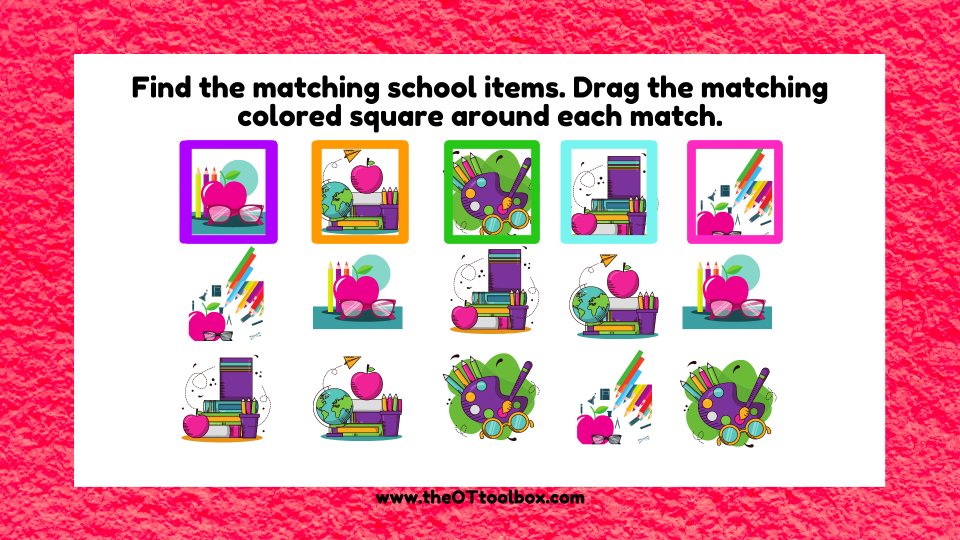
If you are like many OT professionals, you are looking for back-to-school activities for occupational therapy. That’s why I wanted to get this back to school slide deck into your hands! It’s a slide deck activity for addressing visual perceptual skills and fun for occupational therapy activities that may be occurring via teletherapy this year. Use this OT slide deck to work on visual perception with a first day of school theme!
Slide Deck for Back to School Activities
Below, you’ll find a form to enter your email to grab this free interactive slide. But first, I wanted to explain how this slide deck works.
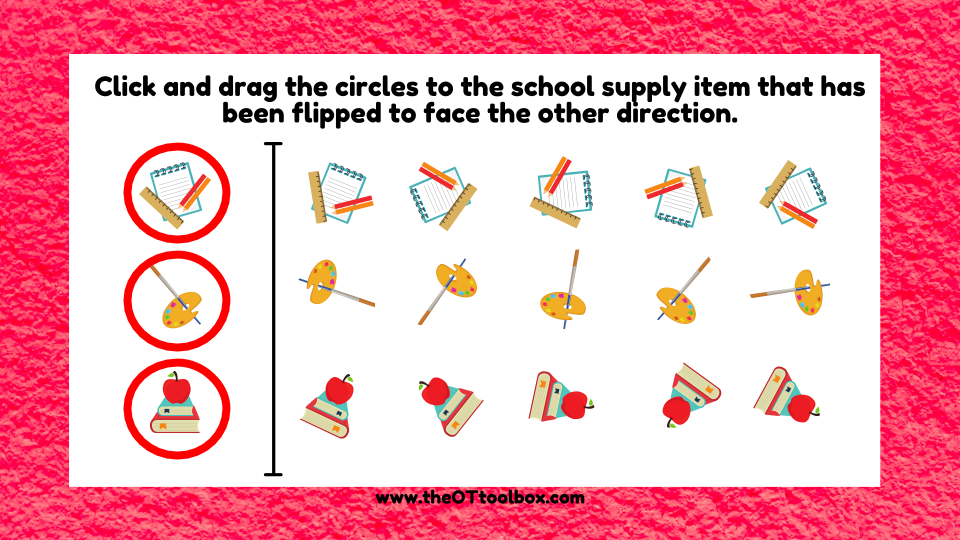
Kids can work through the interactive slides and move the movable parts of the slides to practice visual perceptual skills. The slides are designed to build skills in the following visual perceptual areas:
Form constancy
Visual discrimination
Visual memory
The slides include school materials for a back-to-school theme.
Children can use the slides to practice these specific skills while strengthening visual processing skills including visual scanning, visual fixation, and visual attention.
Finally, eye-hand coordination is needed to manipulate the interactive portion of these slides to move the outline to select certain images.
This blog post on visual motor skills really explains these areas of visual processing and offers tons of hands-on activities to help kids build these skill areas so that they can read and write at a functional level.
Why use a slide deck to work on visual perceptual skills?
There are many functional skills that are impacted by visual perceptual difficulties. Some examples include:
Letter reversal
Poor line awareness in handwriting
Poor margin use in written work
Difficulty copying written work
Trouble recognizing patterns and completing hands-on math problems
Difficulty catching or kicking a ball
Trouble with movement games like hopscotch.
Clumsiness
Difficulty with sports
Difficulty drawing and copying pictures or shapes
Working on the underlying visual processing skills in puzzles and activities like the ones in this back to school slide deck can be one way to build these areas.
FREE back to school SLIDE DECK
Here’s how you can get the interactive slide deck to work on letters:
Enter your email address in the form below. Check your email and click on the button to grab your resource. Save that page so you can access these slide decks again.
Sign into your Google account. Click on the big button in that PDF that you just accessed. It will prompt you to make a copy of the slide deck. That will be your master copy of this slide deck.
Now the slide deck is on your Google account.
Share the slide deck with students. You can make a copy for each student and upload it to their Google classroom or use it in Zoom. Here is a post on FAQ for troubleshooting any issues you might run across with using or accessing the slide deck.
Be sure to sign up for other slide decks that we have to offer. You will have to enter your email address for each one so you can get the resource and make a copy of each slide deck.
Be sure to check out these other slide decks to use in OT teletherapy sessions, distance learning, or homeschooling:
Colleen Beck, OTR/L has been an occupational therapist since 2000, working in school-based, hand therapy, outpatient peds, EI, and SNF. Colleen created The OT Toolbox to inspire therapists, teachers, and parents with easy and fun tools to help children thrive. Read her story about going from an OT making $3/hour (after paying for kids’ childcare) to a full-time OT resource creator for millions of readers. Want to collaborate? Send an email to contact@theottoolbox.com.
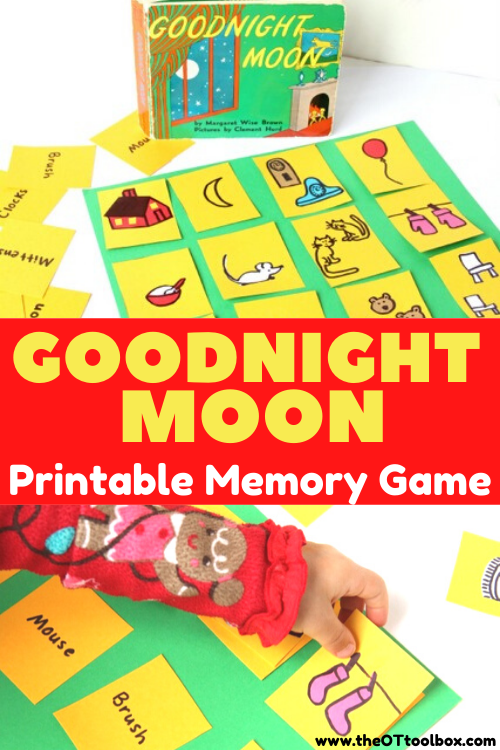
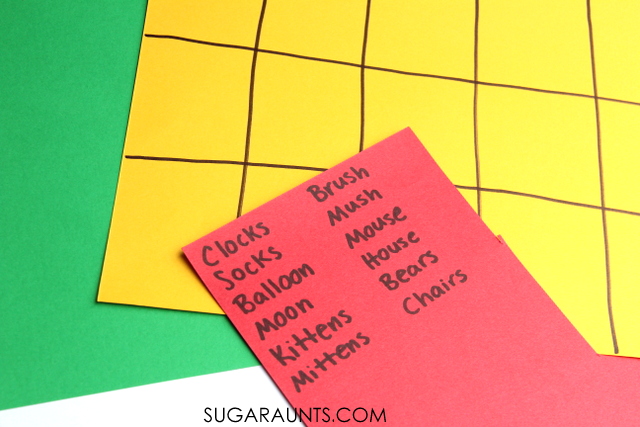
Goodnight Moon is a classic book by Margaret Wise Brown that teaches so many skills, making it the perfect children’s book to use in therapy activities. We used this book activity and a DIY Goodnight Moon printable PDF memory game. It’s a calming book that inspires sleepy contentment with it’s rhyming text and simple images. The book is a fantastic tools to build visual perceptual skills including figure ground, form constancy, and visual memory. Those skills carryover with our memory game printable you can access below. However, for my own kids, I loved the calming tone that the book offers. It’s a great way to calm down before bed.
Our Goodnight Moon activity has been played almost as many times as we’ve read the book! We decided to create a free printable to go along with our memory skills game, so you can play, too.
Goodnight Moon Activity…Memory Game!
Goodnight Moon teaches kids that fear can be caused my our imagination. I loved this explanation of what exactly Goodnight Moon teaches and how this book can be used to help kids build skills.
This post contains affiliate links.
Goodnight Moon by Margaret Wise Brown is one of those books that we read over and over again. Each time, the kids will sit mesmerized as I read the quiet rhyming words. This is definitely a bedtime book that is loved at all times of the day! When we read through the book, my kids love to look for each item on the pages and find it’s rhyme. It’s almost like a memory game as you read through the book, especially as the mouse moves around the room in the book.
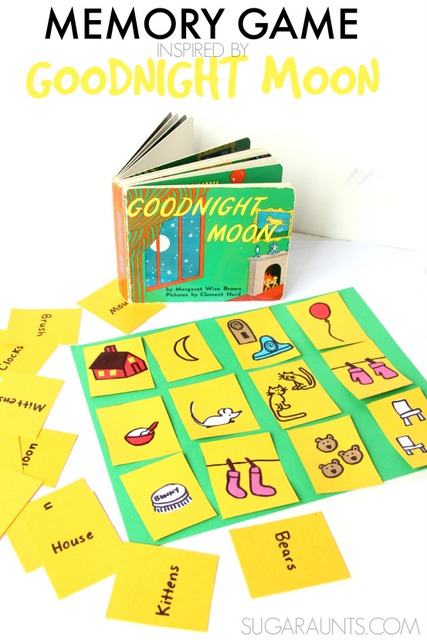
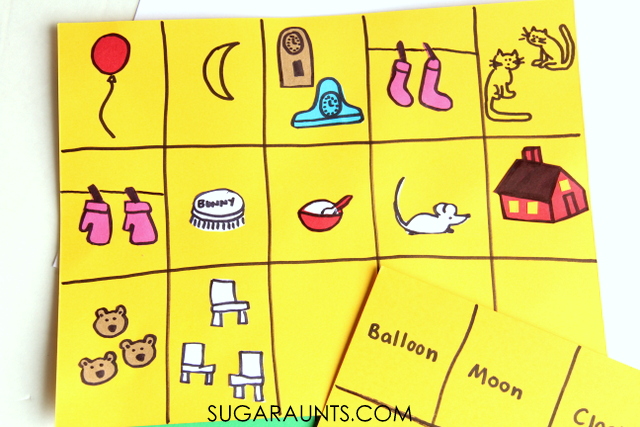
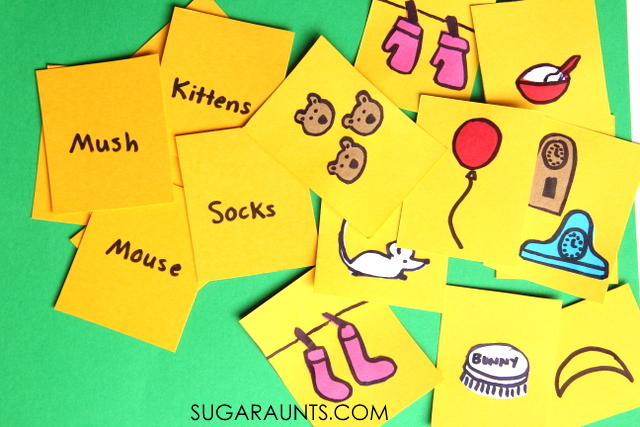
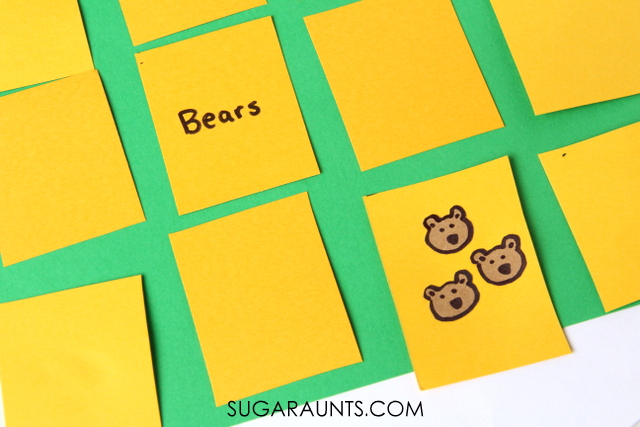
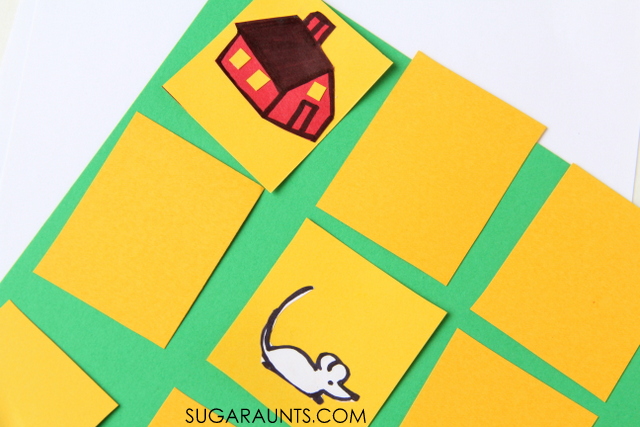
To make your Goodnight Moon memory game, grab a couple of pieces of card stock. We chose brightly colors based on the colors of the book. Because the setting occurs in a green room, we used green paper for our playing board.
You could certainly play this memory game right on a table or floor, but my kids got a kick out of our “green room” and the green paper contained the game for our matches.
Goodnight Moon learning Activities
Make a list of all of the rhyming words as you go through the book. This is a great preschool book activity, but a powerful visual perception activity for all ages. Kids can build visual memory skills as they recall each item and the way it looks throughout the book. Some objects change slightly, such as the position of the mouse. So, when kids look for that image on each page, they are building visual discrimination and form constancy. As you read the book, ask them what rhymes with each word. They can use the book pages as a visual cue to the matching rhyme.
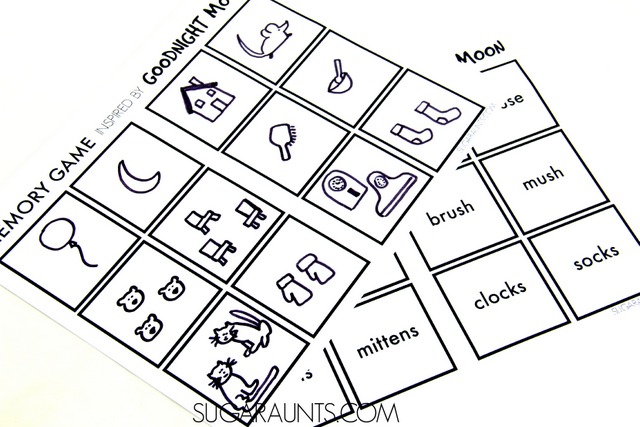
Goodnight Moon PDF
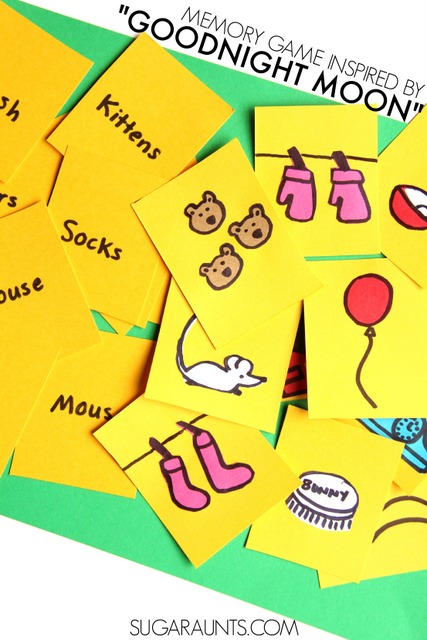
Fill in your game pieces with your own drawings (or kid-drawings!) or use our free printable. You’ll need these three sheets:
>>Printable word cards here. We drew a picture for each rhyme and filled in another card sheet with the written words.
Cut out each block and get ready to play.
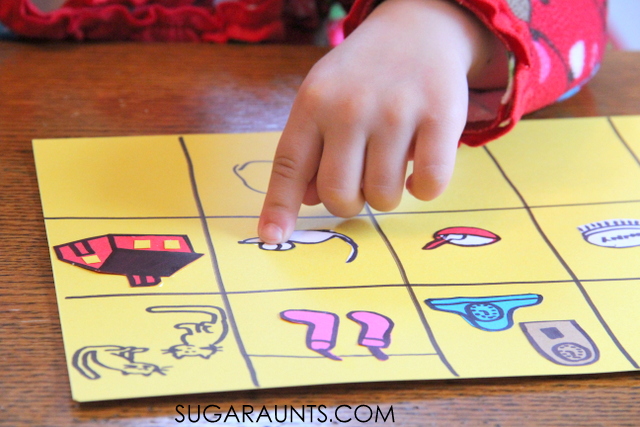
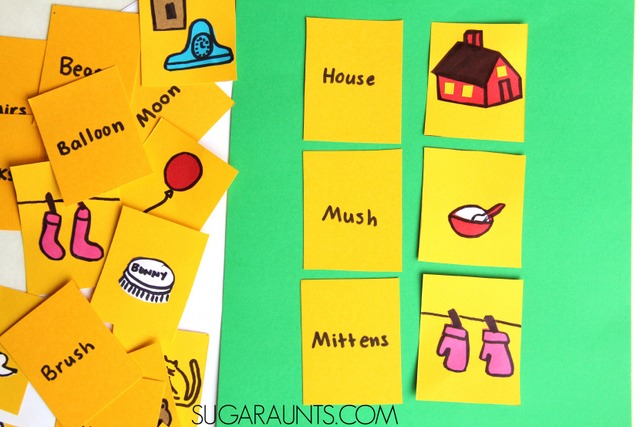
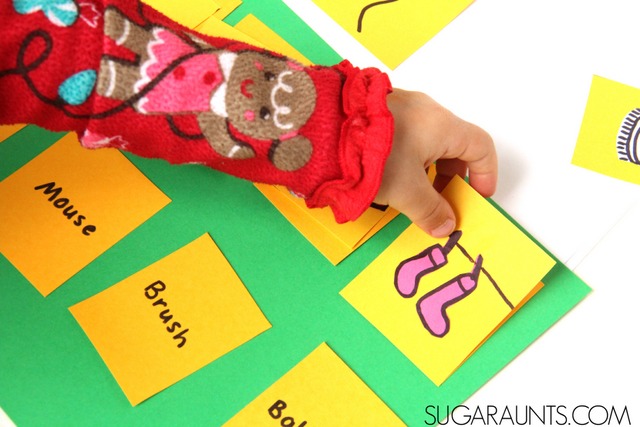
We started with a few matching games. I placed the written word on our green room paper and had the kids scan the pile of pictures for the matching image. This is a great way to work on literacy skills as the child matches the picture to a written word, as well as on visual scanning. Arrange the cards from left to right as a pre-reading skill.
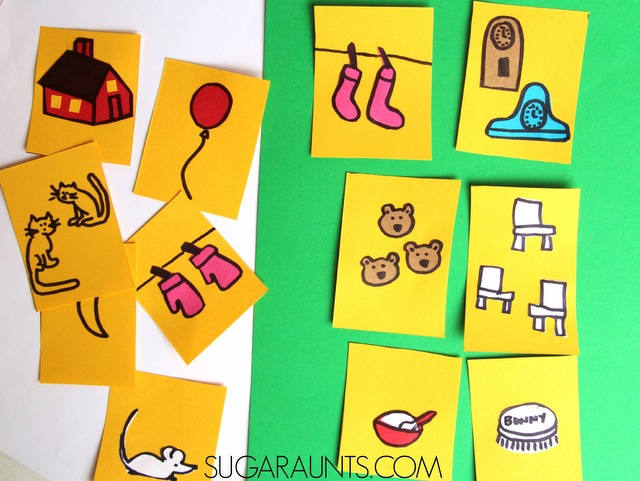
We also matched rhyming words. Arrange a few pictures on the left side of the page and have your child place the rhyming match to the right.
We then arranged the words in a block formation on the green paper. The kids scanned the pile of pictures and placed the matches together.
After all of our rhyming games, we played an actual Memory game. You can also modify the memory game to extend out the activity. Match word to picture, rhyming pictures, and rhyming words. This DIY Memory game can be played in so many ways!
GoodNight Moon Activities
First, don’t forget to grab the Goodnight Moon pdf sheets to play this memory game.
Then, check out these other Goodnight Moon activities. They are great to help kids understand that sometimes scary things are in our minds and that the thoughts we think are not always as scary as things really are.
Be sure to visit the other bloggers in the Preschool Book Club to see their takes on Goodnight Moon:
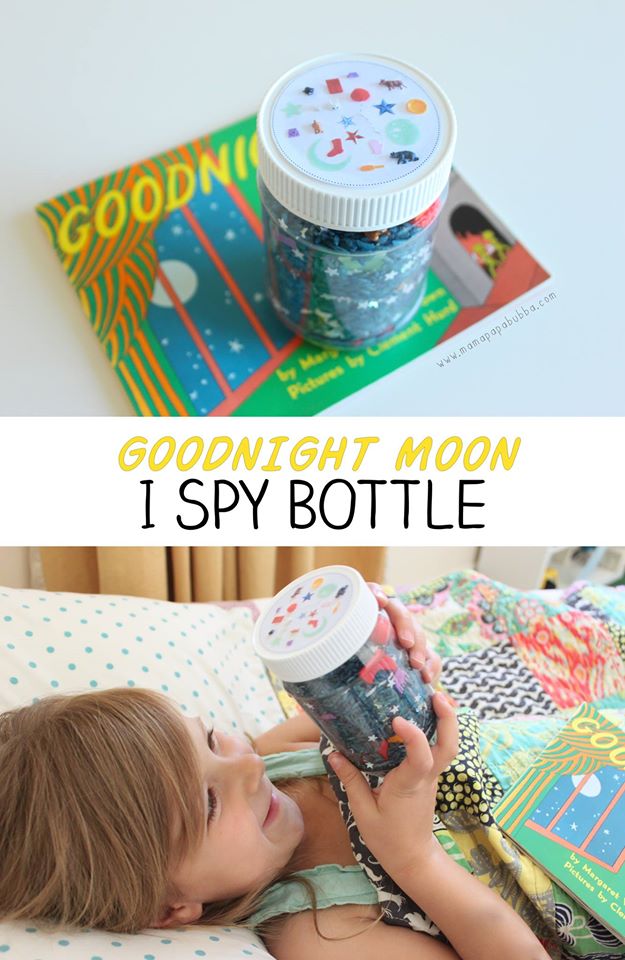
This I Spy Bottle from Mama Pappa Bubba is another fantastic visual perceptual skills activity and a calming one at that. Check out these sensory bottles and WHY sensory bottles are so calming for kids as well as HOW to make sensory bottles that make an impact.
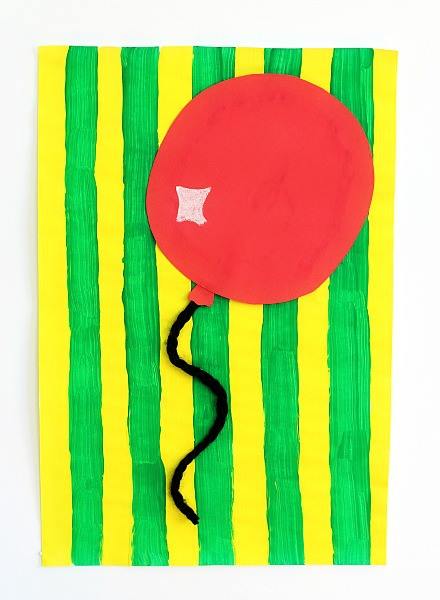
This red balloon Art Activity from Buggy and Buddy uses Goodnight Moon’s red balloon with a creative painting activity. Kids can work on fine motor skills and tool use to paint a creative take on the book. Foster scissor use and scissor skills to, meeting therapy goals as well.
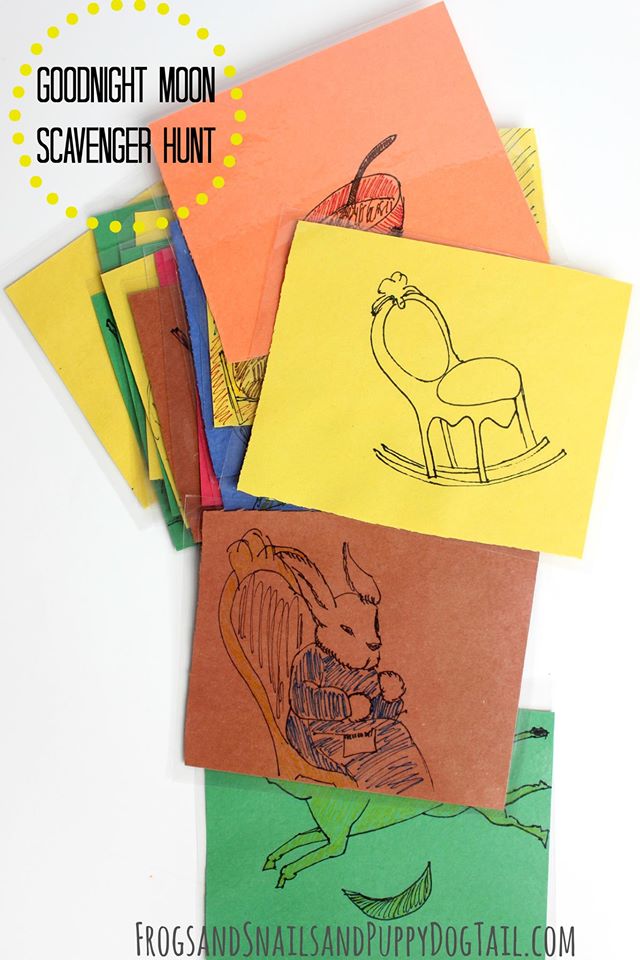
This Goodnight Moon Scavenger Hunt from Frogs and Snails and Puppy Dog Tails is a gross motor activity that builds skills in visual perception and visual scanning. Love this idea to encourage core strength and stability!
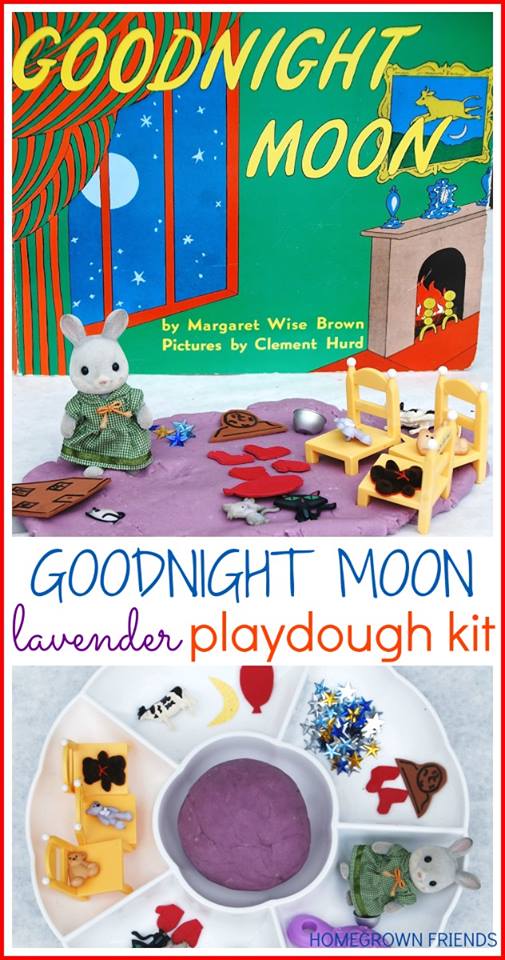
This Goodnight Moon activity with a Lavender Play Dough kit from Homegrown Friends is a calming olfactory activity that adds sensory play and fine motor skills. Kids will love to pair the preschool book with a play dough activity.
Goodnight Moon and the concepts introduced in the book goes well with this resource for parents, teachers, and therapists. It’s a huge collection of 50 activities based on children’s books and it helps to teach children about empathy, acceptance, awareness of others, and friendship. The social emotional development that kids can gain through play based on popular children’s books is amazing!
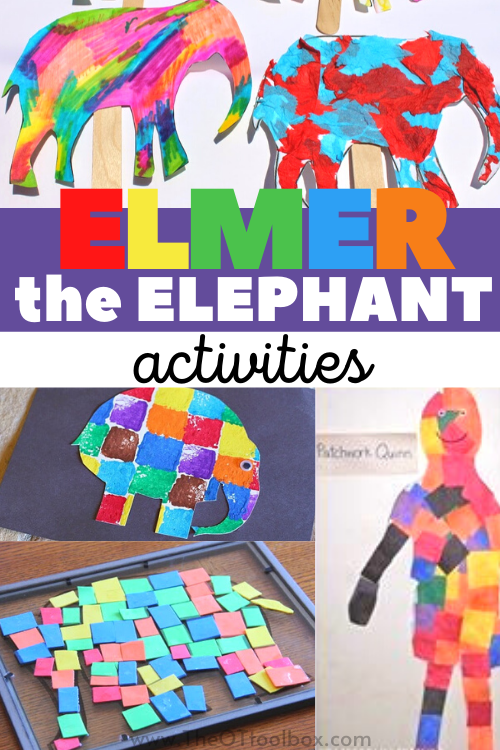
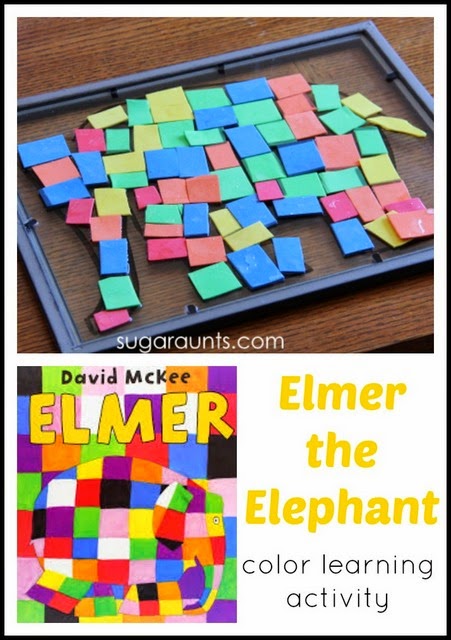
Elmer the patchwork elephant looks different than his friends. Through stories and colorful pictures that depict everyday elephant life, Elmer the elephant teaches us about diversity and differences. Elmer teaches us about acceptance, friendship, and empathy. Check out the Elmer the Elephant activity below that builds a baseline for these important skills, but also helps kids with fine motor skills, visual perceptual skills, and visual motor skills.
If you love the Elmer books as much as we do, then you will adore this Elmer the Elephant activity. We LOVE Elmer the Elephant…and all of the Elmer books. Every time we go to the library, we are sure to check the shelf for a new Elmer book that we may have missed. This week’s book activity was so much fun to do with the kids, because it involved one of our favorite books (ever) and a great visual perception activity. Add this book activity to your list of crafts based on children’s books that build skills through reading.
Elmer the Elephant Activity
This fine motor craft is a powerful one because it not only builds essential visual perceptual, visual motor, and fine motor skills, but it teaches as well. This Elmer the elephant activity can be used to illustrate differences, empathy, and friendship. Here are more books that teach empathy and friendship that can be used in therapy sessions or in the classroom or home.
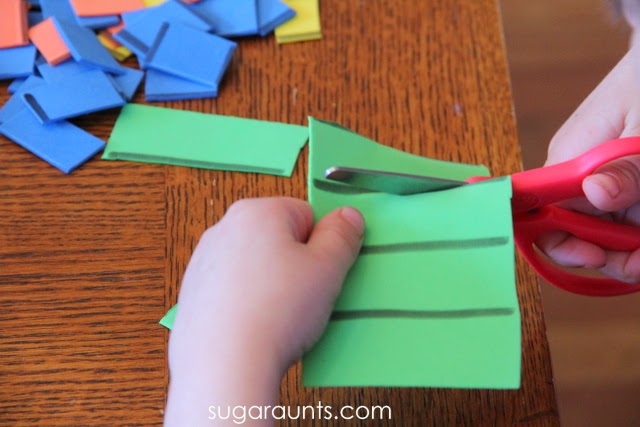
They loved creating and building our very own Elmer craft. Elmer’s colors made for a great way to help kids build fine motor skills and visual motor skills, too. I loved throwing in the scissor work portion of the activity and working on a few important skills. My youngest daughter worked on her color identification and sorting. The colors in Elmer’s patchwork skin are perfect for Toddlers to practice naming colors. Little Guy was loving the puzzle-building portion of our activity. The lines were a great way to work on a few visual perceptual skills needed for handwriting.
Elmer the Patchwork Elephant Activity
This post contains affiliate links.
If you haven’t read Elmer by David McKee, this is definitely a book you need to check out. Elmer is a patchwork elephant with many colors. He sticks out from the crowd of gray elephants. By exploring and interacting with his community of elephants, Elmer and the other elephants learn to accept and value his unique characteristics. Elmer is not only a colorful patchwork elephant. He is funny, smart, caring, and an individual. The book teaches us to accept differences because those differences are what make us who we are.
Elmer teaches us about diversity. He teaches us about identity and tolerance. We all have different colors, shapes, interests, abilities, talents, and ideas. Those differences are what make us special. Let’s see those differences, accept them, and celebrate them!
We made our own patchwork elephant with lots of colors and had a great time building and creating while talking about color names. This was such a great activity for both Little Guy and Baby Girl.
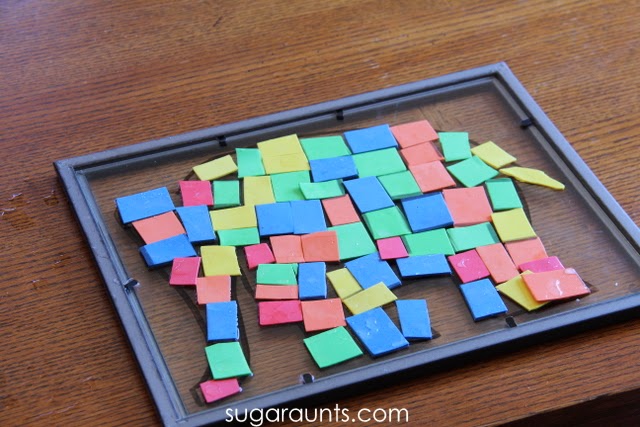
We started with Foam Sheets in lots of different colors. You might have seen our color sorting scissor activity post where we practiced our scissor skills. These squares came in handy for this Elmer activity.
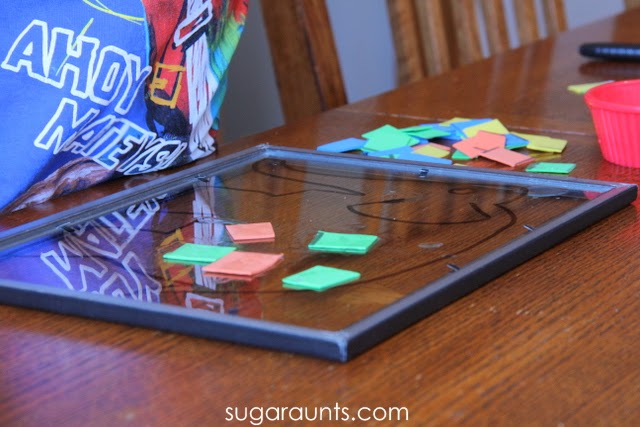
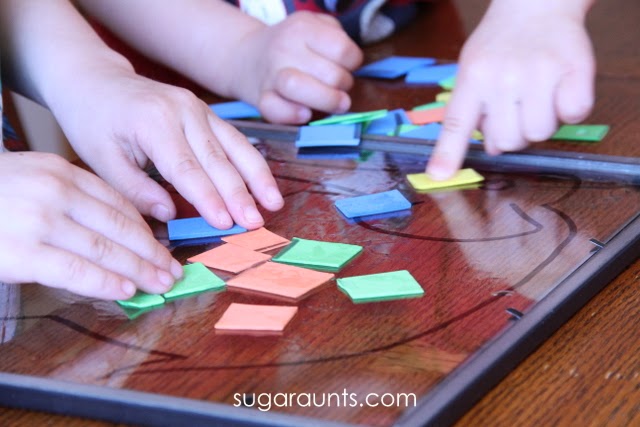
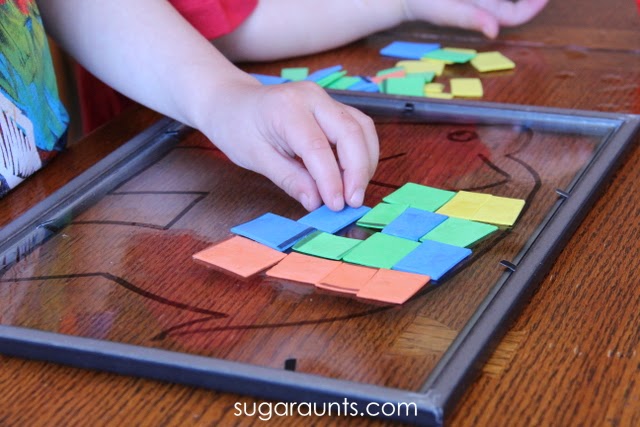
I found a picture frame at the Dollar Store that has an acrylic front, instead of glass. This is a great writing surface using a white board marker. I drew an outline of Elmer with the marker. We had a little bowl of water and started sticking the foam squares onto the surface to build our Elmer. When the foam pieces are dunked into water, they stick really well to the picture frame surface. We did a version of this way back when our blog began with our rainbow building activity.
Visual Perception Activity for Kids
There were fingers everywhere, adding patchwork squares! Little Guy and I quizzed Baby Girl on her colors as we worked. It was a fun puzzle to get the squares fitting into the outline. What a great way to work on visual perceptual skills, fine motor precision, dexterity, and line awareness!
Visual perceptual skills in kids are necessary for so many things…from self-care to fine motor skills, to gross motor skills…all parts of a child’s development require visual perception. There are many pieces to the giant term of “visual perception”. This Elmer building activity works on quite a few of these areas:
Visual Discrimination is determining differences in color, form, size, shape…Finding different sized squares to fit into the outline of our Elmer, discriminating the different colors, and shapes are a great way to work on this area.
Visual Closure is the ability to fill in parts of a form in the mind’s eye to determine shape or a whole object. Filling in the missing parts of our Elmer works on this area.
Visual Spatial Relations is organizing the body in relation to objects or spatial awareness. This is an important part of handwriting. Spacing those pieces amongst the others and in relation to the lines is one way to work on this skill.
Visual Figure Ground is the ability to locate objects within a cluttered area (think “I Spy”). Finding a red square among the pile of foam pieces is one fun way to work on this area of visual perception.
Little Guy was really into this activity. He loved lining up the squares to make our Elmer.
We loved how our Elmer turned out! We’ll be using our frame again, soon. I can think of so many fun ways to learn and play with this dollar store frame and a marker!
More Elmer the Elephant Activities
Check out some of these Elmer the Elephant activities for kids. They are powerful ways to build awareness, acceptance, and friendship through the book and activity.
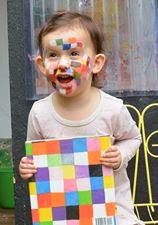
Use face paint to celebrate friendship with a face painting party based on the Elmer the Elephant book.
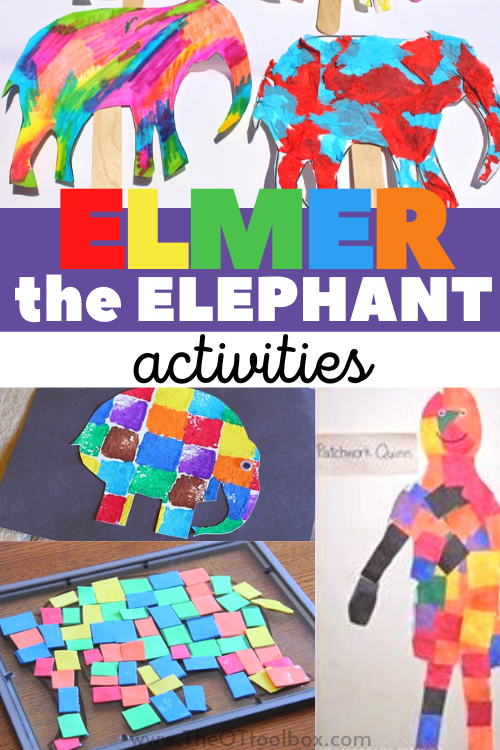
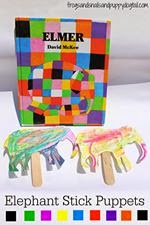
Make an Elmer craft using puppets to celebrate differences, diversity, and uniqueness in a great lesson for kids, while building fine motor skills.
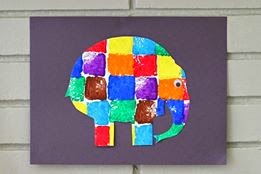
Create an Elmer the patchwork elephant craft using paint to make a paint stamped elephant craft. What a great way to build fine motor skills!
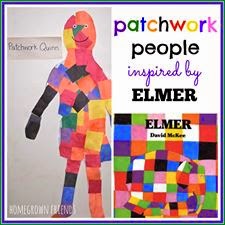
Kids can trace their bodies with large pieces of paper and then fill the space with colorful paper squares to celebrate uniqueness in this Elmer the Elephant preschool activity.
Teach Acceptance, Differences, and Diversity
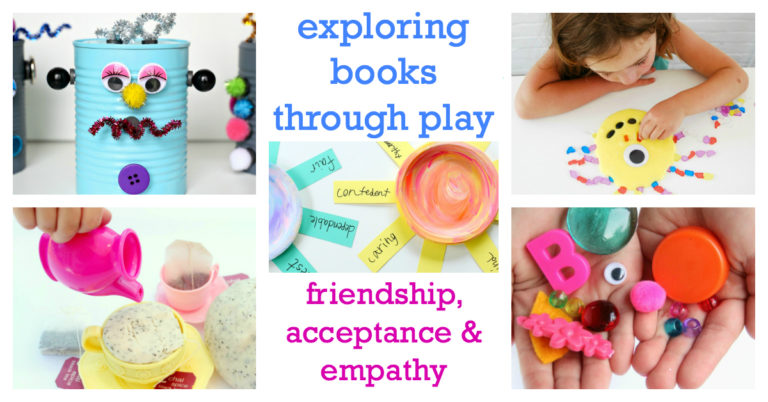
Want to take complex and abstract concepts like empathy, acceptance, uniqueness, and diversity to the next level with kids? This digital, E-BOOK, Exploring Books Through Play: 50 Activities Based on Books About Friendship, Acceptance and Empathyis filled with hands-on activities rooted in interactive, hands-on, sensory play that focus on creating a well-rounded early childhood education supporting growth in literacy, mathematics, science, emotional and social development, artistic expression, sensory exploration, gross motor development and fine motor skills.
Kids can explore books while building specific skills in therapy sessions, as part of home programs, or in the home. is an amazing resource for anyone helping kids learn about acceptance, empathy, compassion, and friendship.
In this book, you’ll find therapist-approved resources, activities, crafts, projects, and play ideas based on 10 popular children’s books. Each book covered contains activities designed to develop fine motor skills, gross motor skills, sensory exploration, handwriting, and more. Help kids understand complex topics of social/emotional skills, empathy, compassion, and friendship through books and hands-on play.
Click here to get the book and add children’s books based on social emotional learning to your therapy practice, home activities, or classroom.
More books to teach social emotional skills
Check out our other posts in the Preschool Book Club Series for activities based on favorite books:
Colleen Beck, OTR/L has been an occupational therapist since 2000, working in school-based, hand therapy, outpatient peds, EI, and SNF. Colleen created The OT Toolbox to inspire therapists, teachers, and parents with easy and fun tools to help children thrive. Read her story about going from an OT making $3/hour (after paying for kids’ childcare) to a full-time OT resource creator for millions of readers. Want to collaborate? Send an email to contact@theottoolbox.com.
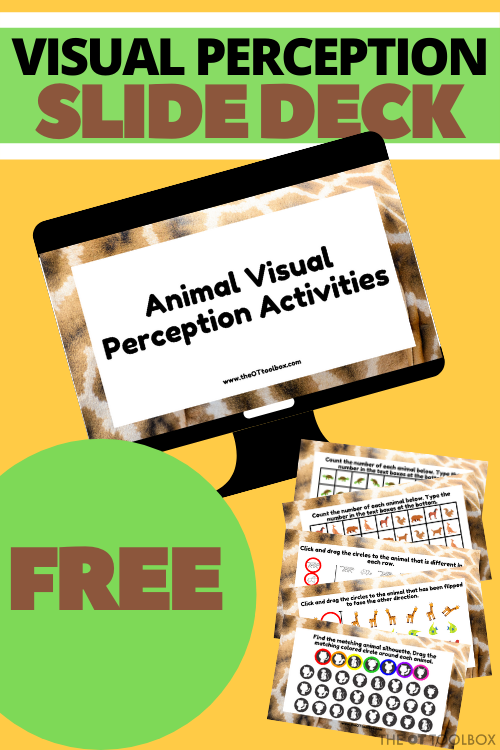
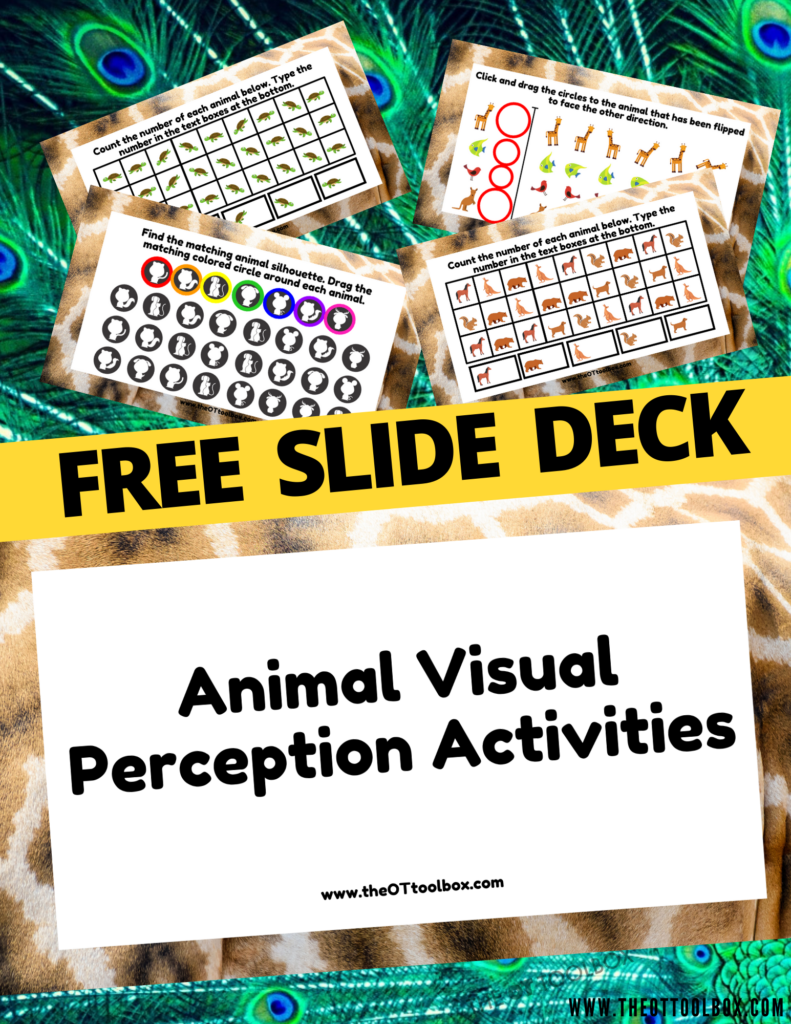
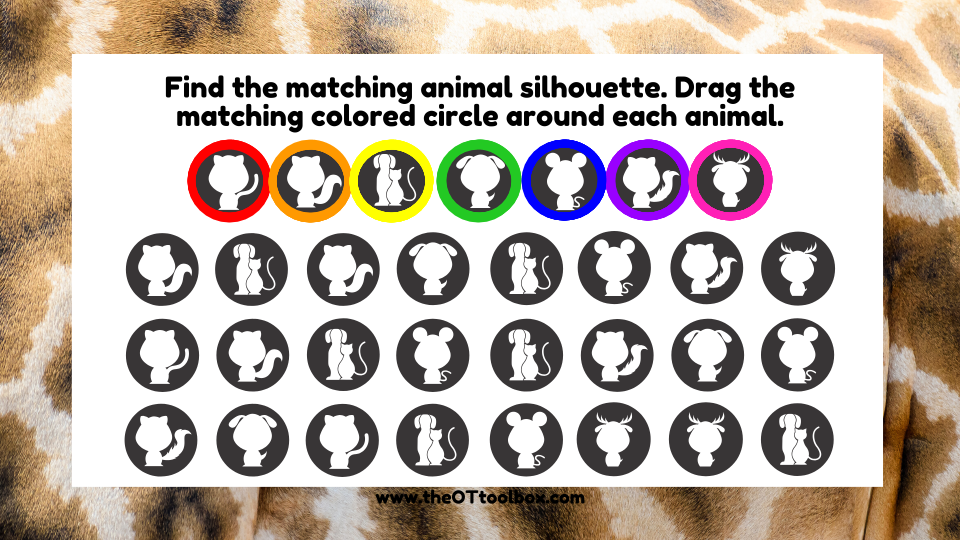
It’s here! If you’ve been enjoying the free slide decks that I’ve been sharing here on the website, then you are in luck. Today, I’ve got another free therapy slide deck. This one is all about visual perceptual skills…the Animal Visual Perception therapy activities are here! Scroll to the bottom of this post, enter your email, and start working on visual perception in your teletherapy activities. Be sure to check out our other recent therapy slide decks, listed below.
This visual perception slide deck covers various visual perceptual areas:
The animal theme therapy slide deck also covers oculomotor skills:
Visual scanning
Visual tracking
Eye-hand coordination
Free Therapy Slide Decks
This animal theme set of visual perception activities are just one of the recent slide decks that I’ve created. Be sure to grab some of the other free slide decks on the site:
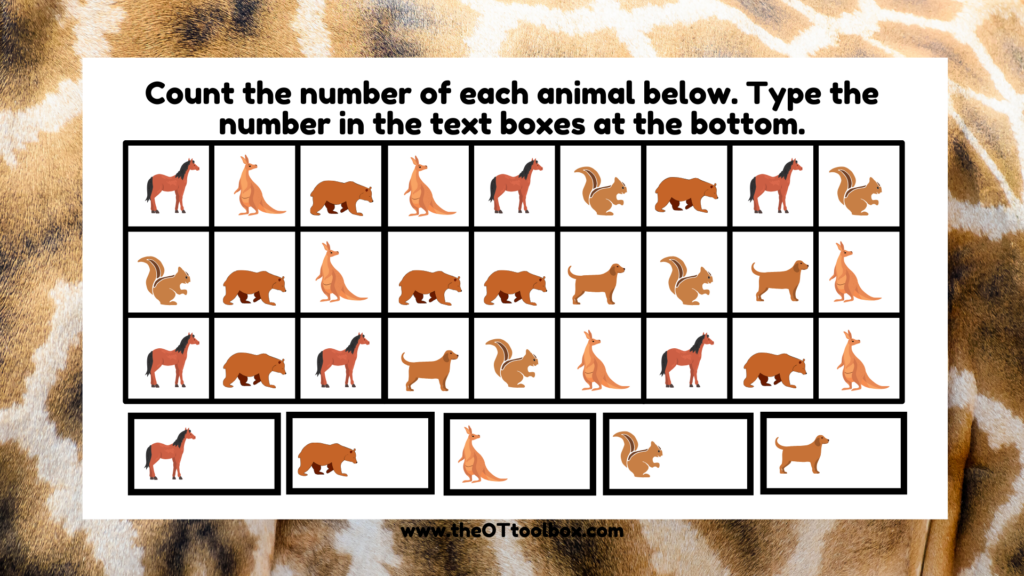
The slide decks in this set are interactive. Kids can click on parts and either type in answers to the visual perception activities or they can click on parts of the slide and move pieces to complete the visual perception task.
Work on specific areas such as visual memory and visual discrimination. Visual discrimination plays a large part in visual memory. Visual Memory is one part of a large arena known as visual perceptual skills. Visual memory focuses on one’s ability to recall visual information that has been seen. Visual memory is also a critical factor in reading and writing.
When a child is writing a word, he must recall the formation of parts of the letter from memory. It can be terribly frustrating for one with a visual memory deficit to perform a handwriting, spelling, or word copying exercise. Children with difficulty in visual memory will have trouble copying letters, words, and sentences from a chalkboard or book.
Difficulties with visual discrimination or visual memory skills may present as very slow handwriting, trouble forming letters, and mixing up letters or words within sentences.
Producing written work on worksheets and tests may be difficult when visual memory is an issue. Recalling sight words in reading exercises can be hard as well as following along in a reading activity during stop and start tasks, due to comprehension and difficulty recalling what was read.
Kids with visual memory deficits can demonstrate difficulty with formation of letters and numbers and appear “lazy” in their written work.
Users can click on the colored circles and move them to cover different forms. With more and more teletherapy sessions and digital activities being used in therapy, children are having to click and drag. This development of eye-hand coordination skills can be a difficult task for some children. Work on practicing with a visual perception component to build skills.
More visual perception activities
Try some of these resources in your therapy activities:
If you are looking for a fun Easter egg game that the kids will love, then you are in luck. Add this activity to your Easter activities and use up a few of those plastic eggs. This color scavenger hunt uses plastic Easter eggs, and it’s a very fun way to play and learn!
Use those plastic eggs to encourage gross motor skills, visual perception, and color learning in a way that kids won’t forget. While the kiddos are playing this Easter game, they are building cognitive skills AND underlying skill areas like visual scanning and other visual perceptual skills.
Easter Egg game
We set this Easter activity up years and years ago. (2013 to be exact!) However, it’s one of those activities that stands the test of time. If you’ve got plastic Easter eggs on hand, use them to build skills like the ones we worked on here!
COLOR SCAVENGER HUNT
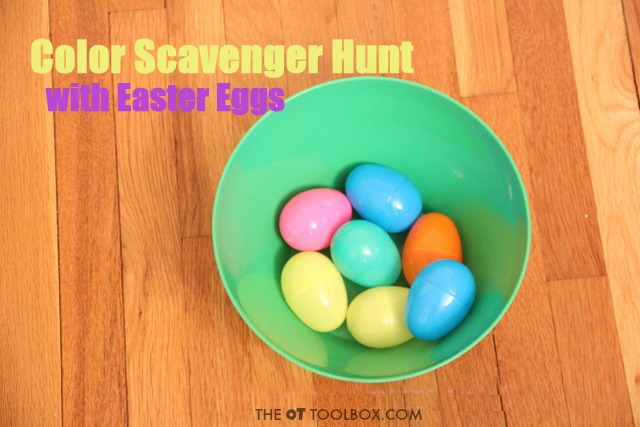
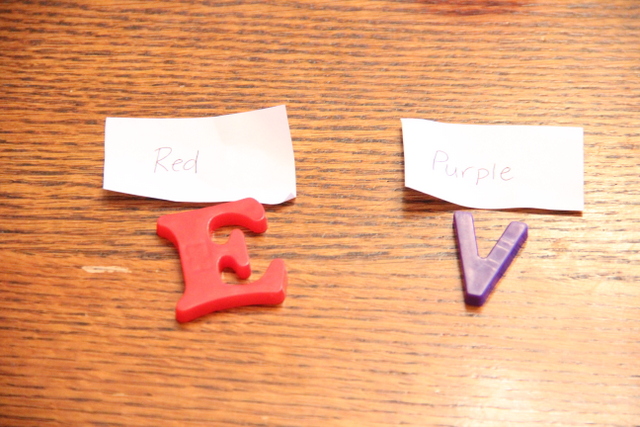
This color scavenger hunt is so easy to set up…and so much fun. Kids can work on identifying color names, and color matching. I wrote different colors on slips of paper and put them into plastic eggs. The kids got to pick an egg from the bowl and “sound out” the color on the slip of paper. Ok, my 5 year old sounded out the color with help. The other two said the first letter of the word and guessed the color. They were pretty excited to “read” the color on their slip of paper!
Another idea to expand this activity is to write words and do an Easter egg version of our word scavenger hunt.
An Easter Game Kids will Love
Now for the egg game…So then, they had to run off and find something that was the color of the written word on their slip of paper…and it had to FIT inside the egg. I sat and waited for them to run back and show me what they found while they tried to fit it in their egg. (completely genius way for this mom to finish a cup of coffee!)
They had a little trouble with some things, but this was a fun and different way to work on visual perceptual skills. Will that little doll fit in the egg? We weren’t sure by looking at it, but with a little fiddling, she did! Fitting the eggs together with the little objects inside was a great fine motor exercise.
Color Identification for Kids
They found something for each color!
Putting items into the eggs and then matching colors was a great way to work on color identification skills.
Matching colors requires visual motor skills to match colors and use that recognition in identifying the name of the color. It’s a skill that requires visual memory as well as working memory. This skill then carries over to so many other areas like letter recognition, and so much more.
This Easter themed play activity could be modified in so many ways for learning words, colors…have fun with it 🙂
Want more ways to play and learn this time of year?
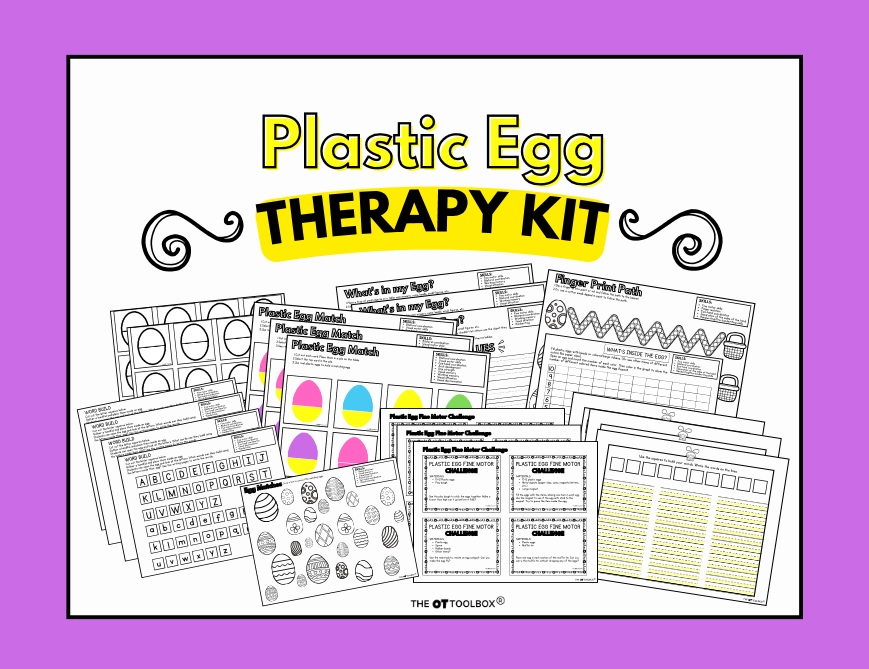
One resource we love is our $5 therapy kit…the Plastic Egg Therapy Kit! It has 27 printable pages of activities with an Easter egg theme. In the kit, you’ll find fine motor activities, handwriting prompts, letter formation pages, pencil control sheets, plastic egg activities, matching cards, graphing activities, STEM fine motor task cards, and more. There are several pages of differentiated lines to meet a variety of needs. This therapy kit has everything done for you.
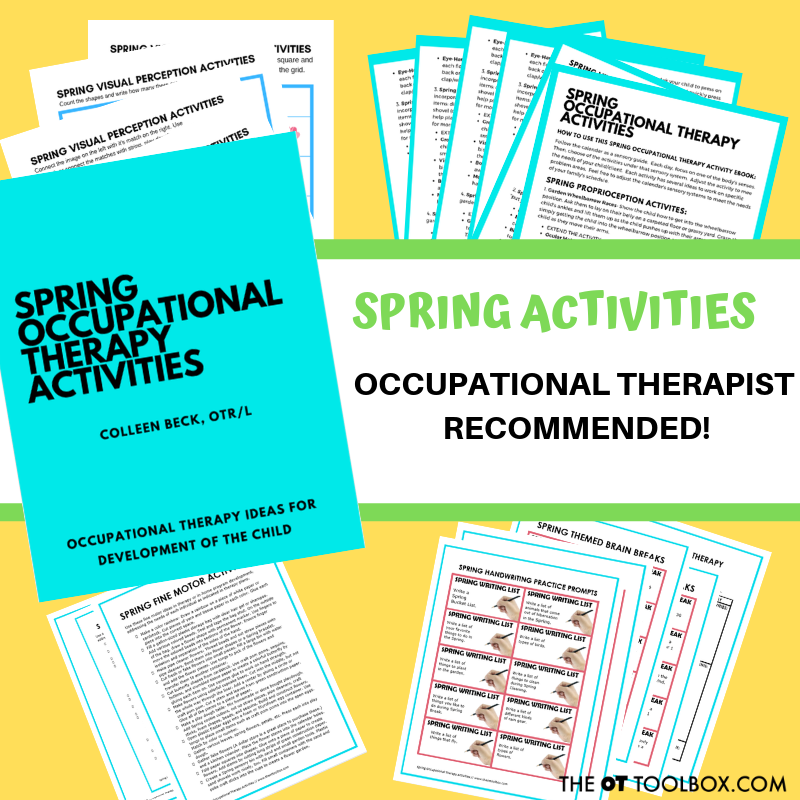
This time of year, one of our more popular products here on The OT Toolbox is our Spring Occupational Therapy packet. The best news is that, this packet has had a major upgrade from it’s previous collection of spring sensory activities.
Another great tool for supporting skills is the Spring OT packet…
In the Spring OT packet, you’ll now find:
Spring Proprioceptive Activities
Spring Vestibular Activities
Spring Visual Processing Activities
Spring Tactile Processing Activities
Spring Olfactory Activities
Spring Auditory Processing Activities
Spring Oral Motor Activities
Spring Fine Motor Activities
Spring Gross Motor Activities
Spring Handwriting Practice Prompts
Spring Themed Brain Breaks
Occupational Therapy Homework Page
Client-Centered Worksheet
5 pages of Visual Perceptual Skill Activities
All of the Spring activities include ideas to promote the various areas of sensory processing with a Spring-theme. There are ways to upgrade and downgrade the activities and each activities includes strategies to incorporate eye-hand coordination, bilateral coordination, body scheme, oculomotor control, visual perception, fine and gross motor skills, and more.
THE BEST THING ABOUT THE SPRING ACTIVITY PACKET:
One of my favorite parts of the Spring Occupational Therapy Packet is the therapist tool section:
Occupational Therapy Homework Page
Client-Centered Worksheet
These two sheets are perfect for the therapist looking to incorporate carryover of skills. Use the homework page to provide specific OT recommended activities to be completed at home. This is great for those sills that parents strive to see success in but need more practice time for achieving certain skill levels. This activity packet is 26 pages long and has everything you need to work on the skills kids are struggling with…with a Spring theme!
Colleen Beck, OTR/L has been an occupational therapist since 2000, working in school-based, hand therapy, outpatient peds, EI, and SNF. Colleen created The OT Toolbox to inspire therapists, teachers, and parents with easy and fun tools to help children thrive. Read her story about going from an OT making $3/hour (after paying for kids’ childcare) to a full-time OT resource creator for millions of readers. Want to collaborate? Send an email to contact@theottoolbox.com.
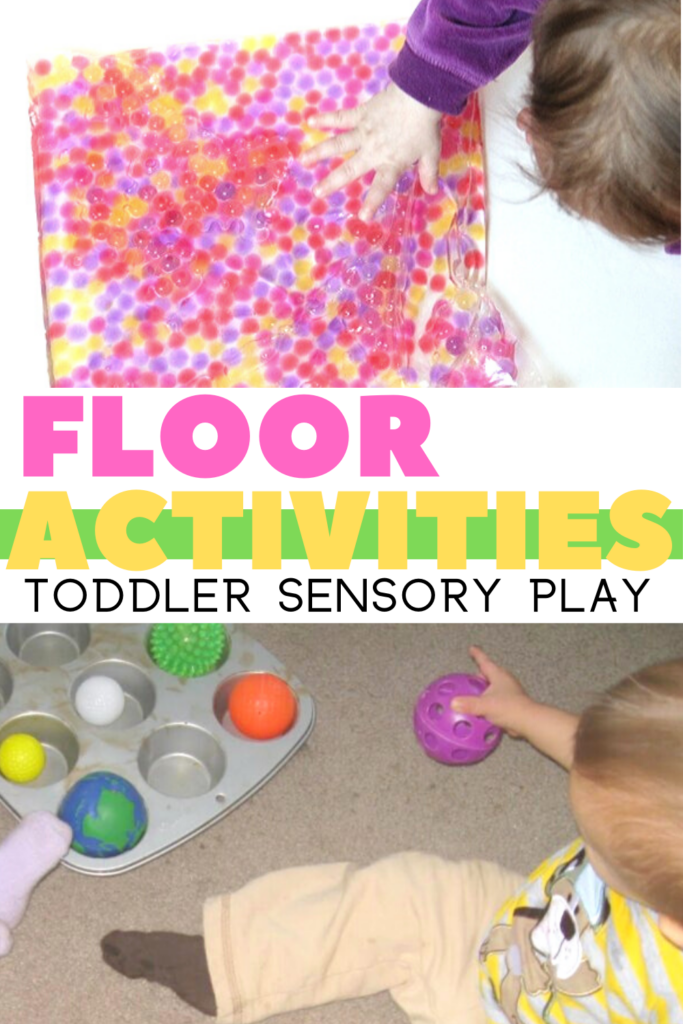
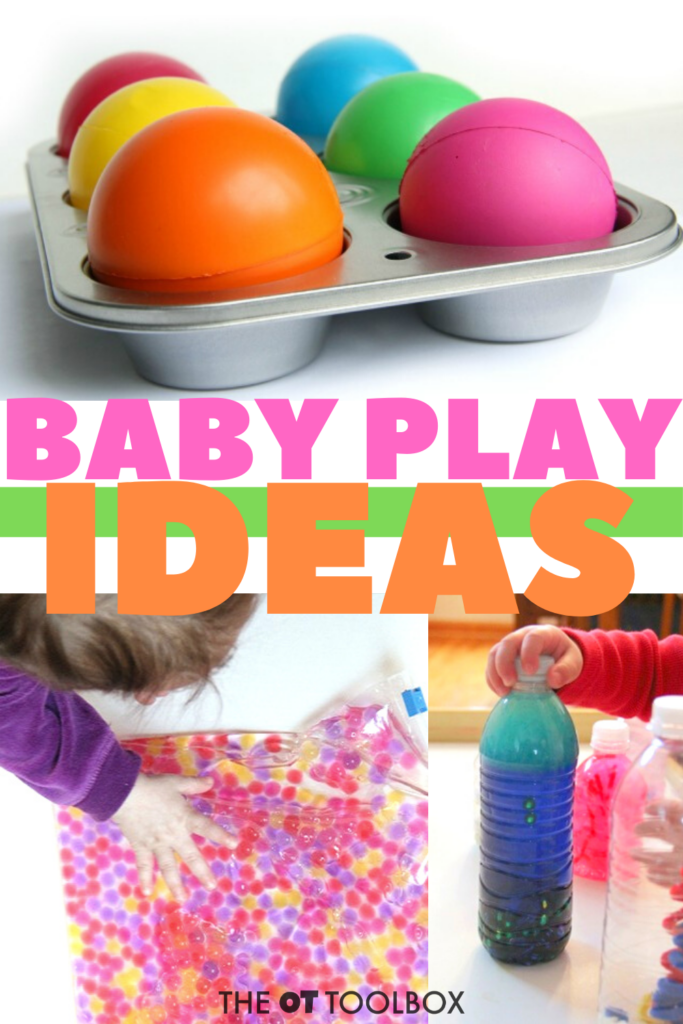
Baby floor play is one of those essential play activities that maybe kids are missing out on more than ever. Here we are talking about why babies need to get down on the floor to baby play, and how to set up floor play activities for babies and toddlers. Baby development depends on movement and play. These ideas will guide you in creating play activities that maximize child development through those early years.
Another great resource to check out is a new blog post on DIR Floortime.
What is Floor Play
Floor play and movement play is one of those things that not only help babies develop essential skills, it is a powerful way to help them excel with higher level tasks. There is so much more than just placing a baby down on the floor to play. Let me explain…
When little ones are on the floor in tummy time or in play activities, they are developing essential core strength and visual perceptual skills that will help them down the road in areas like reading, endurance in play, and even handwriting. Here is more information on how floor play and tummy time helps with the development of spatial awareness and other visual perception skills.
Time spent on the floor helps with kinesthetic intelligence as well. With tummy time play comes skills like body awareness and reasoning, eye-hand coordination, motor skills, and spatial ability for function.
Play For Babies
For babies, tummy time helps to build strength in the core, arms, neck, and shoulder girdle needed for sitting up, changing of positions, and coordination. Here are baby play ideas that can be incorporated into floor time activities. Movement like participating in play, changing positions, reaching, crawling, moving objects, and functional tasks require endurance and stability. Tummy time is an important task for infant babies as well as older babies for different reasons. In each stage, floor play encourages use of the body and eyes in coordinated motor plans.
More Floor Activities for Babiesand toddlers
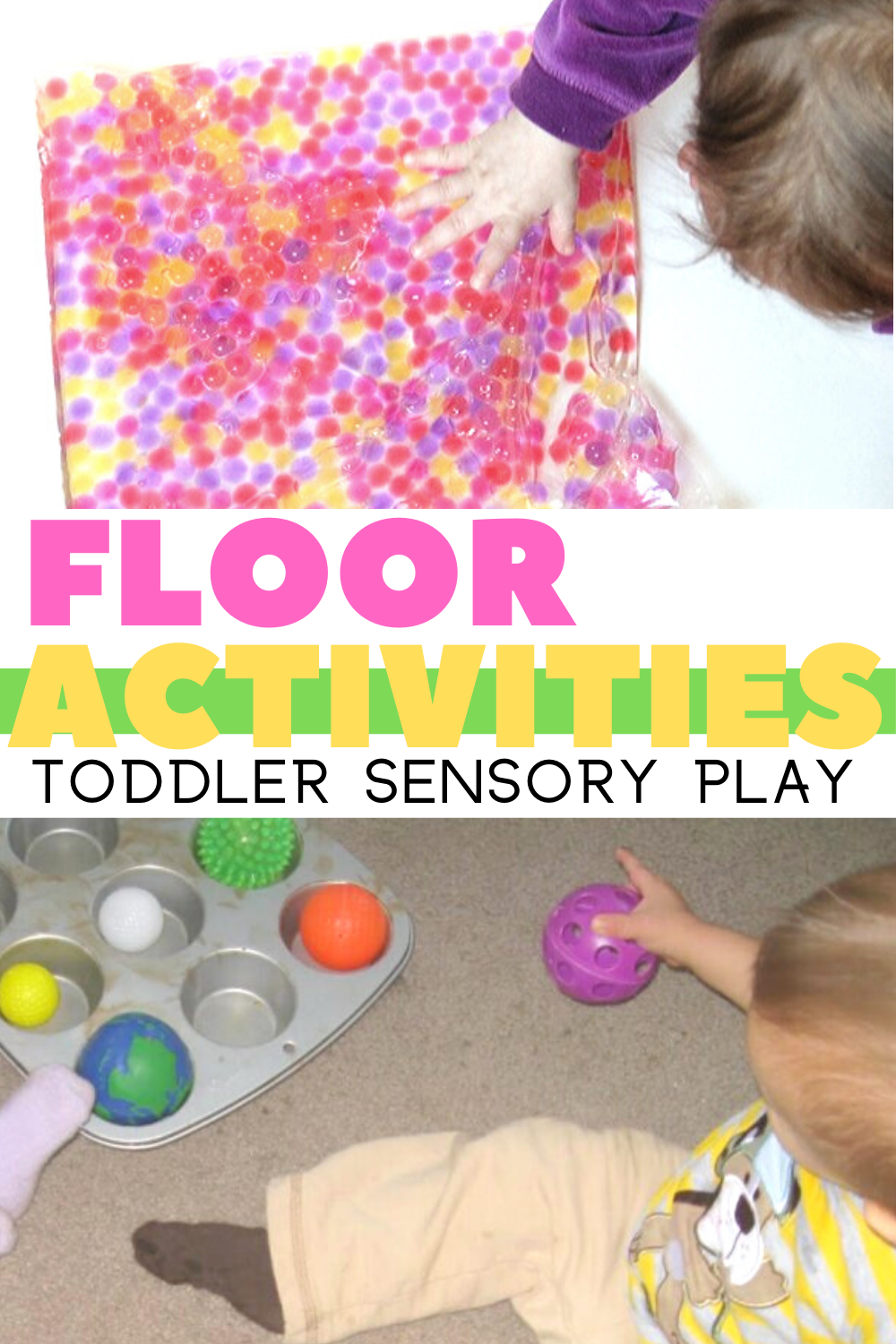
Floor play for babies can look like toys placed in front of the infant. Using noise toys, rattles, and eye-catching toys encourages reach, visual tracking, neck and head movement, and development of visual processing and auditory processing.
Floor play for infants can look like a scattering of toys placed in a circle around the child. This positioning encourages turning, rolling, and creeping or crawling, especially when the little one is pushing up onf their elbows and hands.
For very small babies, floor play can look like getting very close to the child to encourage them to pick up their head and make eye contact.
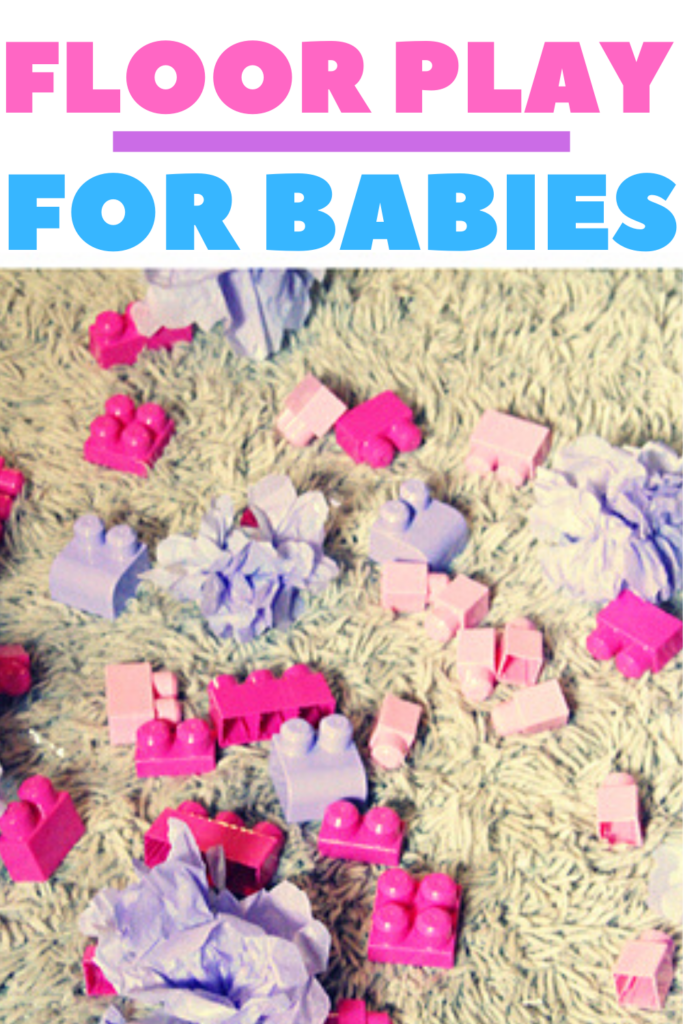
Older babies that are sitting up can benefit from a scattering of toys placed around them on the floor. Place pillows behind and around the baby and encourage them to pick up toys like large blocks as they bring the toy to their mouth to explore. Picking up and bringing items to the midline promotes endurance of core strength, stability in the core, and coordination as they reach and turn.
Playing on the floor can include baby mats or baby-safe mirrors. Check out this baby sensory play idea using mirrors for an easy way to encourage movement and endurance in floor play using everyday items such as cups, balls, and baby toys.
Babies that are beginning to crawl love play tunnels…and for good reason. Baby play tunnels are exciting and fun! But not only that, they develop skills like visual motor skills, cause and effect, visual scanning, visual convergence, and so much more. Here are more play tunnel activities for babies.
Try this indoor play idea that boosts development of skills such as fine motor skills, visual motor skills, and visual perceptual skills using toddler-friendly blocks!
Use large blocks or other baby toys in floor play for babies. Super easy!
Occupational therapists know the value of movement and playing on the floor has on babies. We know that babies need tummy time and a chance to move on the floor without use of the Bumbo seat, swing, and other baby positioners. We KNOW that play is the child’s primary occupation and that through play, they develop motor skills, cognition, language, and so much more.
That’s why I’m SO excited to share a valuable new resource for new and expecting moms.
Remarkable Infants is a HUGE resource for new parents. This online course, taught by 5 child development experts, is a 5 hour crash course on development of the whole child from birth through 12 months of age. It is literally everything that we WISH new parents knew about tummy time, positioners, developmental milestones, baby play, communication, sleep, and nutrition.
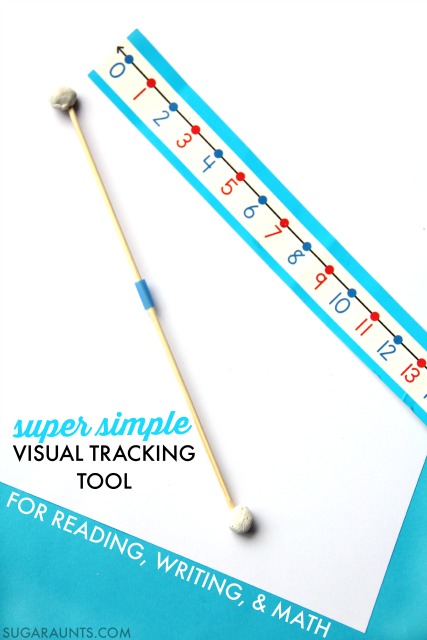
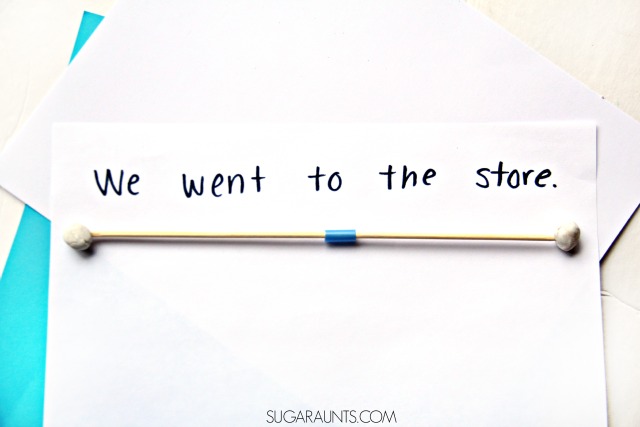
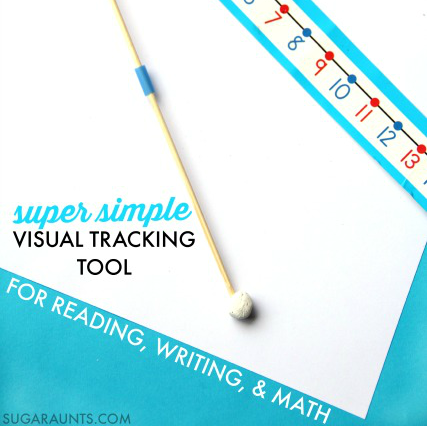
Visual tracking is a skill kids need for reading, handwriting, and learning! Visual tracking activities can help kids strengthen this visual processing skill and in easy and fun ways. We made a Visual Tracking Tool that is an easy DIY occupational therapy activity. It is super easy to make and fun to play with, making it a great way to work on visual tracking skills. We shared an easy way to practice visual tracking with bottle caps not too long ago, and this visual tracking tool will be another creative way for you to work on visual tracking abilities in handwriting, reading, and math number line use.
This tool also support visual closure which is a main aspect of visual perception.
Full Disclosure: This post contains affiliate links.
What is Visual Tracking?
When there are concerns with reading, writing, copying written work, and other issues related to visual processing concerns, understanding what visual tracking means can be an important place to start.
We explained a lot about what visual tracking means here. Visual pursuits are often referred to as visual tracking. When an object moves across a person’s field of vision, their eye movements maintain fixation. Visual tracking occurs when a person’s eyes move along a line in a smooth and accurate manner. When a person moves their eyes, there are two types of eye movements that they use to gather information.
Visual pursuits (tracking) and saccadic eye movements (scanning). Visual tracking can occur with just the eyes moving or the eyes and head in a combined manner. Visual tracking depends a lot on visual attention and fatigue.
Here is more detailed information on saccades and how they impact learning.
Signs of Visual Tracking Problems
A child with visual tracking difficulties might see show of these problems in daily tasks: Loses place when reading. Must use finger to keep their place when reading or when copying a line of text. Skips lines or words often when reading and copying in handwriting. Poor reading comprehension. Short attention span. Moves head excessively when reading.
Homemade Visual Tracking Tool for Bilateral Integration
Using this easy tracking tool requires coordinated movements of both hands together, in coordination with the eyes. integrated movements of both arms and crossing midline is important for laterality and directionality. These are areas needed in writing and reading letters and numbers without reversals.
This visual tracking tool is a great way to practice smooth pursuits of a brightly colored object as it moves in a line across a visual field.
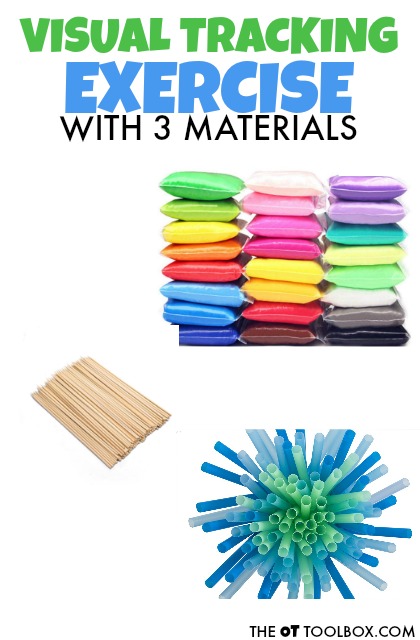
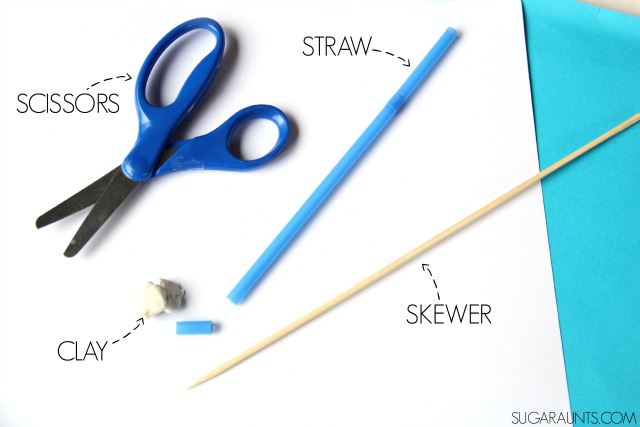
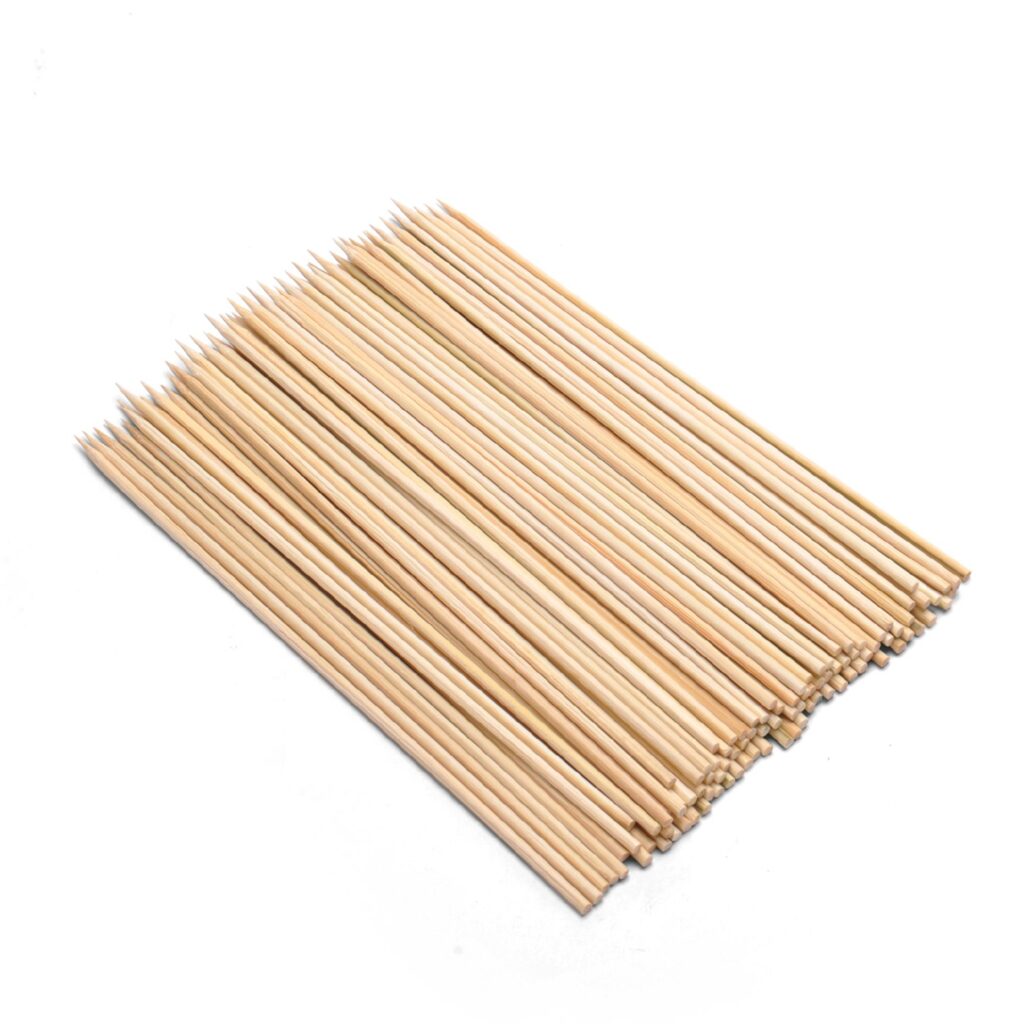
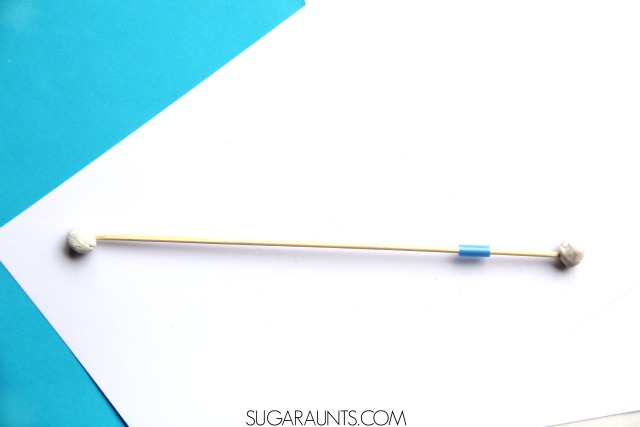
To make your Visual Tracking Tool, you’ll need just a few items:
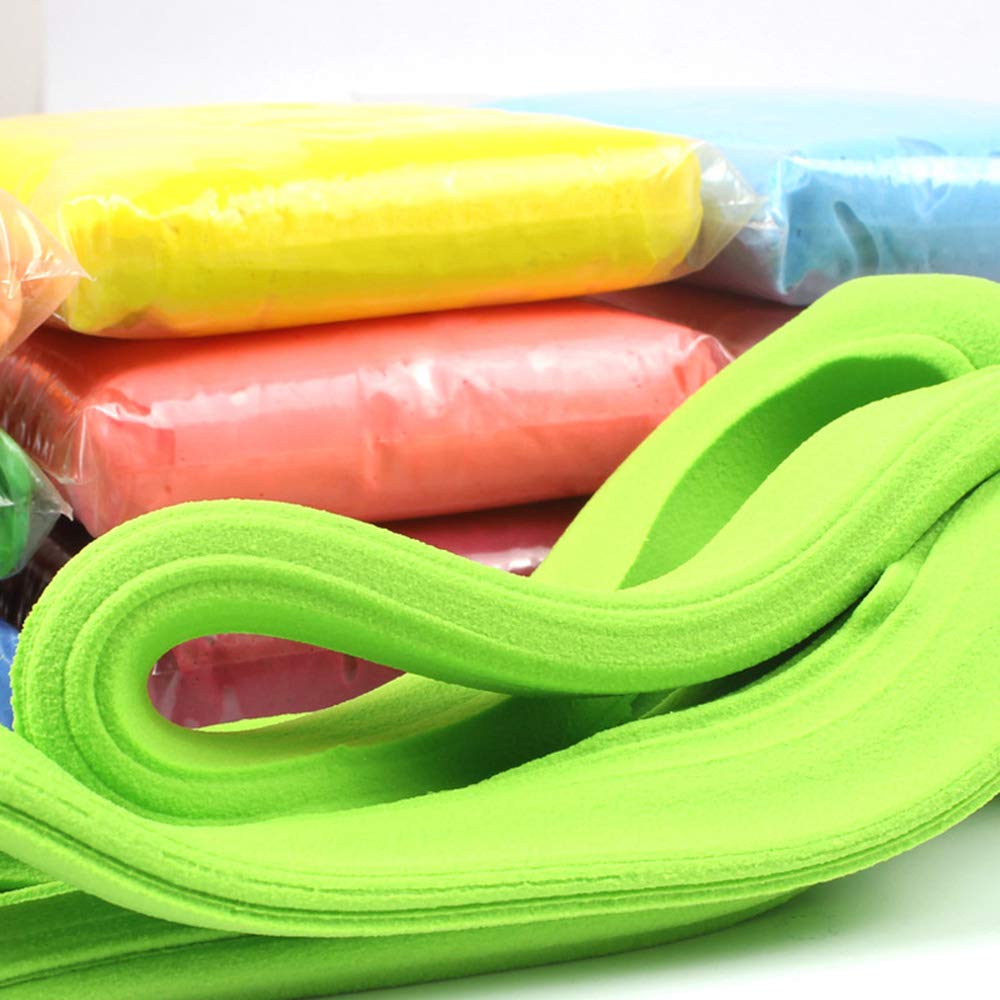
4. Clay (We used a single color, but you could use two different colors to extend the use of this tracking tool. Read more below.)
How to make a Visual Tracking Activity
Cut a small piece from the straw. Thread it onto the skewer. Roll a ball of clay and press it onto both ends of the skewer. Done! You can allow the clay to harden, or use it as is.
How to use this Visual Tracking Tool:
Practice smooth visual pursuit by tilting the skewer from side to side and asking your child to follow the straw with their eyes.
Allow your child to use the tracking tool and ask them to follow the straw with their eyes.
Use the tracking tool in math by placing it along a number line. Tilt the skewer from side to side and when the straw stops at a number, ask your child to name the number. You can extend this activity by asking them to add or subtract numbers that the straw stops.
Align the tracking tool under a number line and use the straw as a movable placeholder while the child counts out addition and subtraction problems on the number line.
Use the tracking tool in reading by placing the skewer under a line of text. Move the straw along the length of the skewer as the child reads the words in the sentence.
Other ways to use this visual tracking tool:
Hold the skewer up horizontally in front of the child. Ask them to look quickly from one clay ball to the other. You can use different colored clay for each end and say “red” for red clay and “blue” for blue clay as they shift their eyes from the red end to the blue end.
Then, hold the skewer vertically and ask your child to quickly look from the top ball to the bottom ball.
Finally, hold the skewer in a diagonal position and ask them to quickly look from one ball to the other.
See it in action in the video below.
You will love these visual tracking activities
These Visual Tracking Games and activities are a big hit in therapy or at home. Use them as part of an occupational therapy home program or in therapy planning.
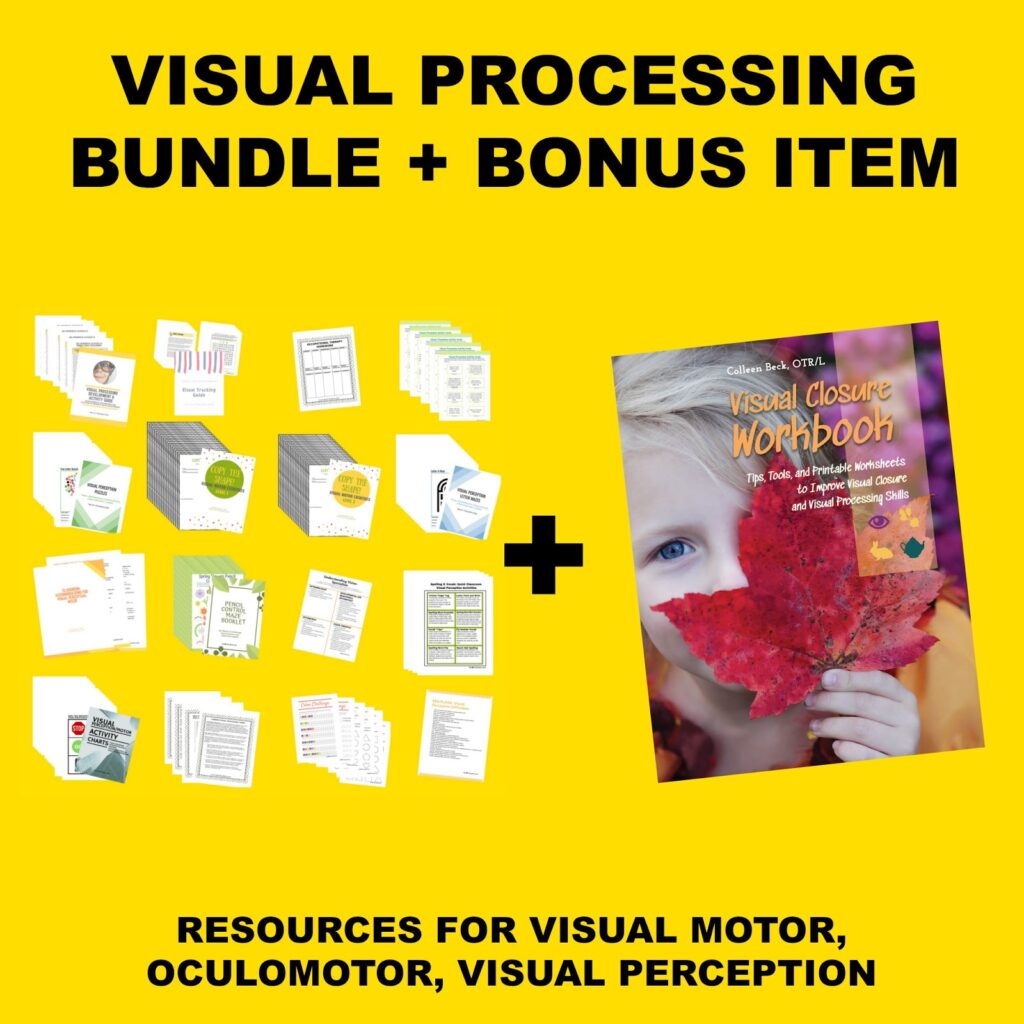
For more information and specific activities that can address visual attention in fun and meaningful ways, grab the Visual Processing Bundle. In it, you will find 17 digital products, ebooks, workbooks, and guides to addressing various aspects of visual processing, including visual attention. The bundle is valued at over $97 dollars for these products, and includes over 235 pages of tools, activities, resources, informaton, and strategies to address visual processing needs. For one week, the visual processing bundle is on sale at $29.99. Grab the Visual Processing Bundle HERE.
Visual processing impacts everything we do! When kids struggle with things like writing on the lines, managing buttons, catching a ball, or finding a missing shoe in a messy room…visual processing skills are at play. The thing is, the components of visual processing are more than meets the eye (literally)!
Free Visual Processing Lab
Visual processing involves several areas like oculomotor function, visual perception, and visual-motor skills. These underlying areas make all the difference in skills like handwriting, fine motor skills, learning, reading, functional tasks…everything!
What if I told you that there is a new resource available through The OT Toolbox. The Visual Processing Lab is here! It’s a short email series that covers everything you need to know about visual processing. And you can join us!
The best thing about this email lab (besides the lab theme references) is that you will leave with tools you need to better understand visual processing. When you join us in lab, you’ll get a free 15 page lab book that is your guide to understanding visual processing.
In visual processing lab, we’ll cover:
The Big Picture of Visual Processing (including definitions)
Taking a closer look at visual processing (including specifics and “red flags”)
Experiments, Interventions, Reflection on the lab contents. We’ll also do two hands-on experiments as part of the lab, and intervention ideas.
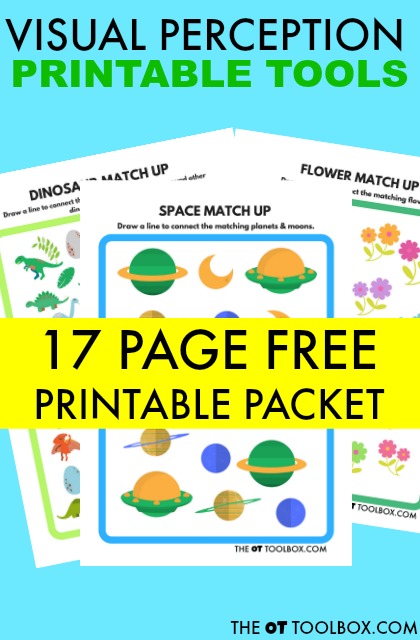
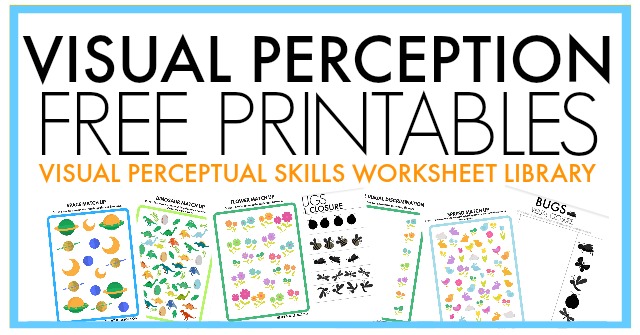
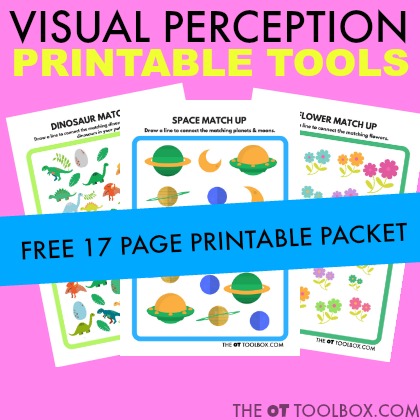
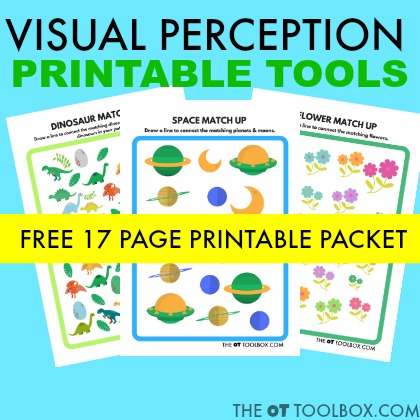
These free visual perception worksheets are just the resource you need to work on visual skills like form constancy, visual discrimination, visual closure, and more. Visual perception is an area that drives so much of what we do. For kids who struggle with visual perceptual skills, so many areas are impacted. Visual perception impacts reading, writing, learning, comprehension, visual motor skills (including copying written materials), fine motor work, gross motor skills, eye-hand coordination, and even social emotional skills! It’s amazing how this one area can impact so many areas of a life and functioning. Because some f our popular free visual perception worksheets have been used by so many therapists, I wanted to pull these resources together into an easy to access visual perception worksheet packet! This is it! Your 17 page packet of free visual perception worksheets can be accessed below.
Free Visual Perception Packet
Visual perception is made up of several areas that are crucial to development, learning, and functioning. Visual attention, visual spatial relations, visual closure, visual discrimination,
That’s why I wanted to bring to you a valuable resource when it comes to understanding visual perception AND visual processing skills.
Below, enter your email in the form box and the visual perception worksheets packet will be delivered to your inbox. I need to send it via email as the packet is a large file. This one form will get you the entire 17 page packet, where the other forms on the other pages in this packet will deliver just one page. I am working behind the scenes to edit all of the other posts in this series of free worksheets so they deliver the big packet.
I wanted to pull all of the worksheets together (along with a few new ones added to the bunch) to create a 25 page packet of visual perception worksheets.
In the packet are a few themed visual perception worksheets. You’ll find reproducible sheets to address figure-ground, form constancy, visual discrimination, as well as oculomotor skills like saccadic movements.
Visual Perceptual Skills and worksheets
Some of the worksheets included address: Visual Figure-Ground
Visual Attention
Form Constancy
Visual Discrimination
Visual Memory
Sequential Memory
Visual Closure
Visual Spatial-Relations
…as well as eye-hand coordination needed to complete pencil control exercises.
All of the worksheets are similar in style, making them a great collection for YOUR therapy toolbox!
For now, grab your visual perception printables, and start working on those visual skills!
Enter your email to get the worksheet packet and BIG NEWS on an upcoming visual perception resource.
Be sure to watch for more news on an upcoming visual processing resource. It’s going to be BIG!
I’m so excited to share more information with you very soon. It’s going to be gooooood!
More Information on Visual Perception Worksheets:
For more information on the worksheets in this free packet, check out these posts describing some of the worksheets included in this packet of free visual perception worksheets:
If you are looking for more visual perception worksheets, you’ll love everything in the Visual Processing Bundle!
The Visual Processing Bundle has everything you need to work on underlying visual processing skills so you can help students with classroom tasks like copying written work, letter reversals, and messy handwriting in fun and engaging ways!
Over 235 pages of workbooks, worksheets, e-books, handouts, activity cards, tracking tools
For even MORE information on visual perception and activities to use in your occupational therapy practice, you will want to join our free visual processing lab email series. It’s a 3-day series of emails that covers EVERYthing about visual processing. We take a closer look at visual skills and break things down, as well as covering the big picture of visual needs.
In the visual processing lab, you will discover how oculomotor skills like smooth pursuits make a big difference in higher level skills like learning and executive function. The best thing about this lab (besides all of the awesome info) is that it has a fun “lab” theme. I might have had too much fun with this one 🙂
Join us in visual processing Lab! Where you won’t need Bunsen burners or safety goggles!