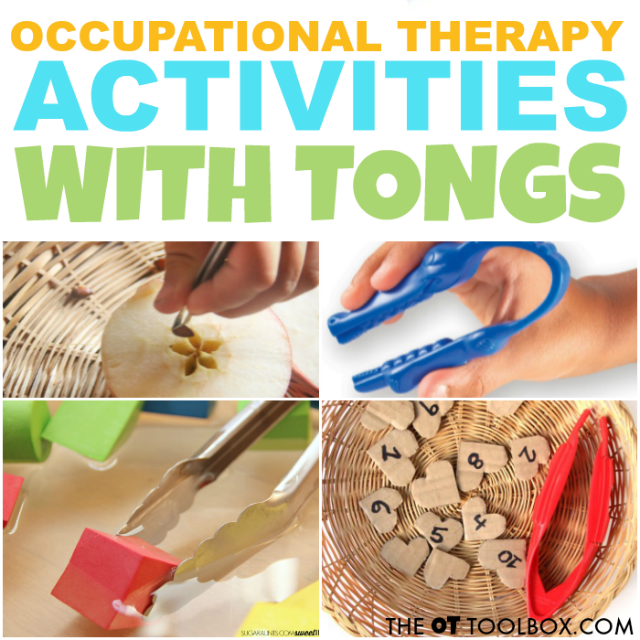
Occupational Therapy Activities Using Tongs

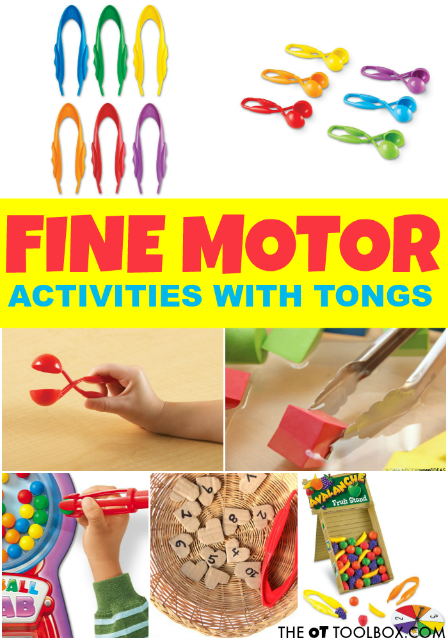
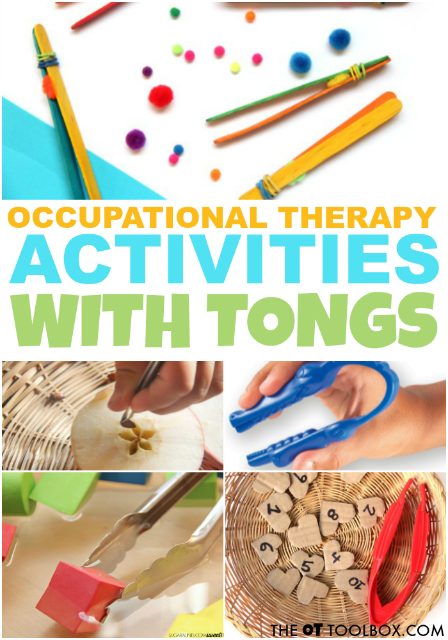
If you are looking for ways to help develop fine motor strength, coordination, pencil grasp, and endurance in functional tasks using the hands, these tong activities are the way to go. One item that a pediatric occupational therapy practitioner always has is a pair of tongs. That’s because there are so many ways to support sensory motor skills with this one fine motor tool.

Tong Activities

One of the most popular posts here on The OT Toolbox is our 31 Days of Occupational Therapy Activities. It was a couple of years back that we shared 31 different occupational therapy activities using free or inexpensive materials. Since then, so many of you have checked out that list of activities. I wanted to expand on that series and add to your therapy toolbox using items you probably already have in your therapy bag. For that reason, we’ll be sharing lots more lists of therapy ideas using common items.

Today, we’ll be talking about tong activities…or occupational therapy activities using tongs.

Tongs are a great tool for promoting and improving fine motor skills! Occupational therapy activities using tongs can strengthen fine motor skills!

Occupational Therapy Activities Using Tongs 

Most therapists probably have a pair of tongs in their therapy closet or therapy bag. There’s a reason why! Tongs are so very versatile when it comes to occupational therapy activities. They can be used in a variety of tasks and play activities that develop strength, an open thumb web space, bilateral coordination, crossing midline, shoulder and wrist stability, arch development, separation of the sides of the hand, visual motor skills, eye-hand coordination, direction-following, and SO much more!

Check out the activity ideas using tongs below for fresh ideas that can be used in treatment with many individuals.

These tong activities would be a great addition to summer occupational therapy activities and home programs!

Occupational Therapy Activities With Tongs

Use tongs to work on intrinsic hand strength and visual motor skills.

Make your own DIY Tongs with craft sticks! So fun and always a hit in our house.

Tongs can be helpful in increasing the graded grasp and release needed for controlling scissors when cutting. These bunny tongs were used to promote scissor skills.

Kids can work on eye-hand coordination with tongs. The nice thing about an activity like this one is that a variety of tongs can be used based on the child’s age, fine motor skills, development, or the goal of the activity.

Go small-scale and use a set of tweezers or mini tongs to remove seeds from apple slices.

Tongs can be added to an occupational therapy activity kit depending on the needs of children on a caseload. Use those tongs to address many different needs and underlying skills!

Incorporate tongs into play to address fine motor skills. Use the fine motor tool in a variety of play experiences.

Use mini erasers in counting, sorting, and learning like The Crafty OT.

Use tongs to manipulate and move strands of yarn in a pasta pretend play activity like Ever Never Again. What a fun activity!

Use cut straws and tongs to strengthen fine motor skills like Mess for Less.

Try these occupational therapy activities using tongs to improve many fine motor skills needed for tasks like handwriting, clothing fasteners, and scissor skills!

How can Occupational Therapy Activities Using Tongs Help with Development? 

Adding a few tong activities to your therapy line up can help in SO many ways!

Motoric Separation of the Two Sides of the Hands- Separation of the two sides of two sides of the hand is important for tasks like holding a pencil while stabilizing the hand along the table, cutting with scissors, and managing coins, among other activities.   

Refinement of fine motor skills in the hand (the radial side) happens when the power half (the ulnar side) is stabilized.  A functional fine motor grasp and manipulation of objects is more accurate when the ring and pinky fingers are flexed (bent) into the palm.    This positioning stabilizes the MCP arch and allows for control of the pointer and middle fingers. Separation of the two sides of the hand allow for more precise use of the thumb. Hand separation starts when a baby bears weight through their arm and ulnar side of the hand while carrying a toy in the radial side.     This simple activity developmentally lengthens the muscles of the ulnar side.   

Hand Dominance-Hand dominance in children is important for refining the skills needed  to perform functional tasks.  While Toddlers begin to show a hand preference, a true hand dominance doesn’t typically develop until 2 to 3 1/2 years.  A toddler can show a hand preference, however hand usage is many times, experimented with during different activities throughout the Toddler and Preschool years.  There is typically variability in hand preference as toddlers and young preschoolers poke, pick up, throw, color, and play.    Another consideration is that oftentimes, kids of this age are influenced in which hand they choose by position of toy, location of the adult or playmate, method materials are presented, and sitting position of the child.    

Lateralization refers to the brain’s ability to control the two sides of the body.  Each hemisphere of the brain controls different tasks and functions.  When a child shows difficulties with laterality, they might switch objects between the two hands in functional tasks.  As a child grows, they are challenged to become more efficient with tools in school.    True hand dominance may not be completely integrated in the child until around 8 or 9 years of age. Occupational therapy activities using tongs can help to build consistency with the child’s preferred hand dominance.     If your child shows a preferred hand, set up the activity to work on tong use with the typically used hand.    

Open Thumb Web Space- An open thumb webspace is essential for true 
opposition of the thumb to the precision side of the hand.  A round “O” shape 
allows the thumb to rotate and oppose the pointer finger in pincer grasp activities.     When kids write or color with that web space area squashed shut, it’s a sign of problems. There may be compensation for thumb instability, underdeveloped hand arches, and/or poor strength.  Each of these problem areas will lead to difficulties with handwriting, dexterity, manipulation of small items like beads, and pencil grasp.    Activities using tongs can help with development of an open thumb web space.   

Precision of Grasp- Precision skills allow a person to manipulate and release of small objects.  Precision provides efficient grading movements in very small dexterity patterns like threading a string through a needle.    

Difficulty with precise motor movements of the hand may cause fumbling with zippers and buttons and trouble with advancing the pencil on small lines of paper. Precision occurs with development of grasp when child to use the pads of the index finger, middle finger, and thumb to manipulate objects with opposition.    Occupational therapists can promote precision of grasp with activities using tongs in occupational therapy activities.  

Pinch Strength and Control- There are a few different grip positions of the 
hand and fingers that are used in play with children.  Difficulties in using and 
maintaining any certain grasp may interfere with tasks that require using the 
hands.  Types of grasp patterns that can be addressed using tongs include:   

  • Lateral Pinch Grip (aka Key Pinch Grip)- The thumb opposes the lateral side of the pointer finger.  This grasp is used when holding and and using a key. A sub group of this type of pinch is the 
  • Lateral Prehension Grip– The thumb is flexed (bent) and it’s pad opposes the lateral side of the tip of the pointer finger. This grip is used to hold an index card or paper, sometimes.
  • Three jaw Chuck Pinch Grip– The thumb is flexed (bent) and opposes the pads of the pointer finger and middle finger. Holding a small cap like a toothpaste lid uses this grip. This is the grip used in holding a pencil.
  • Tip to Tip Grip– The tip of the thumb touches the tip of the pointer finger.  The thumb and pointer finger form an circle (or open thumb web space). This grasp is also called a pincer grasp.  It is used to pick up small items like cereal or beads.  If very small items are picked up (like a needle), a Neat Pincer Grasp is being used.
  • Lateral Grip– Pinching an item between the pointer and middle fingers use this grip.  You would use this grip in holding a cigarette.  While this is not a functional grasp for kids (obviously), you might see kiddos fiddle with a pencil by holding it between two fingers.

Gross Hand Strength and Grasp- Gross grasp is used when squeezing all of the fingers shut around an object, like when holding the handle of a suitcase.  Gross grasp is important in tasks like handwriting and scissor use.  To do these activities, you need to squeeze your whole hand shut and maintain endurance to complete the activity.    

Development of hand arch and thumb web space is important for these functional skills and gross grasp plays a part.    

Occupational therapy activities using tongs can address hand strength by increasing repetitions or smaller object manipulation with a variety of tongs.  

Thump Opposition- Thumb opposition occurs when the thumb is rotated at the
carpometacarpal joint.  Opposition of the thumb to the fingertips is essential 
for tasks such as holding a hairbrush, managing buttons, and even grasping a door 
knob.   Thumb opposition coincides with an open web space in functional tasks.   Tongs can be used to address thumb opposition by ensuring rotation of the base of the thumb and curving of the palmar arches. Occupational therapy activities using tongs can promote  these skills.  

Palmer Arches- In the palm of the hand, there are arches that shape the hand’s grasp on objects of all shapes and sizes.  There are two transverse arches that cross the hand at the carpals and at the metacarpals.  There is a longitudinal arch for each finger. These arches allow for skilled movements of the hands and first develop during crawling.  Arch development is essential for manipulating small objects such as a writing utensil.  

Bilateral Coordination- Bilateral coordination is the functional use of the two hands together in a coordinated manner.  It’s coordinating both hands together and is closely related to hand dominance. When a child has an established hand dominance, there needs to be a fluid use of the two hands together.    

In development of the child, children use both hands together then progress to using  one hand at a time and finally using both hands together.  
Refined bilateral coordination skills allow a child to use both hands in separate tasks fluidly.   Use tongs to promote bilateral coordination by asing kids to support a bowl or cup while manipulating or moving small items with tongs with the dominant hand.     

Wrist and Hand Development- A prerequisite to controlled movements of the hand and fingers are strength and stabilization of the wrist.  Control in the wrist allows for manipulation of small items and grasps with the fingers.   

A functional position for the wrist  in most activities requiring fine motor skills is slight extension and neutral positioning.  


This is an optimal position for handwriting or tasks such as manipulating tongs.  
Other activities like using a toothbrush or managing a utensil during feeding require slight ulnar deviation. Stabilization of the wrist is essential in play and learning activities. 


In order to allow precision of fine motor tasks, the wrist should be stabilized in extension with precision tasks performed on a vertical surface, putting the wrist into optimal positioning and facilitating thumb abduction for distal work to the fingers.

Use tongs to promote fine motor skills like these occupational therapy activities using tongs.

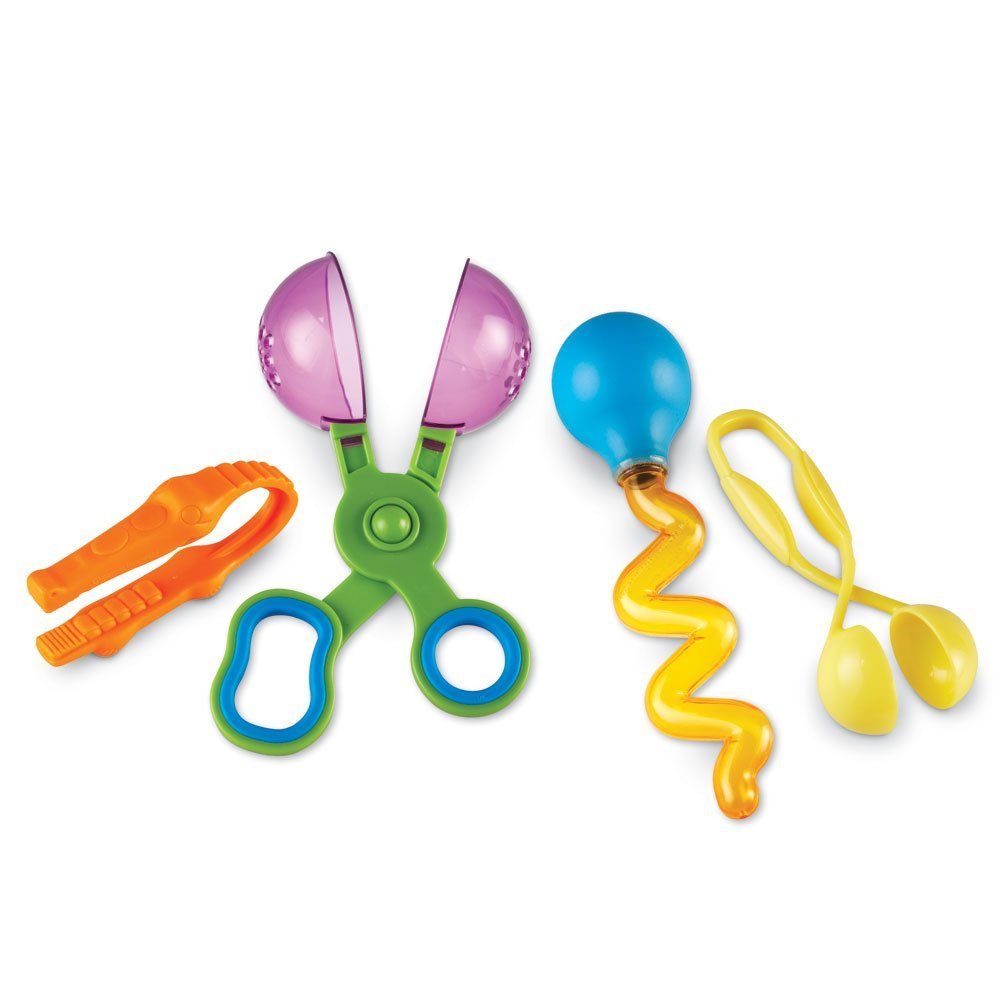
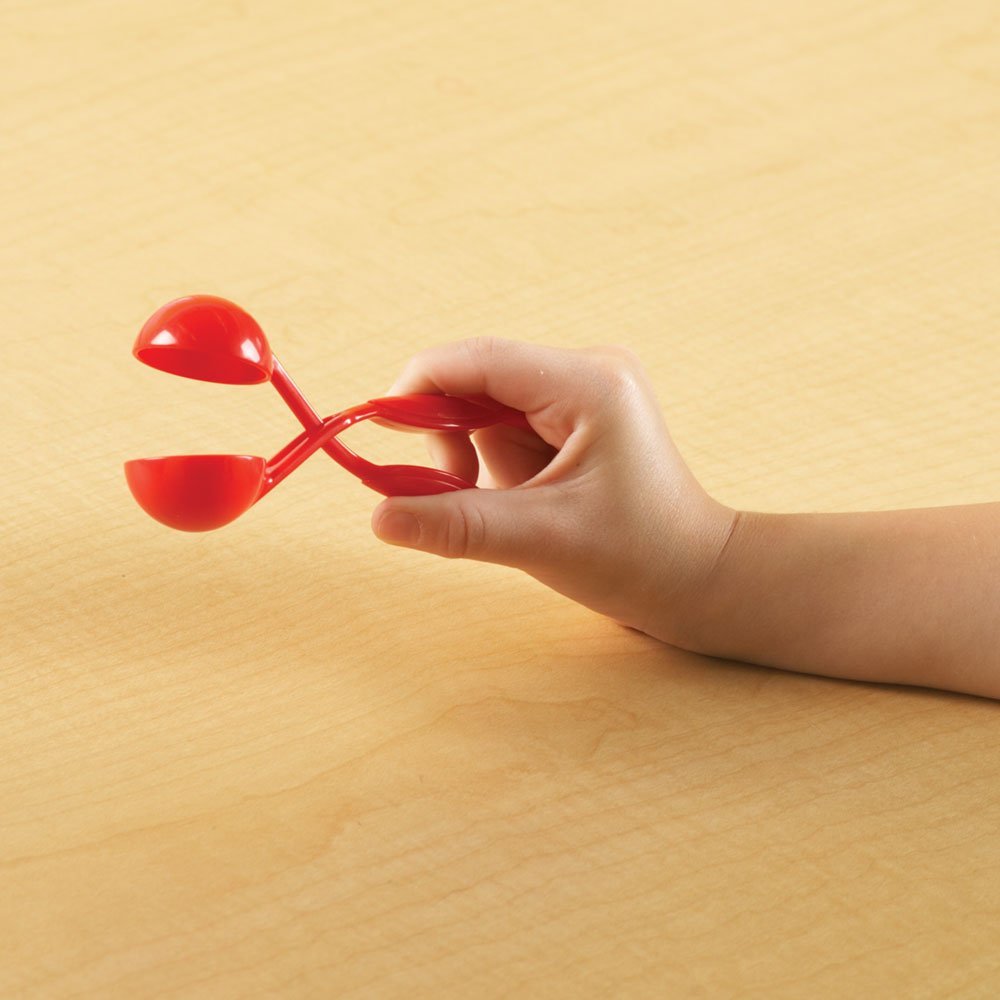
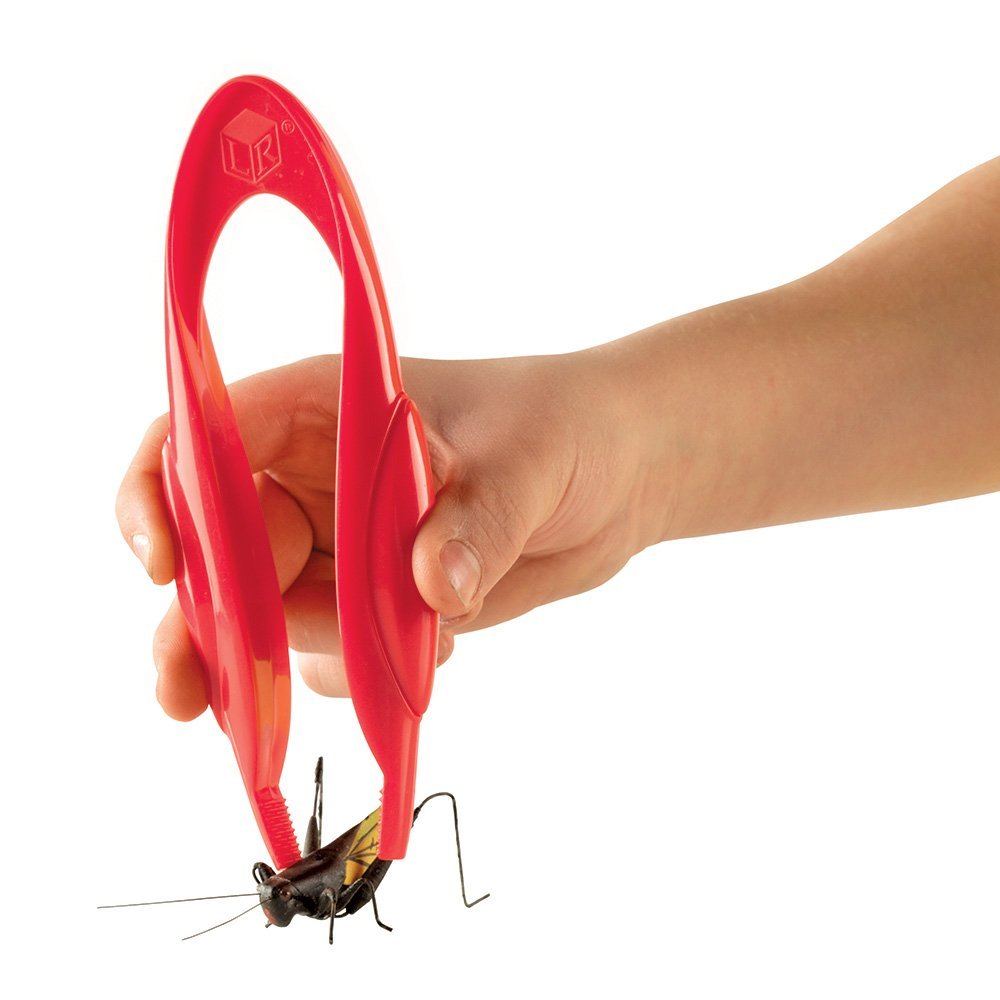
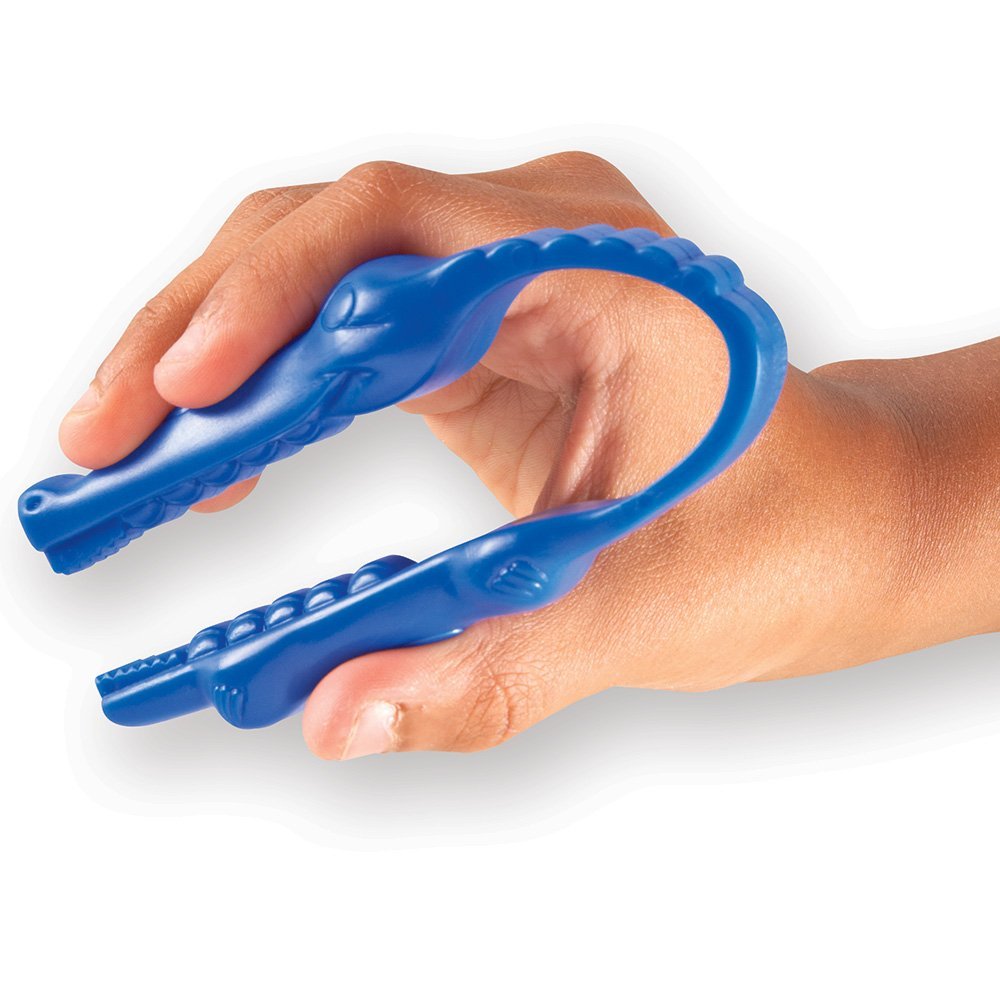
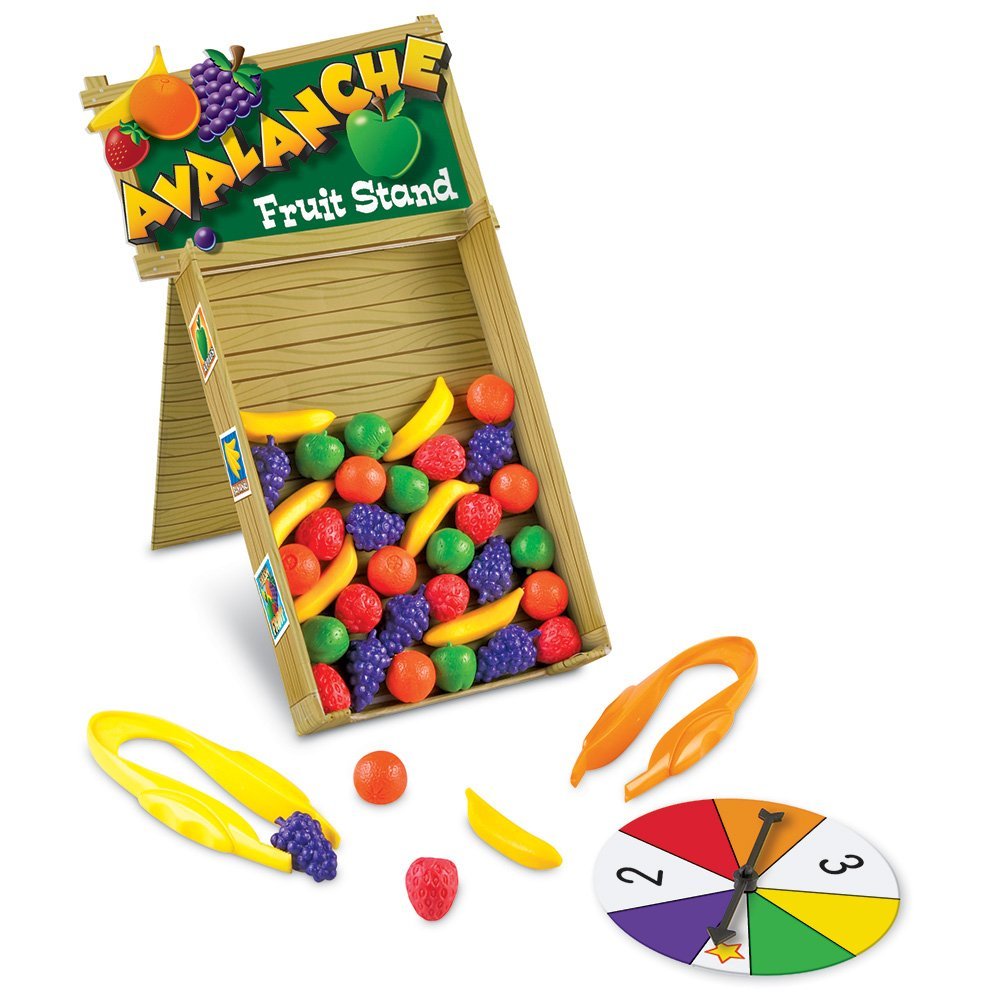
Best tongs for promoting fine motor skills in Occupational Therapy Activities


Amazon affiliate links are included below.


Occupational Therapy Activities Using Tong Games


Use tongs to promote fine motor skills like these occupational therapy activities using tongs.
 

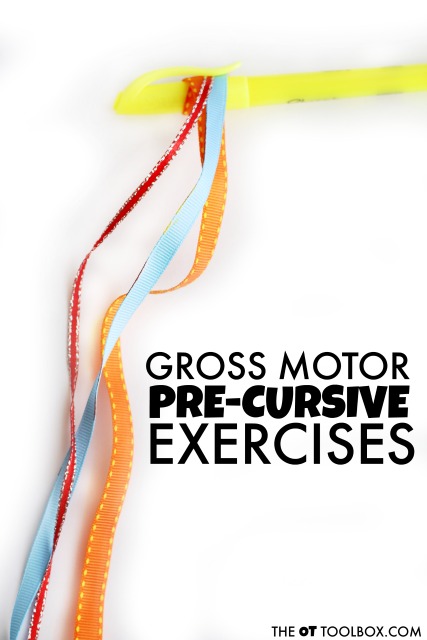
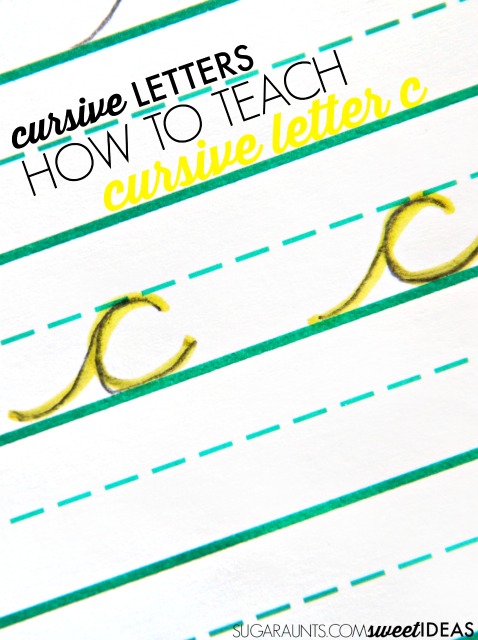
Gross Motor Cursive Writing Warm-Up Exercises

Today in the cursive handwriting series on The OT Toolbox, we’re talking all about gross motor activities and gross motor cursive writing warm-up exercises that can be used to work on and teach cursive letter formation. These are fun activities that can be used with kids who haven’t even yet attempted to write their first letter in cursive. 


If you are teaching cursive writing to a student, this cursive writing series is for you. 


If you are concerned about how to teach cursive writing to students, then this cursive writing series is for you. 


If you are you a therapist who is looking for strategies and creative ideas to help students improve cursive writing as a means of functional and legible handwriting, then this cursive series is for you. 


Below, you’ll find ways to teach cursive writing by addressing the motor plan and verbal cues needed for cursive letter formation in a playful and fun way.


Cursive writing strategies to help kids learn to write in cursive, and this gross motor cursive warm-up exercises are perfect for teaching kids to write in cursive!
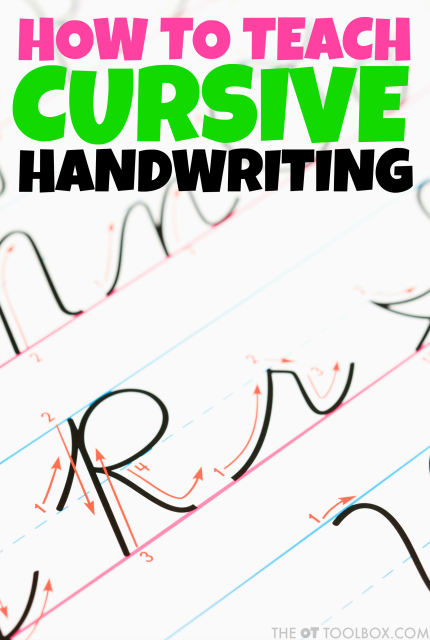
This post and the posts you’ll see here over the next month are part of our 31 day series on teaching cursive. You’ll want to check out the How to Teach Cursive Writing page where you can find all of the posts in this series. For more ways to address the underlying skills needed for handwriting, check out the handwriting drop-down tab at the top of this site.

For resources in handwriting, join us in the Sweet Ideas for Handwriting Help Facebook group.


Gross Motor Cursive Writing Warm-up Exercises


One strategy for teaching cursive writing is using a warm-up program with gross motor movement activities. This is an easy way to get kids moving and ready to focus on cursive writing practice. The large motor cursive writing exercises described below can be used with kids who haven’t yet started on cursive writing instruction. They can also be used at the start of each cursive practice session as a warm-up tool. 

An added bonus for the classroom teacher is that these activities can be a much needed brain break activity during the school day.

Introduce the cursive motions needed for letter formation using large motor patterns. This can be done in a variety of creative ways (described below). Students who are learning a new series of letters or new cursive letter family can practice the movement patterns using large motor or gross motor exercises.


TIP: Try teaching groups of letters together based on the components of the letters. Teaching cursive letters by their cursive letter families can help kids learn letter formation and with carryover.

Gross Motor Exercises for Pre-Cursive Writing


Gross motor cursive warm-ups can be done as a class or individually.  For kids who are not yet learning cursive writing, use the gross motor cursive writing warm-up exercises as an introduction for verbal prompts they will hear as they begin to learn letters.

Instruct children to complete the exercises using a model and with consistent verbal cues. Verbal cues should be the prompts that will be used for cursive letters (i.e. “Start at the bottom. Swoop up. Trace back down. Stop. Swing away.”) Repeat a series of motions needed for a specific letter family or letter. 

The teacher or therapist should stand in front of the students with their back facing the students so that the motions are consistent and the class is able to copy the large motor motions. 

Instruct students to continue with a set of loops, scalloped motions (such as forming a series of lowercase cursive “u’s” in the air), or bumps (as in forming a series of lowercase cursive letter “m’s” in the air.)

Children can move their arms through the air as they practice writing the cursive letter family strokes. Then move onto individual letters. Try using some of the ideas below to work on gross motor motions for introducing cursive letters.

Gross Motor Cursive Writing Activities

Cursive writing strategies to help kids learn to write in cursive, and this gross motor cursive warm-up exercises are perfect for teaching kids to write in cursive!


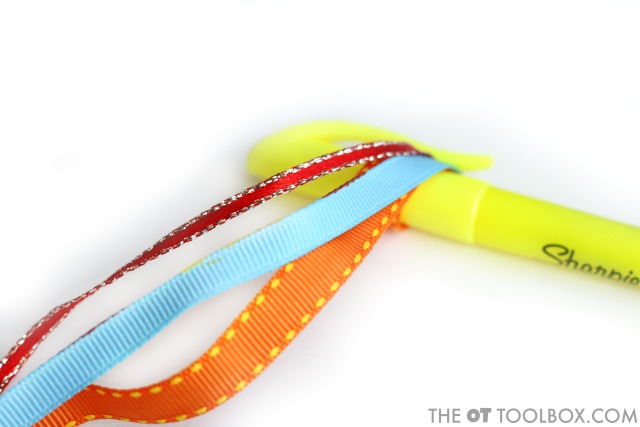
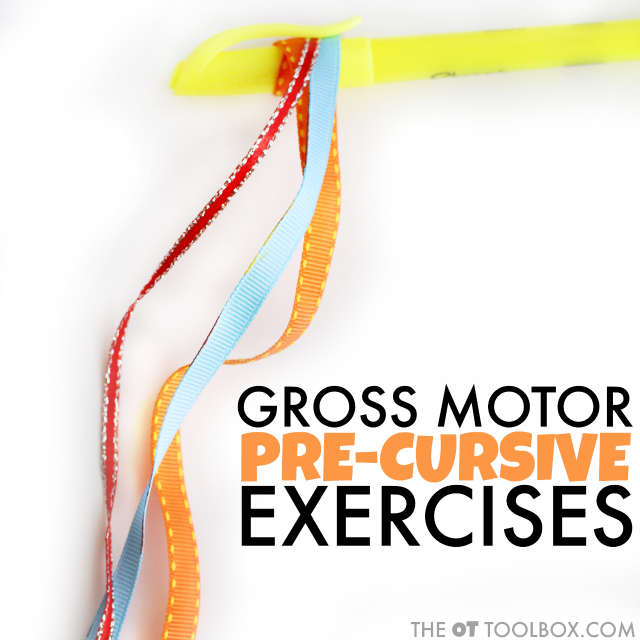
Use a movement stick with a ribbon attached to a dowel rod. This is an easy do-it-yourself craft that kids can work on together and to get excited about learning cursive. Or, use a highlighter or marker with a lid. Tie long ribbons in a knot under the lid of the marker. This is a fun activity for the whole class.


Allow each student to use a pencil with the eraser side pointing out into the air, as if the pencil were a wand. Ask them to hold the pencil tip in their hand and use the pencil wand to form letters or cursive family strokes in the air.


Students can use a paintbrush on a chalkboard to draw letters in water. Ask them to draw large movements.


Children can hold a feather to draw letters in the air. 

Students can use their finger to work on cursive connectors or cursive family strokes on the back of another student.


Use a writing tray with a variety of sensory mediums.


As noted above, be sure to use consistent verbal prompts when using gross motor cursive writing warm-up exercises. 

Don’t forget to try all of the cursive writing strategies in the How to Teach Cursive Writing series!


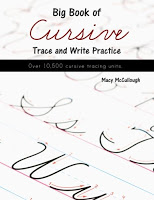
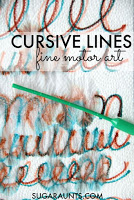
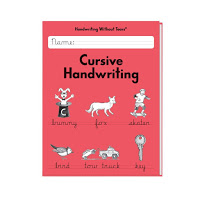
More cursive writing resources (Click on the images to find out more):

 Cursive writing strategies to help kids learn to write in cursive, and this gross motor cursive warm-up exercises are perfect for teaching kids to write in cursive!

You’ll find more cursive writing strategies by clicking the images below:


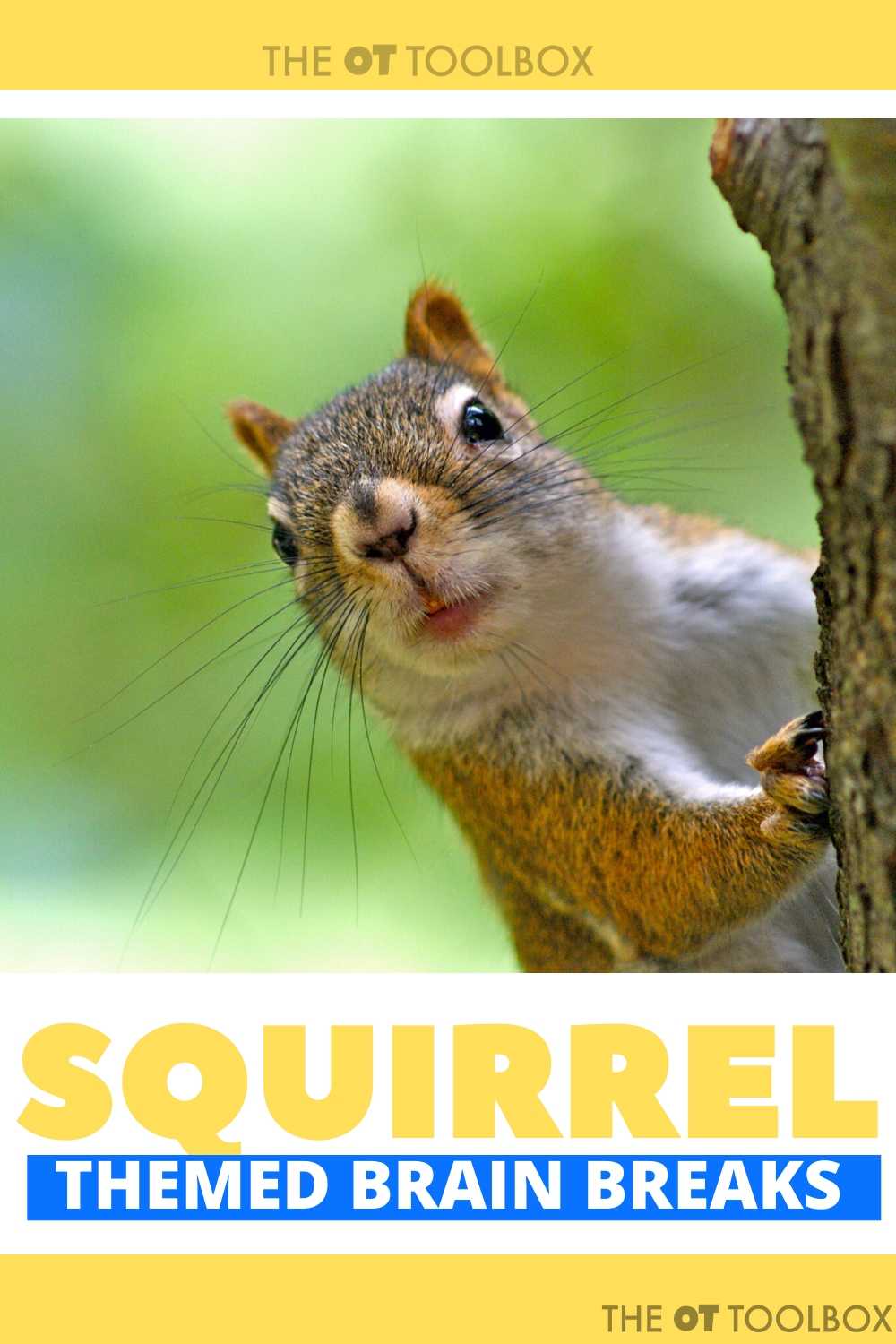
Squirrel Brain Breaks

squirrel brain breaks for a squirrel themed activity for kids

We’ve been sharing a bunch of brain break ideas here on The OT Toolbox recently. You may have seen our recent Best Brain Breaks on YouTube post or some printable brain break activities like the themed activities including these apple themed brain breaks, and bear brain breaks.

Each of these links includes a free printable sheet so you can grab and use these brain break ideas over and over again. Scroll on down and you’ll find a few more printable sheet ideas to incorporate movement into learning and play with special themes.

Use the squirrel brain breaks with a squirrel and acorn theme or with Fall occupational therapy activities this time of year.

Squirrel Brain Breaks

Movement breaks have been shown to improve academic achievements, attention, and more. They are a great self regulation strategy to support self regulation needs. Plus, this activity is perfect for individual needs, a sensory break, transition, in therapy sessions. And, brain breaks like the squirrel themed movements below can be used as self regulation group activities, too.

They would make a great class activity after coming in from recess or during afternoon classwork.

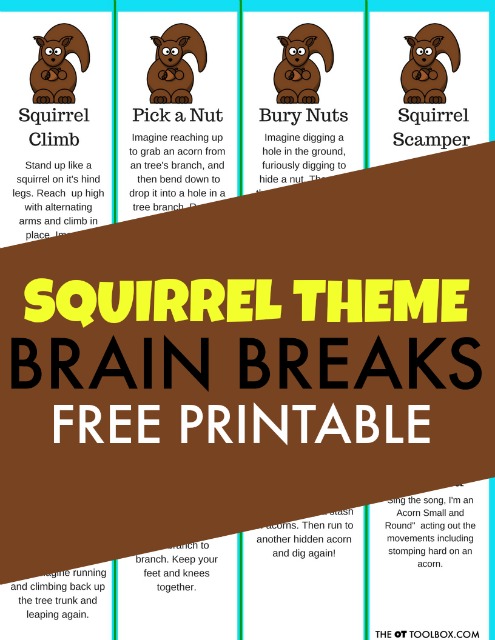
Squirrel brain breaks might include:

  • Scamper across the room like a squirrel
  • Race around a tree trunk
  • Reach up high for an acorn
  • Walk with your knees bent like a squirrel
  • Bend and pretend to dig to bury a nut


squirrel brain breaks for a squirrel themed activity for kids

Squirrel brain breaks for a brain break themed activity that promotes movement for kids in the classroom or home this Fall while improving focus and attention through movement.
 

Today, you’ll find squirrel brain break ideas to use during the Autumn months when the leaves are falling and squirrels are running around finding and hiding acorns and other nuts to stock up for the winter.

Many times, the Fall months mean squirrel and leaf books and learning in the classroom or at home. These squirrel brain breaks can be the perfect accompaniment for a Fall theme.

Affiliate links are included in this post.

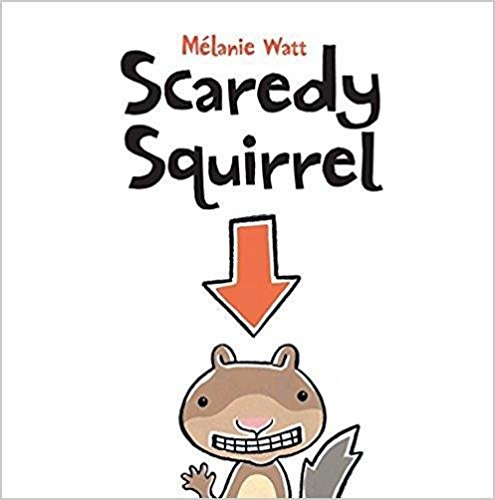
We read the children’s book, Scaredy Squirrel by and were inspired to come up with squirrel themed brain breaks to go along with the book.

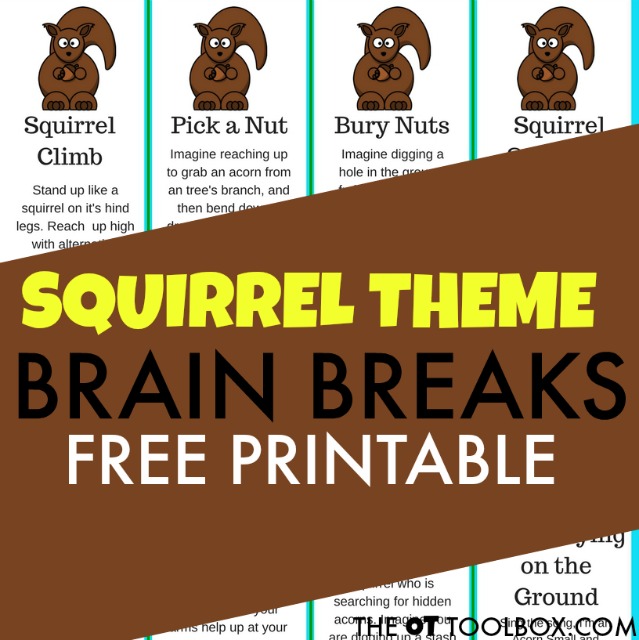
Print the Squirrel Brain Breaks and use them today. Don’t forget to read the book, too!


Squirrel Brain Breaks – Ideas for the Classroom

One of the Squirrel Brain Breaks on the printable sheet includes the action song,
I’m an Acorn Small and Round”. It’s one of our favorite songs to sing during the autumn months. This action song is a fun one!


Squirrel and Acorn Themed Activities

Other squirrel and acorn activities we have here on The OT Toolbox include: 

  • Use real acorns to manipulate with tongs or tweezers
  • Play the Sneaky, Snacky Squirrel game– Enhance executive functioning skills visual attention, visual memory, strategic thinking, hand-eye coordination, and fine motor skills through this captivating and fast-paced kids’ board game.
  • Paint acorns and then sort the colorful acorns into containers
  • Read the book, Scaredy Squirrel  and make a squirrel craft.
  • Follow directions with the song, I’m an Acorn Small and Round (see below). This is a great gross motor activity.
  • Cut out paper acorns from brown construction paper.


Squirrel Activities

Squirrel brain breaks for a brain break themed activity that promotes movement for kids in the classroom or home this Fall while improving focus and attention through movement.


https://www.theottoolbox.com/2017/09/apple-theme-brain-breaks.html


One fun Fall brain break that goes with the squirrel theme is a little song and dance about being an acorn.

Lyrics to I’m an Acorn Small and Round

I’m an acorn, small and round (hold hands into a small ball)
Lying on the cold, cold ground (Lay down on the floor)
Everybody steps on me (Stomp foot)
That is why I’m cracked you see (Hold hands above eyes like binoculars)

[Chorus]
I’m a nut! (Dance)
(Click, click with tongue)
I’m a nut! (Dance)
(Click, click with tongue)
I’m a nut I’m a nut I’m a nut (Dance)
(Click, click with tongue)

Free Squirrel Brain Breaks

Want to print off the squirrel brain break cards to use in the classroom or therapy sessions? Enter your email address into the form below.

This resource is also available inside The OT Toolbox Member’s Club. We have a whole theme with squirrel and acorn activities to use in squirrel themed therapy sessions this Fall season.

Free Squirrel Brain Breaks

    We respect your privacy. Unsubscribe at anytime.

    Colleen Beck, OTR/L has been an occupational therapist since 2000, working in school-based, hand therapy, outpatient peds, EI, and SNF. Colleen created The OT Toolbox to inspire therapists, teachers, and parents with easy and fun tools to help children thrive. Read her story about going from an OT making $3/hour (after paying for kids’ childcare) to a full-time OT resource creator for millions of readers. Want to collaborate? Send an email to contact@theottoolbox.com.

    Best Brain Breaks Videos on YouTube

    Teachers are sometimes looking for movement and activity videos that they can use in the classroom. They may need movement ideas for throughout the day when kids need a brain break or they may want to start the day with a movement activity. Other times, kids need a movement “wake up” midway through the day when they are feeling and acting sluggish or even a little high energy. Maybe students need to get their bodies moving before a test and the perfect brain break for kids is just the ticket. Or, maybe teachers are looking for a way to get the kids moving during indoor recess time. Maybe you are a parent who is looking for ways to get the kids moving on a rainy day.

    Below, you’ll find some great brain break videos on YouTube. These are videos that can be pulled up on a smartboard in the classroom. 

    Some of these YouTube Brain Break videos would work for middle school brain breaks, too.

    Brain Break Videos on YouTube

    The best brain break videos on YouTube can be used for classroom brain break needs, indoor movement and gross motor skills, circle time, indoor recess, or rainy days.


    Brain Breaks for kids

    Brain breaks are considered fun for the brain, AND a great way to shift gears. Check out the videos below for ways to add movement activities to the classroom.

    But first, if you are looking for some printable brain break ideas, here are some of our favorites:
    Apple Theme Brain Breaks
    Farm Theme Brain Breaks
    Bear Brain Breaks
    Squirrel Theme Brain Breaks

    On to the brain break videos.  Try these videos to get the whole classroom up and moving!


    Move and Freeze Song 


    Shake Your Sillies Out


    Count to 100 with Exercise


    I Am a Gummy Bear


    I’m Gonna Catch You


    Frozen Themed Yoga


    The Sid Shuffle – Ice Age: Continental Drift


    Trolls: Can’t Stop The Feeling | GoNoodle


    I Get Loose – Koo Koo Kanga Roo | GoNoodle


    Move To Learn Fitness Break!


    Move to Learn Pre K Counting


    Going On a Bear Hunt with Dr. Jean


    Dr. Jean’s Banana Dance – (aka The Guacamole Song) – Dr. Jean’s Banana Dance


    If You’re a Kid (Dance Around!) (song for kids about following directions)


    Brain Breaks | Following Directions | Physical Education | Get Up To Get Down | Jack Hartmann


    Letters of the Alphabet | Capital Letters | Uppercase Letters | Alphabet Workout | Jack Hartmann


    Letters of the Alphabet | Lower Case Letter Formation | Alphabet Workout | Jack Hartmann


    Hand Clapping Game “Bim Bum”


    Classroom Yoga (Classroom Physical Activity Breaks)


    Yoga for Kids – Children’s Yoga – Brain Breaks – Kids Songs by The Learning Station

    The best brain break videos on YouTube can be used for classroom brain break needs, indoor movement and gross motor skills, circle time, indoor recess, or rainy days.

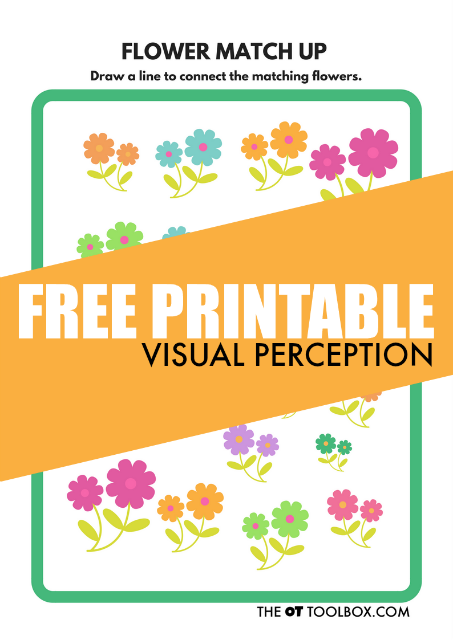
    Visual Perception Apple Activity

    During the fall months, apple activities are a fun way to sneak in skills like visual perception development or fine motor strengthening.  This visual perception apple activity promotes both of those areas in a fun and creative way.  We used recycled pouch bottle caps to make DIY stamps that fit in with an apple theme.  If you are looking for more visual perception activities, there are a bunch on the site.  Check out the additional ideas at the bottom of this post.

    The apple theme is perfect for the fall season and would fit in nicely with this apple theme gross motor activity.

    Visual perceptual skills are needed for so many skills! Handwriting, reading, writing, math, spelling, shoe tying, cutting with scissors…everything! You’ll find easy and fun ways to work on visual perceptual skills through play here. 

    Kids will love this visual perception apple activity using DIY apple stamps.

    Visual Perception Apple Activity

    This post contains affiliate links.
    You’ll need just a couple of materials for this idea:
    Scissors
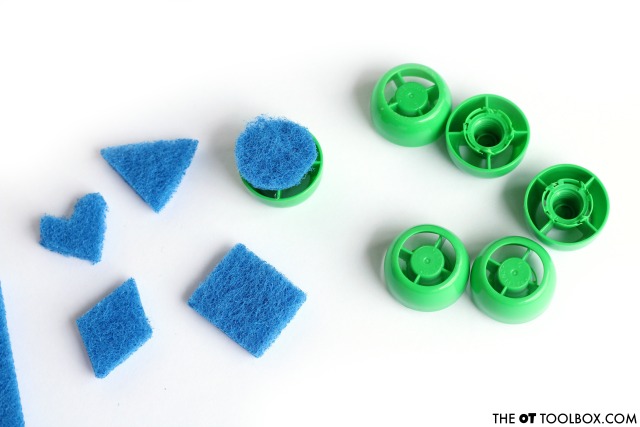
    Applesauce pouches (Eat the applesauce and then wash and dry the lid!)
    Hot glue gun (I love this mini version for making quick projects like this one.)
    Paper
    Red paint

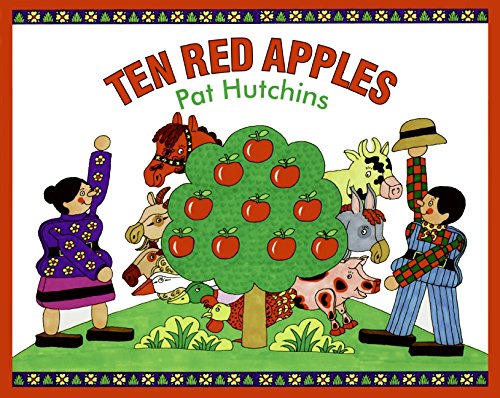
    This activity goes along with the popular children’s book, Ten Red Apples. Grab the book and do this developmental activity with the kiddos.  You’ll love all of the book activities that combine children’s books with activities to promote development of functional skills and underlying skill areas here on The OT Toolbox.

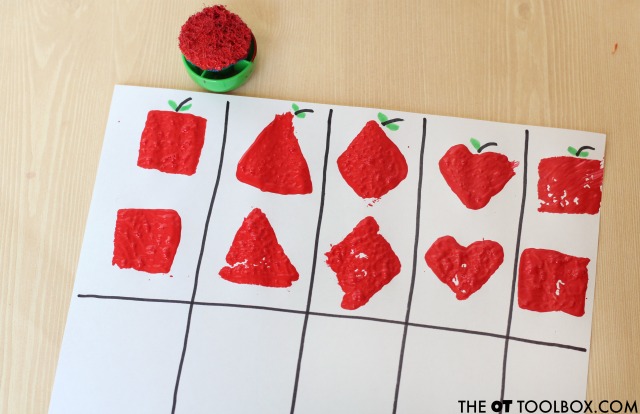
    Use DIY apple stamps to work on visual perception with an apple theme.
    To make the apple stamps:
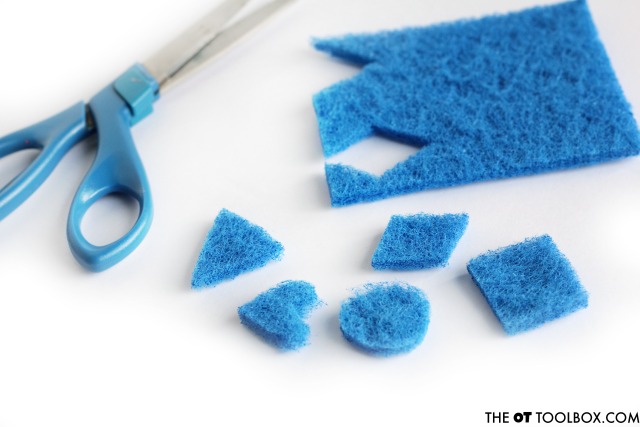
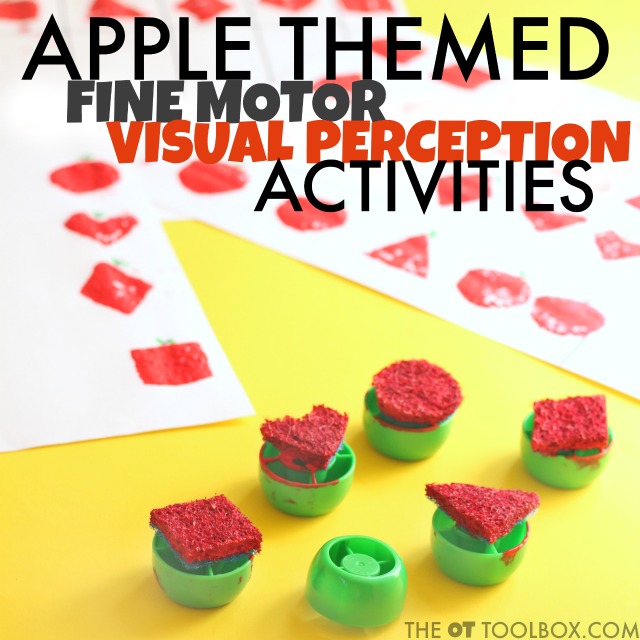
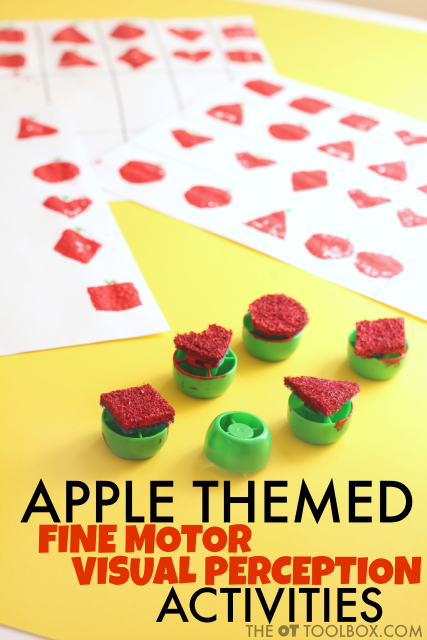
    Cut the scrub pads into different shapes.  We made a square, circle, diamond, and heart.
    Make your own foam stamps to work on visual perception and fine motor skills.
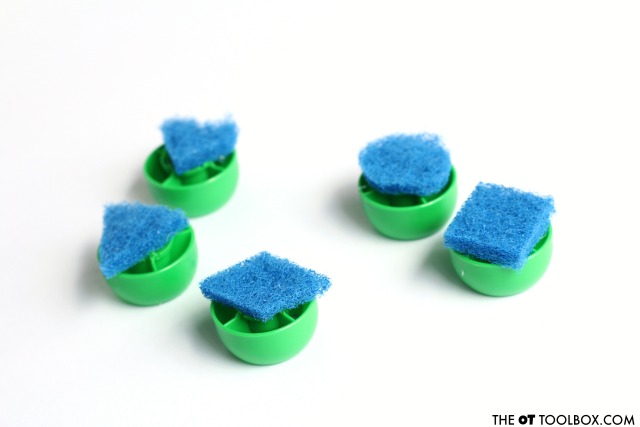
    Use the hot glue gun to attach the shapes to the pouch lids. This is a job for an adult.

    Kids can work on visual perception and fine motor skills using DIY stamps with an apple theme.
    Once the foam shapes are attached and the glue is dry, you can start to work on those fine motor and visual perceptual skills.

    Use these DIY stamps to work on visual perception and fine motor skills with kids.
    This is a fun visual perception activity for kids to work on skills using DIY stamps.
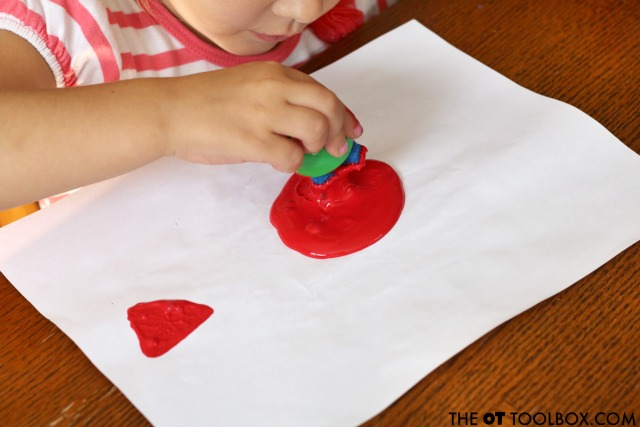
    Pour a small amount of red paint onto scrap paper.  Kids can use the stamps to make different shapes by pressing the foam side into the paint and then pressing paint onto paper. There are several fine motor skills being addressed with these stamps:

    Apple Theme Fine Motor Activity

    Show your child how to hold the stamp using their thumb, pointer finger, and middle finger.  This positioning on the pouch cap encourages a tripod grasp and separation of the two sides of the hand.
    Ask the child to use the stamper with their dominant hand.  By holding the stamp with to paint, they are also developing and strengthening the arches of the hand.
    Additionally, the size of the stamp encourages an open thumb web space which is perfect for a functional pencil grasp during handwriting tasks.
    These stamps are quite the fine motor power tool!
    Apple stamps for helping kids work on visual perception and fine motor skills.

    Apple Stamps and Visual Perception Activity

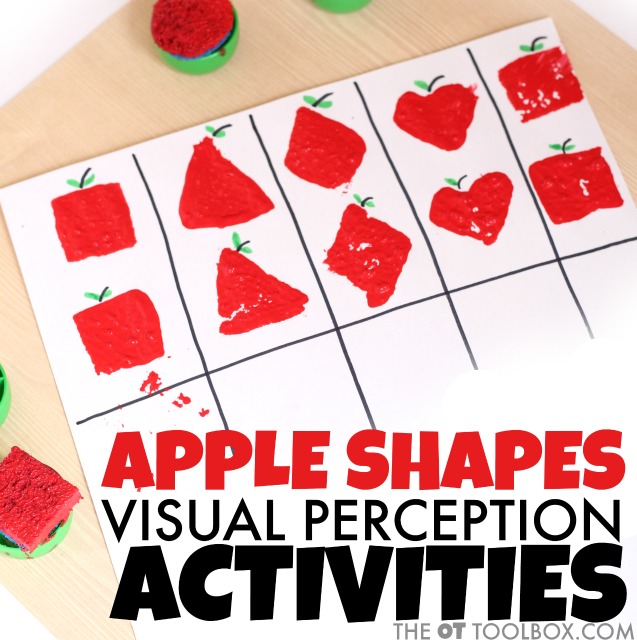
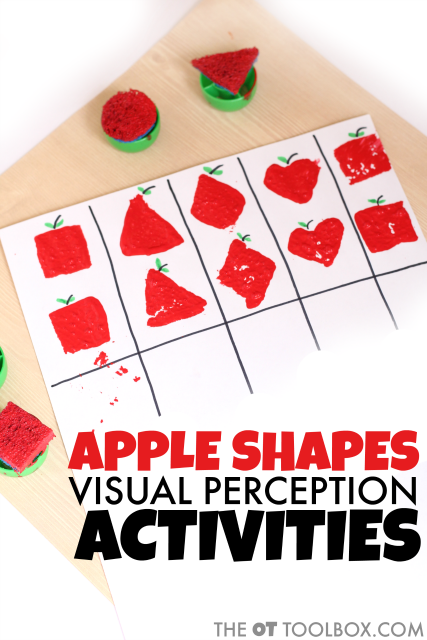
    Next, kids can turn those shapes into apples by copying the different parts that make an apple.  We used black and green markers to add a stem and leaves to each apple shape.
    To encourage development of visual perceptual skills, show kids how to copy the stem and leaves. They can then copy those parts onto their apples.  Try adding one or two leaves or making the stems go into different directions or with different lengths to encourage visual memory, visual discrimination, and visual motor skills.
    Use these apple stamps to help kids improve visual perception and fine motor skills needed for handwriting, reading, and more.

    Visual Perception Apple Activities

    There are so many ways you can use these apple stamps to address visual perceptual skills!
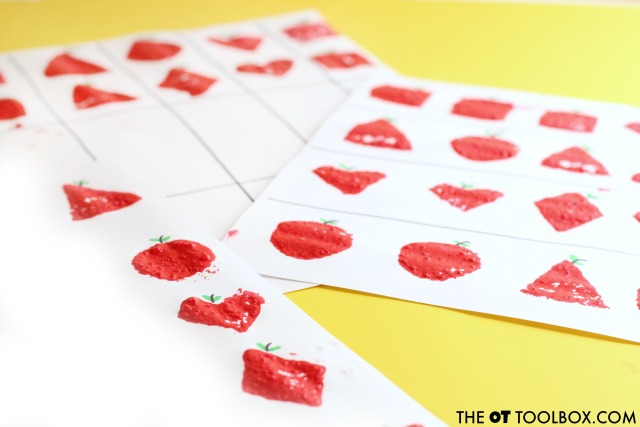
    Make copying sheets where kids copy the apple shapes in the correct sequence to address visual memory.
    Make visual discrimination sheets where kids can identify the difference in shapes.
    Work on visual spatial relations by stamping apples in different positions on a page.  Kids can then tell where they see a specific shape in relation to another shape.
    Address visual discrimination by making an “I Spy” type of sheet.
    Work on form constancy by covering up part of an apple shape and asking kids to make the apple shape that matches that shape.

    Apple theme visual perception activity for kids
    How would you use these apple stamps to address visual perception?

    Kids love these visual perception apple activities that also work on fine motor skills
    These apple stamps is a fun apple activity to use in coordination with a book.  If you have been a reader of The OT Toolbox for long, you know that we love to combine favorite children’s books with developmental activities.  For this apple activity, we joined the bloggers in the Virtual Book Club for Kids group in creating an apple themed activity that fits with the book, 10 Red Apples by Pat Hutchins.
    We loved reading this book as we counted the apples on each page.  The book, Ten Red Apples is a fun way to address visual perceptual skills like visual discrimination, visual memory, and form constancy as each page contains the animals that eat an apple from the apple tree.  To address visual perceptual skills with this book, ask your child to scan the group of animals and pick out individual characters or animals on each page.  It’s a visual perceptual challenge that carries over to skills like reading and writing.

    For more creative ways to address visual perceptual needs, try some of these ideas by clicking on the images below.

    Looking for more ways to add apple themes into learning and play? Try these creative ideas from the Virtual Book Club for Kids team:

    Apple Tree Alphabet Letter Match  Still Playing School
    Apple Piece Names  Preschool Powol Packets
    Sea of Knowledge    Apple Addition within 5 Dough Strips
    Fingerprint Apple Counting Activity   Messy Little Monster
    Apple Math: Counting & Fractions   Teach Beside Me
    Red apple number bonds to 10   Rainy Day Mum
    Apple Tree Playdough  Clare’s Little Tots
    Apple picking sticky wall  Views from a Step stool
    Baked Apples  Witty Hoots
    Apple Stack Game and Snack  Toddler Approved
    Jumping Apple Seeds  JDaniel4’s Mom
    Apple Theme STEM Activity for Preschoolers  The Educators’ Spin On It
    Glitter Apple Stamping  My Bored Toddler
    Apple Tree Tracing Page
    Apple Farm Song with Movement  My Storytime Corner
    Ten Red Apples: Number Words Activities  Growing Book by Book
    Apple Tree Gross Motor Game  Inspiration Laboratories
    Apple Sewing  CrArty Kids

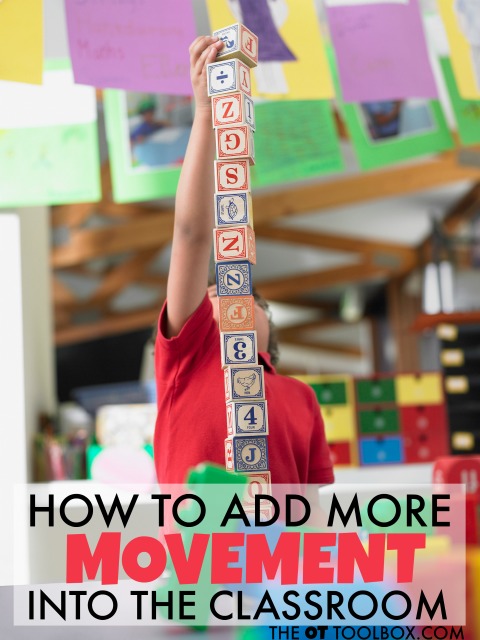
    Ideas to Incorporate Movement into the Classroom

    Children today are experiencing less and less physical activity and more and more sedentary lifestyles that limit participation in many motor experiences. Children are spending more time in front of screens and less time climbing trees, rolling down hills, and in general less time outdoors.  Physical activity is a vital part of health but for the student, movement in the classroom can have a big impact on learning.  Gross motor games and activities can help. 


    There is much evidence of the link between movement and learning.  For some students, movement breaks in the classroom are an essential part of regulation of sensory needs.  Most students need a quick energizer to beat lethargy in a long school day at some point and brain breaks are a great answer to meet that need.   


    Below, you’ll find easy ways to incorporate movement into the classroom.  


    These are easy strategies that can be added at little cost.  As much as most teachers and school based professionals would love extensive equipment or alternative seating and cushions in their classroom, these ideas are not always feasible.  For these and other reasons, I’ve put together this list of ideas to add movement into the classroom environment.

    These are great ideas for how to incorporate movement into the classroom for movement and learning, perfect ideas for teachers to help kids with attention or sensory needs, and any student who needs more movement in the classroom and throughout the school day.


    Easy Ideas to Add Movement into the Classroom


    You may have seen this video depicting movement in the classroom floating around on Facebook. Check it out. Does this sound familiar?


    Add movement into learning- Incorporate gross motor movement into math when repeating math facts by incorporating whole-body games such as Simon Says (Students can perform specific motions when math facts are true, and perform other motor tasks when math facts are false.)


    Daily Stretches


    Afternoon Yoga Stretches


    Dance Party Breaks


    Brain break videos- Here are the best brain break videos on YouTube.


    Themed Brain Breaks- Some ideas are these Bear Brain Breaks or these Farm Brain Breaks


    Role Play Activities for history, science, geometry, etc.


    Large item manipulatives- Use creative items such as large cardboard boxes, printer paper boxes filled with newspapers, old phone books, etc.


    Add in walks during the day.


    Incorporate action rhymes into the morning routine or circle time. 


    Try these sensory motor activities for the classroom.


    As students to move around the room to learn about specific items.  Fall back on those places by asking the students to recall the part of the room they were in when they learned about that particular topic.


    Move books or other items from the desk to a different part of the room so that students need to get up and walk to the back of the room to get their math workbook.


    Try inexpensive seating tools such as this DIY sensory seating idea


    Utilize extra recess as a reward.


    Create a fidget toolbox in the classroom for movement needs while sitting at desks. 


    Try a ball toss game with partners when working on learning facts or spelling. 


    Ask students to perform jumping jacks, clapping, running in place, or hopping when spelling words as a group.


    Add movement requirements within a multi-step project- Students can complete a worksheet, then get up and place it in a bin across the room, then walk to another center to gather materials needed for their next assignment, then return to their desk.


    Ask students to assist in handing out materials and papers.


    Place a math problem at each student’s desk.  Each child can copy the problem to another sheet of paper and complete the problem.  Then, they can move to the next desk and complete that problem.  Ask them to move to each desk until they have solved all of the problems.


    Students can place their chairs on their desks at the end of each day and remove them at the beginning of each day.


    When walking from classroom to classroom, students can all walk on their toes.  Other ideas: walk toe to heel (for short trips down the hall), penguin waddle, walk with extra large steps, or other creative movement ideas.


    Students can carry bins of materials needed for each day from their cubby to their desk.


    Borrow a swivel seat from the computer lab or office.  Use the seat as an alternative seat for different students throughout the day.


    Try Indoor Ice Skating before a learning task- In the classroom, use a sheet of paper under each foot as students “skate” in the classroom for 5 minutes. 


    Raise the desks and allow students to stand for reading/writing/worksheets/learning activities.


    Use easels in the classroom.


    Encourage wall writing by taking paper to the walls and asking students to write at the wall.


    Allow prone writing and reading (lay on stomach on the floor).


    Use a therapy ball as a seat or as a movement area in the classroom.


    What are your favorite ways to add movement to the classroom?

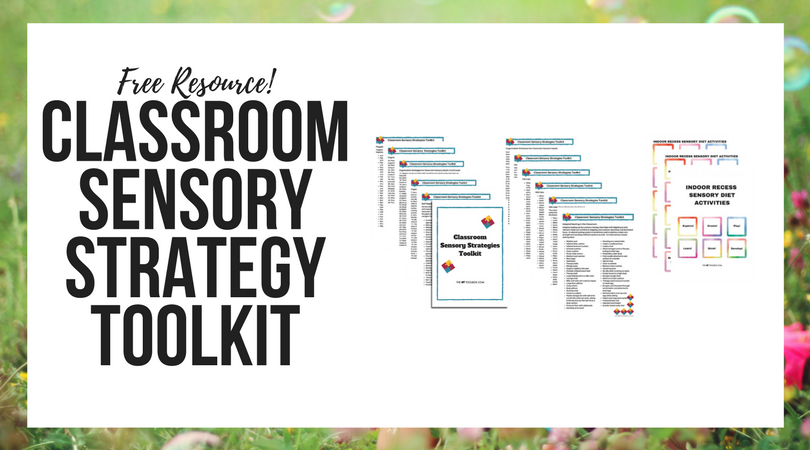
    You may also be interested in the free printable packet, The Classroom Sensory Strategy Toolkit.

    The Classroom Sensory Strategy Toolkit is a printable packet of resources and handouts that can be used by teachers, parents, and therapists. Whether you are looking for a handout to explain sensory strategies, or a tool for advocating for your child, the Classroom Sensory Strategy Toolkit has got you covered.


    And it’s free for you to print off and use again and again.


    In the Classroom Sensory Strategy Toolkit, you’ll find:


    • Fidgeting Tools for the Classroom
    • Adapted Seating Strategies for the Classroom
    • Self-Regulation in the Classroom
    • 105 Calm-down Strategies for the Classroom
    • Chewing Tools for Classroom Needs
    • 45 Organizing Tools for Classroom Needs
    • Indoor Recess Sensory Diet Cards
     
    Sensory Strategies for the Classroom
     

    Free Classroom Sensory Strategies Toolkit

      We respect your privacy. Unsubscribe at anytime.

      Colleen Beck, OTR/L has been an occupational therapist since 2000, working in school-based, hand therapy, outpatient peds, EI, and SNF. Colleen created The OT Toolbox to inspire therapists, teachers, and parents with easy and fun tools to help children thrive. Read her story about going from an OT making $3/hour (after paying for kids’ childcare) to a full-time OT resource creator for millions of readers. Want to collaborate? Send an email to contact@theottoolbox.com.

      The Floor is Lava Games
      As kids, we used to hop from couch to couch and make a flying leap across the living room to the corner chair.  We would hop from one surface to another with one thing on our minds…

      The living room floor had turned into boiling hot lava!
      When my kids started hopping around from pillow to pillow and landing with a roll onto the couch with claims of the floor turning to lava, I had to smile. 
      The Floor is Lava is Back!


      What is so cool about the floor being lava (besides the nostalgic sentiments from parents?)  A great game of The Floor is Lava has some major motor movements and sensory play components!
      From jumping, leaping, hopping, rolling, and crashing, The Floor is Lava is a fun and creative way to encourage movement and sensory motor play, both indoors and out!
      Play these The Floor is Lava Games with your kids to build development of skills like motor control, sensory input, motor planning, gross motor skills, core strength, and balance.

      The Floor is Lava Games
      Here are some fun ways to use The Floor is Lava Games to promote sensory input and motor movements:

      • Place pillows and couch cushions on the floor.  Kids can hop from pillow to pillow on one foot or two.  Move the pillows further and further apart to promote movement coordination and motor planning.  Don’t touch the carpet, it’s lava!
      • Place paper plates in a line on the floor.  Use them as a balance beam to address vestibular sensory input.  Hop from plate to plate without touching the ground, it’s burning up!
      • Play a stop and go game that promotes auditory processing skills like auditory figure-ground discrimination.  Call out, “The floor is lava!” and everyone has to hop off the ground onto something besides the hot, hot ground!
      • Use boxes like milk crates, stools, or dining room chairs to add height components to The Floor is Lava game.
      • Add a learning component by asking kids questions when they land on a safe space.  Think about incorporating spelling words, math facts, or memorization facts.
      • Play The Floor is Lava at the playground to add vestibular sensory components to the game. Don’t touch the ground, it’s hot!  Read more about the sensory benefits of the playground.
      • Make a Safe Island when playing a lava game.  Use a hula hoop and all kids can hop in the hoop to stay safe from that burning hot lava.  Don’t hop out of the other side of the hoop to stay safe and to work on motor control.

      Develop Skills While Playing The Floor is Lava

      When playing these lava games, kids are developing and building so many skills!
      • Gross motor coordination
      • Core strength
      • Eye-body coordination
      • Visual motor skills
      • Motor planning
      • Balance
      • Attention
      • Vestibular sensory tolerance 
      • Proprioceptive sensory tolerance
      • Impulse control
      Do your kids play The Floor is Lava?  Did you play as a child?  Introduce your kids to some of these versions of the lava game and boost movement and development skills at the same time!
      Play these The Floor is Lava Games with your kids to build development of skills like motor control, sensory input, motor planning, gross motor skills, core strength, and balance.

      Sensory Pre-Handwriting Activity Rice Table

      Getting kids to learn to write (or want to practice handwriting skills) can be a tricky task.  It’s important to start off younger kids on a positive foot when it comes to handwriting practice.  What child wants to trace slant after slant or letter after letter on a worksheet?  This sensory pre-handwriting activity is great for younger children who are learning and developing the skills needed for written work.  From tracing lines to forming simple forms, a sensory medium can make fine motor work fun.


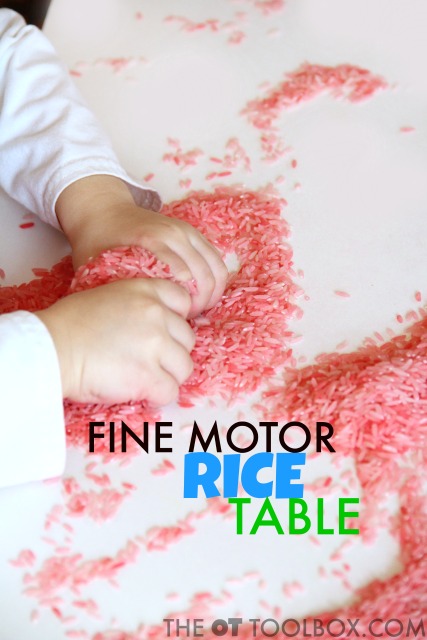
      We used a rice table for this activity.  It was VERY easy to set up and an activity that we will be doing again and again.  The nice thing about creating sensory modalities with items like dyed rice is that you can save them for a while and re-use them over and over again.


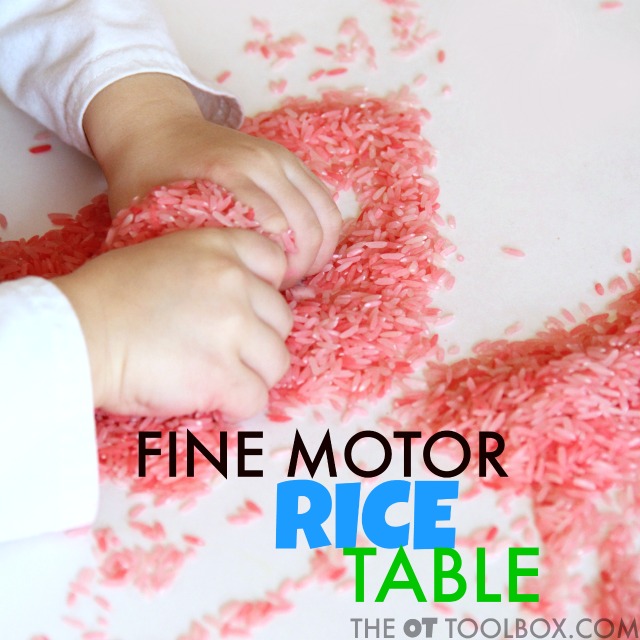
      Rice sensory table for pre-handwriting activity


      Sensory Pre-Handwriting Activity Rice Table

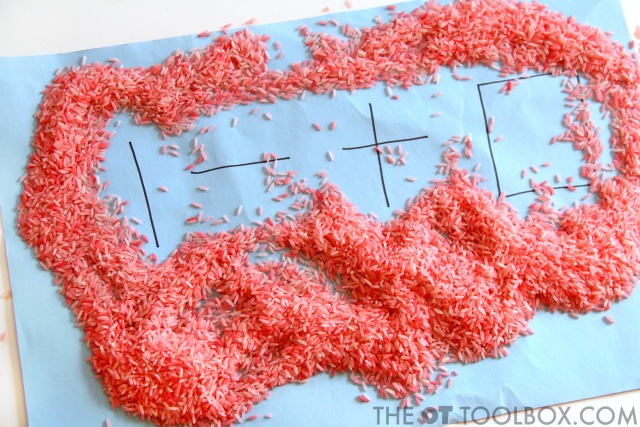
      You can make a sensory writing table with a variety of materials.  We used dyed rice.  To make the rice, simply pour a few cups of rice into a plastic bag.  Add food coloring and a few drops of water.  Seal up the baggie.  Shake it, roll it, and toss it to cover the rice with color.  This is a fantastic gross motor activity for kids.  When the rice is coated with color, spread it out on a paper towel on a counter top and allow it to dry.  

      Once the rice is dry, spread it out on a table surface.  Now, start playing!  We’ve done a bunch of writing trays in the past.  The nice thing about playing on a table top is there is no lip to a container to worry about.  An edge of a tray can interfere with hand and wrist positioning, making grasp and letter formation awkward.  if you are worried about the mess, lay a sheet down on the floor under the table.  You can also work on a large sheet of poster board.  That way, when your child is done playing, use the poster board to gently fold the rice back into the baggie. 


      Kids love this sensory pre-handwriting activity rice table for improving fine motor skills.


      Use this sensory table to work on many skills:

      Click the links below to read more about each sub-skill needed for development of pencil grasp and pre-handwriting skills:
      Bilateral coordination
      Hand grasp
      Pinch strength
      Dexterity
      Visual motor integration
      Finger isolation
      Tactile tolerance
      Letter formation
      Arch development

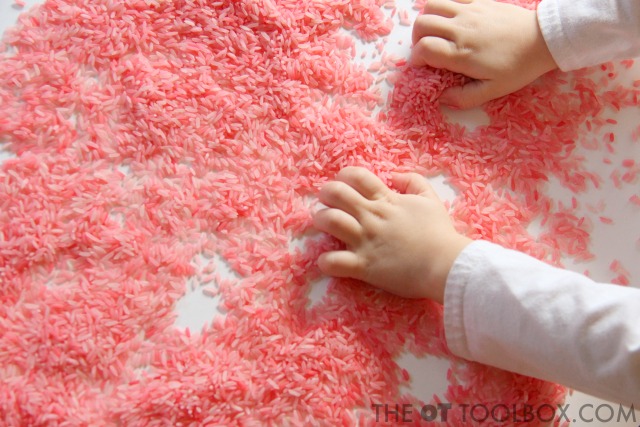
      Kids can spread the rice around with both hands.  Ask them to create symmetrical patterns with their hands and ask that they look at their hands and not the shape that is being made.  This activity requires peripheral vision and encourages visual motor integration.


      Sensory Pre-Handwriting Activity

      To work on pre-writing skills, write lines and shapes on a piece of paper and slide it under the rice.  Kids can seek and find the line or you can find the starting point of the form and ask them to create it.  Watch the video below for more information on this activity.


      Use a sensory pre-writing activity rice table to work on pre-writing pencil strokes.


      Pinch and grip strength pre-handwriting activity

      Use the rice to build those little muscles!  Squeezing the rice with both hands is a grip exercise with a tactile component.  Let the rice slip through the fingers and from one hand to another with a “hand funnel” (Check out the video to see this in action!).  This is a fantastic way to work on arch development in the hands.  

      Address pinch grip by squeezing the rice between the fingers and thumbs.  You can address neat pincer grasp to pinch and move individual pieces of rice, too.  

      There are so many ways to use this easy rice table in pre-handwriting activities!  The kids will love the open-ended play that doesn’t seem like handwriting practice. 


      See this handwriting sensory activity in action! Click to watch the video: 


      This sensory pre-handwriting activity rice table is perfect for kids working on fine motor skills.


      Try these sensory-based activities to work on letter formation, pre-writing handwriting, and play-based writing activities:


      Use Writing Trays for Handwriting


      Pencil Control Worksheets You Can Make At Home uses the sense of sight with bright and high-contrast lines for working on line awareness, pencil control, and motor planning when writing.

      Tracing Letters: Letter Formation Handwriting Practice with Chalk uses the proprioceptive and tactile senses to write with chalk on a bumpy and hard sidewalk.  Up the textures by using wet chalk!

      High-Contrast Letter Formation is one of my favorites from this blog!  Use a black material (do you know what we used?) on a white surface for high visual contrast with an olfactory power punch!

      Bilateral Coordination Activity with Hearts

      Bilateral coordination activity for valentines day

      This Valentine’s Day bilateral coordination activity uses a vivid salt tray in a way that encourages coordination of both hands together in a visual motor integration task.  A fun heart themed activity is a great addition to an occupational therapy Valentine’s Day plan. Use this and other bilateral coordination activities in the home, classroom, or therapy clinic.

      This bilateral coordination activity is a take on our Shamrock bilateral coordination activity that we did last year.  It was a great way to encourage kids to work on visual motor integration while allowing them to use both hands together in a coordinated and functional manner.  

      Valentines Day bilateral coordination activities for working on skills kids need for development.

      Bilateral Coordination Activity for Valentine’s Day

      Using both of the hands to copy heart designs from a different visual plane is a hands-on activity that really works the brain, eyes, and hands together.    

      Development of bilateral coordination results in improved independence in skills like feeding and self-dressing, handwriting, and many other skill areas.  Get creative with a salt writing tray to work on many underlying skill areas that are needed for handwriting and motor planning in functional tasks.

      Bilateral coordination activity with a heart theme for Valentines Day

        First, let’s talk a little more about bilateral coordination:  


      Why is bilateral coordination important? 


      Bilateral coordination is important for a variety of skills.

      When bilateral coordination or bilateral integration is intact and progressing appropriately through development, it is an indicator that both sides of the brain are communicating effectively and sharing information during functional tasks.

      Younger toddlers and babies can be observed using both hands in play as they pick up objects in their line of sight. However, they typically will pick up items with the hand that is closest to the object or toy.

      As toddlers progress in development, they will begin to establish a dominant hand and crossing midline. This ability to utilize a dominant hand and a non-dominant hand in activities indicates a maturation of the brain and lateralization in functional tasks, which is very important for motor planning, directionality, and visual motor skills.

      In fact, impaired bilateral coordination skills can lead to difficulty in the classroom.

      Development of bilateral coordination in self-feeding depends greatly on the child’s developmental level. The baby who is learning to place dry cereal in their mouth will be vastly different level than the child who is scooping soup or cutting a piece of chicken. Development of fine motor skills and visual motor skills have an impact on coordination of the hands in self-feeding.

      What makes up bilateral coordination?

      In fact, there are three components of bilateral coordination:
      Symmetrical movements
      Reciprocal movements
      Dominant hand/supporting hand movements   This post contains affiliate links. 

      This was an easy activity to set up.  We started by making colored salt to use in our salt tray.     Materials to make the colored salt:

      To make your own, fill a sandwich baggie with washable paint, salt, and glitter. We used red, but any color would be fine for making the colored salt.  The amount of paint can vary.  More paint will yield a more vivid hue.  Know that using more paint will require a longer period to dry the salt.   

      Then, simply shade the baggie until the salt is coated with paint.  This is a fun activity for kids to move with gross motor coordination and a creative way to sneak movement into the classroom.

      Colored salt that is dyed with washable paint for a sensory motor activity for kids

      Once the sand is coated with color, spread it out on a cookie sheet.  We let our salt dry overnight.  Note: if the salt is still wet, the paint will color your hands. Once it’s dry, it will not color your fingers.  If you do end up with color on your hands or cookie sheet, just wash it off in warm soapy water.  That’s the beauty of using washable paint for this project.   When you salt is colored and ready to play, spread it out on a tray.  I used a big shallow platter.

      Red glitter salt tray for Valentines Day

      Quickly draw a few hearts on paper and prop them up vertically in front of the tray.  A vertical placement is important for addressing the skills needed to copy written work from an overhead source such as a chalkboard or smart board in the classroom.    

      Kids will need to shift their eyes from the vertical plane to the horizontal plane in order to copy the heart patterns in the salt tray.   Encourage use of both hands to make the hearts, starting at the middle point and using both hands at the same time.  Show your child how to look at the vertical sample or at the starting point on the salt tray.  You don’t want them to look at only one hand at a time as both hands are working together to make the heart shape.  

      Colored salt tray to address bilateral coordination and visual motor integration

      What is going on with this visual motor integration activity?   

      While creating a heart shape as described above, the child is using his visual sense to guides movement through peripheral vision.     This activity uses whole body movements to improve skills, including learning and functional tasks.  

      The activity encourages children to use both hands together.  The point of the activity is to establish direction and orientation relative to the child’s body.  The movement activity addresses hand-eye coordination in different visual fields, promotes spatial awareness and visual discrimination, addresses left and right awareness, improves peripheral vision, promotes body awareness and coordination with specialization of the hands and eyes, and works on gross motor movement skills.   Using both hands to draw and copy from a visual prompt like this activity is an excellent way to promote whole body learning through simple and fun movement activities.   

      Watch for these things:  

      • While drawing, watch the child for stiffness in the hand, wrist, or arm.  
      • Remind the child to keep their eyes fixed on the starting point at the center of the heart.
      • Remind the child to keep both fingers in contact with the sand.  They shouldn’t lift their fingers at all.
      • Watch for bilateral coordination, ensuring that both arms are moving at the same speed, distance, and positioning.

      Related: Need some indoor bilateral coordination activities like this one? Try our list of Winter Bilateral Coordination Activities that kids will love!  

      Child playing with a salt tray to address bilateral coordination and visual motor integration skills.
      Work on bilateral coordination with this salt tray activity

      More Valentine’s Day Occupational Therapy Activities

      Heart Fine Motor Math Activity

      Heart FIne Motor Sorting Activity

      Valentine’s Day Sensory Bin

      One Zillion Valentines Craft

      Colleen Beck, OTR/L has been an occupational therapist since 2000, working in school-based, hand therapy, outpatient peds, EI, and SNF. Colleen created The OT Toolbox to inspire therapists, teachers, and parents with easy and fun tools to help children thrive. Read her story about going from an OT making $3/hour (after paying for kids’ childcare) to a full-time OT resource creator for millions of readers. Want to collaborate? Send an email to contact@theottoolbox.com.