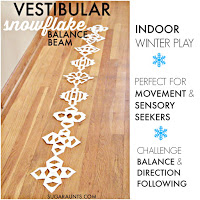
Snowflake Balance Winter Gross Motor Indoor Play Therapy Idea

When the weather is too cold to go outdoors and the kids are bouncing off the walls, you sometimes need to get creative.  Maybe you’ve got a few Occupational Therapy students who would benefit from a vestibular movement activity like this snowflake balance beam! This is a great indoor gross motor activity for preschool or older ages.

The vestibular system is one of the bodys senses and responsible for awareness of our body in space and gravitational insecurity during tasks.  Kids can use balance beams to work on integration of the vestibular sense, perfect for children who seek movement, run into objects, fear certain positions, have trouble visually tracking items in reading and written, and more. Occupational Therapy with a balance beam activities.

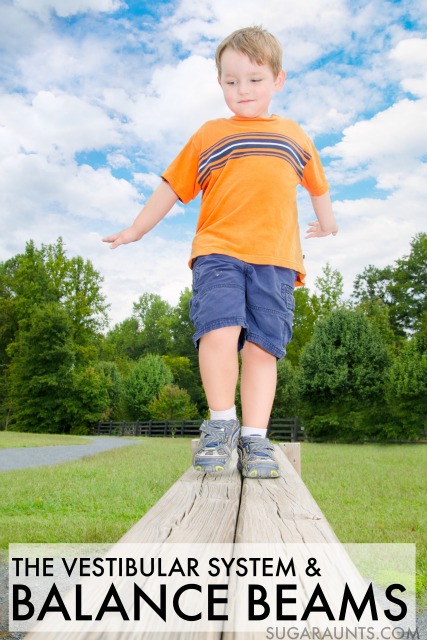
Balance Beams and the Vestibular System

Balance beams are perfect to address needs in the vestibular system.  Our body’s ability to regulate position in space helps us to manage obstacles in our path without losing balance.  The vestibular system allows us to move in space without falling or without making us thing we will fall (gravitational insecurity).
We’re able to take in visual information, process it, and respond accordingly…all with the help of the vestibular system!


When there is a problem in the vestibular system, a child may appear clumsy, running into objects or people, have trouble with visual tracking, attention in reading and writing, difficulty focusing on a task, and trouble with motor planning in coordinated activities that a child needs to do throughout their day.


Balance beams are a great way to practice and work on vestibular sensory integration
into functional activities.  A child can work on balance and motor planning as they visually scan their balance beam and track the line they need to walk along.


Balance beams challenge the vestibular system with variances in difficulty.  The great thing about this snowflake balance beam is that you can adjust the size and provide many, many alternate activities to work on coordination, listening, motor planning, direction following, and attention.

The vestibular system is one of the bodys senses and responsible for awareness of our body in space and gravitational insecurity during tasks.  Kids can use balance beams to work on integration of the vestibular sense, perfect for children who seek movement, run into objects, fear certain positions, have trouble visually tracking items in reading and written, and more. Occupational Therapy with a balance beam activities.


Snowflake Winter Balance Beam: Making therapy fun!

This post contains affiliate links.

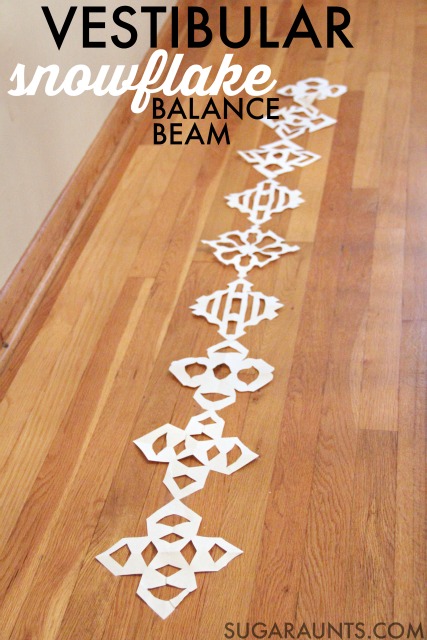
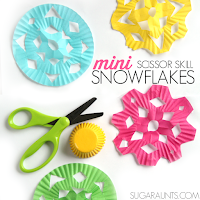
Cut snowflakes from paper and place them around the room.  Get the kids in on the snowflake cutting for seasonal scissor skill work!

The vestibular system is one of the bodys senses and responsible for awareness of our body in space and gravitational insecurity during tasks.  Kids can use balance beams to work on integration of the vestibular sense, perfect for children who seek movement, run into objects, fear certain positions, have trouble visually tracking items in reading and written, and more. Occupational Therapy with a balance beam activities.


Using double sided tape
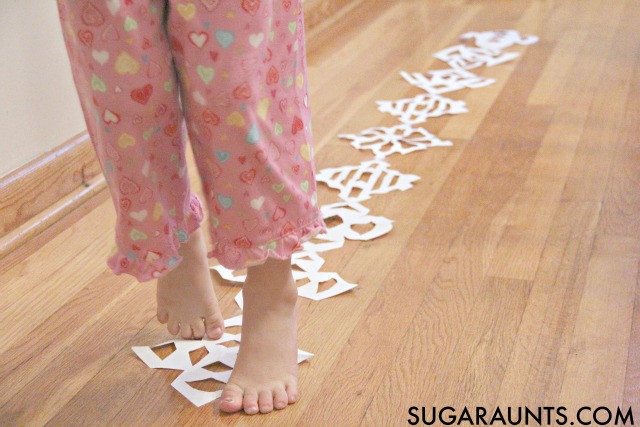
, create a balance beam on the with the snowflakes.  Arrange them in a line along the floor.  It can be a simple strait line or a multi-angled balance beam track. Ask your child to walk along the snowflake line without falling off.  


Other balance beam activities that challenge the vestibular system: 

  • Walking on tip to
  • Walking toe-to-heel
  • Hopping on one foot
  • Jumping
  • Walking sideways
  • Walking backwards
  • Crawling
  • Walking with feet and hands. Encourage direction-following and listening skills by calling out different ways to walk along the snowflake balance beam.
  • Toss a ball to your child as they are on the balance beam.
  • Ask your child to change directions as they walk along the beam.
  • Have the child look up at the wall and not down at their feet as they walk.
 
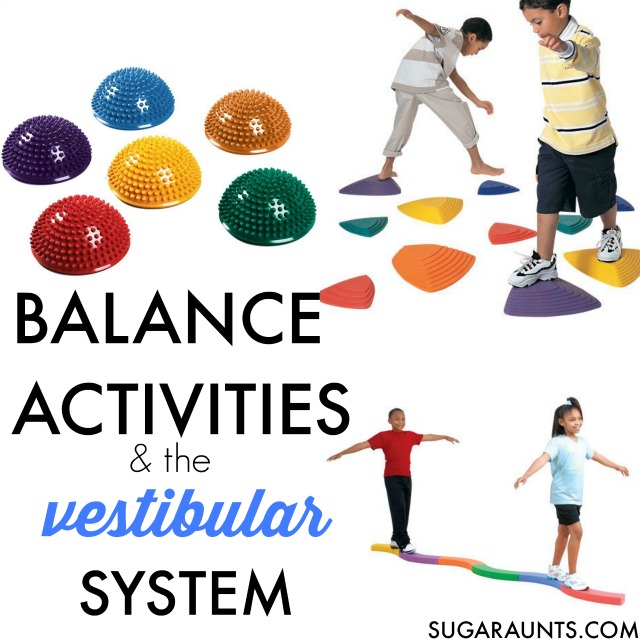
Looking for more balance beam ideas? These are some of the best out there:
The vestibular system is one of the bodys senses and responsible for awareness of our body in space and gravitational insecurity during tasks.  Kids can use balance beams to work on integration of the vestibular sense, perfect for children who seek movement, run into objects, fear certain positions, have trouble visually tracking items in reading and written, and more. Occupational Therapy with a balance beam activities.


This Folding Beam is great for storage concerns. Add creative balance beam activities like transferring items from a bucket at one end to a bucket at the other end.
Balance Pods can be positioned in any room or activity. Encourage big and little steps by spacing them closely and further apart.
Gonge Riverstones are a great challenge to the vestibular system with various sloped sides. 
Stepping Buckets Balance challenge motor planning. Place obsitcals in between the buckets for more visual tracking while working on vestibular sensory integration.
The BSN Gymnastics Curve-A-Beam can be reconfigured in curved patterns.


Are you looking for more information on Vestibular or Proprioception (and ALL of the sensory systems) and how they affect functional skills, behavior, and the body’s sensory systems?  This book, Sensory Lifestyle Handbook, will explain it all.  Activities and Resources are included.  Get it today and never struggle to understand or explain Sensory Integration again.
 
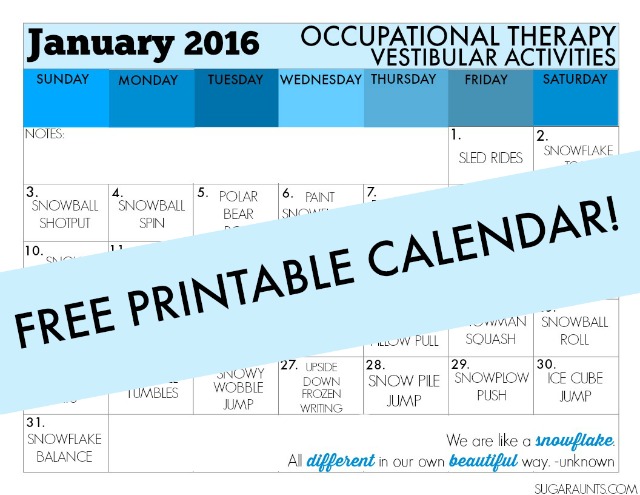
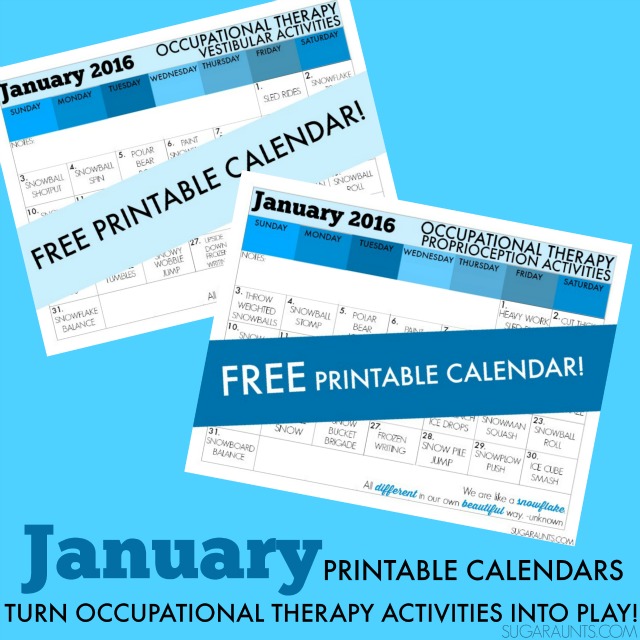
Looking for more vestibular activities?  Check out our January calendar that has 31 days of vestibular and proprioception activities based on winter play.
 

January Calendar: Sensory Integration Activities Turning Therapy into Play

Last month, we created a calendar of Occupational Therapy ideas using a Christmas theme.  It was such a hit among our readers (that’s you!), that I decided to create a monthly version of sensory integration activities.  Be sure to read our blog post on Ayres Sensory Integration for more information on this theory.

What’s better is that these SI activities are geared to turn therapy into play.  Children of all ages can participate in their Occupational Therapy goal areas with themed activities while working on proprioceptive and vestibular input. These activities are designed to address gross motor, fine motor, and visual perceptual skills through January’s winter theme of snow, snowballs, snowflakes, and ice.  


Occupational Therapists are skilled at turning therapy into play in order to make goals of therapy fun.  Kids can work on areas they need to develop with fun and playful winter activities.  You’ll find many recommendations for winter play with a focus on sensory integration.  


Be sure to stop back each month for a calendar of Occupational Therapy and playful activities!


NOTE: These activities are meant to be a resource.  No child is alike and so no therapy regime is alike.  Please contact you physician and Occupational Therapist for individualized evaluation and treatment. These activities are designed to provide creative treatment ideas only.
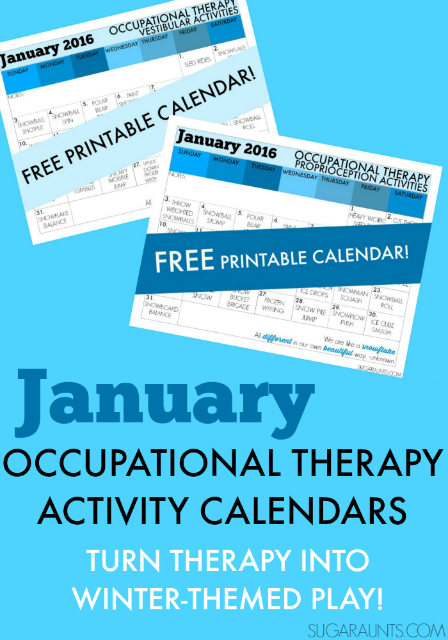
 
Sensory Integration with Proprioception and Vestibular activities for turning therapy into play while working on Occupational Therapy goals.  These January calendars have a sensory activity for each day.

I’ve tried to keep many of the vestibular and proprioceptive activities the same or similarly themed for each day.  

The links below will show ways to work on vestibular and proprioceptive activities and has descriptions on how to work on each area with the day’s theme.  Many children have specific proprioception or vestibular needs.  Other children benefit from a combination of these treatment areas.  The activities linked below show ways to hit these areas in a combination or separately.  


I’ve included other resources with each linked activity as well, so be sure to check out each activity for proprioception and vestibular therapy ideas.  Make sensory integration fun by turning therapy into play!


These calendars are meant to provide a general plan for daily vestibular and proprioceptive input.  We all have best intentions when it comes to our day’s schedule and sometimes life challenges our plan for the day.  No problem! You can easily switch activities with another day’s activity and adjust activities according to your family’s needs.


Just a small amount of proprioception and vestibular activity are enough to help with regulating a child’s sensory needs.  

One activity each day should be effective for most children, so add these themed activities to the sensory diets you’ve got in place to turn therapy into play this winter. HOWEVER, all children should be assessed by an Occupational Therapist to assess individual needs and abilities.

January Winter Calendar: Proprioception Activities turning therapy into play
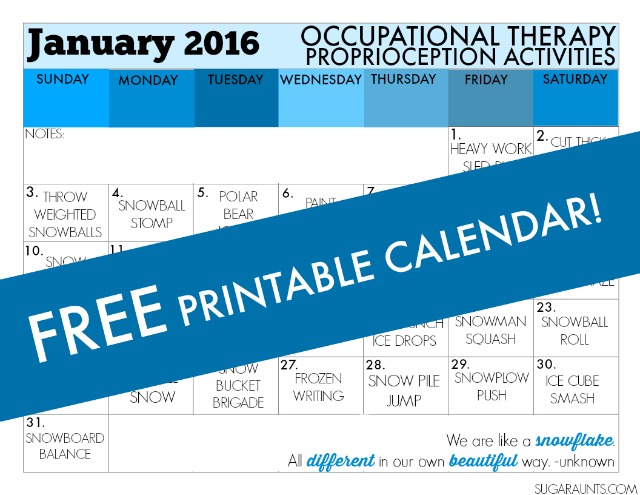
Sensory Integration with Proprioception and Vestibular activities for turning therapy into play while working on Occupational Therapy goals.  These January calendars have a sensory activity for each day.

Proprioception Activities with a Winter Theme:

The proprioceptive system involves receptors in joints and muscles that tell our body how much effort to put into a task. The system allows us to know how to move and use our bodies in response to stimulation from the environment. Children with proprioceptive difficulties may bump into other children, break pencils when writing because they press too hard, show “no fear”, crash into objects, appear uncoordinated, appear lazy, chew clothing/pencils/anything, among other signs.
 
Proprioceptive input can be achieved through heavy work activities that adjust the child’s level of arousal and “wake up” or calm the body’s system.  Activities that involve pushing, pulling, jumping, blowing, squeezing, pinching, throwing, skipping, crawling, and lifting can be achieved through play.
 
1. Heavy Work Sled Pull- For a proprioceptive work activity, load a sled up with books (or another child!)  Pulling a loaded sled is a heavy work activity that is calming to the sensory system.  Try pushing the sled with arms or legs, too.  Take the sled outside and pull it on snowy slopes for added resistive work.


4. Snowball Stomp- Stomping with the legs is a great way to incorporate proprioception into the lower extremities.  Make snowballs and STOMP on them for a fun and playful heavy work activity.  Don’t have snow?  Try making baked cotton balls and stomp on them.  Have you ever made baked cotton balls?  It is a super sensory and creative way to work on so many fine motor skills.  Simply coat cotton balls in a flour/water mixture and bake them until hared.  They will have a hard shell that is perfect for pulling, tearing, and stomping on. Read more about making baked cotton balls here
 
5. Polar Bear Igloo- Get into the polar bear theme and build a polar bear igloo using couch cushions.  Cover your cushion igloo fort with a white blanket to make an igloo.  Pulling heavy couch cushions to build a fort is a great whole body proprioceptive workout.  This heavy work activity is calming, but the warm igloo will be an even more calming area to relax and organize a child’s body.
 
6. Paint Snowflakes- Create masking tape resist snowflakes with tape and blue paint.  Pinch and peel the tape from the roll and stick it into a snowflake shape on white paper.  Now add a dab of blue paint onto the paper.  Use a heavy cardboard box to smash the paint on the snowflake.  Moving a box full of books is a proprioceptive activity that provides heavy work to the whole body.
 
7. Build a snowman- Rolling snow into a snowman is a great proprioception activity.  If you don’t have snow, use several blankets to fold and roll into snowman-ish balls.  Lift those blanket balls to build a snowman indoors.  You’ll probably need to prop your blanket snowman against a wall to keep him standing.
 
8. Blanket Bundle- Lay a blanket out on the floor.  Roll the child up in a blanket, burrito style.  Now roll them back and forth on the floor. This works best on a carpeted floor.  Add extra blanket layers and pillows for more proprioceptive input.
 
9. Indoor Skiing- Coming soon! (I promise!)
 
10. Snow Angels- Snow angels are an excellent way to provide proprioceptive input!  Pushing snow or heavy blankets with the arms and legs is a powerful proprioception activity for kids.  You’re providing heavy work input to the legs and arms as they abduct and adduct. Don’t have snow to make snow angels outside? No problem! Incorporate proprioceptive work into this activity by using heavy blankets on a carpeted floor.
 
11. Snowman Soda Dough- Soda Dough is a fun activity that provides proprioception to the small muscles of the hands as the child rolls small snowmen. You can find the recipe here.
 
12. Cut Icicles  Cut multiple layers of paper to create indoor icicles while providing proprioception to the hands.
 
13. Boot Dash {link coming soon!}
 
14. Snowshoe Walk {link coming soon!}
 
15. Polar Bear Crawl- Animal walks are a great way to incorporate proprioception into play.  Show your child how to crawl like a polar bear on hands and knees.  This position is a great way to provide proprioceptive input to the shoulder girdle and hips.  Add a heavy blanket or towel over your child’s back for additional deep pressure.
 
16. Build a Snow Maze- If you’ve got snow in your area, this snow maze activity is a fun way to add heavy work to play.  (My kids are still talking about our snow maze!) If you haven’t had snow in your area, build a maze using rolled an piled blankets, pillows, and couch cushions.  Move the items around to construct a maze right in your living room.
 
17. Skate on Thin Ice {link coming soon!}
 
18. Snowy Walk- Just walking around in snow is a proprioception activity in itself!  Enjoy the sights, sounds, and smells of a snowy day during an outdoor winter nature walk.
 
19. Snow Bin- Create a proprioception sensory snow bin with resistive materials like rice or homemade proprioception dough.  Add scoops, cookie cutters, and plastic utensils to work on proprioception to the hands and arms.  Push glass gems, beads, or other small items into the dough for more play.
 
20. Dance Party- Get the kids moving with a winter dance party! Add a proprioception component to your snowy winter dance party by adding wall push ups, floor push ups, and push-pull movements.
 
21. Hole Punch Ice Drops- Punching holes with a paper hole punch is an excellent way to provide proprioceptive input to the hands.  Use this activity as a fine motor or handwriting warm up activity to wake up the muscles of the hands. use white paper to punch mini snowflakes and ice droplets.  You can scatter these on blue paper covered in glue to create a snowy scene.
 
22. Snowman Squash- {link coming soon!}
 
23. Snowball Roll- For this activity, you’ll need masking tape, cotton balls, and a straw.  Tape out a line across the floor.  Use the straw to blow the snowman snowballs (the cotton balls) along the line while crawling.  Adding the straw provides proprioceptive and oral motor input, too.  Consider more ways to add proprioception to this activity:  Have your child sit on a scooter as the adult pulls the child along with a towel.  Another child can push a child’s back as they scoot along the line.  Have the child sit on a square of cardboard and move their way along the line using their feet.  Roll a weighted ball along the line.  
 
24. Snowman Says- Play “Simon Says” with a winter theme by calling it “Snowman Says”! Add proprioception directions to the game like calling out: 

  • Animal Walks
  • Wall Push Ups
  • Tug of War with a blanket
  • Jumping
  • Hugs
  • Stomping
25. Shovel Snow- Shoveling snow is a great way to provide proprioception to the whole body.  If you’ve ever shoveled snow, then you know it gets all of the muscles moving…even muscles you didn’t know you had.  And the sore body for the next two days keep reminding you!  Have your child shovel small scoops of snow to clear a sidewalk.  They can help out in the neighborhood by shoveling neighbor’s walks, too.  If you are lacking in the real snow department in your area, take the shovel indoors.  Use a clean shovel to scoop and move piles of towels, small toys, or even shredded paper. 
 
26. Snow Bucket Brigade-  Fill buckets with snow and create a bucket brigade with neighbor hood kids.  Use all of that snow to build a snow fort.  If you don’t have snow in your area, make an indoor bucket brigade using bean bags, toys, balls, or other small items.  Children can dump the buckets’  contents into an empty laundry basket. Pouring the weighted buckets is a great rhythmic and calming activity.
 
27. Frozen Writing- You can incorporate proprioception to the hands by writing on Styrofoam sheets like we did here for proprioceptive input or write in frozen snow dough for tactile input.
 
28. Snow Pile Jump- Use outdoor snow to create a pile of snow.  Jump into the snow with both feet.  Show the child how to try to land on their back or on their side. They can also jump into the snow with one foot or two, or on their knees.  No snow in your area? No problem!  Create a snowy pile using bed pillows, couch pillows, or foam and cover it with a thing blanket or bed sheet.  Jump into the “snow pile” from a trampoline.  Use both feet, one feet, and knees to jump.  
 
29. Snow Plow Push- For this activity, use a large cardboard box. Play snow plow by turning the box or laundry basket on it’s side and have the child push the basket around the room, pushing on all fours. They can scoop up balls or other items, including heavier items like pillows for heavy proprioceptive work.


31. Snowboard Balance- Create a homemade balance board like this one for proprioceptive and gross motor input. OR, make an ice wobble disc!


January Winter Calendar: Vestibular Activities turning therapy into play

Sensory Integration with Proprioception and Vestibular activities for turning therapy into play while working on Occupational Therapy goals.  These January calendars have a sensory activity for each day.


Vestibular Activities with a Winter Theme:

The vestibular system involves the body’s ability to adjust and move in space based on organs within our inner ears.  Problems with vestibular integration may exhibit by difficulty with balance, or a gravitationally insecure child.  
You may see a child who craves movement, can’t sit still, seeks excessive movements, or is hyperactive. They might have trouble planning movements, crossing midline, or difficulties with reading and writing. Vestibular activities can be completed in therapy goals through play:
 

1. Sled Rides- Have your child ride a sled while sitting up, laying flat on their belly, an laying on their back.  Pull your child around a yard covered in snow, down gentle slopes, and up small hills.  The changes in grade challenges the vestibular system.  Don’t have snow?  Bring this activity indoors!  A plastic sled works great on carpeted floors.  Pull your child as they sit/lay in all positions.  Add a bit of bumpy terrain by building a “ramp” with couch cushions and a blanket.  Don’t forget to spin the sled for circular spinning motions.

2. Snowflake Toss- Use an inflated balloon to toss and hit from above and the sides. Encourage your child to extend their head and neck back to see a high “snowflake” and down low as they hit the low tosses.  Bending, reaching overhead, and swooping side to side allow vestibular motions with a playful function.
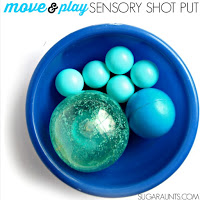


3. Snowball Shot Put


4. Snowball Spin- Curl up like a snowball and get ready to spin! Use a large piece of cardboard for fun break-dancing, snowman-style!  Show your child how to turn and move on the cardboard and slide in all directions and planes.  For a challenge, draw or paint snowflakes on the cardboard.  These are targets for hands and feet and provide a visual motor planning, visual tracking, hand-eye coordination, and crossing midline components!  You can number the snowflakes to incorporate more skills. This is an activity that is sure to inspire smiles!   


5. Polar Bear Roll- Lay on the floor and roll like a polar bear (log roll style).  Use pillows to create obstacles and bumpy targets.  Put items on both sides of the room and transfer the objects by only rolling.  Rolling is an organizing activity for children.


6. Upside Down Snowflake Paint- Place a large sheet of butcher paper or newspaper on the floor.  Have your child hang over a large therapy ball or ottoman to paint on the paper.  You can also push dining room chairs together to create a place to hang.  Try turning the child over so they are laying on their back and painting overhead with an extended head and neck. When your snowflake paintings have dried, hang them on the ceiling to encourage more neck and head extension as you gaze up at your snowy work of art! TIP: Try this snowflake stamping art activity to incorporate fine motor skills.


7. Bounce a Snowman- Bouncing a ball is rhythmic and calming.  Bounce three different sized balls (the snowman’s bottom, middle, and head).  Bounce the balls one at a time, then try to bounce two balls at once to encourage bilateral hand coordination.  Add ping pong balls (the snowman’s eyes and buttons!) for a challenge.  THEN, change the vestibular input by sitting on the balls and bouncing the child or showing them how to bounce up and down.  A large therapy ball works well for this activity but other options include blow up beach balls, rubber balls, and kick balls.


8. Blanket Roll-Roll the child up in a blanket on the floor.  Roll the child back and forth the whole way across the floor.  Be aware of overstimulation and be sure to only do this activity for 10 rolls before taking a break.  Now pull the blanket’s end so that the child is moving in the direction of their feet or head.  Try pulling the child as they lay on their belly and then on their back.


9. Indoor Skiing-Coming Soon (I promise!)


10. Snow Angels– Cover a hard floor with a bed sheet.  Ask the child to lay on the blanket and do snow angels.  The thin sheet on a hard floor will provide little resistive feedback (which is what you want if you are working on proprioception activities!) Do angels while standing and while laying on a large therapy ball or over an ottoman, too.  

11. Snowman Hop Scotch- Draw a snowman on a sidewalk or driveway.  If it has recently snowed, draw a snowman in the snow with a stick.  If the temperatures are too cold to play outdoors, draw a snowman on a large sheet of cardboard or create a snowman on the floor using masking tape.  No matter where you make your snowman hop scotch board, don’t stop at just three circles!  Make your snowman as high as you like!  Play hop scotch with the snowman shape for jumping and hopping vestibular input.  For a challenge, draw buttons on each circle.  Children can count the number of buttons as they play hopscotch.


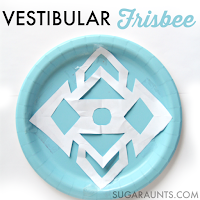
12. Snowflake Frisbee

13. Boot Spin {link coming soon!}


14. Snowshoe Walk {link coming soon!}


15. Polar Bear Crawl- Crawl on all fours like a polar bear.  Add throw pillows and a body pillow, as well as rolled blankets to add a balance course.  Ask them to hang their head down low as they crawl, then stand up on their knees like a polar bear.  Changes in head position is calming and organizing for the vestibular systems integration of sensory input.

16. Snow Maze Obstacle Course- If you’ve got snow outside, build logs of snow for climbing over, walking along, and rolling over.  Pile up a lump of snow for climbing on and sliding down.  Get creative with building piles of snow and showing your child how to slide, drop, swoop, jump, roll, and crawl around, over, and through.  Kids can position themselves in all planes for a variety of vestibular input. If you haven’t got snow in your area, create an indoor snow maze.  use pillows and blankets to make “snow piles”.


17. Skate on Thin Ice-  {link coming soon!}


18. Snowy Spin


19. Snow Slide- Use a large sheet of cardboard to create a snowy slide on the steps.  You can also pile up a few couch cushions and pillows to create a ramp for sliding.  If you’ve got snow outdoors, cardboard makes a great sled!  Try sliding while sitting, laying, and spinning for more vestibular play.


20. Snow Dance Party- Turn up the music and spin, twirl, shake, stretch, jump, and sway to the music.  Play music listening games like Freeze Dance.  Turn the music off and everyone needs to freeze in the position that they are in.  Try dancing with scarves and hoola hoops for more movements.  

Other Winter Dance ideas: 

  • Spin and twirl around a frozen lake
  • Pick up “ice cube” cotton balls and leap across the room to another “ice cube” as kids collect the ice cubes.
  • Frozen Bottom: dance to music and someone stops the music.  When the music stops, everyone drops to the floor and sits on their bottom.
  • Winter Clothes Dance- Everyone dances until someone stops the music. When the music stops, everyone grabs an article of winter clothing and puts it on.  You can have available a sweater, scarf, mittens, hat, earmuffs, coats, etc.  

21. Snowflake Pillow Pull- Cut snowflakes from a small square of felt.  Pin these to a body pillow.  Children must lay on the body pillow, holding onto the snowflakes.  An adult can pull the body pillow around the room as the child hugs the pillow.  An alternate activity is to have the child sit on a a snowflake on the pillow as they hold on to the sides. Being pulled around on a moving seat is a calming vestibular activity for kids.


22. Snowman Squash- {link coming soon!}


23. Snowman Roll- Do somersaults along the floor. Tape a line of masking tape on the floor and have your child somersault along the line.  Use the line to roll balls across the room, using ping pong balls and larger balls.  Use a wheeled scooter to roll along the line.  Scoot along the tape with the scooter while blowing a cotton ball “snowman” with a straw.  

24. “Snowman Says”- Simon says with a snowman theme is a fun way to incorporate vestibular and proprioceptive input and adding the components of your child’s needs into a playful game.  

Try some of these Snowman Says movements:
Vestibular: Twirl your arms.
Bend at the waist and reach between your legs.
Jump
Hop
Skip
Roll
Dance
Spin
Somersault

25. Shovel Tumbles- Use a sandbox shovel to toss a ping pong ball “snowball” into a target such as a bucket or an empty laundry basket.  For added vestibular input, add a tumbling movement to the activity as the child tries to keep the ball in the shovel while they tumble.


26. Snowy Wobble Jump- You can up the vestibular input by placing a mini trampoline on the wobbly cushion base.  Jump on the trampoline or jump off of the trampoline.  Put a cushion or pillow on the trampoline and jump on that.  


27. Upside Down Frozen Writing- Encourage head tilt and alternate planes by writing while hanging over a chair or stack of couch cushions.  Writing in the prone position puts the hands at a more optimal writing position than hanging from supine.  

28. Snow Pile Jump- Use outdoor snow to create a pile of snow.  Jump into the snow with both feet.  Show the child how to try to land on their back or on their side. They can also jump into the snow with one foot or two, or on their knees.  No snow in your area? No problem!  Create a snowy pile using bed pillows, couch pillows, or foam and cover it with a thing blanket or bed sheet.  Jump into the “snow pile” from a trampoline.  Use both feet, one feet, and knees to jump.  


29. Snow Plow Push- For this vestibular activity, use a large cardboard box.  The child can climb into the box and an adult can pull them around.  Take the cardboard outside on a snowy hill.  If you don’t have a cardboard box large enough to hold your child, use a laundry basket.  Play snow plow by turning the box or laundry basket on it’s side and have the child push the basket around the room, pushing on all fours. 


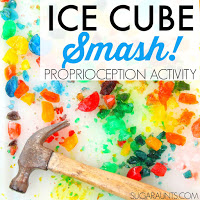
30. Ice Cube Jump

31. Snowflake Balance 

Hopefully these activities will help with Vestibular activities.  Be sure to visit each activity for more vestibular ideas.

Sensory Integration with Proprioception and Vestibular activities for turning therapy into play while working on Occupational Therapy goals.  These January calendars have a sensory activity for each day.
 

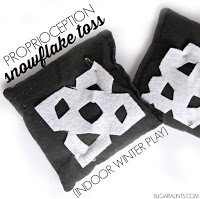
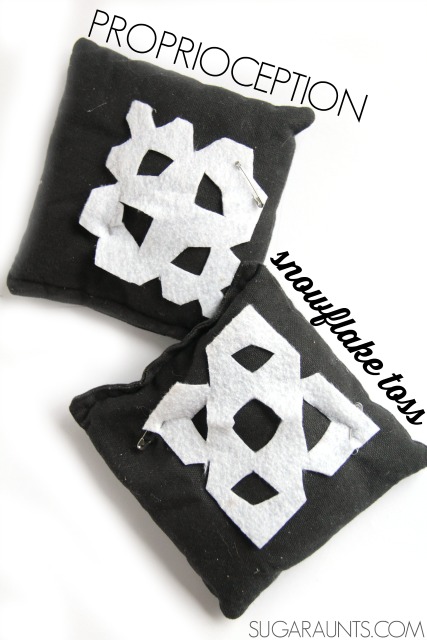
Proprioception Winter Activity Throwing Snowflakes

Proprioception activities are organizing and regulating.  This weighted snowflake activity is a fun way to turn Occupational Therapy and therapy goals into play with a winter theme.  


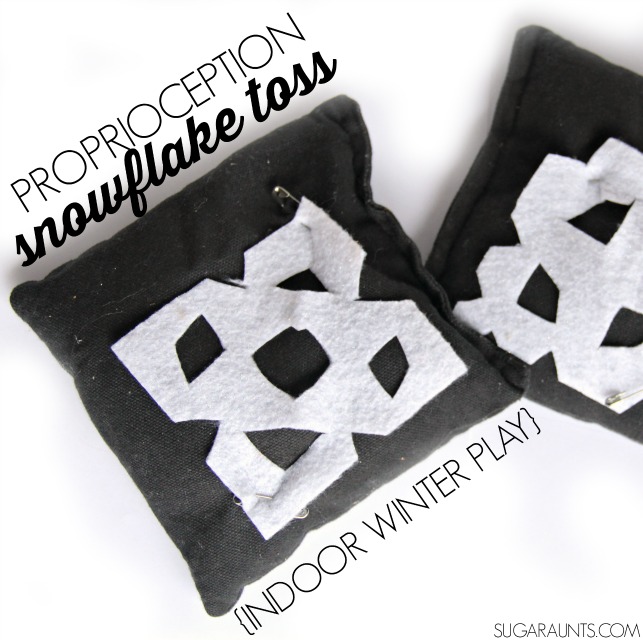
Proprioception indoor winter snowflake toss game for kids with bean bags. This is a great idea for days when it it too cold to go outside, or winter or snowflake themed party games.

Proprioception activity to throw weighted snowflakes


This post contains affiliate links.


Make weighted snowflakes.  We used bean bags and felt snowflakes.


Cut felt snowflakes from white glitter felt.  Cut a small square of the glitter felt.  Ours were 3″x 3″ and big enough to fit on our bean bags.  Cutting the felt is a great proprioception activity for the hands. 
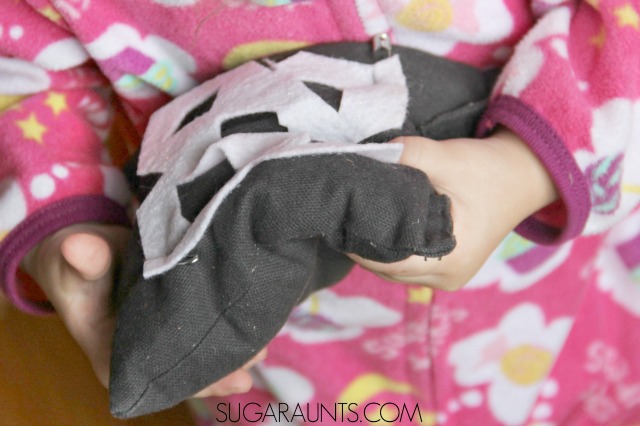

Pin these to bean bags with safety pins to create weighted snowflakes.   Your weighted snowflakes are done and ready for a little indoor proprioception play!


Toss the weighted snowflakes into a target such as a bucket or a basket.  You could even toss them into a sled like we did in this snowball fight activity.

Proprioception indoor winter snowflake toss game for kids with bean bags. This is a great idea for days when it it too cold to go outside, or winter or snowflake themed party games.


This activity can be modified to work on other goal areas:
Move closer or further back from the target.  
Try adding additional body movements like jumps and hops for added proprioceptive input.
Work on counting with one-to-one correspondence.
Add additional movement components by creating an indoor obstacle course.


This post is part of our January Calendar activities where we’re sharing proprioceptive and vestibular activities for each day.  See all of the posts here


Are you looking for more information on Vestibular or Proprioception (and ALL of the sensory systems) and how they affect functional skills, behavior, and the body’s sensory systems?  This book, Sensory Lifestyle Handbook, will explain it all.  Activities and Resources are included.  Get it today and never struggle to understand or explain Sensory processing again. 

Steam Train Dream Train Busy Bag

Great books for preschoolers need a fun activity to extend the fun.  We’ve shared a bunch of our favorite books and activities here on the blog and this Steam Train, Dream Train busy bag activity is another great book and play idea.  
 
Busy bags are a playful way to get kids involved in creative and independent learning through play and are many times, a DIY craft for the moms to make.  If you’ve got a child who loves trains, this preschool book and busy bag activity is for you!


Try these train themed sensory activity ideas for more ways to play with a train theme.


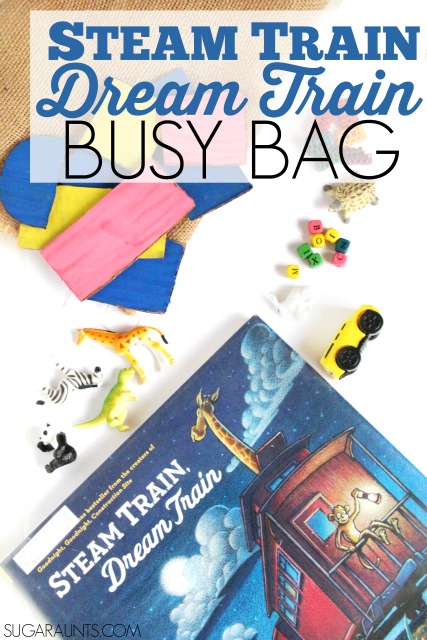
Steam Train Dream Train book and busy bag activity. This is a great idea for preschoolers and beginner readers who need to wait at a restaurant or doctors office!  Make this busy bag to go along with the book and inspire creative and imagination play and learning as kids re-tell the story through play.

“Steam Train, Dream Train” Book and Busy Bag Activity

This post contains affiliate links.
 
“Steam Train, Dream Train”
is a fun book to read.  My kids loved the rhymes and details in the gorgeous pictures.  In the book, a train is rumbling to a stop where it fills it’s cars with toys of all kinds.  The train workers are playful animals who rest in the trains cars after they’ve filled it.  At the end of the book, we see the train is a playset in a child’s bedroom and you can just imagine all of the creative play that happens with that train!
 
We decided to make our own playful train set that can be carried along to places where waiting is difficult.  This book-related busy bag would be a fun way to pass time while waiting at a restaurant.  Slip the book
into a bag along with a few play items and you’ve got a busy bag that will inspire creative play of limitless capacities.
Steam Train Dream Train book and busy bag activity. This is a great idea for preschoolers and beginner readers who need to wait at a restaurant or doctors office!  Make this busy bag to go along with the book and inspire creative and imagination play and learning as kids re-tell the story through play.
 
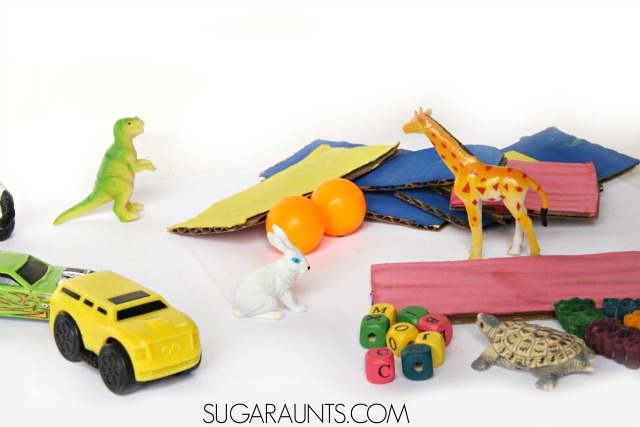
You’ll need a few items to fill your busy bag.  We used items that correspond with the book
that we had in out house, but if you’re needing a few items, it would be easy to replace them with other toys.
We added these items to our busy bag:
 
Cardboard shapes (See how to make them here.)
burlap bag
Small alphabet beads
(We received ours from www.craftprojectideas.com)
Steam Train Dream Train book and busy bag activity. This is a great idea for preschoolers and beginner readers who need to wait at a restaurant or doctors office!  Make this busy bag to go along with the book and inspire creative and imagination play and learning as kids re-tell the story through play.
Read the book together and as you read, play along and build your dream train!
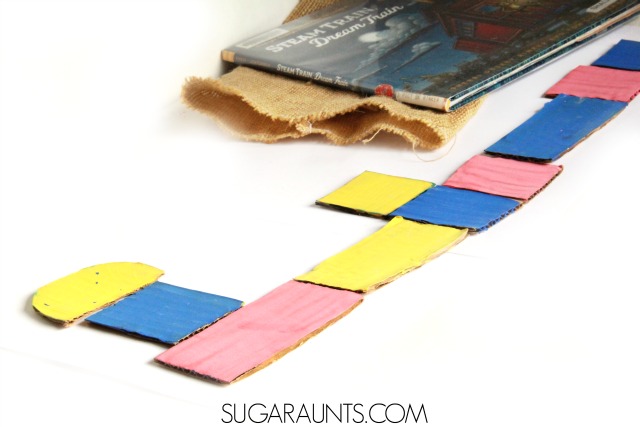
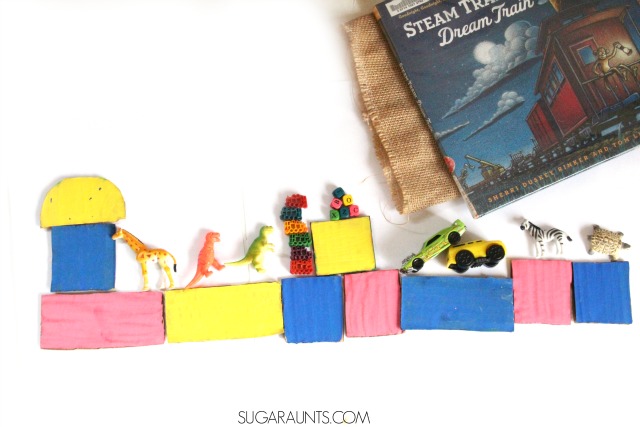
We used the cardboard shapes to build a shape train.  Now is a great time to discuss the shapes that can be used to build a train.  Talk about colors, too!
Steam Train Dream Train book and busy bag activity. This is a great idea for preschoolers and beginner readers who need to wait at a restaurant or doctors office!  Make this busy bag to go along with the book and inspire creative and imagination play and learning as kids re-tell the story through play.
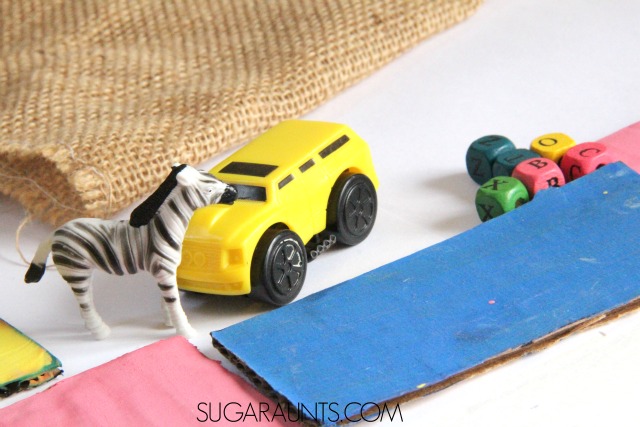
Use the toys to add to the train as you go through the story.  
Steam Train Dream Train book and busy bag activity. This is a great idea for preschoolers and beginner readers who need to wait at a restaurant or doctors office!  Make this busy bag to go along with the book and inspire creative and imagination play and learning as kids re-tell the story through play.


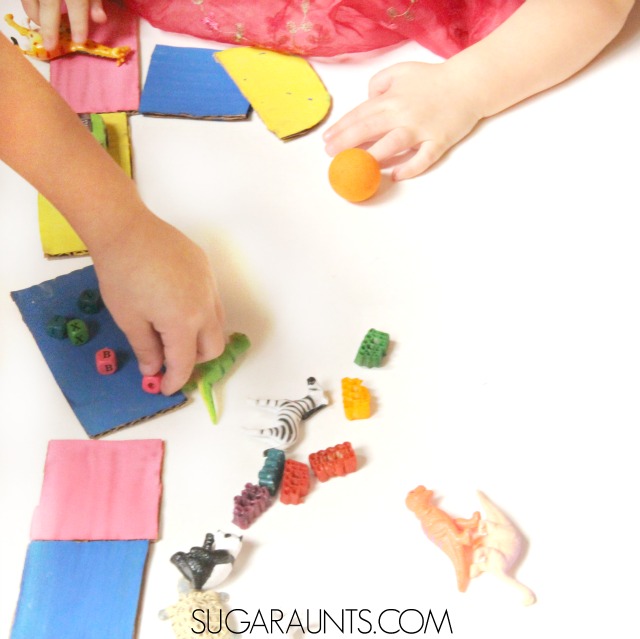
When you’re child is playing independently with their busy bag, they can recall the story or create parts of their own.
Steam Train Dream Train book and busy bag activity. This is a great idea for preschoolers and beginner readers who need to wait at a restaurant or doctors office!  Make this busy bag to go along with the book and inspire creative and imagination play and learning as kids re-tell the story through play.
Play with your shape train busy bag over and over again!
 
Want to find more “Steam Train, Dream Train”?  Stop by and see what the other bloggers in the Book Club Play Dates series have come up with for this book:
 
Make an Egg carton steam train craft based on the book, like Craftulate did.
Play a Number matching game with a printable from Fun-a-Day.
Steam Train Dream Train book and busy bag activity. This is a great idea for preschoolers and beginner readers who need to wait at a restaurant or doctors office!  Make this busy bag to go along with the book and inspire creative and imagination play and learning as kids re-tell the story through play.
Love this post?  Share it on Facebook!
 
More preschool books you and your child will love:
   
hands-on activities to explore social emotional development through children's books.

Love exploring books with hands-on play?

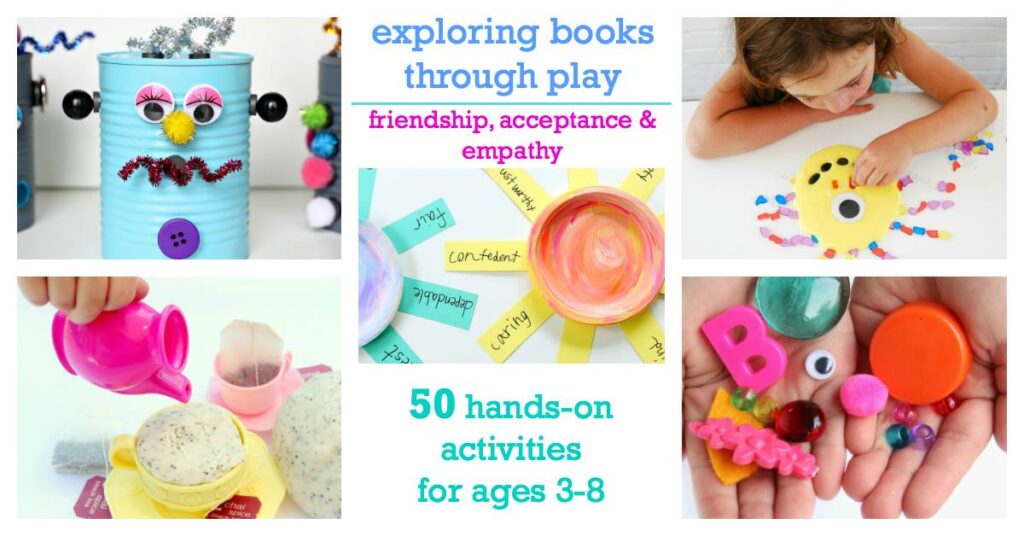
Grab our NEW book that explores friendship, acceptance, and empathy through popular (and amazing) children’s books!  It’s 50 hands-on activities that use math, fine motor skills, movement, art, crafts, and creativity to support social emotional development.

GET THE E-BOOK 

Get the PRINT BOOK 

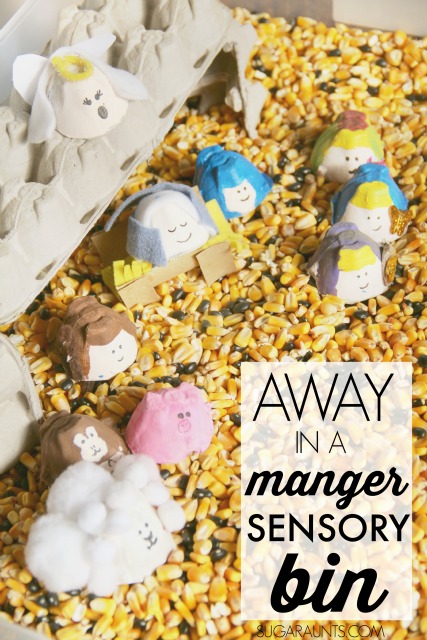
Away In A Manger Christmas Carol Sensory Bin (with Egg Cartons!)

This time of year, we love our Christmas carols. (Actually, we seem to sing them year-round.  During the Christmas season, though, they are on re-play!)  We joined bloggers from all over in creating a sensory bin based on Christmas carols.  You can see all of the bloggers and their Christmas carol-related sensory bins here. This is a Christmas sensory bin that kids love to use in holiday play activities. You can check out all of our Winter sensory bins as well.

 
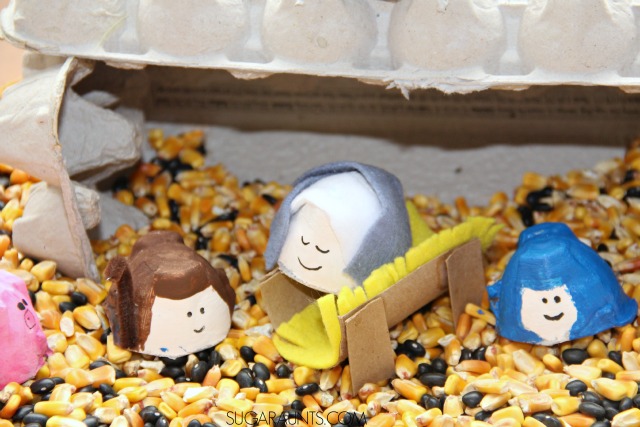
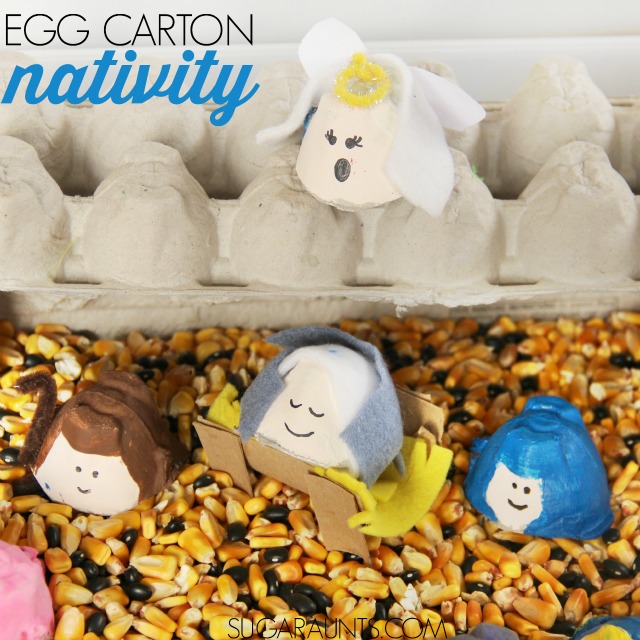
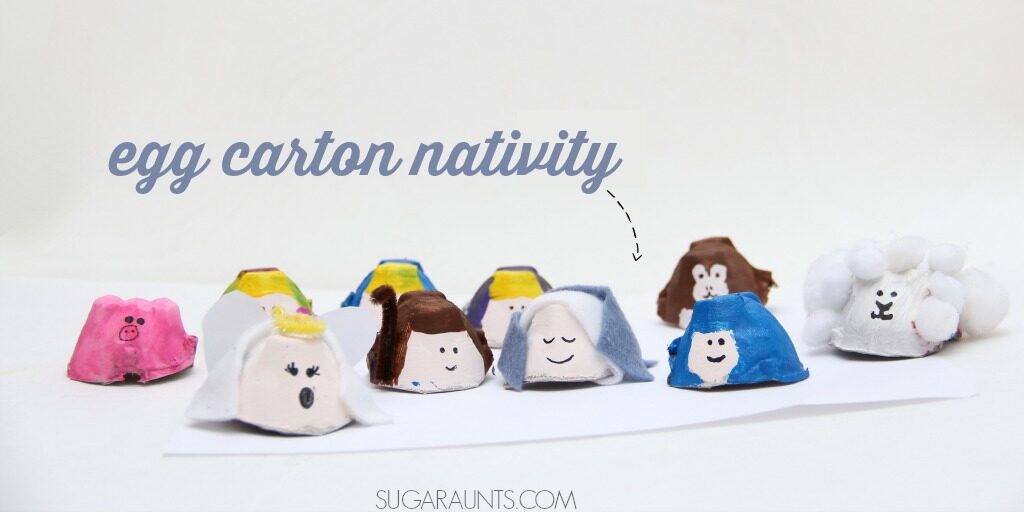
We decided to create a sensory bin around one of our favorite Christmas carols, “Away in a Manger”.  It’s a song that my kids love to sing and one that brings memories of Christmas sing-a-longs and church pageants. This nativity sensory bin used something that we love to craft with: egg cartons!


Check out these Christmas Fine Motor Activities for more creative ways to work on fine motor skills and address development of skills this Christmas season. 

Away in a Manger Christmas Carol sensory bin. With egg cartons!

Egg Carton Nativity Sensory Bin

This post contains affiliate links.  
 
This sensory bin was easy to put together.  Pull out your paint
and glue and a few recycled egg cartons, because this was fun to make AND play with.


Away in a Manger Christmas Carol sensory bin. With egg cartons!
 
  Away in a Manger Christmas Carol sensory bin. With egg cartons!
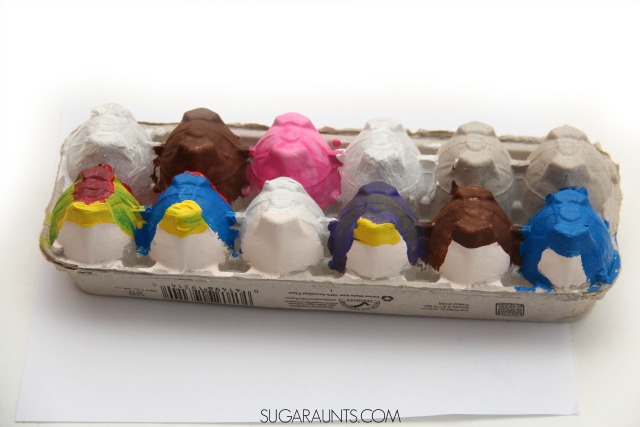
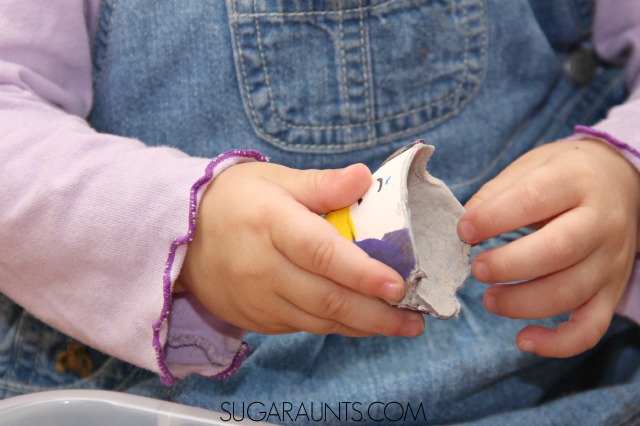
My daughter helped me paint egg carton sections with different colored paints (I love these
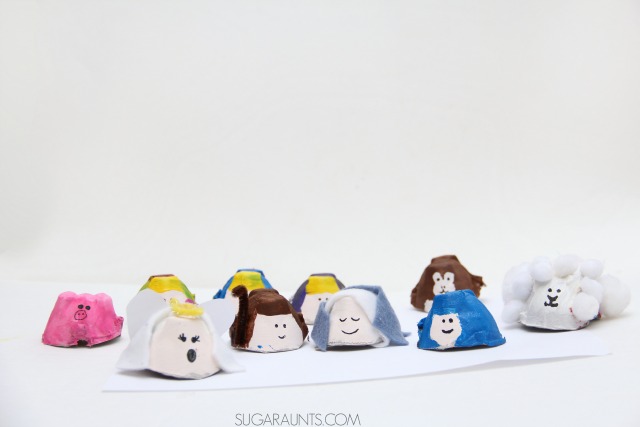
for their bright colors.) and I added the face details.  We glued on parts to the people. like adding a gold pipe cleaner
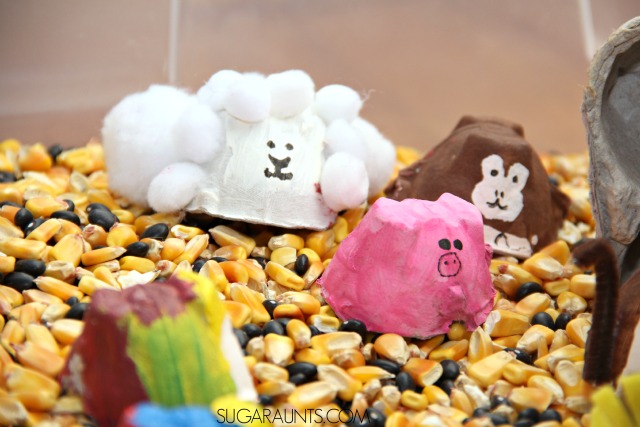
halo to the angel, white crafting pom poms
to the lamb, and sparkly spangles to the three kings. 


Away in a Manger Christmas Carol sensory bin. With egg cartons!
 
Use a permanent marker
to add facial features.


Away in a Manger Christmas Carol sensory bin. With egg cartons!
 
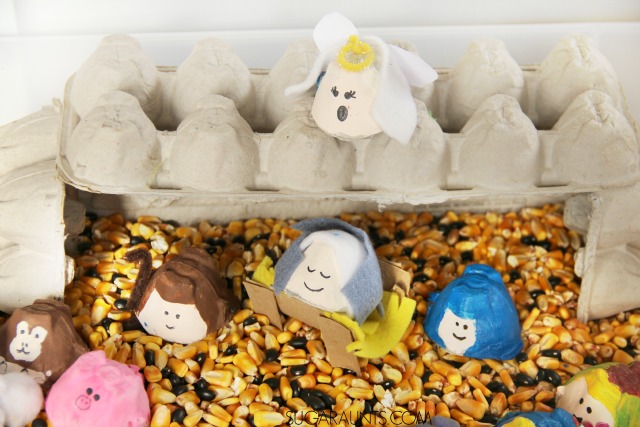
We used another egg carton to build the stable, and a recycled paper tube to make the manger.

Away in a Manger Christmas Carol sensory bin. With egg cartons!
And it was time to play. (Turn on “Away in a Manger” while you play!)

Away in a Manger Christmas Carol Sensory Bin

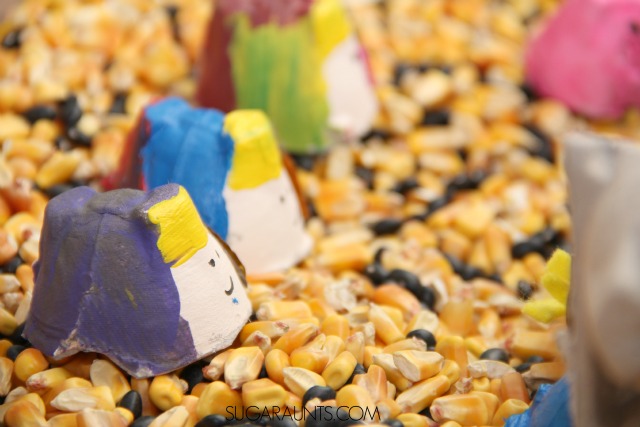
We used corn and black beans to create a sensory bin filler.  It was a cool medium because we could create hills and mounds like the landscape that Mary and Joseph may have crossed to get to the stable.  

Away in a Manger Christmas Carol sensory bin. With egg cartons!
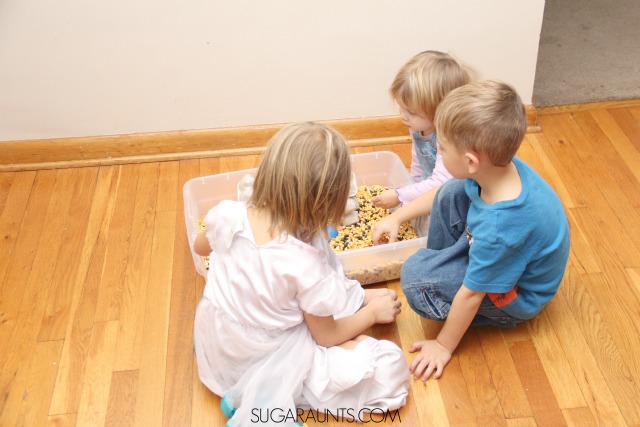
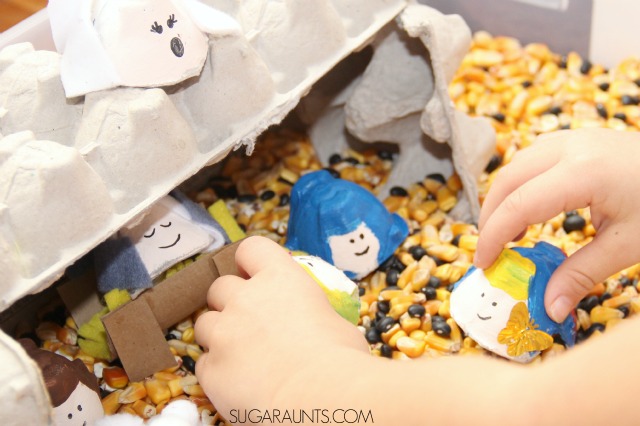
We scooped and smoothed the corn as we pretended our nativity scene (and sang Away in a Manger).  

Away in a Manger Christmas Carol sensory bin. With egg cartons!
 
This donkey looks a little more like a monkey…But it worked for us!  He was pals with the pig and the overly fluffy sheep.
We had so much fun playing with this Manger sensory bin.  It will be out for the rest of our Christmas season…and probably a bit longer after that!
 
Want to see more sensory bins based on Christmas Carols?  Check out what these bloggers have created! 

 
Away in a Manger Christmas Carol sensory bin. With egg cartons!
 

Christmas Handwriting Activities

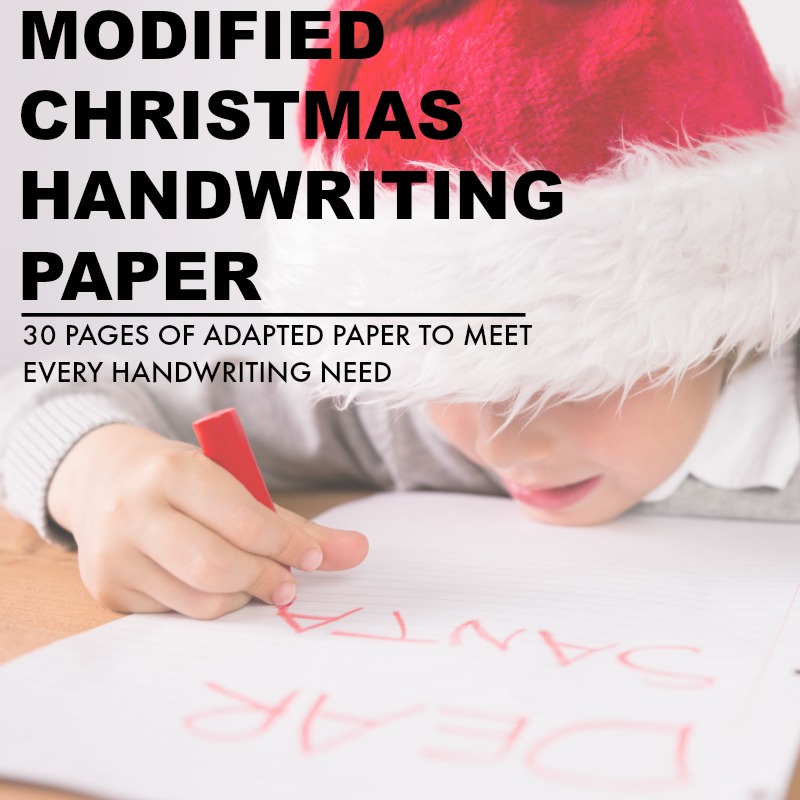
Writing out that Christmas wish list is a difficult task that brings out tears instead of holiday excitement.  I’ve got a solution for your kiddo with handwriting difficulties: a packet of modified paper for all of the Christmas handwriting tasks that come up each year.  Use this handwriting pack to help kids who struggle with handwriting to participate in holiday traditions while even working on and developing their handwriting skills!

Working on handwriting with kids this Christmas season? Grab your copy of the Christmas Modified Handwriting Packet. It’s got three types of adapted paper that kids can use to write letters to Santa, Thank You notes, holiday bucket lists and much more…all while working on handwriting skills in a motivating and fun way! Read more about the adapted Christmas Paper here

Try these Christmas crafts and activities: 

Winter Crafts for Kids


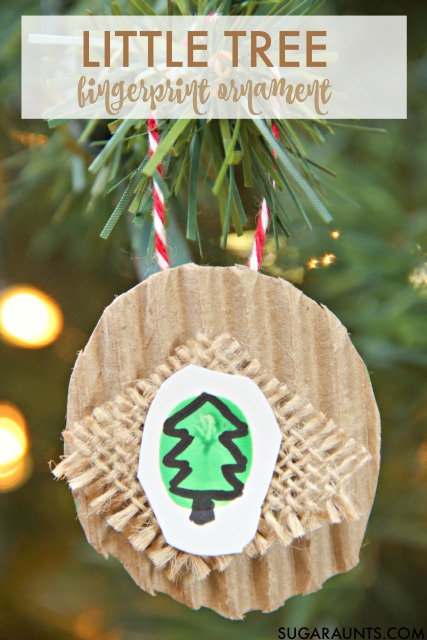
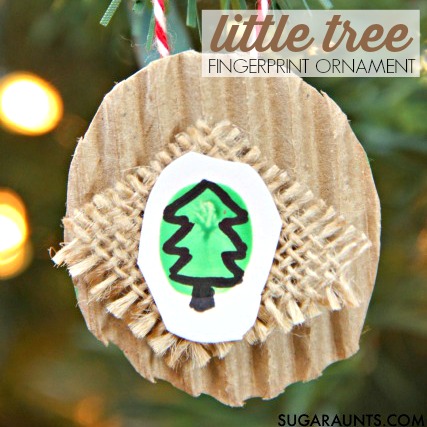
Fingerprint Christmas Tree Ornament Based on ee cummings’ Book Little Tree

You know we are big on sneaking in the fine motor skill development around here, right?  We are also a bit of book fans, so when we decided to make a book-inspired Christmas tree ornament, we went with the book, “little tree” by e.e. cummings and made a little fingerprint Christmas tree. 
 
Check out these Christmas Fine Motor Activities for more creative ways to work on fine motor skills and address development of skills this Christmas season. 
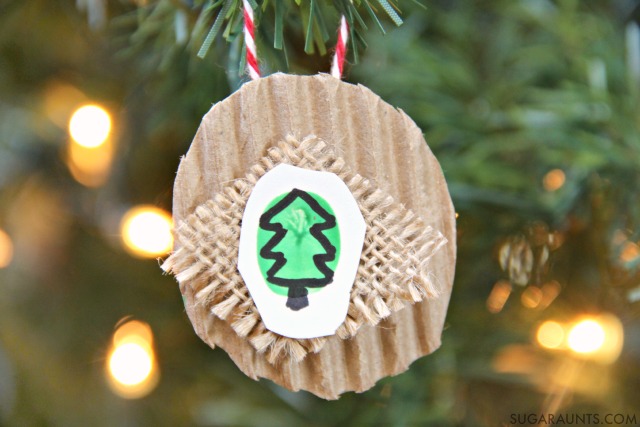
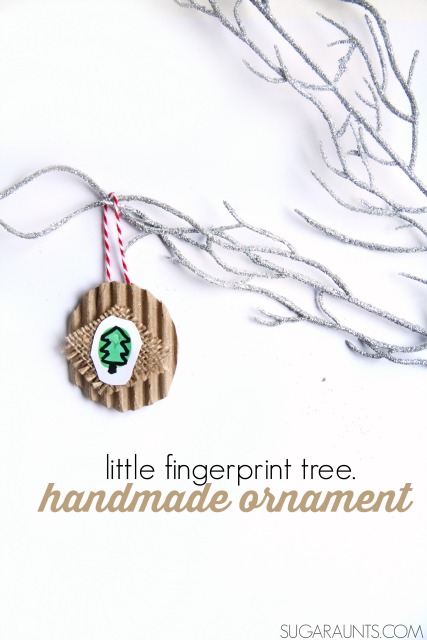
Little fingerprint Christmas tree ornament memento based on the book, little tree by e.e. cummings.  This kid-made Christmas ornament is a fine motor workout for intrinsic muscle strength, arch development, and finger isolation.

 
Full Disclosure: This post contains affiliate links.
 
We read the book, little tree by e.e. cummings (Illustrated by Deborah Kogan Ray).  This book is a poem that describes a little tree that children chose and carried home to decorate in their city apartment.  They are very loving and proud of their little tree.  The warm pencil drawings that illustrate the book make you feel the love the kids have for their Christmas tree.  This book and poem make you realize that it’s the little things and not flashy decorations that really matter this season.  
 
We made our ornament with a little fingerprint tree that can be looked back on each year.  We added to the fingerprint tree, simple and small layers that aren’t flashy or bright, but just warm and comfortable.
We love to create handmade Christmas ornaments each year with fingerprints or handprints.  I love to see their little fingerprints each year when we pull out the Christmas decorations each year.
You might have seen a recent post sharing the importance of fingerprint art in fine motor development, specifically finger isolation.  This fingerprint Christmas tree ornament is a fine motor workout! 


Fingerprint Fine Motor Skills

Little fingerprint Christmas tree ornament memento based on the book, little tree by e.e. cummings.  This kid-made Christmas ornament is a fine motor workout for intrinsic muscle strength, arch development, and finger isolation.
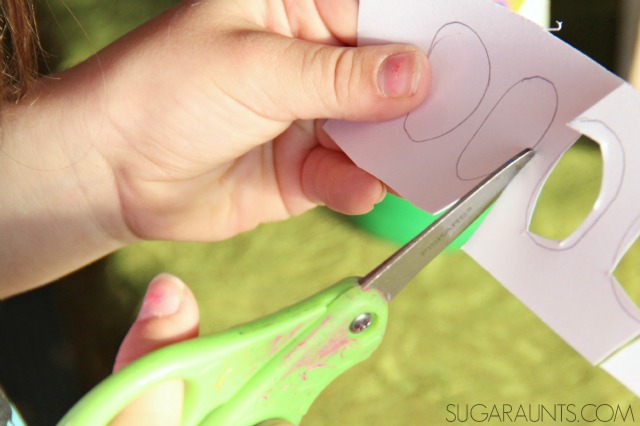
Cut small oval shapes from white cardstock.
Little fingerprint Christmas tree ornament memento based on the book, little tree by e.e. cummings.  This kid-made Christmas ornament is a fine motor workout for intrinsic muscle strength, arch development, and finger isolation.
 
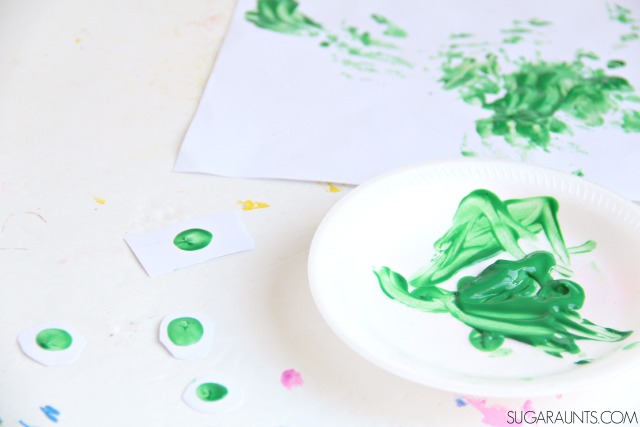
Next, have your kids make fingerprints with green paint on the ovals.


Fine Motor Arch Development

Little fingerprint Christmas tree ornament memento based on the book, little tree by e.e. cummings.  This kid-made Christmas ornament is a fine motor workout for intrinsic muscle strength, arch development, and finger isolation.
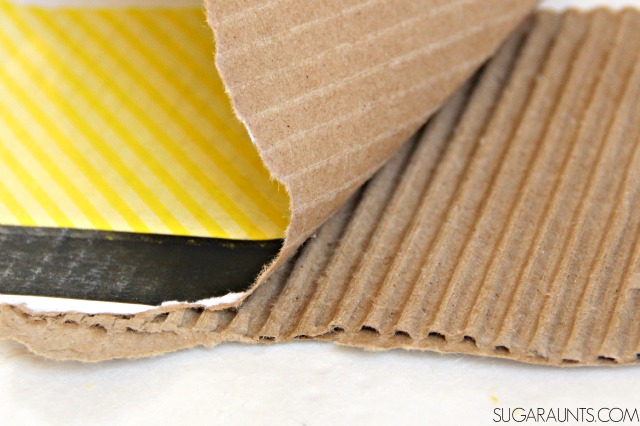
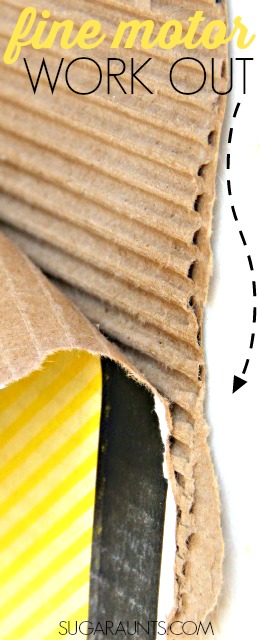
To make our fingerprint tree ornaments, we grabbed some corrugated cardboard.  Ok.  If you are looking for a fine motor activity for the kids, grab the nearest cardboard box.  This time of year, you might be receiving packages in the mail.  Save those cardboard boxes!  
 
Peeling the top layer from corrugated cardboard really works on arch development of the hands and intrinsic muscle strength.  This is an activity that I love to recommend as an Occupational Therapist.
Little fingerprint Christmas tree ornament memento based on the book, little tree by e.e. cummings.  This kid-made Christmas ornament is a fine motor workout for intrinsic muscle strength, arch development, and finger isolation.
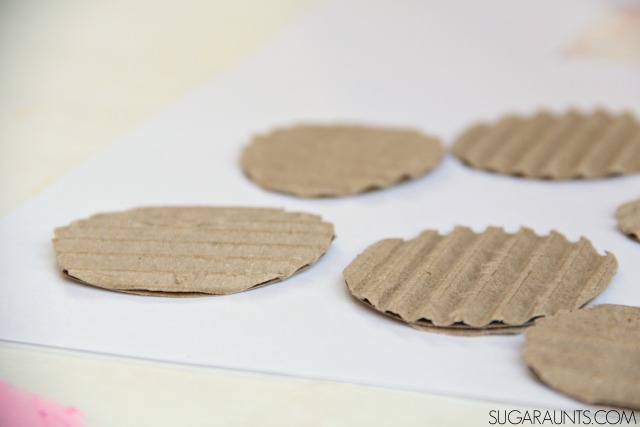
Cut the peeled cardboard into circles.
Little fingerprint Christmas tree ornament memento based on the book, little tree by e.e. cummings.  This kid-made Christmas ornament is a fine motor workout for intrinsic muscle strength, arch development, and finger isolation.
Draw a Christmas tree shape onto the fingerprint.  Add a small piece of  burlap with glue.  Tape a length of  baker’s twine to the back of the ornament. 
 
thumbprint little tree Christmas ornament
 
fingerprint-christmas-tree-ornament-for-kids
 
Hang the little trees in your Christmas tree and  notice how little your child’s fingerprints are! This is an ornament I will cherish as my babies’ (and their fingerprints grow!
This ornament is based on a Christmas book and part of the 10 Days of Kid-Made Christmas series.  
 
Check out the other bloggers who are sharing book related ornaments today:
Rainbow Fish Salt Dough from Artsy Momma
Clay Ornament from Heart of Deborah
Felt Robin Ornament from Mum in the Mad House
Santa Ornament from Inspired by Familia
Elf Peg Dolls from Rhythms of Play
Little fingerprint Christmas tree ornament memento based on the book, little tree by e.e. cummings.  This kid-made Christmas ornament is a fine motor workout for intrinsic muscle strength, arch development, and finger isolation.
 
Try this at home! Pin it here.
Little fingerprint Christmas tree ornament memento based on the book, little tree by e.e. cummings.  This kid-made Christmas ornament is a fine motor workout for intrinsic muscle strength, arch development, and finger isolation.
 
 
More Christmas ornaments you will love:
   

Llama Llama Red Pajama Proprioception Sensory Activity

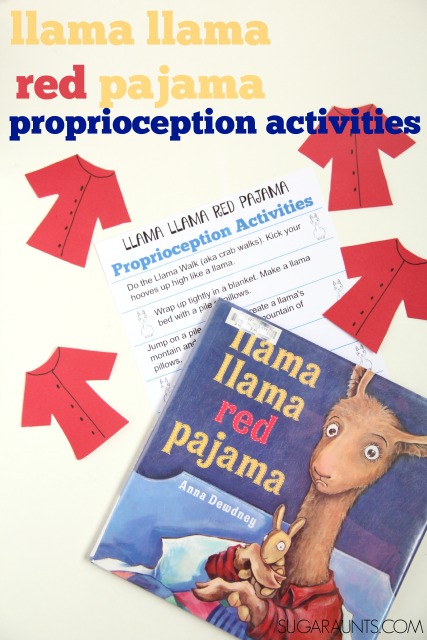
Use these proprioception heavy work activities for calming sensory integration Try these Proprioception activities for sensory integration and calming heavy work input based on the book, Llama Llama Red Pajama with your little llamas!


Did you ever read Llama Llama Red Pajama and think, “That Mama Llama. Oh, I FEEL for that mama!” 


She just wants to put the baby down to sleep so she can finally wash those crusty breakfast dishes.  Then she has to take a call from a friend (which was probably scheduled with the intention to cross another three items from her to-do list, and totally not a call of the friendship-soul-building type).  Then all she wants to do is finally… finally…put up her llama feet and sigh a deep, exhausted, mama breath. 


You know that end-of-the-day mama sigh, right? A Mama can finally breathe at the end of the day, knowing that her babies are safe in their beds and quiet, at peace, and not dumping toys all over the floor.  It’s the biggest sigh and is so satisfying.  Maybe it was a ROUGH day. A day filled with yelling and not happy giggles.  A day loaded with siblings pulling hair and not playing like nice little brothers and sisters.  A day of sensory overload. 


That Mama Llama.  She starts in on her nightly to-dos and hears the “Maaaaammmaaaa!” from upstairs.  


Ugh.  


A long day just got longer. 


But that “Mama!” yelling llama is scared. Nervous.  Alone.  Questioning. Upset.  


And a mama, be it a mama llama or a tired, frizzy, overworked mama of the people variety just help.


Baby Llama’s routines have changed. The normal nightly get-a-drink-one-last-kiss-tuck-me-in norm has been a little diverted.  And then, you can’t help but feel for that little llama baby who NEEDS his mama. Her KNOWS he needs her.  
He needs deep pressure, sensory, proprioceptive input, calming relaxation before he can snuggle up and go to sleep.  Routines have changed, a sensation triggered a thought process of what-ifs, and there is no turning back from the sensory integration that only mama can give.  

Try these proprioception activities for heavy work input based on the book, Llama Llama Red Pajama
 

And Mama Llama does just that.  She drops everything, does the tuck-snuggle-one-last-kiss thing and baby llama is finally able to settle.  


And that Mama Llama.  She can finally take that last big sigh of the day and know that she helped her little one in every way that she could.

Proprioception Needs and Llama Llama Red Pajama book

{This post contains affiliate links.  See our full disclosure here.}


SO, When we read Llama Llama, Red Pajama, I couldn’t help but notice the proprioceptive needs that are being yelled for.  Screamed for, even.  Baby Llama needs to feel calmed after his routine is thrown.  And it doesn’t take much.  That one last drink that mama brings every night, or even some nights, is a known to Baby Llama.  He knows his mama is going to help him and keep him safe.  When that normal thing is gone because Mama is on the phone, his little llama world is thrown.


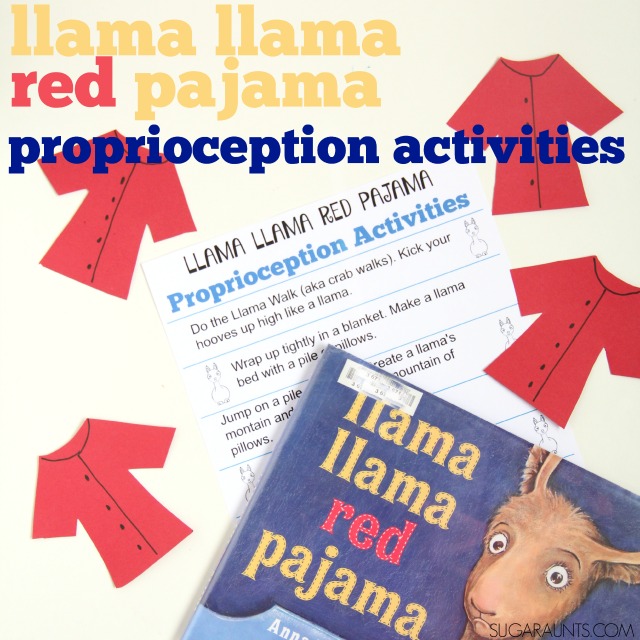
I had to put together these Llama Llama Red Pajama
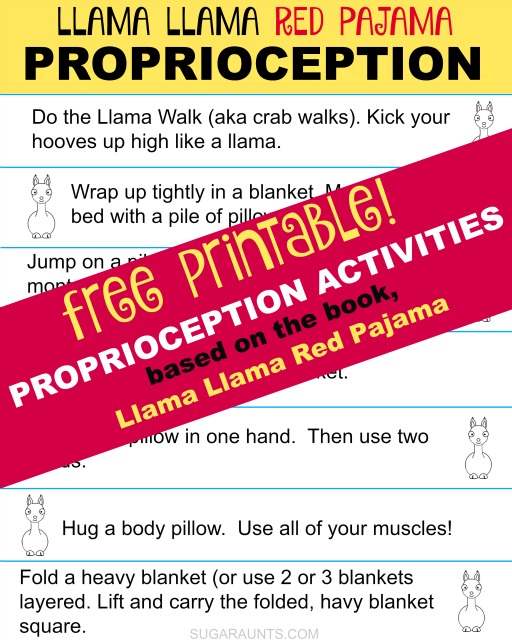
Proprioception cards.  They are a fun way to get a little proprioceptive input in when sensory needs are thrown and a child needs to calm, relax, and center themselves.


This sensory activity is very simple.  Read Llama Llama Red Pajama.  Notice how Baby Llama jumps, twists, stomps, and cries.  He’s gotten so upset that there is NO way he can settle down on his own.  Sometimes all it takes is a snuggle and a reassuring hug from mama, but for other kids, they need proprioception to re-group and organize themselves.

Try these proprioception activities for heavy work input based on the book, Llama Llama Red Pajama


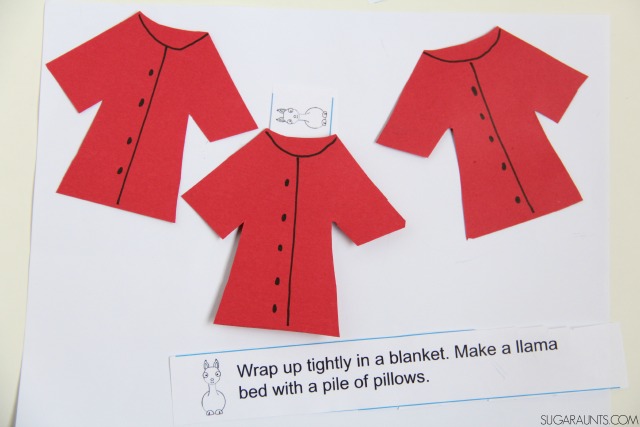
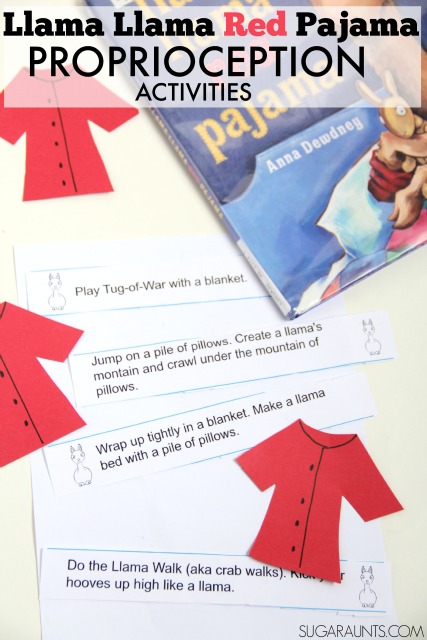
We cut out red pajama shirt shapes from red paper.  After printing the free printable with the Llama proprioception activities, we cut them out and attached them to the pajama shirts.


Try these proprioception activities for heavy work input based on the book, Llama Llama Red Pajama


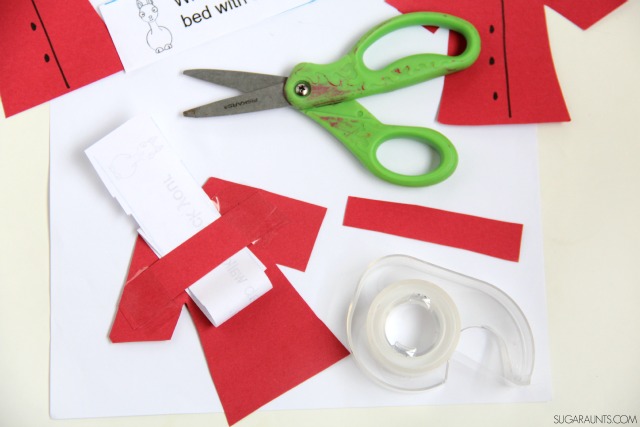
Cut a small strip of paper to create a sleeve on the back of the pajama shapes.  Slip the paper strips into the sleeve to hold the proprioception activity ideas.

Use these cards along with the book or as needed.  Keep them together in a pile on a window sill or in an envelope and pull them out when calming proprioception needs are high.

Llama Llama Red Pajama Proprioception Activity

These activities provide heavy work input and can be calming for some kids.  Other kids might get overly excited by the same activities.  It is SO important to speak to an Occupational Therapist to find the perfect fit for your child’s individual needs.  Know that no tow kids are alike and a general list will not work for every child.  This list is meant to be a resource.
 
Try these proprioception activities based on the book, Llama Llama Red Pajama
 
 
Proprioception activities based on the book Llama Llama Red Pajama:
  • Wrap up tight in a blanket.
  • Squish between pillows.
  • Jump in a pile of pillows.
  • Play tug-of-war with a blanket.
  • Squeeze a pillow with one hands.  Then use two hands.
  • Hug a body pillow. Use all of your muscles!
  • Fold a heavy blanket (or two or three blankets laid on top of one another. Lift and carry the folded, heavy blanket square.
  • Use a sheet like a parachute.
  • Do the Llama Walk (aka crab walks). Kick your hooves up high like a llama.

You’ll be directed to a link with all of our free printables in one place.  It’s a jackpot of freebies. And the bonus is that you’ll receive occasional emails from me with more fun and creative ideas.


Try these proprioception activities for heavy work input based on the book, Llama Llama Red Pajama


Stop by and see what the other bloggers in our Book Club Play Dates series have come up with based on the book, Llama Llama Red Pajama:

  • Create a snack based on the book, Llama Llama Red Pajama! Find snack ideas for the book on Fun-a-Day.
  • Create and play with a Llama Llama busy bag!  Still Playing School has a fun idea.
  • Craftulate has a great idea for a Llama Llama Red Pajama game.
  • Make a Llama print craft like House of Burke.
Try these proprioception activities for heavy work input based on the book, Llama Llama Red Pajama


Love this idea? Share it on Facebook!
The Sensory Lifestyle Handbook
 
Are you looking for more information on Sensory Processing and Proprioception (or any of the sensory systems and how they affect functional skills, behavior, and the body’s sensory systems?  This book, Sensory Lifestyle Handbook, will explain it all.  Activities and Resources are included.  Get it today and never struggle to understand or explain Sensory Integration again.  Shop HERE.
                       
Looking for more proprioception activities?  Try these: 
 
 
hands-on activities to explore social emotional development through children's books.

Love exploring books with hands-on play?  

Grab our NEW book that explores friendship, acceptance, and empathy through popular (and amazing) children’s books!  It’s 50 hands-on activities that use math, fine motor skills, movement, art, crafts, and creativity to support social emotional development.


Fine Motor Fuzzy Beads for Letter Recognition

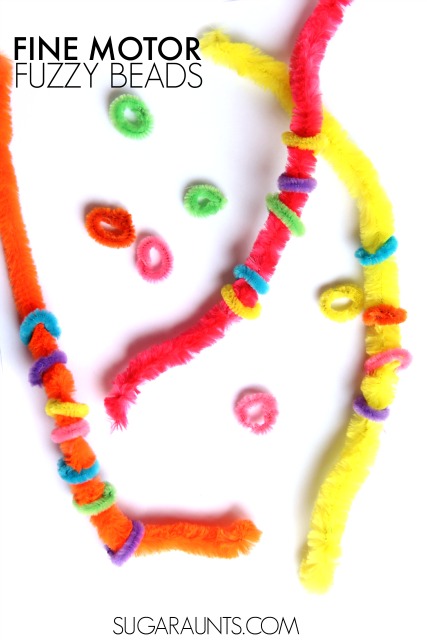
Today, I’ve got an easy letter recognition and fine motor activity for you to try with your preschool and kindergarten aged kids.  Sometimes a fun letter activity adds play to learning and the kids don’t even realize they are learning.  Then, when you throw  in a fine motor component that might be difficult for them typically, it’s a bonus!  We have been sharing a bunch of fine motor tips and tools lately.  It’s part of our 31 Days of Occupational Therapy series and this fine motor activity is a perfect fit.  Whether you are looking for ideas for strengthening, in-hand manipulation, or fidgeting, this fuzzy bead activity will help those areas and more.  So, get ready to see how we came up with this Letter Recognition and Fuzzy Bead fine motor activity and get ready to make your own.  They will be a hit in your house or Occupational Therapy clinic!
 
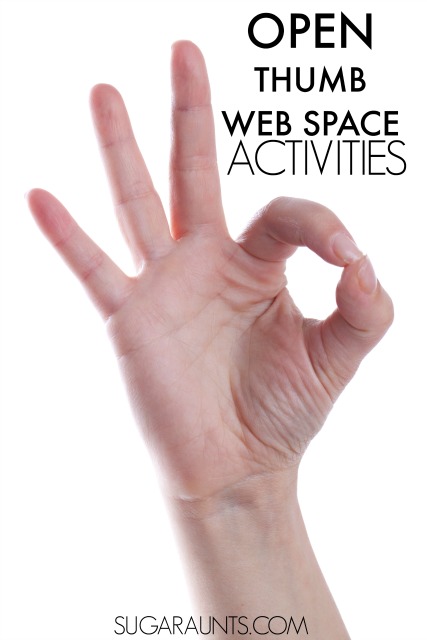
This is one creative way to promote an open thumb web space needed for fine motor skills.

This fine motor activity works on open web space of the thumb and finger in the hand. An open web space is important for fine motor tasks like handwriting and tool use.  Kids will love these ideas to work on an open web space, from an Occupational Therapist.
 
This post contains affiliate links.


Fine Motor Fuzzy Beads Activity (DIY beads!)

This fine motor activity works on open web space of the thumb and finger in the hand. An open web space is important for fine motor tasks like handwriting and tool use.  Kids will love these ideas to work on an open web space, from an Occupational Therapist.
This activity is so easy to throw together.  Grab a few colorful Pipe Cleaners and start cutting them into small pieces.  Cutting pipe cleaners is a fun way to get the kids snipping different materials besides paper.  My kiddos thought cutting the pipe cleaners was a fun activity and loved watching the little pieces fly as they snipped.  It takes a bit of muscle oomph to cut through the pipe cleaner so it’s a great fine motor strengthening exercise.  You’ll want the pipe cleaners to be about an inch long.  Some can be bigger, too.  
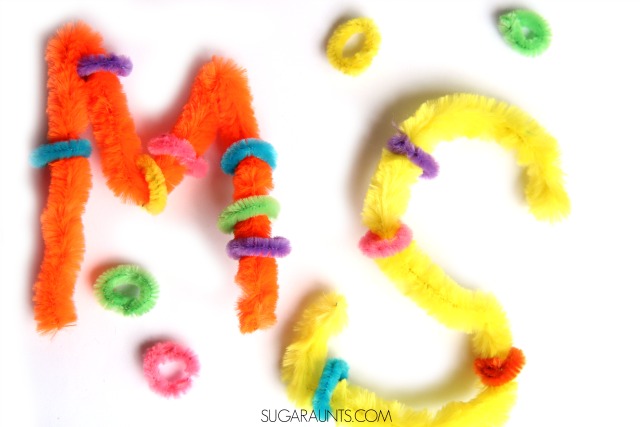
 
Bend the pipe cleaners into circles and pinch them so they stay in a ring shape.  This is a fantastic fine motor activity for kids.  Bending the little pieces of pipe cleaners really works on arch development of the hands and an open web space.  An open web space is essential for so many fine motor activities and dexterity.  Read on to fine out more about open web spaces and arch development below.
This fine motor activity works on open web space of the thumb and finger in the hand. An open web space is important for fine motor tasks like handwriting and tool use.  Kids will love these ideas to work on an open web space, from an Occupational Therapist.
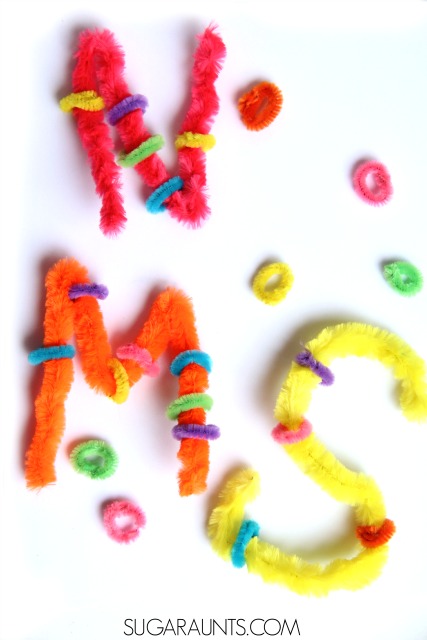
The only other material you’ll need for this fine motor activity are Jumbo Fuzzy pipe cleaners.  we received ours from our friends at www.craftprojectideas.com, but you can find a similar product here.  Bend the fuzzy pipe cleaners into letter shapes to work on letter recognition and letter identification with your preschoolers.  Kindergarten aged kids can practice letter formation with the large pipe cleaners.  Keep s few strait, too, for making bracelets and jewelry.


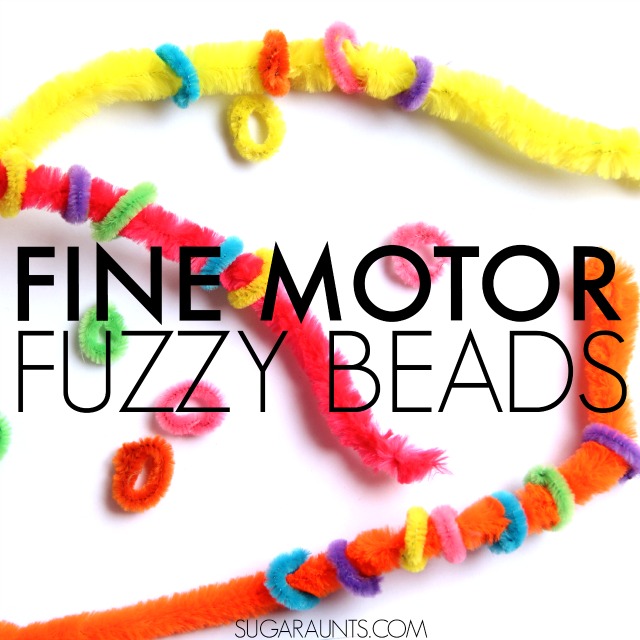
Now for the fine motor fun part:  Using those little pipe cleaner beads that the kids created, show them how to bead them onto the fuzzy pipe cleaners for a threading task.  Beading is an excellent fine motor activity for children, as it opens up the thumb web space and works on skills like bilateral hand coordination, in-hand manipulation, visual scanning (as the child looks for the color they like!), and hand-eye coordination to thread the bead onto the fuzzy stick.

This fine motor activity works on open web space of the thumb and finger in the hand. An open web space is important for fine motor tasks like handwriting and tool use.  Kids will love these ideas to work on an open web space, from an Occupational Therapist.


What is an Open thumb Web Space and WHY do you need to care about it?

So, one of the important areas that Occupational Therapists work on when addressing a poor grasp on pencils, tools, and in functional tasks is an Open Thumb Web Space.  You know that space between your thumb and pointer finger?  That area that makes an “O” when you make the “OK” sign?  That is an important little place for dexterity!  To grasp small items with your thumb and index finger, you need to oppose the tip of your thumb to the tip of your pointer finger.  Not only do the tips of the fingers need to touch, but the thumb must rotate at the joint closest to your hand.  This opposition is needed to manipulate and grasp small items like shoe laces, buttons, and zippers.  


When kids write or color with that web space area squashed shut, it’s a sign of problems.  Then might be compensating for thumb instability, underdeveloped hand arches, and/or poor strength.  Each of these problem areas will lead to difficulties with handwriting, dexterity, manipulation of small items like beads, and pencil grasp. Writing with a closed web space is inefficient and will cause poor and slow handwriting, especially as kids grow and are expected to write at faster speeds. A closed web space while attempting to manage fasteners such as buttons and zippers will lead to fumbling and difficulty. So, what do you do if you’ve got a kiddo who is squashing that web space shut during functional tasks?  I’ve got a few ideas on how to work on open thumb web spaces.  


(NOTE: This post and all others on this site are meant to be a resource, and not treatment.  If your child displays any difficulty that we discuss here, please refer to an Occupational Therapist for individualized evaluation and treatment.)


RELATED READ: Thumb Opposition With Paper Clips
This fine motor activity works on open web space of the thumb and finger in the hand. An open web space is important for fine motor tasks like handwriting and tool use.  Kids will love these ideas to work on an open web space, from an Occupational Therapist.


Open Web Space Activities

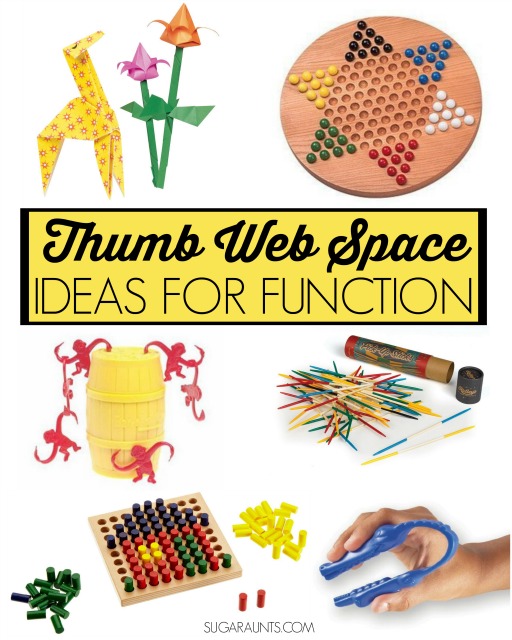
  • Beading (like our idea we shared above!) Other beading ideas include threading plastic beads on a string, placing cereal O’s onto toothpicks, and stringing straws onto yarn.
  • Pick-Up-Sticks 
  • Wind up toys.
  • Barrel of Monkeys
    game. Encourage your child to pick up the monkeys with an open web space. 
  •  A game like Chinese Checkers
    encourages an open web space when the child grasps the small pegs with a pincer grasp between their thumb and the pad of their index finger. 
  • You could also try peg games like this HABA Color Peg
  • Push coins into a piggy bank.
  • Tweezers
    activities are great for an open web space. 
  • If handwriting and poor pencil grasp is an issue, try a pencil grip.
  • Pop beads. 
  • Roll play dough into small balls using the pads of the thumb and index finger. This is a great activity for developing arches of the hands and opening the thumb web space. 
  • Pop bubble wrap.
  • Screw and Unscrew nuts and bolts. 
  • Fold and crease oragami. This Origami Set & Booklooks like fun. Crease the paper between the thumb and pointer finger.
  • Pinching clothes pins.
  • Lacing cards are great for opening the thumb web space.  Prompt your child to keep their thumb web space open while managing the thread.  We’ve got lots of ideas here.
This fine motor activity works on open web space of the thumb and finger in the hand. An open web space is important for fine motor tasks like handwriting and tool use.  Kids will love these ideas to work on an open web space, from an Occupational Therapist.
Looking for more fine motor activities?  Stop by and follow along on our Fine Motor Play Pinterest board.  


You will love these Fine Motor ideas for kids: 

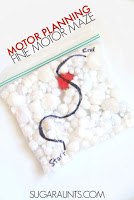
 Motor Planning Fine Motor Maze hand strengthening activity
 

Paper Football Sight Words

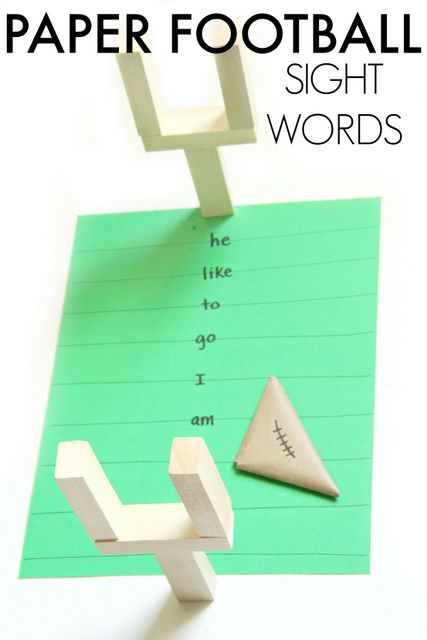
What do you do when your Kindergarten student would rather play paper football than practice sight words?  You combine his love of flicking folded paper across the table with introducing new words!  This Paper Football Sight Word game will get the most resistant student excited about scoring sight word touchdowns!


Sight word paper football game for Kindergarten students and beginner readers.


Paper Football Sight Word Game

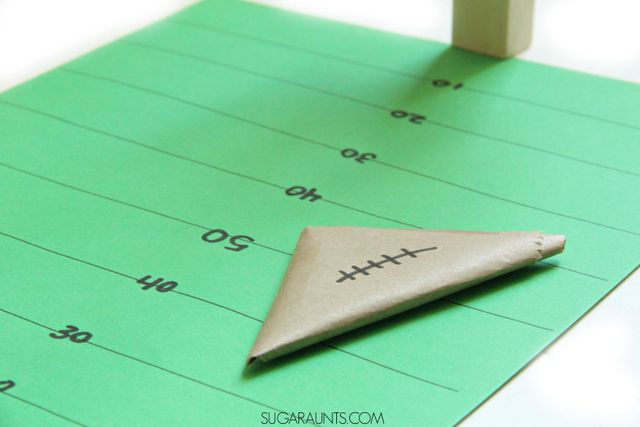
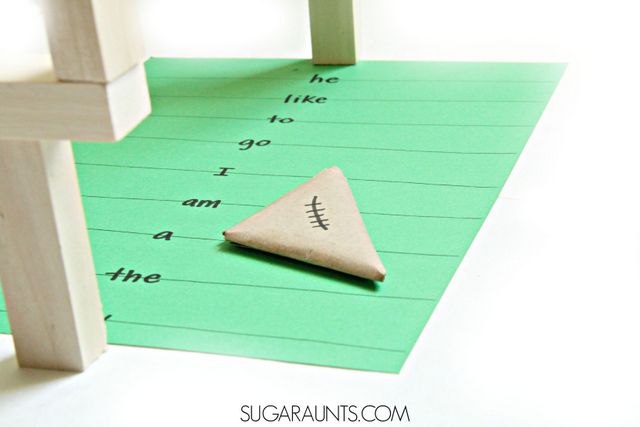
This post contains affiliate links.  This sight word activity is really easy to throw together.  I used Jenga game pieces and a sheet of Green Cardstock to make the football field pretty easily.  To make the goal posts, tape the pieces into a goal post shape using little “donuts” of tape.  Stick more tape to the bottom piece to keep the goal post in place.  Here’s a hint that we shared about the Jenga pieces over on our Instagram page.  Grab up a Jenga game at your dollar store or $5 store for cheap play.  we use these blocks for all kinds of creative play and learning.   (Follow us on Instagram so you can see our daily fun!)
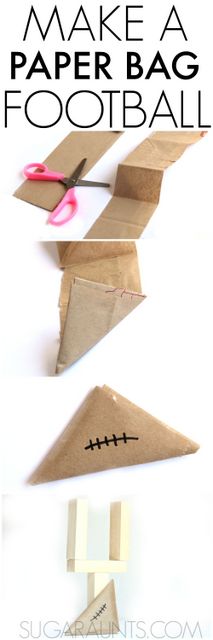
How to make a paper football.

Next you’ll make a paper football.  We used a strip of brown paper bag for a nice brown football.  

How to fold a paper football:

Now, I know that many of you, my lovely readers were note-passing-in-grade-school-on-up-through-high-school-who-passed-so-many-notes-your-locker-was-filled-a-third-of-the-way-with-folded-triangle-notes KNOW how to fold a triangle shaped paper note (I mean football).

This was you, too…right?

But.  Just in case you didn’t fill your locker with paper triangles of notes from friends, here is how you fold a paper football:

Cut a small paper bag in half, long-ways.  Then, cut down the sides so you have a long strip of paper that makes up both sides of the paper bag.  

Starting at one side of the strip, fold over a triangle.  Continue to fold the triangle over and over down the length of the strip of paper.  When you get to the end of the strip, tuck the remaining paper into the folds of the triangle.  Add a bit of tape to keep your football’s shape as you play paper football.

Sight word paper football game for Kindergarten students and beginner readers.
Then, on your Green Cardstock, draw lines for each of the 10 yard lines.  You can add numbers in for the lines.  (Practice counting off by tens with your child while doing this!)

Sight word paper football game for Kindergarten students and beginner readers.

To practice sight words, write a sight word on each yard line.  Start playing paper football. When the point of the football falls close to a word, have your child read the sight word. 

Looking for more Kindergarten sight word activities?  Try these: