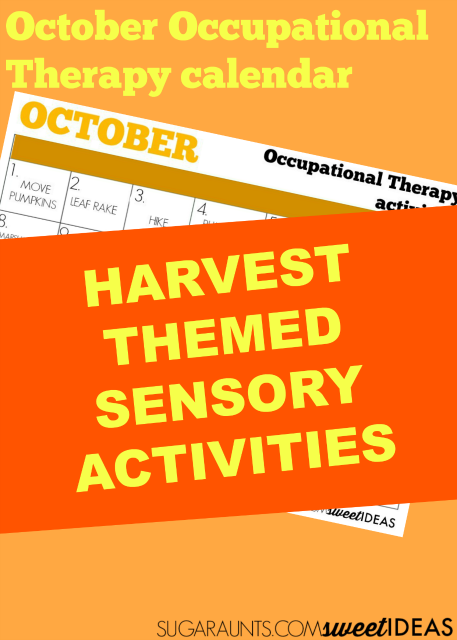
This month’s Occupational Therapy calendar explores the season’s finest with a Harvest theme. If you’ve missed this years’ series of calendars, you can check out last month’s calendar for activities that will keep your child occupied with sensory play and experiences well into this month.
Each month, I’ve been sharing creative and seasonal sensory experiences that address sensory needs based on each of the senses. I try to come up with activities that can be modified to address multiple developmental areas such as fine motor skills, visual motor integration, gross motor coordination and balance, and functional skills.
This month’s calendar is perfect for Sensory Awareness month!
October brings with it all things falling leaves and pumpkin spice everything, and it is definitely a sensory-filled month! This month’s activity calendar is full of sensory activities that will challenge the senses. You will find activities based on all seven senses and are fun ways to involve the whole family in indoor and outdoor play. Print out your free calendar, read through the activities and get ready to play!
For more info on the activities below, grab your Harvest Sensory Booklet (It’s a freebie, too! Scroll below to grab your copy.)
Use these harvest themed ideas in sensory diets to address sensory needs. These are creative ways to experience all that Fall has to offer with the whole family.
Take the challenge. Encourage and experience sensory play every day this month.
Print your Fall Sensory Activities workbook and calendar and join us in daily sensory play.
October Occupational Therapy Calendar Sensory Activities
Grab your Fall Sensory Activities booklet to build Fall harvest themed activities into your child’s sensory diet with activities the whole family can enjoy.
Get yours!
This is a great way to challenge the senses and take part in our Sensory Processing Month sensory challenge!
Simply add one sensory activity to every day. These can be simple ideas that the whole family can do. Need ideas? Grab your sensory activity booklet.
What’s in the Fall Sensory Activities booklet?
Fall Proprioception Sensory Activities
6 creative proprioception activities!
Fall Vestibular Sensory Activities
4 creative vestibular ideas for indoor or outdoor!
Fall Tactile Sensory Activities
4 tactile sensory experiences!
Fall Visual Sensory Activities
4 ways to incorporate the sense of sight into fall play!
Fall Auditory Sensory Activities
4 Fall auditory processing ideas!
Fall Olfactory Sensory Activities
5 ways to encourage and use scent in sensory processing!
Fall Gustatory Sensory Activities
4 Fall taste activities!
Are you excited to take the sensory challenge this October? Join us with the activities in your Fall Sensory Activities book today!
Looking for more ways to explore all things sensory this month?
How to incorporate sensory play into playing outside in the fall
It’s a fact that kids are spending less time playing outdoors. From after-school schedules to two working parents, to unsafe conditions, to increased digital screen time, to less outdoor recess time…kids just get less natural play in the outdoors. Therapists have connected the dots between less outdoor play and increased sensory struggles and attention difficulties in learning.
Knowing this, it can be powerful to have a list of outdoor sensory diet activities that can be recommended as therapy home programing and family activities that meet underlying needs.
That’s where the Outdoor Sensory Diet Cards and Sensory Challenge Cards come into play.
They are a printable resource that encourages sensory diet strategies in the outdoors. In the printable packet, there are 90 outdoor sensory diet activities, 60 outdoor recess sensory diet activities, 30 blank sensory diet cards, and 6 sensory challenge cards. They can be used based on preference and interest of the child, encouraging motivation and carryover, all while providing much-needed sensory input.
30 blank sensory diet cards, and 6 sensory challenge cards
They can be used based on preference and interest of the child, encouraging motivation and carryover, all while providing much-needed sensory input.
Research tells us that outdoor play improves attention and provides an ideal environment for a calm and alert state, perfect for integration of sensory input.
Outdoor play provides input from all the senses, allows for movement in all planes, and provides a variety of strengthening components including eccentric, concentric, and isometric muscle contractions.
Great tool for parents, teachers, AND therapists!
Be sure to grab the Outdoor Sensory Diet Cards and use them with a child (or adult) with sensory processing needs!
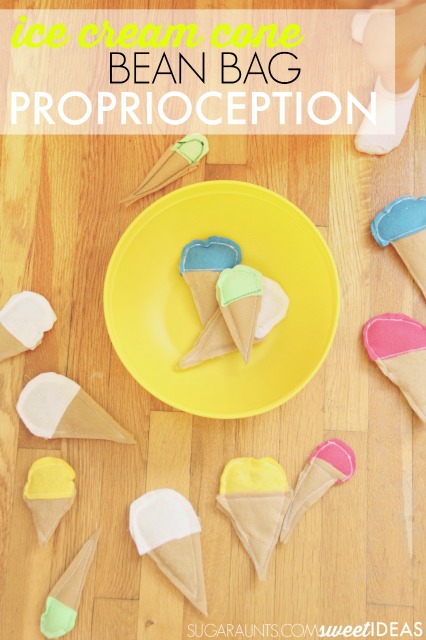
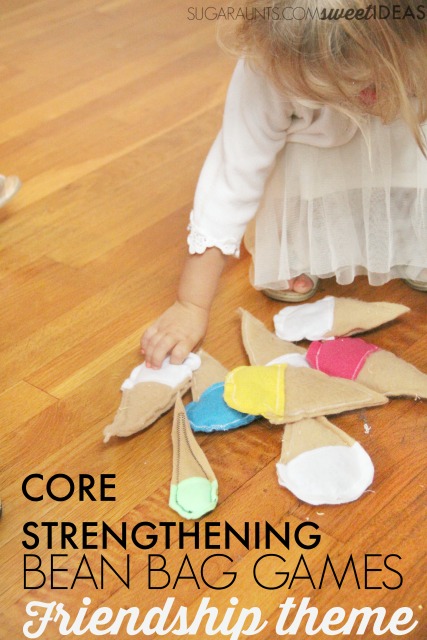
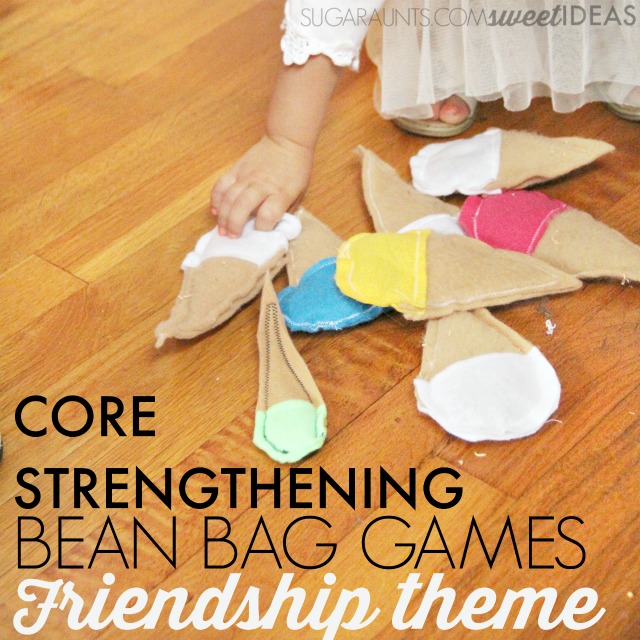
This ice cream gross motor activity is also a fun friendship gross motor activity too! In fact, movement games are a great way to build friendship and establish relationships, especially when team building and problem solving are involved. Here, you’ll find an ice cream bean bag activity that challenges not only core strength, movement patterns, and motor planning (with an ice cream theme!) but also is a fun friendship activity for a group.
The friendship gross motor activities here are bean bag games that would fit nicely with a movement gross motor activity because it’s just another way to improve core strengthening.
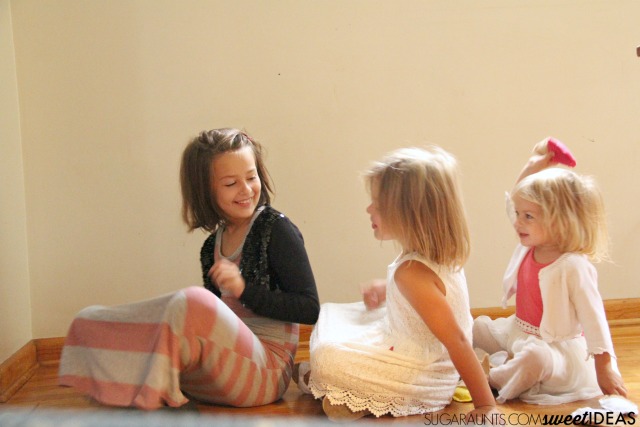
The friendship theme is a bonus, making it a fun friendship activity for preschoolers and younger kids developing from parallel play to associative play to cooperative play.
Use this ice cream therapy activity to add a movement break in the classroom, a creative ice breaker game for a group of new friends, and a playful ways to promote friendship with movement.
And even better, bean bag games improve core strengthening through whole body movement and these friendship themed games are one that will build memories.
Affiliate links are included in this post.
Gross Motor Core Strengthening ActivitY
Building core strength is important for so many reasons: attention, focus, and positioning are just a few reasons to strengthen the core. Read more about core strengthening and attention here.
Use bean bag games in Friendship Activities
There are several reasons why bean bag games are a great addition to any kids’ day. These are the underlying reasons why you’ll see bean bag activities in therapy. But, also bean bag games can be beneficial as a gross motor friendship activity, too.
Bean bag games are a great movement and core strengthening activity.
They are an easy way to add a movement brain break to classroom activities.
Movement games foster friendship and invite conversation in groups like classrooms, youth groups, play dates, and birthday parties.
Bean bag games offer repetition with heavy work, adding proprioception for a calming and organizing activity.
Bean bag games offer an opportunity for gross motor visual motor integration skill work, which is necessary for developing the skills needed for handwriting, reading, and learning.
Bean bag games allow a child to build core muscle strength.
Group games with bean bags build problem solving and group interactions.
For our gross motor friendship activity, we attempted to build core muscle strength through repetition of core muscle building, using a gross motor ice cream theme.
This would be a good activity for a group setting, however, you could definitely do this activity individually as well.
We used the ice cream bean bags that we made last summer. Read more about how to make the ice cream cone bean bags here.
While any bean bags would work for these friendship movement activities, we used what we had in the house, and they went perfectly with our book for this week, Mo Willems’ Should I Share My Ice Cream. (Tell me, are your kids as Elephant and Piggy obsessed as mine are???)
Gross Motor Friendship Ideas
Line up your group of kids. We played a few different games and they all involved FUN!
Bean Bag Slide– Kids can line up side by side, facing in the same direction. Start with all of the bean bags to the left side of one child. The first child should reach down and grab one bean bag. They can then slide the bean bag on the floor between their legs, placing it behind them. The child to their right should lean down and grab the bean bag between their legs. They can then place the bean bag on the floor in front of their feet. The child to their right can grab the bean bag and continue it down the line of kids.
Bean Bag Over Head– Kids can sit on the ground one in front of the other. The bean bags should begin in a pile in front of the first child. That child can pick up one bean bag and place it over their head to pass it to the next child behind them. That child can grab the bean bag and pass it over their head to the child behind them. Continue down the line.
2. Bean Bag Side to Side– Kids can sit in a line behind one another. The kids should pass bean bags down the line by twisting at the core to rotate their trunk. Continue the bean bag pass down the line.
3. Bean Bag Toss– Kids should line up in a line by standing up a few feet from one another. One child should pass one bean bag to the next student by tossing a low toss to the next child. Try to keep the bean bag close to the ground but not touching the ground. Continue to pass bean bags down the line.
4. Bean Bag Foot Pass– Kids can lie on their backs in a line. The fist child should use only their feet to pick up one bean bag and pass it to the next child. That child should grab the bean bag using only their feet. Continue all of the bean bags down the line.
Each of these games can be done in a line or in a circle.
friendship activity for preschoolers
By playing a group game, children can build friendships, foster relationships, problem solve, resolve conflicts, learn from others, and establish many other powerful developmental benefits of group activities.
For this friendship gross motor activity, we first, read one of our favorite Elephant and Piggy books, Should I Share My Ice Cream. We then used our ice cream bean bags to play a friendship game together. As we passed the ice cream bean bags, we shared ways to be helpful.
Sharing with a friend is just one way to be nice to a friend. Being helpful at school, making a nice card, or inviting a friend to play are other ways to be nice to a friend. As we passed the bean bags to one another, saying these qualities of a friend allowed us to slow down in the bean bag passing game.
This way, we could build muscle strength with slow movements.
While we used the ice cream bean bags, you could read the book and use any bean bags in your gross motor friendship activity! What are your favorite bean bag games?
This digital, E-BOOK is an amazing resource for anyone helping kids learn about acceptance, empathy, compassion, and friendship. In Exploring Books through Play, you’ll find therapist-approved resources, activities, crafts, projects, and play ideas based on 10 popular children’s books. Each book covered contains activities designed to develop fine motor skills, gross motor skills, sensory exploration, handwriting, and more. Help kids understand complex topics of social/emotional skills, empathy, compassion, and friendship through books and hands-on play.
Colleen Beck, OTR/L has been an occupational therapist since 2000, working in school-based, hand therapy, outpatient peds, EI, and SNF. Colleen created The OT Toolbox to inspire therapists, teachers, and parents with easy and fun tools to help children thrive. Read her story about going from an OT making $3/hour (after paying for kids’ childcare) to a full-time OT resource creator for millions of readers. Want to collaborate? Send an email to contact@theottoolbox.com.
Remember these ice cream cones? We shared how to make them not very long ago. Besides being very cute and super easy to make, they are a learning tool, too. We used them in a creative summer activity to practice some second grade math skills, specifically adding place value to two and three digit numbers.
Place Value Lesson
Make your bean bags.
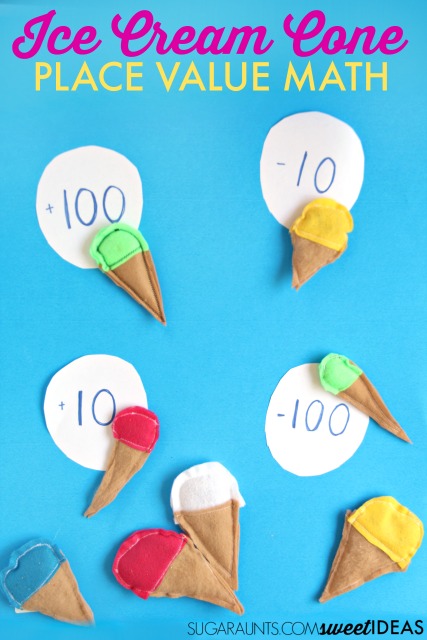
Grab a few pieces of paper and cut out circles. On them, write +10, -10, +100, and -100.
Next, spread the circles out on the floor. Position the kiddos around the circles and tell them that they are about to have some math fun, ice cream style!
You’ll want to tell the kids a number. It might be a single, double, or triple digit number. Then, kids can toss the bean bags onto the circles. When the bean bag hits a circle, they need to either add 10 or 100 to their number or subtract 10 or 100 from their number. This is a fun way tp practice place value and mental math of tens and hundreds place with two or three digit numbers.
There are infinite number of ways you could play this with an ice cream cone theme to work on math skills.
Add single or double numbers by writing different numbers on the circles.
Each color of the ice cream cones indicates a different number. Kids can add together numbers based on the color that hits a target.
Add near doubles with the bean bags.
Add 100’s up to 1,000.
How would you use these ice cream cone bean bags in playful math?
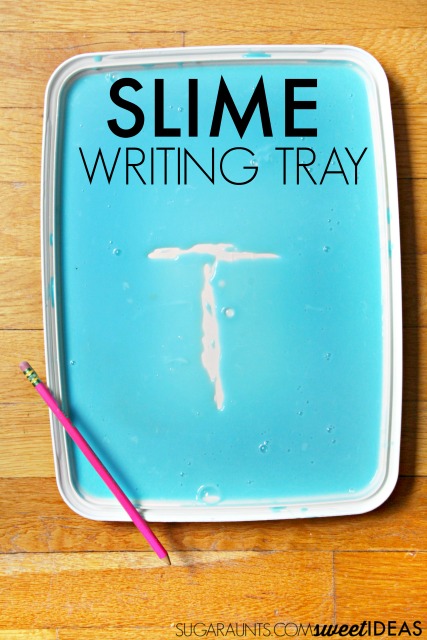
Have you made slime? I have to admit. We’ve got tons (and tons) of play dough recipes…but we have never made slime. It’s been on our list for a long time, but we just never got around to it. We whipped up our first batch the other day and I think I have created a family of slime monsters. My kids were all. over. the slime. When we started using the slime in a slime handwriting tray activity, they were even more into it! This is a perfect addition to our writing trays for handwriting ideas.
They were a little hesitant to try touching the slime at first, but once they saw mom getting in on the fun, they had to try the squishy, slimy material. After a few “eeeewwww!”s, they were loving the slime! I think we have a lot of slime in our future.
How do you make slime?
So, you’ve probably seen all of the awesome slime sensory play pictures all over pinterest.
But, how do you actually make the stuff? As a newbie slime-making mom, I had to look it up. We used this recipe and it turned out completely slimy and fabulous. I have to tell you though: If you are a new slime maker, there is no way you can mix up a batch of slime and take pictures. It just won’t happen. So, I have to apologize for the lack of awesome slime-in-process pics, and even the requisite slime-falling-from-a-child’s-hands pictures. We are a ways off from those action shots in our slime journey.
So after we mixed up our new slime baby, we had to get to playing.
Slime novice tip: Slime is messy. And by messy, I mean M.E.S.S.Y. If you are looking for a tactile sensory play activity, this is it. It’s the coolest texture, but it is mess in a bowl.
Slime Handwriting Tray
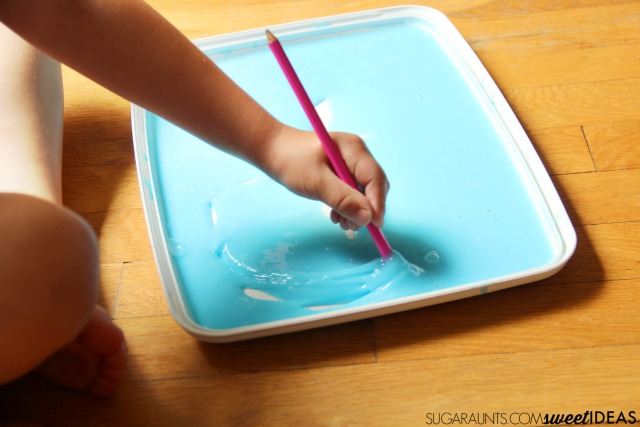
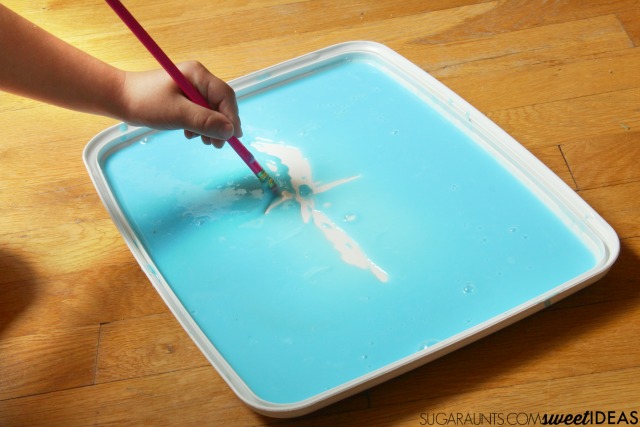
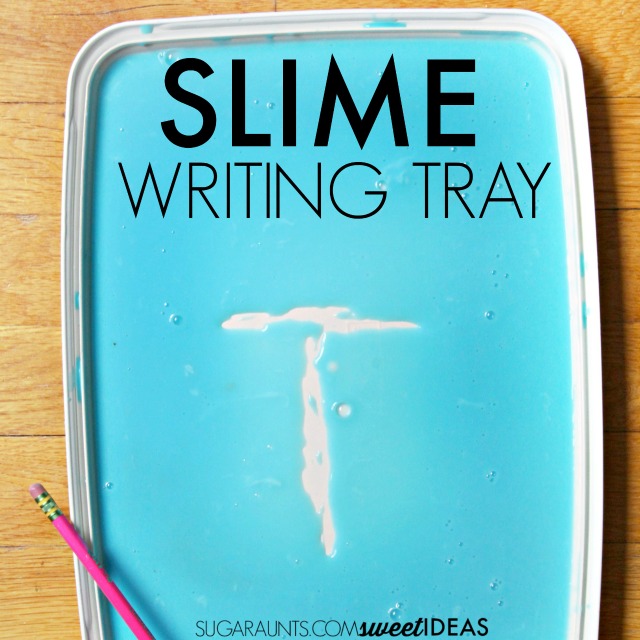
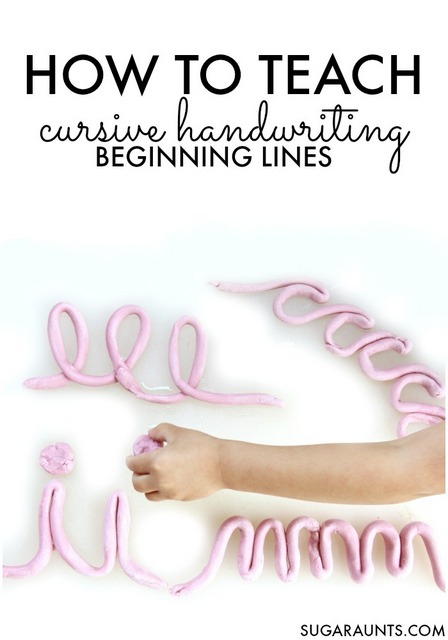
After playing Slimer from Ghost-busters with our wiggly glob, we decided to try a writing tray. This was super easy and a creative way to work on letter formation. Plop the slime into a low edged tray. I used a lid from a plastic bin. Then, grab a pencil with an intact and new(ish) eraser. Use the eraser to write letters and shapes.
Love writing trays? Try this easy rice writing tray to work on letter formation and number formation.
This is a GREAT way for new writers and pre-writers to work on letter formation and pre-writing forms. The slime maintains it’s form for just a little while, but long enough for the letter to stay visible for a bit. It’s a nice way for kids to trace shapes with an appropriate motor plan and tripod grasp on the writing tool.
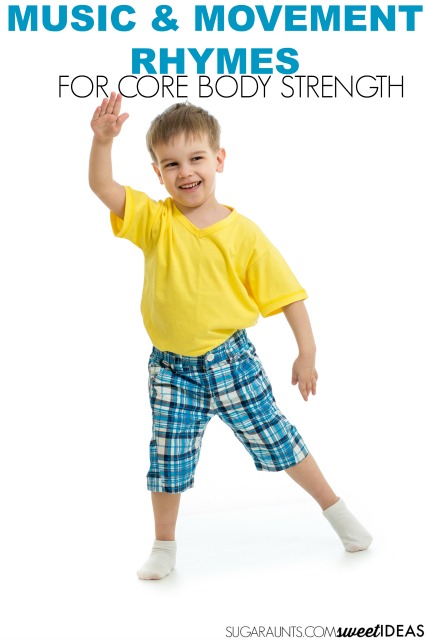
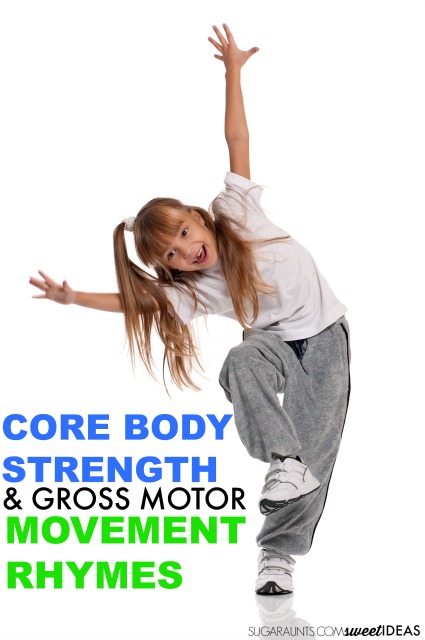
Kids love to move and wiggle. They also need the strengthening that occurs as a result of all of that moving and wiggling. Today, I’ve got fun ways to build the core body strength using music and movement songs and rhymes. These are childhood classics that are fun to pass on to kids!
When children have a strong core (or trunk), they are able to sit up at a desk, play on the floor without drooping or slumping, write with a functional position, and even dress themselves more easily. Strength of the core body is essential for every childhood function, and even allows the child to pay attention more easily.
Core Body Strengthening with Music and Movement Songs
This post contains affiliate links.
Think back to your childhood. Are there games or activities that you recall doing in carefree childhood play? Some of those music rhyming games can be used to work on strength and stability of the body’s trunk.
Try these core body strengthening ideas. I love all of the creative exercises and activities for building strength in the trunk. Plus, these are great tools for posture exercises for kids.
Music and Movement Rhymes for addressing core body strength: I’m a Little Teapot Head Shoulders Knees and Toes Row, Row, Row Your Boat Teddy Bear Teddy Bear Turn Around If You’re Happy and You Know It Hokey Pokey The Wheels on the Bus
Try these rhyming games to work on the strength of the upper body with your kids, all while having fun and inducing giggles!
What should you do when weak core muscles impact handwriting?
Strengthening the core can have a HUGE impact in handwriting!
Do you have any favorite movement and music rhymes from your childhood?
Handwriting legibility and hand strength are closely tied. You might say they go hand-in-hand. (I had to go there!)
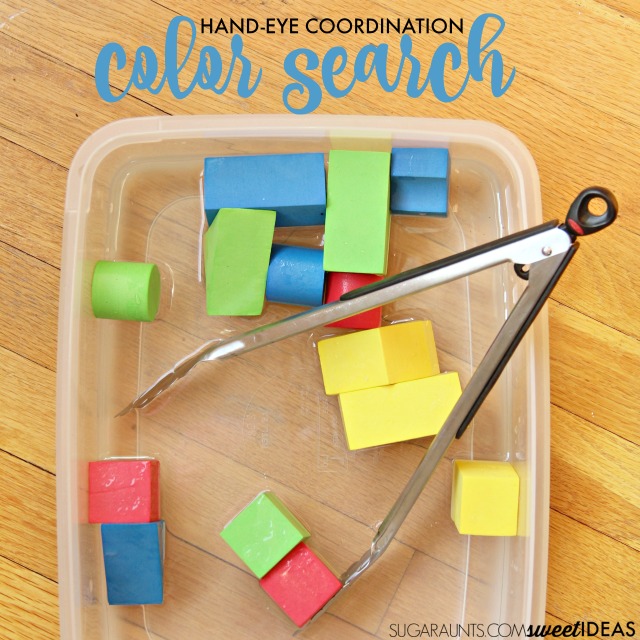
This easy fine motor tong activity is designed to build some of the muscles needed for managing a pencil. The intrinsic muscles are the muscles in the hand that define the arches of the hands, bend the knuckles, and oppose with the thumbs.
Among these muscles are a group called the lumbricals. The lumbrical muscles have a job to bend (flex) the MCP joints and extend (straighten) the PIP and DIP joints. When the lumbricals are in action, the hand might look like it is holding a plate with the big knuckles bent and the fingers extended.
Lumbrical Muscles of the Hands and Handwriting
This post contains affiliate links.
The lumbrical muscles of the hands are important in handwriting. They are used to hold the pencil in a functional grasp. Advancing the pencil in an upward motion using the joints of the fingers require strength and endurance of the lumbrical muscles. Forming letters like upstrokes in cursive letters and the re-trace of letters like a, d, g, h, m, n, p, q, r, u, v, and w require upward pencil strokes.
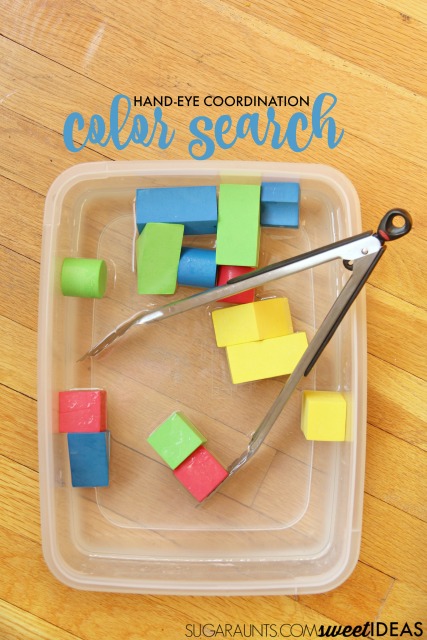
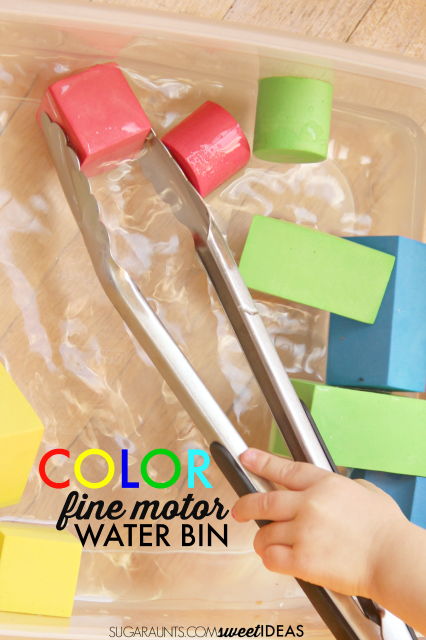
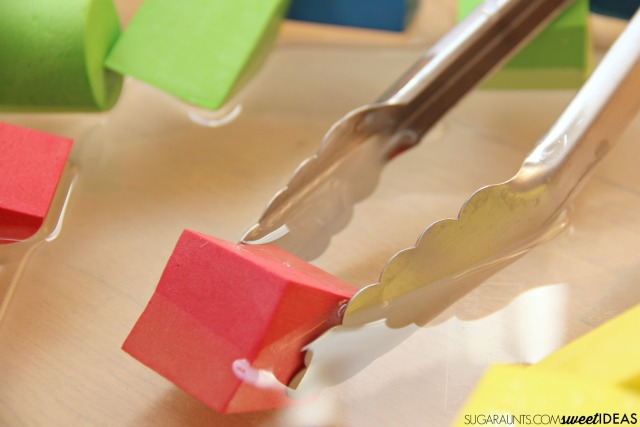
A quick and easy way to develop and strengthen the lumbricals is a tong activity like this one. Use a large kitchen tong utensil to grasp items. We used this kitchen tong, but any large tong would work for this strengthening activity. Foam blocks are a nice size and make a great hand-eye coordination exercise for children with the tongs. Fill a bin with water and add in the foam blocks. Ask your child to grab the blocks as you call out colors for a color identification activity.
It is important to notice the position of your child’s hand on the tongs in activities like this one. You want to see a slightly extended wrist and tongs UNDER the hand to work on lumbrical muscle strength. This is different than a task geared toward building precision and thumb intrinsic muscle strength.
More intrinsic muscles needed in handwriting
The muscles used in handwriting can be broken up into two actions.
The muscles:
flexor digiti minimi, abductor digiti minimi and opponens pollicis & digiti minimi are referred to as the hypothenar muscles work to stabilize the ulnar side of the hand during handwriting.
The muscles:
abductor pollicis brevis, flexor pollicis brevis, and opponens pollicis work to rotate the thumb for manipulation of the pencil.
Adductor pollicis strengthens thumb opposition.
Looking for more ways to use tongs and fine motor tools in learning? Try these:
Colleen Beck, OTR/L has been an occupational therapist since 2000, working in school-based, hand therapy, outpatient peds, EI, and SNF. Colleen created The OT Toolbox to inspire therapists, teachers, and parents with easy and fun tools to help children thrive. Read her story about going from an OT making $3/hour (after paying for kids’ childcare) to a full-time OT resource creator for millions of readers. Want to collaborate? Send an email to contact@theottoolbox.com.
Winter weather means cold temps. We try to get outside to play every day, but sometimes the thermometer is just too low for us to go outside for very long. Other days, we are out there for hours! (Yesterday, my daughter and I were outside for FOUR hours strait. In the mud, melting snow, and more mud. It was a day of fun, but I was ready to bundle up in a blanket with my wiggly babies and hot cocoa after that!
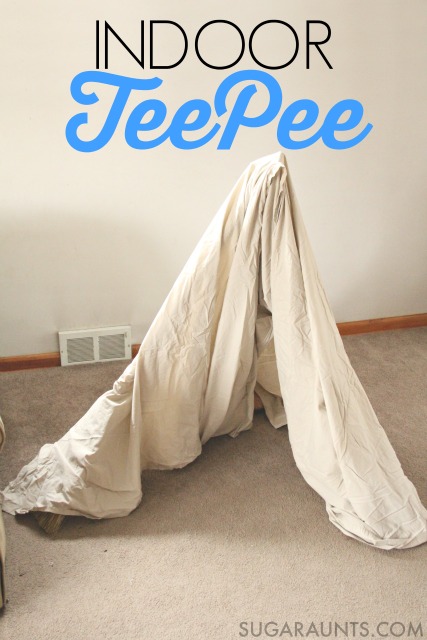
When you are looking for an indoor play idea, you want easy prep, minimal materials, and easy clean-up. This indoor teepee is perfect for creative play, a cozy book nook, or imaginative teepee play, all indoors! I love that it can be used for a sensory calm-down hideaway, too.
How to make an indoor TeePee
Full disclosure: This post contains affiliate links.
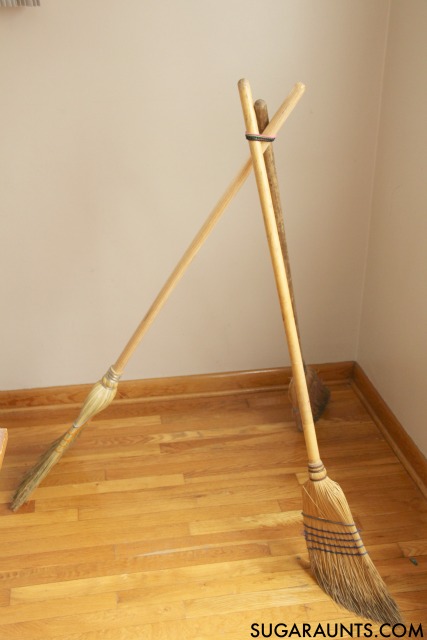
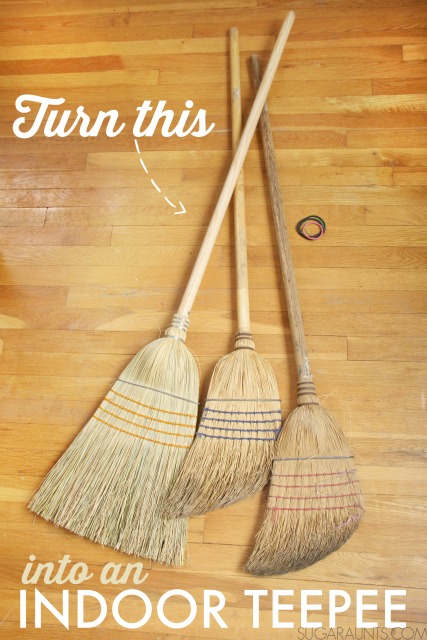
To make this indoor tee pee, you’ll need only a few items:
3-4 Hair bands (THIS brand
worked best because they had a rubber grip to them.)
Cotton Scarf (for added stability)
Large sheet
Start by leaning all of the Corn Brooms
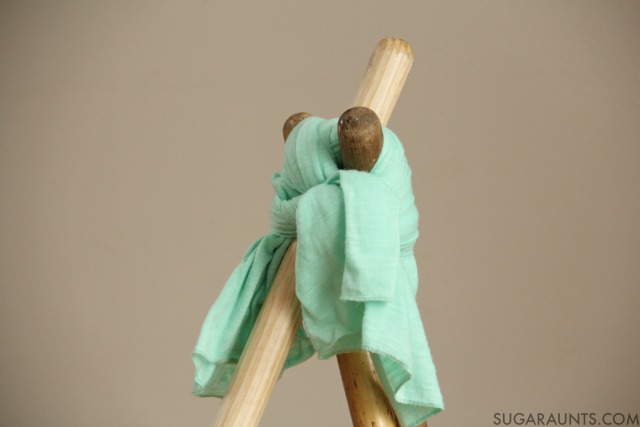
together in a tripod position. Stretch the hair bands over the top to keep the broom sticks together, like in the picture above.
If you like, you can wrap and tie a cotton scarf around the end of the brooms for more stability.
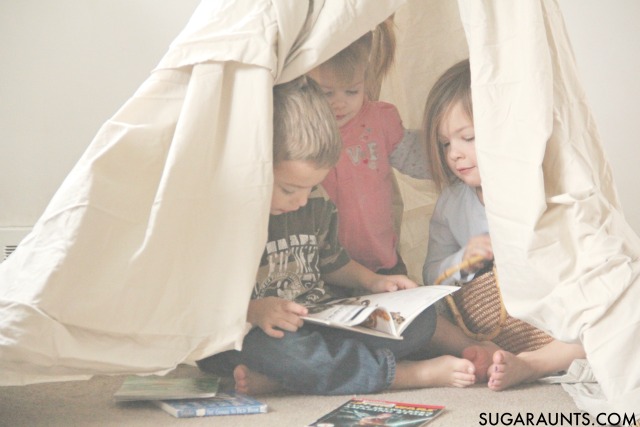
You’re done! Drape a large sheet over the teepee and start playing!
Quick Tip: Place the teepee on a carpeted surface. The Corn Brooms
ends will be more stable than if you place it on a hardwood floor.
Use the teepee for a quiet reading nook, sensory calm-down space, or pretend play area.
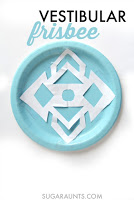
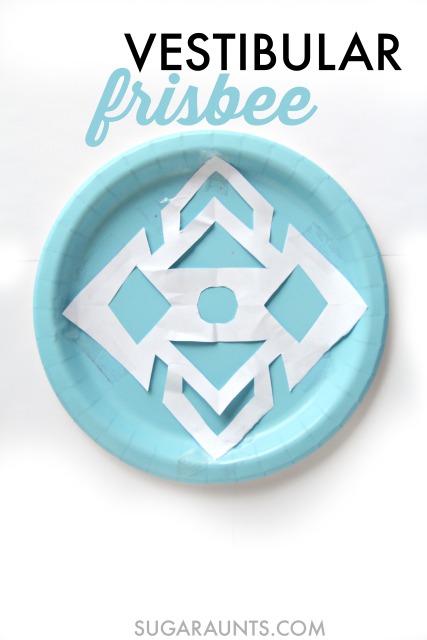
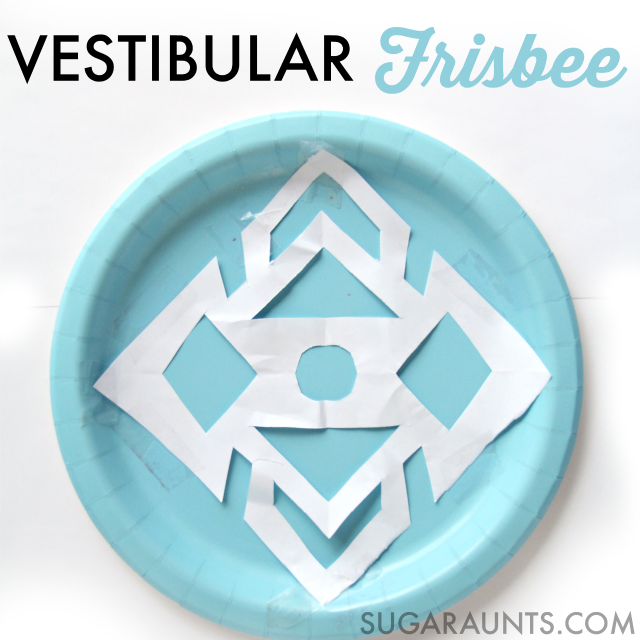
Is it cold where you are? We had our first snow of the year and it is cooooold out there. When the temps drop, there is more time or indoor play. This Vestibular activity is super simple and a great way to incorporate movement and sensory input into play. We’ve been sharing a bunch of creative ways to explore movement with our vestibular and proprioception sensory activities on our January Occupational Therapy calendar. This vestibular Frisbee activity is a quick way to have fun with movement with a snowflake theme!
Full disclosure: This post contains affiliate links.
Kids who appear to never get dizzy or those who are overly sensitive to movement may have difficulty regulating movement in their vestibular system. Activities like rolling, swinging, sliding, and rotating are ways to involve the vestibular system. This super easy snowflake Frisbee is one quick way to add a little vestibular play into your day.
Turing and tossing a Frisbee provides vestibular input as slight head movements are involved in throwing a Frisbee. Some kids may overly turn in circles as they toss the Frisbee.
Super Simple snowflake paper plate frisbee
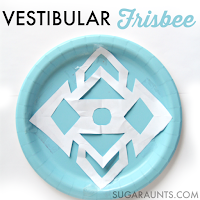
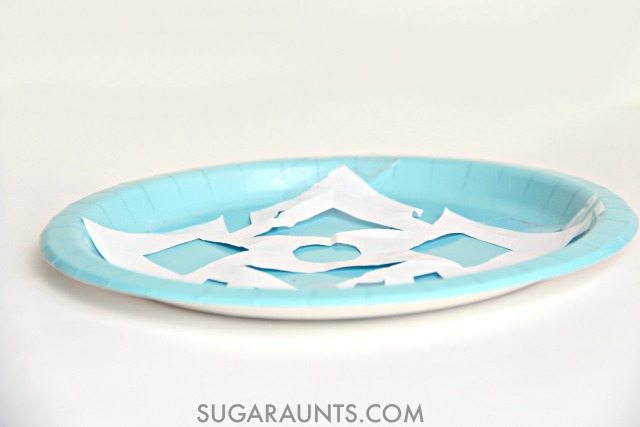
We cut a snowflake from white paper and taped it to a blue paper plate. Double sided tape
works well for this craft, too. The weight of this DIY Frisbee was light and a fun challenge to toss the Frisbee into a laundry basket.
Additional ways to play:
Try tossing the Frisbee in different positions: sitting, laying down, and between the legs.
Tape two paper plates together for a sturdier Frisbee.
Use a styrofoam plate (or two) to grade down this activity (make it easier to toss at a target).
Use a smaller dessert plate
to require more accuracy with tossing the Frisbee.
Today we have a fun snowball game indoor activity. This throwing activity offers vestibular input and is a fun shot put activity for kids, too. You’ll also love our other indoor snowball fight activity.
I’ve got four kids. The weather is starting to get really cold and the illnesses are being passed from kid to kid. We’ve got runny noses, ear infections, and antibiotic prescriptions for half of the crew. This mama needs creative indoor play.
Shot Put Activity
When the indoor play requires a sensory spin, this move and play activity is designed to provide vestibular input for sensory movement seekers and is sure to bring on the smiles. Even through the sniffles!
We’ve been sharing a few creative ways to play with vestibular input recently. These have been wintry activities based on our Christmas OT calendar (and I’ve got a few more fun ideas up my OT sleeves for you!).
Vestibular Ball Throwing Activity
Full disclosure: This post contains affiliate links.
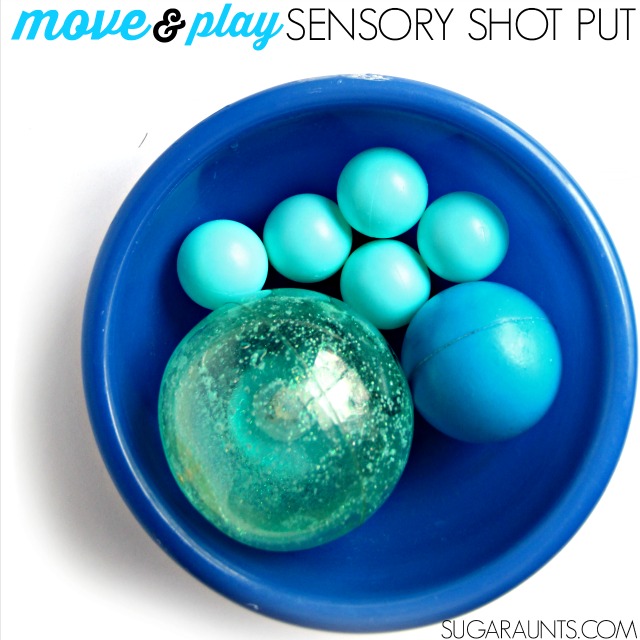
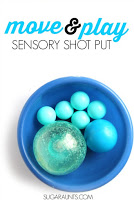
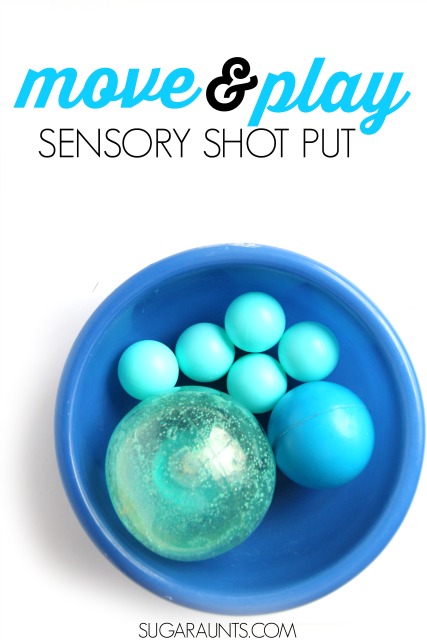
While this sensory shot put activity is definitely a great vestibular input activity, it can be done any time through out the year. I went with light blue (Frozen-esque?) balls that reminded us of winter snowballs. The small balls were from our Bounce-Off Game game.
You can use whatever lightweight ball you’ve got in the house. A ping pong ball or small plastic ball like these ball pit balls would work great. This would be a great activity to incorporate into other ball pit activities, too.
You don’t want to use a bouncy, rubbery ball, because for this activity, we want the concentration to be on the target and not a ball that is bouncing all over your living room and crashing into lamps.
Indoor Shot Put Game
Use a light foam ball or ping pong ball to play shot put. Create a target using an empty laundry basket. Your child should turn in circles like a shot put champ, extend their arm out, and toss that snowball into the target. Encourage them to spin in one area to get rotational vestibular input.
Rotational vestibular input can be done by simply spinning on the feet, but adding a wheeled office seat or Scooter Board can be beneficial too. Adding the scooter board allows this activity to be done in different positions.
Rotational Vestibular Input Activity
It is important to note that rotational vestibular input (spinning) is a powerful physical action on the body.
Activities should last no more than 15 minutes. Spinning needs to be monitored, particularly in children with sensory needs. Some children may react quickly to a spinning activity and others may take longer for their body to register the effects of rotational input. For kids that just do not get dizzy, provide only limited periods of spinning input and only in one direction for 10-15 spins, then in the other direction. The effects of spinning can last for a full 8 hours, so it’s important to not overdo this activity. Please contact your child’s Occupational Therapist for recommendations to meet your child’s particular needs.
Have snow outside? Great! Take this activity outdoors and play snowball shot put with real snowballs!
More ways to extend this activity:
Practice counting spins and balls that are tossed.
Use target areas in various sizes.
Try the activity in various positions: seated, prone, and standing.






 .
. 



 for proprioceptive input.