Sensory Diet Activities for the Classroom

sensory diet in the classroom

In the schools, many teachers struggle with students with sensory processing challenges. There are students who have attention and focus issues that impact learning. Classrooms are a busy place, and when sensory issues impact the ability to pay attention, focus, self-regulate, and interact with others, learning can suffer. Sensory issues are often times, the underlying reasons for impaired functioning in the classroom. For some children, a sensory diet activities for the classroom can help. Sensory activities for the classroom can make a big impact in the life of a student.


The information listed below includes effective strategies for helping kids who are distracted, inattentive, disorganized, irritable, sensitive to sensory input, or seeming to have other sensory-related behaviors.


Add these resources to the ones you can find here under sensory diet vestibular activities to meet the sensory needs of all kids.
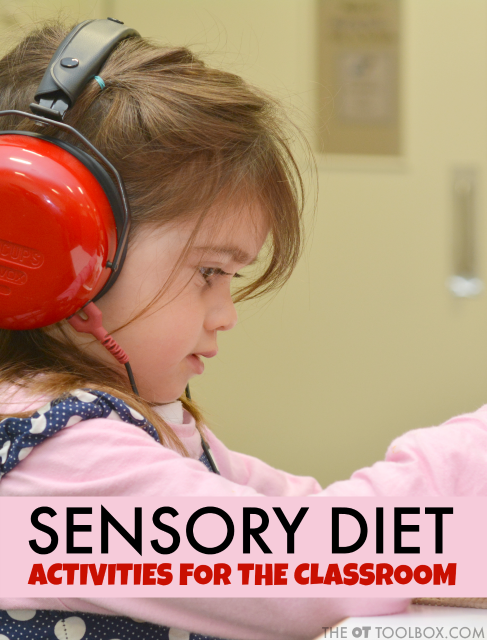
Use these sensory diet activities for the classroom to help kids with sensory processing needs and to address areas like attention, focus, self-regulation and other areas that impact learning.
 
First, I am very excited to tell you about a NEW resource book that I’ve been working on behind the scenes. It’s a HUGE resource related to sensory diets. 
 
There is so much information packed into this book, including underlying information related to the sensory systems, detailed information and references related to sensory diets like what they are and who needs one.  
 
There are data collection sheets and strategy monitoring systems for ensuring sensory diet techniques are authentic and motivating. 
 
This book is coming very soon! If you would like to be among the first to know about this new book, join the list here. Annnnd, there just may be a few freebies in store for anyone who is among the first to be informed! 
 

For some students, a selection of sensory activities can be a helpful strategy for getting through the day. The students who receive therapy may be completing a sensory diet with specific activities based on the individual child’s needs.


Therapists can use the sensory diet activities listed below to add to their toolbox of strategies within the school environment.


NOTE: Activities described here should be used educational information and not as treatment suggestions. Every child’s specific needs and strengths are individual and before activities are utilized as interventions, individualized assessment should be performed by an occupational therapist.


Sensory Diet Activities for the Classroom

You can find many sensory strategies for the school based OT to use and provide in the classroom.


Additionally, therapists and teachers will find many resources, including a printable sensory activity sheet here on this article about calm down strategies for school.


Finally, here is information about using sensory diets in the school. You can see this informative video on our Facebook page, or in the video below:


Sensory diet activities in the classroom are extremely varied! Each child will crave or avoid different sensory input that naturally occurs in the classroom. Sensory diet activities can be integrated into the school environment using materials right in the classroom. Try some of these sensory diet activities:


Move classroom furniture at the beginning or end of the day.
Erase the Smart Board using a cloth.
Add moveable or alternative seating options into the classroom (chair cushions, standing at easels, bungee cord added to the chair legs, bean bags, lying prone on the floor, etc.)
Carry library books from the classroom to the library.
Move equipment from classroom to classroom.
Give the student a “job” to carry a box of materials to the office each day.
Allow the student to sharpen pencils using a manual pencil sharpener.
Add extra playground time into the schedule as a reward.
Provide movement breaks for the whole classroom.


Add calming sensory strategies to a sensory diet for the classroom:

Provide a warm blanket for cozy reading in a bean bag chair.
Create a calm-down space in a cardboard box.
Create a whole-classroom stretch break with yoga or rhythmical knee/shoulder patting and rocking. 
Ask the whole classroom to play “Simon Says”. Use these therapy Simon Says commands.
Allow wall push-ups and chair push-up breaks.
Encourage the child to blow bubbles at recess.


Add calming modifications to the classroom:

Turn down the lights for a calm-down break.
Seat the child away from high-traffic areas.
Use soft voices during classroom instruction.
Remove fluorescent light bulbs from the area above the student’s desk.
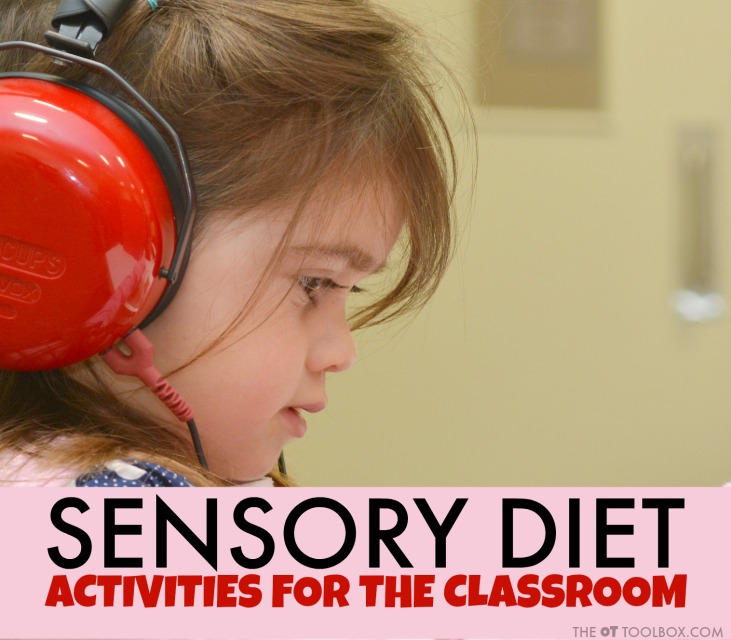
Allow the child to wear headphones to block out environmental sounds.
Minimize overwhelming visual environmental stimuli by using natural light.


Add alerting sensory strategies to a sensory diet for the classroom:

Play “Simon Says” with light touch to the face and palms.
Movement breaks with jumping jacks or burpees (if the space allows).
Show students how to briskly rub up and down the arms to “wake up” the arms and hands.
Provide classroom-friendly fidget tools such as a DIY pencil topper


Add alerting modifications to the classroom:
Have crunchy snacks available: dry cereal, pretzels, celery, raw carrots, etc.
Use modified writing utensils such as modified surfaces or writing utensils.
Provide visually stimulating writing paper with high-contrast lines or writing spaces.
 
Use these sensory strategies in the classroom for students who struggle with sensory processing or those who may experience sensory-related behaviors.
 
 
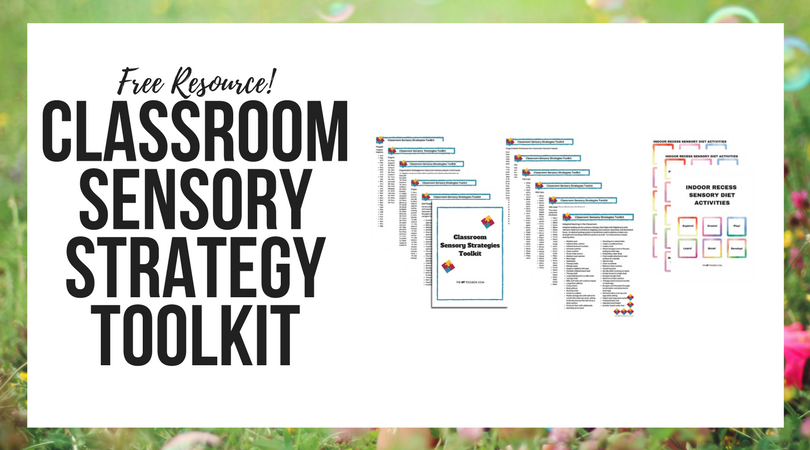
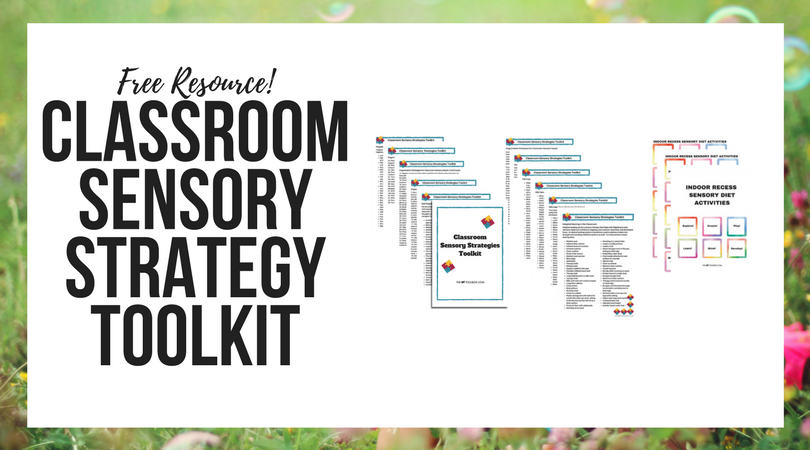
You may also be interested in the free printable packet, The Classroom Sensory Strategy Toolkit.


The Classroom Sensory Strategy Toolkit is a printable packet of resources and handouts that can be used by teachers, parents, and therapists. Whether you are looking for a handout to explain sensory strategies, or a tool for advocating for your child, the Classroom Sensory Strategy Toolkit has got you covered.


And it’s free for you to print off and use again and again.


In the Classroom Sensory Strategy Toolkit, you’ll find:


  • Fidgeting Tools for the Classroom
  • Adapted Seating Strategies for the Classroom
  • Self-Regulation in the Classroom
  • 105 Calm-down Strategies for the Classroom
  • Chewing Tools for Classroom Needs
  • 45 Organizing Tools for Classroom Needs
  • Indoor Recess Sensory Diet Cards
 
Sensory Strategies for the Classroom
 

Free Classroom Sensory Strategies Toolkit

    We respect your privacy. Unsubscribe at anytime.

    Colleen Beck, OTR/L has been an occupational therapist since 2000, working in school-based, hand therapy, outpatient peds, EI, and SNF. Colleen created The OT Toolbox to inspire therapists, teachers, and parents with easy and fun tools to help children thrive. Read her story about going from an OT making $3/hour (after paying for kids’ childcare) to a full-time OT resource creator for millions of readers. Want to collaborate? Send an email to contact@theottoolbox.com.
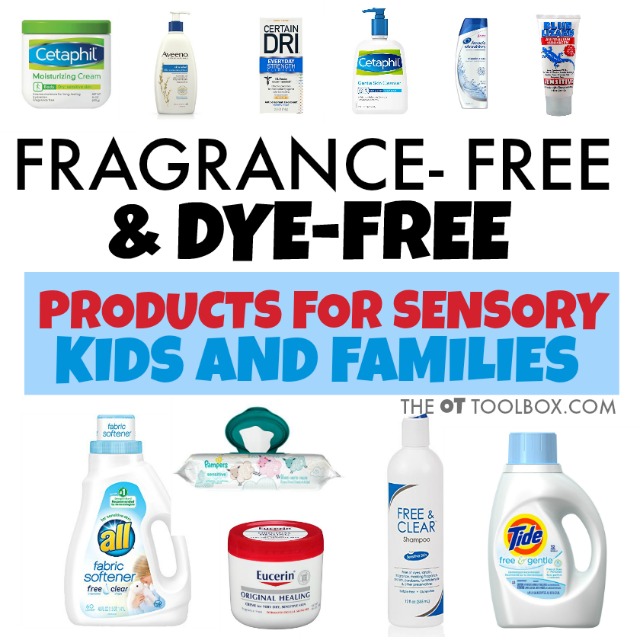
    Fragrance and Dye Free Products for Sensory Kids

    Parents of children with sensory processing challenges know that the slightest scent can throw kids into a sensory-based meltdown. Children with sensory processing issues can over-respond to fragrances in soaps, detergents, or even lotions when others may not even notice the scents. A child with olfactory sensory processing issues can be overly sensitive to specific products that are used in the home or by others that they frequently are around. Use the fragrance free and dye free products listed below on children with sensory processing disorder or those who are overly sensitive to scents. 

    This post describes products that may help children and families who struggle with sensory processing needs. 


    It is important to recognize that even others in the same home or classroom who use a scented product can throw off a child with sensitivities to scent. The child with sensory issues can benefit from everyone in the home using  products without perfumes and dyes. It is especially important that the whole family’s clothing and bed linens be washed with fragrance-free detergents. 

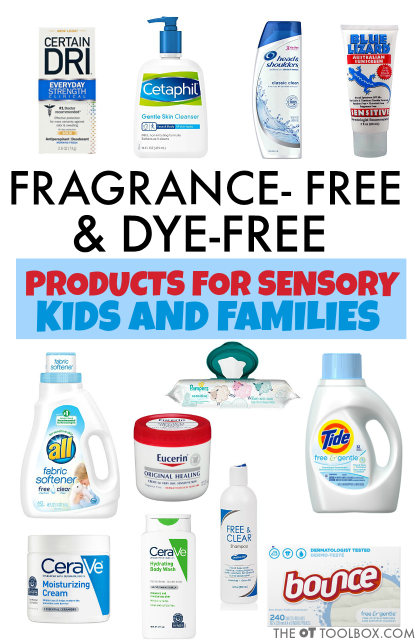
    Sensory kids will appreciate these fragrance-free and dye-free products for sensory sensitivities. Use the fragrance-free lotions, detergents, soaps, and shampoos to help with sensory sensitivities.


    Fragrance-Free and Dye-Free Products for Sensory Kids


    Interestingly, About 5-16% of children live with sensory processing disorder. That is a lot of children who may suffer from sensory sensitivities. Making small changes within the home may help. 


    These fragrance-free and dye-free products can be a modification that is part of a sensory diet for children with sensory processing challenges. 


    Some of the fragrance-free products and dye-free products listed below may be trialed in order to determine the perfect fit for the family of a child with sensory processing issues. An individual may have unique sensitivities and may need to try several of the items listed below in order to find the products that work best. 


    Even adults with sensory processing issues will appreciate these product recommendations. Each item is dermatologist-approved as a fragrance-free and sensitive item. 


    Note: The information included below (and, like everything on this website) is not a substitute for medical intervention, dermatology issues, therapy assessment, intervention, or medical advice. Please contact a physician or Occupational Therapist to assess and intervene. 

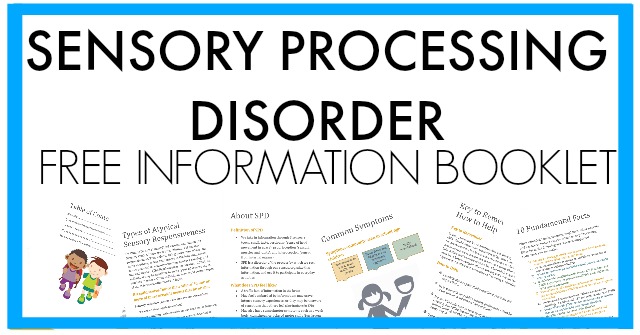
    Start here by getting access to the sensory processing information you need related to sensitivities and hyper-responsiveness to sensation by accessing the Sensory Processing Disorder Information booklet.


    This post contains affiliate links. 

    Fragrance-Free Detergents

    All Free Clear
    Tide Free & Gentle
    Dreft
    Dreft Stage 2 is better for stain removal.

    Fragrance-Free Fabric Softeners

    Bounce Free & Clear Fabric Softener
    All Free & Clear Fabric Softener

    Fragrance-Free Shampoos

    Head and Shoulders Original Formula
    Free & Clear Shampoo for sensitive skin

    Fragrance-Free and Dye-Free Soaps

    Dove Unscented for Sensitive Skin
    CeraVe Cleanser
    Cetaphil Cleanser

    Fragrance-Free Moisturizers

    Dry skin can make a child who is overly sensitive especially aware of clothing textures. Think about your skin in the winter months when most of the time is spent indoors in dry heat. The skin can become rough and dry. When clothing rubs up against this dry skin, it can be downright painful for the child who is sensitive to clothing textures. Moisturizers can help prevent the dry and cracked skin.


    Additionally, for the child who benefits from the proprioceptive input of massages, a moisturizing cream can be a helpful calming tool. Moisturizers should not contain dyes or fragrances. However, trying various moisturizers will be necessary, as some children can be overly sensitive to the different thicknesses of various creams. The dy-free and fragrance free moisturizers listed below are good ones to try:


    CeraVe Moisturizing Cream
    Cetaphil Cream
    Aveeno Free and Clear Cream
    Eucerin Cream
    Aquaphor Ointment

    Fragrance-Free and Dye-Free Antiperspirants and Deodorants

    Deodorants use fragrance to cover up odors of sweat. Antiperspirants utilize aluminum hydroxide without the fragrance of deodorants. Try these fragrance-free antiperspirants and deoderants:
    Certain Dri
    Dove Unscented
    Tom’s of Maine Unscented (aluminum free)
    JASON 
    Silvanapure All Natural Deodorant (aluminum free)

    Fragrance-Free Sunblocks

    Zinc oxide-based sunblocks do not contain the chemicals of typical sunscreens. Try these sunblocks:
    Blue Lizard Baby
    Blue Lizard Sensitive Skin
    Neutrogena baby Pure and Free

    Fragrance-Free Diapers

    Most diapers contain a fragrance that is noticeable. Try these diapers free of dyes and fragrances:
    Seventh Generation
    Tender Care Diapers

    Fragrance-Free Wipes

    Pampers Sensitive Wipes
    Seventh Generation Wipes

    Use these fragrance-free products and dye-free products for kids and families with sensory processing issues or sensory sensitivities.

    Thank you- Upcoming Sensory Diet Book Info

    Your free sensory file is now in your inbox! 

    If you don’t see it right away, be sure to check your SPAM or “other” folder as the email occasionally lands there. 


    If you are using a school’s email system or hospital email system, the email may have been blocked by the system security wall. It may help to enter an email that supports files such as gmail or another personal email. 


    Any questions? Contact us at theottoolbox@gmail.com

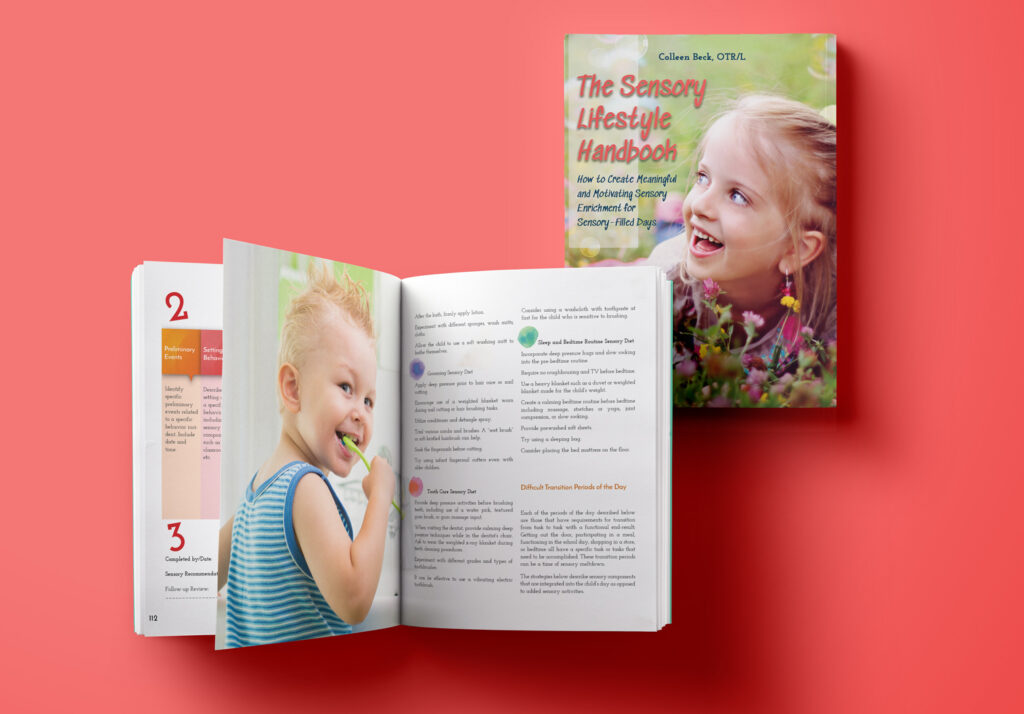
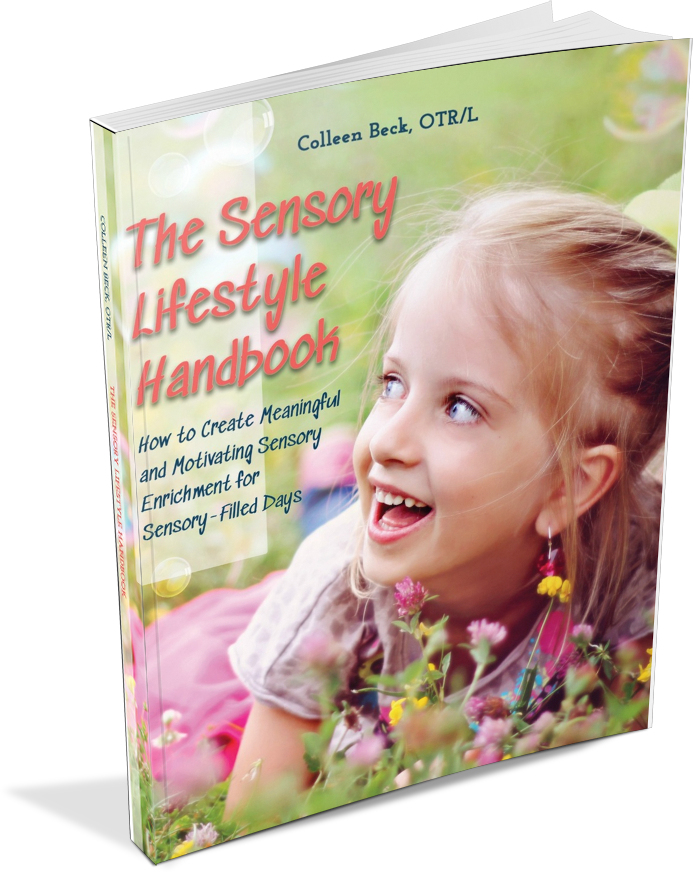
    Information about The Sensory Lifestyle Handbook, a book for understanding how to create sensory diets and motivating and authentic sensory enrichment for a sensory life.

    Information about the upcoming and anticipated Sensory Lifestyle Handbook


    Thank you for wanting to know more about the upcoming book all about sensory lifestyles and creating sensory diet strategies that work! 


    The book is NOW complete and I’m excited to share more information with you about the book. 


    Here are a few facts and a brief description of the book:

    *It took over a year to write the book…it’s a comprehensive resource when it comes to setting up a sensory lifestyle!


    *The book is NOW COMPLETE! You can check it out here: The Sensory Lifestyle Handbook

    * This book has everything you need to know about getting started with a sensory lifestyle, including what a sensory diet is, who needs a sensory diet, the various layers of a sensory diet, and much more!

    *The book contains tactics to make sensory strategies authentic and meaningful and tips to ensure carryover of sensory lifestyle recommendations.

    *There are a bunch of data collection sheets and resources related to the stages of setting up a sensory life, monitoring sensory diet strategies, and education.

    *There are strategies for using the components of a sensory diet in developing co-existing developmental areas like fine motor skills, gross motor skills, bilateral coordination, motor planning, handwriting, etc…the areas that so many sensory kids struggle with!

    *There are specific sensory strategies that can be incorporated directly into functional tasks in a child’s day such as riding the bus, completing school work, participating in community events, etc.

    *This book is a HUGE resource for anyone who lives with, works with, teaches, or loves a child with sensory needs!

    I will have much more information to share very soon…including the title, release date, and a few fun free offers for you just because you signed up to learn more about the book.

    Did you arrive at this article and want to learn more about the book? Sign up at this link on sensory diets in the classroom to join the list of thousands of others who want to learn more about sensory diets and how they can help kids with sensory needs.

    Information about The Sensory Lifestyle Handbook, a book for understanding how to create sensory diets and motivating and authentic sensory enrichment for a sensory life.


    Information about The Sensory Lifestyle Handbook, a book for understanding how to create sensory diets and motivating and authentic sensory enrichment for a sensory life.


    For now, you may be interested in some of the sensory resources available on The OT Toolbox:


    Free Sensory Processing Disorder Booklet

      We respect your privacy. Unsubscribe at anytime.

      Sensory Strategies for the School Based OT

      For the child with sensory challenges, the classroom can be an overwhelming place.  All of the sensory systems are touched on in the classroom.  When sensory systems are challenged, learning is a struggle.  School based OTs are often times consulted when students struggle with physical or sensory issues that result in educational deficits.  


      Previously, The OT Toolbox has shared free ways to incorporate sensory motor experiences into the classroom.   You might be looking for more resources that can be used to address many sensory needs in the classroom.  Below are sensory resources for the school based occupational therapist and strategies that can be incorporated into OT in the school. 


      These are strategies to fill your therapy toolbox and address everything from inattention to sensory meltdowns.


      School-based OTs can utilize this resource of sensory strategies for school based OT and occupational therapy intervention in schools.
       
      These tong activities would be a great addition to summer occupational therapy activities and home programs!

      Sensory Resources for the School Based OT

      This post includes affiliate links.
       

      This is a great article written on sensory integration practices in the school setting.  It includes the clinical reasoning and practices that go along with sensory practice in the school.  Of interest are sensory screening and evaluation recommendations for school settings, sensory intervention and treatment delivery options, and recommendations.  Also included is a table with approaches and sensory strategies for Occupational Therapy intervention in the classroom or school setting.  

      Case studies include IEP goals or 504 accommodations related to sensory processing interventions.


      Assessments for sensory needs can include direct observation of the child’s performance in the school setting.  Observing a variety of tasks during the school day can be helpful to analyze the demands of specific activities, including needs and strengths in tool use, fatigue, sequencing, spatial concepts, social interactions, physical requirements, cognitive abilities, etc.  A child transitions through a variety of settings during a school day and is challenged in various environments which might present differing needs or abilities.  The school-based OT should assess a student’s sensory and neuromuscular functioning in these various environments.  


      Many students who struggle with sensory challenges benefit from a sensory diet during the school day.  This specialized diet of sensory activities and input should be designed by an occupational therapist who assesses and identifies the student’s particular needs and strengths or interests.  Sensory diets in the school can include many different tools, not limited to fidget tools, specialized seating, movement breaks, weighted lap pads or vests, calming scents, limited or structured visual adjustments, chewing tools, or other activities.  Read more about the goals of a sensory diet


      Use this free Sensory Processing Disorder booklet for passing on sensory processing information to parents and teachers. 

      Fidgeting Tools for the Classroom

      Fidgeting with items can help with attention, regulation, and focus.  Try these fidgeting options in the classroom:

      Adapted Seating in the Classroom

      Adapted seating can be a sensory strategy that helps with fidgeting as well.  Sensory needs can overflow to wiggling, poor posture, slouching, and decreased focus.  An altered seating system is sometimes used to address a weak core strength and resulting inefficient posture as well.  Try these sensory-based seating ideas:

      • Cheap Alternative Seating Option
      • Movement seats like a disk cushion are great for allowing movement for improved attention.
      • Wobble Seat uses the idea of a therapy or stability ball in the form of a stool.  This is great for classroom use because the giant therapy balls tend to roll away from desks.
      • This Guide to Alternate Seating is a resource that can benefit many individuals in the school, including teachers, administrators, paraprofessionals, and school-based therapists. 
      • Special cushions
      • Bean bags
      • Intertubes
      • Therapy balls
      • Wedge seats
      • Support added to the seat
      • Etc.

      Self-Regulation in the Classroom

      For the child who struggles with sensory processing disorder or is challenged with impaired responsiveness, interventions in regulation can be used in the classroom:

      Sensory-Based Interventions for the School Based OT

      Here on The OT Toolbox site, we have a huge collection of sensory-based play and sensory experiences that meet various needs.  Find all of the sensory activities here and how these experiences can address discrimination needs, improve participation, and address sensory modulation. 


      Sensory Integration Approach to School Based OT

      A sensory integrative approach is based on the work of A. Jean Ayres, PhD, OTR, and identified as Ayres Sensory Integration.  For school-based practice, sensory integration and praxis needs are addressed by assessment and interventions occurring in natural sensory-rich spaces.   A sensory integration approach utilizes interactions between the OT and the student in a sensory-rich environment in a playful approach that allows for adaptation to novel challenges addressing reactivity, postural skills, praxis, and perceptual skills.  
       
      Read more about sensory-based interventions and sensory integration approaches to school based OT and how these approaches look in meeting needs of students here.


      Chewing Tools for Classroom Sensory Needs

      • Pencil Topper Chews come in a variety of textures and toughness to meet sensory needs.
      • Chewable jewelry  is often times appropriate for the classroom, because the variety of necklace or bracelet styles on the market are discreet while meeting sensory needs. 
      • Here is information on how to choose the right chew tool for addressing sensory needs.

      Push In or Pull Out OT Services in the School

      Sensory needs can be addressed by strategies from the school based OT both in and out of the classroom.  For the child who receives occupational therapy services at school, therapy can occur in any aspect of the child’s day where needs are limiting educational abilities.  
       
      OT services completed with a “push in” model allow the therapist to identify needs in the classroom. Therapists can then intervene, and provide adaptations, modifications, and tools during classroom activities.  Consultation with teachers and professionals can occur right in the classroom during daily tasks and in a natural setting.  Sensory strategies can easily be a collaborative nature with teachers and paraprofessionals when performed right in the classroom and in the natural environment of the child’s day.  
       
      Therapy being competed in a “pull out” model can address sensory diet needs and development that is then utilized throughout and within the student’s daily activities at school.  Specific skill assessment and development can occur in pull out services.  
       
      References:
      Occupational Therapy for Children and Youth Using Sensory Integration Theory and Methods in School-Based Practice. Am J Occup Ther 2015;69(Supplement_3):6913410040p1-6913410040p20. doi: 10.5014/ajot.2015.696S04.
      School-based OTs can utilize this resource of sensory strategies for school based OT and occupational therapy intervention in schools.
      You may also be interested in the free printable packet, The Classroom Sensory Strategy Toolkit.
       
      The Classroom Sensory Strategy Toolkit is a printable packet of resources and handouts that can be used by teachers, parents, and therapists. Whether you are looking for a handout to explain sensory strategies, or a tool for advocating for your child, the Classroom Sensory Strategy Toolkit has got you covered.
       
      And it’s free for you to print off and use again and again.
       
      In the Classroom Sensory Strategy Toolkit, you’ll find:
       
      • Fidgeting Tools for the Classroom
      • Adapted Seating Strategies for the Classroom
      • Self-Regulation in the Classroom
      • 105 Calm-down Strategies for the Classroom
      • Chewing Tools for Classroom Needs
      • 45 Organizing Tools for Classroom Needs
      • Indoor Recess Sensory Diet Cards
       
      Sensory Strategies for the Classroom
       

      Free Classroom Sensory Strategies Toolkit

        We respect your privacy. Unsubscribe at anytime.

        Colleen Beck, OTR/L has been an occupational therapist since 2000, working in school-based, hand therapy, outpatient peds, EI, and SNF. Colleen created The OT Toolbox to inspire therapists, teachers, and parents with easy and fun tools to help children thrive. Read her story about going from an OT making $3/hour (after paying for kids’ childcare) to a full-time OT resource creator for millions of readers. Want to collaborate? Send an email to contact@theottoolbox.com.
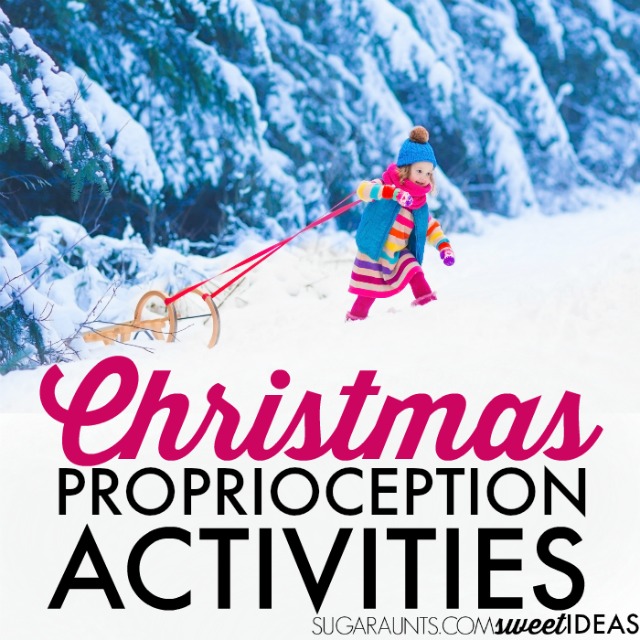
        Christmas Proprioception Activities

        This time of year, the hustle and bustle of the season can make all of us feel a little out of sorts.  For the child with sensory issues, the holiday season can be a real challenge!  Try adding Christmas Proprioception Activities into your child’s day for calming strategies to meet sensory needs.  
        For more ideas, grab this December Occupational Therapy calendar.


        Christmas Proprioception Activities

        Christmas proprioception activities for children with sensory needs


        Christmas Sensory Diet  

         
        Occupational Therapists can add these proprioception activities to sensory diet plans or to make home programs this time of year. Ad these heavy work ideas to your therapy plans this month. They are great Christmas activities for sending home to parents for a home program over the holiday break. 
         
        Parents and teachers can use these activities as part of an individualized plan that meets the child’s needs. 
         
        The calendar’s activities are outlined in an easy to follow therapy plan, however as parents and therapists know, a day that involves children does not always go as planned.  The activities can be shifted around to suit the needs of the child and the family. 
        An activity can be completed on a different day or used in combination with another day’s therapeutic activities. 
         
        Try adding these activities into the child’s day to challenge sensory issues or as a way to help kids focus during overstimulating times that the holidays bring.
         

        Christmas Heavy Work Ideas


        1. Shovel activity- Use a small child’s sized snow shovel or sand shovel to scoop couch
        cushions.

        2. Mitten Toss- Fill a plastic sandwich bag with dry beans.  Push the filled bag into a mitten.  Close the opening of the mitten by rolling the top over on itself like you would roll socks together.  Use the mitten as a DIY bean bag in tossing target games.
         

        3. Gift Push- Load cardboard boxes with heavy objects like books.  Ask the child to push the boxes across a room.  For less resistance, do this activity on a carpeted floor.  For more
        heavy work, do this activity outside on the driveway or sidewalk.
         

        4. Reindeer Kick- Promote proprioceptive input through the upper body with wheel barrow
        race type movements.
          Kids can also stand on their arms and legs in a quadruped position and kick their legs up. 

        5. Sleigh Push- Load a wheelbarrow, sled, or wagon with objects.  (Try the weighted boxes from number three activity listed above.) Ask kids to push, pull, and tug on the “sleigh” through the yard. 

        6. Peppermint Candy Stick Oral Motor Activity- Did you know you can make a peppermint candy stick into a straw?  It’s a great oral motor activity for kids. Cut an orange
        in half and then stick the peppermint stick into the orange.
          Next, suck the peppermint stick.  The juices from the orange will begin to work their way up through the peppermint stick. 

        7. Cocoa Temperature Taste- Make a batch of hot cocoa. Pour it into an ice cube tray and
        let it freeze.
         Next, make another batch of hot cocoa. Divide it out into several mugs. Add a cocoa ice cube to the first mug, two ice cubes to the second mug, and so on. Mix the mugs up on a table.  Place a straw into each mug.  Children can position the mugs in order of
        coolest to hottest or vice versa.
          If doing this activity with several children, use small paper cups so that each child gets their own set of cups. 

        8. Christmas Chewy and Crunchy Food Breaks- A calming sensory snack can be just the thing that children need to organize their sensory system during the hustle and bustle of the holiday season. 

        Calming Sensory Foods for Christmas

        Adding chewy or crunchy foods to a sensory diet has a calming effect. These types of food provide heavy work through the jaw and mouth.

        Try these calming Christmas foods: 

        • Peppermint snack mix with peppermint chocolate candies mixed with dry cereal and raisins
        • Toffee
        • Rice Crispy Wreath cookies
        • Pretzel sticks
        • Homemade fruit leather
         
         
        Christmas proprioception activities for kids with sensory needs


        Christmas Sensory Writing

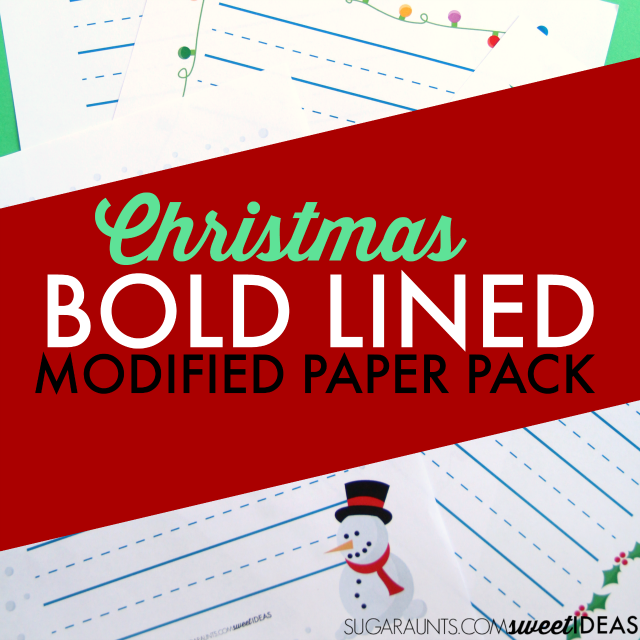
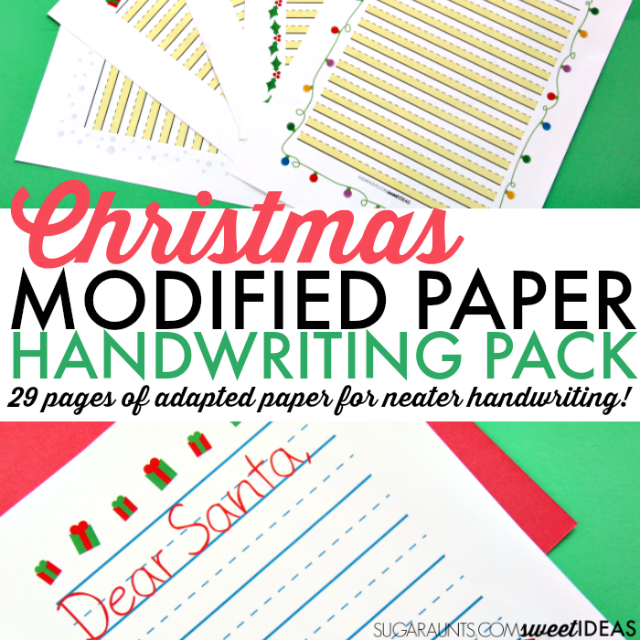
        Looking for modified paper to help kids with handwriting issues?  Try this modified Christmas paper packet!
         
        Use this modified paper Christmas Handwriting Pack to work on legibility and handwriting struggles with kids.
         
        Use these modified paper with a Christmas theme to work on handwriting this time of year. Add a sensory component with proprioceptive feedback to add heavy work through the hands. Here are some ideas for adding adding proprioception to sensory writing activities:
         
        • Write over a sheet of sandpaper.
        • Tape the Christmas paper to a wall or easel and write on a vertical surface. 
        • Use a grease pencil to add proprioceptive input resistance. 


        Fall Visual Processing Sensory Activities

        Use fall activities to work on visual processing needs with fall visual processing sensory activities.

        Visual Processing can result in overactive sensitivity to sights or an under-responsiveness to all that the eye sees.  During Fall, there are many more colors and visual sights that can be a sense of interest to children with sensory processing disorders.  A simple walk in the yard is much different during the Fall months when leaves are changing or there are more sticks and acorns to navigate on the lawn.  For the child who has sensory processing concerns, using the sense of sight can be a calming or alerting tool.  Try these fall visual processing sensory activities this Fall.

        Check out our free Fall Sensory Activities booklet. It’s full of family-friendly sensory activities that celebrate the season through sensory experiences covering all of the senses. The activities in this free booklet are a fun way to encourage motor movement and development through fall activities. Scroll to the bottom of this blog post to grab your copy!


        Fall Visual Processing Sensory Activities with a fall or harvest theme.


        Adding visual sensory activities to vestibular or proprioception activities can have a great affect on children with sensory processing disorders.  Check out our Fall Proprioception Activities and Fall Vestibular Activities or find all of the ideas in one place in our Fall Harvest Sensory calendar.

        Fall Visual Processing Sensory Activities

        1.     Leaf Lay– Head outdoors on a bright and sunny fall day.  Look for trees with brightly colored leaves and lay down on the ground under the tree.  Kids can look up at the leaves as the sun shines through the colored leaves.  Ask kids to notice branches in the leaves.  Address deep breathing and slow counting for a calming sensory experience.  Use this opportunity to discuss events that lead up to feelings of fear or anxiety related to the senses.

        2.     Color Assessment– Use a magnifying glass to explore the colors of leaves, tree trunks, and nature finds while out on a nature hunt.  Kids can look for each color of the rainbow in a scavenger hunt type of activity.  This fall activity builds visual scanning needed for reading and writing.
         
        3.     Pumpkin Seed Colors– Use dry seeds from a pumpkin to create colorful seeds using liquid food coloring or liquid water colors.  While these seeds won’t be edible, they are great for creative play!  Use the seeds to sort, manipulate, and create in Fall themed learning and play or artwork.
         
         
        4.     Fall Maze– Many farms or community events host a corn or hay maze this time of year.  Walking through a maze is a visual processing experience that kids can use to develop directionality needs.  You can create your own backyard version of a fall maze using fallen leaves or a trail of sticks from trees.


        Fall Visual Processing Sensory Activities with a fall or harvest theme.

        Fall Sensory Activities

        Work on visual processing skills this Fall AND address all areas of sensory needs while experiencing all that the Fall season has to offer! Grab your free copy of the Fall Sensory Experiences Booklet to create sensory diet activities that meet the needs of individuals in a Fall-themed way! Enter your email address below and you will find the Fall Sensory Experiences Booklet delivered right to your inbox. Enjoy!

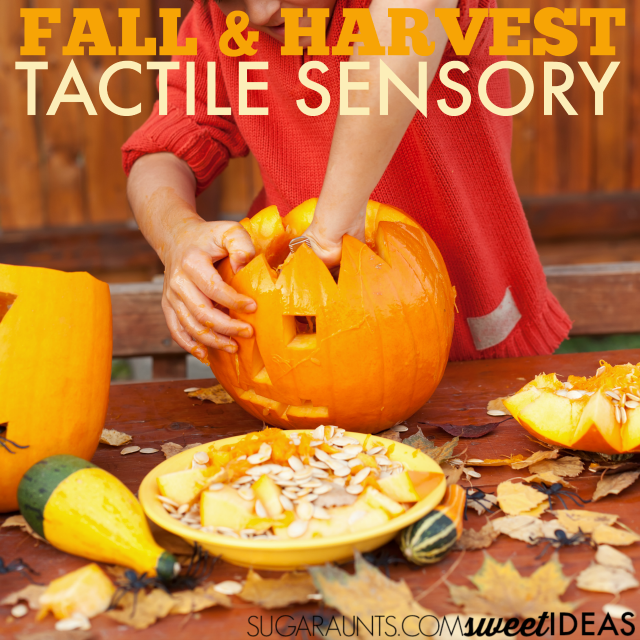
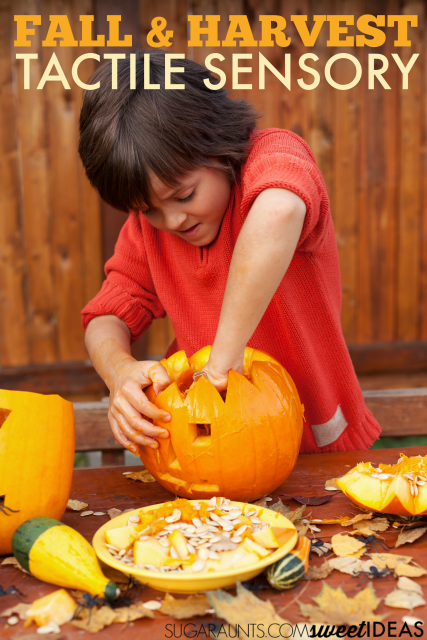
        Fall Tactile Sensory Activities

        Help kids tolerate tactile sensory play with these Fall tactile sensory activities.
        This time of year, it’s fun to encourage Fall tactile sensory activities to promote and encourage the sense of touch and tactile challenges. Kids will love these Fall tactile sensory activities.  Kids and families can get involved in these fall and harvest themed activities that just might start a new seasonal tradition while encouraging sensory play!
         
        For more Fall fun, grab our free Fall Sensory Activities booklet. It’s full of sensory activities that celebrate the season AND promote motor skills through sensory experiences. The activities in this free booklet are a fun way to encourage motor movement and development through fall sensory activities. Scroll to the bottom of this blog post to grab your copy!


        Fall tactile sensory play ideas for families and kids


        Fall Tactile Sensory Activities

         
        This post contains affiliate links.
         
        1.     Pumpkin Seed Scoop- Carving a pumpkin is an excellent sensory experience.  When it comes to scooping out the pumpkin guts, kids can challenge their tactile sense by touching and moving the seeds.  For kids who are not able to tolerate this task, try using latex free gloves.  Kids can also try pulling off the pumpkin’s seeds from the innards using tweezers.  Once the seeds are removed, allow kids to rinse the seeds in a colander and strain them into containers.  Use scoops and spoons of different sizes to address visual motor integration skills as they move and manipulate the wet seeds. Pinching individual seeds is an excellent fine motor task.
         
        2.     Marshmallow Pinch- Kids that have made s’mores know that managing that sticky marshmallow is a messy experience.  Embrace the mess with a marshmallow pinching activity that will challenge the sense of touch.  Warm a marshmallow over a fire or in the microwave.  Allow it to cool to the touch and ask kids to pinch and pull the sticky marshmallow.  Use the pointer finger and thumb to pinch the marshmallow while addressing hand strength and pincer grasp.  Use the stringy marshmallow to create a textured sort of paint by placing the marshmallow on paper.  This is a taste-safe tactile sensory experience that kids will love.
         
         
        3.     Pumpkin Bin- Address sensory needs by creating a sensory bin with a pumpkin theme.  Use egg cartons to create pumpkins and place them in a sensory bin filled with field corn or rice.  Here is an example of how to create this sensory bin. 
         
        4.     Fall Texture Feel- Gather various textures from nature to create a multi-textural sensory experience.  Use leaves, sticks, acorns, small pumpkins and gourds, or dry corn husks for kids to explore various textures.


        Fall harvest tactile sensory play ideas for kids and families


        More Fall and Harvest themed tactile sensory play ideas:

        Create a sensory bin with leaves.  Hide small items in the leaves for kids to feel and find.

        Make Fall Slime for messy sensory play.

        Make a Fall sensory bin like this one at Fantastic Fun and Learning.

        Fall Tactile Sensory Activities and more:

        Encourage tactile sensory tolerance this Fall AND address other sensory needs while experiencing all that the Fall season has to offer! Grab your free copy of the Fall Sensory Experiences Booklet to create sensory diet activities that meet the needs of individuals in a Fall-themed way! Enter your email address below and you will find the Fall Sensory Experiences Booklet delivered right to your inbox. Enjoy!

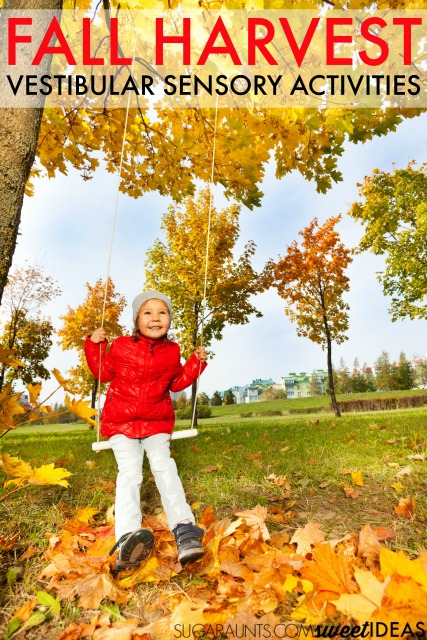
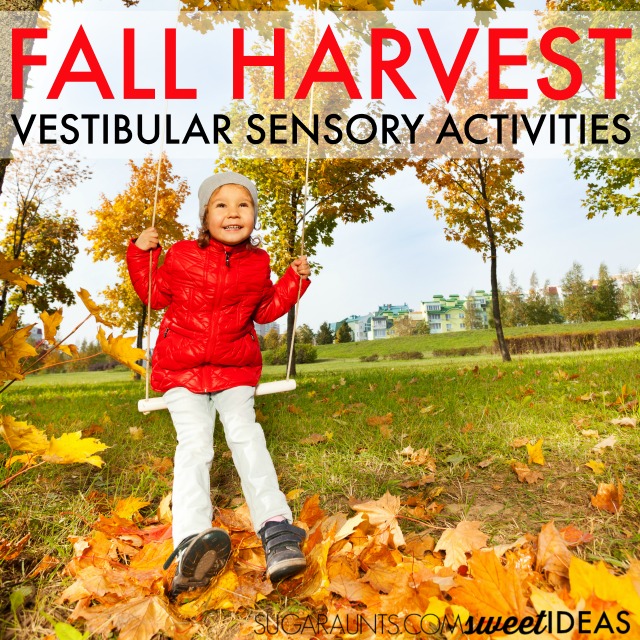
        Fall Vestibular Sensory Activities

        Fall means jumping in piles of colorful leaves and it’s a season of vestibular sensory input. Moving, jumping, rolling, hopping, and swinging are vestibular activities that are sensory based movements that challenge the body’s ability adjust to changes in gravitational pull and movement. The vestibular sensory system can be rhythmical and calming or unpredictable and alerting. These Fall vestibular sensory activities are fun for the whole family.


        Fall Vestibular Activities


        Each of the sensory based Fall activities below can be used in various ways to challenge and support the sensory needs of a child.  When looking for family activities that take in all that Autumn has to offer, why not make it a sensory experience that will build traditions? 

        It’s important to remember that a small dose of vestibular sensory input can impact the entire day.  Children may seek out sensory input but dislike other aspects of vestibular input. Other children may prefer different amounts or types of sensory input.  Be sure to consult your child’s Occupational Therapist.  The information and activities in this blog post and anywhere on this blog are intended nor recommended as a substitute for medical advice, diagnosis, or treatment. Always seek the advice of a registered occupational therapist, physician, or other qualified healthcare professional regarding any medical questions or conditions.


        Try these vestibular sensory activities with the family this Fall


        Fall Sensory Activities

         
        Affiliate links are included in this post:
         
        1.     Leaf Roll- Create a pile of leaves and roll in them for a vestibular component.  Try somersaults and log rolls in the lawn.  Rolling and tumbling is a great way to address vestibular needs by adding movement and challenging the positioning of children.  Set up a lawn obstacle course with piles of leaves with each station requiring different movement activities.  Be sure to check kids for ticks if you live in an area that has ticks.


        2.     Leaf Swing- Kids can enjoy the scents and sights of Fall’s leaves with this activity with an added benefit of vestibular sensory input.  This activity requires a strong adult. Use a blanket to create a swing for the child.  Ask the child to lay or sit on a blanket.  Gather up all corners of the blanket and swing the child carefully just above the ground.  Lower the child into a pile of leaves.  If you don’t have leaves in your area, do this activity indoors over pillows.
         
        3.     Swing and Throw Leaves- Use a playground swing for this activity.  Ask the child to lay belly down on a swing seat, superman style.  They hold and toss fall leaves as they swing back and forth.  Don’t have leaves in your area? Cut leaves from construction paper and ask the child to toss one as they swing back and forth.  Then, ask the child to gather up the leaves and do this activity again while sitting on the swing.
         
        4.     Hayride- Use your local resources to attend a fall festival and ride on a hayride.  This time of year, most areas have hayrides available.  Riding over the bumpy terrain is an excellent vestibular activity. If you don’t have a hayride available in your area, try a wagon ride in the yard.  While riding, ask kids to notice the area, looking for colors, sights, and sounds of Fall.  Ask your child to find three orange things or two things that move while they are riding.


        Fall vestibular sensory activities for the family.


        More vestibular sensory activities for Fall: 

            Make a leaf balance beam
        Catch leaves as they fall
        Somersaults in leaves
        Jump in leaves
        Run through leaves
        Pumpkin patch walk on slopes and hills
        Wagon ride to look at leaves
        Jump on a trampoline with leaves
        Scatter small sized piles of leaves on a drieveway and bounce a ball into the leaf piles
        Dance outside
        Outdoor yoga
        Leaf obstacle course
        March through leaves
        Simon Says, Fall-style (Simon says jump in leaves, etc)


        Looking for vestibular sensory input tools for home, school, or therapy recommendations? Try the ones listed in our Free Fall Sensory Activities Guide:


        Desk Fidget Tool for School

        When kids are working on handwriting tasks, they sometimes show difficulties with attention, focus, or legibility due to heavy pencil pressure, tearing of paper, or smudged pencil lines.  Kids may have sensory needs while sitting at a desk as they are required to attend, or they might have typically developed sensory systems and show typical signs of fidgeting during classroom work.  Whether your child/student/OT client has sensory needs or not, a fidget tool is often times just the key for helping with extra wiggles and movement needs that are interfering with handwriting and thus learning in the classroom.

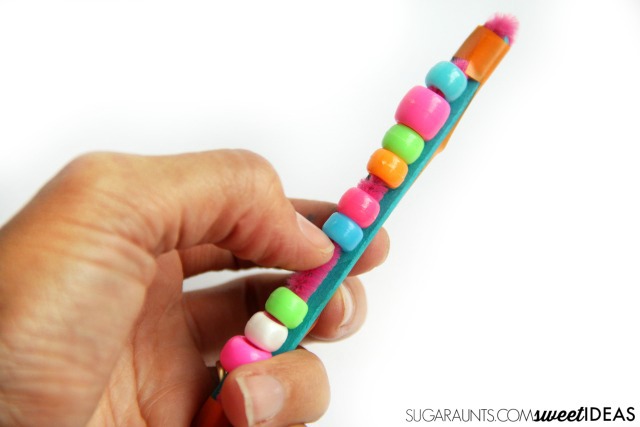
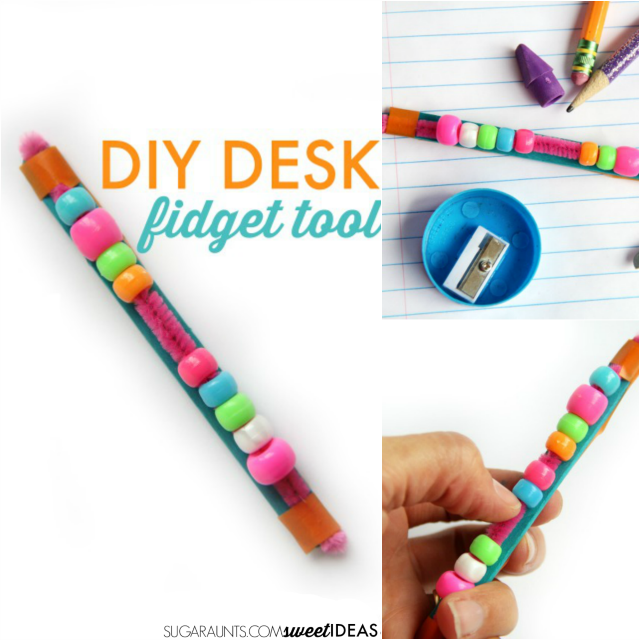
        Craft Stick Fidget

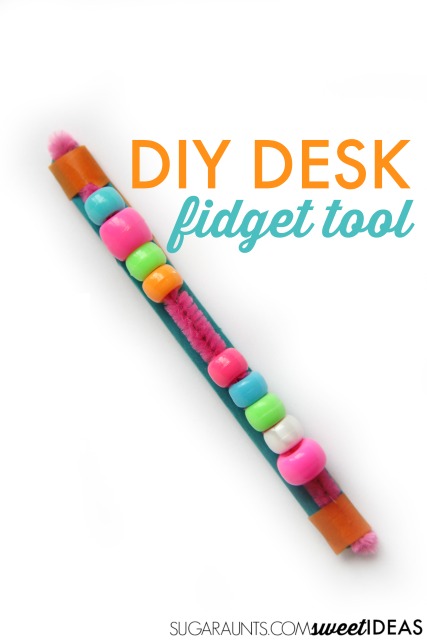
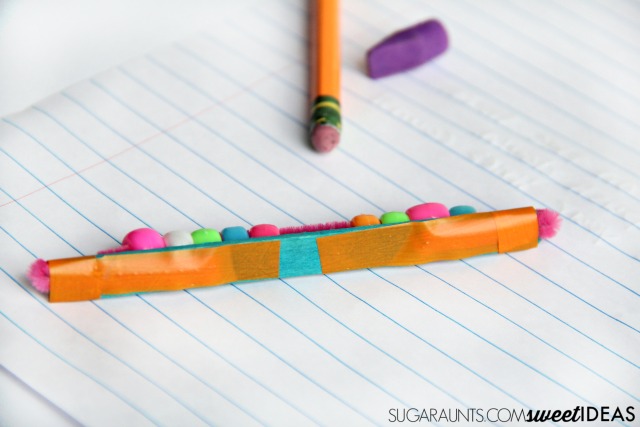
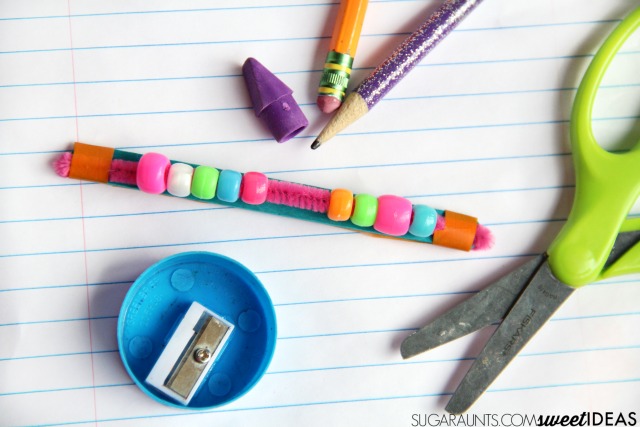
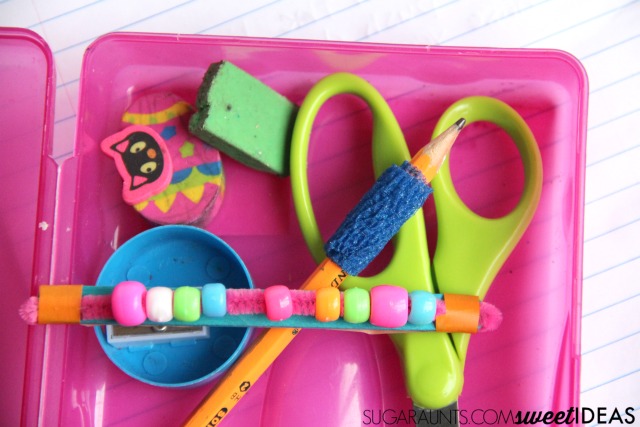
        This DIY fidget tool is perfect for the desk because of it’s small, discrete size can be stored right inside the desk or even in a pencil box.  Kids can place this on their desk top as a fidget tool to use while handwriting.  

        There are many indications that a child shows a need for a sensory tool like a fidget while writing. Read more about proprioception and handwriting here.

        This attention tool is just one idea that might help in the classroom or at home. Here are more DIY fidget toy ideas that you might like.

        Make this DIY fidget tool for use in the classroom or at home while writing and reading to help kids focus, attend, and perform tasks with tactile sensory input and movement they need to help with fidgeting.

        Fidget toys are a great tool for addressing sensory needs, attention and focus during tasks.  We’ve shared a sensory tools for helping with fidget needs during homework and this tool would be a great addition to the homework time.

        You’ll need just a couple of materials to create this DIY fidget tool:

        (This post contains affiliate links)

        To make the desk fidget tool:

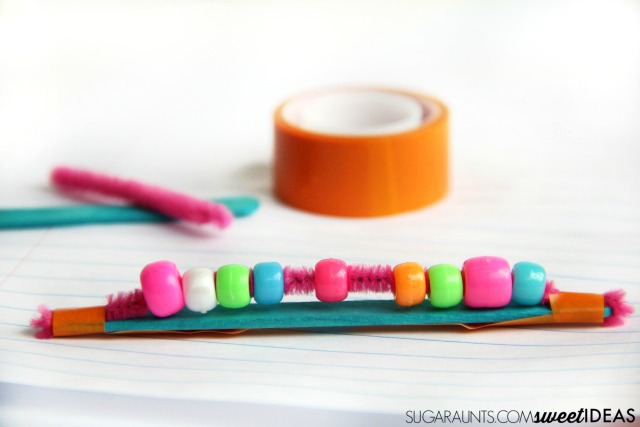
        Cut a pipe cleaner to fit the length of a craft stick, including bending both ends over to the reverse side of the craft stick.  

        Make this DIY fidget tool for use in the classroom or at home while writing and reading to help kids focus, attend, and perform tasks with tactile sensory input and movement they need to help with fidgeting.

        Slide several beads onto the pipe cleaner.  Then, bend both ends over the ends of the stick.  Attach them with a strip of tape over the length of the pipe cleaner that is bent down the backside of the craft stick.  

        At this point, you can wrap rubber bands around each end of the craft stick to secure the pipe cleaner.  You will want to cover the rubber bands (or just tape around the end of the craft stick if you omitted the rubber bands). 

        Make this DIY fidget tool for use in the classroom or at home while writing and reading to help kids focus, attend, and perform tasks with tactile sensory input and movement they need to help with fidgeting.
        Make this DIY fidget tool for use in the classroom or at home while writing and reading to help kids focus, attend, and perform tasks with tactile sensory input and movement they need to help with fidgeting.
        Make this DIY fidget tool for use in the classroom or at home while writing and reading to help kids focus, attend, and perform tasks with tactile sensory input and movement they need to help with fidgeting.

        Use the fidget toy to help with attention and movement needs by sliding the beads up and down the pipe cleaner while writing, copying written work, reading, or listening in the classroom.  

        The small size and flat back of this fidget tool make it perfect to rest on the desktop surface.  The child that is writing can hold it with their non-dominant hand as they stabilize the paper when writing with their dominant hand.  

        Make this DIY fidget tool for use in the classroom or at home while writing and reading to help kids focus, attend, and perform tasks with tactile sensory input and movement they need to help with fidgeting.

        Looking for more sensory tools for use in the home and classroom?  Try these:

        •  A ball of play dough or this Pull and Stretch Bounce Ball is a good way to keep kids’ hand occupied as they move with the small motor proprioceptive input. This heavy work for the hands can allow kids to concentrate as they write. 
        •  The DESK BUDDY is great for kids who are doing homework as it can sit on a table surface or it can be a hand-held sensory fidget toy. 
        •  A pencil topper like these Pencil Tops Fidget can help kids while they write, and can be fidgeted with on or off the pencil. 
        •  Try writing with a vibrating pen like this Squiggle Wiggle Writerfor proprioceptive input before a writing homework assignment. 
        •   THE ULTIMATE FIDGET is a quiet fidget toy that kids can keep in their pocket. 
        •  Something as simple as nuts, bolts, and washers can make a great fidget toy for kids. 
        •  A few (Amazon affiliate link) Wikki Stix can give a child just the fidget toy they need to concentrate. Here are more wikki stix activities as well.  Kids can bend them into a ball, and work the bendable strings as they work. 
        •   Grip Pop Beads are one of my favorite fidget toys for kids. They work on the small muscles of their hands as they build the pop beads and have a fidget once they have a strand of beads. 
        Make this DIY fidget tool for use in the classroom or at home while writing and reading to help kids focus, attend, and perform tasks with tactile sensory input and movement they need to help with fidgeting.

        Be sure to check out all of the easy handwriting tips in this month’s series and stop back often to see them all.  

        You’ll also want to join the Sweet Ideas for Handwriting Practice Facebook group for more handwriting tips and tools.

        Get 29 pages of modified paper with a Christmas Theme for legible and neat Letters to Santa, Christmas Wish Lists, Thank You Notes, Holiday Lists, and MORE! 

        GET YOUR Christmas Handwriting Pack!