Teletherapy Platforms for Occupational Therapy

Which telehealth platform is the best for occupational therapy telemedicine delivery?

Many therapists are becoming more interested in telemedicine, given the current circumstances of our healthcare system. How do you know where to begin when researching teletherapy platforms? Today, we’re discussing various telehealth options for occupational therapy.

To get you started with actual activities that you can apply to virtual OT sessions, here are teletherapy activities to help you get started with virtual occupational therapy services.

Which telehealth platform is the best for occupational therapy telemedicine delivery?

Some existing companies are looking to incorporate the use of telemedicine into their business by converting current clients to teletherapy services. On the other hand, there are teletherapy platforms that provide solely virtual care to their patients.

While other healthcare disciplines, such as nursing and medicine, are more widespread in the telehealth realm, occupational therapists are a growing presence in this up-and-coming practice area.

how to chose a telehealth platform for occupational therapy.

TELETHERAPY Platforms

Speech therapists were perhaps some of the first therapists to enter the world of pediatric teletherapy, perhaps due to the nature of much of their treatment. Unsurprisingly, many of the teletherapy roles for occupational therapists are within school-based therapy settings for similar reasons. These platforms can easily address fine motor skills, developmental milestones, emotion management, behavior modification, executive functioning, sensory regulation strategies, and more.

For those therapists who are interested in providing occupational therapy for a teletherapy platform, there are a variety of platforms available. The following companies offer technology to serve virtual medicine:

Global Teletherapy– As a school-based teletherapy platform that provides care from disciplines such as OT, SLP, LPC, LMHC, and SW, Global Teletherapy is a prominent provider in the telemedicine realm. As an established platform, Global Teletherapy helps therapists gain clinical experience in this arena while providing resources to parents of children who receive teletherapy.

Presence Learning– Presence Learning provides speech-language pathology, occupational therapy, early childhood services, special education, and psychoeducational assessments to children within the school system. This platform provides individualized consultations with schools to determine their suitability for teletherapy services. Many therapists may be familiar with the idea of needs assessments, which Presence Learning completes to ensure best fit for all of the children they serve.

eLuma– This company provides online speech-language pathology, occupational therapy, physical therapy, special education, and mental health counseling from licensed therapists and counselors. Not only has this company been providing therapy services to schools who are in need of online therapy and mental health services, but eLuma also provides ample resources to therapists transitioning into teletherapy. Through blogs, webinars, and online publications, therapists and other professionals can learn more about how to provide effective teletherapy services while facilitating progress in the children they treat. 

TinyEYE– TinyEYE has been providing school- and home-based teletherapy services for children since 2005. Not only is this teletherapy platform consistently growing, but they are committed to providing focused care by providing occupational therapy and speech therapy services to the clients they serve. TinyEYE also provides therapists with treatment ideas, free activities, a wide range of technology-based exercises to use with children to address various concerns during any treatment.

DotCom Therapy– DotCom Therapy employs a diverse range of school-based professionals, including audiologists, mental health counselors, occupational therapists, and speech-language pathologists. With a comprehensive range of services, DotCom Therapy is able to provide extensive IEPs with continual reviews, personalized needs assessments, staff training for school professionals, and ongoing team meetings and parent conferences.

Other Telehealth Platforms

Zoom for Healthcare– In the recent changes to public health and therapeutic service delivery, finding a quick and compliant means of connecting with clients is needed. Zoom for Healthcare is one such platform ahta is easy to set up and get moving with. The video conferencing platform is HIPPA compliant and offers resources to help with setting up virtual communications.

Google Classrooms– With this online classroom platform, therapists are able to connect with and engage with students in a virtual setting. A group classroom setting may not be appropriate for confidentiality reasons, as classmates and parents can view others in a group video setting or in the comments section. However, therapists may choose to use the technology to set up individual classrooms for each student they serve as a way to deliver documents, files, and recommended home programs.

Teletherapy platforms for occupational therapy delivery of virtual therapy services.

Teletherapy Staffing Companies

Some therapists may be familiar with staffing agencies, which are poised to connect therapists of many disciplines with therapy positions. Sunbelt Staffing and ProCare Therapy are unique in that they recruit therapists for contracted (short-term) or permanent (long-term) teletherapy roles within school systems across the country. Some of these roles are part-time and some are full-time, but each position allows physical therapists, physical therapy assistants, occupational therapists, occupational therapy assistants, and speech-language pathologists the opportunity to build connections in valuable technology-based roles in a range of locations.

Occupational therapy and teletherapy

Amazon affiliate links are included below.

For occupational therapists who are interested in making a difference in the world of teletherapy, there are many options for them to consider. For the time being, occupational therapy is still a relatively new discipline within this type of platform, but that can easily change as more parents, families, schools, and communities see the benefit of online occupational therapy services.

This service initially developed to provide essential care for individuals who are in rural areas and cannot access standard, in-person treatment. However, virtual occupational therapy can increase the skills, quality of life, and occupational performance of children in areas with a shortage of therapists, time constraints, or concerns related to recent public health issues.

With the rise of telemedicine, the concept of teletherapy may be difficult for some children to grasp, especially those living with disabilities and those who are accustomed to traditional school-based therapy or outpatient rehab. Thankfully, there are resources available to guide children through this process and learn skills that make them stronger and more confident.

Why is there a person in my computer? is a child’s guide to understanding what teletherapy is and how it can help with a variety of medical concerns. This story follows Andrew, a child with visual deficits who is having difficulty playing hockey, performing well in school, and working on his art. He meets a therapist named Brittany who guides him through his first teletherapy session, and he loves it! This picture book helps children understand what teletherapy is, what makes it different from other therapies, and how it can help them live better lives. Children may also enjoy the supplemental activity guide complete with coloring pages, fact sheets, and more!

This blog post was written by Brittany Ferri. Brittany is an occupational therapist, author, and teletherapy professional. She is passionate about education, health promotion, and disease prevention for all. Brittany currently practices in community-based teletherapy for two platforms, one that serves pediatrics (geared toward mental health diagnoses and developmental delays) and one that serves adults. For more information, visit her company’s website at www.simplicityofhealth.com

Teletherapy Activities for Occupational Therapy

Occupational therapy teletherapy activities

In this article on teletherapy activity ideas for kids, you will learn how to enhance a variety of skills through basic, fun activities. OT is online more than ever in recent days and therapy services may be scrambling to identify occupational therapy activities that can serve children and families in the OT telehealth format. Children and therapists may both be familiar with some of these teletherapy activities, whereas others may be learning experiences for the entire family unit.

We will provide some teletherapy activities broken down by age range so that therapists can best enable functional performance and occupational engagement in the children they serve. To better understand teletherapy start with out recent post that explains the online therapy service.

Occupational therapy teletherapy activities

How to plan occupational therapy teletherapy sessions

One of the hardest parts of OT telehealth can be the planning. Week after week, it is difficult to come up with occupational therapy activities that meet the needs of your clients.

Over the past year, I’ve created many free slide decks that help alleviate some of the stress of consistently creating new therapy activities for digital services. These Google slide decks are completely free and can be used to meet a variety of needs and ages in OT services. Pair the slide decks with weekly occupational therapy themed activities for a combination of hands-on activities and digital resources.

Using the slide decks makes therapy planning easier because you can make a copy for each client and modify the slides to meet the specific goals and needs for each individual on your caseload.

Then, add in some of the age-specific activities listed below.

Teletherapy Activities for Early Intervention

Let’s start with teletherapy for birth to three. Many therapists may struggle with understanding how early intervention services (also known as EI, or “birth to three”) can be provided virtually. The truth is, there is not much difference between teletherapy EI and standard EI programming, since both services are provided within the home and each place a heavy focus on family education.

teletherapy activities for birth to 3 and early intervention

Early intervention therapists can provide training, health information, and in-home strategies to assist with the care of children who demonstrate developmental delays, medical, concerns, or behavioral issues.

Intervention at the early intervention stage can involve a lot of parent coaching. You can address parent concerns regarding child development, addressing difficult behaviors, occupations for the client and family as a support. Parent education can involve occupations of self-care, feeding, sleep, anxiety or worries, attention, executive functioning skills, or any aspect of occupational performance that comes up within the home.

Therapists should ideally provide education that is unique to the child (and their family unit) covering topics such as positioning (for sleep, car seats, and play time), ways to enhance fine motor development and gross motor development, facilitating participation in self-care tasks, productive play, and more. Here are ways to work on fine motor skills in teletherapy.

In this way, the majority of the content that therapists provide families with will mimic traditional home training or home exercise programs (HEPs) that are provided as part of EI treatment.

Therapists in this setting can also provide children with exercises in some of the following areas, depending on their specific concern(s): 

  • Shape and object identification games
  • Letter and number tracing
  • Counting, sorting, and early comparing activities with animals, superheros, cartoons, shapes, etc.
  • Pattern recognition activities
  • Simple digital jigsaw puzzles
  • Online games and apps
  • Bingo activities with numbers, letters, and shapes
  • Holiday-themed activities involving drawing shapes and forming them into objects
  • Counting coins, playing shopping/store-related games
  • Target games involving planning/aiming, throwing, and picking up
  • Gross motor obstacle courses or chalk sensory walks

Here are some quick activity ideas that lend themselves nicely to teletherapy in early intervention:

Backhoe Shapes Craft

Easy Shapes Salt Truck Craft

Preschool Activities

Teach Nose Blowing

Pre-Writing Lines Activities

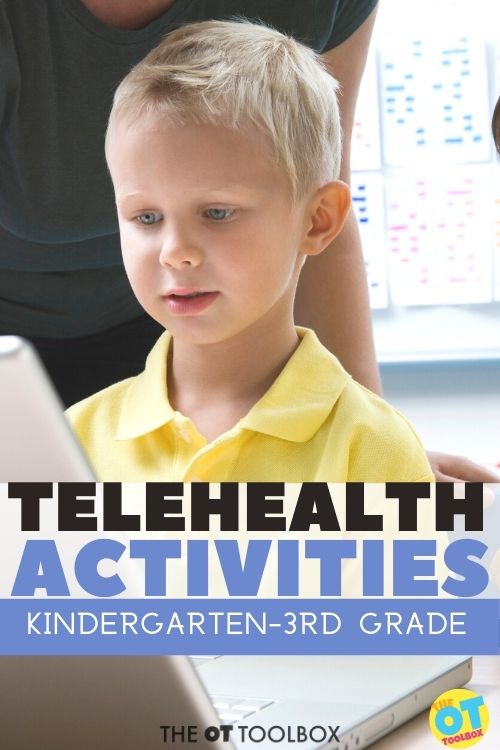
Teletherapy Activities for Kindergarten-3rd Grade

Next, let’s talk teletherapy activities for Kindergarten through third grade. Children between the ages of 5 and 9 can also benefit from teletherapy activities to build and strengthen skills related to sensory regulation, behavior management, handwriting, self-care, and effective communication.

teletherapy activities for kindergarten through 3rd grade

Teletherapy activities for kindergarten through 3rd grade can focus on addressing these concerns may include some of the following:

  • Digital coloring pages
  • “Find the differences” exercise involving comparisons between two similar images
  • Object matching games
  • Handwriting exercises
  • Interactive versions of basic games such as Connect Four, tic-tac-toe, 
  • Cause-and-effect games to encourage early understanding of problem solving and right vs. wrong
  • Worksheets prompting sequencing for basic activities (going to the movies, eating dinner, etc.)
  • Basic human body educational activities (coloring pages, identification charts, and functional purpose)
  • Education on “How does your engine run?” levels to assist in regulating emotions
  • Traditional draw and cut activities
  • Theraband and theragrip for basic strengthening
  • Gross motor obstacle courses or sensory walks

Here are more quick OT telehealth ideas for primary grades:

Therapy Band Exercise Program

Zones of Regulation Activities

Kids Crafts for Occupational Therapy

Motivating Handwriting Activities

Indoor Balance Beams

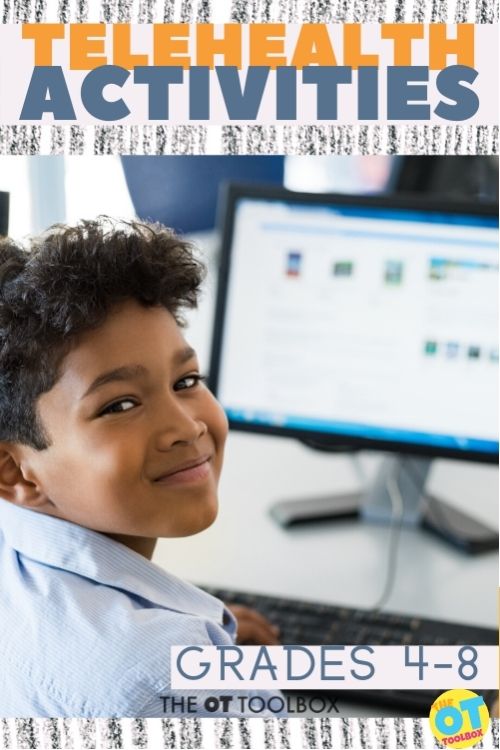
TELeTherapy Activities for Grades 4-8

Occupational therapy telehealth for older grades can expand into further topics. While many of the K-3 activities can be modified for some older children, there are multiple teletherapy activities that can be used for children in this age range.  Teletherapy activities for these children may focus on topics such as communication, behavior management, relationships, rule-following, self-care skills, and more.

teletherapy activities for grades 4-8

Try some of these ideas in planning online therapy services for grades 4th through 8th grade:

  • Word searches, jumbles, or crosswords
  • Mazes
  • More complex jigsaw puzzles and strategy-based games
  • Story-based cause-and-effect activities
  • Creative writing prompts to explore emotions
  • Role identification
  • Sports-based games and exploration of hobbies

Here are a few quick activity ideas for teletherapy in the older grades:

Games to Work on Executive Functioning Skills

Organization Activities and Strategies

Cursive Activities

Occupational therapy teletherapy activities

Areas That Therapists May Struggle to Address

There are certain areas that teletherapists may struggle to incorporate into teletherapy activities. The good news is, with a little creativity, therapists can ensure that the children they treat are receiving the well-rounded treatment they need to advance their skills in a range of areas.

Force modulation: Some games require the use of a tablet and stylus, which allows children to practice force modulation that cannot be addressed by typical point-and-click activities. Therapists can also encourage the use of alternative activities covering force modulation, such as clapping or hi-fives (if another person is present in the room). Therapists might provide prompts such as, “If it’s loud enough for me to hear – you are doing okay! If it makes your hand turn red and hurt – you are hitting too hard! If the two hands are barely touching – you aren’t hitting hard enough!”

Sensory regulation: This is best addressed when you have an e-helper present to aid during the session. However, with some simple planning ahead from a parent or teacher’s assistant, therapists can make sure their kiddo has the materials needed to work on this skill during the session. These e-helpers can provide children with a variety of sensory input (per therapist recommendation and supervision) including soothing music or nature sounds, various textured fabrics, weighted blankets, essential oils, brushing protocols, visually soothing colors, and much more.

Other strategies, such as brushing protocols, can even be trialed or implemented with children per therapist demonstration and instruction. All of this is, of course, best supplemented by educating parents, teachers, and other loved ones on the use of a sensory diet to maximize a child’s tolerance and regulation of sensory input.

If you are searching for additional resources to serve as inspiration or reference for teletherapy activities, check out some of the following websites:

OT Teletherapy ACTIVITIES by area

Pair popular children's books with hands on activities to help kids build skills, perfect addition to occupational therapy sessions.

Children’s books activities


Need an idea to keep the kiddos busy AND building skills like fine motor work or executive functioning? Need an activity for teletherapy sessions that cover a variety of areas like scissor skills, bilateral coordination, eye-hand coordination, and more?

Grab one of these popular children’s books and activities (OR find a reading of them online) and then make the craft or activity outlined on The OT Toolbox

Have fun exploring books through play!

Handwriting ideas for telehealth that can be used in OT virtual sessions.

Handwriting activities for teletherapy

Ohhh, it’s tricky to get the kids to do the hard things in the place they feel safe and loved. Handwriting work they may have had in the classrooms might be a foot stomping “NO!” In the dining room classroom! Here are ways to make handwriting fun:

Easy handwriting activities can be sent as home programs or used in virtual OT sessions via a screen.

These irresistible handwriting activities can work for kids who hate to write.

Natural writing experiences (it’s not about the writing…or is it??? ??) can make handwriting practice at home fu,.

Use these handwriting tips & tricks in fun ways as part of home programs.

Teletherapy resources for occupational therapists and other telemedicine practice.

Many therapists and medical providers have moved to virtual telehealth services recently. Many more will transition to this type of service delivery next week. Here are teletherapy resources to better help understand and deliver virtual therapy:

Understanding teletherapy to get a better vision of what teletherapy actually looks like in action.

Additionally, diving into various Occupational therapy teletherapy platforms can be helpful to know where to begin.

sensory diet activities for home to use in OT teletherapy sessions

Sensory Diet activities for home programs

“A sensory diet is a group of activities that are specifically scheduled into a child’s day to assist with attention, arousal and adaptive responses. The activities are chosen for that child’s needs based on sensory integration theory. … These activities are designed to produce a positive effect on a child.” Here are sensory diet tools I’ve got on the website. Use them in parent education and conferencing or as recommended reading.

Part of virtual teletherapy sessions can involve parent education and explaining the specific Goals of a sensory diet.

These backyard slide and swing activities can be done at home using Sensory diet activities in backyard playground equipment.

These fine motor activities for telehealth and be used in OT sessions with kids.

Fine Motor Activities in telehealth

I’ve had a few requests for this fine Motor Activities using items commonly found in the home.

These fine motor activities and exercises with parents needing tools to build strength and dexterity. Or, use these ideas in teletherapy services:

Playing cards

Craft Pom poms/cotton balls

Paper clips

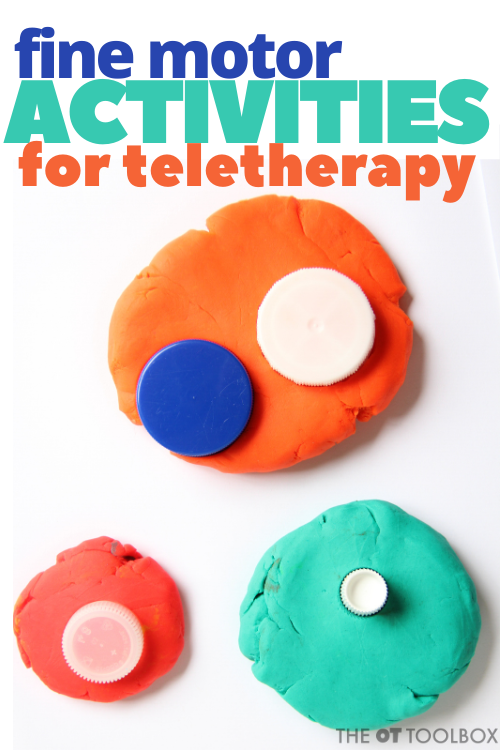
Play dough

More regular home item activity lists coming. These are completed but on the backlog in getting them up on the site.

Cooking with kids is a great way to build skills and help kids learn, add these ideas to teletherapy sessions.

Cooking Activities for virtual therapy

Need some ways to build skills, inspire learning, connect with the kiddos, AND take a minute to reflect on everything? Use that kitchen! Cooking with kids is a great way to build many sill areas.

Cooking is such a great way to build motor skills, sensory experiences, build self-confidence, open up opportunities for conversation, work on math concepts, executive functioning…there are so many areas of learning and growth in cooking tasks.

Here are some resources on kid-friendly recipes that can be graded to make them easier or more difficult for younger/older kids:

These kid-friendly recipes build skills. Send them as home programs or make them along with the child and an E-helper.

You can teach direction-following with cooking with these recipes.

Cooking builds motor skills. Use these recipes and simulated cooking activities (GREAT for virtual therapy sessions!) while building motor skills.

Add brain breaks to occupational therapy telehealth with kids.

Brain breaks in OT teletherapy

? Brain Breaks! ?
These themed activities are quick wins, and (many times) the re-set button that we can all use at one time or another. Brain breaks can be movement-based actions, whole-body breathing strategies, or just a mental reprise. These are perfect ?? for an afternoon re-set or during schooling at home activities.

Themes and brain break activities galore can be found here.

OTs can use crafts to build skills in helping kids develop motor skills.

Use crafts in OT teletherapy

Crafts that build skills
Need a craft or two that doubles as a tool to build fine motor skills, eye-hand coordination, scissor skills, bilateral coordination, midline crossing, hand strength, tactile exploration, and more?

Here are TONS of kids craft ideas to get you started (therapist-approved!)

These executive functioning activities are great for OT teletherapy.

Executive Function activities in teletherapy

Ok…with schooling at home, managing the laundry pile, working with kids playing under the table, trying to get them to read a real, live book…are you running into trouble with prioritization, planning, impulse control, working memory, organization? ? All of these skills are executive functioning! Impulse control, prioritization, planning, working memory…executive functioning skills can be worked on at home. Here are activities, along with information on how and why these areas impact functioning.

What are EF skills

Attention

Games to improve EF

Working memory

motor skills activities occupational therapy teletherapy activities

Ok…the kids are on screens A TON now, right? Here are creative ways to build motor skills, motor planning, and coordination using everyday, household items that you probably have in the home right now. Add these to your teletherapy line-up for hands-on activities that don’t involve apps, videos, or computer slides:

Pencil control exercises with paper and pencil– Use just a pencil and paper to work on pencil control, hand strength, and visual motor skills. We used colored pencils, but this activities works with a regular pencil, too. Practice shading in the circles with more or less pencil pressure to work on proprioception.

Grasp development and in-hand manipulation with recycled containers– Use recycled water bottles, plastic containers with lids, and other upcycled items to work on grasp strength, and translation to remove caps and lids. Washing out the containers is a GREAT functional task, too. Then, kids can throw the recycled containers right into the recycle bin when they are finished with this activity.

DIY tongs with craft sticks/pencils– One of our oldest posts here on the website, you can use craft sticks and craft pom poms OR, if those items are available in the home, no problem. Substitute them for a pair of pencils and rolled up pieces of paper to make DIY tongs.

Balance beam ideas using household items– Kids can work on coordination, motor planning, balance, and core strength in the home using regular, household items in DIY indoor balance beams.

Intrinsic hand strength/motor planning, coordination with an egg carton & straw– Use what you’ve got! An empty egg carton, and pieces of straws, (or any other small item) can be a powerful way to work on hand stregth and intrinsic strength needed for pencil grasp and fine motor dexterity.

Fine motor with playing cards– Playing with items found in the home can build big skills in a low-tech manner. Playing cards can be used to build visual motor skills, visual perception, fine, motor and more.

Extended wrist/fine motor/eye-hand coordination with a
Colander & toothpick
s- Head to the kitchen for this fine motor activity that builds big motor skills and coordination.

HELP KIDS UNDERSTAND TELETHERAPY

Amazon affiliate links are included below.

With the rise of telemedicine, the concept of teletherapy may be difficult for some children to grasp, especially those living with disabilities and those who are accustomed to traditional school-based therapy or outpatient rehab. Thankfully, there are resources available to guide children through this process and learn skills that make them stronger and more confident.

Why is there a person in my computer? is a child’s guide to understanding what teletherapy is and how it can help with a variety of medical concerns. This story follows Andrew, a child with visual deficits who is having difficulty playing hockey, performing well in school, and working on his art. He meets a therapist named Brittany who guides him through his first teletherapy session, and he loves it! This picture book helps children understand what teletherapy is, what makes it different from other therapies, and how it can help them live better lives. Children may also enjoy the supplemental activity guide complete with coloring pages, fact sheets, and more!

For more resources, be sure to join our Occupational therapy teletherapy mini course. You’ll receive resources and loads of information in this 5 day email course to guide OT teletherapy sessions and keep you on track to helping kids thrive in your teletherapy services.

Fine Motor Activities with Clothespins

These fine motor activities can be added to occupational therapy teletherapy activities to work on precision and dexterity in kids, all using items found in the home, like clothespins.

Looking for fine motor activities you can do with kids at home and using items you already have in the house? Today, I’ve got fine motor activities using clothespins. These are great finger strength exercises using activities that can be shared with families so they can work on skills at home or as part of an occupational therapy home program. These activities ideas need just clothespins, so it’s a great way to work on fine motor skills as part of teletherapy or virtual occupational therapy services. For more activities you can easily set up at home, check out some of the posts listed below. In all of them, we are talking about fine motor activities using items you already have in the home.
FIne Motor Activities Using Items You Have at Home

FIne Motor Activities with Play Dough

Fine Motor Activities with Paper Clips

Fine Motor Activities with Craft Pom Poms or Cotton Balls

Fine Motor Activities with Playing Cards

Fine Motor Activities with Beads

Fine Motor Activities with Chalk

fine motor activities using everyday household items, like cloths pins to work on fine motor skills in kids.

Fine motor skills Activities using clothes pins

When using clothespins to work on fine motor skills, kids can address so many underlying skill areas. Fine motor skills like bilateral coordination, hand strength, arch strength, intrinsic hand strength, eye-hand coordination, motor planning, proprioceptive sensory input, and so many other areas. All of these components of fine motor skills are covered here on The OT Toolbox. Check out the menu drop down bar above for activities geared toward each of these specific skills.

  • Drop into large container
  • Make into animal craft 
  • Use as legs for animal puppets
  • Squeeze onto number cards
  • Use clothespins to work on pinch strength
  • Hang from string overhead
  • Use to hang a pendant banner
  • Clip onto leaves on a tree
  • Play outdoor scavenger hunt game
  • Use a clothespin to work on pencil grasp
  • Label with letters and place in alphabetical order
  • Press onto pipe cleaners 
  • Make a tree with string and pipe cleaners
  • Use clothespins to work on spacing between words
  • Squeeze onto clothes for labeling body parts or clothing items for functional task
  • Use in ordering activities for a sensory diet or activity list
  • Chore clips for home or classroom chores
  • Squeeze ball of play dough color code or number coded 
  • Use clothespins in fine motor busy bags
  • Squeeze small ball of paper
  • Squeeze craft Pom Pom and paint dots 
  • Pick up and transfer mini erasers
  • Pinch onto the edge of a table when laying underneath for overhead reach. Hang up paper
  • Make a sheet fort 
  • Squeeze onto craft wire to make a sculpture
  • Use to count in math centers
  • Pinch into clothing (sleeve) for a kindness count

We have created a video to show how to use clothes pins to support development of different grasp patterns. You can watch this video below. If you can’t view the video, check it out on The OT Toolbox YouTube channel.

These fine motor activities can be added to occupational therapy teletherapy activities to work on precision and dexterity in kids, all using items found in the home, like clothespins.

MORE FINE MOTOR ACTIVITIES:

Create Your Own Race Track


Spring Sensory Seek and Find


Sensory Soup with Fine Motor Sorting


Fine Motor Strengthening with Color Match


Cereal Box Fine Motor Coordination Activity


DIY Lacing Cards


Manipulating Coins Fine Motor Skills


Best Fine Motor Play Ideas for Kids


Tripod Grasp with Pipe Cleaners


Textured Shaving Cream Play Finger Isolation

Sight Word Scooping

Golf Tee Hammering

Finally, use these games with paper clips to support fine motor skills using another every day activity.

Clover Deep Breathing Coloring Page

Ahhh…taking a deep breath with mindful breathing is such an easy way to add coping skills to a child’s repertoire of sensory diet activities. Deep breathing as part of mindfulness adds a moment of whole-body relief. With all that is going on in the world with the impact of COVID-19, children and families can feel stress and anxiety. When parents read and discuss current events in public health, children can sense the stress and feel worries that they can openly express. Using a deep breathing tool like this clover deep breathing coloring page is one way to cope. In fact, research tells us that deep breathing can reduce stress. Read on for more on using deep breathing as a coping strategy for kids…and to grab your clover coloring page!

Clover deep breathing activity for mindfulness for kids.

Deep Breathing to RELIEVE Stress

Teaching kids mindfulness strategies is one way to reduce worries or stress. Stressors in the home or by hearing scary things can impact children in may ways. We know that stress can lead to declines in mental and physical health. For kids, this might show up as behaviors, acting out, fighting with siblings (more than usual), or even trouble concentrating and completing school work or learning at home.

One way to combat worries in children is to help them with mindfulness and the use of coping tools. Mindfulness entails paying attention to the present moment with a nonjudgmental and open awareness of one’s sensations, thoughts, and feelings (de Jong et. al., 2016). In children, we can help to reduce the impact of worries or anxiety by teaching them about mindful breathing. Taking in deep breaths while focusing on the inhale and exhale, children can become more aware of their body’s rhythm and sensations.

One way for parents and occupational therapists to support a child’s development is through addressing mindfulness. By providing tools to impact well-being, we can address stressors of both the family or parent and the child. In current public health situations (such as right now with the coronavirus keeping everyone at home and away from typical routines), stress might impact children in a variety of ways.

Research on Deep Breathing and Stress

Researchers have found changes in brain activity that occurs when deep breathing strategies are implemented. Check this out:

“Whereas the link between breathing and brain activity has a long history of application to therapy, its neurophysiology remains unexplored. Using intracranial recordings in humans, we show neuronal activity to track the breathing cycle throughout widespread cortical/limbic sites. Volitional pacing of the breath engages frontotemporal-insular cortices, whereas attention to automatic breathing modulates the cingulate cortex. Our findings imply a fundamental role of breathing-related oscillations in driving neuronal activity and provide insight into the neuronal mechanisms of interoceptive attention.”

Read more from the Journal of Neurophysiology study.

Clover Deep Breathing Coloring Page

Use this deep breathing coloring page to work on mindful breathing with kids. Use it as a coping tool to encourage deep breaths in and out. This coloring page goes nicely with our Thanksgiving mindfulness deep breathing page, our pumpkin deep breathing activity, and our Christmas tree deep breathing page.

Enter your email address below so the coloring page can be delivered and printed off.

Get a Clover Deep Breathing Coloring Page

    We respect your privacy. Unsubscribe at anytime.
    Powered By ConvertKit

    Colleen Beck, OTR/L has been an occupational therapist since 2000, working in school-based, hand therapy, outpatient peds, EI, and SNF. Colleen created The OT Toolbox to inspire therapists, teachers, and parents with easy and fun tools to help children thrive. Read her story about going from an OT making $3/hour (after paying for kids’ childcare) to a full-time OT resource creator for millions of readers. Want to collaborate? Send an email to contact@theottoolbox.com.

    Understanding Teletherapy

    Occupational therapy teletherapy tips

    There have been many questions in recent days about teletherapy and how to incorporate telemedicine into occupational therapy interventions. Today, I’m excited to share resources and information explaining what is teletherapy, strategies to help kids understand teletherapy (when they are used to their OT seeing them in the classroom or clinic…), what exactly teletherapy looks like, and more resources. Here are specific occupational therapy teletherapy activities for early intervention, kindergarten, early elementary, upper elementary, and middle school ages.

    Broadly speaking, telemedicine (also known as telehealth) refers to the use of technological tools within medical treatment. This general definition includes computer programs that create home exercise programs (HEPs) for patients, shared portals for electronic medical records (EMRs), and secure messaging systems where patients can communicate with their therapists or healthcare providers. Telemedicine has now been used with a variety of populations, health disciplines, and diagnoses. Disciplines such as nursing, medicine, pharmacy, psychiatry, and psychology are all able to provide a variety of medical and mental health care for individuals without seeing them in person.

    Occupational therapy teletherapy tips

    What is teletherapy?

    When technology is used within the therapy world, these services are called teletherapy. Teletherapy involves therapists providing care virtually over a computer platform. Occupational therapists in particular are an integral part of the teletherapy movement, as these professionals can provide virtual care for pediatric, adult, and geriatric patients with a variety of physical and mental health conditions.

    Here is an explanation of the various teletherapy platforms for occupational therapy services that may work for delivery.

    Occupational therapists working with children in both school-based and outpatient settings can use telehealth to deliver many of the same treatments they would use during in-person treatments. These interventions include activities, exercises, and testing to help children who have difficulty in some of the following areas:

    • Fine motor skills (such as using buttons, manipulating scissors, or holding a pencil)
    • Writing, reading, or learning
    • Gross motor skills (such as using muscles in the neck, arms, hands, and torso)
    • Assisting with self-care, such as dressing, eating, and grooming
    • Managing their emotions or behaviors
    • Playing or engaging in leisure activities
    • Organizing, planning, and completing tasks
    • Interacting or communicating with other children, adults, teachers, etc.
    What is teletherapy? This resource explains occupational therapy virtual therapy sessions with kids.

    help children understand teletherapy

    How can you help children understand teletherapy? When kids are used to seeing their occupational therapist in the classroom setting, clinic, or therapy, room, the transition to teletherapy can be a strange and difficult thing. Here are tips to help kids understand virtual occupational therapy sessions:

    While the core aspects of therapy remain the same when sessions are completed virtually, this change can be difficult to explain to children, especially children with disabilities. If children have received in-person therapy services before, you can explain to them that the computer will be their “learning portal” to help them participate in all the fun and educational activities that they would typically do in therapy.

    For children who have no experience participating in any kind of therapy services, you can call the computer their “creativity helper” through which they can play games, talk with their therapist, learn new things, and strengthen their bodies and minds! For younger kids, it may help for you to mention that there will be games with animals, superheros, their favorite cartoon characters, sports, and more.

    Parents, guardians, and teachers can explain to children that this type of therapy helps everyone learn and practice what they need. Many children particularly love hearing that they could be talking with a therapist from anywhere in the country, and parents can say that teletherapy is taking them to a whole new world with new and exciting experiences!

    The success and ease of a child’s transition to teletherapy is often dependent on their prior experience with technology, specifically computers or tablets. Children who use these devices will likely have a more intuitive understanding of programs, since they probably have used some similar programs to play games or work on certain school assignments. Some children may even view teletherapy as more exciting than traditional therapy, since they get to play games on the computer (something that is often viewed as a reward or leisure activity after their homework is done).

    How to start teletherapy with kids that are receiving occupational therapy services at home.

    Tips to make teletherapy easier for children and their families

    Moving from in-person therapy services to teletherapy can be a difficult transition. If you are looking for tips on how to make teletherapy easier for children (and their families), read on.

    Therapists and other healthcare professionals can test the computer programs and teletherapy platforms out with parents and children before they begin their first session. Some situations are time-sensitive, such as many children moving from in-person therapy to teletherapy due to sudden concerns surrounding coronavirus, and may not allow for this level of facilitation. However, this type of guidance will ease the implementation process and make all parties more comfortable with these types of therapy services. 
    Therapists should educate parents, guardians, and teachers about the type of environment that is most conducive to success in teletherapy. Children should be set up at a desktop computer with a properly working webcam and in-computer microphone along with noise-cancelling headphones. When using this computer, children should be stationed at an ergonomic workstation with a desk and chair that are the appropriate height for them. An appropriate height desk and chair will allow a child to sit up straight with their hips, knees, and feet at a 90° angle. 

    A child’s back and knees should both be flush with the back of the chair, and their feet should rest flat on the ground. If you do not have a chair that allows for this, you can place some books or a box under their feet to reduce strain.

    Additionally, the computer screen should be eye-level to prevent them from craning their neck or using poor posture. Not only will these tips prevent a child from experiencing unnecessary injury or muscle aches, but this position also helps children to remain alert and attentive to focus on the task at hand.

    Getting Started with teletherapy activities

    Here are a few ways to help with the implementation of teletherapy:

    Many children can benefit from teletherapy services, and most aspects of teletherapy are not all that different from traditional therapies. Children in both types of therapy complete evaluations, participate in games, activities, and tests, and receive feedback about the work they do. Teletherapy applications contain games to strengthen a child’s ability to see, write, learn, express emotion, communicate, behave in a socially appropriate manner, and more.

    To start a teletherapy session, children will typically log in to a “school building” or something similar. Once in this building, children can enter various “rooms”, each representing places they can access such as, “homework”, “reports”, “therapist’s office ”, and more. Once children are ready to begin their session, they will access the therapist’s office and video chat rooms should pop up so they can see a small image of themselves and a similar image of their therapist.

    Once the session begins, therapists may need to guide children to click certain buttons to engage with the program and play games. The focal point of the screen will be the games, tests, and lessons, but the screen may switch back to a larger image of the therapist throughout the session if they need to demonstrate something to the child or get their attention. 

    Similarly to the rest of the session, children will access their homework by entering a certain room. Much of their homework will resemble or be the same as some of the lessons they complete during therapy sessions. These lessons will be provided by the therapist, who determines skills that children must further develop through additional practice. Children will receive particular guidance if they are assigned new games or activities to complete for homework.

    Using hands-on Activities in teletherapy

    In the classroom or clinical settings, occupational therapists work with kids in hands-on activities. Moving to the virtual setting can be a big question for therapists who are wondering how to use manipulatives and hands-on activities in a virtual setting. Here are some strategies on how to work with manipulatives and activities during teletherapy. In other words, this is what teletherapy “looks like”:

    Many children must get used to the absence of many of the arts and crafts supplies, handheld games, and other toys that they are used to using in traditional therapy. However, teletherapy is not entirely virtual. Many teletherapy sessions require some of these same objects to help strengthen a child’s fine motor skills and reach developmental milestones, such as manipulating scissors and drawing certain shapes. Here are specific ways to work on fine motor skills in teletherapy.

    However, some children with disabilities or learning impairments may have difficulty accessing and using these objects (also called manipulatives) throughout therapy sessions. For this and other reasons, most schools or outpatient clinics have “e-helpers”. These e-helpers are usually teaching assistants or rehab aides, who are present to assist with tasks and manage technology as needed. These professionals play an integral role in facilitating the teletherapy process for children who may struggle with the transition or the implementation.

    However, these e-helpers are not always present in schools or clinics that are understaffed or do not have the resources to assist with this step. In this case, additional resources are extremely helpful in preparing children for this sometimes new and overwhelming experience.

    How to explain teletherapy to kids

    resources to help kids understand teletherapy

    Amazon affiliate links are included below.

    With the rise of telemedicine, there may soon be a day when all people are receiving medical services virtually. Until then, this concept may be difficult for some children to grasp, especially those living with disabilities and those who are accustomed to traditional school-based therapy or outpatient rehab. Thankfully, there are resources available to guide children through this process and learn skills that make them stronger and more confident.

    Why is there a person in my computer? is a child’s guide to understanding what teletherapy is and how it can help with a variety of medical concerns. This story follows Andrew, a child with visual deficits who is having difficulty playing hockey, performing well in school, and working on his art. He meets a therapist named Brittany who guides him through his first teletherapy session, and he loves it! This picture book helps children understand what teletherapy is, what makes it different from other therapies, and how it can help them live better lives. Children may also enjoy the supplemental activity guide complete with coloring pages, fact sheets, and more!

    This blog post was written by Brittany Ferri. Brittany is an occupational therapist, author, and teletherapy professional. She is passionate about education, health promotion, and disease prevention for all. Brittany currently practices in community-based teletherapy for two platforms, one that serves pediatrics (geared toward mental health diagnoses and developmental delays) and one that serves adults. For more information, visit her company’s website at www.simplicityofhealth.com

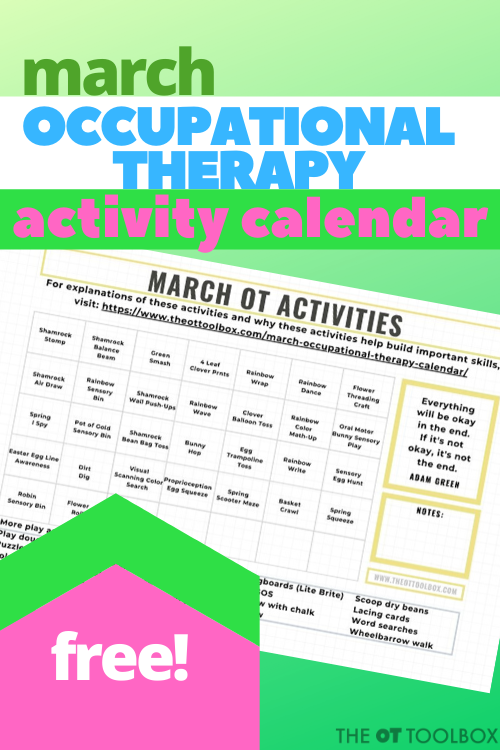
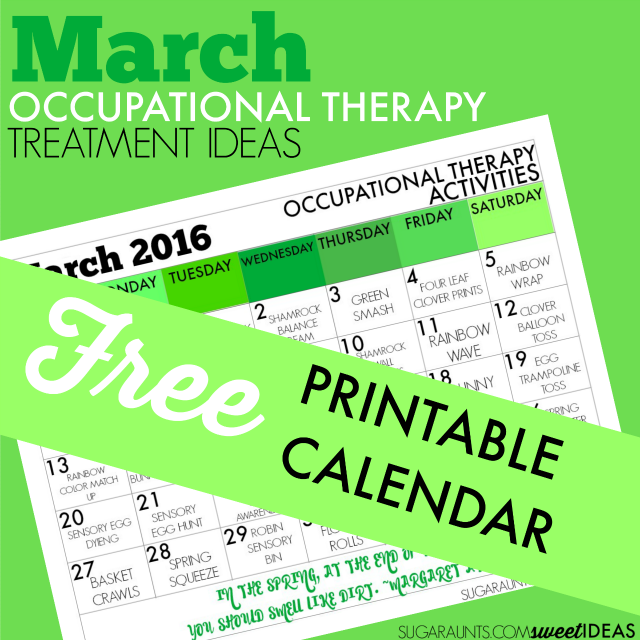
    March Occupational Therapy Calendar

    march occupational therapy activity calendar to build skills in kids

    It’s that time again!  Here is your March Occupational Therapy calendar for treatment ideas and themed activities designed to work on goal areas.  These ideas can be customized to meet the needs of your patient or client and modified as needed.  Add these St.Patrick’s Day activities, Spring activities, and shamrock activities to your occupational therapy activities toolbox.

    As always, consult an Occupational Therapist for a full assessment of your child as no two kids are alike and even with similar diagnoses or problem areas, unique treatment strategies are a must.  

    Disclaimer: This is intended to be a resource and not a replacement for occupational therapy treatment. You may print off this calendar and share it with your clients or direct contacts. You may not share this resource digitally or post it online.  

    march occupational therapy activity calendar to build skills in kids

      Full disclosure_This post contains affiliate links.

    IMPORTANT: Scroll to the bottom to access your free calendar. This page is your go-to resource on HOW TO do each activity on the calendar. Save this page.  

    March Occupational Therapy Activities

    1. Shamrock Stomp- Works on proprioception, gross motor, coordination, visual motor skills, visual scanning.  Spread out Shamrock cut outs on the floor.  Show your child how to stomp, hop, and jump on the shamrocks.  Looking for more info?  Read about proprioception here.  

    2. Shamrock Balance Beam– Use those same Foam Shamrocks from above to create a balance beam.  Use the same strategies as our snowflake balance beam.  

    3. Green Smash– Works on fine motor skills, hand eye coordination, proprioception, and visual scanning with baked cotton balls.  Dye them green for a March theme.  Read how to make baked cotton balls and how to use them in OT activities here.  

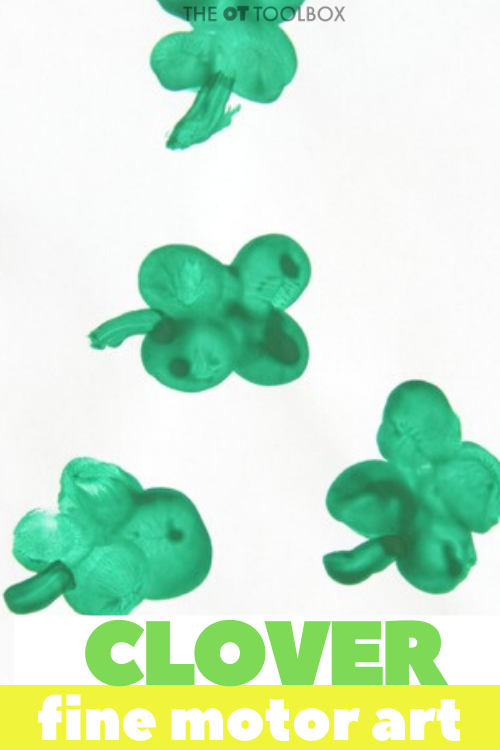
    4. Four Leaf Clover Prints– Make a clover shape from a pipe cleaner, sort of like we did here.  Add paint to make clover stamp art.  Works on tripod grasp.  

    5. Rainbow Wrap- Grab a bunch of colorful blankets, towels, and scarves.  Ask your kiddo to lay don on the floor as you roll them up in the colors of the rainbow!  Works on proprioception.  

    6. Rainbow Dance– Use colored paper sheets to create colored areas on the floor (one sheet per color is enough!).  Turn up the music and dance.  Assign each color to different gross motor movements like reaching down to the ground with head between legs. Have someone turn off the music and everyone runs to a color and does the motion.  This is a vestibular sensory input, gross motor, motor planning, listening, attention, and visual scanning activity.  

    7. Flower Threading Craft– Grab petals, leaves, and flowers (real or fake) and thread with a large embroidery needle.  Thread the flowers along the thread to work on fine motor skills, pincer grasp, tripod grasp, bilateral hand coordination, in-hand manipulation, visual scanning, hand-eye coordination, and crossing midline.  

    8. Shamrock Air Draw–  Ask your child to lay down on the floor on his back.  (Get down on the floor right beside him!) Raise your arm straight up in the air and draw a big shamrock in the air.  Now stand up and lean over, hanging your hands straight down to the ground and draw another large shamrock in the air. Works on gross motor, motor planning, crossing midline, and vestibular.  

    9. Rainbow Sensory Bin– Create a sensory bin based on the colors of the rainbow to work on fine motor skills, tactile sensory input, language development, self-confidence, hand-eye coordination, and in-hand manipulation.  

    10. Shamrock Wall Push-Ups– Tape Foam Shamrocks to the wall and show your child how to place their hands on the shamrocks.  Press away from the wall, doing a standing push-up.  Works on proprioception, upper body strengthening, core body strength.  

    11. Rainbow Wave– Grab a brightly colored sheet and play parachute with 2 or 3 other people.  Add small scraps of fabric or tissue paper to the top of the sheet.  Works on bilateral hand coordination, gross motor skills, problem solving, visual tracking.  

    12. Clover Balloon Toss–  Draw a four leaf clover on a balloon.  Practice batting the balloon from person to person, not letting it hit the ground.  Next, do this activity by walking on knees.  Finally, do this activity sitting on the floor.  Other ways to play: Use new fly swatters to hit the balloons.  Add more balloons to the game.  Works on visual scanning, visual tracking, hand-eye coordination, bilateral coordination, and crossing midline.  

    13. Rainbow Color Match Up– Use colored clothes pins to match up to items around the home.  Try to find all of the colors of the rainbow.  Works on fine motor skills: pinch grasp, tripod grasp, hand strength.  

    14. Oral Motor Bunny Sensory Play– Work on oral motor sensory skills with a DIY bunny craft and a straw.  Works on oral motor skills, mouth musculature, visual scanning, coordination, motor planning, and problem solving.  

    15. I Spy Visual Perception Activity– Make your own real life “I Spy” game using spring, Easter, or St. Patrick’s Day toys, items, stickers, plastic eggs, beads, etc.  Spread them all out on a table and ask your child to search and find certain items. This is similar to this I Spy activity we’ve done.  Works on visual memory, visual scanning,  and language development.  

    16. Pot of Gold Sensory Bin– Grab gold coins, yellow checker pieces, or even real money and put them all into a big bin.  Add tweezers and tongs to work on fine motor skills as your child scoops and places the coins into a bowl.  Works on tripod grasp, open thumb web space, intrinsic muscle strength, and hand-eye coordination. Here is more information on the fine motor benefits of playing with coins.  

    17. Shamrock Bean Bag Toss–  Cut shamrocks from felt (or use these ones) and pin them onto bean bags.  Toss them into bowls, pans, and other target areas.  Try playing hopscotch with the bean bags, too.  This is similar to our snowflake bean bag toss activity. Works on motor planning, proprioception, hand-eye coordination.    

    18. Bunny Hop– Find some friends and do the bunny hop. Such a classic Easter activity is a great way to incorporate bilateral hand coordination, motor planning, proprioception, listening skills, direction following, and problem solving.    

    19. Egg Trampoline Toss–  This is an activity to use with a mini trampoline or a full size outdoor trampoline.  Tape plastic eggs shut with tape,  Throw them on  the trampoline and try to catch them as they bounce back up. This is and activity for vestibular sensory input, hand-eye coordination, and motor planning. Don’t have a trampoline? No problem! Use plastic eggs in a tossing game, or a color scavenger hunt.  

    20. Rainbow Write- Place a piece of paper on the floor. Have a big piece like a roll of wrapping paper? Even better! Use crayons or markers to write words in one color. Then trace over those words or letters in another color. Work your way through the colors for a beautiful way to practice letter formation. This activity works on proprioceptive input, core strengthening, letter formation, wrist and shoulder stability, visual motor skills, and more.  

    21. Sensory Egg Hunt– Create an egg hunt in a confined area with a sensory twist: Use a blindfold and a leader who needs to describe the directions the blindfolded person needs to go.  Provide an arm support to avoid injuries! Works on visual imagery, teamwork, and problem solving.   

    22. Easter Egg Line Awareness–  Practice pre-writing line awareness with an Easter theme.  Working on more advanced skills? Try writing words on the lines of the eggs.  Can’t do an Easter theme in your school?  Adapt this activity to become a Spring flower line awareness activity.   

    23. Dirt Dig– Start turning dirt for a Sensory Garden.  Not growing a garden this year?  Try some indoor gardening with flowers or herbs.  Works on sensory input, proprioception, problem solving, and executive functioning skills.  

    24. Visual Scanning Color Search– Look for the colors of Spring (go through the rainbow) in an outdoor color hunt.  Gather items from nature in each color of the rainbow.  Works on visual scanning, motor planning,   

    25. Proprioception Egg Squeeze–  Use balloons to make sensory squeeze balls for stress relief through proprioception to the hands.  Add other items to the balloons like flour for differing resistances.  Works on proprioception, hand strengthening.  
    26. Spring Scooter Maze– Use a floor scooter, skateboard, or even a regular scooter as a wheeled seat to go through a maze drawn in chalk on a driveway. Kids can use their legs to pull along the path drawn with flowers and spring raindrops.  Works on core muscle strength, proprioception, motor planning, problem solving, and visual perception.  

    27. Basket Crawls– Crawl across the floor crab walk/bear walk/wheelbarrow style.  The only problem is, you’ve got to carry a basket with you!  How can you get it across the room?  Maybe it’s on your belly or attached to a foot.  Works on motor planning, problem solving, bilateral coordination, gross motor skills, proprioception. Try these brain breaks for more ideas.  

    28. Spring Squeeze–  Grab the cushions from the couch and make a big pile to squeeze out the winter blahs.  Try adding more or less pillows. Works on proprioception.  

    29. Robin Sensory Bin– Use an egg carton to make a robin busy bag and add it to a Spring themed sensory bin for tactile play. Works on fine motor skills, tactile sensory.  

    30. Flower Roll– Roll across a room or down a hill while naming types of flowers. Works on vestibular input, proprioception, motor planning.  

    31. Seed Fine Motor Names– Use squeeze glue to write a name, letters, or words. Use seeds (or small pieces of paper torn up into bits) and sprinkle them on the glue letters.    

    March, Spring, St. Patricks Day, and Easter themed Occupational Therapy ideas

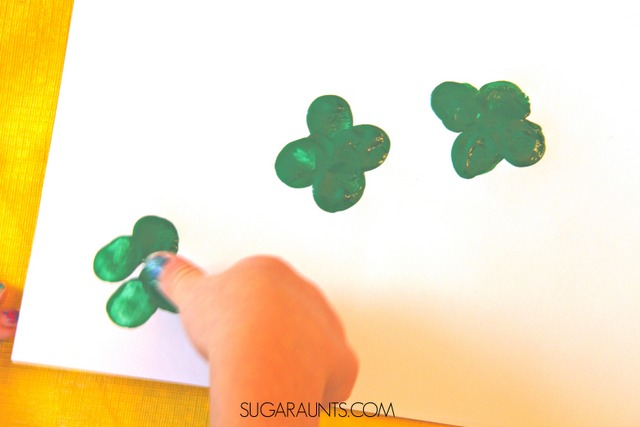
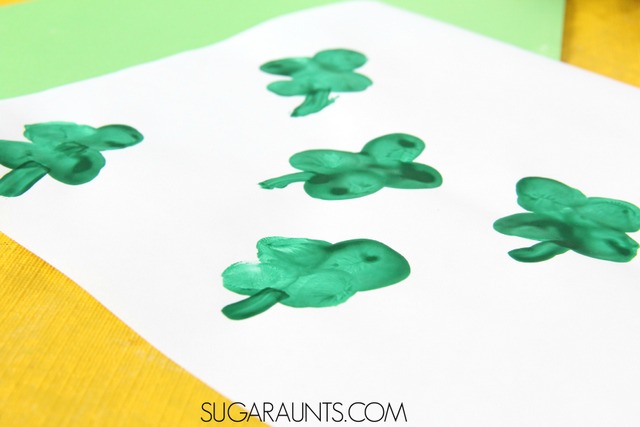
    Improve Finger Isolation with this Clover Thumbprint Craft

    Here is a super easy St. Patrick’s Day craft and fingerprint art that builds skills.  We made this simple clover thumbprint art one day as we geared up for St. Patrick’s Day. We made four leaf clovers, but you could make shamrocks too. The important part is that kids are getting a great experience with strengthening finger isolation…a much needed fine motor skill for functional tasks like tying shoes, typing, pencil grasp, and so many more dexterity tasks. 

    This St. Patrick's day craft uses clovers to work on fine motor skills like finger isolation. What a fun dexterity activity for kids!

    Help Kids with Finger Isolation

    What is finger isolation? It’s an important fine motor skill! Here is a more detailed explanation of finger isolation and functional tasks, but in short, here’s what you should know:

    Finger isolation typically develops in the baby at around 6 months of age as they begin to pick up small pieces of cereal. It progresses to pointing, and then separation of the two sides of the hand with in-hand manipulation. Finger isolation is so important in fine motor dexterity in every task that the hands perform. 

    Fingerprint art like the four leaf clovers in this St. Patrick’s Day craft promotes isolation of the index finger.  

    Fingerprint art like this one allows students to isolate one finger and bend  (flex) the rest of the fingers into a fist.  This is refinement from the fisted hand and “raking” motion that babies and young toddlers demonstrate.  To create a fingerprint, the ulnar (pinkie side of the hand) are stabilized with the pinkie and ring fingers bent into the palm, or are positioned with the pinkie finger extended and abducted (spread apart).   

    This positioning allows the knuckle joints (metacarpals) to stabilize and allow the pointer and middle fingers to be used with more control. The separation of the radial and ulnar sides of the hand allows for more skilled fine motor manipulation.

    Rainbow Finger Isolation Art

    Rainbow finger isolation activity to build fine motor skills, making this St. Patrick's Day art a rainbow craft that builds dexterity and motor skills.

    Take the finger isolation skills a step further by making a whole rainbow of fingerprint art. Here’s how you can make a rainbow craft to work on finger isolation:

    1. Pour a rainbow variety of paint colors on a paper plate.
    2. Ask your kiddo wot point their index finger into red. They can make a curved line of red dots on a piece of paper. Ensure the remainder of the fingers are tucked into the palm with the thumb holding them in place.
    3. Ask them to wipe off their finger for proprioceptive input through the joints of the finger. Talk about awareness and heavy work!
    4. Move on to orange. They can follow the curve of their rainbow to make each color in rainbow order.
    5. Wipe off each finger in between colors for more feedback.

    Simple St. Patrick’s Day Craft

    This post contains affiliate links.  

    This craft needs just one item (besides the paper you’re printing on!) We love this green paint for it’s bright color. Pour a little on a paper plate and you are ready for fingerprint art.  

    Shamrock Fingerprint art

      Show your child how to make a thumbprint using the green paint.  Kids can use either their index finger or thumb to make these prints.  

    Fingerprint art for kids. Shamrock fingerprint craft at St. Patrick's Day

      Make a little stem using the paint.  The four leaf clovers are done!  These would be cute on a fun St. Patrick’s Day card, or just for fun.

    Colleen Beck, OTR/L has been an occupational therapist since 2000, working in school-based, hand therapy, outpatient peds, EI, and SNF. Colleen created The OT Toolbox to inspire therapists, teachers, and parents with easy and fun tools to help children thrive. Read her story about going from an OT making $3/hour (after paying for kids’ childcare) to a full-time OT resource creator for millions of readers. Want to collaborate? Send an email to contact@theottoolbox.com.

    Easter Scissor Skills Activity for Kids

    occupational therapy tools for building scissor skills in kids and helping children to cut with scissors with a fun Easter fine motor activity.

    This Easter scissor skills activity for kids is a creative way to work on scissor skills with kids this time of year. Coming up with Easter ideas for kids doesn’t need to be difficult. Use a few items found at your dollar store to help kids address skills like bilateral coordination, graded precision with scissor control, and eye-hand coordination and other fine motor skills. In fact, adding this fine motor activity to an Easter or Spring craft session can be a fun way to build specific skills in a fun way.  

    This is a quick and easy scissor activity to add to your occupational therapy toolkit. We used a plastic Easter egg and Easter grass (the kind that is used to fill Easter baskets) to work on basic scissor skills like opening and shutting the scissors and using the non-dominant helper hand in a fun cutting activity.

    occupational therapy tools for building scissor skills in kids and helping children to cut with scissors with a fun Easter fine motor activity.

    Easter Activity for Kids

    This post contains affiliate links.  

    You’ll need just a few materials for this scissor activity:  

    A scissor activity that is easy to create is a great activity for the Occupational Therapist’s therapy toolkit.  We used plastic Easter eggs from our Easter supply bin to hold a long strand of Easter grass.  Both of these items can be found at your dollar store, making this a frugal way to address scissor skills.   

    This Easter activities for kids doubles as a scissor skills activity to help kids cut with graded precision and accuracy.

    To create this Easter themed scissor activity, open up the plastic egg.  Then, place a long strand of Easter grass in the egg and thread one end of the grass through the hole in the egg.  Most plastic Easter eggs have a small hole in one end.  If yours doesn’t, then this activity won’t work.  Simply look for an egg with the hole in one end of the plastic egg.   And that’s it!

    You now have an Easter-themed scissor activity ready for practicing basic scissor skills.

    This Easter activity for kids doubles as a scissor skills activity to build precision and accuracy with cutting with scissors.

    Occupational therapy Tools and SKills

    There are a myriad number of skills that an occupational therapist can address in kids. Occupational therapists address the underlying skills that interfere with function and occupation. Those OT skills include of fine motor strength, dexterity, stability, coordination, visual perception, sensory processing…the list goes on and on when it comes to meaningful occupations and the occupational therapy tools that address these areas..

    One such occupational therapy area that this OT tool addresses are independence with using scissor as well as precision with scissors in their dominant hand. Kids can hold the egg in one hand while managing bilateral coordination, precision, laterality and more. They can pull out the Easter grass through the egg and work on cutting bits of the grass.  With a small piece of Easter grass sticking out of the egg, kids can address precision grasp and release when using scissors during cutting tasks.     The egg makes a great grasping tool for younger kids.  While use of scissors requires children to hold onto and manipulate paper with their non-dominant hand, holding the egg promotes a power grasp with arch development during this cutting with scissors.    

    Pulling the strand of grass out of the egg is a nice way to work on neat pincer grasp and threading more into the plastic egg’s hole is an excellent way to encourage fine motor development. Here are more Spring fine motor activities to keep your little ones busy and working on hand strength and dexterity this time of year.   

    Use this Easter activity for kids to help with scissor skills as a fine motor activity that pairs nicely with Easter crafts for preschoolers and school aged kids.
    Use this Easter activity for preschoolers or older kids to work on scissor skills and teaching kids to cut with scissors.

    Looking for more creative scissor skills activities?  Try these:


    Teach kids Scissor skills and accuracy with cutting with scissors with this easy Easter activity for kids.

    Spring Fine Motor Kit

    Score Fine Motor Tools and resources and help kids build the skills they need to thrive!

    Developing hand strength, dexterity, dexterity, precision skills, and eye-hand coordination skills that kids need for holding and writing with a pencil, coloring, and manipulating small objects in every day task doesn’t need to be difficult. The Spring Fine Motor Kit includes 100 pages of fine motor activities, worksheets, crafts, and more:

    Spring fine motor kit set of printable fine motor skills worksheets for kids.
    • Lacing cards
    • Sensory bin cards
    • Hole punch activities
    • Pencil control worksheets
    • Play dough mats
    • Write the Room cards
    • Modified paper
    • Sticker activities
    • MUCH MORE

    Click here to add this resource set to your therapy toolbox.

    Spring Fine Motor Kit
    Spring Fine Motor Kit: TONS of resources and tools to build stronger hands.

    Grab your copy of the Spring Fine Motor Kit and build coordination, strength, and endurance in fun and creative activities. Click here to add this resource set to your therapy toolbox.
    Colleen Beck, OTR/L has been an occupational therapist since 2000, working in school-based, hand therapy, outpatient peds, EI, and SNF. Colleen created The OT Toolbox to inspire therapists, teachers, and parents with easy and fun tools to help children thrive. Read her story about going from an OT making $3/hour (after paying for kids’ childcare) to a full-time OT resource creator for millions of readers. Want to collaborate? Send an email to contact@theottoolbox.com.

    Cooking with Kids and Hand Skills

    Did you know you can work on hands skills with cooking with kids activities? It’s true! In fact, cooking with kids can help kids build hand skills both in the kitchen and out. Actually, using arts and craft activities with kids can build the hand skills kids need for not only kitchen activities, but for other areas where fine motor skills and hand dexterity is needed. Using recipes with kids works on skills in a functional way, but there is more than one way to peel an apple, so to speak!

    Kitchen activities such as cooking with kids or kitchen learning activities are great ways to develop skills in kids. This list of kitchen tasks describes motor skills, executive functioning, and other tasks kids need.

    Cooking with Kids = Hand Skills + Arts and Crafts

    I bet you are asking yourself, “Wait, what? Cooking with kids, hands skills, and and crafts? What does that mean?” Well, simply put, you can use art and craft activities with simple techniques and tools to help children build foundational hand skills necessary for cooking and meal prep in the kitchen. Yep, that’s right! You can teach kids cooking and work on hand skill essentials while being creative and having fun using a meaningful activity!

    Cooking with kids helps children learn and develop motor skills and learning tasks through cooking activities.

    Kitchen ACTIVITIES

    There are so many ways that kitchen activities help kids develop much needed skills. From executive functioning, to fine motor development, to direction following, to sensory exploration, cooking with kids build skills! But let’s not forget that actual cooking activities with children are a fun learning experience too and a wonderful bonding time for families.

    With cooking, kids use so many wide-ranging skills, learn educational concepts, and well, have so much fun!  But, how about those children that need to work on building some foundational hand skills needed to engage in cooking tasks with success and confidence. Or maybe those children who need to expand their hand skill use through other activities aside from the actual task of cooking.

    Art and Crafts and COoking with Kids

    As therapists, we use art and craft activities frequently in our work with children. They find it playful and therapists know that art and crafting is a valuable therapeutic tool to work on important skills and build rapport. Using these activities as an avenue to build foundational skills is a win-win for both parties!

    Hand skills are motor development areas that kids need for tasks requiring dexterity, coordination, and other fine motor areas. These kitchen hand skills are ways to build motor tasks through cooking activities.

    Kitchen Hand Skills

    Structured and non-structured art and craft activities can help build hand skills such as finger and hand strength, bilateral coordination, in-hand manipulation, grasp patterns, fine motor control and coordination, separation of the two sides of the hand, and hand dominance. So, how exactly does art and crafting work on cooking, you ask. Well, let’s first look at some hand skill verbs that are closely connected to cooking and meal preparation:

    • dipping               
    • slicing
    • spreading
    • crushing
    • sprinkling
    • stirring
    • flipping
    • cracking
    • pinching
    • tearing
    • shredding
    • squeezing
    • cutting
    • timing
    • whisking
    • grating
    • scooping
    • rolling
    • mixing
    • peeling

    Notice how many of these words have something to do with an action and the use of hand skills. That’s right, hand skills are a HUGE part of cooking and art and craft tasks! In this post, we will be discussing how during the process of art and craft tasks, you can help a child build or learn essential hand skills for cooking. So essentially it’s like cooking with art and crafts!  You’ll see what is meant shortly.

    Sometimes you can find recipes that have different steps that can be offered to kids when helping in the kitchen. This is great because you can offer the child to do just one step of the task. They then don’t become overwhelmed by the whole task. For example, our Greek turkey burger recipe has different steps that can be offered to target specific skills: chopping, slicing, stirring, mixing, scooping, grilling.

    Hand Skills Kids Need

    Let’s start with simulated hand actions. Simulated hand actions are when the hands perform similar movements that are utilized when performing a specific task or using a specific tool.

    Children can either learn simulated hand movements when working on art and crafts by manipulating various art and craft items or they can use the actual kitchen or cooking tool during art and crafts providing a novel and humorous way to engage children in the task even if they are not necessarily “into art.”

    Using kitchen tools during art is fun for kids and adults! Lots of laughs and giggles will ensue. Some children will even make the connection to the actual task that the tool is used for during cooking.

    Cooking with Kids Activities

    Now, let’s get onto to sharing some ideas that can help YOU view art and crafts in a new way.  Below is a list of some easy ways to use art and craft items as well as actual cooking tools during therapy to build cooking hand skills with children.  

    1. Pull apart cotton balls for art and craft projects which simulates shredding chicken and other food items.
    2. Peel crayon paper off of crayons and grate the crayons into small pieces to use for art or craft project decoration.
    3. Pinch crushed food items such as cereal or snack foods and place onto surface of a project.
    4. Use a kitchen mallet to crush cereal or stuffing crumbs to place onto surface of a project.
    5. Dip a basting brush, spatula or other rubberized kitchen tool into vegetable or olive oil and draw pictures onto sheets of construction paper.
    6. Use a pipe cleaner to open and close plastic bags that are storing art and craft materials. Simply twist on and off like bread ties.
    7. Use a plastic knife to spread Elmer’s glue or tacky glue onto surface of project like spreading mayo, mustard, and cream cheese.
    8. Use a plastic knife to spread paint onto a sponge and use the sponge to create art pictures or decorate crafts.
    9. Recycle a spice container and sprinkle glitter from the bottle onto a project.
    10. Poke holes with a fork into a clump of putty, play dough, or clay like poking holes into a potato for baking or piercing food for cooking.
    11. Use a rolling pin to flatten a ball of putty, play dough, or clay like rolling out cookie or pastry dough.
    12. Tear different paper weights such as tissue paper, construction paper, card stock or even leaves which is similar to shredding leafy foods like lettuce or tearing open packages.
    13. Use scissors to cut strips off of a paper lunch bag to use on a project in order to simulate cutting open food packages.
    14. Use a kitchen timer to time self during project assembly.
    15. Crack and pull apart plastic eggs with paint or liquid glue inside for projects to simulate cracking an egg.

    Hopefully after this post and the list of ideas provided above, you are now inspired to use art and craft activities to work on or expand foundational hand skills which are needed for cooking and meal preparation tasks. Be creative and let the kids come up with some of their fun ideas too! It’s a great time to build skills while stimulating a child’s creativity and encouraging curiosity that benefits functional daily living too!

    Regina Allen

    Regina Parsons-Allen is a school-based certified occupational therapy assistant. She has a pediatrics practice area of emphasis from the NBCOT. She graduated from the OTA program at Caldwell Community College and Technical Institute in Hudson, North Carolina with an A.A.S degree in occupational therapy assistant. She has been practicing occupational therapy in the same school district for 20 years. She loves her children, husband, OT, working with children and teaching Sunday school. She is passionate about engaging, empowering, and enabling children to reach their maximum potential in ALL of their occupations as well assuring them that God loves them!