Colleen Beck, OTR/L is a pediatric occupational therapist and the owner and author of The OT Toolbox website. She manages all of The OT Toolbox social media accounts and runs the popular newsletter.
Read about Colleen's experience and career as an occupational therapist, including how The OT Toolbox began on our About The OT Toolbox page: https://www.theottoolbox.com/about-us/
Colleen created The OT Toolbox in 2011 and since then has written thousands of blog posts designed to support therapy providers, educators, parents, counselors, admin, and caregivers in promoting the healthy development of kids.
Check out Colleen's blog posts below:
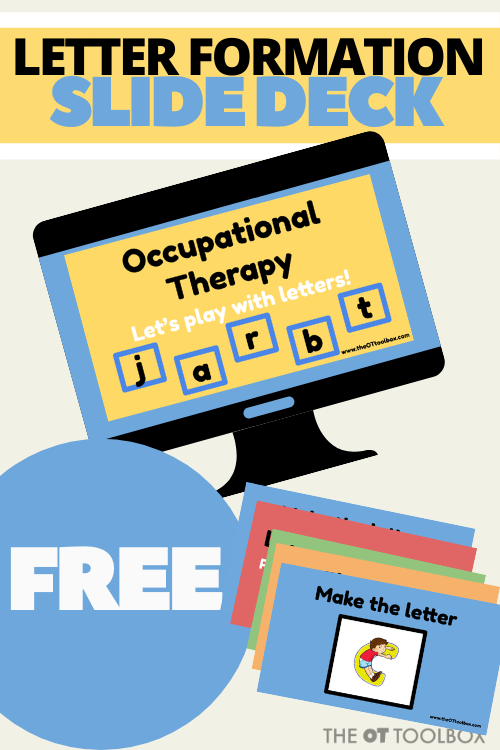
Teaching letters in distance learning? Working on handwriting in OT teletherapy? Well, one thing is for certain. Our recent virtual therapy slide deck to teach strait line letters was a popular one! That’s why I wanted to not only continue with that letter formation slide deck series (coming soon!) but I wanted to get this newest slide deck out to teach letters in occupational therapy telehealth. So often, school-based OTs have handwriting goals to address. However, when it comes to teaching letter formation and working on handwriting through the screen of teletherapy, it can be difficult to work on aspects such as accuracy without the hands-on component.
These telehealth slides should fill some holes. My mission, as always, is to help you help kids thrive. So, in the current season of virtual therapy sessions, therapy slide decks it is!
Teach Letters in Teletherapy
This slide deck includes a few different ways to teach kids letter formation while working on the underlying areas that impact function and independence.
One tool I love is our printable color by letter worksheet. Use it along with the letter slide deck below.
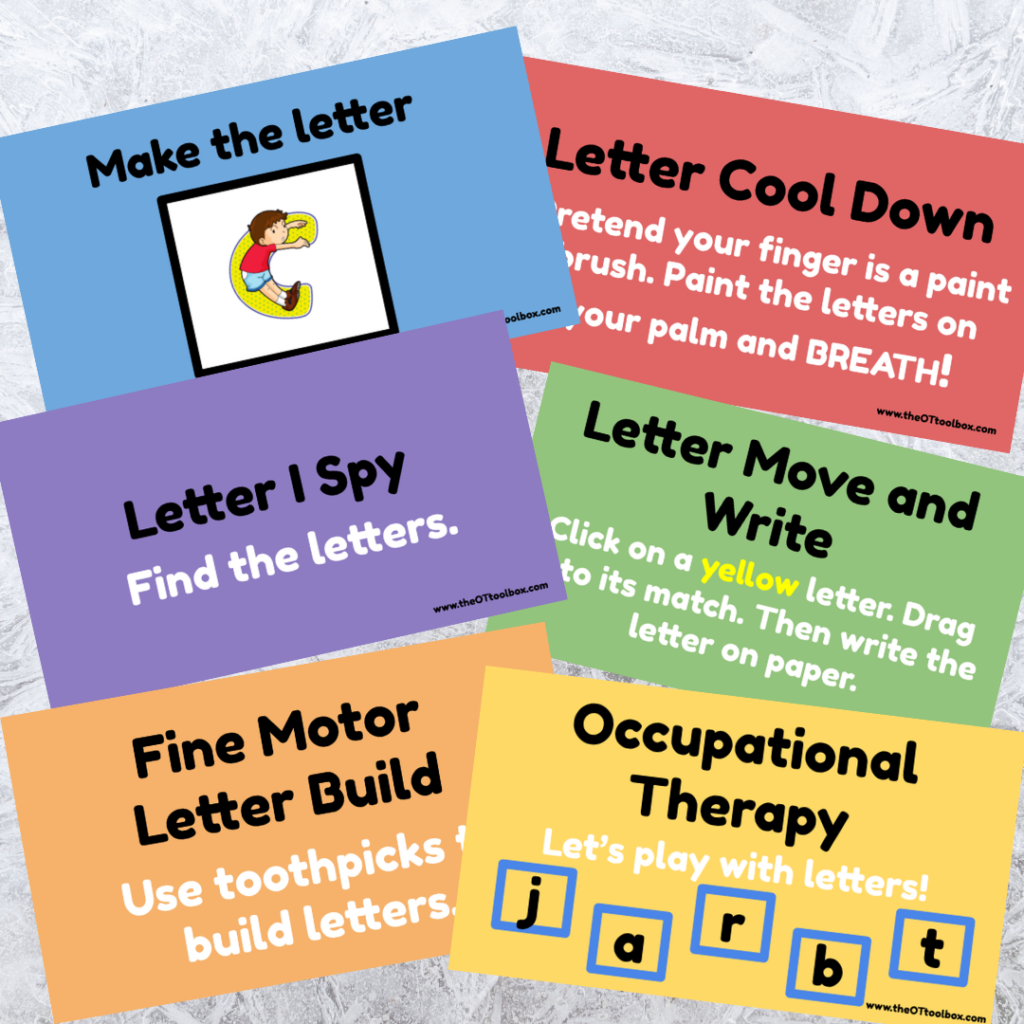
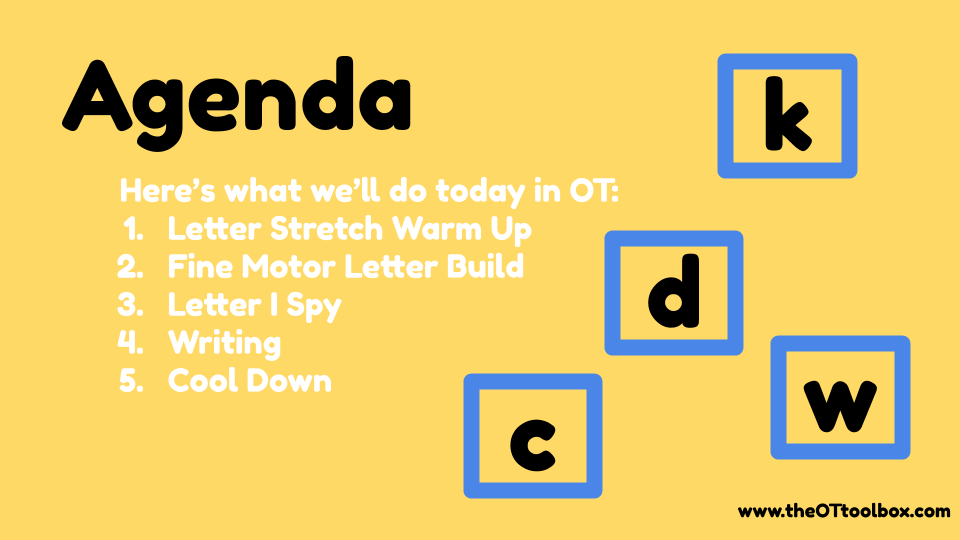
The slide deck includes handwriting activities in a variety of ways:
Gross Motor Warm-Up- Use the slides to work through teaching letters with a gross motor component. Kids can make several letters using their body to form the letter. This is a great way to incorporate bilateral coordination, core strength, motor planning, and whole-body movements. Pair it with deep breathing if you like.
2. Fine Motor Letter Build- Use items from around the home (toothpicks, crayons, cotton swabs, craft sticks, tree twigs, etc. to build a handful of letters. Work with students as they build components of letters. Be sure to talk them through proper letter formation. Part of the difficulty with distance learning is that we don’t always have a clear picture of what the student is actually doing, especially when they are given a YouTube video to follow with their parent as the implementer, for example. Kids can “build” a letter with totally incorrect formation without the hands-on approach that live teaching offers. Talk them through how to start letters at the top, and jump over to slide down for diagonal portions. Here is more information on teaching kids to build letters with proper formation.
3. Letter I Spy- This slide allows students to visually scan and locate letters hidden in a busy scene. The activity is one that promotes essential visual perceptual skills such as figure-ground, form constancy, visual discrimination, visual closure. Ask students to find a certain number of a specific letter. They can write the letter each time they find it. Or, students can go through the image and find letters to spell their name or a spelling word. They can then write that word out on paper after they locate each letter. Here are more visual motor activities that pull in the perceptual component as well as the motor piece to offer hands-on approaches to building these skills.
4. Writing- This interactive slide asks students to click and drag a lowercase letter to it’s match. They can then practice writing this letter (or ask them to write a word that starts with that letter). This activity challenges more visual perceptual skills such as visual tracking, eye-hand coordination, and visual scanning.
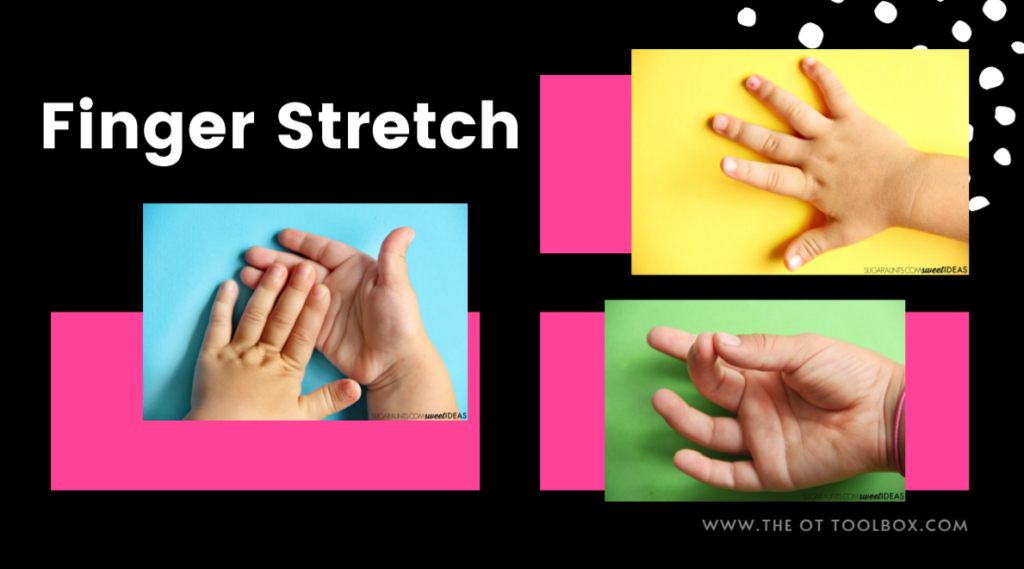
5. Cool Down- Add a sensory component with the cool-down portion of the slide deck. Students can use finger isolation (more fine motor skills) to “paint” a letter on the palm of their other hand (bilateral coordination) for a light touch, tactile challenge as they “write” letters. Best of all is the deep breathing exercise that goes along with this activity. Use it as a regulation or coping strategy at the end of the distance session as you send your little ones off for the day. Here are more activities and ideas to help with anxiety, worries, attention, and other areas impacted by regulation through sensory-based coping strategies.
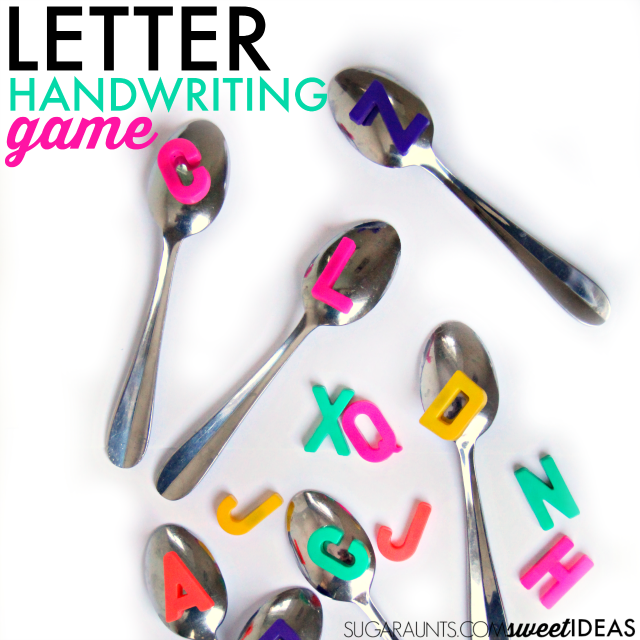
Many children write backward letters and numbers when learning to write. This is typical handwriting and a normal part of learning letter formation. However, sometimes it can be hard to break this habit. Other times, children really struggle with reverse text in a way that they write upside down or flip letters. For older children, there may be underlying visual perceptual issues going on. We’ve covered some of the reasons for letter reversals previously on this site. Today, I wanted to share a fun and creative way to work on letters that are commonly written backwards or mixed up. When older kids write upside down letters or mirror write letters, it can mean spelling words are marked wrong because of letter errors. This simple, hands-on activity should help.
Letters that are written BACKWARDS
There are a handful of letters that are commonly mistaken or reversed in text. Others are written upside down, resulting in a different letter. Mirror writing is one aspect of visual processing that may occur when perceptual or efficiency difficulties are present. A good place to start in gaining a better understanding on visual processing is in this post on vision problems you cannot “see”.
Letters that are commonly reversed or flipped include: b, d, and p. These letters may be interchanged with one another. A child may read or write a letter “b” when they mean to write a letter “d”. Another set of letters that are commonly written backwards and are confused for the other letter include g and q. Other letters that are just written backwards but not confused for another letter includes j, s, y, z. Upper case letters that are commonly written in reverse include: B, D, J, N, P, S, Y, and Z.
Activity to Help with Writing Backwards Letters
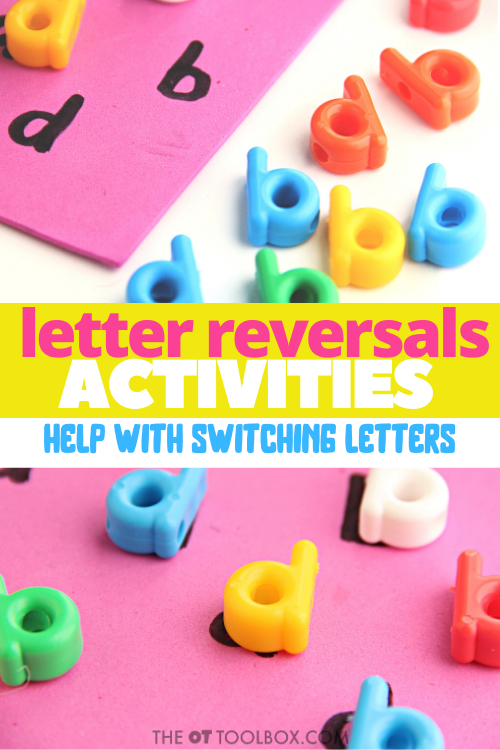
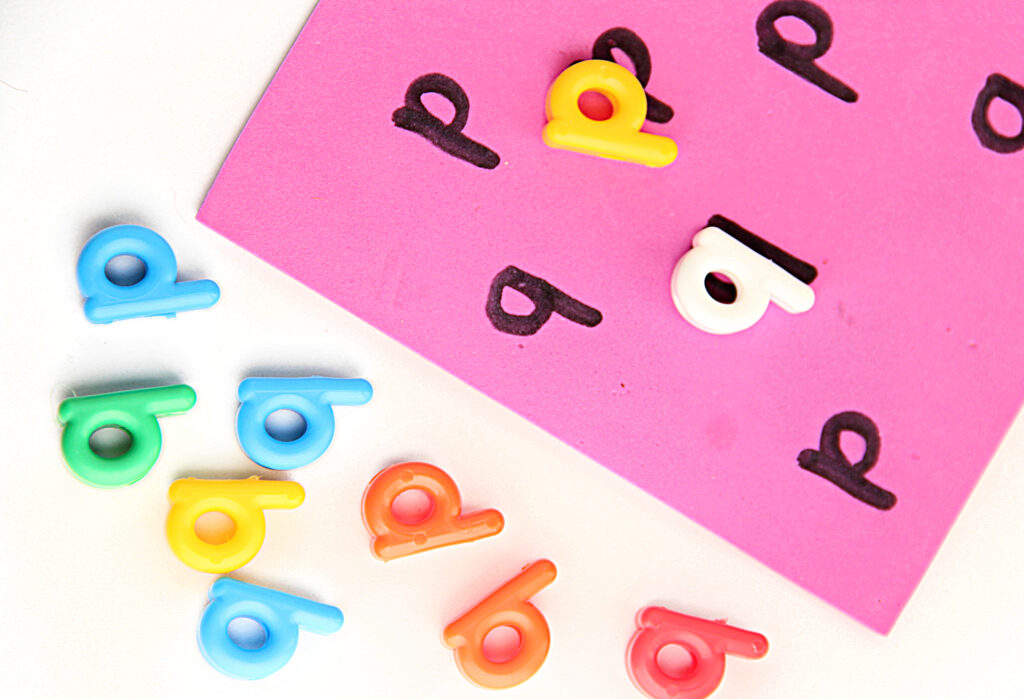
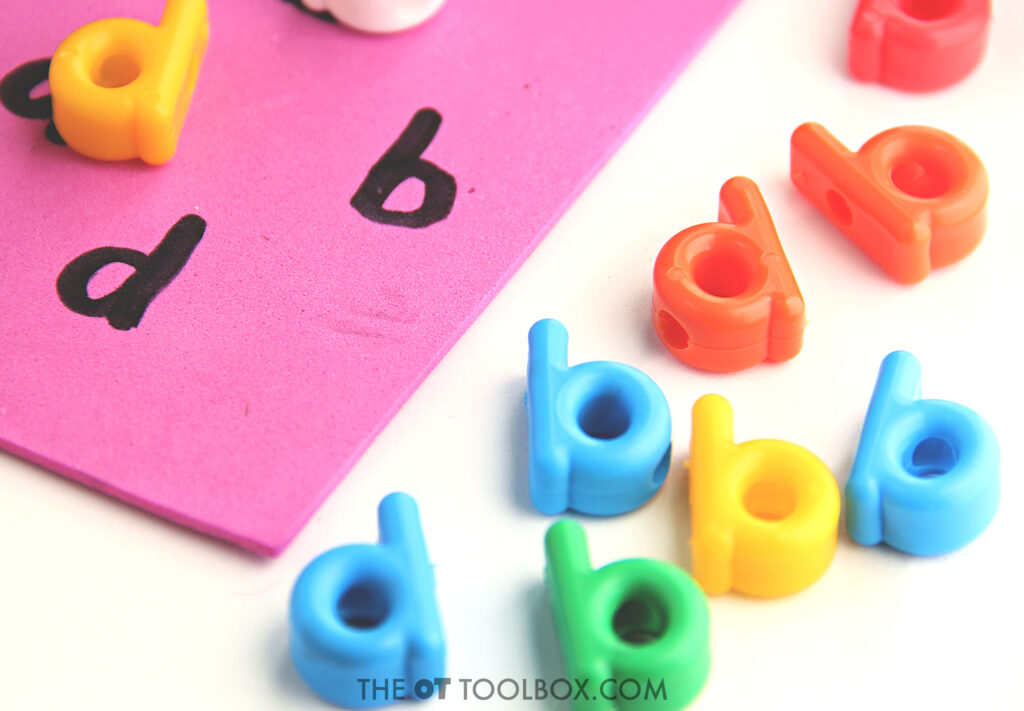
This fun activity helps kids discriminate between correct formation and backward letters or flipped letters. For this letter reversal activity, we used lowercase letter beads from Roylco. (Use the coupon code “OTTOOLBOX” to save 10% on these letters and anything else on the Roylco website. Affiliate link) These letters have a small hole in them making them great for threading and other fine motor activities as well as the visual motor activity we are describing here.
Any letter beads or magnets would work for this letter. We are attempting to work on discrimination, or differentiation between the letters to address flipping letters or writing in reverse.
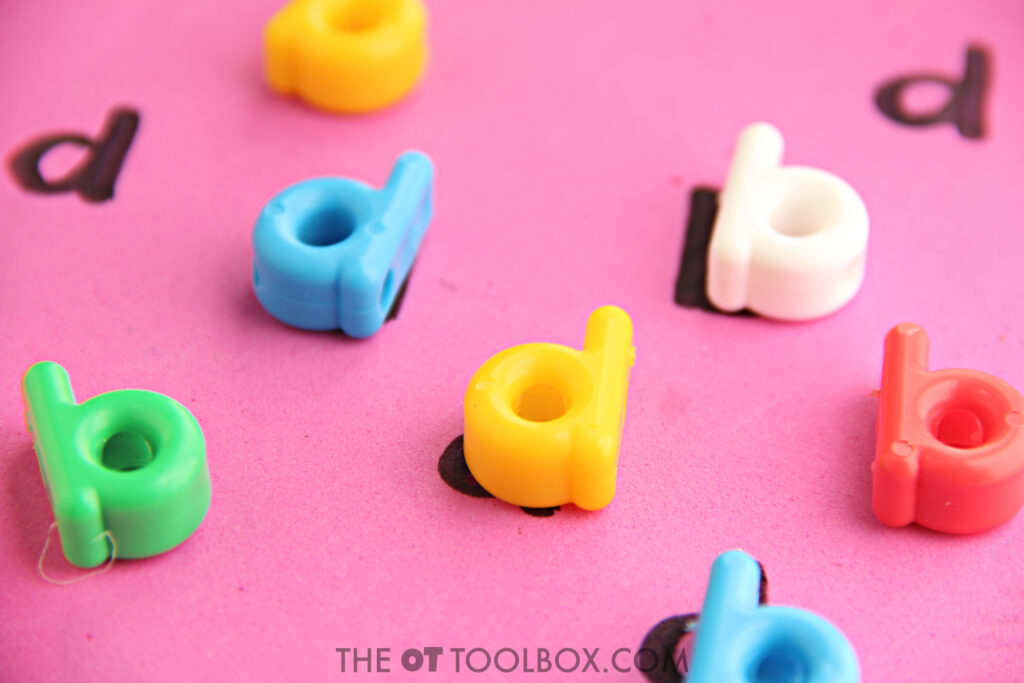
We also used a piece of foam craft sheet, but a plain piece of paper would work well, too. To set up this letter reversal activity, identify two or three letters that are commonly mixed up. We are working on lowercase letters “b” and “d” in this activity. I wrote letters b and d on the foam sheet in the same size as the lowercase letter beads. I placed a handful of b and d beads next to the sheet and asked my kindergartner to place the letters on the matching letter.
She was able to visually scan and locate a letter after picking up a letter bead manipulative. We extended the activity by hanging her name the letter, produce the sound of the letter, and name a word that begins with that letter. She then located the match and placed the bead onto of the letter on the foam sheet.
There are several areas we worked on with this activity:
Letter identification- By picking up a letter and identifying letters from a group of similar letters, she had repetitive practice in identifying aspects of the letter. The small lowercase letter beads offer a smooth texture that is pleasing to hold or manipulate while naming the letter.
Phonetic awareness and letter reversals– Identifying letters and paring it with naming the sound and using that sound in a word is a way to practice phonetic awareness, which has been found to aid in correct letter formation. In fact, there can be a connection between letter reversal problems and phonetic awareness delays.
Fine motor skills- Picking up and manipulating small letter beads is a great way to work on dexterity and finger control. Placing the letter beads on the written form requires eye-hand coordination and precision. Here are more activities to work on fine motor skills in kids.
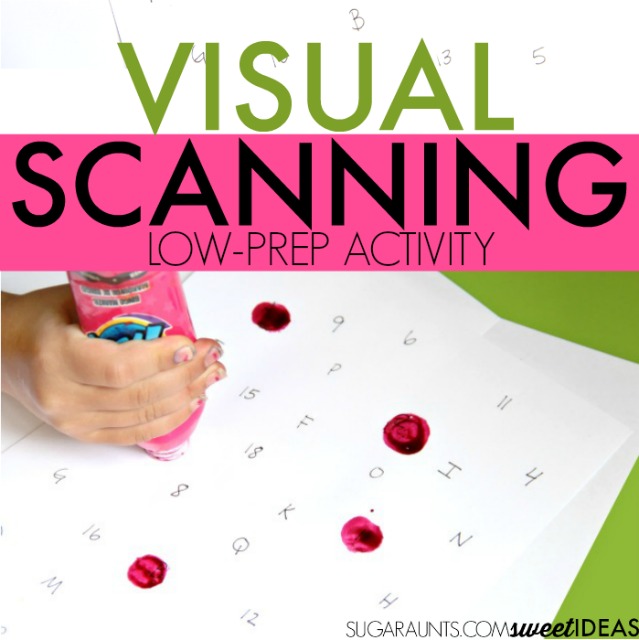
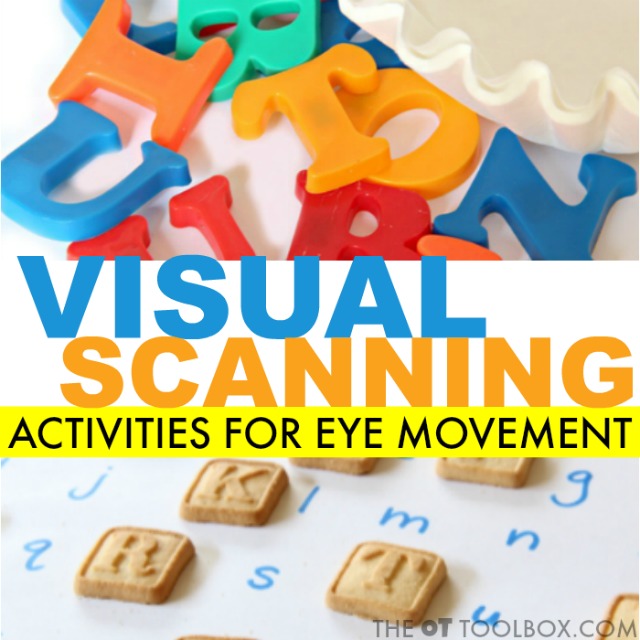
Visual Scanning– Searching for the written letter that matches the letter bead is another way to practice letter identification and differentiating differences between the letters. Here is more information and a fun visual scanning activity.
Eye-hand coordination- Picking up and placing the letter beads and placing them onto the written letter requires coordinated movements of motor skills and visual system. This is another eye-hand coordination activity to work on letter matching and identification.
Don’t have letter beads? Try cutting small pieces of paper and writing letters on the slips. They can then be placed over the letters on the large piece of paper as children visually scan for the match while practicing form discrimination.
More visual perception tools
Try some of these related activities to work on visual perceptual skills:
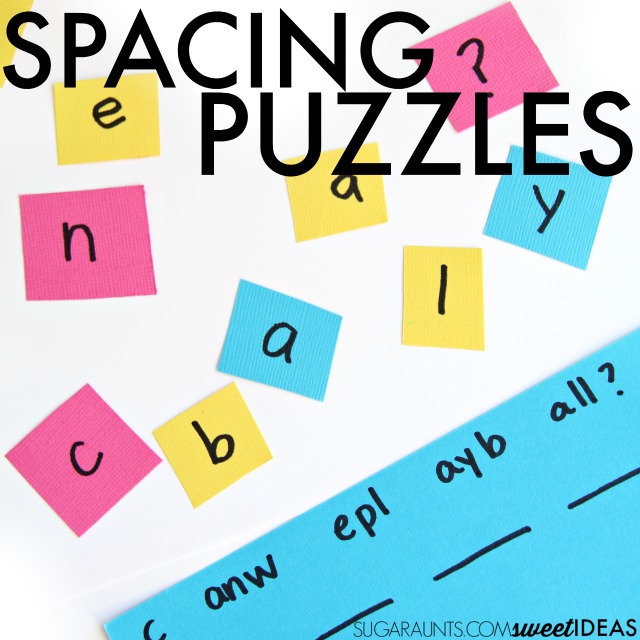
Use spacing puzzles to work on spacing between words and letters.
Gain a better understanding of visual processing, visual perception and how this impacts letter formation and writing backward letters. Join us in the Visual Processing Lab.
Colleen Beck, OTR/L has been an occupational therapist since 2000, working in school-based, hand therapy, outpatient peds, EI, and SNF. Colleen created The OT Toolbox to inspire therapists, teachers, and parents with easy and fun tools to help children thrive. Read her story about going from an OT making $3/hour (after paying for kids’ childcare) to a full-time OT resource creator for millions of readers. Want to collaborate? Send an email to contact@theottoolbox.com.
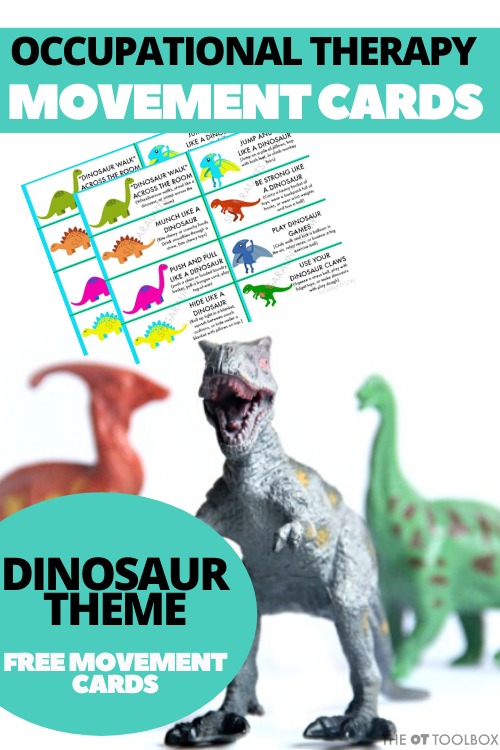
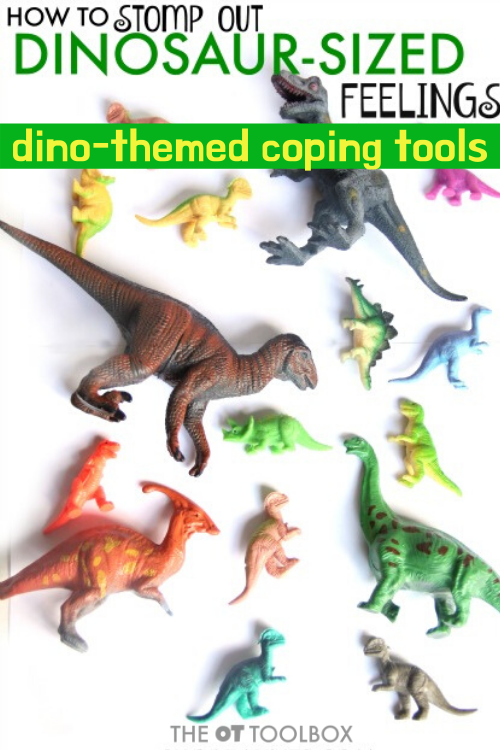
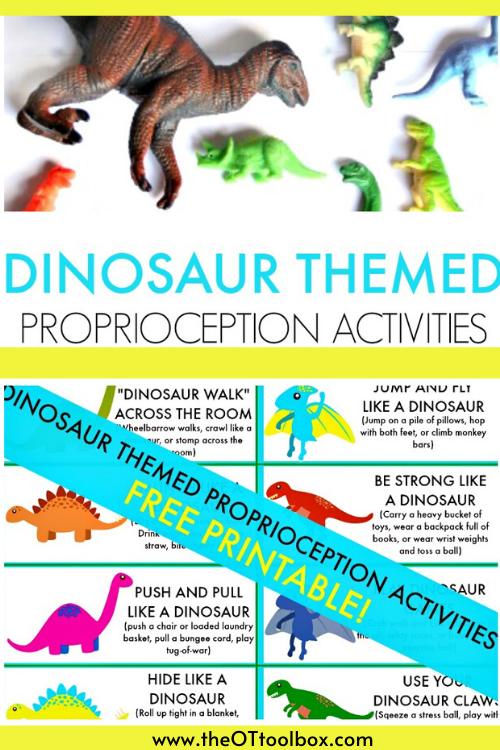
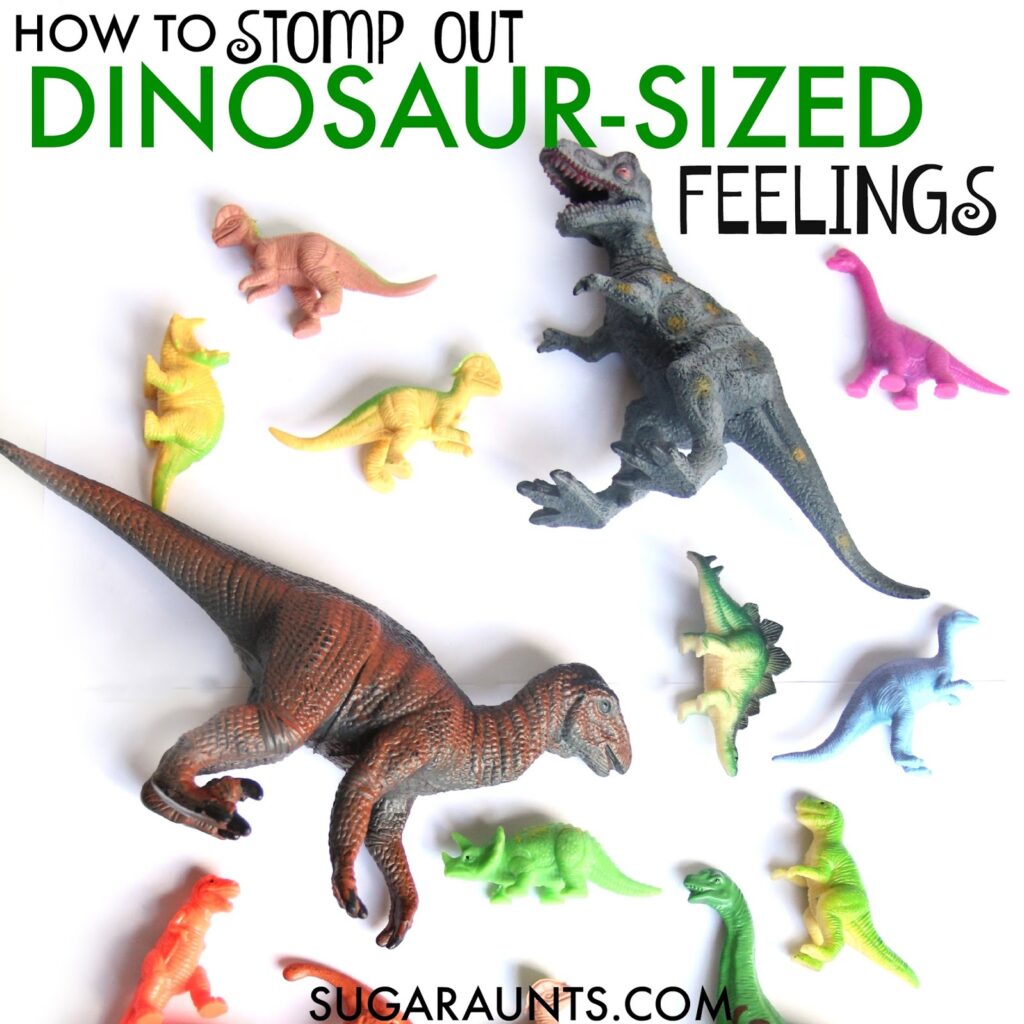
This dinosaur brain break activity is a set of free proprioception activities that provides heavy work with a dinosaur theme, making movement and proprioceptive input a fun way to address dinosaur -sized needs. Whether you are looking for heavy work activities for the kids to add to distance learning or heavy work activities for OT teletherapy programs, these free dinosaur movement cards are a great sensory activity to add to your therapy toolbox. Scroll all the way to the bottom of this post to grab your Dinosaur Movement Activity Cards…and check out the Dinosaur OT activities too!
This post explains more about proprioception sensory activities but to better understand why and how to incorporate movement breaks into learning, check out this post on brain breaks for kids.
This freebie was originally created as part of October’s Sensory Processing Awareness Month, however, for a kiddo that loves anything dinosaurs, it works out great any time of year. Kids with sensory integration needs are those kiddos who are bumping into everything and everyone.
The little ones who fall out of their chairs, press too hard on their pencils, are clumsy, fidget, or seek extra movements. They might flap their hands or slap their feet when they walk.
he thing about kids is that everyone is different and everyone will have different needs, interests, and abilities. This Dinosaur Sized Feelings sensory movement activity is perfect for kids seeking sensory input and kids who just need to move!
Now, it’s important for me to note, that when I say Dinosaur-Sized feelings in this post, I’m talking about the child’s feeling of hyposensitivity to their environment.
They are seeking out extra stimulation from people, walls, cushions…anything really and are feeling a big need to improve their central neural system functioning in order to complete tasks and function.
(Read more about the Central Nervous System below!)
What I’m not talking about in this post is the emotional side of feelings. There has been at least one study done that attempts to determine whether emotional feelings can be influenced by proprioceptive input.
I’m not talking about the big emotional feels we all have. In this activity, I’m focusing on the big feelings of sensory needs kids might have, and how to stomp those sensory needs out with proprioception.
It’s all about the ability to regulate those giant, dinosaur-sized sensory related feelings that impact emotional regulation, coping abilities, worries, anxieties. This post on Zones of Regulation activities explains a little more on self-regulation and specific ways to address these needs.
What is Sensory Integration?
Let’s cover some of the background info about what’s going on behind self-regulation. Typically, our Central Nervous System integrates sensory input from the environment in a balanced process that screens out certain information and acts on important information, at an automatic level…one that we are not cognitively aware of.
For kiddos with atypical sensory integration, the central nervous system has difficulty screening out unimportant information from our environment.
For those children, interaction with their surroundings can be stressful as they are either over responsive or under-responsive to normal stimulus. This results in dysfunctional behavior and social difficulties.
For a thorough explanation of sensory integration, sensory processing, and what specific actions look like as a part of our sensory systems, grab this free sensory processing booklet.
You’ll access the free booklet and join a short email course that explains sensory processing in great detail. It’s a free informative course via email that you don’t want to miss.
In that post, I told you how the proprioceptive system receives input from the muscles and joints about body position, weight, pressure, stretch, movement and changes in position in space.
Our bodies are able to grade and coordinate movements based on the way muscles move, stretch, and contract. Proprioception allows us to apply more or less pressure and force in a task.
Instinctively, we know that lifting a feather requires very little pressure and effort, while moving a large backpack requires more work. We are able to coordinate our movements effectively to manage our day’s activities with the proprioceptive system.
The brain also must coordinate input about gravity, movement, and balance involving the vestibular system.
(This post does contain affiliate links.)
Kids who are showing signs of proprioceptive dysfunction might do some of these things:
Appear clumsy
Fidget when asked to sit quietly.
Show an increased activity level or arousal level.
Seek intense proprioceptive input by “crashing and bashing” into anything.
Slap their feet when walking.
Flap hands.
Use too much or too little force on pencils, scissors, objects, and people.
“No fear” when jumping or walking down stairs.
Or, are overly fearful of walking down steps/jumping.
Look at their body parts (hands/feet) when completing simple tasks.
Sit down too hard or miss chairs when sitting.
Fall out of their seat.
Fluctuates between over-reacting and under-reacting in response to stimulation.
Constantly on the move.
Slow to get moving and then fatigue easily.
Dinosaur Themed Heavy Work Activities
This activity is easy. There is not much to it really, other than being a dinosaur themed way to calm and organize those big dinosaur feelings.
The heavy work activities add proprioception that can be a tool to address regulation or sensory needs. Here, I’m sharing with you a few heavy work suggestions that may help hyposensitive kiddos.
I wanted to share activities that might be of interest to the child that loves a dinosaur theme. It’s my hope that these work for you and your family! If you are looking for more dinosaur themed movement activities, check out this past post sharing Dinosaur movement activities, based on the book popular children’s book, Dinosaurumpus.
Please note (as with any activity that you find on this website): This is meant to be a resource and not Occupational Therapy treatment.
Please seek individualized evaluation and treatment strategies for your child. All kids are so different in their sensory needs and abilities and adverse reactions can occur with globalized treatments.
Big dino-sized feelings can happen in a little body!
Simply print out the free printable, cut out the cards, and pretend to play, walk, and eat like a dinosaur!
We did use our Mini Dinosaurs as we practiced all of the Dino Moves in these activities. Use them in a scavenger hunt. Your child needs to find hidden dinosaurs and once they bring them back to you, do a proprioception activity from the handout.
Another idea is to do the heavy wok activities before a fine motor task like handwriting to calm and organize the body.
You can get the free dinosaur proprioception activities printable by joining the thousands of others on our newsletter subscriber list. You will receive occasional newsletter emails.
Once you subscribe you’ll receive an email with a link to the free printable, as well as other freebies that only our subscribers receive.
Dinosaur Activities for OT sessions
Looking for more Dinosaur activities? Try adding these to your occupational therapy interventions. Some of the ideas below are great for adding to teletherapy sessions. Others make great OT home programs.
Dinosaur Activities for Occupational Therapy
Ok, you have a child on your OT caseload (on in your classroom or home) that LOVES all things dinosaur…how do you get them involved in therapy sessions? You can totally guide therapy goals along a theme like dinosaurs.
The OT dinosaur activities listed below are fun ways to work on specific skills in therapy sessions, using hands-on play and activities. You’ll find fine motor dinosaur activities, gross motor dinosaur ideas, dinosaur printables, sensory play with a dino theme, and even dinosaur visual perception activities.
If you have a child in OT who LOVES all things dinosaur, these are great incentive activities that will build attention and focus to the session. Adding a much-loved theme to therapy sessions can empower a child as they play with more intent and attention.
Dinosaur Gross Motor Game– This dinosaur game offers kids a chance to MOVE! Use a child’s love of dinosaurs to create movement breaks and indoor activity with a dinosaur theme.
This is one indoor play idea that my own children loved when they were little, but the bonus is that they gain midline crossing, motor planning, sequencing, bilateral coordination, balance, endurance, proprioception, and vestibular benefits all in the same movement activity.
Dinosaur Playdough Kit can be made with play dough and a few small dinosaur figures. It’s a great way to add proprioception to the hands as heavy work before a handwriting activity.
This busy activity can be pulled out at any time and kids can keep those hands busy while building intrinsic hand strength and endurance needed for tasks like coloring. Read more about warming-up the hands before fine motor tasks here.
Free Dinosaur Visual Perception Sheet– This printable page can be printed off once and used with a page protector sheet for the whole therapy caseload. Or, add it to teletherapy sessions or distance learning as part of a child’s specific plan.
Kids can work on visual perceptual skills such as scanning, form discrimination, figure ground, form constancy, and other visual perception skills. It’s perfect for dinosaur fans of all ages!
Dinosaur Counting Cards with clothes pins to clip onto the matching number of dinosaurs is a great way to build hand strength with a dinosaur theme. Print them off and add them to your therapy toolbox. Here are more ways to use clothes pins in building skills in kids.
Goldilocks and the Three Dinosaurs book and jacks game– have you read the children’s book, Goldilocks and the three dinosaurs? This children’s book is very cute and a fun way to add books to occupational therapy sessions.
Then, add the fine motor and motor planning jacks game to build coordination and dexterity skills by playing jacks. This is such a fun way to add movement and reading to therapy sessions, making motor planning, sustained attention, bilateral coordination, crossing midline, floor play (heavy work!), all integrated into a single dinosaur activity!
Dinosaur Matching with mini-figure dinosaurs is a fun way to work on visual scanning, visual discrimination, visual memory, and other visual perceptual skills. Using a small ball of play dough, press the dinosaur’s feet into the dough. They can then try to match up the feet to the footprints.
All you need are mini dinosaur figures and salt dough, play dough, or similar dough. It’s a fun way to work on skills that come in handy for handwriting, reading, and number identification.
Dinosaur Guessing Game is a fun way to work on discrimination skills and visual attention. For kids that have trouble attending to tasks, this dinosaur themed activity may do just the trick. Use dinosaur figurines and a box or basket to hide the dinosaurs.
You can cover the dinosaurs and ask children to find the dino with specific features such as sharp teeth or a specific color. This visual memory game builds skills needed for letter discrimination and attention to detail.
Free Dinosaur Number Puzzles– Kids can cut the paper puzzles into strips to work on scissor skills and bilateral coordination. The strait lines or these puzzles make it a great beginning scissor activity for children learning to use scissors. Then, they can challenge those visual perceptual skills to build the puzzle by scanning, and attending to details as they discriminate parts of the puzzles.
Dinosaur Emergent Reader– Use a piece of colored paper to create a cone dinosaur craft like the one shown in this post.
Kids can make colored dinosaurs and match them to dinosaur counters or small pieces of paper that match the colors. Don’t want to make the dinosaur crafts? Use colored cups to pretend!
Free Dinosaur Subtilizing Game– This dinosaur subtilizing printable page has a fine motor component by that builds precision and dexterity as kids place counters on a printable play mat. They can roll a dice and work on an the essential math skill of subtilizing.
What is subtilizing? Essentially, this skill means kids can look at a group of objects and know how many there without having to count each object one by one. Subtilizing is important in math, especially higher math skills.
Dinosaur Sensory Bottle– You know we love sensory bottles! Sensory bottles are a great tool to add to your toolbox to address sensory needs or self-regulation. Using a sensory bottle as a coping tool can help kids relax, calm down, or focus.
This dinosaur themed sensory bottle is great for kids who love dinosaur anything! Here is more information on how to make a sensory bottle.
Dinosaur Letter Tracing– Kids can work on fine motor precision and dexterity while also working on letter formation, gross motor skills, bilateral coordination, crossing midline, visual tracking, and so many more skills.
All you need are dinosaur mini-figures, paper, and a marker. Draw a large letter on the paper and then children can place the small dinosaurs along the lines to “build” the letters. Here is more information on teaching letter formation and using manipulatives like these small dinosaur figures in teaching letters.
This is a great activity for those who have the actual tangram puzzle pieces, but don’t have access to a color printer or are able to purchase pre-made dinosaur pattern cards. Work on visual perceptual skills by copying and building the geometric dinosaurs together as a fun activity that little dinosaur fans will love.
Are you looking for thorough information on Sensory Processing and Proprioception (or any of the sensory systems and how they affect functional skills, behavior, and the body’s sensory systems? This book, Sensory Lifestyle Handbook, will explain it all. Activities and Resources are included. Get it today and never struggle to understand or explain Sensory Integration again. Shop HERE.
This post is part of our 31 Days of Occupational Therapy series where you can find free or almost free treatment activities and ideas. Stop by every day! You’ll find more fun ideas each day in October.
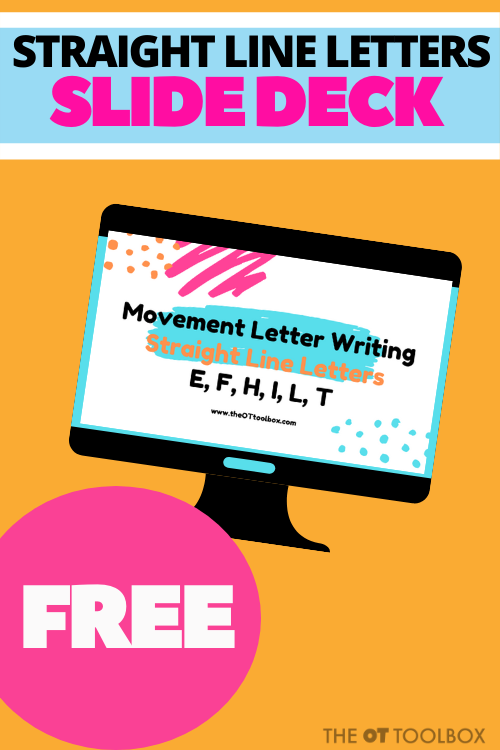
Teaching letter formation doesn’t need to be boring. Teach kids how to write letters by beginning with letters that have straight lines (horizontal and vertical lines) to make it developmentally appropriate. Today, I’ve got a free virtual therapy slide deck to teach straight line letters in occupational therapy virtual sessions. Help kids work on letter formation of straight line letters using whole-body gross motor activities and motor planning concepts. Straight line letters are those letters that contain horizontal and vertical lines: (E, F, H, I, L, T) and are great letters to begin wiht when teaching handwriting.
This free slide deck offers movement based, gross motor activities to work on writing straight line letters.
Teaching kids to write letters helps when you begin with developmentally appropriate letters, based on straight lines. These easy tips for teaching handwriting explains more on that concept of starting by teaching upper case letters first (though the concept of lowercase letters can be taught from the beginning as well.
By helping kids understand that letters are “built” from lines and curves, they can get a better visual picture in their mind. Building letters is one way to work on these concepts.
In this particular slide deck, you’ll see that we are really working on the motor plan of letters. This whole-body lesson helps kids to gain motor skills such as crossing midline, coordination, core strength, and balance, as well as motor planning skills. Check out this post for more information on motor planning and handwriting. The impact of motor planning on writing skills is pretty huge!
Here are more motor planning resources and tools found on The OT Toolbox. Add some of these ideas to your virtual therapy sessions, too.
Looking for more tools to use in teaching letter formation? Try these ideas:
Free Letter Formation Slide Deck– This is another slide deck that has a scribble theme to work on letter formation. Kids won’t be scribbling those letters, though! They will be working on fine motor skills, visual perception, gross motor, and more…all needed to write letters clearly!
AWESOME! Your free dinosaur proprioception activity cards are in your email inbox.
But wait, would you like to add the benefits of heavy work to home programs, play, indoor activities, and outdoor fun?
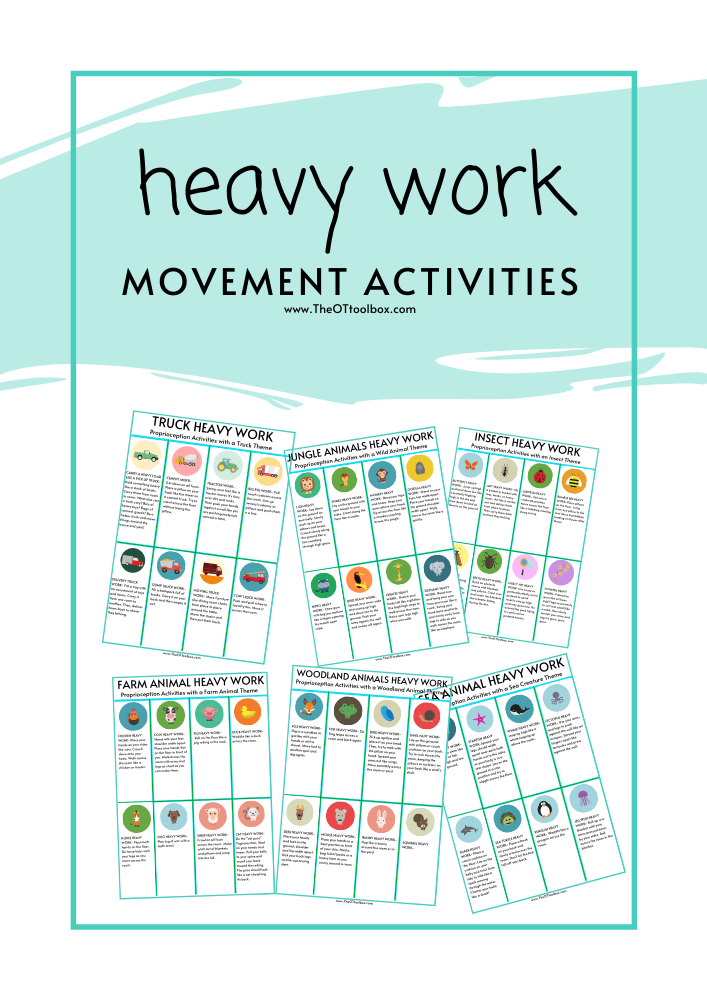
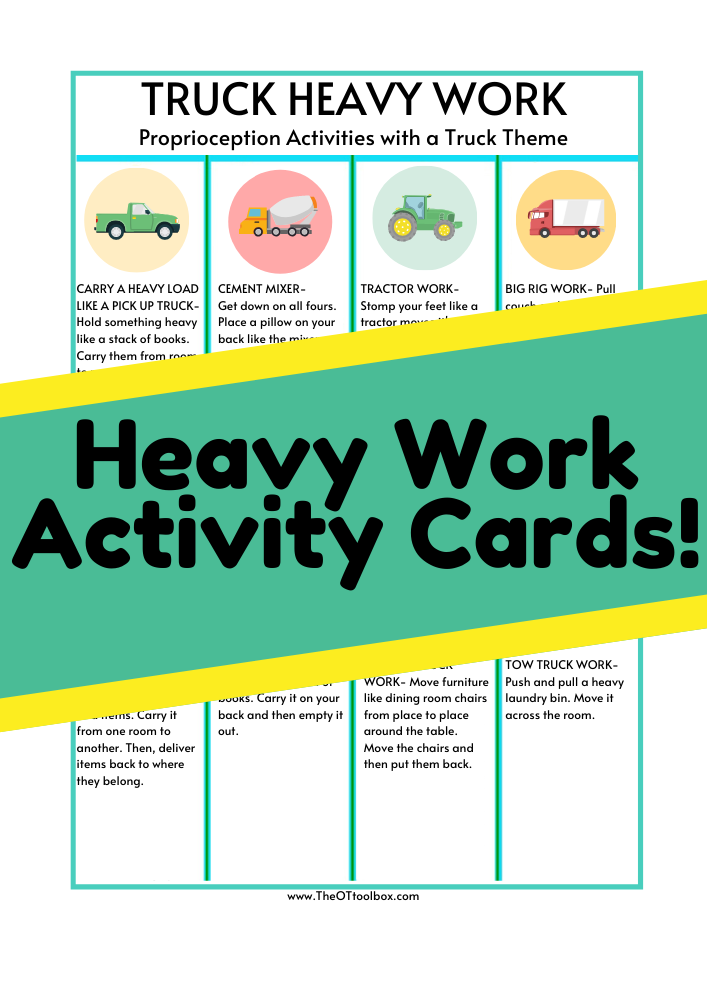
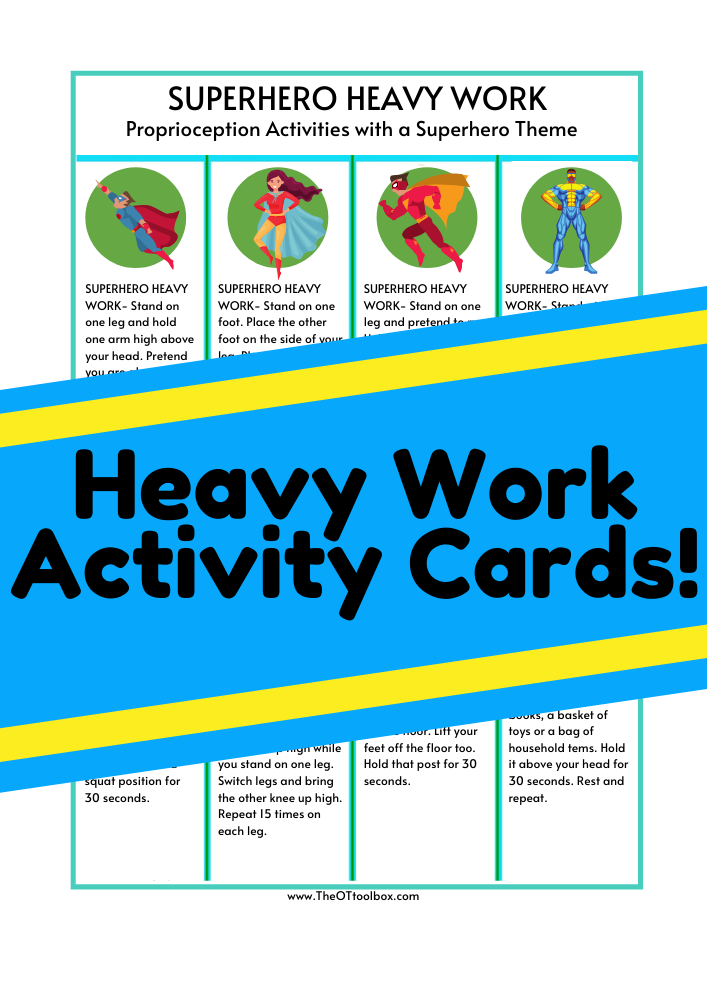
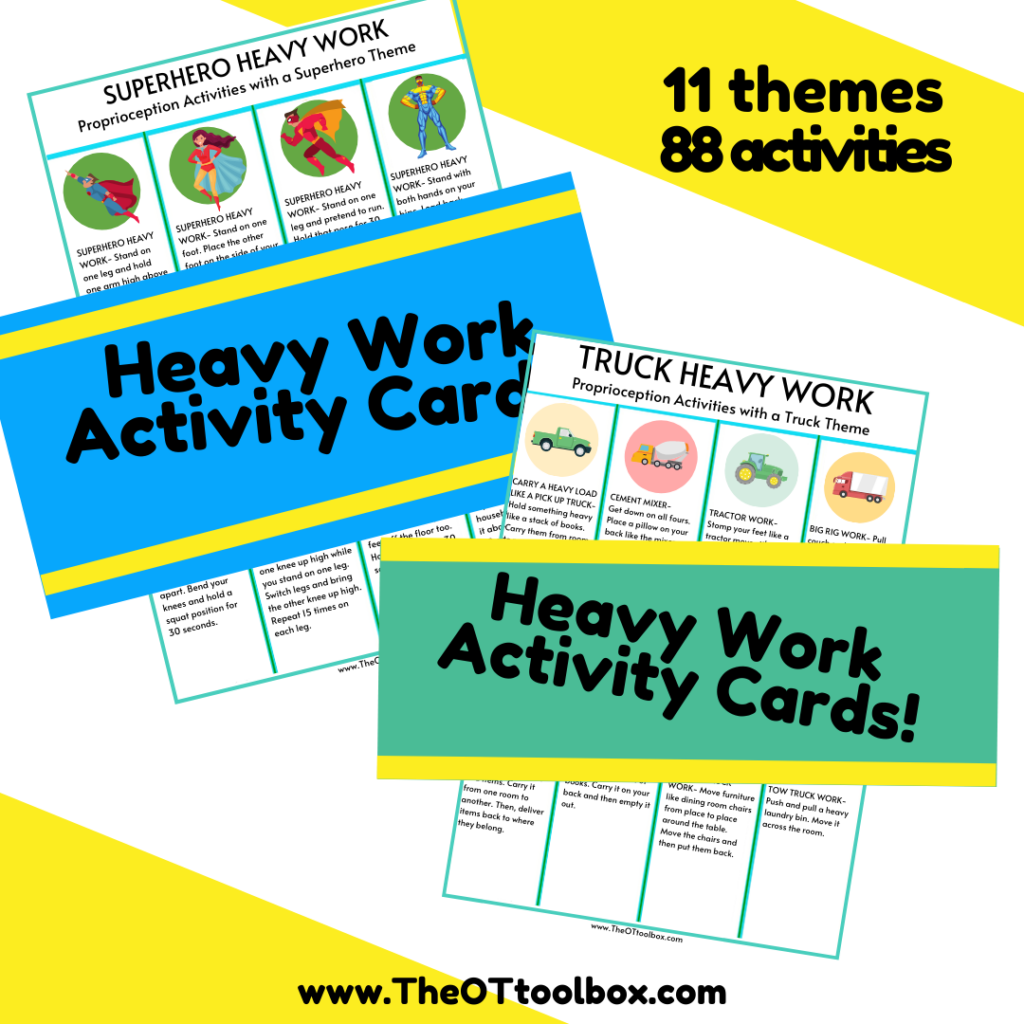
Click here to get 88 heavy work activities with 11 themes to add movement and proprioception activities to play, learning, and therapy sessions.
As a special thank you for grabbing the Dinosaur Proprioception Activity Cards, this set of heavy work activity cards is available at a discounted price. This collection of 11 heavy work activity cards are combined into themed cards so you can add heavy work to everyday play.
In the set of cards, you’ll find heavy work activities in the following themes:
1. Trucks Heavy Work Activities
2. Insects Heavy Work Activities
3. Sea Animals Heavy Work Activities
4. Farm Animals Heavy Work Activities
5. Jungle Animals Heavy Work Activities
6. Woodland Animals Heavy Work Activities
7. Superheros Heavy Work Activities
8. Sports Heavy Work Activities
9. Monsters Heavy Work Activities
10. Summer Heavy Work Activities
11. Butterfly Life Cycle Heavy Work Activities
Each activity page includes 8 movement and heavy work cards in that theme.
These heavy work activities can be added to home programs, teletherapy activity plans, or used as brain breaks during learning and play.
Heavy Work Activities to Help Kids
Heavy work activities help kids with a variety of needs:
Who appear clumsy and need help with motor planning or body awareness.
Fidget when asked to sit quietly.
Show an increased activity level or arousal level.
Seek intense proprioceptive input by “crashing and bashing” into anything.
Slap their feet when walking.
Flap hands.
Use too much or too little force on pencils, scissors, objects, and people.
“No fear” when jumping or walking down stairs.
Or, are overly fearful of walking down steps/jumping.
Look at their body parts (hands/feet) when completing simple tasks.
Sit down too hard or miss chairs when sitting.
Fall out of their seat.
Fluctuates between over-reacting and under-reacting in response to stimulation.
Constantly on the move.
Slow to get moving and then fatigue easily.
Use these heavy work cards to help with building awareness in body awareness, motor planning abilities, proprioceptive input, or a movement activity as a brain break to pay attention between learning activities.
Brain breaks are a powerful and effective way to address regulation needs, help with attention, and impact learning into the classroom. Learning can be exhaustive to our kids. They are struggling through the day’s activities while sometimes striving to pay attention through sensory processing issues or executive functioning needs. Brain breaks, or movement breaks can be used as part of a sensory diet or in a whole-classroom activity between classroom tasks.
Arrive here by accident or by searching for dinosaur related activities for kids? No problem. Just click on the link above to grab your free dinosaur proprioception activity cards.
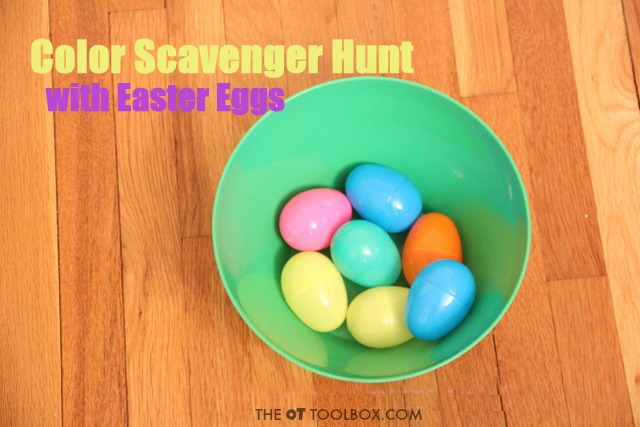
If you are looking for a fun Easter egg game that the kids will love, then you are in luck. Add this activity to your Easter activities and use up a few of those plastic eggs. This color scavenger hunt uses plastic Easter eggs, and it’s a very fun way to play and learn!
Use those plastic eggs to encourage gross motor skills, visual perception, and color learning in a way that kids won’t forget. While the kiddos are playing this Easter game, they are building cognitive skills AND underlying skill areas like visual scanning and other visual perceptual skills.
Easter Egg game
We set this Easter activity up years and years ago. (2013 to be exact!) However, it’s one of those activities that stands the test of time. If you’ve got plastic Easter eggs on hand, use them to build skills like the ones we worked on here!
COLOR SCAVENGER HUNT
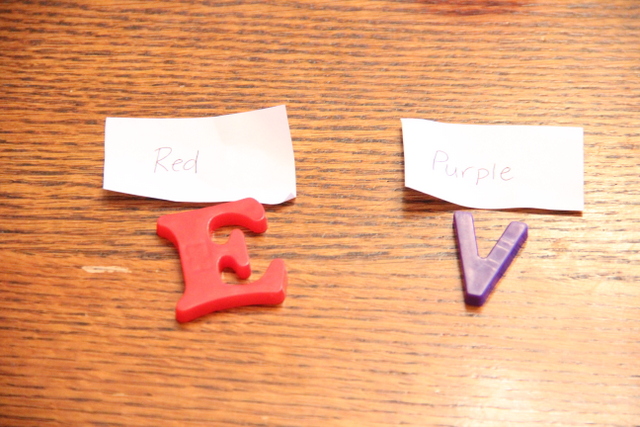
This color scavenger hunt is so easy to set up…and so much fun. Kids can work on identifying color names, and color matching. I wrote different colors on slips of paper and put them into plastic eggs. The kids got to pick an egg from the bowl and “sound out” the color on the slip of paper. Ok, my 5 year old sounded out the color with help. The other two said the first letter of the word and guessed the color. They were pretty excited to “read” the color on their slip of paper!
Another idea to expand this activity is to write words and do an Easter egg version of our word scavenger hunt.
An Easter Game Kids will Love
Now for the egg game…So then, they had to run off and find something that was the color of the written word on their slip of paper…and it had to FIT inside the egg. I sat and waited for them to run back and show me what they found while they tried to fit it in their egg. (completely genius way for this mom to finish a cup of coffee!)
They had a little trouble with some things, but this was a fun and different way to work on visual perceptual skills. Will that little doll fit in the egg? We weren’t sure by looking at it, but with a little fiddling, she did! Fitting the eggs together with the little objects inside was a great fine motor exercise.
Color Identification for Kids
They found something for each color!
Putting items into the eggs and then matching colors was a great way to work on color identification skills.
Matching colors requires visual motor skills to match colors and use that recognition in identifying the name of the color. It’s a skill that requires visual memory as well as working memory. This skill then carries over to so many other areas like letter recognition, and so much more.
This Easter themed play activity could be modified in so many ways for learning words, colors…have fun with it 🙂
Want more ways to play and learn this time of year?
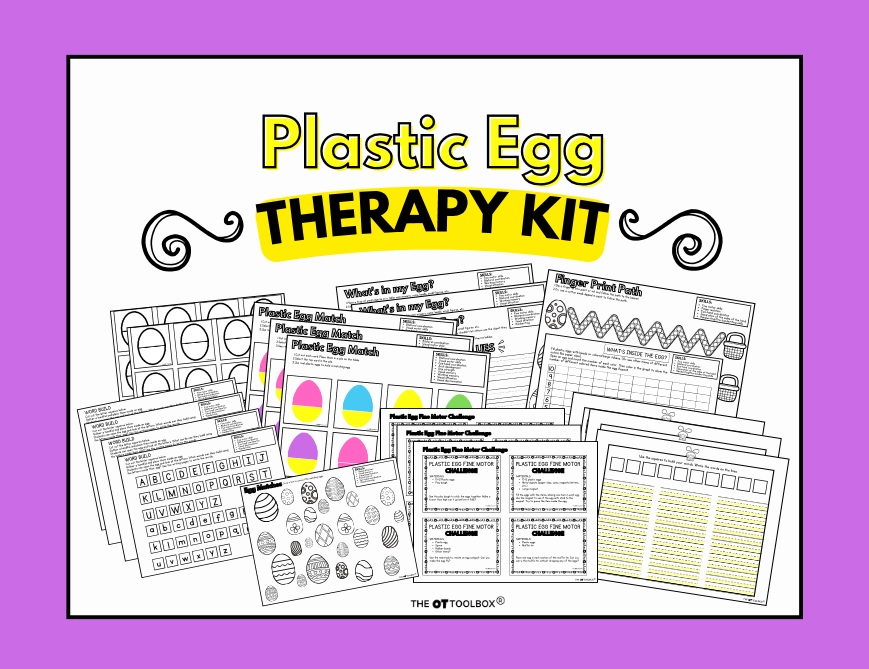
One resource we love is our $5 therapy kit…the Plastic Egg Therapy Kit! It has 27 printable pages of activities with an Easter egg theme. In the kit, you’ll find fine motor activities, handwriting prompts, letter formation pages, pencil control sheets, plastic egg activities, matching cards, graphing activities, STEM fine motor task cards, and more. There are several pages of differentiated lines to meet a variety of needs. This therapy kit has everything done for you.
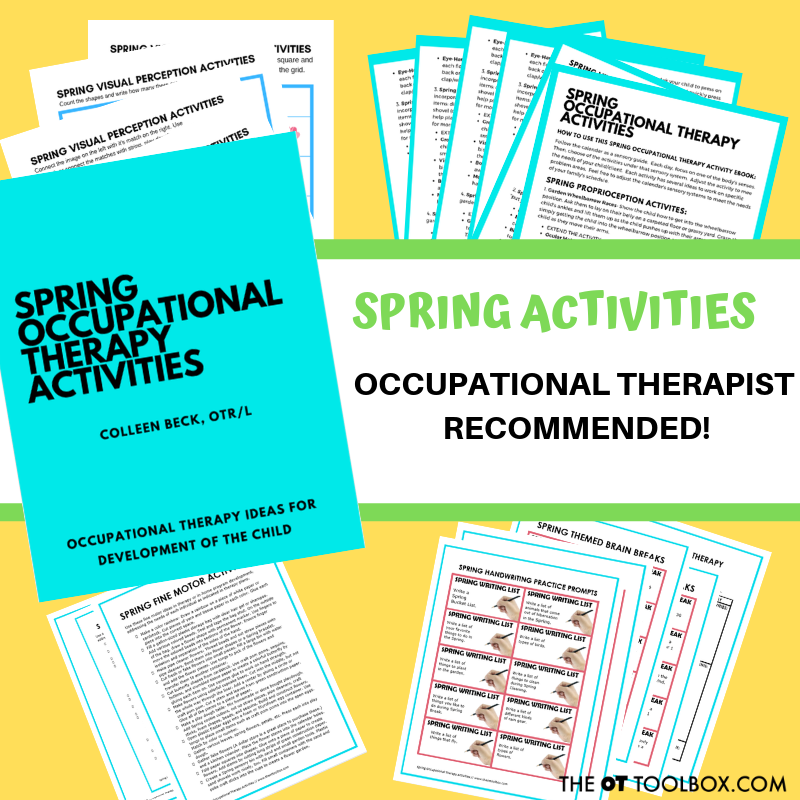
This time of year, one of our more popular products here on The OT Toolbox is our Spring Occupational Therapy packet. The best news is that, this packet has had a major upgrade from it’s previous collection of spring sensory activities.
Another great tool for supporting skills is the Spring OT packet…
In the Spring OT packet, you’ll now find:
Spring Proprioceptive Activities
Spring Vestibular Activities
Spring Visual Processing Activities
Spring Tactile Processing Activities
Spring Olfactory Activities
Spring Auditory Processing Activities
Spring Oral Motor Activities
Spring Fine Motor Activities
Spring Gross Motor Activities
Spring Handwriting Practice Prompts
Spring Themed Brain Breaks
Occupational Therapy Homework Page
Client-Centered Worksheet
5 pages of Visual Perceptual Skill Activities
All of the Spring activities include ideas to promote the various areas of sensory processing with a Spring-theme. There are ways to upgrade and downgrade the activities and each activities includes strategies to incorporate eye-hand coordination, bilateral coordination, body scheme, oculomotor control, visual perception, fine and gross motor skills, and more.
THE BEST THING ABOUT THE SPRING ACTIVITY PACKET:
One of my favorite parts of the Spring Occupational Therapy Packet is the therapist tool section:
Occupational Therapy Homework Page
Client-Centered Worksheet
These two sheets are perfect for the therapist looking to incorporate carryover of skills. Use the homework page to provide specific OT recommended activities to be completed at home. This is great for those sills that parents strive to see success in but need more practice time for achieving certain skill levels. This activity packet is 26 pages long and has everything you need to work on the skills kids are struggling with…with a Spring theme!
Colleen Beck, OTR/L has been an occupational therapist since 2000, working in school-based, hand therapy, outpatient peds, EI, and SNF. Colleen created The OT Toolbox to inspire therapists, teachers, and parents with easy and fun tools to help children thrive. Read her story about going from an OT making $3/hour (after paying for kids’ childcare) to a full-time OT resource creator for millions of readers. Want to collaborate? Send an email to contact@theottoolbox.com.
Play using household items is one thing that parents are really seeking out these past few weeks. Therapists know the power of play. Likewise, occupational therapy activities using household items like kitchen items, spray bottles, recycled items and other everyday items are very useful in OT home programs. Here are ways to play and build skills with everyday items you’ve already got in the home.
I don’t know about you but I can not keep going to the store to buy things for my kids to do. As a mom and an Occupational Therapist, I want my kids to learn, have fun and gain skills from what they are playing with. If I take a minute, sit back and look around my house I have found that there is a variety of items I already have that can be used for play. Here are over 31 ways to play and learn at home with free materials (using things you already have at home).
Why is play important?
Play is such a vital component in a child development. Not only is it fun, but it allows your child to develop cogitative, physical and emotional skills. Play is how the child interacts with the world around them. It promotes language skills and interaction between others. Play builds the child’s imaginative skills. A child can learn to play with everyday objects and turn it into something else. This is seen when a child uses a car as a phone or a stick at a wand. To learn more check out this article on the, Incredible Power of Play.
Stages of play
There are different stages of play depending on your child’s age. Mildred Parten Newhall was a sociologist who came up with different stages of play. There are 6 stages of play in which a child will fall into based upon their age.
Unoccupied (play) –Infant – when your child is observing. Learning about their environment but not participating in it yet. If you want ideas on how to play with your baby check out, Baby Play.
Solitary (independent) play – 2-3 year olds. when your child is solely focused on the activity they are doing and is not aware of what others are playing with.
Onlooker play (behavior) – 2-3 year olds. when your child watches others play, may make comments, but does not join in.
Parallel play (adjacent play, social coaction) – 2 ½-4 year old- when your child may play next to a peer, imitate what they are doing, but they are still playing with items separately.
Associative play – 3-4 years. when your child engages with others in a mutual activity but not with a common goal.
Cooperative play –4 ½ -6 years old- when your child engages with other children, it is organized, children have assigned roles.
It is important to know the different stages of play that your child is in. This will help to tailor activities for them. But also you can also give your child an object and just see what they do with it. The following are everyday household items that can promote imaginative play, dexterity, social skills and cognitive skills. If you would like more ideas on household items to use to help with different grasps, check out this article, WORK ON TRIPOD GRASP (AND PENCIL GRASP) WITH EVERYDAY ITEMS
Ideas for play and OT home programs with everyday household items
Painters tape
Place tape on a high chair or table in long strips and let child pull it off
Use tape to mark of sections for a child to color or paint creating a unique picture
Place a little figurines on the bottom of the tape, attach tape to pencil and have your child rotate the pencil until the figurine is on top on the pencil
Use tape to make letters/numbers
Create a space for each child in your living room using tape to block off sections
Take small pieces of tape and place them throughout the house and have a scavenger hunt
Practice wrapping boxes using wrapping paper and tape
Plastic containers
Have your child match up the different sized lids to the containers
Use the containers to make a sensory bin- fill with rice, beans, kinetic sand, cotton balls, water beads, or any item you want. Hide toys in the materials, have tongs and measuring cups to pour and scoop.
Place different colors of construction paper on the bottoms of the containers and have your child go around the house and place matching household items based on their color into the correct colored container.
Place paper on bottom inside the container, tape it down, squirt paint onto the paper and roll a marble back and forth making a neat design.
Cut slits into the lid of the containers. You can then have your child place popsicle sticks, coins, pipe cleaners, into the slits.
Large Legos
Place the legos upside down. Have your child use tongs to place colored pom poms into the holes on the bottom of the legos. They can even work on color matching this way.
Take a picture, cut it into pieces and tape the pictures to the legos. Then your child can form the picture again by putting the legos together, like a puzzle.
Place different letters on the legos and have your child work on building their names
Work on replicating patters. You make a tower then have them make a tower. You make a bridge and then have them make a bridge. See if they can replicate when you have created.
Place legos in paint and let them use it as a stamp
Push legos into playdough to make a design ( ex. A road for their car).
Spray bottle
Have your chld spray the plants inside and outside your house to water them.
Color a coffee filter with markers, have your child spray it and watch the colors run off
Use a spray bottle in the bathtub. Bring in toys, lather them with soap and have your child spray them off
Draw on the sidewalk with chalk and have your child “clean the sidewalk” by spraying water
Place a few drops of food coloring into spray bottle, add water, shake and have your child spray a piece of white paper to make a colorful picture.
Play in the kitchen
There are so many ways to play in the kitchen that help children develop fine motor skills, explore the senses, improve eye-hand coordination, and develop motor planning skills.
Try these 4 ways to play with kitchen items AND develop fine motor skills:
Hope you find these ideas helpful and easy to do. As you have read there are many different ways to play with everyday item. Have fun and see what creative things your child comes up with.
About Christina: Christina Komaniecki is a school based Occupational Therapist. I graduated from Governors State University with a master’s in occupational therapy. I have been working in the pediatric setting for almost 6 years and have worked in early intervention, outpatient pediatrics, inpatient pediatrics, day rehab, private clinic and schools. My passion is working with children and I love to see them learn new things and grow. I love my two little girls, family, yoga and going on long walks.
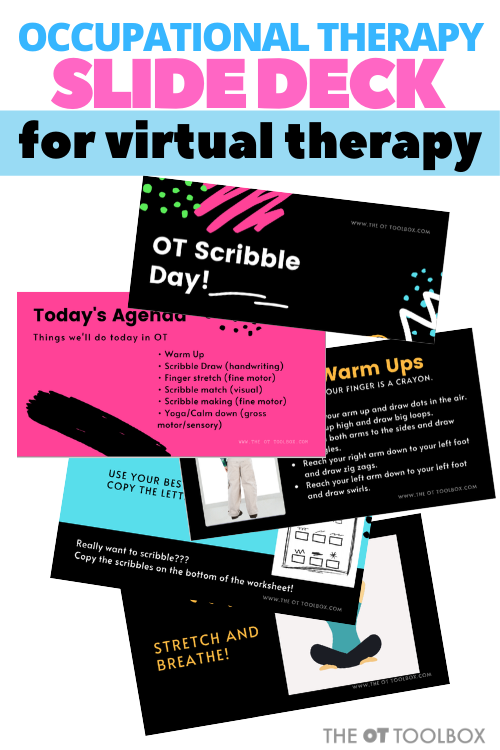
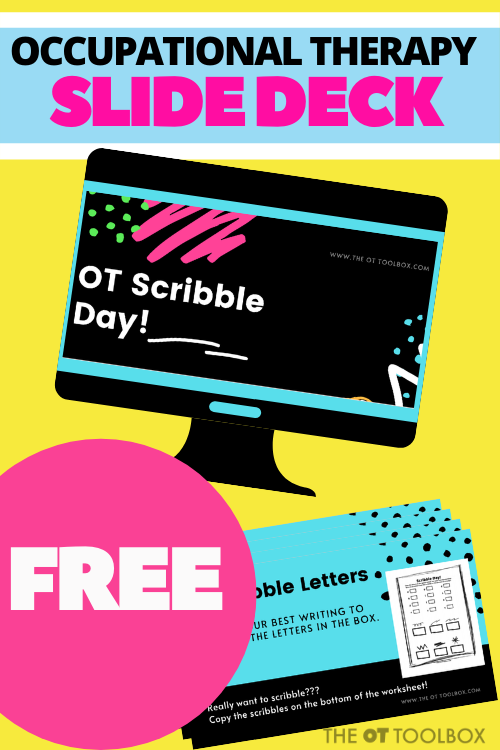
This letter formation activity for teletherapy sessions is one that is perfect for virtual sessions. Use the slidedeck to upload right to your Google classroom or other teletherapy platform. You can go through the slides along with the child, or use them as an independent occupational therapy home program without individualized intervention from the occupational therapist. There are many underlying skills that play a part in letter formation. When using them in OT interventions, therapists can intervene with specific adaptations, modifications, and strategies to help kids improve on various skill areas such as visual motor skills, fine motor skills, motor planning, bilateral coordination, crossing midline, sensory processing, core strength, balance, positioning, and more.
“Scribble Theme” Letter Formation Teletherapy SlideDeck
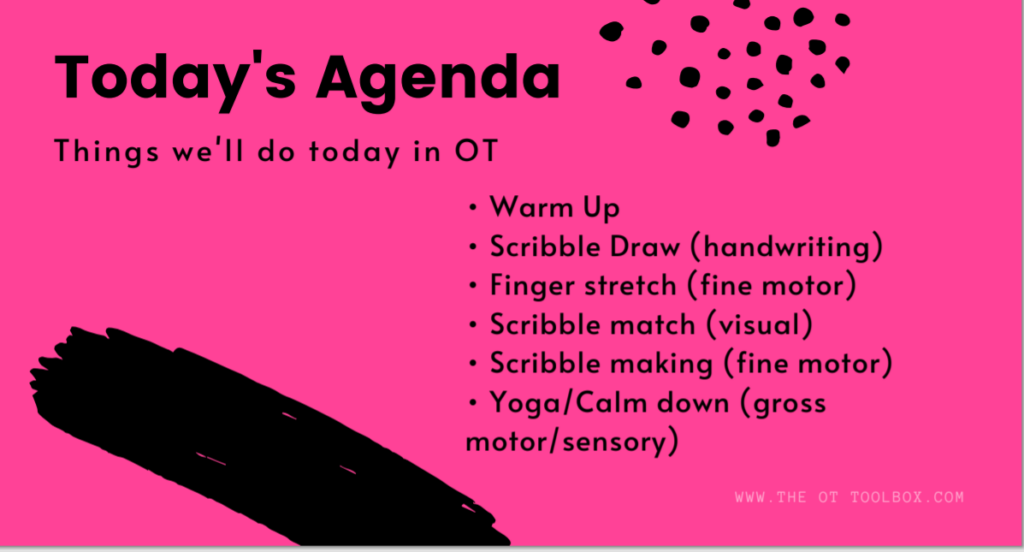
This free virtual therapy session outline goes through several areas:
Warm-Ups
Handwriting
Fine Motor Skills/Motor Planning/Direction Following
Visual Motor work/Fine Motor Skills
Yoga/Calm Down/Gross Motor/Balance
This free virtual therapy activity set can be used in face-to-face interventions, too. The options are pretty much limitless.
Along with the worksheet is one that I created as a free printable that went out to The OT Toolbox newsletter list.
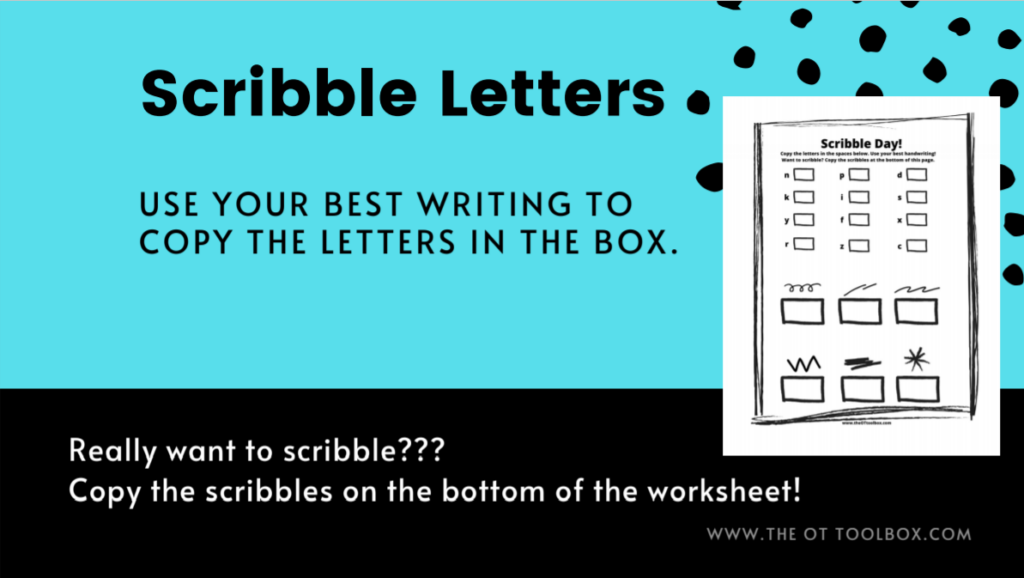
In the printable worksheet, children can work on letter formation and writing letters in a small space. Kids can copy the letters and then copy the scribbles into the boxes at the bottom. This printable page is free for you today, too! Bonus news is that when you access this freebies, you’ll be entered onto The OT Toolbox subscriber list. Win, win, win, right? Don’t worry, you can unsubscribe at any time, if you like.
If you would like free printable tools like this one, subscribe to our newsletter. You’ll get resources and tips in your inbox, along with the weekly Friday Freebie. It’s a fun time!
Enter your email to access this free “Scribble Theme” Occupational therapy slide deck:
With therapy sessions now moved to online settings, and children receiving virtual therapy as their source for occupational therapy intervention, you may be wondering HOW to help your child thrive in virtual therapy sessions. With many parents experiencing their first encounter with online therapy, I wanted to put together tips that you can pass on to parents to allow their child to succeed in online therapy sessions. Here are common teletherapy activities that can serve as a starting point. Remember that occupational teletherapy is a virtual version of face-to-face occupational therapy sessions.
Virtual Therapy Tips for Parents
Let your therapist know what you need and where your child is struggling- The family and parents are part of the “team” with the child being the center of that relationship. Parents are often times the voice for the child to communicate needs or frustrations of the child. With new realities as a result of public health issues, kids can struggle in unprecedented ways. Be sure to communicate any new changes with your child’s therapist.
Gather any needed materials- Consult with the therapist prior to the virtual session by email or text to find out what materials you should have ready for the session.
Prepare your child for teletherapy sessions- Add a computer “appointment” to your child’s written or visual schedule. Let them know in advance (at the appropriate level of understanding of your child).
Prepare the area- Set up a specific location for teletherapy sessions to occur. Have headphones or a headset there and ready for your teletherapy session.
Log on and check internet connection a few minutes before your scheduled time- Realize that your child’s therapist likely has between 6-14 virtual therapy sessions scheduled each day. They are striving to meet the needs of your kiddo right along with all of the other kiddos on their caseload. Being on time provides the best service for your child and is considerate of the therapist’s hefty schedule.
Try a trial run- Consider setting up a trial run with use of the headphones and a video conference call with a grandparent or friend to practice speaking into the headphones or computer microphone. Try the headphone volume at this time, too. This is a good time to test the lighting in the room, and placement of the computer’s camera.
Prepare the household- Let siblings or others in the home know that the teletherapy appointment is scheduled. This is a time for the child to interact with their therapist. Try to reduce background distractions if possible. Put pets and distracting toys away during the teletherapy session.
Consult with the therapist regarding being an “e-helper”- Some activities and interventions may require the use of an adult to act as an e-helper. This is especially true for younger children or during hands-on tasks. Here is more information on understanding teletherapy and e-helpers.
What would you add to this list? Do you have any suggestions for parents who have children receiving occupational therapy teletherapy for the first time?