Colleen Beck, OTR/L is a pediatric occupational therapist and the owner and author of The OT Toolbox website. She manages all of The OT Toolbox social media accounts and runs the popular newsletter.
Read about Colleen's experience and career as an occupational therapist, including how The OT Toolbox began on our About The OT Toolbox page: https://www.theottoolbox.com/about-us/
Colleen created The OT Toolbox in 2011 and since then has written thousands of blog posts designed to support therapy providers, educators, parents, counselors, admin, and caregivers in promoting the healthy development of kids.
Check out Colleen's blog posts below:
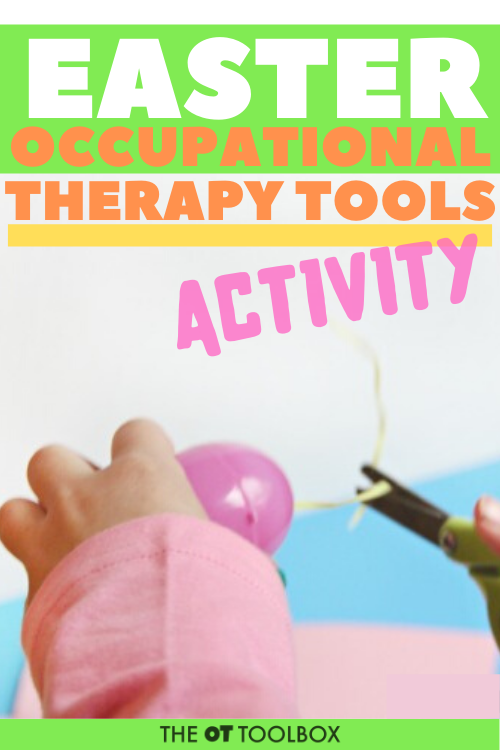
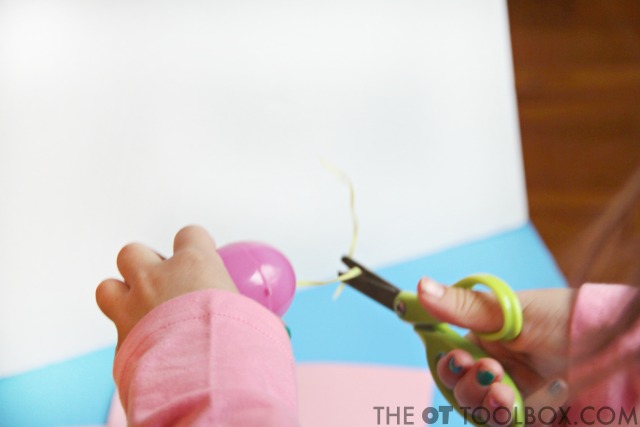
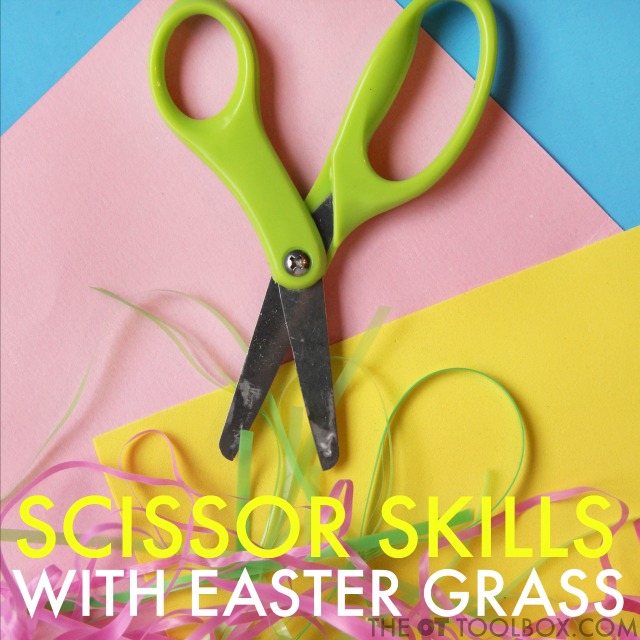
This Easter scissor skills activity for kids is a creative way to work on scissor skills with kids this time of year. Coming up with Easter ideas for kids doesn’t need to be difficult. Use a few items found at your dollar store to help kids address skills like bilateral coordination, graded precision with scissor control, and eye-hand coordination and other fine motor skills. In fact, adding this fine motor activity to an Easter or Spring craft session can be a fun way to build specific skills in a fun way.
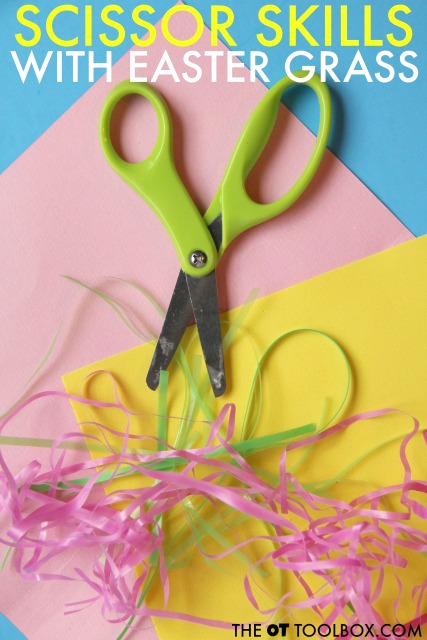
This is a quick and easy scissor activity to add to your occupational therapy toolkit. We used a plastic Easter egg and Easter grass (the kind that is used to fill Easter baskets) to work on basic scissor skills like opening and shutting the scissors and using the non-dominant helper hand in a fun cutting activity.
Easter Activity for Kids
This post contains affiliate links.
You’ll need just a few materials for this scissor activity:
Scissors (These are my favorite brand for helping kids learn to cut.)
A scissor activity that is easy to create is a great activity for the Occupational Therapist’s therapy toolkit. We used plastic Easter eggs from our Easter supply bin to hold a long strand of Easter grass. Both of these items can be found at your dollar store, making this a frugal way to address scissor skills.
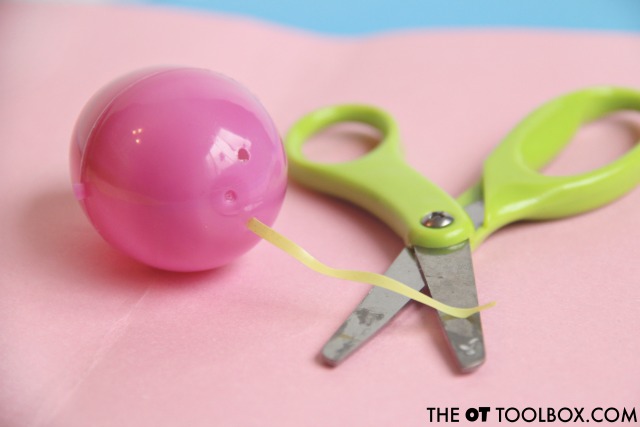
To create this Easter themed scissor activity, open up the plastic egg. Then, place a long strand of Easter grass in the egg and thread one end of the grass through the hole in the egg. Most plastic Easter eggs have a small hole in one end. If yours doesn’t, then this activity won’t work. Simply look for an egg with the hole in one end of the plastic egg. And that’s it!
You now have an Easter-themed scissor activity ready for practicing basic scissor skills.
Occupational therapy Tools and SKills
There are a myriad number of skills that an occupational therapist can address in kids. Occupational therapists address the underlying skills that interfere with function and occupation. Those OT skills include of fine motor strength, dexterity, stability, coordination, visual perception, sensory processing…the list goes on and on when it comes to meaningful occupations and the occupational therapy tools that address these areas..
One such occupational therapy area that this OT tool addresses are independence with using scissor as well as precision with scissors in their dominant hand. Kids can hold the egg in one hand while managing bilateral coordination, precision, laterality and more. They can pull out the Easter grass through the egg and work on cutting bits of the grass. With a small piece of Easter grass sticking out of the egg, kids can address precision grasp and release when using scissors during cutting tasks. The egg makes a great grasping tool for younger kids. While use of scissors requires children to hold onto and manipulate paper with their non-dominant hand, holding the egg promotes a power grasp with arch development during this cutting with scissors.
Pulling the strand of grass out of the egg is a nice way to work on neat pincer grasp and threading more into the plastic egg’s hole is an excellent way to encourage fine motor development. Here are more Spring fine motor activities to keep your little ones busy and working on hand strength and dexterity this time of year.
Score Fine Motor Tools and resources and help kids build the skills they need to thrive!
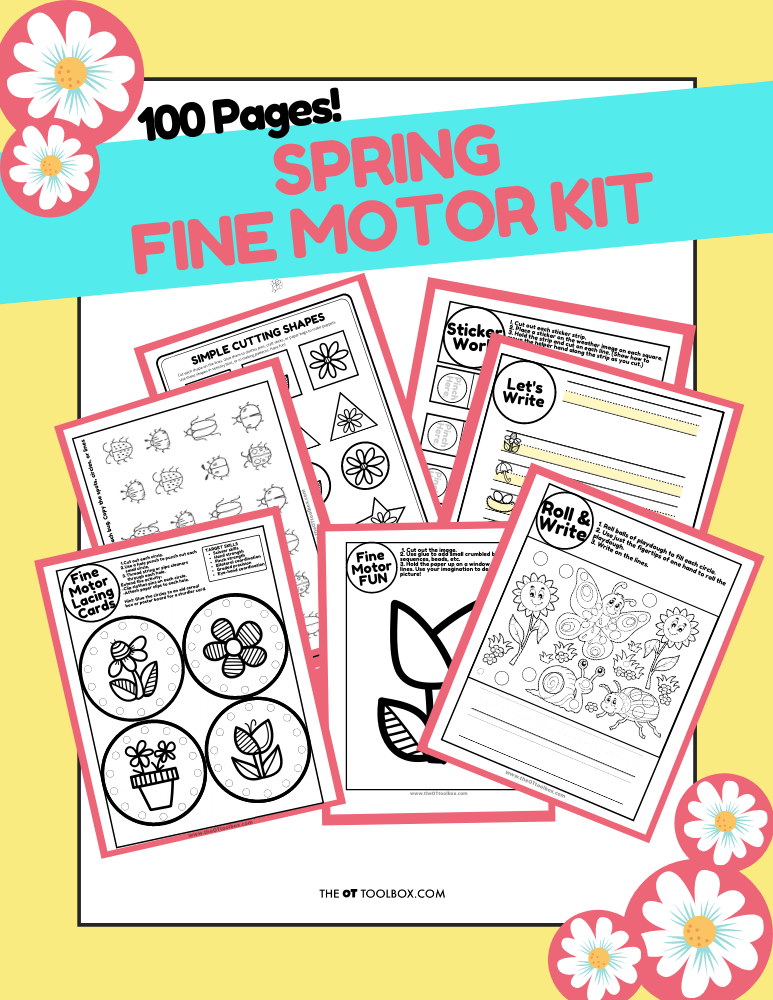
Developing hand strength, dexterity, dexterity, precision skills, and eye-hand coordination skills that kids need for holding and writing with a pencil, coloring, and manipulating small objects in every day task doesn’t need to be difficult. The Spring Fine Motor Kit includes 100 pages of fine motor activities, worksheets, crafts, and more:
Colleen Beck, OTR/L has been an occupational therapist since 2000, working in school-based, hand therapy, outpatient peds, EI, and SNF. Colleen created The OT Toolbox to inspire therapists, teachers, and parents with easy and fun tools to help children thrive. Read her story about going from an OT making $3/hour (after paying for kids’ childcare) to a full-time OT resource creator for millions of readers. Want to collaborate? Send an email to contact@theottoolbox.com.
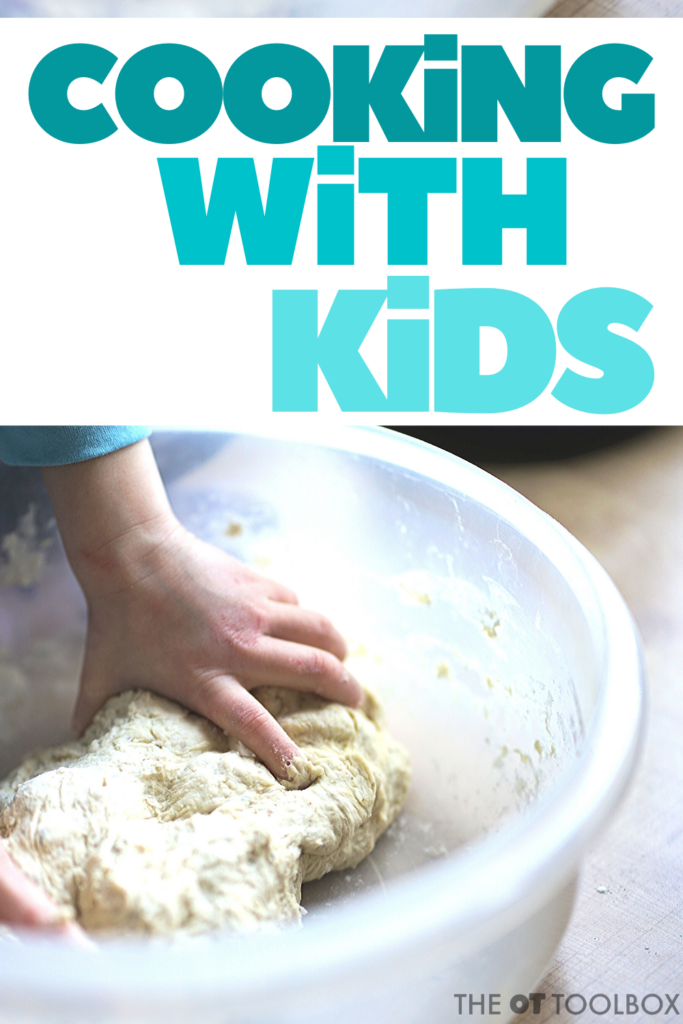
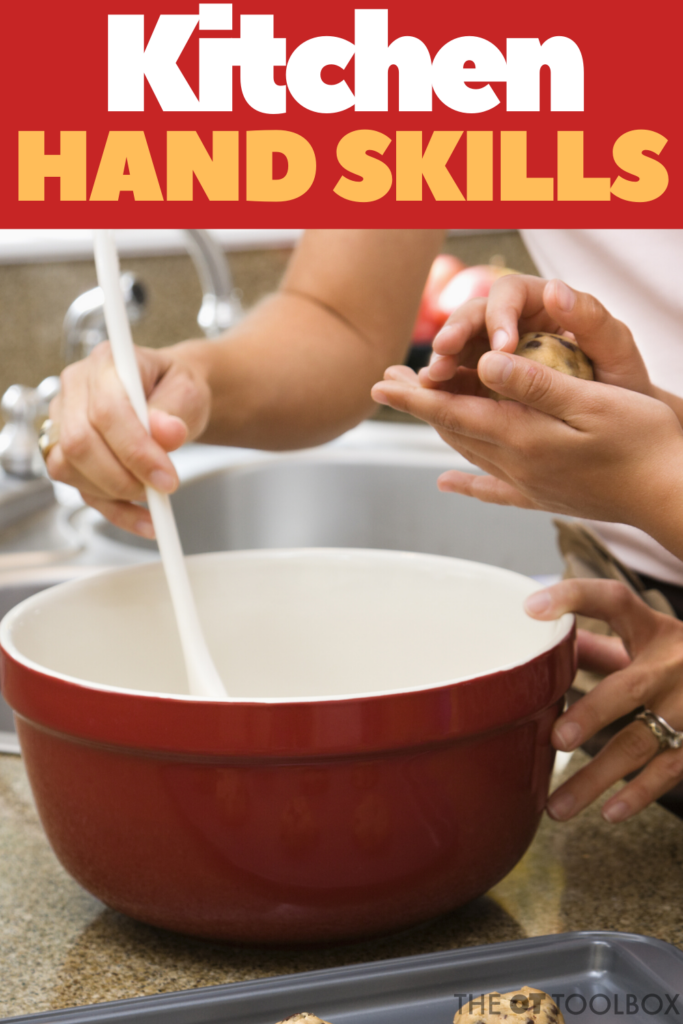
Did you know you can work on hands skills with cooking with kids activities? It’s true! In fact, cooking with kids can help kids build hand skills both in the kitchen and out. Actually, using arts and craft activities with kids can build the hand skills kids need for not only kitchen activities, but for other areas where fine motor skills and hand dexterity is needed. Using recipes with kids works on skills in a functional way, but there is more than one way to peel an apple, so to speak!
Cooking with Kids = Hand Skills + Arts and Crafts
I bet you are asking yourself, “Wait, what? Cooking with kids, hands skills, and and crafts? What does that mean?” Well, simply put, you can use art and craft activities with simple techniques and tools to help children build foundational hand skills necessary for cooking and meal prep in the kitchen. Yep, that’s right! You can teach kids cooking and work on hand skill essentials while being creative and having fun using a meaningful activity!
Kitchen ACTIVITIES
There are so many ways that kitchen activities help kids develop much needed skills. From executive functioning, to fine motor development, to direction following, to sensory exploration, cooking with kids build skills! But let’s not forget that actual cooking activities with children are a fun learning experience too and a wonderful bonding time for families.
With cooking, kids use so many wide-ranging skills, learn educational concepts, and well, have so much fun! But, how about those children that need to work on building some foundational hand skills needed to engage in cooking tasks with success and confidence. Or maybe those children who need to expand their hand skill use through other activities aside from the actual task of cooking.
Art and Crafts and COoking with Kids
As therapists, we use art and craft activities frequently in
our work with children. They find it playful and therapists know that art and
crafting is a valuable therapeutic tool to work on important skills and build
rapport. Using these activities as an avenue to build foundational skills is a
win-win for both parties!
Kitchen Hand Skills
Structured and non-structured art and craft activities can help build hand skills such as finger and hand strength, bilateral coordination, in-hand manipulation, grasp patterns, fine motor control and coordination, separation of the two sides of the hand, and hand dominance. So, how exactly does art and crafting work on cooking, you ask. Well, let’s first look at some hand skill verbs that are closely connected to cooking and meal preparation:
dipping
slicing
spreading
crushing
sprinkling
stirring
flipping
cracking
pinching
tearing
shredding
squeezing
cutting
timing
whisking
grating
scooping
rolling
mixing
peeling
Notice how many of these words have something to do with an action and the use of hand skills. That’s right, hand skills are a HUGE part of cooking and art and craft tasks! In this post, we will be discussing how during the process of art and craft tasks, you can help a child build or learn essential hand skills for cooking. So essentially it’s like cooking with art and crafts! You’ll see what is meant shortly.
Sometimes you can find recipes that have different steps that can be offered to kids when helping in the kitchen. This is great because you can offer the child to do just one step of the task. They then don’t become overwhelmed by the whole task. For example, our Greek turkey burger recipe has different steps that can be offered to target specific skills: chopping, slicing, stirring, mixing, scooping, grilling.
Hand Skills Kids Need
Let’s start with simulated hand actions. Simulated hand actions are when the hands perform similar movements that are utilized when performing a specific task or using a specific tool.
Children can either learn simulated hand movements when working on art and crafts by manipulating various art and craft items or they can use the actual kitchen or cooking tool during art and crafts providing a novel and humorous way to engage children in the task even if they are not necessarily “into art.”
Using kitchen tools during art is fun for kids and adults! Lots of laughs and giggles will ensue. Some children will even make the connection to the actual task that the tool is used for during cooking.
Cooking with Kids Activities
Now, let’s get onto to sharing some ideas that can help YOU view art and crafts in a new way. Below is a list of some easy ways to use art and craft items as well as actual cooking tools during therapy to build cooking hand skills with children.
Pull apart cotton balls for art and craft projects which simulates shredding chicken and other food items.
Peel crayon paper off of crayons and grate the crayons into small pieces to use for art or craft project decoration.
Pinch crushed food items such as cereal or snack foods and place onto surface of a project.
Use a kitchen mallet to crush cereal or stuffing crumbs to place onto surface of a project.
Dip a basting brush, spatula or other rubberized kitchen tool into vegetable or olive oil and draw pictures onto sheets of construction paper.
Use a pipe cleaner to open and close plastic bags that are storing art and craft materials. Simply twist on and off like bread ties.
Use a plastic knife to spread Elmer’s glue or tacky glue onto surface of project like spreading mayo, mustard, and cream cheese.
Use a plastic knife to spread paint onto a sponge and use the sponge to create art pictures or decorate crafts.
Recycle a spice container and sprinkle glitter from the bottle onto a project.
Poke holes with a fork into a clump of putty, play dough, or clay like poking holes into a potato for baking or piercing food for cooking.
Use a rolling pin to flatten a ball of putty, play dough, or clay like rolling out cookie or pastry dough.
Tear different paper weights such as tissue paper, construction paper, card stock or even leaves which is similar to shredding leafy foods like lettuce or tearing open packages.
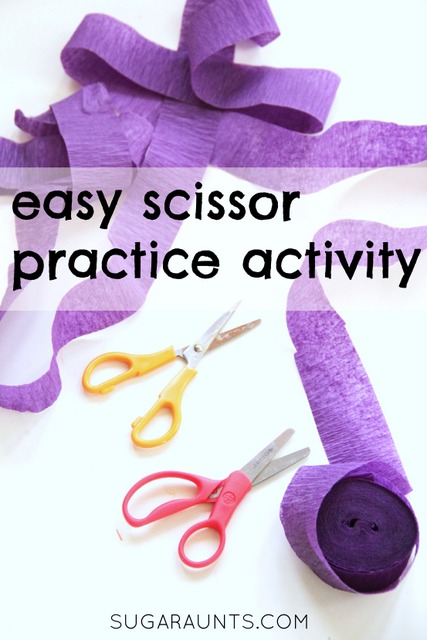
Use scissors to cut strips off of a paper lunch bag to use on a project in order to simulate cutting open food packages.
Use a kitchen timer to time self during project assembly.
Crack and pull apart plastic eggs with paint or liquid glue inside for projects to simulate cracking an egg.
Hopefully after this post and the list of ideas provided above, you are now inspired to use art and craft activities to work on or expand foundational hand skills which are needed for cooking and meal preparation tasks. Be creative and let the kids come up with some of their fun ideas too! It’s a great time to build skills while stimulating a child’s creativity and encouraging curiosity that benefits functional daily living too!
Regina Parsons-Allen is a school-based certified occupational therapy assistant. She has a pediatrics practice area of emphasis from the NBCOT. She graduated from the OTA program at Caldwell Community College and Technical Institute in Hudson, North Carolina with an A.A.S degree in occupational therapy assistant. She has been practicing occupational therapy in the same school district for 20 years. She loves her children, husband, OT, working with children and teaching Sunday school. She is passionate about engaging, empowering, and enabling children to reach their maximum potential in ALL of their occupations as well assuring them that God loves them!
Occupational Therapists are often times consulted to assess a child for their fine motor skills that are needed in school and for resources to build fine motor skills in the classroom. When a child’s fine motor skills are lacking, classroom tasks can be difficult and result in delays in many aspects that are necessary for learning and functioning in the school environment.
Today, I’m sharing a breakdown of fine motor skills in the school environment and how to build these skills during the school day through simple strategies. One of these strategies is Finger Aerobics. Read on to learn more about finger aerobics exercises for a fine motor writing warm-up exercise.
Fine Motor Skills Needed at School
A recent article in the American Journal of Occupational Therapist called Fine Motor Activities in Elementary School Children: A Replication Study examined the motor and technology requirements of kindergarten, second-, and fourth-grade general education classrooms.
The study found that students spend between 37.1% to 60.2% of the school day performing fine motor activities, with handwriting accounting for 3.4%–18.0% of the day. Does that surprise you? We are talking about all of the fine motor tasks students complete during the school day in this post, but it certainly makes sense that a large portion of the school day includes fine motor work.
The study provides an updated information on the amount of handwriting, technology requirements, and fine motor work that children are taking part in during the school day.
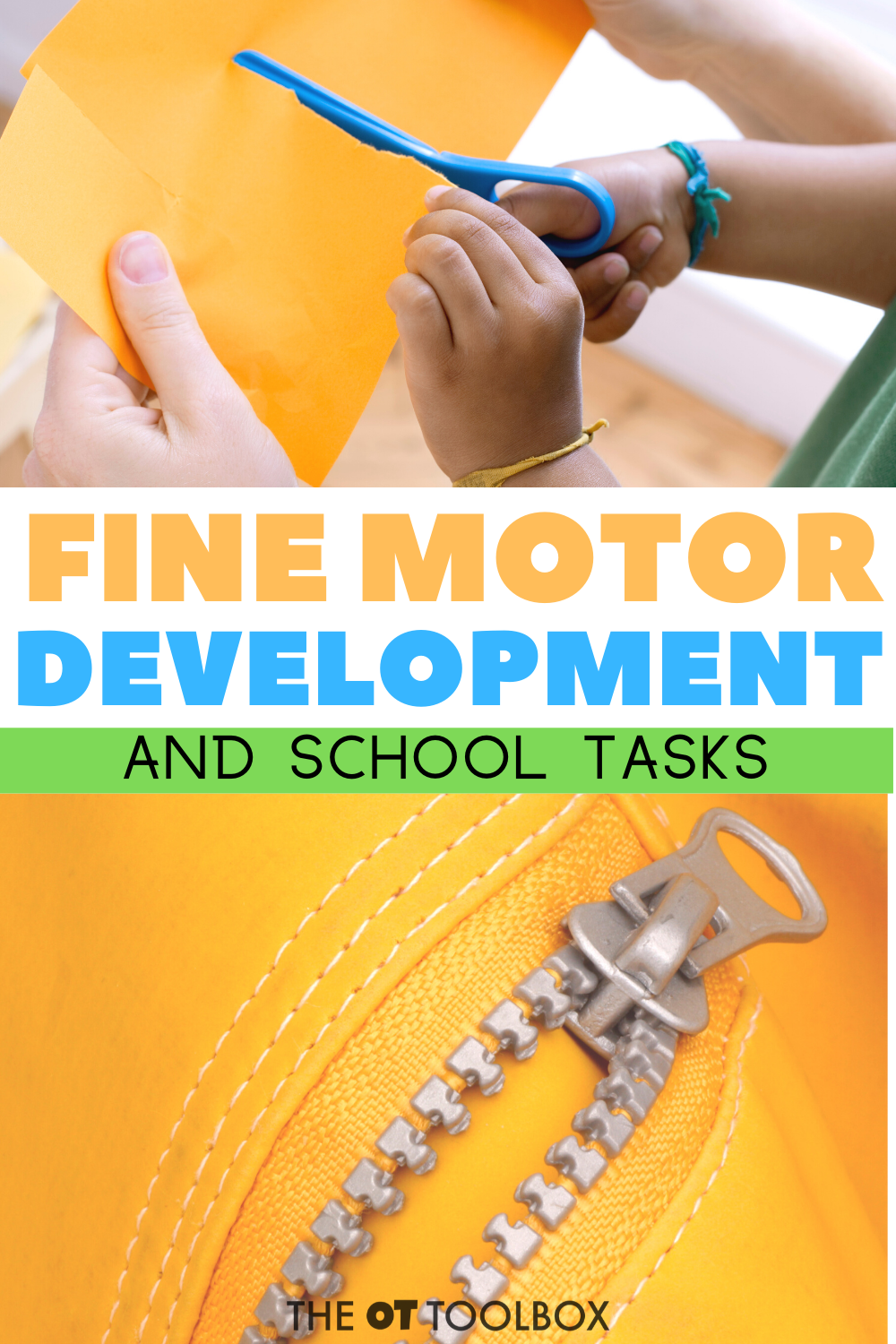
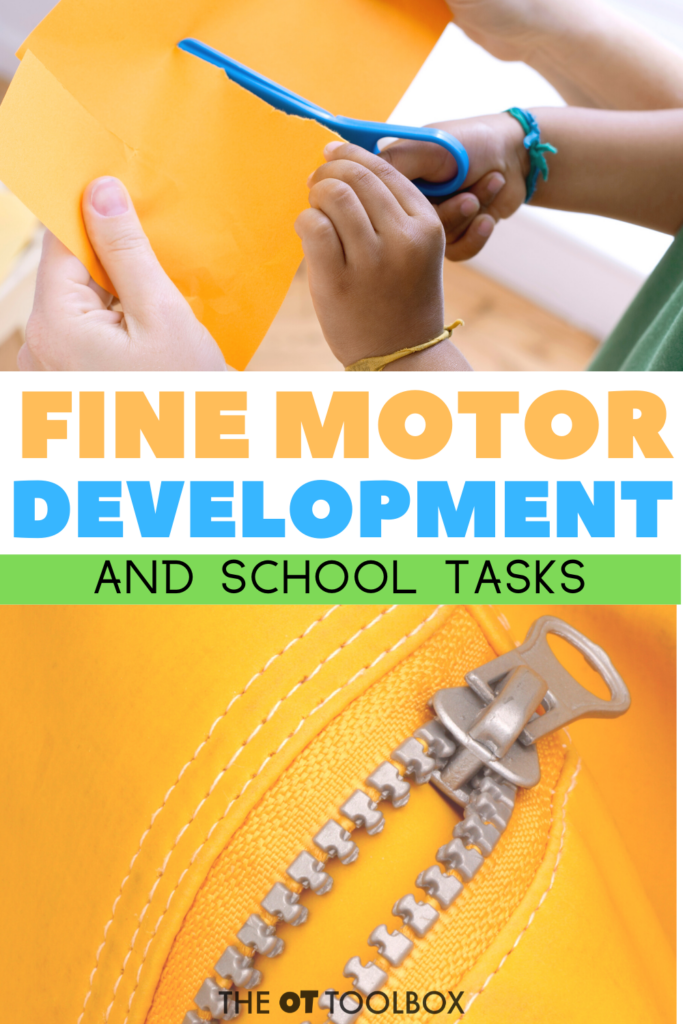
The study also found that fine motor skills were integrated into tasks throughout the day, including transitions to and from the classroom and between activities. tasks like unzipping a backpack to get out paperwork for the teacher, gathering materials, managing writing utensils such as pencils and markers, activities of daily living (e.g., zipping and buttoning jackets for recess), and technology use (e.g., using a finger to complete a maze on the Smartboard) all are included in the school day. These tasks require development and integration of fine motor skills. It should be noted that students who struggle with fine motor skills will likely struggle throughout the day.
When you stop and think about all of the contributing factors that impact fine motor development and strength, it is no wonder that kids are struggling more than they seemed to in the past (this is coming from personal experience, but I think most of you might agree that kids seem to struggle more with fine motor, pencil grasp, and visual motor skills than they did years ago.) There are so many considerations that play a part in fine motor woes. Check out the fine motor development considerations listed below.
Fine Motor Development Considerations
These are areas of childhood that impact the development of fine motor skills.
Skip crawling and move straight to walking
More time being rushed around in baby carriers
Time spent in “baby positioners”
Less “free play” and more scheduled activities
Less exposure to small parts and creative play (More structured and planned play)
Less movement-based and developmentally appropriate learning in preschool, kindergarten, and the younger grades
More time on screens
Early screen-time exposure
Less outdoor time and strengthening through heavy work/outdoor play
What would you add to this list?
Knowing all of this, we can empower our kiddos with support and fine motor activities integrated right into their classrooms and play. Here are some tools and resources to help with those fine motor struggles:
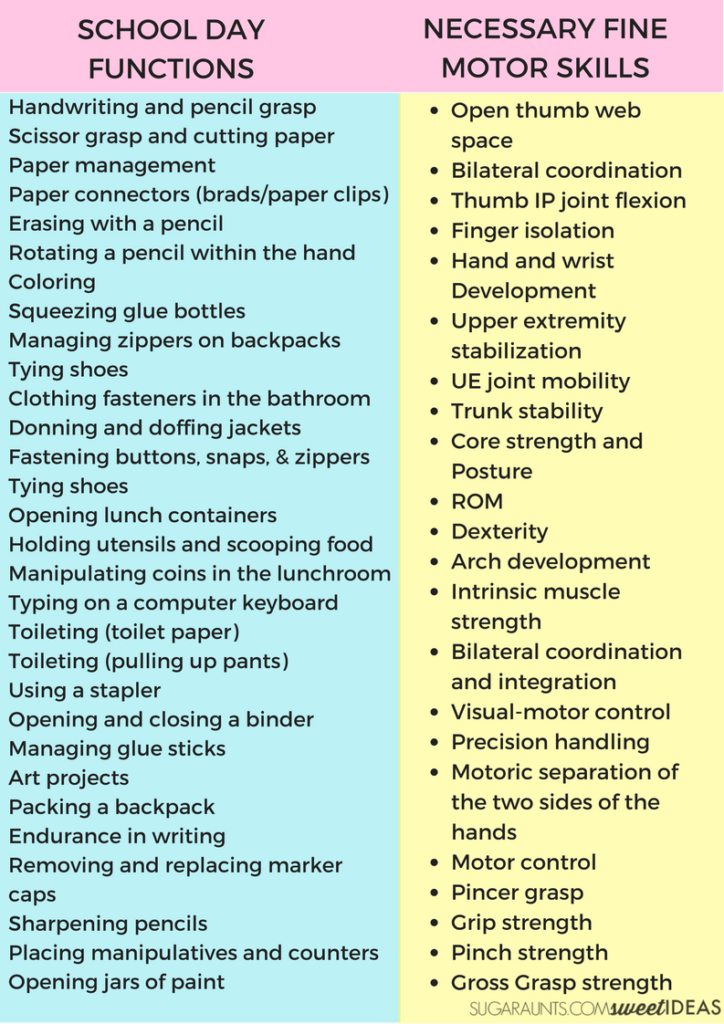
Fine motor skills are essential for independence and functioning within the classroom environment. Consider all of the areas where fine motor skills are needed for ease during the school day:
Handwriting and pencil grasp Scissor grasp and cutting paper Paper management including placing papers into folders Paper clip management Paper connectors (brads) management Erasing with a pencil Rotating a pencil within the hand Coloring Squeezing glue bottles Removing glue caps from squeeze bottles or glue sticks managing zippers on backpacks Tying shoes Managing clothing and clothing fasteners during bathroom breaks Donning and doffing jackets and coats Managing buttons, snaps, and zippers on coats and jackets Tying shoes Opening containers in the lunch room Holding utensils and scooping food to eat Picking up small pieces of food Manipulating coins in the lunchroom Typing on a computer keyboard Toileting (tearing toilet paper and wiping) Toileting (pulling up pants) Using a stapler Opening and closing a three ring binder Managing glue sticks Art projects Packing a backpack Endurance in writing Removing and putting on caps on markers Sharpening pencils Placing manipulatives and counters accurately in hands-on math activities Opening jars of paint
Fine Motor Skills Examples
Fine motor skills play a huge part of a student’s day! So what are fine motor skills? I explained in detail the various aspects of and examples of fine motor skills. For more examples of fine motor skills, check out the list below. These are the aspects of motor work that play a part in fine motor tasks during a child’s school day. All of these skill areas are types of fine motor skills that impact function, in big ways.
These daily functions within the school environment require many fine motor skills. Each daily task requires many fine motor skills:
Open thumb web space
Bilateral coordination
Thumb IP joint flexion
Finger isolation
Hand and wrist Development
Upper extremity stabilization
UE joint mobility
Trunk stability
Core strength and Posture
ROM
Dexterity
Arch development
Intrinsic muscle strength
Bilateral coordination and integration
Visual-motor control
Precision skills and graded fine motor skills in handling objects
Motoric separation of the two sides of the hands
Motor control
Pincer grasp
Grip strength
Pinch strength
Gross Grasp strength
Definition of Fine Motor Skills
Occupational therapists know the definition of fine motor skills. It’s an integral part of every therapy evaluation.
For a layman’s definition of fine motor, the Medical Dictionary defines fine motor skills as: “Any of the motor skills that require greater control of the small muscles than large ones, especially for hand eye coordination or for precise hand and finger movement. Fine motor skills include handwriting, sewing, and fastening buttons. Most movements require both large and small muscle groups, and there is considerable overlap between fine and gross motor skills, but distinguishing between the two is useful in rehabilitation settings, special education, adapted physical education tests, motor development tests, and aptitude tests in industry and in the military.”
When fine motor skills are delayed, a student’s success in the classroom can be greatly impaired.
There are many reasons that fine motor skills might be lacking, resulting in delays in functional skills: Muscle weakness Dysgraphia Low tone Delayed wrist and hand development Poor posture and core strength Insufficient somatosensory input with failure to develop kinesthesia Insufficient visual control Incomplete bilateral integration Incomplete utilization of proximal joints of the upper extremity including poor support Inadequate spatial analysis and or synthesis skills Insufficient visual-motor control Delayed or inadequate arch development Underdeveloped precision handling Difficulty with Motoric separation of the two sides of the hands.
Fine Motor Development
Fine motor development and successful use of refined motor skills in functional tasks relies on a sensorimotor foundation of trunk and arm stability, strength, manipulation, ability to motor plan, and effective coordination of visual motor information.
When kids are required to perform classroom and school activities without these foundations in place, difficulties arise, resulting in frustration, feelings of failure, and behaviors. So many times, there is a question of whether a student should be referred to the school-based OT for evaluation and assessment of fine motor skills for improved success in the classroom.
Teachers, parents, and school support staff should consider a referral to the school-based Occupational Therapist if the following fine motor conditions are observed and are effecting school occupations and learning.
Signs a Student Needs Occupational Therapy in the School for Fine Motor Skill Development: Difficulty holding scissors and cutting shapes when age-appropriate Trouble with letter/number formation or reverses letters Avoids fine motor activities Trouble using an effective pencil grasp Fatigue when coloring Difficulty erasing without tearing paper Writes too lightly or too dark and written work is illegible Difficulty putting on coat, managing buttons/zippers/snaps, or tying shoes (from what is age appropriate) Switches hands during activities
There are some easy ways to build fine motor skills right in the classroom. Try some of these strategies to accommodating for poor fine motor skills that might impact a student’s success in the classroom:
Classroom strategies for addressing fine motor skills at school
Try various writing utensils. Work on various writing surfaces (chalkboard, slant board, easel). Use a kneaded eraser for less required effort when erasing. Evaluate pencil grasp and try various pencil grips to modify for efficiency. Utilize techniques for organizing papers when motor planning is an issue. Manage papers and bilateral coordination by taping paper to the desk.
Finger Aerobics for Building Fine Motor Skills
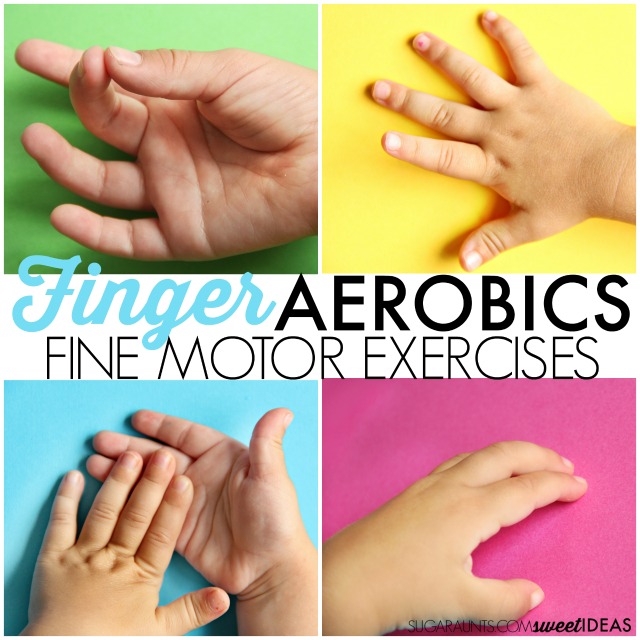
One strategy that is helpful in building fine motor skills in the classroom is finger aerobics. These finger motor movement exercises are activities that can be used by the whole classroom as part of a handwriting warm-up exercise. Kids with poor fine motor skills can oftentimes struggle with hand functions and tool use in the classroom. Finger dexterity activities like finger aerobics promote sensorimotor awareness and manipulation of the hands. Finger aerobics are ideal as a transitional movement activity for the whole classroom or a brain break type of activity.
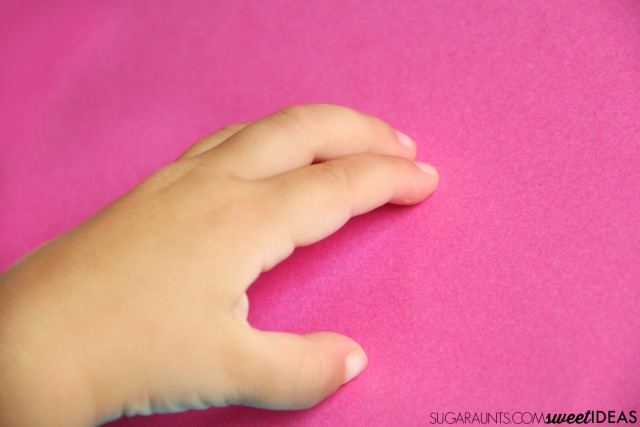
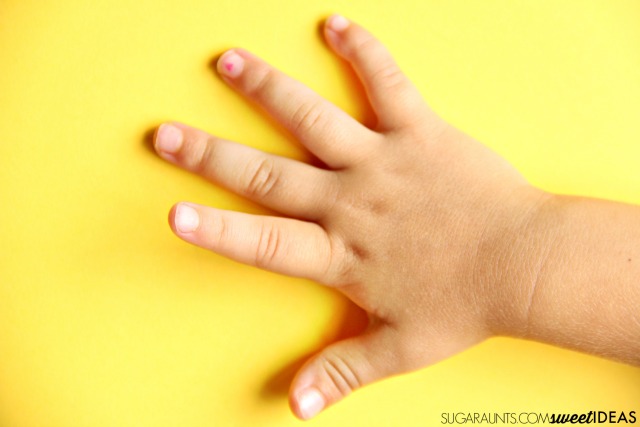
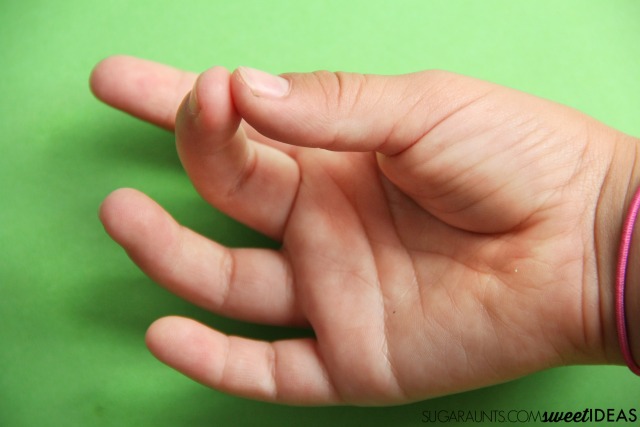
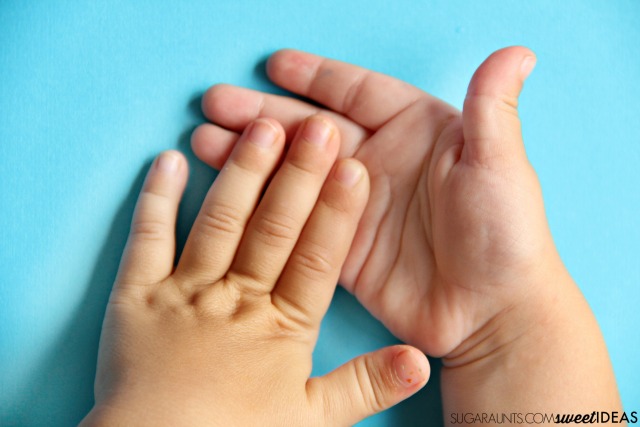
Check out the finger aerobics in the images and descriptions below:
Spider Push-Ups: Show the students how to place both hands together with palms and fingers touching. Then, show them how to push the hands away from each other at the palm. The fingertips should remain in contact.
Finger Pick-Ups: The students should stand at their desk and place their hands flat on the desk surface. They can then pick up each finger in isolation. Ask them to raise each finger from the desk surface 3 times and then pick up and hold each finger individually for several seconds.
Fingertip Touch: Ask the students to touch their thumbs to the tips of each of the fingers. They can do both hands at the same time or one hand at a time. Then, ask them to touch the tip of their thumb to the base of each finger. They can touch the tip or base of each finger at different speeds, as they spell words, or count in various increments. Next, ask them to touch the tips or bases of each finger with their hands held behind their back or out of their field of vision.
Finger Sounds: Ask the students to close their eyes. Then, the teacher or group leader can ask the students to listen carefully as she makes sounds with her hands. The teacher can make one sound and then ask the students to repeat the sound using their hands. Ideas include: rubbing the hands together to make a soft swishing sound, snapping, clapping, thigh slapping, finger tapping, or patting the desk. The students should keep their eyes closed as they repeat each individual sound.
Fist Squeeze: Ask the students to make a fist with both hands. Then, they should try placing their thumb in different positions and squeezing as hard as they can. Try the thumb at the side of the fingers, wrapped over the knuckles, and tucked under the fingertips. Show them how to stretch out the fingers and then repeat.
Spider Crawl: Ask the students to stand up behind their desks. They can then place both hands with the palm and fingers flat on the desk surface. Show the students how to make their hands “crawl” across the desk like spiders. They can move both hands together symmetrically and individually in different directions. Keep the palm lightly positioned on the desk surface.
Finger Muscles: Show the students how to use their other hand to provide resistance for squeezing. They can place their pointer finger or their pointer and middle finger of one hand on the outstretched fingers of the other hand. Ask them to squeeze their fingers and then to try to push against the fingers.
Writing Gloves: Ask the students to pretend to put a glove on their hands, slowly moving the glove over each finger. They should push each finger down individually. Then, they can remove that pretend glove, one finger at a time. This is an especially calming activity that provides proprioceptive input through joint compressions.
Finger Ducks: Ask the students to straiten the fingers and thumbs to create a “duck” puppet with just their fingers. They can make the duck open and close it’s mouth to spell words, count, or read. Then, ask them to pretend that the duck ate a lemon as they pull the finger tips into the palm. This is a great activity that strengthens the lumbrical muscles of the hands.
You can view all of the exercises here:
Be sure to visit the other Occupational Therapists and Physical Therapists who are writing about School Day Functions this month in the Functional Skills for Kids series.
More Fine Motor Activities that will build skills needed for Function and Learning in School:
Sierra Caramia, Amanpreet Gill, Alisha Ohl, David Schelly; Fine Motor Activities in Elementary School Children: A Replication Study. Am J Occup Ther 2020;74(2):7402345010. https://doi.org/10.5014/ajot.2020.035014
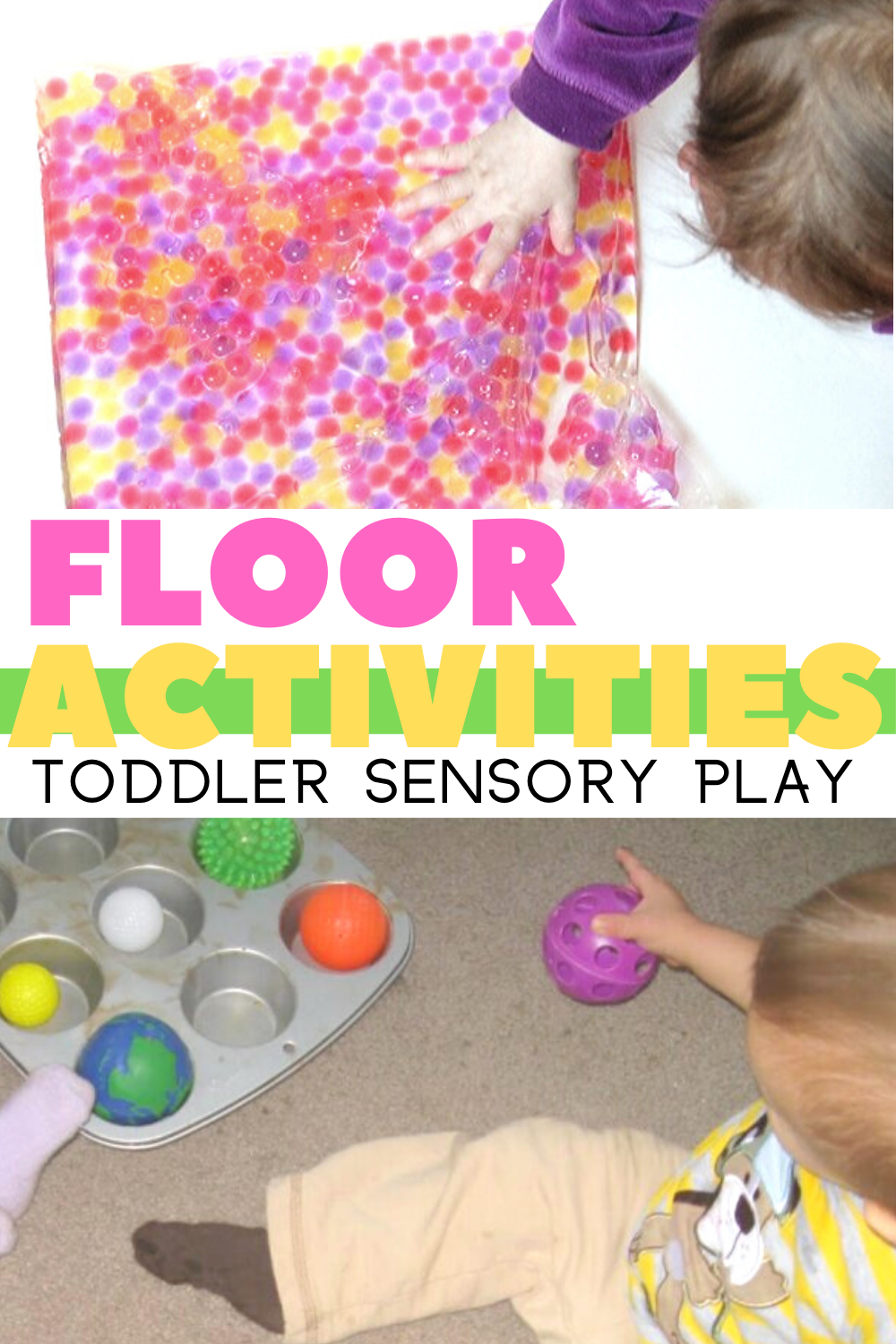
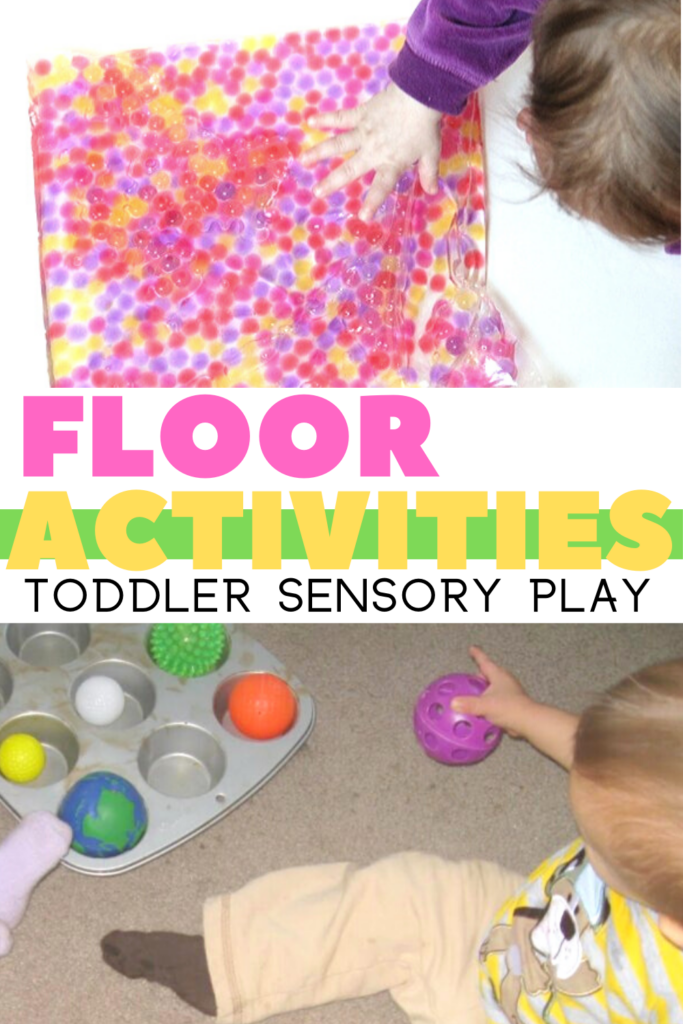
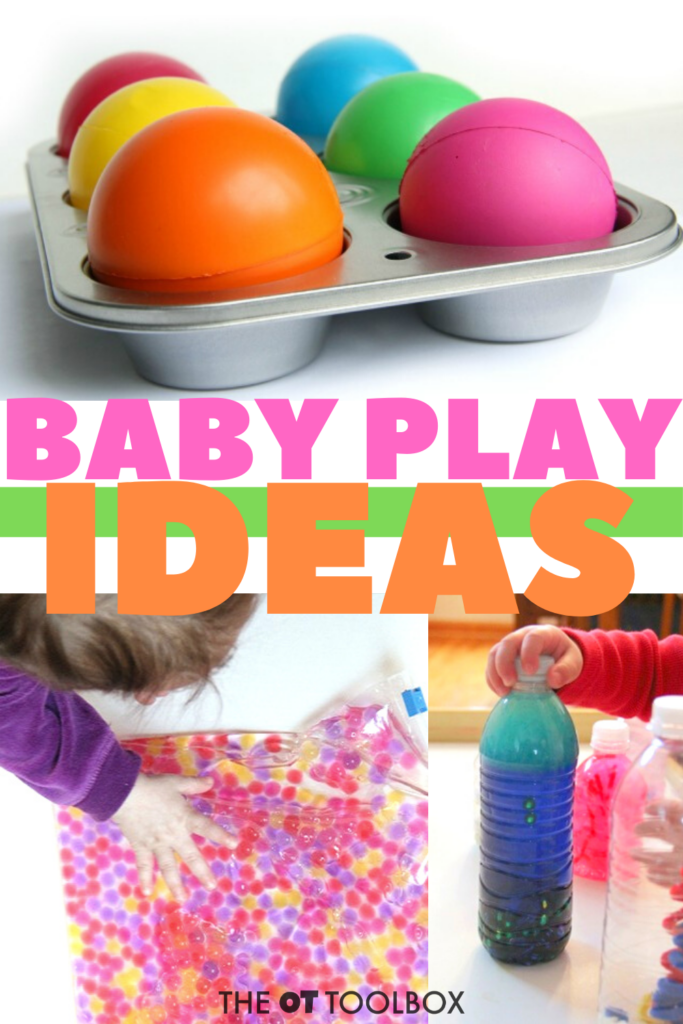
Baby floor play is one of those essential play activities that maybe kids are missing out on more than ever. Here we are talking about why babies need to get down on the floor to baby play, and how to set up floor play activities for babies and toddlers. Baby development depends on movement and play. These ideas will guide you in creating play activities that maximize child development through those early years.
Another great resource to check out is a new blog post on DIR Floortime.
What is Floor Play
Floor play and movement play is one of those things that not only help babies develop essential skills, it is a powerful way to help them excel with higher level tasks. There is so much more than just placing a baby down on the floor to play. Let me explain…
When little ones are on the floor in tummy time or in play activities, they are developing essential core strength and visual perceptual skills that will help them down the road in areas like reading, endurance in play, and even handwriting. Here is more information on how floor play and tummy time helps with the development of spatial awareness and other visual perception skills.
Time spent on the floor helps with kinesthetic intelligence as well. With tummy time play comes skills like body awareness and reasoning, eye-hand coordination, motor skills, and spatial ability for function.
Play For Babies
For babies, tummy time helps to build strength in the core, arms, neck, and shoulder girdle needed for sitting up, changing of positions, and coordination. Here are baby play ideas that can be incorporated into floor time activities. Movement like participating in play, changing positions, reaching, crawling, moving objects, and functional tasks require endurance and stability. Tummy time is an important task for infant babies as well as older babies for different reasons. In each stage, floor play encourages use of the body and eyes in coordinated motor plans.
More Floor Activities for Babiesand toddlers
Floor play for babies can look like toys placed in front of the infant. Using noise toys, rattles, and eye-catching toys encourages reach, visual tracking, neck and head movement, and development of visual processing and auditory processing.
Floor play for infants can look like a scattering of toys placed in a circle around the child. This positioning encourages turning, rolling, and creeping or crawling, especially when the little one is pushing up onf their elbows and hands.
For very small babies, floor play can look like getting very close to the child to encourage them to pick up their head and make eye contact.
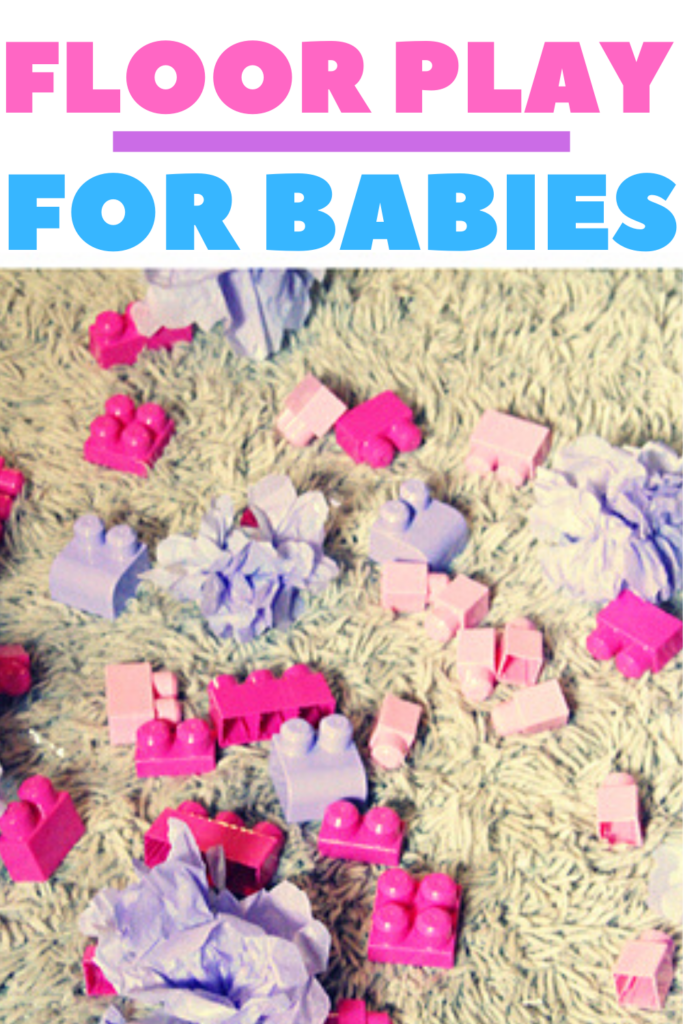
Older babies that are sitting up can benefit from a scattering of toys placed around them on the floor. Place pillows behind and around the baby and encourage them to pick up toys like large blocks as they bring the toy to their mouth to explore. Picking up and bringing items to the midline promotes endurance of core strength, stability in the core, and coordination as they reach and turn.
Playing on the floor can include baby mats or baby-safe mirrors. Check out this baby sensory play idea using mirrors for an easy way to encourage movement and endurance in floor play using everyday items such as cups, balls, and baby toys.
Babies that are beginning to crawl love play tunnels…and for good reason. Baby play tunnels are exciting and fun! But not only that, they develop skills like visual motor skills, cause and effect, visual scanning, visual convergence, and so much more. Here are more play tunnel activities for babies.
Try this indoor play idea that boosts development of skills such as fine motor skills, visual motor skills, and visual perceptual skills using toddler-friendly blocks!
Use large blocks or other baby toys in floor play for babies. Super easy!
Occupational therapists know the value of movement and playing on the floor has on babies. We know that babies need tummy time and a chance to move on the floor without use of the Bumbo seat, swing, and other baby positioners. We KNOW that play is the child’s primary occupation and that through play, they develop motor skills, cognition, language, and so much more.
That’s why I’m SO excited to share a valuable new resource for new and expecting moms.
Remarkable Infants is a HUGE resource for new parents. This online course, taught by 5 child development experts, is a 5 hour crash course on development of the whole child from birth through 12 months of age. It is literally everything that we WISH new parents knew about tummy time, positioners, developmental milestones, baby play, communication, sleep, and nutrition.
Want to make therapy planning easier? Want to help kids develop fine motor skills so they can hold a pencil, color, cut, tie shoes, and other motor tasks?
Your slide deck file should be delivered to your email inbox shortly. Don’t see it? Scroll below for answers to FAQ.
Need More Virtual Learning Slide Decks?
If you arrived here by accident and would LOVE to get a free slide deck, save this page and then grab any one of the free slide decks below. Or, if you’ve already accessed one of the slide decks, be sure to grab the others to add to your therapy toolbox!
When you open the PDF file in your email, you will see a document explaining how to open these slides.
First, make sure you are signed into your Google account.
Then, click on the button that says “CLICK HERE” on the PDF that was delivered to your email.
A page will come up prompting you to “make a copy” of the slide deck. Click Yes to confirm. Your copy of the slide deck will now be on your Google drive.
When you share the slides with students, make a copy for each student so they do not change your master copy. You could also make a single copy of your own master copy and use that with each student if you prefer. You will need to replace the movable slides back to their starting point if you do that option.
Please don’t change the url. It may edit all copies that others are using.
I can’t find the email with my slides. Help??
Once you enter your email on the slide deck form, you should receive an email containing a link to access a file in your email inbox. If you don’t see it right away, give it about 15 minutes. If you still don’t see it, be sure to check your SPAM folder or “other” folders. Still don’t see it? Run a search in your email to check for an email from The OT Toolbox. Some email networks, like those using an email ending with .org, .edu, .net, etc. may have this email blocked.
How do I use the interactive slide decks?
Some of the slide decks that you can access for free on The OT Toolbox have interactive components. Others are not interactive.
Interactive slide decks contain images that students can click on and move around on the slide. Students will be able to participate in interactive games in their therapy sessions/distance learning sessions by moving pieces on the slides to work on specific skills. They will need to be in “edit” mode for the interactive slide decks. The interactive portion will not work if you present the slide to students like it is a typical slide presentation.
How do I get the slide decks into “Edit” mode?
When you make a copy of the slide deck onto your Google drive, it will automatically create a copy that is in edit mode. If you are having trouble accessing these movable parts, you will want to make sure you have the slide in “edit” mode. In “present” mode, they will not be interactive. You may need to change the mode to edit and then the interactive pieces will be able to move on the background.
You should see a button to If you don’t see “edit” under the right hand drop down box beside the share button on the top right, and if you don’t see “edit” under the drop down menu under “view” at the top, you can still change to edit mode. Here is a YouTube videothat explains how to do so in a round-about way.
Can I use Google Slide decks on a Zoom session?
You can! While the slides will not be interactive in “present” mode, you can still access Google slides in Zoom. If they have access to a Google account (like a parent using that same computer, that opens up automatically when they click), you could change the settings so anyone with that specific link can edit, and then share that link with them. Here’s an explanation on how to share a document in Zoom to interact with Google Slides.
Arrive on this page by accident? Want your copy of the free “scribble day” occupational therapy screen deck to use in therapy sessions? Go here to access your copy of this letter formation/fine motor/gross motor letter formation teletherapy session.
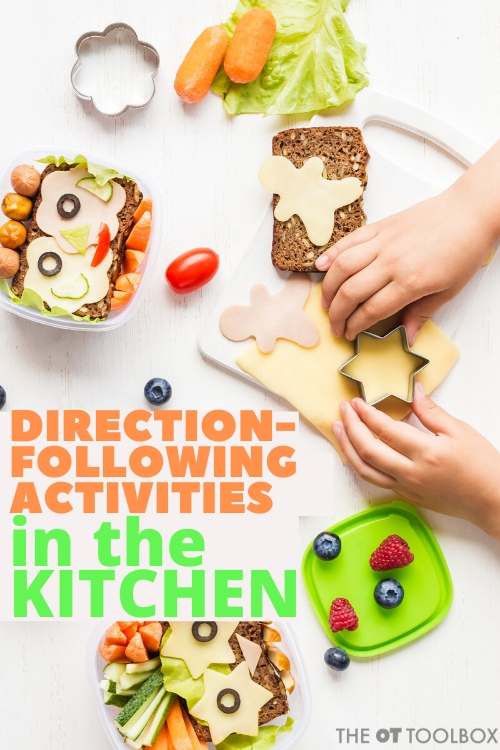
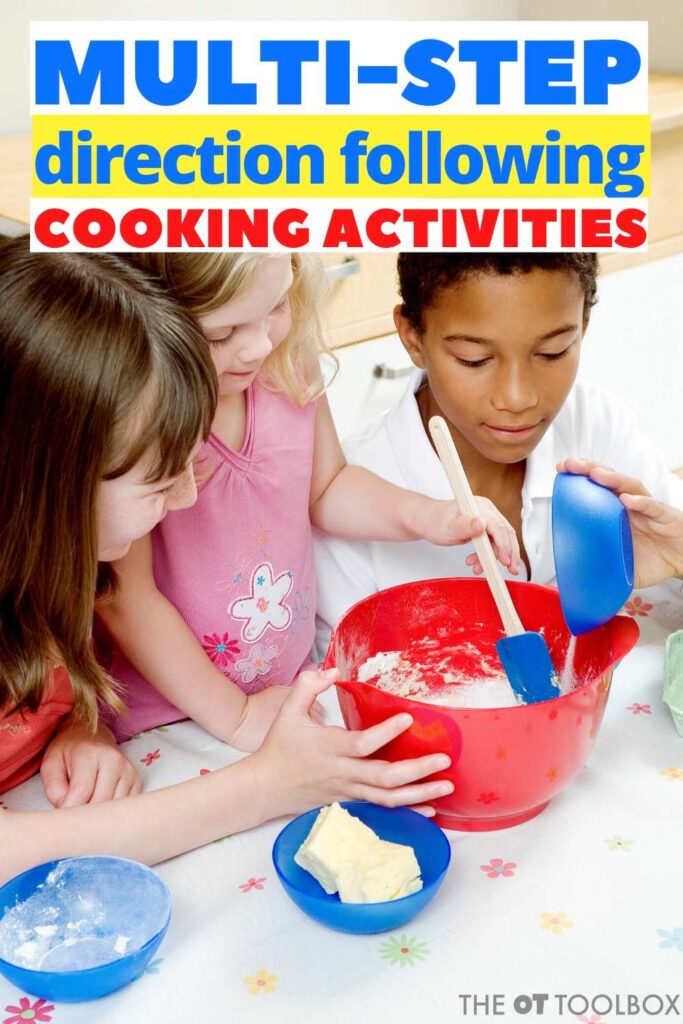
Did you know you can teach direction following with cooking tasks? It’s true! Teaching direction following can be tough! Kids and following directions is sometimes like pulling teeth, especially when it comes to completing tasks around the home. The bedtime routine or morning routine is just one example of where direction following is a struggle.
Helping kids with strategies to address multi step activities in occupational therapy sessions is one tool to work on direction following with kids. In fact, occupational therapy cooking activities is a great way to teach direction following with cooking by reading recipes with kids, and asking them to follow instructions at various levels.
Call it cooking therapy! Using cooking activities to higher level cognitive skills can be fun with delicious results! Below are a few ways to use cooking as a following direction activity that teaches skills.
Multi Step Direction following
You may see difficulties with direction following in every part of daily life with kids. You tell them to go upstairs to get dressed and they pull out their clothes, start playing and forget the getting dressed part.
Mom asks them to put their homework into their backpack and put the backpack away and she finds the homework on the coffee table and the backpack on the steps.
Following directions and childhood can be a real struggle! They get distracted, resist, or forget instructions and the tasks they were supposed to complete are half-way done.
So what is going on when kids have trouble following directions? Part of it may be executive functioning issues. Or, it could be that it’s just typical development of these skills. Kids can work on improving their direction-following abilities with multi-step direction activities.
Direction Following activities in the kitchen
Today, I’m sharing ways to teach direction following while cooking with your kids. Time, practice, modeling, structure, growth, and play can help with direction following. Today, I have tips, tools, and ideas to help cook with your child and work on direction following in the kitchen.
If you have been following this blog for long, you know that I love to get my kiddos busy in the kitchen. They are my little helpers; my ingredient-grabbing, dish-washing, egg-cracking, apron-clad cuties.
My favorite part of cooking alongside my kids, though? I love the one-on-one time (or usually, the group dynamic of more than one helpful child) while we cook a dish that we enjoy as a family. It’s productive and real-world creativity and meaningful time spent together.
Cooking with my kids provides time of memory building (and ALL four kids never forget to ask to lick the beaters when we bake…or that time the flour flew up out of the mixer and all over the fridge…).
But, not only are we cooking up memories together, we’re making fun dishes that my kids recall long after the dishes have been washed and the many (Oh, so many!) smudgy fingerprints have been scrubbed.
Besides all of these mommy -based benefits to cooking with my kids, there are the developmental and educational benefits of cooking with children.
The Occupational Therapist in me loves the sensory, fine motor, bilateral coordination, visual perceptual, and motor planning skill areas that are developed through cooking.
There are SO many skills that can be worked on through cooking. Every Occupational Therapist recalls their time in OT school where they assessed each step of cooking a grilled cheese sandwich with their pretend client…all of the fine motor, strengthening, endurance, cognitive, and physical aspects of a simple occupation of making lunch.
Today, I’ve got ways to work on direction following by cooking with your kiddos!
These ideas are perfect for working on specific skills. Add them to a cooking group for kids or to therapeutic cooking classes for kids.
Use the specific direction-following strategies listed here to work on skills like planning, prioritization, and task completion by reading recipes and other kitchen tasks.
Teaching Direction Following with Cooking Activities
Cooking activities in the kitchen provides unique opportunities. Kids can practice skills that are needed to imagine, prepare, create, and serve food.
Each step of cooking requires attention to detail to prevent skipping steps or dangerous situations with sharp knives or hot stoves.
Adults can help with direction following in recipes and food prep/cleaning up in many ways.
Tips to help kids with direction following:
Model appropriate behaviors.
Rehearse parts of the cooking process. This is especially ideal for safety concerns, like handling sharp tools or managing the stove.
Verbal, visual, or physical prompts for appropriate behavior during cooking tasks.
Practice turn-taking with tasks like stirring and mixing ingredients.
Organize a child’s participation with written directions. Some kids might need picture sequencing cards or social stories before beginning a cooking task.
Break down tasks into smaller parts. Children can sequence parts of the task before starting. Use different techniques (written directions, picture cards, strips of paper with directions written out. The child must sequence the steps of a task before starting on the cooking process.
Verbally tell your child one direction at a time to work on verbal direction following. Allow them to complete the tasks successfully, then add more complex or multi-step directions. Add more details slowly and don’t add more until they are successfully following the next level of directions.
Provide a written checklist for kids. They can mark off completed tasks.
Together with your child, draw out the parts of a recipe. A visually organized list is better for some kids.
Practice direction following with a simple task that the child knows how to do. If they can pour their own cereal and milk, instruct them to tell you or another child each step of the task. Act out or perform the activity as your child tells each step. They will be able to see any mistakes and self-correct, or correct their directions with a little prompting. Telling the step-by-step directions to another person is a great way to practice direction following.
Discuss transitional words like first, second, third, last. Write out directions for a task like washing hands. Have your child sort the directions into order using the directional words.
More benefits to cooking with kids:
Problem solving in cooking can carry over to other areas like self-care and management of personal items.
Improved self-confidence.
Communication and language development while talking about ingredients.
Functional practice of life-skills.
Strengthened family support system through team working on a collaborative task.
Personal and family well-being development.
Sensory exploration of new or different tastes, scents, and textures.
Proprioceptive input while cutting vegetables, kneading bread, stirring ingredients.
Conversation turn-taking
Self-management.
Improved self-confidence.
Exploration of self-identity.
Individualized modifications can be made to meet the child’s needs and abilities.
Meaningful tasks encourage carry-over of practiced skills.
The kitchen is a natural environment and functional work here will lead to carryover of practiced skills.
Cooking with various textures, colors and scents will encourage kids to try new foods.
Tool use and practice.
Now, Take the Direction Following out of the kitchen!
So, you’ve worked with your mini chef on all of the tasks involved with cooking a recipe (or washing dishes, chopping fruits, getting out needed ingredients…whatever is appropriate for your child!) and now what?
How do you help your little one to brush their teeth when they are told without accidentally getting distracted and messing in the toilet water as their toothbrush sits untouched? (Only real-life examples here, folks!)
Carryover the skills you’ve worked on with your kiddo in the kitchen into other areas. Use what’s worked and use those same tips that I shared above in all areas.
Sequencing cards, one step directions, activity breakdown…they can all be used in other jobs, too.
Use the ones that work and modify the ones that don’t. The best thing about cooking and working on direction following is the tasty reward to getting the job done, the together time, and the meaningful time.
Use that to work on the tricky direction following skills and then try them in other areas.
One way to support development of direction following skills is to start simple! Use this lemon lime popsicle recipe to get started. There are only a few ingredients and kids can pour, scoop, and place items into the popsicle molds.
Cooking and food preparation is a task that is done daily in households.
Cooking in the kitchen is an opportunity or learning and development that can be done every day. Practice some of these tips and hopefully, you will see some direction following development!
This post is part of my 31 Days of Occupational Therapy series where I’m sharing 31 days of activities that use free or practically free treatment materials.
While cooking and ingredients are certainly not free, food prep and meals are something that must be done every day. Use the opportunity to learn and explore with your child! The memories (and hopefully not flying flour!) will follow.
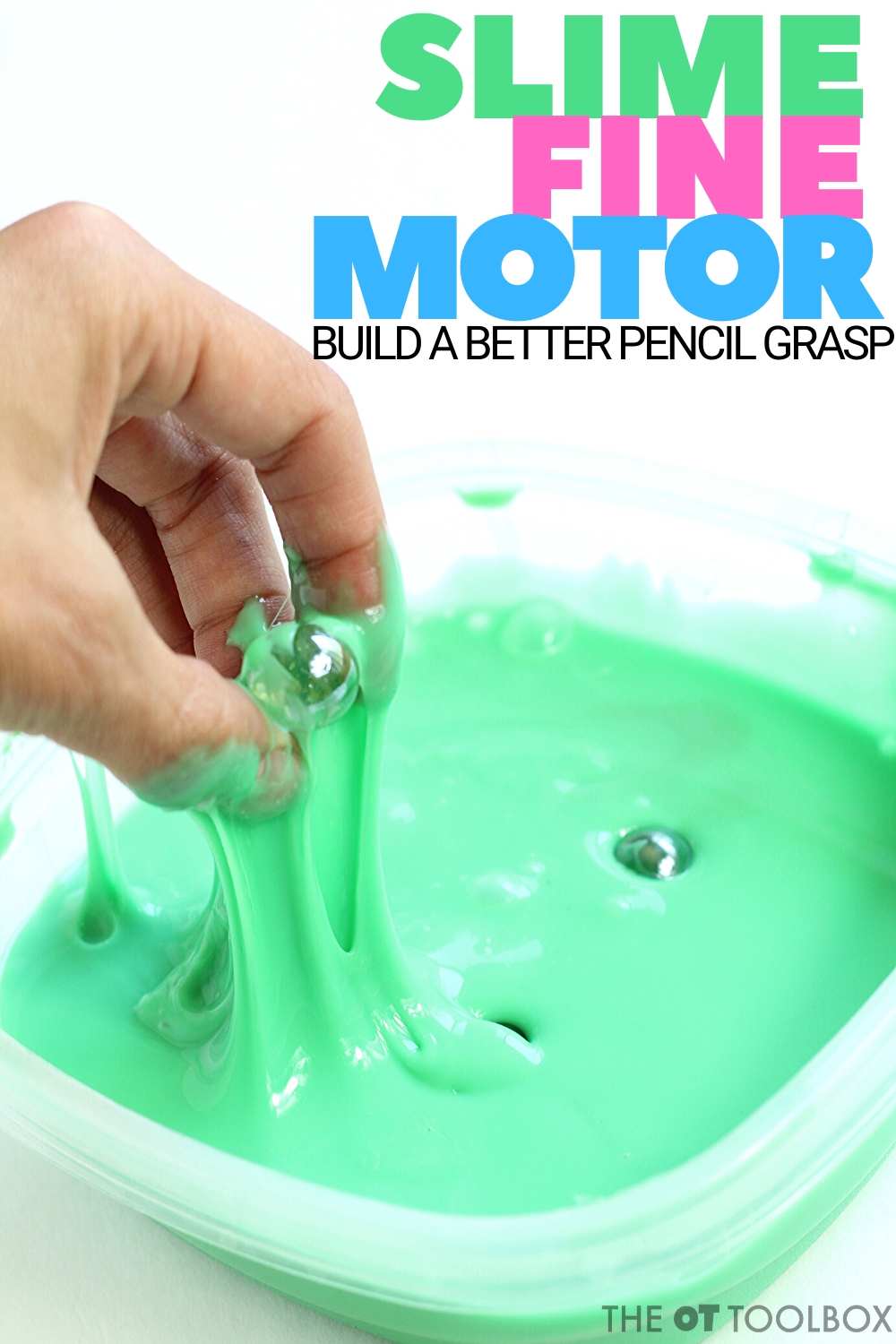
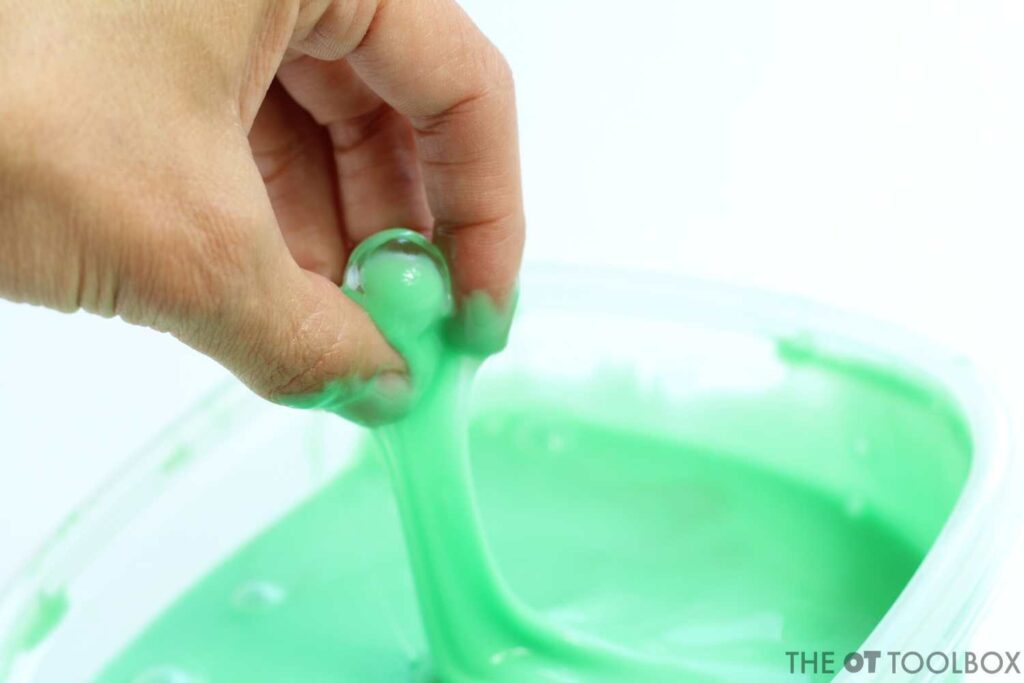
Working on pencil grasp? Or are you looking for a fresh fine motor activity that builds pencil grasp in kids? This slime fine motor activity is just that. It’s a fun and messy way to strengthen fine motor skills needed for a functional pencil grasp…using slime! You may have read the title of this blog post and thought “What does slime have to do with a pencil grasp activity?” Well, this slime activity sure does meet the requirements for fine motor activities that double as pencil grip activities. Read on!
Slime Activity
Do you have kids that are still loving slime? We’ve made a lot of slime activities in our days, including a slime exercises, a great way to build hand strength in a fun way. We’ve even practiced handwriting using cursive letter beads for our cursive letter slime activity. One of our favorite slime activities was cutting it with scissors as a scissor skills activity.
When it comes to working on writing and pencil grasp, however, some of these activities play a part in building a better pencil grasp. Slime is a great way to work on intrinsic hand strength and fine motor skill development. If you’ve ever played with slime, then you might know why.
Slime has a consistency that is a pretty sticky. It sort of molds to itself and spreads at the same time (weird, right?) so that when it’s near the edge of a table, it spreads and then strings down to the floor in a long strand. (Which if your table is over a rug or carpet, grab that carpet cleaner!)
Slime Activity to Build Fine Motor Skills
This slime idea uses any slime recipe. You can find tons of homemade slime recipes online. We made homemade slime when we made a slime writing tray, but this activity focuses on strengthening the fine motor skills needed for skills like pencil grasp, manipulating items like buttons and snaps, or other functional tasks.
This activity uses regular slime just two materials. Here are Amazon affiliate links so you can set this activity up:
Small Container– Use one with a lid. A smaller-sized container requires a smaller space to manipulate with the hand, providing a strengthening opportunity.
To set up this slime hand strengthening activity
Use slime to work on fine motor hand strength
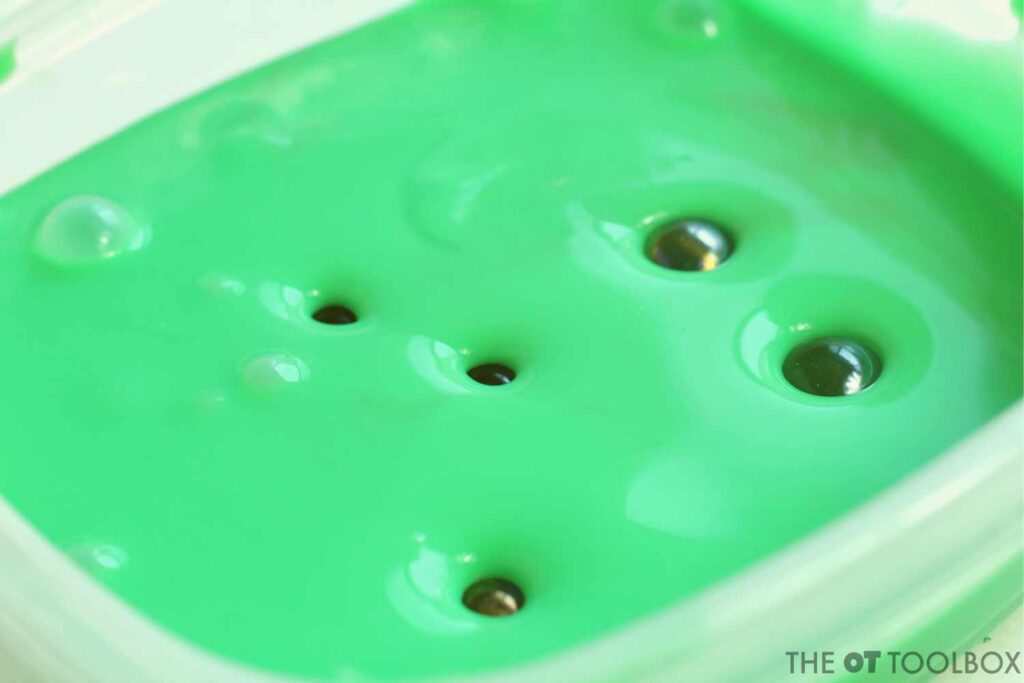
Place slime into a container.
Use a reusable food storage container such as a Rubbermaid food storage container. This allows the activity to be used over and over again.
Add clear marbles to the slime.
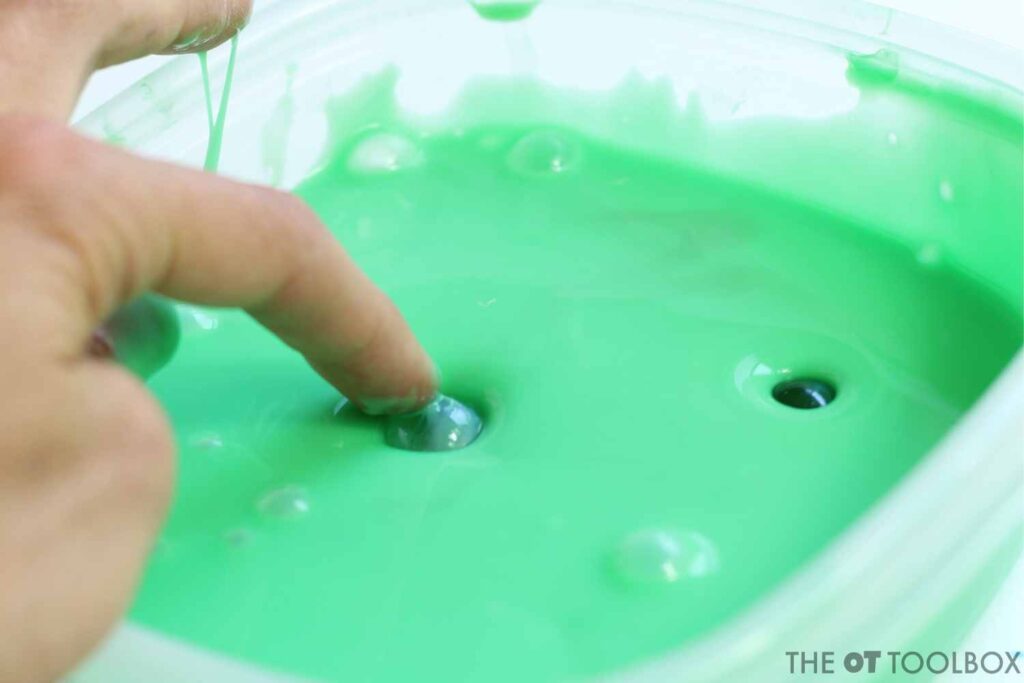
Students can press the marbles down into the slime using one finger. This is a great finger isolation activity. Read more on what finger isolation is and why this important fine motor skill matters so much.
Move those marbles! Use the fingertips to find and locate a marble in the slime.
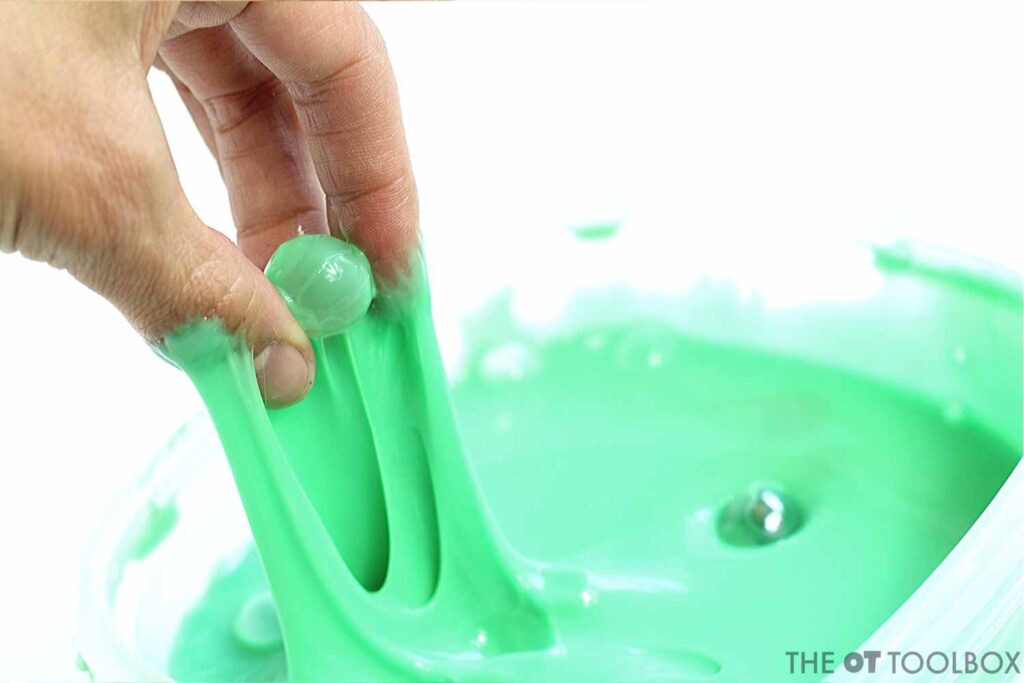
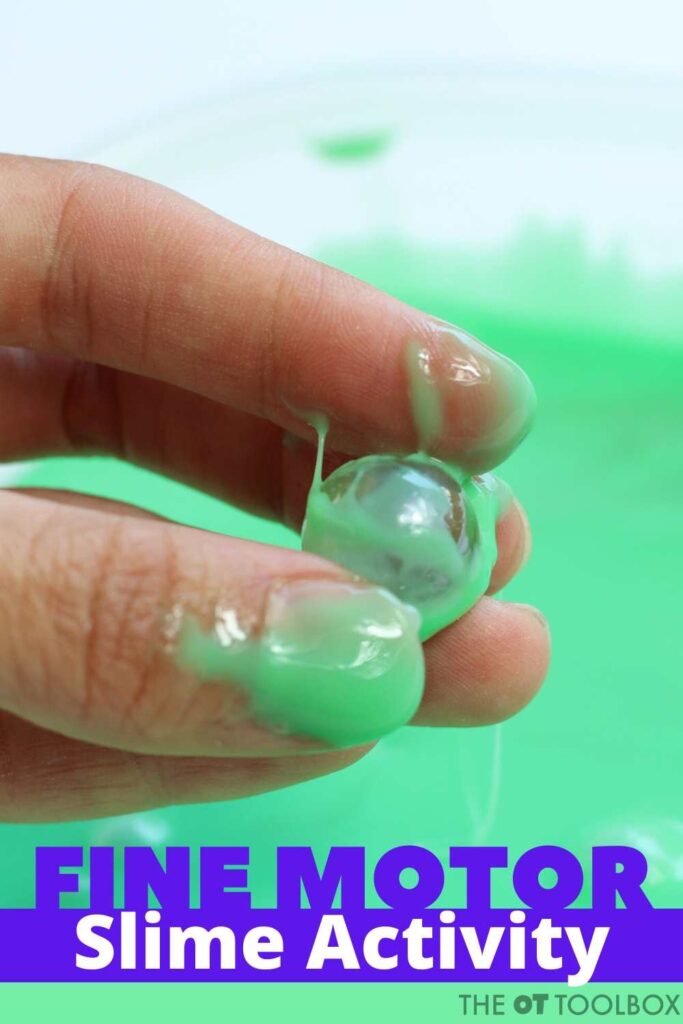
Once you find a marble, use the fingertips to pull it out of the slime. Pulling a marble from the slime requires strength, but also works to improve that hand strength. Because the slime is in a smaller container, the arches of the hand/intrinsic hand muscles have to work to maintain grasp against the pull of the slime.
Remove slime from the marbles.
This is the messy part…in a good way! Use the fingertips to pull and remove slime from the surface of the marble. This is another way to strengthen and improve endurance as well as dexterity in manipulating with the fingertips.
Do it again!
Once you’ve located all of the marbles, press them back into the slime. This is a great hide and seek activity that can be passed on to another client or to use in the next therapy session.
Use slime to work on finger isolation and other fine motor skills.Slime is a great way to work on arch development and intrinsic hand strength.
Grade this Fine Motor Strengthening Activity
You can adjust this activity to make it harder or more resistive for those building their hand strength. It can be downgraded as well to make it easier for those needing an easier fine motor activity.
Adjust the resistance of the slime- add more liquid to make the slime easier to manipulate. You could experiment with adding other materials to hold the slime, making it easier to remove from the marble. Some ideas include foam balls, glitter, flour, or other materials. This collection of slime add-ins is a good way to experiment.
Add resistance by leaving the slime exposed to air for several hours. This will make the slime more rubbery and harder to manipulate.
More Slime Pencil Grasp Activities
Working on the fine motor skills needed for a functional pencil grasp doesn’t need to be boring and predictable. Using slime to work on these essential fine motor skills can make pencil grasp tasks fun. We’ve used beads with cursive letters as a slime add in to help with fine motor skills. Kids can use beads like these ones to find and then remove the slime to work on those pencil grasp strengthening skills. Then, practice copying the letter. Extend the activity by asking them to write a word that starts with that letter. The options are endless with an open-ended slime activity like this one.
Want to Take pencil grasp to the next level?
Join our free, 5 day pencil grasp challenge! We’re talking all things pencil grasp with fun and easy activities designed to build a better pencil grasp. Join in on the fun!
There are so many ways that executive functioning in school environments impact learning, peer interactions, and participation in the classroom. The back to school season, or any transition in school can be chaotic for kids, but it can also be a great time to work on executive functioning skills in a practical way! From shopping for supplies or creating a countdown, to getting on the bus that first day, the options for working on executive functioning in school situations are endless. Continue reading for more information on executive functioning in the classroom.
Every year at the end of summer, there tends to be two “camps”—those who cannot wait to get back into the classroom and those who cannot wait for next summer! Regardless of the type of child you may have, executive functioning skills are critical at every age as this season approaches!
The thing is that as occupational therapy providers, we can see all the ways that executive functioning skills impact learning. I’ve worked with students at all grade levels on impulse control, organization, attention, and working memory. These executive function skills impact participation in the classroom and things like gathering materials, staying on task, walking in a line through the hallways, cafeteria skills, and so much more!
While OT is not the only profession in the school system that addresses these skills, we can support students. Some of the ways that executive functioning development is used in everyday tasks at school are listed below.
Organization: Students need to organize their materials, such as books, notebooks, and assignments, to keep track of what they need for each class. We as occupational therapy professionals can make suggestions for desk and locker organization, support students with technology for organization, and suggest systems like using folders or binders for papers, and keeping a planner or digital calendar to track assignments and deadlines.
Time Management: How many times have you seen a student struggle over and over again with prioritizing the school assignments on a short list of tasks? I have! The thing is that time management impacts learning, especially when students struggle to prioritize tasks, estimate how much time each task will take, and allocate time effectively is crucial. One way to support students is to provide tools to help them balance homework, studying, extracurricular activities, and leisure time while meeting deadlines for assignments and projects.
Planning and Prioritization: Planning and prioritization in the schools is a big area! Students must plan out their academic tasks, break larger assignments into smaller, manageable steps, and prioritize tasks based on deadlines and importance. This involves setting goals, creating action plans, and adjusting plans as needed.
Working Memory: You’ve probably seen working memory struggles in the school environment. Students need to hold information in mind while completing tasks, such as following multi-step directions, solving math problems, or writing essays. This area of executive function in school environments means students might struggle to retain information temporarily and manipulate it to perform cognitive tasks.
Self-Regulation: We’ve covered this area of executive functioning because it’s a huge area of development for kids. Self regulation and executive functioning is a major area of development. Self regulation naturally includes managing emotions, impulses, and behavior in various situations. We can help students to stay focused on tasks, resist distractions, regulate their frustration when facing challenges so they can use appropriate behavior in the classroom.
Flexibility and Adaptability: There’s one thing about the classroom and school environment; it’s constantly changing! Because of this, we might need to support students to be flexible and adapt to new schedules, routines, and academic expectations. There are many ways we as occupational therapy providers can help students to be flexible in their thinking and problem-solving approaches so they can roll with the unexpected!
Initiation and Goal Setting: The school setting requires students to initiate tasks independently without constant prompting from teachers or parents…and this is part of development that is a challenge for some! This involves setting academic and personal goals, breaking them down into actionable steps, and following through to achieve them.
Metacognition: Executive functioning development occurs over decades, and metacognition is an area of constant development. For our students, it can be a real struggle to reflect on their own thinking processes, monitor their progress, and make adjustments as needed. Metacognitive skills help students become more aware of their strengths and weaknesses, leading to improved learning strategies and academic performance.
Developing these executive functioning skills supports academic success and overall well-being, so it makes sense that we as the OT professionals help.
Remember that executive functioning skills are essential for success in school in many ways, including with regulating emotions and social and emotional skills. This is one area that OTs can cover with their students, too.
Executive Function IEP Goals
When we talk about executive functioning in schools, I definitely need to mention IEP and 504 plan goals. Executive functioning goals for the IEP will depend on the age and level of the student that an occupational therapist is evaluating. IEP goals will also be written for the functional needs that impact learning. So, each child will definitely be different when it comes to their IEP goals.
As an occupational therapist, I’ve seen executive function IEP goals that are written around many areas:
Messy Desk
Disorganized Locker
Lost Homework
Difficulty Following Directions
Procrastination
Impulsivity
Inconsistent Performance
Difficulty with Test-Taking
Trouble with Long-Term Projects
Limited Problem-Solving Skills
Cafeteria Issues (e.g., difficulty choosing healthy options, managing time to eat)
You might want to check out our resource on self regulation IEP goals because regulation and EF are so closely related.
Also check out our resource on the differences between an IEP and 504 plan.
Executive Functioning in Preschool
Think preschoolers do not need or have executive functioning skills? Think again! Studies show that critical development in this area starts far earlier, but especially strong growth occurs during the preschool years.
As your preschooler starts to prepare for the start of the year, consider the following ways to work on executive functioning development in a positive, age-appropriate approach. By doing so, you give them the chance to start the year out strong!
Provide opportunities for play dates, perhaps with classmates, to work on emotional control and problem-solving skills.
Begin adjusting wake and bedtimes about 1-2 weeks prior to school starting so that your child can be acclimated before that first day, avoiding any difficulties with initiation or shifting attention.
Encourage your child to select their own school supplies, giving them 2-3 items at a time to retrieve in an aisle for their working memory!
Model coping strategies, especially if this will be your child’s first exposure to the school setting, addressing emotional control and self-monitoring.
Allow your child to help pack their snack or lunch for the day.
teach kids about age-appropriate self control. This skill is needed for every stage of the student’s educational career!
Calm down toys are a good way to teach kids about impulse control at this age.
A child’s independence increases exponentially during the elementary school years. Start off the year on the right foot with these activities!
Executive functioning in elementary years impact a log of different areas of the day to day.
One area of consideration is executive functioning skills and handwriting. Because students are learning to write more and are required to write…often without a true handwriting curriculum, we might see real issues in this area.
Help your child develop self-reflection skills by discussing what they thought was the best part of summer, their least favorite part, what they are most excited for with school coming back in session, and what they are nervous about with the new school year.
Provide opportunities for impulse control, planning, and working memory by giving your child their supply list and allowing them to check items off as they place them in the cart. You may need to model components, such as having a notebook/folder set of particular colors.
Encourage your child’s organization skills by having them label their school supplies with their name and pack their backpack
Give your child the opportunity for more independence and accountability to pack their own lunchbox. You can still have some control in this by organizing your refrigerator and pantry with designated labels, such as taking one item out of each container on the bottom shelf.
The middle school years are filled with so many changes! Occupational therapy in middle school work on many areas of executive functioning that impact function in the classroom and middle school environment.
Middle school students have a lot of changes going on, and we might see impulsivity at work. Teaching foresight is important because we can help kids make good choices for their own safety as well as education.
Help your child prepare for these changes by integrating some of these activities:
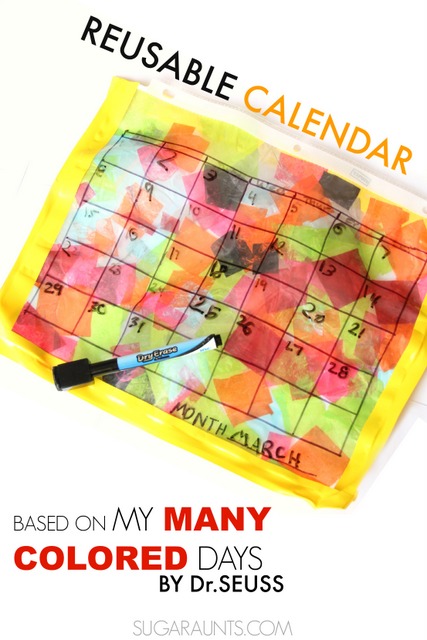
Use a calendar to set up regular family meetings, including all members of the household. This allows for communication lines to be kept open, preventing any major hiccups, while promoting your child’s ability to manage their impulses (interruptions, especially!) and control their emotions, along with reflecting on things that might need to be changed.
Begin allowing for more and more independence with tasks, such as packing up their backpack each night, fading back prompts with homework, and encouraging their use of a planner.
Provide opportunities for developing self-advocacy, having your middle school direct communication with teachers versus jumping in yourself when conflicts arise. While you are still there to support your student, this is a life-long skill that they will thank you for later!
Teaching middle schoolers about self reflection is important because we can help them see that they have choices in their school day, especially when it comes to completing assignments and not falling to peer pressure.
Executive Functioning Skills in High School
Your child is now off to high school! This is a pivotal time in a teenager’s life—an opportunity for them to prepare for adulthood while still having the active support of their family. Our resource on high school occupational therapy covers more on this area.
Check out these ideas to encourage continued growth in executive functioning skills as your high schooler heads back to school.
Have a teen driver in your house? Let them drive to the store with their school supply list and get their needed supplies! If you will be paying for the supplies, send them with an allowance to promote money management. For an additional challenge, give them a set time that they need to complete their shopping in to promote time management!
Continue to encourage your teenager to manage conflicts or difficulties with teachers themselves prior to jumping in, because soon, they will not be living in your house and will need to do this themselves!
Allow your child to have more of a say in which electives they take. This is a great opportunity for exploration—you never know what class might pique their interest for a future career.
Provide opportunities for your child to learn multiple note-taking methods to organize information in classes.
More help with executive functioning in kids
Executive functioning skills develop throughout a child’s school years. If you’ve ever wondered how to improve executive functioning skills, hopefully this resource has helped.
Kids of all ages (including adults) can use The Impulse Control Journal to work on self-regulation, self-control, planning, prioritization, and executive functioning skills in everyday tasks. These hands-on journaling sheets are perfect for all ages. Grab the Impulse Control Journal here.
Colleen Beck, OTR/L has been an occupational therapist since 2000, working in school-based, hand therapy, outpatient peds, EI, and SNF. Colleen created The OT Toolbox to inspire therapists, teachers, and parents with easy and fun tools to help children thrive. Read her story about going from an OT making $3/hour (after paying for kids’ childcare) to a full-time OT resource creator for millions of readers. Want to collaborate? Send an email to contact@theottoolbox.com.
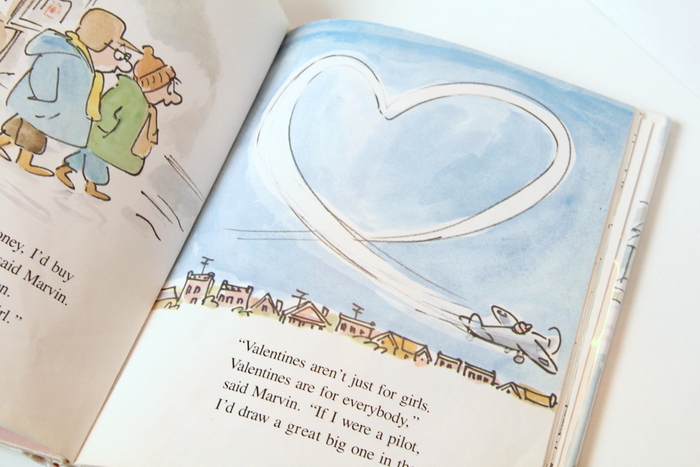
Have you read the book, One Zillion Valentines? It i such a cute Valentine’s Day book for kids. We read the book and made a Miniature Candy Heart Valentine based on the book a few weeks back. That same day, we made this airplane valentine craft too, because we loved this part of the book! Valentines Day crafts are a fun way to work on certain skills in a way that is motivating for kids. This window cling Valentine’s Day craft we made years ago is a fine motor powerhouse, a lot like this airplane craft.
This is just one of the Valentine’s Day occupational therapy activities here on the website. Use this heart craft to work on skills like fine motor strength, dexterity, direction following, and more.
Valentines Day craft for kids
Valentines Children’s Book Activity
Pairing a book with therapy or when working on skills with kids is a fun way to open up conversation, problem solving, and strategizing to create a project or activity based on the book. This Valentine’s Day book for kids is just that. One Zillion Valentines is one children’s book that pairs nicely with a fine motor craft for kids. This post contains affiliate links.
Valentines Day Book Activity
One Zillion Valentines is one fun book for kids around Valentine’s Day. We love this part of the book…the message and the images! We decided to make our own airplane craft for Valentine’s Day.
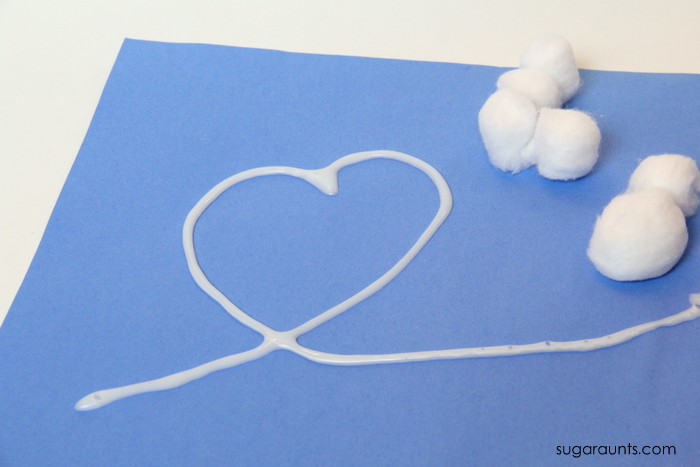
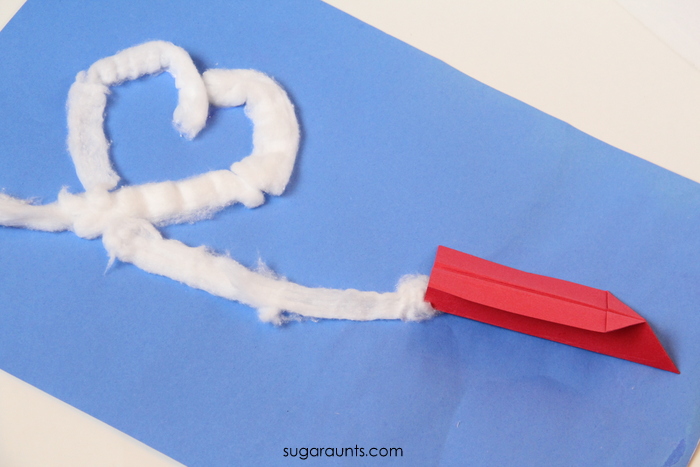
First we drew a big glue heart on large blue paper. Be sure to use squeeze glue for strengthening the hands.
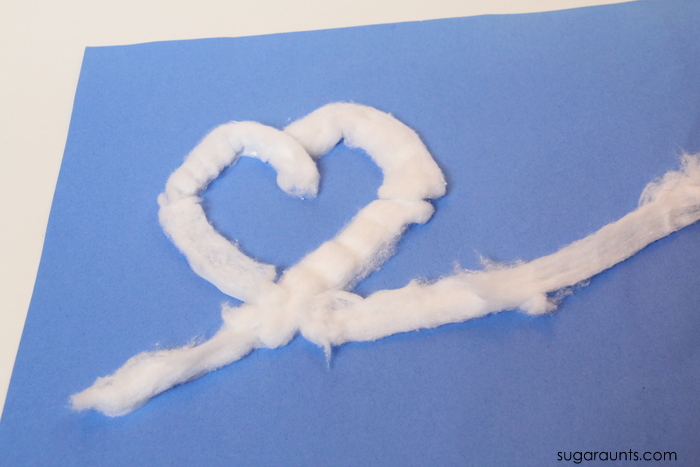
Grab a handful of cotton balls. Some brands of cotton balls are rolled and you can pinch and unroll the layers of cotton. This is a great fine motor activity for kids! Other brands of cotton balls can be pinched apart into strands.
This is ALSO a great fine motor activity for kids! Pinching and pulling the cotton balls apart works on the intrinsic hand strength of the small muscles of the hands. These are the muscles that are located within the hand and are essential for endurance during writing and coloring tasks while holding a writing utensil with an open web space.
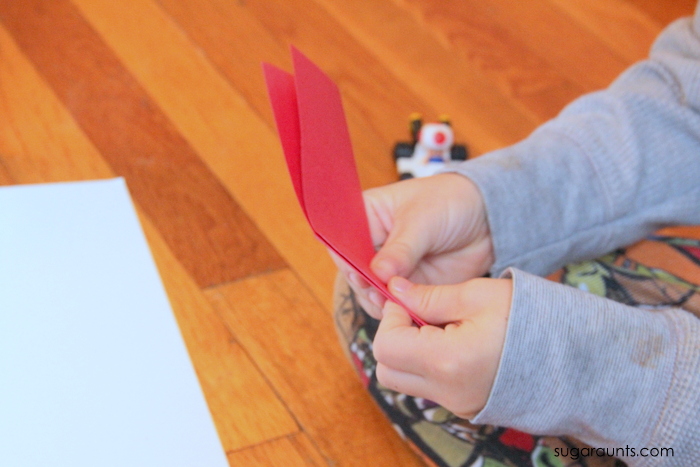
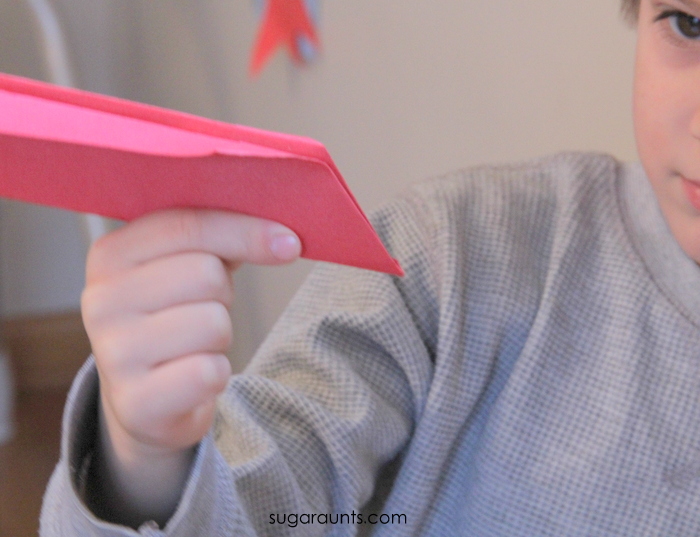
Make a paper airplane from red cardstock. My Little Guy (age 5) was totally into following a step by step example to make his own airplane.
Glue the paper airplane onto the trail of Valentine smoke and you’ve got a super cute airplane craft! Keeping the cotton strands on the glue is an exercise in eye-hand coordination.
This is a great craft that doubles as a book extension activity AND a means for working on specific skills.
How to make this Valentine’s Day Craft:
Time needed: 15 minutes
Make a Valentine’s Craft based on One Zillion Valentines.
Create the background of this Valentine’s day craft.
Use squeeze glue to draw a big swoop on blue construction paper. This will be the clouds following the airplane.
Use cotton balls to make clouds.
Stretch out the cotton balls using both hands. This is a great fine motor workout.
Make a paper airplane.
Use red paper (if you have it) to match the book. Fold a paper airplane by bending the paper in half and folding the top of the page into a point. Fold in half again. Bend the wings down in the opposite direction. It can help to make a paper airplane along side your child so they can copy each step.
Glue the paper airplane onto the page.
Add the paper airplane at the end of the cotton clouds.
More Valentine’s Day Activities for Kids
There are many Valentines’ Day activities here on The OT Toolbox that double as fine motor and visual motor powerhouses. Check out some of these Valentine’s Day themed activities for therapy:
Colleen Beck, OTR/L has been an occupational therapist since 2000, working in school-based, hand therapy, outpatient peds, EI, and SNF. Colleen created The OT Toolbox to inspire therapists, teachers, and parents with easy and fun tools to help children thrive. Read her story about going from an OT making $3/hour (after paying for kids’ childcare) to a full-time OT resource creator for millions of readers. Want to collaborate? Send an email to contact@theottoolbox.com.