Count and Color Worksheet

Count and color worksheet

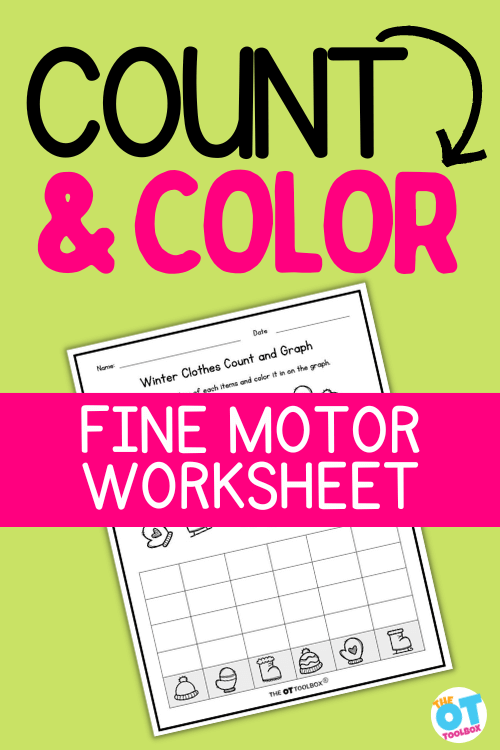
If you are looking for a free count and color worksheet, you are in luck. Today, we have a counting and coloring printable that supports development in kids of all ages, with functional tasks. Not only are we covering number recognition, math skills, and fine motor work, but also motor planning, visual scanning, visual discrimination, and more! You’ll want to add this count and color worksheet to your therapy lineup! 

Count and color worksheet

Looking for a consistent way to support fine motor skills all year?
This yearlong fine motor system includes seasonal activity kits and monthly data collection tools to support planning and progress monitoring.

If fine motor planning and data collection feel overwhelming, you’re not alone.
This done-for-you yearlong bundle organizes seasonal activities and monthly screening tools in one system.

Get the Yearlong Fine Motor and Data Collection Bundle today!

Free Count and Color Worksheet

    Are you interested in resources on (check all that apply):
    We respect your privacy. Unsubscribe at anytime.

    Count and Color Worksheets

    Printables like the one below are great for preschool, kindergarten and every grade, depending on the needs of the student. We love coming up with fun worksheets that support a variety of skills and abilities using the same worksheet, so you can print out one set and then use it with your whole caseload in therapy sessions.

    This is just one more of our free resources that support skills. (Like teaching coloring skills). Check out all of the free printables on the site for different worksheets, printable activities, and tools for a variety of skills.

    Count, color, and play!

    Elementary educators will love this count and color activity, too.

    Make this printable just part of your winter plan.  While not effortless, having a plan makes the long winter months a little more enjoyable.  The OT Toolbox has several winter worksheets debuting this month to add to your treatment plan.  Add this to the fun activities and crafts offered, and a well rounded plan can be developed.

    Why use a count and color worksheet?

    What skills does this winter count and graph worksheet address?

    As always, an excellent activity is one that is effective, efficient, meaningful, relevant, and measurable. This winter counting printable works on multiple skills in one activity all by counting the number of pictures, coloring in the similar shapes and forms, and writing in the correct number of items. 

    Some fun ways to use this printable tool to count and color:

    • Coloring inside the lines with full coverage (crayon control and fine motor skills)
    • Cutting on the line, within half inch of lines, in the direction of lines – teach your learner to bubble cut or cut large circles around each object before cutting them into their finer finished product (scissor skills)
    • Pasting using glue stick or drippy glue with accuracy (tactile defensiveness)
    • Counting one to one correspondence
    • Visual scanning, visual discrimination, visual figure-ground, visual memory, and other skills
    • Categorizing by clothing type
    • Sorting (like this color sorting activity)
    • Fine motor strengthening, hand development, and grasping pattern
    • Core strength to sit at a table, with shoulder stability and wrist support
    • Following directions, attention to detail, turn taking, waiting, social skills, compliance, behavior, and work tolerance
    • Visual perceptual skills to determine visually which shape the learner is looking for.  Figure ground to be able to pick out these items from their background. Visual scanning to look at all of the shapes, visual attention to follow where the shapes are going to go.
    • Bilateral coordination holding the paper with one hand while coloring, stabilizing and turning the paper for cutting skills

    Various ways to use a count and color worksheet

    How do I modify these count and color tasks for varied learners?  

    Most likely your caseload or class has young learners with varied levels of skills and abilities.  Modifying this task for multiple users is a more efficient way to plan your treatment.  Using a handful of tasks for the whole week is much more productive than 40 different activities.

    • Color and laminate the page ahead of time, and precut all the shapes to eliminate cutting and coloring
    • Add velcro dots to make this reusable, and work on task completion as well as fine motor control
    • Place small objects such as beads, balls of play dough, coins, or other small objects onto each item that is the same on the worksheet. Then, count the number of each item and color in the bar graph at the bottom of the page to determine how many of each item were found. 
    • Work on number formation by writing numbers in each space on the bar graph. Start at the bottom by writing 1. Then on the next level, write 2 if there are two of that item found. Continue writing a number for each level of the bar graph to match the number of items found.
    • Cut the shapes for the learner ahead of time, to eliminate cutting
    • Print onto different colored or weighted paper for different visibility. Thicker paper adds to the stability when cutting, or it could improve hand strength cutting through thicker cardstock
    • Provide different manipulatives for sorting and categorizing
    • Limit the amount of supplies on the table so your learner has to use social skills to ask for what they need, or share with peers
    • For your lowest level learners, perhaps this just becomes a scribble and color page, working on attending to a task
    • Make this into a sorting task instead of graphing for early learners
    • Add sensory, gross motor, or other fine motor tasks, to address more skills such as working on dressing skills, talking about winter, playing a winter game, graphing other fun things about winter.

    Check out this Color Sorting post for more lessons to work on sorting, categorizing and graphing, and other hands-on math activities, without actually counting numbers.

    Another great way to find resources on the OT Toolbox is to head to the SEARCH BOX.  Type in keywords like, sorting, cutting, graphing, fine motor, winter, or counting.  The blog archives span many years full of ideas including free download options, free printable worksheets, printable resources, PDF files, hands-on activities, and multisensory learning tools.

    If you work in the school system, you probably know that the time between Winter and Spring break feels like forever.  Try and make the most of this time with excellent treatment plans, winter activities, interactive play, and lots of hot cocoa.

    Free Count and Color Worksheet

    Want to add a free count and color worksheet to your therapy toolbox? Enter a valid email address into the form below. Or, if you are member of The OT Toolbox Member’s Club, log into your account and grab this coloring and counting resource from our subscription. You can add it to all of your favorite worksheets and printable materials inside the Member’s Club.

    Free Count and Color Worksheet

      Are you interested in resources on (check all that apply):
      We respect your privacy. Unsubscribe at anytime.

      Colleen Beck, OTR/L has been an occupational therapist since 2000, working in school-based, hand therapy, outpatient peds, EI, and SNF. Colleen created The OT Toolbox to inspire therapists, teachers, and parents with easy and fun tools to help children thrive. Read her story about going from an OT making $3/hour (after paying for kids’ childcare) to a full-time OT resource creator for millions of readers. Want to collaborate? Send an email to contact@theottoolbox.com.

      Tall and Short Worksheet

      tall and short worksheet

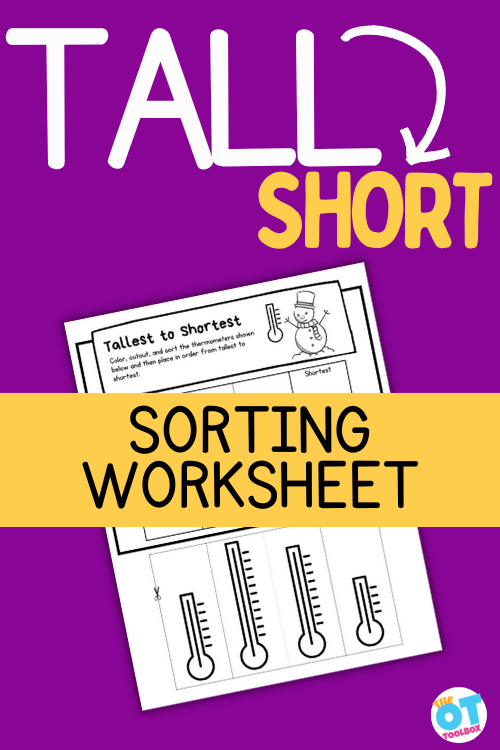
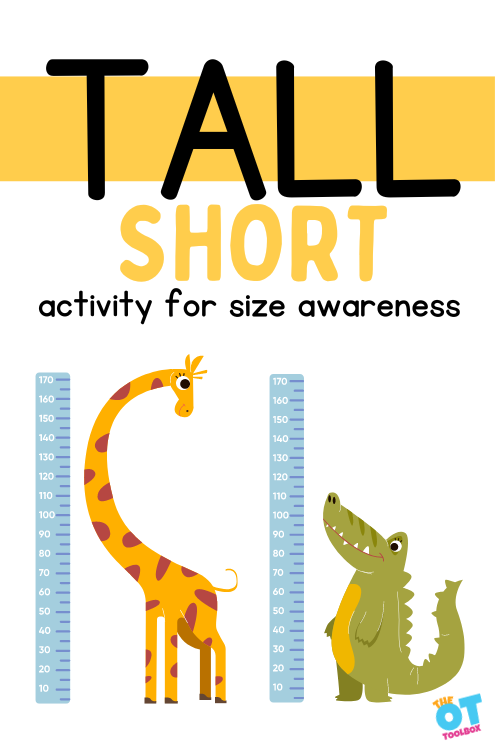
      Today, I have a great tall and short worksheet…or maybe you would call it a sorting by size worksheet. This activity is a cut and paste worksheet that users can color, cut, and sort by size to address a variety of skills all while incorporating spatial concepts of tall and short. We’ll cover those areas below as a tool to work on size awareness, sequencing, cognitive skills, and fine motor skills. Add this size sorting resource to your list of winter fine motor activities!

      Tall short worksheet

      Looking for a consistent way to support fine motor skills all year?
      This yearlong fine motor system includes seasonal activity kits and monthly data collection tools to support planning and progress monitoring.

      If fine motor planning and data collection feel overwhelming, you’re not alone.
      This done-for-you yearlong bundle organizes seasonal activities and monthly screening tools in one system.

      Get the Yearlong Fine Motor and Data Collection Bundle today!

      Free Tall Short Worksheet

        We respect your privacy. Unsubscribe at anytime.

        Tall and Short Worksheets

        This winter cut and paste worksheet is a fun one that we’ve had in the OT Toolbox Member’s Club resource library since last year. For children, dissecting the differences between tall and short worksheet can support spatial awareness skills.

        Spatial awareness, or awareness of the spatial area that objects or the individual takes up in space, as well as awareness of size and positioning, support so many aspects of functional performance.

        Why use a tall and short worksheet?

        Not only does this impact body awareness, the concept of sizing activities such as this tall and short worksheet can help young learners in several ways:

        • Understanding body awareness as they relate to size of objects
        • Organizing and sorting information
        • Taking in information about the world around them and using that information in functional tasks
        • Relating tall and short concepts to functional tasks such as handwriting
        • Understanding differences between tall letters, small letters, and tail letters in handwriting. Read this resource on letter size for more information.

        How does body awareness work?

        Body awareness refers to being aware of the body’s position in space at rest and during movement. This concept can be broken down into several concepts:

        • Having an awareness of body parts by name
        • Movement and how the body moves through space and around objects
        • discrimination of sides of the body
        • Use of objects in the world around us

        Self-awareness is a similar skill taking those same concepts into consideration, but adds on the emotional and cognitive aspects. This awareness allows for emotional regulation and behavioral that make up self-regulation. For some, these components of self-awareness are extremely difficult. When awareness of one’s preferences, tendencies, emotions, reactions, one can begin to understand their nee

        Related, are the concepts of dominance and mixed dominance vs. ambidexterity.

        There are many ways to use this tool to support skills. Let’s cover those below.

        Hopefully you all made it unscathed through the holidays with some fun memories attached.  We place such high expectations of ourselves and others during the holidays.  I hope you spent time on self care, prioritizing what needed to be done versus what was just an extra chore. 

        It is time to get back into the swing of things for the new year.  One way to jump back into functional goal practice is through creative and play-based activities centered around a fun theme like winter activities.

        Just as during the rest of the year, lesson and treatment planning will be key to easing the load, goal accomplishment, and efficiency.  The OT Toolbox, as anticipated, has great resources both free if you need one or two ideas, and for purchase if you are looking for a more comprehensive lesson plan.

        This latest free printable does not disappoint. It’s a tall and short worksheet, where users can color, cut, and then sequence the sizes into an order that makes sense according to size.

        This Winter Cut and Paste Tallest to Shortest worksheet will be a great activity to add to your winter theme and winter crafts

        This winter cut and paste worksheet is a nice printable if you are working on sorting by size, measurement, math concepts, classifying, cutting or gluing, to name a few.

        Tall and short worksheet and tall vs short activities

        How to use a Tall and Short worksheet

        If you follow my posts on the OT Toolbox, you already know how flexible these worksheets are.  If you are new, let me tell you how flexible they are! The thing is that occupational therapy practitioners like to use a single activity in many different ways to serve many clients on a caseload.

        This Tall Short worksheet is so much more than a cut and paste task.

        Print off the tall vs short worksheet (below) and then use it along with the activities listed below based on the needs of the users.

        Use the tall-short worksheet to address just some of these important skills:

        • Coloring inside the lines with full coverage
        • Discuss tall vs. short
        • Cutting on the line, within half inch of lines, in the direction of lines
        • Pasting using glue stick or drippy glue with accuracy
        • Ask questions about whether the objects are tall or short and then sort the objects in sequential order of height
        • Measuring by size can be done by eye, with a ruler, or other manipulatives
        • Categorizing tallest to shortest
        • Categorizing shortest to tallest
        • Sorting other objects from tall to short or short to tall
        • Sort crayons, toys, blocks, etc. into tall, taller, tallest
        • Sort crayons, toys, blocks, etc. into short, shorter, shortest
        • Incorporate into measuring activities
        • Place one small object on the shorted object. Then add one more object to each item as they get tall, taller, and tallest. Some ideas include: coins, play dough balls, beads, cotton balls, etc.
        • Fine motor strengthening, hand development, and grasping pattern
        • Core strength to sit at a table, with shoulder stability and wrist support
        • Following directions, attention to detail, turn taking, waiting, social skills, compliance, behavior, and work tolerance
        • Visual perceptual skills to determine visually which shape looks bigger than the others. Figure ground to be able to pick out these items from their background. Visual scanning to look at all of the shapes, visual attention to follow where the shapes are going to fit
        • Bilateral coordination holding the paper with one hand while coloring, stabilizing and turning the paper for cutting skills

        As part of your treatment plan, you could decide to focus on all of these objectives or just one or two. 

        There are times I might just want to focus on cutting skills, so I would add more help in the measurement section.  If I am looking at social skills and following directions, my focus might not be on the quality of coloring at all, or minimally.  If I need a math spin on it, perhaps I am not concerned about cutting, but measurement, size referencing, or classifying.

        Modify a Tall Short Worksheet

        How do I modify these tasks for varied learners?  This is the key to an efficient work week. Using a handful of tasks for the whole week is much more productive than 40 different activities.

        • Laminate the page and precut all the shapes to eliminate cutting and coloring
        • Cut the shapes for the learner ahead of time, to eliminate cutting
        • Print onto different colored or weighted paper for different visibility. Thicker paper adds to the stability when cutting, or it could improve hand strength cutting through thicker cardstock
        • Provide different manipulatives for measuring and talking about the sizing of these thermometers
        • Limit the amount of supplies on the table so your learner has to use social skills to ask for what they need, or share with peers
        • For your lowest level learners, perhaps this just becomes a scribble and color page, working on attending to a task
        • Add this sheet to other PDFs found on the OT Toolbox for a well rounded lesson plan such as the Food Alphabet Cut and Color book found here:
        • Add sensory, gross motor, or other fine motor tasks, to address more skills.

        How can I expand this task?

        • Measure the temperature of water, versus ice or snow
        • Talk about the winter weather in other parts of the world
        • Use rulers, cubes, fingers, or other objects to measure the thermometers
        • Read a book about winter temperatures or snowmen.
        • Talk about personal experiences with cold temperatures or snow
        • Add a sensory bin with real or fake snow, hiding items in the snow or creating something out of the snow
        • Throw real or created snowballs to build arm strength
        • Search OT Toolbox for plenty of winter activities for learners of all different levels

        Free Tall Short Worksheet

        If you love using printable tools to support skill development, why not consider becoming a member of The OT Toolbox Member’s Club?  This is a new feature at the OT Toolbox offering members even more access to great tools and resources.

        Or, access the printable tall short worksheet using the form below. Enter your email address into the form below and the tall short activity will be delivered to your email inbox.

        Free Tall Short Worksheet

          We respect your privacy. Unsubscribe at anytime.

          Victoria Wood, OTR/L is a contributor to The OT Toolbox and has been providing Occupational Therapy treatment in pediatrics for more than 25 years. She has practiced in hospital settings (inpatient, outpatient, NICU, PICU), school systems, and outpatient clinics in several states. She has treated hundreds of children with various sensory processing dysfunction in the areas of behavior, gross/fine motor skills, social skills and self-care. Ms. Wood has also been a featured speaker at seminars, webinars, and school staff development training. She is the author of Seeing your Home and Community with Sensory Eyes.

          Digital Content Creation Program: Sell Your Digital Products on The OT Toolbox

          Digital content creation program on The OT Toolbox

          If you have ever thought about using your knowledge and experience in digital content creation, then you are in the right place. While most of the blog posts on this site relate to all things pediatric occupational therapy, this one is a bit different. It’s likely that at one point or another, you’ve accessed one of our printable resources, or purchased a digital product. Did you ever wonder if YOU could create a digital resource for others? Did you know that The OT Toolbox has a team of digital content vendors in our shop marketplace? Those creators started out just like you: wondering how to sell resources online! That’s what we’re talking about in this blog post! Read on for information on how to create a passive income using what you know, experience, and are passionate about!

          We go deep into how to sell what you know on our Digital Product Professionals page.

          Do you LOVE being creative? Do you make resources for the clients on your caseload and know that there are others out there that would benefit as well? Want to make money online but don’t want to deal with customer service, starting a website? Did you know that we love to support other therapy professionals by selling resources on our shop?

          Digital content creation program on The OT Toolbox

          Digital Content Creation

          Do you LOVE being creative? Do you make resources for the clients on your caseload and know that there are others out there that would benefit as well? Want to make money online but don’t want to deal with customer service, starting a website?

          Let’s break down HOW and WHY to sell digital products on The OT Toolbox as a vendor in our marketplace.

          First, you may or may not know about all of the contributing factors that play a role in running a website and selling resources online. Just to quickly cover all the bases, website management includes:

          • Web hosting
          • Building the technical side of a website including plugin management
          • Managing costs of hosting fees, website fees, email list fees, etc.
          • Managing customer service including the email management
          • Content creation
          • Coming up with a content marketing strategy
          • Graphics creation
          • Writing articles
          • Editing and formatting articles
          • Speaking to target audiences (Here on The OT Toolbox, we create content geared toward therapy providers, parents, and educators, as well as other professionals- counselors, administrators, etc.)
          • Publishingblog content
          • Creating and maintaining a digital marketing strategy
          • Brainstorming content ideas
          • Working with a graphic designer
          • Building a following on social media platforms and working on social media engagement on Facebook, Pinterest, Twitter, Instagram, Tiktok, and YouTube
          • Writing blog posts geared toward web traffic- Speaking to the search engines, or meeting search engine optimization (SEO) needs. This includes keyword research.
          • Working among trends such as Tiktok, Facebook reels, or Instagram videos, etc. 
          • Creating infographics for social media posts
          • Using publishing tools such as photoshop or Canva
          • Coming up with a publishing schedule for the website and social media platforms
          • Working on different types of content: articles in Google docs, video, digital products, etc.

          That’s a lot to manage! 

          When it comes to running a website and managing all of the working pieces, there is a lot to juggle. 

          Sell digital products on The OT Toolbox website

          Digital Content Creators on The OT Toolbox

          The mission of The OT Toolbox has always been to provide tools to support the healthy development of kids. We initially started out by supported occupational therapy providers with resources and tools to help their clients thrive. That audience has since moved on to other therapy professionals such as physical therapy, speech therapy, and mental health therapy as well as all of the types of readers. We did this by offering tools, tips, and resources that not only support their clients, but themselves as professionals. 

           Over time, we have started to support other therapy providers in additional ways, including offering our shop as a platform to sell digital content.

          Selling digital products on The OT Toolbox as a digital content creator is a great way to not only make money, but also transfer your skills, knowledge, and experience to other professionals. It’s a literal ripple impact that can change lives!

          There are other good things about creating digital content, too! These could be considered the “pros” to digital content creation.

          • Earning money as an online shop
          • Supplementing other income sources (especially true for new digital creators) This is great for the school based therapy provider seeking income over the summer months, or while on school breaks.
          • Passive income. Much about digital content creation as a vendor meaning creators who host products on The OT Toolbox earn money passively.
          • Using your creative resources to support other professionals all over the world to help others thrive

          Plus, when you list your digital products on The OT Toolbox shop, we take care of all the details:

          1. Hosting and listing the digital product- You don’t need to build a website and deal with the tech side of things or pay all of the hosting and plugin fees. We also list the product on our shop. You don’t need to worry about copywriters or target keywords on the product listing. We take care of that for you.

          2. Marketing- we take care of the promotional side of things too. We have a digital content strategy in place so all you have to do is submit your product and sit back to wait for the payments each month. We market on our email newsletter, our social media platforms, and on the blog posts.

          3. Customer service- Dealing with deliverability issues, refunds, and customer questions is a necessary thing when you have a shop and business. However, these service considerations take a LOT of time. We handle all of these aspects of product sales.

          4. Credit card fees and taxes- When you sell on The OT Toolbox marketplace, we take care of the fees and taxes that are related to digital product sales. 

          5. Passive income- You can market products as little or as often as you like on your own social media channels, but there is no obligation to do so. When you list products in The OT Toolbox marketplace as a digital content creator, it can be all passive income. We’ll pay you at the beginning of each month for any sales that your product had during the previous month.

          6. Your products will show up in our shop- If you’ve listed a digital resource on Teachers Pay Teachers or Etsy, then you know the pain of publishing a product only to have it sit somewhere in the depths of the website. There is just SO much content on those sites that it’s hard to get your product in front of eyeballs even with SEO tools or influencer marketing on social media. On The OT Toolbox shop, your product will show up by search and it will get in front of web traffic guided by our monthly search volume on the site.

          7. Start now- If you have a product already created, you can start right away. If you don’t have a product and have no idea where to begin with making digital products, the Digital Product Creation for Professionals Toolkit is for you. 

          How to be a Digital Content Creator and Sell on The OT Toolbox?

          The cool thing is that this opportunity is open to everyone. If you’re slightly interested in selling products online, and you have knowledge, experience, and a passion to create a resource, the creator marketplace is for you. 

          There are two options, depending on where you are in this process: 

          If you already have a digital product… 

          …and you want a place to sell it that has a hot audience:

          This option is great if you sell products on Teacher Pay Teacher, Etsy, or your own website and you want to get it in front of The OT Toolbox.

          Just send us an email at contact@theottoolbox.com with a copy of your product so we can make sure the item is a good fit for our audience. Then, we’ll get back to you with details and a contract to put all of the details onto paper. We’ll create a vendor account for you and list your item. Then, you earn each month depending on the sales of your product. At any time, you can log into your vendor account and see sales on your dashboard.

          One other tip that I would encourage for vendors on The OT Toolbox is to write a blog post on the topic that your product covers. Our vendors that write blog posts promoting their product sell up to 3 times more than the vendors that don’t. Why?

          • Blog posts cover a lot of the “why” behind a product, which is what people are looking for through search
          • A blog post goes deep on how to support a specific need. Readers that arrive at that blog post are looking for answers to a specific question. Your product or resource can be the solution to that problem
          • When a digital content creator covers the many benefits of a product in high-quality content of an article, you can go deep on why specific issues are happening, what the end user might see, red flags that are involved, and then explain in detail how a solution to that problem might be a product that was created by a professional with experience in that area. 
          • You can create different blog articles based on the various topic ideas that a product was intended to solve. For example, most professionals have created products based on years of experience working with a specific issue or problem area. And typically, those resources solve several aspects of the issue at hand. Blog content can go deep on these different issues through a blog series, which targets each aspect of the product. A series of articles related to a single product is an asset to the marketing.

          In exchange for the services listed above (hosting, marketing, product delivery, customer service, etc.) we do take a percentage of the product’s pricing. Marketplace vendors earn 65% of the product price. 

          This percentage is consistent or better than other online marketplaces such as TPT or Etsy, plus you’ll have the additional benefit of reaching a consistent market and audience. 

          Even with that percentage of administration and hosting fees, we have digital vendors earning hundreds of dollars each month, all as passive income. 

          If you might be interested in writing a blog post related to your digital product, please reach out to us at contact@theottoolbox.com. We can walk you through the process and come up with some content creation tools that might help. 

          If you don’t have a digital product yet…

          …and you would like to create one (but don’t know how):

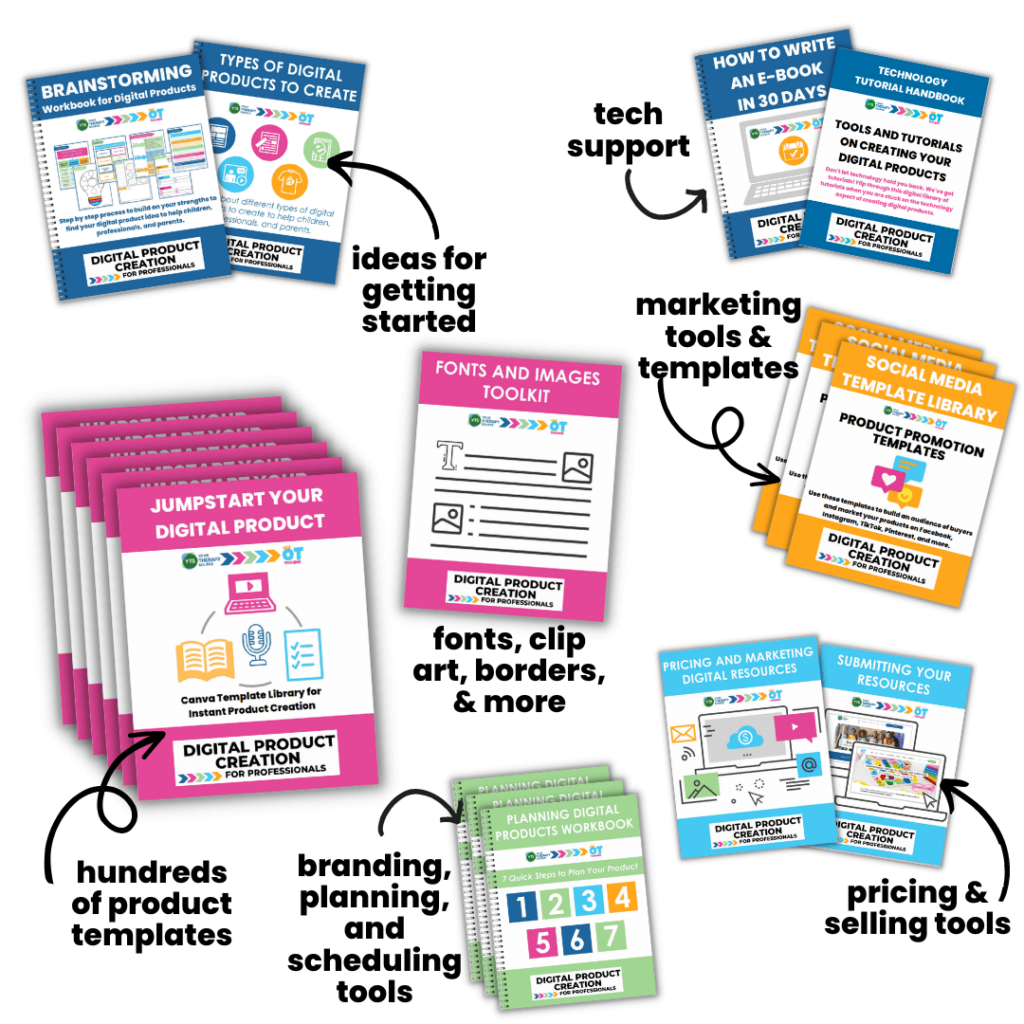
          This option is perfect for anyone wanting to explore their creativity, and use what they know, as well as experience, and zones of genius into a resource that they can sell to toothers. We’ve walked many creatives through the process and decided to put the instructions, the systems, and the step-by-step roadmap into a course. The Digital Product Creation Program is a creator academy of sorts. It’s a toolkit with blueprints, workbooks, and roadmaps to support your journey in getting started as an online creator. 

          Digital Product Creation Program
          All of these resources and more are included in the Digital Product Creation Program.

          In the Digital Product Creation Program, we have several stages of product development with resources, ebooks, and templates to support your journey to creating and selling digital products. It includes 5 stages:

          1. Product Development- This section of the toolkit includes types of digital content that you can make based on your experience, passions, and knowledge. This is a great brainstorming space if you know you want to make something, but don’t know exactly what…or how! You’ll also find tutorials on all of the tech so you don’t hit a stumbling block by not knowing how to manage the technology aspect of digital content creation. One tool that is especially helpful is “How to Write an Ebook in 30 Days”. So often, as professionals, we have amazing experiences and know-how that could be a huge resource to others in ebook format. We walk you through getting your information into a consumable format.
          2. Business Development – This stage of the process takes out the unnecessary tasks and streamlines the things you really need to worry about. We cover how to protect your product legally. We also include workbooks and planning books so you can stay on track to get your digital product completed. This is a huge time saver for the whole content creation process. 
          3. Product Template Library- This section includes hundreds of product templates for everything from ebooks, to courses, to worksheets, to handouts, screening tools, forms, and so much more. You can use these templates and plug in the information you know and love to teach others about. These templates are literally done-for-you product templates.
          4. Sell Your Products- This section of the toolkit offers strategies for selling that supports all levels, whether you’ve sold products before, are already on Teachers Pay Teacher, or if you are just getting started and have no idea where to begin. We have created a blueprint for submitting your products to The OT Toolbox and Your Therapy Source, so you can submit your product once and be done. 
          5. Digital Marketing- In this section of the program, we’ve put together a library of templates to plug your product into so you can start marketing on social media. Social media content creators will love this section because the design is already done for you. Open up the templates and start marketing.
          6. Bonuses- There are several bonuses included with this program, including frames and backgrounds for digital content creation. These include all commercial rights so you can use the materials in products that you sell anywhere. We also have put together a top secret, data-backed list of needed digital products. These are materials that are just not that prevalent out there in the market, but they are much-needed.

          You can find out more about Digital Product Creation for Professionals here

          How to sell Digital Content Creations on The OT Toolbox

          We love to support occupational therapy professionals and supporting professionals by allowing them to create and serve others, while building an income on the side is just one way to do that!

          The process is really simple. Margaret from Your Therapy Source and I walked through this process (and had a great chat!) about how vendors can apply to sell their products on our websites, to our email lists, and on our social media channels. Check out our chat here: 

          Margaret from Your Therapy Source and I talk about how to become a digital content vendor in the shops on our websites.

          Basically, the process to sell your digital content creations on The OT Toolbox is this:

          1. Send an email to contact@theottoolbox.com. Include your product name and attach it to the email. Tell me about yourself…I love to hear from other digital content creators out there!
          2. We will review the product to ensure it fits with The OT Toolbox. We’ll get back to you via email.
          3. If the product is accepted as a resource to include on our shop, you’ll get a digital contract. The contract basically says it is your product and you can sell it in other places online or in person, that the product is yours, and The OT Toolbox is only a marketplace to list the product. We also outline the percentage of earnings, and other information we’ve listed in the video above. 
          4. You will return the signed contract along with a product description, a cover images of the product, and any other images that will help the resource sell. 
          5. We will take care of the rest! We’ll list the product on The OT Toolbox shop, create a product listing, market the product in our newsletter, on social media, and in related blog posts.
          6. You will get paid. We pay through Paypal and will send out payments once a month. 

          It’s a great stream of passive income for professionals that love sharing their experiences and knowledge!

          Latest Therapy Vendor Resources

          Want to see the latest digital products that have been created by Occupational Therapists and Occupational Therapy Assistants? Our OT vendors are experts in areas like dyslexia, documentation, handwriting, sensory diets, and more. Check out the latest OT vendor additions to The OT Toolbox shop:

          Colleen

          Colleen Beck, OTR/L has been an occupational therapist since 2000, working in school-based, hand therapy, outpatient peds, EI, and SNF. Colleen created The OT Toolbox to inspire therapists, teachers, and parents with easy and fun tools to help children thrive. Read her story about going from an OT making $3/hour (after paying for kids’ childcare) to a full-time OT resource creator for millions of readers. Want to collaborate? Send an email to contact@theottoolbox.com.
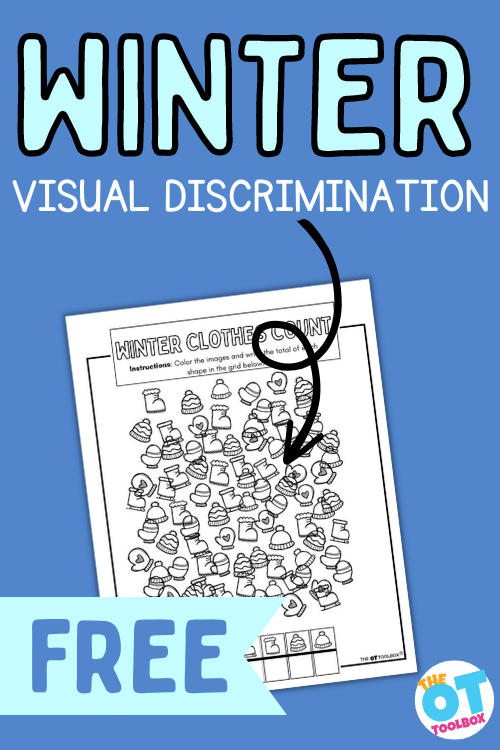
          Winter Clothes Worksheet for Visual Perception

          During the cold winter months, bundling up in mittens, scarves and other winter clothing is a must, which makes today’s winter clothes worksheet a fun way to work on various skills with children in the theme of winter! We’ve covered quite a few different winter occupational therapy activities here on the site, and this winter clothes printable supports visual perceptual skill building in fun ways during the cold months of the year.

          Our free color and count worksheet goes really well with this printable so be sure to grab that resource, too.

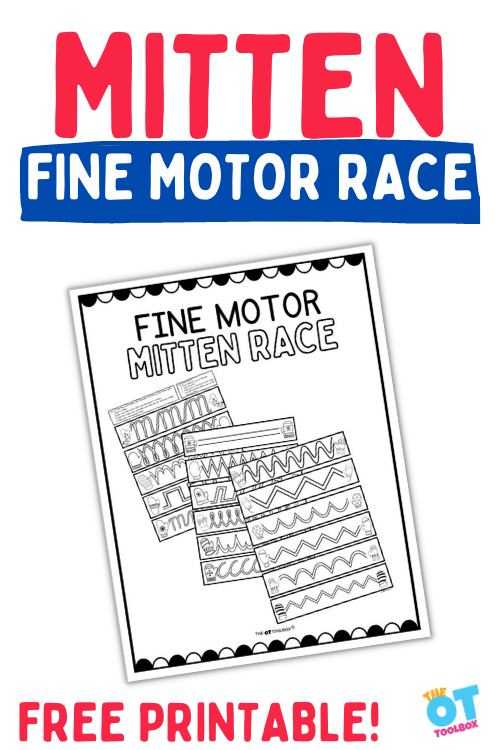
          And, grab this mitten printable for fine motor and visual motor skill development.

          Wither clothes worksheet for visual perception

          Looking for a consistent way to support fine motor skills all year?
          This yearlong fine motor system includes seasonal activity kits and monthly data collection tools to support planning and progress monitoring.

          If fine motor planning and data collection feel overwhelming, you’re not alone.
          This done-for-you yearlong bundle organizes seasonal activities and monthly screening tools in one system.

          Get the Yearlong Fine Motor and Data Collection Bundle today!

          Free Winter Clothes Worksheet for Visual Perception

            Are you interested in resources on (check all that apply):
            We respect your privacy. Unsubscribe at anytime.

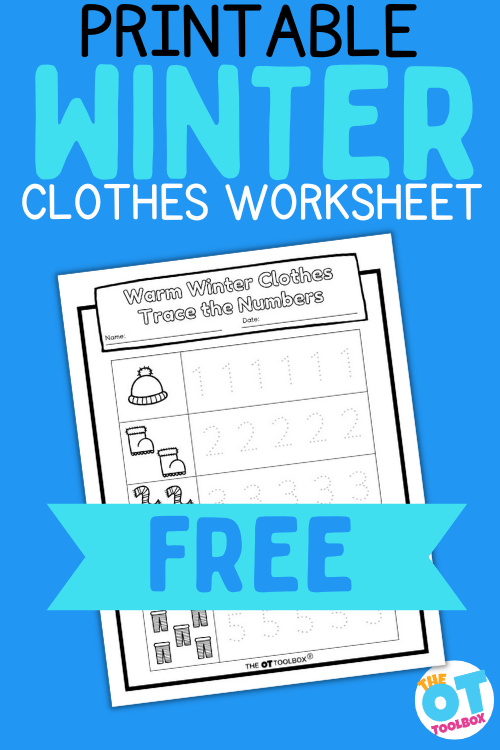
            Winter Clothes Worksheet

            Using creative themes and activities in therapy is a fun way to practice meaningful and functional skills in creative ways. That’s where the winter clothes worksheet that you’ll find below comes into play.

            Winter means different things for different people depending on their climate. Winter in the southern United States means adding a sweatshirt, possibly a hat at the bus stop early in the morning.  In the northern states winter is a different story.  Up north, winter starts in mid- September and seems to last until May.  I have northern roots but am a southern girl by heart. 

            Winter months in cold areas of the world mean bundling up and adding clothes.  Mittens, hats, coats, snow pants, boots, gloves, earmuffs, thick socks, long johns, and lots of layers are the customary daily garb. 

            You can add this winter clothing printable to a few others from our Member’s Club, which you’ll find in the Winter Therapy Theme (Level 2 members):

            • Winter Pattern Paper Chain activity
            • Winter Words ABC order
            • Winter Listen and Color
            • Build a Sweater Craft
            • Winter Clothing Checklist
            • Winter Clothes Worksheet: Word Scramble
            • Uppercase and Lowercase Letter Earmuffs
            • Winter hat Hole Punch Cards
            • Match the Mittens
            • Mittens Lacing Cards
            • Winter Clothes I Spy Sheet
            • Winter Clothing Handwriting pages
            • MORE!

            Since bundling up is a daily chore in the frozen north, why not add all it to your treatment plan?

            The Warm Winter Clothes Worksheet is a cute winter printable PDF designed to target the underlying skills of visual discrimination, visual figure ground, and visual attention, making it a great winter clothes worksheet for kindergarten or early primary grades.

            Winter Clothes Worksheet for Therapy

            This winter worksheet prompts users to find the number of articles of winter clothing, but there are coloring and handwriting options as well. It’s a cute winter printable to build essential skills while using meaningful, relevant content.

            What does this winter number tracing worksheet work on besides visual perception?

            1.  Kinesthetic awareness – Kinesthetic learning means learning by doing and this worksheet supports practice skills.
            2.  Hand strength and dexterity – Coloring while staying on the lines builds hand strength in the muscles of the hands and develops muscle control. Check out the In Hand Manipulation Blog which covers what this skill means as well as activities.
            3. Visual motor skills –Combining what is seen visually and what is written motorically.  Visual Motor Skills takes coordination to be able to translate information from visual input to motor output. Coloring, drawing, counting, cutting, and tracing are some visual motor skills.
            4. Visual Perception – Developing visual perceptual skills supports learning, reading, writing, and basically every functional task done throughout the day. One example addressed in this winter clothing worksheet is the figure ground skills to see where one item start and finishes, scanning to find all answers, and visual closure to understand that dotted lines will create something.
            5. Strength Core strength needed for sitting, shoulder/elbow/wrist stability, finger strength, and head control all play their role in writing.
            6. Bilateral CoordinationBilateral coordination is needed to use both hands together in a coordinated manner, which is important in handwriting and coloring. Be sure your learner uses their helper hand for stabilizing the paper while using their dominant hand for writing. You can target this skill by taping the worksheet to the wall on the bottom of the page. The user then has to work on the vertical surface and hold the paper up so they can write or color.
            7. Counting/Learning Numbers – Count the items to understand number concepts in addition to tracing them. Work on learning to write numbers by using this worksheet along with others on our site.
            8. Social/Executive Function – Following directions, turn taking, task completion, orienting to details, neatness, multi-tasking, attending to task, and impulse control can be addressed using this Warm Winter Clothing Printable PDF.

            When using a task such as this number tracing worksheet, therapists can utilize and focus on all the above skills or just one or two. 

            There are times when I am working more on executive function than fine motor skills but will use this task with more of my focus on these executive function skills. 

            When using this worksheet in therapy, my documentation note might not say much about their number formation, counting skills, or neatness, but how well they were able to attend to the task, complete the task, follow directions, and control their impulses.

            How to Modify a Winter Clothing Worksheet

            The nice thing about using a worksheet in therapy sessions, is that you can print off the page as many times as you need to and use it with your whole caseload. OR, print it off once and slide it into a page protector sleeve. Then, use the winter clothing printable with the whole caseload. Just wipe off the page protector sleeve in between uses.

            How do I incorporate or modify this task for the needs of all my learners?

            There are lots of ways to modify this activity to meet various needs! 

            • This sheet can be laminated for reusability or marker use
            • Print off the number tracing worksheet on different colored paper for readability,
            • Print the number tracing worksheet in an enlarged or smaller size
            • Add more details to make the activity more complex
            • Use a cardboard window to show only portions of the sheet to make the activity simpler

            Try having learners color the shapes and write the numbers independently on the back to add more visual motor tasks to this winter clothes worksheet.

            This covers one day of winter, what about the other 240?

            Glad you asked!  The OT Toolbox is stuffed with activities, blog posts and work pages to fill those winter days. The Winter Fine Motor Kit full of handouts and PDF files provides several visual motor tasks to be used throughout the winter season.

            You can grab the Winter Fine Motor Kit inside our shop OR, OT Toolbox Member’s Club members can log into your account and grab the whole Winter Fine Motor Kit, along with hundreds of other printable resources.

            Winter is a very long season. Especially if you are not a fan of the cold weather (author raises hand).  Adding fun activities and games can take some of the monotony and sting out of the long cold days.  Moving south can also take the bitterness out of winter, but we are full.

            Brrrrrr, bundle up!

            Free Winter Clothes Worksheet

            This printable is located inside the Member’s Club in our Winter Therapy Theme. Or, if you’re not yet a member, enter your email address into the form below.

            Free Winter Clothes Worksheet for Visual Perception

              Are you interested in resources on (check all that apply):
              We respect your privacy. Unsubscribe at anytime.

              Victoria Wood, OTR/L is a contributor to The OT Toolbox and has been providing Occupational Therapy treatment in pediatrics for more than 25 years. She has practiced in hospital settings (inpatient, outpatient, NICU, PICU), school systems, and outpatient clinics in several states. She has treated hundreds of children with various sensory processing dysfunction in the areas of behavior, gross/fine motor skills, social skills and self-care. Ms. Wood has also been a featured speaker at seminars, webinars, and school staff development training. She is the author of Seeing your Home and Community with Sensory Eyes.

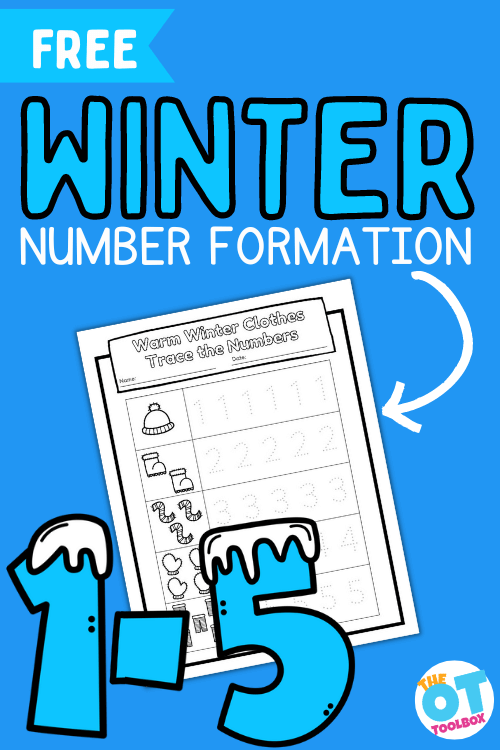
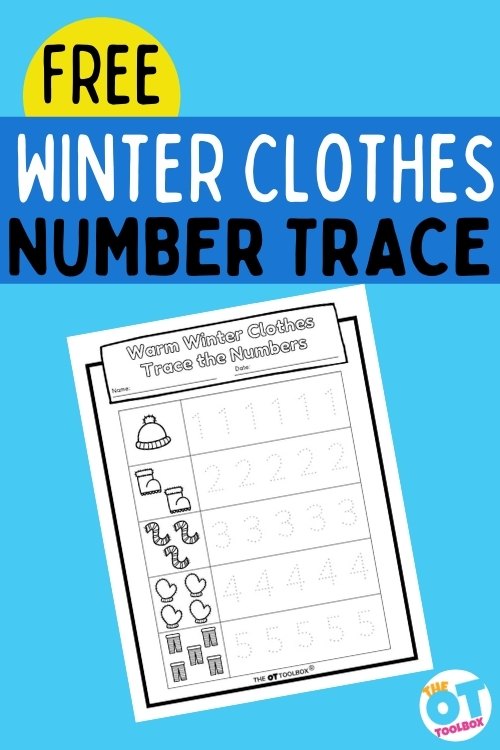
              Winter Number Tracing Worksheet

              Winter number formation

              When it comes to managing the long winter with activities, this winter number tracing worksheet has you covered. Be sure to read up on our recommended use of tracing sheets as a tool to support functional writing. Use the printable below along with our winter number tracing worksheet to talk with kids about winter clothing AND work on number formation. It’s a winter printable that you’ll want to add to your therapy toolbox! Also be sure to grab our winter crossword puzzle and our winter clothes worksheet (for visual perception) as a tool to build visual motor skills.

              You’ll want to grab this winter worksheet because it covers number formation and writing numbers with a wintery theme!

              Kids also love this mitten printable to race the mittens across the page whild building motor skills.

              Winter clothing worksheet

              Looking for a consistent way to support fine motor skills all year?
              This yearlong fine motor system includes seasonal activity kits and monthly data collection tools to support planning and progress monitoring.

              If fine motor planning and data collection feel overwhelming, you’re not alone.
              This done-for-you yearlong bundle organizes seasonal activities and monthly screening tools in one system.

              Get the Yearlong Fine Motor and Data Collection Bundle today!

              Winter Clothing Number Tracing Worksheet

                We respect your privacy. Unsubscribe at anytime.

                Free Winter Number Tracing Worksheet

                On the winter worksheet, you’ll find number writing spaces where the user can trace numbers. By practicing numbers through tracing, you give the user the opportunity to practice the motor plan needed to form the number. We talk about the occupational therapy provider’s perspective on tracing in our resource on tracing sheets. Specific for this winter clothing activity, we wanted to add the number practice option along with a few other ways to practice specific skills.

                This winter number tracing worksheet is similar to our recent Christmas lights number tracing printable.

                Winter means different things for different people depending on their climate. Winter in the southern United States means adding a sweatshirt, possibly a hat at the bus stop early in the morning.  In the northern states winter is a different story.  Up north, winter starts in mid- September and seems to last until May.  I have northern roots but am a southern girl by heart. 

                Winter months in cold areas of the world mean bundling up and adding clothes.  Mittens, hats, coats, snow pants, boots, gloves, earmuffs, thick socks, long johns, and lots of layers are the customary daily garb.  Imagine trying to put this on and off a toddler each time you head out!  As soon as you get your child decked out in all these layers, they usually announce the need to go to the toilet!  It never fails.

                Since bundling up is a daily chore in the frozen north, why not add it to your treatment plan? The Warm Winter Clothes Number Trace Worksheet is a cute printable to build essential skills while using meaningful, relevant content.

                This free winter number tracing worksheet is a winter clothes activity for kids that helps with motor planning of number formation using a winter clothing printable.

                Tracing Numbers Worksheets

                Let’s talk tracing so you can use it to the maximum benefit and its intended purpose. 

                I am not a fan of tracing unless it is used correctly, or the objective is understood. Here is information on the benefits of tracing

                • Tracing is not going to teach number/letter formation if the learner does not know what those figures are.  To a learner who does not know these symbols, they will be tracing lines, not numbers or letters
                • Know your audience. If your learner does not know the letters or numbers, use the activity as a fine motor task to develop dexterity
                • Kinesthetic awareness.  This long word means to learn by doing.  Theoretically if a person writes the number 5 enough times, the body will start to recognize this pattern and commit it to memory.  This only works if the learner understands what is being traced. Using our sandpaper writing trick is one great way to incorporate kinesthetic awareness into number tracing and number formation.
                • Tracing for dexterity. This is the type of tracing I like best.  Tracing for dexterity works on staying on the lines, fine motor control, building hand muscles, scanning and a whole host of other important skills as defined below

                Winter Clothes Worksheet

                While worksheets are not a favorite among occupational therapists, there are ways to support skill areas by using worksheets to meet the needs of kids. When we address the underlying skill areas to support function, printables like this winter clothes worksheet can address a variety of areas.

                What does this winter number tracing worksheet work on besides tracing?

                1.  Kinesthetic awareness – This means learning by doing.
                2.  Hand strength and dexterity – staying on the lines builds hand muscles and develops muscle control. Check out the In Hand Manipulation Printable Worksheet to incorporate developing the intrinsic hand muscles.
                3. Visual motor skills –Combining what is seen visually and what is written motorically.  This takes coordination to be able to translate information from visual input to motor output. Coloring, drawing, counting, cutting, and tracing are some visual motor skills.
                4.  Visual Perception – Developing figure ground to see where one item start and finishes, scanning to find all answers, and visual closure to understand that dotted lines will create something.
                5. Strength – Core strength needed for sitting, shoulder/elbow/wrist stability, finger strength, and head control all play their role in writing.
                6. Bilateral Coordination – Be sure your learner uses their helper hand for stabilizing the paper while using their dominant hand for writing.
                7. Counting/Learning Numbers – Count the items to understand number concepts in addition to tracing them.
                8. Social/Executive Function – Following directions, turn taking, task completion, orienting to details, neatness, multi-tasking, attending to task, and impulse control can be addressed using this Warm Winter Clothing Printable PDF.

                When using a task such as this number tracing worksheet, therapists can utilize and focus on all the above skills or just one or two.  There are times when I am working more on executive function than fine motor skills but will use this task with more of my focus on these executive function skills.  My note might not say much about their number formation, counting skills, or neatness, but how well they were able to attend to the task, complete the task, follow directions, and control their impulses.

                Number Tracing worksheet for winter

                Winter Clothing Printable

                There are so many ways to use this winter clothing printable to work on number tracing, and more.

                How do I incorporate or modify this task for the needs of all my learners?

                Lots of ways!  As always, this sheet can be laminated for reusability or marker use, printed on different colored paper for readability, enlarged or made smaller, made simpler or more complex. Try having learners color the shapes and write the numbers independently on the back to add more visual motor tasks to this winter clothes worksheet.

                This covers one day of winter, what about the other 240?

                Glad you asked!  The OT Toolbox is stuffed with activities, blog posts and work pages to fill those winter days. The Winter Fine Motor Kit full of handouts and PDF files provides several visual motor tasks to be used throughout the winter season.

                Plus, in The OT Toolbox Members Club, you’ll find winter clothing printables and resources to address a variety of needs.

                In addition to these handouts, you can also read this article on Winter Fine Motor Activities for more great ideas and suggestions:

                Winter is a very long season. Especially if you are not a fan of the cold weather (author raises hand).  Adding fun activities and games can take some of the monotony and sting out of the long cold days. 

                Brrrrrr, bundle up!

                Free WINTER NUMBER TRACING WORKSHEET

                Want to access this printable number tracing worksheet? Enter your email address into the form below. You can also find this winter clothing printable in The OT Toolbox Member’s Club.

                Winter Clothing Number Tracing Worksheet

                  We respect your privacy. Unsubscribe at anytime.

                  Victoria Wood, OTR/L is a contributor to The OT Toolbox and has been providing Occupational Therapy treatment in pediatrics for more than 25 years. She has practiced in hospital settings (inpatient, outpatient, NICU, PICU), school systems, and outpatient clinics in several states. She has treated hundreds of children with various sensory processing dysfunction in the areas of behavior, gross/fine motor skills, social skills and self-care. Ms. Wood has also been a featured speaker at seminars, webinars, and school staff development training. She is the author of Seeing your Home and Community with Sensory Eyes.

                  Watch for more winter clothes worksheets and winter printables coming to this space.

                  Best Hibernation Activities

                  Hibernation activities

                  Brrr…when the weather gets cold and the winds are gusting, hibernation activities are fun ways to help kids develop specific skills with the theme of winter. Hibernation on the sofa is my place to go, but that doesn’t mean that adding a creative ways to learn about winter and how animals survive the cold can’t be included into therapy themes! Let’s explore different hibernation ideas to support kids!

                  This activity set is just one theme in our weekly themes for occupational therapy. However, these are great winter activities to add to a preschool setting, kindergarten classroom setting, or learning lessons at home.

                  Or, use them along with a favorite book about hibernation which is great this time of year.

                  Hibernation activities

                  Hibernation activities

                  When the weather gets colder, coffee or hot cocoa, a warm throw, a good movie, and the fireplace on, ah, now that’s what I call good hibernation for humans. However, animals don’t have those luxuries so they deal with the cold winter with the harshness of winter season by going into their own form of hibernation. Some animals essentially curl up in a safe place and stay there until winter ends. Some sleeping for their hibernation entirety!


                  Children love learning about animals and there are plenty of fun ways to explore animals in the winter season!

                  Not only are these hibernation themed ideas great for the cold of winter, but there are many learning lessons here too that relate to self-regulation, the occupation of sleep hygiene, and heavy proprioceptive input that occupational therapy professionals often cover with their caseloads.

                  Think about using hibernating animals as a tool to teach kids about a slowed heartbeat (interoception), deep sleep, and the calming environment a cave or sleeping space can have.


                  We’ve pulled a variety of hibernation activities together so you can pack your sessions with hands-on activities that include some animals in the wintertime. There are a variety of animals that hibernate in the winter months such as, bears, snails, bats, lemurs, bumblebees, hedgehogs, groundhogs, and raccoons.


                  You will find many fun and easy-to-implement ideas to bring the hibernation-theme to your sessions. So, go exploring and grab some inspirational fun that will engage your kiddos while theming it up for wintertime!

                  We’ve sorted these various hibernation theme activities into skills, so you can pick and choose the activities that work for your needs.


                  Fine Motor Hibernation Activities


                  Fine Motor Hedgehog- You can make a fine motor hedgehog with a bit of play dough and some toothpicks. Create a ball of play dough (read about the benefits of play dough, too) and then poke the toothpicks into the back. Add googly eyes and draw a face on the playdough using one of the toothpicks.  This hibernation idea provides kids with the engaging activity of hedgehog creation using play dough and toothpicks to create! Tactile, fine motor, and eye-hand coordination skills are in use with this fun little guy!


                  Weaving Hedgehog-  by Ryan & Marsha | This cute little activity works on bilateral coordination and delicate touch in order for the child to gently weave strips of construction paper through the slits in the body of the hedgehog to create a rainbow-bodied hedgehog. Read more about the benefits of weaving paper in developing fine motor skills and bilateral coordination skills.


                  Build a Hibernation Den- All you need is a blanket to make bear caves, or a nest used by sleeping chipmunks, squirrels, or skunks. This center is designed for kids to be creative in using blocks to create dens for hibernating animals. Children use the materials provided to create their den using prompts provided by an adult such as, build a covering for the top and a small entry for the animal. Works on eye-hand coordination and visual perceptual skills.

                  You can check out our polar bear cave which we used for a polar bear theme, but it would be a great addition to any hibernation theme.


                  Feed the Animals Activities- This activity would work for many different animals, and you can even have each child make their own hibernation animal craft. Start with a paper plate and create an animal’s face such as: 

                  • Bear
                  • Squirrel
                  • Skunk
                  • Bees
                  • Turtles
                  • ​Mouse
                  • Woodchuck
                  • Ground squirrel
                  • Snakes
                  • Frogs
                  • Bats
                  • And more!

                  Children can use crayons, paper scraps, markers, etc. to create the winter animal of their choosing. Then, cut a hole in the middle to make a mouth (You may want to start with the hole cut in the plate before decorating.) Then, children can use tongs to pick up and move small objects like beads, craft pom poms, either real or fake acorns, crumbled paper, etc. as a counting activity to feed the paper animals that are placed on plastic cups. Works on fine motor strength and grasp patterns as well as counting skills.


                  Clothespin Hedgehogs- A clothespin activity that works on fine motor strengthening and pinch grasp to place the clothespins on the back of a paper plate hedgehog to build the spines. The child can create the hedgehog first by cutting and painting the plate to extend the activity.


                  Gross Motor Hibernation Activities


                  Bear Brain Breaks – These movement activities are perfect to use for sleep time and/or winding down in preparation for bedtime. They include stretches and whole-body movements that happen in a calm manner to prepare for sleep.

                  Squirrel Brain Breaks– Just like the bear brain breaks listed above, these squirrel themed heavy work activities support calming input of brain breaks.


                  Hibernation Den- Use the bear cave described above as a home base for obstacle courses, animal walks, and heavy work. This is a great way to work on crawling skills or the bear walk movement so as to have a child crawl or bear walk to the large cardboard box that has been turned into a den. Or you can drape a blanket over a small table and create a bear den for children to hibernate in to read a book. This den will allow them to be cozy and comfy while inside.

                  Hibernation Obstacle Course- You could use sorting activities along with the den described above tape along the floor to create a path for winter animals heading to their home before the long winter. Discuss how the den is created after exploration of how animals survive in winter. Think about using multi-sensory materials such as tree bark, rocks, crumpled paper, fake trees, pine cones, sticks, nuts, a forest habitat and pond, and stumps. This is an open
                  project that uses whatever you can get your hands on! 

                  Bear Walk Dice Game for bear walks
                  Bear Walk Dice Game


                  Bear Walk Gross Motor Dice- This activity is perfect for a chilly day that you need to get the wiggles out with kids as it focuses on deep impact body movements with different directions and speeds. We incorporated other motor skills too, such as fine motor skills to roll a dice, visual motor skills and visual perception, and handwriting skills to track motor actions. You can find this resource inside our Member’s Club (Level 2)in the Arctic Animals Therapy Theme. The printable worksheet is geared toward polar bears, but it works well with any bear theme, too.

                  Visual Activities with a Hibernation Theme


                  Groundhog Vision Activities Slide Deck -This slide deck is designed with activities
                  specifically for vision therapy including visual perceptual skills and visual motor integration. It’s always a hit around Groundhogs day but perfect for including in a hibernating animals activity. It’s free so go grab your copy today!


                  Groundhog Day Shadow Matching (COMING SOON)- This is a free printable worksheet where children work on matching the groundhog to its shadow while working on visual discrimination and visual memory skills.


                  Hibernating Animal Food Ideas- Cooking with kids is a powerful way to address various skills, including fine motor skills, social skills, direction following, sensory motor skills, and more. 

                  We made this Bear Snack Food to go along with the book, “We’re going on a Bear Hunt” but they would be great for books like “Bear Snores On” by Karma Wilson, or other hibernation books about bears. 

                  These cute food ideas can work on assembly skills with the use of snack foods to create two bears! Cute and tasty! 

                  Please be aware of any food allergies before doing these activities as one activity uses peanut butter. You have the child work to create, but they get the reward of eating at the end! Yummy!


                  Teddy Bear Apple Snack- This bear themed snack is another fun activity to work on skills through cooking. We used sliced apples and small items like raisins and mini marshmallows to create a teddy bear face. 


                  Note: You can switch out peanut butter with SunButter, which uses sunflower seeds to create a butter that tastes very similar to peanut butter! That is what our family uses as we have a child that is very allergic to peanuts. 


                  Hibernation Craft Activities

                  We’ve covered a hibernation craft idea or two above, but these ideas are fun, too:


                  Popsicle Stick Hibernating Bear- Make this craft by Glued to my Crafts as a cute bear cave craft. It’s a fun activity that uses craft sticks to build a bear cave and then create a bear that lies inside of it. This activity works on cutting and pasting skills and the important process of sequencing to assemble accurately. There’s a small tactile element with the use of cotton balls to create the snow.


                  Paper Plate Hedgehog Craft- You can support development of scissor skills, graded grasp and release, eye-hand coordination, and bilateral coordination skills by snipping into the edge of a paper plate. Start with the plate cut in half. Then, draw a small face in one corner. Then, snip into the curve of the plate to create spines along the back of a hedgehog.

                  This activity directly works on cutting skills to cut on lines to create the hedgehog body and then repetitive lines on the back to create the spines of the hedgehog. A great time to work on scissor grasp and cutting on lines.

                  Bear Craft– Use a cardboard piece cut into a bear head shape. Then, wrap string, yarn, or twine around the form to create a textured bear craft. This is a great motor skill activity that challenges bilateral coordination and crossing midline.


                  Tissue Paper & Paper Plate Raccoon or a Sleeping Bear craft– This idea by Glued to my Crafts are fun ways to make different hibernating animals. These cute paper plate crafts are the perfect time to work on either snip cutting strips of tissue paper to create the faces of these hibernating animals or you can have a child work on pinch and tear skills and just
                  leave the scissors in the pencil bag!


                  Hibernating Bear Paper Plate Craft– This cave craft by A Little Pinch of Perfect is a cute craft that uses simple materials for children to create a cave for a bear to sleep in for the winter. Children work on cutting, drawing, pasting, and painting skills. Sequencing skills are an essential piece of this craft.

                  Racoon Craft– Use a clothes pin, newspaper print, and black paper to make a cute racoon craft that supports fine motor skills.


                  Hibernation Sensory Bins


                  Hibernation Sensory Bin- To make a hibernation sensory bin, all you need are various textures, possibly animal toys or figures, and hands! Use a large bin and add items such as:

                  • dry beans
                  • rice
                  • crumbled paper
                  • dry split peas
                  • sticks
                  • cotton balls
                  • pine cones
                  • wooden trees
                  • glass gems
                  • rocks
                  • and more

                  Making a sensory bin with a hibernation theme is great for visual and tactile exploration of various textures but you could also incorporate fine motor skills by making sleeping animal homes for winter. We have some examples in our polar bear sensory bin that would transfer well to a hibernation sensory bin.

                  These sensory bins can go along with a preschool hibernation theme as literacy activities when incorporating different preschool books.

                  Hibernation Theme Play Dough- Use a plastic tray and play dough along with animal figures, rocks, glass gems, beads, popsicle sticks, etc. to create a woods small world for hibernating animals. Press the animals into the play dough to create animal tracks as they retreat for their winter sleep. There is so much possibility with this idea!

                  There are multiple ways for kids to engage with this tray to include building dens and hibernating spots for the animals. Scissor use helps to provide opportunities for grasping skill development and hand strengthening. When children manipulate the play dough, they are strengthening fingers, developing eye-hand coordination and bilateral hand skills.  

                  Bear Deep Breathing Activity– We used a polar bear for this deep breathing activity, but you can make it into a bear for a hibernation activity, too. Print it off and work on deep breathing as a sensory and self-regulation tool.


                  We hope that you enjoyed this round-up of hibernation activities listed here as they are simply perfect for the winter season! They build essential skills that kids need while allowing them to remain engaged and provide opportunities for creativity!

                  Regina Allen

                  Regina Parsons-Allen is a school-based certified occupational therapy assistant. She has a pediatrics practice area of emphasis from the NBCOT. She graduated from the OTA program at Caldwell Community College and Technical Institute in Hudson, North Carolina with an A.A.S degree in occupational therapy assistant. She has been practicing occupational therapy in the same school district for 20 years. She loves her children, husband, OT, working with children and teaching Sunday school. She is passionate about engaging, empowering, and enabling children to reach their maximum potential in ALL of their occupations as well assuring them that God loves them!

                  Arctic Animals Word Search

                  Arctic animals word search

                  Today I have a great arctic animals word search to share as a winter tool to develop visual perceptual skills, handwriting, attention, and executive functioning skills, all with an arctic theme. This printable arctic animals worksheet is a fun winter therapy theme in occupational therapy that you can use all season long. You’ll also want to check out our winter fine motor activities which includes hands-on activities and free winter worksheets to support underlying areas of development.

                  Arctic animal word search PDF
                  Free winter word search

                  Looking for a consistent way to support fine motor skills all year?
                  This yearlong fine motor system includes seasonal activity kits and monthly data collection tools to support planning and progress monitoring.

                  If fine motor planning and data collection feel overwhelming, you’re not alone.
                  This done-for-you yearlong bundle organizes seasonal activities and monthly screening tools in one system.

                  Get the Yearlong Fine Motor and Data Collection Bundle today!

                  Arctic Animals Word Search

                  We created this arctic animal word search to use in therapy with a winter theme, while building skills. During the cold months, an arctic animal theme is a common one!

                  This arctic animal word search includes words such as:

                  • narwhal
                  • puffins
                  • reindeer
                  • arctic fox
                  • seals

                  This worksheet, provided to you in pdf format, can either be the jumping off point to talking about arctic animals, or the wrap up after learning about all of these amazing creatures.

                  The narwhal is the “unicorn of the sea”.  Maybe that is what makes them so popular.  Their spiraled tusks can reach up to nine feet in length.  Presumed (by me) to be a fictional animal like the unicorn, or an extinct creature such as the dinosaurs.  These are neither fictional, nor extinct, but an animal that is loved by many children, making it a motivating theme in occupational therapy goal achievement.

                  Puffins, reindeer, arctic fox, and seals are just delightful.  Even the most deadly arctic animals seem cuddly from afar.  Unless you are headed on an expedition to Antarctica, the only place you might spot these is the zoo, or online unfortunately.  

                  Now that winter is fully upon us, this is a great time to use a winter theme for your lesson plans.  Whether you live somewhere freezing with nine foot snow drifts, or in the south where it was 75 degrees on Christmas Day, this is a cool theme. 

                  Learners who live in the snow can personally relate to this winter theme, while those in warmer climates have to research and imagine the cold.

                  The OT Toolbox has great worksheets and resources to cover your treatment planning needs! 

                  That’s where this free winter word search comes into play.

                  Before jumping into the “what and why” of word searches, let’s talk strategy!  When completing puzzles and word searches, are you type 1 who just dives right in and searches in a random fashion, or type 2 who has a systematic way of proceeding? 

                  One tip for scanning for words is to earch row by row across the lines looking for the first letter in the word. When that letter is found, look in all directions around the letter for the second letter in the word. Work sequentially to scan for each letter in the word search this way.

                  One benefit to scanning for words systemically is that you are not only targeting an important visual processing skill (visual scanning and saccadic eye movements) but you are working through the task in an organized manner. This is effective for addressing visual attention needs, as well as the executive functioning skill of task completion.

                  As a firm type 2, it seems this is the correct way to go about completing puzzles and word searches.  I teach these types of  strategies when working on visual motor or perceptual tasks.  It may not be as exciting, but it is efficient and effective.  

                  Use an Arctic Animal Word Search in Occupational Therapy

                  Occupational therapy practitioners use word searches to target several areas of development. Let’s break it down:

                  Why do we do word searches? Is it for fun, personal achievement, or because it is required? Possibly all of the above, however, worksheets like this Arctic Animal Word Search build necessary visual perceptual skills.

                  What skills are being addressed?

                  Visual Perception: There are seven categories of visual perception.  Which ones do you think are being used in this winter animal word search activity?

                  1. Visual memory – remembering what was seen long enough to find it somewhere else
                  2. Visual scanning – being able to look at all of the choices (either in random or sequential order)
                  3. Visual form constancy – looking at items that might be slightly different or in a different position and recognizing they are the same figure
                  4. Visual figure ground – picking out items from competing backgrounds
                  5. Visual spatial relations – identify items in relation to other items. What is in front, next to, behind
                  6. Visual closure – making sense of an item when only given part of it, such as doing a puzzle
                  7. Visual discrimination – the ability to idenfity differences between objects which may be obvious or subtle

                  If you responded, all of the above, you are correct!  Imagine the amount of visual skills, attention, concentration, brain power, and motivation it takes to incorporate all of these skills at the same time? 

                  Visual perception is more than just arctic animal worksheets.  It is a much needed skill for self care, activities of daily living, reading, writing, and simply navigating one’s environment.  Work pages are a controlled systematic format to build these skills.

                  Make this arctic animal worksheet part of your bigger treatment plan.  Your plan could be a winter theme, animals, visual perception, or any combination of the above.  The OT Toolbox has tons of new and archived resources for visual perceptual activities and ideas, including this animal themed visual perception activity in a slide deck task.

                  Besides visual perception, what other skills are being addressed using this Winter word search ?

                  • Fine motor – By completing the arctic animal word search, address: grasping pattern, wrist stability, intrinsic hand muscle development, pencil control
                  • Bilateral coordination – Holding the paper while writing on the word search, use hand dominance, using “helper hand”, crossing midline
                  • Proprioception – Address sensory input such as pressure on paper, grip on writing tool
                  • Strength – Target strengthening by using the arctic animal wordsearch with shoulder, elbow, wrist, hand, core, head control
                  • Executive function- Target specific skills by completing the printable word search including: following directions, attention, focus, sequencing, planning, task completion, frustration tolerance
                  • Social function – Use this word search in OT sessions by working together in a group, problem solving, sharing materials and space, turn taking, talking about the activity

                  How do I grade this free winter word search activity? (in a clinical setting “grade” means to adapt or modify)

                  • Laminate the page for using markers and wipes. This can be useful for reusability as well as the enjoyment markers bring.
                  • Different colored paper may make it more or less challenging for your learner
                  • Enlarging the font may be necessary to beginning learners who have difficulty scanning
                  • Review skills first such as scanning, decoding, and usable strategies if you need to make the task easier.
                  • Project this page onto a smart board for students to come to the board and write in big letters.
                  • Higher level learners can write sentences with these words on the back of the page for more practice, or draw these items on a paper.
                  • More or less prompting may be needed to grade the activity to make it easier or harder.
                  • Try different writing utensils. This can be very motivating.  Some learners work better with markers, as they glide easier on paper. Dot or bingo markers are super fun to use. Did you know that golf sized pencils promote more of a tripod grasp than traditional long pencils?
                  • Use different colored paper for more or less visual contrast.
                  • Have learners write a sentence using each unscrambled word.
                  • Draw pictures of each of the words or create a picture containing all of the words.

                  How to document this winter word search PDF activity:

                  • First determine what goals and skills you are addressing. Are you looking strictly at visual perception, visual motor skills, or something else entirely such as executive function and behavior?
                  • Focus your observations on the skills you are addressing.  It is alright to address one or ten skills at once, just be sure to watch for those skills during the activity.  This can take practice to watch everything all at once. Newer clinicians often videotape sessions to go back and review clinical observations they may have missed.
                  • Use data to back up your documentation. Avoid or limit phrases such as min assist, fair, good, some, many, etc.  They are vague and do not contain the numbers and data critical to proficient documentation.  Instead use percentages, number of trials, number of errors, number of prompts, minutes of attention, or behavioral reactions.
                  • This type of documentation may feel foreign at first if this is not what you are used to, however insurance and governing agencies are becoming more strict on accurate documentation.

                  free winter word search

                  Want a free printable arctic animal word search? Enter your email address into the form below. You can also access this printable winter word search inside the Member’s Club. Level 1 members will find it in our Vision Membership Tools and Level 2 members will find the resource there as well as in our Arctic Animals Therapy Theme.

                  Or, enter your email address into the form below for immediate access:

                  What’s next?  The OT Toolbox has a wonderful Winter Fine Motor Kit packed with activities and ideas, including arctic animal pencil control pages, cutting and snipping worksheets, pinch and grip activities and tons more!

                  Victoria Wood, OTR/L is a contributor to The OT Toolbox and has been providing Occupational Therapy treatment in pediatrics for more than 25 years. She has practiced in hospital settings (inpatient, outpatient, NICU, PICU), school systems, and outpatient clinics in several states. She has treated hundreds of children with various sensory processing dysfunction in the areas of behavior, gross/fine motor skills, social skills and self-care. Ms. Wood has also been a featured speaker at seminars, webinars, and school staff development training. She is the author of Seeing your Home and Community with Sensory Eyes.

                  New Year Printable

                  Free printable for New Years

                  Today, I have a fun New Year printable for you: A New Year’s maze worksheet! What are you and your learners doing to prepare for next year?  As a writing prompt and lesson starter, we are including a free downloadable New Year Maze to help out. This printable end-of-year activity for students is great for reflecting on the past year, helping students set goals for the new year, AND developing a growth mindset for a new year!

                  Free New Years printable for kids

                  Looking for a consistent way to support fine motor skills all year?
                  This yearlong fine motor system includes seasonal activity kits and monthly data collection tools to support planning and progress monitoring.

                  If fine motor planning and data collection feel overwhelming, you’re not alone.
                  This done-for-you yearlong bundle organizes seasonal activities and monthly screening tools in one system.

                  Get the Yearlong Fine Motor and Data Collection Bundle today!

                  Free New Year’s Printable: Maze Worksheet

                    Are you interested in resources on (check all that apply):
                    We respect your privacy. Unsubscribe at anytime.

                    NEW YEAR Printable

                    As the new year approaches, there should be time for self-reflection on the accomplishments and lessons learned this year.  

                    That’s where this New Years printable comes into play: reviewing the past year, and looking toward the upcoming year, all with a growth mindset.

                    Not all lessons will be positive, nor should they be.  People learn and grow through making mistakes. Growth mindset, as highlighted in our recent post on supporting growth mindset mistakes, is a great tool for understanding the concept of learning and growing. 

                    Another resource, the Big Life Journal is a great resource for goal planning and growth mindset.

                    HOW TO USe THE NEW YEAR MAZE Worksheet

                    The New Year Maze is a printable New Year’s worksheet kids will love. The printable is a three part task that can be used in therapy, at home, or as a therapy home program over the holiday break.

                    Included on this New Years printable are three aspects:

                    1. Write a memory from this year.
                    2. Complete the maze.
                    3. Then write a new goal for this year. 

                    Because the New Year’s printable is a tool for therapy and building skills, it focuses on various aspects of development: visual motor skills, visual perception, and handwriting all in a functional maze activity.

                    The free printable has three different versions. 

                    1. The first is a color version of the New Year Maze highlighting the writing line for learners with visual perceptual challenges during writing tasks
                    2. The other two versions are printer-friendly in black and white, with single rule lines
                    3. Printer-friendly with wide rule writing lines. containing two different styles of lines

                    This printable New Year’s maze can be used with different levels or to address various skills in therapy…so print off copies for your therapy caseload or classroom.

                    Use the New Year’s maze worksheet to:

                    • Lowest level learners can dictate what they would like written, and/or draw pictures
                    • Middle level learners can write one or two words about their memories and goal, or copy from a model
                    • Higher level learners can write an idea about a New Years goal, then use this as a writing prompt for a longer paper. This turns into a multilevel activity to use during many sessions.  They can also draw about their ideas, or copy the designs
                    • Put learner’s page into a sheet protector to reference later in the school year and again at the end of December
                    • Make this part of a larger lesson plan including gross motor, sensory, social, executive function, or other fine motor skills.  This New Year Activities post is full of great ideas to expand your treatment sessions
                    • Talk about memories, describe what makes them great or terrible, and what they learned from it.  Share your own memories of the year to make yourself relatable
                    • Enlarging the font may be necessary to beginning handwriting students who need bigger space to write
                    • More or less prompting may be needed to grade the activity to make it easier or harder
                    • Executive function – observe how your learners handle this open ended task.  Some skills to watch for are: following directions, attention to task, attention to detail, focus, sequencing, planning, task completion, neatness, impulse control, compliance, behavior, and work tolerance are all important skills to learn
                    • If your learners are struggling, deconstruct the task to determine what area is causing them difficulty.  Visual perception, handwriting, thought processing, executive function, fine motor skills, strength, or 27 other possibilities could be causing frustration or shutdown

                    New Years Printable for Setting Goals with Kids

                    You can use this New Year’s printable in therapy to work on specific goals with kids and set objectives for the upcoming year.

                    Writing goals and setting objectives is at the heart of individual education planning (IEP).  While this is tedious, it is necessary and effective.  While encouraging learners to set their own goals, consider how you formulate the goals used in their IEP.  SMART goals are key to successful goal planning.  Are your goals specific, measurable, attainable, relevant, and timebound?  If not, they may fail.  

                    Here is a post on breaking down goals to get you started.  Learners might need a tool such as this goal ladder to help them understand and formulate SMART goals.  

                    As you work with your learners to set great goals on this New Years Maze, think of the reason they may have failed in the past.  Perhaps their goal was not:

                    • specific enough (I will eat less junk food), 
                    • measurable (how much is less junk food), 
                    • attainable (can you really cut back on junk food), 
                    • relevant (is eating junk food causing you a problem), and 
                    • timebound (how long do you give yourself to eat less snacks?)

                    As you think about your own goals, is the type of goal, or an element of it, holding you back?  Challenge yourself to write a really SMART goal this year and see if you can make progress.  It could be difficult, or very easy (I will eat three pieces of chocolate every day).

                    Growth Mindset for the New Year

                    When we work with kids using this New Year’s printable activity, we can talk about their cup being half empty, half full, or bubbling over.

                    This goes back to growth mindset and personal beliefs. Learners of all ages and stages have different feelings and beliefs about their skills. 

                    • Some believe they are just terrible at everything and their cup is still draining. 
                    • Others feel they are amazingly perfect, and their cup is bubbling over with enthusiasm. 
                    • The third group are the realists.  They understand we are never perfect, there is always room for self improvement. 

                    Unless your learners are truly perfect, you might have to gently squash a couple of bubbles, and point out things they can improve, or a new skill while pondering their New Year’s Maze assignment.  This is the essence of learning and change.

                    As I think about the upcoming year, I challenge myself to set personal objectives. This year was a gratitude jar.  I wrote down all of the great things that happened, the moments that made me thankful, and the shining stars in my life.  I will read this in the new year to reflect on what went right this year.

                    Free New Year’s Printable Maze Worksheet

                    Want a copy of this New Year’s worksheet (that builds skills in many areas?) Enter your email address into the form below. Or, if you are a member of The OT Toolbox Member’s Club, access this printable New Year’s activity in our New Years Therapy Theme (Level 2 members).

                    Free New Year’s Printable: Maze Worksheet

                      Are you interested in resources on (check all that apply):
                      We respect your privacy. Unsubscribe at anytime.

                      Victoria Wood, OTR/L is a contributor to The OT Toolbox and has been providing Occupational Therapy treatment in pediatrics for more than 25 years. She has practiced in hospital settings (inpatient, outpatient, NICU, PICU), school systems, and outpatient clinics in several states. She has treated hundreds of children with various sensory processing dysfunction in the areas of behavior, gross/fine motor skills, social skills and self-care. Ms. Wood has also been a featured speaker at seminars, webinars, and school staff development training. She is the author of Seeing your Home and Community with Sensory Eyes.

                      Looking for a consistent way to support fine motor skills all year?
                      This yearlong fine motor system includes seasonal activity kits and monthly data collection tools to support planning and progress monitoring.

                      If fine motor planning and data collection feel overwhelming, you’re not alone.
                      This done-for-you yearlong bundle organizes seasonal activities and monthly screening tools in one system.

                      Get the Yearlong Fine Motor and Data Collection Bundle today!

                      Tools for a Newborn not Sleeping

                      newborn not sleeping? these tools will help

                      Newborn not sleeping? One of the main occupations of infants is sleep but for parents, finding sleep remedies for babies can be the interrupting point in every other occupation of the parents (beyond holding, feeding, and caring for the newborn). Here, we are covering how to support the newborn fighting sleep as well as the parents struggling to get newborns and babies to sleep safely. These strategies support the whole household. Let’s take a look at this important area of occupational performance.

                      Supporting sleep hygiene, or good sleep habits in parents as well as in babies can be an area that occupational therapy professionals address as a daily occupation for the whole family unit.

                      Tips for a newborn not sleeping

                      Sleep remedies for Babies

                      This sleep remedy information is essential for parents of newborns, but also pediatric occupational therapy practitioners who may be working with parents of newborns.

                      When a newborn is not sleeping, supporting parents of newborns, babies, and even toddlers is an area of support that OT practitioners can address. Pediatric sleep is an occupation of the whole family!

                      Let’s break down practical advice for creating an effective bedtime routine for both the baby and the parent.

                      Strategies for newborn not sleeping

                      Occupational therapy providers can offer skilled interventions for occupational therapy to support parents of babies fighting sleep so that it impacts the occupational performance of others in the home, including everyday tasks, caring for other children in the home, work, daily self-care, emotions, mental status, and cognitive thought processes.

                      This occurs through parent education, documenting strategies using a sleep journal, analyzing results, and making suggestions based on the dynamic needs of the family. We cover all of this below, as well as sleep strategies and tools to support newborns and babies in sleep.

                      Newborn fighting sleep? Create a routine

                      Parents of newborns have a common problem, all beginning with the newborn fighting sleep.

                      The issue is that there are several things at play here, occurring in a cycle.

                      1. The newborn fights sleep.
                      2. The parents try different strategies.
                      3. The baby sleeps for a short period but wakes.
                      4. The sleep deprived parents try the easiest strategy to get baby back to sleep.

                      Then the cycle continues. But what really happens is that the baby is on a maladaptive sleep routine, or rather, the fact that the baby fighting sleep has become part of the routine.

                      Additionally, children with challenges in sleep will likely impact the sleep routines of their caregivers and everyone else in the home. When the baby’s sleep is consistently poor, the parents may adapt strategies such as co-sleeping, which results in insufficient sleep.

                      The importance of establishing a bedtime routine is enormous. It’s been found that parents instructed to introduce bedtime routines have reported rapid improvements in sleep quality.

                      Your new baby will not be ready to follow a set sleep schedule during the first couple of weeks, so looking for signs that they might be tired is the best way to tell when you should put them to bed. They might be crying more, wanting to be held, having heavy eyelids, or sucking on their thumb. You can help them to fall asleep by gently rocking or bouncing them, feeding or swaddling them.

                      The transition from holding the baby to laying them down in their crib is where things can get difficult. 

                      So often, the young infant or baby is comforted by the warmth and proprioceptive input offered by the arms holding them in close. The baby can even feel the heartbeat of their mother that they were so close to for months in the womb. That comfort is quickly stopped when they are placed into a cool sleep surface. It can be an abrupt change that wakes up baby into a state of startled irritations.

                      When parents experience this situation over and over again night after night, the sleep quality in the home suffers.

                      So how to support restful sleep in babies and in the whole household?

                      One suggestion that is hard for many parents is that you should not let your baby fall completely asleep in your arms. This is because they will get used to this comfortable position and may start wanting to fall asleep this way every time.

                      Establish a nightly sleep routine to establish rhythm in sleep needs:

                      • start with a warm bath
                      • Include slow massage with a warm towel
                      • Sing nightly lullabies
                      • Complete the night time routine in a dimly lit and quiet space
                      • Include bedtime stories along with toddler siblings or other family household members

                      Create another routine for nighttime feeding ritual:

                      • Diaper changes often wake up baby in the middle of the night. Be prepared with diaper, wipes, spare clothing, and a bag or place to put dirty diapers right at the changing area
                      • After the diaper change, then do the feeding
                      • Sit in a rocking chair or lounge chair 
                      • Keep the lighting low
                      • Softly hum or sing
                      • Pat baby’s bottom slowly and with a rhythm

                      The disruption to sleep can be a source of anxiety for parents, especially as insomnia becomes expected. Having a calm sense can actually support baby more than the worry or anxiety. This can be easier said than done, however, and having a few regulation tools for parents can be a help.

                      Getting them comfortable with their own bed early on will help with healthier sleep hygiene. Instead, notice when your baby is starting to drift off and put them in their bed before they are completely asleep.

                      They will wake up many times throughout the night to be fed or changed, so be prepared for them to wake every few hours.

                      Know that sleep is a fluid area development…meaning that routines will change sometimes nightly as the baby develops.

                      When to start a sleep routine with newborns

                      Getting into a routine right away with your baby is important not only for them but also for you. Sleep at night when your baby is asleep and as you need during the day. Make a habit of doing chores during the day like cleaning or showering while your baby naps, or even nap while they do. You can even schedule to have someone watch your child once a week during nap time while you run errands. This will allow you to get things done that you need without having to watch your baby every second.

                      Start a nighttime routine of changing your baby into their pajamas and then reading them a book (or singing them a song) before putting them to bed. This will set you up for success for when they are older and starting to fight sleeping a little more. Your baby will still wake through the night for a couple of feedings at this age, but it will start to happen less and less. If your child is having trouble falling asleep, it may be because:

                      • They are hungry
                      • They are spitting up
                      • They have had too much or not enough sleep
                      • Their swaddle is too tight or too loose
                      • They are having a sleep regression (usually around 4 to 6 months old)

                      Recognize that sleep routines change over time as as development happens. What works at one stage may need to change at other stages.

                      Newborn Fighting Sleep due to sleep location

                      During the first weeks and months after birth, learning how to help your baby sleep can be a challenge for many parents.

                      It is important to pay attention to the place you are letting your baby fall asleep during their first couple of weeks of life.

                      They will quickly learn to become comfortable in whatever place they are in, so if they learn to fall asleep in your arms, this will be how they will always want to fall asleep. Unfortunately, this is not a practical option for either of you, so get your baby used to falling asleep in their crib from day one.

                      One thing that new parents consider doing is having their baby fall asleep in bed with them. Doing this has been proven to lead to higher rates of sudden infant death syndrome (SIDS). 

                      The first step to effective sleep routines is deciding where the baby will sleep whether that be in a crib or bassinet.

                      The risk of SIDS which could be avoided in this case by simply putting your baby to sleep in their own bed. A bassinet or a crib can be used for your child’s bed which can easily be kept in your room or in your baby’s room, whichever you prefer. Make sure that your baby is falling asleep in a smoke-free area, and that their bed meets safety standards by going to cpsc.gov. 

                      This includes leaving out the pillows, sleep positioners, toys, and blankets.

                      positioning strategies for a newborn not sleeping

                      One strategy to support the newborn not sleeping is thinking about bed and sleep positioning. Your baby should be put to sleep on their back on a firm but soft surface just as they are falling asleep.

                      If you put them to bed while they are still slightly awake, they will learn that they can fall asleep on their own, without the need of a parent to rock them to sleep. Do not put them to sleep with a tv in their room, as it can affect their ability to fall asleep. Read more about how electronics effect sleep in your child for more information.

                      Baby’s Head and Sleep

                      During the first few months of a baby’s life, they will not yet have strong enough muscles to lift their head or push something off of them like a blanket if they need.

                      This is why it is important to lay your baby on a firm but soft surface on their back with nothing else around them.

                      Do this every time you put them to sleep. Keep soft objects, loose bedding, stuffed animals, or anything that could trap your baby away from them.  You will want to make sure that your baby’s face and head are not covered while they sleep.

                      To help you remember this, the saying “Back to sleep, tummy to play” was created to help your baby sleep. You can find out more about it here.

                      More tools for the newborn not sleeping

                      Sleep clothing- For clothing, it is suggested that your baby wears no more than one layer more than what you would wear in that same space. Typically this means that your child will be comfortable in a onesie and swaddle. Do not let the swaddle come high enough that it touches their face.

                      Room temperature- Make sure that their room is not too hot and not too cold. If their chest is sweaty, they are too hot and you should take off one of their layers. A small fan in the baby’s room can help too, and additionally, the white noise from the sound of the fan can drown out other noises in the home and act as a white noise machine.

                      Thinking about these considerations, it’s also important to consider development.

                      Newborn Fighting Sleep? What’s normal?

                      So, when a newborn is not sleeping through the night, what is typical for the age and the stage? Did you know that newborns fight sleep as a developmental stage?

                      For the first 3 to 4 months your baby may only stay awake for about 1 hour at a time, but they will then start to get into a routine of sleeping every 2 hours for a longer amount of time.

                      Up to the time they are three months old, they should be getting about 14 to 17 hours of sleep. Make sure they have no less than 11 hours and no more than 19 hours of sleep.

                      During the first three months, that hour can go by very quickly and it can seem like the newborn is fighting sleep, when they are actually developmentally on track. After about an hour, the newborn may have something waking them: hunger, diaper changes, and just overall short circadian rhythms.

                      Between 4 to 6 months old, they will be getting about 12-15 hours of sleep, but should not be getting less than 10 hours and no more than 18 hours of sleep.

                      When we see problems here is that not all babies easily fall into this sleep regimen. There can be real challenges limiting sleep. Consider the areas stated above:

                      • Routines or lack of them
                      • Technology use
                      • Positioning needs
                      • Environment
                      • Temperature
                      • Clothing
                      • Feeding schedule
                      • Many other considerations!

                      Around 4 to 6 months old is when your baby will most likely have what is known as a sleep regression. A sleep regression is when your baby is able to sleep for longer lengths of time at each sleep cycle and will not need to be put down for a nap as many times during the day. 

                      The baby fighting sleep at this stage is also developmental as this sleep regression happens right when the baby is beginning to develop more mobility and motor control.

                      It’s important to remember that every child will sleep differently and stay asleep for different lengths of time. Some may prefer to fall asleep on surfaces that are firm while others may love their swaddle. Differences can also come from sensory preferences which impact a baby’s sleep.

                      Documenting Sleep remedies for babies

                      Taking all of these developmental stages into consideration, as well as the sleep remedies listed above, there is more to the process.

                      Occupational therapy practitioners can provide intervention by supporting parents and families with use of a sleep diary. A sleep diary can be used by parents of newborns and babies to document hours slept, and tools used as a support.

                      When a sleep diary, or sleep journal is used, the family is able to track sleep habits and routines, including successful and unsuccessful tactics. Occupational therapy practitioners can then use information from the sleep journal to identify needs and make recommendations based on the baby’s development, family dynamics, strengths and needs of the family.

                      This article on AOTA suggests a sleep diary with questions such as:

                      • What time did you start trying to put the child to bed?
                      • What time did your child go to bed?
                      • What time did your child fall asleep?
                      • How many times did your child wake during the night?
                      • What time did your child wake in the morning?
                      • How much awake time did your baby have during the day before?

                      Other sleep journal questions can include:

                      • What did you do before bed to encourage sleep?
                      • What sleep strategies were used? (rocking, dark room, sound machine, etc.)
                      • How long did the baby sleep?
                      • Where did the baby sleep?
                      • How long did they sleep before waking?
                      • How many times did the baby wake during the night?
                      • Reasons for waking during the night? (Example: diaper change, feeding, etc.)
                      • What time did the baby wake for the day?

                      When it comes to sleep remedies for babies, there can be a lot of trial and error. Try to enjoy this time with your young child!

                      Colleen Beck, OTR/L has been an occupational therapist since 2000, working in school-based, hand therapy, outpatient peds, EI, and SNF. Colleen created The OT Toolbox to inspire therapists, teachers, and parents with easy and fun tools to help children thrive. Read her story about going from an OT making $3/hour (after paying for kids’ childcare) to a full-time OT resource creator for millions of readers. Want to collaborate? Send an email to contact@theottoolbox.com.