Eye-Hand Coordination Activity

Eye hand coordination activity

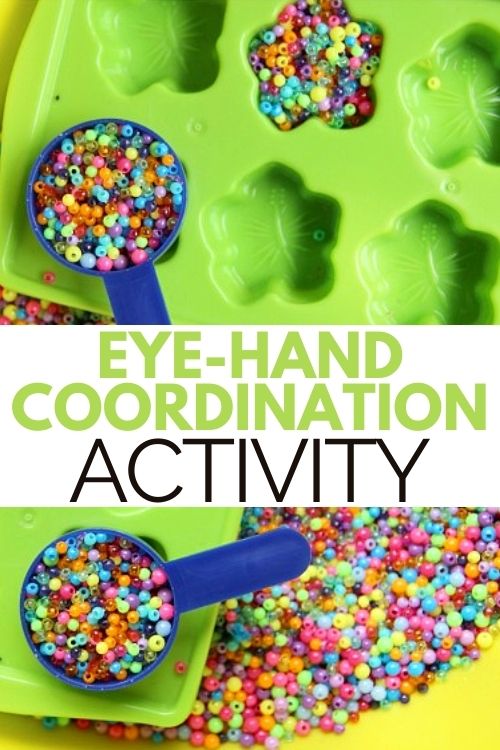
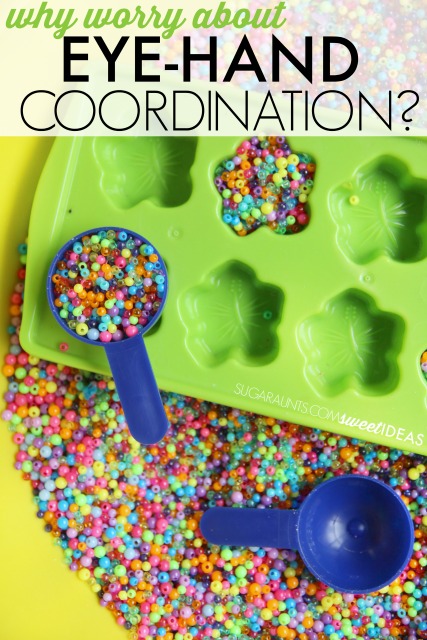
This eye hand coordination activity is an easy one to set up and can use the materials you have in your home. We used a flower ice cube tray and some craft materials, as well as a recycled scoop to work on eye-hand coordination skills, but the motor activity is very open ended. Let’s discuss hand eye coordination and a few ways to work on this skill area.

Development of hand-eye coordination is an important place to begin.

Our movements are guided by vision.  In order for our brains to coordinate a motor plan for a particular task, we need visual input for accuracy.  

Eye hand coordination activity to help kids with refined motor coordination skills.

Eye Hand Coordination Activity 

Visual motor skills or eye-hand coordination impacts our dexterity and motor movements for so many tasks:  handwriting, scissor use, threading beads, reading a paragraph, throwing a ball, placing a cup on a shelf, coloring in lines, and pouring milk into a bowl are just a few skills that require coordination of the vision and hands.    

If eye hand coordination skills are lacking, then these areas of function will be difficult to do with ease.  Learning, social interactions, and independence in tasks can be limited as a result.  That’s a pretty clear a reason to look at eye-hand coordination when there seem to be “bigger picture” problems. 

What is eye-hand coordination and how does this skill impact "big picture" tasks like reading, writing, fine motor skills, and gross motor skills?  This easy, low-prep eye hand coordination activity can help.
 

Scooping and Pouring and eye hand coordination

This scooping activity is a simple way to work on the eye-hand coordination needed for coordinated movements of the hands in relation to visual input.  An activity as simple as scooping beads can help children (and adults addressing physical disabilities!) to improve their visual motor integration.  

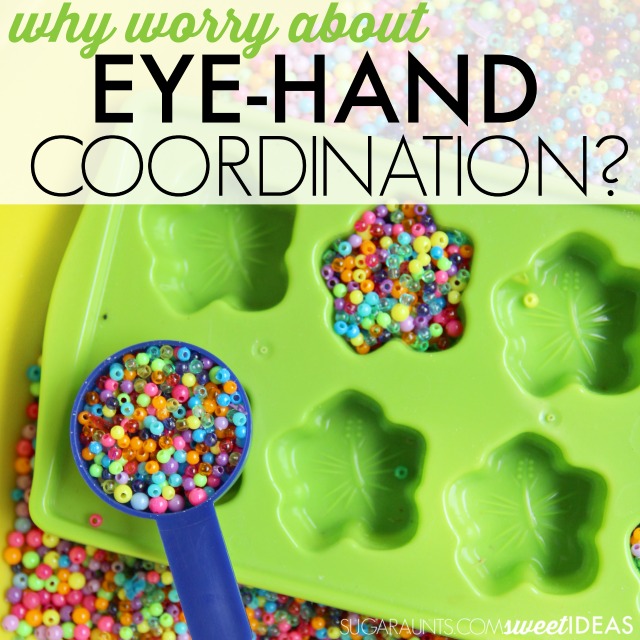
This post contains affiliate links.   We used  a HUGE bin of seed beads and a flower ice cube tray. This is a similar tray. It was a tray of 10 flowers, making it perfect for counting to ten with my toddler and preschooler and working on ten frame math facts with my kindergartner.    

What is eye-hand coordination and how does this skill impact "big picture" tasks like reading, writing, fine motor skills, and gross motor skills?  This easy, low-prep eye hand coordination activity can help.

I added a couple of small scoops to our beads.  These scoops came from dry laundry detergent and were the perfect size for scooping the beads into each flower.  

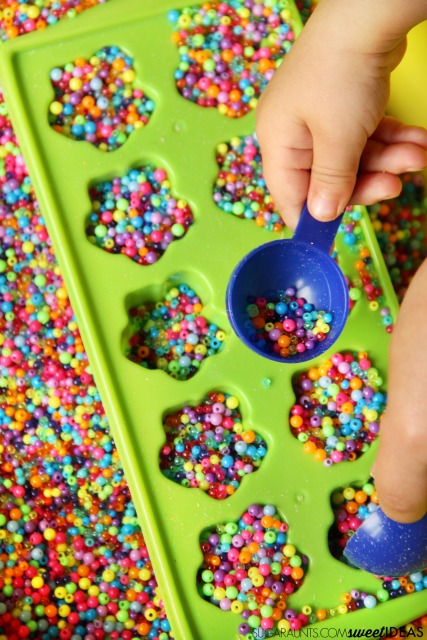
Scooping and pouring the beads into each flower, one at a time works on eye hand coordination to make sure the beads fall into the flowers and not over the edge of the ice cube tray.  

What is eye-hand coordination and how does this skill impact "big picture" tasks like reading, writing, fine motor skills, and gross motor skills?  This easy, low-prep eye hand coordination activity can help.

How to improve eye hand coordination

Scooping and pouring a material that “pours” is an eye hand coordination activity that helps to refine fine motor skills and motor planning. For children, setting up a scooping activity like the one described here can be graded to make the task more difficult, or easier. Different grades of scooping activities can be more difficult because there is less weight (pouring flour compared to sand) or more mobility ( scooping and pouring liquid compared higher viscosity of the materials.)

In our scooping and pouring eye hand coordination activity, the beads are smaller and rounder, adding more of a challenge in coordinating the scoop and accuracy of pouring. To further grade this activity, different sizes of scoops can be used, and different sizes of containers to pour the material into.

Make sure your child is scooping beads into one section of the ice tray at a time.  They need to intentionally fill one section while trying to keep the beads in that section.  If the beads are falling over the edge of the ice cube tray and into other sections, it’s not working on eye-hand coordination.   

More eye hand coordination activities

Looking for more creative ways to build eye hand coordination?

Spring Fine Motor Kit

Score Fine Motor Tools and resources and help kids build the skills they need to thrive!

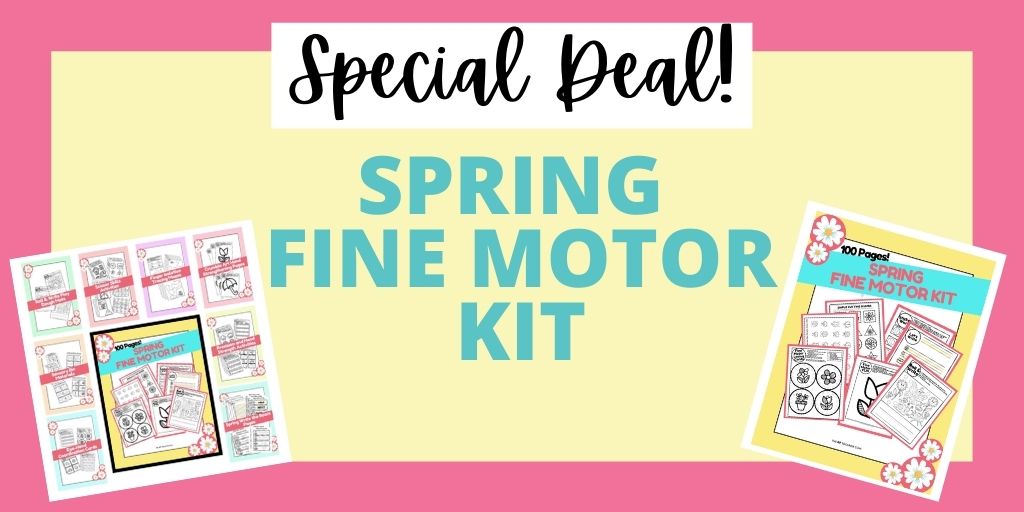
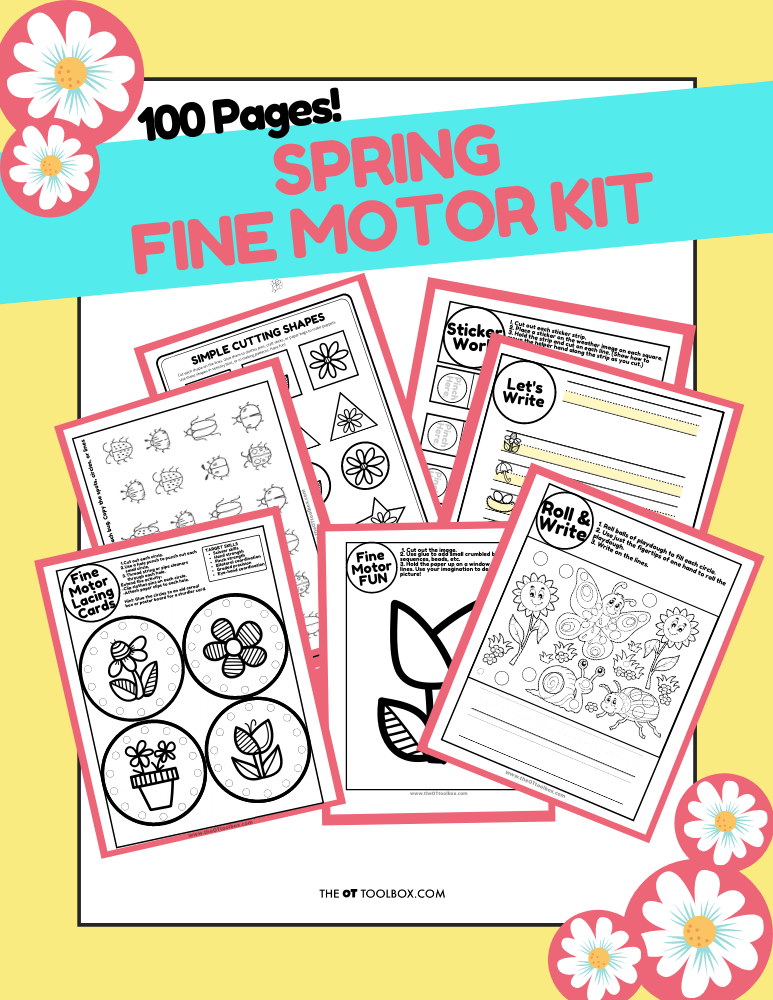
Developing hand strength, dexterity, dexterity, precision skills, and eye-hand coordination skills that kids need for holding and writing with a pencil, coloring, and manipulating small objects in every day task doesn’t need to be difficult. The Spring Fine Motor Kit includes 100 pages of fine motor activities, worksheets, crafts, and more:

Spring fine motor kit set of printable fine motor skills worksheets for kids.
  • Lacing cards
  • Sensory bin cards
  • Hole punch activities
  • Pencil control worksheets
  • Play dough mats
  • Write the Room cards
  • Modified paper
  • Sticker activities
  • MUCH MORE

Click here to add this resource set to your therapy toolbox.

Spring Fine Motor Kit
Spring Fine Motor Kit: TONS of resources and tools to build stronger hands.

Grab your copy of the Spring Fine Motor Kit and build coordination, strength, and endurance in fun and creative activities. Click here to add this resource set to your therapy toolbox.

Colleen Beck, OTR/L has been an occupational therapist since 2000, working in school-based, hand therapy, outpatient peds, EI, and SNF. Colleen created The OT Toolbox to inspire therapists, teachers, and parents with easy and fun tools to help children thrive. Read her story about going from an OT making $3/hour (after paying for kids’ childcare) to a full-time OT resource creator for millions of readers. Want to collaborate? Send an email to contact@theottoolbox.com.

Flower Snacks

flower snacks

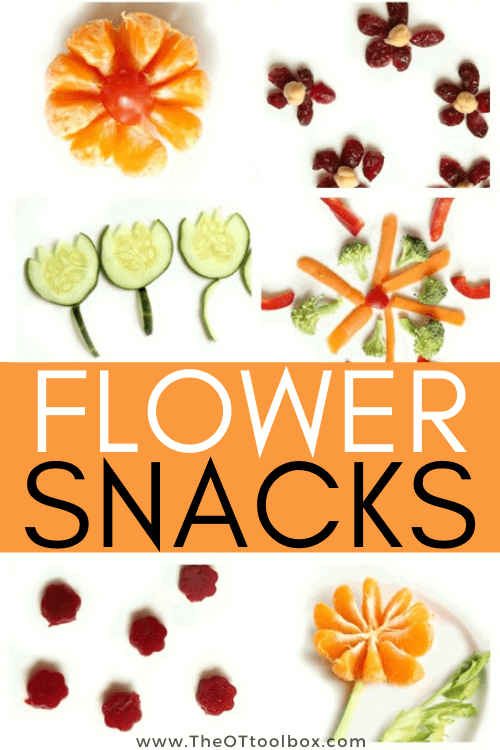
These flower snacks are fun and super easy to create with kids and build fine motor skills in the kitchen. If you are looking for creating ways to add healthy snacks into a child’s diet, these flower themed snacks are just that. Whether kids help in the kitchen for fun or for the benefits of building executive functioning skills or fine motor development, there are many reasons to make these flower healthy treats! This is just one of the many cooking with kids recipes here on the website.

Add these cooking with kids activities to your Spring occupational therapy toolbox.

Flower snacks that are healthy snacks for kids

Flower Snacks

The flower snacks you see below are creative ways to add fun healthy foods for kids. But, even better, kids can help to make these treats. When kids make these snacks, they are building many skills.

Getting kids involved in the kitchen helps to develop fine motor skills like eye-hand coordination, dexterity, and motor planning. All of these skills are refined through dicing, chopping, scooping, and pouring.

Cooking with kids also is a powerhouse task for developing executive functioning skills. Following recipes, direction following, impulse control, planning, prioritization, and working memory are all skills that are developed through meal preparation and recipe following.

Here are more cooking with kids recipes to get kids active in the kitchen to develop skills.


Flower snacks for cute healthy foods for kids
 

Let’s get started with those flower snacks…
 

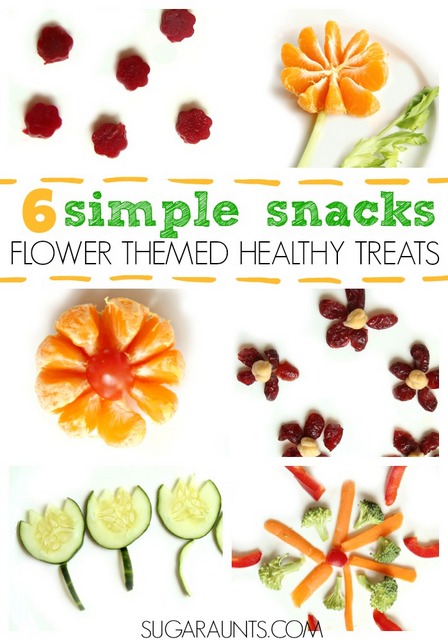
6 healthy flower snacks:

Beet slices flower snack– Use a flower shaped cookie cutter to cut beet slices (or other soft fruit/veggies: pineapple, apples, thin potatoes…
 
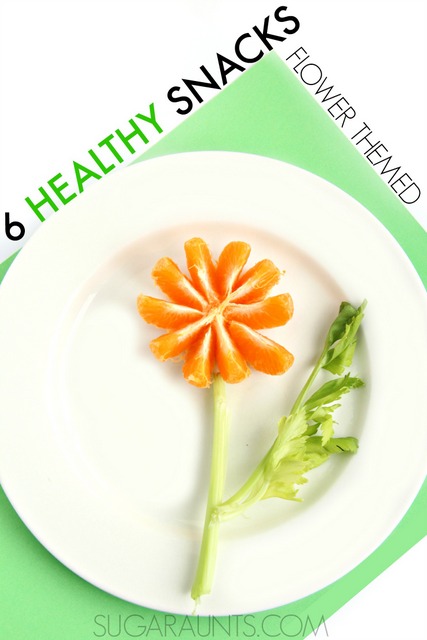
Mandarin orange flower– Peel an orange and open one end.  Add celery for a stem.
 
Orange with flair–  Add a grape tomato to the center of your orange to add a little color.  Other fruits could also be arranged into a flower shape: apple, pear, and banana slices would work.
 
Dried cranberry mini flowers– Arrange cranberries (or raisins) into petal shapes.  Add chickpeas for a center to each flower.
 
Tulip cucumbers– Cut a jagged line into cucumber slices.  Add a piece of the peel for stems for each flower.
 
Flower art–  Get the kids involved in this one!  Provide carrots, broccoli, red peppers, grape tomatoes and create a flower design as a family.  Enjoy!

Cute flower snack ideas for kids!  Kids can help make these flower themed healthy treats.

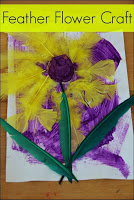
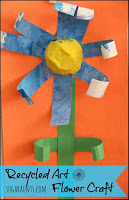
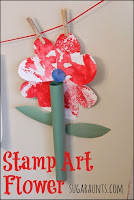
Make today special with a little bit of healthy flower fun!  While you’re at it, make a few flower crafts: 

Spring Fine Motor Kit

Score Fine Motor Tools and resources and help kids build the skills they need to thrive!

Developing hand strength, dexterity, dexterity, precision skills, and eye-hand coordination skills that kids need for holding and writing with a pencil, coloring, and manipulating small objects in every day task doesn’t need to be difficult. The Spring Fine Motor Kit includes 100 pages of fine motor activities, worksheets, crafts, and more:

Spring fine motor kit set of printable fine motor skills worksheets for kids.
  • Lacing cards
  • Sensory bin cards
  • Hole punch activities
  • Pencil control worksheets
  • Play dough mats
  • Write the Room cards
  • Modified paper
  • Sticker activities
  • MUCH MORE

Click here to add this resource set to your therapy toolbox.

Spring Fine Motor Kit
Spring Fine Motor Kit: TONS of resources and tools to build stronger hands.

Grab your copy of the Spring Fine Motor Kit and build coordination, strength, and endurance in fun and creative activities. Click here to add this resource set to your therapy toolbox.

Colleen Beck, OTR/L has been an occupational therapist since 2000, working in school-based, hand therapy, outpatient peds, EI, and SNF. Colleen created The OT Toolbox to inspire therapists, teachers, and parents with easy and fun tools to help children thrive. Read her story about going from an OT making $3/hour (after paying for kids’ childcare) to a full-time OT resource creator for millions of readers. Want to collaborate? Send an email to contact@theottoolbox.com.

Spring Writing Prompt Cootie Catcher

Spring Writing Prompt worksheets

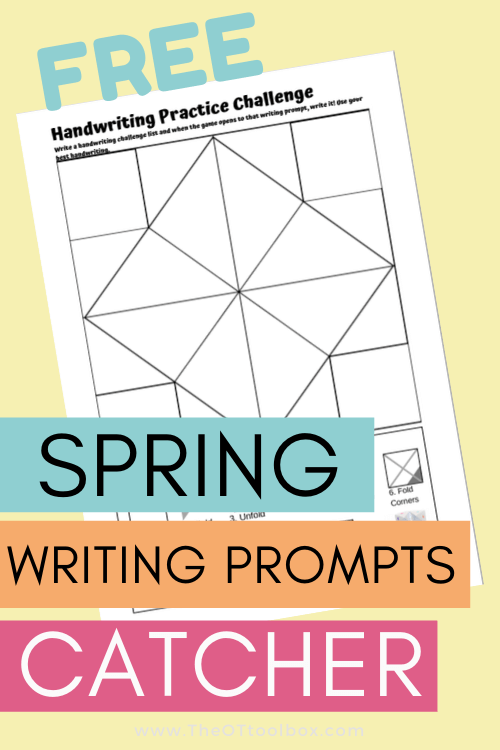
Want to help kids build fine motor skills with a fun cootie catcher game? This Spring writing prompt activity includes fine motor benefits with a cootie catcher that kids can color, write in, and use as a writing prompt to work on handwriting skills. Print this free cootie catcher template and get started building skills! Add this resource to your Spring occupational therapy activities.

Spring writing prompt cootie catcher for working on handwriting skills and fine motor skills with kids.

Spring Writing Prompt Cootie Catcher

This cootie catcher activity is a fine motor skills powerhouse. Kids can work on fine motor skills including:

  • Coloring
  • Cutting
  • Folding paper
  • Writing numbers, words, and sentences

Once the cootie catcher is cut out, kids can write on each space on the cootie catcher. The free printable includes a few different versions.

In one of the free printable resources, you’ll see that the cootie catcher is filled in with writing prompts. Once you go through moving the cootie catcher to open it to the center, kids can write out their response to the Spring writing prompt, working on handwriting skills.

There is also a cootie catcher with Spring images. Kids can color in these icons, working on pencil control and hand strength to color in the small areas. Then, they can write the names of the images in the center of the cootie catcher, working on handwriting.

Finally, there is a blank cootie catcher included, where kids can fill in the spaces while writing in a small space and working on the visual motor skills needed to write in the correct spaces and in the correct directions.

Fine Motor Cootie Catcher

When going through the process of creating a cootie catcher, kids can develop many fine motor skills.

  • First cut out the square cootie catcher, working on scissor skills.
  • Follow the directions to fold the paper along the lines. This direction-following task is a GREAT challenge in visual motor skills!
  • Folding and creasing paper builds hand strength.
  • Kids can write in words, numbers, and writing prompts in the cootie catcher or set it up for them!
  • Opening and closing a cootie catcher builds separation of the sides of the hands, bilateral coordination, and arch development/hand strength.
  • To make a handwriting challenge, sentences can include topical lists such as  “Write a list of favorite foods.” or “Write a list of animals.”
  • Use this challenge to practice spelling words, sight words, vocabulary words and definitions, etc.

Free Spring Writing Prompt Worksheet

Want to grab this free worksheet and work on Spring writing prompts AND fine motor skills? Enter your email address into the form below and the PDF will be sent to you.

Want to add this resource to your therapy toolbox so you can help kids thrive? Enter your email into the form below to access this printable tool.

This resource is just one of the many tools available in The OT Toolbox Member’s Club. Each month, members get instant access to downloadable activities, handouts, worksheets, and printable tools to support development. Members can log into their dashboard and access all of our free downloads in one place. Plus, you’ll find exclusive materials and premium level materials.

Level 1 members gain instant access to all of the downloads available on the site, without enter your email each time PLUS exclusive new resources each month.

Level 2 members get access to all of our downloads, exclusive new resources each month, PLUS additional, premium content each month: therapy kits, screening tools, games, therapy packets, and much more. AND, level 2 members get ad-free content across the entire OT Toolbox website.

Join the Member’s Club today!

FREE Spring Writing Prompt Cootie Catcher

    We respect your privacy. Unsubscribe at anytime.

    Looking for more Spring printables?

    This handout is just one creative way to work on fine motor skills, precision, and dexterity this Spring? You’ll love these other free PDFs here on the website (all are available in our Member’s Club):

    Colleen Beck, OTR/L has been an occupational therapist since 2000, working in school-based, hand therapy, outpatient peds, EI, and SNF. Colleen created The OT Toolbox to inspire therapists, teachers, and parents with easy and fun tools to help children thrive. Read her story about going from an OT making $3/hour (after paying for kids’ childcare) to a full-time OT resource creator for millions of readers. Want to collaborate? Send an email to contact@theottoolbox.com.

    St. Patrick’s Day Writing Slide Deck

    St. Patrick's Day writing prompts and activities

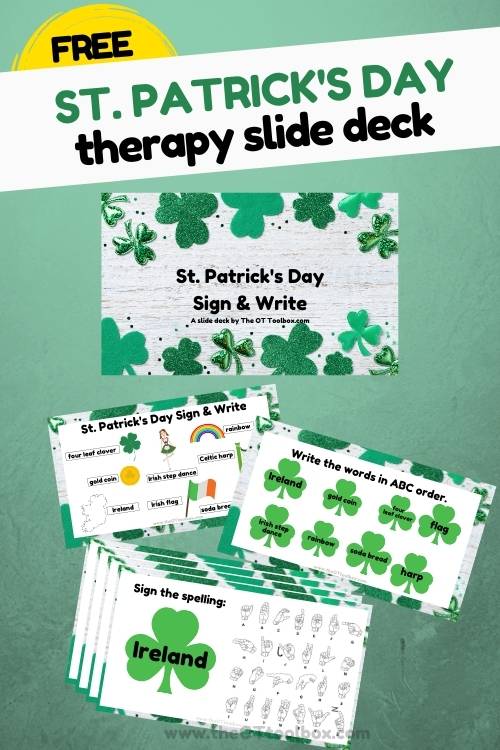
    Another free therapy slide deck in this week’s St. Patty’s Day theme is this St. Patrick’s Day writing activity. It’s an occupational therapy activity that addresses handwriting, legibility, self-correction in writing, and fine motor skills. Sometimes it can be hard to work on handwriting in teletherapy and this activity strives to make that fun and motivating for kids. Use the St. Patrick’s Day writing prompts as activities to get kids started on letter formation, sizing, spacing, and the motor skills needed to hold the pencil with a fun March theme.

    This slide deck goes really well with our recent freebies: Four Leaf Clover balance exercises and Shamrock Theme Visual Perception Activities.

    All are part of the free slides teletherapy resources here on The OT Toolbox.

    St. Patrick's Day writing prompts and activities

    St. Patrick’s Day Writing

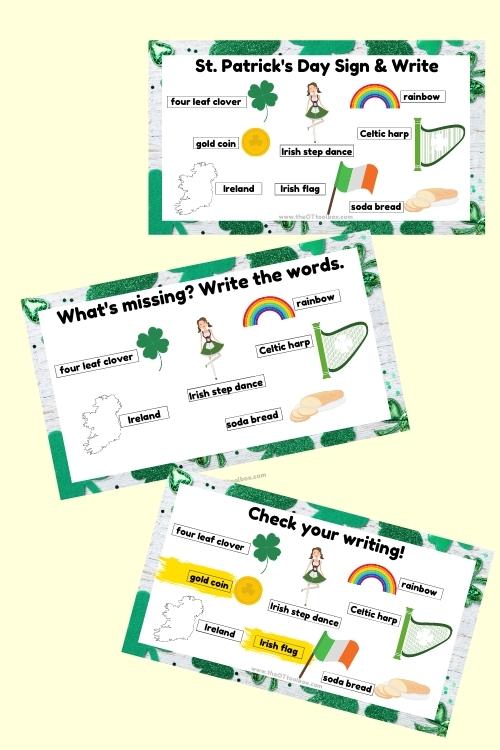
    Working on handwriting isn’t fun for a lot of children. That’s why the slide deck starts off with a writing “ice breaker” activity of sorts. Kids can check out the St. Patrick’s Day items on the slide and try to memorize the items. Then, you can move to the next slide and ask the child to tell you two items that are missing.

    This visual constancy exercise is a way to help kids notice details about what they see, and can be a powerful way to work on handwriting accuracy and formation of letters. Use this as a building block to work on self-correcting handwriting mistakes.

    When children write, that self-assessment piece is important to legibility and accuracy of writing, so when kids can notice and recall missing information or details, they can self-correct for legibility issues.

    As kids go through the slides, ask them to write down the items that are missing. This handwriting activity challenges kids to write without a model, so they are building letter formation skills.

    Then, the next slide shows the answer to the missing pieces. Kids can check their letter formation for accuracy and correct letter formation.

    St. Patrick's day writing prompt and puzzle

    There are two different exercises like this one.

    Depending on the child, you can then have them write down all of the St. Patrick’s Day items.

    Next, users are asked to write the St. Patrick’s Day words in alphabetical order. This activity challenges visual shift from the vertical plane to the horizontal plane and back again. This skillset is needed for copying material from a blackboard or classroom environment. Putting words into alphabetical order also challenges the visual attention and visual memory needed for reading and math work.

    The next several slides of the therapy deck include a fine motor piece where kids are challenged to spell St. Patrick’s Day words in American Sign Language. They will need to visually shift their attention from the word to the sign language sign and form that letter.

    Spelling several words with sign language is a fine motor exercise that helps with finger dexterity, precision, finger isolation, arch development, and motor planning skills.

    St. Patrick’s Day Writing Prompts

    Then, the final piece of the St. Patrick’s Day writing task is to use the words that have been used throughout the slide deck to write sentences. It’s an open-ended St. Patrick’s Day writing prompt that incorporates multisensory learning into the whole lesson.

    Encourage kids to self-check their writing for accuracy and to help with carryover of writing skills.

    Free Writing and Fine Motor Slide Deck

    Add this therapy slide deck to your toolbox. Enter your email into the form below and you will get a copy to use in teletherapy, home programs, or in the classroom.

    St. Patrick’s Day Writing and Fine Motor Activity

      We respect your privacy. Unsubscribe at anytime.
      Colors Handwriting Kit

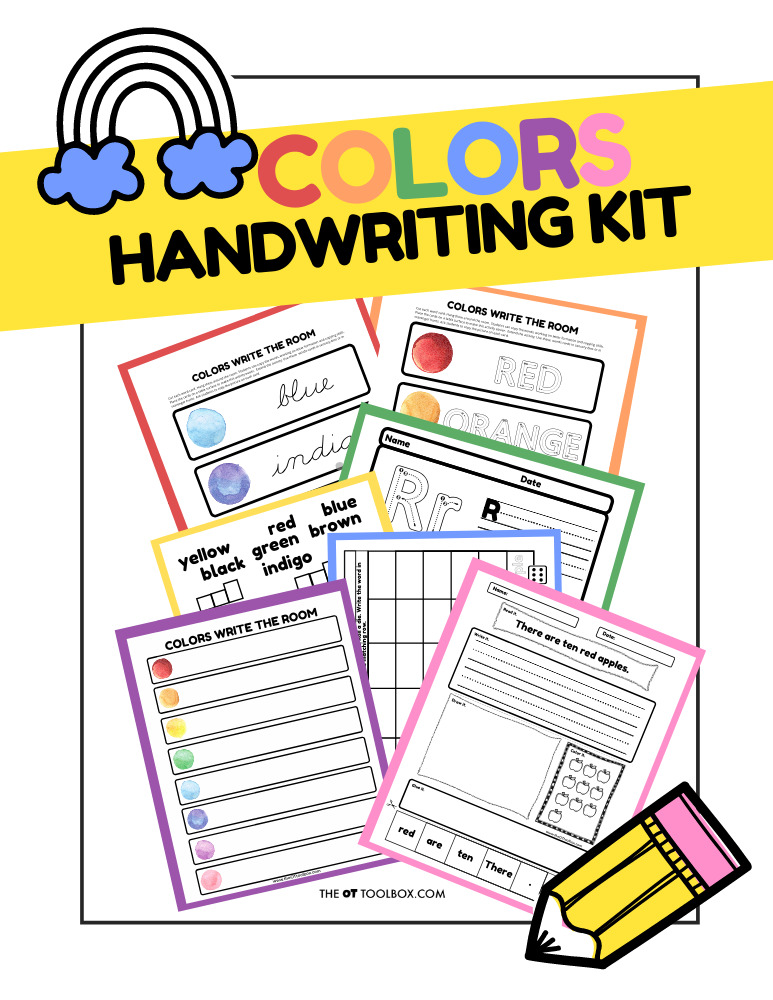
      Rainbow Handwriting Kit– This resource pack includes handwriting sheets, write the room cards, color worksheets, visual motor activities, and so much more. The handwriting kit includes:

      • Write the Room, Color Names: Lowercase Letters
      • Write the Room, Color Names: Uppercase Letters
      • Write the Room, Color Names: Cursive Writing
      • Copy/Draw/Color/Cut Color Worksheets
      • Colors Roll & Write Page
      • Color Names Letter Size Puzzle Pages
      • Flip and Fill A-Z Letter Pages
      • Colors Pre-Writing Lines Pencil Control Mazes
      • This handwriting kit now includes a bonus pack of pencil control worksheets, 1-10 fine motor clip cards, visual discrimination maze for directionality, handwriting sheets, and working memory/direction following sheet! Valued at $5, this bonus kit triples the goal areas you can work on in each therapy session or home program.

      Click here to get your copy of the Colors Handwriting Kit.

      Colleen Beck, OTR/L has been an occupational therapist since 2000, working in school-based, hand therapy, outpatient peds, EI, and SNF. Colleen created The OT Toolbox to inspire therapists, teachers, and parents with easy and fun tools to help children thrive. Read her story about going from an OT making $3/hour (after paying for kids’ childcare) to a full-time OT resource creator for millions of readers. Want to collaborate? Send an email to contact@theottoolbox.com.

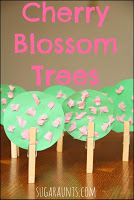
      Cherry Blossom Crafts

      Cherry blossom crafts

      Spring is finally upon us, and the flowers will be blooming soon – it’s the perfect time to introduce some springtime crafts! The ideas you’ll find here are Spring fine motor activities that help to develop hand strength and dexterity. Cherry Blossoms are one of the most famed blooms every year, and for good reason, too – they are gorgeous and short-lived. Cherry blossom trees only have flowers for about 14 days, and only for about a week of that time is when they are this beautiful:

      Cherry blossom crafts kids can make to develop fine motor skills.

      Cherry Blossom Crafts

      Get yourself and your kiddos into the springtime spirit with any of these Cherry Blossom crafts, and add these ideas to your Spring occupational therapy interventions.

      At the bottom of this post, you’ll also fine Cherry Blossom book ideas to incorporate into multisensory learning through play, so keep reading for story time ideas, too!

      Cherry blossom crafts for kids that develop skills, use in occupational therapy interventions or at home to help kids develop motor skills.

      Q-TIP CHERRY BLOSSOM CRAFT

      First, we have to talk about q-tip art. Just look at the creations you can make with a simple bathroom staple:

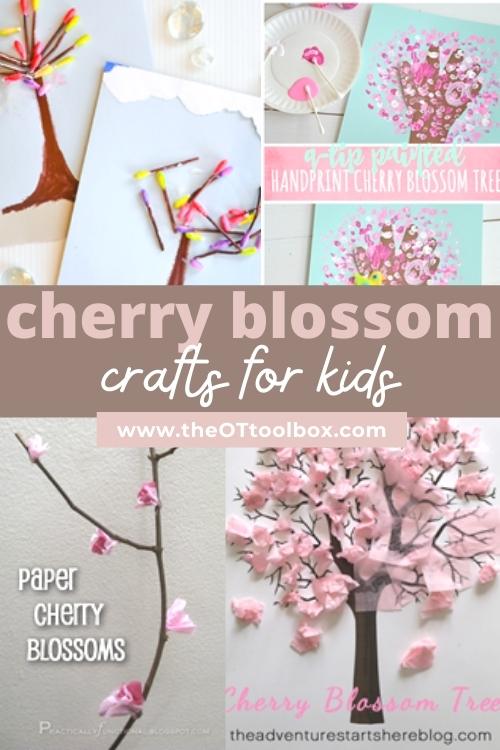
      • This Handprint Tree from Glued to my Crafts will keep your little ones entertained for a while!
      • Or this Spring Tree from A Little Pinch of Perfect, using the q-tips as the tree branches – brilliant!

      Why make art with a Q-Tip?

      • First of all – It’s fun and cheap!
      • Using objects in a way that is not their intended purpose teaches object fluidity, and encourages cognitive development through creative play.
      • Holding a tiny Q-tip stick strengthens fine motor skills and encourages the development of a tripod grasp which is a part of handwriting development

      Tissue Paper CHERRY BLOSSOM Craft

      Next on the list is tissue paper crafts, so simple yet so beautiful!

      We have to have one in here for developing mathematical skills! This is the perfect craft that challenges logical thinking and memory but doesn’t feel like learning to your young student.

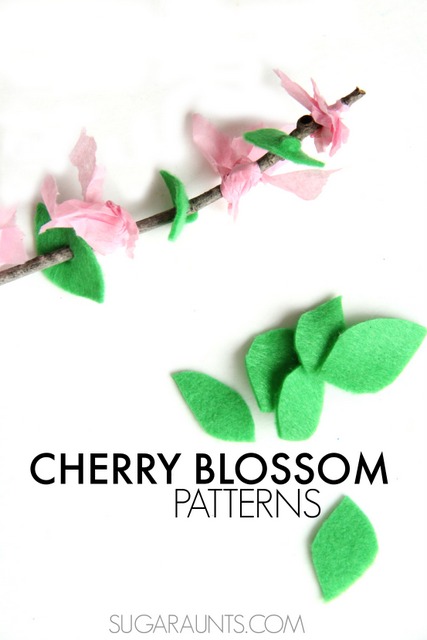
      • Cognition and fine motor skills can be developed using felt and a tree branch in this cherry-blossom-themed Tactile Math Activity.
      Cherry blossom craft pattern craft for teaching patters
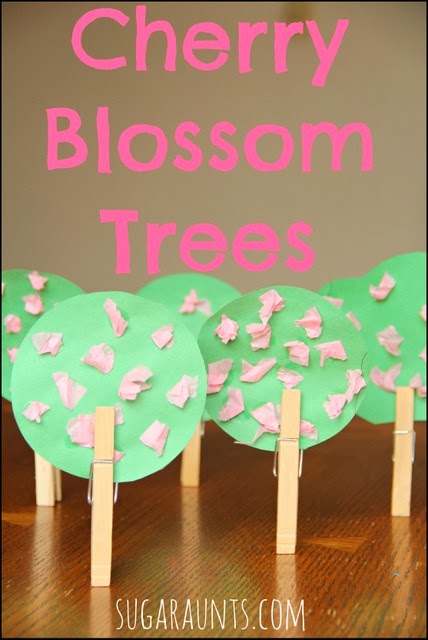
      • This Tissue Paper Tree from The Adventure Starts Here couldn’t be easier! You just need glue, tissue paper, and a printed (or drawn!) image of a tree. 
      • Or, glue some tissue paper on to a stick in this 3D Cherry Blossoms project, from Practically Functional. 
      Cherry blossom craft to develop fine motor skills in kids

      For even more fine motor development in a craft, check out these Fine Motor Cherry Blossoms

      Why use tissue paper in crafts?

      • Ripping tissue paper strengthens the muscles of the fingers, hands, and arms.
      • Touching the crinkly and smooth textures of tissue paper provides a gentle sensory experience that is good for sensory seekers or avoiders.
        • Depending on the papers that you use, you can offer various sensory experiences – the textures, the sounds, the colors!

      Why should I give my toddler a bottle of glue?

      • Squeezing a bottle of glue can take a lot of effort, which strengthens the muscles of the hands that are necessary for occupational skills like handwriting, zipping coats, etc.
      • Learning to control the pressure is a great way to teach fine motor planning skills.
        • Motor planning occurs before a voluntary movement happens, and when we are learning new physical skills, like squeezing a glue bottle, it requires some thinking beforehand to get it right.
        • The action-reaction that occurs with the amount of pressure from the squeeze (action) to the glue that is released (reaction) is a very tangible way to teach this skill. 

      CHERRY BLOSSOM Fingerprint crafts

      We can’t offer a craft without a finger painting option! Read on for why painting with your fingers is beneficial for your child’s development.

      Why use fingers when we have a paintbrush?

      • The answer is that both are great tools to teach different skills!
      • Using fingers as a tool in artistic play provides great sensory feedback to the brain.
        • The textures of the paint, the feeling of the paper, the pressure to place the pain down, and the colors that they can experiment with all provide learning experiences for their growing mind.
      • Using a paintbrush is great, too!
        • The paintbrush provides another way to interact with the paint and paper while using their little hands in a prehensile pattern. Prehensile = grasp, and using any utensil develops their general grasping skills necessary for many occupational skills that are coming their way (handwriting, opening bottles/jars, buttoning, zipping, the list is endless!). 

      Cherry blossom books

      Add a book to the craft activity to add dialogue and communication opportunities to craft time, while facilitating problem solving, social emotional learning, and more.

      I personally love the days when I am able to connect a craft with a story. It makes the simplest things feel so purposeful and well-thought-out – like you’ve won the parenting award for the day!

      Here is a list of cherry blossom themed books to go along with your craft: (Amazon affiliate links included below.)

      Pinkalicious: Cherry Blossom by Victoria Kann

      Sakura’s Cherry Blossoms  by Robert Paul Weston and Misa Saburi

      Cherry Blossom and Paper Planes by Jef Aerts and Sanne te Loo

      Cherry Blossoms Say Spring (National Geographic Kids) by Jill Esbaum

      Spring Blossoms by Carole Gerber and Leslie Evans

      Sydney Thorson, OTR/L, is a new occupational therapist working in school-based therapy. Her
      background is in Human Development and Family Studies, and she is passionate about
      providing individualized and meaningful treatment for each child and their family. Sydney is also
      a children’s author and illustrator and is always working on new and exciting projects.

      Rainbow Pencil Control Exercises

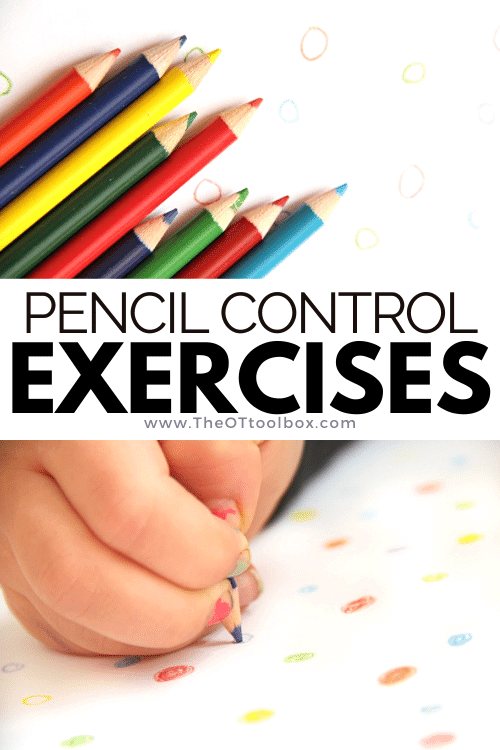
      Pencil control exercises with colored pencils

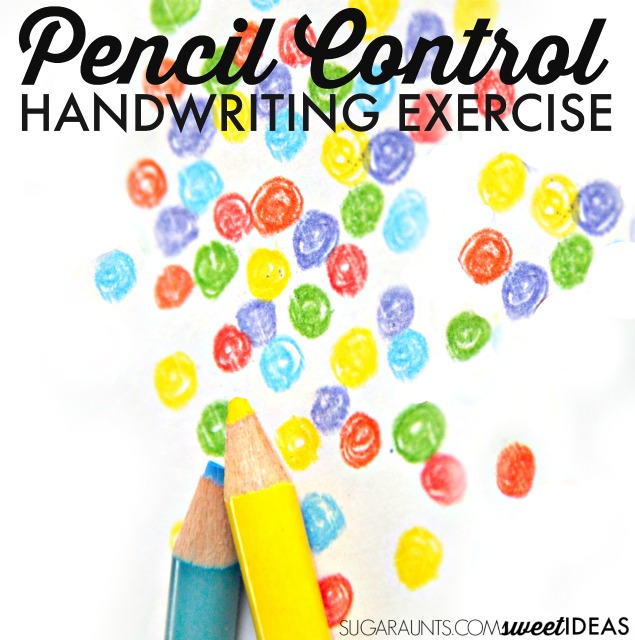
      If you are looking for ways to work on handwriting legibility and pencil control, then you are in the right place. This Occupational Therapist loves to teach kids handwriting.  Neatness counts when it comes to writing on the lines and being able to read that homework assignment a few hours into the nightly after-school ritual.  Today, I’ve got one easy tip for helping kids to manage with pencil control in order to write on the lines at an age-appropriate speed. Add this pencil control activity to this list of pencil control exercises.

      Combine this pencil control exercise with a Fruit Loop rainbow craft for more colorful fun.

      Pencil control exercises with colored pencils
      This activity is perfect for kids from Kindergarten on up through school-aged.  Anyone who is writing with a pencil and trying to form letters on lines, copy written work, fill in worksheets, and take notes will love this handwriting exercise in pencil control.
       
      Try these pencil control handwriting exercises to work on writing in lines with the small muscles of the hands for more accuracy with lines, legibility, and speed when writing.


      Pencil Exercises

      This post contains affiliate links.
       
      Pencil exercises like this simple colored pencil activity are powerful ways to improve pencil control in handwriting.
       
      This activity is really, so simple.  There is nothing you need more than a pencil and paper.  We pulled out colored pencils to make our handwriting activity into a rainbow of color and to add a visual scanning component.
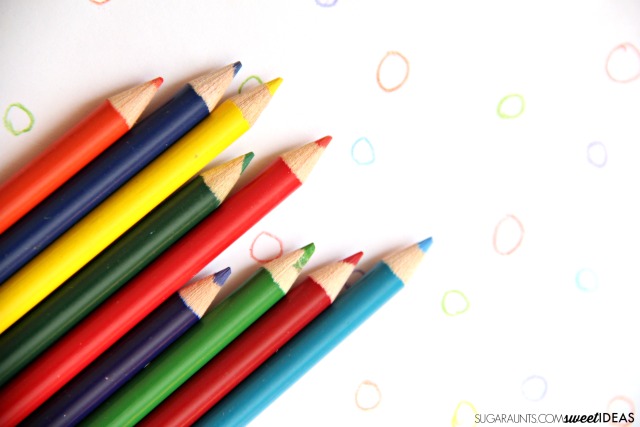
       

      Try these pencil control handwriting exercises to work on writing in lines with the small muscles of the hands for more accuracy with lines, legibility, and speed when writing.


      Rainbow Pencil Control Exercises

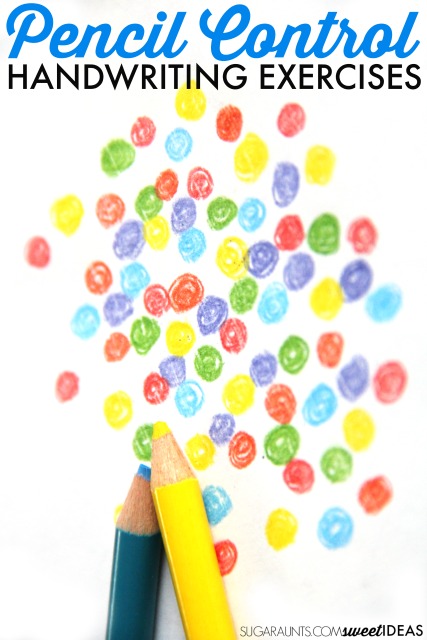
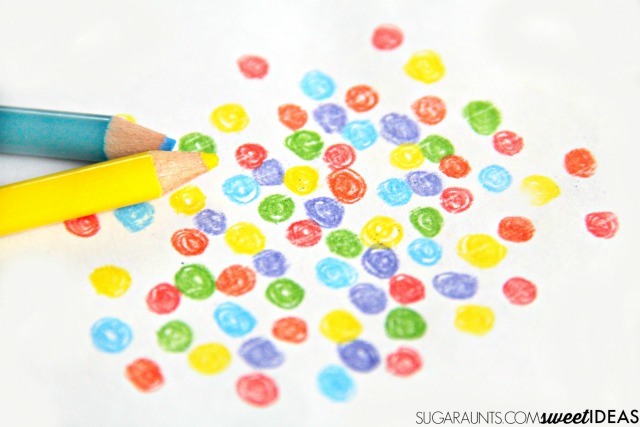
      With this activity, we’re working on keeping the pencil strokes within the lines of a small circle.  

      1. First, draw a bunch of circles in different colors on a piece of paper.  The circles should be 1/4 inch in diameter.  
      2. Ask your child to fill in the circle with the matching colored pencil. A red circle should be filled in with the red colored pencil.  

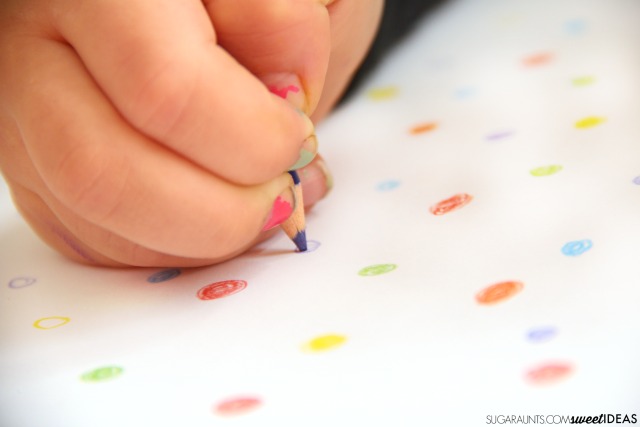
      The objective here is to fill in the whole circle without going over the lines.  Because the circle is so small, filling it in with the colored pencil requires very small muscle movements of the fingers.  

      A child who uses their wrist or forearm to write (such as a child using a grasp such as the thumb wrap grasp, for example, are over compensating for weakness and lack of endurance of the intrinsic musculature in the hand and utilizing a stabilizing grasp.  This rainbow pencil control exercise strengthens dexterity, including range of motion in the thumb IP joint. Read more about the thumb IP joint and handwriting in a previous post.

      This overcompensation does not allow fluid motions of the fingers when moving the pencil in handwriting.  Because the circles are so small, the child can focus more on using the small motor motions to fill in the color.

       
      Try these pencil control handwriting exercises to work on writing in lines with the small muscles of the hands for more accuracy with lines, legibility, and speed when writing.


      More Pencil Control Exercises


      Extend this activity to further your child’s fine motor skills and pencil control in handwriting:

      • Ask your child to draw an “X” in each circle, without going over the lines.
      • Ask your child to draw horizontal or vertical lines within each circle, much like we did here.
      • Create a color coding activity: Match one circle color up with another pencil color.  When you call out a color, your child can fill in that colored circle with a different, predetermined colored pencil.  This is a test of visual scanning and quick thinking.
      • Draw larger circles and show your child how to fill them in with strait pencil strokes.
      • Work on pencil control strokes using the pages in our Colors Handwriting Kit
      Pencil control exercises for kids using colored pencils

          This rainbow handwriting activity is part of the Rainbow Activities for Kids series.  Find more rainbow activities here:

      Colored pencils exercises for improving pencil control in handwriting.

      Looking for more handwriting ideas?  Here are some of my favorites:

      Colors Handwriting Kit

      Rainbow Handwriting Kit– This resource pack includes handwriting sheets, write the room cards, color worksheets, visual motor activities, and so much more. The handwriting kit includes:

      • Write the Room, Color Names: Lowercase Letters
      • Write the Room, Color Names: Uppercase Letters
      • Write the Room, Color Names: Cursive Writing
      • Copy/Draw/Color/Cut Color Worksheets
      • Colors Roll & Write Page
      • Color Names Letter Size Puzzle Pages
      • Flip and Fill A-Z Letter Pages
      • Colors Pre-Writing Lines Pencil Control Mazes
      • This handwriting kit now includes a bonus pack of pencil control worksheets, 1-10 fine motor clip cards, visual discrimination maze for directionality, handwriting sheets, and working memory/direction following sheet! Valued at $5, this bonus kit triples the goal areas you can work on in each therapy session or home program.

      Click here to get your copy of the Colors Handwriting Kit.

      Colleen Beck, OTR/L has been an occupational therapist since 2000, working in school-based, hand therapy, outpatient peds, EI, and SNF. Colleen created The OT Toolbox to inspire therapists, teachers, and parents with easy and fun tools to help children thrive. Read her story about going from an OT making $3/hour (after paying for kids’ childcare) to a full-time OT resource creator for millions of readers. Want to collaborate? Send an email to contact@theottoolbox.com.

      Rainbow Hundreds Chart Puzzle

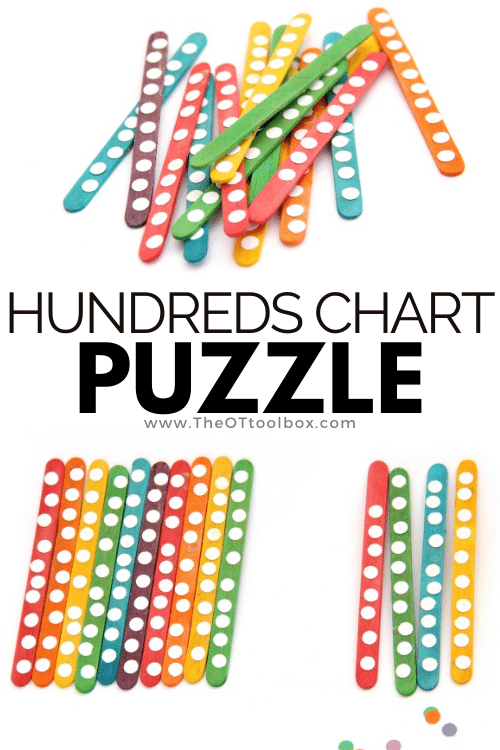
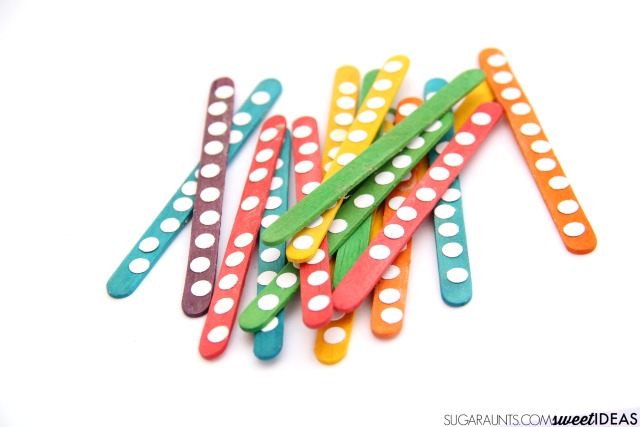
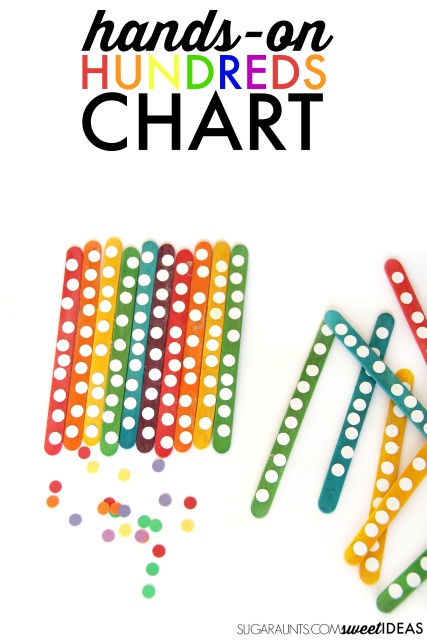
      In this rainbow math activity, we used popsicle sticks to make a rainbow hundreds chart puzzle that was perfect for my kindergarten and second grade kiddos. (And, it would be a nice hands-on math activity for first grade, too.)  This is a multisensory math idea that combines fine motors skills with the colors of the rainbow to teach kids about groups of tens in a hundreds chart.

      Combining numbers into groups of ten and those tens into hundreds is a math concept that is so important for so many math concepts.  We worked on fine motor skills to build the tens columns and combined them into hundreds to work on a few math skills.

      Another great fine motor activity is our Fruit loop rainbow craft ideas.

      Make this hundreds chart puzzle with rainbow popsicle sticks for multisensory math and hands on learning for kids.

      This was such a fun rainbow activity for the season, but this activity could definitely be used year-round.


      Hundreds Chart Puzzle

      Amazon links are included below. You’ll need a few materials for this rainbow hundreds chart puzzle:

      A punch like this one is perfect for building gross hand grasp strength. BUT, if you want this crafting project to move by faster than a snail’s pace, use a 3 Hole Punch. It’s perfect for working proprioception to the arms.  Fold paper into columns and slide it into the punch to get a bunch of holes punched at once.
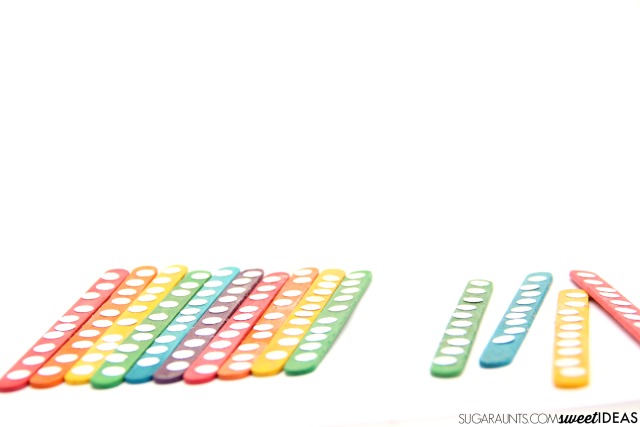
      Make a hundreds chart puzzle using rainbow popsicle sticks for multisensory math for kids.

      To make the rainbow puzzle:
      Punch a ton of holes from the white paper.

      Sort the popsicle sticks into rainbow order on the table surface. Kids can work on visual scanning and visual perceptual skills for this task as they look for colors of the rainbow.

      Next, Swipe the glue along the craft sticks and count out ten holes from the white paper. This is a super counting activity for kids to practice counting ones and grouping into tens.  

      The fine motor work going on here is fantastic, too. Picking up those itty bitty paper holes is a precision grasp workout.

      Punch extra holes from the colored construction paper.  

      A rainbow popsicle stick hundreds chart puzzle is a fine motor math activity that kids can make.


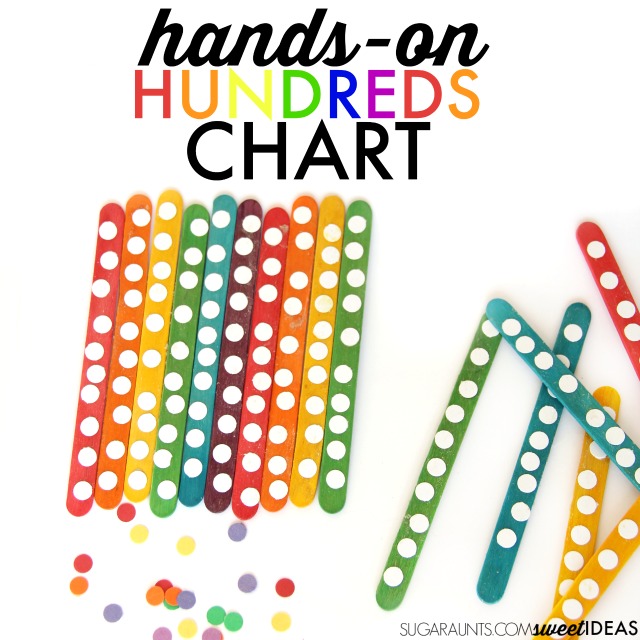
      And, you’re done!  Practice counting the numbers using the tens craft sticks.  Arrange them into groups of ten sticks to create a hundreds chart.  

      Use this rainbow math hundreds chart to work on building tens and hundreds into a hands-on math hundreds chart activity, perfect for working on important math concepts and fine motor skills with kindergarten, first grade, and second grade!
      Use this rainbow math hundreds chart puzzle to work on building tens and hundreds into a hands-on math hundreds chart activity, perfect for working on important math concepts and fine motor skills with kindergarten, first grade, and second grade!

      Multisensory Math activities

      Use this rainbow hundreds chart puzzle for a variety of hands-on math activities:

      • Sort the popsicle sticks into rainbow order.
      • Count the dots by tens
      • Add up all of the colors that are the same, being sure to count by tens.
      • Build two and three digit numbers
      • Practice addition with and without regrouping using the manipulatives as counters.
      • Practice subtraction with and without regrouping using the craft stick manipulatives.
      • Build a two or three digit number and ask your child to name the number.
      • Ask your child to name a number and then build a two or three digit number.

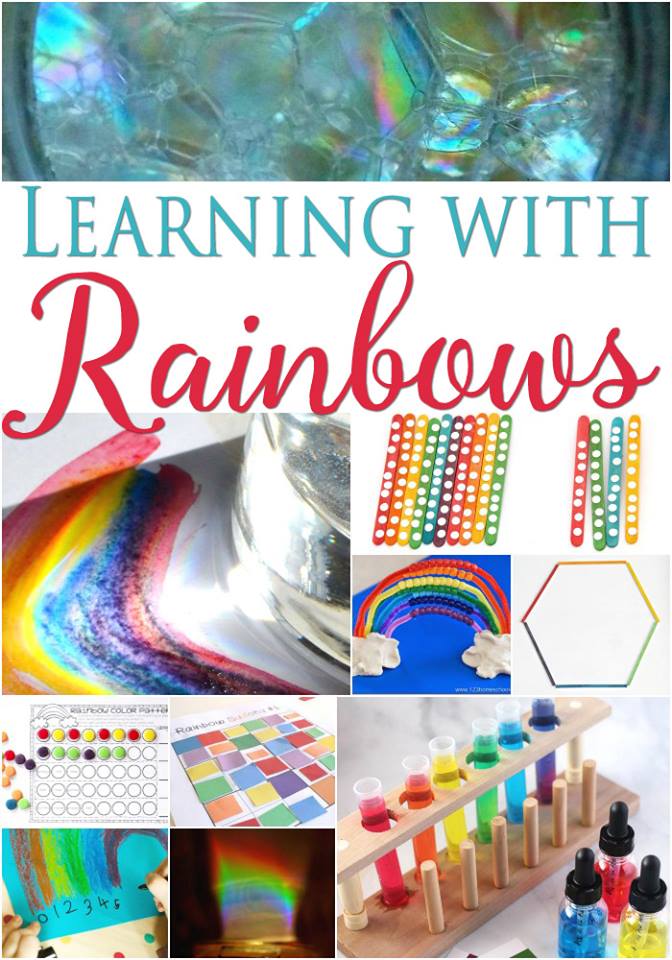
      Looking for more ways to learn with rainbows?  

      Rainbow learning activities for kids
      Use this rainbow math hundreds chart to work on building tens and hundreds into a hands-on math hundreds chart activity, perfect for working on important math concepts and fine motor skills with kindergarten, first grade, and second grade!

      Our favorite multisensory math activities:


      Regrouping double digit math

      Outer Space Regrouping Maze


      Regrouping Tips and Tricks

      How would you play and learn with this rainbow hundreds chart puzzle and math popsicle stick hundreds chart?

      Take multisensory learning further with the rainbow theme. Try our new Colors Handwriting Kit. It now includes a bonus pack of fine motor, visual motor, and directionality pencil control activities.

      Colors Handwriting Kit

      Rainbow Handwriting Kit– This resource pack includes handwriting sheets, write the room cards, color worksheets, visual motor activities, and so much more. The handwriting kit includes:

      • Write the Room, Color Names: Lowercase Letters
      • Write the Room, Color Names: Uppercase Letters
      • Write the Room, Color Names: Cursive Writing
      • Copy/Draw/Color/Cut Color Worksheets
      • Colors Roll & Write Page
      • Color Names Letter Size Puzzle Pages
      • Flip and Fill A-Z Letter Pages
      • Colors Pre-Writing Lines Pencil Control Mazes
      • This handwriting kit now includes a bonus pack of pencil control worksheets, 1-10 fine motor clip cards, visual discrimination maze for directionality, handwriting sheets, and working memory/direction following sheet! Valued at $5, this bonus kit triples the goal areas you can work on in each therapy session or home program.

      Click here to get your copy of the Colors Handwriting Kit.

      Colleen Beck, OTR/L has been an occupational therapist since 2000, working in school-based, hand therapy, outpatient peds, EI, and SNF. Colleen created The OT Toolbox to inspire therapists, teachers, and parents with easy and fun tools to help children thrive. Read her story about going from an OT making $3/hour (after paying for kids’ childcare) to a full-time OT resource creator for millions of readers. Want to collaborate? Send an email to contact@theottoolbox.com.

      Rainbow Sort Color Activity

      rainbow sort fine motor activity

      This rainbow sort activity is a fine motor skills idea to help kids sort colors while developing dexterity and precision and learning colors. By sorting the colors of the rainbow into small containers, a rainbow fine motor activity is a colorful way to help kids develop fine motor skills. Add this idea to your rainbow theme in therapy interventions, or home activities for developing motor skills.

      Extend this activity and sort the rainbow colors to make a Fruit Loop rainbow craft for more fine motor and visual motor fun.

      I love this activity for helping kids learn colors!

      Rainbow sort activity for fine motor skills in kids
      Rainbow sort activity to help kids develop fine motor skills with a rainbow theme

      Rainbow Sort

      We have been on a rainbow kick recently and have a ton of rainbow projects going on right now.  This color sorting activity was a fun one that the big kids and my toddler really got into. 

      This rainbow sort activity is easy to set up. All you need is colorful craft pom poms and an ice tray or two. The ice trays are the perfect size for the crafting pom poms.

      Rainbow sort activity for kids to develop fine motor skills
       
      Kids can sort the colors of the rainbow to work on fine motor skills

      Preschool Rainbow Activities

       
      This color sorting activity is great for toddlers to develop fine motor skills in the preschool and toddler years. Baby Girl (17 months) got right in there.
       
      In the preschool years, fine motor skills are a precursor for handwriting and pencil grasp. This pre-writing activity is perfect for preschool aged children. 
       
      Add this rainbow fine motor activity to the preschool classroom or home by adding tongs, tweezers, or scoops to help kids develop the precision, motor coordination, and eye-hand coordination skills kids need at the preschool age. 
       
      Plus, this rainbow sort activity is a great way to teach preschoolers colors, too.
       
      To work on pre-writing skills in other ways, try this rainbow prewriting activity available on a free slide deck. 
       
      Tongs are a powerful fine motor tool to use in occupational therapy activities that develop fine motor skills. To elevate this fine motor activity, ask kids to make their own craft stick tongs to manipulate these colorful craft poms. Preschool children can sort the colors using different colored tongs that are easy to make.
       
      Rainbow sorting fine motor activity for preschool
       She is ALWAYS watching the big kids and copies everything!
       
      Look at that concentration.  And that cute little baby belly!   

      Rainbow activity for fine motor skills in toddlers
       
      I can’t stand the cuteness!
       
      Toddler fine motor skills

      Rainbow sort color learning activity for kids

      Rainbow fine motor skills activity
       
       
      Colors Handwriting Kit

      Rainbow Handwriting Kit– This resource pack includes handwriting sheets, write the room cards, color worksheets, visual motor activities, and so much more. The handwriting kit includes:

      • Write the Room, Color Names: Lowercase Letters
      • Write the Room, Color Names: Uppercase Letters
      • Write the Room, Color Names: Cursive Writing
      • Copy/Draw/Color/Cut Color Worksheets
      • Colors Roll & Write Page
      • Color Names Letter Size Puzzle Pages
      • Flip and Fill A-Z Letter Pages
      • Colors Pre-Writing Lines Pencil Control Mazes
      • This handwriting kit now includes a bonus pack of pencil control worksheets, 1-10 fine motor clip cards, visual discrimination maze for directionality, handwriting sheets, and working memory/direction following sheet! Valued at $5, this bonus kit triples the goal areas you can work on in each therapy session or home program.

      Click here to get your copy of the Colors Handwriting Kit.

      Colleen Beck, OTR/L has been an occupational therapist since 2000, working in school-based, hand therapy, outpatient peds, EI, and SNF. Colleen created The OT Toolbox to inspire therapists, teachers, and parents with easy and fun tools to help children thrive. Read her story about going from an OT making $3/hour (after paying for kids’ childcare) to a full-time OT resource creator for millions of readers. Want to collaborate? Send an email to contact@theottoolbox.com.

      Color Exercises

      Color exercises for teletherapy

      Looking to get kids moving and building skills in therapy sessions or at home? These color exercises use all the colors of the rainbow to help kids move and strengthen gross motor skills, fine motor skills, and even visual motor skills! Add these whole body exercises use colors as a therapy theme, but I love that the colorful exercise activities get kids strengthening muscle groups in big and small ways.

      This therapy activity slide deck is one of the many free slides available here on the site, as a resource for teletherapy, home programs, and therapy planning!

      Be sure to grab the free I Spy Colors therapy slide deck, too. For a hands-on activity, be sure to use our color by letter worksheet.

      Color exercises for teletherapy

      Related resource- Working with kids in teletherapy? Need streamlined info on how to structure your sessions? Need activities for week-to-week therapy planning? need answers for all of your teletherapy questions? Join the free teletherapy course, a 5 day email series on telehealth for occupational therapists.

      Color exercises

      This is a color learning activity, that can be used in teletherapy sessions to develop many skill areas:

      Color exercises for kids

      Gross Motor Color Exercises

      All of these gross motor skill areas can be addressed using the color activities in this slide deck:

      • Gross motor skills
      • Core strength
      • Bilateral coordination
      • Crossing midline
      • Core strength
      • Stability
      • Balance and equilibrium skills
      • Coordination
      • Range of motion
      • Flexibility
      • Motor planning
      • Crossing midline
      • Movement patterns
      • Posture and postural control
      • Muscle tone
      • Proprioceptive input
      • Vestibular input

      As kids go through the slides, they need to complete various stretches, challenging the skills listed above. There are movement patterns, crossing midline activities, yoga positions, and more. Kids can go through these slides several times if you like, to work on motor planning, sequencing, and memory skills.

      Color and letter exercises

      Then, the slides ask the child to air write letters. This is an eye-hand coordination activity that incorporates shoulder positioning and strengthening, finger isolation, and crossing midline, motor planning, range of motion.

      These slides also work on visual perceptual skills including visual closure as kids identify the hidden letter.

      Grade and extend this activity:

      • Challenge kids by calling out a color and they can complete that gross motor activity.
      • Having the child air write the letter associated with the color and writing the letter larger or smaller, using whole arm motions, or just the finger.
      • Challenge kids by calling out a color and asking them to air write the letter.
      • Or ask kids to complete the air writing task while in the gross motor stretch activity.
      Color hand strength exercises

      Fine Motor Color Exercises

      This slide deck challenges fine motor skills as well. Kids can use their finger and work on finger isolation as they write the letters on each of the color slides.

      There is another movement section of the slide deck that incorporates colored letters with a fine motor activity. All students will need is a piece of paper (scratch paper works, so tell them to grab an old homework page or even a piece of junk mail) and their hands.

      Following the directions on the fine motor activity slides, they will tear the paper into small pieces using their hands to tear and crumble. Tearing paper with the hands and using the finger tips to crumble small bits of paper strengthens the intrinsic muscles of the hands. Here is more information on tearing paper as a fine motor activity.

      This activity works on fine motor skills:

      • Arch development
      • Intrinsic hand strength
      • Open thumb web space
      • Hand strength
      • Dexterity
      • Precision
      • Graded tearing- eye hand coordination
      • Separation of the sides of the hand

      Then, you can extend this activity to use it in different ways or to challenge kids of all levels and ages:

      • Use different colored paper to match with different letter activities and gross motor exercises in the first part of the slide deck.
      • Use different grades of paper to make the exercise more difficult. Heavy weight paper like construction paper, cardstock, or paper plates is more of a challenge and lighter weight paper like thing paper, wrapping paper, wax paper, or tissue paper is easier.
      • Encourage children to use only the very tips of one hand.
      • Ask kids to write a letter on the small piece of paper and then crumble it up so the letter is hidden.
      Letter exercises using colors

      Visual Motor Exercise with Colors

      Finally, the last part of this slide deck is a visual motor exercise. Children can use those small pieces of paper to copy the lines and letters on the slides.

      This activity includes strait lines for younger children to incorporate pre-writing lines. There are also letters included for kids working on forming letters.

      Extend this activity

      • Matching letters to the exercises at the beginning of the deck.
      • Kids could also form letters using the paper balls by memory rather than copying the letter forms.
      Color exercise for self regulation

      The slide deck ends with a color self regulation exercise. Kids can choose the color that matches their feelings, alert state, and regulation needs, all with a rainbow color theme!

      Virtual Color Exercise Activities

      Want this free therapy slide deck? Enter your email into the form below. Grab the free Google slide deck by entering your email into the form below. You will receive a PDF containing a link to open the slide deck. Be sure you are logged into your Google account before clicking the button on that PDF. Save the PDF in your therapy files so you can access this resource any time and share with those on your caseload.

      Color Exercises!

        We respect your privacy. Unsubscribe at anytime.

        Colleen Beck, OTR/L has been an occupational therapist since 2000, working in school-based, hand therapy, outpatient peds, EI, and SNF. Colleen created The OT Toolbox to inspire therapists, teachers, and parents with easy and fun tools to help children thrive. Read her story about going from an OT making $3/hour (after paying for kids’ childcare) to a full-time OT resource creator for millions of readers. Want to collaborate? Send an email to contact@theottoolbox.com.