Upper Extremity Activities for Toddlers

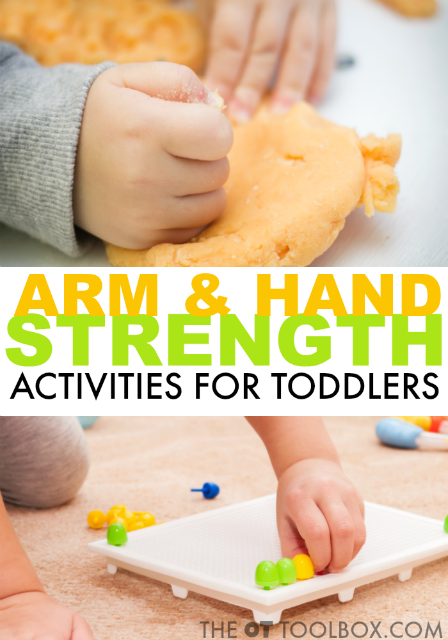
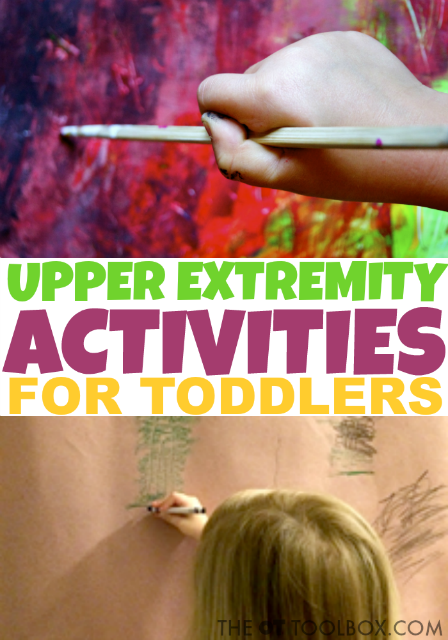
Upper extremity hand strength isn’t just about strong hands! Kids need upper extremity strength for tasks such as handwriting, coloring, managing clothing fasteners, and more! The thing is, upper extremity strengthening begins at a very young age. In fact, activities for toddlers can be loaded with the strengthening and dexterity activities that strengthen the upper extremities for improved endurance and coordination down the road. All of these components work together fluidly for strong upper extremities. Check out the upper extremity activities for toddlers to find out how and where to begin with upper extremity strength!  


Upper extremity activities for toddlers

 
Working on upper extremity strength is a key factor in being
able to have the endurance for handwriting. Working on the shoulder muscle strength and flexibility will help to improve the coordination needed for drawing and handwriting. 
 
We covered some of the best crayons for toddlers with focus on the strength and motor skills that develops during the toddler years. Check out that blog post for information based on strength development during ages 1-3 years.


These upper extremity activities for toddlers will help improve the strength and stability needed for endurance and coordination in handwriting and other tasks.


Importance of upper extremity activities for strength

 
Why is this important? If a child does not have adequate
shoulder strength and core body strength it will be difficult for them to have controlled hand movements.
You may notice that when handwriting or coloring that they position their
shoulder abducted and wrist will be flexed instead of in extension.  Build muscle strength proximal to distal
because if you don’t have strength in your shoulders, back, traps etc. then
your distal function (example handwriting) will not be as controlled.
 
 Below are two easy activities
that can be done at school, in a clinic or at home with a child to address
upper extremity strength. Also try these activities to promote wrist extension.
Use these arm and hand strength activities for toddlers to improve upper body strength for better coordination and endurance in handwriting and other fine motor activities for toddlers.

Upper extremity strength activities for toddlers

These are upper extremity activities for toddlers and kids who would benefit from strength and endurance in the upper body.

Gravity Resistive Sticker Activity

 
Have the child lay on the ground under a table. I will
usually place a pillow or blanket to make it more comfortable. Tape a large
piece of paper under the table and have the child, while laying on their back,
place stickers on the paper.
 
I have drawn circles for the child to place stickers in or
had a background theme. For example, a nature background and use stickers such as birds, trees, etc. The other activity I have done is had the child place stickers randomly all over the paper and then then have to use a marker to circle the shapes. Works great if you are working on a child’s pre-writing skills.
They could also put a square, triangle or make an X on the shapes.
 

Crayon Rubbing on a Vertical Surface

I remember when I was younger I really enjoyed taking coins,
placing paper over them and then using a crayon to rub the print onto the
paper. I also did this with leaves in the fall. How exciting to see the print
come out on the paper!
 
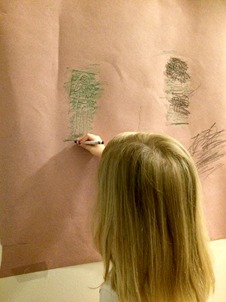
One fun way to keep a child engaged with this great upper extremity activity for toddlers, is to tape crayon rubbing plates on the wall, place a large sheet of paper over them and then give the child crayons to rub the paper until they see the print.


Use wall crayon rubbings to help kids strengthen the upper extremities in this upper extremity activity for toddlers.
 
Having a child color on a vertical surface is a great
activity in itself for shoulder stability and flexibility and it puts the wrist
in extension which helps encourage a better pencil/crayon grasp.
I have used crayon rubbing plates with animal pictures on
them and  girls love to color the fashion
plates. To keep the child engaged I won’t let the child see what plates I am
using. That way they continue to color on the vertical surface to see what pictures
they get.
 
This activity also
works on teaching children how to apply more pressure when writing/coloring, as
you need to press hard to have the print come through and softer if the print
is blurred because of how hard the child pushed on the crayon.


Looking for more upper extremity activities for toddlers?

This crayon rubbing activity uses sight words to work on strength and pressure in handwriting.

 
Want some other fun ideas to work on a vertical surface? Check out learning ideas on windows and glass doors!


Stickers are an awesome fine motor tool. Here are 10 ways to use stickers to help with fine motor skills.
 
Read more about the many benefits of coloring with crayons.
 
Read more about working on a resistive surface to build strength and stability.
 
Another great under the table activity is beading! Use resistance and gravity to strengthen and boost skills by beading under a table.
 
 
About Christina:
Christina Komaniecki is a school based Occupational Therapist. I graduated from Governors State University with a master’s in occupational therapy.   I have been working in the pediatric setting for almost 6 years and have worked in early intervention, outpatient pediatrics, inpatient pediatrics, day rehab, private clinic and schools. My passion is working with children and I love to see them learn new things and grow. I love my two little girls, family, yoga and going on long walks.


Kinesthetic Learning Fine Motor Activity

The Kinesthetic Sense is needed for almost every task. Read on for more information on kinesthetic learning, exactly what is kinesthesia, how the kinesthetic sense plays a part in fine motor skills, and kinesthetic fine motor activities that can help with motor planning and learning through play.


What is Kinesthetic Learning?


The Kinesthetic sense is a huge part of every action we do.  When we pick up a toothbrush and brush our teeth, we “know” the motion and amount of pressure that is needed to move the toothbrush and polish teeth without poking the side of mouth with the toothbrush. 

The Kinesthetic sense allows us to zipper a jacket without looking at the zipper. It allows us to tie our shoes while looking up at a friend on the playground.  It allows us to have a conversation and look around at our table mates while using a fork, wiping our mouth, and picking up a cup during dinner. It enables a student to flip the pencil and erase a mistake without looking at the pencil and thinking through each step of moving the pencil within the hand. 

Kinesthesia allows us to participate in actions with motor planning, appropriate motor actions, and effective proprioception. 


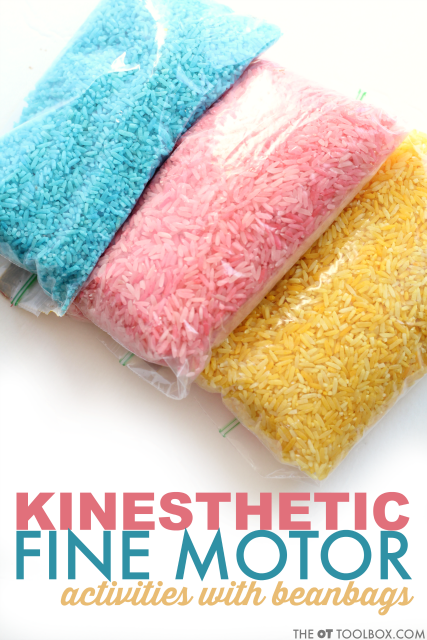
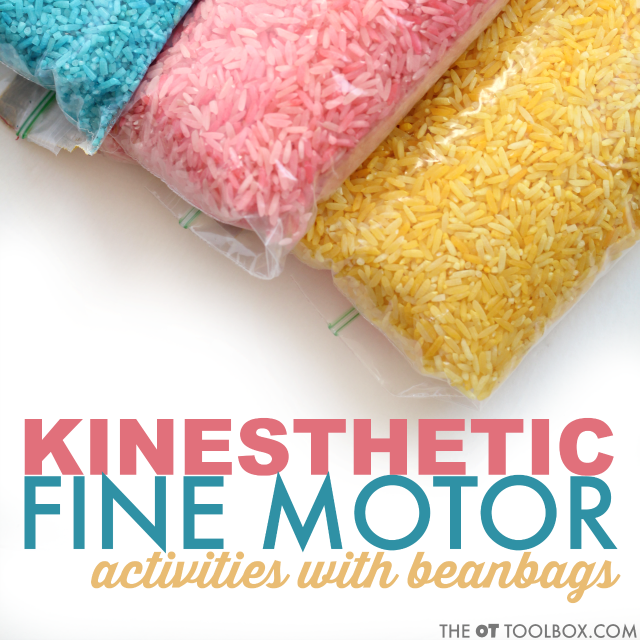
These kinesthetic learning fine motor activities use homemade bean bags.


Praxis, or
kinesthesis
 help
us understand how to move our bodies. 
The praxic system is also known as the kinesthetic system. The kinesthetic system essentially “puts it all
together” when it comes to motor responses to sensory information that has been
perceived by the other senses.  

Knowing how to move our body and how those actions are to be performed is a big part of sensory processing, including a combination of many senses! Read more about sensory processing and how all of the senses are part of a big puzzle in our recent book, The Sensory Lifestyle Handbook


All of this processing movements and knowing how to move the body within an action make up kinesthetic learning


Kinesthetic learners need to move their bodies, manipulate materials, and really interact with learning materials.  These children tend to fidget, wiggle, slouch, or get up out of their seats when in the classroom setting.  This site has a lot of great information on kinesthetic learning. 


Adding movement opportunities involving multiple senses into learning opportunities benefit the kinesthetic learner. 


Kinesthetic learning has also been called three dimensional learning. 


Kinesthetic learning occurs during learning experiences where a student feels, touches, hears, moves, and overall “experiences” in learning. 

Kinesthetic Learning and Motor Planning in Activities


Having a motor plan for an action can help with tasks that
are performed again and again. This is true for the motion needed to open and
close scissors while using both hands in a coordinated manner. 

Motor planning
is necessary for formation of letters and numbers (Consider being able to jot
down notes very quickly or writing a quick fill-in-the-blank word when looking
up at a Smartboard.) Motor planning allows us to manage clothing fasteners
without looking. This is the “muscle memory” that allows movements to be performed in a
smooth and coordinated manner.

Addressing the kinesthetic sense in learning can be helpful for many children, particularly those who are kinesthetic learners. 

Proprioception and the kinesthetic sense

Linked to motor planning and kinesthetic motions is
proprioception. The ability for muscles and joints to manage weight and
position in space are necessary for movements to occur with appropriate force
modulation.

The Proprioception Sensory System is the recognition and response to the body’s
position in space with an internal feedback system using the position in space
of the joints, tendons, and muscles. 
This sensory system allows the body to automatically react to changes in
force and pressure given body movements and object manipulation.  The body receives more feedback from active
muscles rather than passive muscle use.  

Related to the proprioceptive system is kinesthetic motor actions, or praxis.  Individuals are able to plan and execute
motor tasks given feedback from the proprioceptive system. Praxis allows us to
utilize sensory input from the senses and to coordinate hat information to move
appropriately. 

Kinesthetic Learning Fine Motor Activities 

Kinesthetic actions occur in both gross and fine motormovements. When a child is able to complete jumping jacks with coordinated
upper and lower body movements they are utilizing gross motor kinesthetic
movements. 


When a child manages buttons on their pajamas without looking and
with a coordinated manner, they are utilizing fine motor kinesthesia (among other skills! This is an overgeneralization.) 

These outdoor kinesthetic learning activities can be as fun as they are helpful for kids!


Kinesthetic Fine Motor Activity

Kids can work on kinesthetic learning and kinesthetic fine motor skills with this bean bag activity that helps to address motor planning needs.
There are ways to develop and strengthen kinesthetic fine
motor actions. These activities can be used to help develop muscle memory,
motor planning, and the ability to recognize and respond to various levels of
weight and kinesthetic input.

One way to develop kinesthetic fine motor skills is to use
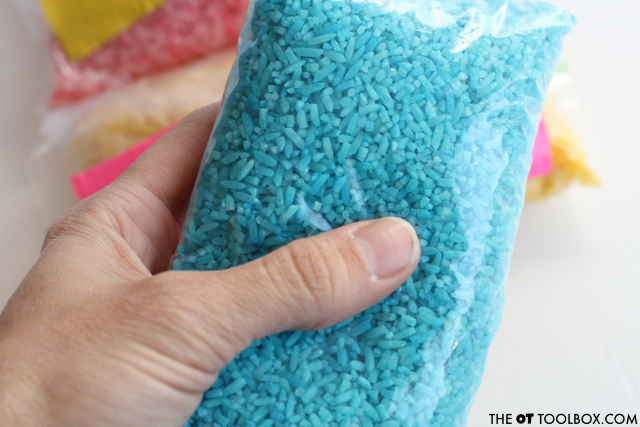
weighted bean bags in various weights.

These simple DIY bean bags use brightly colored sand in
see-through plastic baggies. Different styles of DIY bean bags can be used to
provide more a more lasting bean bag.

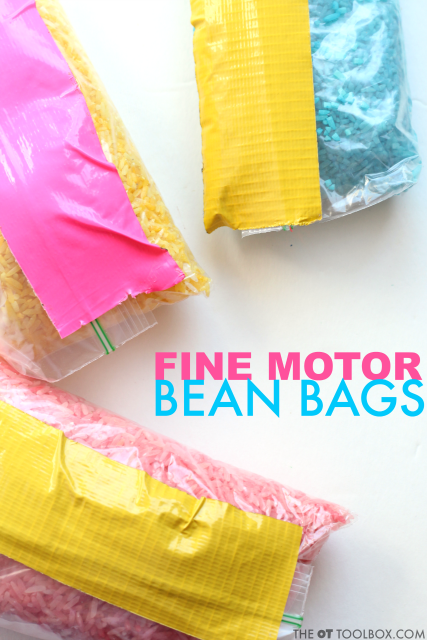
Use these DIY bean bags to address kinesthetic learning needs and boost fine motor skills.
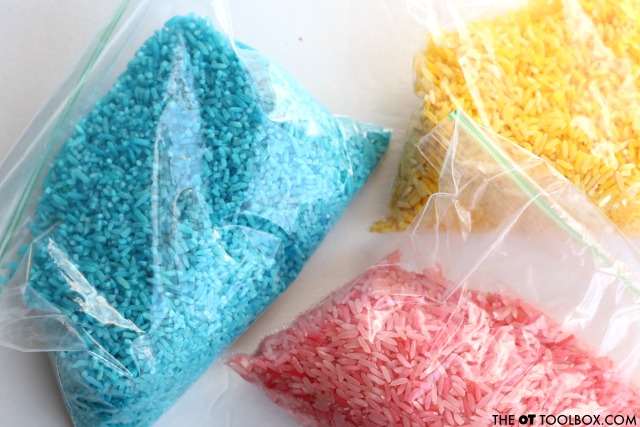
Use dry rice and liquid food coloring to create colored
rice. When the rice is completely dry, fill varying amounts into plastic bags.
(Cloth pockets can be used and then sewn up for a more lasting version.)

Use colored duct tape to secure the bean bags.

Occupational therapists will love this bean bag activity to build kinesthetic learning and fine motor skills by addressing motor planning needed for tasks.

Students can then use the weighted bean bags to practice and
develop kinesthetic fine motor skills.

Weighted bean bags may be sized appropriately to fit the
child’s hand to address arch development and closure of the hands.

The weighted objects can be dropped from one hand and caught
with the other supinated hand. Trial this activity in various positions and
distances. Then, switch hands so the non-dominant hand is dropping the bean bag
and the dominant hand catches the bean bag.

Have the child close their eyes and drop the bean bag from one hand to the other. This encourages and challenges the kinesthetic sense without input from the visual sense. More practice with the eyes open will make this exercise easier as the child’s muscle memory is built. 

Various weights and sizes of objects should be trialed in
the various positions and distances.


Try this activity while sitting and standing.

There is more input from heavier objects and less input from
lighter weight objects.


Be sure to limit throwing of these bean bags, unless you enjoy sweeping up lots of dyed rice! 

Other weighted objects can be used for this activity too,
including marbles, small balls, stress balls, etc.

This kinesthetic learning fine motor activity uses DIY beanbags made with colored rice. Use them in learning activities where kids move and learn.

Gross Motor Cursive Writing Warm-Up Exercises

Today in the cursive handwriting series on The OT Toolbox, we’re talking all about gross motor activities and gross motor cursive writing warm-up exercises that can be used to work on and teach cursive letter formation. These are fun activities that can be used with kids who haven’t even yet attempted to write their first letter in cursive. 


If you are teaching cursive writing to a student, this cursive writing series is for you. 


If you are concerned about how to teach cursive writing to students, then this cursive writing series is for you. 


If you are you a therapist who is looking for strategies and creative ideas to help students improve cursive writing as a means of functional and legible handwriting, then this cursive series is for you. 


Below, you’ll find ways to teach cursive writing by addressing the motor plan and verbal cues needed for cursive letter formation in a playful and fun way.


Cursive writing strategies to help kids learn to write in cursive, and this gross motor cursive warm-up exercises are perfect for teaching kids to write in cursive!
This post and the posts you’ll see here over the next month are part of our 31 day series on teaching cursive. You’ll want to check out the How to Teach Cursive Writing page where you can find all of the posts in this series. For more ways to address the underlying skills needed for handwriting, check out the handwriting drop-down tab at the top of this site.

For resources in handwriting, join us in the Sweet Ideas for Handwriting Help Facebook group.


Gross Motor Cursive Writing Warm-up Exercises


One strategy for teaching cursive writing is using a warm-up program with gross motor movement activities. This is an easy way to get kids moving and ready to focus on cursive writing practice. The large motor cursive writing exercises described below can be used with kids who haven’t yet started on cursive writing instruction. They can also be used at the start of each cursive practice session as a warm-up tool. 

An added bonus for the classroom teacher is that these activities can be a much needed brain break activity during the school day.

Introduce the cursive motions needed for letter formation using large motor patterns. This can be done in a variety of creative ways (described below). Students who are learning a new series of letters or new cursive letter family can practice the movement patterns using large motor or gross motor exercises.


TIP: Try teaching groups of letters together based on the components of the letters. Teaching cursive letters by their cursive letter families can help kids learn letter formation and with carryover.

Gross Motor Exercises for Pre-Cursive Writing


Gross motor cursive warm-ups can be done as a class or individually.  For kids who are not yet learning cursive writing, use the gross motor cursive writing warm-up exercises as an introduction for verbal prompts they will hear as they begin to learn letters.

Instruct children to complete the exercises using a model and with consistent verbal cues. Verbal cues should be the prompts that will be used for cursive letters (i.e. “Start at the bottom. Swoop up. Trace back down. Stop. Swing away.”) Repeat a series of motions needed for a specific letter family or letter. 

The teacher or therapist should stand in front of the students with their back facing the students so that the motions are consistent and the class is able to copy the large motor motions. 

Instruct students to continue with a set of loops, scalloped motions (such as forming a series of lowercase cursive “u’s” in the air), or bumps (as in forming a series of lowercase cursive letter “m’s” in the air.)

Children can move their arms through the air as they practice writing the cursive letter family strokes. Then move onto individual letters. Try using some of the ideas below to work on gross motor motions for introducing cursive letters.

Gross Motor Cursive Writing Activities

Cursive writing strategies to help kids learn to write in cursive, and this gross motor cursive warm-up exercises are perfect for teaching kids to write in cursive!


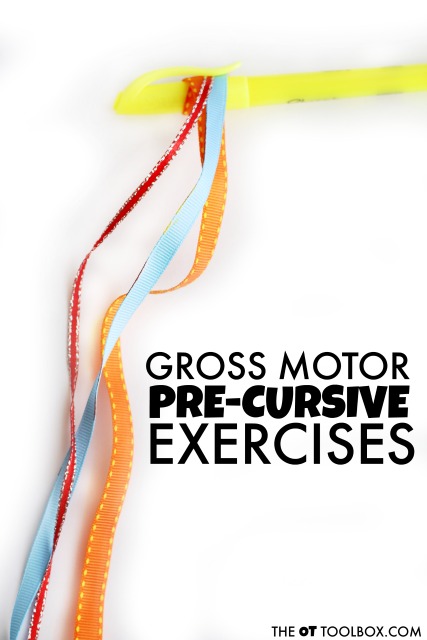
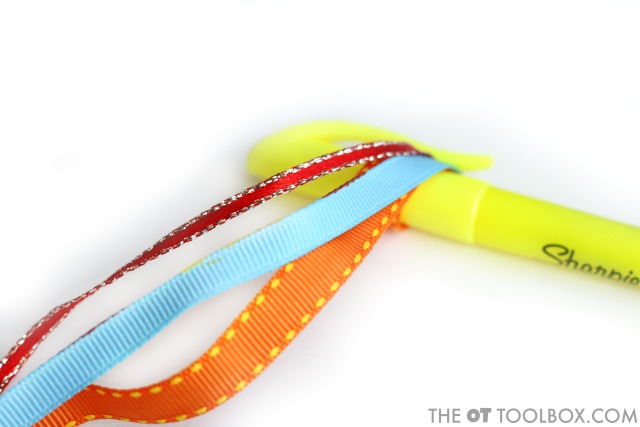
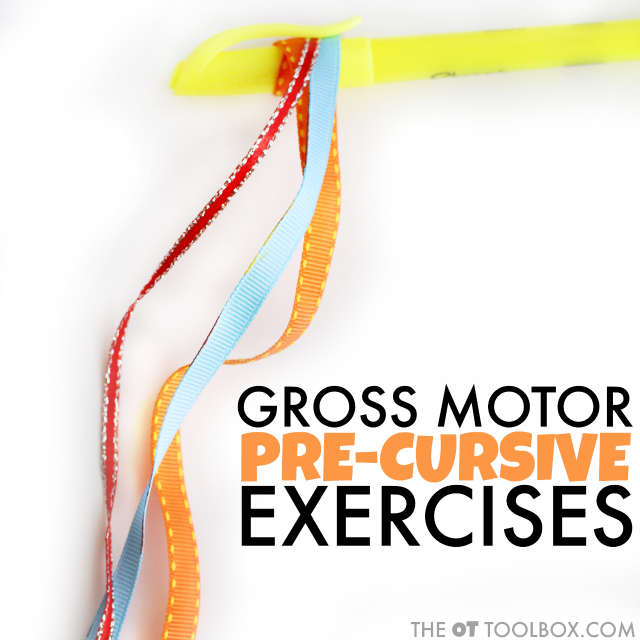
Use a movement stick with a ribbon attached to a dowel rod. This is an easy do-it-yourself craft that kids can work on together and to get excited about learning cursive. Or, use a highlighter or marker with a lid. Tie long ribbons in a knot under the lid of the marker. This is a fun activity for the whole class.


Allow each student to use a pencil with the eraser side pointing out into the air, as if the pencil were a wand. Ask them to hold the pencil tip in their hand and use the pencil wand to form letters or cursive family strokes in the air.


Students can use a paintbrush on a chalkboard to draw letters in water. Ask them to draw large movements.


Children can hold a feather to draw letters in the air. 

Students can use their finger to work on cursive connectors or cursive family strokes on the back of another student.


Use a writing tray with a variety of sensory mediums.


As noted above, be sure to use consistent verbal prompts when using gross motor cursive writing warm-up exercises. 

Don’t forget to try all of the cursive writing strategies in the How to Teach Cursive Writing series!


More cursive writing resources (Click on the images to find out more):

 Cursive writing strategies to help kids learn to write in cursive, and this gross motor cursive warm-up exercises are perfect for teaching kids to write in cursive!

You’ll find more cursive writing strategies by clicking the images below:


Best Brain Breaks Videos on YouTube

Teachers are sometimes looking for movement and activity videos that they can use in the classroom. They may need movement ideas for throughout the day when kids need a brain break or they may want to start the day with a movement activity. Other times, kids need a movement “wake up” midway through the day when they are feeling and acting sluggish or even a little high energy. Maybe students need to get their bodies moving before a test and the perfect brain break for kids is just the ticket. Or, maybe teachers are looking for a way to get the kids moving during indoor recess time. Maybe you are a parent who is looking for ways to get the kids moving on a rainy day.

Below, you’ll find some great brain break videos on YouTube. These are videos that can be pulled up on a smartboard in the classroom. 

Some of these YouTube Brain Break videos would work for middle school brain breaks, too.

Brain Break Videos on YouTube

The best brain break videos on YouTube can be used for classroom brain break needs, indoor movement and gross motor skills, circle time, indoor recess, or rainy days.


Brain Breaks for kids

Brain breaks are considered fun for the brain, AND a great way to shift gears. Check out the videos below for ways to add movement activities to the classroom.

But first, if you are looking for some printable brain break ideas, here are some of our favorites:
Apple Theme Brain Breaks
Farm Theme Brain Breaks
Bear Brain Breaks
Squirrel Theme Brain Breaks

On to the brain break videos.  Try these videos to get the whole classroom up and moving!


Move and Freeze Song 


Shake Your Sillies Out


Count to 100 with Exercise


I Am a Gummy Bear


I’m Gonna Catch You


Frozen Themed Yoga


The Sid Shuffle – Ice Age: Continental Drift


Trolls: Can’t Stop The Feeling | GoNoodle


I Get Loose – Koo Koo Kanga Roo | GoNoodle


Move To Learn Fitness Break!


Move to Learn Pre K Counting


Going On a Bear Hunt with Dr. Jean


Dr. Jean’s Banana Dance – (aka The Guacamole Song) – Dr. Jean’s Banana Dance


If You’re a Kid (Dance Around!) (song for kids about following directions)


Brain Breaks | Following Directions | Physical Education | Get Up To Get Down | Jack Hartmann


Letters of the Alphabet | Capital Letters | Uppercase Letters | Alphabet Workout | Jack Hartmann


Letters of the Alphabet | Lower Case Letter Formation | Alphabet Workout | Jack Hartmann


Hand Clapping Game “Bim Bum”


Classroom Yoga (Classroom Physical Activity Breaks)


Yoga for Kids – Children’s Yoga – Brain Breaks – Kids Songs by The Learning Station

The best brain break videos on YouTube can be used for classroom brain break needs, indoor movement and gross motor skills, circle time, indoor recess, or rainy days.

Ideas to Incorporate Movement into the Classroom

Children today are experiencing less and less physical activity and more and more sedentary lifestyles that limit participation in many motor experiences. Children are spending more time in front of screens and less time climbing trees, rolling down hills, and in general less time outdoors.  Physical activity is a vital part of health but for the student, movement in the classroom can have a big impact on learning.  Gross motor games and activities can help. 


There is much evidence of the link between movement and learning.  For some students, movement breaks in the classroom are an essential part of regulation of sensory needs.  Most students need a quick energizer to beat lethargy in a long school day at some point and brain breaks are a great answer to meet that need.   


Below, you’ll find easy ways to incorporate movement into the classroom.  


These are easy strategies that can be added at little cost.  As much as most teachers and school based professionals would love extensive equipment or alternative seating and cushions in their classroom, these ideas are not always feasible.  For these and other reasons, I’ve put together this list of ideas to add movement into the classroom environment.

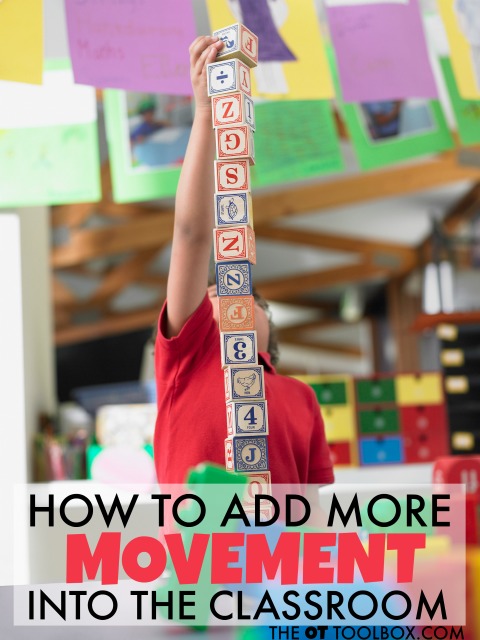
These are great ideas for how to incorporate movement into the classroom for movement and learning, perfect ideas for teachers to help kids with attention or sensory needs, and any student who needs more movement in the classroom and throughout the school day.


Easy Ideas to Add Movement into the Classroom


You may have seen this video depicting movement in the classroom floating around on Facebook. Check it out. Does this sound familiar?


Add movement into learning- Incorporate gross motor movement into math when repeating math facts by incorporating whole-body games such as Simon Says (Students can perform specific motions when math facts are true, and perform other motor tasks when math facts are false.)


Daily Stretches


Afternoon Yoga Stretches


Dance Party Breaks


Brain break videos- Here are the best brain break videos on YouTube.


Themed Brain Breaks- Some ideas are these Bear Brain Breaks or these Farm Brain Breaks


Role Play Activities for history, science, geometry, etc.


Large item manipulatives- Use creative items such as large cardboard boxes, printer paper boxes filled with newspapers, old phone books, etc.

Add in walks during the day.


Incorporate action rhymes into the morning routine or circle time. 


Try these sensory motor activities for the classroom.


As students to move around the room to learn about specific items.  Fall back on those places by asking the students to recall the part of the room they were in when they learned about that particular topic.

Move books or other items from the desk to a different part of the room so that students need to get up and walk to the back of the room to get their math workbook.

Try inexpensive seating tools such as this DIY sensory seating idea


Utilize extra recess as a reward.


Create a fidget toolbox in the classroom for movement needs while sitting at desks. 


Try a ball toss game with partners when working on learning facts or spelling. 


Ask students to perform jumping jacks, clapping, running in place, or hopping when spelling words as a group.


Add movement requirements within a multi-step project- Students can complete a worksheet, then get up and place it in a bin across the room, then walk to another center to gather materials needed for their next assignment, then return to their desk.


Ask students to assist in handing out materials and papers.


Place a math problem at each student’s desk.  Each child can copy the problem to another sheet of paper and complete the problem.  Then, they can move to the next desk and complete that problem.  Ask them to move to each desk until they have solved all of the problems.


Students can place their chairs on their desks at the end of each day and remove them at the beginning of each day.


When walking from classroom to classroom, students can all walk on their toes.  Other ideas: walk toe to heel (for short trips down the hall), penguin waddle, walk with extra large steps, or other creative movement ideas.


Students can carry bins of materials needed for each day from their cubby to their desk.


Borrow a swivel seat from the computer lab or office.  Use the seat as an alternative seat for different students throughout the day.


Try Indoor Ice Skating before a learning task- In the classroom, use a sheet of paper under each foot as students “skate” in the classroom for 5 minutes. 


Raise the desks and allow students to stand for reading/writing/worksheets/learning activities.


Use easels in the classroom.


Encourage wall writing by taking paper to the walls and asking students to write at the wall.


Allow prone writing and reading (lay on stomach on the floor).


Use a therapy ball as a seat or as a movement area in the classroom.


What are your favorite ways to add movement to the classroom?

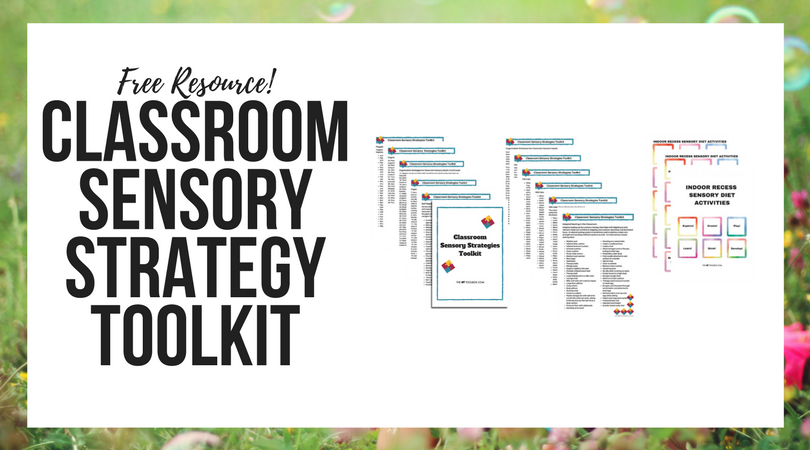
You may also be interested in the free printable packet, The Classroom Sensory Strategy Toolkit.

The Classroom Sensory Strategy Toolkit is a printable packet of resources and handouts that can be used by teachers, parents, and therapists. Whether you are looking for a handout to explain sensory strategies, or a tool for advocating for your child, the Classroom Sensory Strategy Toolkit has got you covered.


And it’s free for you to print off and use again and again.


In the Classroom Sensory Strategy Toolkit, you’ll find:


  • Fidgeting Tools for the Classroom
  • Adapted Seating Strategies for the Classroom
  • Self-Regulation in the Classroom
  • 105 Calm-down Strategies for the Classroom
  • Chewing Tools for Classroom Needs
  • 45 Organizing Tools for Classroom Needs
  • Indoor Recess Sensory Diet Cards
 
Sensory Strategies for the Classroom
 

Free Classroom Sensory Strategies Toolkit

    We respect your privacy. Unsubscribe at anytime.

    Colleen Beck, OTR/L has been an occupational therapist since 2000, working in school-based, hand therapy, outpatient peds, EI, and SNF. Colleen created The OT Toolbox to inspire therapists, teachers, and parents with easy and fun tools to help children thrive. Read her story about going from an OT making $3/hour (after paying for kids’ childcare) to a full-time OT resource creator for millions of readers. Want to collaborate? Send an email to contact@theottoolbox.com.

    The Floor is Lava Games

    As kids, we used to hop from couch to couch and make a flying leap across the living room to the corner chair.  We would hop from one surface to another with one thing on our minds…

    The living room floor had turned into boiling hot lava!
    When my kids started hopping around from pillow to pillow and landing with a roll onto the couch with claims of the floor turning to lava, I had to smile. 
    The Floor is Lava is Back!


    What is so cool about the floor being lava (besides the nostalgic sentiments from parents?)  A great game of The Floor is Lava has some major motor movements and sensory play components!
    From jumping, leaping, hopping, rolling, and crashing, The Floor is Lava is a fun and creative way to encourage movement and sensory motor play, both indoors and out!
    Play these The Floor is Lava Games with your kids to build development of skills like motor control, sensory input, motor planning, gross motor skills, core strength, and balance.

    The Floor is Lava Games

    Here are some fun ways to use The Floor is Lava Games to promote sensory input and motor movements:
    • Place pillows and couch cushions on the floor.  Kids can hop from pillow to pillow on one foot or two.  Move the pillows further and further apart to promote movement coordination and motor planning.  Don’t touch the carpet, it’s lava!
    • Place paper plates in a line on the floor.  Use them as a balance beam to address vestibular sensory input.  Hop from plate to plate without touching the ground, it’s burning up!
    • Play a stop and go game that promotes auditory processing skills like auditory figure-ground discrimination.  Call out, “The floor is lava!” and everyone has to hop off the ground onto something besides the hot, hot ground!
    • Use boxes like milk crates, stools, or dining room chairs to add height components to The Floor is Lava game.
    • Add a learning component by asking kids questions when they land on a safe space.  Think about incorporating spelling words, math facts, or memorization facts.
    • Play The Floor is Lava at the playground to add vestibular sensory components to the game. Don’t touch the ground, it’s hot!  Read more about the sensory benefits of the playground.
    • Make a Safe Island when playing a lava game.  Use a hula hoop and all kids can hop in the hoop to stay safe from that burning hot lava.  Don’t hop out of the other side of the hoop to stay safe and to work on motor control.

    Develop Skills While Playing The Floor is Lava

    When playing these lava games, kids are developing and building so many skills!
    • Gross motor coordination
    • Core strength
    • Eye-body coordination
    • Visual motor skills
    • Motor planning
    • Balance
    • Attention
    • Vestibular sensory tolerance 
    • Proprioceptive sensory tolerance
    • Impulse control
    Do your kids play The Floor is Lava?  Did you play as a child?  Introduce your kids to some of these versions of the lava game and boost movement and development skills at the same time!
    Play these The Floor is Lava Games with your kids to build development of skills like motor control, sensory input, motor planning, gross motor skills, core strength, and balance.

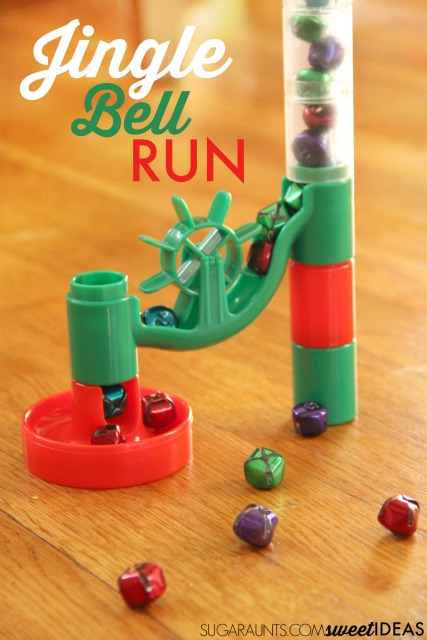
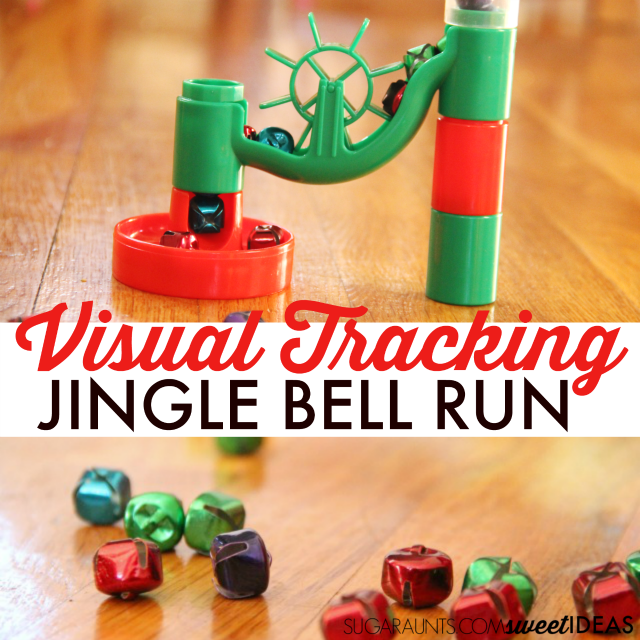
    Jingle Bell Marble Run Visual Tracking Activity

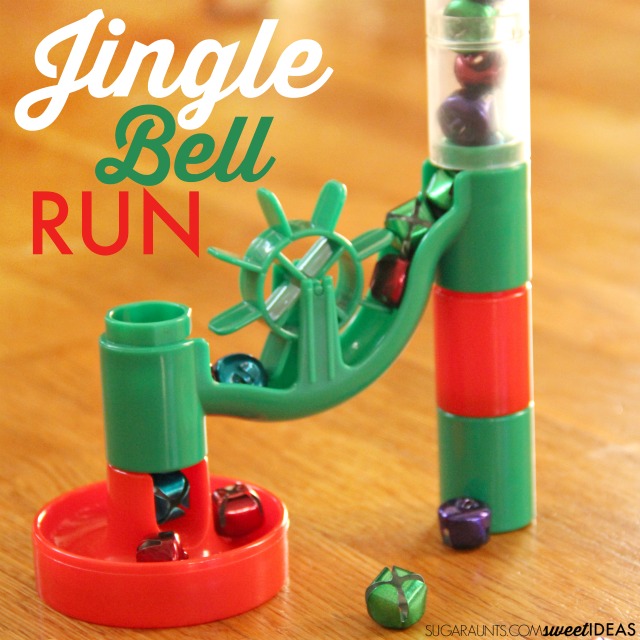
    This Christmas activity was one that happened by accident.  We were playing with our marble run one day recently when the kids started rolling jingle bells across the floor.  Before we knew it, jingle bells were making their way down the marble run.  It may have been a certain preschooler who thought, “Hmmmm. I wonder if a bell could fit through that tube…?”  And, voila! Our jingle bell marble run visual tracking activity was born!  It was a great way to have a little Christmas-y fun while addressing visual tracking skills.


    My kids love this jingle bell marble run visual tracking activity for working on fine motor skills and the sills needed for reading and writing!


    Jingle Bell Marble Run Activity


    This post contains affiliate links.
    Use these bells in a marble run for a fun visual tracking activity at Christmas!
    We used our marble run for this activity.  

    It’s actually been used in a lot of non-marble run activities in our house, including using waterbeads on the marble run in the water table and sending goop down a marble run.

    This time, we added jingle bells that we received from our pals over at www.craftprojectideas.com.

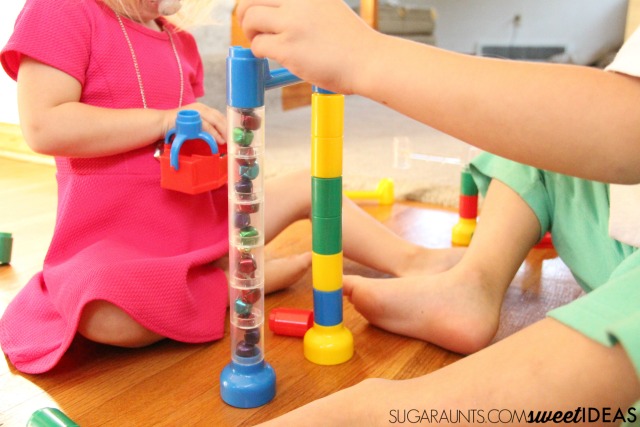
    We simply built a marble run and dropped the bells in! Instant jingly fun!

    We lso tried this Christmas marble run activity using small craft pom poms. They were a big hit with my toddler! Use these ones.
    Put jingle bells in the marble run for a fun way to work on visual tracking skills.


    Visual Tracking Activity with Jingle Bells in the Marble Run


    Read more about visual tracking skills and how they are helpful for skills like handwriting and reading in this previous visual perceptual skills post.  

    Here is detailed information on saccades and their impact on learning
    How fun is this Jingle Bell Marble Run visual tracking activity for Christmas play!
    Essentially, following the bell as it rolls along the marble run track is a fun and festive way to help kids work on visual processing skill like the ones needed to track words in a line of text as they read, follow a ball as it’s thrown toward them, or follow a line in a maze.  Visual tracking skills are also required for copying text from a book, completing word search puzzles, and completing tasks like reading.  

    Read more about working on visual tracking skills with homemade marble runs here.
    Kids love this jingle bell marble run for working on visual tracking activities this time of year, perfect for Christmas season classroom preschool planning!

    Christmas Handwriting Activities

    Writing out that Christmas wish list is a difficult task that brings out tears instead of holiday excitement.  I’ve got a solution for your kiddo with handwriting difficulties: a packet of modified paper for all of the Christmas handwriting tasks that come up each year.  Use this handwriting pack to help kids who struggle with handwriting to participate in holiday traditions while even working on and developing their handwriting skills!

    Working on handwriting with kids this Christmas season? Grab your copy of the Christmas Modified Handwriting Packet. It’s got three types of adapted paper that kids can use to write letters to Santa, Thank You notes, holiday bucket lists and much more…all while working on handwriting skills in a motivating and fun way! Read more about the adapted Christmas Paper here

    amzn_assoc_placement = “adunit0”;
    amzn_assoc_search_bar = “true”;
    amzn_assoc_tracking_id = “sugaun-20”;
    amzn_assoc_ad_mode = “manual”;
    amzn_assoc_ad_type = “smart”;
    amzn_assoc_marketplace = “amazon”;
    amzn_assoc_region = “US”;
    amzn_assoc_title = “My Amazon Picks”;
    amzn_assoc_linkid = “42c59858b8f2340cfe128284519c0a84”;
    amzn_assoc_asins = “B01IV3FQQK,B00DSNQ35W,B01IQ4SVBQ,B002OFCW5A”;

    December Sensory Processing Activities

    These December Sensory Processing Activities are designed to provide sensory opportunities, Christmas themed sensory prompts, accommodations to holiday activities, and sensory challenges with a Christmas and winter theme.  For more Christmas themed developmental activities for Occupational Therapists, parents, and teachers, grab try this free Christmas Occupational Therapy activities printable calendar.


    December Sensory Processing Activities
     
    December is a time of holiday fun,
    hustle, and bustle.  Families have added
    activities, winter parties, and distant family to visit.  This time of year brings with it unusual holiday
    songs and bells, lights, different foods to smell and taste, and crowded
    stores.  For the child with sensory processing concerns, it can be a very difficult time.  


    The holiday rush brings with it, added and unusual sounds, sights, smells, visitors, scratchy holiday sweaters, and schedule changes. The holiday season can be downright debilitating for the child with sensory challenges. 
     
    The time leading up to Christmas
    can be a month-long time of sensory overload for children with sensory
    issues.  It can be confusing for sensory
    systems!  The overwhelming feelings of
    sensory uncertainty can add a whole new meaning to holiday stress.  This time of year, when even the most intentional
    parents and teachers can still cause over-stimulation or under-stimulation to
    the child who is already struggling with sensory issues. 
     
    There can be a need for additional calming
    sensory input or changes to sensory diet, additional modifications, and added
    sensory down-time.  


    When it comes to preparing for the holidays and all the adjustments it brings, a plan can help. An understanding of the sensory system and how the senses are processed can help parents, teachers, and caregivers to cope with the added sensory stress for children with sensory issues.


    Having a kit of ideas and coping strategies can be a helpful tool to prepare the child with sensory processing difficulties for the holiday season. 


    A list of sensory activities that can be added to the day…WITH a holiday theme can make all the difference in creating a holiday that the whole family will remember, all while keeping the sensory systems in mind. 


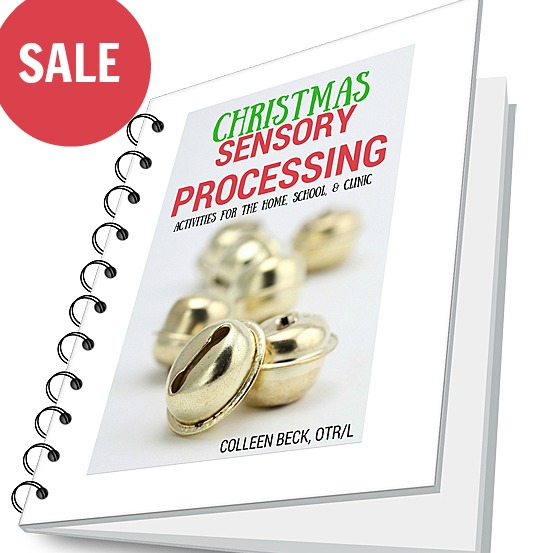
    Below, you’ll see a packet of sensory activities that has been on this site for a little over two years. This packet of Christmas Sensory Activities are bound to help families of those with sensory processing challenges to thrive this holiday season. 


    There are coping strategies for dealing with all of the added and new sensory input. 


    There are activity challenges that hit on the big sensory systems, allowing for calming or stimulating sensory input with a Christmas theme. 


    There are Christmas and holiday themed activities that can be incorporated into an established or new sensory diet, making a valuable tool for the child who is overwhelmed or underwhelmed by all that the holidays bring.


    Read more about what’s included in the Christmas Sensory Processing Activity Packet…


    Included in the Christmas Sensory Processing Activity Packet:


    • Each of the sensory systems are addressed in the 31 sensory activities.


    • There is a detailed description of the sensory system and sensory processing included in this packet.


    • Information is included on sensory diets and how they are needed during the holiday season. Sensory activities with a holiday theme can be added to sensory diets depending on individual sensory needs. 
     
    • Sensory challenges and modifications that can be added into daily routines this time of year.


    • A comprehensive list of sensory coping strategies is included for handling holiday stress and over- or under-responsiveness related to holiday travel, holiday visitors, and changes in routines over the Christmas season.

    ON SALE for 25% OFF NOVEMBER 24-27, 2017! Just click the link to access the reduced price of $3.75!


    Add these activities to your
    therapy plans this month.  The activity list
    is perfect for passing on to parents as a home program.  Parents and teachers can use these activities
    as part of an individualized plan that meets the child’s needs. 
     
    The activities are
    outlined in an easy to follow therapy plan, however as parents and therapists
    know, a day that involves children does not always go as planned.  The activities can be shifted around to suit
    the needs of the child and the family.  


    Does this sound like a resource that might help your client, child, or student? If the holidays make you want to curl up in a blanket because of the added stress and sensory challenges, this might just be the tool for you and your family! 


    Visual Motor Integration Tool with KORXX Blocks

    Disclosure: This post was sponsored by KORXX.  All opinions are my own.
     

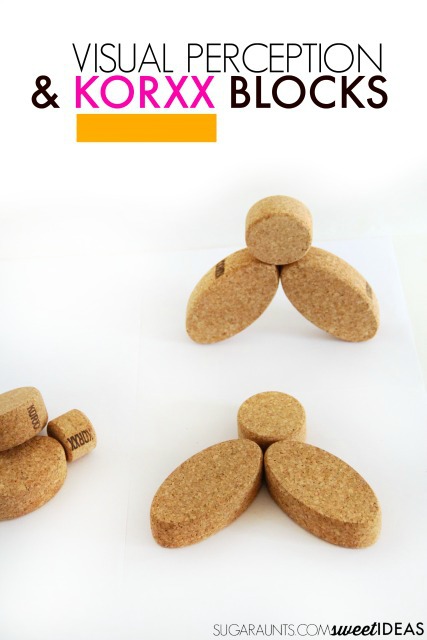
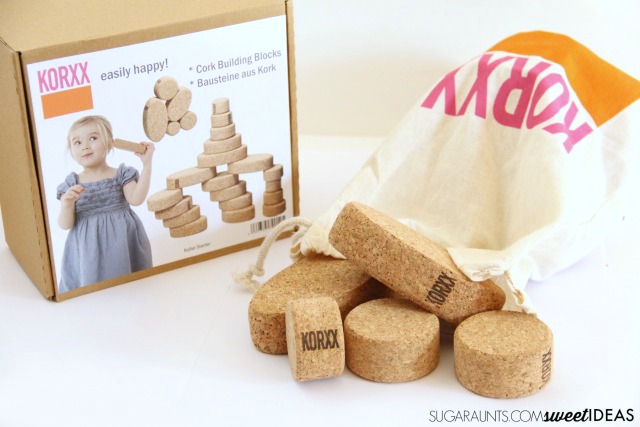
    We found a new favorite building toy for play, learning, and imagination, and are so excited to share it with you.  If you haven’t played with KORXX blocks before, you are in for a fine motor and visual motor integration treat.  These cork building blocks are a natural and sustainable and a light material for little builders. We received a set of KORXX blocks to try and had a blast using them for a visual motor integration challenge.  Using blocks to assess and build a child’s visual motor integration skills are an easy way to challenge the skills needed for skills such as handwriting and letter formation and any task that requires the child to use the hands and eyes together in a coordinated and effective manner.  


    Address visual motor integration in written work by improving visual perception using block copying skills with KORXX cork blocks.
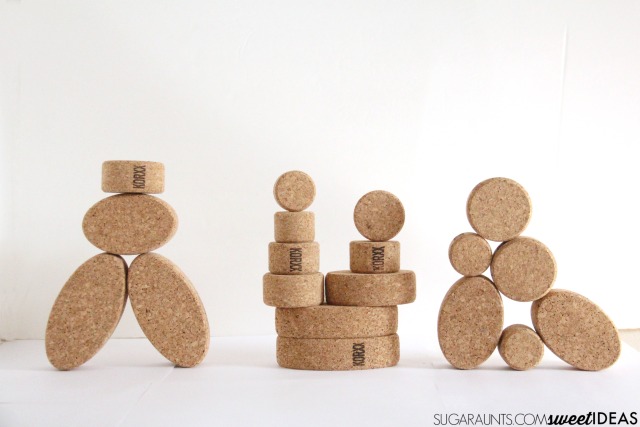
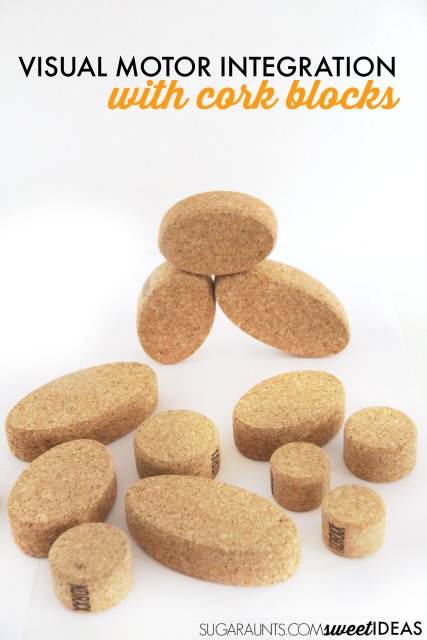
    When we played with our KORXX blocks, we were excited to see how the blocks can easily be used to create three dimensional or two dimensional constructions. The therapist in me immediately noted the unique opportunity for addressing visual motor integration skills in this toy! 
     
    Address visual motor integration in written work by improving visual perception using block copying skills with KORXX cork blocks.

    Visual Motor Integration and KORXX Building Blocks

     
    Blocks are quite often used as a therapy tool to address and assess visual motor integration skills.  The fact that blocks are a toy that is common in classrooms, playrooms, and therapy gyms makes using blocks for eye and hand skill needs easy and fun for kids.  
     
    Visual motor integration skills are essential for any task that requires the hands to manipulate items based on what the eye perceives.  In that manner, our eyes must perceive certain information and process it to allow our hands to work in an efficient manner to produce written work, catch a ball, manipulate clothing fasteners, or copy and draw shapes and pictures.  
     
    Visual motor integration is an essential skill needed for forming and copying letters in handwriting.
    Address visual motor integration in written work by improving visual perception using block copying skills with KORXX cork blocks.


    Visual Perceptual Skills and Visual Motor Integration

    Skills that fall under visual perception are needed for visual motor integration. Skills such as form constancy, visual memory, visual discrimination, visual figure ground, visual closure, and visual sequential memory.
     
    Form Constancy allows us to recognize shapes or letters and numbers no matter what position they might be in.  Blocks positioned on their side or in a different direction are still the same block.  A large oval shaped KORXX block is still a large oval shaped block and can be recognized for use in copying block patterns.
     
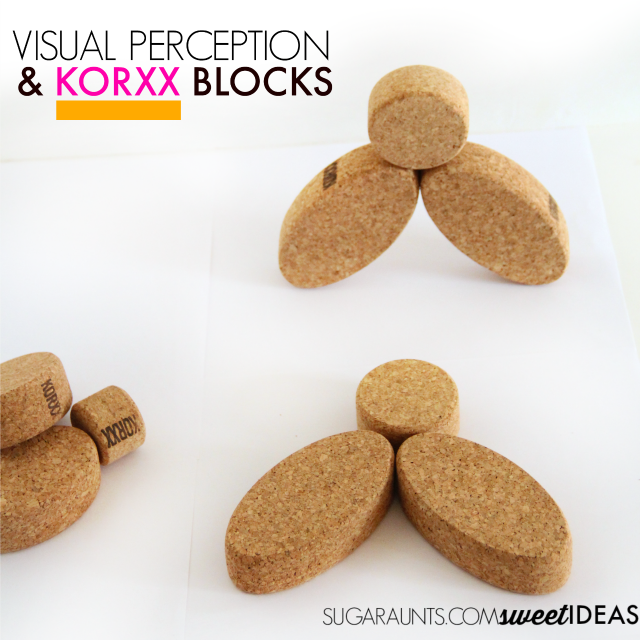
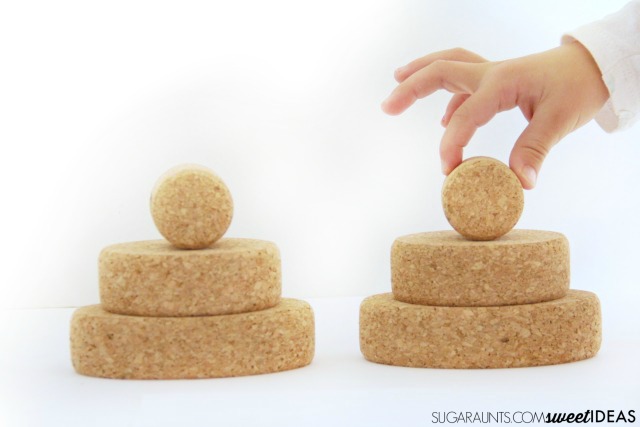
    Visual Memory allows us to hold a memory in our mind of something we just saw.  It also allows us to recall letter formation when writing.  When we shift our vision to copy written work from the chalk board onto our paper, we are using visual memory to hold and then recreate that piece of information.  KORXX blocks can be used to address this skill by creating a block form in the upright position and then constructing a two dimensional copy of that form with the same shape and sized blocks.
     
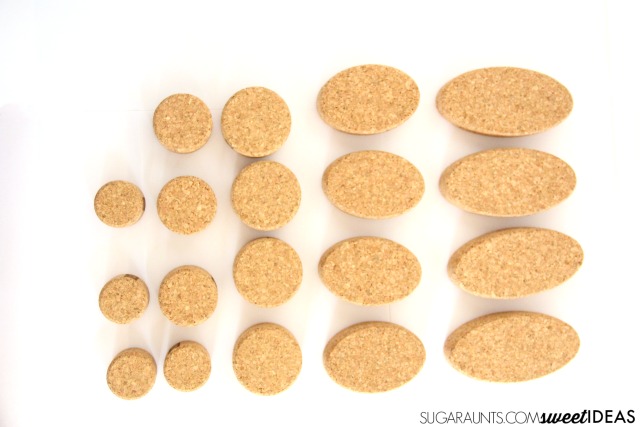
    Visual Discrimination allows us to discriminate between differences in parts of letters (for example, we are able to see the difference between an “R” and a “P”).  The different sizes in the KORXX block sets are perfect for this visual perception skill.
     
    Visual Figure Ground is a skill that allows us to locate and identify items when they are scattered among other items.  Locating a single puzzle piece on a table of puzzle pieces is just on example of this skill.  Use the KORXX blocks to locate needed pieces when they are scattered on the table.
     
    Visual Closure allows us to identify an object when we are able to see only a portion of it.  Blocks that are stacked in a scatter on a table surface require visual closure for children to locate specific needed pieces.  They can locate a small oval KORXX block when it is partially covered.
     
    Visual Sequential Memory allows us to create words or numbers in the correct sequence.  When building and copying block forms, we need to start with the correct KORXX blocks in order to copy the form.
     
    So, using the parts of visual perception is a necessary part of copying letters and words in written work, math problems, and block forms in a play activity!
     
    Address visual motor integration in written work by improving visual perception using block copying skills with KORXX cork blocks.
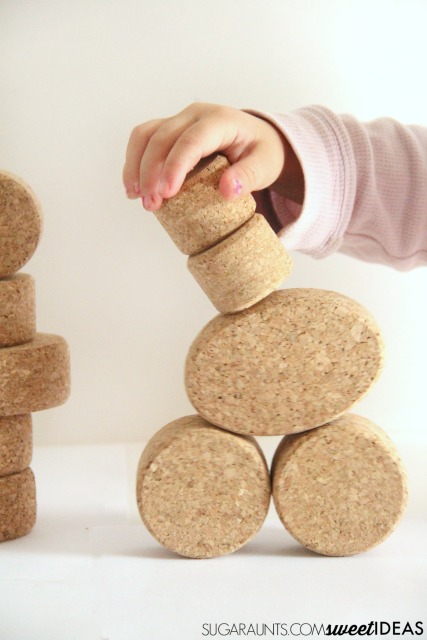
    For our block play, we used our Kuller set KORXX block set to copy different forms.  I created a few multi-dimension block forms to add a depth perception component.  I set up blocks in  front of my preschooler and asked her to copy the forms.  By looking for the correct block on the table surface, she had to use all of the visual perception areas described above.  
     
    Address visual motor integration in written work by improving visual perception using block copying skills with KORXX cork blocks.
     
    This is such a great exercise for kids who are copying written work from an overhead position.  In the classroom, kids might have to copy their homework from an overhead position.  Between using the information they perceive in combination with their motor component of forming letters and manipulating the pencil, there are a lot of areas where illegibility can occur.
     
    Address visual motor integration in written work by improving visual perception using block copying skills with KORXX cork blocks.
    Try using simpler block copying forms to address visual motor and visual perception needs can be done with forms placed flat on the table surface in a top-to-bottom orientation.  Place the block form on the table and the child can construct their own form directly under the block form.  Limit the number of KORXX blocks that are presented to the child.
    Address visual motor integration in written work by improving visual perception using block copying skills with KORXX cork blocks.

    A little more information about KORXX blocks:

    • These eco-friendly blocks are all natural and made free of any harmful contaminants. There are no phthalates, dioxins, or other sensory emissions. The product adheres to the guidelines for children’s toys (under 3 years) and the harmonized standard DIN EN 71.
    • The soft and light cork blocks provide excellent stability without slippage. This makes them perfect for grasping by young children.
    • The KORXX bricks are made from natural cork harvested without harming the trees.
     
    • KORXX is an all natural and sustainable building block made from natural cork harvested without harming the trees.
     
    You can purchase any of the KORXX block sets here.
     
    Address visual motor integration in written work by improving visual perception using block copying skills with KORXX cork blocks.
     

    Check out these activities using KORXX blocks:

     
    Nature Play with KORXX Blocks from Fireflies and Mud Pies  

    Balancing Activities with KORXX Quiet Blocks from Preschool Inspirations