Friendship Skills- Personal Space

friendship skills for personal space and body awareness with a free therapy slide deck for teletherapy

Part of building friendship skills is teaching kids to have an awareness of personal space with those around them. Body awareness is a big part of this, especially when social distancing is something to consider. Friendship skills involve a variety of pieces of the bigger social emotional skills picture and a component of that is personal space, or a personal bubble of comfort space. Read more about the part that personal space plays in friendship skills, including personal space/body awareness activities. You’ll also find a free therapy slide deck to help children with the friendship skill of personal space and body awareness. If strategies to address friendship skills is needed for your clients, also try this writing about friendship slide deck.

Friendship skills for personal space and body awareness using gross motor activities in a free therapy slide deck.

Children who struggle with social and emotional development, and those with specific sensory preferences may show personal space issues that could be related to body awareness needs. For these needs, occupational therapists can offer several suggestions and interventions.

Occupational therapists have the ability to play a role in social skills training in children. Included in this support is activities designed to improve social and emotional skills.

One study indicated that children who participated in a friendship skills group in occupational therapy. The researchers found that children receiving the social skills training group showed improved friendship skills and quality of friendship as reported by the children’s parents.

Personal Space and Body Awareness

Some strategies to address personal space and body awareness can include:

  • Develop strategies specific to the child to address the individual’s preferences
  • Offer strategies for self-regulation
  • Offer strategies for controlling inhibitions
  • Focusing on spatial relations
  • Teach self-regulation techniques, such as progressive muscle relaxation, self-awareness, and mindfulness, to decrease anxiety while improving body awareness
  • Incorporate play into spatial concepts such as over, under, around, and through
  • Body drawing activities
  • Body part naming activities
  • Obstacle courses
  • Proprioceptive activities
  • Coach the child to state their preferences for personal space in a given situation
  • Map activities for teaching spatial concepts
  • Set up a small social skills group for a low-stress social gathering
  • Offer instruction in sensory tactics that can help to calm or regulate sensory needs such as deep breathing exercises, heavy work input, or deep pressure
  • Sensory integration occupational therapy interventions
  • Practice social skills interactions that may come up in a given situation
  • Work on working memory so the individual can pull from past successful situations
  • Work on foresight so the individual can think ahead of tools they might need in a given situation
  • Incorporate dance and music
  • Body awareness games and activities such as Simon Says, Twister, and the Hokey Pokey. Use these printable Simon Says commands.
  • Body awareness positioning activities

Because of the need many children have with developing an awareness of personal space, and the part that plays into friendship skills, I wanted to create a free Google slide deck to work on these skills.

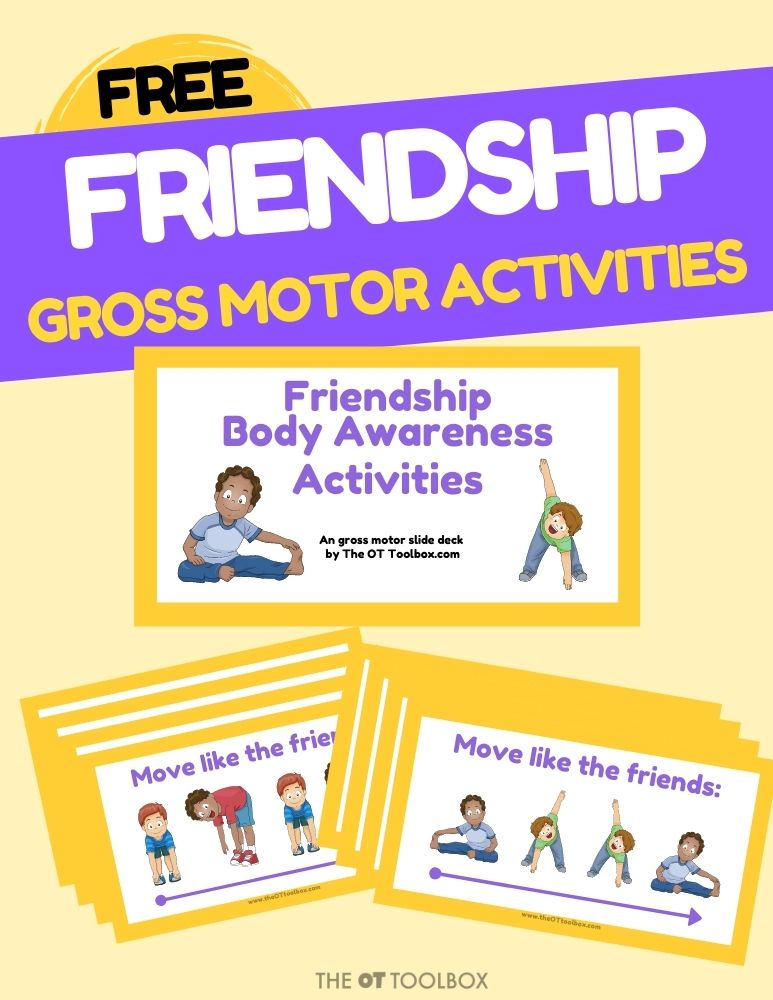
You’ll see that the therapy slide deck pairs friendship with body awareness activities so that kids can practice various gross motor body positioning challenges.

These free slides offer movement activities to incorporate proprioceptive and vestibular input, as well as motor planning challenges. All of these activities challenge movement changes and body awareness.

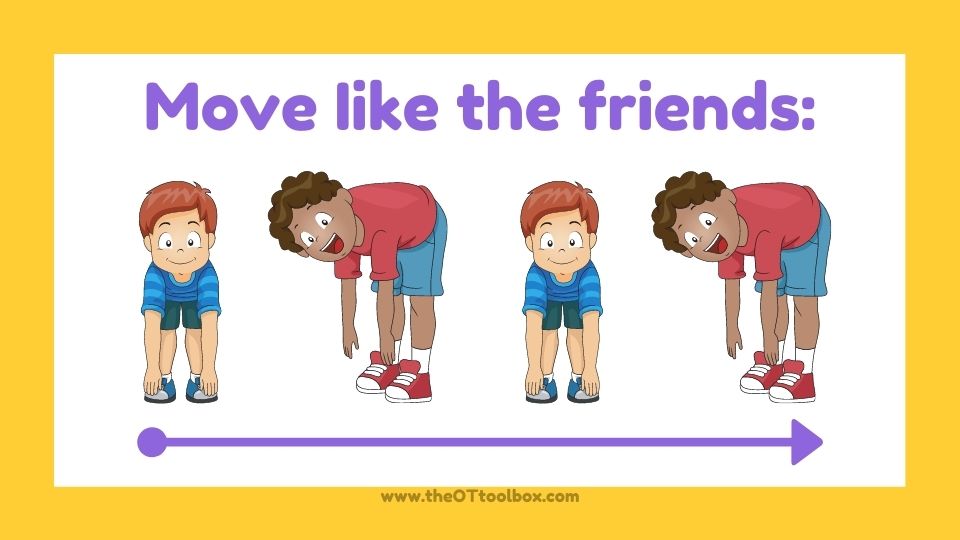
Friendship skills gross motor activity for body awareness and personal space awareness.

Users can go through the slides and visually track from left to right as they complete each gross motor activity. There is an interactive portion of the slide deck when used in “edit mode” in Google slides. Kids can slide the round dot along the arrow to complete each gross motor activity in sequence.

This motor planning activity challenges body awareness needed for personal space awareness as a friendship skill. Kids can challenge themselves in movement, motor planning, bilateral coordination, core strength, and movement changes for addressing personal space considerations as they learn how their body moves through space.

Free Body Awareness Slide Deck

Want to get a free Google slide deck to help kids with personal space and body awareness? This friendship theme activity deck is a fun way to get kids moving and gaining an awareness of their body and how it moves through space.

Enter your email into the form below. You will be emailed a PDF so you can access this slide deck at any time.

Before clicking the button on your PDF, be sure you are logged into your Google account. Make a copy and share the slide deck with anyone on your therapy caseload.

FREE Friendship Skills Body Awareness Activities Slide Deck

    We respect your privacy. Unsubscribe at anytime.

    MORE SOCIAL Skills RESOURCES

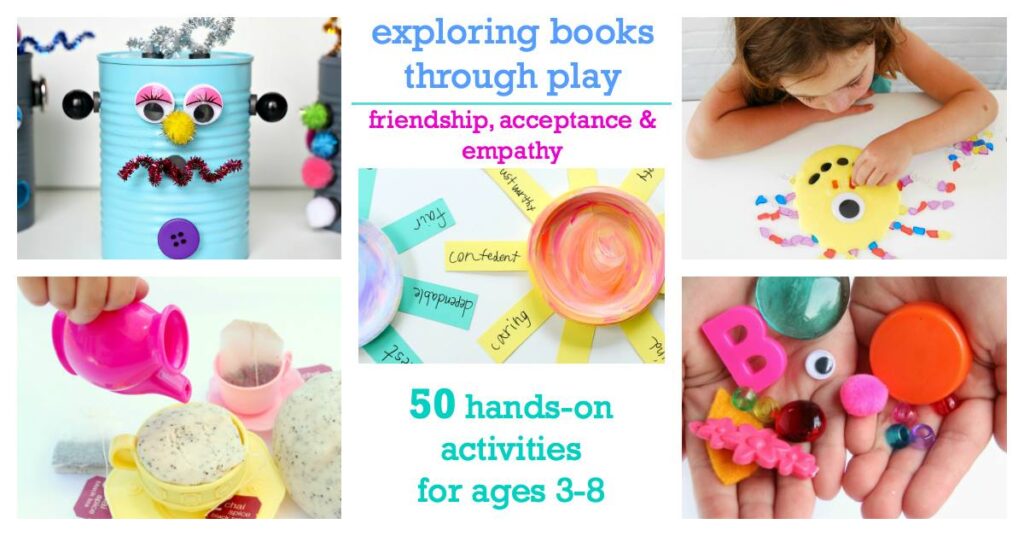
    Want to help kids explore social and emotional learning through play? Exploring Books Through Play inspires social and emotional development though play based on children’s books. The specifically chosen books explore concepts such as differences, acceptance, empathy, and friendship.

    Exploring Books Through Play: 50 Activities Based on Books About Friendship, Acceptance and Empathy is filled with hands-on activities rooted in interactive, hands-on, sensory play that focus on creating a well-rounded early childhood education supporting growth in literacy, mathematics, science, emotional and social development, artistic expression, sensory exploration, gross motor development and fine motor skills. Kids can explore books while building specific skills in therapy sessions, as part of home programs, or in the home.

    Click here to explore acceptance, empathy, and friendship through play.

    social emotional activities for kids

    Colleen Beck, OTR/L has been an occupational therapist since 2000, working in school-based, hand therapy, outpatient peds, EI, and SNF. Colleen created The OT Toolbox to inspire therapists, teachers, and parents with easy and fun tools to help children thrive. Read her story about going from an OT making $3/hour (after paying for kids’ childcare) to a full-time OT resource creator for millions of readers. Want to collaborate? Send an email to contact@theottoolbox.com.
    Writing About Friendship Slide Deck

    Writing about friendship google slide deck for teletherapy

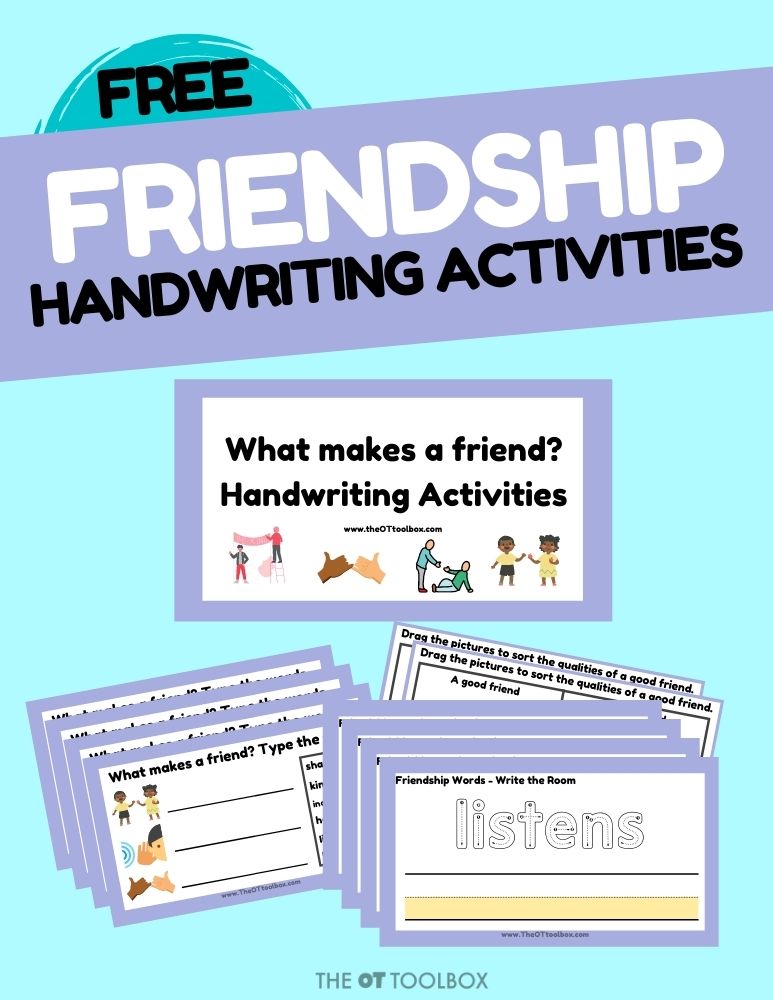
    Today, I have another free Google slide deck to share with you. This one is perfect for writing about friendship. In this teletherapy occupational therapy activity, kids can explore social emotional learning while working on handwriting skills. Kids can use this slide deck to write about the qualities of a friend, and use the friendship words and friendship writing prompts for developing social skills that is important for making friends. Also try this friendship skills for personal space and body awareness slide deck.

    Write about friendship with this free Google slide deck that helps kids with social emotional skills, resiliency, and handwriting skills.

    Writing about Friendship

    I have had this friendship activity on my mind for a while now. After noting the lack of social interaction that we’ve been seeing in kids more this past year, I’ve had this friendship writing activity planned as a tool to support kids’ social emotional needs.

    We know the power that socialization has on child development, mood, and

    When it comes to hybrid learning, virtual classrooms, and online activities and social events, kids are losing out on the social aspect of sports and activities that they have had in the past. This lack of face-to-face interaction impacts a child’s ability to make friends.

    And, children that struggle with social-emotional development are impacted by the added complexity of seeing face masks on faces. They can’t get social cues like smiles or other facial expressions that are a sign of a friend.

    To help children better understand facial expressions and emotional learning skills, grab this facial expressions worksheet.

    Additionally, children that are in virtual learning situations and those in hybrid classes are seeing all or half of their peers virtually. This isolation can potentially impact a child’s social participation, and may be especially impactful for children with social, emotional, or communication challenges.

    Participation in virtual classrooms and activities limits social participation in a way that limits the opportunities to make friends and nurture friendship relationships.

    Children who struggle with social skills or social participation in a typical school setting can have a difficult time with making friends.

    Even more to consider is the impact that this past year has had on a child’s perspective of interacting with others socially. One study took a look at children’s perspectives as a result of this year’s events.

    The study also noted that children expressed concern, anxiety, and worry about leaving their home after being on a lockdown mode. Because, here’s the thing: staying at home is safe, right? It’s where kids are protected. Staying home and interacting with others virtually has a sense of security.

    But, when kids are asked to leave the home, we are starting to see an emergence fear of going outside. There can be a fear of interacting with others.

    And that’s where an issue with making friends could come into play that REALLY impacts our kids down the line.

    It’s really interesting when you think about it.

    Because of the need for virtual interaction, kids are bored, angry, overwhelmed, tired, and lonely because they have to stay at home without being able to go out. Because there are so many unknowns related to the current situation, it’s hard to identify specific strategies to help kids struggling.

    But, there are options to assist with social and emotional supports. There are tools for mental health supports.

    attention must also be paid to the emotions of fear, worry, guilt, loneliness, boredom, and anger, with an emphasis on strengthening resilience and offering psychological support to parents and children, a point that has already been emphasized by a number of scholars during this crisis (Coyne et al., 2020)

    One thing that has been determined that we need to do for sure is to foster children’s resilience.

    Resilience refers to specific personal attributes that help children manage disappointments and even traumas to a point. In part, resilience involves emotional regulation and social emotional development.

    One specific way to foster resilience and social emotional development is through the discussion of friendships, specifically relationships that may be missing as a result of needing to work and learn online and in virutal settings.

    That’s where this writing about friendship activity comes into play. Use the interactive slide deck and Jamboard activity to drive discussion on friendships and offer a source of discussion points for building friendships during this strange time.

    Friendship Writing activity for handwriting and developing resilience in kids as part of social emotional learning.

    Free Writing About Friendship Slide Deck

    In the friendship writing activity slide deck, you’ll see that there are several aspects of friendship that kids can write about and dive into. These handwriting tasks each dive into aspects of social development, making friends, and understanding friendship. The writing activity can even be used as a tool for social supports during a time when kids are not interacting with freinds on a face-to-face basis.

    Maybe the slide deck is a starting point for coming up with ways to interact with friends virtually. Or, kids can explore how they can maintain friendships even when they do not see their friends for a while. This is all part of resilience that we can help to foster in kids.

    Help kids to identify  and write about qualities of a true friend paragraph writing that can develop social emotional skills.

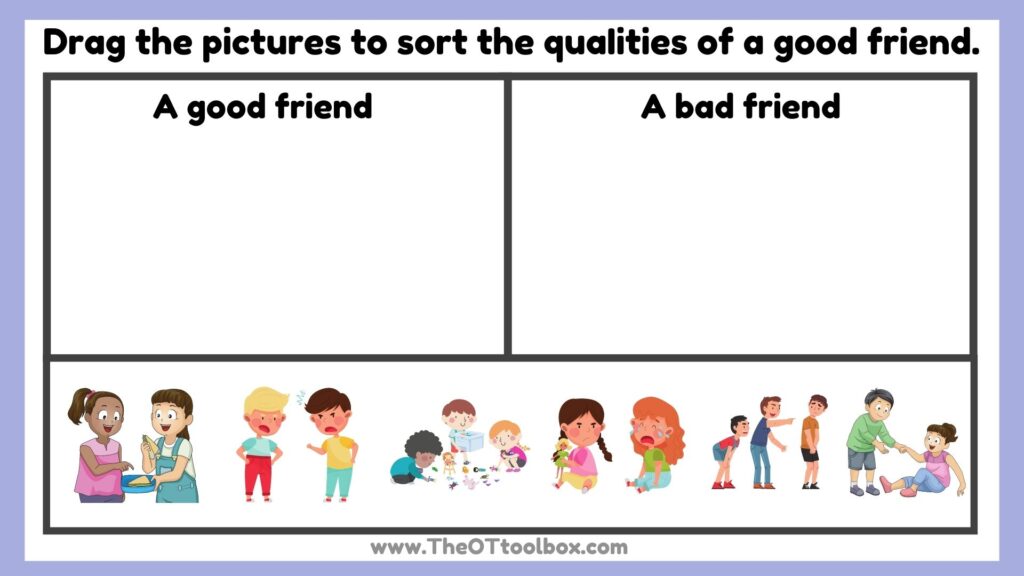
    Sort the qualities of a good friend

    The first part of this slide deck is two slides that allow kids to sort aspects of good friends from qualities of “could be better” friends. The slide deck is interactive when it’s used on edit mode of Google drive, so kids can actually slide the images into the correct category.

    Use this friendship writing slide deck to work on handwriting and writing about friends.

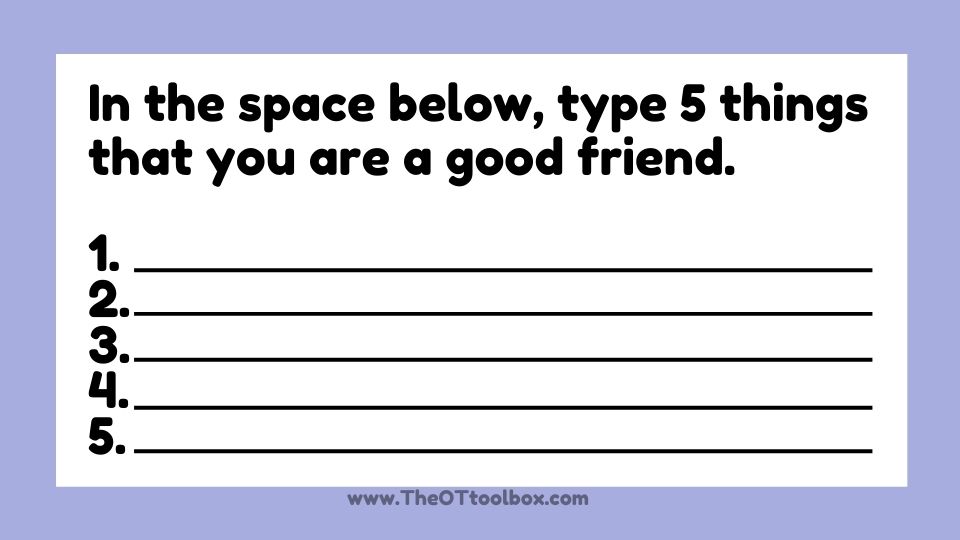
    Identify ways you are a good friend

    Users can then identify ways that they are good friends to others. This is a place where users can type in their responses, making the ways to be a friend very open-ended.

    This is a nice space to identify novel ways of maintiaing friendship during a time where virtual interactions are necessary. How can kids interact and maintain friendships with others when there is not face-to-face school or activities?

    Children can use this space to identify aspects of friendship that can be maintained virtually or from a distance.

    Kids can work on typing skills here. Or, take the writing piece off the computer and ask that children work on handwriting on paper. Focus on letter formation, letter size, margin use, etc.

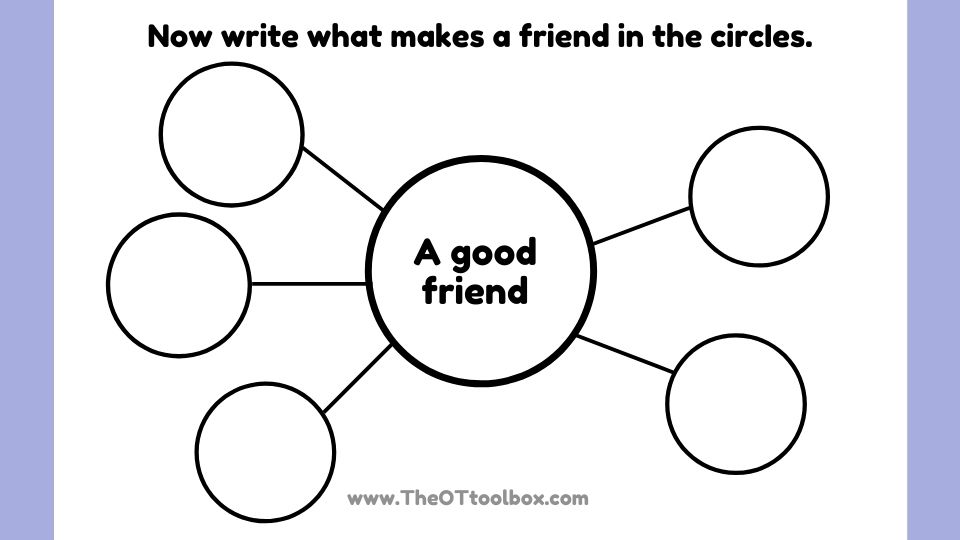
    A friendship mind map to explore social emotional skills.

    Friendship mind map

    The next slides ask kids to copy onto paper, a mind map. We covered drawing mind maps here as a specific strategy for this skill. This is a great visual motor activity as they see the image and break it apart into pieces so that they can copy the shapes. Work on visual motor integration and ensure the child doesn’t miss any pieces, overlap lines, and copies all aspects of the mind map. This is a great way to work on the skills needed for reading and writing.

    Then, on their own friendship mind map, kids can write qualities of a friend. This visual exploration turns friendship into a picture as kids brain dump various aspects of social friendships.

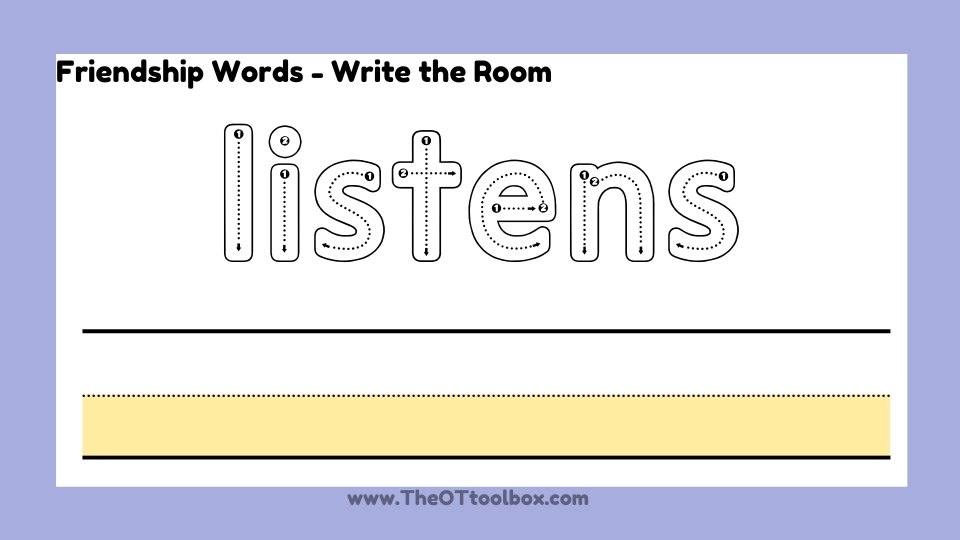
    Friendship words for working on handwriting skills, in a free Google slide deck for therapy.

    Friendship words handwriting activity

    The next slides on the deck are spaces where kids can copy various friendship words. This part of the friendship writing activity can meet various needs.

    Children can work on copying words with accuracy, and correct letter formation, without omitting or adding letters. This is an exercise in visual perceptual skills.

    Kids can work on letter formation as they write the letters on their paper. I’ve included directional arrows for proper letter formation.

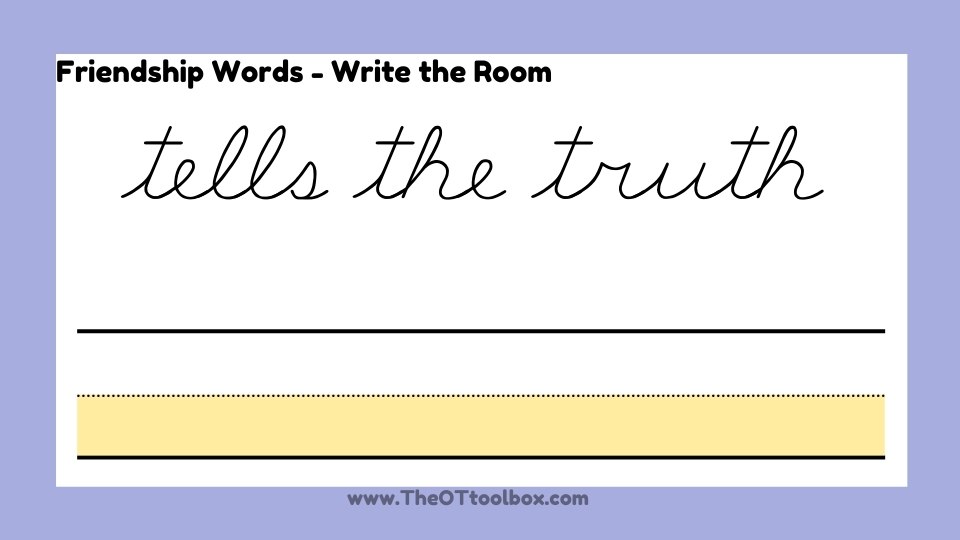
    Cursive writing activity with a friendship theme, in a Google slide deck for occupational therapy.

    There are slides with cursive writing, too, for older children working on their cursive handwriting.

    And, finally, there is a visual cue of lined writing space with highlighted portions for smaller letters. In these spaces, kids can type right onto the slide to copy the friendship terms.

    AND, maybe my favorite part, is that when you access this free deck, you’ll also get access to the JAMBOARD version, so kids can “write” right on the screen using a fingertip, stylus, or mouse. Then, they can write the words on the lines with they highlighted spaces. Therapists, teachers, or parents could also use the lined spaces to correct or star good use of the lines.

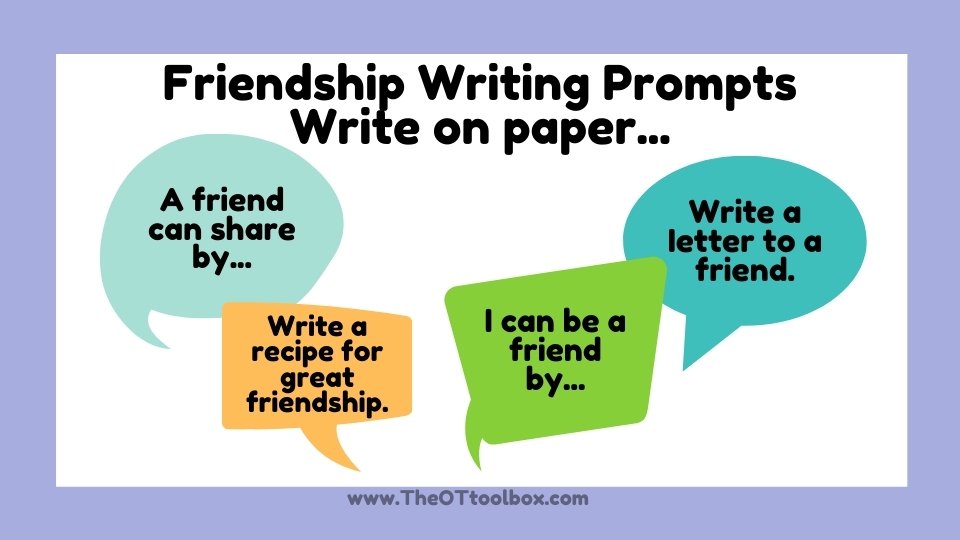
    Friendship writing prompts for social emotional development and handwriting.

    Friendship writing prompts

    The next aspect of the slide deck is a writing prompt. Kids can use the writing prompts to write sentences or a paragraph onto paper to further extend the activity.

    Free Friendship Activity Slide Deck

    Want access to this free Google slide deck?

    You can get access to this free slide deck and JAMBOARD by entering your email into the form below. This is necessary to deliver the PDF containing a link to the slide deck to your Google Drive. Save the PDF because you can add it to your toolbox for future use.

    Save that PDF file, because you can come back to it again and again and send it to the kids on your caseload (or classroom) so they can make their own copy on their Google drive.

    Be sure to make a copy of this slide deck and not change the url to indicate “edit” at the end. When you make a copy of the slide deck onto your Google drive, you will end up with your own version that you are free to adjust in order to meet your student’s needs. By changing the url to “edit”, you can potentially mess up the original version that many other therapists and The OT Toolbox users are given.

    FREE Writing About Friendship Slide Deck

      We respect your privacy. Unsubscribe at anytime.

      More Social Emotional Learning Resources

      Want to help kids explore social and emotional learning through play? Exploring Books Through Play inspires social and emotional development though play based on children’s books. The specifically chosen books explore concepts such as differences, acceptance, empathy, and friendship.

      Exploring Books Through Play: 50 Activities Based on Books About Friendship, Acceptance and Empathy is filled with hands-on activities rooted in interactive, hands-on, sensory play that focus on creating a well-rounded early childhood education supporting growth in literacy, mathematics, science, emotional and social development, artistic expression, sensory exploration, gross motor development and fine motor skills. Kids can explore books while building specific skills in therapy sessions, as part of home programs, or in the home.

      Click here to explore acceptance, empathy, and friendship through play.

      Colleen Beck, OTR/L has been an occupational therapist since 2000, working in school-based, hand therapy, outpatient peds, EI, and SNF. Colleen created The OT Toolbox to inspire therapists, teachers, and parents with easy and fun tools to help children thrive. Read her story about going from an OT making $3/hour (after paying for kids’ childcare) to a full-time OT resource creator for millions of readers. Want to collaborate? Send an email to contact@theottoolbox.com.
      Coyne, L. W., Gould, E. R., Grimaldi, M., Wilson, K. G., Baffuto, G., and Biglan, A. (2020). First things first: parent psychological flexibility and self-compassion during COVID-19. Behav. Anal. Pract. 6, 1–7. doi: 10.1007/s40617-020-00435-w

      Valentine’s Day Math Activity

      valentines day fine motor activity

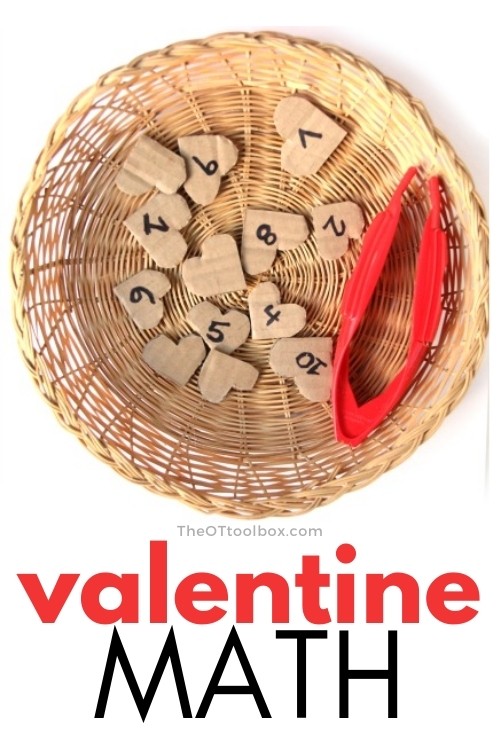
      This Valentine’s Day math activity is an easy activity designed to promote hand eye coordination and other fine motor math activities. Hand eye coordination, otherwise known as eye hand coordination, is a visual motor skill needed for so many functional tasks in children. This particular hands-on math activity was created to not only help with math skills around Valentine’s Day, but also to develop the essential coordination skills that kids need. It was easy to throw together and made working on a few Kindergarten math concepts more fun for my kiddo.  

      Add this idea to your Occupational therapy Valentine’s Day activities along with our new printable Valentine’s Day cards, too!

      Valentine's Day math activity to help kids with hand eye coordination and math concepts with a heart theme.

      Hand Eye Coordination Activity

      Full disclosure: This post contains affiliate links.

      To create this Valentines math activity, I cut a piece of cardboard into smaller pieces and then used them to make small heart shapes. On those hearts, I wrote numbers 1-20.  The hearts that we used were about 1 and a half inches tall but, you could create larger hearts, if coordination skills are something you need to address.

      In our hand-eye coordination activity, we used a large red tweezer to work on picking up the hearts from a small container.  

      Typically, using tweezers is a great way to work on fine motor skills like hand strength, tripod grasp, and arch development.  Here is information on the fine motor skills that tweezers help to establish, especially when using a smaller, hand-sized tong or tweezer.

      With these extra large Jumbo Tweezers, the actual tweezer tool is larger than the hand. Because of this, different muscle groups are working.

      The size of the Jumbo Tweezers requires the hands to open and shut with the thumb and all of the fingers.  This adduction and abduction of the thumb and slightly flexed MCP joints uses encouraged more of opposition of the thumb.  The wrist is extended and in an effective position for functional tasks.  

      Grabbing up the cardboard hearts requires hand-eye coordination or visual motor integration.  The ability to effectively use hand-eye coordination in activities like handwriting, scissor use, games, and play allows children to write within given spaces, cut along lines, and move game pieces in a coordinated and fluent manner.  

      Free therapy resources for Valentines

      If eye-hand coordination, visual motor skills, and handwriting are tasks that you are working on with children, you’ll love both of these free therapy slide decks. Use them to outline occupational therapy interventions or to use in teletherapy sessions this time of year.

      Free Spot It Handwriting Slide Deck

      Free Gross Motor Valentine’s Day Activity Slide Deck

      Hand-Eye Coordination Valentines Heart activity for math activities with Kindergarten kids or any school aged child. These jumbo tongs are great for visual motor integration skills and recommended by an Occupational Therapist.

      Valentines Math Activity

      These number hearts worked well with a few different hands on math activities, especially kindergarten math concepts. And, the heart counters made a great Valentines math activity for this time of year.

      The activity is very open-ended, so there are many ways you could use this activity to work on math concepts at different levels. Here are some of the hands-on math activities that we completed:

      Practice odd/even numbers- We then did a round of looking for and picking up the even numbers and then the odd numbers with the tweezers.    

      Number order- To practice our hand-eye coordination with these hearts, I had my son try to find and pick up the hearts in number order.  

      Counting by 10s- Practice counting up by tens and then count by tens into 100.

      Number bonds- You can use the number hearts to build and take apart numbers to build and understanding of addition and subtraction facts. My son’s favorite was using the side without numbers to build and take apart numbers.  We did a snowman version of number building when my older daughter was in Kindergarten.  

      Composing and decomposing numbers- With the cardboard hearts, we practiced composing and decomposing numbers.  I named a number, like “7” and my son had to use the hearts to build number 7 in many different ways.  He pulled out 7 hearts and separated them into two piles: one with 3 hearts and one pile with 4 hearts. We used more hearts to make other ways to take apart 7, too: 6 and 1, 5 and 2, 4 and 3, 2 and 5, and 1 and 6.  

      More Valentine Math activities

      Try some of these ways to play and learn using the

      • Practice number formation: pull out a heart with the Jumbo Tweezers
        and have your child write that number.
      • Ask your child to pull out a pile of hearts. They can count with one to one correspondence and then write the number.
      • Use the hearts in a ten frame.
      • Practice counting the hearts, starting at different numbers.
      Hand-Eye Coordination Valentines Heart activity for math activities with Kindergarten kids or any school aged child. These jumbo tongs are great for visual motor integration skills and recommended by an Occupational Therapist.


      Valentines Fine Motor Activities

      If you need more hand eye coordination activities for Valentine’s Day fine motor fun, try the Valentine’s Day Fine Motor Kit.

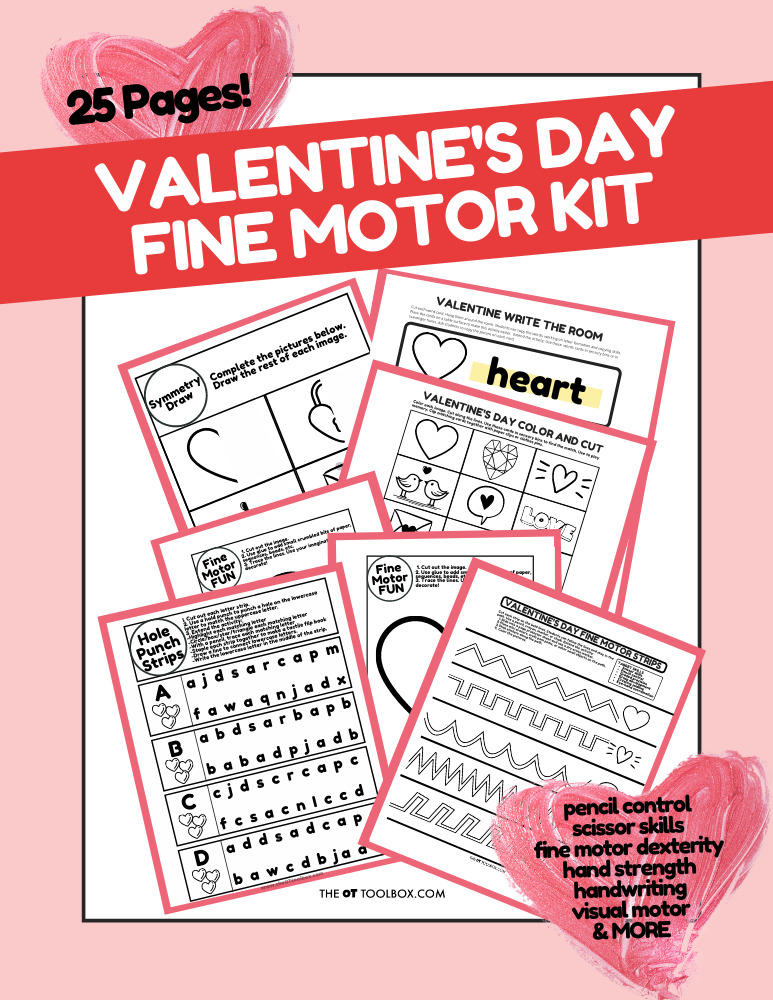
      The Valentine’s Day Fine Motor Kit is here! This printable kit is 25 pages of hands-on activity sheets designed to build skills in pinch and grasp strength, endurance, eye-hand coordination, precision, dexterity, pencil control, handwriting, scissor skills, coloring, and more.

      When you grab the Valentine’s Day Fine Motor Kit now, you’ll get a free BONUS activity: 1-10 clip cards so you can challenge hand strength and endurance with a counting eye-hand coordination activity.

      Valentines Day fine motor kit

      Colleen Beck, OTR/L has been an occupational therapist since 2000, working in school-based, hand therapy, outpatient peds, EI, and SNF. Colleen created The OT Toolbox to inspire therapists, teachers, and parents with easy and fun tools to help children thrive. Read her story about going from an OT making $3/hour (after paying for kids’ childcare) to a full-time OT resource creator for millions of readers. Want to collaborate? Send an email to contact@theottoolbox.com.
      Valentines Fine Motor Activities

      Valentines fine motor activities

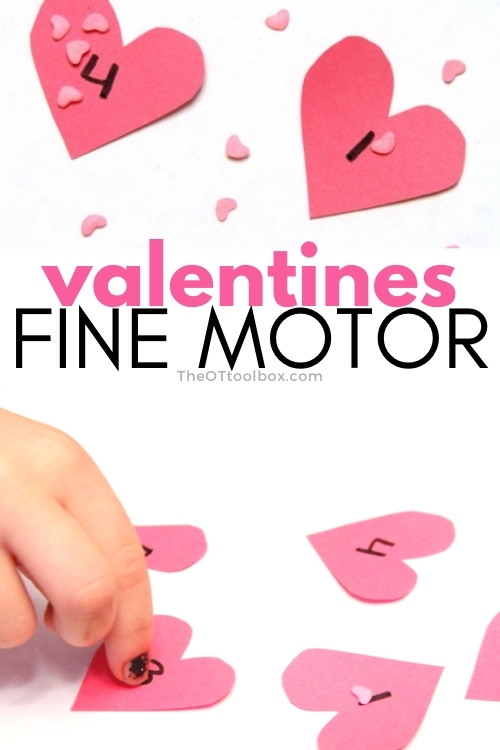
      If you are looking for a low-prep Valentines fine motor activities, then this is it. Sometimes, a quick and easy activity falls together without any plans. This Valentine’s Day Math activity just kind of happened one afternoon after we had some hot cocoa with sprinkles. It’s a kindergarten math or preschool valentine fine motor activity with a heart theme that will align perfectly with your Valentine’s Day occupational therapy plans.

      For more Valentine fine motor fun, use these printable Valentine cards for folding, coloring, and cutting.

      Heart math activities like this one bring on the fine motor love with big benefits! For another heart activity that develops skills, try this heart visual perception maze.

      I know when we have sprinkles on anything, that they go crazy for any misplaced sprinkle.  Is it just my kids???   I gathered up the random sprinkles (really, why do sprinkles end up everywhere??!) and a handful of hearts and we did a little Valentine’s Day math.  

      Valentines fine motor activities like this heart math activity help kids develop fine motor skills and a tripod grasp.

      Valentines Fine Motor Activities

      This post contains affiliate links.

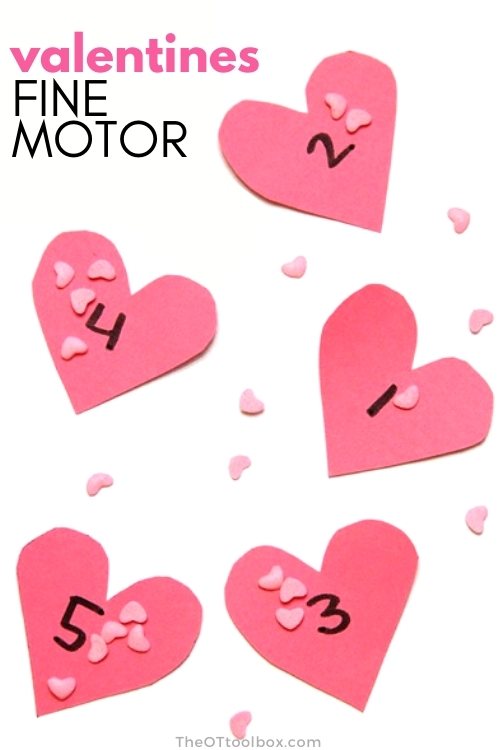
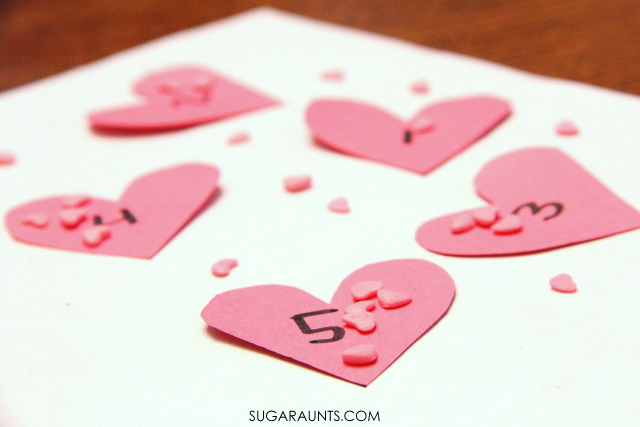
      Valentine fine motor can require just paper hearts and sprinkles to encourage kids to develop fine motor precision skills.

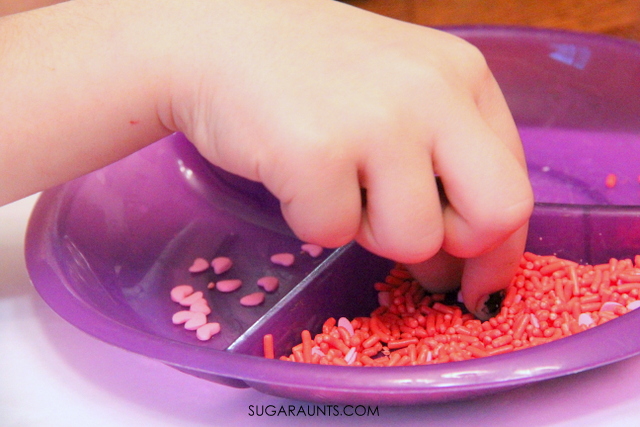
      We started with the leftover valentine’s day sprinkles from a hot chocolate treat. I gathered up the stray heart sprinkles
      and had Big Sister pick out the other hearts from the tray of mixed sprinkles.  

      Use heart sprinkles to encourage pincer grasp and other fine motor skills for a Valentine's Day occupational therapy activity with fine motor development.

      This is a fabulous fine motor activity with a big motivator (SPRINKLES!) and a fun way to practice pincer grasp (tip to tip grasp of the thumb and pointer finger).  

      You can encourage your child to tuck away a few sprinkles into their hand as they pick out the hearts.  This is called translation from fingers to palm and is an important part of in-hand manipulation (manipulating items within the hand).  

      These skills are important in pencil grasp and positioning in handwriting.

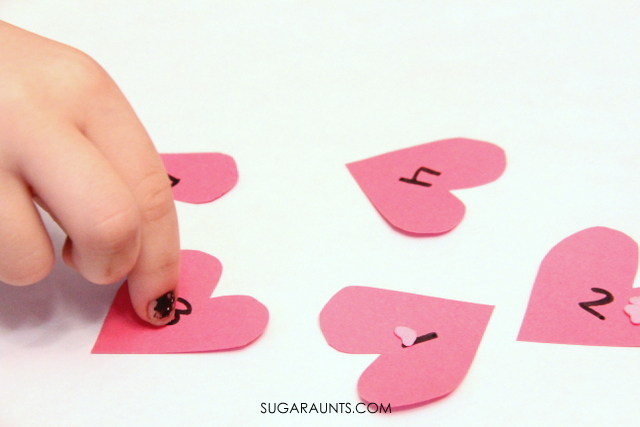
      We used hearts that we had leftover from another activity.  These are just little hearts cut from pink cardstock.  I wrote numbers on the hearts and had the kids put the correct number of sprinkles on each heart. 

      This was a fun (and tasty) math and fine motor activity for all of the kids, but my 5 year old was able to do some beginning math as he counted out the sprinkle manipulatives and matched them to the correct number (number identification) and my 3 year old counted along aloud.  

      All three kids were very happy with the end result of this math and fine motor activity…more sprinkles to eat!

      more Valentines Fine Motor Activities?

      Heart Fine Motor Math Activity

      Heart Fine Motor Sorting Activity

      Valentine’s Day Sensory Bin

      One Zillion Valentines Craft

      Want to add more Valentine Fine Motor activities and movement tools to your skill-building?

      The Valentine’s Day Fine Motor Kit is here! This printable kit is 25 pages of hands-on activity sheets designed to build skills in pinch and grasp strength, endurance, eye-hand coordination, precision, dexterity, pencil control, handwriting, scissor skills, coloring, and more.

      When you grab the Valentine’s Day Fine Motor Kit now, you’ll get a free BONUS activity: 1-10 clip cards so you can challenge hand strength and endurance with a counting eye-hand coordination activity.

      Valentines Day fine motor kit
      Help kids develop fine motor skills using the Valentine’s Day Fine Motor Kit.

      Click here to access the Valentines Fine Motor Kit.

      Colleen Beck, OTR/L has been an occupational therapist since 2000, working in school-based, hand therapy, outpatient peds, EI, and SNF. Colleen created The OT Toolbox to inspire therapists, teachers, and parents with easy and fun tools to help children thrive. Read her story about going from an OT making $3/hour (after paying for kids’ childcare) to a full-time OT resource creator for millions of readers. Want to collaborate? Send an email to contact@theottoolbox.com.
      Heart Deep Breathing Exercise

      This quick deep breathing exercise has a heart theme, and it’s a fun mindfulness exercise for kids. You may have seen our other deep breathing exercises here on the site. These are all themed activities that encourage deep, mindful breathing as a coping strategy, and they are based on themes that kids can recognize and relate to. This heart activity acts as a coping tool that fits perfectly with our occupational therapy Valentine’s Day activities.

      Deep breathing heart activity for kids to use in mindfulness exercises or deep breathing exercises as a coping strategy.

      Heart Deep Breathing Exercise

      I love this quick mindfulness activity, because it is based on a shape that everyone knows. Use the picture and the arrows to take deep breaths in and out as you trace along the outer edge of the heart image.

      Kids can use this heart breathing activity as a mindfulness strategy or as a sensory coping tool to help with self-regulation and coping skills.

      On-the-go-mindfulness

      Sometimes, coping strategies are needed when out and about or when a coping toolbox is not available.

      Having a set of strategies to reset is helpful. That’s where this mindfulness tool comes into play. There are a couple of ways to use this heart deep breathing exercise without the actual image.

      Start by teaching kids about breath control.

      Then, try this strategy to use deep breathing when the need comes up, no matter where the child is, and what specific coping tools they have available. For this activity, all they’ll need is their hands.

      Because a heart shape is such a well-know image, kids can use the heart shape and picture a heart in their mind. Then, show them how to draw a heart on the palm of their hand using their pointer finger of the other hand.

      They can practice taking deep breaths in and out as they trace the imaginary heart on their palm.

      This is a deep breathing tool that goes anywhere they do!

      Another idea is to draw a heart on paper. When they trace around the heart, show kids how to take deep breaths in and out.

      Just use the printable version as a visual example, with the arrows and pause points. They can then use the coping strategy any time.

      Free Breathing Exercise Printable

      Want to print this off and use it as a poster or visual reminder for deep breathing exercises? Enter your email address in the form below and you’ll receive a printable PDF of this heart shaped deep breathing activity.

      Free Heart Deep Breathing Exercise

        We respect your privacy. Unsubscribe at anytime.

        Want more heart activities?

        Want to add more Valentine’s Day activities and movement tools to your skill-building?

        he Valentine’s Day Fine Motor Kit is here! This printable kit is 25 pages of hands-on activity sheets designed to build skills in pinch and grasp strength, endurance, eye-hand coordination, precision, dexterity, pencil control, handwriting, scissor skills, coloring, and more.

        When you grab the Valentine’s Day Fine Motor Kit now, you’ll get a free BONUS activity: 1-10 clip cards so you can challenge hand strength and endurance with a counting eye-hand coordination activity.

        Valentines Day fine motor kit

        Colleen Beck, OTR/L has been an occupational therapist since 2000, working in school-based, hand therapy, outpatient peds, EI, and SNF. Colleen created The OT Toolbox to inspire therapists, teachers, and parents with easy and fun tools to help children thrive. Read her story about going from an OT making $3/hour (after paying for kids’ childcare) to a full-time OT resource creator for millions of readers. Want to collaborate? Send an email to contact@theottoolbox.com.
        Valentine’s Day Maze for Visual Perception Activity

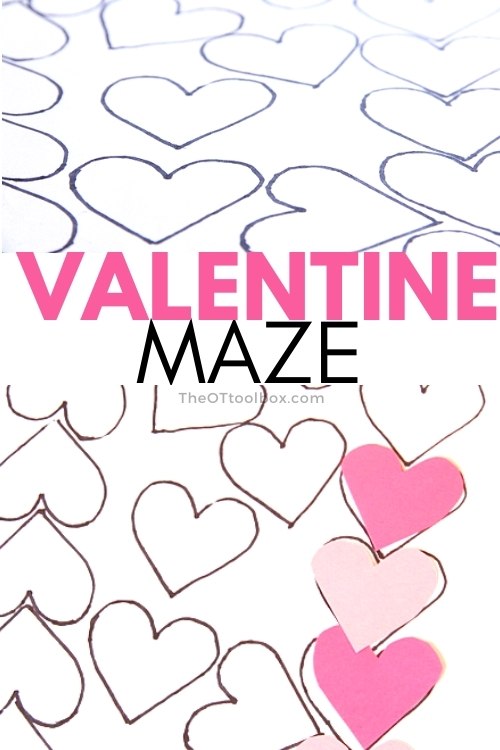
        Valentine's Day maze

        This Valentine’s Day maze is an easy DIY visual perception activity that requires only paper and a pencil. Sometimes an activity can be just easy to throw together and the kids love it.  This Heart Maze is a simple visual perception activity that can be adapted to any season or shape.  We used hearts for a Valentine’s Day occupational therapy activity, while practicing visual scanning, visual spatial relations, line awareness, and eye-hand coordination.

        For more Valentine fine motor fun, use these printable Valentine cards for folding, coloring, and cutting.

        Valentine's Day Maze for working on visual motor skills in occupational therapy interventions with limited materials, perfect for  virtual therapy at home.

        Valentine’s Day maze activity

        This visual perception maze is an easy way to work on visual motor skills needed for tasks like handwriting, reading, and learning. The hearts are placed in a path-like maze that challenges visual perception skills.

        Kids can help with making this Valentine’s Day maze, or you can make a template and copy it over and over again. Let’s discuss how this maze works and how it and other visual perception skills helps kids with reading, learning, reading, and writing.

        This post contains affiliate links.

        Work on visual perception skills with this heat maze, for a Valentine's Day occupational therapy activity

        Visual Perceptual Heart Maze Activity

        How to make a Valentine’s Day Maze

        You need just a few materials for this DIY maze, making this a good occupational therapy intervention for teletherapy.

        So, grab your materials:

        • Paper
        • Pencil or marker
        • Scissors

        We used construction paper to make a heart, but you could use regular paper as well.

        It really doesn’t get much easier.  

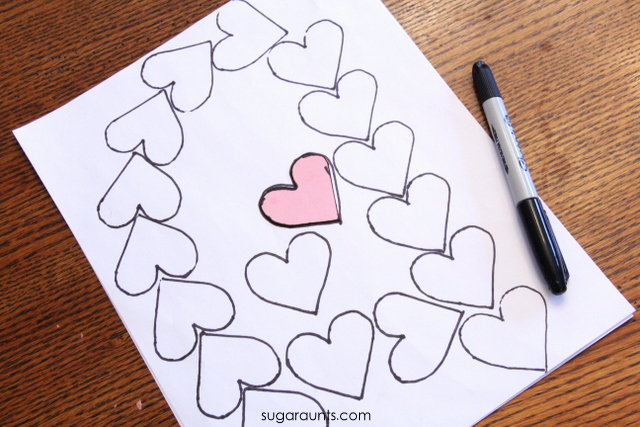
        1. Draw a small heart. You can use regular paper or colored paper.

        2. Using scissors, cut out the heart.

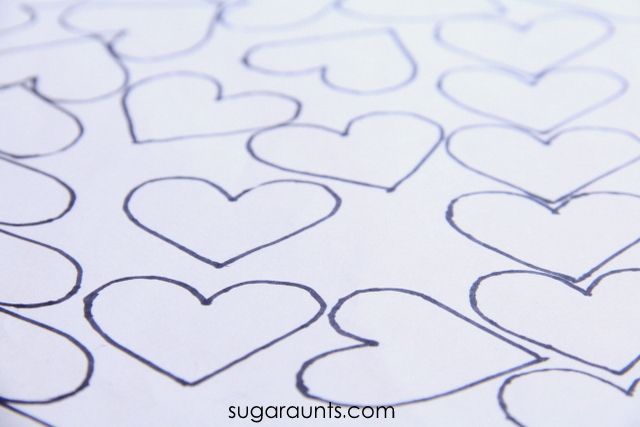
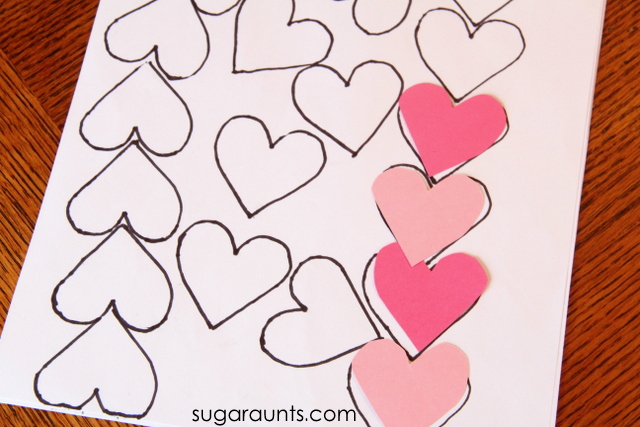
        3. Trace the heart on a piece of white paper.

        4. Place the point of the heart into the top of the heart so the hearts are connected. Trace the second heart on the paper.

        5. Continue tracing, positioning the hearts in a line.  You want a “maze” to form around the paper. 

        A heart maze is a fun visual perception activity to use in a Valentine's Day theme occupational therapy activities.

        6. Fill in the blank space with more heart outlines, but this time, rotate the shape so it’s positioned randomly and not as close to the maze.

        Use this Valentine's Day activity to work on visual perceptual skills in occupational therapy goals.

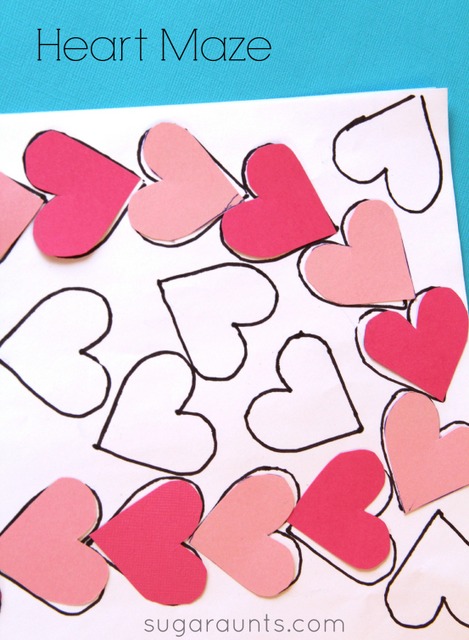
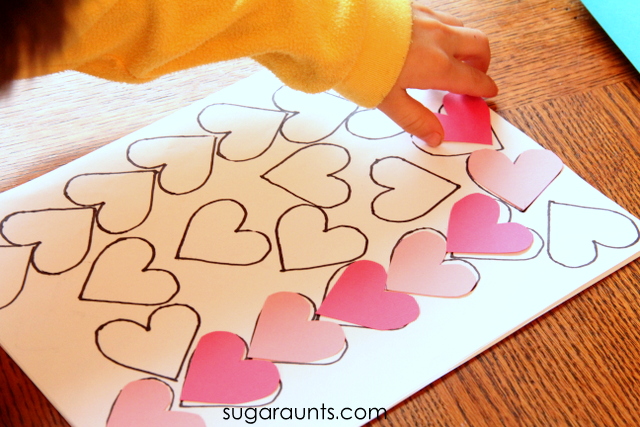
        Next, you can follow the path of hearts and color them in. You could also place small objects on the hearts, like craft pom poms or mini erasers.

        Another option is to use the heart template to cut more hearts from colored paper.  We used a darker shade to work on patterns as we filled in the maze. If two shades of colored paper isn’t available, just use two different colored crayons to color in patterns as the child completes the maze.

        For children who are working on scissor skills, try using a thicker paper for the heart template. Cardstock is a great option because the thicker paper is resistive and offers proprioceptive feedback through the hands. Here is a link to pink card stock.

        For more information on scissor skills and types of paper, try this crash course on scissor skills.

        Visual perception, fine motor, eye-hand coordination, and other skills can be used with this heart maze in Valentine's Day occupational therapy sessions.

        Visual Motor Maze

        There are many visual skills being addressed in this occupational therapy maze activity.

        Lining up the hearts requires eye-hand coordination to position the card stock hearts within the outlines.  Using the hands in a coordinated manner based on visual input is an important skill for many functional tasks including handwriting and scissor use.

        This is a great strategy to support visual closure skills needed for reading and writing.

        What Are Visual Spatial Relations?

        Visual spatial relations is the ability to identify a form/shape/letter despite being rotated, and identify it as being rotated.  Children need visual spatial relations to identify the difference between a “b” and “d” and “p”, and “q”.  

        This sheet full of hearts that look the same requires the child to identify the hearts that are following a path.  Some of the hearts not along the path are rotated  and the child should be able to identify by scanning, the hearts that are rotated.

        Valentine's Day occupational therapy activities can include this hearth maze to work on visual perception.

        Looking for more Visual Perception Activities?  

        Try these:   Smashing Peanuts Activity

        Elmer the Elephant Activity

        Toys to Improve Visual Perception

        Tangrams and Visual Perception

        Visual Closure Bugs

        Visual Perception Activities

        Visual processing bundle full of resources and tools to work on visual perception and visual motor skills
        Grab the Visual Processing Bundle to better understand visual perception skills through play and hands-on activities.

        Need help fixing visual processing problems?

        Know a student with identified visual processing problems…but difficulties are brushed over or missed in the school setting?

        Have a kiddo on your caseload that struggles with visual tracking, fixation, eye teaming, or visual scanning? 

        Need tools to incorporate visual perception and visual-motor strategies right into the classroom?

        Wondering how to help kids who can not visually attend to an object in order to focus for more than a few seconds?

        The Visual Processing Bundle is a comprehensive resource on oculomotor skills, visual perception, visual-motor skills. 

        Details about The Visual Processing Bundle:  

        • Over 235 pages of tools, activities, resources, informaton, and strategies to address visual processing needs
        • Classroom accommodation ideas for visual perception challenges
        • Checklists for trialing various activities and strategies
        • 2 leveled visual-motor integration workbooks…with data collection tools to monitor progress
        • Pencil control worksheets to integrate visual input and motor work in meaningful ways
        • Classroom activities that can be incorporated into reading, spelling, math, and other subjects…reducing the amount of extra “work”. This math maze is a fun idea.
        • Activity cards to guide therapy warm-up sessions or used in home program development
        • Specific and open-ended activity cards to address visual attention and spatial awareness
        • Visual tracking guide explain components of visual tracking and specific activities to improve tracking
        • SO much more!

        Click here to get the Visual Processing Bundle.

        MORE FINE MOTOR HEART ACTIVITIES

        The Valentine’s Day Fine Motor Kit is here! This printable kit is 25 pages of hands-on activity sheets designed to build skills in pinch and grasp strength, endurance, eye-hand coordination, precision, dexterity, pencil control, handwriting, scissor skills, coloring, and more.

        When you grab the Valentine’s Day Fine Motor Kit now, you’ll get a free BONUS activity: 1-10 clip cards so you can challenge hand strength and endurance with a counting eye-hand coordination activity.

        Click here to grab your copy of the Valentine’s Day Fine Motor Kit.

        Valentines Day fine motor kit

        Colleen Beck, OTR/L has been an occupational therapist since 2000, working in school-based, hand therapy, outpatient peds, EI, and SNF. Colleen created The OT Toolbox to inspire therapists, teachers, and parents with easy and fun tools to help children thrive. Read her story about going from an OT making $3/hour (after paying for kids’ childcare) to a full-time OT resource creator for millions of readers. Want to collaborate? Send an email to contact@theottoolbox.com.
        Valentines Day Busy Bag

        Fine motor activity using cookie cutters

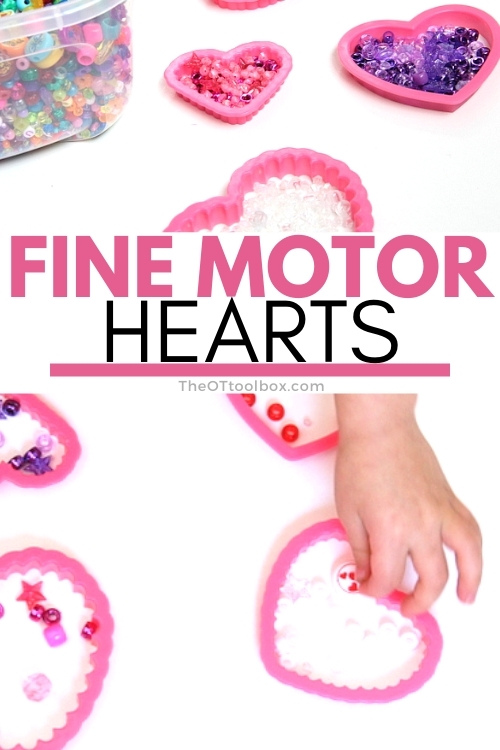
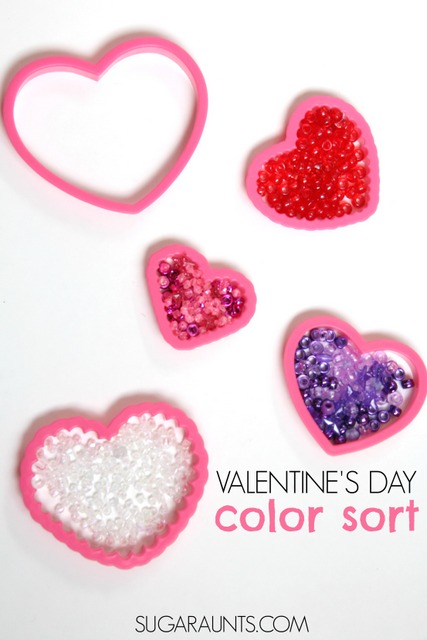
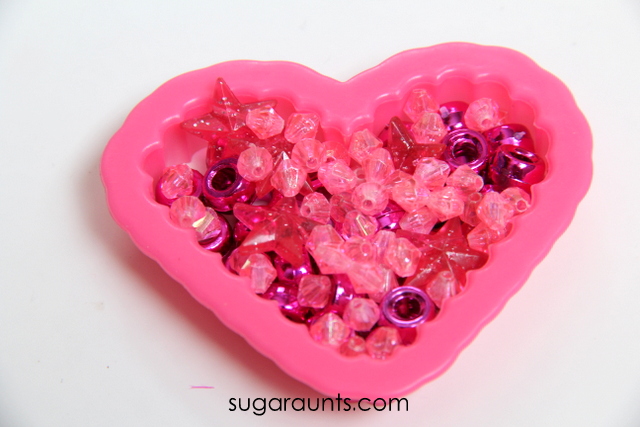
        This February fine motor activity is a fun way to use an item you probably have on hand: cookie cutters! We used heart cookie cutters and beads to build fine motor skills in a fun and themed way.  There’s a lot of learning that happens during activities with kids.  We put together this Valentine’s Day busy bag activity as a way to practice fine motor skills and color sorting.  It’s another Valentines Day occupational therapy activity that builds essential skills.

        You’ll also love our printable Valentine cards for more fine motor work including writing, folding, coloring, and cutting.

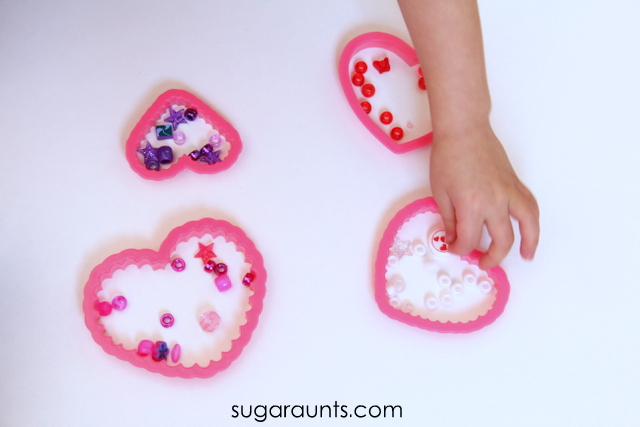
        Valentine's Day busy bag with fine motor heart activity using cookie cutters and beads.

        Heart Busy Bag Activity

        This sorting heart busy bag is a powerful way to improve in-hand manipulation skills.   In-hand manipulation  is a fine motor dexterity skill needed for tasks like managing clothing fasteners, using a pencil when writing, manipulating items like coins or beads, and more.

        Valentine's Day busy bag color sorting activity with beads for fine motor work and color identification.

        Valentine’s Day Busy Bag Activity

        Busy Bag Activities are a great way to learn and play during quiet time or down time.

        This post contains affiliate links.

        Work on fine motor skills with this Valentine's Day fine motor activity

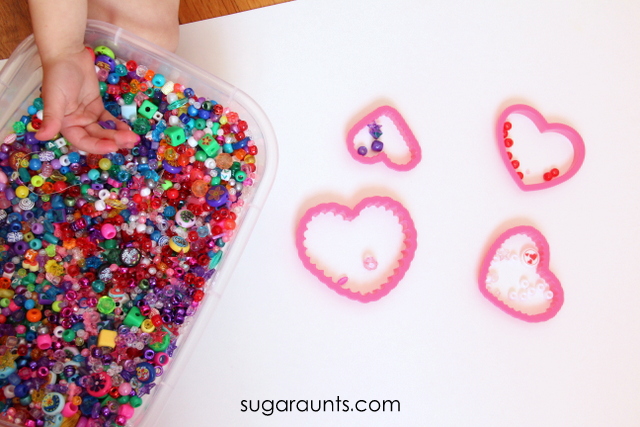
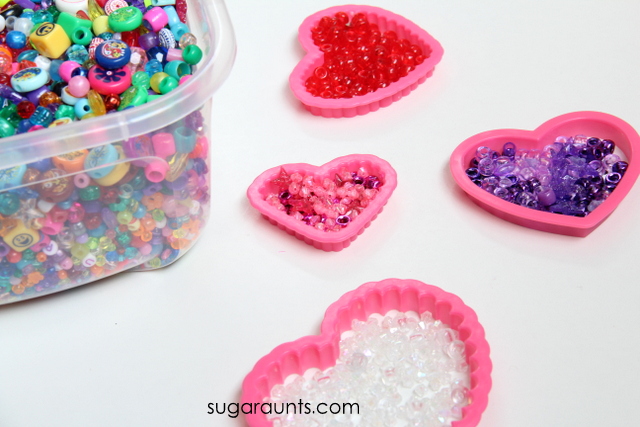
        We started with a big bin of  beads and a few heart cookie cutters.  I showed Little Sister (age 3) how to sort the beads by color into the hearts.  She had a blast examining each bead and saying “Oh, this one looks pinkish!  Oh this one looks purple-ish!”  

        Valentine's Day busy bag and fine motor activity for skills like in-hand manipulation.
        Use heart shaped cookie cutters and beads to work on fine motor skills.
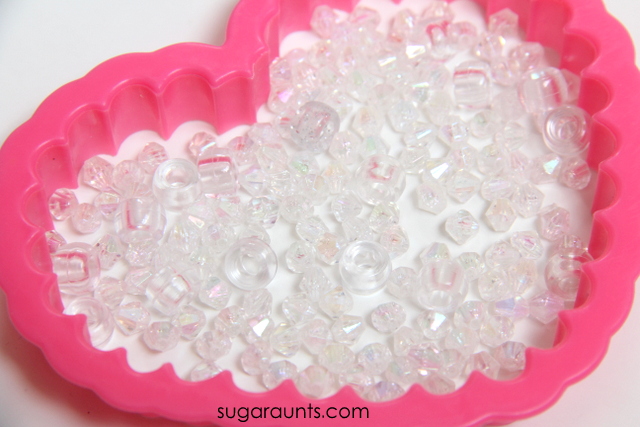
        Work on fine motor skills with a Valentine's Day fine motor activity


        Fine Motor Valentine’s Day Activity

        Manipulating the beads in the big bin to grab certain colors works on some great fine motor skills.  You need to pick up the beads with a pincer grasp (tips of the pointer finger and thumb) with fine dexterity.  

        Once she grasped a bead, Little Sister would “squirrel away” the colors into the palm of the hand.  This transfer of beads from the tips of the fingers into the palm of the hand is in-hand manipulation(fingers to palm translation).  

        Manipulating small items like beads in this way works on the muscles of the hands and is a great way to work on pre-handwriting or handwriting skills.  A child needs strength of the intrinsic muscles (the muscles within the hand) to manipulate the pencil and maintain endurance for writing and coloring.

        Work on fine motor skills with this heart Valentine's Day occupational therapy activity.

        More Fine Motor Heart Activities

        The Valentine’s Day Fine Motor Kit is here! This printable kit is 25 pages of hands-on activity sheets designed to build skills in pinch and grasp strength, endurance, eye-hand coordination, precision, dexterity, pencil control, handwriting, scissor skills, coloring, and more.

        When you grab the Valentine’s Day Fine Motor Kit now, you’ll get a free BONUS activity: 1-10 clip cards so you can challenge hand strength and endurance with a counting eye-hand coordination activity.

        Click here to grab your copy of the Valentine’s Day Fine Motor Kit.

        Valentines Day fine motor kit
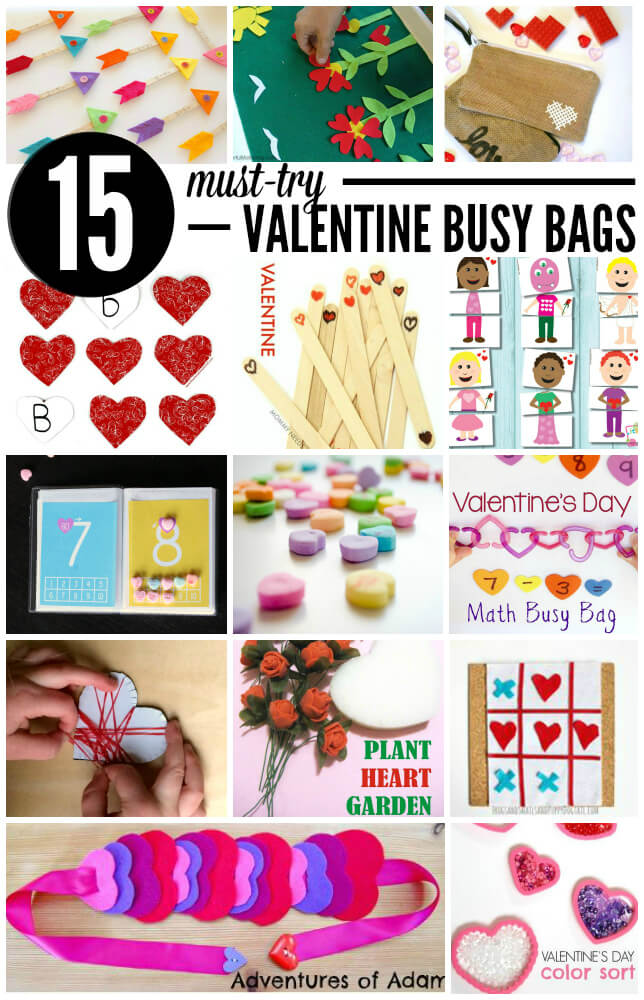
        15 Must-Try Valentine Busy Bags

        Colleen Beck, OTR/L has been an occupational therapist since 2000, working in school-based, hand therapy, outpatient peds, EI, and SNF. Colleen created The OT Toolbox to inspire therapists, teachers, and parents with easy and fun tools to help children thrive. Read her story about going from an OT making $3/hour (after paying for kids’ childcare) to a full-time OT resource creator for millions of readers. Want to collaborate? Send an email to contact@theottoolbox.com.
        Valentine’s Day Handwriting Activity Slide Deck

        Valentine's Day handwriting activity and free slide deck for occupational therapy

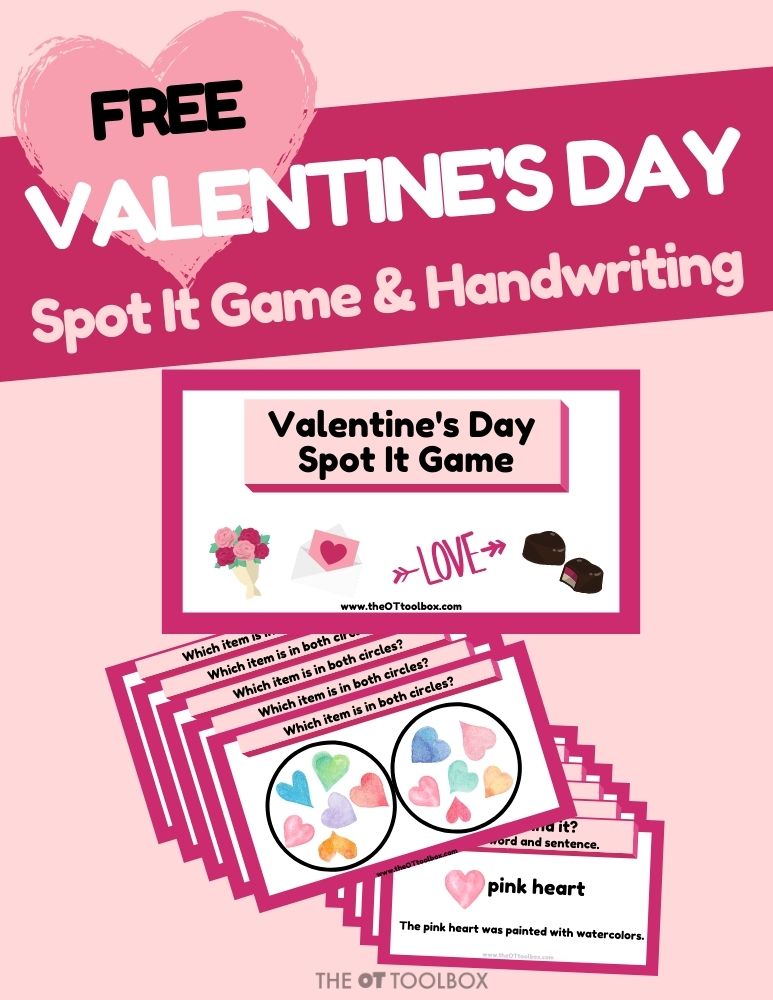
        Adding fun handwriting activities doesn’t need to be boring! This Valentine’s Day handwriting slide deck proves that. Here, you’ll find an interactive free Google slide deck that challenges visual perceptual skills in the form of a match-up type of game and a Valentine’s Day themed handwriting task. Use these occupational therapy slides in teletherapy activity planning or in hybrid/face-to-face lesson planning. Let’s get ready to help kids develop the skills needed for handwriting with hearts and love!

        You’ll also love this Valentine’s Day gross motor slide deck for occupational therapy and physical therapy teletherapy sessions.

        Valentine's Day handwriting activity and free slide deck for occupational therapy

        Valentine’s Day handwriting activity

        This free slide deck includes two separate activities. The first is a match up game, a lot like the virtual handwriting activities we’ve shared before, including this pencil theme write the room activity.

        In this particular therapy slide deck, students can use the Valentine’s Day theme to identify the missing item on the match-up, spot it style of Valentine’s Day puzzles.

        Valentine's Day Spot it activity to practice visual perceptual skills with a heart theme.

        Then, on the next slide, students are given a handwriting task where they copy the word and a sentence.

        There are several reasons why I’ve included these two activities together on a handwriting therapy activity.

        When kids complete a spot-it game visual perception activity, they are challenging and developing several visual perceptual skills including form constancy, visual discrimination, visual memory, and visual figure ground skills.

        All of these perceptual skills are needed for copying written work. When a child copies a word, they need to visually shift from their paper to the word or sentence that they are copying. To copy, students need visual perceptual skills of visual memory so that they can recall where they left off as they copy letters and words. They also need visual discrimination skills to quickly identify the differences between letters. Finally, kids need visual figure ground skills so that they can visually pull out the letters or words that they pull out of a sentence as they copy.

        So, in this slide deck, students can first determine the image that is different between the two circles. One Valentine’s Day symbol is matching and all others are different. The student can click on the heart in the corner of the slide and drag it onto the matching Valentine’s Day symbols.

        Valentine's Day handwriting activity for kids to practice handwriting skills.

        Next, each match-up puzzle in the deck is followed by a handwriting activity. Users can copy the word or they can copy the sentence, or they can copy both! This slide deck is very adaptable depending on the needs of the child.

        You’ll find different Valentines themes including cute animals with hearts, heart trees, sweet treats, heart cupcakes, emojis, conversation hearts, watercolor hearts, and even more heart themes!

        Additionally, this activity is available on Google Jamboard so that users can write right on the slide with a stylus or their finger.

        Free Valentine’s Day Handwriting Slide Deck

        Want to add this slide deck to your therapy toolbox? Enter your email address into the form below.

        Enter your email address below and you will receive a PDF containing a link to copy the slide deck onto your Google drive. Next, save that PDF file, because you can come back to it again and again and send it to the kids on your caseload (or classroom) so they can make their own copy on their Google drive.

        Please use the copy of the slide deck and do not change the url.

        FREE Valentine’s Day Handwriting Activity!

          We respect your privacy. Unsubscribe at anytime.

          Want to add more Valentine’s Day activities and movement tools to your skill-building?

          he Valentine’s Day Fine Motor Kit is here! This printable kit is 25 pages of hands-on activity sheets designed to build skills in pinch and grasp strength, endurance, eye-hand coordination, precision, dexterity, pencil control, handwriting, scissor skills, coloring, and more.

          When you grab the Valentine’s Day Fine Motor Kit now, you’ll get a free BONUS activity: 1-10 clip cards so you can challenge hand strength and endurance with a counting eye-hand coordination activity.

          Valentines Day fine motor kit
          Valentine’s Day Fine Motor Kit to develop fine motor strength, endurance, dexterity, and coordination of hand skills.

          Click here to grab your copy of the Valentine’s Day Fine Motor Kit.

          Colleen Beck, OTR/L has been an occupational therapist since 2000, working in school-based, hand therapy, outpatient peds, EI, and SNF. Colleen created The OT Toolbox to inspire therapists, teachers, and parents with easy and fun tools to help children thrive. Read her story about going from an OT making $3/hour (after paying for kids’ childcare) to a full-time OT resource creator for millions of readers. Want to collaborate? Send an email to contact@theottoolbox.com.
          Valentine’s Day Gross Motor Activity

          Valentines day gross motor slide deck for helping kids with movement, motor planning, coordination, and other gross motor skills.
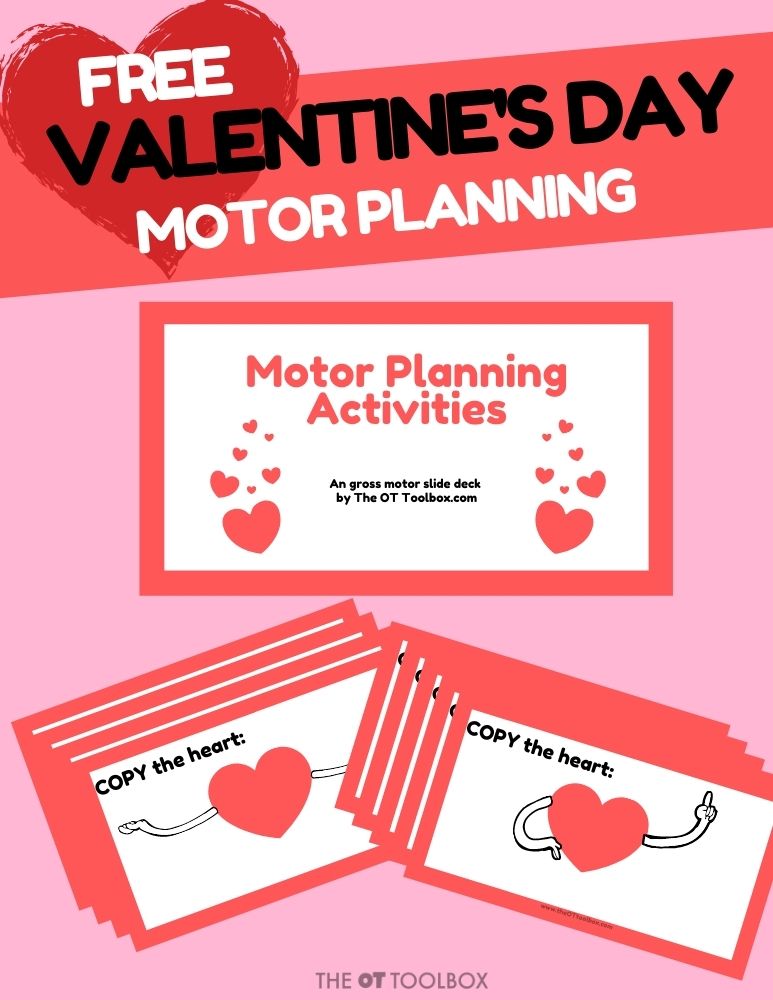
          Today, I’m excited to bring you another free Google slide deck, this one is a way to get kids moving and working on motor planning skills. It’s a Valentine’s Day gross motor activity that challenges bilateral coordination, crossing midline, movement challenges, and motor planning skills. Kids can follow along with this therapy slide deck and use the heart theme therapy activity to work on so many movement skills. Let’s get those kiddos moving in occupational therapy, physical therapy, in the classroom, or at home!

          Valentines day gross motor slide deck for helping kids with movement, motor planning, coordination, and other gross motor skills.

          Valentine’s Day Gross Motor Activity

          If hands-on activities that are used by many different children are possible, sensory-based tactile activities like this bilateral coordination activity with heart drawing is the way to go for building motor planning and coordinated use of both hands.

          However, if you’re working with many children or in virtual therapy situations, a guided slide deck can be helpful in encouraging kids to build specific skills like motor planning, coordination, and strengthening.

          That’s where this Valentine’s Day gross motor activity comes in.

          This slide deck is a tool for helping kids develop skills in a variety of areas:

          • Balance
          • Coordination
          • Motor planning
          • Crossing midline
          • Movement changes
          • Sequencing

          The heart theme is a fun way to encourage movement of these gross motor skills.

          Copy the heart motor planning exercise

          Kids can copy each slide in the deck and work on motor planning skills.

          There are different upper body movement activities that can be used based on the needs of each individual child.

          Working on balance? Go through the slides while standing on one foot and then the other.

          Working on motor planning? Go through several slides and ask the child to recall the sequence of the movements as they complete the arm positioning with their eyes closed or without the visual prompt of the slides. Or, challenge the child to go through the movements as fast as they can.

          Need a brain break activity? Combine heavy work like animal walks, wall push-ups, burpees, push-ups, or chair push-ups between each arm positioning.

          Working on listening skills or direction-following? Use the slide deck in a “Simon Says” activity.

          Valentines Day motor planning activities

          Valentine’s Day Gross Motor Slide Deck

          Want to add this slide deck to your therapy toolbox? Enter your email address into the form below.

          Enter your email address below and you will receive a PDF containing a link to copy the slide deck onto your Google drive. Next, save that PDF file, because you can come back to it again and again and send it to the kids on your caseload (or classroom) so they can make their own copy on their Google drive.

          Please use the copy of the slide deck and do not change the url.

          FREE Valentine’s Day Gross Motor Therapy Activities!

            We respect your privacy. Unsubscribe at anytime.

            Want to add more Valentine’s Day activities and movement tools to your skill-building?

            The Valentine’s Day Fine Motor Kit is here! This printable kit is 25 pages of hands-on activity sheets designed to build skills in pinch and grasp strength, endurance, eye-hand coordination, precision, dexterity, pencil control, handwriting, scissor skills, coloring, and more.

            When you grab the Valentine’s Day Fine Motor Kit now, you’ll get a free BONUS activity: 1-10 clip cards so you can challenge hand strength and endurance with a counting eye-hand coordination activity.

            Valentines Day fine motor kit
            Valentine’s Day Fine Motor Kit to develop fine motor strength, endurance, dexterity, and coordination of hand skills.

            Click here to grab your copy of the Valentine’s Day Fine Motor Kit.

            Colleen Beck, OTR/L has been an occupational therapist since 2000, working in school-based, hand therapy, outpatient peds, EI, and SNF. Colleen created The OT Toolbox to inspire therapists, teachers, and parents with easy and fun tools to help children thrive. Read her story about going from an OT making $3/hour (after paying for kids’ childcare) to a full-time OT resource creator for millions of readers. Want to collaborate? Send an email to contact@theottoolbox.com.