Salt Truck Craft

salt truck craft

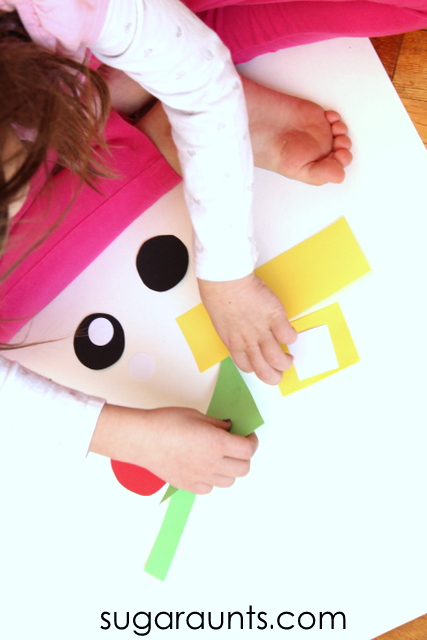
We live in an area with cold winters and lots of snow.  With the wintery weather comes ice, salt, and snow plows.  We’ve been watching many salt trucks rumble down our road, scattering salt and plowing snow.  My kids love to see the salt truck come and every time the see one when we’re out and about, they shout, “SNOW PLOW” from the back of the minivan.  We had to make an Easy Shapes Salt Truck craft to join our other truck crafts.

Salt truck craft is perfect for kids that love vehicles, and working on early scissor skills.

Other trucks and cars crafts that work on scissor skills with simple geomteric shapes include:

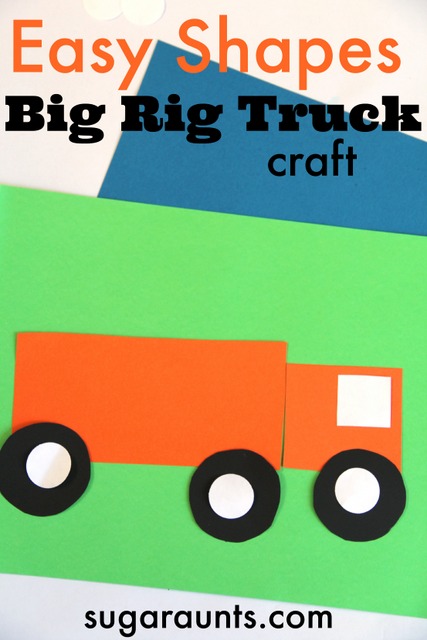
Big Rig Craft

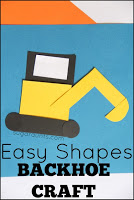
Backhoe Craft

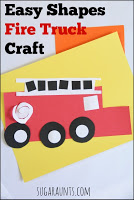
Firetruck Craft

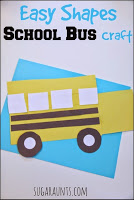
School Bus Craft

Craft for Scissor Skills

If working on scissor skills is a must, then this salt truck craft is the way to go. Kiddos that love all things trucks and vehicles will love it for the vehicle theme, but as a therapist, I see the geometric shapes, making it perfect for working on early scissor skills.


Salt Truck Craft

  This post contains affiliate links.


To make the craft, you’ll need just a few materials:

  • Scissors
  • Yellow paper
  • Red paper
  • Black paper
  • White paper
  • Green paper
  • Glue

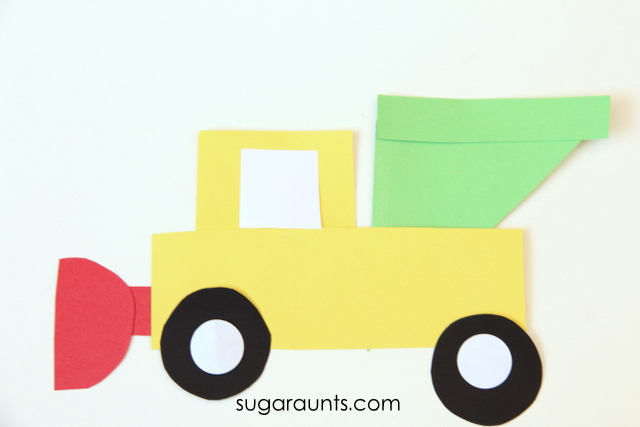
Other colors of paper can certainly be used! These are the colors we used, and I’ll describe the shapes you need for this truck craft here so you can use the salt truck as a template.

About paper type- Different types of paper provides different amounts of feedback for young scissor users. We love crafting with card stock or thicker paper, because it’s easy to hold with the assisting hand and the paper doesn’t easily bend or move when cutting through it with scissors. Cardstock paper is great for younger kids or those just learning to snip and cut with smooth lines as well as just starting with turning the scissors around a corner of simple shapes..  Its brightly colors make great crafting material and the thickness is perfect for new scissor users. You can find more information on types of paper for scissor skill development in our scissor skills crash course.

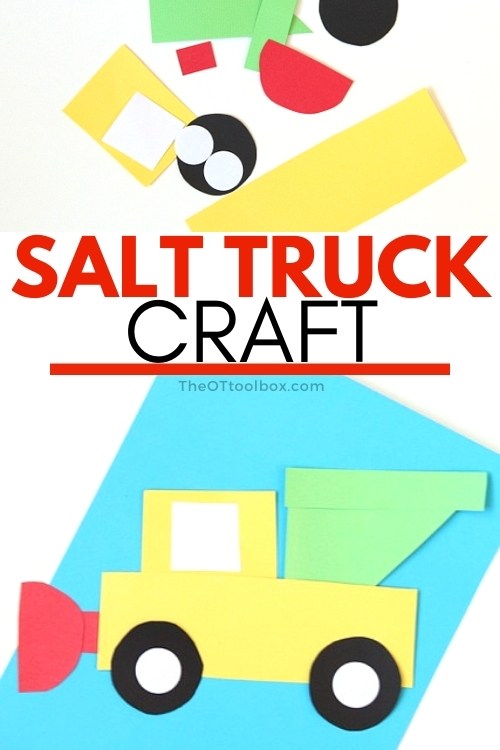
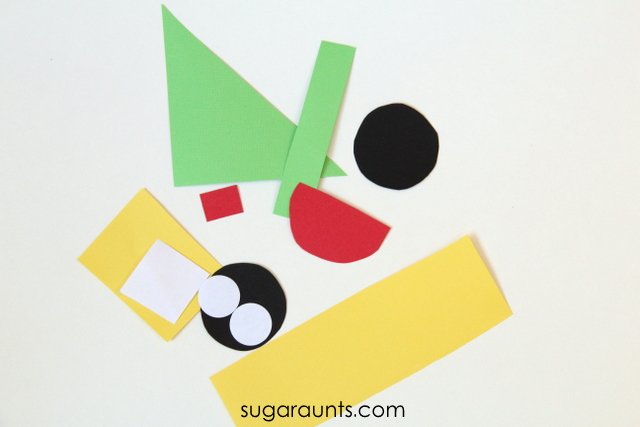
You’ll need to draw the following shapes:

  • Yellow Rectangle- for the body of the truck
  • Yellow Square- for the cab of the truck
  • White Smaller Square- for the window of the truck
  • Large Green triangle- for the truck’s Salt bed
  • Long Green rectangle- for the top of the salt truck’s bed
  • 2 Black larger circles- for the wheels
  • 2 Smaller white circles- for inside the wheels
  • Red Half Circle- for the plow
  • Small Red Square- for the plow attachment

Draw the shapes onto the paper and then start cutting. Cut shapes as pictured above to build the salt truck craft.    

Snow Plow Puzzle

Constructing this snow plow puzzle is part of the fun! Kids can work on visual memory by building the truck from memory or by looking at an example picture and then back to their project.

You can build the salt truck with them and then deconstruct the truck.  Ask your child to recreate the truck from memory, using their mind’s eye to recall the placement of the shapes.  This memory is visual memory and an important skill for copying work when handwriting.  

There are other visual perceptual skills at work, too.

Looking for specific pieces that are placed on the table surface is a challenge in visual scanning, visual discrimination, figure-ground, and form constancy.

Remembering the position of the shapes is part of visual discrimination, a skill needed when children need to remember subtle differences in a picture or written work.  Difficulty with visual discrimination will be apparent when a child has difficulty discerning between b, d, p, or q.

Kids love salt trucks and snow plows!  Make an easy shapes truck craft to work on visual memory and visual discrimination.

Early scissor skills fine motor

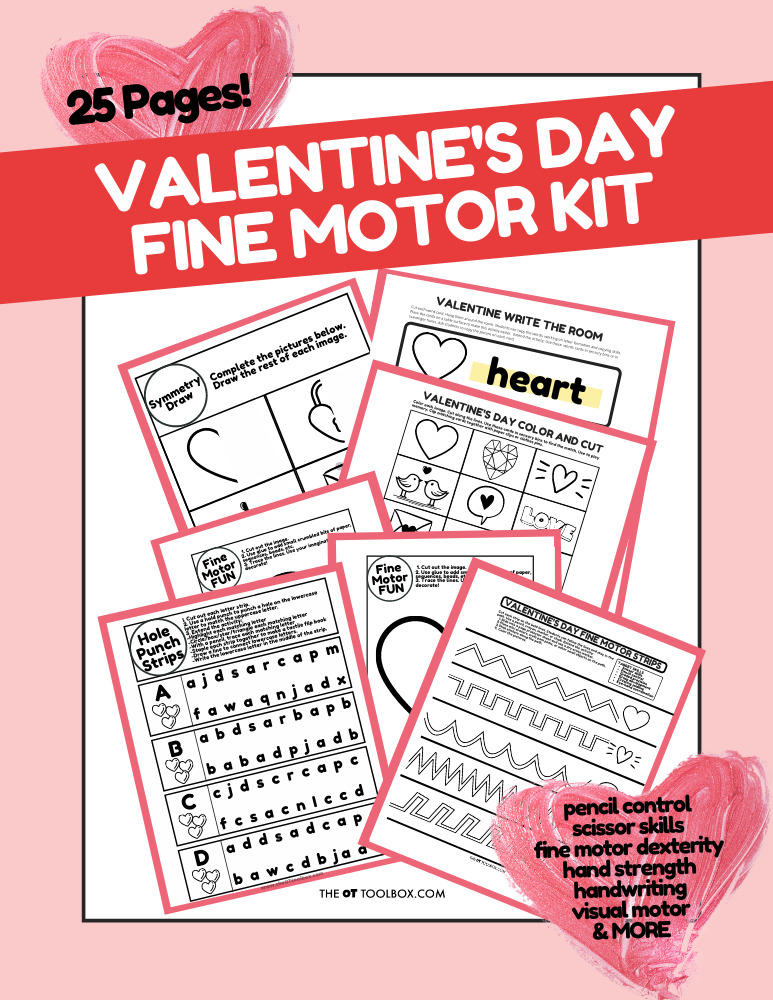
For more ways to work on scissor skills, along with all of the fine motor skills needed for scissor use and handwriting, try the Winter Fine Motor Kit. It’s loaded with cutting activities, lacing cards, coloring, clip activities, fine motor art, and fun ways to help children develop pre-writing hand strength, dexterity, and motor skills.

Use the fine motor activities, lacing cards, toothpick art, and crafts in the Winter Fine Motor Kit. It’s a 100 page packet with all winter themes, and you’ll find penguins there!

winter fine motor kit

Click here for more information on the Winter Fine Motor Kit.

 
More easy shapes Truck Crafts you may like:
 
firetruck craftBig rig truck craftDigger truck craftSchool bus craft
 
             Fire Truck craft | Big Rig craft Digger craft | School Bus craft  

Colleen Beck, OTR/L has been an occupational therapist since 2000, working in school-based, hand therapy, outpatient peds, EI, and SNF. Colleen created The OT Toolbox to inspire therapists, teachers, and parents with easy and fun tools to help children thrive. Read her story about going from an OT making $3/hour (after paying for kids’ childcare) to a full-time OT resource creator for millions of readers. Want to collaborate? Send an email to contact@theottoolbox.com.


Pirate Activities for teletherapy

Pirate activities for teletherapy

Here, you will find pirate activities for teletherapy and helping children develop skills in occupational therapy interventions. Use these pirate fine motor ideas, gross motor activities, and pirate crafts will get you started on planning therapy sessions. Add this to your weekly therapy themes!

Pirate activities for occupational therapy interventions in teletherapy

When occupational therapy teletherapy became a necessity due the pandemic I took a deep breath and jumped in. After working face to face with children for 20 years it definitely tested my powers of adaptability and flexibility as well as my limited tech know-how. I got the hang of it and as the months passed by I must admit that I developed a bit of a love-hate relationship with teletherapy. I loved that I could connect with my clients and I that I could still work on the core skills we had been developing before we had to go online.

I hated that I could not be hands on in the way that I guided and facilitated the sessions for the best possible outcomes. It gave me a lot to think about. Planning the sessions was challenging and having to make on the spot changes was hard. Some things worked better than I expected and some things that I had been so excited about
bombed!


I started putting together a file of all the teletherapy sessions that I had conducted and would like to share some of the more successful ones with you. These are not one size-fits all recipes for therapy sessions but rather guidelines that you can use to adapt for the specific clients.

Use what you can, change what you need to and have fun as
you zoom off to your next therapy session.


Pirate Theme Teletherapy Activities

For this session I wore a pirate hat with a skull and cross bones. Some of my clients had pirate hats that they chose to wear as well. Otherwise they used any hat and we just pretended. In future I may email a skull and cross bones badge for them to colour and cut and we can include making a pirate hat as part of the session.

Pirate Gross Motor Activities

Use these pirate gross motor ideas as a warm up to the therapy session while incorporating bilateral coordination, crossing midline, balance, and motor planning.


We pirates had to warm up our muscles for the treasure hunt. We made cross bones by crossing our forearms and then proceeded with our favourite crossing the midline activities. These included

  • Cross crawl exercises (elbow to opposite knee)
  • Foot taps (hand to opposite foot behind your body)
  • Shoulder taps standing (touch right hand to left shoulder, touch left hand to right shoulder)
  • Shoulder taps four-point kneeling (in four point kneeling touch right hand to left shoulder, touch left hand to right shoulder)
  • Lazy eights in the air (waving our pirate flags)

We also practised toe-heel walking and standing balance on one leg in case we had to walk the plank. Then we were ready for the hunt.

Treasure Hunt Scavenger Hunt for Therapy


For the treasure hunt I asked the children to have a pillow case ready to stash their booty. Then I asked them to listen carefully and find the following items and I gave them a description based on their age and ability.

This scavenger hunt activity is an exercise in visual perceptual skills including visual discrimination, visual figure-ground, visual attention, and visual memory.


Examples of the treasures they must find are

  • something round, square, oval, rectangle
  • something soft, heavy, smooth, rough
  • something red, blue, that is your favourite colour
  • something you wear
  • something you read
  • something that starts with the first letter of your name
  • something of their own choosing

The clues were given one at a time and the clues were graded according to the age and ability level of ability of the child I was working with.

Once the child had been given the clue they go off to find the item. When they returned I encouraged them to describe what they have found and encouraged them to take a mental picture of the item before putting it in the pillow case.


During our pirate session we found between 5 and 8 treasures again depending on the child’s age and ability.


Once all the treasures have collected I asked my pirate to place the pillowcase under their table or chair. Then I asked them to recall the items that they collected. Younger children were encouraged to name them while older children were asked to write them down. Give clues if they are not able to complete the list.


The children loved this activity and it targeted receptive language, expressive language, visual memory and handwriting in the older children. Also got them up and moving around the house which was great for their physical endurance.

Pirate Fine Motor Ideas

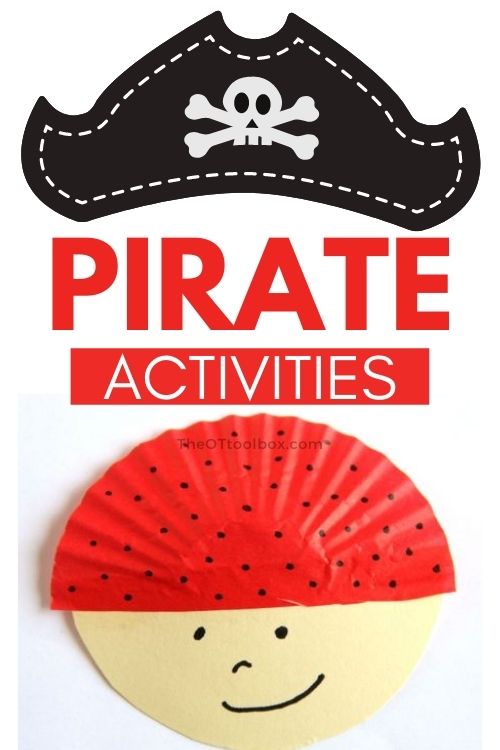
Pirate crafts are a fun way to build fine motor skills. Depending on the supplies available, different pirate crafts can be completed. This pirate puppet craft requires a cupcake liner, paper, scissors, and glue.


I tried some origami boats with one of my children but they found this quite challenging and I probably needed to down grade the design of the boat that I chose.


For fine motor work and visual motor integration, try shark teeth patterns with the younger children. Clients can draw zigzag patterns as sharks teeth. Or, try drawing a skull and cross bones with the older children. Kids can address scissor skills with these activities, as well.

If a paper towel tube or toilet paper roll is available, create a pirate telescope craft to work on fine motor skills.

Kids love making maps, and so do pirates! This map craft encourages visual attention, scissor skills, sensory exploration, and fine motor work. As we showed in a previous activity, you can use a map to work on spatial concepts, too.


More Pirate Activities for Therapy


Once the treasure hunt has been completed the world is your oyster in terms of Activities that you can include to target your specific goals.

For visual discrimination we played spot the difference and I found pirate themed spot the difference worksheets for children to completed. This followed on nicely from the looking for treasure activity.


Pirate themed word searches also went down well with the older children.


I also asked one or two of them to read from the book that had been part of our treasure hunt.


I really got such a positive response from the children who participated in the pirate session. So OT’s do what you do best and adapt this outline to suit your clients and happy treasure hunting. Also get ready for the next teletherapy session. You don’t want to miss out on this Jungle Adventure.

Contributor to The OT Toolbox: Janet Potterton is an occupational therapist working predominantly in school-based settings and I love, love, love my job. I have two children (if you don’t count my husband!), two dogs, one cat, two guinea pigs and one fish. When I am not with my family or at work I try to spend time in nature. The beach is my happy place.

Groundhog Day Vision Activities Slide deck

groundhogs day vision activities for vision therapy and occupational therapy

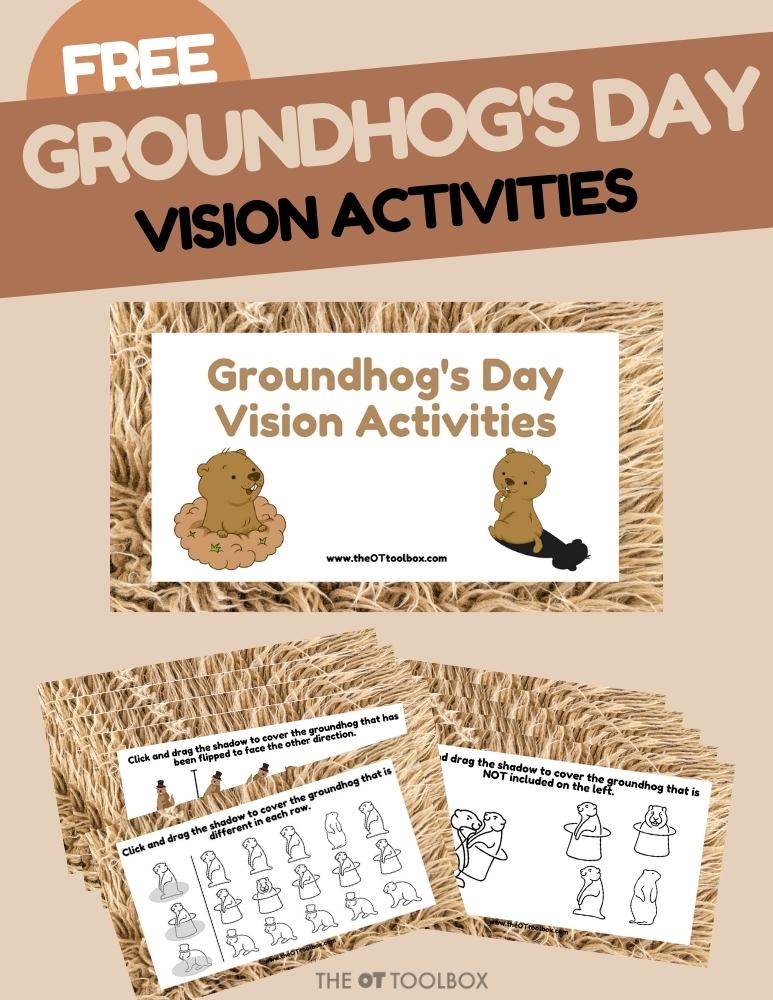
If you saw the last post here on the site, you know we are off and running with a groundhog day theme for therapy interventions. Today, I’m excited to share an expansion on that last resource…a Groundhog’s Day vision activities slide deck is designed specifically for vision therapy activities including visual perceptual skills and visual motor integration! This activity slide deck is perfect for therapy interventions this week because it covers a variety of skills related to visual perception and visual motor skills. And when the groundhog “sees” his shadow, he’s using visual skills, too!

So, read through the vision activities included in the free Google slide deck and Jamboard, and then enter your email into the form at the bottom of this post. This is going to be a hit in therapy this week!

groundhogs day vision activities for vision therapy and occupational therapy

Groundhog Day Visual Perception Activities

This interactive slide deck is fun because it covers a variety of areas related to visual perceptual skills. It’s an expansion on our Groundhog’s Day Activities slide deck, which covers various occupational therapy areas. If going into more depth with visual skills is needed for the children you work with, then today’s vision activity slide deck is a great addition to your therapy toolbox.

In today’s slide deck and Jamboard freebies, you’ll be able to address specific visual perceptual skill areas:

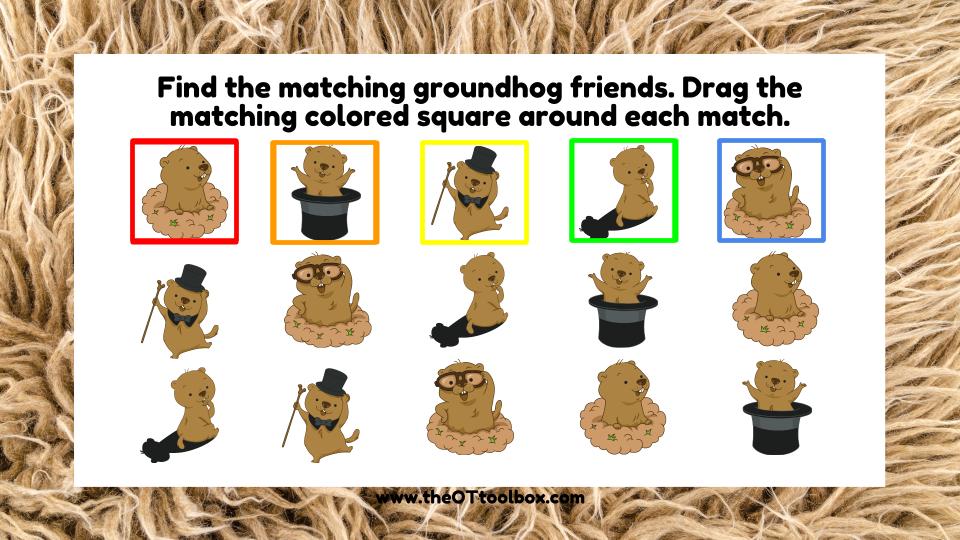
Visual discrimination- Users can go through the slide and work on the ability to discriminate between small details. This skill is needed for reading, writing, comprehension, and learning.

Groundhog's day visual perception activity

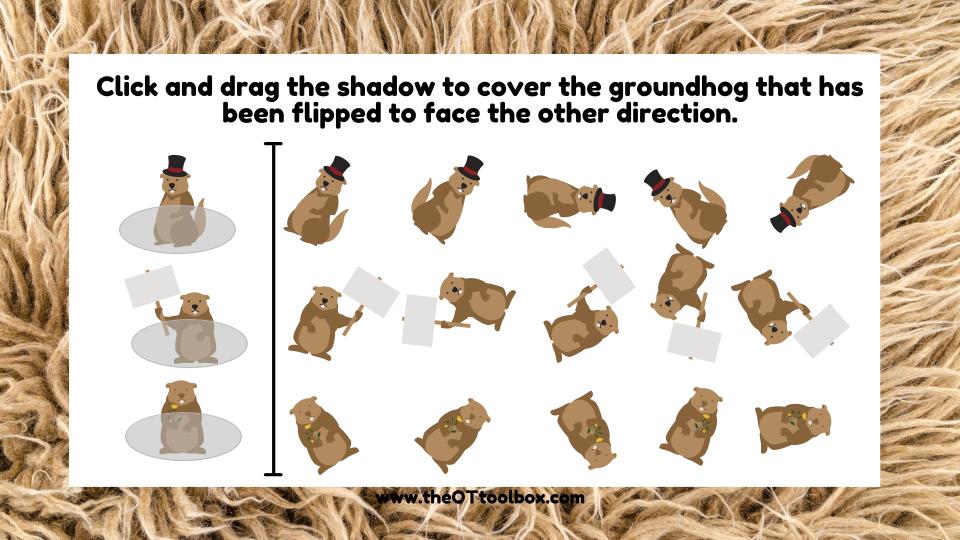
Form constancy- knowing that the images on each slide remain the same no matter what direction they face or if they are turned or flipped is awareness of form constancy. This is an important skill needed for reading and handwriting. Knowing that an object or form is the same no matter how it is positioned, turned, or flipped is an important visual perceptual puzzle that our brains do automatically.

groundhogs day visual perception activity for form constancy

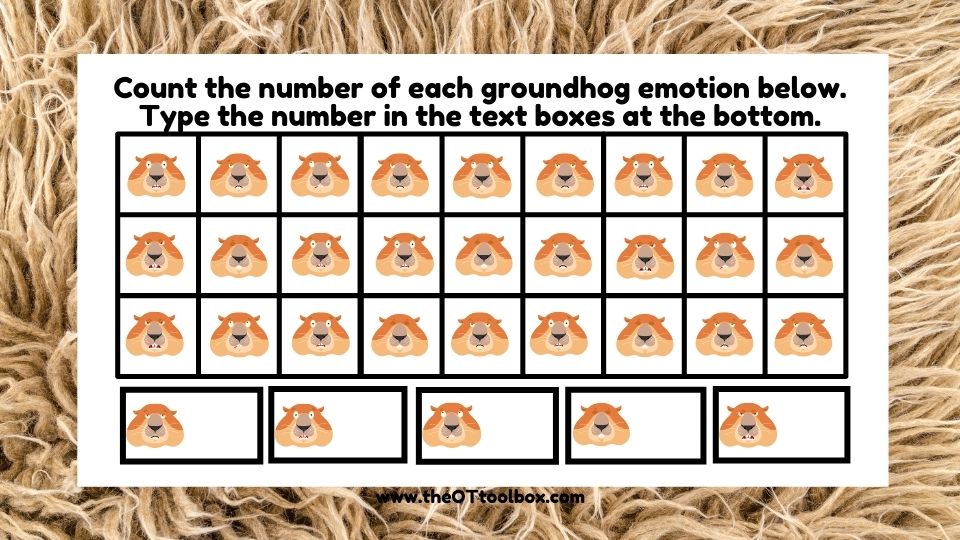
Visual attention- Having visual attention allows us to read and write. Users can work on visual attention by following along with the step-by-step directions and noticing the new parts of the drawing on each slide. They will improve their visual attention by seeking matching images on some of the other slides. This skill works in connection with visual memory.

Use this groundhog's day vision therapy activity to work on visual perception including form constancy, visual attention. and visual memory.

Visual memory- Recalling a visual image and noticing if that image is the same or different is a visual memory skill. This ability is important in reading, writing, and learning.

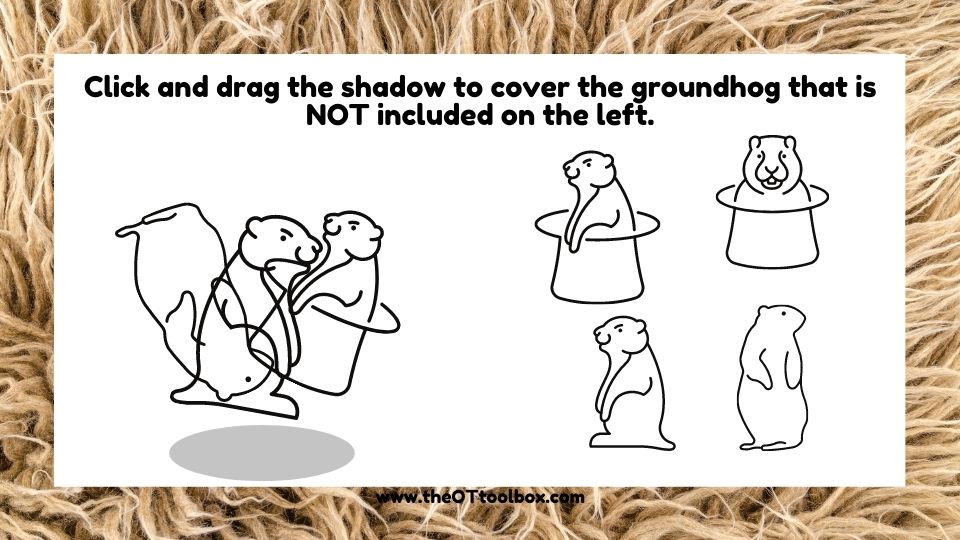
Visual figure ground- Identifying forms that are overlapping or covering one another is a visual figure ground skill. This visual perceptual skill works closely with visual closure. Figure ground abilities allow us to pull out single words in a text or find out place when reading. It’s a functional skill needed in almost every daily task, as we move about our day or locate items we need and use all day long.

visual perception activity for groundhogs day

Groundhog’s Day Visual Motor Integration Activity

To take these visual perceptual skills a step further, there is a picture-copying activity to address visual motor integration. Visual motor integration allows us to use our visual perceptual skills in combination with motor skills.

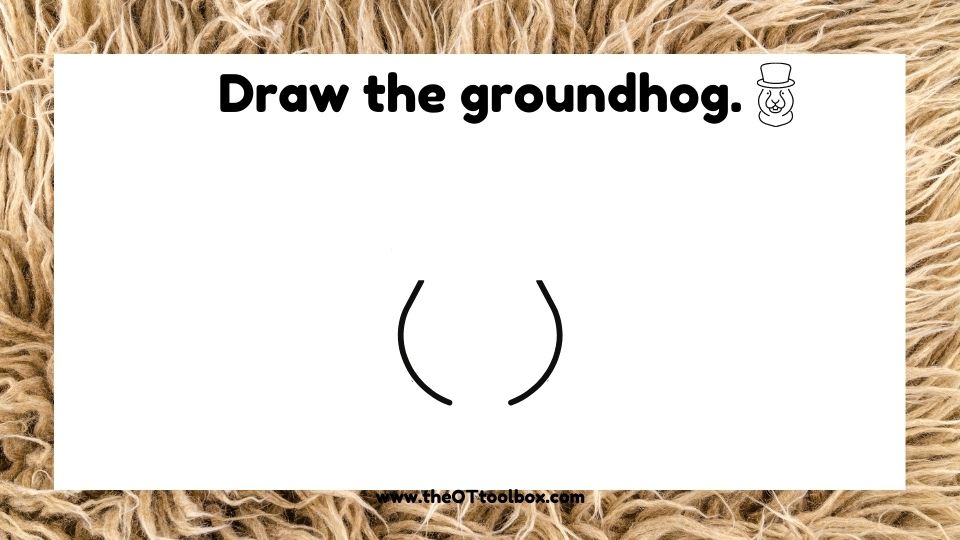
How to draw a groundhog activity

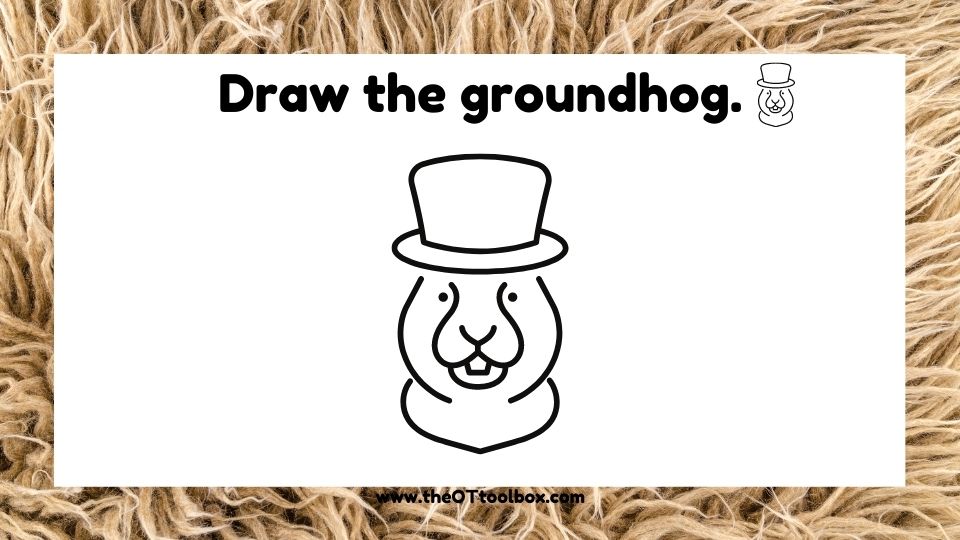
Use this part of the slide deck to work on visual motor skills by copying each part of a groundhog.

Slide users can copy each step of the image to draw a groundhog. I’ve left room on the sides of the slide if this activity is completed in Jamboard.

You can have a student draw right on the screen to copy each individual step with their finger or a stylus.

copy a groundhog activity for how to draw a groundhog

Go through the slides and copy each part of the groundhog picture. Each slide goes through how to draw a groundhog, step by step.

By the end of this part of the vision activity, kids will have drawn a groundhog.

How to draw  a groundhog activity to help with visual motor skills.

Free Vision Activities Slide Deck and Jamboard

Want to add this interactive Google slide deck and Jamboard to your vision therapy toolbox? Enter your email in the form below. You’ll receive a PDF and a link to copy these activities right onto your Google drive.

Be sure to make a copy of this slide deck and not change the url to indicate “edit” at the end. When you make a copy of the slide deck onto your Google drive, you will end up with your own version that you are free to adjust in order to meet your student’s needs. By changing the url to “edit”, you can potentially mess up the original version that many other therapists and The OT Toolbox users are given.

Free Groundhogs Day Vision Therapy Slide Deck

    We respect your privacy. Unsubscribe at anytime.

    Here are more visual perception slide decks you’ll enjoy:

    Back to School Visual Perception Activities

    Animal Theme Visual Perception Slide Deck

    The Football Slide Deck has some vision activities included.

    Here is a Space Theme Therapy Slide Deck.

    Here is a Strait Line Letters Slide Deck.

    Groundhog’s Day Activity

    groundhog's day activities for teletherapy

    This week’s free therapy slide deck has a groundhog theme. Use this as a teletherapy groundhog’s day activity to help kids develop motor skills in virtual therapy sessions. So, if you’re looking for a fun Groundhog’s day idea to do with the kids in a virtual setting, this free Google slide deck is for you! Use this activity along with a groundhog craft for some therapy fun!

    Love this groundhog's day activity for virtual occupational therapy sessions with kids.

    Groundhog’s Day Activity

    This occupational therapy teletherapy activity is designed to help kids with a variety of skill areas: deep breathing/mindful breathing to warm-up and settle into the session, followed by handwriting tasks, visual perceptual activities, and finally a groundhog fine motor activity.

    You can get this free Google slide deck and start using right away, making it a no-prep therapy activity, that requires no other materials other than the child and some paper!

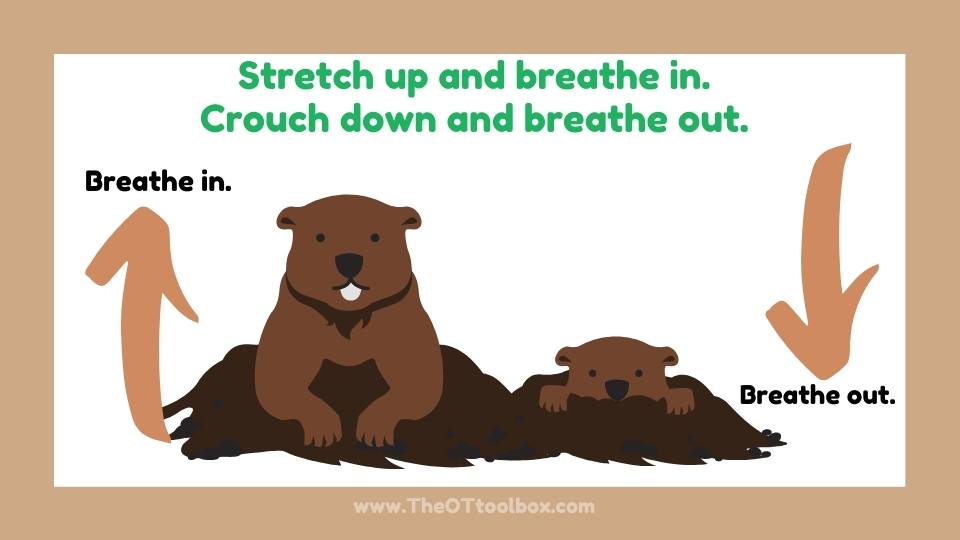
    Start the therapy session with some mindful breathing. Kids can follow the directions of the therapy slide and breathe deeply in and out along with the image on the slide.

    Groundhog’s Day Handwriting Activity

    This handwriting activity is designed as a “write the room” activity for teletherapy sessions. Kids can copy the word or the sentence on the screen (or both) and work on their handwriting goals: letter formation, line awareness, spacing, copying skills, writing speed, and legibility.

    If you use the Jamboard option, kids can write right on the screen to trace the large letters to spell “groundhog”.

    groundhogs day writing prompt

    Groundhog’s Day Fine Vision Activity

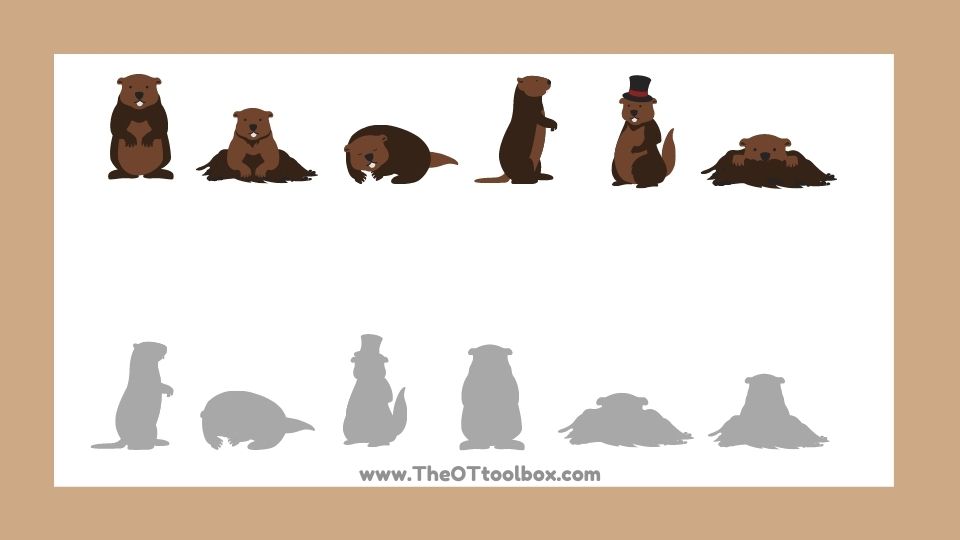
    The next slide in this therapy deck is perfect for this time of year. Kids can match the groundhog images with their matching shadows. It’s a nice eye-hand coordination activity on the interactive slide deck, and can be used as a matching activity to work on line use for younger users if used on the Jamboard option.

    Matching the images to their shadow is an exercise in visual discrimination, form constancy, visual scanning, and visual memory.

    groundhog's day vision puzzle

    Groundhog’s Day Fine Motor Activity

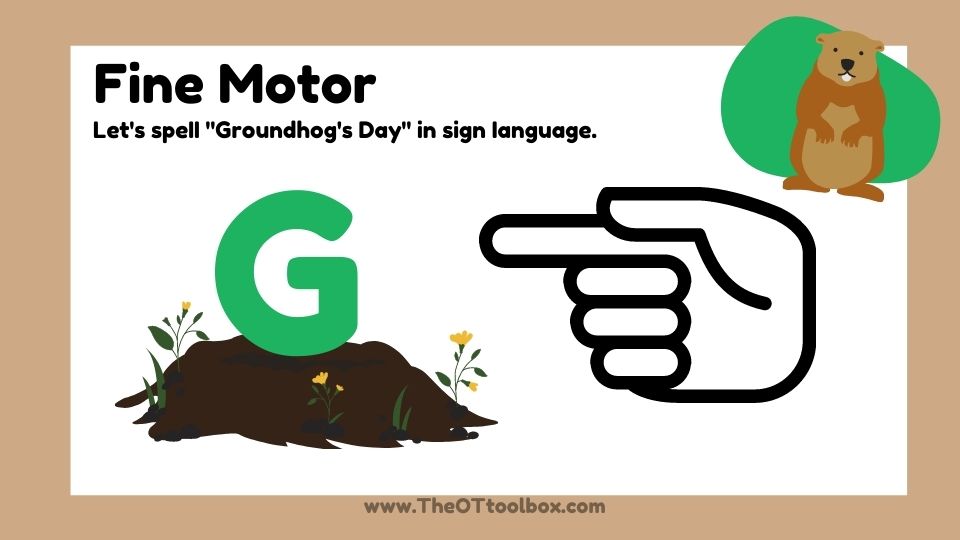
    The next series of slides asks students to spell out “groundhogs day” using sign language. Kids can make the ASL signs for each letter of the word and work on finger isolation, motor planning, dexterity, separation of the sides of the hand, eye-hand coordination, and more.

    groundhog's day fine motor activity

    Groundhog’s Day Self-Regulation Activity

    The therapy slide deck ends with a self-regulation check-in. Students can move the groundhog to the matching color coded check-in system. This pairs well with the Zones of Regulation systems’ color coding, so students can carry through with previously used regulation strategies. This is also a nice time for therapists to work on coping tools as needed for after the therapy session ends and the child carries on with their day.

    groundhog's day deep breathing activity

    Free Therapy Slide Deck

    Want to grab a copy of this free Google slide deck? Just enter your email address in the form below. You should be logged into your Google account before openeing the attachment that arrives to your inbox. Then, you can make a copy right onto your Google drive.

    You’ll also access a link to copy this deck onto your Google Jamboard, so you can use the apps whiteboard feature to write directly on the slides during therapy sessions.

    Colleen Beck, OTR/L has been an occupational therapist since 2000, working in school-based, hand therapy, outpatient peds, EI, and SNF. Colleen created The OT Toolbox to inspire therapists, teachers, and parents with easy and fun tools to help children thrive. Read her story about going from an OT making $3/hour (after paying for kids’ childcare) to a full-time OT resource creator for millions of readers. Want to collaborate? Send an email to contact@theottoolbox.com.
    10 Ways to Support a Child’s Milestone Development at Home!

    Support milestone development in natural environments at home

    Every home is different, but here are some options for you to be able to swiftly encourage milestone development during your normal, everyday life. While they do have their benefits, child growth and development doesn’t require fancy play centers, playgroups, and activity centers. Here you will find easy ways to integrate child milestone development right into the daily family life at home. Here is information on child development to get you started.

    Use these easy ways to support milestone development at home when getting out of the house is difficult.

    If you just read the word “milestones” and still aren’t so sure what that means, you are not alone! You can also pop on over to The Child Mind Institute to learn more about what milestones are.


    You don’t need a bunch of fancy equipment to help your child reach their milestones, even if they show signs of delay. I hope that this list of ideas will spark ideas of your own so that your family’s needs can be met in ways that work for you.

    That is really what the natural environment is all about. Contrary to its name, it isn’t about green trees and blue skies or organic fruits and vegetables. The natural environment is wherever your child spends their time. Often, it is considered their home, but it could be the library, or the park, or grandma’s cabin. The point is that the natural environment is somewhere that is a recognizable, comfortable, and safe place for your child.

    It just so happens that this magical place is where most of their development takes place, and that is why it is so important to use these spaces effectively for the naturally-occurring learning opportunities they provide!

    These strategies to support milestone development can happen in the home.

    How to Support Milestone development at home

    For starters, I would like to kick off this list with a few overarching ideas to support development right in the day-to-day tasks of everyday life at home. There is so much development to be had by involving your child in things that are done in and around the home.


    ONE: PUT THEM TO WORK
    Playing and chores alike help your child reach their developmental milestones. In order to reach fine motor milestones and gross motor milestones, those little muscles need to be challenged!


    TWO: INTEGRATE INTO YOUR LIFE
    If you are doing laundry, your kiddo can help push laundry baskets to develop their gross motor muscles. If you are making pancakes, they can pop little chocolate chips in one by one to work on fine motor skills. Setting aside extra time for your baby’s milestones is not always necessary.


    THREE: SHARE WITH YOUR BABY
    In some ways, treating your infant or toddler to a friendly conversation is all that it takes to give them a little extra boost in communicative and cognitive development. Talk to your baby, share your interests, show them your work. This will strengthen their understanding of your spoken
    language, and encourage them to use their mouths and faces for communication, too!

    5 WAYS TO SUPPORT YOUR CHILD’S MILESTONES IN THE
    NATURAL ENVIRONMENT

    1. Support your child’s Development with family workouts

    Family workouts are a great way to support milestone development and health and wellness of the whole family! Use at-home workouts to ensure that your baby gets in their tummy time (and more!) is to encourage your baby to work out with you. If you lift weights, your mischievous 18-month-old can lift his stuffed animals, books, wooden blocks, or whatever else may be around.

    Or, maybe you are more of a yoga mom, and you and your toddler can work on balancing poses or squats like chair pose or goddess pose. You’ll feel great not only because you got in some exercise time – but also because you are helping your child become stronger!

    2: Support developmental milestones in the kitchen

    Use meal preparation times to your advantage! Cooking with kids in the kitchen offers powerful experiences for child growth and development. If you like to bake, offer your little one some dough to smash and squeeze between their fingers. Their blossoming fine motor skills, like handwriting, will thank you.

    Baking is often rich in sensory experiences as well; the smells, the
    textures, the tastes! Sensory-rich experiences like these are integral to the healthy development of the sensory system.

    There’s more; cooking offers opportunities to develop direction-following and other cognitive development as well.

    The next time your game-day guacamole needs smashing, you’ll know who to call.

    3: Support motor skill development with chores

    We know how much of your days are filled with laundry. It feels like it’s a never-ending cycle (no pun intended). Why not recruit some help? Your little one can help you out at their level. If they are able to distinguish between colors and reach, grab, and place objects, then they can
    separate your whites from your colors. Maybe that is a bit too advanced: instead, they can take your sorted piles and throw them in the washing machine. When you’re done, have them push, pull, drag, carry – whatever they can manage – that laundry basket to its destination.


    This strengthens so many skills. We’re talking fine motor, gross motor, cognitive, and sequencing skills. Plus, you can make something as dull as laundry day a bit more interesting.

    4: Promote child development with day-to-day tasks

    Supporting cognitive milestones can be done right in the home. Anytime you need to get some grown-up desk work done, your child can do their work, too! Offer them a pencil and paper – I am sure they would love it if they got to use something from your work bag – and let them get to it! Now they are kept busy so that you can have a few
    moments to complete your schedule, email your colleagues, or document your tasks that week.

    Allowing them the opportunity to use various writing utensils, instead of just one kind of chunky crayon, gives their little hands and fingers a challenge.

    Strengthening their grasp will improve handwriting outcomes as well as things like dressing ability (hello, buttons and zippers!) and independent skills in achieving feeding developmental milestones. Not to mention the visual motor development that coloring can offer.

    5. Support child development with downtime

    Some days, all you can do is keep everyone alive. Maybe it’s putting on some Bee Gees and dancing to their classic hits because if you didn’t, mental breakdowns would ensue.

    Dancing is great for growing bodies! Or maybe you just need time away inside of a good book, and your baby can cuddle your chest while you read. They can also peruse a book of their own while you take your escape. No matter their age or abilities, don’t overwhelm yourself, do what you need to do to keep your family safe and happy.

    Looking for more? Click here to learn more about occupational therapy for babies!

    For more ideas on milestone development and child development, head over here to get ideas for play based on your child’s age.

    References

    1. Woods, J. (2008). Providing early intervention services in natural environments. The ASHA
      Leader, 13(4). https://doi.org/10.1044/leader.FTR2.13042008.14
    2. Butcher, K. & Pletcher, J. (2016, December). Cognitive development and sensory play. Michigan State University Extension. https://www.canr.msu.edu/news/cognitive_development_and_sensory_play
    3. The Center for Vision Development. (2020). Visual motor integration.
      https://www.thecenterforvision.com/visual-motor-integration/

    Sydney Thorson, OTR/L, is a new occupational therapist working in school-based therapy. Her
    background is in Human Development and Family Studies, and she is passionate about
    providing individualized and meaningful treatment for each child and their family. Sydney is also
    a children’s author and illustrator and is always working on new and exciting projects.

    Write the Room Pencil Theme

    Write the room handwriting activity

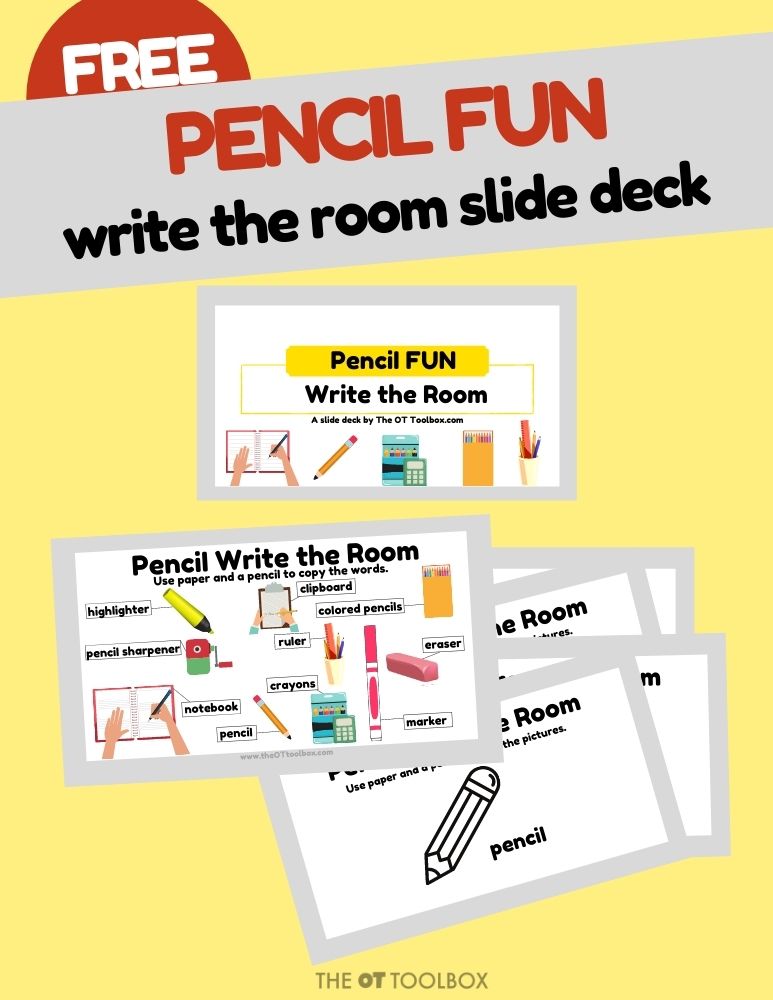
    Working on handwriting? What about pencil grasp? Today, I have a fun companion to make working on these skills more fun. This write the room activity has a pencil theme and it works perfectly with some other pencil themed activities recently released here on the site: Pencil Theme Deep Breathing Exercise and our Virtual I Spy pencil theme activity.

    Write the room with a pencil theme for virtual handwriting activities.

    What is Write the Room?

    Write the Room activities are just that: a handwriting exercise in copying and writing words that are posted around the room. Typically, students walk around the room and find matching images and words. They then copy those words onto paper.

    There are several skills that kids strengthen with room writing handwriting activities:

    • Visual attention
    • Visual shift
    • Visual memory
    • Visual discrimination
    • Visual scanning
    • Copying from a distant point

    These skills translate into handwriting when copying information from a far point, which can be difficult for kids to do.

    With Write the Room activities, kids can strengthen these skills with a focus on handwriting.

    Virtual Write the Room

    More kids are in hybrid learning or virtual learning situations right now, so typical handwriting activities can be difficult to use for the activity’s benefits.

    That’s where this virtual write the room activity comes in. Use the free Google slide deck or the Google Jamboard option as a virtual option.

    While kids can’t walk around and write, or visually scan a room to copy the words, they can use the words scattered on the slide decks.

    And, to make this a challenge, I’ve created a Draw the Room option as well. Kids can copy the simple forms to work on copying from a near or far point. Just move the screen further away for a distance copying task.

    Copying forms is a great visual motor activity that is needed for the skill of handwriting and forming letters.

    This virtual write the room activity is also available on Google Jamboard. Students can write write on the Jamboard whiteboard option using their finger or stylus to simulate handwriting and letter formation as well as drawing and copying skills. Using the Jamboard option is a great way to see how the student is forming letters when they write it directly on the screen.

    Free Write the Room Activity

    Want to add this handwriting activity to your therapy toolbox? Enter your email into the form below. You will receive an email with a PDF to access the Google slide deck AND a link to the Jamboard option.

    NOTE: Please do not change the urls. Please make a COPY of these files onto your Google drive, when prompted.

    Free Write the Room Slide Deck

      We respect your privacy. Unsubscribe at anytime.
      winter fine motor kit

      For more handwriting activities, be sure to grab our Winter Fine Motor Kit. Loaded with tons of fine motor and handwriting activities, this printable packet has pages of winter themed write the room options, including all lowercase letters, all uppercase letters, and cursive handwriting.

      Click here to get your copy of the Winter Fine Motor Kit.

      JOIN THE PENCIL GRASP CHALLENGE!

      Want to know how to fix a problem with pencil grasps? Need help knowing where to start when it comes to immature pencil grasps or a child hating to write because their hand hurts? The Pencil Grasp Challenge in open for you! In this free, 5 day email series, you’ll gain information, resources, specific activities designed to promote a functional, efficient pencil grasp.

      The pencil grasp challenge is a free, 5 day mini course and challenge. During the course of five days, I’ll be teaching everything you need to know about the skills that make up a functional pencil grasp. You’ll learn what’s going on behind the inefficient and just plain terrible pencil grasps you see everyday in the classroom, clinic, or home. Along with loads of information, you’ll gain quick, daily activities that you can do today with a kiddo you know and love. These are easy activities that use items you probably already have in your home right now.

      Are you in??

      Besides learning and gaining a handful (pun intended) of fun ideas to make quick wins in pencil grasp work, you’ll gain:

      • 5 days of information related to pencil grasp, so you know how to help kids fix an immature pencil grasp.
      • Specific activities designed to build a functional pencil grasp.
      • Free printable handouts that you can use to share with your team or with a parent/fellow teachers.
      • You’ll get access to printable challenge sheets, and a few other fun surprises.
      • And, possibly the best of all, you’ll get access to a secret challengers Facebook group, where you can share wins, chat about all things pencil grasp, and join a community of other therapists, parents and teachers working on pencil grasp issues.

      Click here to join the Pencil Grasp Challenge.

      free pencil grasp challenge

      Colleen Beck, OTR/L has been an occupational therapist since 2000, working in school-based, hand therapy, outpatient peds, EI, and SNF. Colleen created The OT Toolbox to inspire therapists, teachers, and parents with easy and fun tools to help children thrive. Read her story about going from an OT making $3/hour (after paying for kids’ childcare) to a full-time OT resource creator for millions of readers. Want to collaborate? Send an email to contact@theottoolbox.com.
      Pencil theme deep breathing

      Today, I’m continuing with our pencil theme with another deep breathing exercise. This pencil themed breathing activity is a fun way to incorporate mindfulness or self-regulation strategies into a therapy theme. In occupational therapy interventions, OTs often times work with kids on the occupation of handwriting. It’s a necessary “job” of students and an important part of a child’s participation in education. I think the OTs out there will appreciate this pencil deep breathing activity in therapy sessions!

      Pencil Theme Deep Breathing Exercise

      This deep breathing exercise goes well with other deep breathing exercises we’ve shared here on the site. Here is information on breath control, including deep breathing exercises. You’ll find information on deep breathing as a coping strategy impacts self-regulation as well as achieving that alert-calm state that enables us to focus and attend.

      In the classroom, this is so important!

      Want to add this pencil deep breathing activity to your therapy toolbox? Enter your email into the form below and the PDF will be mailed to your inbox.

      You can also direct your students to this blog post and pull up the image below. Kids can follow the arrows in the image below. Then, they can use a pencil with the same deep breathing strategies no matter where they are.

      Pencil theme deep breathing exercise.

      Free Polar Bear Theme Deep Breathing Exercise

        We respect your privacy. Unsubscribe at anytime.

        Here are more deep breathing/mindfulness resources you will love:

        Join the pencil grasp challenge!

        Want to know how to fix a problem with pencil grasps? Need help knowing where to start when it comes to immature pencil grasps or a child hating to write because their hand hurts? The Pencil Grasp Challenge in open for you! In this free, 5 day email series, you’ll gain information, resources, specific activities designed to promote a functional, efficient pencil grasp.

        The pencil grasp challenge is a free, 5 day mini course and challenge. During the course of five days, I’ll be teaching everything you need to know about the skills that make up a functional pencil grasp. You’ll learn what’s going on behind the inefficient and just plain terrible pencil grasps you see everyday in the classroom, clinic, or home. Along with loads of information, you’ll gain quick, daily activities that you can do today with a kiddo you know and love. These are easy activities that use items you probably already have in your home right now.

        Are you in??

        Besides learning and gaining a handful (pun intended) of fun ideas to make quick wins in pencil grasp work, you’ll gain:

        • 5 days of information related to pencil grasp, so you know how to help kids fix an immature pencil grasp.
        • Specific activities designed to build a functional pencil grasp.
        • Free printable handouts that you can use to share with your team or with a parent/fellow teachers.
        • You’ll get access to printable challenge sheets, and a few other fun surprises.
        • And, possibly the best of all, you’ll get access to a secret challengers Facebook group, where you can share wins, chat about all things pencil grasp, and join a community of other therapists, parents and teachers working on pencil grasp issues.

        Click here to join the Pencil Grasp Challenge.

        free pencil grasp challenge

        Colleen Beck, OTR/L has been an occupational therapist since 2000, working in school-based, hand therapy, outpatient peds, EI, and SNF. Colleen created The OT Toolbox to inspire therapists, teachers, and parents with easy and fun tools to help children thrive. Read her story about going from an OT making $3/hour (after paying for kids’ childcare) to a full-time OT resource creator for millions of readers. Want to collaborate? Send an email to contact@theottoolbox.com.
        Pencil I Spy Game

        virtual I Spy game for teletherapy

        With online learning, virtual games and activities are the way to go. This virtual I Spy game is a fun way to easily work on visual perceptual skills when in the virtual classroom or virtual therapy format. Use the virtual game to work on skills such as visual attention, visual memory, form constancy and visual discrimination. This one is a free slide deck for teletherapy, and it has a pencil theme, so it’s a nice activity for a fun activity that’s a little different than the normal pencil and paper work.

        Pencil I Spy

        I love this Pencil I Spy activity to go along with our pencil craft! Use them both together in a therapy session to target a variety of skills.

        This is one of our free therapy slides but you can print off the pages from the Google slide deck.

        Other I Spy activities we have on the site include:

        Virtual I Spy game with a pencil theme.

        Virtual I Spy Game

        This virtual I Spy game is a Google slide deck. You can enter your email address in the form below to add this slide deck to your Google drive. From there, your students can work through the slides and students can locate the items on the slides. They can then type right onto the slide deck with the number of each item that they find.

        Or, you can use the image below and pull this webpage up as a visual for completing this virtual I Spy Game.

        If you use this activity in therapy, in the classroom, or at home, you can use it as a warm-up activity. Then, children can work on visual motor skills with the pencil theme:

        • Ask them to copy the images and draw each shape.
        • Work on number formation by writing the numbers of each item they find.
        • Work on handwriting by asking students to write a sentence or word related to each image on the slide deck.
        Virtual I Spy game with a pencil theme

        I Spy Jamboard

        Now, you can use this slide on Google’s Jamboard white board app. When you enter your email below, you’ll receive an email with a link to access the slide deck, AND a link to access this slide on Jamboard.

        Students can “write” right on the Jamboard with their finger or stylus. They can then work on number formation. This is also a great option for students that need visual prompting. Use the highlighter or pen options to mark off images that they’ve already found.

        Free I Spy Game for Virtual Therapy

        Want to get these resources? Enter your email in the form below.

        FREE Virtual I Spy Game- Pencil Theme!

          We respect your privacy. Unsubscribe at anytime.

          free pencil grasp challenge

          JOIN THE PENCIL GRASP CHALLENGE!

          Want to know how to fix a problem with pencil grasps? Need help knowing where to start when it comes to immature pencil grasps or a child hating to write because their hand hurts? The Pencil Grasp Challenge in open for you! In this free, 5 day email series, you’ll gain information, resources, specific activities designed to promote a functional, efficient pencil grasp.

          The pencil grasp challenge is a free, 5 day mini course and challenge. During the course of five days, I’ll be teaching everything you need to know about the skills that make up a functional pencil grasp. You’ll learn what’s going on behind the inefficient and just plain terrible pencil grasps you see everyday in the classroom, clinic, or home. Along with loads of information, you’ll gain quick, daily activities that you can do today with a kiddo you know and love. These are easy activities that use items you probably already have in your home right now.

          Besides learning and gaining a handful (pun intended) of fun ideas to make quick wins in pencil grasp work, you’ll gain:

          • 5 days of information related to pencil grasp, so you know how to help kids fix an immature pencil grasp.
          • Specific activities designed to build a functional pencil grasp.
          • Free printable handouts that you can use to share with your team or with a parent/fellow teachers.
          • You’ll get access to printable challenge sheets, and a few other fun surprises.
          • And, possibly the best of all, you’ll get access to a secret challengers Facebook group, where you can share wins, chat about all things pencil grasp, and join a community of other therapists, parents and teachers working on pencil grasp issues.

          Click here to join the Pencil Grasp Challenge.

          Colleen Beck, OTR/L has been an occupational therapist since 2000, working in school-based, hand therapy, outpatient peds, EI, and SNF. Colleen created The OT Toolbox to inspire therapists, teachers, and parents with easy and fun tools to help children thrive. Read her story about going from an OT making $3/hour (after paying for kids’ childcare) to a full-time OT resource creator for millions of readers. Want to collaborate? Send an email to contact@theottoolbox.com.
          Breath Control

          breath control

          In this blog post, you’ll learn about breath control as a coping tool. By consciously breathing using deep breaths and engaging the diaphragm, controlled breathing is a strategy for regulation and helping kids reach a calm and alert state so they can focus. Let’s discuss breath control and deep breathing as a tool for children!

          Breath control strategies for children to use deep breathing as a self regulation strategy.

          As an occupational therapist working with children, there have been many times that I have told myself to ‘Just Breathe’. It’s always been something that has helped me to center myself and helped me to deal calmly with the situation at hand. Despite gathering a fair amount of experience over the past 20 years I found myself using this phrase more than ever before as we were all thrown into a whole new pandemic world
          last year. And it helped me on a number of levels.

          I started talking to the children that I work with about breathing and I started incorporating breathing exercises into our therapy sessions. This wasn’t entirely new but somehow it took on a new meaning while facing so many changes and so much uncertainty. And the kids LOVED it. What a simple effective way to help calm and focus children (and adults!) Just breathe!

          What is Breath Control?

          Before we explored how to breathe I chatted to my young clients about why it is important to breathe. Apart from the obvious (we need to stay alive!) we spoke about how breathing can help you feel calmer, can help you focus and concentrate and can help you prepare for a challenge or new activity.

          Breath control uses conscious breathing, or an awareness of using deep breaths as a strategy for regulation. Engaging the diaphragm for full, “belly breaths” allow for controlled breathing and is helpful in allowing children to reach a calm and alert state so they can focus.

          Breathing exercises have been shown to activate the parasympathetic nervous system which tones down the bodies fight or flight response to stress. In the therapy setting it is essential for clients to be in a calm-alert state in order for therapy to be effective. Deep breathing, mindful breathing , and deep breathing exercises help to achieve this state.

          Breath Control for Kids

          I found that clients from the age of five years were able to engage in these conversations about breathing and feeling calm. Therapists, teachers and parents can use this as an opportunity to connect with children and can use breathing exercises to begin to understand how to help children with self-regulation. Read more about additional information on the benefits of breathing in children. For research on the benefits of deep breathing as a self-regulation strategy, check out this Clover Deep Breathing Activity.


          How to improve breath control


          Once we had covered the importance of breathing we started to look at how we should breathe if we wanted to reap the benefits of this self-regulation tool.

          The challenge was to encourage children to slow down when they engaged in this activity! Not an easy task when the majority of my caseload are little bundles of energy who do things at 100 miles an hour.

          But we worked on it and practiced together discovering that it was really important to to fill your lungs up when you breathe in and empty them out when you breathe out.

          We also practiced breathing in through our nose and out through our mouth.

          Breath Control Analogies

          It was helpful to give few different analogies and use illustrations while we were developing our breathing technique. Try these strategies for breath control:

          Breathe like you are inflating and deflating balloons.

          Breathe like you are smelling flowers and blowing dandelions.

          Breathe like you are buzzing bees.

          Try Take Five Breathing and use your hand as a prompt take five deep breaths.

          Pumpkin Deep Breathing Activity

          Clover Deep Breathing Exercise

          Snowman Deep Breathing Activity

          Penguin Deep Breathing Exercise

          Polar Bear Deep Breathing Exercise

          Football Theme Deep Breathing

          Each child seemed to find technique that they were comfortable with and breathing exercises became one of warm up activities at the beginning of each session.

          We added this to our breathing exercises toolbox and the box continues to grow as the children make up their own breathing activities or as I come across more breathing resources online.


          Breath Control Anywhere

          The beauty of breathing exercises is that you can breathe anywhere! No special equipment or apparatus needed.

          With practice and encouragement children can incorporate these simple exercises into their everyday lives e.g. before they do homework, before an event they perceive as stressful, before bedtime.

          As adults we can model the use of breathing exercises and reap the rewards from them as well.

          Tips for breath control


          Tips for Breath Control

          Use these tips to teach breath control to help with controlled breathing, full breath intake, and diaphragmic breathing.

          • Explain why controlled breathing is important.
          • Breathe slowly.
          • Fill your lungs up and empty them out.
          • Breathe in through your nose and out through your mouth.
          • Use illustrations and visual cues.
          • Practice together and encourage children to use the breathing exercises on their own.


          I know that if you make breathing exercises part of your child’s daily routine you will see improvements in their focus and attention and improvements in their ability to self-regulate. So go for it and just breathe.