Colleen Beck, OTR/L is a pediatric occupational therapist and the owner and author of The OT Toolbox website. She manages all of The OT Toolbox social media accounts and runs the popular newsletter.
Read about Colleen's experience and career as an occupational therapist, including how The OT Toolbox began on our About The OT Toolbox page: https://www.theottoolbox.com/about-us/
Colleen created The OT Toolbox in 2011 and since then has written thousands of blog posts designed to support therapy providers, educators, parents, counselors, admin, and caregivers in promoting the healthy development of kids.
Check out Colleen's blog posts below:
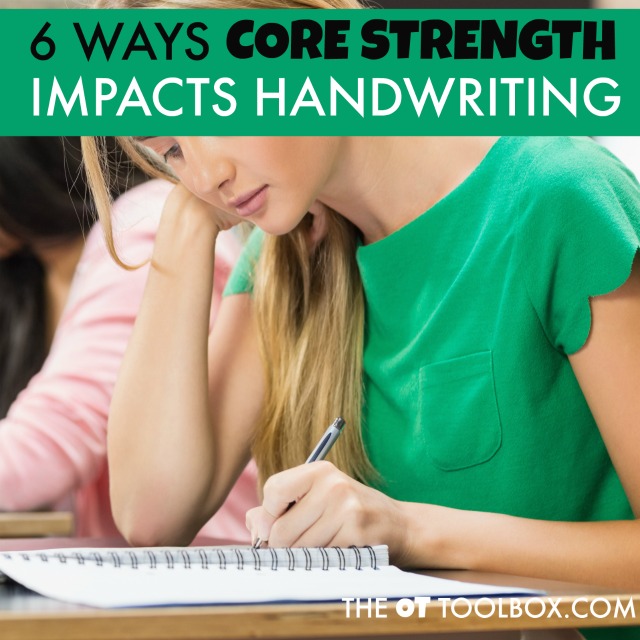
When a child sits down to write at a desk, it can be easy for everything to go awry and messy, illegible handwriting to result. It might be poor carryover of handwriting skills, difficulty with letter formation, visual motor skills that are not up to par, or weak fine motor skills and pencil grasp struggles. The issue with sloppy handwriting is that there is a LOT going on! One tip to check as soon as a child sits down to write, is their posture. Everything from head positioning and visual view of the writing space to positioning of the arm and hand on the paper stems from the midline and base of support. Because of this, I wanted to share ways that core strength impacts handwriting.
Core Strength and Handwriting
The child with weak core strength may have sloppy handwriting that just can’t be fixed. Band-aides of pencil grips, specialty lined paper, and handwriting modifications can help improve written work, but when a weak core is holding up the child, the handwriting struggles will never be fully fixed.
It is so important to start with the midline and base of support when it comes to handwriting. That proximal beginning of assessing the child can make a world of difference with just a few adjustments in posture and strengthening.
When there are handwriting problems, there are underlying issues that cause them. Core strength is a big cause of handwriting struggles.
Here are 6 ways that core strength impacts handwriting legibility and neatness:
1) When a child has a weak core, they may tend to sit with a modified base of support. They might slump over at their desk and lean on their elbows. You might see a slouched back, knees and legs sticking out between the rows of desks. You might see kids who are slumped over their papers or are leaning on one hand as they write. You might see the child lying forward on an extended arm that reaches over the front of their desk. An inefficient posture can lead to poor handwriting. Read more about a 90/90/90 posture and how to promote that posture using cue cards.
2) Classroom teachers will say they often times see students who are not active and alert during school tasks. A weak core can transition to inattention and inability to focus on learning or handwriting tasks. A core strengthening plan can help this problem.
3) When the core is not engaged, the child’s non-dominant hand can not support the paper. When this happens, the paper isn’t stabilized and legibility can suffer. Coordinating both hands together with an engaged midsection requires a strong core. Read here about tricks for holding the paper when writing.
4) A weak core can lead to a child who can’t engage their muscles over a period of time. This looks like a child who wiggles, moves in their seats, jumps up, and slouches. With all of that wiggling and moving, handwriting can suffer!
5) Copying a list of words from a smartboard, book, or homework assignment center across the classroom or desk requires visual shift and the ability to quickly scan using visual perceptual skills. When a child who has weak core tries to copy a list or sentences, they might present with a slouched upper back and neck over their desk. Looking up and back down again can be really difficult for these students with the repeated flexion and extension of the neck. This can result in skipped words, letters, and phrases as well as poor margin use, line awareness, and spatial awareness when writing and copying written work.
6) A weak core leads to weak fine motor skills distally. The engaged and strong muscles of the abdomen and upper body allow for strength and engagement of the upper arm, and in turn leads to dexterity and motor control of the hands. When the core is weak the hands can not effectively do their job to hold the pencil and manage tasks such as in-hand manipulation.
What should you do when weak core muscles impact handwriting?
Strengthening the core can have a HUGE impact in handwriting!
Use the strategies and tips to give kids the strong core foundation they need to improve handwriting.
As kids, we used to hop from couch to couch and make a flying leap across the living room to the corner chair. We would hop from one surface to another with one thing on our minds…
The living room floor had turned into boiling hot lava!
When my kids started hopping around from pillow to pillow and landing with a roll onto the couch with claims of the floor turning to lava, I had to smile.
The Floor is Lava is Back!
What is so cool about the floor being lava (besides the nostalgic sentiments from parents?) A great game of The Floor is Lava has some major motor movements and sensory play components!
From jumping, leaping, hopping, rolling, and crashing, The Floor is Lava is a fun and creative way to encourage movement and sensory motor play, both indoors and out!
The Floor is Lava Games
Here are some fun ways to use The Floor is Lava Games to promote sensory input and motor movements:
Place pillows and couch cushions on the floor. Kids can hop from pillow to pillow on one foot or two. Move the pillows further and further apart to promote movement coordination and motor planning. Don’t touch the carpet, it’s lava!
Place paper plates in a line on the floor. Use them as a balance beam to address vestibular sensory input. Hop from plate to plate without touching the ground, it’s burning up!
Play a stop and go game that promotes auditory processing skills like auditory figure-ground discrimination. Call out, “The floor is lava!” and everyone has to hop off the ground onto something besides the hot, hot ground!
Use boxes like milk crates, stools, or dining room chairs to add height components to The Floor is Lava game.
Add a learning component by asking kids questions when they land on a safe space. Think about incorporating spelling words, math facts, or memorization facts.
Play The Floor is Lava at the playground to add vestibular sensory components to the game. Don’t touch the ground, it’s hot! Read more about the sensory benefits of the playground.
Make a Safe Island when playing a lava game. Use a hula hoop and all kids can hop in the hoop to stay safe from that burning hot lava. Don’t hop out of the other side of the hoop to stay safe and to work on motor control.
Develop Skills While Playing The Floor is Lava
When playing these lava games, kids are developing and building so many skills!
Gross motor coordination
Core strength
Eye-body coordination
Visual motor skills
Motor planning
Balance
Attention
Vestibular sensory tolerance
Proprioceptive sensory tolerance
Impulse control
Do your kids play The Floor is Lava? Did you play as a child? Introduce your kids to some of these versions of the lava game and boost movement and development skills at the same time!
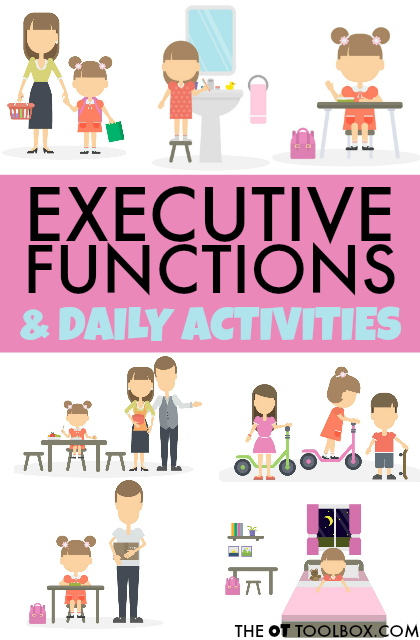
For kids who struggle with executive functioning skills, there are parts of the day that require more intentional focus in order to successfully progress through the day. Identifying high-stress or high-processing times during the day can help parents, teachers, and therapists come up with a plan of action for executive functioning skills and kids’ daily activities.
Executive Functioning Skills and Kids Daily Activities
These are times of the day that involve multiple executive functions or periods of transition:
Morning routines
Mealtimes
Transitions to the car or school bus
Start of the school Day
After school at home
Homework
Evening routine
After school activities
Bedtime routines
Social experiences (parties, play groups, group activities)
Community interactions (library, shopping, meals out in a restaurant)
Church
During these periods of the day, it can become overwhelming for the child who struggles with executive function skills, particularly if the child is also challenged with sensory processing difficulties, attention or hyperactivity, or communication challenges.
So why are these transition periods a high target period for inefficient use of executive functions? There are a few theories to consider:
1.) Executive functioning depends on the frontal lobes of the brain. These high-stress times of the day may be impacted by a busy environment, multiple tasks that need to be completed, and other frontal lobe tasks such as judgment, abstract reasoning, planning, and other thinking functions, management of body movement (motor function), emotions, attention, or motivation.
2.) Each of these high-executive function periods of the day require multiple actions of the body and brain. There are many tasks that make up the period of before-school routines, for example. Each of those tasks can throw a child off task and interfere with getting out the door on time, with a jacket, lunchbox, homework, school supplies, notes for the teacher, snack, and whatever else is needed for a typical school day. A lot of steps with a lot of opportunities for impulsive actions can derail progression of steps to get a job done.
3.) Within the main areas of executive functioning are many smaller scaled steps that go into every task and particularly tasks that include several steps and processing, prioritization of steps:
a. Forming ideas to do an action.
b. Starting an action.
c. Maintaining an action until the step is finished (knowing when a step is done).
d. Switching behaviors to do the next step needed.
e. Regulating, controlling, and adjusting body actions to deal with changes and new information along the way.
f. Planning a tactic down the road to deal with a new issue or new direction.
g. Holding details in the working memory.
h. Controlling emotions.
i. Thinking abstractly.
j. Knowing when the whole task is finished, stopping that task, and moving onto a different task or activity.
4.) It’s possible that time of day can have an impact on an individual’s ability to process tasks. Difficult tasks might be easier for some to accomplish earlier in the day when we are at optimal attention and focus and not fatigued.
When executive function skills interfere with so many parts of the day, it can be overwhelming for a child! As a result, behaviors, or meltdowns can result.
So what to do about about children who struggle with task initiation, task completion, working memory during these high stress-low executive functioning skill times of the day?
Fall back on proven executive functioning skill strategies that help. Each child will be different in what works for them, so identifying tools that work are key.
Here are a few additional strategies to help with executive function skills.
References:
Bennett, C. L. (2008). Individual differences in the influence of time of day on executive functions. Am J Psychol. 121(3):349-61. https://www.ncbi.nlm.nih.gov/pubmed/18792714
Doty, L. (2012). Executive Function & Memory/Cognition Changes. Retrieved from http://alzonline.phhp.ufl.edu/en/reading/executivefxlatest.pdf.
Colleen Beck, OTR/L has been an occupational therapist since 2000, working in school-based, hand therapy, outpatient peds, EI, and SNF. Colleen created The OT Toolbox to inspire therapists, teachers, and parents with easy and fun tools to help children thrive. Read her story about going from an OT making $3/hour (after paying for kids’ childcare) to a full-time OT resource creator for millions of readers. Want to collaborate? Send an email to contact@theottoolbox.com.
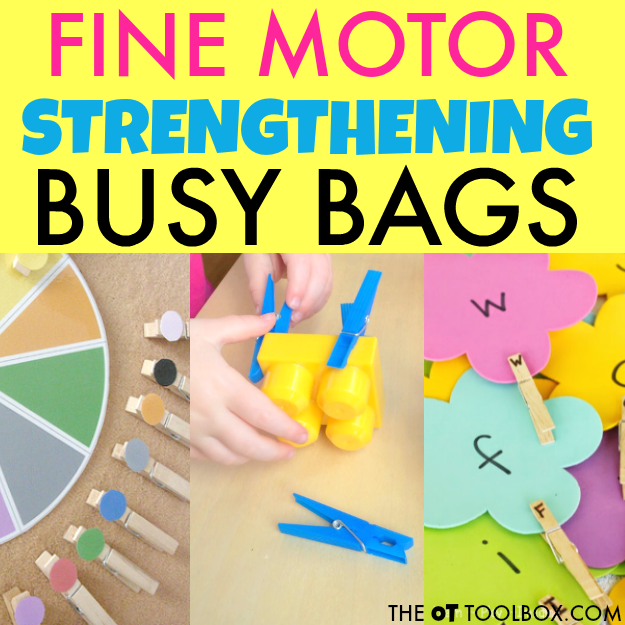
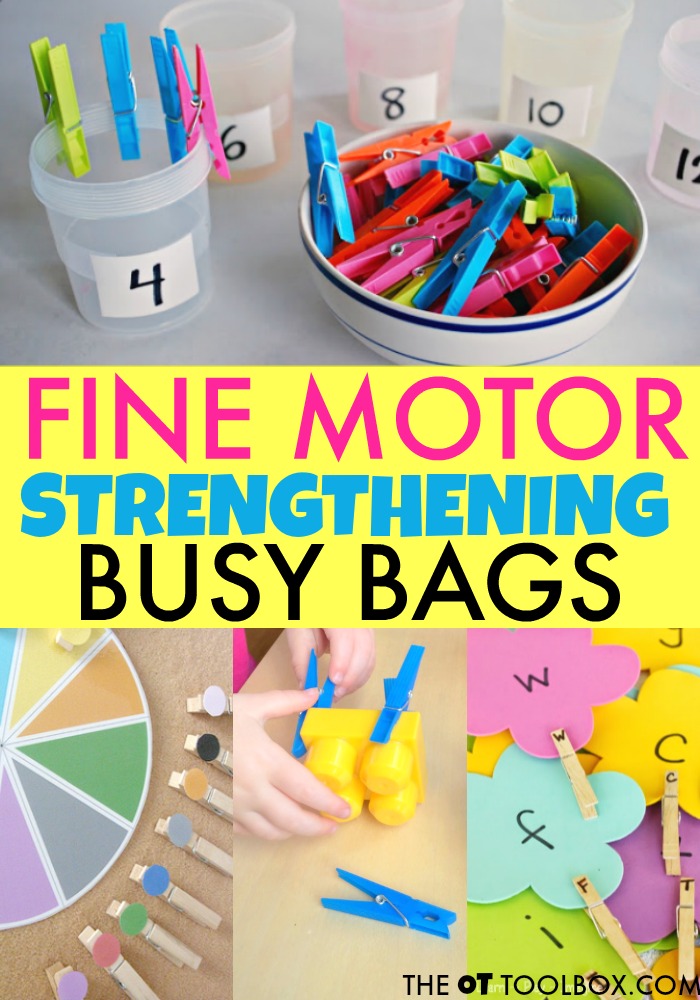
This clothespin busy bag is a clothespin occupational therapy activity that we’ve had on our site for a long time (originally written June 19, 2017). We love to use busy bag activities in therapy to work on a variety of skill areas.
When kids struggle with weak fine motor skills, they can have difficulty in so many areas! This post includes ideas for using clothespins and busy bags to improve fine motor strength. We love using clothes pin activities for fun and engaging finger strength exercises.
Clothespin Busy Bag
Developing hand strength is an important skill for kids who struggle with manipulation of small items like buttons or zippers. A child who struggles with handwriting can many times present with weak hand strength.
Trouble maintaining a pencil grasp, very light handwriting, pencil pressure, switching hands when coloring or writing, using the whole arm to write, a closed thumb web space, and a distorted grip on the pencil are signs of weakness in the hands.
But the trouble with working on improving hand strength is that many times, kids just don’t want to correct their pencil grasp or work on tasks that are hard to do like practicing zippers over and over again.
One simple strategy to fix these strength issues is making the work fun. Here are creative ways to use clothespins to improve fine motor hand strength.
Putting the activities together in a busy bag form can be helpful for therapists who need to quickly pull a strengthening activity from their therapy bag. The fine motor busy bags below can be passed on to teachers to encourage development of fine motor strength in the classroom and at home.
These fine motor strengthening activities are busy bag ideas that can be used in therapy home programs or as part of fine motor activities that the whole class can benefit from!
Clothespin Busy Bags Fine Motor Strength Activities
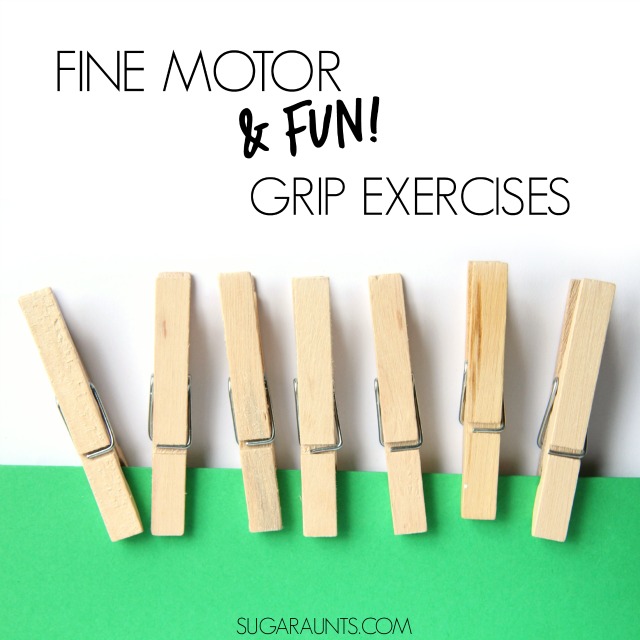
We talked before about the fine motor strength benefits of clothes pins. There are SO many ways to develop the specific grips needed for functional tasks using clothes pins. Work on lateral pinch, tip to tip pinch, three jaw chuck using clothes pins. Read more about the different pinch grips and how clothes pins help with strengthening by clicking the link above or this image:
These fine motor strength activities use clothes pins. Clothes pins are something that you can grab at the dollar store and easily adapt to activities of all sorts. Make a busy bag that builds on learning concepts like math, literacy, colors, or patterns with activities that can be done over and over again in a busy bag!
Try these clothespin busy bag activities to strengthen the hands:
This Math Clothes Pin Activity by Beauty in the Mess works on math skills while strengthening the hand muscles.
Attach spiny plates to a stegosaurus using clothespins in this Clothespin Stegosaurus by No Time for Flashcards.
Match colors on a printable color wheel while strengthening the hand muscles with this printable color wheel by Frau Liebe.
Work on place value with a 1-100 math activity that uses the muscles of the hands in a superhero hand strengthening activity.
Match colored clothes pins to colored Mega Blocks in this color matching activity by LalyMom.
Match colors with a neat pincer grasp using very small clothes pins in this super fine motor busy bag.
Address letter recognition while building fine motor strength in a busy bag using letters like Learn Play Imagine.
Making busy bags that work on specific skills WHILE addressing educational concepts such as math or reading are a powerhouse tool for therapists and teachers! Make the busy bag ideas above and pass them on to teachers or parents who want to build hand strength. Busy bag ideas like this are perfect for centers or home programs.
Occupational Therapists are always looking for activities that build specific skills and can be easily incorporated into the classroom. Fine motor busy bags like these can be a powerful tool for the school based OT!
Looking for more ways to create fine motor busy bags for parents, teachers, or classrooms?
Check out the video below for ideas to use clothes pins to develop fine motor skills. If you can’t see the video due to blockers on your device, check out our video on The OT Toolbox YouTube channel.
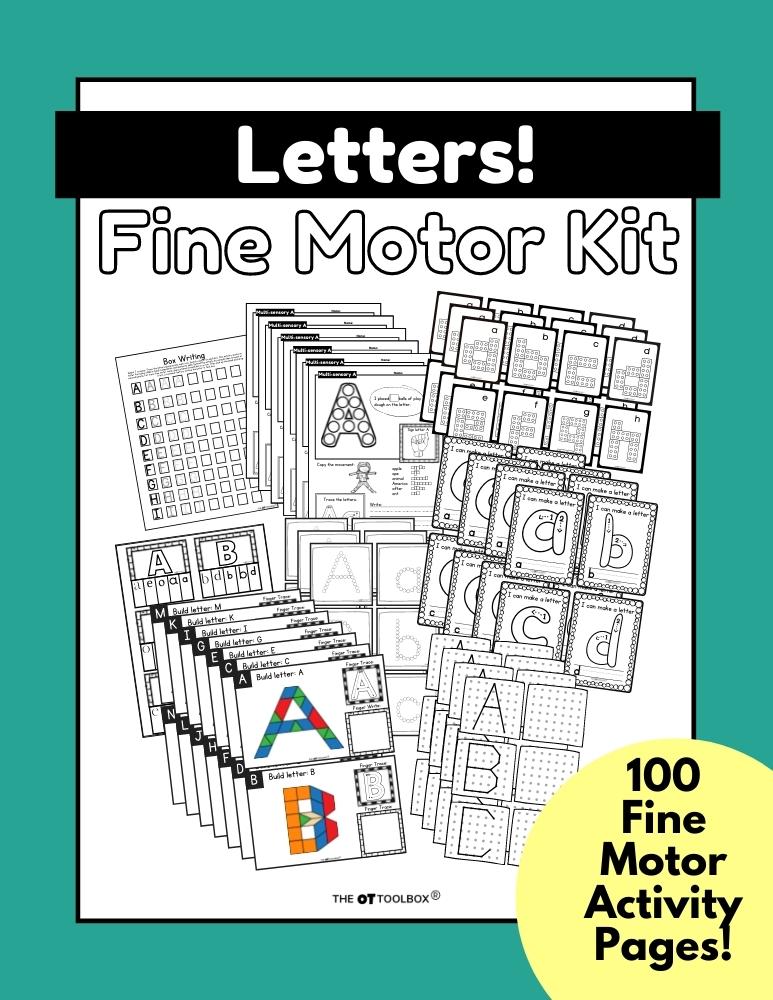
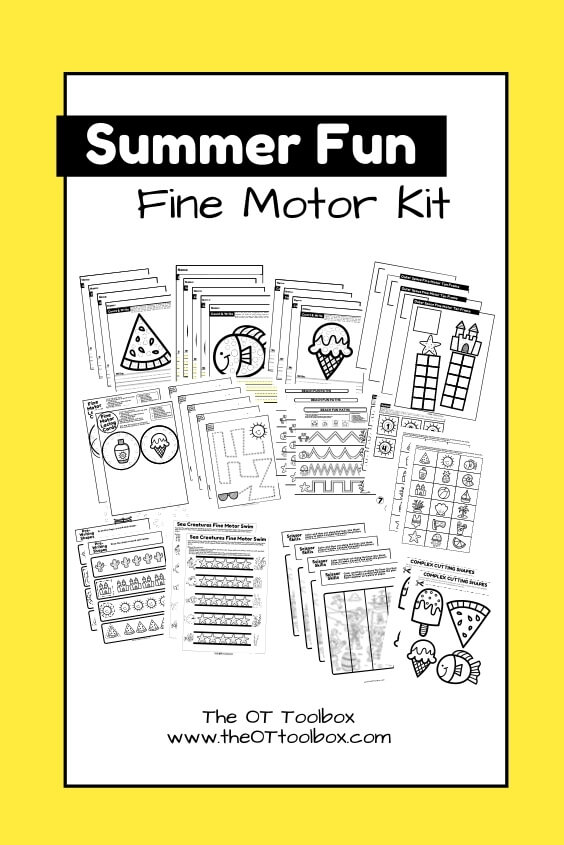
Working on fine motor skills, visual perception, visual motor skills, sensory tolerance, handwriting, or scissor skills? Our Fine Motor Kits cover all of these areas and more.
Check out the seasonal Fine Motor Kits that kids love:
Thank you for grabbing the Christmas Occupational Therapy Activity sheets. Use these activities in a month of play based on developing the underlying skills needed for function and independence. Each activity promotes underlying areas such as fine motor skills, sensory processing and exploration, visual processing, visual attention, visual motor integration, bilateral coordination, eye-hand coordination, direction following, and so much more.
The activities can be cut out and glued to clothes pins for increased fine motor strengthening. Ask children to move the clips when they’ve completed an activity as they countdown to Christmas.
This will be a month-long time of memory making while promoting healthy development that will foster function on into the new year.
Explore the season while addressing Sensory Processing issues using this Christmas Sensory Processing guide. It’s got activities for the whole season and sensory coping strategies to help kids who struggle with sensory processing difficulties.
Children with ADHD, ADD, or even just difficulties with focus and attention can have resulting struggles with executive functioning skills. There are many executive function skills tied to attention and focus that interfere with success in the classroom, home, extracurricular activities, and community. Consider all of the areas that make up executive functioning skills. These are abilities that develop through maturation and developmental progression. For some, these skills develop more easily than others. For the child who struggles with attention, these executive functioning abilities may lack, causing difficulties in all areas of life.
Executive Function Skills and Attention
There are many executive functioning skills that allow us to complete tasks. On this executive functioning skills page, I’ve linked to several of the skill areas that we’ve covered here on the site. Be sure to stop back, because I’ve got more activities and information in store for you.
When kids have trouble with attention, there are executive functioning skills that lack.
Does any of this sound familiar?
Emotional Control- Kids with attention issues may not be able to attend for extended periods of time on a situation that enables them to control their emotions. They can perseverate on the emotions of a specific situation or may not be “up to speed” on the situation at hand or be able to process their emotions as they attend to a different situation. Issues with emotional control can then lead to behavioral responses as they struggle to keep their emotions in check.
Task Initiation– Children with attention difficulties can be challenged to start tasks. It can be difficult to pull out the starting point or the most important parts of a multi-step project so that just starting is a real struggle.
Task Completion- Similar to the initiation of specific tasks, completing a task or project can be a real challenge for the child who is limited in attention. Reading a multiple chapter book can seem overwhelming and quite difficult and just never is finished. Cleaning a room can be a big challenge when there are visual, auditory, or other sensory-related distractions that make up the project.
Working Memory– Attending to past situations and pulling that information into a current situation is a difficulty for some kids with attention issues. Attention issues can interfere with parts of working memory including encoding, storage, and manipulation of information. This can result in safety issues when it comes to skills like crossing a street or even conversations.
Planning and Prioritizing- Planning out and picking the most important tasks of a project can be a struggle for the child with attentional issues. It can be easy to become overwhelmed and distracted by the options for importance.
Processing Speed- Processing speed refers to the ability to receive, understand, and process information in order to make a decision or response. It also involves using working memory in a situation or experience. Children who experience attention struggles may experience difficulty in retrieval of information (using working memory) and responding using that information (initiation). This carries over to missed information, difficulty keeping up with a conversation or lesson in school, or a fast-moving game or activity.
Organization– A child with attention challenges can easily become disorganized with tools, books, clutter, and trash. Focusing on a project such as cleaning out a desk or locker is a multiple-step task that might not ever happen without intervention from a teacher or support person. Organization requires attention to detail and separation of pieces into sections, whether that be folders of a similar subject in school or matching colors of socks. It’s easy to see how the child with attention issues can get off track very easily with organizational tasks
Self-Monitoring- This executive functioning skill goes hand in hand with attention and focus. Self monitoring allows us to keep ourselves in check in a situation. We need to stay on task and focus on that a person is saying and respond in appropriate ways. If the child with attentional issues can not focus on what a person is saying for more than a few minutes, than the ability to respond appropriately can be a real issue.
Impulse Control– Attention and impulses are another set of executive functioning skills that are very closely related. When the distracted child can not focus on a specific task or conversation, or situation, then the tendency to impulsively respond is quite likely. A great tool for assessing and monitoring impulses in the child with attention struggles is the impulse control journal.
Cognitive Flexibility- The ability to think with flexibility is what makes the human brain superior to other species. We are able to think in the future and assess different situations using cognitive flexibility.
Cognitive flexibility is the ability to stop a thought process and change a way of thinking. When the child who struggles with attention can not focus on a thought or process for a period of time, they are distracted by things in their environment or thoughts, limiting the ability to focus on flexible thinking patterns.
Foresight- This skill is also related to distractibility and focus. Interference from outside interruptions can limit the thoughtful foresight that allows us to make safety decisions. For the child with impulsivity and hyperactivity, being on-the-go, or constantly in motion can interfere with the ability to pause and consider consequences from a single action.
Hindsight- Similar to thinking ahead, the ability to process that “20/20” vision of our our past mistakes and actions is what allows us to use experience to make better decisions.
Self-Talk– The skill used for assessing situations and monitoring our behaviors related to consequences is a difficult task for the child with attention issues. Distractions interfere with self-talk and the positive result of our inner mind.
Problem Solving- When distractions and impulsivity are at the forefront of thought processes, it can be difficult to solve problems as they are presented to the child with attention difficulties. This area is closely related to working memory.
Persistence- For the child with attention struggles, it can be very difficult to persist through a lengthy task or assignment. Distractions, impulsivity impact the ability to power through a task. A tendency of ADHD is the difficulty in follow through during tasks like homework, reading, chores, or duties.
Shift- Switching through processes in order to problem solve or attend to various tasks can be quite difficult for the child with attention struggles.
You can see how all of these areas are related and work cohesively with one another in typical daily tasks. It makes sense that the child who struggles with attention and sustained focus will have difficulty with a multitude of executive functioning skills.
More tools for addressing attention needs in kids
HUGE Sensory Resource
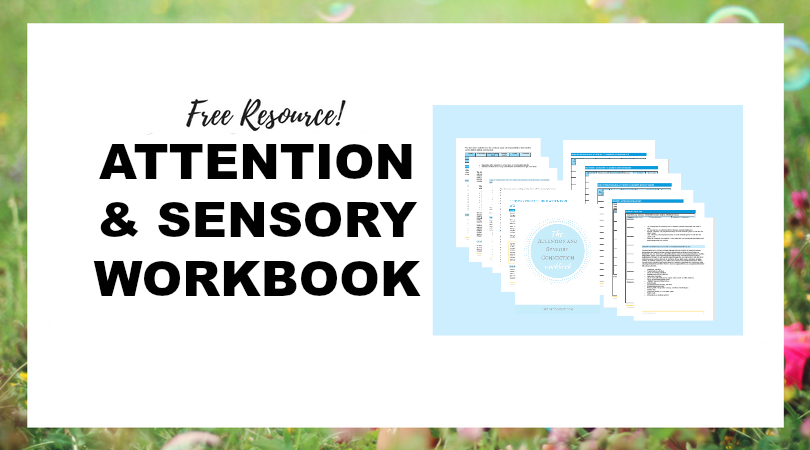
There are so many strategies to address attention in kids and activities that can help address attention needs. One tactic that can be a big help is analyzing precursors to behaviors related to attention and addressing underlying needs. The Attention and Sensory Workbook can be a way to do just that. The Attention and Sensory Workbook is a free printable resource for parents, teachers, and therapists. It is a printable workbook and includes so much information on the connection between attention and sensory needs. Here’s what you can find in the Attention and Sensory Workbook:
Includes information on boosting attention through the senses
Discusses how sensory and learning are connected
Provides movement and sensory motor activity ideas
Includes workbook pages for creating movement and sensory strategies to improve attention
A little more about the Attention and Sensory Workbook:
Sensory processing is the ability to register, screen, organize, and interpret information from our senses and the environment. This process allows us to filter out some unnecessary information so that we can attend to what is important. Kids with sensory challenges often time have difficulty with attention as a result. It’s been found that there is a co-morbidity of 40-60% of ADHD and Sensory Processing Disorder. This workbook is an actionable guide to help teachers, therapists, and parents to help kids boost attention and focus in the classroom by mastering sensory processing needs. You will find information on the sensory system and how it impacts attention and learning. There are step-by-step strategies for improving focus, and sensory-based tips and tricks that will benefit the whole classroom. The workbook provides tactics to address attention and sensory processing as a combined strategy and overall function. There are charts for activities, forms for assessment of impact, workbook pages for accommodations, and sensory strategy forms.
Grab the Attention and Sensory Workbook below.
References:
Adi Stern, Adina Maeir; Validating the Measurement of Executive Functions in an Occupational Context for Adults With Attention Deficit Hyperactivity Disorder. Am J Occup Ther 2014;68(6):719-728. doi: 10.5014/ajot.2014.012419.
“Attention-Deficit/Hyperactivity Disorder (ADHD): The Basics.” National Institute of Mental Health. Retrieved from https://www.nimh.nih.gov/health/publications/attention-deficit-hyperactivity-disorder-adhd-the-basics/index.shtml
Colleen Beck, OTR/L has been an occupational therapist since 2000, working in school-based, hand therapy, outpatient peds, EI, and SNF. Colleen created The OT Toolbox to inspire therapists, teachers, and parents with easy and fun tools to help children thrive. Read her story about going from an OT making $3/hour (after paying for kids’ childcare) to a full-time OT resource creator for millions of readers. Want to collaborate? Send an email to contact@theottoolbox.com.
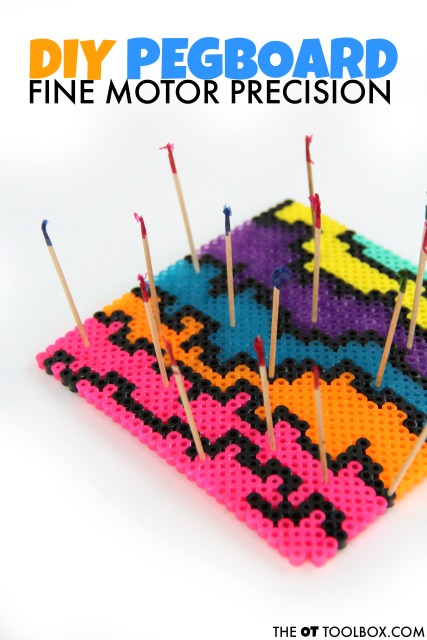
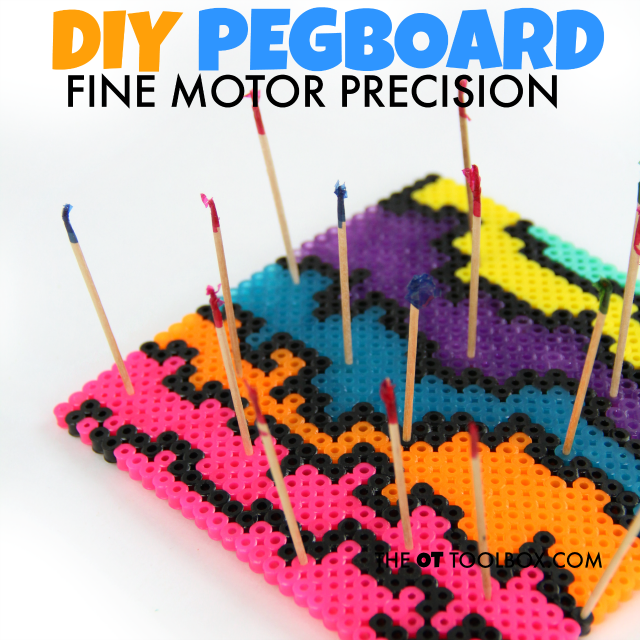
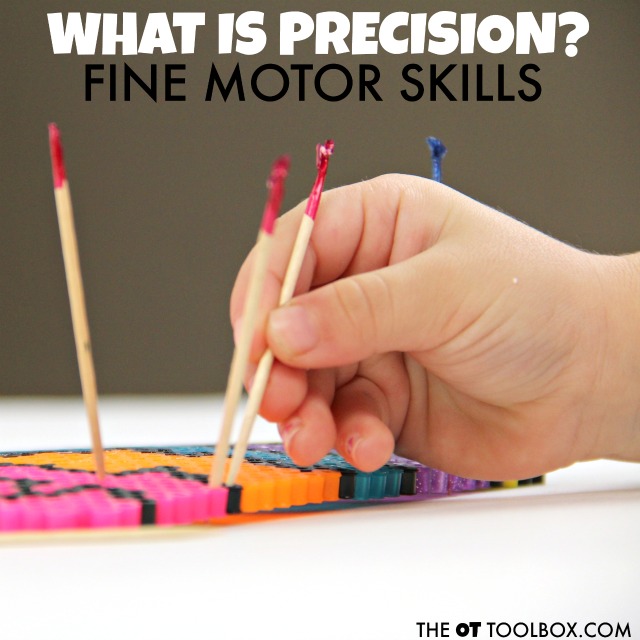
Did you know you can make a fine motor pegboard using craft items like perler beads and toothpicks?
Precision skills in fine motor skills are essential for so many functional skills. When we write with a pencil, we need to make small motor movements in order to manipulate and move the pencil to form parts of letters. We need to adjust the pencil in order to erase, press harder, or make circles or swoops in parts of letters. We need precision of the hands to manage buttons on clothing or press down with varying degrees of pressure on a keyboard or when cutting strawberries. Precision in fine motor skills are needed to cut with scissors, put pegs into a pegboard, or thread a needle.
What happens with it is difficult for a child to master precision? The small motor movements of the hands and fingers are limited or disrupted and may result in use of larger muscle movements. Actions in handwriting, clothing fasteners, utensil use, scissor use, or other fine motor tasks become difficult or clumsy. The pegboard activity below is one easy way to work on fine motor precision skills using a DIY pegboard.
What is Fine Motor Precision?
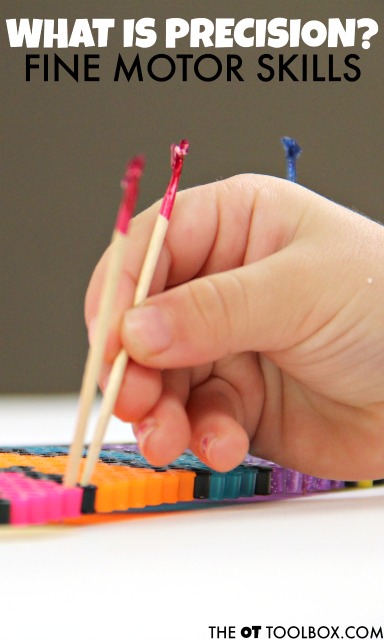
First, let’s talk about what precision means. When kids perform very small motor actions, they need to have control so they can use the very tips of the fingers to place objects where they intend to. Precision occurs with development of grasp when child to use the pads of the index finger, middle finger, and thumb to manipulate objects with opposition.
Precision is made up of three parts when it comes to manipulating objects:
Precision in release is needed for releasing or letting go of small items. Precision is needed for a child to let go of an item in a controlled manner. If they are not exercising precision in release, you might see them dumping, rolling, or tossing an object as they let go. They will knock over a stack of blocks, or over open the scissors when cutting lines, making their accuracy very choppy.
Precision in grasp is related to the picking up of items. A graded pincer grasp, neat pincer grasp, or lateral grasp is needed to grasp small objects with precision. Around 3-4 years, a preschool aged child typically develops a greater variety of grasping patterns, including precision. They begin to grade their small motor actions. Grasps in babies typically begin with a raking motion and work towards a pincer grasp. Precision in this skill occurs when the child is able to pick up very small items like beads with accuracy and graded movements.
Precision in rotation is another task that children develop around age 5. Rotation is a portion of in-hand manipulation and seen when turning a coin on the edges and the child rotates it in a circular motion. Precision in rotation also occurs when holding a pencil between the fingers and the child rotates it over and over.
Fine Motor Skills Needed for Precision
Precision handling of very small items with controlled movement is necessary for dexterity in functional grasp. To manipulate items with small motor motions, the hand needs to be in a functional position. The index and middle digits must oppose the thumb with tip-to-tip finger contact and interphalangeal joint range of motion. opening and closing the grasp on items with control is precision and allows the hand to grasp small objects from a refined area and enables the hand to release objects in a specific location.
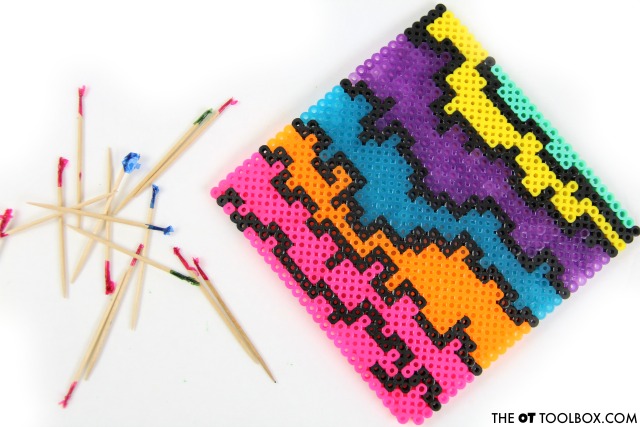
This pegboard activity is a powerhouse when it comes to precision and fine motor development. We used perler beads to create a pegboard and work on precision of grasp, release, rotation, and in-hand manipulation.
To make your own fine motor pegboard, you will need perler beads. These beads are perfect for creating customized designs and pegboards. I love these huge sets that can be used to create any tool you or your child can imagine. Make a pegboard that focuses on favorite colors or images like rainbows, hearts, or themes like Minecraft. Making the perler bead pegboard requires pincer grasp, in-hand manipulation, graded release, and eye-hand coordination to create a design.
Follow the directions in your perler bead kit and iron the beads so they melt together to create a pegboard.
Then, you can use your DIY pegboard over and over again.
How cool would it be to have a set of these pegboards in your therapy bag to work on different skills like visual discrimination, visual scanning, and visual motor integration with different colors and increasingly complex pegboard designs?
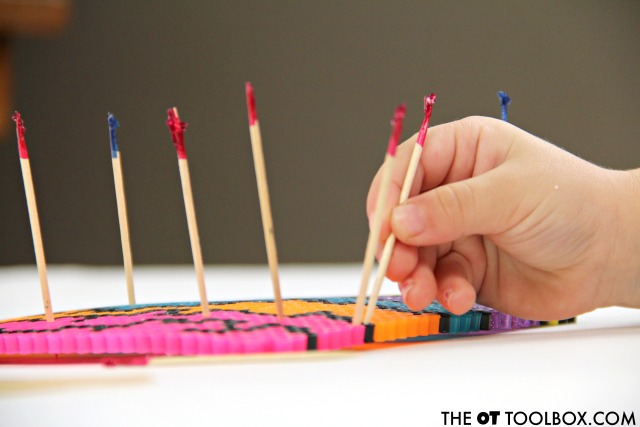
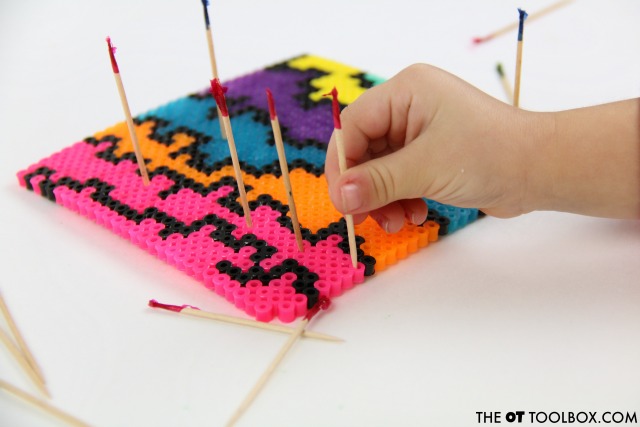
Next, use a set of toothpicks as pegs for your DIY fine motor pegboard.
Our pegboard had different colors and a black thread dividing colors. Work on eye-hand coordination by matching colored toothpicks to the colored sections of the pegboard. Work on fine motor control by placing the toothpicks only in the black beads that move in different directions.
How would you make a DIY pegboard? Let me know if you make one! I would love to see it and share it with other therapists on social media!
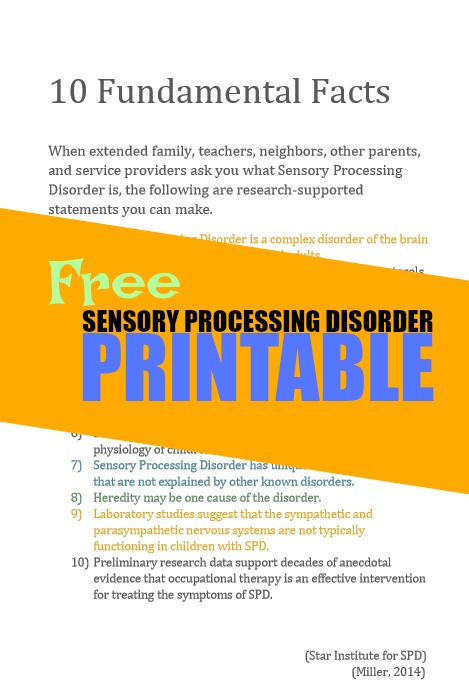
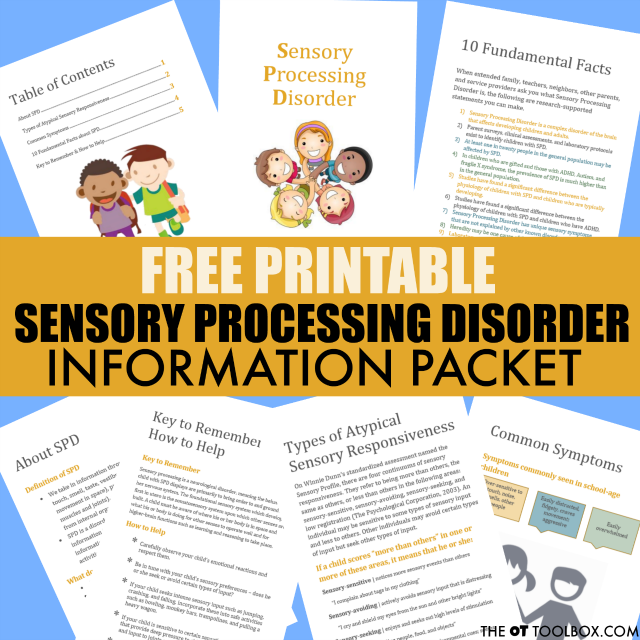
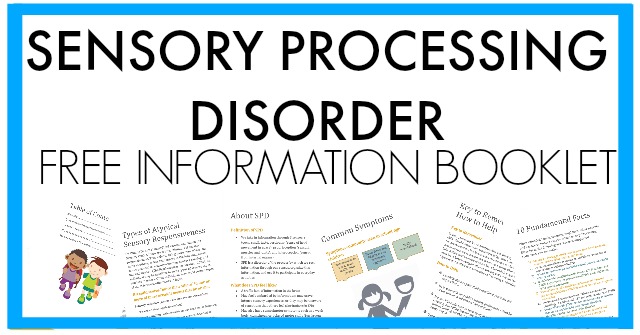
This free Sensory Processing Disorder Information packet is a printable booklet of SPD info that can be passed on to parents, teachers, and anyone who works with kids with SPD.
Sensory Processing Disorder Information
Many times, parents notice something seems “off” about their child. They might notice little quirks, or personality traits that just make them wonder if something is going on in their child’s mind.
Other times, parents KNOW there is a sensory processing issue happening with their child. They have seen sensory-related behaviors in action and know that their child needs help to address the underlying issues in order to communicate, process sensory information, and learn.
Parents who are just beginning to seek out information related to sensory processing disorder can run into a maze of confusing information. It can be hard to know where to turn and what to do to start the process of understanding what makes their child tick.
Parents who understand their child’s tendencies and know what it takes to make days, nights, meals, travel, and education easier can run into a wall of teachers/counselors/babysitters/grandparents who just don’t “get it”.
Does any of this sound familiar? Whether you are a parent who suspects sensory issues or a parent who is experienced with therapy, sensory interventions, and breaths a sensory life, this sensory processing disorder packet is for you.
When you sign up to get the printable booklet, you will also receive a small series of emails with information related to Sensory Processing Disorder, including another free printable.
Sensory Processing Disorder Information
Information on Sensory Processing Disorder in a compact, printable packet.
I am excited to share this Sensory Processing Disorder Booklet with you…and it is absolutely FREE.
This printable packet is a resource about sensory processing that professionals and parents can reference.
In the Sensory Processing Information booklet, you’ll find:
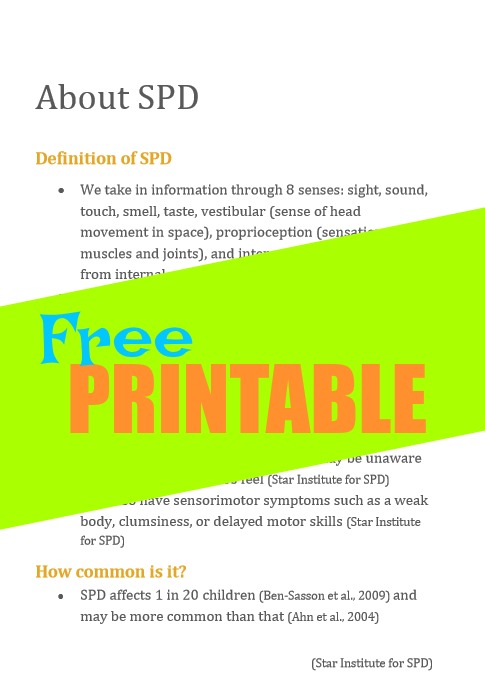
Information about SPD Types of Atypical Sensory Responsiveness Common Symptoms of Sensory Processing Disorder Fundamental Facts about SPD Key Points to Remember about SPD Ways to Help Resources related to Sensory Processing Issues
Who will benefit from this Sensory Processing Information packet?
This collection of information is perfect for handing out to teachers, administrators, paraprofessionals, and classroom aides at the start of a new school year. It’s a great resource for babysitters, camp counselors, neighbors, grandparents, aunts, uncles, concerned family members, or anyone who has recurring contact with a child with sensory processing disorder.
NOTE: The booklet is in print order so the pages appear to be out of order, but they are actually just aligned for printing. There are page numbers on the bottom of the pages so you know which order to read it in on the document. The packet is 8 pages long.
This packet was written and created by Anabelle Alamangos, MOTS and Selena Bach, MOTS
Who do you know that would benefit from this free Sensory Processing Disorder Information?
Share this with someone who lives with, works, with, or loves a child with Sensory Processing Disorder!
The summer months mean outdoor play! That doesn’t mean that the fine motor development needs to stop. Today, I’ve got fun ways to build fine motor skills using a simple pack of sidewalk chalk.
You can grab a pack of sidewalk chalk at the dollar store. We love to buy up the end of year clearance sales and have new packs ready to go at the start of the summer months. These fine motor activities are perfect for outdoor summer play while hanging out with the kids.
Drawing on a sidewalk or driveway is a great way to encourage increased strength of the hands. There are a few things happening when kids get down on the ground to play with chalk. First, they are getting into a different position. Whether in quadruped or sitting on the ground, the core muscles are engaged.
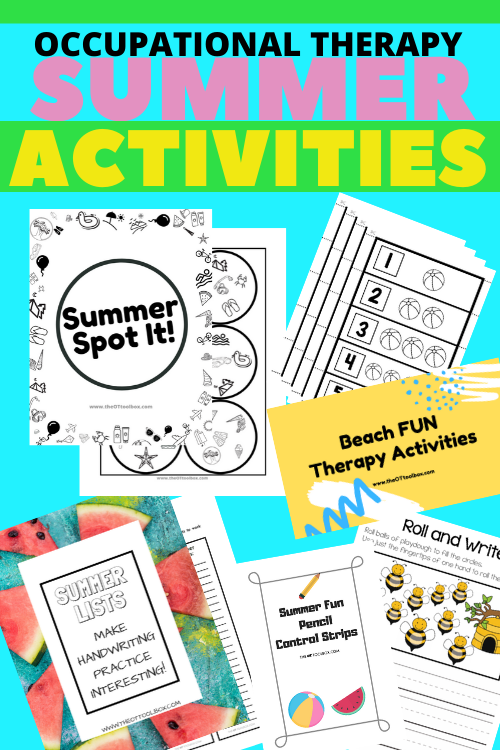
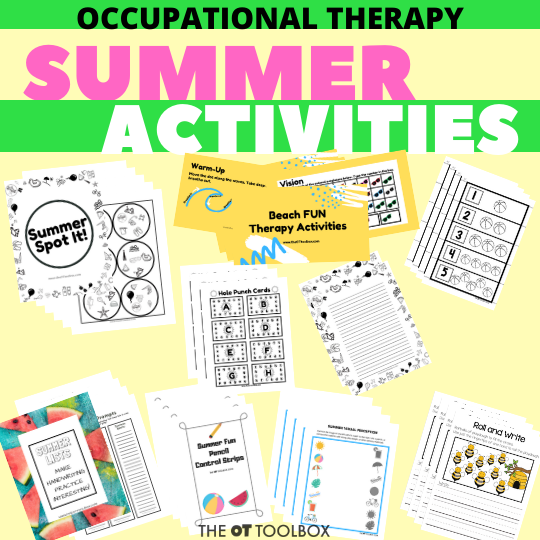
You’ll also be interested in our new Summer Occupational Therapy Activities Packet. It’s a collection of 14 items that guide summer programming at home, at school, and in therapy sessions. The summer activities bundle covers handwriting, visual perceptual skills and visual motor skills, fine motor skills, gross motor skills, regulation, and more.
You’ll find ideas to use in virtual therapy sessions and to send home as home activities that build skills and power development with a fun, summer theme. Kids will love the Summer Spot It! game, the puzzles, handouts, and movement activities. Therapists will love the teletherapy slide deck and the easy, ready-to-go activities to slot into OT sessions. The packet is only $10.00 and can be used over and over again for every student/client!
Try to encourage kids to draw big, so that they are really reaching out with their arms to support their upper body as well as putting weight through their supporting arm. This is a nice way to add proprioceptive input, too.
Use Chalk to Build Fine Motor Skills
This post contains affiliate links.
Next, use that pack of chalk to get to work on fine motor skills! You can use a box of regular chalkboard chalk, or you can use a few jumbo sidewalk chalk pieces. The key with the jumbo pieces is to get them smaller for the hands to really develop the skills they need for holding a pencil and writing.
One fun activity is to use a rock or a hammer to smash the chalk into smaller pieces. All you need is a chunk of chalk. Kids really get into this part of the fun, and it’s a nice upper body and heavy work strengthening activity, too.
Once you have smaller pieces, use them in the following ways to develop fine motor skills:
Draw circles and color them in. Drawing connecting lines on a resistive surface like the sidewalk promotes the visual motor skills needed for letter formation and line placement when writing letters.
Play word games like hangman, Tick Tack Toe (Use letters in place of “x” and “o”), and hopscotch with words in the boxes.
Get the chalk dust wet and draw with your fingers. This is a great way to encourage finger isolation and separation of the two sides of the hands.
Use that wet chalk dust to create DIY liquid chalk paint. Paint it on paper to promote tool use (paintbrushes of different sizes). Then, use bamboo skewers, lollipop sticks, or craft sticks to scrape lines and words into the paint. Can you scrape your name in the paint before it dries?
Color with a small chalk piece onto rocks of various sizes. What an activity this is! Holding the rock in one hand while coloring with the small chalk chunk is a bilateral hand activity that provides heavy input through the assisting hand. This promotes an awareness of the non-dominant hand while the dominant hand colors in the rock. The rock will need to manipulated within the hand, allowing for arch development and intrinsic hand strength. (Developing fine motor skills in the non-dominant hand is important too! Think about tying shoes, typing and other bilateral activities that require fine motor skill development in both hands.)
Write words on bricks and then move them to make crazy sentences. We love the magnet word games that you can make silly sentences with on the fridge. This outdoor version is just as much fun, but adds heavy work input that is calming and silly at the same time! Work together for a fine motor (and gross motor) activity that the kids won’t forget!
Write on a brick wall. Then squirt it with a squeeze spray bottle. This is another fine motor powerhouse activity. Writing on a vertical surface has SO many benefits. From encouraging an extended wrist, to strengthening the arm, to promoting the whole body to look up for better posture, breathing, and lung capacity. There is also the fine motor benefits: Promoting dexterity in the precision side of the hand and separation of the two sides of the hand. Plus, writing on the bricks provides a resistive surface that promotes motor planning and strengthening for motor memory related to letter formation. Write on bricks like cement block bricks as opposed to house bricks for better letter formation practice. THEN, use a squeeze bottle to erase the words! This promotes gross grasp strength of the power side of the hand, separation of the two sides of the hand, and visual motor integration as kids aim and squeeze. This is one handwriting activity that kids will love!
What are your favorite ways to practice fine motor skills with chalk during the summer months? Let us know on our Facebook page. We would love to see them!
These fine motor activities that use sidewalk chalk would be a great addition to our summer sensory handwriting camp. Sneak those fine motor skills and handwriting work into sensory play fun this summer!