Sensory Stations Free Spring Printables

Sensory stations free printables

This sensory stations printable set is a free resource that you can print off and hang up as an easy sensory path. You may have seen sensory walks in school hallways, or outdoor sensory walks on sidewalks. Sensory paths can even be done at home as a DIY sensory activity. The reason why we are seeing so many of these sensory strategies in place? They are a great way to get kids motivated and moving to incorporate the sensory input and motor planning that kids need.

The Spring themed sensory paths in this blog post are just one of the popular seasonal sensory path printables you’ll find on this site. Try these other themed sensory walks: Winter Sensory Stations, Summer Sensory Stations, and Fall Sensory Stations.
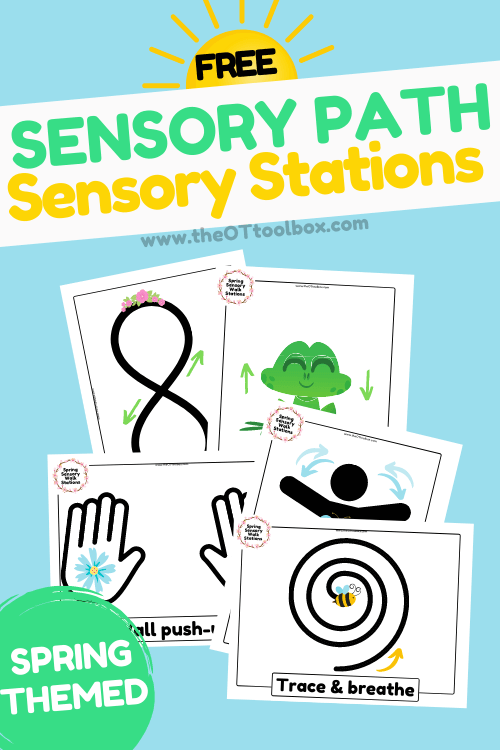
Free printable sensory stations for a sensory path with a Spring theme

What is a Sensory Path

First, let’s talk about what a sensory path is. You’ve probably seen the videos of kids completing motor activities in a hallway or even on a sidewalk. There are typically several sensory stations, or sensory and movement-based activities that kids can do as they move through the sensory walk.

A sensory walk (or a sensory path) is a fun and engaging series of movements and activities designed to incorporate the senses and movements. They are designed to promote motor skills so kids get the sensory input they need in order to focus, pay attention, regulate their sensory systems so they can learn and function along with their peers. They are a fun and engaging way to incorporate sensory diet tasks into the school or home environment.

When kids move through the colorful path, they are challenged to hop, jump, skip, tip toe, turn, spin, push, etc. All of these movements incorporate gross motor skills and sensory systems of vision, vestibular, and proprioceptive senses. You can read more here about heavy work of gross motor skills and sensory processing.

What are Sensory Stations?

In a sensory hallway or sensory pathway, there are typically “stations” or different movement activities that challenge different sets of muscles or actions. You might see a station where kids move through the letters of the alphabet as they hop along ABC images. You might see a sensory station that asks kids to tip toe along a spiral path, or complete wall push-ups. You may see a hopscotch board on the floor with numbers, letters, colors, or even sight words.

Other sensory paths stations for deep breathing exercises, animal walks, or figure 8 visual motor activities.

There are sensory pathways that incorporate different themes into the sensory stations. The sky is the limit when it comes to coming up with movement-based activities within a sensory walk.

All of these sensory stations offer an opportunity for the child to engage the senses in a particular movement or activity.

Free sensory stations printables

Today, as part of our Spring Week, I have a free printable set of sensory stations for you. These are PDF sheets with several different sensory station activities. Print them off, hang them in a hallway, classroom, or in the home to engage vestibular, proprioceptive, and visual senses.

The sensory stations included in this free resource include a figure 8 deep breathing activity. Kids can trace along the figure 8 as they take in deep breaths and then breathe them out.

The next sensory activity in this DIY sensory path is a frog hop activity. Kids can hop like a frog and engage proprioceptive input as they hop up and down. The printable is open-ended so you can ask kids to complete as many from hops as you like.

Next, you’ll find a wall push-up activity. Kids can complete wall push-ups against the hand visuals and engage heavy work input through their upper body as a calming motor activity.

Then, there is a jumping jack activity that engages the vestibular sense and gets kids active, moving their whole body, and working on coordination, motor planning, and symmetrical and asymmetrical movements gross motor movements.

Finally, the sensory path printables includes a spiral deep breathing activity with a buzzing bee. Kids can trace along the spiral and take deep breaths in and out. This calming activity can re-set kids and help with relaxation.

All of these sensory station activities are open-ended so you can ask kids to say the ABCs or count as they complete the tasks. You can also rearrange the order of the sensory walk tasks or omit some of the activities is you like.

Printable Sensory Stations

Want to add these sensory path stations to your therapy toolbox? Enter your email into the form below and you’ll receive them in your inbox. Enjoy and happy sensory path planning!

This handout is just one creative way to work on fine motor skills, precision, and dexterity this Spring? You’ll love these other free PDFs here on the website (all are available in our Member’s Club):

Want to add this resource to your therapy toolbox so you can help kids thrive? Enter your email into the form below to access this printable tool.

This resource is just one of the many tools available in The OT Toolbox Member’s Club. Each month, members get instant access to downloadable activities, handouts, worksheets, and printable tools to support development. Members can log into their dashboard and access all of our free downloads in one place. Plus, you’ll find exclusive materials and premium level materials.

Level 1 members gain instant access to all of the downloads available on the site, without enter your email each time PLUS exclusive new resources each month.

Level 2 members get access to all of our downloads, exclusive new resources each month, PLUS additional, premium content each month: therapy kits, screening tools, games, therapy packets, and much more. AND, level 2 members get ad-free content across the entire OT Toolbox website.

Join the Member’s Club today!

FREE Printable Sensory Stations for a Sensory Path

    We respect your privacy. Unsubscribe at anytime.

    Spring Fine Motor Kit

    Score Fine Motor Tools and resources and help kids build the skills they need to thrive!

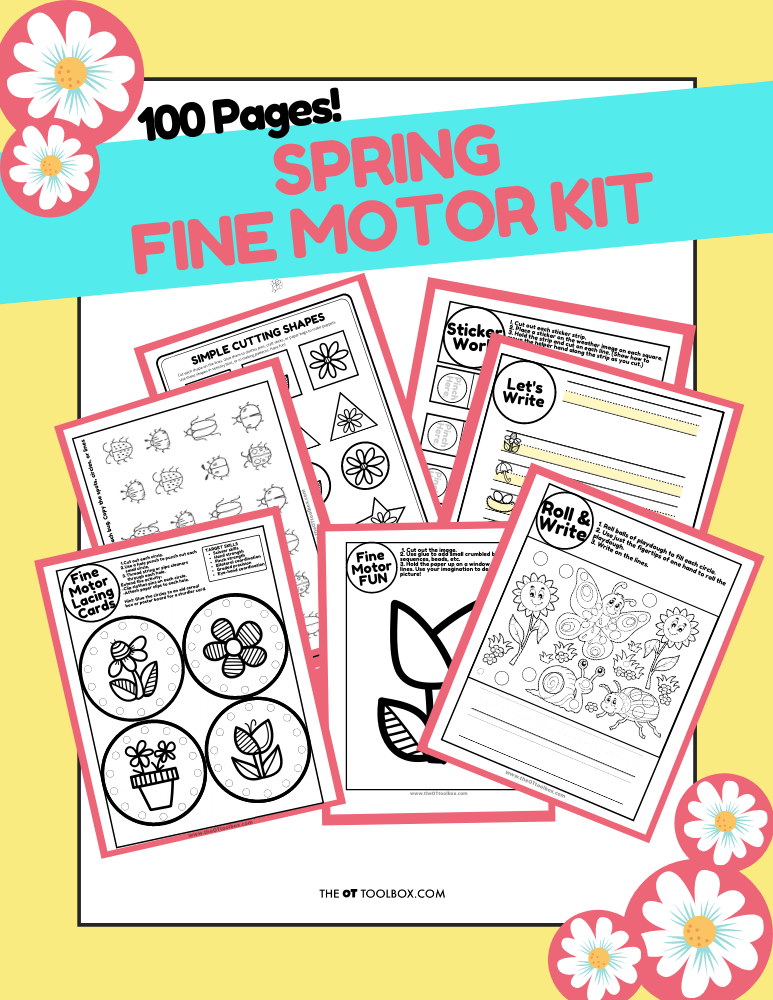
    Developing hand strength, dexterity, dexterity, precision skills, and eye-hand coordination skills that kids need for holding and writing with a pencil, coloring, and manipulating small objects in every day task doesn’t need to be difficult. The Spring Fine Motor Kit includes 100 pages of fine motor activities, worksheets, crafts, and more:
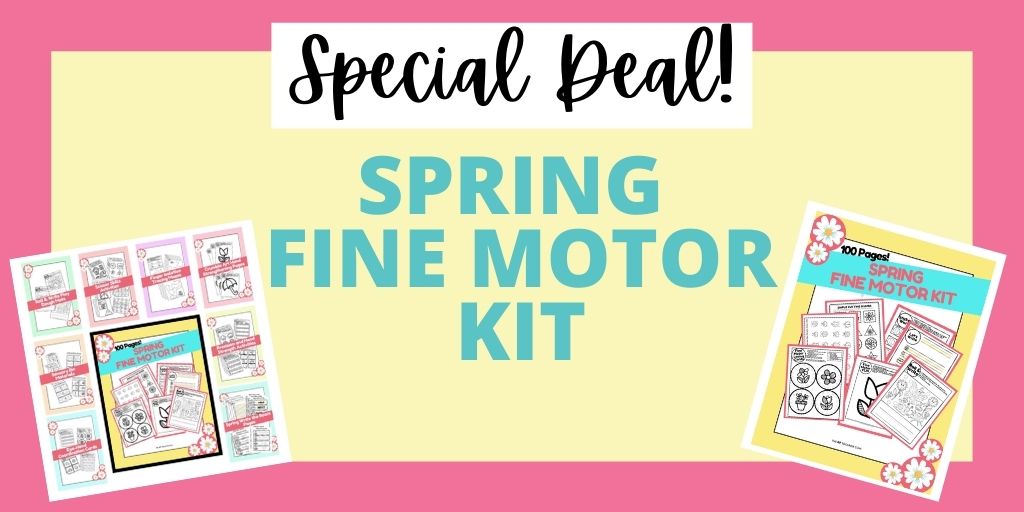
    Spring fine motor kit set of printable fine motor skills worksheets for kids.
    • Lacing cards
    • Sensory bin cards
    • Hole punch activities
    • Pencil control worksheets
    • Play dough mats
    • Write the Room cards
    • Modified paper
    • Sticker activities
    • MUCH MORE

    Click here to add this resource set to your therapy toolbox.
    Spring Fine Motor Kit
    Spring Fine Motor Kit: TONS of resources and tools to build stronger hands.

    Grab your copy of the Spring Fine Motor Kit and build coordination, strength, and endurance in fun and creative activities. Click here to add this resource set to your therapy toolbox.

    Add these other Spring printables to your toolbox this time of year:

    This handout is just one creative way to work on fine motor skills, precision, and dexterity this Spring? You’ll love these other free PDFs here on the website (all are available in our Member’s Club):

    Spring Sensory Stations– These printable sensory stations are great for building a sensory walk anywhere: Print off these sensory station sheets and hang them in hallways, in a classroom, or even in the home.

    Spring Worksheets for Handwriting and Fine Motor Skills– Therapists love this resource because it includes a fine motor and visual motor warm-up that can be integrated right into the handwriting activity, using a fun theme.

    Spring Cootie Catcher– This printable resource is a fine motor, handwriting, and eye-hand coordination activity as well as bilateral coordination, and motor planning skill work.

    Cute Bugs Visual Closure Worksheets– These visual perceptual skills worksheets are perfect for Spring, and they are included in our free huge visual perception worksheet packet.

    Colleen Beck, OTR/L has been an occupational therapist since 2000, working in school-based, hand therapy, outpatient peds, EI, and SNF. Colleen created The OT Toolbox to inspire therapists, teachers, and parents with easy and fun tools to help children thrive. Read her story about going from an OT making $3/hour (after paying for kids’ childcare) to a full-time OT resource creator for millions of readers. Want to collaborate? Send an email to contact@theottoolbox.com.
    Free Heavy Work Activities Cards

    Heavy work activity cards Spring themed gross motor tasks

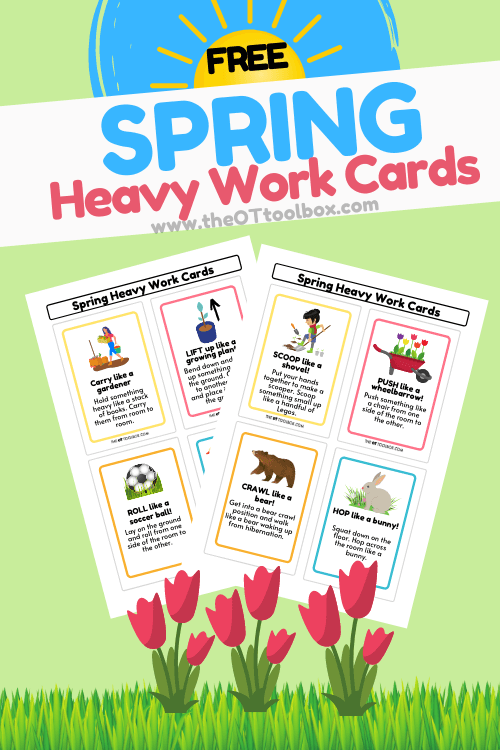
    Today’s free resource in the Spring Week tools are these free Heavy Work activities in printable card version, with a Spring theme! These are just the thing to get kids moving and adding much-needed gross motor movement into the classroom, home, or occupational therapy session. I modeled these printable exercise cards off our heavy work teletherapy activities freebie, so these are the perfect addition to your therapy toolbox.

    Heavy work activities with a Spring theme to add gross motor exercise and brain breaks as well as sensory processing input.

    Heavy Work Activities

    Heavy work activities help kids to incorporate balance, endurance, and motor planning into functional activities. By integrating the proprioceptive sense and vestibular sense, or balance, equilibrium, position in space, and movement, kids are able to better move their body with awareness of how their body moves. This body awareness is needed for most every activity.

    Adding resistance, or heavy work activates the muscles and joints in the body and “wakes them up”. Proprioception and calming vestibular work can have an organizing effect on kids. This enables a ready state for completing tasks.

    Getting kids to incorporate the whole-body movements that they need to regulate and develop strong, healthy bodies isn’t always easier, now more than ever. That’s where the Spring Gross Motor activities come into play. These are whole body activity, Spring-themed activities that make fun brain breaks.

    Functional Heavy Work

    Many heavy work activities can be incorporated right into the daily tasks. Things like pushing a vacuum, moving furniture, carrying a laundry basket are day-to-day chores that add a ton of heavy work input.

    Other heavy work tasks can integrate these senses as well.

    Tasks like using a moldable eraser, coloring with crayons vs. markers, or pulling on socks offer heavy work just as well, on a smaller scale.

    These are all strategies that play into a sensory lifestyle, or a sensory diet that is well ingrained into the day-to-day tasks. You can learn more about creating a sensory lifestyle into every day activities in my book, The Sensory Lifestyle Handbook.

    Heavy Work and Gross Motor Skills

    There’s more about heavy work than just sensory processing benefits.

    Heavy work tasks improve balance, core strength, motor planning, equilibrium needed for movement changes, stability, coordination, and movement patterns. All of these skills require equilibrium of the vestibular system for movement and changes in planes. They also require position in space changes. Heavy work has so many benefits!

    There’s more: Heavy work input also incorporates areas such as range of motion, flexibility, motor planning, crossing midline, muscle tone, and core stability.

    Free Heavy Work Activity Cards

    Would you like to get your hands on a set of free heavy work printable activities? This is a free resource that you can print off and use in therapy sessions, in home programs, as classroom brain breaks, and to just get those kids moving.

    To grab this free resource, enter your email address into the form below.

    FREE Spring Heavy Work Cards

      We respect your privacy. Unsubscribe at anytime.

      More heavy work brain breaks and Spring activities

      You can find more Spring brain breaks and heavy work activities in the Spring Occupational Therapy Activities Pack. Right now, it’s a BONUS add-on to our newly released Spring Fine Motor Kit!

      Spring Fine Motor Kit

      Score Fine Motor Tools and resources and help kids build the skills they need to thrive!

      Developing hand strength, dexterity, dexterity, precision skills, and eye-hand coordination skills that kids need for holding and writing with a pencil, coloring, and manipulating small objects in every day task doesn’t need to be difficult. The Spring Fine Motor Kit includes 100 pages of fine motor activities, worksheets, crafts, and more:

      Spring fine motor kit set of printable fine motor skills worksheets for kids.
      • Lacing cards
      • Sensory bin cards
      • Hole punch activities
      • Pencil control worksheets
      • Play dough mats
      • Write the Room cards
      • Modified paper
      • Sticker activities
      • MUCH MORE

      Click here to add this resource set to your therapy toolbox.

      Spring Fine Motor Kit
      Spring Fine Motor Kit: TONS of resources and tools to build stronger hands.

      Grab your copy of the Spring Fine Motor Kit and build coordination, strength, and endurance in fun and creative activities. Click here to add this resource set to your therapy toolbox.

      Colleen Beck, OTR/L has been an occupational therapist since 2000, working in school-based, hand therapy, outpatient peds, EI, and SNF. Colleen created The OT Toolbox to inspire therapists, teachers, and parents with easy and fun tools to help children thrive. Read her story about going from an OT making $3/hour (after paying for kids’ childcare) to a full-time OT resource creator for millions of readers. Want to collaborate? Send an email to contact@theottoolbox.com.
      Four Leaf Clover Balance Exercises

      four leaf clover teletherapy exercises

      This free teletherapy slide deck is a fun one; It’s a visual guide of four leaf clover activities for kids to work on balance and strength. The balance exercises are set up so kids can balance with a bean bag to work on core strength, coordination, stability, and motor planning skills. These balance exercises will get kids moving with St. Patrick’s Day therapy ideas!

      Try this four leaf clover exercises to challenge kids balance or use it as a brain break activity for St. Patrick's Day.

      Four Leaf Clover Activities

      If you need some activities to incorporated into virtual therapy sessions, or a fun brain break in time for St. Patrick’s Day, this four leaf clover activity is it.

      Like all of our free virtual therapy slide decks, this gross motor workout encourages kids to move and develop skills, with a fun theme.

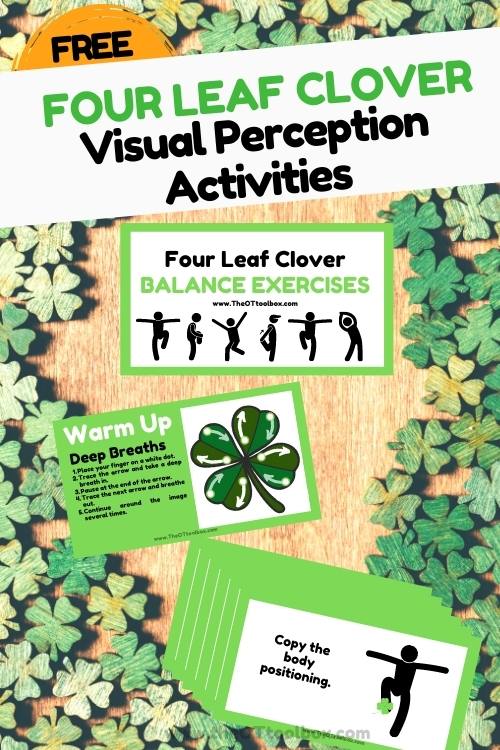
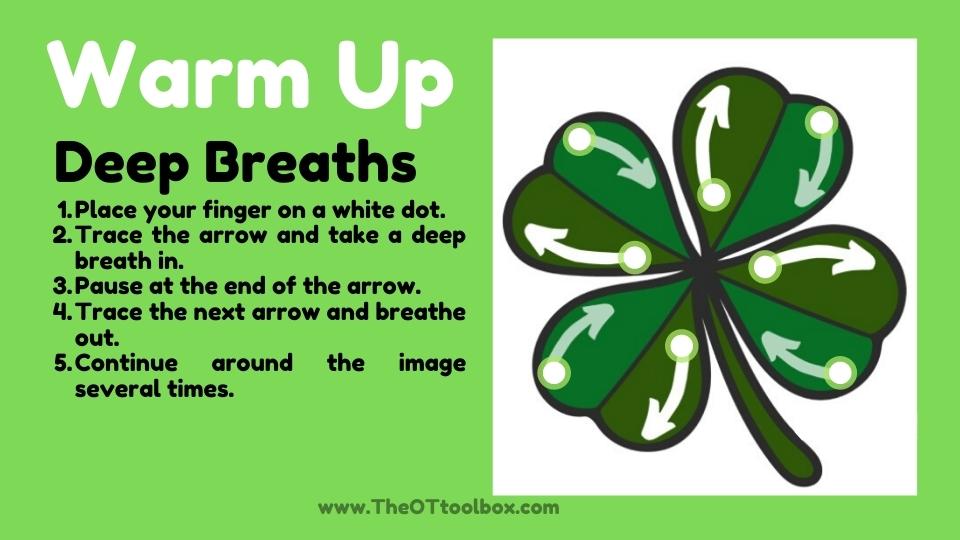
      4 leaf clover activity includes a deep breathing activity and balance exercises.

      Kids can start with the deep breathing warm up activity, using the clover image. Kids can start by taking deep breaths in and out and following the directions on the 4 leaf clover image.

      Deep breathing exercises are a powerful way to achieve a calm-alert state, so that children are ready to learn and participate in therapy. This self-regulation benefit, along with the mindfulness and relaxation benefits makes this four leaf clover breathing exercise a great way to start any therapy session.

      You can get a printable version of this four leaf clover deep breathing exercise here on our site. It includes a coloring page, too, so if that would add to your therapy session, be sure to print that off as well.

      Use these four leaf clover exercises for balance and sensory input.

      Next, kids can move onto the balance exercises. Kids can use a bean bag or a pillow with each exercise to really challenge balance and coordination.

      For kids in virtual therapy, a bean bag may not be available. In that case, kids can balance with a pillow in the place of the clover images. Other ideas include using rolled up socks or a stuffed animal.

      Each slide deck moves kids through a set of exercises to incorporate core strength and stability, movement changes, inverted positioning, and motor planning challenges. By completing the 4 leaf clover exercises, kids are also gaining vestibular, and proprioceptive sensory input.

      Free 4 Leaf Clover Slide Deck

      Want a copy of this free therapy slide deck?

      Enter your email address into the form below and this slide deck will be sent to your email. You can make a copy onto your Google drive and then use it in teletherapy sessions, in home programming, or as a classroom brain break activity.

      Four Leaf Clover Balance Exercises!

        We respect your privacy. Unsubscribe at anytime.
        Colors Handwriting Kit

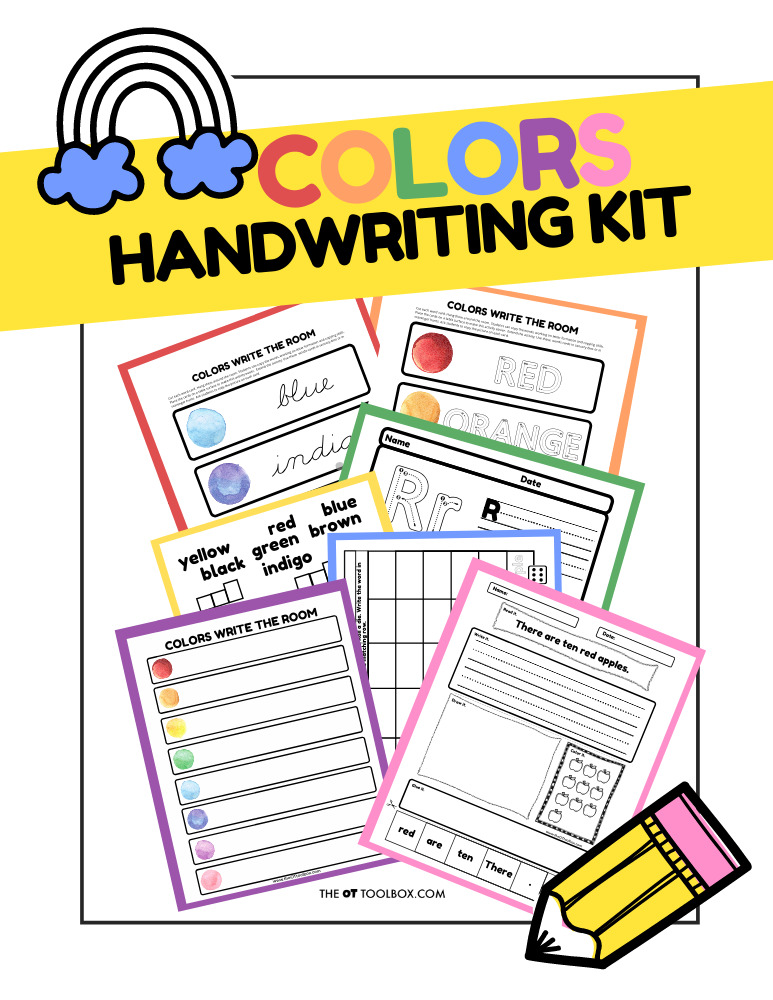
        Rainbow Handwriting Kit– This resource pack includes handwriting sheets, write the room cards, color worksheets, visual motor activities, and so much more. The handwriting kit includes:

        • Write the Room, Color Names: Lowercase Letters
        • Write the Room, Color Names: Uppercase Letters
        • Write the Room, Color Names: Cursive Writing
        • Copy/Draw/Color/Cut Color Worksheets
        • Colors Roll & Write Page
        • Color Names Letter Size Puzzle Pages
        • Flip and Fill A-Z Letter Pages
        • Colors Pre-Writing Lines Pencil Control Mazes
        • This handwriting kit now includes a bonus pack of pencil control worksheets, 1-10 fine motor clip cards, visual discrimination maze for directionality, handwriting sheets, and working memory/direction following sheet! Valued at $5, this bonus kit triples the goal areas you can work on in each therapy session or home program.

        Click here to get your copy of the Colors Handwriting Kit.

        Colleen Beck, OTR/L has been an occupational therapist since 2000, working in school-based, hand therapy, outpatient peds, EI, and SNF. Colleen created The OT Toolbox to inspire therapists, teachers, and parents with easy and fun tools to help children thrive. Read her story about going from an OT making $3/hour (after paying for kids’ childcare) to a full-time OT resource creator for millions of readers. Want to collaborate? Send an email to contact@theottoolbox.com.

        Exercise and Mood: Why Does my Child Need to Exercise?

        Exercise and mood in kids

        Years of research and personal experience can tell us that adults tend to function better with regular exercise. Exercise helps us sleep better, reduce our stress, and manage our weight2. But what about our kids – how do they benefit from exercise? Today we are going to dive deep into the research and see why and how our kids should exercise to better their mood. Let’s look at the link between exercise and mood, and establishing healthy habits that lead to function and independence in kids.

        Related: Emotional Regulation and Executive Functioning Skills.

        Exercise and mood in children. Kids benefit from exercise to help with tantrums, behaviors, and confidence.

        Exercise and Mood: Managing TEMPER TANTRUMS

        If your child is having issues with emotional regulation, it may come out as a temper tantrum. You know the feeling of having no control over your emotions; being taken on a ride of sadness, aggression, and pounds of heavy frustration. Most adults have had enough practice honing their emotional regulation skills to keep them from screaming in the middle of the grocery store after a long day. Children, however, are still working on developing emotional regulation skills, and because of that, their overall mood can suffer.

        Also related is the mood of those around us, or co-regulation. This is another aspect of mood that we don’t always first think of as it relates to our behavior and actions.

        According to research new and old, exercise can help a child better regulate their mood9. Next time your child is screaming in the middle of Target, think to yourself – have they gotten enough physical activity recently? I have found that 30 mins of exercise in the morning can help even out moods for the whole day. Plus, you are bound to get a good nap time out of them if they have gotten enough physical activity – double whammy for everyone’s mood!

        Tips for Exercise and Mood

        Try these tips for encouraging exercise to reduce tantrums in toddlers:

        • Instead of pushing your toddler in a scroller on neighborhood walks, encourage them to walk next to you for a while.
        • Use classic movement songs to incorporate movement into their day – our favorites are “Animal Action” By Greg and Steve, “Jim Along Josie” By Pete Seeger, and “Pet Parade” by Hoyt Axton.
        • If screen time is a part of your routine, use videos like Cosmic Kids Yoga  to make the screen time more valuable.

        Exercise to REDUCe ANXIETY AND DEPRESSION

        Research shows that regular exercise in youth can treat anxiety and depression in the short term and long-term 3,4. Some studies suggest that high-intensity exercises, that will increase cardiorespiratory activity, improve mood more than low-impact exercises, like yoga5.

        While there is lots of evidence to support that exercise can improve mood in both adults and children, some of the research points to other affects that exercise programs can have on children. For example, when children are enrolled in sports or other physical activity programs, they are also socially active and get attention from adults, which may also positively impact their mood7.

        Whatever way you look at it, exercise is likely to improve their mood and guard against anxiety and depression.

        Exercise for self-CONFIDENCE

        One way that exercise improves mood is through raising self-esteem – physical activity gives you a confidence boost! Research shows that all kinds of physical activity contribute to a rise in self-esteem5.

        Self-esteem is so important in all the occupations that children have, particularly in school. Academic and social success are partially dependent on self-esteem and self-worth, and both contribute to a positive mood.

        “Psychological and behavioural problems in children and adolescents are common, and improving self‐esteem may help to prevent the development of such problems” (Ekeland et al., 2004).

        Exercise and positive BEHAVIORS

        In one study, researchers found that teachers reported an increase in wanted behaviors for children enrolled in both high and low-intensity exercise programs5. The theory here is that when a child’s physical activity needs are met, they are better able to regulate their emotions, attention, and behaviors9.

        This comes with the awesome effects that exercise has for executive functioning, which controls many cognitive abilities6. With this increase in desirable behaviors, they will be more likely to develop positive relationships with their peers, teachers, and family members8.

        “Exercise…is highly relevant in preadolescent children… given the importance of well-developed executive functions for daily life functioning” (Verburgh et al., 2014). 

        Exercise has been shown to increase self-esteem, cognition and academic success, and decrease depression and anxiety in children3. Not to mention the obvious health factors associated with physical activity like heart and respiratory function. All said, exercise is integral to the overall health and wellness of our children.

        EXERCISES FOR KIDS

        After all that exercise talk, we have to offer some great ideas to add to your list! Most important to any exercise routine – you have to do what you love! Find what your kids like and encourage them to try new activities.

        Another key strategy to encourage exercise in kids is to model healthy habits as the child’s parent. When parents model healthy choices, fitness, and regular exercise, kids see that and are more likely to follow suit with their own healthy choices.

        One way that adults can model healthy choices is through exercising in the home. When kids see adults exercising, they have that positive interaction with physical activity.

        Having a treadmill in the home is one sure-fire way to encourage movement, exercise, and healthy habits that are integrated into the day-to-day. With  Horizon Fitness treadmills and fitness equipment, you get the availablity of cardio equiptment right in the home. It’s there as a visable option for adding movement and regular cardio exercise on a daily or weekly basis.

        Plus, parents of children can benefit from the fitness programs for quick and effective workouts that fit into the busy family’s schedule. Horizon offers a number of entertainment apps and streaming options, including Bluetooth speakers,  live or on-demand fitness apps, and other streaming fitness opportunities. All of these extras are designed to promote improved physical exercise and meaningful motivation.

        Click here to join me in using Horizon Fitness equipment as a tool to ensure healthy families.

        References

        1. Ekeland, E., Heian, F., Hagen, K. B., Abbott, J. M. & Nordheim, L. (2004). Exercise to improve self‐esteem in children and young people. Cochrane Libary of Systematic Reviews. https://doi.org/10.1002/14651858.CD003683.pub

        2. Oaten, M. & Cheng, K. (2010). Longitudinal gains in self‐regulation from regular physical exercise. The British Journal of Health Psychology,11(4). https://doi.org/10.1348/135910706X96481

        3. Ortega, F. B., Ruiz, J. R., Castillo, M. J. & Sjöström, M. (2008). Physical fitness in childhood and adolescence: a powerful marker of health. International Journal of Obesity, 32, 1–11. https://doi.org/10.1038/sj.ijo.0803774

        4. Pascoe, M. C. & Parker, A. G. (2018). Physical activity and exercise as a universal depression prevention in young people: A narrative review. Early Intervention in Psychiatry, 13(4). https://doi.org/10.1111/eip.12737

        5. Telles, S., Singh, N., Bhardwaj, A. D., Kumar, A. & Balkrishna, A. (2013). Effect of yoga or physical exercise on physical, cognitive and emotional measures in children: a randomized controlled trial. Child and Adolescent Psychiatry and Mental Health,7(37). https://doi.org/10.1186/1753-2000-7-37

        6. Verburgh, L., Königs, M., Scherder, E. J. A., & Oosterlaan, J. (2014). Physical exercise and executive functions in preadolescent children, adolescents and young adults: a meta-analysis. British Journal of Sports Medicine,48, 973-979. https://bjsm.bmj.com/content/48/12/973

        7. Williams, C. F., Bustamante, E. E., Waller, J. L. & Davis, C. L. (2019). Exercise effects on quality of life, mood, and self-worth in overweight children: the SMART randomized controlled trial. Translational Behavioral Medicine,9(3), 451–459. https://doi.org/10.1093/tbm/ibz015

        8. Xue, Y., Yang, Y. & Huang, T. (2019). Effects of chronic exercise interventions on executive function among children and adolescents: A systematic review with meta-analysis. British Journal of Sports Medicine,53, 1397-1404. doi:10.1136/bjsports-2017-097600

        9. Zhang, Y., Fu, R., Sun, L., Gong, Y., & Tang, D. (2019). How does exercise improve implicit emotion regulation ability: Preliminary evidence of mind-body exercise intervention combined with aerobic jogging and mindfulness-based yoga. Frontiers in Psychology,10. doi: 10.3389/fpsyg.2019.01888

        Sydney Thorson, OTR/L, is a new occupational therapist working in school-based therapy. Her
        background is in Human Development and Family Studies, and she is passionate about
        providing individualized and meaningful treatment for each child and their family. Sydney is also
        a children’s author and illustrator and is always working on new and exciting projects.

        Exercise and Mood Resources for Kids

        You’ll love these resources designed to help kids get moving, exercising, and building skills, and kids won’t even realize they are “exercising”!

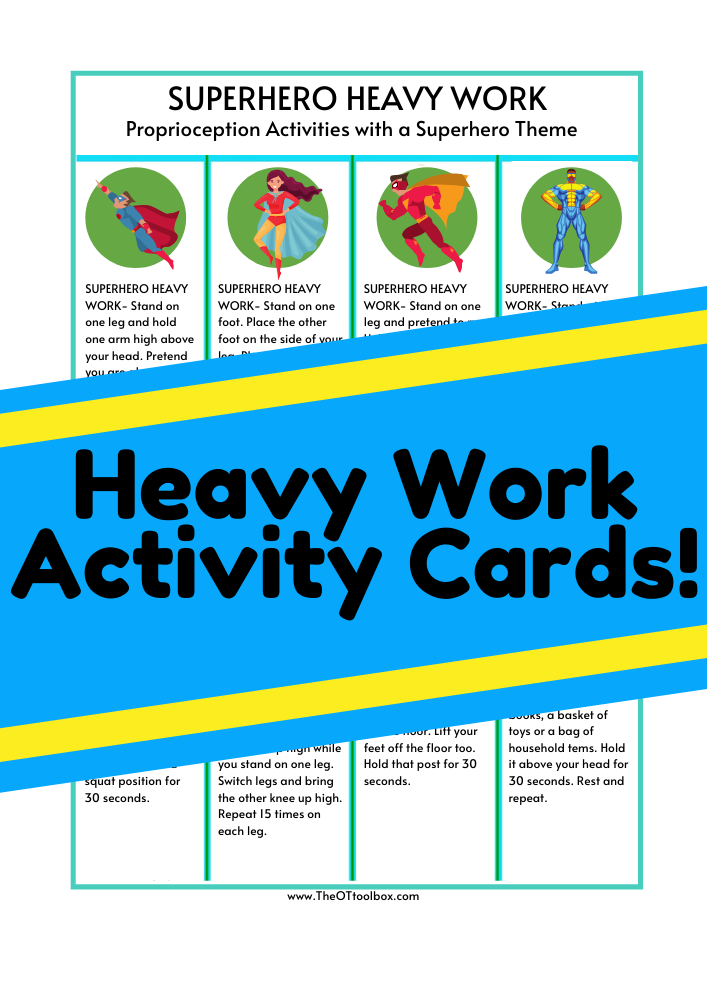
        Designed to use fun themes, these heavy work activity cards add proprioceptive input to help kids become more aware of their body’s position in space.

        Heavy work input allows kids to gain more awareness of motor planning skills, coordination, AND strengthening in fun and creative ways.

        Incorporate the themed exercise cards into learning themes or play.

        Grab your set of heavy work exercise cards, now.

        Includes themes:

        1. Trucks Heavy Work Activities
        2. Insects Heavy Work Activities
        3. Sea Animals Heavy Work Activities
        4. Farm Animals Heavy Work Activities
        5. Jungle Animals Heavy Work Activities
        6. Woodland Animals Heavy Work Activities
        7. Superheroes Heavy Work Activities
        8. Sports Heavy Work Activities
        9. Monsters Heavy Work Activities
        10. Summer Heavy Work Activities
        11. Butterfly Life Cycle Heavy Work Activities
        heavy work activity card example

        Color Exercises

        Color exercises for teletherapy

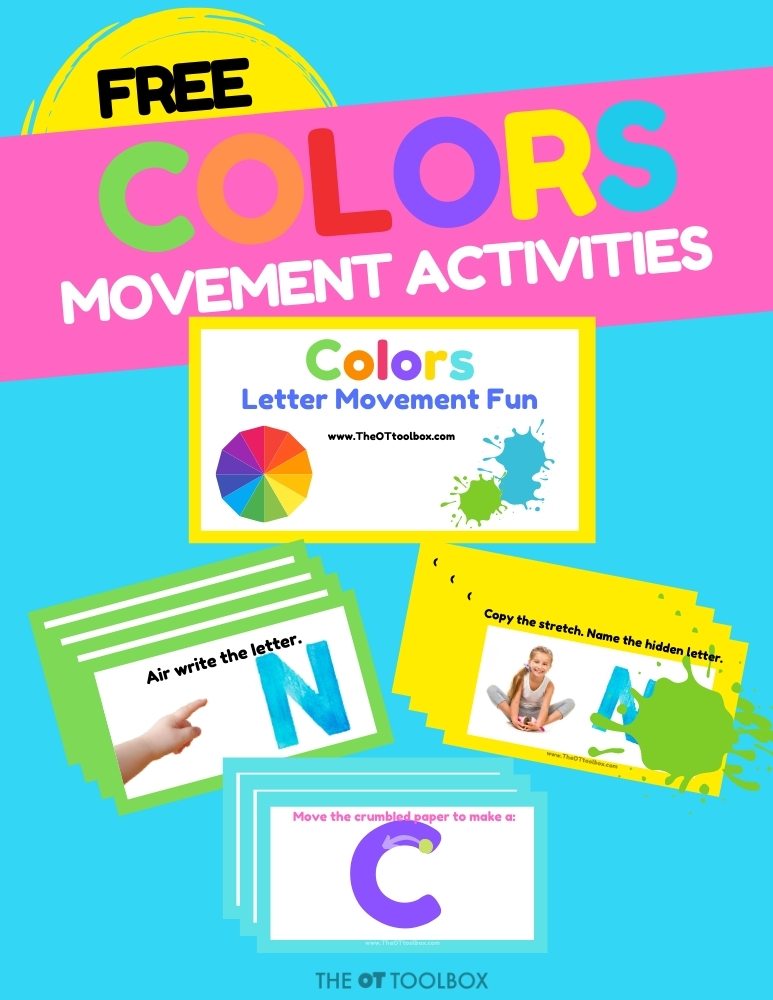
        Looking to get kids moving and building skills in therapy sessions or at home? These color exercises use all the colors of the rainbow to help kids move and strengthen gross motor skills, fine motor skills, and even visual motor skills! Add these whole body exercises use colors as a therapy theme, but I love that the colorful exercise activities get kids strengthening muscle groups in big and small ways.

        This therapy activity slide deck is one of the many free slides available here on the site, as a resource for teletherapy, home programs, and therapy planning!

        Be sure to grab the free I Spy Colors therapy slide deck, too. For a hands-on activity, be sure to use our color by letter worksheet.

        Color exercises for teletherapy

        Related resource- Working with kids in teletherapy? Need streamlined info on how to structure your sessions? Need activities for week-to-week therapy planning? need answers for all of your teletherapy questions? Join the free teletherapy course, a 5 day email series on telehealth for occupational therapists.

        Color exercises

        This is a color learning activity, that can be used in teletherapy sessions to develop many skill areas:

        Color exercises for kids

        Gross Motor Color Exercises

        All of these gross motor skill areas can be addressed using the color activities in this slide deck:

        • Gross motor skills
        • Core strength
        • Bilateral coordination
        • Crossing midline
        • Core strength
        • Stability
        • Balance and equilibrium skills
        • Coordination
        • Range of motion
        • Flexibility
        • Motor planning
        • Crossing midline
        • Movement patterns
        • Posture and postural control
        • Muscle tone
        • Proprioceptive input
        • Vestibular input

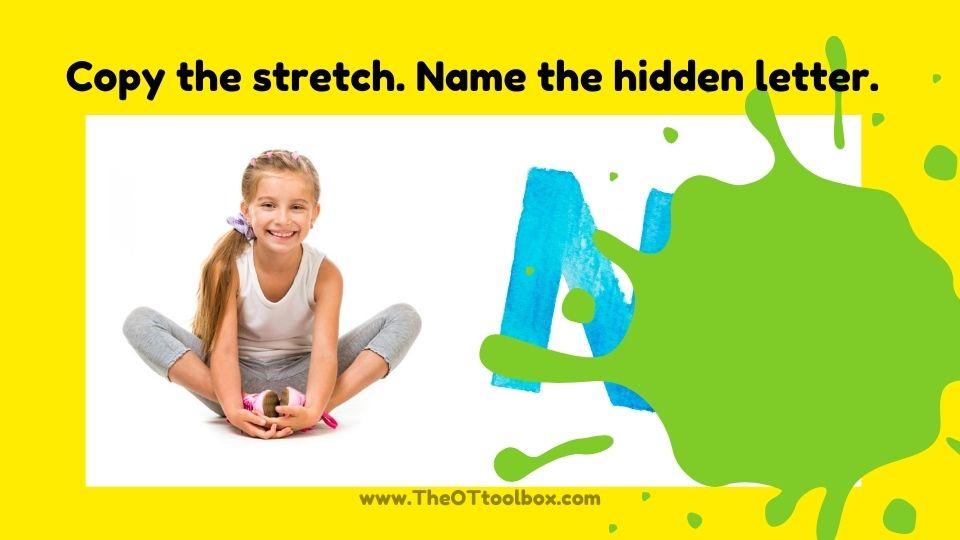
        As kids go through the slides, they need to complete various stretches, challenging the skills listed above. There are movement patterns, crossing midline activities, yoga positions, and more. Kids can go through these slides several times if you like, to work on motor planning, sequencing, and memory skills.

        Color and letter exercises

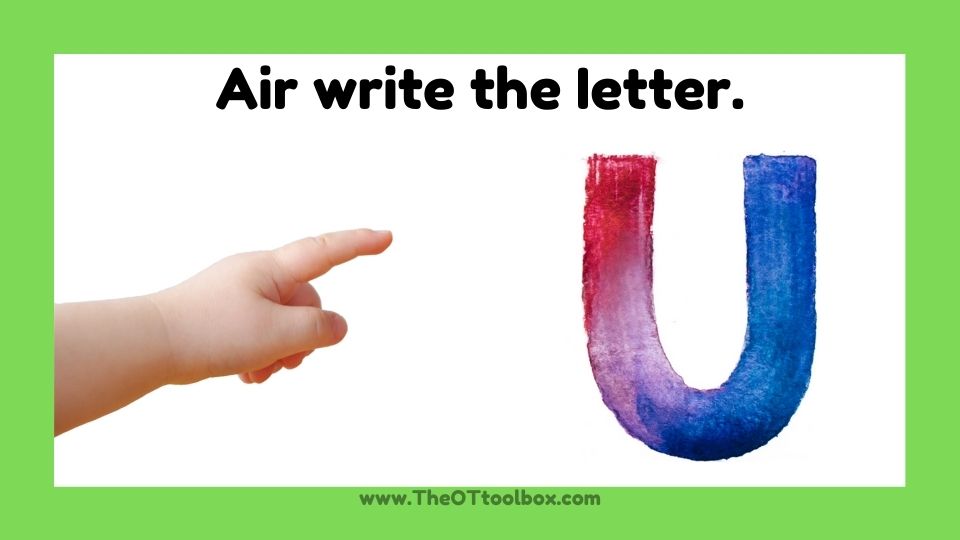
        Then, the slides ask the child to air write letters. This is an eye-hand coordination activity that incorporates shoulder positioning and strengthening, finger isolation, and crossing midline, motor planning, range of motion.

        These slides also work on visual perceptual skills including visual closure as kids identify the hidden letter.

        Grade and extend this activity:

        • Challenge kids by calling out a color and they can complete that gross motor activity.
        • Having the child air write the letter associated with the color and writing the letter larger or smaller, using whole arm motions, or just the finger.
        • Challenge kids by calling out a color and asking them to air write the letter.
        • Or ask kids to complete the air writing task while in the gross motor stretch activity.
        Color hand strength exercises

        Fine Motor Color Exercises

        This slide deck challenges fine motor skills as well. Kids can use their finger and work on finger isolation as they write the letters on each of the color slides.

        There is another movement section of the slide deck that incorporates colored letters with a fine motor activity. All students will need is a piece of paper (scratch paper works, so tell them to grab an old homework page or even a piece of junk mail) and their hands.

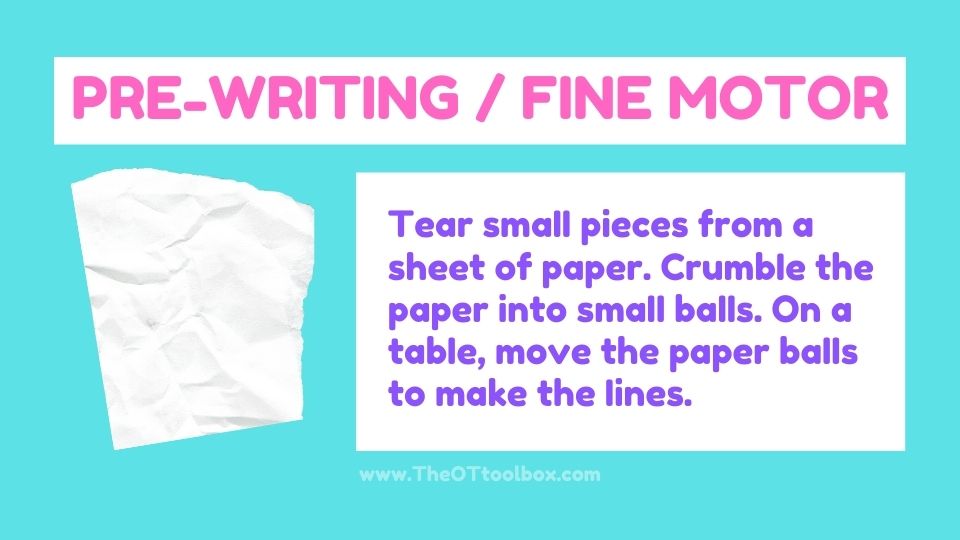
        Following the directions on the fine motor activity slides, they will tear the paper into small pieces using their hands to tear and crumble. Tearing paper with the hands and using the finger tips to crumble small bits of paper strengthens the intrinsic muscles of the hands. Here is more information on tearing paper as a fine motor activity.

        This activity works on fine motor skills:

        • Arch development
        • Intrinsic hand strength
        • Open thumb web space
        • Hand strength
        • Dexterity
        • Precision
        • Graded tearing- eye hand coordination
        • Separation of the sides of the hand

        Then, you can extend this activity to use it in different ways or to challenge kids of all levels and ages:

        • Use different colored paper to match with different letter activities and gross motor exercises in the first part of the slide deck.
        • Use different grades of paper to make the exercise more difficult. Heavy weight paper like construction paper, cardstock, or paper plates is more of a challenge and lighter weight paper like thing paper, wrapping paper, wax paper, or tissue paper is easier.
        • Encourage children to use only the very tips of one hand.
        • Ask kids to write a letter on the small piece of paper and then crumble it up so the letter is hidden.
        Letter exercises using colors

        Visual Motor Exercise with Colors

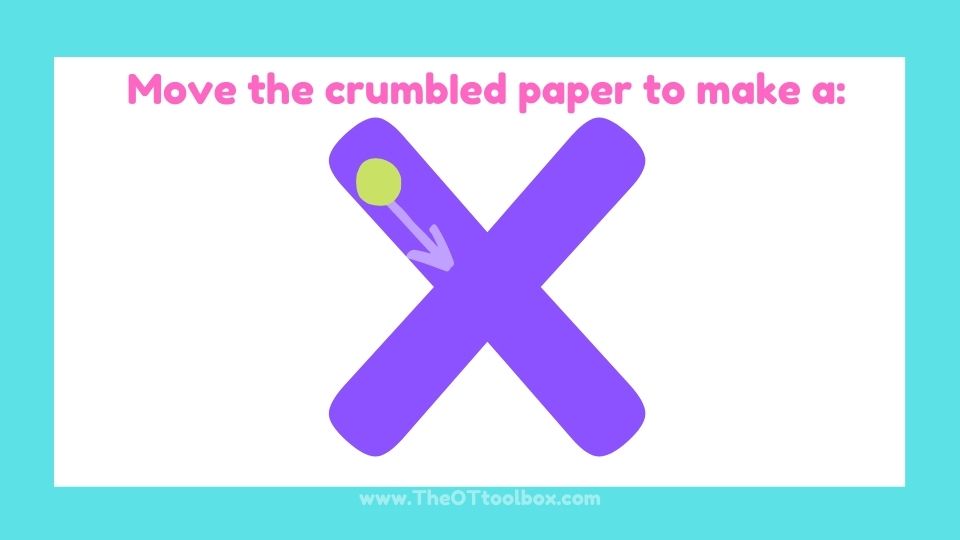
        Finally, the last part of this slide deck is a visual motor exercise. Children can use those small pieces of paper to copy the lines and letters on the slides.

        This activity includes strait lines for younger children to incorporate pre-writing lines. There are also letters included for kids working on forming letters.

        Extend this activity

        • Matching letters to the exercises at the beginning of the deck.
        • Kids could also form letters using the paper balls by memory rather than copying the letter forms.
        Color exercise for self regulation

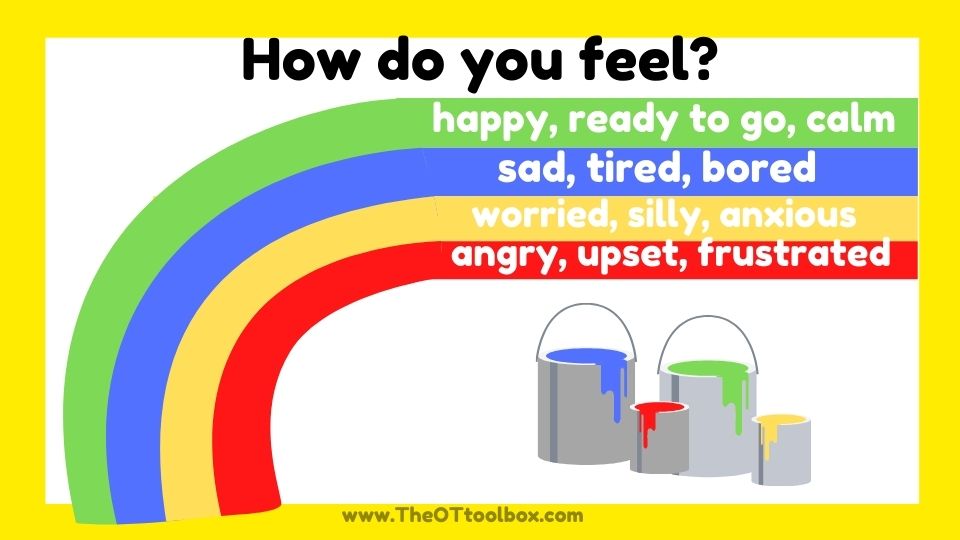
        The slide deck ends with a color self regulation exercise. Kids can choose the color that matches their feelings, alert state, and regulation needs, all with a rainbow color theme!

        Virtual Color Exercise Activities

        Want this free therapy slide deck? Enter your email into the form below. Grab the free Google slide deck by entering your email into the form below. You will receive a PDF containing a link to open the slide deck. Be sure you are logged into your Google account before clicking the button on that PDF. Save the PDF in your therapy files so you can access this resource any time and share with those on your caseload.

        Color Exercises!

          We respect your privacy. Unsubscribe at anytime.

          Colleen Beck, OTR/L has been an occupational therapist since 2000, working in school-based, hand therapy, outpatient peds, EI, and SNF. Colleen created The OT Toolbox to inspire therapists, teachers, and parents with easy and fun tools to help children thrive. Read her story about going from an OT making $3/hour (after paying for kids’ childcare) to a full-time OT resource creator for millions of readers. Want to collaborate? Send an email to contact@theottoolbox.com.
          Valentine’s Day Gross Motor Activity

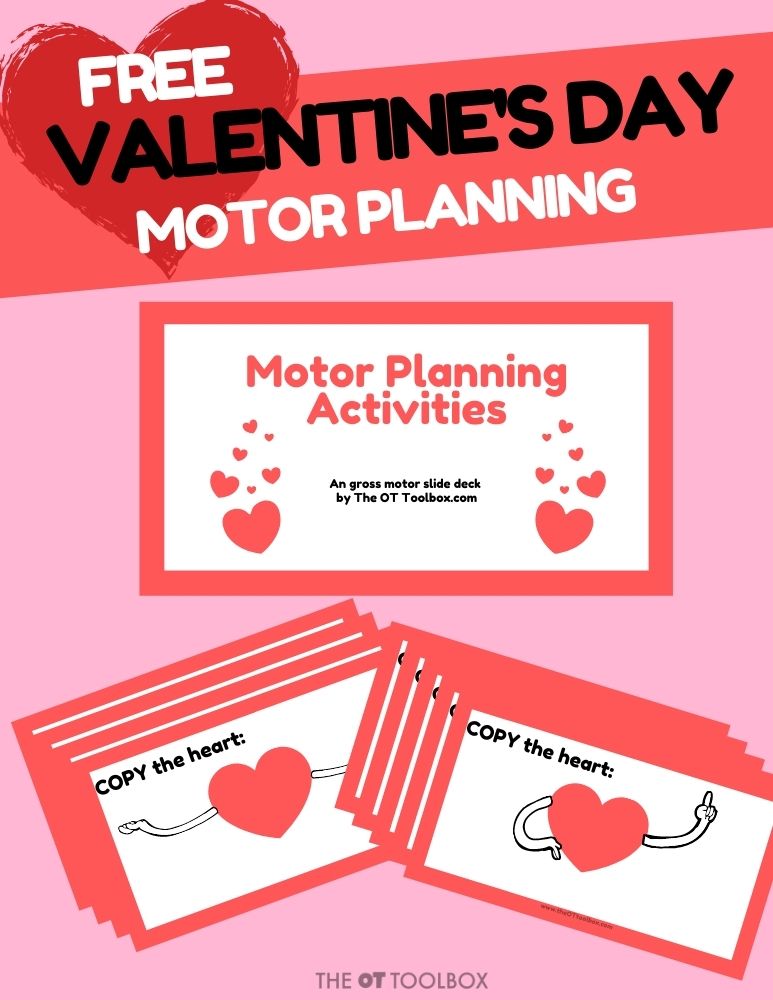
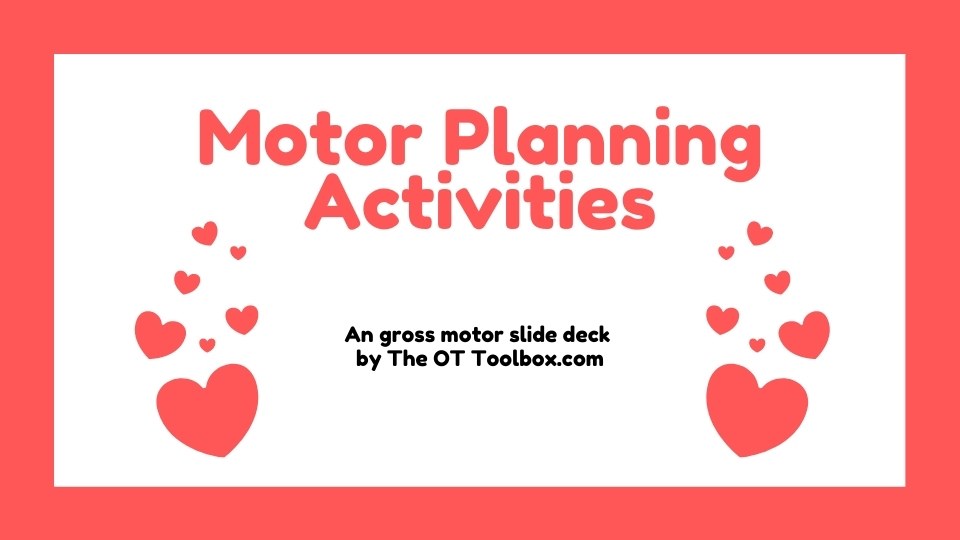
          Valentines day gross motor slide deck for helping kids with movement, motor planning, coordination, and other gross motor skills.

          Today, I’m excited to bring you another free Google slide deck, this one is a way to get kids moving and working on motor planning skills. It’s a Valentine’s Day gross motor activity that challenges bilateral coordination, crossing midline, movement challenges, and motor planning skills. Kids can follow along with this therapy slide deck and use the heart theme therapy activity to work on so many movement skills. Let’s get those kiddos moving in occupational therapy, physical therapy, in the classroom, or at home!

          Valentines day gross motor slide deck for helping kids with movement, motor planning, coordination, and other gross motor skills.

          Valentine’s Day Gross Motor Activity

          If hands-on activities that are used by many different children are possible, sensory-based tactile activities like this bilateral coordination activity with heart drawing is the way to go for building motor planning and coordinated use of both hands.

          However, if you’re working with many children or in virtual therapy situations, a guided slide deck can be helpful in encouraging kids to build specific skills like motor planning, coordination, and strengthening.

          That’s where this Valentine’s Day gross motor activity comes in.

          This slide deck is a tool for helping kids develop skills in a variety of areas:

          • Balance
          • Coordination
          • Motor planning
          • Crossing midline
          • Movement changes
          • Sequencing

          The heart theme is a fun way to encourage movement of these gross motor skills.

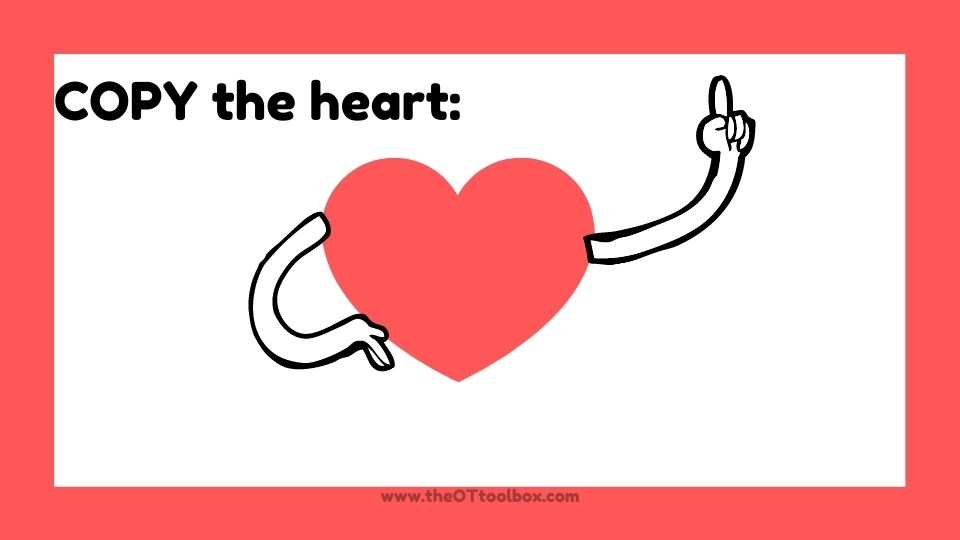
          Copy the heart motor planning exercise

          Kids can copy each slide in the deck and work on motor planning skills.

          There are different upper body movement activities that can be used based on the needs of each individual child.

          Working on balance? Go through the slides while standing on one foot and then the other.

          Working on motor planning? Go through several slides and ask the child to recall the sequence of the movements as they complete the arm positioning with their eyes closed or without the visual prompt of the slides. Or, challenge the child to go through the movements as fast as they can.

          Need a brain break activity? Combine heavy work like animal walks, wall push-ups, burpees, push-ups, or chair push-ups between each arm positioning.

          Working on listening skills or direction-following? Use the slide deck in a “Simon Says” activity.

          Valentines Day motor planning activities

          Valentine’s Day Gross Motor Slide Deck

          Want to add this slide deck to your therapy toolbox? Enter your email address into the form below.

          Enter your email address below and you will receive a PDF containing a link to copy the slide deck onto your Google drive. Next, save that PDF file, because you can come back to it again and again and send it to the kids on your caseload (or classroom) so they can make their own copy on their Google drive.

          Please use the copy of the slide deck and do not change the url.

          FREE Valentine’s Day Gross Motor Therapy Activities!

            We respect your privacy. Unsubscribe at anytime.

            Want to add more Valentine’s Day activities and movement tools to your skill-building?

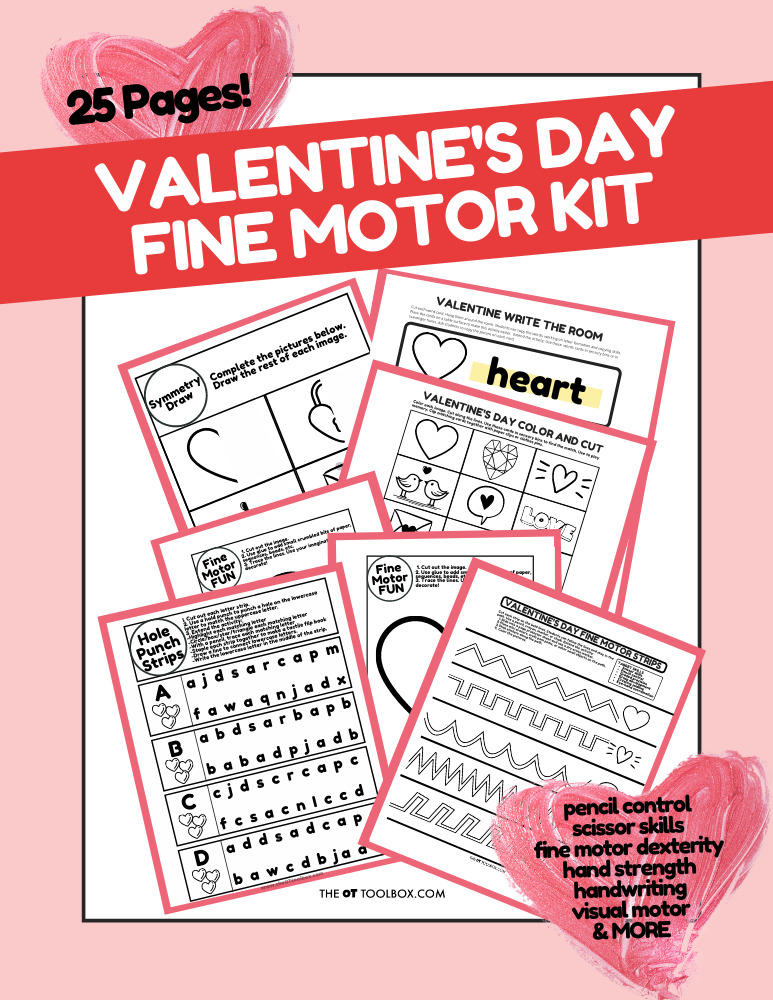
            The Valentine’s Day Fine Motor Kit is here! This printable kit is 25 pages of hands-on activity sheets designed to build skills in pinch and grasp strength, endurance, eye-hand coordination, precision, dexterity, pencil control, handwriting, scissor skills, coloring, and more.

            When you grab the Valentine’s Day Fine Motor Kit now, you’ll get a free BONUS activity: 1-10 clip cards so you can challenge hand strength and endurance with a counting eye-hand coordination activity.

            Valentines Day fine motor kit
            Valentine’s Day Fine Motor Kit to develop fine motor strength, endurance, dexterity, and coordination of hand skills.

            Click here to grab your copy of the Valentine’s Day Fine Motor Kit.

            Colleen Beck, OTR/L has been an occupational therapist since 2000, working in school-based, hand therapy, outpatient peds, EI, and SNF. Colleen created The OT Toolbox to inspire therapists, teachers, and parents with easy and fun tools to help children thrive. Read her story about going from an OT making $3/hour (after paying for kids’ childcare) to a full-time OT resource creator for millions of readers. Want to collaborate? Send an email to contact@theottoolbox.com.
            Penguin Yoga

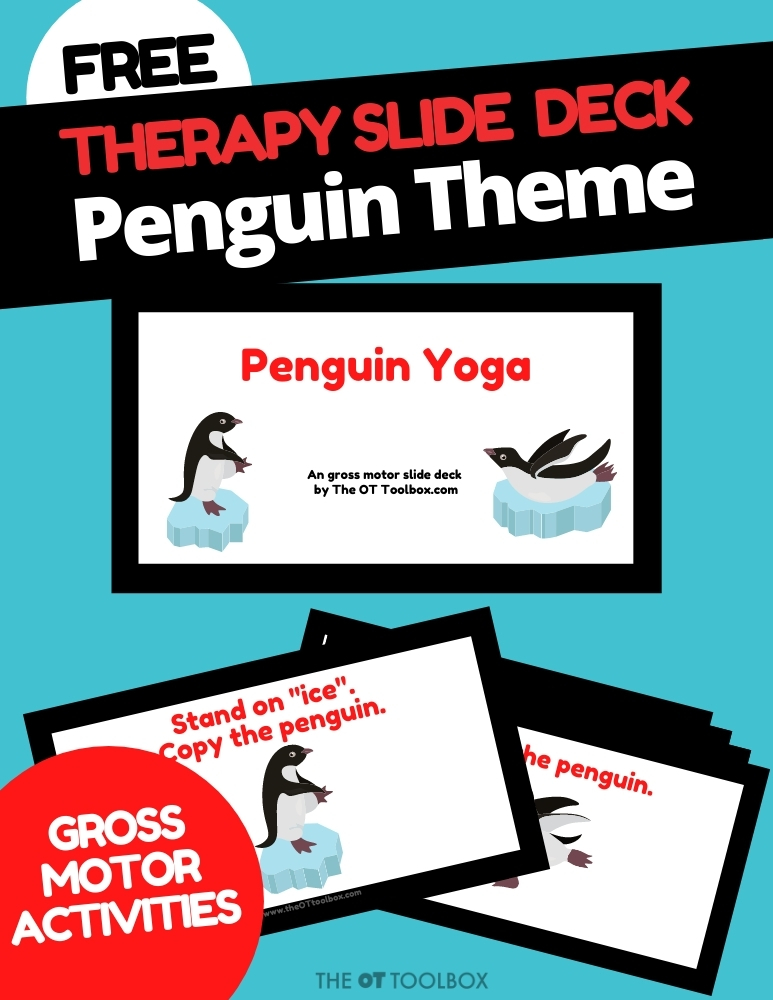
            Penguin Yoga slide deck for teletherapy

            Did you ever wonder if a penguin can do yoga? Well, today we’re not talking about penguins doing yoga…we are talking about penguin-themed yoga exercises! These are brain breaks for kids that are a great addition to a penguin theme in the classroom or home. Last week, we had a polar bear therapy slide deck full of yoga and gross motor activities for you. It goes well with this penguin yoga slide deck. Use it in virtual therapy, in home programs, or as a brain break in distance learning or therapy at home!

            Penguin Yoga gross motor slide deck for teletherapy or brain breaks.

            Penguin Yoga Exercises

            This slide deck is a fun way to get the kiddos moving along with the penguins. Like many of our other slide decks, you’ll find the movements include heavy work exercises for proprioceptive input that can be calming and centering.

            Other slides are vestibular activities that encourage movement in various planes.

            These slides can be part of a sensory diet for scheduled sensory activities throughout the day. Read more on how to start a sensory diet.

            Add these slides to brain breaks or other movement activities throughout the virtual classroom or teletherapy day.

            Yoga and Balance

            This slide deck has two options for each yoga movement. The nice thing about yoga exercises is that each movement can be modified to meet the needs of the individual while challenging abilities and strength at a “just right” level.

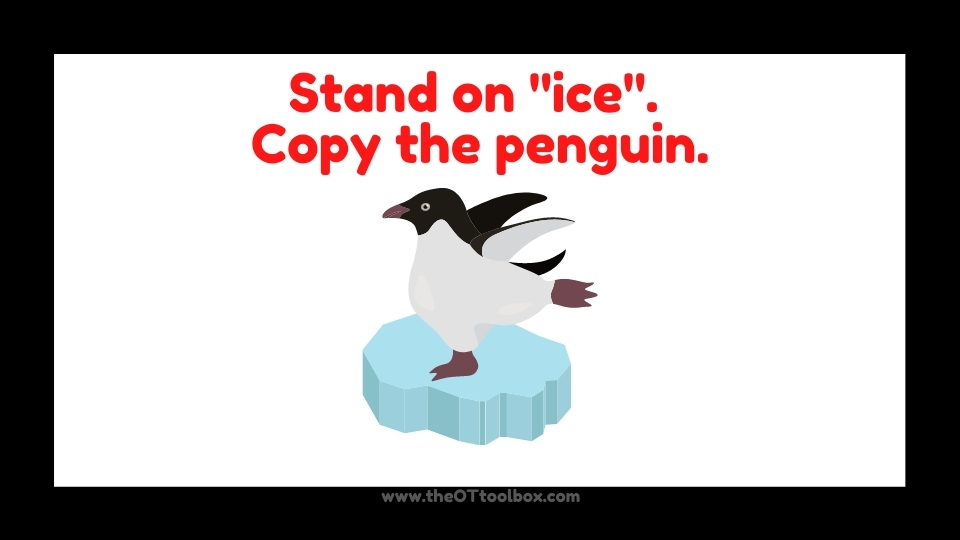
            You’ll notice that each slide has one penguin on it. As you progress through the slide deck, the penguin does a move, and then it does that same move on an iceberg or piece of ice. This can be a way to challenge kids and work on core strength, coordination, motor planning, and upper or lower body strength depending on the yoga position.

            Kids can use an object they have in the home and pretend they are a penguin posing on the slab of ice. Some ideas to use include:

            • Couch cushion
            • Folded towel
            • Washcloth or flat fabric
            • Paper plate
            • Hoola hoop
            • Any object in the home!

            Ask the child to complete the yoga move and then complete the yoga exercise concentrating on balance.

            This slide deck is not interactive. There are no moveable pieces on this particular slide deck.

            Penguin yoga exercises for brain breaks for kids

            Winter Activities for Kids

            Use the penguin yoga along with these winter activities for whole-body movement and development activities that are effective in building skills in kids:

            Winter Fine Motor Kit– Use this printable kit to help kids develop and strengthen fine motor skills. The 100 page kit includes penguin theme activities, polar bears, and other arctic activities, as well as all-things winter.

            Indoor winter activities for kids– Try these fun and effective ways to to incorporate movement during the winter months.

            Winter Brain Breaks– Just like our penguin brain breaks, these winter theme movement activities will get brains and bodies developing!

            Penguin themed snacks– These cute snacks are easy to make and get the kids developing skills in the kitchen.

            Get the Penguin Slide Deck for Teletherapy

            You can grab a copy of this Google slide deck and use it to work on specific skills.

            Enter your email address below and you will receive a PDF containing a link to copy the slide deck onto your Google drive. Next, save that PDF file, because you can come back to it again and again and send it to the kids on your caseload (or classroom) so they can make their own copy on their Google drive.

            Please use the copy of the slide deck and do not change the url.

            FREE Penguin Yoga Gross Motor Therapy Activities!

              We respect your privacy. Unsubscribe at anytime.

              MORE VIRTUAL LEARNING SLIDE DECKS?

              Would you like more therapy slide decks? Grab the others to add to your therapy toolbox!

              Try this Polar Bear Gross Motor Slide Deck.

              Use this Holiday Cookies Activities to address working memory, visual perception, and direction following.

              Here is a Community Helpers Theme Slide Deck.

              Here is a Football Theme Slide Deck.

              Here is a slide deck for a Social Story for Wearing a Mask.

              Here is a Space Theme Therapy Slide Deck.

              Here is a Therapy Planning Interactive Slide Deck.

              Here is a Back to School Writing Activity Slide Deck.

              Here is an Alphabet Exercises Slide Deck.

              Here is a Self-Awareness Activities Slide Deck.

              Bear Brain Breaks

              bear brain breaks

              These bear brain breaks are perfect for winter time movement, or using in a bear theme in school or in therapy. Sometimes, brain breaks are the perfect tool to can help with movement or sensory needs in the classroom.  We used a favorite childhood book to come up with bear themed brain breaks that can be used alongside the book in a movement and learning activity or in a bear-themed classroom activities.  Not long ago, we shared more brain break ideas that you might like to add to your classroom.

              Use these bear brain breaks along with ideas from our hibernation activities for more winter fun!


              bear brain breaks

              Bear Brain Breaks

              Looking for brain break videos for the classroom or home? Here are the best brain break videos on YouTube.
               
              Bear brain breaks for movement and learning in the classroom setting with a bear theme

              This post contains affiliate links.

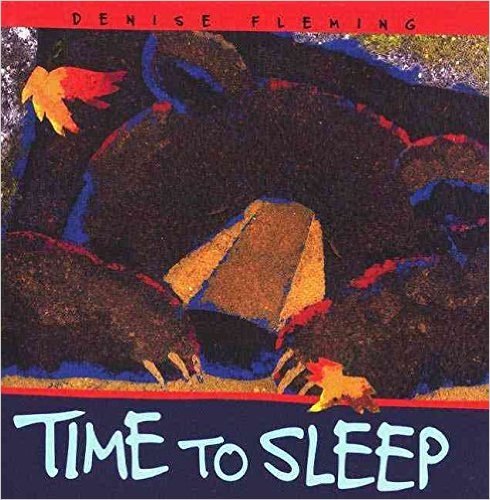
              Have you read the book, “Time for Sleep” by Denise Fleming? My kids loved to hear about all of the animals as they prepared for sleep over the winter.  We decided to try a few bear gross motor moves based on the book.

              Bear Theme Brain Breaks

              Stretches and whole-body movements that happen in a calm manner are a great way to prepare for sleep, so these activities went along nicely with the bear in the book as well as the getting ready for sleep theme.

              If fidgeting, wiggling, or just a break from screens is needed, try these movement breaks to help. 

              We created these themed brain breaks to go along with the book, Time to Sleep, but they are perfect for any day (or when paired with other bear books)!

              If you are looking for resources for sleep or bedtime relaxation stretches, we shared some based on another children’s book.

              Time for Sleep by Denise Fleming and bear themed brain breaks for a bear activity.
               
              This is such a fun book to read with kids.  It would go along perfectly with a bear theme in your classroom.  Try adding some gross motor movement activities based on the book.
               
              Kids can then use the bear themed brain breaks throughout their day when it seems the classroom or individual students need a movement break. 


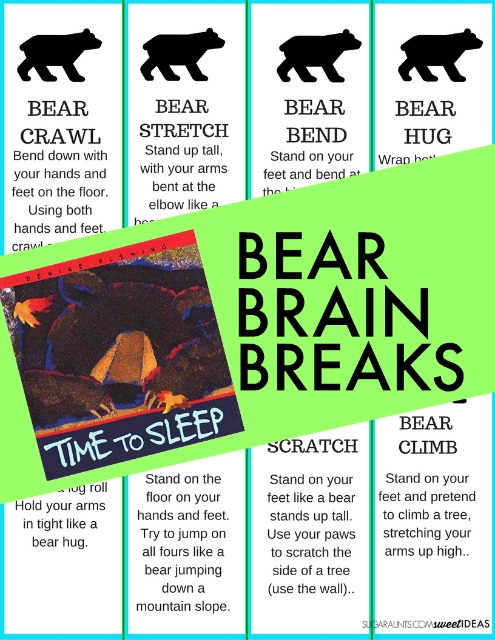
              Below, you can enter your email to access the free brain break printable that would go along perfectly for teaching the classroom about these bear brain breaks.  They can be cut up and laminated for the children to pull out of a cup.  Or, add them to a key ring for bear themed movement activities.
                
               
              Using these bear brain breaks, kids can stretch, roll, reach, climb, and crawl like a bear.  There are eight bear themed movement activities included that allow kids to move with a bear theme.  
               
              Read the book Time for Sleep and try the movement activities!
               
              Bear brain break ideas for kids
               

              Bear Activities

              Looking for more bear themed activities?  Try these hands-on ways to play with a bear theme based on bear books like “Time for Sleep”.

              Polar Bear Gross Motor Ideas

              Bear Craft

              Fun and Therapeutic Polar bear Activities

              Polar Bear Therapy Slide Deck– Free! Perfect for virtual therapy sessions

              Polar Bear Self-Regulation Deep Breathing Activity

              Bear Says Thanks Fine Motor Activity

              Bear Oral Motor Exercise

              LiTERACY BEAR THEMED ACTIVITIES

              NUMERACY BEAR THEMED ACTIVITIES

              BEAR THEMED RECIPES

              BEAR CRAFTS AND IDEAS FOR PLAY

              Get these free bear brain break activities

                We respect your privacy. Unsubscribe at anytime.

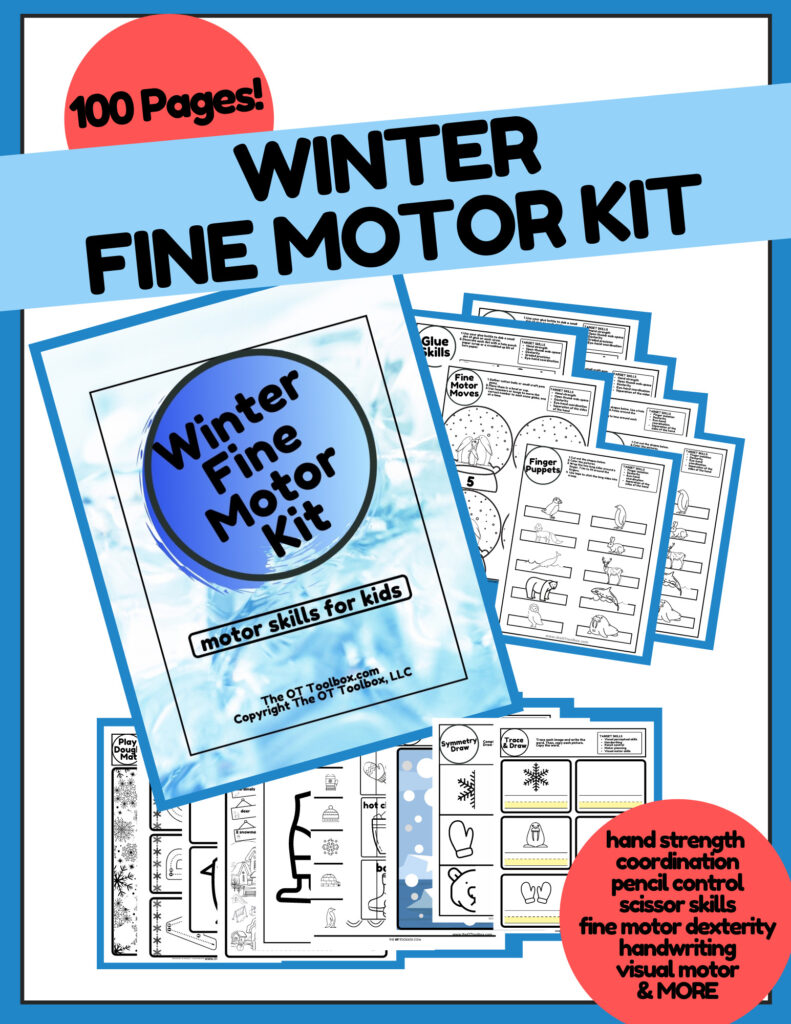
                These brain breaks would be a great addition to our Winter Fine Motor Kit, loaded with winter theme and bear activities! It’s got all things fine motor in print-and-go activities. You’ll find lacing cards, modified handwriting sheets, pencil control strips, cutting activities, crafts, coloring exercises, and MUCH MORE!

                Get the Winter Fine Motor Kit HERE.

                winter fine motor kit

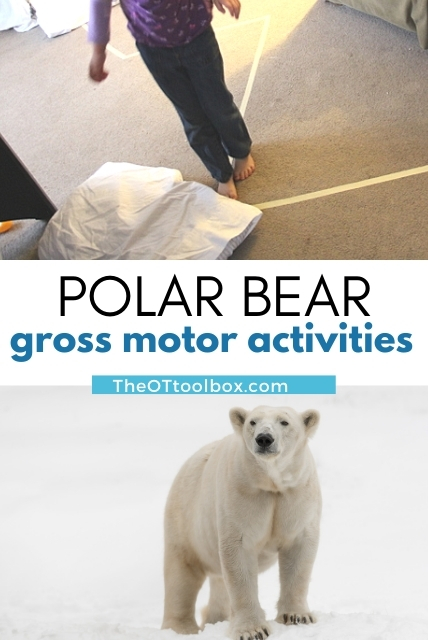
                Polar Bear Gross Motor Activities

                polar bear gross motor activities

                 We are continuing with our Polar Bear Theme with all kinds of play ideas.  Check out the polar bear gross motor activities listed here and challenge kids to move, and develop coordination, balance, direction changes, movement patterns, core strength, stability, and more. These polar bear activities go well with our polar bear gross motor virtual therapy slide deck, too, so you’ll want to check that out as well. Add gross motor play to your winter line-up!

                polar bear gross motor activities

                Polar Bear Gross Motor Activity

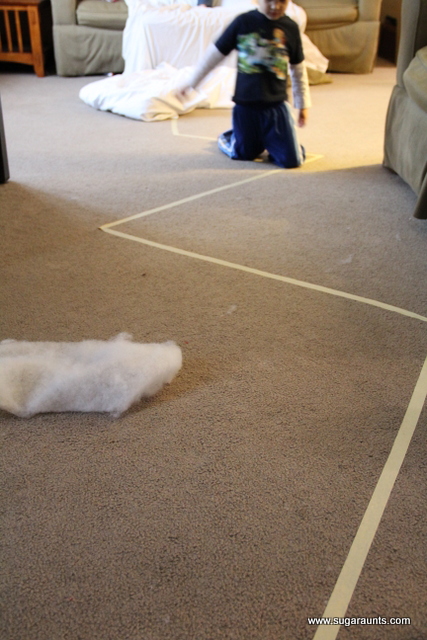
                For this gross motor activity, you’ll need masking tape, some couch cushions, and other small items (cotton batting, polar bear figures, or other materials can be used).

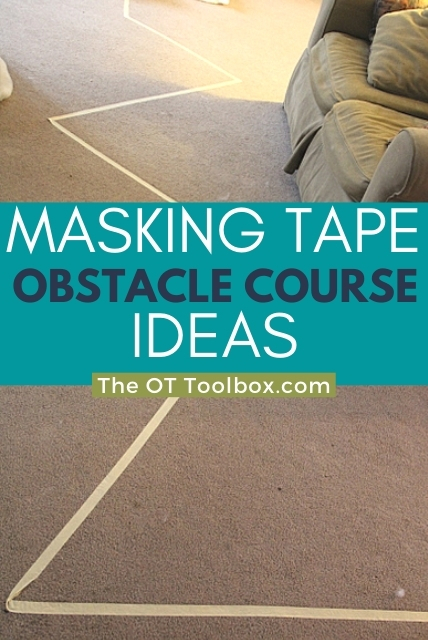
                Start by creating a path with the masking tape. We made a zig zag path across the room, but the options are limitless here.

                The masking tape path is perfect for polar bear crawls, toe walking, walking backwards, and knee walking. 

                indoor obstacle course ideas with masking tape obstacle course

                Masking Tape Balance Beam Ideas

                Once the masking tape is positioned on the floor, there are so many ways to use this in therapy in a classroom, hallway, clinic, or therapy at home activity.

                I put a couple of pillows at the end to make a “snow pile” for the polar bears.  Your kids can jump or hop into the pillows, or use them as balance challenges.

                We put some cotton batting along the path that the kids had to bend and stoop to grasp using one hand or the other. Then, they had to transport the “snow” to the other end of the path.

                Polar bear gross motor obstacle course

                A balance beam is so great for gross motor skills including coordination and balance.  You can start with normal toe to heel steps, and then increase the balance and coordination needed by asking your child to take bigger steps, side steps, backward steps, tip toe, go fast/slow.

                Polar bear gross motor activity for therapy at home or in a clinic.

                Kids can hold an object and transport it from one end of the path to the other. Ask them to hold the item in their hands, on their head, on their toes, or on their back as they bear walk. Objects can be large or small, heavy or light.

                Use couch pillows as pretend ice blocks for the polar bears.

                Use tongs and a small plastic ice cube to incorporate fine motor skills and eye-hand coordination skills. You can place buckets or bins along the path for obstacles to place the small objects in while challenging core strength, motor planning, and movement changes.

                Add buckets or cones along the path for children to step over or hop over. If cones aren’t available, just use couch throw cushions as an obstacle.

                Add a big duvet blanket or other large blanket at one end or both ends as a DIY crash pad for heavy work and proprioceptive input. Crawling into and under the heavy blanket offers heavy work, and that blanket makes a great “igloo” for your little polar bear.

                Advance the motor planning and core development by asking kids to stand along the path as they try to catch/toss a ball, navigate turns, curves, hop…There is so much you can do with the masking tape balance beam!  Add more fine motor skill work by using paper snowflakes along the balance beam.

                Challenge kids in a masking tape obstacle course with a polar bear theme.

                Use a polar bear sensory bin along the path to challenge kids to transport items from one end of the path and to place them into the sensory bin. This is a fantastic occupational therapy or physical therapy intervention that challenges so many skills.

                Use masking tape to make an obstacle course in the living room, with a polar bear theme or other animal walks.


                For more polar bear gross motor activities, (and fine motor work), grab the Winter Fine Motor Kit, with 100 pages of done-for-you therapy activities, including polar bear themes. There are sensory bin materials, crafts, and activities designed to boost fine motor skills. These would be great additions to a polar bear gross motor theme in therapy sessions.

                Grab it now before January 9th and you get a bonus of 3 fine motor slide deck activities.

                CLICK HERE TO GET THE WINTER FINE MOTOR KIT.

                winter fine motor kit

                Colleen Beck, OTR/L has been an occupational therapist since 2000, working in school-based, hand therapy, outpatient peds, EI, and SNF. Colleen created The OT Toolbox to inspire therapists, teachers, and parents with easy and fun tools to help children thrive. Read her story about going from an OT making $3/hour (after paying for kids’ childcare) to a full-time OT resource creator for millions of readers. Want to collaborate? Send an email to contact@theottoolbox.com.