This collection of outdoor sensory activities focus on the vestibular sense. Today, I’ve got another post in the Backyard Sensory Summer series that have here on the website. This series of summer activity ideas are perfect for challenging kids to get outdoors and play. The backyard sensory ideas can be used as part of a sensory diet at home, or as individual summer activities. Today, we are talking about vestibular sensory activities for summer. Grab the kids, the family, or a favorite stuffed animal toy. Here are summer ideas for kids that incorporate the vestibular sense and are perfect for the backyard.
If you are looking for information on how to create a sensory diet and use these movement activities with kids, then you are in the right place. Here are more outdoor sensory diet activities to get you started with sensory needs and the outdoors.
If you’ve been following this summer activity series, then you know that I’ve been sharing sensory activities that can be done right in the backyard. In most cases, these sensory play ideas use toys and materials that you probably already own. Most importantly, these sensory ideas are perfect for getting the kids outdoors and playing in the backyard while meeting sensory needs. They are easy (and fun) ideas that can be added to a child’s sensory diet this summer and every day. Take these ideas and sensory play ideas right into Fall and all season long with backyard sensory play!
You’ll find ideas to use in virtual therapy sessions and to send home as home activities that build skills and power development with a fun, summer theme. Kids will love the Summer Spot It! game, the puzzles, handouts, and movement activities. Therapists will love the teletherapy slide deck and the easy, ready-to-go activities to slot into OT sessions.
VESTIBULAR SENSORY BACKYARD ACTIVITIES:
Swing painting- Grab some paint brushes and create art while providing vestibular sensory input in a calming back and forth motion in the swing. Read more about that here. (Idea from Homegrown Friends.
Slip and Slide Relay Race- Set up a slip and slide and use a timer to time kids as they race down the slide. Children can sit on their bottom, lay on their belly, or slide on their back for variations in positioning.
Slide on cardboard- Grab a cardboard box or even cereal box. Open it up using a sharp knife or scissors to create a large piece of cardboard. Kids can use the cardboard to slide down slopes. Try various positions on the cardboard. An alternative to this activity is using a cardboard box to create a “car” like we did here.
Picnic Blanket Roll- Use a large blanket or comforter as a picnic blanket. Spread it out on the grass and ask your child to lay on the blanket. Roll them up in the blanket to add a calming proprioceptive component with deep pressure. Roll the child in a log-roll fashion while they are wrapped up in the blanket. Then, why not use the blanket for a real picnic?
Roll down hills- Find a hill in the backyard and start rolling!
Spin in circles- This is a great activity with a family member or even a stuffed animal. Hold hands and spin. Try spinning fast, slow, to music, or even in the sprinkler.
Swing side to side on a swing set- Playing on the swings doesn’t need to look like the regular back and forth. Try swinging side to side. Ask the child to sit sideways and straddle the swing.
Hang upside down from swing set equipment- What are some other movement-based ways to play and challenge motor skills using the play equipment you already have? Climb up the slide. Swing on the belly. Create an obstacle course or play “the ground is lava”. The options are limitless.
Swing on a hammock- do you have a hammock? This inexpensive lawn item can be used in calming or facilitating side to side movements, rocking, a log roll swing, laying in prone or supine, or back and forth swinging.
Backyard dance party- Encourage lots of whole body movements and spinning. Use fast or slow movement to facilitate alerting or calming movements. Try adding a copy dance, or freeze dance play. Get the whole family involved.
Cartwheels- Tumbling or cartwheels in the lawn is a fun way to add movement right in the backyard.
Tumbles- If cartwheels are too tricky, try tumbles.
Hopscotch- Add this movement and motor planning game to the backyard. Use sidewalk chalk to draw a hopscotch board on the sidewalk or driveway. This is such a great core stability and strengthening activity for building confidence and coordination. There are options to upgrade or downgrade this activity. Use more or less hop spaces, or make them bigger or smaller.
Play Leap frog- This classic game is a great one for building gross motor skills, motor planning, core stability, visual convergence, and more with a movement based forward motion.
Mini trampoline (or the big sized-trampoline)- If adding a sensory tool to your backyard is priority, then a mini trampoline is an easy and affordable option. Kids can sit or stand to hop or bounce. Try adding other toys to make the sensory play interesting. Add water balloons, chalk, a sprinkler, or make a cozy resting place to calm down.
Colleen Beck, OTR/L has been an occupational therapist since 2000, working in school-based, hand therapy, outpatient peds, EI, and SNF. Colleen created The OT Toolbox to inspire therapists, teachers, and parents with easy and fun tools to help children thrive. Read her story about going from an OT making $3/hour (after paying for kids’ childcare) to a full-time OT resource creator for millions of readers. Want to collaborate? Send an email to contact@theottoolbox.com.
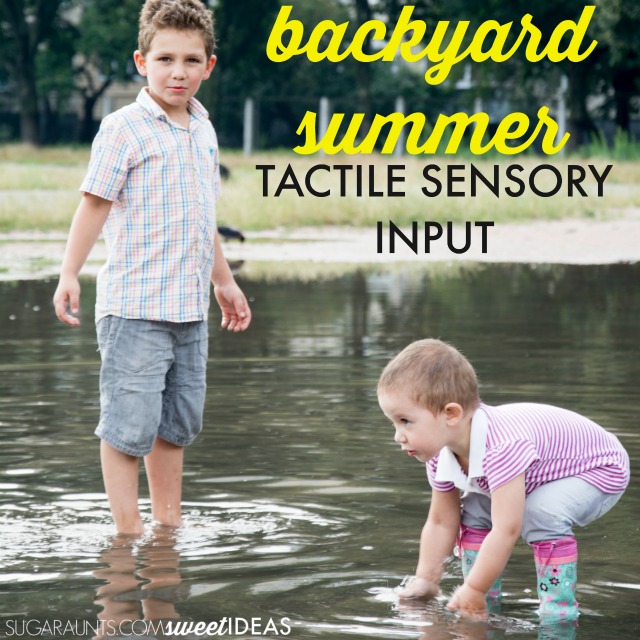
This article on outdoor sensory activities focuses on the tactile sense. Our sensory touch plays a huge part in sensory experiences, sensory tolerance and challenging behaviors (the actions we see) as a result of difficulties regulating tactile sensory input. From tickly grass on the bare feet to tolerating bathing suit textures or sunscreen, tactile input and summer go hand-in hand. If you are looking for outdoor sensory play ideas, then you are in the right spot!
Outdoor sensory Activities for Tactile Sense
Touching toes on the grass can make some kiddos squirm. The sandbox brings on a mini world of sensory defensiveness when grains of sand stick to skin. For the child with a hypersensitivity to touch, the backyard can be overwhelming. Other kids seek out tactile sensations and need to touch everything. Still others find comfort in certain sensations but other textures bring on the tantrums or withdrawal.
If you are looking for information on how to create a sensory diet and use these movement activities with kids, then you are in the right place. Here are more outdoor sensory diet activities to get you started with sensory needs and the outdoors.
outdoor sensory activities for autism
A quick note on various sensory challenges that can result in actions we see in neurodiverse children of all ages (adults included). Some of the outward actions we see can be related to sensory input that is regulated differently in summer or warmer weather:
Tolerance of shorts
Tolerance of bathing suits
Sensation of sunscreen
Sensation of socks or other clothing in hot weather
Humidity changes
Summer thunderstorms (can change the air temperature)
Short clothing that brushes on legs or arms
Sandals or open-toed shoes
Crowds or places where others are in close contact
Wearing a mask in warmer temperatures
This is just a short list of considerations. Remember that no child will be alike and there can be many other situations that arise in the summer months that impact tolerance of differences in tactile sensory input.
Below you will find outdoor sensory activities that focus on tactile sensory input as a challenge or outdoor sensory play ideas that can be helpful and fun this summer.
Create a mud kitchen in an area of your backyard. It doesn’t need to be complicated. A simple piece of wood or a sheet of cardboard makes a nice work space. Use buckets, scoops, and spoons to mix up muddy concoctions while working on fine motor skills, eye-hand coordination to scoop and pour in a tactile sensory (and very messy) imagination play.
Don’t be afraid to let the kids get muddy and messy! Just hose them off afterwards. Mud and puddles are a part of childhood and the dirt will wash off. Have fun and get messy with your kids!
Flower Sensory Bin- Explore tactile differences with an outdoor dandelion messy sensory bin. Add more squishy messy play by adding dirt or sand to the bin. Use scoops and tongs to add in fine motor work.
Feel and Name Game- Fill a bin or paper bag with grass clippings. To the bag, add random small toys, plastic figures, or magnetic letters. Ask the child to reach into the bag without looking. They can locate a small item and feel it as they try to name the object.
Sandbox Dig and Find– Practice tactile discrimination in the sandbox. You’ll need two sets of matching items for this activity. (Magnetic letters, coins, small figures, or matching utensils would work.) When the child is not looking, hide small objects and figures in a sandbox. Then, show the child an object that matches one of the hidden items. Do not name the object. Rather, ask them to “find another one just like this.”
When in doubt add water! Try these backyard sensory tactile play ideas: goop play dough shaving cream backyard messy play date paper mache.
Colleen Beck, OTR/L has been an occupational therapist since 2000, working in school-based, hand therapy, outpatient peds, EI, and SNF. Colleen created The OT Toolbox to inspire therapists, teachers, and parents with easy and fun tools to help children thrive. Read her story about going from an OT making $3/hour (after paying for kids’ childcare) to a full-time OT resource creator for millions of readers. Want to collaborate? Send an email to contact@theottoolbox.com.
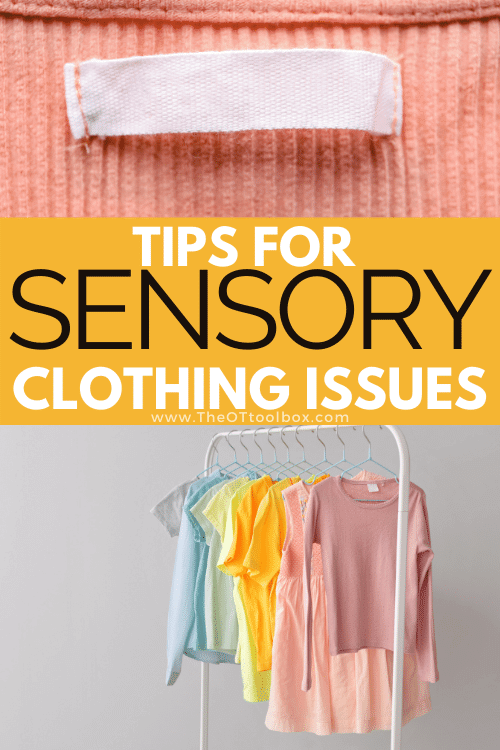
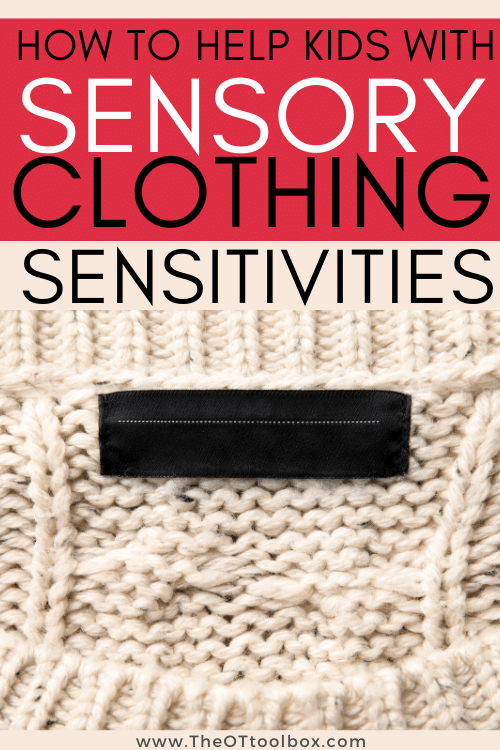
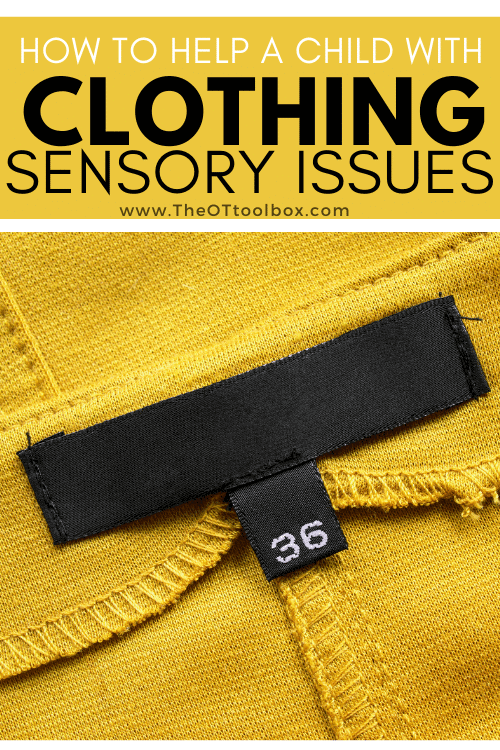
Here, we’ll discuss the specific considerations for sensory issues with clothes. You’ll also find intervention strategies to support children with clothing sensitivities. The thing is that sensory processing issues for children can be highly complex and sometimes puzzling to those who do not have these difficulties. We see children that refuse to wear socks or shoes. Or we see children who will not put on pants in the dead of winter. Other kids can’t tolerate the seams of shorts or the fasteners of bras. How do you support individuals with sensory sensitivities? Let’s talk about strategies to address clothing sensitivities.
This post addresses and discusses considerations and a few possible solutions for clothing sensitivities to provide insight and areas to investigate in order to provide a child with the best possible sensory experiences with dressing and clothing as possible. The considerations are not all encompassing, but do provide valuable information in pursuit of understanding the possible reasons for clothing sensitivities for a child.
Sensory issues with clothes
Sensory issues with clothes and other sensory challenges can interfere with school, community, and home life for children who struggle with sensory processing on a daily, hourly, or even minute by minute basis. Sensory issues can be random, sporadic and happen one time, but not another despite similarities in circumstances.
A child can also have sensory sensitivities and not be diagnosed with a disorder per se, but even sensitivities have a real impact on daily functioning. Check out these clothing red flags for common sensory issues that come up again and again.
A common sensory issue reported by parents are their child’s clothing sensitivities. This involves more than the child who always wants to wear the same shirt because it has their favorite logo on it or it is their favorite color as this is more about style preference. It’s dealing more with a child who has real issues donning clothing and refuses to wear an article of clothing based on the way it feels causing the child to cry and scream and not be able to proceed with the task of dressing.
Using certain clothing preferences to address clothing sensitivities include sensory friendly clothing options.
All of us have separate sensory systems that help us register, discriminate, and process sensory input. When there is a clothing sensitivity, this is dealing with the tactile (touch) sense and how the information from that sense is sending information to our brain to process. These may show up as tactile defensiveness in some.
We have fabrics we like as they are cozy and provide us comfort and we have fabrics that are scratchy and prickly causing anxiety and keeping us on edge not allowing us to focus on much of anything else other than getting it off. Some individuals with serious sensory issues register this input as harmful and even dangerous making them want to flee or do anything to get that feeling away from them. An important thing to remember is never force a child to don something that they perceive as painful or harmful. A child’s dramatic responses, such as mentioned above, can make home life chaotic and frustrating.
Stating the obvious, dressing is a necessary part of daily living and clothing is required for a child to engage in school and community life and it helps for clothing to be worn at home even though it is not completely necessary there. With some children who do have intense clothing sensitivities, they find their home is a free place to go without clothes.
If you are a parent, these considerations can help you investigate and pinpoint the possible problem with clothing or dressing for your child. These considerations can give you valuable information to either share with your child’s OT practitioner or to pursue an assessment with an occupational therapist. Occupational therapy practitioners can provide interventions specifically directed for your child and their needs as every child is different and requires a skilled set of eyes with knowledge of your child and their needs to provide the best possible interventions and opportunity for your child’s successful daily life engagement.
Sometimes considering simple clothing anatomy for sensory sensitivities can be a good place to start, but there are other areas of clothing and the tactile (touch) sense that need to be explored a little more directly. We’ll look at both in this post.
Related: Sensory issues that impact fine motor skills can make fastening buttons and zippers a difficulty for many children.
Sensory issues with Pants
Consider: length of shirt sleeves and pant legs. The feeling of pant legs and sleeves can cause aggravation to the child’s extremities. Maybe the sounds of fabric while walking such as when wearing denim or corduroy or even the feeling of the leg fabric rubbing together while walking is enough to irritate.
Consider: elastic waistbands vs. zippered and buttoned pants as they may work better for the child. Elastic can provide more flexibility and comfort for some children. Does the waistband roll down or bunch up or are there hidden adjustable waist band apparatuses? Adjustable apparatuses can be cut out by an adult if necessary.
Consider: if there are tags or buttons sewn into the seam of pants of shorts. A tag at the back of pants can cause irritation. These can be removed by cutting out or purchase tag-free clothing.
Consider: certain textures may be more irritating to the skin or even possibly pulling arm or leg hair. If older, shaving legs can help. If the texture feel is the difficulty, purchase clothing with more soft and natural materials.
Sensory issues with shirts
Consider: The length of shirt sleeves. The feeling of sleeves can cause a tight sensation in the arm pits or around the neck, elbows, or wrists, causing aggravation to the child’s extremities. Clothing can feel too tight in the trunk.
Consider: length of shirt tails as they can be drafty if short, especially when sitting.
Consider: if the clothes are too tight or too loose. Do they sway or shift when they move? Does the fabric bunch up in the arm pits or at the wrists from being too big? Purchase clothing with the fit that is preferred for size and pressure, maybe they like tight vs. loose.
Consider: graphics on shirts and get one-dimensional graphics if necessary therefore no sequins, gems, puffy pieces, etc. are impacting the child.
Consider: if the seams in clothing are large or thick with too much fabric inside the clothing causing discomfort. Check this before you purchase clothing items. Purchase seamless clothing or turn clothing inside out as appropriate.
Consider: the pulling of hair as a shirt is pulled over the head or being too tight of a neck hole causing irritation. Purchase button up shirts vs. overhead shirts.
Consider: some clothes may be more uncomfortable to wear due to the feel of waistbands, cuffs, or collars. Explore if they are too tight, too loose, ribbed or simply hemmed. Maybe a certain type is preferred over another. Purchase no collared clothing or lightly hemmed cuffs vs snug-fitting, ribbed cuffs.
General Sensory Considerations with Clothing
Sensory issues with clothes can look different for every individual. But, there are some common similarities that make helping those with clothing sensitivities more comfortable and functional. Try these general considerations:
Consider: some clothing may be hotter or even colder to wear.
Consider: how clothes fit and adhere to the body when sitting vs. standing. Also, check regarding static cling in different seasons and purchase cling free dryer sheets to help when drying clothes.
Consider: layers of clothing to keep warm rather than wearing a jacket.
Consider: the smell of the clothing. Is the smell of the detergent, fabric softener or dryer sheet too strong for the child to tolerate? Purchase odorless detergent, softener or dryer sheets.
Consider: the color of the article of clothing, if they’ve had a bad experience with a certain color, it could be recalled for every article of clothing that color.
Sensory Socks and Shoes
Issues with wearing socks or shoes is a common concern for those with sensory challenges.
Consider: checking sock seams and the position on the toes. How do the socks fit? Are they a good size, too tight, too loose, too short, or too long? Have the socks stretched and become ill-fitting? Purchase seamless socks or wear them inside out.
Consider: if socks are smooth or have fuzz ball lent on them. Are they nylon or cotton fabric, thick or thin? Purchase socks that do not gather fuzz balls as they are washed.
Consider: if toe nails are scrapping the fabric when donning. Do the shoes “eat” the socks when walking causing them to ball up under the heel? Cut the toe nails and purchase socks that do not get pulled under the heel.
Consider: shoe comfort such as width, size, and how high the backs are. Are the shoes too tight or too loose? Purchase shoes that have an open heel.
Consider: if the tongue is twisted or shifted. Is there anything inside that could be poking or irritating the foot? Make sure to put laces through the slots on shoe tongues to keep them straight, if this is part of the shoe design.
Understand that shoes fit and feel different with and without socks and even with thick or thin socks.
Sensory Issues and Underwear
Consider: the seams in the underwear, especially in the crotch. Are the genitals comfortable? Purchase underwear without seams or fewer seams.
Consider: if they fit too loose or too tight. Maybe they prefer more tightness like boxer briefs or maybe they prefer more looseness like regular briefs. Is the waistband too high, too low, too tight or too loose on the stomach? Is the hip design too high or too low?
Consider: if they bunch up when pants or shorts are donned. Does the underwear ride the groove between the buttocks when walking or moving? Do they harbor hygiene odors?
Consider: if the child has thigh sensitivity and underwear is possibly pulling leg hair such as with boxer briefs.
Sensory Issues and Bras
Sensory issues in teens can show up in different ways than the younger years. Some considerations include the need for a bra. For kids that previously have struggled with tight or scratchy sensations with clothing, wearing a bra can be difficult. Here are some things to consider:
Consider: the fit of the bra. Is it too tight and causing discomfort from the straps, rings/sliders, under band, or underwire as evidenced by skin markings and redness? Purchase bralettes or bras that do not have these features. Maybe an athletic bra would be better.
Consider: if they are sensitive to the feel of the hook closures against the back when leaning on a surface. Do the straps brush the arm as they slide off of the shoulder causing some irritation? Does the fabric feel uncomfortable such as with lace that tends to be scratchy?
Sensory Pajamas
Sleepwear can cause a lot of issues for some children. Pajamas can be tight and compressing, which can benefit other children who prefer and benefit from compression garments. Others, however, can feel too much pressure that impacts sleep. Here are some things to consider about sensory issues and pajamas.
Consider: the fit of sleepwear. Is it too tight, too loose, too hot, too cold, too scratchy, or too silky? Is the texture of the material such as fleece, silk, nylon, cotton, spandex, etc. cause irritation or does the sound of it against the bed sheets cause sensitivity?
Consider: if wearing p.j. bottoms, do the legs of the pants ride up the leg while moving in bed causing bunching and sensitivity? Do the shirt sleeves shift up the arm when sleeping making them uncomfortable causing bunching and creases that rub or mark the skin?
Consider: if buttons cause discomfort when lying on the stomach. Do collars or tags irritate? Do ribbed cuffs or seams cause irritation?
Investigate the fabric and other issues of the bed sheets and covers. Explore the sounds, feel, temperature, fuzz balls on the fabric due to washing, smell of detergent, softener, dryer sheets, static cling, etc.
There are many ways to address these sensory sensitivities. Sometimes any number of the above solutions can help. Allowing a child to shop for their own clothing and make their own choices while acknowledging and respecting their desire and need for certain tolerated textures can help with sensory issues.
But for those with more intense sensitivities the best bet for success is looking at a sensory diet tailored to their direct needs. If you are a parent, contact an occupational therapist for assistance. They are available to assess, treat, and consult regarding your child’s specific sensory needs. Often times, sensory sensitivities can be significantly reduced or even completely eliminated with proper treatment.
In the Sensory Lifestyle Handbook, we cover various options to address sensory issues in children and teens. You’ll find in this comprehensive resource, strategies to implement a motivating and meaningful sensory diet that is integrated right into day-to-day activities and tasks in order to create a lifestyle of sensory solutions.
How to support children with clothing sensitivities
If you are an occupational therapy practitioner, below are some activities or intervention ideas which can help support a child with their tactile sensitivities. Be sure to go through the considerations listed above to investigate where clothing sensitivities are stemming from in regards to specific clothing. This step can help with finding clothing styles and types that meet the needs of the individual child.
1. Explore a variety of fabrics on the skin by using fabric swatches – increase time as tolerated.
2. Desensitize skin with lotion rubbing prior to donning clothing.
3. Use whole body deep pressure activities.
4. Present a variety of textured materials by dressing a doll with various textured clothes.
6. Massage with a towel vigorously prior to introducing new textures.
7. Rub feet with lotion or towel prior to donning socks or shoes.
8. Provide textured material exploration with sensory bins
9. Provide textured floor mats for feet.
10. Explore textures using stuffed animals of different textures.
11. Suggest tight-fitting swim or biking shirt or shorts, spandex clothing or workout attire under clothes.
12. Use vibration to the extremities and back/neck as tolerated even allowing child to do this – sometimes the child will choose to do this themselves.
13. Use firm pressure activities such as rolling a therapy ball up and down the body (avoid the face).
14. Use a squeeze machine or body sock.
15. Roll child up in a bedsheet (not the face) like a taco.
16. Use firm pressure to the top of the head or up and down the arms/legs.
17. Give hugs.
18. Rub lotion on body prior to dressing as dry skin can be more easily irritated than moist skin.
Utilize the motivating strategies in the Sensory Lifestyle Handbook to integrate a sensory diet right into the daily life activities of each child, in a way that works for the whole family.
Regina Parsons-Allen is a school-based certified occupational therapy assistant. She has a pediatrics practice area of emphasis from the NBCOT. She graduated from the OTA program at Caldwell Community College and Technical Institute in Hudson, North Carolina with an A.A.S degree in occupational therapy assistant. She has been practicing occupational therapy in the same school district for 20 years. She loves her children, husband, OT, working with children and teaching Sunday school. She is passionate about engaging, empowering, and enabling children to reach their maximum potential in ALL of their occupations as well assuring them that God loves them!
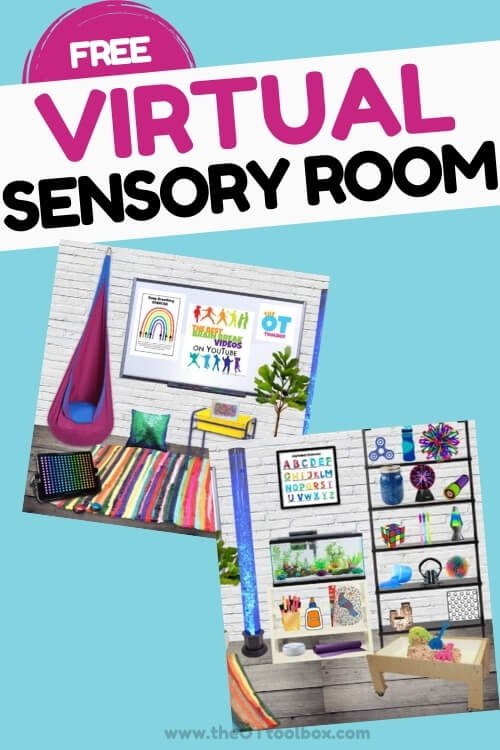
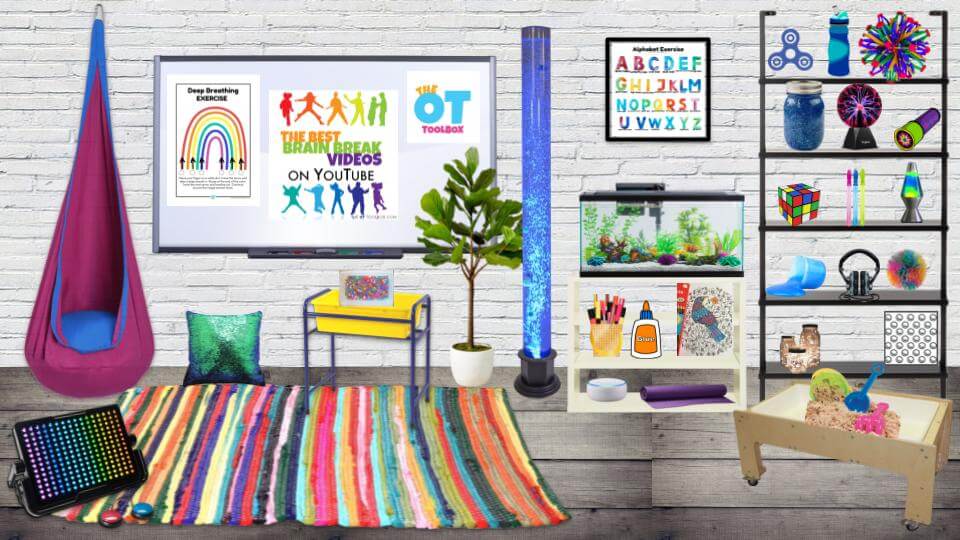
This virtual sensory room has been on my “to-do” list for a while. It’s a free slide deck that adds all the benefits of a calming sensory space in an online version. You can use this free virtual calming room as a sensory tool in teletherapy sessions, in the home, and in face-to-face classroom or therapy sessions. Let’s take a look at this virtual sensory room space and all of the calming tools it includes.
Virtual Sensory Room
Adding sensory diet tools to an online platform isn’t always an easy concept. Especially in a virtual space, the calming benefits of a sensory room can be difficult to integrate the senses of proprioception, vestibular input, and oral motor sensory input.
Many of the free online sensory videos out there are mindfulness videos, virtual lava lamps, and auditory videos like waves or rainforest sounds. But the virtual sensory spaces sometimes omit calming heavy work input and proprioceptive feedback that offer the calming and self-regulatory benefits of heavy work.
That’s why I wanted to create this virtual calming room.
Virtual Calming Room
In this virtual calming room, you’ll find the following sensory items that kids can click on and access videos:
Fidget Spinner
Water bottle
Hoberman breathing sphere
Sensory jar
Plasma globe
Kaledescope
Rubic cube
Bubble wands
Lava lamp
Slime
Calming sounds headphones
Koosh Ball
Glitter jars
Fish tank visual
Online relaxing coloring activities
Sound machine
Yoga mat
Kinetic Sand Bin
Bubble wrap popping activity
Heavy work exercises
Light tube
Nature grounding exercises
Waterbeads sensory bin
Brain breaks
Deep breathing exercises
Sequin pillow
Light tube
Kids crafts
When you click on the sensory objects in the sensory room, you’ll be directed to different online sensory tools. These include:
Guided meditation videos
Slime videos
Yoga exercises
Calming sounds videos
Deep breathing exercises
Craft ideas to involve the hands in fine motor resistive work
Grounding exercises
Calming visual images
Relaxing vision and auditory input
Brain breaks
Calming videos
All of these are links to videos, exercises, and resources to promote calming self-regulatory input for kids of all ages. You can add these tools to a sensory diet or use them in Zones of Regulation activities.
Free sensory room slide deck
Want to add this online sensory room to your therapy toolbox? Enter your email address into the form below and you can add this tool to your Google drive. It’s just one of the many free slides available here on The OT Toolbox.
NOTE- Due to an increase in security measures, many readers utilizing a work or school district email address have had difficulty accessing resources from the delivery email. Consider using a personal email address and forwarding the email to your work account.
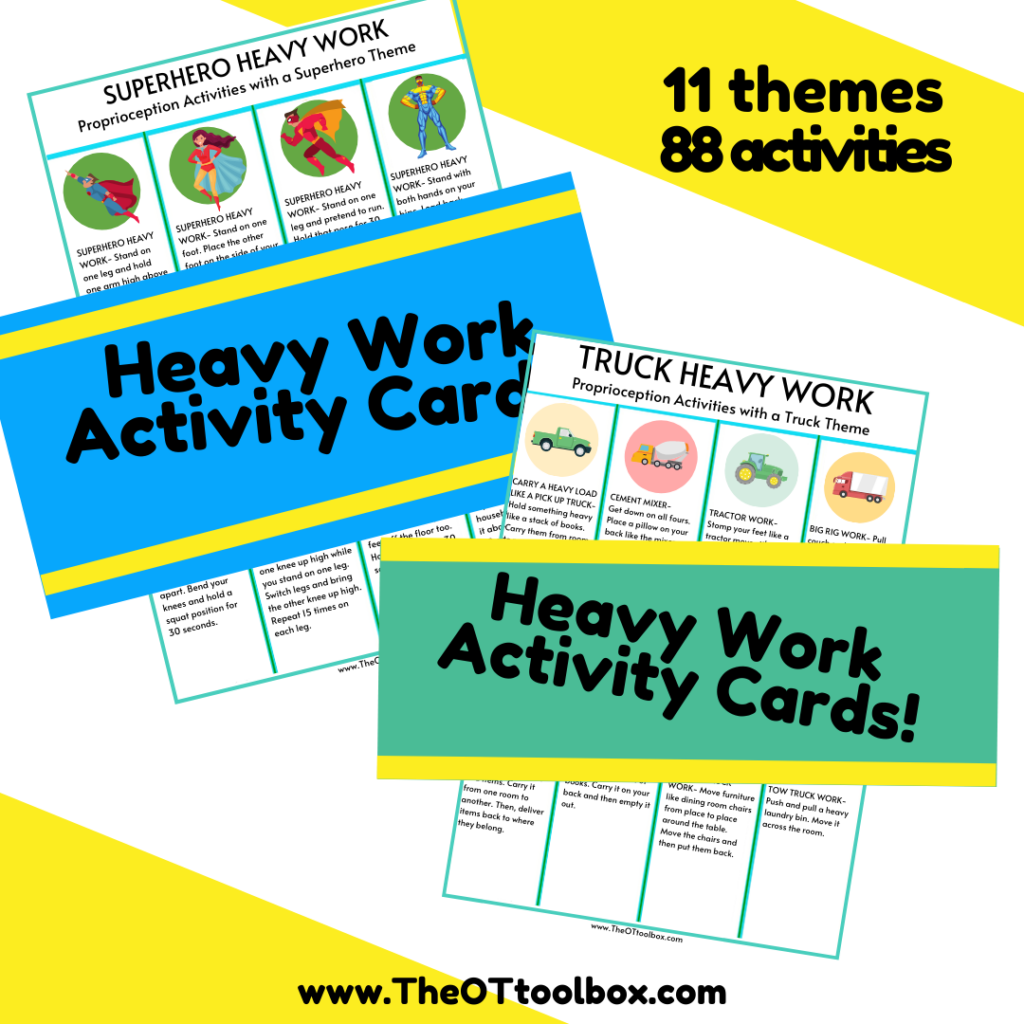
Add heavy work with these heavy work exercises to incorporate many themes into therapy and play.
Colleen Beck, OTR/L has been an occupational therapist since 2000, working in school-based, hand therapy, outpatient peds, EI, and SNF. Colleen created The OT Toolbox to inspire therapists, teachers, and parents with easy and fun tools to help children thrive. Read her story about going from an OT making $3/hour (after paying for kids’ childcare) to a full-time OT resource creator for millions of readers. Want to collaborate? Send an email to contact@theottoolbox.com.
This sensory stations printable set is a free resource that you can print off and hang up as an easy sensory path. You may have seen sensory walks in school hallways, or outdoor sensory walks on sidewalks. Sensory paths can even be done at home as a DIY sensory activity. The reason why we are seeing so many of these sensory strategies in place? They are a great way to get kids motivated and moving to incorporate the sensory input and motor planning that kids need.
First, let’s talk about what a sensory path is. You’ve probably seen the videos of kids completing motor activities in a hallway or even on a sidewalk. There are typically several sensory stations, or sensory and movement-based activities that kids can do as they move through the sensory walk.
A sensory walk (or a sensory path) is a fun and engaging series of movements and activities designed to incorporate the senses and movements. They are designed to promote motor skills so kids get the sensory input they need in order to focus, pay attention, regulate their sensory systems so they can learn and function along with their peers. They are a fun and engaging way to incorporate sensory diet tasks into the school or home environment.
When kids move through the colorful path, they are challenged to hop, jump, skip, tip toe, turn, spin, push, etc. All of these movements incorporate gross motor skills and sensory systems of vision, vestibular, and proprioceptive senses. You can read more here about heavy work of gross motor skills and sensory processing.
What are Sensory Stations?
In a sensory hallway or sensory pathway, there are typically “stations” or different movement activities that challenge different sets of muscles or actions. You might see a station where kids move through the letters of the alphabet as they hop along ABC images. You might see a sensory station that asks kids to tip toe along a spiral path, or complete wall push-ups. You may see a hopscotch board on the floor with numbers, letters, colors, or even sight words.
Other sensory paths stations for deep breathing exercises, animal walks, or figure 8 visual motor activities.
There are sensory pathways that incorporate different themes into the sensory stations. The sky is the limit when it comes to coming up with movement-based activities within a sensory walk.
All of these sensory stations offer an opportunity for the child to engage the senses in a particular movement or activity.
Free sensory stations printables
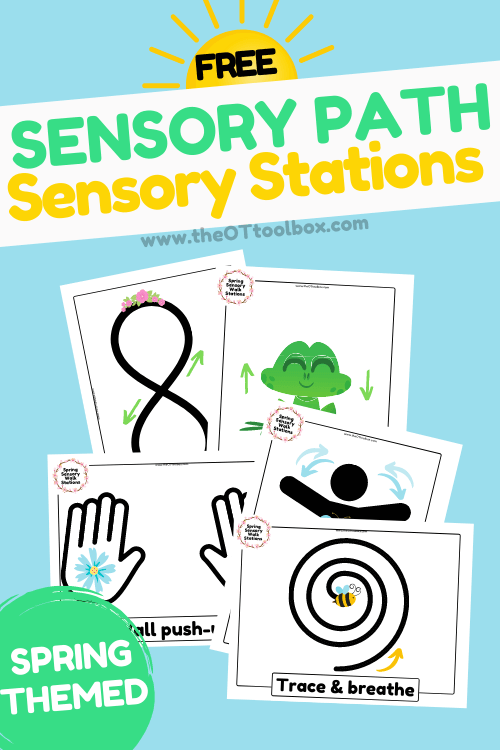
Today, as part of our Spring Week, I have a free printable set of sensory stations for you. These are PDF sheets with several different sensory station activities. Print them off, hang them in a hallway, classroom, or in the home to engage vestibular, proprioceptive, and visual senses.
The sensory stations included in this free resource include a figure 8 deep breathing activity. Kids can trace along the figure 8 as they take in deep breaths and then breathe them out.
The next sensory activity in this DIY sensory path is a frog hop activity. Kids can hop like a frog and engage proprioceptive input as they hop up and down. The printable is open-ended so you can ask kids to complete as many from hops as you like.
Next, you’ll find a wall push-up activity. Kids can complete wall push-ups against the hand visuals and engage heavy work input through their upper body as a calming motor activity.
Then, there is a jumping jack activity that engages the vestibular sense and gets kids active, moving their whole body, and working on coordination, motor planning, and symmetrical and asymmetrical movements gross motor movements.
Finally, the sensory path printables includes a spiral deep breathing activity with a buzzing bee. Kids can trace along the spiral and take deep breaths in and out. This calming activity can re-set kids and help with relaxation.
All of these sensory station activities are open-ended so you can ask kids to say the ABCs or count as they complete the tasks. You can also rearrange the order of the sensory walk tasks or omit some of the activities is you like.
Printable Sensory Stations
Want to add these sensory path stations to your therapy toolbox? Enter your email into the form below and you’ll receive them in your inbox. Enjoy and happy sensory path planning!
This handout is just one creative way to work on fine motor skills, precision, and dexterity this Spring? You’ll love these other free PDFs here on the website (all are available in our Member’s Club):
Want to add this resource to your therapy toolbox so you can help kids thrive? Enter your email into the form below to access this printable tool.
This resource is just one of the many tools available in The OT Toolbox Member’s Club. Each month, members get instant access to downloadable activities, handouts, worksheets, and printable tools to support development. Members can log into their dashboard and access all of our free downloads in one place. Plus, you’ll find exclusive materials and premium level materials.
Level 1 members gain instant access to all of the downloads available on the site, without enter your email each time PLUS exclusive new resources each month.
Level 2 members get access to all of our downloads, exclusive new resources each month, PLUS additional, premium content each month: therapy kits, screening tools, games, therapy packets, and much more. AND, level 2 members get ad-free content across the entire OT Toolbox website.
Score Fine Motor Tools and resources and help kids build the skills they need to thrive!
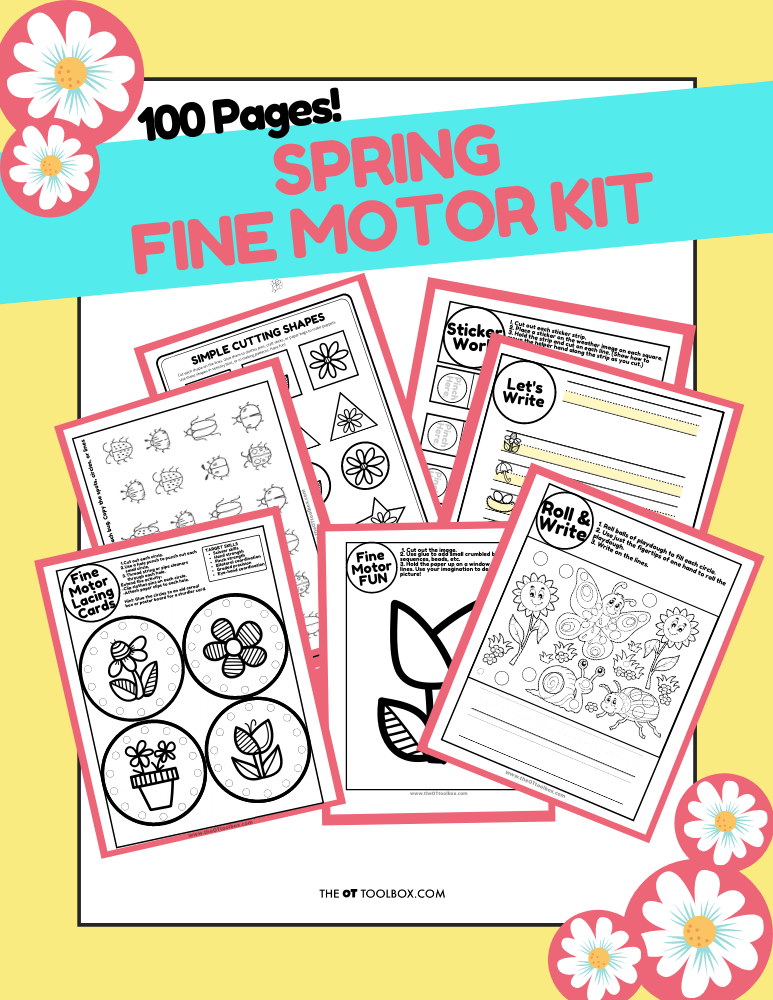
Developing hand strength, dexterity, dexterity, precision skills, and eye-hand coordination skills that kids need for holding and writing with a pencil, coloring, and manipulating small objects in every day task doesn’t need to be difficult. The Spring Fine Motor Kit includes 100 pages of fine motor activities, worksheets, crafts, and more:
Add these other Spring printables to your toolbox this time of year:
This handout is just one creative way to work on fine motor skills, precision, and dexterity this Spring? You’ll love these other free PDFs here on the website (all are available in our Member’s Club):
Spring Sensory Stations– These printable sensory stations are great for building a sensory walk anywhere: Print off these sensory station sheets and hang them in hallways, in a classroom, or even in the home.
Spring Worksheets for Handwriting and Fine Motor Skills– Therapists love this resource because it includes a fine motor and visual motor warm-up that can be integrated right into the handwriting activity, using a fun theme.
Spring Cootie Catcher– This printable resource is a fine motor, handwriting, and eye-hand coordination activity as well as bilateral coordination, and motor planning skill work.
Colleen Beck, OTR/L has been an occupational therapist since 2000, working in school-based, hand therapy, outpatient peds, EI, and SNF. Colleen created The OT Toolbox to inspire therapists, teachers, and parents with easy and fun tools to help children thrive. Read her story about going from an OT making $3/hour (after paying for kids’ childcare) to a full-time OT resource creator for millions of readers. Want to collaborate? Send an email to contact@theottoolbox.com.
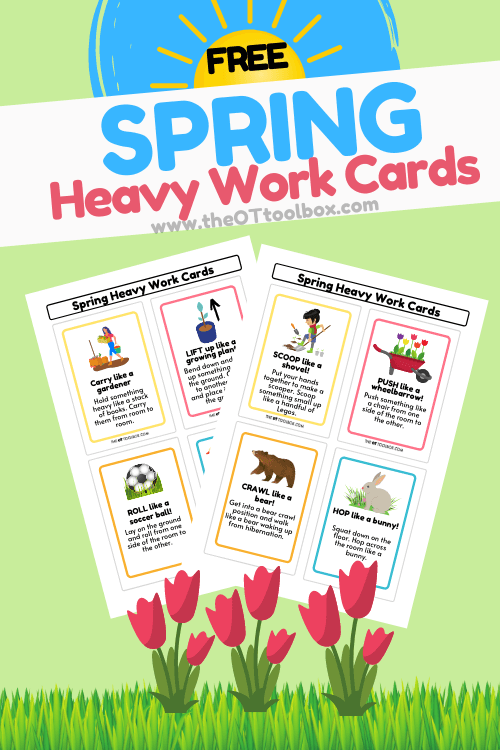
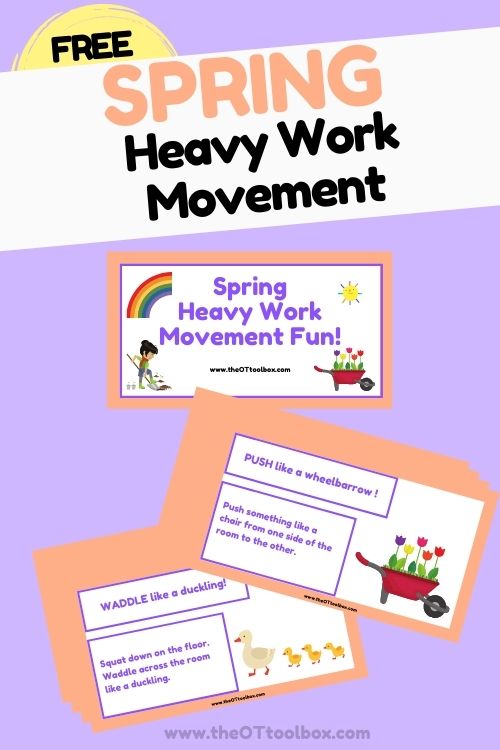
Today’s free resource in the Spring Week tools are these free Heavy Work activities in printable card version, with a Spring theme! These are just the thing to get kids moving and adding much-needed gross motor movement into the classroom, home, or occupational therapy session. I modeled these printable exercise cards off our heavy work teletherapy activities freebie, so these are the perfect addition to your therapy toolbox.
Heavy Work Activities
Heavy work activities help kids to incorporate balance, endurance, and motor planning into functional activities. By integrating the proprioceptive sense and vestibular sense, or balance, equilibrium, position in space, and movement, kids are able to better move their body with awareness of how their body moves. This body awareness is needed for most every activity.
Adding resistance, or heavy work activates the muscles and joints in the body and “wakes them up”. Proprioception and calming vestibular work can have an organizing effect on kids. This enables a ready state for completing tasks.
Getting kids to incorporate the whole-body movements that they need to regulate and develop strong, healthy bodies isn’t always easier, now more than ever. That’s where the Spring Gross Motor activities come into play. These are whole body activity, Spring-themed activities that make fun brain breaks.
Functional Heavy Work
Many heavy work activities can be incorporated right into the daily tasks. Things like pushing a vacuum, moving furniture, carrying a laundry basket are day-to-day chores that add a ton of heavy work input.
Other heavy work tasks can integrate these senses as well.
Tasks like using a moldable eraser, coloring with crayons vs. markers, or pulling on socks offer heavy work just as well, on a smaller scale.
These are all strategies that play into a sensory lifestyle, or a sensory diet that is well ingrained into the day-to-day tasks. You can learn more about creating a sensory lifestyle into every day activities in my book, The Sensory Lifestyle Handbook.
Heavy Work and Gross Motor Skills
There’s more about heavy work than just sensory processing benefits.
Heavy work tasks improve balance, core strength, motor planning, equilibrium needed for movement changes, stability, coordination, and movement patterns. All of these skills require equilibrium of the vestibular system for movement and changes in planes. They also require position in space changes. Heavy work has so many benefits!
There’s more: Heavy work input also incorporates areas such as range of motion, flexibility, motor planning, crossing midline, muscle tone, and core stability.
Free Heavy Work Activity Cards
Would you like to get your hands on a set of free heavy work printable activities? This is a free resource that you can print off and use in therapy sessions, in home programs, as classroom brain breaks, and to just get those kids moving.
To grab this free resource, enter your email address into the form below.
More heavy work brain breaks and Spring activities
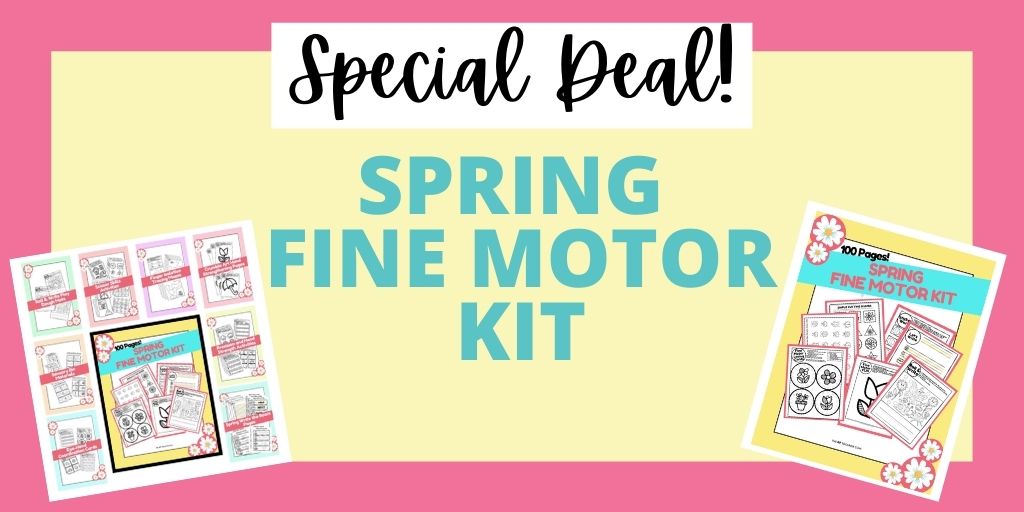
You can find more Spring brain breaks and heavy work activities in the Spring Occupational Therapy Activities Pack. Right now, it’s a BONUS add-on to our newly released Spring Fine Motor Kit!
Spring Fine Motor Kit
Score Fine Motor Tools and resources and help kids build the skills they need to thrive!
Developing hand strength, dexterity, dexterity, precision skills, and eye-hand coordination skills that kids need for holding and writing with a pencil, coloring, and manipulating small objects in every day task doesn’t need to be difficult. The Spring Fine Motor Kit includes 100 pages of fine motor activities, worksheets, crafts, and more:
Colleen Beck, OTR/L has been an occupational therapist since 2000, working in school-based, hand therapy, outpatient peds, EI, and SNF. Colleen created The OT Toolbox to inspire therapists, teachers, and parents with easy and fun tools to help children thrive. Read her story about going from an OT making $3/hour (after paying for kids’ childcare) to a full-time OT resource creator for millions of readers. Want to collaborate? Send an email to contact@theottoolbox.com.
Offering sensory, heavy work in teletherapy doesn’t need to be difficult. Wondering how to support sensory kids virtually? Need ideas to help with attention or focus in the classroom? This free teletherapy slide deck covers an area that is much needed for many children. We know that kids today need to move more. But did you know the part that heavy work plays into development and self-regulation strategies in kids?
We see it all the time: kids in teletherapy or in the virtual classroom that just can’t sit still or pay attention. And there’s a lot going on when screens are involved. The research on screen time is telling. But other times, kids are just being kids and movement is needed! Brain breaks and movement breaks are as necessary as hydration and eating healthy meals when it comes to learning.
What is Heavy Work?
Heavy work is a sensory strategy that helps children regulate so they are at a calm-ready state of learning and participation in tasks. For kids, heavy work helps them know where their body is in space by using the proprioceptive sensory system.
When deep heavy input is offered, the child challenges their proprioceptive system. Input in the child’s muscles and joints lets their brain know about body position, weight, pressure, stretch, movement and changes in position in space. Then, the body is able to grade and coordinate movements based on the way muscles move, stretch, and contract. In this way, the proprioceptive system allows us to apply more or less pressure and force in a task.
Proprioception and that heavy work input occurs when we lift, jump, pull, carry, hug, snuggle, crash, climb, push, etc. All of these movements incorporate the muscles and joints and offer “heavy work” input. Kids who may benefit from heavy work input might do some of these things:
Appear clumsy
Fidget when asked to sit quietly.
Show an increased activity level or arousal level.
Seek intense proprioceptive input by “crashing and bashing” into anything.
Slap their feet when walking.
Flap hands.
Use too much or too little force on pencils, scissors, objects, and people.
“No fear” when jumping or walking down stairs.
Or, are overly fearful of walking down steps/jumping.
Look at their body parts (hands/feet) when completing simple tasks.
Sit down too hard or miss chairs when sitting.
Fall out of their seat.
Fluctuates between over-reacting and under-reacting in response to stimulation.
Constantly on the move.
Heavy work is a huge part of sensory diets that are created to help kids organize their sensory systems and regulate those sensory needs.
Occupational therapists recommend heavy work to calm and help kids pay attention. And, if there were any time that heavy work was more needed, it might be during virtual learning.
For more heavy work ideas that cover a variety of themes, grab a copy of the Heavy Work Movement cards.
Heavy Work Teletherapy Activity
So how do you incorporate heavy work and all the benefits of proprioceptive sensory input into a teletherapy or virtual learning environment?
That’s where this heavy work virtual therapy slide deck comes into play. I created this slide deck as part of our free slides here on the site, as a support for therapists working with kids in virtual environments. We know that kids need movement to support learning and development of motor skills. They need to move and get that heavy work feedback so they can pay attention, focus, and learn.
This heavy work activity does just that.
Therapists (or teachers, or parents) can use this heavy work activity to help kids get the deep resistive input that they need.
Kids can go through the slide deck and complete each activity. The slides use Spring images and concepts to incorporate proprioception and to offer FUN ways to add heavy work and help kids calm or regulate their sensory needs.
Spring heavy work activities in the slide include:
Digging in dirt
Pushing a wheelbarrow
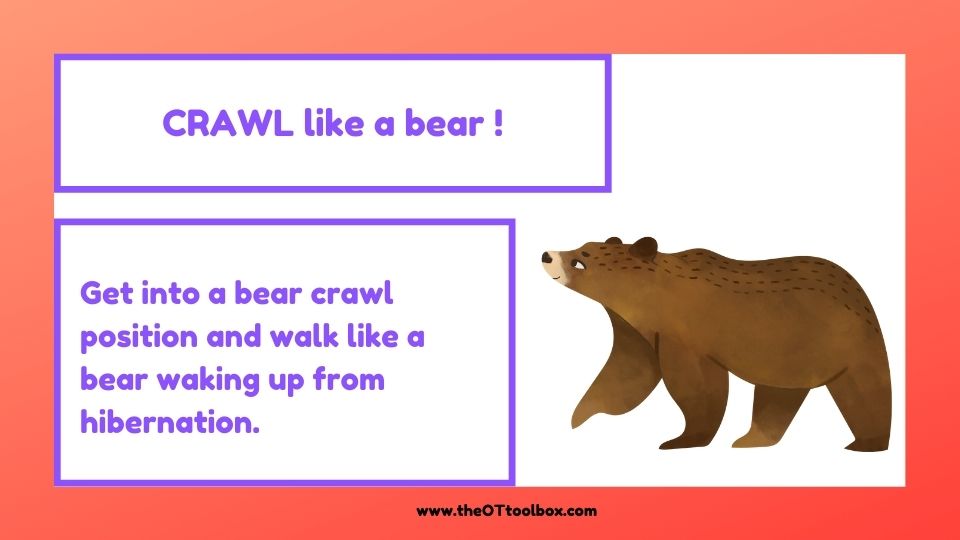
Crawling like a bear coming out of hibernation (Pair the activity with others from our collection of hibernation activities!)
Waddling like a duckling
MORE!
Users can act out each heavy work activity on the slides and work on motor planning, coordination, bilateral coordination, gross motor skills, AND gain the benefits of heavy work input!
Free heavy work slide deck
Want this slide deck in your therapy toolbox? Enter your email address into the form below to access this free slide on your Google drive.
Colleen Beck, OTR/L has been an occupational therapist since 2000, working in school-based, hand therapy, outpatient peds, EI, and SNF. Colleen created The OT Toolbox to inspire therapists, teachers, and parents with easy and fun tools to help children thrive. Read her story about going from an OT making $3/hour (after paying for kids’ childcare) to a full-time OT resource creator for millions of readers. Want to collaborate? Send an email to contact@theottoolbox.com.
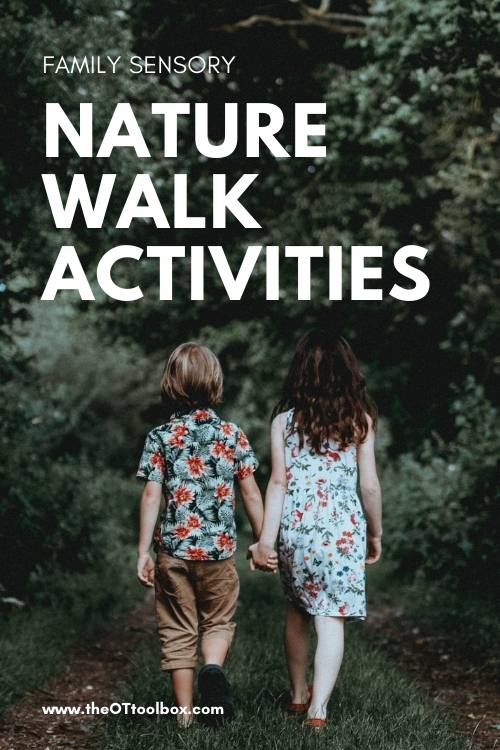
There are so many benefits to getting the whole family out for a family nature walk. Besides the physical exercise and family time, nature walks are powerful tools to incorporate all of the senses without any sensory equipment. Research tells us outdoor sensory play has many benefits. Use the sensory activities described here to learn and explore all of the senses (including the proprioceptive, vestibular, and interoceptive senses!) and add these sensory nature walk ideas to an outdoor sensory diet to help kids achieve an optimal sensory state so they can complete functional tasks and daily occupations.
Nature Walk Sensory Benefits
A nature walk and all of its colors, sights, and sounds make for a multi-sensory experience that can be easily shared as a family. There are so many sensory benefits when going on a nature walk or simply just by getting outdoors. The sensory input, learning and development, and simple family connection are just a few long-term benefits that can be provided by hiking in the woods.
Nature walks promote wellness by meeting many different needs:
Facilitate engagement and an alert state of regulation
Learning and cognitive benefits
Play and activity
Social interaction
Rest and sleep
All of these benefits make a family nature walk perfect for a family fun day! Or, pull out the flashlights and headlamps and go on a night walk as part of a family fun night.
Sensory Nature Walk
Stimulating the senses can help a child reconnect with their inner self, helping them identify how their body calms and relates to a free-flowing natural environment. Parents can help facilitate a child’s interaction in nature and the outdoors by simply being aware of a few activities that can be enjoyed as a family while experiencing the outdoors. Every sense can be utilized and engaged with a few fun ideas.
To help get you started, take look at the sensory components of a nature walk:
Nature Walks and the Visual Sense
The visual (sight) sense can be stirred by the abundance of colors with the trees and leaves and don’t forget to take some time to seek out a few outdoor critters or insects which can add a little element of fun while observing.
Try these visual processing activities during a family nature walk:
Play a game of I-Spy during your outdoor adventure. Think about playing using colors or items found in the environment. Take turns, and work on building vocabulary while playing this game.
Do a scavenger hunt and look for certain things found in the woods (you can find printable nature scavenger hunts on the internet).
Complete some nature rubbings with paper and crayons. Maybe rub some leaves within a notebook or complete rubbings of different types of tree bark.
Take a notebook and write down items you see in nature. It can be a nature journal that adds an opportunity to work on handwriting.
Auditory Processing and Sensory Walks
The auditory (hearing) sense can be jostled by the crunching of leaves under the feet as well as the snapping of twigs that can be heard while walking along a path or in the woods.
Snap twigs and listed to the cracks. Maybe even taking some time to build a few fun critter forts allowing for snapping of twigs to measure and build.
Also, try snapping twigs and building letters to add a little handwriting into the nature walk.
Listen for the birds and their chirping of songs and listen for some rustling of leaves when squirrels and other critters move about the woods.
Maybe the breeze is blowing, is it causing the trees and leaves to sway back and forth? Close your eyes and simply just listen to hear (it adds another fun element).
Gustatory Sense and Family Walks
The gustatory (taste) sense can be provided a little nudge, with adult supervision of course, if you find some wild blackberries or strawberries. They can be yummy to eat, but they do require cleaning so you may want to wait until you get back home to eat them so they can be properly cleaned for complete safety. If you are not that adventurous though, that’s okay you can still stimulate the gustatory sense on your walk if you work to prepare a fun trail mix before you leave the house so you can eat it on your outdoor adventure.
Bring a cold drink- A water bottle can be added to a backpack and brought along for a cold drink during a family walk. Remember the proprioceptive and oral motor benefits to drinking through a sports bottle, or a straw in a water bottle with a straw lid.
Nature walk snacks-Don’t have time to make trail mix, that’s okay too, you can just grab some granola or granola bars or maybe even some veggie sticks or beef jerky!
Tactile Sensory Nature Walk
The tactile (touch) sense can be heavily engaged with all of the different textures that can be explored and possibly gathered on your nature walk. Try some of these strategies on your nature walk:
Take some time to feel the leaves, moss, tree bark, rocks, dirt, and even a few fuzzy critters that can be given a little lift to their next destination.
Tossing rocks into small streams or even walking through puddles of water could provide a multi-sensory experience.
Write a few letters in the dirt with use of broken twigs as a pencil.
Take some time to feel the warmth of the sun or the breeze on your face as you walk.
Be sure to collect some nature items along the way though so you can explore them later either in a sensory bin or in an art project.
Play toss and catch with pine cones as appropriate. Toss and catch to each other or have kiddos toss to themselves including back and forth between their left and right hands.
The olfactory (smell) sense can be triggered by taking time to smell the dried leaves, flower scents, and even the smells that get blown as the wind or breeze lifts them through the air. Let’s face it, the wilderness has many smells that are unidentified and when mixed together create scents that are unusual kind of, musty. Even decaying wood has a very unique smell. Try these olfactory activities:
Smell flowers
Close your eyes and smell the air. Can you identify any scents?
Talk about scent words and the meaning of those terms. Some concepts to explore are: fresh, musty, moldy, sweet, sour, dry, etc.
Proprioception and Nature Walks
The proprioceptive (muscles and joints) sense can be impacted if you allow the child to lift heavy rocks, larger limbs and even just jump from higher elevations such as large rocks. All of the walking, climbing, and exploring adds heavy work input that tells the body where it is in space so the legs and body as a whole can move. Heavy work is a calming and regulating source of getting to a calm and alert state. Consider these opportunities for adding proprioceptive input on a nature walk:
Allow them to climb some trees and hillsides.
Explore trails with variations on elevation.
Consider the walking surface. Walking through a field, even trail, flat trail, or wooded hiking trail, or paved sidewalk offer different variants of heavy work though the legs and core.
Add hopping, jumping, bending, leaping, galloping, or skipping as you walk.
Even just the act of walking up and down the trail inclines can provide muscle and joint input that can be regulating for some kiddos.
Carrying water bottles in a backpack is an additional opportunity for heavy work.
Nature walks and the Vestibular sense
The vestibular (movement) sense can be activated as a child moves their body around the trees and rocks even while crawling up large rocks and trees. Incorporate vestibular input through these ideas:
Have them try some simple spinning with their eyes open and closed and arms outstretched to get a unique view of the outdoors maybe even doing some somersaults or cartwheels.
Allow them to try out their balance skills as they walk across a downed tree or along a trail of rocks.
Climb trees.
Run up hills.
Roll down grassy hills.
Nature walks and interoception
The interoception (inner body awareness) sense can be explored by the act of simply disconnecting from technology and other distractions and identifying how the body feels during this change of setting and heavy multi-sensory environment. An additional benefit of family walks is the connection to sleep (described more in detail at the bottom of this post.) Sleep has been noted to be included in the interoceptive processes much like hunger or thirst, as a brain process similar to other homeostatic processes.
Incorporate interoception in nature with these strategies:
Work on identifying their feelings and bodily responses to the sensory input such as noticing their breathing, heart rate, temperature, or possibly if they feel either tired, hungry, or thirsty.
How do you feel? A walk can change how you’re feeling. Maybe you feel re-energized and more alert. Talk about it.
Mindfulness is impacted by nature. Take deep breaths. Can you feel your heart rate slowing down?
Thirst inventory- How do you feel after a hike in nature? Thirsty? Dry mouth? These are signs that your body is thirsty. Some people struggle with this internal awareness. Talk about the signs of thirst and how the body reacts to this need and then afterwards once you’ve got a drink.
Nature Walk Activities
A nature walk is a fun time to collect items from nature for exploring. While out on family walk, collect items from nature such as rocks, pebbles, sticks, leaves, moss, etc. These items can be placed into a backpack or bag and brought home to explore and create. (Be sure to return items to nature, afterwards as long as they are free from paint or glue.)
After you’ve finished your outdoor adventure and you’ve collected some fun nature goodies from your walk, take those items home and create a sensory bin, fine motor craft kit, or maybe even use them in a fun art project. What can you collect?
Look for some of these items (and explore the visual sense as you seek and find items):
Acorns
Twigs
Leaves
Rocks
Feathers
Pine needles
Pine cones
Moss
Seeds
Grasses
Sand
Dirt
Sunflower seeds
Fallen tree bark
Nature Walk Sensory Bins
Use these materials to make a sensory bin. Add the items you’ve collected to a large bin, basket, or tray. Now it’s time to explore! Try these nature sensory bin ideas:
An added benefit of incorporating a nature walk into the family routine is that walks in turn promote rest. All of the physical activity of nature walks may be helpful in encouraging rest and as a result, sleep.
Additionally, research suggests a relationship between sleep difficulties and patterns of sensory processing issues in children.
Studies show that sensory processing differences, considerably including increased sensory sensitivities, sensory-avoiding patterns, sensory-seeking patterns, and poor sensory registration have been associated with changes in sleep quality. (Vasek, M., Williamson, J., Garden, J., Zwicker, J., 2015).
Occupational therapists play a role in sleep by offering tools and strategies to promote adequate and restful sleep. Because sleep is a necessary component of performing functional tasks and daily occupations, occupational therapists can assist with promoting adequate and healthy sleep by using evidence based methods, once of which can include physical activity such as family nature walks.
A final note about sensory walks
Take a seasonal nature walk to simply allow children to explore with their senses while building skills needed for learning and development! Allow children the freedom to explore at their own pace and to be creative. Give them the opportunity to come up with a fun, family activity outdoors. They’ll surprise you!
Don’t live near a colorful hiking area? Take some time to visit a farm, a pumpkin patch, a flower garden, a cornfield, or even the beach. Really, just get outdoors and explore anywhere! By being outside away from technology and other distractions, children can rejuvenate their bodies and minds while stimulating their senses.
Try these resources to incorporate the sensory system when in the great outdoors:
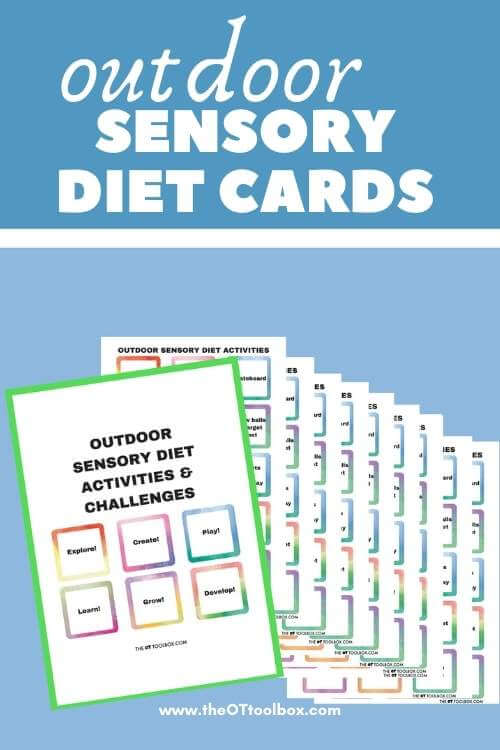
Create the “right kind” of sensory experiences to improve regulation, attention, focus, body awareness, motor development, and sensory processing.
90 outdoor sensory diet activities
60 outdoor recess sensory diet activities
30 blank sensory diet cards, and 6 sensory challenge cards
They can be used based on preference and interest of the child, encouraging motivation and carryover, all while providing much-needed sensory input.
References:
Mark Vasak, James Williamson, Jennifer Garden, Jill G. Zwicker; Sensory Processing and Sleep in Typically Developing Infants and Toddlers. Am J Occup Ther 2015;69(4):6904220040. https://doi.org/10.5014/ajot.2015.015891
Regina Parsons-Allen is a school-based certified occupational therapy assistant. She has a pediatrics practice area of emphasis from the NBCOT. She graduated from the OTA program at Caldwell Community College and Technical Institute in Hudson, North Carolina with an A.A.S degree in occupational therapy assistant. She has been practicing occupational therapy in the same school district for 20 years. She loves her children, husband, OT, working with children and teaching Sunday school. She is passionate about engaging, empowering, and enabling children to reach their maximum potential in ALL of their occupations as well assuring them that God loves them!
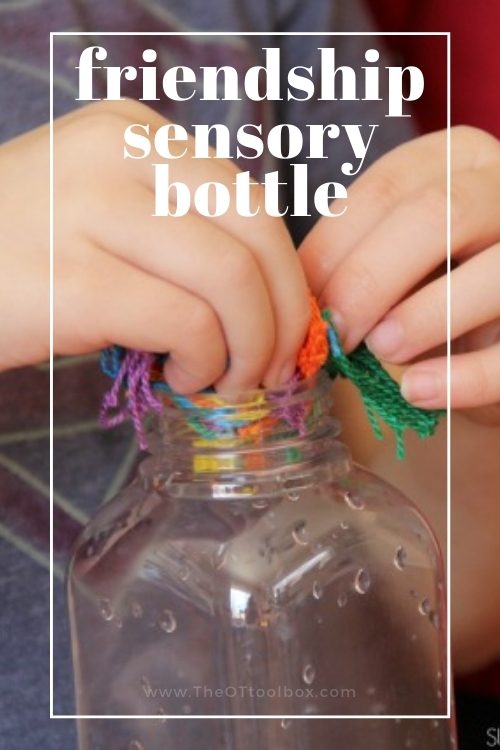
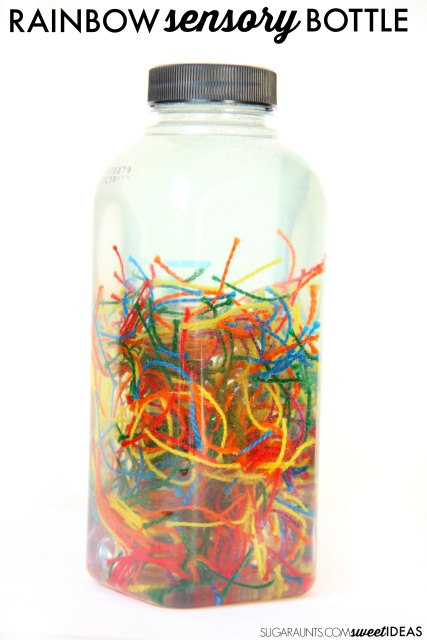
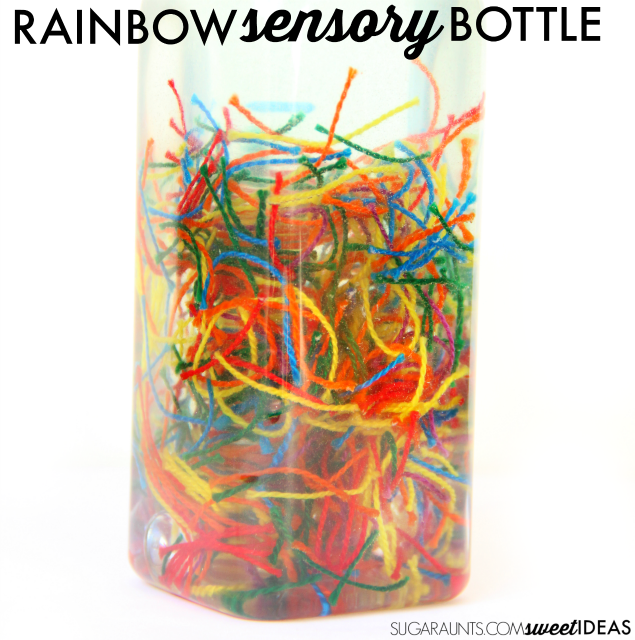
This rainbow sensory bottle is a simple friendship sensory activity to throw together, and uses whatever materials you have in your home. We used rainbow string to make our sensory bottle for use as a calming tool for visual and proprioceptive input. We made these friendship sensory bottles as a friendship activity that helped to work on cooperation and specific aspects of social emotional development.
The reason for making sensory bottles is simple: Shake a sensory bottle and watch the contents slowly fall for visual sensory input. There is just something relaxing about watching a sensory bottle. This rainbow sensory bottle is colorful and packs a fine motor punch when the kids are involved in the making process.
How to make a friendship sensory bottle
First, gather a friend. Then, you’ll need a couple of empty bottles and some materials. You could gather craft supplies like glitter, sequence, string, craft pom poms, or any materials really.
This sensory bottle was super simple to make. We used just a few materials:
To make the rainbow sensory bottle, first cut the friendship thread into 1-2 inch lengths.
Have the friends take turns filling each other’s friendship sensory bottles with the materials. You could make each bottle the same, or they can be as different as two friends are!
While filling the sensory bottles, this is a nice time to talk about qualities of a friend.
Talk about how different each friendship bottle will be even through they may contain many of the same materials.
Talk about how different people are too, and no matter what is inside of one, the bottle will always look different with it’s swirls and whirls of sensory materials.
You can discuss qualities of a friend: companionship, trustworthiness, listening skills, being helpful, and working together. When friends shake their sensory bottles, they can recall these qualities.
Each child can fill their bottle (and their friends’ bottle) with the thread.
This is a great exercise in fine motor skills to work on tripod grasp and neat pincer grasp. My toddler and preschooler really got into pushing the thread into the bottle.
Once all of the thread has been added to the bottle, pour in about 1/2 inch of body wash.
Amounts are approximate and will vary depending on the recycled bottle you use for your sensory bottle.
Add water to the top.
As you add water, suds will form. Continue adding water to allow the suds to spill over the top of the bottle.
When MOST of the bubbles have poured out of the bottle, twist on the lid.
Now, give the sensory bottle a big shake. This is the job for the kids. Have then shake the bottle to mix in the gel.
Now, as you shake, more bubbles will form but let them settle. After the gel and water has mixed, add a couple of the glass gems to the bottle. These help to mix and stir the rainbow thread within the water-gel combo. An added bonus of the marbles is an added bit of weight in the bottle. This gives the sensory bottle some heavy work to the sensory play. Shaking a bottle that is heavy provides proprioceptive input.
More Friendship Sensory Activities
Add these friendship sensory bottles to these movement and sensory activities to develop friendship skills:
Pair these activities with the free friendship slide decks that are now on the site:
Writing about Friendship Slide Deck – writing prompts, writing letters to friends, and handwriting activities to develop friendship skills, all on a free interactive Google slide deck.
Personal Space Friendship Skills Slide Deck– Friendship involves allowing personal space, and body awareness and all of this is part of the social skill development that some kids struggle with. Use this free Google slide deck to work on body awareness and personal space.
Colleen Beck, OTR/L has been an occupational therapist since 2000, working in school-based, hand therapy, outpatient peds, EI, and SNF. Colleen created The OT Toolbox to inspire therapists, teachers, and parents with easy and fun tools to help children thrive. Read her story about going from an OT making $3/hour (after paying for kids’ childcare) to a full-time OT resource creator for millions of readers. Want to collaborate? Send an email to contact@theottoolbox.com.