Books About Primitive Reflexes

Looking to better understand primitive reflexes, how reflexes impact development, and what you can do to support children (and adults) who have retained primitive reflexes? You are in luck! This collection of books about primitive reflexes offer tools you can use to support functional independence, learning in the classroom, community independence, social emotional learning, and so much more!

Books about Primitive Reflexes

If you are just getting started with understanding the impact primitive reflexes has on everyday functioning, then reading out blog post on what are primitive reflexes is a good place to begin.

Primitive Reflexes impact a child’s ability to function in so many ways. Learning about primitive motor reflexes is something that we’ve all gone through as therapists during our school career during those days in occupational therapy schools.

There are many questions about primitive reflex integration, too. Specifically what is a reflex and what is reflex integration.

That’s why I wanted to put together some information on primitive reflex integration, including books about primitive reflexes so that a collection of tools are available for anyone researching reflexes and their impact on functioning.

You’ll also find more resources on primitive reflex integration including courses on primitive reflexes.

Books about primitive reflexes and resources for learning about primitive reflexes including primitive reflexes courses and reflex integration trainings.


Books on Primitive Reflex Integration

The following books are resources available on Amazon. There are many more books on primitive reflexes out there, and they are tools that therapists may have had access to during occupational therapy school programing. I wanted to limit the list below to books that are easily accessible.

Have you read or used any of these books on primitive reflexes? Do you have any other book recommendations that you would like to share with readers? 


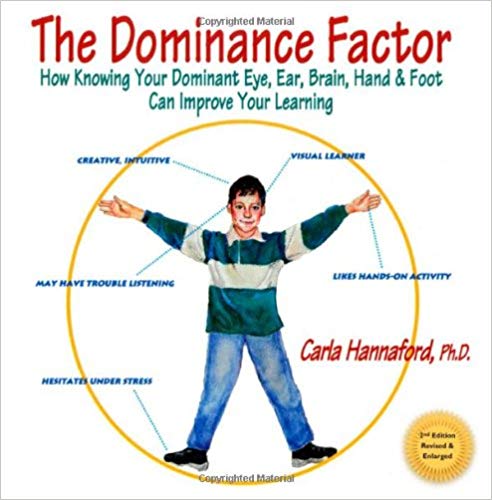
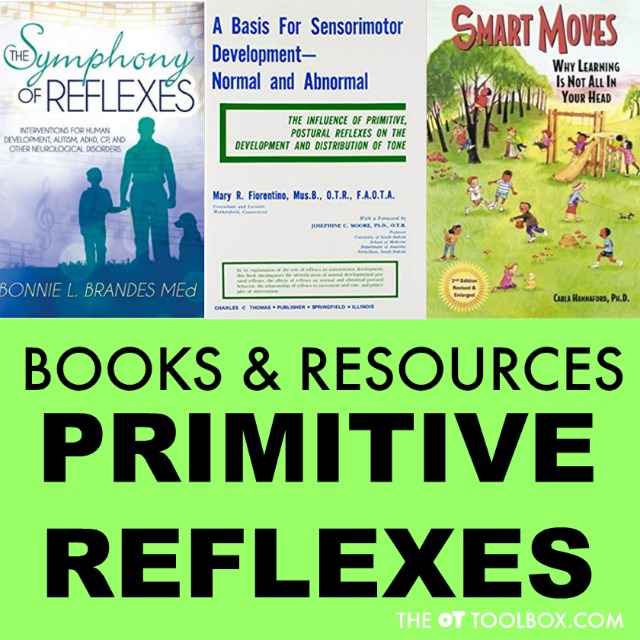
The Dominance Factor: How Knowing Your Dominant Eye, Ear, Brain, Hand & Foot Can Improve Your Learning by Carla Hannaford


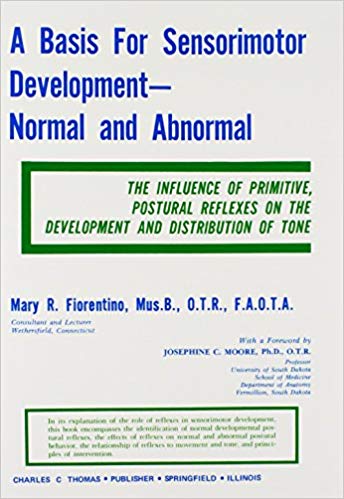
A Basis for Sensorimotor Development-Normal and Abnormal: The Influence of Primitive, Postural Reflexes on the Development and Distribution of Tone by Mary R. Fiorentino


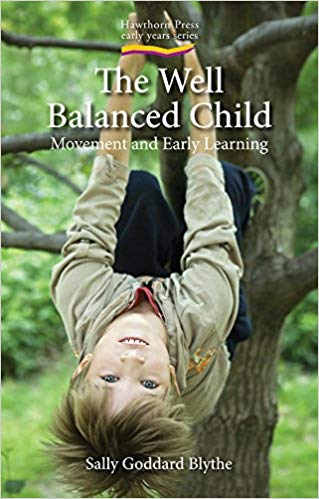
The Well Balanced Child: Movement and Early Learning (Early Years) by Sally Goddard Blythe 


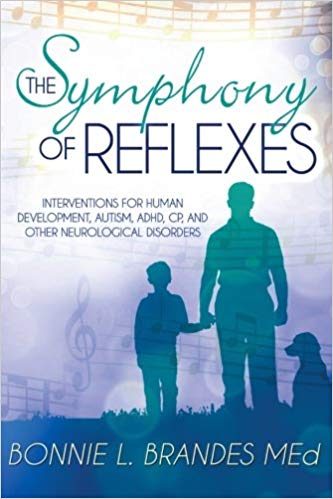
The Symphony of Reflexes: Interventions for Human Development, Autism, ADHD, CP, and Other Neurological Disorders by Bonnie Brandes M.Ed. 


Other Primitive Reflex Resources

Rhythmic Movement Training is a reflex integration program that uses developmental movements, gentle isometric pressure and self-awareness to rebuild the foundations necessary to help overcome learning, sensory, emotional and behavioral challenges for children and adults.
 
What courses have you taken that you would recommend to other therapists? Let me know and I will add them to this database! 


Use these books about primitive reflex integration to learn more about reflexes and reflex integration
 

Need more information on retained primitive reflexes? 

For the clients, students, and kids that you see and work with every day that possibly have one or more retained primitive reflexes, may struggle in any of the following areas:

  • Sensitive to touch, sound, smell and taste
  • Balance issues, is clumsy, struggles with sports, runs into furniture
  • Freezes or is in constant fight or flight mode
  • Poor impulse control, easily distracted, severe mood swings
  • Can’t cross the midline, trouble with hand-eye coordination, struggles with fine motor
  • Has difficulty tracking when reading and writing
  • Poor posture, attention issues, wraps legs around chair, wets the bed after the age of five
  • W-sitting, poor muscle control, toe walking

Primitive Reflexes e-Course and Handbook

Check out this primitive reflexes course. (affiliate link)

Assessment And Integration Of Primitive Reflexes For Improved Independence In Daily Activities is a course on primitive reflexes where you’ll learn how to, screen, test and integrate retained primitive reflexes and find tools to help your client or child improve motor, social and daily functioning skills by implementing fun, therapeutic, and functional activities!

In this primitive reflexes course, created by two occupational therapists, you’ll find modules and functional intervention activities for:

  1. Moro reflex
  2. The Tonic Labyrinthine (TLR) & Landau Reflex 
  3. The Rooting Reflex
  4. The Asymmetrical Tonic Neck Reflex (ATNR)
  5. The Spinal Galant Reflex
  6. The Palmar Grasp Reflex
  7. The Symmetric Tonic Neck Reflex (STNR)
  8. Support for kids who push back
  9. Printable handouts, screening tools, and checklists
  10. Information on postural reflexes, yoga, sensory diets, and more
  11. Case studies
  12. Research
  13. AOTA continuing education: 1.05 AOTA CEUs

If your child has retained primitive reflexes, learning to integrate them could lead to improved development in many areas:

  • Social Skills
  • Learning
  • Motor Skills
  • Executive
  • Functioning
  • Coordination
  • Reading & Writing

Find out more and gain insight and tools on retained primitive reflexes and start supporting kids needs with “Assessment And Integration Of Primitive Reflexes For Improved Independence In Daily Activities” today.

Colleen Beck, OTR/L has been an occupational therapist since 2000, working in school-based, hand therapy, outpatient peds, EI, and SNF. Colleen created The OT Toolbox to inspire therapists, teachers, and parents with easy and fun tools to help children thrive. Read her story about going from an OT making $3/hour (after paying for kids’ childcare) to a full-time OT resource creator for millions of readers. Want to collaborate? Send an email to contact@theottoolbox.com.

Back to School Fine Motor Tool Kit + A Bonus

In this post I will share with you a super fine motor tool kit that will reach a variety of kiddos and probably contains many items that you already have on hand.

It’s back to school time and all of us are beginning to think about how we want to approach the new school year. We feel re-energized and rejuvenated and are looking for some new therapy tools to start off the year. If you are like me, you want an easy and fun start to the school year for all!

The beginning of the year is a busy time for the occupational therapist, determining caseloads, organizing forms, reviewing goals, scheduling kids, and collaboration with the staff and your team.

After all of this OR during all of this, you start seeing kiddos for services and you want something that is easy, something that addresses OT goals, and something that is fun for the kids while helping build a rapport. Why not a fine motor fun kit? It is low key and helps transition into the new school year without a lot of stress.

As an added bonus, you can scroll to the bottom of this post to get a free back-to-school bonus for planning therapy themes this school year.

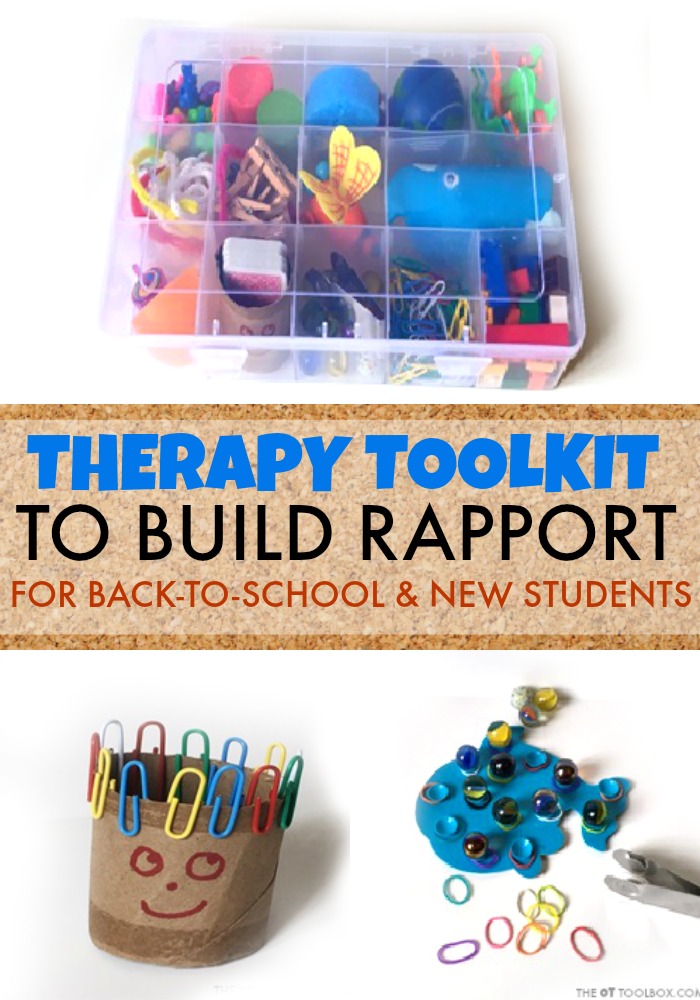
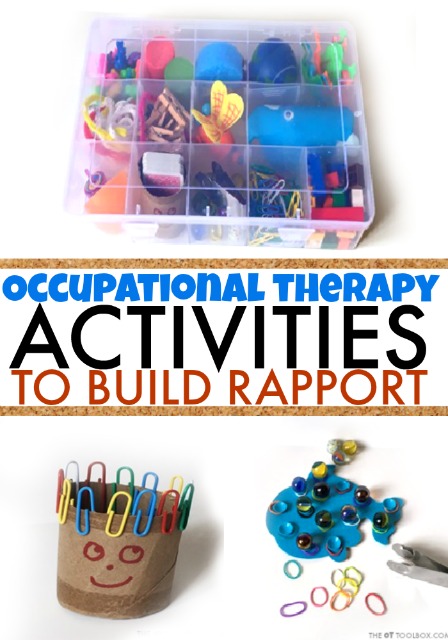
Use these fine motor activities and occupational therapy tools to create a back-to-school fine motor toolkit that helps students address occupational therapy goals while building rapport.

Back-to-School Fine Motor Toolkit

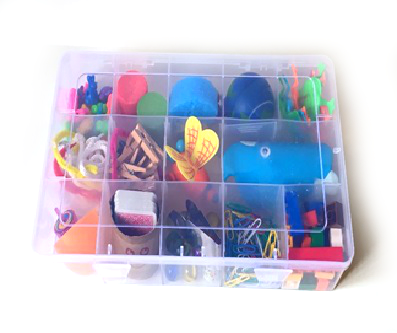
Below is a sweet craft organizer I purchased at a local Dollar General for $2 this summer! Craft organizers are great for storing therapy materials.  I am using it as my new fine motor tool kit this school year to toss in my therapy bag and use with most any child I see for service. I can use at least one, if not many, of the activities to address hand skill goals or provide a fun warm-up to handwriting or other OT tasks.

This occupational therapy toolkit is a great one to use for back-to-school fine motor activities and a nice way to build rapport with students at the start of a new school year.

It is just the right size to toss in a therapy bag or therapy cart and is packed full of fun fine motor activities. I think I’ll call it my “toss n’ go” kit. The organizer has optional features with which you can choose to store your fine motor goodies. It displays 15 small sections, but can easily convert to create larger sections in the middle while keeping a total of 10 smaller sections on the top and bottom. This great design will keep my goodies organized and ready for use while providing space for some of my larger items too.

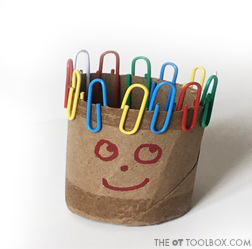
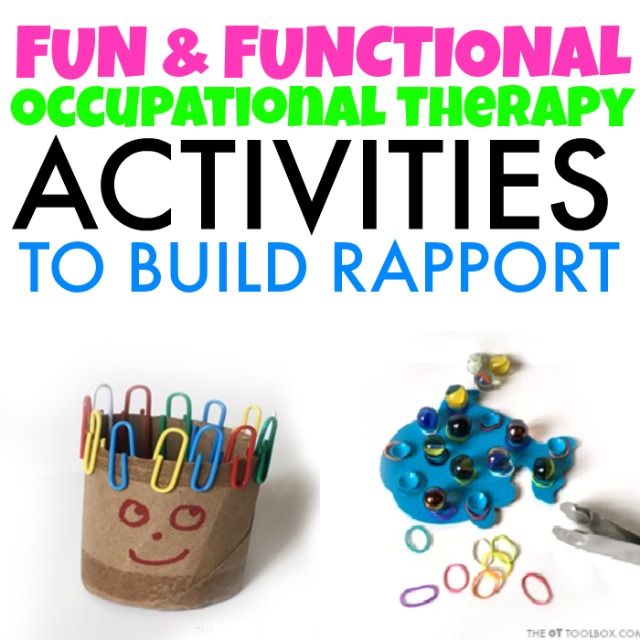
Use paper clips and a paper towel tube to make a paperclip man, a fun fine motor activity for kids to work on fine motor skills as part of a back-to-school fine motor toolkit that works on fine motor skills in a fun way!
Use the items in your back-to-school fine motor toolkit to create and build rapport with occupational therapy students and clients. This paper clip man is just one idea, using must-have occupational therapy materials in a fine motor toolkit.
Work on fine-motor-skills with this occupational therapy toolkit that is perfect for back-to-school and building rapport with kids at the start of a new school year.

Fine Motor Toolkit Activities and Therapy Items

Amazon Affiliate links are included in this post. You can find these items in your local dollar stores and at various sales throughout the year. Amazon links are included for convenience.

Let’s get started by taking a look at the fun items that I have included in my fine motor tool kit this year and discuss the ways I plan to use them.

Paperclips – these are great for creating paper clip chains and creating fun hair on paper towel tube faces.  Using the paper clips this way addresses fine motor manipulation and coordination, bilateral coordination, eye-hand coordination and finger strength.

Use paper clips and small paper tubes to make fun people and creatures!

Beads – these are great for stringing on a chenille stem or string. Using beads addresses fine motor manipulation and coordination, precision, bilateral coordination, eye-hand coordination, and pincer grasp.

Spin Tops or Spinning Egg Bottoms– these are great for duration races. Using spin tops addresses pincer grasp and finger rotation. Using egg bottom makes spinning a little easier for some children who need this activity downgraded to be successful.

Pool Noodle Poppers – these are great to pop for fun or for distance races. Using the pool noodle segments in this way addresses finger strength, pincer grasp patterns, and fine motor coordination.

Also included in the box are solid foam poppers that I found at Christmas at a local dollar store. I use these for pop distance races and wrapping loom bands.

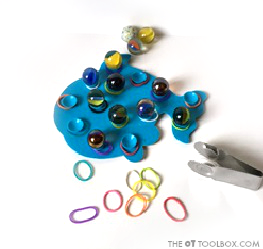
Bathtub Soapdish Grippers – these are great for pony bead or marble placement and loom band wrapping. Using the bathtub soap dish grippers in this way addresses grasp patterns, eye-hand coordination, fine motor control, and bilateral coordination.

Use a soap dish gripper and tweezers to help kid improve fine motor skills

Mini or Small Clothespins – these are great for clipping onto chenille stems or for creating hair on paper towel tube faces. Using the clothespins in this way addresses eye-hand coordination, pincer grasp, bilateral coordination, and fine motor control.

Wind-up Toys – these are great for duration races and are simply fun to watch. Using wind-up toys addresses pincer grasp, finger rotation, and bilateral coordination.

Mini Playing Cards – these are great for counting and placing loom bands or paper clips to correspond to the number on the playing card. Using the cards in this way addresses fine motor manipulation and coordination, bilateral coordination, and pincer grasp.

Loom Bands – these are great for wrapping on playing cards, around suction cups on bathtub soapdish grippers, and around the solid poppers. Using the loom bands works on fine motor coordination and manipulation, pincer grasp, bilateral coordination and eye-hand coordination.

Spools – these are great for wrapping lacing string. Spool wrapping addresses bilateral coordination, fine motor coordination and manipulation, motor planning, and eye-hand coordination.

Squeeze Ball – these are great for exercise repetition. Using the squeeze ball in this way addresses hand and finger strength and can help with stress or anxiety reduction.

Mini Driving Cars – these are great for a number of activities. You could use them to practice shape and letter formation by driving the cars to form or create a road for the cars to drive on with mini playing cards. They address grasp patterns, eye-hand coordination and motor planning.

Hopper Animals – these are great for aiming at targets or simply just for fun. Using them addresses finger isolation, force/pressure regulation, and eye-hand coordination.

Small Lego – these are great for constructing small objects. Using Lego addresses finger strength, bilateral hand skills, problem solving and creativity.

Small Tongs – these are great for picking up and placing items onto or into a target.  Using them addresses tripod grasp, hand and finger strength, open web space, and eye-hand coordination.

Kids will love these fine motor activities in occupational therapy this year! Use the back-to-school fine motor kit to build rapport at the start of a new school year!

Although I have many great ideas for using the fun tools in my toss n’ go kit, I know there will be many other ways to use them which will blossom over the next school year. New ideas will emerge out of necessity, but also out of child creativity. That’s what I love about OT, you teach a child new skills and they teach you to see the world (and activities) differently!

Kids can work on fine motor skills and therapists can build rapport with this back to school fine motor kit in occupational therapy activities.
Use this occupational therapy activities planner as a back-to-school therapy guide to plan activities and themes in occupational therapy sessions, perfect for school-based OT.

Therapy Planning Calendar

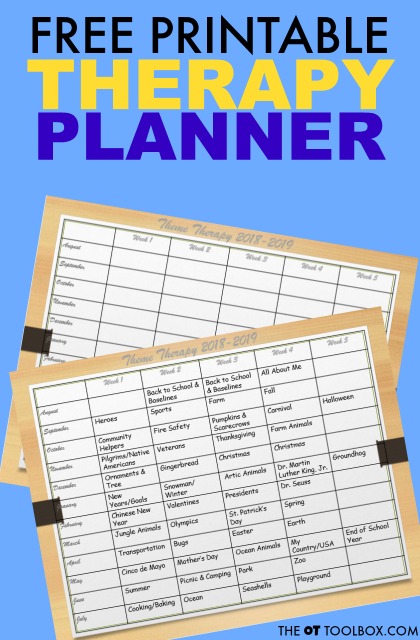
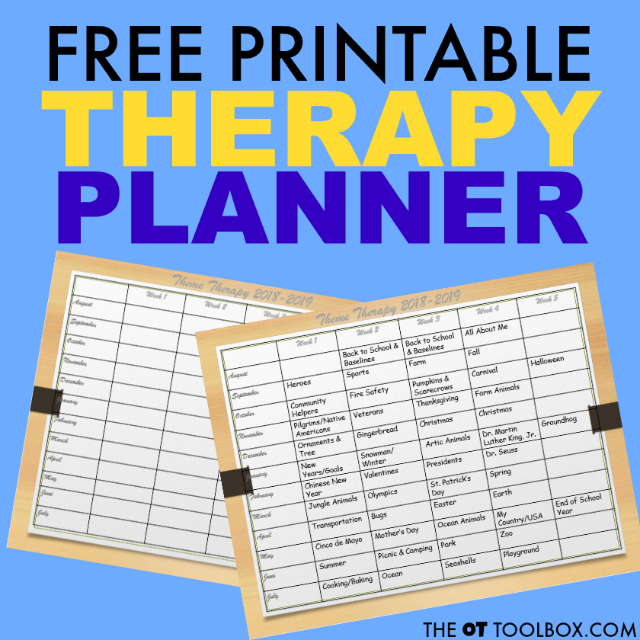
For the new school year, I have included a fun bonus to this post that you will find below. It is an editable Theme Therapy Calendar for the 2018-2019 school year.  Sometimes weekly themes can help you stay motivated AND make your life easier as a therapist while helping to keep children engaged in therapy activities from week to week.

Enter your email address below to get the free printable therapy planning calendar. Use it as a guide to schedule and plan themed occupational therapy activities throughout the school year. You’ll also get a blank therapy planning calendar so you can fill in special themes that may go along with your school’s calendar or planned activities.

This free occupational therapy activity planner is perfect for the school based OT and planning occupational therapy themes and sessions.

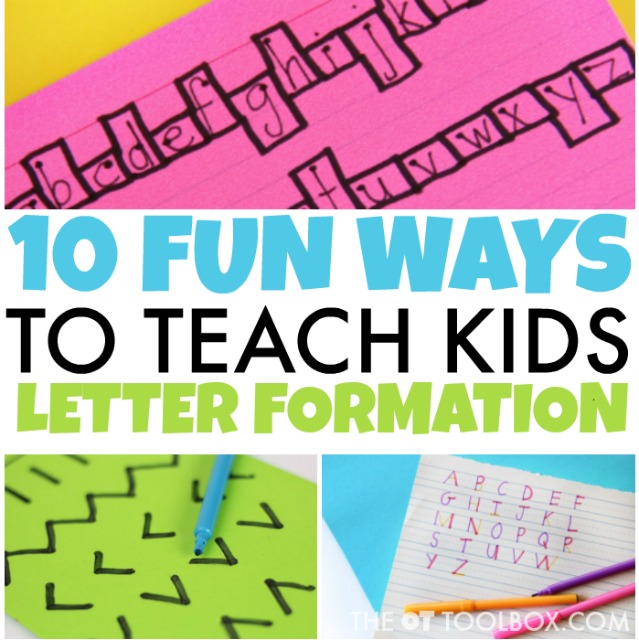
10 Ways to Teach Letter Formation

letter formation activities

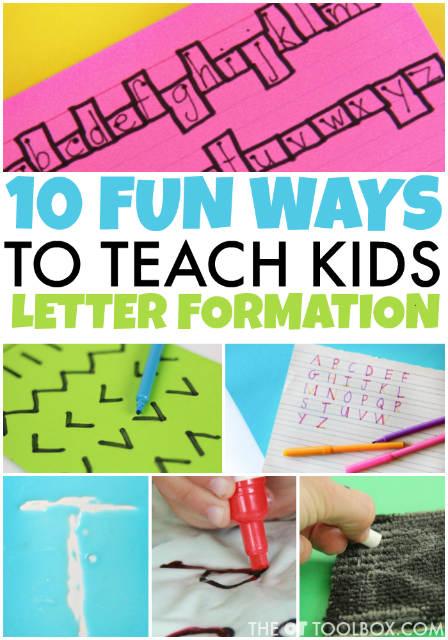
Here we are covering creative letter formation activities to help children with letter formation practice to create the motor plan of actually writing and forming letters. This handout on letter formation will support parents, teachers, and therapists with advocating for this functional handwriting skill.

Letter Formation Activities

To get started, be sure to access these practical and creative letter formation tools:

In addition to the ideas below, be sure to grab a copy of our color by letter worksheet. It’s a fun way to teach letter formation through a coloring activity that helps kids with the visual memory needed for letter writing skills.

One thing that is apparent in teaching Handwriting is the very real need  that parents and teachers struggle with when it comes to teaching letter formation.

Teaching letter formation can be a complicated thing for children with visual perception challenges, fine motor skill difficulties, or sensory processing concerns. In this article, you will find creative ways to teach letter formation.

So many members of the group question how to teach letter formation. They wonder where to start with teaching kids to write letters or they are challenged by kids who have formed bad habits with letter formation.

They are seeing kiddos who form letters incorrectly or don’t know where to even start to teach letters accurately from the beginning.


Read on to find 10 creative ways to teach letter formation whether you are starting at the beginning with a young child or are addressing those pesky bad handwriting habits that have resulted in poor letter formation and therefore, legibility.

Creative Ways to Teach Letter Formation

These fun handwriting activities are those that add a fresh concept to teaching letter formation. You can use these ideas to teach pre-writing skills or to work on specific letters.

Creating a motor plan for handwriting to form letters from muscle memory is the key here. These creative activities support that skill.

But first, consider these thoughts when teaching kids to write letters…

When using the ideas below, it’s typically recommended to start with uppercase letters because of the simplified forms and letters that for the most part, start at the top and are formed in a downward pencil stroke, which is developmentally appropriate for young children. Read more about the order to teach letters like cursive letter order here.


Using a non-pencil activity to teach handwriting can be the trick to get kids interested in writing!

When kids are learning to write, knowing how to write letters can be hard! These handwriting activities are great for anyone trying to teach letter formation to kids.


10 Ways to Teach Letter Formation

Affiliate links are included in this article.

1.) Work on letter formation by “building” letters- This is a question for some parents, teachers, and therapists. Sometimes we see children who construct letters by parts, but use inappropriate letter formation when building letters. When writing a lowercase letter “d”, they might draw a circle and then draw a line, without the re-trace. Drawing or building letters can have inefficient consequences if kids are just allowed to copy letters inaccurately and without being taught. So often, we see this in those writing tray videos over on Pinterest or Facebook. Read more about writing trays and handwriting and how to use writing trays to effectively teach letter formation. Teaching kids wot build letters with proper sequence in each letter formation is essential! This color-coded letter building activity teaches kids to start at the correct starting spot and to pick up the pencil when necessary. Try this activity for those children who respond well to visual cues. Adding a kinetic twist to teaching letter formation can be just the tool that makes formation stick! 

2.) Teach Letter Formation with a Writing Tray- The fact is, using a sensory writing tray for handwriting is a technique to practice proper letter formation is a way to incorporate multiple senses into learning letter formation.

Multisensory learning approaches to handwriting are very effective. Be sure to encourage proper starting points and direction of letter lines such as starting letters at the top and lifting the writing utensil when appropriate to form parts of letters such as the curves in a “B” or the slanted little lines in a “K”. Writing trays can come in all sorts of themes, sizes, and using all types of mediums. You can even create a mini-sensory writing tray like we did. Take it along in your therapy bag or on-the-go to learn and practice letter formation anywhere!

3.) Use the Sandpaper Letter Trick to Teach Letter Formation- Use a sheet of sandpaper to work on letter formation! This multi-sensory activity uses the senses to teach letter formation, by providing feedback for pencil control and line placement. Adding a quick sheet of sandpaper to your therapy toolkit is an easy way to work on letter placement by adding additional prompts to handwriting.

4.) Teach Letter Formation with Soap- Kids can learn to write letters in shaving cream, soap, and even pudding! Using multi-sensory strategies to work on letter formation can help kids remember the proper formation. So often we see strategies that are taught in isolation and then not carried over to the classroom or home. When a child is asked to write with increased speed or in a distracting environment, we may see letters that revert back to those bad habits. Adding sensory activities to letter formation such as writing in soap, shaving cream, or sandpaper can provide the feedback kids need to add just one more cue for formation. Remember to provide instruction in proper letter formation and line placement and not just setting up a child with an activity and then letting them “play and write”.

5.) Teach Letter Formation with Gross Motor Play- Sometimes, adding a movement component to teaching letter formation can be all it takes to make letters “stick”! There are so many options for adding gross motor to letter formation. 


6.) Teach Letter Formation on an alternate surface with a sensory bag- Fill a sandwich bag with soap, foam, or other liquid material and practice letter formation. You can even tape the sensory bag onto a wall or window to practice letter formation. Read more about how to create and use a sensory bag to teach letter formation in this older post on sensory handwriting


7.) Use a resistive surface to teach letter formation- The motor plan needed for letter formation can occur with practice on a resistive surface. We’ve shared ideas to teach letter formation on resistive surfaces such as using carpet squares or carpet scraps, a styrofoam tray to learn letter formation, and foam sheets to teach letter formation.


8.) Teach Letter Formation with the “Ghost Writing” Trick- Have you tried the ghost writing trick to teach letter formation? It’s a fun way to explore the pencil strokes needed for letter formation as well as skills needed for legible handwriting and pencil pressure in written work. 


9.) Use Boxes and Dots to Teach Letter Formation- This box and dot letter formation trick also helps kids learn letter size or spatial awareness in written work. It’s also a tool to help kids who struggle with letter reversals. You can make your own paper or use graph paper to create a quick practice tool for teaching letter formation. 


10.) Help kids learn to write with a Kinetic Letter Formation- This is fun kinetic fine motor activity is another spin on adding resistive input and a motor component to letter formation, all using recycled materials or objects found around the home. Use a recycled can and push pins to teach letter formation while improving hand strength and fine motor skills. 

Working on handwriting with kids? These creative handwriting activities can help kids with letter formation and are a tool for anyone trying to teach letter formation in handwriting.


Do you have any letter formation activities that you love to use when teaching handwriting? Tell us about them! There are over 14,000 members in the Sweet Ideas of Handwriting Help Facebook Group that love sharing ideas to work on handwriting. 

Colleen Beck, OTR/L has been an occupational therapist since 2000, working in school-based, hand therapy, outpatient peds, EI, and SNF. Colleen created The OT Toolbox to inspire therapists, teachers, and parents with easy and fun tools to help children thrive. Read her story about going from an OT making $3/hour (after paying for kids’ childcare) to a full-time OT resource creator for millions of readers. Want to collaborate? Send an email to contact@theottoolbox.com.

The Handwriting Book is a comprehensive resource created by experienced pediatric OTs and PTs.

The Handwriting Book covers everything you need to know about handwriting, guided by development and focused on function. This digital resource is is the ultimate resource for tips, strategies, suggestions, and information to support handwriting development in kids.

The Handwriting Book breaks down the functional skill of handwriting into developmental areas. These include developmental progression of pre-writing strokes, fine motor skills, gross motor development, sensory considerations, and visual perceptual skills. Each section includes strategies and tips to improve these underlying areas.

  • Strategies to address letter and number formation and reversals
  • Ideas for combining handwriting and play
  • Activities to practice handwriting skills at home
  • Tips and strategies for the reluctant writer
  • Tips to improve pencil grip
  • Tips for sizing, spacing, and alignment with overall improved legibility

Click here to grab your copy of The Handwriting Book today.

How Vision Problems Affect Learning

vision and learning problems

Did you know that vision and learning are closely related? It’s true! Vision problems impact learning in a big way. Here, you’ll discover how vision problems impact learning for children. With a new school year, it’s time to start thinking about kindergarten screenings, screenings for vision problems, and wondering how previously struggling kids will do in the next academic year. One of the largest challenges facing some of these kids may be unidentified vision problems. Read more to learn about how vision problems affect learning.

Typical vision screenings given by the pediatrician or school nurse test for acuity only. They do not look for any other underlying vision problems that a child may be experiencing that is hindering their overall development in reading and writing.

You’ll also want to check out these specific scanning activities for reading.

There are many ways that vision problems affect learning in kids.

What You Need to Know About Vision Problems and Learning

There are many causes of learning difficulties that a child may present with. However, the following list of difficulties may indicate underlying vision problems and the need for a more in-depth vision screening.

Learning Difficulties Implying Underlying Vision Problems

* Reversals
* Difficulty with handwriting
* Poor reading comprehension
* Difficulty copying from the board
* Difficulty transferring information from one page to the next
* Frequent falls or walking into things
* Difficulty spelling
* Difficulty with letter and number recognition


Vision is More the 20/20 

Vision is more than 20/20 acuity. It is the ability to move your eyes with smooth, coordinated and controlled movements. These movements can be broken down into tracking (pursuits), depth perception, teaming, saccades, convergence/divergence and nystagmus. When these skills are impaired, learning difficulties will arise.

Here is more detailed and specific information related to saccades and their impact on learning.

Common Vision Problems that Impact Learning

These visual processing skills are essential to learning:

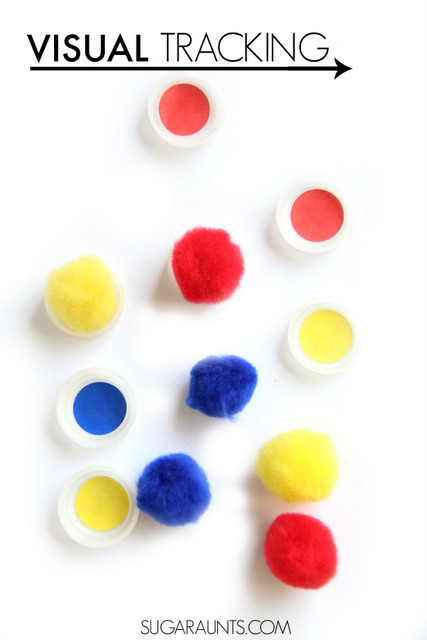
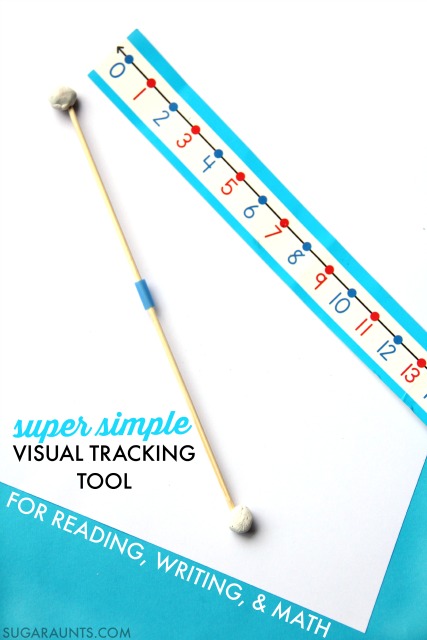
TrackingVisual Tracking is the ability smoothly follow an item with your eyes while in a stabilized position. A child with tracking difficulties may be unable to dissociate their eye movement from their head, be unable to maintain visual focus on the target, or “skip” or “jump” when crossing midline. These patterns indicate difficulties with tracking that may hinder the development of reading skills. Read more about visual tracking here.

Teaming– Teaming or binocular vision, refers to the ability to move both eyes in a controlled, coordinated fashion. Children with teaming difficulties also frequently have trouble with reading, along with letter and number recognition. This vision difficulty can be hard to see during a screening, as it is related to an eye muscle imbalance that may be slight, or due to fatigue during longer activities. However, teaming difficulties should be considered if the child is having tracking difficulties, as tracking and teaming skills play into one another.

Depth Perception– Depth perception helps us to know where we are in relation to items in the world utilizing our visual system. Children with depth perception difficulties frequently fall, have difficulties with catching a ball (early closure of hands, or fail to catch at all), poor righting reactions and reflexes and frequent tendencies to readjust their bodies in relation to their work space.
Saccades Saccades is the ability to quickly look between a set of objects without losing focus. For children with difficulties with saccadic movements reading is a significant challenge. They frequently lose their place, are unable, to keep up or experience eye muscle fatigue and headaches.

Convergence/Divergence- Convergence is the ability to track an object from a distance into near point range with smooth movements. Divergence, is the opposite. It is the ability to track an object smoothly from near to far. Deficits in these skills often lead to difficulties with near and far point copying tasks. The child may skip lines, letters or even whole words with deficits in this area.

Nystagmus- Nystagmus is a visual response to circular vestibular input. After being spun, one’s eyes should oscillate before returning to a normal resting position. When a child does not have a nystagmus response, it can be an indicator of a vestibular deficit. However, in this post, if a nystagmus pattern is noted at rest without input, is abnormal and results in lowered overall vision.

Related Read: Need help addressing visual problems in the classroom? Here are classroom accommodations for visual impairments

Screening for Visual Problems

Screening for vision problems is an integral part to addressing visual motor integration concerns for school aged children. A simple screen during an OT evaluation can help make the difference in success or continued struggles with development, reading and writing.

What to Look for In Vision Screenings

A variety of simple tools can be utilized to complete screenings.

These tools include 2 pens or pencils with a fun end such as a character or cool eraser, H and X patterns, and ZigZag Patterns. H and X patterns look at tracking, while the ZigZag pattern looks at saccades, convergence/divergence.

The ZigZag Pattern is a series of movements that are not ZigZags, but were designed to be a fun way to explain to kids what you want them to do. Especially, as these movements are often difficult for them to complete resulting in frustration and non-compliance at times.

Screening for Visual Tracking

H and X Patterns When screening for tracking I tell the child that we are going to make H’s and X’s with our eyes only. It’s a fun way to engage the kiddo in a task that may seem challenging to them.

Have the child follow the tip of a pen or pencil approximately 12 inches from the face in an H and X pattern moving slowly. You are looking for smooth, controlled movements. Note any abnormal movements such as jumping, skipping or ticks. If the child is having a difficult time with following directions, complete the H and X patterns several times to get the best picture of the child’s skills.

Don’t forget to note if the child was unable to move his eyes in dissociation from his head/ body. This is a tell tale sign of a vision deficit.

Screening for Visual Saccades

“Zig” Pattern The “Zig” portion of the pattern assess saccadic movements. Hold 2 pens/pencils approximately 12 inches from the face, and 6 inches apart. Ask the child to look between the two items as fast as they can.

A child with difficulties with this skills will demonstrate slow, uncoordinated movements, attempt to move their head or say that they can’t do it.

Screening for Convergence Insufficiency or Divergence

Convergence/Divergence: “Zag” Pattern: The “Zag” portion of the pattern assesses convergence/divergence. Have the child watch the end of the pen/pencil all the way into their nose, and back out again.

Children with difficulties with convergence typically are unable to make their eyes move in towards their nose, or demonstrate jumping or extropic movement of one eye. The child may also be unable to remain in convergence for more than a few milliseconds before returning to a neutral position.

Difficulties with divergence are a little more difficult to spot. The child will typically have difficulty coming out of convergence with smooth movements, or may demonstrate one eye remaining in convergence before moving into a divergence pattern. The transition may also be uncoordinated and lack fluidity.

Learning Difficulties can Imply Underlying Vision Problems. Here are common vision problems that can affect learning in kids.

What if you suspect vision problems?

Now what?  When vision problems are suspected after a screening by the OT, it is best practice to refer the family to a developmental optometrist.

A developmental optometrist will complete a full evaluation and determine the need for corrective lenses, vision therapy or a home program to address vision concerns.

As occupational therapists, it is imperative that we rule out vision problems before treating handwriting or delays in visual motor integration, to ensure the best possible trajectory of development and success for the child.

Occupational Therapy Vision Screening Tool

Occupational Therapists screen for visual problems in order to determine how they may impact functional tasks. Visual screening can occur in the classroom setting, in inpatient settings, in outpatient therapy, and in early intervention or home care.
This visual screening tool was created by an occupational therapist and provides information on visual terms, frequently asked questions regarding visual problems, a variety of visual screening techniques, and other tools that therapists will find valuable in visual screenings.
This is a digital file. Upon purchase, you will be able to access the 10 page file and print off to use over and over again in vision screenings and in educating therapists, teachers, parents, and other child advocates or caregivers.

Looking for more information on visual problems and learning? Try these resources:

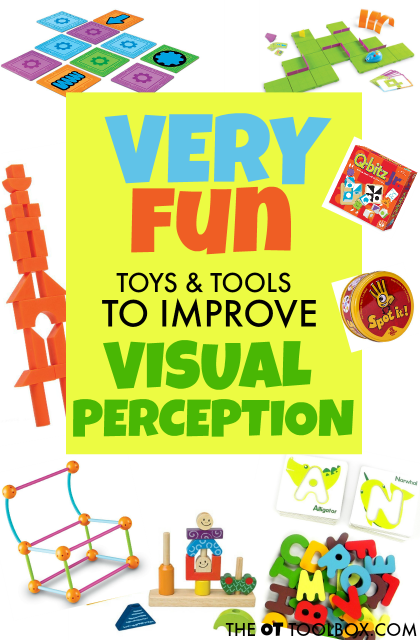
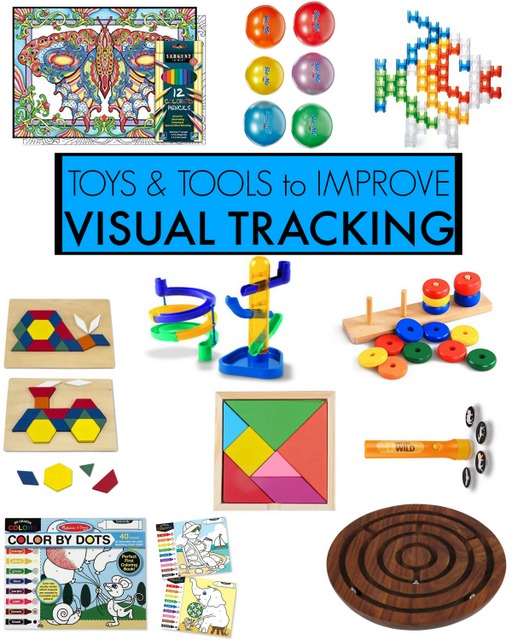
Try these toys to improve visual problems, tools for visual perception and other visual problems in kids.Read more about visual problems in kids and visual perceptual skills kids need for learning.
 
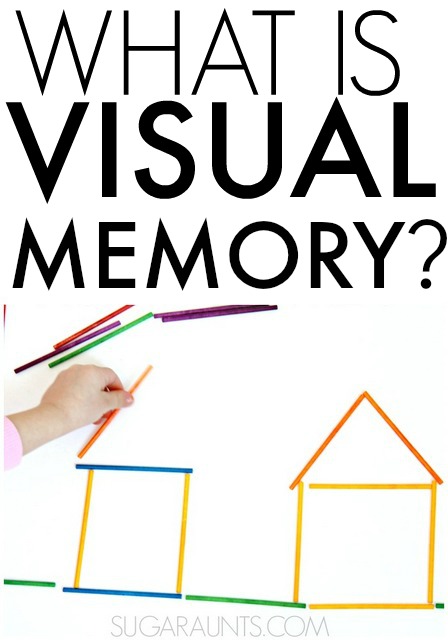
What is visual memory and how does problems with visual memory impact learning as a vision problem?What is visual tracking and how does visual tracking problems impact vision problems and learning?
A little about Kaylee: 
Hi Everyone! I am originally from Upstate N.Y., but now live in Texas, and am the Lead OTR in a pediatric clinic. I have a bachelors in Health Science from Syracuse University at Utica College, and a Masters in Occupational Therapy from Utica College. I have been working with children with special needs for 8 years, and practicing occupational therapy for 4 years. I practice primarily in a private clinic, but have experience with Medicaid and home health settings also. Feeding is a skill that I learned by default in my current position and have come to love and be knowledgeable in. Visual development and motor integration is another area of practice that I frequently address and see with my current population. Looking forward to sharing my knowledge with you all! ~Kaylee Goodrich, OTR

How do vision problems affect learning in kids and underlying visual processing problems that impact learning in kids.

Thank You City Play Dough Mat

Thank you for grabbing our City Play Dough Mat! You should have an email in your inbox right now with a link to access the file. 

Did you find this page accidentally and want to get your free copy of our city themed playdough mat? Go to our city play dough mat page to get your free city play dough mat!

The email also includes some instructions and the “why” behind play dough mats like this one. There is a lot of development going on when a little one uses a play dough mat like the one you just accessed! Scroll below to to find some additional instructions to best use the play dough mat to increase hand strength of the intrinsic muscles of the hands.


General Housekeeping Information on your Free Printable:


If you do not see the email right away, check back within 30 minutes. Be sure to check your SPAM folder.  Other subscribers using an email hosted on a school system’s email provider may have security restrictions in place that block the email. If you still don’t see the email, shoot me a message at contact@www.theottoolbox.com and I will send the file to you directly.

If you arrived here by accident and would like to receive a free city themed play dough mat to improve hand strength, check out this post that shares information on the City Themed Play Dough Mat.

Play Dough Mats Can Be Used to Improve Fine Motor Skills

Kids love play dough! This city play dough mat is a fun way to build so many small muscles of the hand with this activity! Follow the directions below to maximize intrinsic muscle strengthening. Start with play dough of any kind and the printable playdough mat.

Rolling play dough within one hand promotes development of a variety of areas: 

Strengthens the arches of the hands, helps awareness and coordination in separation of the two sides of the hand

Promotes finger isolation for improved control and dexterity

Encourages dexterity and coordination of the thumb and index finger which are important in pencil grasp

Strengthens the intrinsic muscles for improved endurance in fine motor tasks such as maintaining hold on a pencil, manipulating clothing fasteners, managing and using scissors, coloring, and many other tasks.


Looking for more play dough activities to boost fine motor strengthening?


Play Dough Farm Activity | Play Dough Activity Color Match  | Play Dough Cupcakes

Upper Extremity Activities for Toddlers

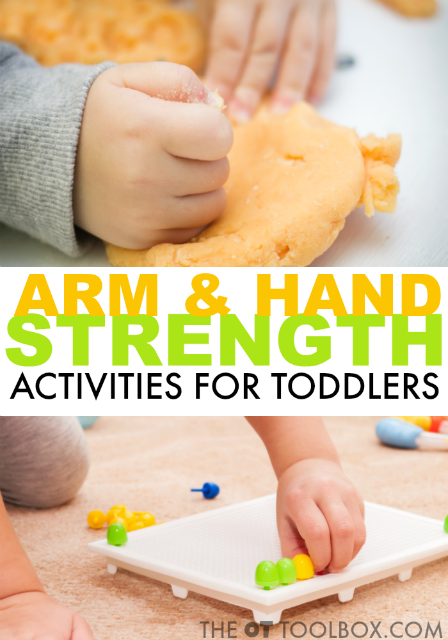
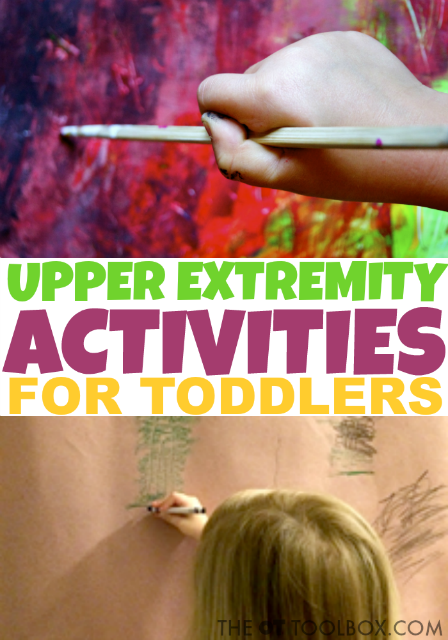
Upper extremity hand strength isn’t just about strong hands! Kids need upper extremity strength for tasks such as handwriting, coloring, managing clothing fasteners, and more! The thing is, upper extremity strengthening begins at a very young age. In fact, activities for toddlers can be loaded with the strengthening and dexterity activities that strengthen the upper extremities for improved endurance and coordination down the road. All of these components work together fluidly for strong upper extremities. Check out the upper extremity activities for toddlers to find out how and where to begin with upper extremity strength!  


Upper extremity activities for toddlers

 
Working on upper extremity strength is a key factor in being
able to have the endurance for handwriting. Working on the shoulder muscle strength and flexibility will help to improve the coordination needed for drawing and handwriting. 
 
We covered some of the best crayons for toddlers with focus on the strength and motor skills that develops during the toddler years. Check out that blog post for information based on strength development during ages 1-3 years.


These upper extremity activities for toddlers will help improve the strength and stability needed for endurance and coordination in handwriting and other tasks.


Importance of upper extremity activities for strength

 
Why is this important? If a child does not have adequate
shoulder strength and core body strength it will be difficult for them to have controlled hand movements.
You may notice that when handwriting or coloring that they position their
shoulder abducted and wrist will be flexed instead of in extension.  Build muscle strength proximal to distal
because if you don’t have strength in your shoulders, back, traps etc. then
your distal function (example handwriting) will not be as controlled.
 
 Below are two easy activities
that can be done at school, in a clinic or at home with a child to address
upper extremity strength. Also try these activities to promote wrist extension.
Use these arm and hand strength activities for toddlers to improve upper body strength for better coordination and endurance in handwriting and other fine motor activities for toddlers.

Upper extremity strength activities for toddlers

These are upper extremity activities for toddlers and kids who would benefit from strength and endurance in the upper body.

Gravity Resistive Sticker Activity

 
Have the child lay on the ground under a table. I will
usually place a pillow or blanket to make it more comfortable. Tape a large
piece of paper under the table and have the child, while laying on their back,
place stickers on the paper.
 
I have drawn circles for the child to place stickers in or
had a background theme. For example, a nature background and use stickers such as birds, trees, etc. The other activity I have done is had the child place stickers randomly all over the paper and then then have to use a marker to circle the shapes. Works great if you are working on a child’s pre-writing skills.
They could also put a square, triangle or make an X on the shapes.
 

Crayon Rubbing on a Vertical Surface

I remember when I was younger I really enjoyed taking coins,
placing paper over them and then using a crayon to rub the print onto the
paper. I also did this with leaves in the fall. How exciting to see the print
come out on the paper!
 
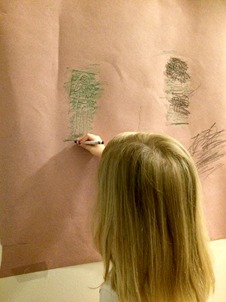
One fun way to keep a child engaged with this great upper extremity activity for toddlers, is to tape crayon rubbing plates on the wall, place a large sheet of paper over them and then give the child crayons to rub the paper until they see the print.


Use wall crayon rubbings to help kids strengthen the upper extremities in this upper extremity activity for toddlers.
 
Having a child color on a vertical surface is a great
activity in itself for shoulder stability and flexibility and it puts the wrist
in extension which helps encourage a better pencil/crayon grasp.
I have used crayon rubbing plates with animal pictures on
them and  girls love to color the fashion
plates. To keep the child engaged I won’t let the child see what plates I am
using. That way they continue to color on the vertical surface to see what pictures
they get.
 
This activity also
works on teaching children how to apply more pressure when writing/coloring, as
you need to press hard to have the print come through and softer if the print
is blurred because of how hard the child pushed on the crayon.


Looking for more upper extremity activities for toddlers?

This crayon rubbing activity uses sight words to work on strength and pressure in handwriting.

 
Want some other fun ideas to work on a vertical surface? Check out learning ideas on windows and glass doors!


Stickers are an awesome fine motor tool. Here are 10 ways to use stickers to help with fine motor skills.
 
Read more about the many benefits of coloring with crayons.
 
Read more about working on a resistive surface to build strength and stability.
 
Another great under the table activity is beading! Use resistance and gravity to strengthen and boost skills by beading under a table.
 
 
About Christina:
Christina Komaniecki is a school based Occupational Therapist. I graduated from Governors State University with a master’s in occupational therapy.   I have been working in the pediatric setting for almost 6 years and have worked in early intervention, outpatient pediatrics, inpatient pediatrics, day rehab, private clinic and schools. My passion is working with children and I love to see them learn new things and grow. I love my two little girls, family, yoga and going on long walks.


What is Visual Tracking?

Visual problems can surface in many ways. Visual processing challenges present as difficulty in reading, handwriting, sports, navigating a hallway, or many other areas. Sometimes, the issue is a result of visual tracking challenges. Read on to find out exactly what is visual tracking and what an eye tracking problem looks like in kids, including common visual tracking difficulties that present in the classroom or during academic work. We’ve shared a few visual tracking tips and soon on the site, we’ll share a collection of visual tracking activities, too.

Wondering about visual tracking? This article explains what is visual tracking and what visual tracking difficulties look like, along with visual tracking problem areas and visual tracking red flags that can be used by occupational therapists to help kids having trouble with visual processing.

What is Visual Tracking?

You’ve probably seen it before: The child who struggles with letter reversals..the child who has challenges in navigating obstacles when playing…the child who labors with reading and commonly skips words or lines of words when reading.

These are all signs of a visual tracking problem. There are many more, in fact. The thing is, visual tracking is a part of almost everything we do!

Before we talk more about what visual tracking looks like and other common signs of visual tracking problems, let’s discuss what exactly visual tracking is.

Definition of Visual Tracking

Visual tracking is a visual processing skill that occurs when the eyes focus on an object as it moves across the field of vision. Visual tracking occurs with movement of the eyes to follow a moving object and not movement of the head. The eyes have the ability to track an object in the vertical and horizontal, diagonal, and circular planes. There should also be an ability to track across the midline of the eyes and with smooth pursuit of the object. Visual tracking requires several skills in order to efficiently occur. These include oculomotor control abilities, including visual fixation, saccadic eye movement, smooth pursuit eye movements, along with convergence, and visual spatial attention.

Here is more detailed information on saccades and their impact on learning.

Components of Visual Tracking

These are the visual processing skills that need to occur in conjunction with visual tracking. They are necessary to enable visual tracking in functional tasks.
Visual Fixation- The ability to visually attend to a target or object. Visual fixation occurs while maintaining focus on the object and typically occurs at a variety of distances and locations within the visual field. This is a skill that typically develops at about 4 weeks of age.
Saccadic Eye Movement- These eye movements are those that occur very rapidly and allow us to smoothly shift vision between two objects without turning or moving the heads. Saccadic eye movement, or visual scanning is necessary for reading a sentence or paragraph as the eyes follow the line of words. This skill also allows us to rapidly shift vision between two objects without overshooting. In copying written work, this skill is very necessary.
Smooth Pursuit Eye Movement- This ability allows us to steadily follow an object as it is visually tracked. When a smooth pursuit of eye movements occurs, the eyes do not lose track of the object, and occur without jerky movements or excessive head movements. Visual scanning occurs in vertical, horizontal, diagonal, and circular movements.
Convergence- This ability is the simultaneous shift of both eyes together in an adducted position toward an object. The eyes work together to shift inward toward a target object, with single vision occurring with fixation on the object. Convergence is needed to focus on an object with both eyes together.
Visual Spatial Attention- This skill includes awareness and attention in the body and the environment and allows us to attend to all visual fields. When visual spatial inattention occurs, visual neglect can occur.

Occupational Therapy Vision Screening Tool

Occupational Therapists screen for visual problems in order to determine how they may impact functional tasks. Visual screening can occur in the classroom setting, in inpatient settings, in outpatient therapy, and in early intervention or home care.
This visual screening tool was created by an occupational therapist and provides information on visual terms, frequently asked questions regarding visual problems, a variety of visual screening techniques, and other tools that therapists will find valuable in visual screenings.

This is a digital file. Upon purchase, you will be able to access the 10 page file and print off to use over and over again in vision screenings and in educating therapists, teachers, parents, and other child advocates or caregivers.
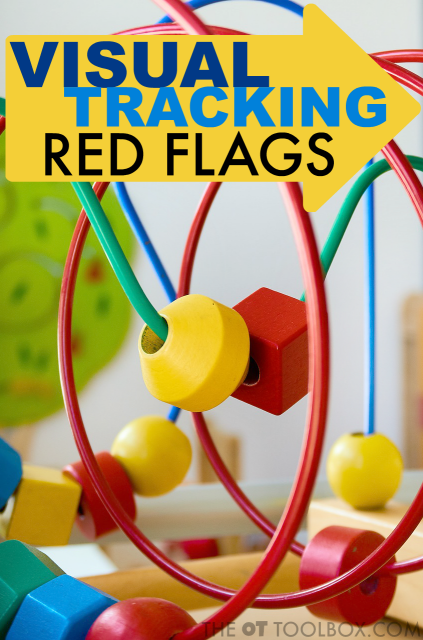
Visual tracking red flags can look like many different visual processing needs. Use this list of visual tracking problems and resulting visual needs to address visual tracking in kids.

What does a Visual Tracking Problem Look Like?

So many times, we may see kids who struggle with tasks like reading, writing, coordination, or other areas and miss the visual part of the difficulty. The ability to process visual information plays an important part in everything we do. The areas below are signs that a visual tracking problem may present and visual tracking skills should be assessed.

Visual Tracking Problem Red Flags

  • Incoordination when visual perceptual skills or visual motor skills are required
  • Difficulty with eye-hand or general coordination
  • Difficulty with sports including those that use a ball or target
  • History of delayed developmental milestones
  • Reverse letters or numbers when writing
  • Misjudges distances or heights related to orientation of the body or body parts in movement or activities
  • Difficulty following an object across their field of vision, especially when the object crosses midline
  • Difficulty reading
  • Difficulty writing
  • Trouble copying work from one place to a paper in single plane or multi-plane locations
  • Difficulty keeping up with peers
  • Difficulty managing body on uneven surfaces, including navigaing and managing bleachers, steps, or walkways
  • Difficulty drawing or coloring
  • Trouble shifting gaze in all planes
  • Skips words or a line of words when reading or re-reads lines of text
  • Must use finger to keep place when reading
  • Poor reading comprehension
  • Short attention span
  • Difficulty comprehending or remembering what is read
  • Confusion with interpreting or following written directions
  • Writing on a slant, up or down hill, spacing letters and words irregularly
  • Confusion with left/right directions
  • Errors when copying from a chalkboard or book to paper
  • Misalignment of horizontal and vertical series’ of numbers in math problems
These are just some of the problem areas that may be present when a visual tracking difficulty is present.
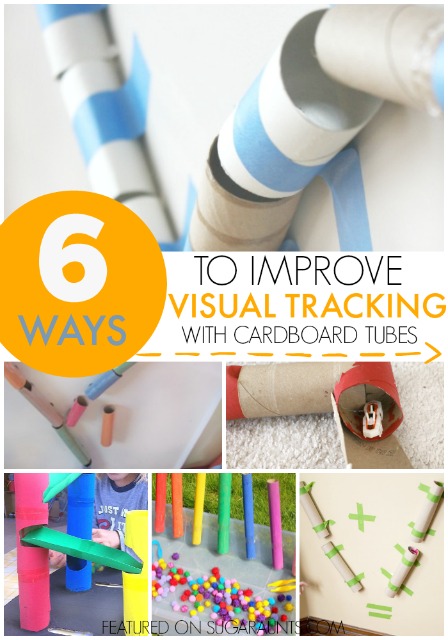
Looking for strategies to address a visual tracking problem? Try some of these:


This information on visual tracking skills explains what is visual tracking so occupational therapists, teachers, and parents can better understand common visual processing needs in kids.

The OT Toolbox Contributor Spotlight-Kaylee

Meet Kaylee!


Kaylee Goodrich, OTR/L is originally from Upstate N.Y., but now lives in Texas, and is the Lead OTR in a pediatric clinic. She has a bachelors in Health Science from Syracuse University at Utica College, and a Masters in Occupational Therapy from Utica College. Kaylee has been working with children with special needs for 8 years, and practicing occupational therapy for 4 years. Kaylee practices primarily in a private clinic, but has experience with Medicaid and home health settings also. Feeding is a skill that Kaylee has learned by default in her current position and has come to love and be knowledgeable in. Visual development and motor integration is another area of practice that Kaylee frequently addresses and sees with her current population.

Contributor Posts By Kaylee Goodrich on The OT Toolbox:
Pediatric Feeding: Is it Sensory, Oral Motor, or Both?
Development of Oral Motor Skills

Disclaimer Statement: 
Kaylee Goodrich is a registered occupational therapist, but is in no way representing herself as an evaluating or treating occupational therapist in the publication of any post. The information, ideas or activities presented here are not intended to provide medical advice or physician/therapist instruction nor should they be used as a substitute for occupational therapy or other medical services. The information, activities, and ideas do not replace any relationship with a child and their therapist nor do they provide one to one treatment or consultation for a child with an established plan of care based on an assessment. Consult with a qualified occupational therapist if you have questions regarding the information or ideas presented or how to implement them with a child. If concerned about your child’s development, consult your child’s physician or a licensed occupational therapist regarding specific concerns or other medical advice. Any information, ideas or activities presented here are designed for complete adult supervision. Never leave a child unattended during implementation of any ideas or activities. Always follow and be aware of any age recommendations when using all of the products contained in any activities or ideas. The adult implementing and preparing the ideas or activities is ultimately responsible for using their best judgement when choosing and providing activities to best meet a child’s skill and safety level. Do not provide objects or materials that would pose as a choking hazard to a child. Kaylee Goodrich and The OT Toolbox are not liable for any impairment, damage, accident or loss arising out of the use or misuse of the information, ideas, and activities suggested in the publication of any post.


ClothesPin Pencil Grip

Pencil grip

Pencil grips! It can be hard to find the perfect pencil grip. And then, once you find one that works just right, that perfect pencil grip gets lost in the expanse of a backpack or a messy desk. Today, I’ve got a pencil grasp hack for you. This clothespin pencil grip will help kids write with a better pencil grasp, and it’s an inexpensive way to offer cues to position fingers on the pencil correctly.

ClothesPin Pencil Grip

Pencil grasp is a tricky thing! You can remind kids over and over, try all of the pencil grasp tricks and tips, but if a child struggles with fine motor skills, they revert right back to the inefficient and non functional pencil grasp. This is especially true in handwriting problems when kids are rushing to write or holding their pencil inefficiently, and legibility suffers.

The easy pencil grasp trick described below is one that provides a frugal option for ensuring a functional pencil grasp and one that plays into the dexterity needed for letter formation and handwriting. Looking for more information on pencil grasp and fun ways to work on pencil grip? 

Try these activities designed to boost pencil grasp in creative ways.     

Kids can hold a clothespin clipped onto a pencil to help with pencil grasp and fine motor skills needed for improving handwriting and pencil grasp with this easy pencil grasp trick.

  One of the skills kids need for handwriting is pencil grasp. 

Easy Pencil Grasp Trick…that costs pennies

For this pencil grasp trick, you’ll need to understand why it works.    The issue with many kids who hold a pencil with an inefficient grasp is the dexterity and limited motion that results. They are holding the pencil with their fingers wrapped in such a way that they can’t hold a pencil with dexterity. They lack pencil control needed for efficient handwriting speed.

Letter formation suffers and legibility lacks. When a child moves ahead in grade level or age and are required to write more quickly, they can’t keep up with written work requirements and legibility suffers. They then can’t read their class notes, handwritten work, homework lists, etc.    Try these pencil control exercises for more fun ways to work on dexterity and pencil movement in letter formation.  

why does the clothespin pencil grasp trick work?!

For the child who can’t maintain a proper pencil grasp because of inefficient separation of the sides of the hand, this easy pencil grasp trick can be just the way to ensure the stability side of the hand is separated motorically from the precision side of the hand. Read more about motoric separation of the sides of the hand and what that looks like in fine motor work (such as holding and writing with a pencil).  

When kids hold the pencil with the clothespin “bar”, it provides a physical prompt that allows them to flex or close their pinkie finger and ring finger around the support of the clothespin. This allows the stability side of the hand, or the ulnar side, to provide support in writing.  

The radial side of the hand, or the precision side, is then able to work independently of the other two fingers. This means the middle finger, ring finger, and thumb are free to manually move the pencil with precision. The precision side which primarily consist of the thumb and pointer finger movements in a tripod grasp can move the pencil with control and dexterity as the middle finger supports the pencil.   

For the modified tripod grasp, the middle finger can be a helper digit where it is positioned on the pencil shaft and a worker in moving the pencil with control.   

Both the tripod grasp and the modified tripod grasp are efficient pencil grasps. The primary concern is that the ulnar side is separate and supportive, allowing for endurance and dexterity in written work.   

We created a video that shows how you can target different grasp patterns using just a clothes pin. This is another benefit of using a clothespin pencil gripper. It’s a built-in hand strengthening tool!

Video walks through various grasp patterns using a clothes pin.

Here is a fine motor activity that can be used to build and develop the separation of the sides of the hand.

Working on pencil grasp in handwriting? Why not start a handwriting club for kids? Kids can work on handwriting skills in a fun way. Here’s how to start a handwriting club kids will WANT to join!

Clip a clothespin onto a pencil to help kids with pencil grasp as a physical cue for better grip on the pencil when writing.

Clothespin Pencil Grip

Affiliate links are included below.  

For this pencil grip trick, you’ll need just a single clothespin. The clothes pin can be the standard wooden variety or a colorful plastic type. Why not make it a project and decorate the clothespins as a group to add a bit of fine motor play?

Check out these fun clothespins we decorated and used as a spacing tool to teach spacing between words when writing.   

Some great clothes pins can be found here:  Wooden clothespin, perfect for decorating and customizing Plastic, colored clothes pin (A great price for 100 plastic clothespins!)

Natural colorful wooden clothespins

Pink and blue decorated clothespins  

I can’t think of a student that would like to make this writing tool their own with some glitter paint, fun washi tape, adhesive gems, or stickers.    

Try this pencil grasp trick that uses a clothespin to help kids with pencil grasp for better handwriting.

More pencil grip tricks:

Pencil Grip idea
Simple pencil grasp trick
Opposition pencil grasp trick

Join the pencil grasp challenge!

Need to know about the skills that make up a functional pencil grasp? The Pencil Grasp Challenge is open! In this free challenge, you’ll learn what’s going on behind the inefficient and just plain terrible pencil grasps you see everyday in the classroom, clinic, or home. Along with loads of information, you’ll gain quick, daily activities that you can do today with a kiddo you know and love. These are easy activities that use items you probably already have in your home right now.

Besides learning and gaining a handful (pun intended) of fun ideas to make quick wins in pencil grasp work, you’ll gain:

  • 5 days of information related to pencil grasp, so you know how to help kids fix an immature pencil grasp.
  • Specific activities designed to build a functional pencil grasp.
  • Free printable handouts that you can use to share with your team or with a parent/fellow teachers.
  • You’ll get access to printable challenge sheets, and a few other fun surprises.
  • And, possibly the best of all, you’ll get access to a secret challengers Facebook group, where you can share wins, chat about all things pencil grasp, and join a community of other therapists, parents and teachers working on pencil grasp issues.

Click here to join the Pencil Grasp Challenge.

free pencil grasp challenge

Colleen Beck, OTR/L has been an occupational therapist since 2000, working in school-based, hand therapy, outpatient peds, EI, and SNF. Colleen created The OT Toolbox to inspire therapists, teachers, and parents with easy and fun tools to help children thrive. Read her story about going from an OT making $3/hour (after paying for kids’ childcare) to a full-time OT resource creator for millions of readers. Want to collaborate? Send an email to contact@theottoolbox.com.