Press Here Book Activity

Press Here activity
If you love sensory activities to pair with children’s books, you will LOVE this Press Here book activity!  The book, “Press Here” is a memorable one that kids adore, but when you add a fun sensory play activity that goes with the book’s themes, you’ve got a winner. It has been so much fun coming up with play and learning ideas for HaroldElmerPete, and more.  This week, we’re reading and playing with the book, “Press Here” by Herve Tullet.
 
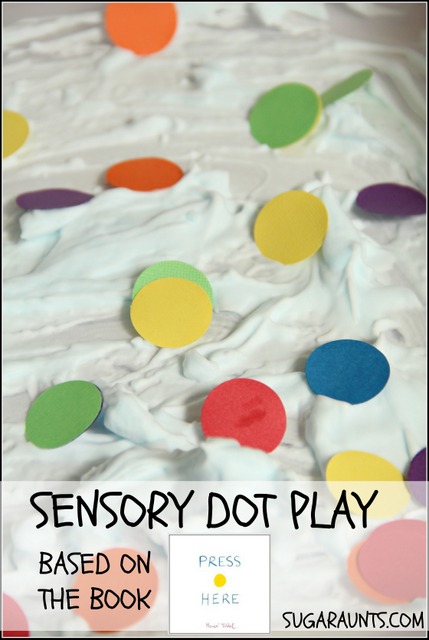
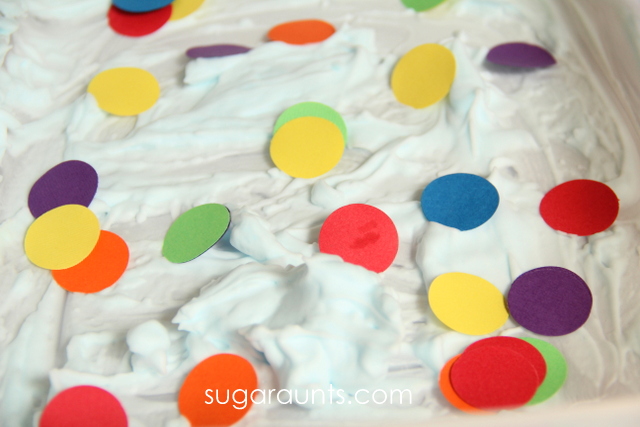
Sensory play activity for the book, Press Here. From Sugar Aunts
 

Press Here Book Activity

 
This post contains affiliate links.  
 
 
Press Here is a new book to us.  And what a fun book it is!  The bright and bold pictures, the movement and direction following, and the fun instructions made this book a huge hit in our house. 
 
Little Guy (age 5) is STILL talking about this book.  He loved following the directions to shake, pull, push, and move the dots and even the whole book.  We decided to put the movement into our play activity with a sensory based interpretation of this fun book.


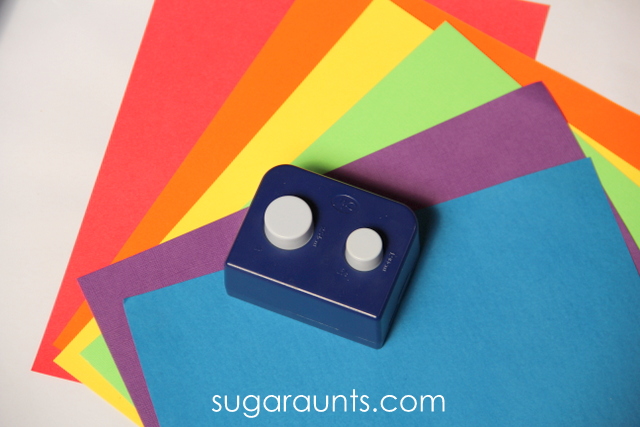
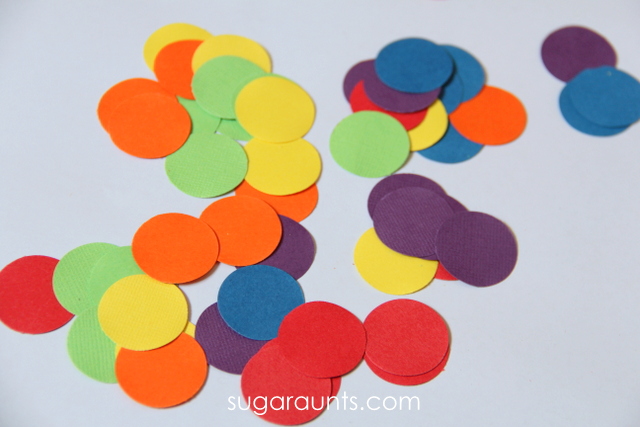
I started with rainbow cardstock and a circle hole punch.  I punched a bunch of holes from all of the colors.  Little Guy (age 5) LOVED helping me with the hold punching.  Fun stuff!
 
 
How pretty are these colorful dots??
 
 
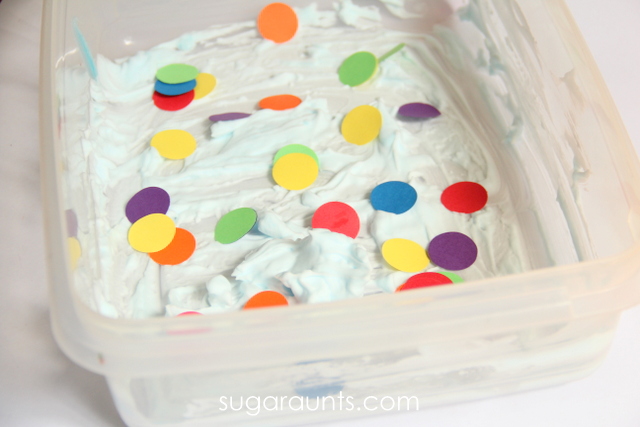
Add shaving cream to a container, and sprinkle in the colored dots.  Sensory play is ready for little fingers!


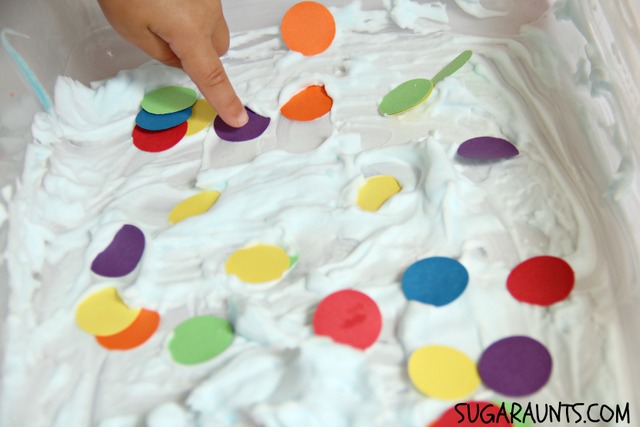
We pushed, pulled, and poked the dots just like in the book.  Be sure to talk about the colors while playing.  This is a great sensory bin to work on color identification.  Sensory play and learning go hand in hand, and this is a great way to learn and play.

Press Here Activities

For more Press here activities, check out the ideas listed below. Each Press Here book activity uses the concepts in the book, the fun colors of the dots, and lots of pressing! 

Check out the other Preschool Book Club bloggers for more Press Here ideas.  And be sure to watch for our next book club activity. You won’t want to miss it!
 
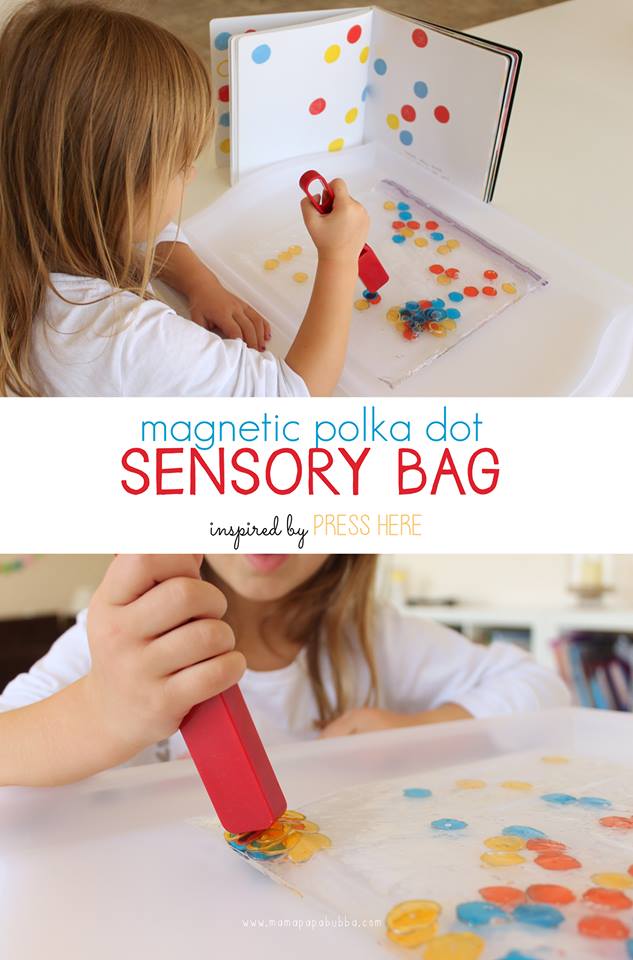
Mama. Papa. Bubba. blog: Magnetic Sensory Bag
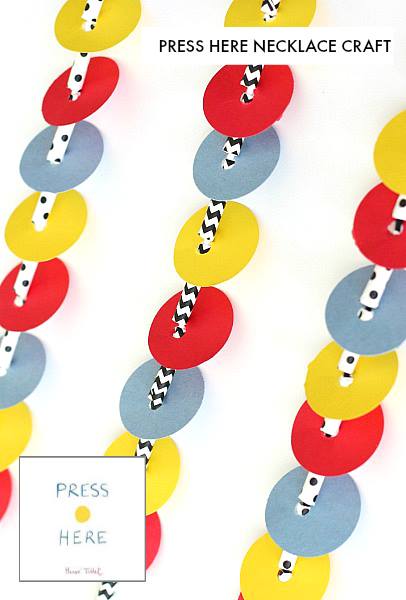
Buggy and Buddy: Necklace Craft
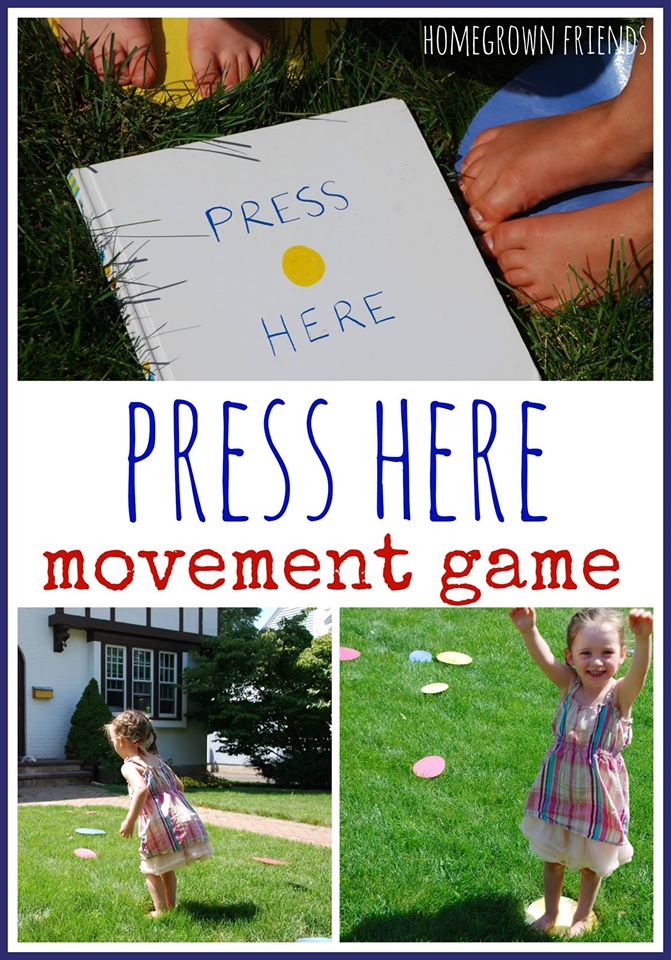
Homegrown Friends: Movement Game
Frogs and Snails and Puppy Dog Tails: Eraser Painting


For more book-related activities based on popular children’s books, check out Exploring Books Through Play!
 

Colleen Beck, OTR/L has been an occupational therapist since 2000, working in school-based, hand therapy, outpatient peds, EI, and SNF. Colleen created The OT Toolbox to inspire therapists, teachers, and parents with easy and fun tools to help children thrive. Read her story about going from an OT making $3/hour (after paying for kids’ childcare) to a full-time OT resource creator for millions of readers. Want to collaborate? Send an email to contact@theottoolbox.com.

Sunflower Cupcake Liner Craft

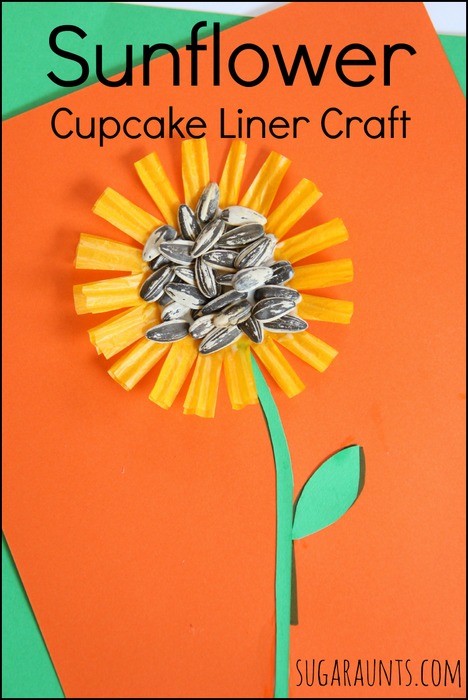
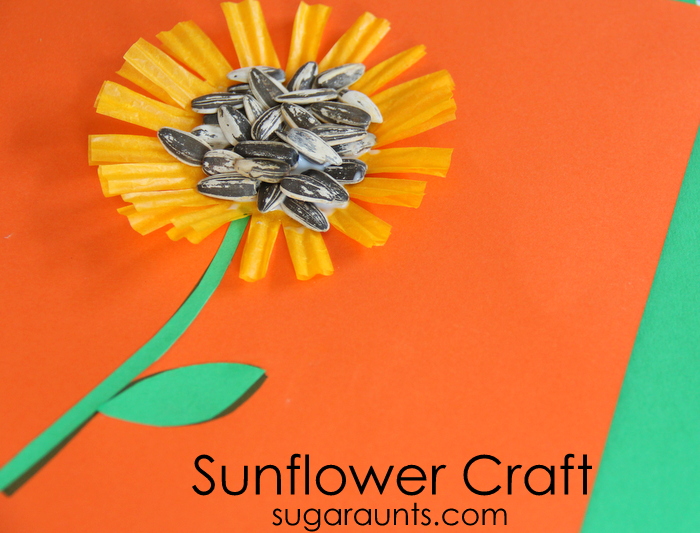
Sunflowers are such a fun flower.  This time of year, you can see giant sunflowers standing tall all over the neighborhood.  We made a super cute sunflower with cupcake liners and sunflower seeds.
Not only is this craft easy, it’s a great way to practice a little fine motor skills, too!


Use a cupcake liner to create a fall craft for kids.

This post contains affiliate links.  That means when you click on one of the links in this post, we will receive a few pennies.  Thanks for your support!


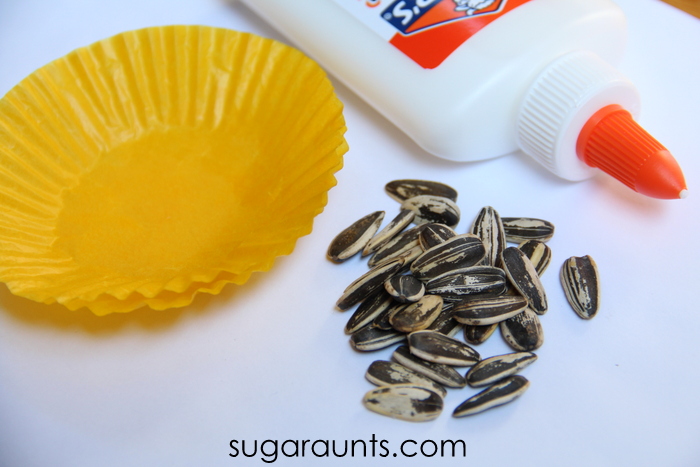
To make a Sunflower Cupcake Liner Craft, you will need:

solid yellow cupcake liners

sunflower seeds (Rinse the salt from the seeds and dry on a towel)

glue

scissors

We used two cupcake liners for a brighter color. This is a great way to teach kids to snip paper
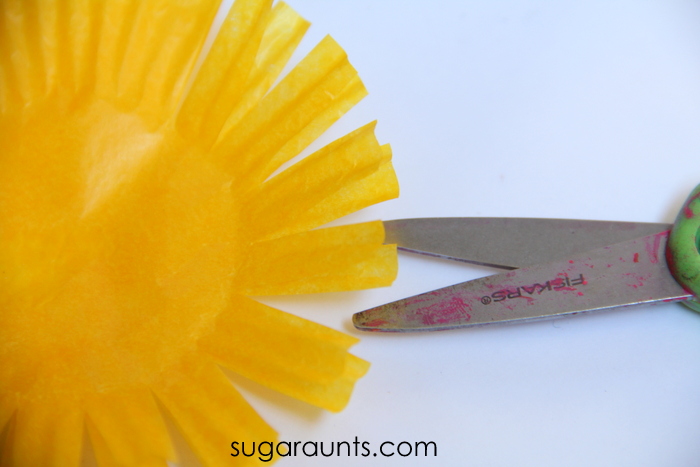
Start by snipping little wedges from the edge of the cupcake liners.  This is a great scissor activity for school aged kids.  The material of cupcake liners is thinner than regular paper and requires more precision when snipping.  The cupcake liner is small and a great way to practice scissor accuracy and bilateral hand coordination.

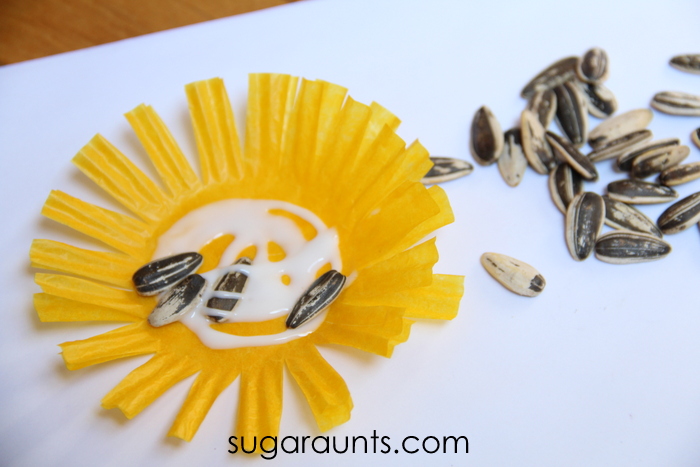
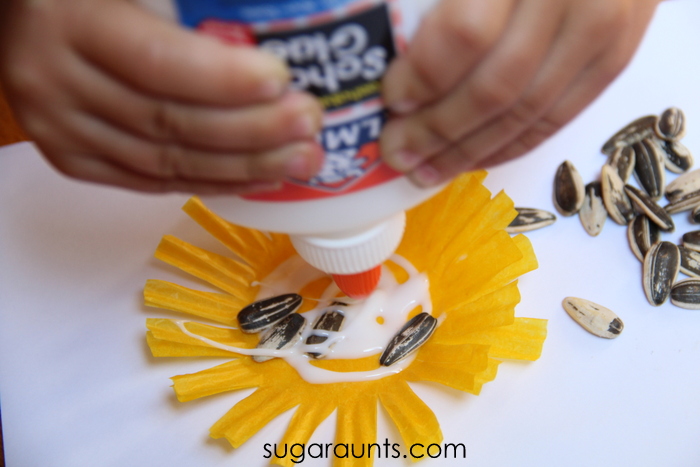
Add glue to the center of the cupcake liner.  Baby Girl though we needed A LOT of glue.  And A LOT of sunflower seeds on our flower.  It turned out looking pretty cute with a bunch of seeds.

More glue.  She is a big fan of glue.

Fine Motor Fall Craft

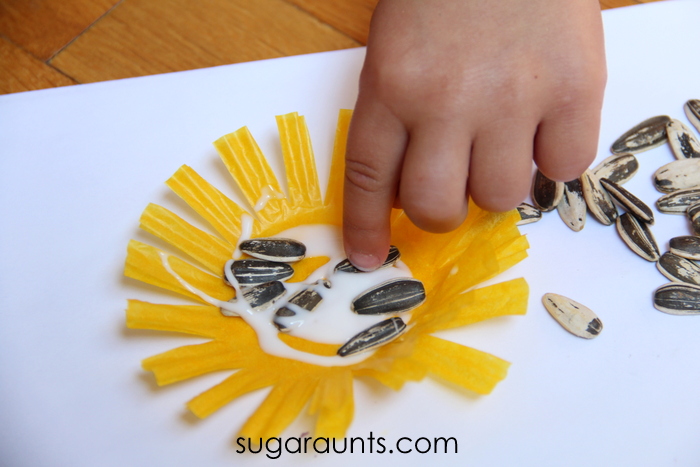
Place the sunflower seeds into the glue.  Manipulating the small seeds is a great way to practice tip to tip grasp and dexterity.  If more fine motor skill is needed, encourage your child to pick up a handful of seeds.  “Squirrel away” the seeds in the palm of the hand and place the seeds into the glue one at a time.  Using the index finger and thumb to transfer the seed from the palm of the hand to the tips of the fingers and into the glue is in-hand manipulation.  This is a vital skill needed for tasks such as manipulating coins, tying shoes, and managing small objects.
We glued our sunflower onto bright orange paper and gave this to Baby Girl’s Great Grand Pappy.  Let us know if you make a sunflower craft like this.  We love to see your projects on our Facebook page.

Looking for more easy crafts?  Stop by and follow along on our Kids Crafts Pinterest board.

Apple Activities for Therapy

apple activities

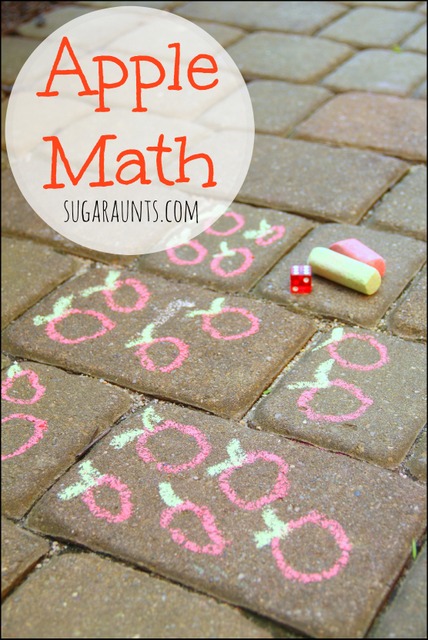
It’s that time of year again for all of the apple activities! The kids are headed back to school and crisp, fall days are ahead. The excitement that comes with summer has dwindled, but don’t you worry – we are here to help fill your days with fall-themed fun, starting with Apple Activities to use in occupational therapy sessions or at home to help kids develop skills! Get started with our apple pie sensory bin to start off the sensory and fine motor play, and grab a copy of our Fine Motor Therapy Kit for visual motor, handwriting, and fine motor play.

Apple activities including apple fine motor, apple gross motor, apple sensory activities, and more.

Just think of the hot apple cider, apple picking, and apple pie that lies ahead…along with the opportunities to learn, of course! 

We have broken down our activity list into therapy topics, so that you are able to pick and choose what you would like to address that day: sensory, motor, vision, cognition, or social skills! 

Apple Sensory Activities

Amazon affiliate links are included in this blog post.

For heavy work through the hands that offers proprioceptive input AND tactile sensory experiences, try making these baked cotton ball apples. We used them in apple sensory play and fine motor work.

Sensory bins can be a great way to learn by experience. An apple-themed one could look like this: Apple-Cinnamon Sensory Bin. You could hide magnet letters to find and spell out the word “apple”, which would be great practice for children who have difficulty with shape constancy and letter reversals – actually holding the letter in their hand can help wire their memory for future use!  

Applesauce oobleck is just like traditional oobleck, a type of slime, but with applesauce! The applesauce adds a new texture that is not often felt in traditional slime, as well as the smell of apples and cinnamon, as an added sensory experience. You can use these types of sensory experiences to address sensory concerns, like hyper or hyposensitivity, or you can use them as a means to address other unrelated concerns. For example, I love making slime as a way to address attention, sequencing and direction following. Additionally, when paired with education or discussion, it can be used as an adjunct to a socioemotional intervention. 

For more Fall sensory activities, grab our Fall Sensory Activities Guide for hands-on sensory play with apples and all things Fall.

Apple Fine Motor Activities

To work on fine motor skills, strength, dexterity needed for functional tasks like handwriting, clothing independence, pencil grasp, cutting with scissors, and more, an apple themed fine motor activity is the way to go. Check out our Apple-Themed Fine Motor Math activity for a multi-sensory learning activity with apples. 

Kids love these apple stamps using a toilet paper tube. It’s a fun OT craft to work on precision, eye-hand coordination, crossing midline, and much more.

Apple Poke with Toothpicks is a super easy but satisfying sensory and fine motor activity for children of all ages. Holding the thin toothpick requires a fine grasp like a pincer or tripod, which prepares hands for the work of a child (handwriting, buttoning, zipping, etc). 

Adjust as necessary to make this activity your own:

  • Follow a pattern with colored toothpicks
  • Encourage fine motor precision by poking on dots or in pre-made holes
  • Use golf tees or one-sided toothpicks for a safer option 

Apple Pointillism is a great way to use one of my favorite tools – the hole punch. Hole punching strengthens important hand muscles, in preparation for skills like handwriting, buttoning, and so much more. Even better, picking up those teeny-tiny circles will encourage a pincer grasp. 

Apple Gross Motor Activities

Apple gross motor activities can be used to develop core strength, endurance, balance, position changes, motor planning, and more. All of these skill areas are a must for occupations and functional tasks. Try these gross motor activities with an apple theme:

Make an indoor balance beam with an apple theme to address balance, core strength, proprioceptive input, coordination, vestibular input, and more.

Check out our Apple-Themed Brain Breaks for plenty of movement-based activities as well as self-regulation through whole body movement.

Ten Apples Up on Top by Dr. Seuss is a great book for sequencing and identifying numbers, but I think it could be great for gross motor development like coordination, balance and postural stability. Just have your child copy the movements of the animals! For even more challenging fun, cut out felt “apples” so they can balance them on their heads, too! 

Apple Visual Perception Activities

This apple visual perception activity uses shapes to work on visual discrimination, form constancy, visual closure and more.

Just like you would do with tangrams, you could create a pattern fitting for the theme with Lego Apples. Matching an image to another by building a structure is a great way to address visual perceptual skills, problem solving, and spatial awareness. 

Plus, here are some more on-theme resources for vision and fine motor skills: 

Apple Executive Function Activities

Cooking and executive function go hand-in-hand. To work on executive functioning skill development with an apple theme, try this apple salt dough recipe. It’s great fun and a wonderful sensory and fine motor experience, too.

The Apple Pie Tree by Zoe Hall shows the life cycle of a tree, and even shares a recipe for apple pie! I love using this story for sequencing and attention. 

You can address attention, memory, spelling, letter recognition or word recognition with these Red Apple Cups. You could use constructing the cups as an intervention, too – this activity can be used in so many different ways! 

Apple Activities for Social Emotional Skills

Social Communication Skills with Apples from the Social Butterflies Club offers great resources to use with kids that encourage social interaction in a structured activity.  

We hope that you have been inspired to create your own apple themed activity, or have chosen one that will work great for your kiddos! Check in for more fall-themed activities soon. While you are waiting, take a look at these awesome resources for a great fall: Fall Themed Water Table, Fall Gross Motor Activities, and Fall Fine Motor Crafts. 


Apple Theme Activities

Apple themed activities for learning and play: Math, spelling, fine and gross motor, art, sensory. This is perfect for school or home preschool apple themed week!
 

Sydney Thorson, OTR/L, is a new occupational therapist working in school-based therapy. Her
background is in Human Development and Family Studies, and she is passionate about
providing individualized and meaningful treatment for each child and their family. Sydney is also
a children’s author and illustrator and is always working on new and exciting projects.

Beans and Bugs Simple Sensory Bin

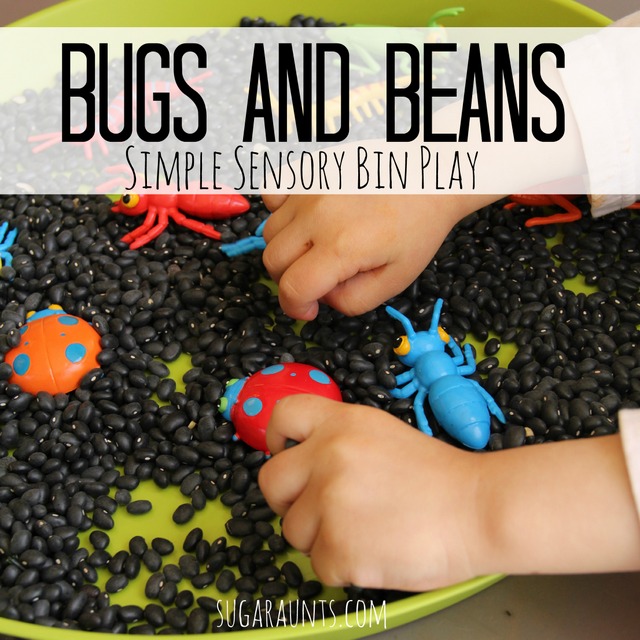
Simple sensory bins are fun to throw together in a few minutes.  Sometimes, all it takes to occupy the kids in a sensory learning activity is just two items that you can find around the house or in the toy bin.  We started a Simple Sensory Bin series a few weeks ago, making sensory bins with just two items.  We’re working our way through the alphabet with simple sensory activities.  Of course we’re not going alphabetically…that would make too much sense 🙂  Instead, we’re just playing our way around the alphabet.  Today, we bring you B is for Beans and Bugs!


Create imagination play sensory fun with beans and bugs

This post contains affiliate links.  Thank you for your support to our blog.


“B” themed sensory bin

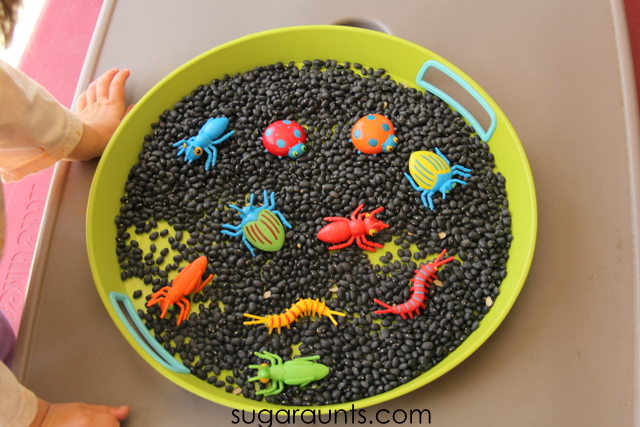
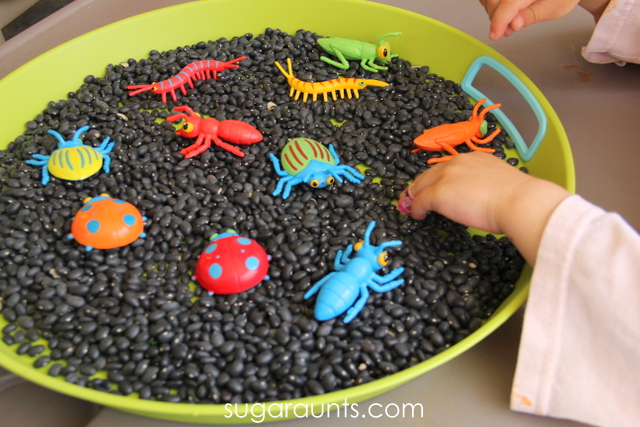
We gathered up just two items for this easy sensory bin. 

 shallow tray

Easy sensory play doesn't require more than a few items found around the home.

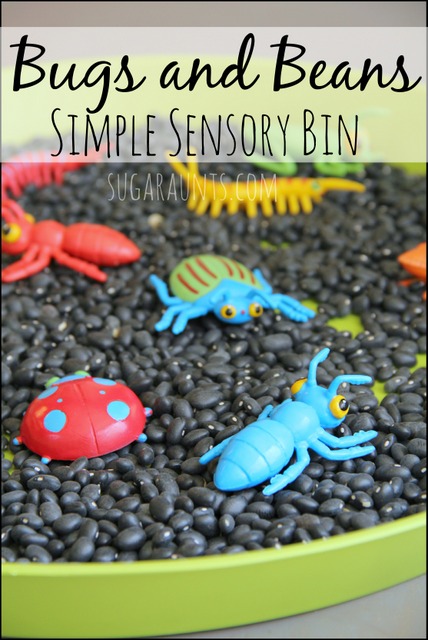
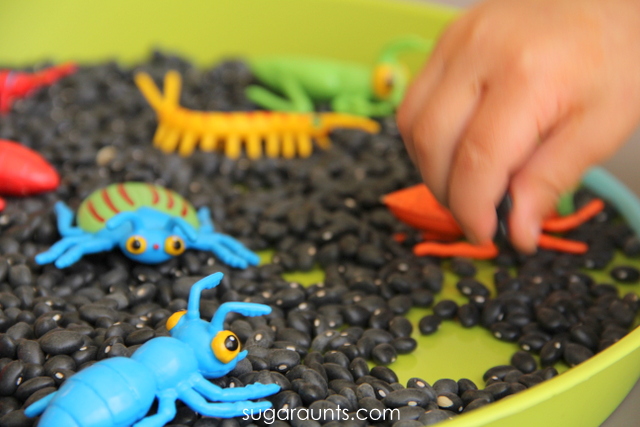
How easy is this sensory bin?  It doesn’t get much easier to throw together.  Open a bag of dried beans.  Scatter bugs around.  Play.

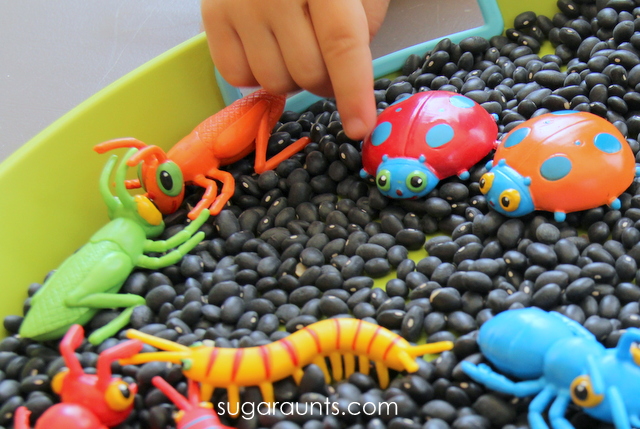
Explore ants, spiders, and beatles with a sensory activity

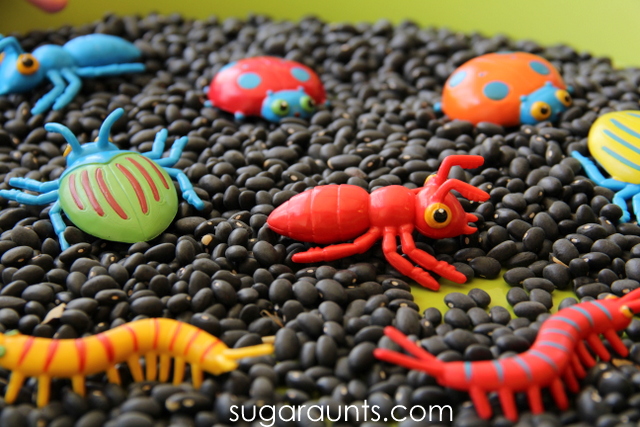
We love our Melissa and Doug bugs.  The colors of these little guys are so vibrant and stand out great against the black of the beans.

B is for beans and bugs. Sensory bin for kids

We played with this bug sensory bin for such a long time.  And the pretend play…we had bugs digging in “dirt”, bugs making other buggy friends, and bugs building “dirt houses”.

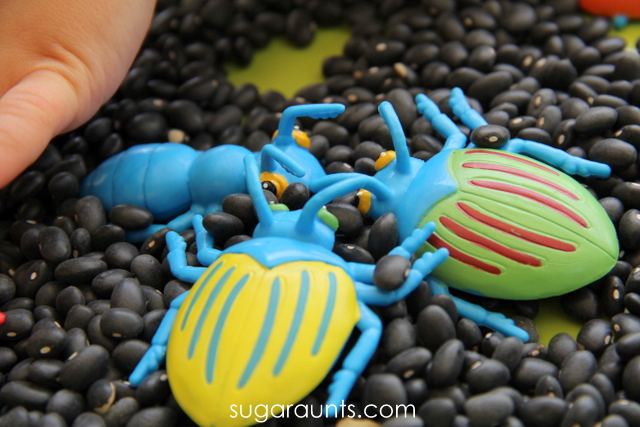
These three buggy friends were talking and having a party.

Sensory play has never been so easy.  We put these black beans away for another day.  And maybe dinner. 😉
Simple sensory bin play idea with Beans and Bugs.
  

What simple sensory ideas will be next in our series?  Stay tuned for easy ideas coming this way soon!

Circus Sensory Bin

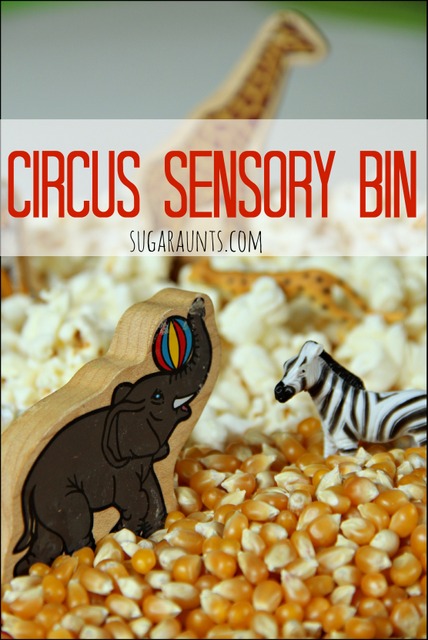
A while back, we were on a bit of a Circus Theme in our pretend play.  We had a bunch of fun with our circus party ideas and read a bunch of circus books.  We did this sensory bin around that time, but are just now getting the chance to blog about it.  This was such an easy sensory activity to throw together that we will definitely be playing this again.

Creative and sensory play for kids with an easy circus theme.

This post contains affiliate links.  Read our full disclosure here.

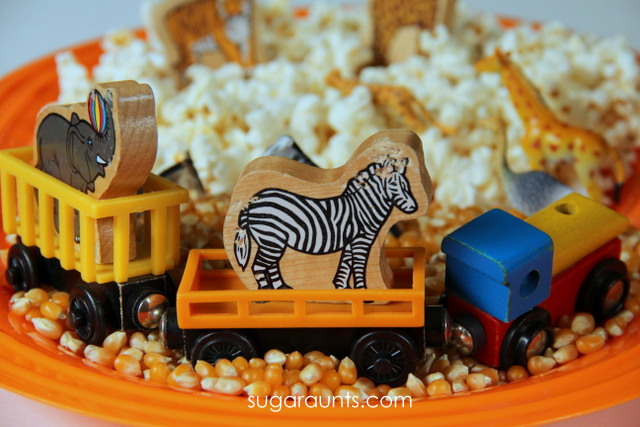
Create a circus themed sensory bin using popcorn!

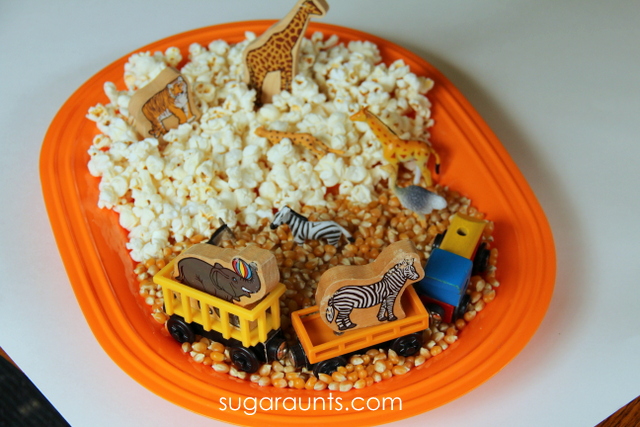
To create an easy Circus Sensory Bin, you will need:


circus train pieces

Mini Animals

popcorn


plastic tray

Use circus train and circus animals in an easy sensory bin

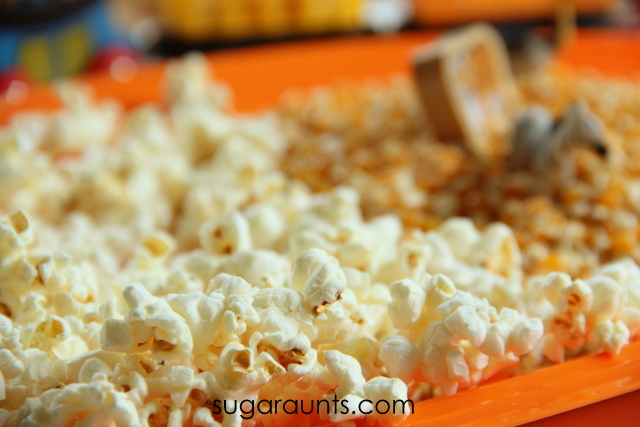
I started by popping some corn.  And only ate a few handfuls.  Pop extra.  Snacks are good.

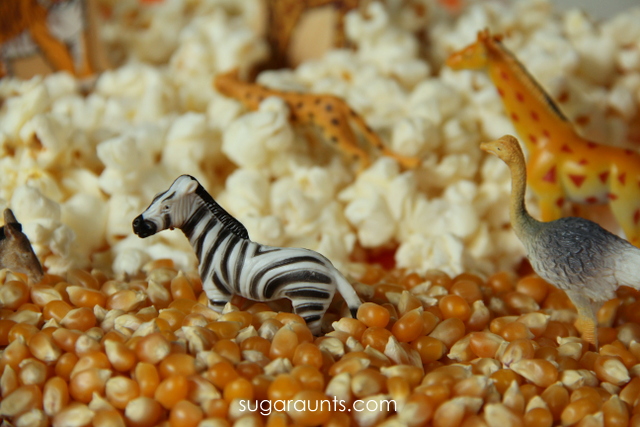
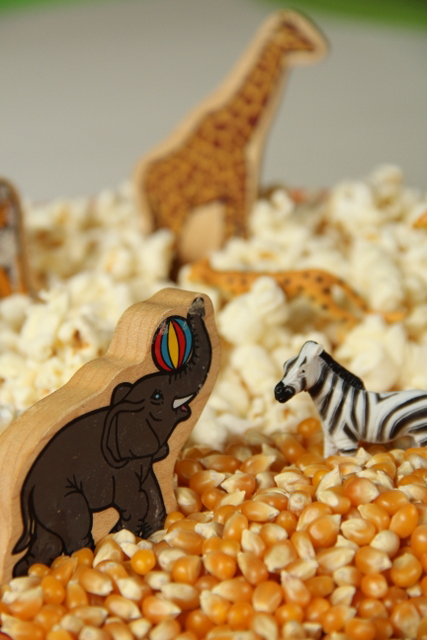
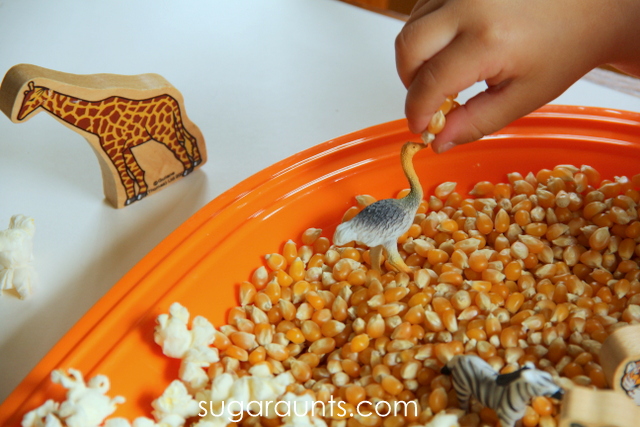
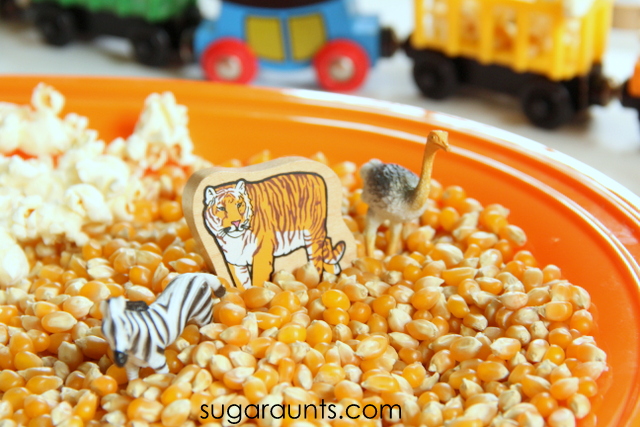
I put some popped and un popped corn onto a plastic tray.  Then, simply added our train set and animals.  The scene was set for imagination and pretend fun!

Kids will love to pretend with mini animals.

The animals in the different textures was such a fun way to explore animal names, animal sounds, and all in an easy sensory bin.

Kids will love to pretend and play while learning animal names and noises.

Baby Girl (age 2) loved this pretend play so much!  Not only did we have a blast playing and learning, she got a snack too!  Bonus!
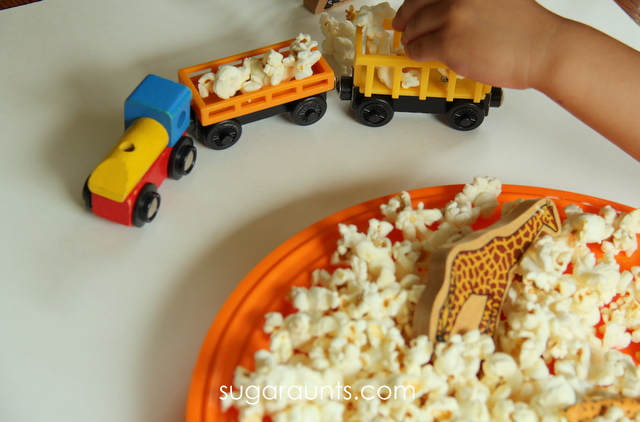
Of course, the animals needed feeding, too.

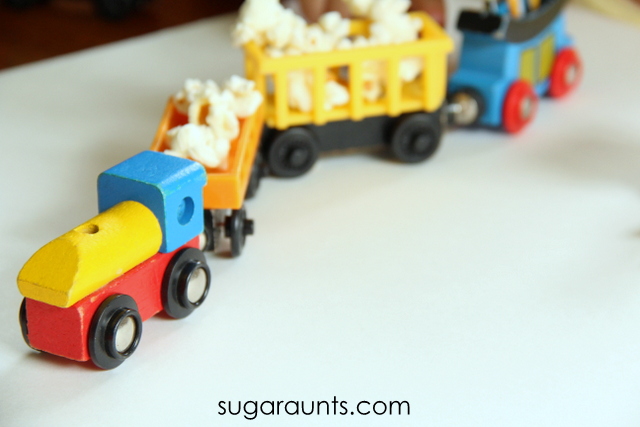
We loaded up the train with popcorn and made deliveries.  Such a fun way to play away an afternoon.

This might be the perfect accompaniment to our circus tent craft.  Sensory play, craft, and snack…sounds like the perfect afternoon with the kids to me!

Note:  Like all of our activities on sugaraunts.com, we encourage playing alongside your kids and in a supervised manner.  Some crafts and activities may present a dangerous situation for children who like to put things into their mouths.  Please monitor your child with this and any activity you see on our website.  Popcorn will present as a choking hazard for small children.  Please use your best judgment if you decide to do this activity with your kids.

You may be interested in our Circus Crafts and Activities Pinterest board for more circus ideas.

94518f049891ff1c8aaaff383574fe67e370df4dfc14a6001e

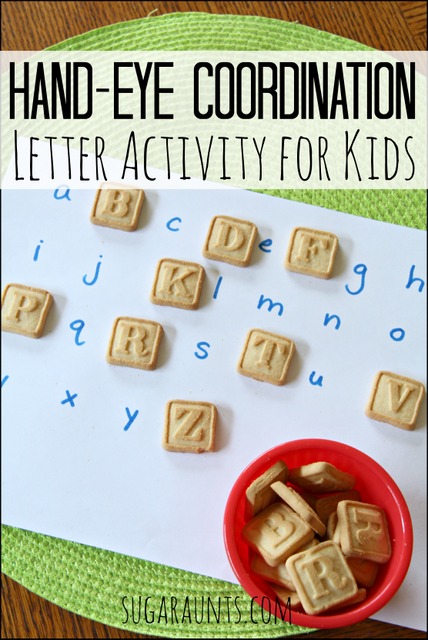
Hand-Eye Coordination Letter Activity for Kids

This hand eye coordination letter activity is not only a great way to work on letter identification and visual discrimination skills, it’s also a motivating activity because we used letter cookies!

Hand Eye Coordination Letter Activity

How many times a day do you hear the phrase, “I’m hungry!” ?? It seems like that’s all I hear all. day. long.  One afternoon the kids were extremely hungry. again. and I put together this quick little activity and snack combined. 

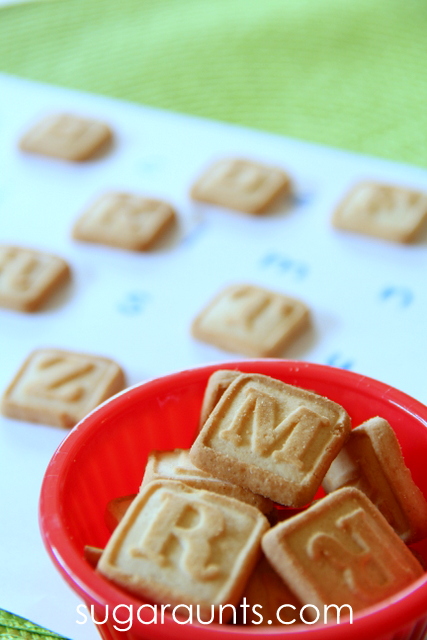
We practiced a few skills (letter identification, letter matching, visual scanning, eye-hand coordination, fine motor skills) while we enjoyed a little letter snack!

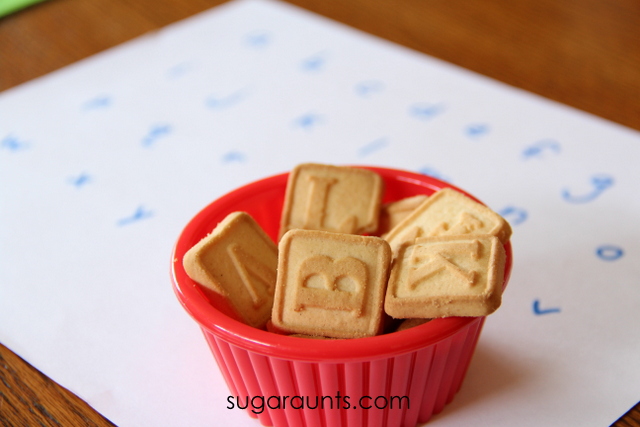
Kids will love to practice letter matching with alphabet cookies!
 
 
This post contains affiliate links. Thank you for your support of this blog!


Letter Matching Activity for Kids


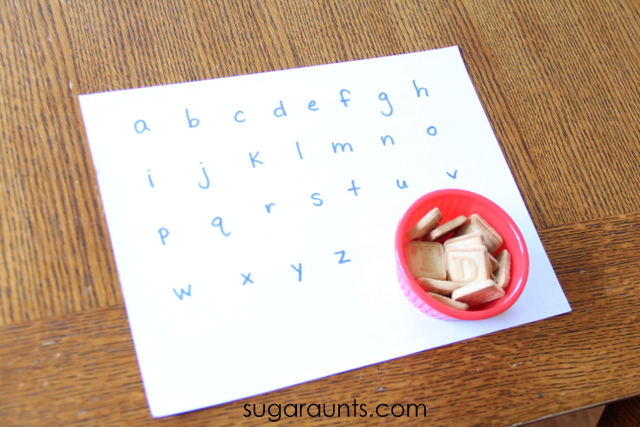
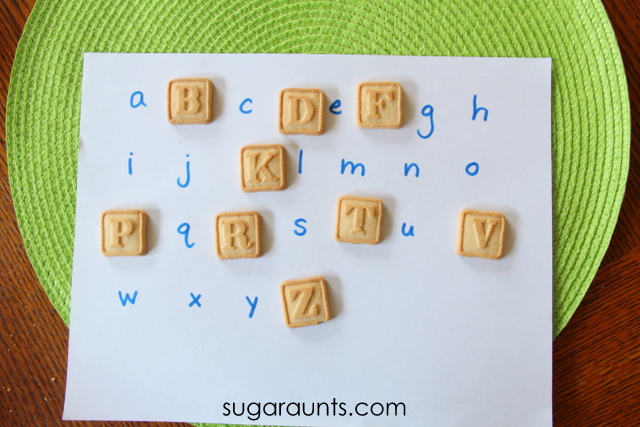
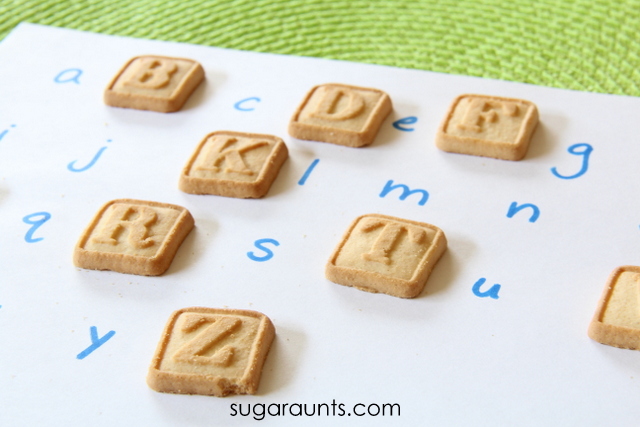
I used a sheet of paper and quickly wrote out the lower case letters of the alphabet.  Our snack was a little cup of alphabet cookies.  We matched up the upper case letters to the lower case letters.  This was a great activity for my preschooler.  Little Guy (age 5) was so quick to match the letters (mostly because he wanted to eat them)! 

Baby Girl (age 2 and 1/2) had some trouble with identifying the upper case letters, but we haven’t really worked on that yet. This is a great activity to introduce letter identification for younger preschoolers.  The cookie incentive is sweet!

 
Mom only snuck a few cookies.
 
This is a fun eye hand coordination activity for kids. Bonus, it's a snack too!
 

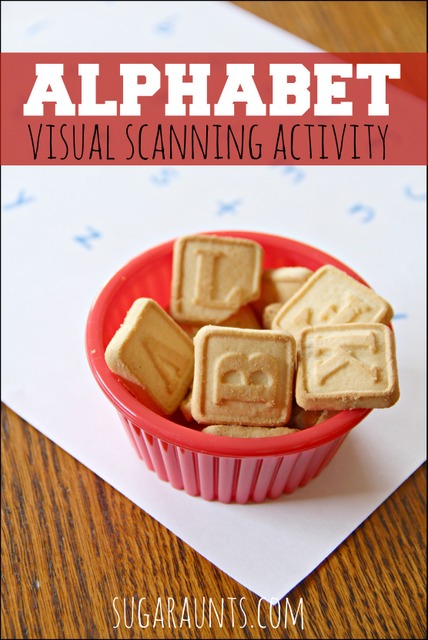
Visual Scanning Activity for Kids

 
Visual scanning is essential for handwriting skills, puzzles, word searches, mazes, and many many functional tasks.  Scanning a room for a missing sock may be difficult if a child demonstrates difficulty with visual scanning. 
 
When matching the upper case letters to the lower case letters, the child must scan the whole page in order to search and find the correct letter.  Younger children or those working on visual scanning skills may require modifications to this.  You could fold the page in half, offering only half of the options.


Fine Motor Activity for Kids

Picking up those cookies and laying them flat on the paper is a fun way to practice fine motor skills.  Don’t let those cookies crumble by pinching too hard!  Children will use a tip to tip grasp to pick up the cookies from the table surface, may tuck one or a few cookies into their palms, and transfer the cookies one at a time (hopefully!) into their mouths.  What a great fine motor experience!


Hand-Eye Coordination Activity for Kids

Hand-eye coordination is using the information received through the vision system to coordinate the hands with control, in order to complete a task, such as handwriting or catching a ball.

 
Don’t have alphabet cookies?  You could also use alphabet pretzels or
alphabet cereal in this activity.


Colleen Beck, OTR/L has been an occupational therapist since 2000, working in school-based, hand therapy, outpatient peds, EI, and SNF. Colleen created The OT Toolbox to inspire therapists, teachers, and parents with easy and fun tools to help children thrive. Read her story about going from an OT making $3/hour (after paying for kids’ childcare) to a full-time OT resource creator for millions of readers. Want to collaborate? Send an email to contact@theottoolbox.com.

Fine Motor Play with Keys

If you’re a frequent visitor to this blog, you know that we LOVE our fine motor play activities!  We are very into playing with household items and recycled materials (aka FREE stuff) in our play, crafts, and activities.   We’re joining so many other bloggers in 26 activities using everyday household items with one focus: Fine Motor Play for kids! 

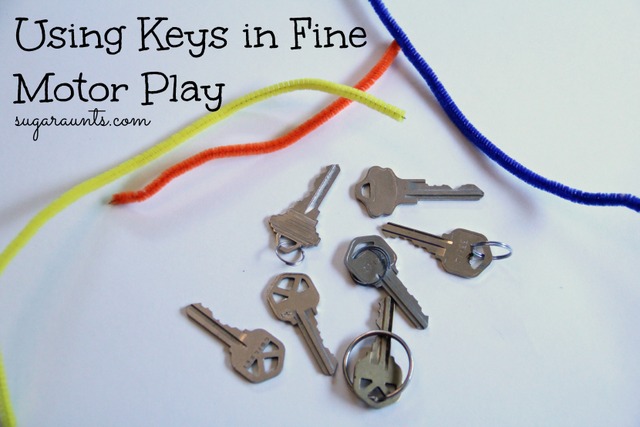
Like most homes, we have a junk drawer full of random things.  There seem to be a ton of keys that go to who-knows which lock in this house.  So, what to do with those keys that we may someday need for some unknown locked door? …PLAY with them!

 Fine Motor Play with Keys


This post contains affiliate links. We thank you for your support of  our blog by purchases made through these links.
When you have kids, many times it seems like there is more playing with every day household objects than there is of toy playing.  Babies start out by banging pots and pans and reaching for the remote buttons, right?   So why not play with something as simple as real keys?  They are great for fine motor skills.  Hey, there is even a grasp termed “key grasp”!  When the thumb opposes the lateral side of the pointer finger to hold an object (piece of paper, coin, and of course, a key), you are utilizing the “key grasp”. 
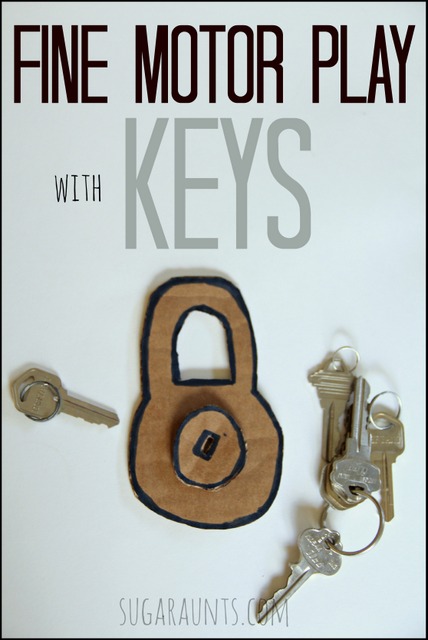
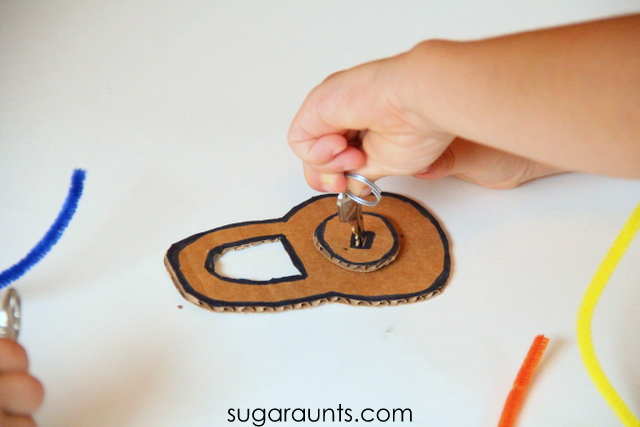
We pulled out our supply of mystery keys and got busy playing.  I created a cute little lock from cardboard and the kids had fun locking and unlocking with their keys.  We even pretended to lock up treasures and then unlock with different keys.

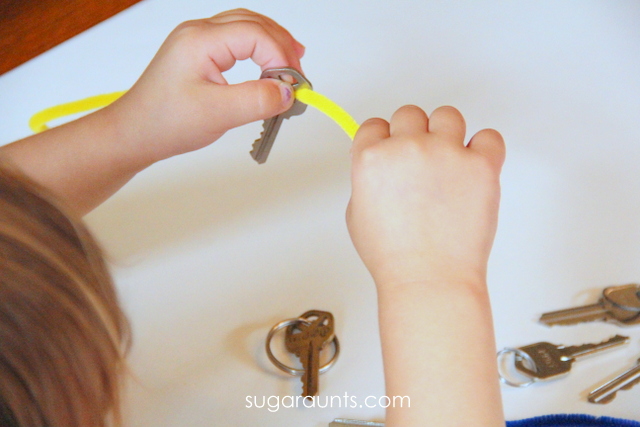
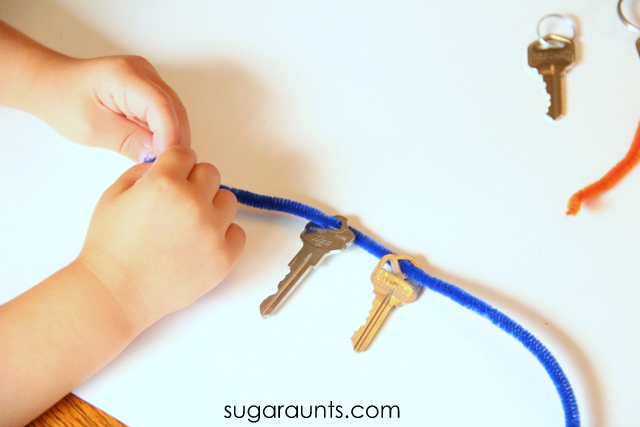
We did a threading activity with pipe cleaners
and keys.  I asked the kids to thread one key on the yellow pipe cleaner, two keys on the orange pipe cleaner, three keys on the blue pipe cleaner, etc. 

This was such a fun way to practice fine motor skills, listening, direction following, and early math.

Baby Girl (age 2 and half) was very into this activity.  Little Guy (age 5) LOVED the cardboard lock.  He locked away all sorts of treasures with it.

Don’t have extra keys in your house?  Use the ones on your key ring.  (Just watch them closely so your house key doesn’t “walk” away!)  Or, you could purchase a box of blank keys and use them in fine motor play!

Looking for more fine motor activities using everyday items?  These are fun and frugal:

Paper Clips | Spoons and Cupcake Tin | Ice Cube Tray | Masking Tape | Golf Tees

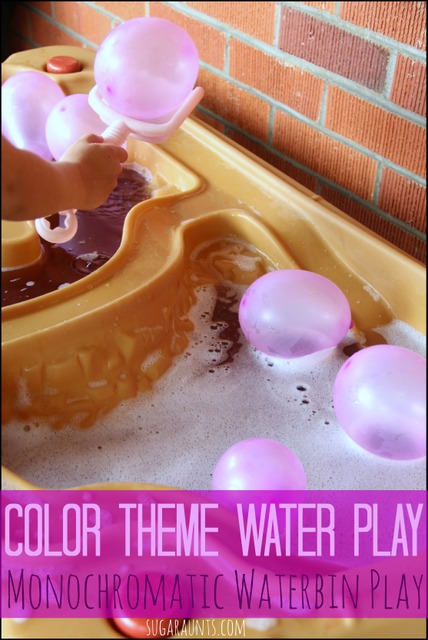
Monochromatic Water Bin Color Play

We love playing all kinds of learning through water on the water table.  We’ve played lots of other materials too…sand, nature, and even snow have made their way into our water table.  Recently, we explored a single color with water play in the water table.  Monochromatic learning  through water play is such a great summer play activity, but could be carried over to year round with a little mess-proofing indoors. 
This activity is part of the All Things Kids blogger’s monthly series.  This month we’re talking about Learning with Water Play.  You can see all of the great ideas from the All Things Kids bloggers by checking out the series homepage on All Things Kids.


Learning with Color

Explore a single color in the water bin with this learning through water play activity for kids.

This post contains affiliate links.  Your purchases through these links provide us with a small percentage and enable us to run this blog.  Thank you for your support!


Monochromatic Water Bin Play

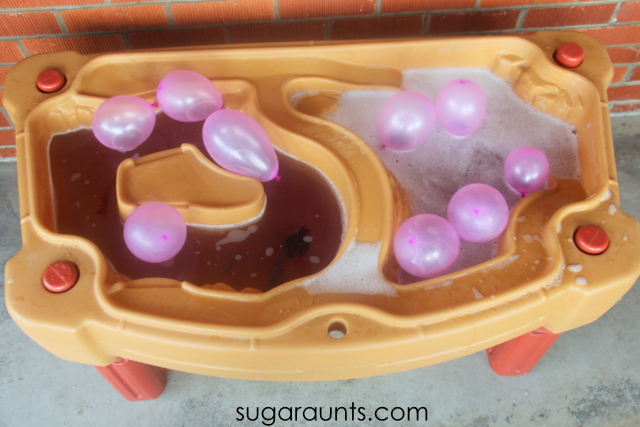
We started with our sand and water table
and filled both sides with water.  We added a little bit of g
rape scented bubbles
for a fun scent and foamy sensory play on one side of the water table.  I blew up a bunch of
purple water balloons and threw those in the water table.  (HINT: Blowing up water balloons can be a beast!  We have a little hand air pump that came from some toy and made it much easier to blow up the water balloons!) You could use any size balloons for this activity, but I wanted small size for our transferring part of the fun. 
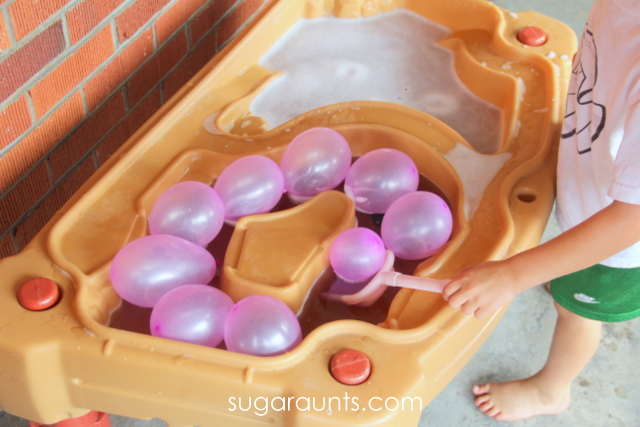
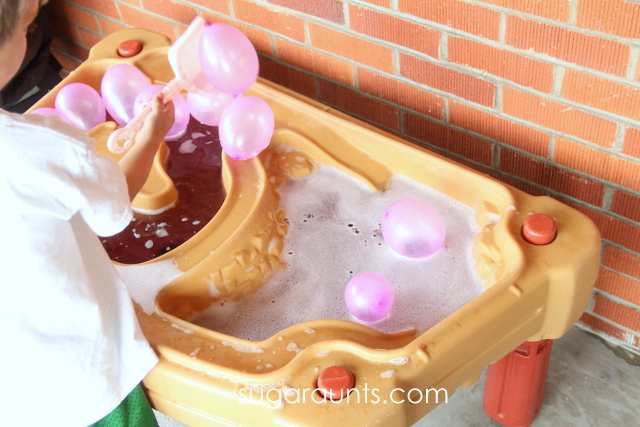
I gave the kids a little plastic shovel from our sandbox and showed the kids how to transfer the balloons from side to side in the water table.


It was fun to try to catch the balloons as they scooted around on the water surface.  Transferring the balloons with a shovel is a great way to work on eye-hand coordination while encouraging bilateral hand coordination and crossing midline.  Transferring from left to right is great for pre-readers, too.  Kids need to scan from left to right across the page as they read and working on this skill in pre-readers is a great beginner activity.

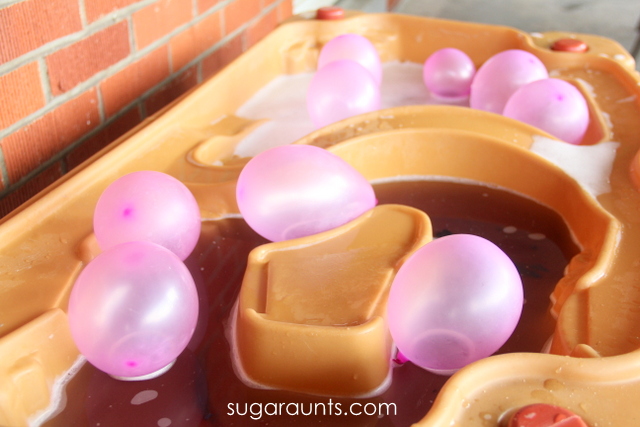
We had so much fun talking about the different shades of purple and the term “monochromatic” as we pointed out the different shades.  Our learning with water activity was a great way to spend a hot summer afternoon. 
You may be interested in some of the products that we love and used in this post’s activity:

This Little Piggy Went to the Market craft

Is there a song or nursery rhyme that is a huge hit in your house?  You know the one that is said over and over (and over) again?  Right now we are on a This Little Piggy Went to the Market kick.  Baby Girl (age 2 and a half) loooooooves This Little Piggy.  She will ask me to do the finger play rhyme on both feet and then both hands again and again.  I’ve even heard her saying it to herself…with lots of adorable mistakes.  It’s beyond cute.  I love when she asks me, “Mom, what does this piggy do?” and points to a toe.  What a cutie!
When we made this piggy craft, Baby Girl very excited.  I told her we were making a This Little Piggy craft and she was so happy!

"This Little Piggy Went to the Market" craft for kids

This Little Piggy Went to the Market craft for Toddlers

This post contains affiliate links.  Your purchases through these links help support our blog. 
This craft for toddlers is very easy and a great opportunity for some learning, too.  You can talk to your Toddler about circles and sizes (big and little).  Toddlers are learning concepts such as size awareness and you can show them the big and little circles as you build the pigs.

I started with 5 big circles cut from pink construction paper and 15 small circles.  We counted out the big circles together.

I helped Baby Girl fold ten of the small circles in half.  These will be the pigs ears.

Big Sister helped out a little with counting out our piggy ears.

Baby Girl is all about using the glue stick.  This Little Piggy Went to the Market + glue stick
= Baby Girl’s best day ever!  She went crazy gluing on the big circles, ears, and snouts.

Craft idea for This Little Piggy finger play.

After all of the pieces were glued in place, I drew on little faces.  We had fun saying the finger play while using our five little piggys to join in on the fun.  Baby Girl played with these little piggys all day!