Pincer Grasp Activities

pincer grasp

The development of fine motor skills such as the pincer grasp is an important aspect of a baby’s growth and development. As a baby grows and gains more control over their movements, they begin to develop the ability to grasp objects with increasing precision. One of the most significant fine motor milestones in this journey is the emergence of the pincer grasp. This grasp enables babies to pick up small objects and use their fingers with greater finger dexterity, allowing them to explore their surroundings in new and exciting ways.

However, the functional use of a pincer grip doesn’t stop in babies and toddlers. Pincer grip use supports independent and manipulation of items with precision and dexterity and is an important part of fine motor work. 

In this blog, we will delve deeper into the pincer grasp, exploring what it is, how it develops, and why it is such an important milestone for a baby’s growth and development. 

pincer grasp

Amazon affiliate links are included in this blog post. As an Amazon Influencer, I earn from qualifying purchases.
What is Pincer Grasp?

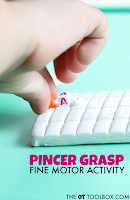
The pincer grasp is a significant hand grasp that enables one to pick up and manipulate items with the tips of the fingers and is used to manipulate items such as small pieces of cereal or other little items. When we manipulate objects between the pad of the thumb to the pad of the pointer finger (index finger), we are using pincer grasp.

Pincer grip is essential for babies who are beginning to explore self-feeding with finger foods and begins to develop with the raking motion of the hands used to grasp at items such as food or cereal pieces. The hand eye coordination progression builds from here.

The raking grasp motion we see in young babies is actually a prerequisite to facilitate a pincer grasp development as the motion supports strengthening and coordination with all of the fingers, allowing for development of finger isolation in the index finger and thumb. 

 With the pincer grasp, the baby can pick up small items between the tips of their index and thumb fingers and bring them to their mouth. 

Pincer grip can be broken down into types:

  • Inferior pincer grasp- Also known as crude pincer grasp, or pad-to-pad grasp, the inferior pincer grasp uses the pads of the index and thumb to grasp objects. 
  • Pincer grasp- Slight flexion of the DIP joint of the index finger and IP joint of the thumb results in a round thumb web space. This grasp component utilizes the tips of these fingers. 
  • Neat pincer grasp- Also known as superior pincer grasp, Neat pincer grasp pulls the tips of the fingers in closer to the thumb web space and requires more flexion of the thumb IP joint and index finger DIP joint as well as flexion of the thumb MP joint and index PIP joint. Neat pincer grip is a more refined and dexterous grip used for extremely precise fine motor tasks such as picking up very small objects like a pin, thread, or sequin.

Development of Pincer Grasp

Pincer grip is one of the first dexterity skills to develop. The grasp pattern is a precision motor skill that emerges when a baby is between 8 to 10 months old and is guided by self-feeding and exploring objects through the primary sensory system at this young age: the mouth. 

Inferior pincer grasp begins at 6-9 months. Before a true pincer grasp is established, you’ll notice a lateral pincer grasp, or an inferior pincer grasp. This progression begins as a raking motion from the fingers to grasp at the food pieces, but this movement is typically not successful in picking up small foods like baby puff snacks. The next stage of pincer grasp development progresses as the baby uses the lateral side of the index finger and the thumb to pick up small food pieces using the thumb and the side of the pointer finger to grasp items (not a true pincer grasp).

Pincer grasp develops around 9-12 months of age.  This is when you see the baby pick up baby puffs and small chunks of food pieces to pick up the items with the thumb and the pad of the index finger.

Neat pincer grasp develops between 12-18 months and is a much finer skill. This is a common part of feeding developmental milestone achievement which allows babies to pick up and then feed themselves using that pincer grasp. This is when you will see babies pick up small crumbs from the carpet. Baby proofing takes on a whole new level once pincer grasp has developed!

Pincer Grasp Activities

We can use play-based pincer grasp activities to support this development based on the child’s age, development of these motor skills build independence, too. This pincer grasp activity supports precision needed to manipulate a pencil.

Pincer grasp and neat pincer grasp are precision fine motor skills that develop when babies start to pick up cereal in self-feeding. The developmental skill is essential for development of fine motor skills and manipulation of toys and items in play and discovery.  

Try these pincer grasp activities:

  1. Stacking blocks
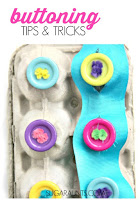
  2. Practice buttoning with buttons. Here are button activities to try.
  3. Build puzzles
  4. Play with nuts and bolts
  5. Open drawers with knobs
  6. Pound golf tees into an egg carton or hammering golf tees into the ground
  7. Flip pages of a board book
  8. Spray water with a spray bottle to strengthen the arches of the palm
  9. Color with small crayon pieces. Read more about the benefits of coloring.
  10. Play with play dough- Roll play dough into small balls and place onto a target. Use our play dough mats for inspiration.
  11. Bend pipe cleaners into different shapes
  12. Play with stickers. Read this resource on 10 reasons why every kid needs to play with stickers.
  13. Poke holes in a cardboard box and thread pipe cleaners into the holes.
  14. Press a pushpin into a lid of a container or cardboard box
  15. Use tongs to manipulate objects and sort craft pom poms by color
  16. Use tweezers to pick up cotton balls
  17. Tissue paper art- crumble tissue paper and dip into glue, then paste to paper
  18. Offer small food items in a cupcake pan
  19. Glue beans onto lines on paper
  20. Tread beads onto pipe cleaners or string
  21. Play with marbles (this marble slime activity is fun!)
  22. Water play with an eye dropper and colored water.
  23. Clip clothespins onto paper. These clothes pin ideas will give you more fun ways to build a stronger pincer grasp.
  24. Play with Cheerios or small pieces of cereal
  25. Build with LEGO blocks
  26. Play with wind-up toys
  27. String pasta onto yarn or pipe cleaners
  28. Geoboard and pegboards

What is Neat Pincer Grasp?

Neat pincer grasp is used to pick up very small items such as perler beads, a thread from a surface, or a needle.  You might see the tip-to-tip grasp to pick up a sequin or fuzz from clothing.


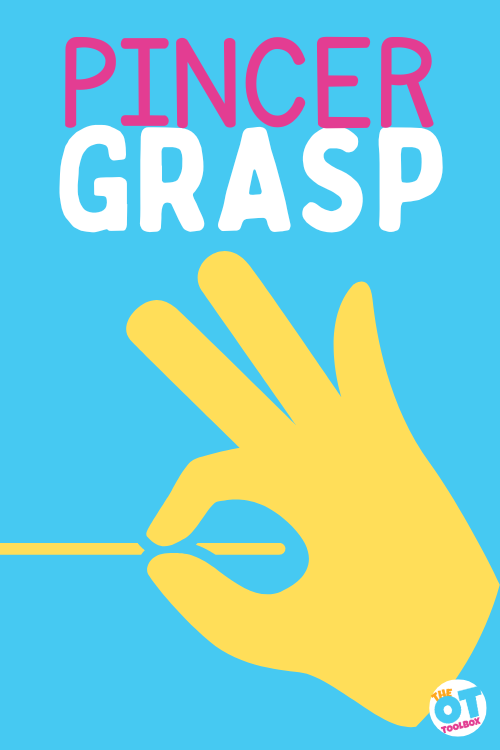
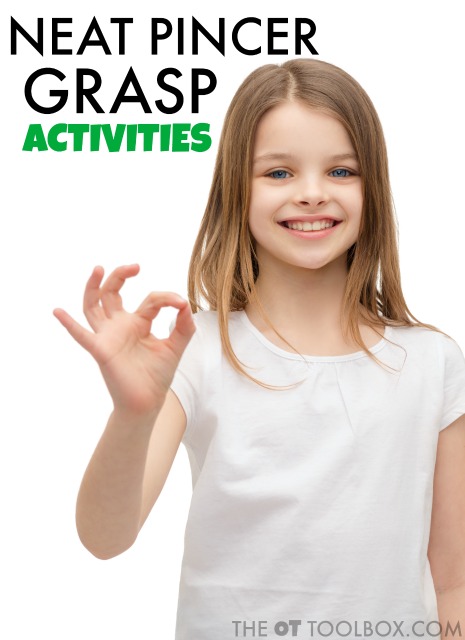
Think about the “ok” sign with the thumb and pointer finger touching and a nice round “O” in the thumb web space.  That tip-to-tip pinch is neat pincer grasp.


If neat pincer grasp is not developed, kids can potentially present with less thumb IP joint flexion and difficulty opening the thumb web space when manipulating very small items.  This can lead to fumbling and decreased dexterity during fine motor tasks.


This post contains affiliate links.


Neat Pincer Grasp Activities

Neat pincer grasp uses the tips of the thumb and pointer finger to stabilize objects.  When using a pincer grasp, children use the pads of the thumb and finger to stabilize the object.  

These neat pincer grasp activities are creative ways that can help kids develop the small motor skill area.


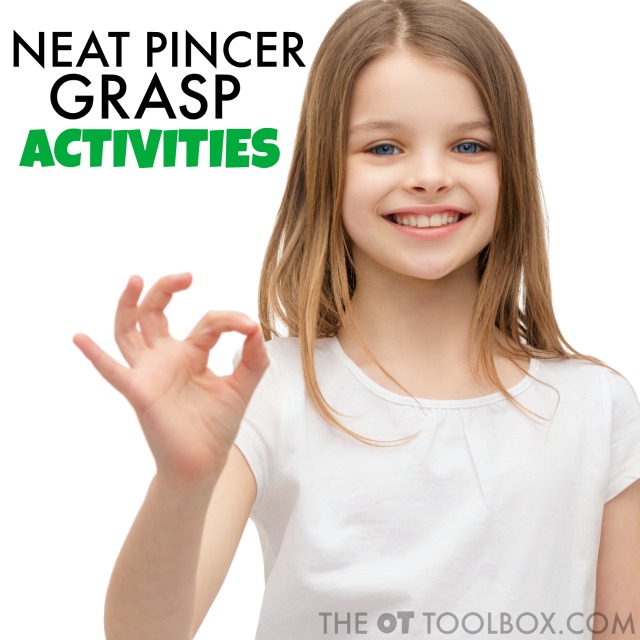
Neat pincer grasp activities for kids to develop dexterity and fine motor skills.


Neat pincer grasp activities for kids to develop dexterity and fine motor skills.


More fine motor skills you will love to explore:

 Pincer grasp fine motor activity


Neat Pincer Grasp Fine Motor Activity Buttoning Tips and Tricks https://www.theottoolbox.com/2015/11/benefits-of-playing-with-stickers-occupational-therapy.html


In the Fine Motor Kits here on our website, you’ll find many precision activities that support development of pincer grasp. Specifically, there are tearing activities, crumbling activities, pinch activities, and other hand strengthening activities using themed fine motor activities.

Working on fine motor skills, visual perception, visual motor skills, sensory tolerance, handwriting, or scissor skills? Our Fine Motor Kits cover all of these areas and more.

Check out the seasonal Fine Motor Kits that kids love:

Or, grab one of our themed Fine Motor Kits to target skills with fun themes:

Want access to all of these kits…and more being added each month? Join The OT Toolbox Member’s Club!

Colleen Beck, OTR/L has been an occupational therapist since 2000, working in school-based, hand therapy, outpatient peds, EI, and SNF. Colleen created The OT Toolbox to inspire therapists, teachers, and parents with easy and fun tools to help children thrive. Read her story about going from an OT making $3/hour (after paying for kids’ childcare) to a full-time OT resource creator for millions of readers. Want to collaborate? Send an email to contact@theottoolbox.com.
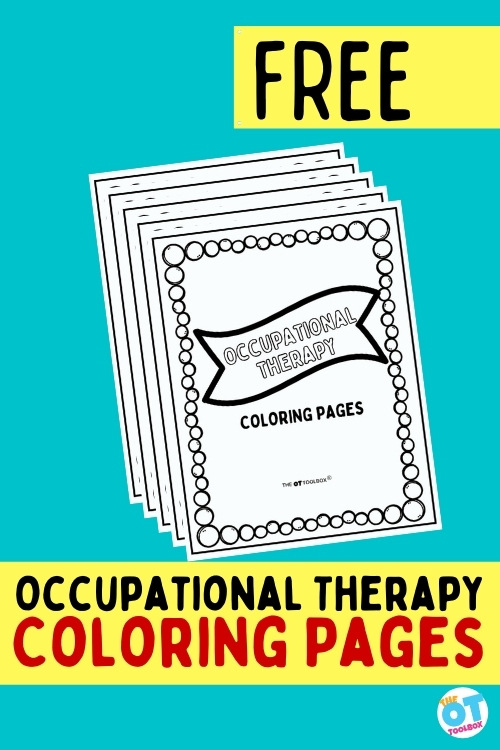
Occupational Therapy Coloring Pages

occupational therapy coloring pages

In celebration of Occupational Therapy Month, we’ve got a series of free OT PDFs and these occupational therapy coloring pages will get you started with the OT fun. April is Occupational Therapy Month!  Not only is it a month to celebrate the occupational therapists in your life, but to advocate for our profession.  Raise your hand if you have been asked, “what the heck is occupational therapy?”  This question comes from adults as much as children. This spring, in celebration of OT month, the OT Toolbox will be offering a series of resources to help educate young learners about the role of occupational therapy. These therapy coloring pages will make advocating for the profession fun AND engaging as users build motor skills!

You’ll also love our President’s Day coloring pages that are great for all US holiday themes.

Occupational therapy coloring pages for therapy skills

Today’s resource is occupational therapy coloring pages to start the journey towards advocacy and education. 

Therapy Coloring Pages

We wanted to create a set of therapy coloring pages that are as useful as a therapy coloring tool as they are useful for advocating for the profession of occupational therapy. OT professionals know the value of an engaging activity on developing and refining skills in their clients, and these therapy coloring pages do just that! Each therapy coloring sheet includes images of OT equipment which users can color while also learning about the value of OT in supporting client needs.

A therapeutic coloring page is a tool for therapy providers to use with clients because the OT practitioner can target goal areas such as:

  • Fine Motor Skills
  • Hand Strength
  • Visual Motor Skills
  • Eye-Hand Coordination
  • Force Modulation (color this item light red and this other therapy picture dark red)
  • More!

Then, when the therapy coloring sheet is completed, the pictures are great to hang on a bulletin board, door, or hallway and advocate for the powerful nature of occupational therapy!

It is important for people to know who we are and what we do, so they can ask for help when needed, and see that what we do matters. A persons’ occupation is their job.  Also known as functional skills, occupations are the day to day tasks we do all day long. Occupations go beyond the workplace. 

A child’s occupation is to learn to care for themselves, go to school, play, and develop social skills.  An adult’s occupation entails self care skills, social function, caring for others, instrumental activities of daily living (cooking, cleaning, laundry, fixing the car, etc.) along with any work functions they have.

Occupational therapy (OT) helps bridge the gap between where the learner currently is functioning, and independence. For children we might say we bridge the gap between functional and chronological age. 

OT might be restorative, or teach new skills. OTs can be found in schools, hospitals, clinics, rehabilitation centers, daycares, home therapy and many other places.

Add these occupational therapy coloring pages to your OT month awareness packet!

Occupational Therapy Coloring Pages

OTs use some fun toys!

Younger learners, especially in schools, have seen many tools therapists use to help their students. These range from fidgets, swings, trampolines, alternative seating, slant boards, pencil grips, and more.

Some often wonder why our learner gets to play with the OT, and get fidget toys to use in class.

Using these occupational therapy coloring pages will help start the conversation about what these tools are, and how they are used. Share these OT coloring pages both with the learners on your caseload, as well as the other students in the school.

While it is true we use some fun toys in therapy, these are tools for the learners who need them. Occupational Therapy for young learners is play based

This is  because the role of the young learner is to play. You will notice that the learner who NEEDS the fidget or other adaptations will use it appropriately as a tool to help them get organized, while the neurotypical student tends to use it as a toy.

Use these occupational therapy coloring pages to talk about what each piece of therapy equipment does for the learner. 

Beyond educating others about our amazing profession, great skills are being addressed with these coloring worksheets:

  • Hand strength and dexterity – coloring inside the lines builds hand muscles and develops muscle control. 
  • Visual motor skills –Combining what is seen visually and what is written motorically.  It takes coordination to be able to translate information from visual input to motor output. Coloring, drawing, counting, cutting, and tracing are some visual motor skills.
  • Visual Perception – Developing figure ground to see where one item starts and finishes, scanning to find all items to color, and recognizing the border lines while coloring. 
  • Proprioception – pressure on paper, grip on pencil
  • Social/Executive Function – Following directions, turn taking, task completion, orienting to details, neatness, multi-tasking, attending to task, and impulse control can be addressed using these occupational therapy coloring pages PDF.
  • Fine motor strengthening, hand development, and grasping pattern
  • Bilateral coordination – remembering to use their “helper hand” to hold the paper while writing.  Using one hand for a dominant hand instead of switching back and forth is encouraged once a child is in grade school or demonstrates a significant strength in one or the other.
  • Strength – core strength, shoulder and wrist stability, head control, balance, and hand strength are all needed for upright sitting posture and writing tasks.

April is also Disability Awareness month.  This is a great opportunity to talk about different disabilities, while addressing the tools used to help people. How can you incorporate both of these important awareness months into a teachable moment?

While pediatric occupational therapists do have a lot of fun at our jobs, we are also providing an amazing service to the people we work with. Advocacy for our profession is so important.

With the push to integrate young people with special needs into the mainstream classroom, teachers are finding it more difficult to educate everyone at the same time. Our role as an occupational therapist is to help learners become more independent, provide tools and suggestions to classroom teachers to make their job easier, and help them identify which learners might be struggling.

The OT Toolbox is full of amazing resources for therapists, teachers, parents, and learners of all ages. This post shares what occupational therapy is all about and what tools are needed to make life easier.  Stay tuned for more occupational therapy month activities during April.

Free OT Coloring Pages

Want to add these resources to your occupational therapy toolbox? Enter your email address below to grab these printable PDF coloring sheets. These materials are also available in the OT Toolbox Member’s Club!

Level one members will have the opportunity to sign up for and download five different occupational therapy month activities.  Level two members will have access to all of these plus the larger collection of OT themed materials.  

Want to add this resource to your therapy toolbox so you can help kids thrive? Enter your email into the form below to access this printable tool.

This resource is just one of the many tools available in The OT Toolbox Member’s Club. Each month, members get instant access to downloadable activities, handouts, worksheets, and printable tools to support development. Members can log into their dashboard and access all of our free downloads in one place. Plus, you’ll find exclusive materials and premium level materials.

Level 1 members gain instant access to all of the downloads available on the site, without enter your email each time PLUS exclusive new resources each month.

Level 2 members get access to all of our downloads, exclusive new resources each month, PLUS additional, premium content each month: therapy kits, screening tools, games, therapy packets, and much more. AND, level 2 members get ad-free content across the entire OT Toolbox website.

Join the Member’s Club today!

Free Occupational Therapy Coloring Pages

    We respect your privacy. Unsubscribe at anytime.

    Victoria Wood, OTR/L is a contributor to The OT Toolbox and has been providing Occupational Therapy treatment in pediatrics for more than 25 years. She has practiced in hospital settings (inpatient, outpatient, NICU, PICU), school systems, and outpatient clinics in several states. She has treated hundreds of children with various sensory processing dysfunction in the areas of behavior, gross/fine motor skills, social skills and self-care. Ms. Wood has also been a featured speaker at seminars, webinars, and school staff development training. She is the author of Seeing your Home and Community with Sensory Eyes.

    NOTE*The term, “learner” is used throughout this post for readability and inclusion. This information is relevant for students, patients, clients, preschoolers, kids/children of all ages and stages or whomever could benefit from these resources. The term “they” is used instead of he/she to be inclusive.

    Occupational therapy materials bundle

    NEW RESOURCE: Occupational Therapy Bundle!

    The Occupational Therapy Materials Bundle includes:

    • I Spy OT Dynamic Duos- School Based OT
    • I Spy OT Dynamic Duos- Outpatient OT
    • OT Coloring Pages
    • OT Writing Prompts
    • OT Copy the Words
    • OT Fine Motor Copy Kit
    • OT Fine Motor Game
    • OT Homework Bingo
    • OT Materials Toothpick Art
    • OT Supplies Match It Game
    • OT Supplies-What’s Missing
    • OT Visual Schedule Cards
    • OT Word Search
    • 8 OT articles on professional development

    • Summer Sensory Activities and Sensory Circuits

      Summer is a time when we sometimes need to alter our sensory processing input options. In this blog post, we’ve updated the information to include Summer themed sensory play activities parents can use at home. We also wanted to include ideas for educators and therapy providers running Summer school classrooms or Summer camps. This includes…

    Grab The Occupational Therapy Materials Bundle during OT Month to grab this 21 resource bundle for just $8!

    Occupational Therapy Equipment List Writing Pages

    occupational therapy equipment list handwriting worksheets

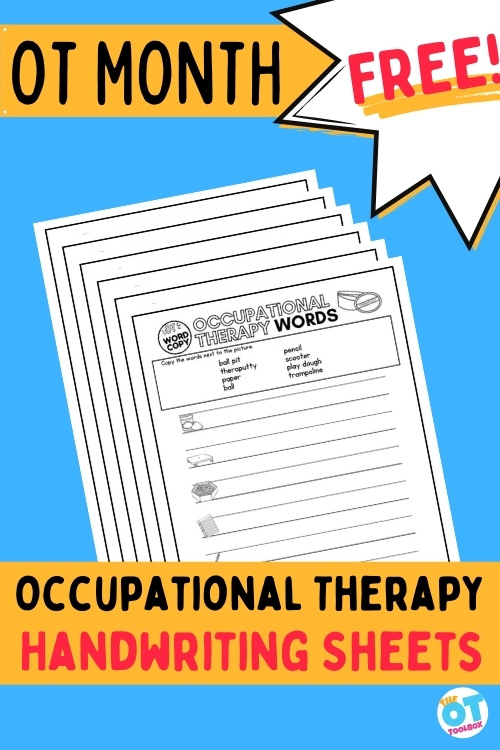
    Today, we have another OT PDF, this one is an occupational therapy equipment list. We created this printable list of OT equipment as a writing exercise. It’s another free download that you’ll want to grab for OT month! For occupational therapy month, we’ve been sharing free OT-themed tools and this occupational therapy equipment list handwriting pages is today’s freebie! Pediatric occupational therapists have some cool tools, so why not use those OT equipment items in handwriting practice? It’s a great way to promote the profession during OT month and all year long!

    OT practitioners work with clients on myriad aspects of daily life tasks. Because an OT professional can support their clients in essentially any aspect of living, the equipment used is vast and can be unique to each individual. However, the OT or OTA has a commonly used list of occupational therapy equipment that is found in almost every OT clinic or therapy bag. In today’s blog post, you’ll find an occupational therapy equipment list PDF which providers can print off to use as a handwriting exercise with clients and students. Put those OT items students use each therapy session to greater use!

    Amazon affiliate links are included in this blog post. As an Amazon Influencer, I earn from qualifying purchases.

    occupational therapy equipment list handwriting worksheets

    Occupational Therapy Equipment List

    Occupational therapy (OT) helps people become more independent. Whether it is babies, toddlers, students, people who are disabled or have had an accident, or those being rehabilitated from surgery, OT’s play a vital role. 

    The cool thing is that OT equipment can literally be anything that helps people achieve functional goals, in any aspect of life!

    OT equipment items could be the toys, tools, and games that help to develop skills:

    This list of OT items are just the beginning of our arsenal of tools!

    When it comes to school-based occupational therapy and outpatient occupational therapy equipment, there can be differences based on the educational modal vs. the medical modal of therapy intervention.

    Having the right equipment and tools is essential for facilitating the development and progress of students. Here’s a list of commonly used occupational therapy equipment for school-based OT:

    1. Fine Motor Therapy Tools:
      • Pencil grips or adaptive writing tools for improved grip and control.
      • Precision toys
      • Tweezers or tongs and small objects to manipulate
      • Coins and slotted containers
      • Scissors with spring-loaded handles or loop scissors to assist with cutting skills.
      • Play dough or thera-putty
      • Paper for coloring drawing, cutting and tearing
      • Manipulative toys like pegboards, lacing cards, and building blocks to enhance fine motor coordination
    2. Sensory Integration/Sensory Processing Tools:
      • Sensory balls or therapy putty for tactile stimulation and hand strengthening.
      • Sensory play materials like sensory bins, shaving cream, writing tray materials, etc.
      • Weighted blankets or vests to provide calming input and promote self-regulation.
      • Therapeutic swings or therapy bands for vestibular and proprioceptive input.
      • Ball pit
      • Fidget toys
      • Tunnels
      • Floor markers, masking tape for obstacle courses
      • Deep breathing exercises
    3. Seating and Positioning Aids:
      • Adaptive seating options like wobble cushions, therapy balls, or stability discs to improve posture and core stability.
      • Adjustable-height desks or tables to accommodate different student needs.
      • Lap trays or angled writing boards to provide a stable surface for writing and activities.
    4. Cognitive Tools:
      • Visual timers or schedules to assist with time management and organization skills.
      • Memory games, puzzles, or matching activities to enhance cognitive skills
      • Cooking activities and materials
      • Games
      • Visual schedules
      • Checklists
      • Scheduling tools and planners
    5. Visual Processing Tools:
      • Visual supports such as visual schedules, picture cards, or visual cueing systems for task completion and transition support.
      • Mazes
      • Puzzles
      • I Spy
      • Word search activities
    6. Gross Motor Equipment:
      • Balance beams
      • therapy balls or therapy mats for improving balance and coordination
      • Scooters, tricycles, or adaptive bikes
      • Cones or targets for obstacle courses
      • Mini trampoline
      • Masking tape for obstacle courses
      • Hula hoops
      • Bean bags for gross motor games
    7. Adaptive Tools for Self-Care:
      • Adaptive utensils, plates, or cups for promoting independence in eating and drinking.
      • Adaptive paper for addressing handwriting skills
      • Dressing aids such as buttonhooks, zipper pulls, or elastic shoelaces for developing self-care skills.
      • Adaptive equipment for toileting, including raised toilet seats or step stools.
    8. Assistive Technology:
      • Alternative keyboards, computer mice, or speech-to-text software for students with fine motor or writing difficulties.
      • OT apps
      • Visual or auditory aids, such as timers or reminders, on tablets or smartphones to support organization and time management.

    While these look like toys (and in some cases are), they are often valuable tools to build independence, strength, focus, and help bridge the gap between functional and chronological age.

    Use this word copying worksheet to talk about what each of these tools are, while building some great skills. 

    Amazon has great occupational therapy equipment and OT tools and we’ve created a bunch of (Amazon affiliate link) OT equipment lists and suggestions for OT toys and tools.

    We serve people from birth to the end of life. Did you know that April is OT Month?  A month-long celebration to advocate for the work we do. The OT Toolbox will be offering several valuable activities to share with your learners to educate them about our role. 

    Occupational Therapy Equipment List Handwriting Worksheets

    Today’s freebies are occupational therapy tools handwriting worksheets.

    These occupational therapy equipment handwriting worksheets PDF highlight just a handful of the tools we use to help learners grow.

    The occupational therapy tools, handwriting activity is presented with two sets of lines, to use with different levels of learners. Each picture is presented in simple black and white to encourage coloring as well as copying the words. 

    How can I modify this task to work with all groups of learners?

    • Lowest level learners can cut and paste the words into the correct rows
    • Middle level learners can copy each word into the lines

    Use OT equipment writing lists.

    • Higher level learners can write a sentence using the key words or write how these items can be used in therapy
    • Take away the word bank for higher level learners to sound out the words, or dictate the spelling aloud for a higher level challenge
    • Make this occupational therapy, copy the word sheet part of a larger lesson plan including gross motor, sensory, social, executive function, or other fine motor skills
    • Print in black and white or color for different levels of difficulty
    • Cut the shapes and make a matching activity instead of using a writing tool to copy the words
    • Talk about the equipment, describe their characteristics, and give context clues to help your learner understand why these tools are helpful
    • Enlarging the font may be necessary to beginning handwriting students who need bigger space to write.
    • Project this page onto a smart board for students to come to the board and write in big letters.
    • More or less prompting may be needed to grade the activity to make it easier or harder.
    • More advanced learners can work on social skills by talking to the group about these therapy tools
    • Write a report about occupational therapy, types of equipment, the history of OT, different disabilities, or how the equipment is used
    • Turn it into a gross motor task, sensory activity, following directions, or combination of all of these
    • Work in pairs or in a small group to address problem solving, turn taking, and sharing information with others

    Talk to young learners about the role of occupational therapy

    It is difficult enough to talk to adults about what occupational therapists do.  Now try describing this to a group of first graders!  If you describe it as playing on swings, trampolines, riding scooters, and getting fun fidgets, you will have everyone in the school trying to figure out a way to sign up for OT! 

    Instead talk about the kinds of goals we address, and how we help other students to be more independent using the tools described on the occupational therapy tools, handwriting worksheet.

    Start the conversation to promote the OT Profession

    The conversation about what occupational therapists do might sound like this:

    • OTs might help a student who can not open all their lunch containers by themselves
    • If a student can not use the bathroom independently, put on their coat, wash hands, or eat their lunch with utensils, they might need occupational therapy
    • Not everyone is able to write their letters, cut, and color like the rest of the class.  OTs work on helping students to improve these skills so they can keep up with the class
    • Some students have difficulty making friends, playing with other people, following directions, sharing, taking turns, or standing in line.  Some of these students might need occupational therapy to help them with these skills
    • Have you noticed some students get in trouble at school?  They don’t finish their work, their stuff is a mess, they don’t listen to the teacher very well, and seem to make a lot of mistakes?  These are not bad students, they may need some help to get better.  There is a whole team to help students like these, OTs are one of them.
    • How do you think some of the items on the occupational therapy tools handwriting worksheet help students?

    The month of April is specially dedicated to sharing our knowledge with other people.  Take a moment to give yourself a pat on the back while you are at it!  Keep an eye out for several posts this month dedicated to advocating for the OT profession.

    Free OT Equipment Worksheets

    Grab these OT equipment list handwriting worksheets and get started to open conversations about what we do as occupational therapists! AND work on the functional task of handwriting skills during your conversations.

    Want to add this resource to your therapy toolbox so you can help kids thrive? Enter your email into the form below to access this printable tool.

    This resource is just one of the many tools available in The OT Toolbox Member’s Club. Each month, members get instant access to downloadable activities, handouts, worksheets, and printable tools to support development. Members can log into their dashboard and access all of our free downloads in one place. Plus, you’ll find exclusive materials and premium level materials.

    Level 1 members gain instant access to all of the downloads available on the site, without enter your email each time PLUS exclusive new resources each month.

    Level 2 members get access to all of our downloads, exclusive new resources each month, PLUS additional, premium content each month: therapy kits, screening tools, games, therapy packets, and much more. AND, level 2 members get ad-free content across the entire OT Toolbox website.

    Join the Member’s Club today!

    Free Occupational Therapy Handwriting PDFs

      We respect your privacy. Unsubscribe at anytime.

      Don’t miss the other OT month freebies! This month the OT Toolbox is highlighting occupational therapy month by providing insight into what occupational therapists do, along with offering FREE resources to add to your lesson plans.  Keep an eye out for more posts from this series, including:

      Victoria Wood, OTR/L is a contributor to The OT Toolbox and has been providing Occupational Therapy treatment in pediatrics for more than 25 years. She has practiced in hospital settings (inpatient, outpatient, NICU, PICU), school systems, and outpatient clinics in several states. She has treated hundreds of children with various sensory processing dysfunction in the areas of behavior, gross/fine motor skills, social skills and self-care. Ms. Wood has also been a featured speaker at seminars, webinars, and school staff development training. She is the author of Seeing your Home and Community with Sensory Eyes.

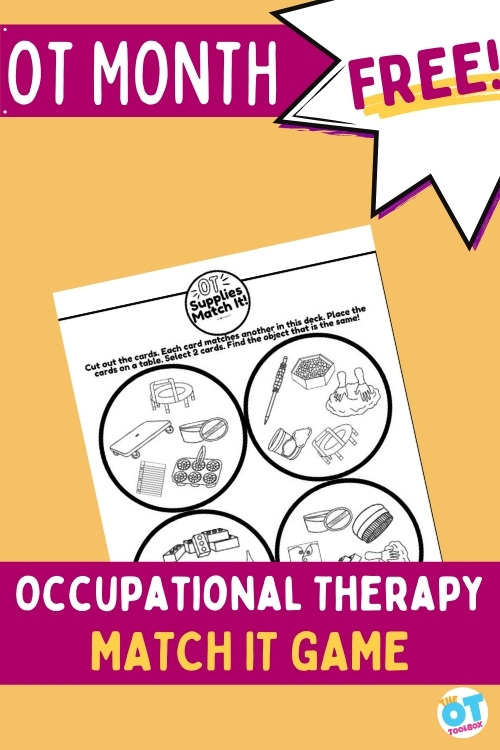
      OCCUPATIONAL THERAPY SUPPLIES MATCH IT CARDS

      OT Spot it game for occupational therapy

      Children love Spot It games and OT professionals love to use Spot It in occupational therapy to develop skills! Today’s free resource for OT month is a fun OT Spot It type of game. This occupational therapy supplies match it activity develops visual perceptual skills and uses common OT materials and supplies. If you are working with kids, you’ll want to grab this freebie as a tool to use during OT month, but also all year long!

      Amazon affiliate links are included in this blog post. As an Amazon Influencer, I earn from qualifying purchases.

      OT Spot it game for occupational therapy

      OCCUPATIONAL THERAPY Spot It Game

      This therapy game is part of a larger set that you can find in our OT Materials Bundle. And, incase you missed the OT month freebie that we shared already, be sure to grab this set of OT coloring pages, too. Both are great resources to add to your toolbox.

      If you have ever played the (Amazon affiliate link) Spot It card game, you will love these Occupational Therapy Supplies Match it Cards!  Spot it games come in dozens of different styles to motivate even the most resistant learner. With these occupational therapy tools matching cards, learners can practice visual perceptual skills using a familiar platform. 

      Why are visual perceptual skills important?

      We’ve previously shared a great post explaining the importance of visual perception on learning.  Visual perception is important for reading fluency, decoding words, scanning a page, remembering what has been seen, finding things in a drawer or closet, playing games like puzzles, recalling/recognizing correct spelling, completing math equations, and so much more.

      As a related resource, this free visual perception packet covers many different visual perceptual skills.

      Spot It Game for Visual Perception

      If you’ve seen the Spot It game being used in therapy sessions as a tool for development, you may have wondered how this popular game supports visual perceptual skills.

      What visual perceptual skills are used in the occupational therapy supplies match it game?

      • Visual Attention: The ability to focus on important visual information and filter out unimportant background information.
      • Visual Memory: The ability to recall visual traits of a form or object.
      • Visual Spatial Relationships: Understanding the relationships of objects within the environment.
      • Visual Figure Ground: The ability to locate something in a busy background.
      • Visual Form Constancy: The ability to know that a form or shape is the same, even if it has been made smaller/larger or has been turned around.

      All of these skills are addressed through the use of the Spot It games, and that’s why we wanted to create an OT version to develop skills!

      Use the OT Match IT Game

      Because April is OT month, it is a great time to talk about the role of occupational therapy with other students, or to work with learners on understanding why they get OT. 

      They may not understand why they get to see this awesome person every week.  By educating learners about the role OT plays in their lives, they can begin to explain it to other people.  When we educate other adults about occupational therapy, we are advocating for the profession, as well as teaching them how we can help.

      WHERE WILL YOU TAKE THIS ACTIVITY?

      1. A great place to start would be by ordering the rest of this occupational therapy supplies match it cards HERE. This bundle of occupational therapy activities includes 13 printable products that can be printed off and used with students in therapy sessions to celebrate all of the therapy tools kids use. This packet is great for OT month, and all year long.
      2. An all inclusive lesson plan can easily be made by using all of the occupational therapy month themed activity freebies:
      1. Create a visual perception theme addressing several of the important visual perceptual skills.  The OT Toolbox has some brand new resources for visual perception. 
      2. Color and laminate these cards to build a reusable game set.  Make a special game set for your learners to take home and share with family
      3. Have learners research and learn more about occupational therapy and the supplies or tools we use

      HOW TO DOCUMENT Spot IT Games in Therapy

      If you are using these occupational therapy supplies match it cards as part of your treatment plan, you will need to accurately document your learner’s skill level. 

      • The percentage of correct cards matched
      • How long it takes to do each card
      • Attention to detail, following directions, prompts and reminders needed, level of assistance given
      • Can your learner scan the page to identify the correct items?  Are they recognizing what they are matching or merely matching shapes?
      • How many times do you need to repeat the directions so your learner can follow them?
      • How many reminders does your learner need while doing this activity?
      • First determine what goals and skills you are addressing. Are you looking strictly at visual perception and picture matching?  Or something else entirely such as executive function and behavior?
      • Focus your observations on the skills you are addressing.  It is alright to address one (or ten) skills at once, just be sure to watch for those skills during the activity.  This can take practice to watch everything all at once. Newer clinicians often videotape sessions and go back and review clinical observations they may have missed.
      • Use data to back up your documentation. Avoid or limit phrases such as min assist, fair, good, some, many, etc.  They are vague and do not contain the numbers and data critical to proficient documentation.  Instead use percentages, number of trials, number of errors, time to do a task, number of prompts, minutes of attention.  You get the idea.
      • This type of documentation may feel foreign at first if this is not what you are used to, however insurance and governing agencies are becoming more strict on accurate documentation.

      TAKE CARE OF YOURSELF AS WELL AS OTHERS

      Take time this month not only to advocate for occupational therapy, but to celebrate each other for the fabulous work we do!  Share stories of success, funny moments, learning opportunities, and resounding failures.  Every time I think I have heard or seen it all in my thirty years practicing, a new surprise or hilarious moment comes my way!  Someone should publish a book or page about all of the funny things people say during a therapy session. 

      This profession is rewarding but also very tough.  Burnout is common among health professionals. In fact, caregiver stress and burnout applies to many therapy professionals! If you can’t find a moment of levity, it will break you.  

      While this post is highlighting the occupational therapy match it cards, take time to reflect about what great work you are doing, spread the word about OT, and practice your own self care.

      Free Match IT Game for OTs

      Want to add this resource to your therapy toolbox so you can help kids thrive? Enter your email into the form below to access this printable tool.

      This resource is just one of the many tools available in The OT Toolbox Member’s Club. Each month, members get instant access to downloadable activities, handouts, worksheets, and printable tools to support development. Members can log into their dashboard and access all of our free downloads in one place. Plus, you’ll find exclusive materials and premium level materials.

      Level 1 members gain instant access to all of the downloads available on the site, without enter your email each time PLUS exclusive new resources each month.

      Level 2 members get access to all of our downloads, exclusive new resources each month, PLUS additional, premium content each month: therapy kits, screening tools, games, therapy packets, and much more. AND, level 2 members get ad-free content across the entire OT Toolbox website.

      Join the Member’s Club today!

      Free Occupational Therapy Spot It Game

        We respect your privacy. Unsubscribe at anytime.

        Victoria Wood, OTR/L is a contributor to The OT Toolbox and has been providing Occupational Therapy treatment in pediatrics for more than 25 years. She has practiced in hospital settings (inpatient, outpatient, NICU, PICU), school systems, and outpatient clinics in several states. She has treated hundreds of children with various sensory processing dysfunction in the areas of behavior, gross/fine motor skills, social skills and self-care. Ms. Wood has also been a featured speaker at seminars, webinars, and school staff development training. She is the author of Seeing your Home and Community with Sensory Eyes.

        9 Hole Peg Test

        9 hole peg test

        The 9 hole peg test is a common fine motor test used in occupational therapy assessments to collect a baseline on fine motor skills, dexterity, hand-eye coordination, motor planning, and more. When an occupational therapist uses a nine hole peg test in OT evaluations, several areas of data are collected to support and drive therapy progression. Let’s take a closer look at this fine motor assessment and the skills developed using pegboard activities like the nine hole peg test.

        9 hole peg test

        This blog post on the 9 hole peg test contains affiliate links.

        Amazon affiliate links are included in this blog post. As an Amazon Influencer, I earn from qualifying purchases.

        9 Hole Peg Test

        Continuing in the series of posts related to grasping, grip strength, and standardized testing measures, the (Amazon referral) 9 Hole Peg Test is another classic test used to measure and track fine motor dexterity.  In this post we will review the nine hole peg test, norms, correct testing protocol, and testing options.

        The Nine-hole Peg Test typically is used in the adult clinical settings such as outpatient hand therapy, rehabilitation settings, or in assessment of adults with coordination and dexterity needs, typically seen with neurologically impaired or cognitive, sensory, or motor impaired patients.

        However, we know that in children, especially in the 5-9 range, much of the day revolves around motor skills, particularly fine motor contributions. We’ve covered in a previous blog post, the vast amount of school and learning tasks that involve fine motor work. Read about fine motor skills needed at school for more information.

        • In this test, participants are asked to place pegs into the holes one at a time, then remove them one at a time, and place them back in the container as fast as they can
        • Participants may only use one hand at a time, but the opposite hand can stabilize the board
        • Alternative testing method: record the number of pegs placed in the peg holes in 30, 50, or 100 seconds.  Record the data as number of pegs/second.
        • Another alternate testing method: record the number of peg placed in the peg holes and seconds before the child loses interest. First, record the number of pegs.  Second, record the number of pegs placed/second.
        • The timer starts the second the hand touches the first peg, and ends when the last peg is placed into the container.

        Versions of 9 hole peg test:

        There are different varieties of the 9 hole peg test available for purchase, from a basic board (affiliate link) to the gold standard  Jamar 9 Hole Peg Test

        The Jamar test is reported to be worth the hefty price tag because:  “The placement of the dish and pegboard allows for an easy, consistent reach, which ensures proper results during the evaluation procedure. Thanks to the design and materials, the kit is also easy to clean and maintain, allowing for quick and easy disinfection to prevent any contamination”. 

        How to Administer the 9 Hole Peg Test

        The nine hole peg test is a convenient testing instrument.  It requires the test kit, a pencil and paper, and a stopwatch or other timing device.

        • Set up the pegboard on a flat surface in front of the learner.  Add a grip or non-slip surface to insure the board does not move.  The peg side of the board is placed toward the dominant hand (when testing the non-dominant side, this will be reversed).  
        • Instruct the learner to:  “Pick up the pegs one at a time, using your right (or left) hand only and put them into the holes in any order until the holes are all filled. Then remove the pegs one at a time and return them to the container. Stabilize the peg board with your left (or right) hand. This is a practice test. See how fast you can put all the pegs in and take them out again. Are you ready? Go!” 
        • After the patient performs the practice trial, instruct the patient: “This will be the actual test. The instructions are the same. Work as quickly as you can. Are you ready? Go!” (Start the stop watch when the patient touches the first peg.)  While the patient is performing the test say “Faster” When the patient places the last peg on the board, instruct the patient “Out again…faster.” Stop the stop watch when the last peg hits the container. Place the container on the opposite side of the pegboard and repeat the instructions with the non-dominant hand.
        • Record the number of seconds to place and remove all nine pegs for the dominant and non dominant hand. Testing will include one practice test, one test for dominant hand, and one for the non-dominant hand. 
        • Create a tracking form to track scores over time.
        • Cross reference the scores of your learner with standardized norms.

        Fine Motor Assessments with the 9 Hole Peg Test

        There are several tests that incorporate the 9 hole peg test within their testing protocols:

        Skills Assessed with a Nine Hole Peg Test

        Once a measurement is assessed, different pegboard type activities can be used to encourage and strengthen dexterity.  While these will not be standardized with norms, they can be measured over time for improvement or decline in function.  

        Skills that the nine hole test analyzes can include:

        • In-hand manipulation
        • Precision
        • Dexterity
        • Hand-eye coordination
        • Separation of the sides of the hand
        • Force modulation
        • Cognition

        There are endless resources and activities available to address fine motor precision. This article from the OT Toolbox on Fine Motor Precision contains valuable information.

        Here is an inclusive post on Fine Motor Skills, also from the writers at the OT Toolbox.

        When Use the 9 Hole Peg Test

        You might be wondering why do we need to use measurements like the 9 hole peg test?

        Unfortunately (or fortunately depending on your perspective) therapists and practitioners are held to higher and higher standards. There is a certain amount of accountability that is being expected in practice. This is largely due to insurance regulations, however it is good practice to be able to show measurable progress.

        By using standardized methods to record and gather data, more accurate measurements can be made to document and demonstrate what is happening in therapy.  “They are doing a great job” or “we are making nice progress” was sufficient evidence at one time. 

        I personally like standardized tests. It keeps me on top of my students, helps me justify what I do, and is less likely to be questioned than a random worksheet or coloring page. With children, it is hard to make sure a test is exactly standardized to precise measurements, however, it is more measurable than “they are doing a great job”.

        If you are a new clinician, take time to study and learn various types of assessments.  If you are seasoned, brush up on your skills, dust off old assessments, or continue using the gold standard in your practice.

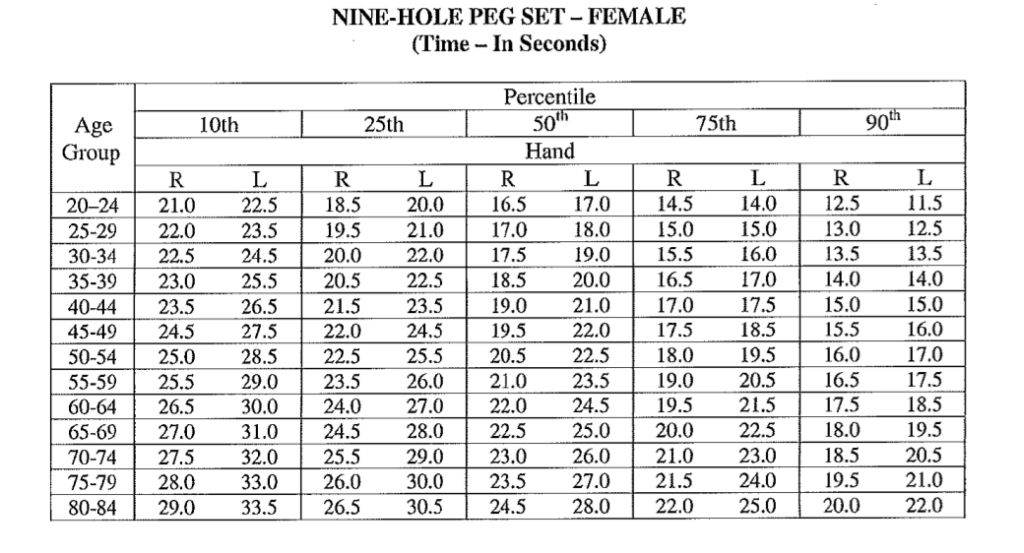
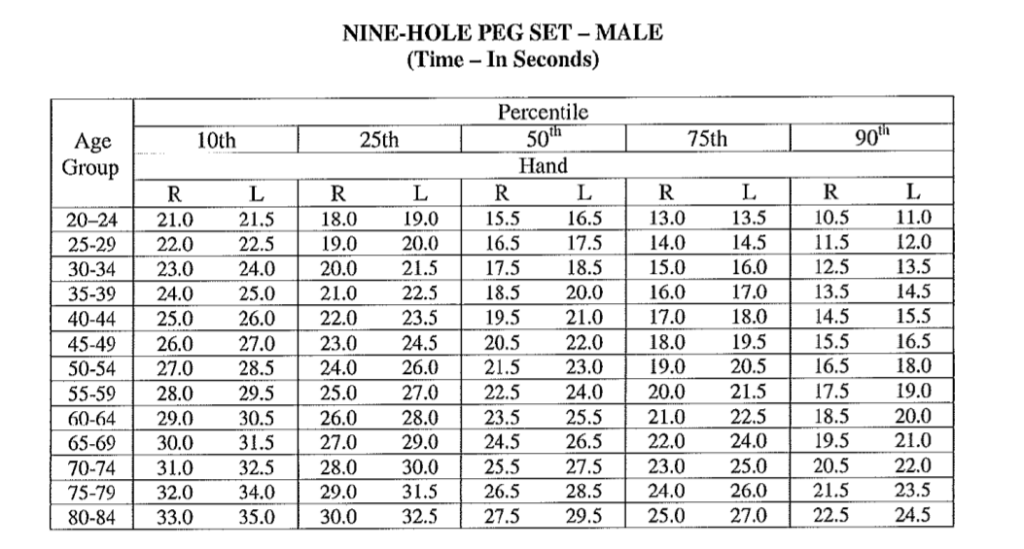
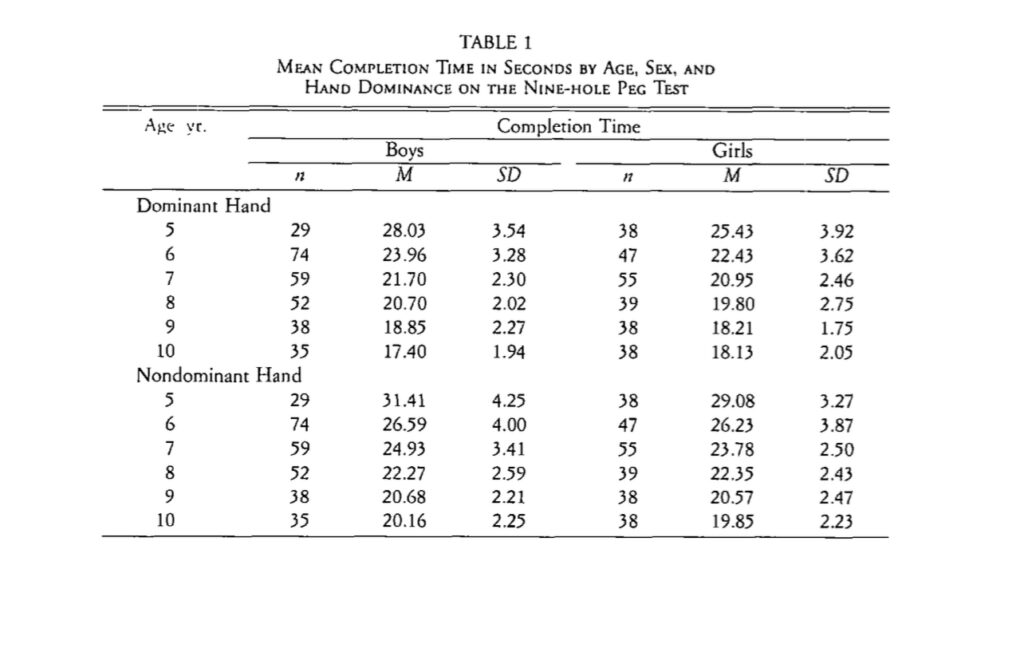
        9 Hole Peg Test Norms

        A clinician can use results of the 9 hole peg test to assess the skill areas above but a standardized test should be used. Norms can be used to determine needs, strengths, and skills that can be addressed in therapy sessions for functional participation in daily activities.

        Norms for the nine hole peg test vary and are separated by age, including different norms for children as opposed to adults. The norms can also be broken down by diagnoses like Parkinson’s Disease or Stroke, as well as healthy individuals.

        Use the 9 hole peg test norms to determine if dexterity, coordination, precision, in-hand manipulation, eye-hand coordination are delayed.


        Data differs between the ages of 5 though 10. During these ages, we see a huge amount of fine motor development occurring. We see this progression in ability to form smaller letters with a pencil, complete more intricate craft activities, build with more refined blocks, color with more dexterity, etc.


        This article breaks down normative data into nice charts that can be used to determine baseline levels and skill development.

        This report also breaks down norms for the 9 hole peg test.

        Variations exist with differences in dominant hand, non-dominant hand, other needs (called special education students in some reports), diagnoses, age, male/female, and other considerations.

        NOTE*The term, “learner” is used throughout this post for readability and inclusion. This information is relevant for students, patients, children and/or adults of all ages and stages or whomever could benefit from these resources. The term “they” is used instead of he/she to be inclusive.

        • References: Mathiowetz V, Weber K, Kashman N, Volland G. Adult Norms for the Nine Hole Peg Test of Finger Dexterity. The Occupational Therapy Journal of Research. 1985;5:24-33

        Working on fine motor skills, visual perception, visual motor skills, sensory tolerance, handwriting, or scissor skills? Our Fine Motor Kits cover all of these areas and more.

        Check out the seasonal Fine Motor Kits that kids love:

        Or, grab one of our themed Fine Motor Kits to target skills with fun themes:

        Want access to all of these kits…and more being added each month? Join The OT Toolbox Member’s Club!

        Victoria Wood, OTR/L is a contributor to The OT Toolbox and has been providing Occupational Therapy treatment in pediatrics for more than 25 years. She has practiced in hospital settings (inpatient, outpatient, NICU, PICU), school systems, and outpatient clinics in several states. She has treated hundreds of children with various sensory processing dysfunction in the areas of behavior, gross/fine motor skills, social skills and self-care. Ms. Wood has also been a featured speaker at seminars, webinars, and school staff development training. She is the author of Seeing your Home and Community with Sensory Eyes.

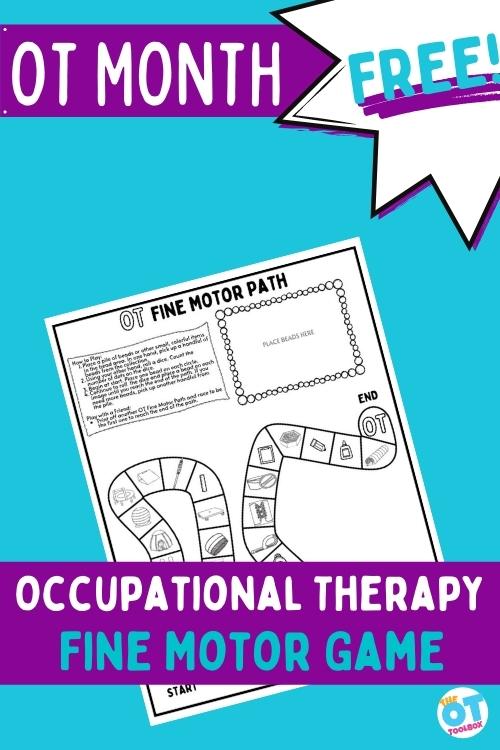
        Occupational Therapy Fine Motor Game

        occupational therapy fine motor game

        Today, we’ve got a fun occupational therapy fine motor game up for grabs in our series on OT month free downloads. In case you missed the memo, April is occupational therapy month!  An entire month dedicated to you, the amazing occupational therapist. 

        Be sure to grab the OT Match It game here,

        the occupational therapy word search here,

        and the occupational therapy coloring pages here.

        Ready to add a new OT themed PDF tool to your toolbox?

        Free PDF- Occupational therapy fine motor game for precision and dexterity skills.

        Occupational Therapy Fine Motor Game

        Looking for an occupational therapy fine motor game you can print off and target several skills, making one game applicable to your whole caseload? This printable fine motor game does just that. Plus, this OT game printable is perfect for promoting the profession of occupational therapy at the same time!

        What makes us amazing?

        We focus on the most important skills.  Physical therapists might teach people to walk, but I would like to be able to put clothes on if I am going for a walk, or open the refrigerator once I get where I am going!  Speech therapists work on speaking and language, but who am I going to talk to if I can’t make friends? 

        Occupational Therapists (OTs) often get overlooked because people have no idea what we do.  What we do makes the MOST impact on people’s lives. Use this month to advocate for the OT profession. Use tools found on the American Occupational Therapy Association (AOTA) website, or highlighted here at the OT Toolbox. The OT Toolbox is rolling out several great activities such as this Occupational Therapy Fine Motor Game to teach others what we do.  

        The occupational therapy fine motor game is more than just a fun game. It is a tool to work on several skills, while providing a conversation starter to explain what we do, and how we do it.

        WHAT SKILLS DOES THE OCCUPATIONAL THERAPY FINE MOTOR GAME BUILD?

        • Hand strength and dexterity – picking up and placing the beads one at a time builds coordination and the intrinsic muscles of the hands. Rolling the dice builds dexterity also
        • Visual motor skills –Combining what is seen visually and what is done motorically
        • Visual Perception – Developing figure ground to see where one item starts and finishes, scanning to follow the path, visual sequencing to follow the pattern, and visual memory to remember the number on the dice while counting the items
        • Proprioception – feedback from the muscles and joints to roll the dice, and grasp/release the beads onto the correct squares
        • Counting/Learning Numbers – Count the number on the dice to understand number concepts in addition to picking up and placing the correct number of beads
        • Executive Function – Following directions, task completion, orienting to details, multi-tasking, attending to task, and impulse control can be addressed using this occupational therapy fine motor game
        • Coloring – if you choose to have your students color the page first, this builds visual motor skills, along with neatness, accuracy, and attention to details.
        • Bilateral coordination – remembering to use their “helper hand” to hold the paper while playing.  Using one hand for a dominant hand instead of switching back and forth, is encouraged once a child is in grade school, or demonstrates a significant strength in one or the other.
        • Strength – core strength, shoulder and wrist stability, head control, balance, and hand strength are all needed for upright sitting posture and writing tasks.

        How to Use this OT fine motor game in therapy sessions

        This game not only develops the underlying skills mentioned above, but there are so many ways to grade this activity and to use it to work on the level that the child or individual is at to challenge and develop skills.

        Other tips and tricks to play the occupational therapy fine motor game:

        • Lowest level learners can use larger items than beads such as pompoms, coins, buttons, or marshmallows
        • Middle level learners can write the words they see on the game board
        • Higher level learners can write an idea about the therapy tools in the game. This turns into a multilevel activity. They can also draw about their ideas, or copy the designs.
        • Laminate the page for reusability. This saves on resources, and many learners love to write with markers! Note: some children love to use wipe off sheets, while others become upset that they can not take their work with them.
        • Make this part of a larger lesson plan including gross motor, sensory, social, executive function, or other fine motor skills
        • Vary the size of the items to be picked up.  Swap out the dice for a spinner for a different fine motor experience
        • Talk about the items on the board, describe their characteristics, and give context clues to help your learner understand why they help students learn
        • Two students can play against each other in a head to head competition. This adds a social element to game play
        • More or less prompting may be needed to grade the activity to make it easier or harder.
        • More advanced learners can work on social skills by teaching beginners to play
        • Learners can explore other games they could make using this activity 

        Occupational therapy, especially with younger learners, is all about play.  That is the occupation of a child. 

        Use activities like the occupational therapy fine motor game, to build a conversation about how the tools we use help other people learn. 

        Observations to make with this OT fine motor game PDF

        While there are many skills being addressed with a single game like this one, we’ll cover the example of using the OT fine motor game to focus on the development of in-hand manipulation skills. Let’s go over some of the observations we can make while playing this fine motor game with a child.

        Because this is more than just a game, think about what you are looking for while building in-hand manipulation:

        In-hand manipulation observations:

        • Can your student pick up the beads one at a time without using a raking grasp or sliding them off of the table?
        • How many items can your student hold at once without dropping some?
        • Can your student move the items from the palm of their hand to their finger tips to get them out, or do they drop the beads by opening their fingers?
        • How many times do you need to repeat the directions so your student can follow them?
        • How many reminders does your student need while doing this activity?
        • What is your student’s frustration tolerance when they have to start over?
        • Is there any cheating or cutting corners going on? There always is.

        All of these game observations can be monitored and documented to monitory for progression of skills.

        As an added idea, try these games with paper clips using a single item (a great therapy bag addition) to support precision skills and refined motor planning.

        Occupational Therapy is a growing profession.  Unfortunately there are more and more people needing our services every day. The good news is we are here to help people gain or regain vital skills for independence.

        Free OT Fine Motor Game

        Want to add this resource to your therapy toolbox so you can help kids thrive? Enter your email into the form below to access this printable tool.

        This resource is just one of the many tools available in The OT Toolbox Member’s Club. Each month, members get instant access to downloadable activities, handouts, worksheets, and printable tools to support development. Members can log into their dashboard and access all of our free downloads in one place. Plus, you’ll find exclusive materials and premium level materials.

        Level 1 members gain instant access to all of the downloads available on the site, without enter your email each time PLUS exclusive new resources each month.

        Level 2 members get access to all of our downloads, exclusive new resources each month, PLUS additional, premium content each month: therapy kits, screening tools, games, therapy packets, and much more. AND, level 2 members get ad-free content across the entire OT Toolbox website.

        Join the Member’s Club today!

        Free Occupational Therapy Fine Motor Game

          We respect your privacy. Unsubscribe at anytime.

          This month the OT Toolbox is highlighting occupational therapy month by providing insight into what occupational therapists do, along with offering FREE resources to add to your lesson plans.  Keep an eye out for more posts from this series, including:

          Victoria Wood, OTR/L is a contributor to The OT Toolbox and has been providing Occupational Therapy treatment in pediatrics for more than 25 years. She has practiced in hospital settings (inpatient, outpatient, NICU, PICU), school systems, and outpatient clinics in several states. She has treated hundreds of children with various sensory processing dysfunction in the areas of behavior, gross/fine motor skills, social skills and self-care. Ms. Wood has also been a featured speaker at seminars, webinars, and school staff development training. She is the author of Seeing your Home and Community with Sensory Eyes.

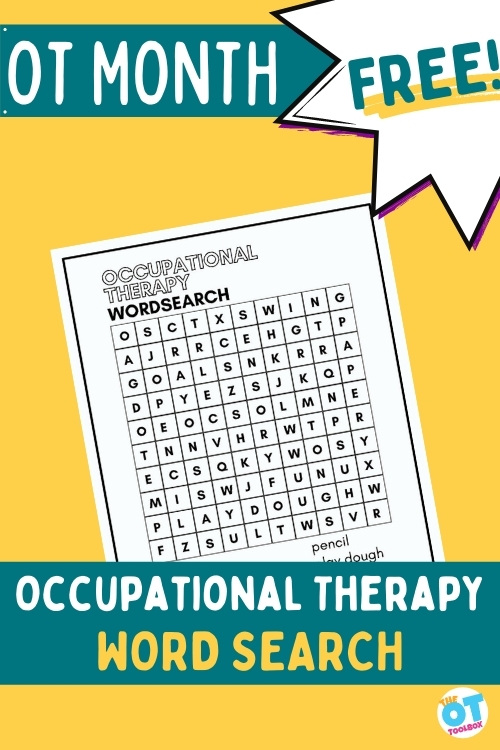
          Occupational Therapy Word Search

          occupational therapy word search

          Today we have a free printable occupational therapy word search to add to your therapy toolbox, just in time for occupational therapy month! Looking for a fun way to advocate for occupational therapy, celebrate the profession, and share the fun of OT? This OT word search does the job! Plus, you can print it off once and use the therapy word search in so many ways to support various needs of a whole OT caseload. We’ll explain how to use a word search in therapy AND how to document for collecting data! Read on!

          Amazon affiliate links are included in this blog post. As an Amazon Influencer, I earn from qualifying purchases.

          Occupational therapy word search for OT professionals

          Occupational Therapy Word Search

          We wanted to create an occupational therapy word search because word searches are a versatile and supportive tool for targeting a variety of skill areas. Just some of the areas that are practiced or refined while using this word search includes:

          • Visual perception
          • Visual motor skills
          • Pencil control
          • Hand-eye coordination
          • Memory
          • Attention
          • Fine motor skills
          • Posture/positioning
          • More!

          Being that this is a free word search for therapy, it supports the therapy professional AND the client.

          This free OT word search uses words and phrases that come up in the school-based setting or outpatient pediatric setting. While this therapy word search can be used in so many other therapeutic spaces, these seem to be the settings most of our readers are in.

          We know that occupational therapy works on everything else needed to be independent, and as occupational therapy practitioners, we LOVE to support clients, students, and the family or caregivers of those we work with in developing or refining the skills and activities that matter the most to the individual. OT practitioners are so lucky because we get to support the areas that make our clients who they are as human individuals. What an amazing profession OT is!

          That is a big job! 

          Your “occupation” is everything you do. Your occupation is more than just a job. It could be a student, mother, father, firefighter, accountant, child, caregiver, or a combination of several roles.

          Occupational therapy addresses everything it takes to fill your roles. Because we have such a big job, Occupational Therapists have the entire month of April to celebrate and share what we do! 

          Here are easy occupational therapy month ideas to celebrate the profession of OT.

          Plus, add these other OT month ideas to your therapy toolbox:

          Free OT Word search

          One quick way to advocate for the profession and to celebrate all that we do is to use several tools like the occupational therapy word search free PDF to advocate for our profession.

          Students and young learners see the OT coming in and out of classrooms all day.  They probably have no idea what the OT does. 

          They know students like to see the occupational therapist, and sometimes they get to use cool tools and fidgets.  The occupational therapy word search highlights some of the basic ideas about occupational therapy to get the discussion started. 

          An entire conversation can be started about different types of pencils, pencil grips, handwriting, and the importance of good letter formation. Another conversation may revolve around goals for occupational therapy. Use the occupational therapy word search to build a treatment plan.  

          Occupational Therapy Word Search Treatment Plan:

          • Bring all of the items found in the word search to demonstrate what each item is and how it is used
          • Build a hallway obstacle course to work on sensory processing skills for all students
          • Use this Blank Word Search Template to make your own OT month puzzle
          • Make sensory bins, play dough, putty, or slime to demonstrate the sensory effect these have on the body
          • Create a lesson plan using visual perceptual activities to further build on this OT word search
          • Create a slideshow or video about occupational therapy
          • Make students disabled for a day so they can feel what it is like to need help
          • Laminate all of the occupational therapy month activities to create centers in the classroom
          • Incorporate Disability Awareness month into your OT month planning
          • Hand out fidgets to take home, so students can feel part of this special group that gets to see the occupational therapist. Amazon has several (affiliate link) low cost fidgets for handing out in bulk.

          A word about fidgets and other accommodations, and an interesting experiment. 

          There is a lot of misconception about fidgets and other accommodations used by OTs in the classroom.  I can’t tell you how many fidgets have been taken away from deserving students, because the teacher did not understand what they were for.  They just saw them as toys. 

          Educate the students you are working with, along with all other staff members about the importance of these “tools”.  Fidgets that are used as toys are not serving their purpose.  

          Fidgets in the wrong hands become toys. This is the reason fidget spinners got a bad name.  In the wrong hands they became ninja stars, conversation pieces, or distractions. 

          In the right hands they are amazing tools to be used discreetly under a desk to provide input while the student is trying to focus on the lesson being taught, or sit still during an endless circle time. 

          On to the interesting experiment…

          I was working in a private preschool, seeing two young boys in the same class.  The other students were very interested in what I was doing with their friends each week. I brought in deflated beach balls for each of the students to use as wiggle seats. 

          I simultaneously presented a fine motor task.  Within ten minutes, all of the students except the two boys I had been seeing for OT, were playing with the beach balls.  They were throwing them around the room and waving them in the air.  The two boys?  They were sitting very quietly on the beach balls doing the fine motor task. 

          What started out as a teachable moment about the role of OT in the classroom, turned into a real life demonstration about the use of accommodations.

          This added weight to my theory that the children who needed the accommodations would use them properly (perhaps with a little teaching in the beginning), while the other students would see them as toys, because they did not need anything extra to do their work.  

          Whether you celebrate OT month using activities like this occupational therapy word search, or doing your own social experiment on the nature of young children, spreading the word about what OTs do, and dispelling misconceptions is the goal. 

          Talking about OT might spark some questions about how teachers, caregivers, and other team members can help their students. 

          The OT Toolbox has great tools like this OT Materials Bundle to use in therapy sessions to promote the profession and to celebrate the materials that we use every day in therapy. It’s an advocate tool that builds skills…very much the way we as therapy professionals build skills in the very occupations that we are working to develop!

          Free OT Word Search for OT Advocacy

          Want to add this resource to your therapy toolbox so you can help kids thrive? Enter your email into the form below to access this printable tool.

          This resource is just one of the many tools available in The OT Toolbox Member’s Club. Each month, members get instant access to downloadable activities, handouts, worksheets, and printable tools to support development. Members can log into their dashboard and access all of our free downloads in one place. Plus, you’ll find exclusive materials and premium level materials.

          Level 1 members gain instant access to all of the downloads available on the site, without enter your email each time PLUS exclusive new resources each month.

          Level 2 members get access to all of our downloads, exclusive new resources each month, PLUS additional, premium content each month: therapy kits, screening tools, games, therapy packets, and much more. AND, level 2 members get ad-free content across the entire OT Toolbox website.

          Join the Member’s Club today!

          Free Occupational Therapy Word Search

            We respect your privacy. Unsubscribe at anytime.

            Victoria Wood, OTR/L is a contributor to The OT Toolbox and has been providing Occupational Therapy treatment in pediatrics for more than 25 years. She has practiced in hospital settings (inpatient, outpatient, NICU, PICU), school systems, and outpatient clinics in several states. She has treated hundreds of children with various sensory processing dysfunction in the areas of behavior, gross/fine motor skills, social skills and self-care. Ms. Wood has also been a featured speaker at seminars, webinars, and school staff development training. She is the author of Seeing your Home and Community with Sensory Eyes.

            Occupational therapy materials bundle
            OT Materials Bundle– celebrate the profession with what we use in therapy sessions WHILE developing skills!

            Working with kids in occupational therapy sessions? This set of Occupational Therapy Materials Bundle includes 13 activities and resources to promote the profession using therapy supplies and themes.

            Incorporate OT supplies like sensory tools, adapted materials, and therapy supplies to work on functional skills in school-based OT or outpatient clinical therapy settings.

            As a bonus, you’ll also get 8 articles to help occupational therapy practitioners develop as a professional.

            How to Write C in Cursive

            Cursive c

            we’ve covered many cursive letter resources here on the site, and this blog on how to write c in cursive is one of the top! There’s a reason why: Cursive c is a building block for forming other cursive letters. After learning how to make cursive c, students can then easily transition to several other cursive letters! Let’s get started with how to teach cursive, starting with the lowercase letter c.

            Amazon affiliate links are included in this blog post. As an Amazon Influencer, I earn from qualifying purchases.

            how to write c in cursive

            How to Write C in Cursive

            Cursive handwriting can be a difficult thing to teach kids.  Today, I’m starting a new series on how to teach cursive letters in fun and creative ways.  

            In this series, we’re starting with how to write cursive c first.

            Letter “c” is one of the first letters that kids are taught when learning cursive. The letter is directly related to it’s printed counterpart.  The curve of the letter is one of the most basic pre-cursive strokes that are made and helps to build several other cursive letters (a, d, g, q, and o).    

            In the Loops and Other Groups cursive writing program, these letters are called Clock Climbers. They are the letters a, d, g, q, o which start with the cursive c formation. The lines “climb a clock” around a curve.

            The fact is that fluent cursive writing predicts high level spelling and
            composing skills, more so than manuscript or typing. And, in fact, studies show that test completed in cursive receive higher scores than those completed in manuscript.


            First up is how to make letter c in cursive.  This series will most definitely not be in alphabetical order for many reasons, mainly because the cursive writing alphabet is typically not taught in alphabetical order.  Rather, the letters are taught in groups of related pencil lines. This supports the motor plan of forming each individual letter and helps with carryover skills. Read more about this concept in our post on cursive letter families.

            Let’s start with addressing cursive letter c!

            In this blog post, images show use of raised line paper. While this type of adapted paper isn’t a must, the raised lines support development of line awareness when teaching this lowercase cursive letter formation.

            Cursive c


            How to Teach c in Cursive:

            This post contains affiliate links. 

            Beginning Upstroke

            The beginning upstroke of the beginning lines in cursive “c” can be practiced in creative ways in order to help with re-trace when forming the curve of the letter.

            Curve up to make cursive c on raised line paper.

            There is research that shows teaching the cursive letter c like a cursive “i” with a hooked top, the carryover of legibility is better.    

            Re-trace-

            After forming the up-stroke of the letter, the curved top, and the re-trace back to the bottom of the letter, it is helpful to work on sliding the pencil along the baseline of the paper to develop letter connectors and to improve legibility. Read about tips to teach cursive letter connectors. The letter c has a re-trace at the beginning of the letter and traces back over the initial letter connection from the start of the letter.

            Practice-

            The final step of writing cursive c is to practice, practice, practice! When it comes to writing c in cursive, there are many tips that you can use. Try the activities listed below as well as these practice tips:

            Teach kids how to make letter c in cursive with the tips in this cursive letter writing series, perfect for kids who are working on their handwriting.

            Write Cursive C with Gross motor practice- Use whole body movements to practice formation. This can occur on the ground with chalk, on a dry erase board at the vertical, in the air with air writing, or using the ideas listed below.

            • Air writing
            • Ribbon wand writing
            • Sidewalk chalk
            • Laser pointer or flashlight writing
            • Writing tray
            • Vertically mounted chalk or white board
            • Rainbow writing- The child writes the letter in one color and then trace over it with another color. Continue to trace over the letter with each color of the rainbow. This can be done on a large scale with chalk, markers, etc.


            Teach cursive c by showing how the pencil traces back over the first line, or re-trace.

            Tips for helping kids stop at the baseline when writing the letter “c”: 

            Use a verbal prompt to bump the bottom line. Trace the baseline with a highlighter for a visual prompt.  Try some of these tricks for writing on the lines. 

            Establish a motor plan to make cursive c consistently

            After cursive letter c has been taught, the next step is multisensory exposure to the motor plan to complete the letter consistently. This establishes the kinesthetic input and practice trials. We cover this in more detail in a blog post on motor planning and handwriting.

            With different tactile and sensory-based movements of handwriting, repetitions allow information to be embedded in the brain.

            Here are some activities to work on cursive c:

            The Handwriting Book is a comprehensive resource created by experienced pediatric OTs and PTs.

            The Handwriting Book covers everything you need to know about handwriting, guided by development and focused on function. This digital resource is is the ultimate resource for tips, strategies, suggestions, and information to support handwriting development in kids.

            The Handwriting Book breaks down the functional skill of handwriting into developmental areas. These include developmental progression of pre-writing strokes, fine motor skills, gross motor development, sensory considerations, and visual perceptual skills. Each section includes strategies and tips to improve these underlying areas.

            • Strategies to address letter and number formation and reversals
            • Ideas for combining handwriting and play
            • Activities to practice handwriting skills at home
            • Tips and strategies for the reluctant writer
            • Tips to improve pencil grip
            • Tips for sizing, spacing, and alignment with overall improved legibility

            Click here to grab your copy of The Handwriting Book today.

            Colleen Beck, OTR/L has been an occupational therapist since 2000, working in school-based, hand therapy, outpatient peds, EI, and SNF. Colleen created The OT Toolbox to inspire therapists, teachers, and parents with easy and fun tools to help children thrive. Read her story about going from an OT making $3/hour (after paying for kids’ childcare) to a full-time OT resource creator for millions of readers. Want to collaborate? Send an email to contact@theottoolbox.com.

            A final note on Cursive C

            Learning cursive c is a common starting point for other cursive letters due to the beginning formations of the pencil strokes. Once a learner has cursive c down pat, you can add a single stroke or combination of pencil strokes to form cursive d, g, o, and q.

            Use the strategies shared above to work on the visual motor, sensory motor, and muscle memory to create cursive letters with fluency and efficiency.

            Building Block Towers

            what type of skill is building towers of blocks or stacking blocks?

            Building block activities like building block towers, and stacking blocks support development of many skills for young children. Development occurs through play and play is the job of the child. By using creative block activities in play, children can thrive in their skill development. We’ve shared specifics on fine motor skills using blocks, however, the skill-building doesn’t stop there. Here, we’ll discuss how and why building with blocks is so powerful in development of kids. We’re covering all things building block activities and exactly HOW to maximize skills like fine motor skills, visual perception, and even social emotional skills…all with toy blocks!

            You’ll also love our DIY cardboard bricks activity to develop skills!

            what type of skill is building towers of blocks or stacking blocks?

            Building Blocks for Kids

            Most of us have strolled through the toy aisle and found a set of building blocks for kids. Building blocks come in different sizes, colors, shapes, and even patterns. Did you know, however, that despite building block activities being one powerful way to build skills, that most sets are not played with once they are in the home?

            That’s right…most of the time, those building block sets just sit they’re collecting dust. Today, we’re talking all about how to use building sets with kids to build skills!

            Block activities to improve visual processing skills, fine motor skills, executive functioning and more.

            The block set in this picture is our set of Lovevery blocks.

            what type of skill is building towers of blocks or stacking blocks?

            Toy blocks a are classic toy…and there is good reason. When kids build towers with blocks they are developing skills through play. Knocking blocks over is another set of skills, and stacking blocks to create shapes or forms (a train made from a handful of blocks, for example) is another set of skills. They are all related, however, and together, building towers with blocks results in powerful underlying skills that children can use in later years.

            Research tells us that early experiences with blocks stimulate the development of spatial language, cognitive, and problem-solving skills. All of these are the literal building blocks for higher level tasks like reading, writing, executive functioning, math, and communication skills.

            We talked previously about the connection between fine motor skills and math. Building blocks are a literal building block to math skills.

            There’s more. By building with blocks, kids are establishing concepts of cause and effect (that tower falls down if I build it too high), reasoning (I need to place the blocks flat on each other so they don’t topple over), and creativity, self-esteem, fine motor STEM concepts, early math, language, and motor planning. Wow!

            Let’s break this down further.

            Building a tower with blocks

            When a child builds a tower with blocks, there are several motor and cognitive skills at play:

            • Visual perception
            • Eye-hand coordination
            • Visual motor skills
            • Fine motor skills
            • Gross motor strength and core stability/strength (placing a block on a stack requires posture and positioning, especially as the tower gets taller)
            • Fine motor precision and graded release, or force modulation- It takes a gentle hand to place a block on a tower with precision and manual dexterity.

            Knocking a tower over

            Every baby, toddler, and preschooler knows the fun of knocking over a stack of blocks, particularly when it’s a sibling or friend’s tower! What’s happening here?

            • hand-eye coordination
            • Cause and effect
            • Self-confidence (I did that!)
            • Emotional practice- when another child’s tower is knocked over, there is sure to be an emotional response. This is not always a malicious act on the part of the tower-knocker! It is a repetition in what will happen however. We see facial expressions, emotions, and outbursts. This can be a good opportunity for problem solving, age-appropriate emotional regulation, personal space, body awareness, force modulation, and language skills.

            Building things with blocks

            Taking the block tower a step further, we can see more development and precision when creating shapes and forms with blocks. This is another set of skills that are expanded upon:

            We’ve covered the fine motor development that occurs by playing with blocks. We’ve also addressed visual perception and block play.

            Today, we are discussing the various ways to play with blocks that build more than wooden buildings…blocks build skills!

            Block Activities for Toddlers

            For the young child, presenting kids with just a jew blocks is the key to avoiding overwhelm. The nice thing about a variety set of blocks is that the various blocks can be used in different ways while working various skill areas.

            During toddler play, young children develop many areas that impact functional skills and independence.

            Try these block activities for toddlers to support development of skills. We used the Lovevery block set for these activity ideas.

            Lovevery blocks for toddlers and preschoolers

            One of the block sets in our Lovevery block set.

            Sorting Shapes Block Activity– By sorting the colors and shapes of blocks, they are working on so many skills. Visual perceptual skill development begins at a young and age, including the ability to visually discriminate. We know that young babies are able to visually differentiate their mother from another female adult by visual assessment. The same skill can be used and honed with toy blocks

            Use a small set of blocks and ask the child to pile clocks into sets according to color or shape. You would be surprised at a young child’s sorting ability and visual discrimination skills.

            Sorting block shapes occurs around 15 months and at that time, a shape sorter is the perfect tool for encouraging matching. Visual discrimination skills will improve over the toddler years as your little one begins to recognize differences in shapes such as triangles and pentagons.

            Sorting blocks is a literal building block for visual perceptual skills, math skills and executive functioning skills.

            use blocks to work on fine motor skills and imagination

            Pretend Play Block Activities– Children can use blocks as pretend play items as they interact with adults or other children. Giving blocks a name and a voice offers opportunities act out scenarios, express needs and wants, and practice communication.

            By using blocks as pretend people, cars, trains, and animals, toddlers and preschoolers experiment with imagination and creativity. This is the beginning of social emotional skills.

            Show your little one how they can set up a little family with the blocks as they talk to each other in words and phrases that your child knows. What a great way to work on communication and language.

            building with blocks help development of visual motor skills and fine motor skills

            Building Activities- The sky is the limit when it comes to building with blocks. You can show a young toddler how to stack two blocks while the develop the fine motor precision and refined grasp to place blocks and releasing their hand without knocking over the blocks.

            Show your little one how to stack one or two blocks with specific colors. By asking them to copy your block form, not only are they working on fine motor skills, they are also building visual perceptual and visual motor skills.

            Lovevery block set and block activities for kids

            Use Blocks to Make Patterns- Building on the copying skills mentioned above, using blocks to copy and create patterns is an exercise in early visual motor skills, visual perception, and fine motor skills.

            It’s also a fun way to introduce early math concepts. Little ones can copy and create patterns using different sizes, shapes, and colors of blocks.

            Start out by creating a simple pattern with an AB pattern of blocks. Preschool children can use blocks to create ABB and ABC patterns too.

            Gross Motor Skills with Blocks- Just because using blocks with preschoolers is a fun fine motor activity, there’s no reason to leave out the gross motor skill development. Use a small wagon, or create a pulling system to help kids with pushing, and moving the whole body while moving blocks from one place to another.

            There is a reason why toddlers and preschoolers love to move their toys around in bags or carts…the proprioceptive input that they achieve by pushing or pulling a cart full of toys provides much needed sensory input that helps them organize and calm their bodies. Pretty cool, right?

            Another gross motor coordination activity with blocks is a pretty simple one to set up. Use blocks to create obstacle courses, paths, and games. Kids can animal walk from block to block, tip toe between block paths, or transport blocks one by one in a relay race. Block play is so open-ended and can meet any child’s needs.

            Build Letters with Blocks- Block activities for preschoolers can involve building and making letters. Letter recognition begins around 24-36 months and during that time is a great way to teach letter identification.

            Use building blocks to help kids trace letters using a finger. Point out how the letters are formed and you can even build those letters higher with another layer. Here is information on how to build letters with correct formation.

            Use blocks to make dominos for a fine motor activity

            Stack and Knock Over- Building towers with blocks or a trail of dominos is one way to help kids better understand STEM concepts, cause and effect, and problem solving.

            Ask your little one how they can make one block fall over by using another. See if they can figure out how far apart to place blocks to make them push one another over in a row of “dominos”. It’s a fantastic exercise in eye-hand coordination.

            Building Borders- Use about 10-20 blocks to create small squares and rectangles to form a border or home for small toys, dolls, or other small toys. By creating a “home” for their toys, children can work on shape identification as well as various skills: eye-hand coordination, visual motor skills, fine motor skills, precision of grasp and release, bilateral coordination, and crossing midline.

            Take the house building up a notch by adding layers to the walls. Children can begin to stack blocks and attempt to create higher walls without knocking them over.

            Amazon links included below.

            Lovevery Blocks are a new product created by the folks at Lovevery. The 70 piece set is valued at $90.00 and is perfect for kids aged 12-48+ months (and higher! My big kids are loving this set right now!)

            Lovevery has thought of your child as they grow. The set includes an activity guide with over 20 block activities designed to build learning and developmental skills as they grow. These are beautifully made blocks that will grow with your child.

            • 70 wood pieces in a rainbow of 18 different hues
            • 18 different shapes and tools
            • Activity guide with block play ideas to promote skills like visual perception, eye-hand coordination, fine motor skills, gross motor skills, and more
            • Arrives in a wooden storage box that converts into a pull car
            • Drawstring cotton bag for flexible storage
            • Solid wood blocks made of sustainably harvested FSC-certified wood
            • Water-based non-toxic paint and finishes
            Lovevery building block activities for kids

            Block Activities and Ideas

            Also, check out these other toy suggestions based on therapeutic development through play.

            1. Fine Motor Toys 
            2. Gross Motor Toys 
            3. Pencil Grasp Toys 
            4. Toys for Reluctant Writers
            5. Toys for Spatial Awareness 
            6. Toys for Visual Tracking 
            7. Toys for Sensory Play 
            8. Bilateral Coordination Toys 
            9. Games for Executive Functioning Skills 
            10. Toys and Tools to Improve Visual Perception 
            11. Toys to Help with Scissors Skills
            12. Toys for Attention and Focus 

            Working on fine motor skills, visual perception, visual motor skills, sensory tolerance, handwriting, or scissor skills? Our Fine Motor Kits cover all of these areas and more.

            Check out the seasonal Fine Motor Kits that kids love:

            Or, grab one of our themed Fine Motor Kits to target skills with fun themes:

            Want access to all of these kits…and more being added each month? Join The OT Toolbox Member’s Club!

            Colleen Beck, OTR/L has been an occupational therapist since 2000, working in school-based, hand therapy, outpatient peds, EI, and SNF. Colleen created The OT Toolbox to inspire therapists, teachers, and parents with easy and fun tools to help children thrive. Read her story about going from an OT making $3/hour (after paying for kids’ childcare) to a full-time OT resource creator for millions of readers. Want to collaborate? Send an email to contact@theottoolbox.com.