These leaf activities are fun ways to incorporate colorful fall leaves into occupational therapy sessions! Fall themed activities to use all week in done-for-you therapy planning. Use real leaves from outside, or materials on hand. Fall leaves make a great theme for weekly occupational therapy themes!
Leaf Activities
Leaf Handwriting– These Fall writing prompts include leaf writing prompts, among other fall themed prompts. Includes sentence prompts and single words, all with a Fall and leaf theme.
Pre-Writing Lines Activity- Work on Pre-writing activity with real leaves. Use real leaves to work on eye-hand coordination, visual motor skills, and pre-writing lines with hands on fine motor work.
Bilateral Coordination Activity: Use this Leaf Craft to address bilateral coordination skills. Use real leaves to make a craft that builds bilateral coordination, heavy work proprioceptive input, and scissor skills.
Leaf Craft for Older Kids: This Sewing Skills Leaf Craft is great for older kids that need to address fine motor skills. Use a needle and thread, wire, lacing cord to thread around leaf shapes. We used plastic canvas, but you could use cardboard, cereal boxes, or even laminated paper.
Leaf Auditory Processing Activities– You can use leaves found out in the lawn to work on so many auditory processing skills including auditory discrimination and more.
Leaf Therapy Activities– This free printable home program uses a Fall leaves theme for a leaf tic tac toe game. Kids can complete different leaf themed therapy activities and score tic tac toe!
Hand Strength– Leaf Ten Frames are a great way to build hand strength using leaves. Use a hole puncher with leaves to work on hand strength and hands-on math.
Leaf Sensory Play– This Nature Water Table is perfect for sensory exploration, but is a fun toddler Fall activity with very little prep. Use a bin, water table, or bowl to explore Fall’s colors and textures and challenge the senses.
Leaf Sensory Activity– This corn husk painting activity is sensory activity art with the corn husk leaves of Fall! Sensory Painting- Use leaves, corn husks, and grasses for sensory painting. Then, practice handwashing!
Leaves Heavy Work Activity– We used play dough and Fall leaves in this Fall Play Dough Press to add heavy work through the hands. Use natural materials and play dough to add heavy work for the hands. This is a great visual perception activity, too.
Leaf Eye-Hand Coordination Activity– Use leaves to make these Fall tree crafts. They are great to work on eye-hand coordination and problem solving with a sensory experience to make these fall trees.
Fall Scissor Skills Activity– This Fall leaves scissor activity uses leaves found right outside the home or therapy clinic! Use leaves to work on line awareness, bilateral coordination, and visual motor skills.
Bilateral Coordination Activity– Work on bilateral coordination skills with this Fall leaf garland craft.
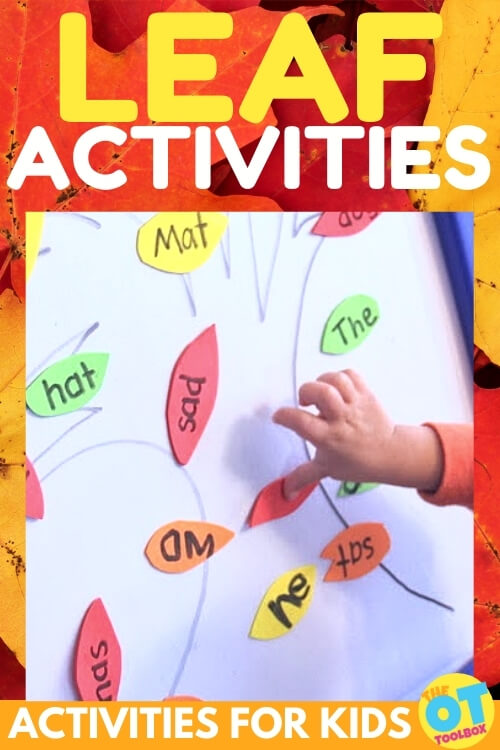
Shoulder Stability and Posture– Use a vertical surface to build strength, stability, posture, balance, coordination, and eye-hand coordination skills with this easel leaf activity. We used these easel leaves to work on sight words and trick words, but you could use this activity for any multi-sensory learning or math activity, too.
Fall Crafts
This Fall Art Collage from A Little Pinch of Perfect adds a sensory and fine motor component to Fall art for preschoolers!
These Autumn Leaf Hats from Mosswood Connections are a fun craft to work on scissor skills, bilateral coordination, and fine motor skills.
Address bilateral coordination, eye-hand coordination, finger isolation, and precision skills to make these Leaf Stamping Tee Shirts from Mommy Crusader.
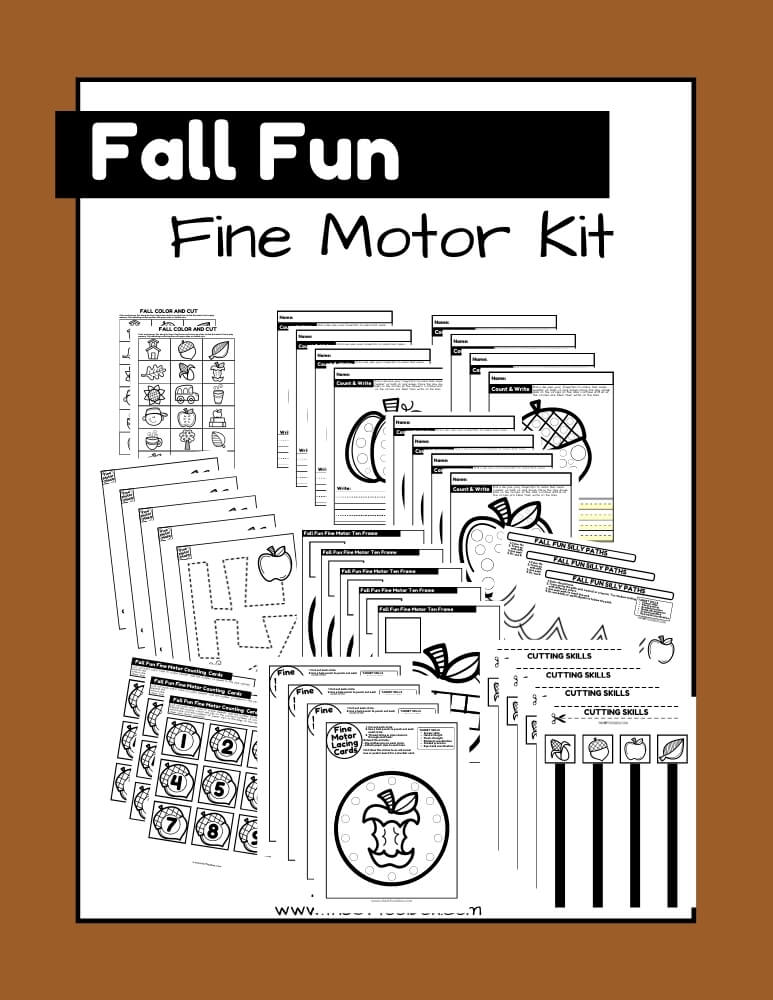
Printable 76 page, (no-prep) Fall themed fine motor activities and fine motor worksheets designed to build strong hands so kids can learn, hold & write with a pencil, and play.
This print-and-go Fall Fine Motor Kit includes no-prep fine motor activities to help kids develop functional grasp, dexterity, strength, and endurance. Use fun, Summer-themed, fine motor activities so you can help children develop strong fine motor skills in a digital world.
Includes Fall themed activities for hand strength, pinch and grip, dexterity, eye-hand coordination, bilateral coordination, endurance, finger isolation, handwriting, scissor skills, pre-writing skills, and much more.
Colleen Beck, OTR/L has been an occupational therapist since 2000, working in school-based, hand therapy, outpatient peds, EI, and SNF. Colleen created The OT Toolbox to inspire therapists, teachers, and parents with easy and fun tools to help children thrive. Read her story about going from an OT making $3/hour (after paying for kids’ childcare) to a full-time OT resource creator for millions of readers. Want to collaborate? Send an email to contact@theottoolbox.com.
Working with kids is always an adventure and that’s why these jungle activities fit the bill when it comes to fun therapy activities for kids. Here, you’ll find jungle jungle crafts, jungle sensory bin ideas, and other ways to make a jungle them therapeutic. There are even strategies to use in teletherapy. If you feel like you are a jungle explore sometimes when working with children, put on your adventure hat, because we’re ready for some therapy fun!
Jungle Activities
This jungle theme is just one of the many therapy themes we have here on the website. These are themed therapy ideas that you can incorporate into your therapy sessions, add to a jungle preschool theme (or any age!), or use at home to help kids develop skills.
When it comes to serving children in the therapy clinic or in the classroom, there are a lot of things to remember when promoting development of functional skills and underlying areas like fine or gross motor skills. And, these considerations carryover to the home, too…Two of the most valuable things that I have learnt from providing occupational therapy services are:
1) that thorough planning is absolutely essential and
2) that the most effective sessions are fairly simple.
The outlines provided in this jungle theme therapy ideas are not prescriptive, set-in-stone templates. They are a framework to hang your own ideas and preferences on. Because sometimes you just need that little spark of inspiration to get you going.
Occupational therapy teletherapy, as with face-to-face therapy, there is no one size fits all. So it’s up to you to adjust your session according to you aims and objectives for each individual child.
Let’s step into the jungle and get some jungle themed activities ready for your littlest adventurers.
jungle themed gross motor activities
A fun jungle warm up or cool down is a fun way to start and end a therapy session, but there are other ways to incorporate jungle gross motor activities into a jungle themed classroom, lesson, or home activities:
Use these ideas as a jungle brain break during jungled themed learning
I am sure that you have realized that the first few minutes of an OT therapy session or teletherapy session are so important in setting the tone for the subsequent time that you will spend with the child. Take time to check in with the child that you are working with in order to get a sense of where they are at on that day.
This always helps me adjust my energy level and approach according to what the child needs. It’s a great time to introduce the theme of the session and incorporate gross motor activities as a way to “warm up”.
Jungle Animal Exercises
In order to introduce the Jungle Adventure ask your child what their favorite animal is. Talk a bit about what the animal looks like, where it lives, what it eats and why it’s the child’s favorite animal.
Then explore how their animal moves and act out that animal’s movement. This will lay the foundation for jungle exercises!
Prepare some animal pictures before the session – these can be printed or drawn pictures, flashcards, pictures from magazine or online pictures that you can screen share with the participant.
Present the child with a picture and demonstrate how that animal moves. Then set a timer for 30 seconds while you and the child perform the animal movement together.
Examples of jungle animal movements include gross motor exercises like:
Move like a snake
Jump like a frog
Hop like a bunny
Crawl like a lion
Sway like an elephant
Stomp like a hippopotamus
Swing like a monkey
Fly like a hawk
There are two main benefits to using gross motor exercises as a warm-up in therapy:
The physical warm up is perfect for getting the child connected to the session and for helping to regulate the child if they have difficulties with focus and attention.
The imaginary element of pretending to be an animal introduces the child’s language of play and brings the teletherapy session to life.
For more specific physical gross motor goals you can adapt the animal walks to target certain areas:
Upper body strength
Core strength
Co-ordination between left and right
Motor planning
Bilateral coordination
Crossing midline
Posture
Positioning
Changes in position
Animal walks are also an easy exercise to ask the child to practice on their own between therapy sessions to promote their progress in these areas.
Once the warm up is complete take a seat and catch your breath. You are still in the jungle but now you are going to look at the little creatures that live there.
Jungle Fine Motor Activities
This section of the session focuses on developing selective finger movements and finger strength with a jungle theme.
As you did with the animal walks in the warm up, select a number of insect pictures that you can present to your child during the teletherapy session. Allow the child to select a picture and then use your fingers to imitate the movement that the insect makes. Moving your fingers like an insect requires a little creativity and imagination! Examples of bugs that I have used in sessions included caterpillars, ants, spiders, butterflies, grasshoppers.
Demonstrate how the insect moves across your desk or along your arm and encourage your child to copy the motor pattern.
Adjust the demands of the motor pattern according to your child’s ability including more complex, selective finger movements to increase the demands on motor planning. Increase the amount of repetitions or distance the insect has to walk to increase the demands on finger strength.
Incorporating visual perceptual skills into the Jungle Adventure is easy. The activities that you select will target the specific skills that you are working on with the individual child.
For eye tracking you can ask the child follow an animal figurine that you move across a desk, field of vision, or the screen in teletherapy services.
Figure ground perception can be developed by working on animal themed I Spy worksheets.
Visual discrimination can be encouraged by completing spot the difference worksheets.
I know you will have lots of tools in your box to develop the specific skills you are targeting and I encourage you to use the Jungle Theme to keep the child’s interest and motivation going.
Jungle Handwriting Activities
When handwriting needs to be incorporated into occupational therapy sessions, there are many ways to use a jungle theme in handwriting goals.
Younger children are encouraged to write down the names of the animals or insects that we imitated in the beginning of the session.
Older children will enjoy copying out animal themed jokes.
Try this Jungle Joke for copying:
What do you call a fly with no wings?
Answer: A walk!
Jungle Writing Prompts
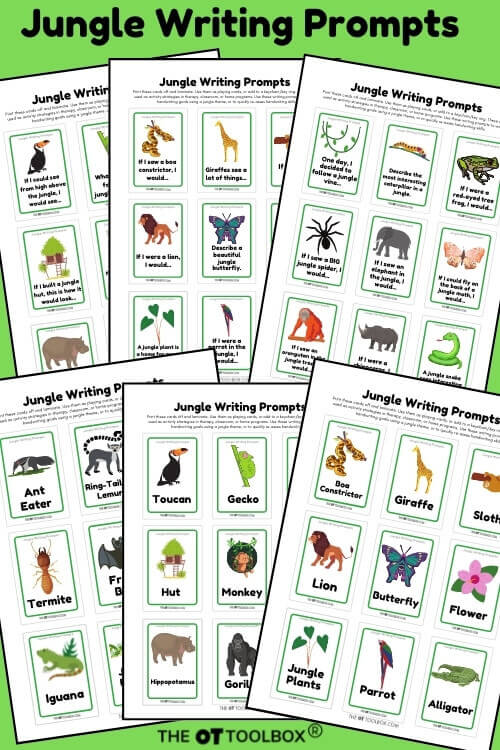
For more handwriting activities, use these Jungle Writing Prompts. These cards are perfect for older students who are writing sentences and paragraphs, AND younger students who copy words.
The Jungle Writing Prompt set includes 54 jungle themed writing prompts, including 27 open-ended sentence prompts and 27 jungle themed words.
Perfect for older students writing in sentence and paragraph format AND younger students copying words, these printable cards can be used in so many open-ended ways in therapy sessions.
A jungle sensory bin is a fun way to incorporate many different goal areas. Start with a sensory bin material such as flour, dry beans, dry split peas, corn, rice, cotton, water, shaving cream, or shredded paper. Here are more ideas to create an easy sensory bin.
Then add items to your sensory bin:
Jungle animal figures
Fake flowers
Fake leaves
Scoops
Cups and bowls
Jungle animal images
Use the sensory bin to work on tactile exploration, motor skills, executive functioning skills, handwriting, and much more.
The word cards in the Jungle Writing Prompts set includes animal images with words that are perfect for laminating and adding to a Jungle sensory bin.
Well done! You have survived your Jungle Adventure and your children have had a blast. They were having so much fun that I am sure that they didn’t even notice that they were working on their sensory regulation, planning, gross motor skills, fine motor skills and visual perception. All in a day’s teletherapy work.
Contributor to The OT Toolbox: Janet Potterton is an occupational therapist working predominantly in school-based settings and I love, love, love my job. I have two children (if you don’t count my husband!), two dogs, one cat, two guinea pigs and one fish. When I am not with my family or at work I try to spend time in nature. The beach is my happy place.
Colleen Beck, OTR/L has been an occupational therapist since 2000, working in school-based, hand therapy, outpatient peds, EI, and SNF. Colleen created The OT Toolbox to inspire therapists, teachers, and parents with easy and fun tools to help children thrive. Read her story about going from an OT making $3/hour (after paying for kids’ childcare) to a full-time OT resource creator for millions of readers. Want to collaborate? Send an email to contact@theottoolbox.com.
Each year, one of the most exciting parts of back-to-school is meeting a new teacher or therapist. That’s why these free meet the teacher forms/ meet the therapist forms are the way to go when it comes to starting the school year off right. Many teachers have created meet the teacher forms to introduce themselves to their new class, and OTs/COTAs should have the same fun to start off a new year of OT services.
Free Meet the teacher templates
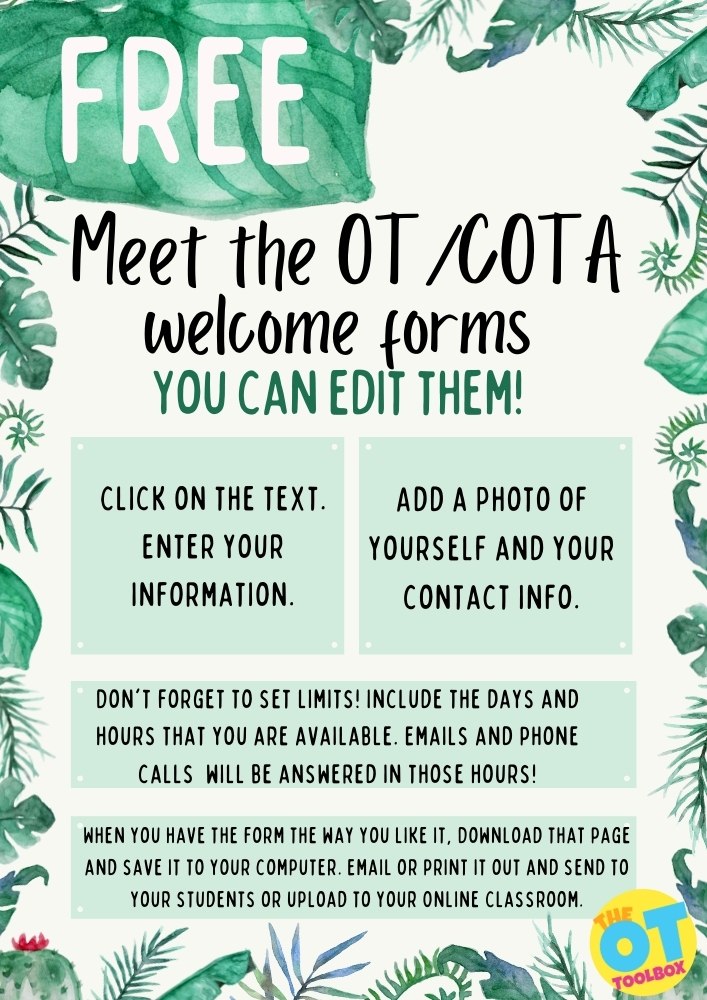
If you’ve worked in the school long, then you’ve probably seen a meet the teacher form or two. Meet the therapist forms are just as important! You can grab this set of editable forms and enter your information, then share them with your new caseload.
Here’s how it works:
Enter your email address into the form below.
You’ll receive an email with a PDF containing a link to access this template of free meet the teacher/meet the therapist forms. (Save the PDF if you want to make a new letter next year!)
When you click the link on the PDF, you’ll be sent to Canva. If you have a Canva account, you can open the files in Canva.
If you don’t have a Canva account, you’ll be directed to create one (it’s free).
When you open the link, you’ll see a template of 13 different Meet the Therapist Forms.
Click on the text and change it to say what you like. Add a picture of yourself if you like.
Download the page that you like and email it to your student’s parents, print it, or add it to your online classroom.
When you access this free template of meet the therapist or teacher letters, you’ll find 13 different templates. Each one is editable in Canva, so you can add your own information.
A Meet the Teacher letter or Meet the Therapist letter is a fun way to start of the school year. You can add fun facts, information about this upcoming school year, and even your working hours. A meet the therapist or meet the teacher letter is the perfect place to set limits on your working days or working times. Don’t set yourself up to answer phone calls or emails outside of your working hours, and you can let parents know that on your back-to-school letter.
Add in contact information like a phone number or email address.
Then, use this meet the therapist form on your school webpage, in an email to parents, or in an online classroom. Some forms are even printer friendly, so you can print off copies and send them home with students.
Have fun making your Meet the Therapist Letter and let’s have a great school year!
Colleen Beck, OTR/L has been an occupational therapist since 2000, working in school-based, hand therapy, outpatient peds, EI, and SNF. Colleen created The OT Toolbox to inspire therapists, teachers, and parents with easy and fun tools to help children thrive. Read her story about going from an OT making $3/hour (after paying for kids’ childcare) to a full-time OT resource creator for millions of readers. Want to collaborate? Send an email to contact@theottoolbox.com.
There are many types of child therapy healthcare professionals that work with children, and so many of them are considered “therapists”. What is the difference between a physical therapist, an occupational therapist, and a speech therapist? Or how about a child therapist, a psychologist, a psychiatrist? We will break down the roles of these professions, why they may be recommended for your child, and discuss the main differences between them that make them unique.
Types of Child Therapy
Before we get to talking about these fantastic professions and the different types of child therapy that helps kids develop into the best version of themselves, let’s talk about stigma. No type of therapy, whether it be for physical or mental needs, should come with feelings of guilt or embarrassment. Therapy should be celebrated! You are improving as an individual – whoo!
We hope that parents and caregivers of children receiving therapy understand this, and are able to let go of any negative connotations that used to come along with receiving services.
PHYSICAL, OCCUPATIONAL, AND SPEECH THERAPISTS
You are most likely to come across these three therapists when your child has a developmental disability, a physical injury or deficit, or a diagnosis that makes it harder for them to develop skills independently.
Often, the OT, PT, or ST professionals work as a team to improve the independence of the children they work with.
Does my child need a physical therapist?
A physical therapist works with the physical body. They work to make sure that all the muscles, tendons, joints, and moving parts of the body are working properly.
Kids that have muscle weakness, joint stiffness or contractures, or an irregular walking pattern may be recommended physical therapy. Interested in hearing more? Head over to here for some great information.
Does my child need an Occupational therapist?
An occupational therapist helps people function through their occupations (activities). This article dives deeper into pediatric occupational therapy, but here is the just of it: if your child needs help with their daily activities, like dressing, eating, playing, or writing, an occupational therapist can work to improve their functional abilities.
While physical therapists work with the physical body only, occupational therapists work with physical as well as cognitive, social, and emotional needs.
Does my child need a speech therapist?
A speech therapist, or a speech-language pathologist (SLP), is pretty much what it sounds like – they help children with their communication abilities. More than that, however, is the way that they work with cognition, as all speech and language skills come from the cognitive abilities of the brain.
A child may be referred to a speech therapist if they have a physical speech impairment (originating in the mouth, tongue, face, jaw, etc.) or a cognitive delay or disability that impairs their ability to speak, to understand spoken language, or any other kind of communication barrier. Children with slurred speech or stutters often receive speech therapy. Learn more about speech therapy here.
MENTAL HEALTH THERAPISTS
Mental health therapists usually hold a master’s degree from a field like social work, marriage and family therapy, or counseling. Therapists can diagnose and treat mental, emotional, and behavioral issues in a counseling, play-based, or group therapy format.
Does my child need a child therapist?
A child may be referred to a child therapist because of their health history, for example, experiences of trauma, divorcing parents, losses of loved ones, etc.
Children with big feelings like anxiety, depression, or overwhelming fear may be recommended therapy. Therapists are not able to prescribe medication but may be the right choice for non-pharmaceutical interventions for a child’s mental well-being. Other reasons for pursuing a mental health therapist may include:
Big personality changes
Social or emotional difficulties such as having trouble making and keeping friends
Challenges that get worse with age rather than better, including participating in activities, dropping out of school or school activities, and hobbies
Difficult situations such as bullying, divorce, moving, health problems, death of a family member or friend, etc.
Consistent behavior or mood changes
Anxiety, attention issues, worries, depression, etc.
CHILD PSYCHOLOGISTS & PSYCHIATRISTS
Child psychologists hold doctorate degrees and may work clinically, with patients, or complete research for the field. A clinical child psychologist is able to provide counseling and traditional methods of therapy for children and their families much like a therapist, but can also provide more thorough testing and diagnosis for children.
Does my child need to see a Child Psychologist?
A child psychologist may be the right route for you if your child needs accommodations in school for a psychological or neurological issue. These professionals are not medical doctors, so they cannot prescribe medication. Psychiatrists, on the other hand, are able to prescribe medication for mental health.
Does my child need to see a psychatrist?
Child psychiatrists may treat a patient for traditional therapy services, but most often they only see their patients occasionally to manage medications. A child may be referred to a psychiatrist if non-pharmaceutical methods of therapy are not providing the results that are necessary for their participation in activities.
The Center for Mental Wellness offers great information on the specific types of treatment therapies that a child psychologist may offer. If you are looking for more information on the differences in mental health providers for children, this webpage is a great resource!
While this is not an exhaustive list of therapists and their abilities, we hope to have provided you with some new information on these wonderful professions.
Remember: therapy is not always necessary but often life-changing, mental health is just as important as physical health, and all of the professionals on your child’s health care team are there for you and your family.
Sydney Thorson, OTR/L, is a new occupational therapist working in school-based therapy. Her background is in Human Development and Family Studies, and she is passionate about providing individualized and meaningful treatment for each child and their family. Sydney is also a children’s author and illustrator and is always working on new and exciting projects.
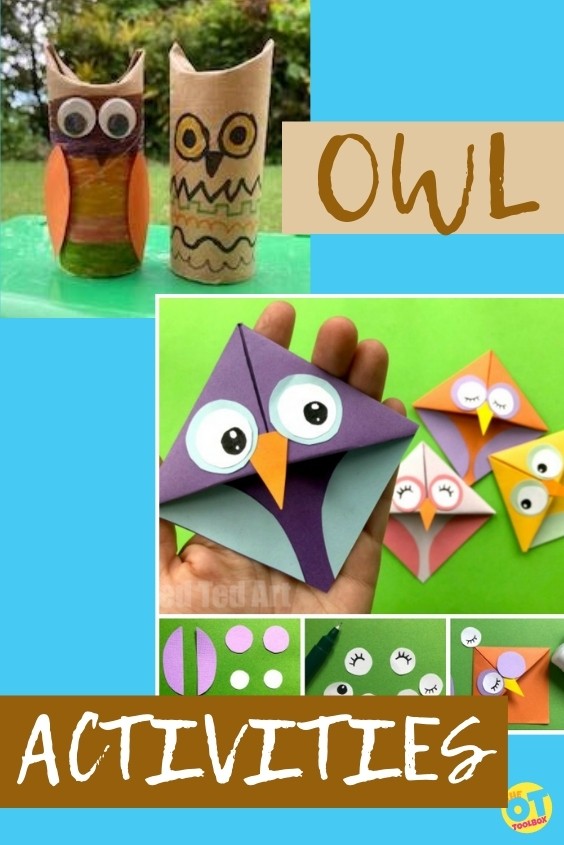
These owl activities are not just owl themed activities for kids, they are therapy tools to use in occupational therapy sessions! I love introducing the children that I work with to owls. There is something both appealing and mysterious about their big, thoughtful eyes and it’s fascinating to learn about their nocturnal nature. There are so many fun, creative ways that owls can be incorporated into therapy sessions to help you achieve your therapy goals.
Owl Activities
Pick some of the owl activities below, using owl crafts, owl visual motor activities, and owl movement activities for helping kids develop skills.
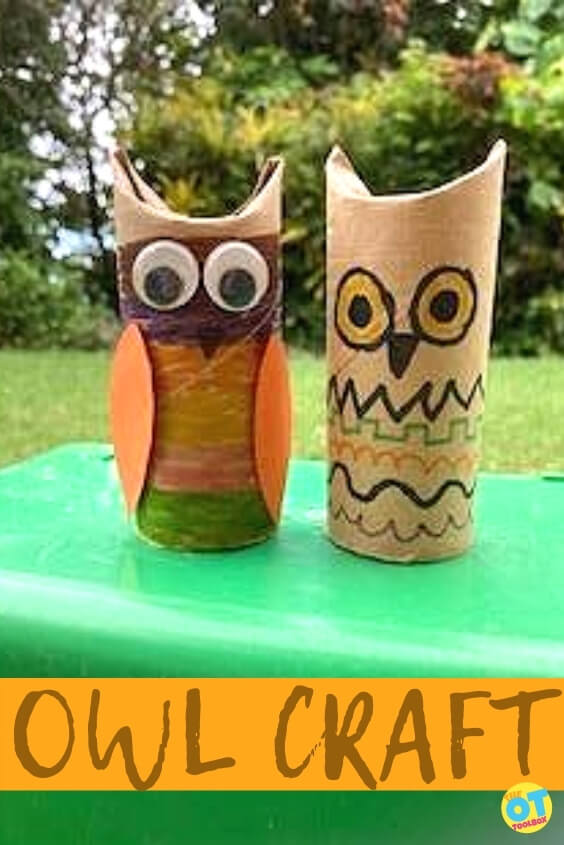
Owl Toilet Paper Roll Craft
This super simple activity produces a gorgeous little decorative owl. All you need is a toilet paper roll and some markers. Googly eyes are a bonus but not essential. Use markers to color in or decorate the paper toilet roll.
Younger children can color as they would like to and older children can be encouraged to draw patterns around the roll. Holding the paper roll and drawing on it requires co-ordination between the left and the right hand. This introduces a good way to promote bilateral integration.
Coloring in the toilet roll requires some bilateral integration while turning the roll while drawing patterns around the roll increases the demands on coordination between the left and right hands. For more bilateral coordination strategies, try these activities for bilateral integration.
To add another element to the task you could ask your child to copy the patterns or designs that you have drawn on your owl. This could be fun in sessions if you have two children attending together or in class where children could work in pairs.
Copying the patterns on the owl requires good spatial organization and the ability to transfer visual information accurately onto paper.
Once the paper roll is decorated draw or stick eyes onto the top and fold the top ends inwards to create the owl’s ears.
Feed The Owl Fine Motor Activity
On the paper towel owl crat, draw the outline of an owls head and use scissors to cut out the beak so that it flaps open. You can stick a container underneath the beak to catch the food. Provide a clothes pin and a handful of small pom poms.
Use the clothes pin to pick up a pom pom and drop it into the owl’s beak. This is good for fine motor strengthening. Using a clothes pin also isolates the thumb, index and middle fingers which will help to establish a tripod grip. This is a great activity that uses a clothes pin activities to develop a child’s grasp.
Owl crafts, owl art, and owl drawing activities are fun ways to build skills.
How-to-draw activities are an excellent way to develop planning skills, copying abilities, pencil control and confidence in drawing. Children are often amazed at what they are able to draw after following a few simple steps. That’s where this how to draw an owl easy directed drawing worksheet comes into play.
The owl is a great animal to start with as it is made up of circles and simple shapes. Circles are one of the earliest developmental shapes a child is able draw.
The circle is also one of my best friends when we start working on letter formation in the foundation phase.
Mastering a good circle in an anti-clockwise direction puts you on the path to being able to form many of your letters correctly. Here are other prewriting lines activities that form this foundation of letter formation.
To draw an owl in building therapy skills needed for handwriting, use the simple steps from one to four to complete this cute owl. Copying simple shapes owl form helps children to develop their visual discrimination skills and to improve their copying abilities.
Once the drawing is completed spend some time discussing the final outcome. This part of self-assessment is effective in self-analysis and carryover of skills.
Is it the same as the picture provided?
Is anything different?
Copying, or visual motor integration is vital for successful learning in the classroom and learning.
The draw an owl activity can be extended to address other areas as well, including visual memory.
Challenge the children to have a look at the owl they have drawn for a minute and then cover up their picture. See if they are able to reproduce the owl from memory. This is a good way to work on visual memory and copying, especially when copying written material from a distant point, where visual memory is helpful to recall materials so the child doesn’t need to shift their vision up and down for each letter or word.
Owl Bookmark Craft
Another great owl activity is this owl bookmark craft from Red Ted Art. When I tackle reading difficulties I find that creating an owl bookmark is a good way to motivate reluctant readers. Using the owl gives me an opportunity to talk to children about the importance of the visual system and how essential it is for our eyes to move well and see well so that we can read.
The owl bookmark craft helps them to understand many of the tasks that we do in therapy to develop eye tracking and visual perception. Most of all I think the children enjoy creating something of their own that they can keep and that they can use when they read their books at home.
When children follow the directions to make the owl bookmark, they are incorporating many fine motor skills and visual motor skills:
Bilateral coordintaion
Finger isolation
Separation of the sides of the hand
Arch development
Hand strength
Visual motor skills
Spatial organization
Paper folding develops spatial organization, bilateral co-ordination, fine motor strength and selective finger movements. For other ideas on paper folding activities have a look and the Beautiful Oops Book Activity
Owl Worksheets
There are also some lovely owl worksheet resources when you need to focus on pencil control and pre-writing skills:
I know that you will have a hoot including owls into your activities with your children.
Contributor to The OT Toolbox: Janet Potterton is an occupational therapist working predominantly in school-based settings and I love, love, love my job. I have two children (if you don’t count my husband!), two dogs, one cat, two guinea pigs and one fish. When I am not with my family or at work I try to spend time in nature. The beach is my happy place.
Here we are sharing tips for sleep hygiene for kids, and the role that occupational therapy has on sleep. Did you know that sleep is an occupation? It’s a part of our daily activities that impact function. And, sleep has been established as critical for optimal health, wellbeing, occupational performance and participation (American Occupational Therapy Association, 2012). When it comes to sleep hygiene, occupational therapy can be a big help in offering tips for better sleep, suggestions for more efficient or effective sleep, and how to manage areas that impact sleep.
sleep hygiene for kids
It seems as though every parenting book has something to say about sleep; Whether you are a parent of young children or a therapist serving kids (and their families), you’ll probably come across sleep questions such as:
How to get your infant on a sleep schedule?
How many hours a day a child should sleep based on their age?
How some behavior problems may be related to the amount or quality of sleep?
As kids get older, they may change their sleeping habits, or never grow out of old ones. They may be too needy or dependent on you come nighttime, or maybe your five-year-old still co-sleeps and you’re wondering how in the world can you get them to sleep in their own bed. Sleep hygiene is necessary at each stage of childhood.
When it comes to babies and newborns, there is a big range in sleep, but the intervention of an occupational therapist can support families during this stage of parenting. Specifically, OT professionals can support caregivers with newborns not sleeping as this can be a new change to the family dynamic that changes many activities of daily living for the whole family.
What is sleep hygiene for kids?
Sleep hygiene refers to quality sleep and making the actions, habits, and necessary actions to set up a child for success in their sleep. Sleep hygiene involves nightly routines, modifications to the environment (quiet sleep space, dark room, etc.), and daily decisions (limiting caffeine in the hours before bedtime, being active during the day, etc.) that will optimize sleep.
According to the CDC, there are specific amounts of time that children of different ages need to sleep. And, the amount of sleep needed at each age changes as you grow. Here is a simple breakdown of sleep needed at each age:
Age
Hours of sleep needed per 24 hour day
Newborn (0-3 months)
14-17 hours
Infant (4-12 months)
12-16 hours
Toddler (1-2 years)
11-14 hours
Preschool (3-5 years)
10-13 hours
School age (6-12 years)
9-12 hours
Teen (13-18 years)
8-10 hours
Adult (18 years +)
7+ hours
The Importance of Sleep Hygiene
Occupational therapists can help with sleep hygiene. OTs help to improve sleep in children (or adults) because sleep has been determined to be an occupation, or a task that occupies your time. Not only that, but sleep impacts your ability to complete functional tasks, and perform activities. When poor sleep occurs, mood, cognitive processes, emotional regulation, can suffer. In kids, sleep hygiene is needed to learn, play, and complete tasks.
OTs work with individuals on task completion, participation in activity, and engagement in daily tasks. In each of these aspects of function, sleep is pivotal. Sleep is needed for overall health and wellbeing.
Just some of the implications of consistently poor sleep hygiene include:
Poor focus
Trouble concentrating
Problems paying attention
Health problems: obesity, type 2 diabetes, poor mental health, and injuries
Attention and behavior problems
Poor academic performance in school
Excess weight
Decreased physical activity
Increased food intake
Poor mental health, including depression, depressive symptoms
Unhealthy risk behaviors including alcohol, tobacco, and drug use
Risk-taking behaviors, bullying,school violence-related behaviors, and physical fighting
Higher risk of unintentional injury
In this article we will break down sleep hygiene for children, and how you can improve sleep so that kids can perform functional tasks.
healthy sleep habits for babies
For starters, we want to reassure you that no one has the exact right answer that will work for everyone. What works for you and your family may not work for your neighbor. We hope to provide you with education, resources, and maybe even some new things to try, as you and your family find what works best for you.
One thing to remember is to start healthy sleep habits early.
Sleeping habits, like most things, are easier to maintain if you start off on the right foot early in life. For example, if you know that you want your child to sleep independently for whatever reason, do not have them sleep in your bed from the start. Simply put: do not start a habit if you do not want it to continue.
This is easier said than done, as with most things in parenting life, but remain resilient. For those of you with babies, start their sleeping journey off right with a routine that you can stick to for years to come.
Usually 4 months old is a good time to start developing a routine, and by 6 months, most babies can sleep through the night. For older children, it is never too late to start these healthy sleep habits! Better now than never.
Healthy Sleep Habits for Toddlers
Sleep in the toddler years builds on the earlier baby stage. Habits that were established in the first year can become routine. This is when you may see the toddler that needs to sleep in the parent’s bed every night. You may have a pre-bedtime routine that is long and tedious. You might see separation anxiety at bedtime rear it’s head. Maybe you have the toddler that wanders from their bed and room each night. In each of these cases, a few bedtime relaxation stretches may support the child.
Sleep hygiene for toddlers involves different environmental set-up compared to babies. For toddlers, optimal environment can involve a toddler bed that is low to the ground for safe entry and exit, bed bars for safety, comfortable sheets, or stuffed animals that comfort the toddler. Children may begin to prefer a nightlight at this age, or a dim light that shines onto the ceiling.
Other strategies to promote sleep hygiene in toddlers can include:
Bedtime routine with bath, story, song, prayers, etc.
Cozy pajamas with feet to prevent diaper removal during the night or socks being lost
Settling down an hour or more before bedtime
Physical activity during the day time hours
Reading the same story each night as part of a routine
Consistent routine and sleep space
Quiet the home after bedtime
Remove screens, tablets, phones, etc. from the bedroom
Limit screen time prior to bedtime
Safe sleep space (toddler bed, bed rails)
Comfortable sleep space with sheets, blankets)
Stuffed animal or special blanket to comfort the child
Healthy Sleep Habits for Preschoolers
During the preschool years, children may be more exposed to tablets, cell phones, and learning apps. They may have more use of these screens as a learning tool. But when limits are not put into place, we can see overuse at this young age. For preschoolers, we might see screen use right before bedtime so that it impacts sleep quality.
In the preschool years, there is much learning. Children are gaining physical, cognitive, emotional, social, and communication skills daily it seems! Sleep is very much needed as a rest for the brain and body. But, some children may fight the sleep time and it is possible to impact hygiene of sleep.
Let’s break down healthy sleep hygiene habits in preschool aged children:
Bedtime routine
Consistent bedtime
Dark room or dimmed lights
Nightlight
Bedtime stories
Bath before bed
Songs and/or prayers before bed
Limit caffeine during the day
Consistent nap times or quiet time during the day
Consider a wake up clock so that kids can see the time to get out of bed in the morning (and not wake up too early)
When it comes to older kids, including grade school aged kids (6-12 years), middle school aged children (12-14), and high school aged kids (14-18 years), healthy sleep habits change. Even within these age ranges, there are different sleep requirements, but many of the contributing factors of sleep hygiene are similar. Also, many of the tips for healthy sleep hygiene are alike in these age ranges. I’m including these tips and contributing factors together, for these reasons.
In older children, factors that impact sleep hygiene may include:
Later bedtimes
Earlier rise times related to earlier school star
Increase in schoolwork (later bedtimes as a result)
Later afterschool and evening activities
Working in the evening
More child-led decisions and fewer parent-set bedtimes
Use of late-night technology in the bedroom
Puberty
Caffeine intake in the afternoon or evening
Many of these reasons for poor sleep qualitity can not be changed, such as the need to work or complete school work in the later evening hours, or puberty that impacts sleep and circadian rhythems. However, in the older children, there are some ways to impact healthy sleep:
Limit screen use before bed
Remove screens from the bedroom
Limit caffeine use in the evening hours
Encourage physical activity
Relaxation strategies
Low lights and relaxing music in the bedroom
Limit snacks before bedtime
Sound machines
Create a sleep log to monitor sleep and outcomes
Try light reducing shades or curtains for a darker sleep environment
Avoid sleeping in during the weekends; stick to a routine on the weekends
This literature review covers aspects of sleep hygiene in older students.
Like previously mentioned, there are many different aspects of sleep habits in this stage, and no two children and family dynamics may be the same.
Successful Bedtime Routines
Following a bedtime routine, no matter the age, will convince the brain that it is almost time to sleep, and it will start producing melatonin. This sleep hormone will cue the yawns, stretches and sleepy eyes that parents dream of.
Allow for some habit-breaking if it is a special day (late-night sleepover, anyone?), your child is sick, or the routine is just not going to work that day. Otherwise, maintain your chosen routine and your child is likely to sleep soundly throughout their lives.
Using a bedtime routine signals relaxation to the body and the brain. For some children, a visual schedule is needed for sleep routines. It can become automatic for other children.
Example of a sleep routine
Baths before bed- Start at a specific time
Reading books in bed- Consider a selection of the same books or types of books
Singing a song together- Use the same songs
Saying your prayers- Follow a consistent or similar prayer
Always sleep in the same spot
Lights out, parent leaves the room (door open or closed, nightlight or not, etc.)
General Tips for Good Sleep Hygiene
The ideas and tips below are general strategies that can impact sleep hygiene across different ages and stages.
If your child needs you in order to fall asleep, you are their sleeping aide. This is not always sustainable, and if your child wakes in the middle of the night without you by their side, you may be in for a rude awakening in the way of nighttime wake-ups or a difficult to change routine.
Go for a tired/awake stage- Leave the room before they are asleep, and offer them a different sleeping aide that they can snuggle all night long. They may be over-tired if they are screaming and crying for hours, have the delirious “sillies” late at night, or cannot settle their bodies, minds, or voices after 30 minutes.
Shift the bedtime routine up a bit if you sense that they are getting tired earlier than usual. If this doesn’t work, think about their activities from that day. Did they eat too much sugar? Not enough physical activity? How was their rest time? Find the right balance of daily activities that leads them to be ready to sleep around bedtime. Bedtime stalling is another reason why kids may not be getting enough sleep. If your child tends to ask for one more story (again), another drink of water, to go “check” on one of their toys, or needs more than one potty break at bedtime, they are a bedtime staller.
Stick to your bedtime routine! Be kind, but be firm: it is time to sleep. Make return visits to their room as short as possible, and know when to stop going back. What if your child just doesn’t like sleep? Every night is a struggle and nothing seems to be working. You may be frustrated and dread bedtime, too.
Check your attitude towards sleep, your child’s perspective, and what both of your emotions are like at bedtime. The caregiver’s mood is most important – you must believe that they will sleep in their bed (or whatever desired place), happily and peacefully. You should also try and use your mood to signal that sleeping is wanted and really, quite lovely. If you believe it, and your emotions follow, your child is likely to follow along. Although it can be frustrating, never use anger or threaten your child into going to bed – this may work short-term, but it is not going to benefit their sleep in the long run.
Create a “bedtime” and stick to it even on weekends. (Ex: In bed by 8:30pm)
Remove stimulating toys, video games, TV, music, lights, etc. an hour before bedtime. Tip: Install light dimmers so that you can lower the lights in the house at this time.
Think about sleeping space. If your child sleeps better on the floor, let them!
Keep sleeping areas consistent (i.e. always the floor in front of their bed), and eventually your child will want to climb into their bed.
Find the “cozy” in your child’s life. Maybe they have a special blanket or lovey. Perhaps they feel most restful underneath only a sheet, while your other child needs a weighted blanket to find rest.
Light and Noise Sound machines and nightlights can be a nice signal for bedtime and provide comfort, but they are not always necessary. Hold off on purchasing them until you see a need.
It should go without saying that these “easy fixes” may not work overnight. They may not feel all that easy, either. Be patient, be kind, and be strong. You can do this! If all else fails, talk to the learner about how animals sleep and bring it all together with a few hibernation activities for building skills in therapy, the home, or the classroom.
Don’t hesitate to reach out to your physician to discuss your child’s sleeping habits, especially if you or your child are getting significantly less sleep than you should. They will guide you in the right direction.
Sydney Thorson, OTR/L, is a new occupational therapist working in school-based therapy. Her background is in Human Development and Family Studies, and she is passionate about providing individualized and meaningful treatment for each child and their family. Sydney is also a children’s author and illustrator and is always working on new and exciting projects.
Executive functioning skills are an important component of skilled occupational therapy intervention, but they can be confusing to some. What are executive functioning skills? Executive functioning skills go beyond the basics like working memory and impulse control. Using the individual skills in a cohesive manner with mental dexterity drives function at all ages and stages of life. In fact, there is not necessarily one agreed-upon definition for executive functioning! Ready to learn more? Keep reading!
What are executive FUNCTIONING Skills?
Executive functioning (EF) skills are diverse. Typically, EF consists of skills including the ability to manage emotions, initiate activities within a timely manner, shift attention from topics or activities, control impulses and urges, retain information for use during functional activities, develop plans and formulate systems to perform a desired task, prevent missing materials, and being mindful of how our own behavior impacts others.
One aspect to delivering strategies and tools to support executive function development can be through a coaching model. In fact, executive function coaching is a powerful tool to support individuals in specific needs.
While a child in late elementary school may seem successful
with their ability to manage classroom materials, turn in homework assignments
on time, and engage in age-appropriate behaviors, the same child may
demonstrate significant challenges upon the transition to middle school. For
example, now they have to return to their locker between classes to exchange books,
which is not just a simple stop-and-go activity.
There are distractions, the desire to engage in social
interactions, a time crunch to make it to the next class on time, the need to
remember what class is next and what materials they need, and not to mention
needing to remember the sequence for their combination lock! This all happens
before they even make it into their next classroom or head home for the day.
How can executive functioning skills improve?
Thanks to the brain’s neuroplasticity, EF skills have
potential for improvement! Many daily activities require diverse EF skills,
making them a fantastic opportunity to integrate effective strategies.
Emotional regulation as an area of executive functioning:
Emotional regulation is one of the first areas of executive functioning that many parents want to improve, since it can add significant stress to family life. Self-reflection is one way to improve emotional regulation. However, it’s important that this takes place after the big feelings pass, since learning takes place when bodies and minds are “just right.”
This can easily be added to family routines. One way to
encourage self-reflection is to have each family member share a positive and
negative from the day when seated for dinner.
This also allows for family members to support each other
(“Good luck on your test today, Jacob, you studied very hard!”) and provides
opportunities for continued conversation (“You mentioned having an argument
with your friend at lunch today. Is there anything I can do to help?”). It can
also normalize the big feelings we all experience!
Initiation and executive functioning skills:
We’ve all struggled with initiation at some point in our
lives; we need to complete items on an ever-growing to-do list, but just don’t
know where to start! Kids experience this, too.
For children who are competitive, make a contest out of completing tasks. See who can complete their to-do list the fastest, but with the best quality, too! Teaching children and teens how to become more independent with initiation can be fun and successful.
Shifting as an executive function:
Shifting is often combined with attention, since shifting
requires the individual to determine what is important and focus on that,
rather than what they might have been doing or thinking before.
Take, for example, a student who was writing a paper on a
Shakespearean play for their English class. They’ve now finished the assignment
and have moved on to a worksheet on the quadratic formula. Their mind needs to
completely turn “off” Shakespeare and turn “on” the quadratic formula.
Luckily, there are many activities for attention. One fun way is to build an obstacle course. Each time the child completes the course, change one of the rules!
For example, the second time, they can only touch primary
colors or can only hop on one foot in between obstacles. They will not only
need to remember what the new rule is, but they will have to shift away from
the old rules!
Inhibition and executive functioning:
Inhibition is often referred to as impulse control. It can
be an exhausting component of executive functioning, as it can lead to
significant safety concerns.
One way to improve impulse control with younger children is through the game “Red Light, Green Light.” Many children (even early teenagers) enjoy playing versions of “Floor is Lava,” avoiding certain materials as they attempt to navigate a room. This can also be a great way to work on working memory!
Working memory as an executive function:
Working memory can be a significant challenge for many
individuals. Working memory requires us to retain learned information and use
it during daily activities.
There are many ways to support working memory development and deficits. There are many task-management apps available, even for things like medication management. For activities to improve working memory, try playing games like Magic Labyrinth, Melissa and Doug’s Sandwich Stacking Game, or making a recipe!
Planning/organizing for executive functioning success:
Planning for projects and organizing ideas is stressful! It
can be helpful to go through large assignments one at a time. Break the
assignment into manageable pieces, including what materials are needed for that
step and when that step needs to be completed.
The good news is that these skills can experience definite improvements with practice. Check out this link for more information and strategies on prioritization and planning skill development.
Organization of materials and executive functioning:
Messy rooms with laundry covering the floor, desks and
lockers overflowing with paper, expandable folders filled to the brim with
assignments—these are the signs of a disorganized student! Organization is
often the first thing to go when a person feels stressed or overwhelmed, as it
can be time-consuming.
To support a child’s organization skills development, try making checklists for their locker or desk. As they place each item into their backpack, they can check a box to make sure they have everything they need before they go! Or, use labels to clearly define where belongings go in a closet or on a bookshelf.
Monitoring for executive functioning success:
Monitoring is important since we all interactive with others
on a daily basis! Monitoring is the acknowledgement that we behave in certain
ways and that these behaviors can affect other people.
Self-reflection (mentioned above) can be a good way to promote monitoring. An individual can process through what they think went well, what they struggled with, and how they think others felt during these events. Behavior charts can also be helpful by clearly listing out what the expectation is and whether the individual demonstrated that skill area. Ultimately, the goal is to encourage self-monitoring as much as possible, rather than adults monitoring the child. The possibilities for monitoring strategies are diverse and it’s possible to find something that works for each person.
More Executive Functioning Skills Resources:
Free Executive Function Mini-Course- Wondering about what are executive functioning skills? This Executive Functioning Skills Course is a FREE, 5-day email course that will help you understand executive functioning and all that is included in the set of mental skills.
Getting organized can be a start to addressing several executive functioning skill areas. Here is a collection of organization strategies, tips, and tools.
For resources, tools, and printable activities to improve and strengthen the development of executive functioning skills, check out The Impulse Control Journal.
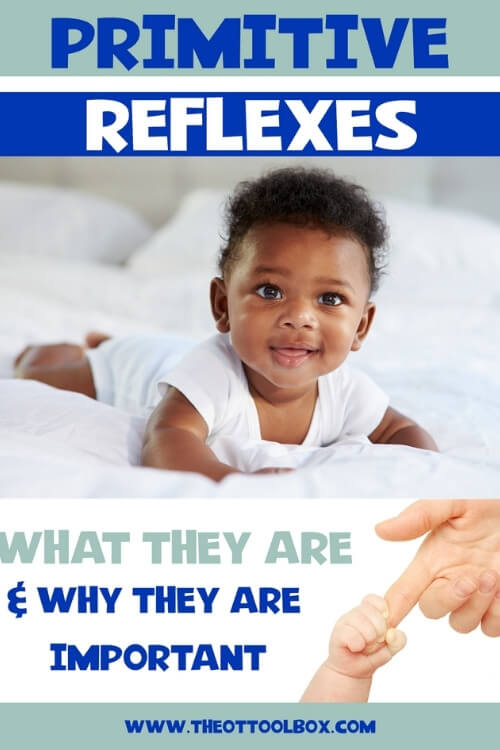
Have you even heard the term reflexes and wondered what are primitive reflexes? One of the many things that your newborn’s pediatrician will check periodically is their primitive reflexes. The existence of reflexes can be a great marker for neurological health in people of all ages, as they are controlled by the nervous system – the brain, spinal cord, and nerves. Primitive reflexes develop in the womb and are integral to an infant’s survival and future development. Below we will break down each of these reflexes and their purpose. Be sure to read our blog on retained primitive reflexes as well, to discover how to support reflex integration.
As infants develop into toddlers, these reflexes should do what health care professionals call “integration”. The response that comes with the primitive reflex should integrate into a more mature or voluntary movement.
If they are still present long after they should have integrated, the child will display certain characteristics specific to the retained reflex, many of which hold back their development and academic skills.
Let’s begin with the most easily noticeable reflex that babies have: the palmar reflex. This is also known as the grasping reflex. You will see this when you place your finger into the palm of an infant’s hand, and they hold on tight. This is an adorable response that can make you feel pretty special, but it is involuntary up until about 6 months of age when the reflex should disappear.
PALMAR REFLEX
The palmar reflex is important for the development of purposeful grasping, something that an infant is learning throughout their first year of life.
Fun Fact: if your baby is holding your hair in a death grip because of this reflex, stroke the back of their hand with your finger – it should initiate a release of the grasp.
ROOTING REFLEX
The rooting reflex is one of the main “survival” reflexes. The rooting reflex can be elicited by stroking an infant’s cheek with your finger, or more likely, a bottle or breast nipple. This is because when the cheek is stimulated, the infant will turn his or her head towards that stimulation.
If you ever need your baby to pay attention to their feeding, try giving their cheek a little stroke or tap so they turn towards the feeding source. This response should be seen in infants up until about 4 months of age.
SUCKING REFLEX
Similar to the rooting reflex, the sucking reflex is necessary for an infant’s feeding abilities. To stimulate the sucking response, touch the roof of the infant’s mouth and they will automatically begin sucking.
Most infants learn this skill very quickly (they do get tons of practice, after all!) and the reflex will disappear by about 2 months old.
MORO REFLEX
This reflex is the first of three on this list that is a response to a change in body position. Also known as the startle reflex, the Moro reflex can be seen by gently dipping a baby’s head and neck backward, as if they are falling. It can also be elicited by other stimuli like a startling noise or a drastic change in temperature.
The response that you will see in the baby is that of fear – their arms, legs, and head will reach out and then tuck back in – jerking their body back and forth. They may also open and close their hands and may even cry. The movement that is created by a startling stimulus is to protect your baby and allow them to move away from the stimuli even before they can control their own movements. Pretty cool, huh?
You may notice the startle reflex really kicking in around 1 month old. If your baby is inconsolable and moving around their body in this way, securing supporting their bottom and their head should help them realize that they are safe. By six months old, or as early as two months, this reflex will disappear.
TONIC LABYRINTHINE REFLEX
The tonic labyrinthine reflex (TLR) is used for head and postural control. We know that baby has poor control of their head and neck when they are born, and this reflex is part of what helps them gain control over this part of their body.
It’s important to know that posture in kids that impact functional performance (sitting at a desk for example) can be a result of a retained reflex and this is an area that is sometimes overlooked.
The TLR can be seen when moving the head and neck forward and backward. When the head moves forward toward the chest, the arms and legs bend and the baby assumes the fetal position. When the head moves back away from the chest, the arms and legs straighten. You can see this really well during tummy time!
The TLR will disappear by about 4 months old so that more advanced reflexes and movements can begin development.
ASYMMETRICAL TONIC NECK REFLEX
Last on the list of movement-based reflexes is the asymmetrical tonic neck reflex (ATNR). As the name suggests, this reflex has to do with the neck. You can see the reflex if you turn a baby’s head to one side while they are laying on their backs. They will reflexively straighten their arm and leg on the side that they are looking, and bend the arm and leg of the other side. That is where the asymmetrical part comes in: their left side and right side of their body are opposite. They look a bit like an archer, about to shoot an arrow.
This reflex is important in the birthing process, as the motions of the head can control the movement of the rest of the body help the baby through the birth canal. It is also important to the initiation of crawling, as the arms and legs move as a baby turns their heads while on their belly. For this same reason, the ATNR is crucial to the development of hand-eye coordination.
The ATNR disappears around the time an infant is gearing up for crawling, around 6 months old.
MORE ON PRIMITIVE REFLEXES
There are a few more infant reflexes that we did not mention, and you can check them out if you are looking to learn more!
The Spinal Galant Reflex, the Babinski Reflex, the Landau Reflex, and the Symmetrical Tonic Neck Reflex (STNR) are some that we missed in this article. The Landau and the STNR are actually not primitive reflexes, as they develop after the baby is born, but they are developmentally important nonetheless!
Luckily, we have a resource to share that covers these reflexes and much more…
Sydney Thorson, OTR/L, is a new occupational therapist working in school-based therapy. Her background is in Human Development and Family Studies, and she is passionate about providing individualized and meaningful treatment for each child and their family. Sydney is also a children’s author and illustrator and is always working on new and exciting projects.
Here you will find indoor winter activities for kids and indoor winter activities for families. These indoor activities are designed to help kids develop skills when it is too cold to go outside. We’ve used many of these occupational therapy activities when the weather is icy or frigid outside. Fun indoor winter activities can be essential to help kids get their energy out during winter days. This year, indoor therapy ideas may be needed to meet teletherapy needs, as well. Related: Add our Winter Fine Motor Kit to your daily toolbox, to help kids develop fine motor strength and dexterity with easy, no-prep activities.
An indoor winter activity like a winter crossword puzzle is a fun way to spend a winter day, while building skills. Let’s cover a few more indoor ideas…
Indoor Winter Activities
I’ve sorted these activities into areas so that you can find activities to meet therapy needs. Included below are indoor activities designed to boost fine motor skills, gross motor skills, visual motor skills, sensory input, regulation, and more.
The Winter Fine Motor Kit has materials to print-and-go, including arctic animal finger puppets to develop finger isolation, toothpick art activities with winter themes, crumble art pages, coloring and pencil control activities for building strength and endurance in the hands. All of these materials are included in a 100 page packet with winter themes: snowmen, mittens, snowflakes, penguins, polar bears, arctic animals, and more.
Click here to access the Winter Fine Motor Kit and develop fine motor skills and dexterity with winter themes.
Colleen Beck, OTR/L has been an occupational therapist since 2000, working in school-based, hand therapy, outpatient peds, EI, and SNF. Colleen created The OT Toolbox to inspire therapists, teachers, and parents with easy and fun tools to help children thrive. Read her story about going from an OT making $3/hour (after paying for kids’ childcare) to a full-time OT resource creator for millions of readers. Want to collaborate? Send an email to contact@theottoolbox.com.