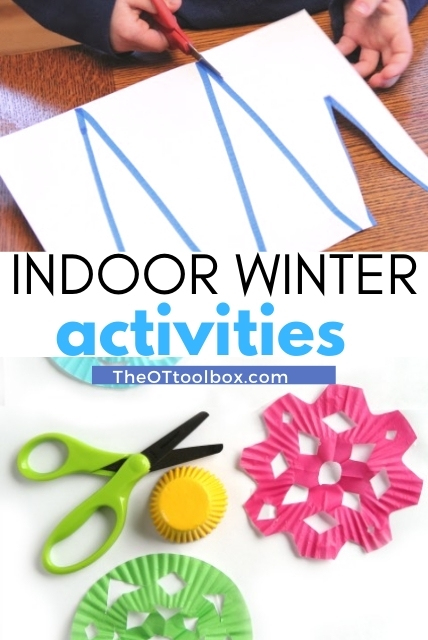
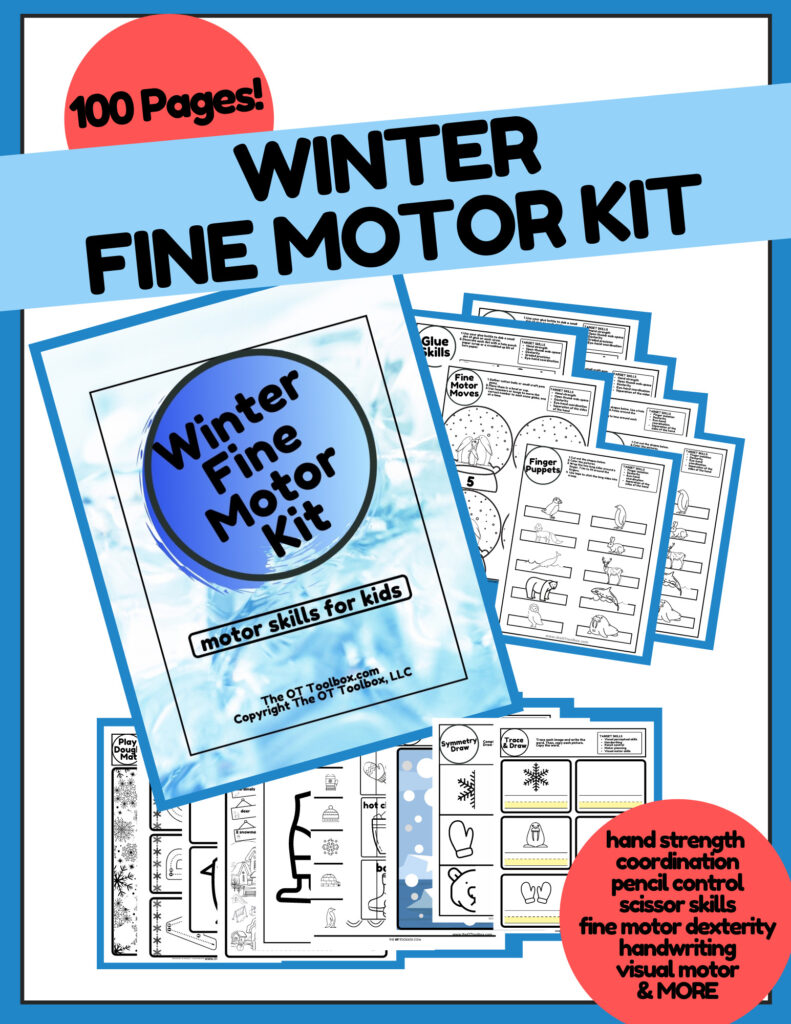
Here you will find indoor winter activities for kids and indoor winter activities for families. These indoor activities are designed to help kids develop skills when it is too cold to go outside. We’ve used many of these occupational therapy activities when the weather is icy or frigid outside. Fun indoor winter activities can be essential to help kids get their energy out during winter days. This year, indoor therapy ideas may be needed to meet teletherapy needs, as well. Related: Add our Winter Fine Motor Kit to your daily toolbox, to help kids develop fine motor strength and dexterity with easy, no-prep activities.
An indoor winter activity like a winter crossword puzzle is a fun way to spend a winter day, while building skills. Let’s cover a few more indoor ideas…
Indoor Winter Activities
I’ve sorted these activities into areas so that you can find activities to meet therapy needs. Included below are indoor activities designed to boost fine motor skills, gross motor skills, visual motor skills, sensory input, regulation, and more.
The Winter Fine Motor Kit has materials to print-and-go, including arctic animal finger puppets to develop finger isolation, toothpick art activities with winter themes, crumble art pages, coloring and pencil control activities for building strength and endurance in the hands. All of these materials are included in a 100 page packet with winter themes: snowmen, mittens, snowflakes, penguins, polar bears, arctic animals, and more.
Click here to access the Winter Fine Motor Kit and develop fine motor skills and dexterity with winter themes.
Colleen Beck, OTR/L has been an occupational therapist since 2000, working in school-based, hand therapy, outpatient peds, EI, and SNF. Colleen created The OT Toolbox to inspire therapists, teachers, and parents with easy and fun tools to help children thrive. Read her story about going from an OT making $3/hour (after paying for kids’ childcare) to a full-time OT resource creator for millions of readers. Want to collaborate? Send an email to contact@theottoolbox.com.
You might know that there is a lot of vision information and resources on visual processing here on the website. Today, I’m excited to bring you all of those vision resources in one place and to to share information on Vision 101, a new vision course that you will find useful.
Vision problems are very common in children that receive occupational therapy.
If you are looking for information on visual processing and vision in kids, then you are in the right place. Check out the various resources and tools available here on The OT Toolbox:
Free Visual Perception Packet– Print and go! These free visual perceptual skills worksheets cover a variety of topics and themes. Work on visual closure, visual scanning, visual discrimination, and more.
Vison Screening Packet– Use this vision screening packet to screen for vision issues that impact occupational performance and education in learning and school tasks.
Vision Information– Check out all of the vision blog posts here on the website.
Vision Activities– Let’s break down vision! These vision activities address specific skills in fun and creative ways. You’ll find information on vision definitions and activities to work on each aspect of visual processing.
Free Visual Processing Lab– This free email course covers tons of information on visual processing and breaks down this massive topic into visual motor integration, visual perception, and visual efficiency…and then explains each aspect.
Visual Processing Checklist– This printable checklist is perfect for screening visual needs in the school setting.
Vision’s Impact on Learning– The fact is that children with vision issues are impacted in their learning. Here’s what you need to know.
Visual Motor Skills– Let’s face it. Much of what we do on a daily basis involves visual motor integration. Here is all of the info and resources to address visual motor skills in kids.
Visual Processing Bundle– This resource is a must-have for all things vision. It includes 17 products that you can use in therapy sessions to work on vision needs impacting occupational performance.
Want to gain continuing education credits while you learn how to apply vision interventions into your school-based practice? Vision 101 is your resource!
Vision 101 Course for School-Based OTs
Vision 101 is a course created by my friend Jaime at Miss. Jaime OT. She’s created this AOTA-approved course as a tool to help you improve your skills as a school-based occupational therapist. In the course, you can learn how to detect, screen for, and treat the visual difficulties that impact students’ learning
Vision 101 for School-based Occupational Therapy Practitioners is a tool to help you understand how vision deficits impact a child’s ability to learn and participate in school work.
The course offers resources on how to helpstudents learn and participate in school tasks.
Included in the Vision course is information on:
Vision and the school-based therapist
Recognizing possible visual impediments to learning
Understanding visual diagnoses
Assessing and documenting eye movements
Visual characteristics of common pediatric diagnosis
Treatment Ideas
Vision and telehealth
Vision in the school setting
Check out the blog comments below for common questions about vision in the school setting.
Colleen Beck, OTR/L has been an occupational therapist since 2000, working in school-based, hand therapy, outpatient peds, EI, and SNF. Colleen created The OT Toolbox to inspire therapists, teachers, and parents with easy and fun tools to help children thrive. Read her story about going from an OT making $3/hour (after paying for kids’ childcare) to a full-time OT resource creator for millions of readers. Want to collaborate? Send an email to contact@theottoolbox.com.
Today’s giveaways in our annual Therapy Tools and Toys Giveaways series (Giveaway is now closed) holds a special place in my heart. Today, I’m featuring occupational therapy entrepreneurs who are creating resources, occupational therapy gifts, and toys that promote the profession of occupational therapy. These are occupational therapists and COTAs who have created a nontraditional therapy business that offer resources, private practice, and out-of-the box entrepreneurship!
Each of the OT businesses featured here promote products and resources for others using their knowledge and experiences as occupational therapy practitioners. With all that this year has brought our way in the need for virtual therapy, and an astonishing impact on small businesses, it is my absolute pleasure to promote and feature these occupational therapy small businesses.
Occupational Therapy Entrepreneurs
There is just something about occupational therapists and the profession of OT that makes it a natural in the business world. Occupational therapists are natural entrepreneurs for so many reasons!
As occupational therapy professionals, we have the unique ability to impact and change lives with a whole-body approach to addressing clinical needs. What if, as professionals, we took that holistic viewpoint and inner drive to see people thrive… and coupled it with the zeal and ambition of an entrepreneur?
Therapists are innovators and motivators. We make evidenced-based decisions and have a compelling public image in facilities, schools, clinics, and the community. We have the ability to influence the marketplace and in collaboration with other professionals.
These elements of business creation are outlined as some of the eight vision components in AOTA’s Centennial Vision and Executive Summary. (American Occupational Therapy Association, 2007). That same creative excitement can be applied to one’s own entrepreneurial goals. In fact, “occupational therapy has great entrepreneurial potential, with relatively low risk for entry” (Anderson & Nelson, 2011).
Connecting the dots from the traits of an OT to the traits of a business owner is pretty easy when you think about it. We have many of the very skills engrained in us.
Therapists, in most cases, excel at these skills:
Bravery
Creativity
Innovation
Confidence
Persistence
Organization
Time Management
Goal Mindedness
Confidence
Humbleness to ask for help when needed
Friendly and honest
Able to set and maintain schedules
Open to new ideas
Skilled in networking
Calm and level-headed under pressure
Aware of personal weaknesses and able to ask for help
Willingness to learn and learn some more!
These are attributes of business owners. These skills are needed to conceptualize, create, and run a business. These are the skills needed for entrepreneurship!
Those are also quite a lot of “OT traits”, right??
These are essential traits of therapeutic use of self. These are the skills that allows us to connect with our clients, pivot on a dime, and reach functional outcomes.
It’s no wonder that occupational therapists are naturals at entrepreneurship.
Occupational Therapy Businesses
So, now that we’ve talked about the attributes that therapists have making them naturals at business, let’s celebrate and support our fellow OTs who have taken steps to start a business.
Below are OT-created/owned businesses that are creating, sharing, and providing resources designed to help others. They are using their OT hats to create a business and make it work!
Check out these OT innovators and occupational therapy businesses! Let’s support your fellow occupational therapy entrepreneurs by following them on social media and browsing their products.
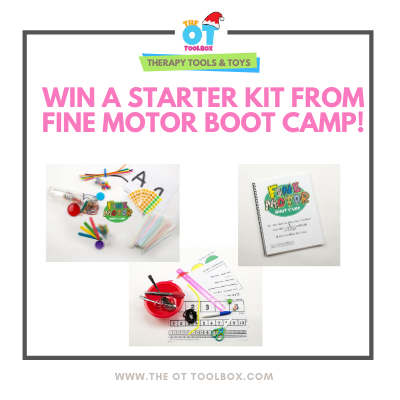
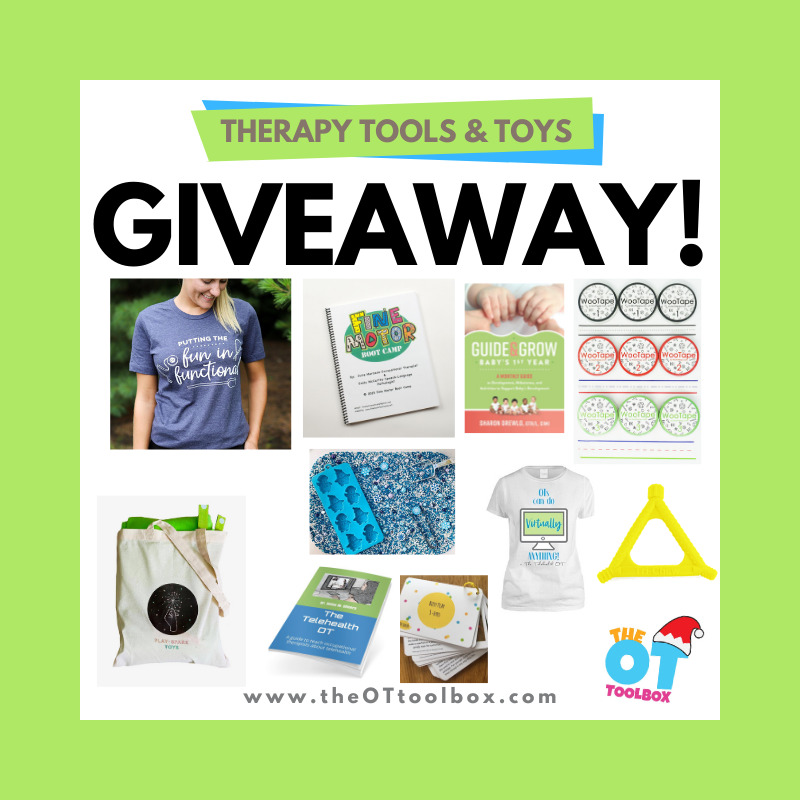
Fine Motor Boot Camp- Developed by a Speech-Language Pathologist and Occupational Therapist, Fine Motor Boot Camp was developed to meet cognitive, language and fine motor needs in under 15 minutes a day using simple, inexpensive materials.
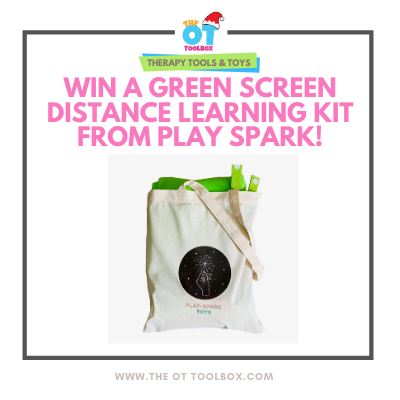
Play Spark- Play Spark is a new business created by a speech language practitioner and an occupational therapist who offer green screens and materials to foster therapeutic interventions in virtual therapy sessions.
Telehealth OT Services– Created by occupational therapist, Reina Olivera, Telehealth OT Services is a resource providing training and education to OT providers on all things teletherapy.
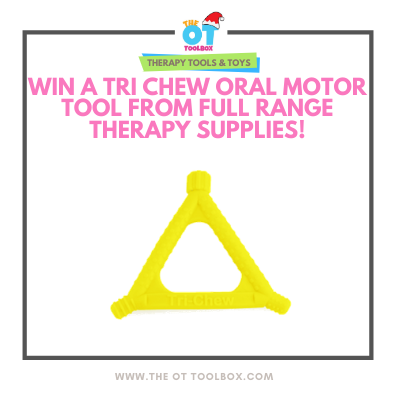
Full Range Therapy Supplies-Full Range Therapy Supplies offers therapeutic materials and supplies such as h as Nosey Cups, Nuk Massage Brushes, Chewy Tubes, Sensory Brushes, and feeding equipment.
Forward Therapy Solutions- With over 30 years of experience in guiding parents in their child’s development, pediatric occupational therapist Sharon Drewlo brings you “GUIDE & GROW: Baby’s 1st Year“. This book is an easy-to-navigate monthly guide to understanding and supporting your baby’s development throughout the first year with monthly milestones and developmental information to support your little one’s development through their first year. Check out the book Guide & Grow: Baby’s 1st Year: A Monthly Guide to Development, Milestones and Activities to Support Baby’s Development
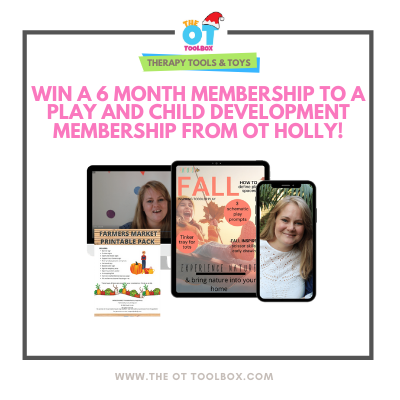
OT Holly-OT Holly is an OT small business created by an occupational therapist who provides and shares opportunities for toddler play and child development. These activities and educational resources are specifically designed for parents of 1-4 year old children and includes trainings, printables and a month play digital magazine.
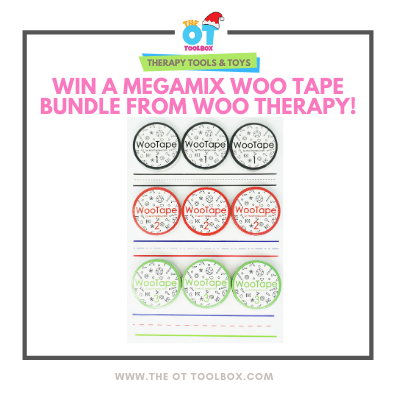
WooTherapy-WooTherapy is the maker of Woo Tape, a handwriting tool for kids. Created by occupational therapist, Meghan, this handwriting tape allows children tactile feedback and visual cues for handwriting on any type of paper.
Purpose Therapeutic Box– Purpose Therapy Box is a subscription box created by two COTAs, Holi and Ali. Together they created Purpose The Therapeutic Subscription Box in order to decrease sadness and loneliness within the older adult population using products and encourage aging in place. The boxes inspire positivity and enhance quality of life through personalized products that encourage independence, well being, and improve overall health.
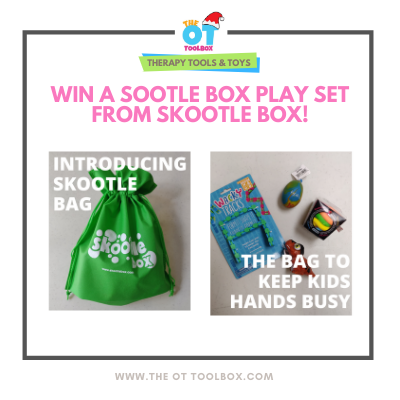
Skootle Box– Skootle Box is a subscription box containing toys and materials to help parents help their children succeed. Items are carefully chosen and come with guided therapy inspired instructions on how to use the activities with your child and what skills it is working on.
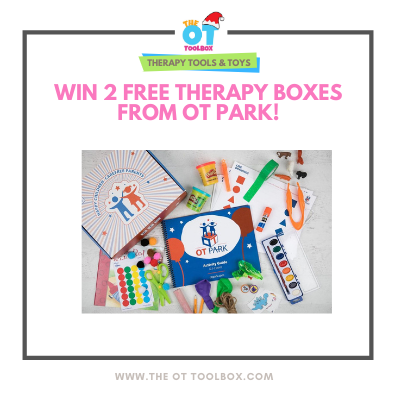
OT Park-OT Park Box is a kids subscription box designed by a pediatric OT. The monthly boxes include age appropriate and developmentally correct activities for kids age groups 0-3 years and boxes have categories: 0-6 months, 6-12 months, 12-18 months, 18-24 months, 2-2.5 years and 2.5-3 years
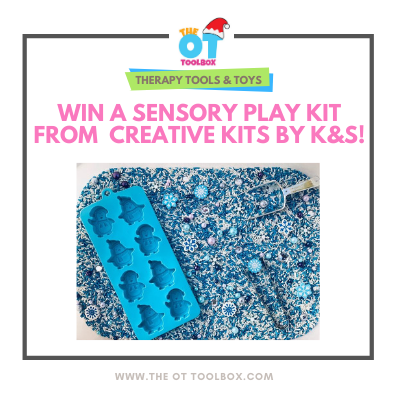
Creative Kits by K&S- Started by occupational therapist and preschool teachers, Kelly & Sara, Creative Kits by K& S offers themed sensory kits for toddlers & preschoolers. These sensory activities are thoughtfully designed sensory play and small world play kits for young children.
Laddalove Creations- Created by a COTA, Laddalove Creations offers custom t-shirts, mugs, masks, and wooden creations, especially for occupational therapy practitioners. These items are designed to spark joy and brighten the day of an occupational therapist!
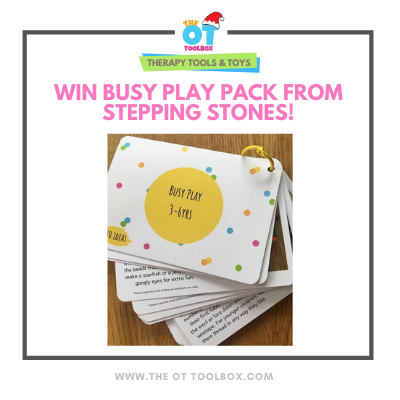
Stepping Stones- Created by an educator, Stepping Stones offers activity cards using everyday materials and centers on fine motor skill development for children aged 3-6 years of age. These activity cards are carefully designed to use things that you ordinarily have at home.
Want to support occupational therapy entrepreneurs AND fill your emotional toolbox with prizes, resources, and therapy materials?
Let’s support occupational therapy small businesses!
Colleen Beck, OTR/L has been an occupational therapist since 2000, working in school-based, hand therapy, outpatient peds, EI, and SNF. Colleen created The OT Toolbox to inspire therapists, teachers, and parents with easy and fun tools to help children thrive. Read her story about going from an OT making $3/hour (after paying for kids’ childcare) to a full-time OT resource creator for millions of readers. Want to collaborate? Send an email to contact@theottoolbox.com.
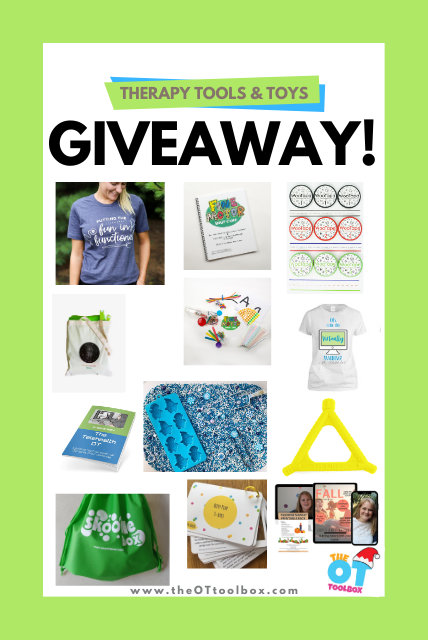
2020 has been a year like no other. This year calls for a mega giveaway! Let’s celebrate therapists, teachers, and parents with the 2020 Therapy Tools Giveaway!
Giveaway is now closed.
The winners are…
I wish I could send a big toy or tool to each and every therapist, educator, and parent out there, because you are all stars in my book!
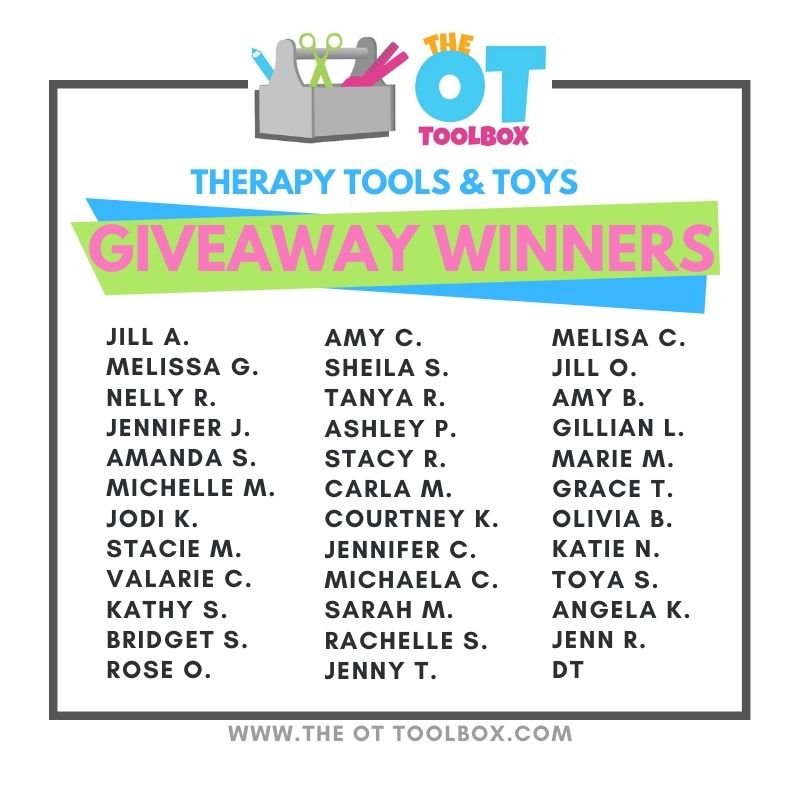
Here are the winners of this year’s giveaways…
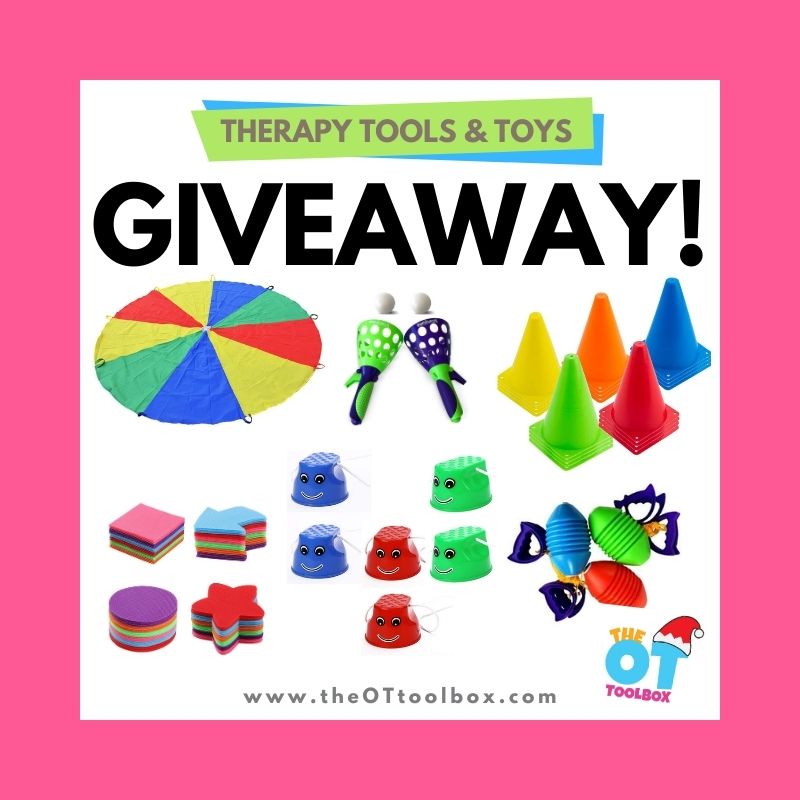
Parachute- Jill A.
Carpet Markers-Melissa G.
Agility Cones- Nelly R.
Ball Launcher- Jennifer J.
Bucket Stilts- Amanda S.
Zoom Ball- Michelle M.
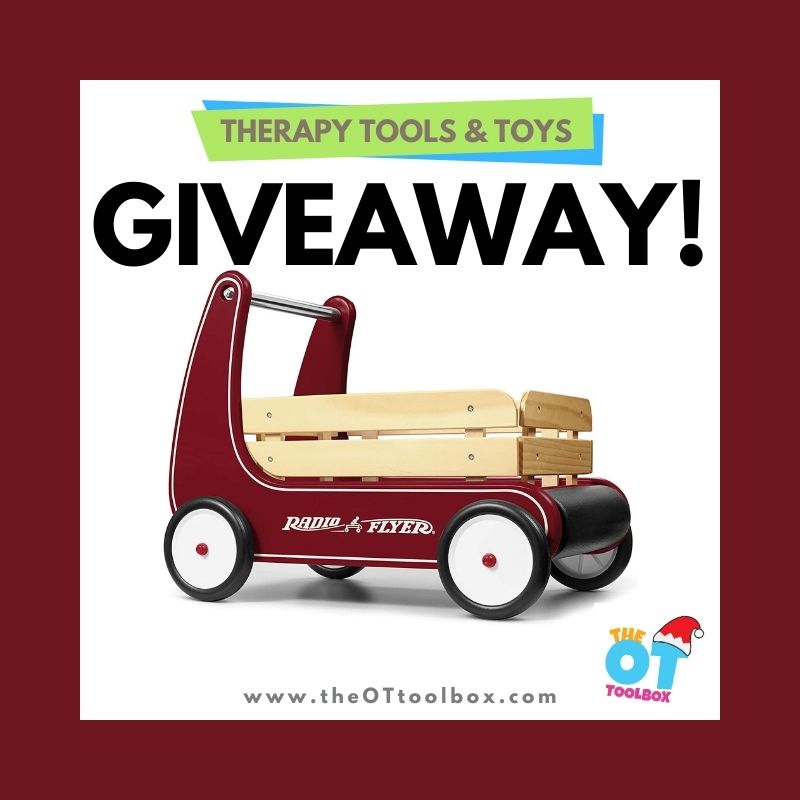
Radio Flyer Push Walker- Jodi K.
Vision 101 Course- Stacie M.
Art Play Book- Valarie C.
Whatsitsface toy-Kathy S.
OT Park Box- Bridget S.
Telehealth OT pack- Amy C.
OT Holly- Sheila S.
Fine Motor Boot Camp- Tanya R.
Play Spark- Ashley R.
WooTape- Stacy R.
Purpose Therapeutic Box- Carla M.
Skootle Box- Courtney K.
Laddalove Creations- Jennifer C.
Stepping Stones- Michaela C.
Forward Therapy Solutions- Sarah M.
Full Range Therapy Supplies- Rachelle S.
Creative Kits- Jenny T.
Big Life Journal- Melisa C.
Sensory Meltdowns Course- Jill O.
Radio Flyer Balance Bike- Amy B.
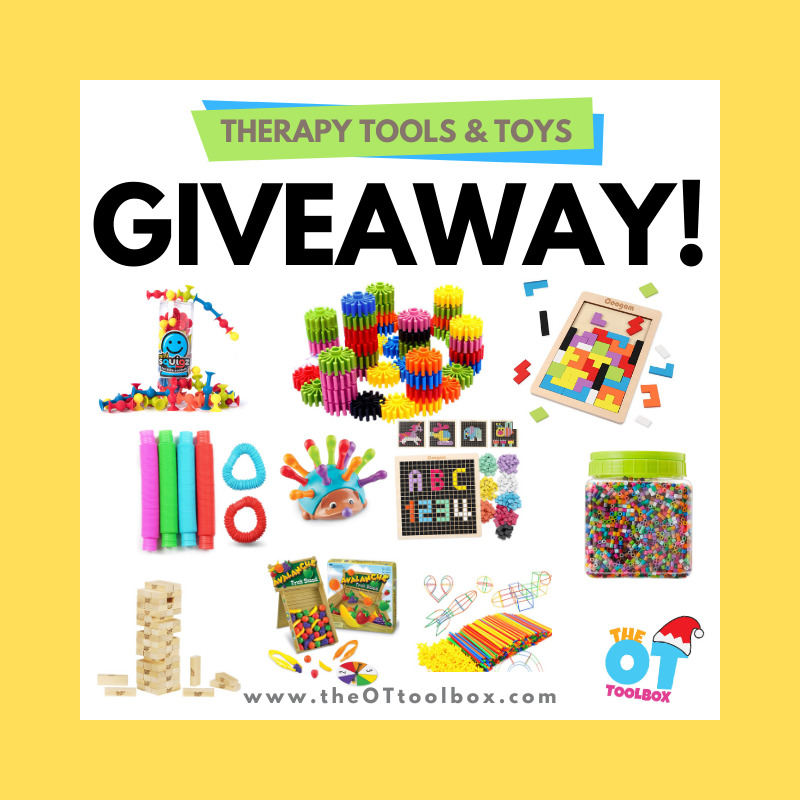
Avalanche Fruit Stand- Gillian L.
Pop Tubes- Marie M.
Spike the FM Hedgehog- Grace T.
Bucket of Perler Fuse Beads- Olivia B.
I had so much fun bringing these giveaway items each day. Stay tuned for next year’s series! Check out the items that were a part of this year’s fun below.
I wanted to celebrate and honor all of the work that you’ve done this year and bring something fun and exciting this year…maybe a change from the sales emails that you may be seeing in your inbox during this holiday season.
It’s been YOU, the therapists, educators, and parents that are working with children who are feeling the impact of 2020 in major ways. It’s been YOU that are feeling burnout, overworked, and exhausted.
And, we all know that therapists and teachers, many times, purchase materials with their own money to use in their work and that fact often doesn’t often get recognized.
Each day, I am blessed to serve therapists, parents, and teachers all over the world while promoting the profession of OT. During all that this year has brought, it is my hope that The OT Toolbox has made things just a little easier.
Each year around this time, I partner with brands and services to bring giveaway items to fill therapist’s/parent’s/teacher’s toolboxes with resources and toys. This year, I am excited to say that the Annual Therapy Tools and Toys Giveaway is bigger than ever!
Therapy Tools Giveaway
I am so grateful and incredibly proud of the readers of The OT Toolbox. You are professionals, advocates, and servants, defenders, and counselors. You are leaders, educators, and supporters of those looking for their ability to do and be. You are the manager of function and the chief of ability. By using your sincere empathy, insight, judgement, and expertise, you are the means for guiding those you serve towards capability. The profession is proud to have you. You are an instrument to build up others and the system to establish function.
You are the reason that so many flourish with their daily occupations. You are the roadmap to ability in the day to day skills that make up our classrooms, clinics, and communities. You deserve so much more than these items. These giveaways are just a simple way to express gratitude for you and all you do on a daily basis.
Celebrating Therapists, Teachers, Parents
So, to kick off the holiday season with gratitude and thanks, I’m excited to announce the Annual Therapy Tools and Toys Giveaway!
This is the place you will need to come back to each day over the course of the next 10 days. Each day, you will find a new therapy giveaway item “turned on”. If you missed entering any of the past giveaways, don’t worry! Just go back and enter those giveaways. All giveaways end on December 6th at 11:59 pm PST. Winners will be notified by email. Prizes will be fulfilled by the brand or company offering the giveaway. For some prizes, a full name and physical mailing address will need to be obtained via email so the prize can be mailed out.
Scroll through the images below and enter each one beginning on the day indicated. I’m excited to share each of the items below.
You’ll find therapy items that you can use in your practice, in the clinic, classroom, or home. There are sensory tools, handwriting products, massive therapy resource bundles, amazing therapeutic toys, and so much more. You are going to love each item!
Giveaways are now closed.
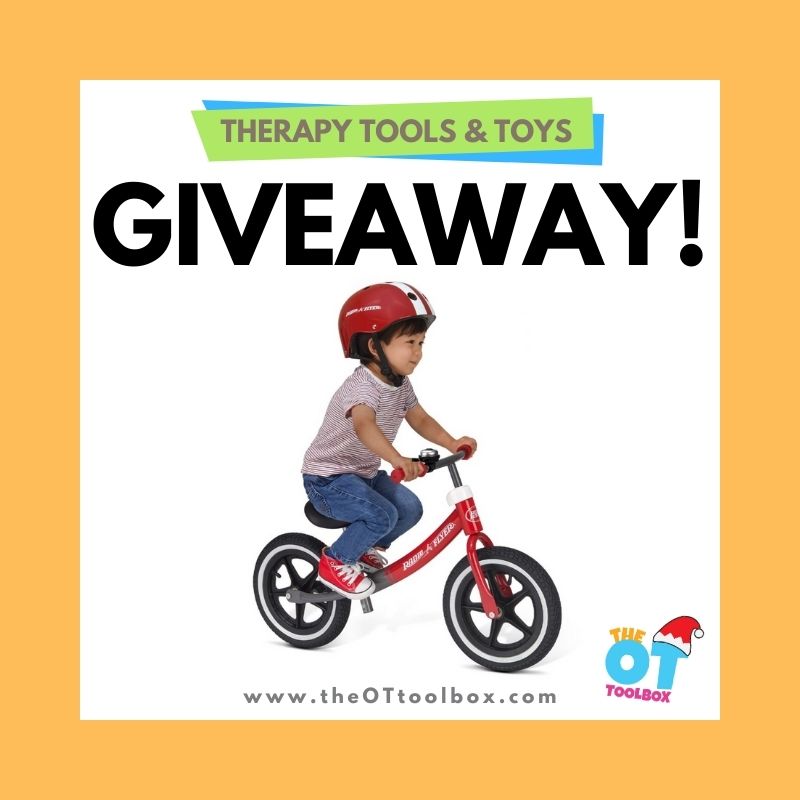
THERAPY Tool #1: Radio Flyer Air Ride Balance Bike
Colleen Beck, OTR/L has been an occupational therapist since 2000, working in school-based, hand therapy, outpatient peds, EI, and SNF. Colleen created The OT Toolbox to inspire therapists, teachers, and parents with easy and fun tools to help children thrive. Read her story about going from an OT making $3/hour (after paying for kids’ childcare) to a full-time OT resource creator for millions of readers. Want to collaborate? Send an email to contact@theottoolbox.com.
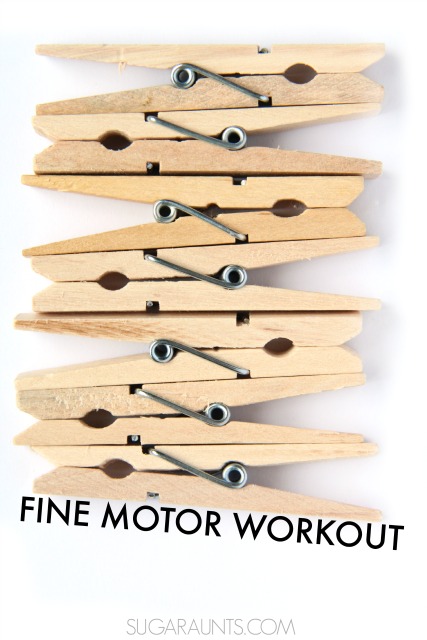
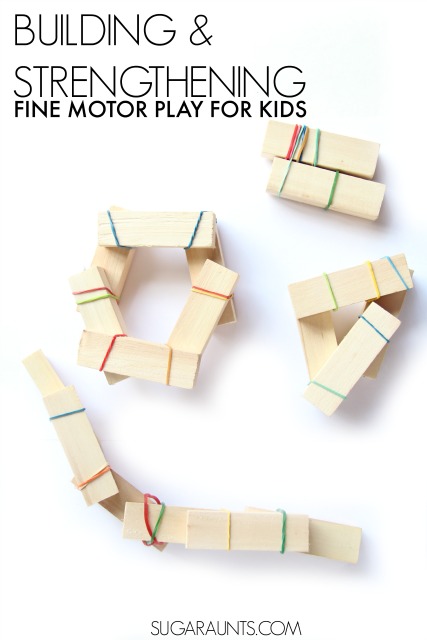
Wondering about lateral pinch strength? Hoping to help kids build tip to tip strength? Trying to build pinch strength in general? Here, I am sharing pinch exercises to strengthen pinch strength so that tasks that require strong hands (like coloring without fatigue, or holding the pencil and writing with endurance) can maneuver and manipulate objects. Check out the pinch strength exercises listed here and add these to your hand strengthening activities toolbox. All you need are clothes pins to build muscle strength and pinch patterns in occupational therapy sessions.
Before we get into the pinch exercises below, be sure to bookmark the popular series about Occupational Therapy activitiesthat can be done using free or almost free materials. This post is included in that series, and you will find other activities designed to build skills using everyday materials.
(Affiliate links are included in this post.)
Pinch Exercises for Kids
Today, I’m going back to the early days of my OT career and sharing fun ways to work on a few different hand pinch grasps. For this fine motor activity, we’re using wooden clothes pins…something you probably have in your house or could get for a dollar at the dollar store. There are many pinch grasp tools on the market designed to build pinch strength, but having an easily accessible (and inexpensive) option is key to carryover, use, and feasibility in building strength.
Types of Pinch Grips
Ok, the basics: When you use your hand to do …anything… you’ll use one or more of the different types of pinch grips. These pinch patterns are developed through use. Les cover the types of pinch grips, as well as some common terms when we talk about pinch.
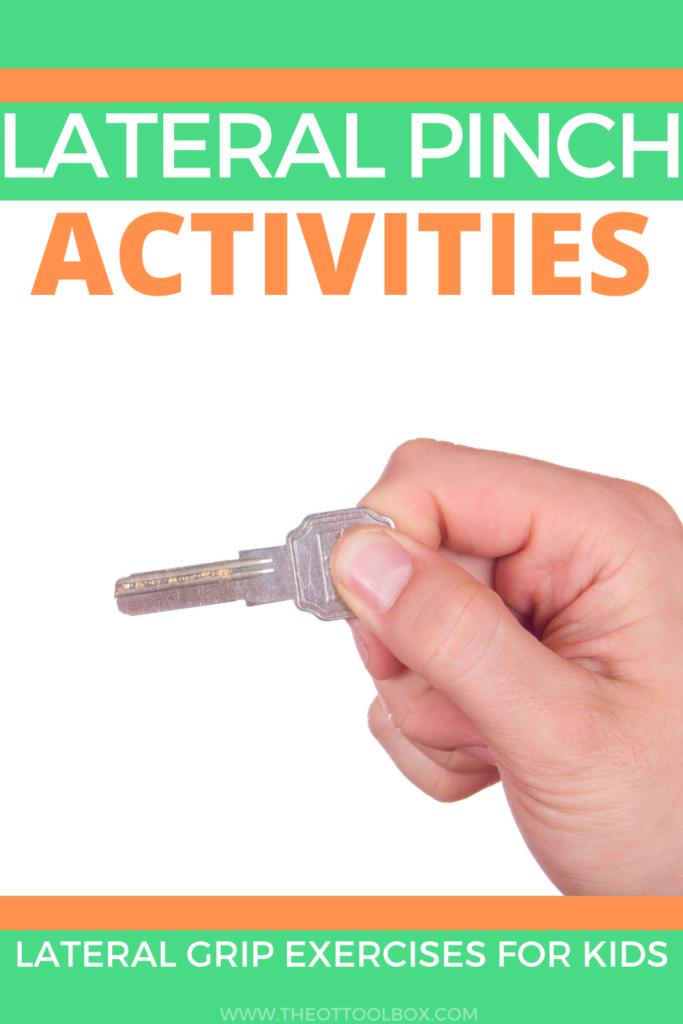
Lateral Pinch Grip (aka Key Pinch Grip)- The thumb opposes the lateral side of the pointer finger. This grasp is used when holding and using a key.
Lateral Prehension Grip– A sub group of the lateral grip type of pinch is the Lateral Prehension Grip. In the lateral prehension grip, the thumb is flexed (bent) and it’s pad opposes the lateral side of the tip of the pointer finger. This grip is used to hold an index card or paper, sometimes.
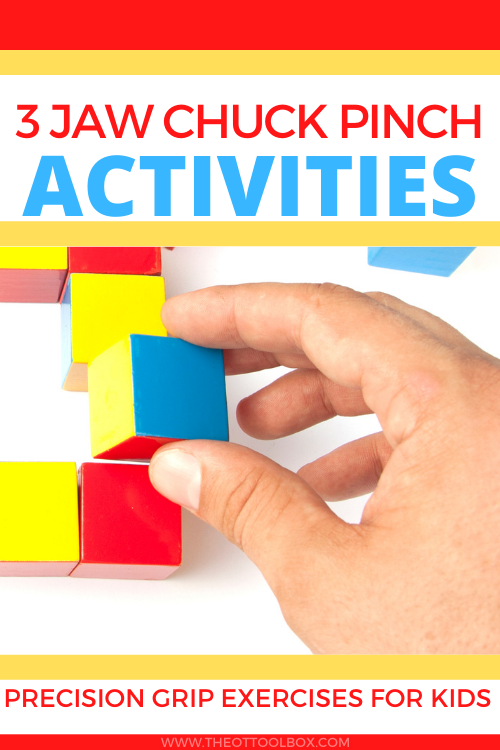
Three jaw Chuck Pinch Grip– The thumb is flexed (bent) and opposes the pads of the pointer finger and middle finger. Holding a small cap like a toothpaste lid uses this grip. This is the grip used in holding a pencil.
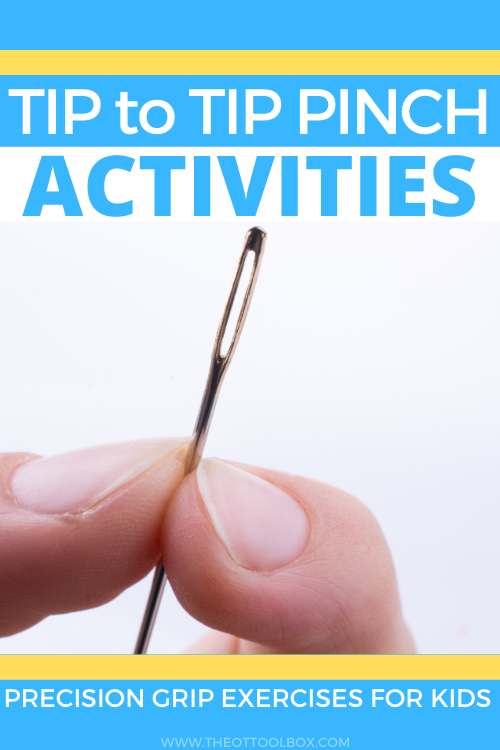
Tip to Tip Grip– The tip of the thumb touches the tip of the pointer finger. The thumb and pointer finger form an circle (or open thumb web space). This grasp is also called a pincer grasp. It is used to pick up small items like cereal or beads. If very small items are picked up (like a needle), a Neat Pincer Graspis being used.
Lateral Grip– Pinching an item between the pointer and middle fingers use this grip. You would use this grip in holding a cigarette. While this is not a functional grasp for kids (obviously), you might see kiddos fiddle with a pencil by holding it between two fingers.
Prehension
Prehension is another common term that you may have heard mentioned. But what is prehension?
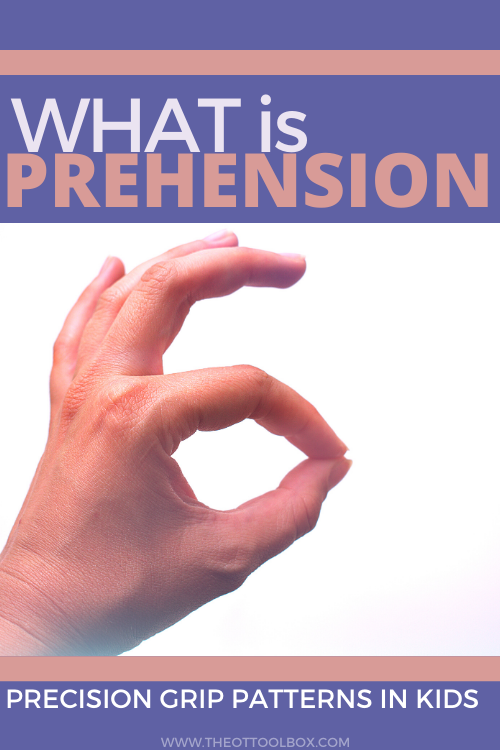
The definition of prehension is the act of holding or grasping. The ability to hold and grasp an object in the hand requires prehension of the fingers. Prehension can also refer to the ability to hold a concept or idea in the brain to allow for understanding. Here, we are talking about prehension skills that allow us to manipulate items or objects. We are covering prehension patterns in the way of pinch grips.
To break this down further, prehension can be identified in the different types of pinch grips.
Tip prehension refers to the ability of the tip of the thumb, or the last joint of the thumb (known as the IP joint) to bend in isolation so that the rest of the thumb is stabile while just the last joint bends, or flexes. This tip prehension works in combination with opposition of the thumb as it rotates at the base, in order to oppose the tip of the index finger. Prehension can refer to the precision of grasp in the index finger as it bends at the PIP joint (proximal interphalangeal joint, or the middle joint of the finger), and the DIP joint (distal interphalangeal joint, or the end joint of the finger). This tip prehension is needed for small motor movements such as picking up a button or coin, threading a needle, etc.
There are other types of prehension, like palmer prehension. This dexterity refers to in-hand manipulation, which we cover in other places on this website.
Still other types of prehension are included in each of the pinch grasp patterns described above. Specific motions of the joints related to each pattern, and stability offered by related joints such as the wrist or metacarpophalangeal joints, and the arches of the hand allow for dexterity and precision of grasp…or prehension!
We’ve created a video specifically showing how to target different grasp patterns using clothes pins. These clothes pin exercises are a great way to build hand and finger strength with a few repetitions. Simply clip the clothes pins onto the edge of a sheet of cardboard or cardstock paper for building pinch strength in the fingers.
Watch this video for an example of how to position the fingers on the clothes pins for each pinch grasp: (If you can’t view the video due to blockers on your device, check out the video on The OT Toolbox YouTube channel.)
Pinch Grip Exercises
So, how can you work on these grips in a fun way? Try using something you probably have in your home: Wooden clothes pins. These are a therapy treatment bag staple. You can work on each of the pinch grasps above to improve strength, arch development, open web space, and dexterity using clothes pins.
Lateral Pinch Exercises
Hold the clothes pins between the thumb and the side of the pointer finger, like holding a key. Clip the clothes pins onto an index card.
Hold the clothes pin between the thumb and the side of the pointer finger, like holding a key. Use the clothes pin to pick up an object like a craft pom pom to drop it into a color-coded bowl, cupcake liner, or onto a marked circle on a piece of paper.
Tip to tip Grasp Exercises
Hold the clothes pin between the thumb and the pointer finger. Be sure the tip of the thumb is doing the work. The IP joint of the thumb should be bent. Do several repetitions of this exercise to open and close the clothes pin.
Holding the clothes pin between the tip of the thumb and the tip of the pointer finger, try to clip the clothes pin onto the single page of a book. Then, try to clip the clothes pin onto 10-20 pages of a book. Try to increase the increments and number of pages that are clipped between the clothes pin.
3 Jaw Chuck Pinch Exercises
Hold the clothes pin between the thumb and the pointer finger and middle finger. Clip the clothes pins onto a shirt or edge of clothing. Using both the index finger and the middle finger allows for more strength through the 3 jaw chuck grip pattern, so try clipping items of clothing together, like pairs of socks or two shirts. Clip several clothes pins around the edge of the clothing.
Hold the clothespin between the thumb and the pointer finger/middle finger. Try to clip clothing to a string or clothes line.
Prehension Exercises
All of these exercises listed above can be completed in increasing repetitions. You might notice that the exercises listed include a functional component, like hanging clothes, or play. This is part of what makes occupational therapy, well, occupational! Try to include an aspect of function or daily tasks like painting, moving and manipulating objects with sorting for a learning aspect, or other aspect of independence.
Here are more pinch activities clothes pins:
Use the grips described above in the play and art activities below. Try using different grips while completing the tasks, to work on the grips or skill areas appropriate for your child. Start with these fine motor activities using clothes pins.
Pinch clothes pins along a string.
Line the edges of an index card with clothes pins. Try using the different pinches described above.
Make clothes pins into a superhero craft and pinch them onto strips of paper.
Write letters on each clothes pin and match them to letters written along the edge of a piece of paper in this sight word activity to spell sight words or create a sentence with sight words.
Pinch clothes pins onto a ruler.
Use clothes pins to pinch and grab small items like crafting pom poms, small erasers, or crumbled up pieces of tissue paper.
Colleen Beck, OTR/L has been an occupational therapist since 2000, working in school-based, hand therapy, outpatient peds, EI, and SNF. Colleen created The OT Toolbox to inspire therapists, teachers, and parents with easy and fun tools to help children thrive. Read her story about going from an OT making $3/hour (after paying for kids’ childcare) to a full-time OT resource creator for millions of readers. Want to collaborate? Send an email to contact@theottoolbox.com.
Looking for activity themes to make your OT planning easier? These weekly lesson plans are great for occupational therapy intervention activities because they are open-ended and can be used as a planning theme while meeting the needs of a whole caseload of students or OT clients. While curriculum planning in occupational therapy isn’t typically a “thing”, coming up with creative activities certainly is!
My hope is to provide weekly themes for creating a set of activities that you can adjust to meet your needs, in the classroom, clinic, or home.
And, if you like the idea of a printable PDF version of these OT intervention themes, be sure to sign up as a newsletter subscriber (enter your email in the “Subscribe” button at the top right side of this webpage. All email subscribers get access to the subscriber-only freebie library. Or, CLICK HERE to subscribe. These therapy themes are available in printable format with supply lists. These are great for home programs and therapy planning!
Weekly Themes
Even if you aren’t seeking out specifically occupational therapy activities, these fun themes for children serve to offer strategies to build fine motor skills, gross motor skills, sensory challenges, brain breaks, interactive and hands-on learning activities, and so much more. Some of these themes have slide decks for distance learning/virtual therapy sessions. Others have book lists and activities related to the books. Still others have crafts and fun ways to build various skills all focused on one weekly theme.
So, be sure to save this page…Pin it to Pinterest…email a link to yourself. This weekly theme page will be updated weekly as we go through this school year with A thematic curriculum that integrates basic skill development areas addressed in occupational therapy and the classroom or home through the exploration of a broad subject or topic, such as apples, community helpers, transportation, rain forests, STEM, etc.
Thematic Instruction in OT
Thematic instruction can be a powerful tool that is meaningful, motivating, and FUN for kids. Plus, while it can require a little prep on the side of the occupational therapist, parent, or teacher, it sort of flows throughout the week. Students can come back to activities that they enjoyed while working on specific or related skills. But, for the therapist working with a large caseload, thematic instruction can be much easier to plan and adapt to meet each client or student’s levels and goals. My mission is to make this planning simple for you and get you all of the ideas into one place, including materials you will need!
Weekly Themes for Therapy
Here it is! Let’s get those weekly themes into your hands:
September Themes
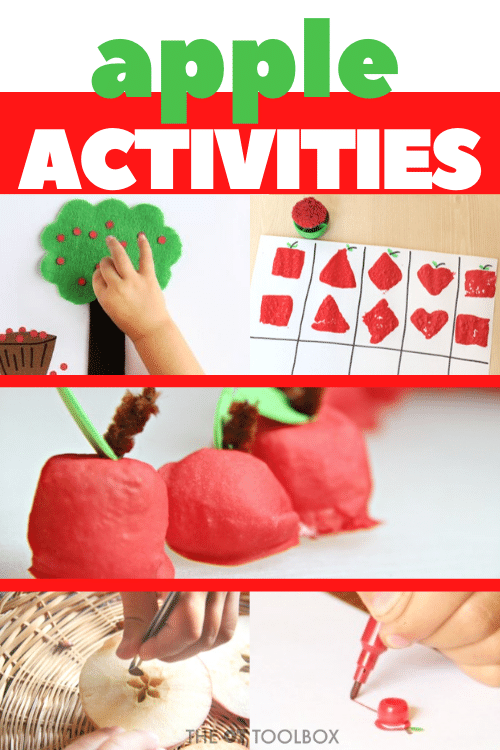
Apple Theme- Use apple theme activities with fine motor, gross motor activities, apple brain breaks, and more.
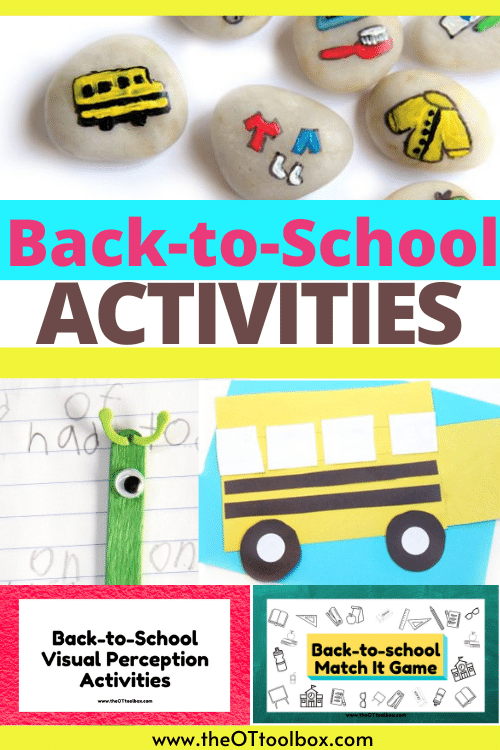
Back-to-School Theme- These back-to-school activities include crafts, writing activities, fine motor fun, gross motor activities, and back-to-school slide decks.
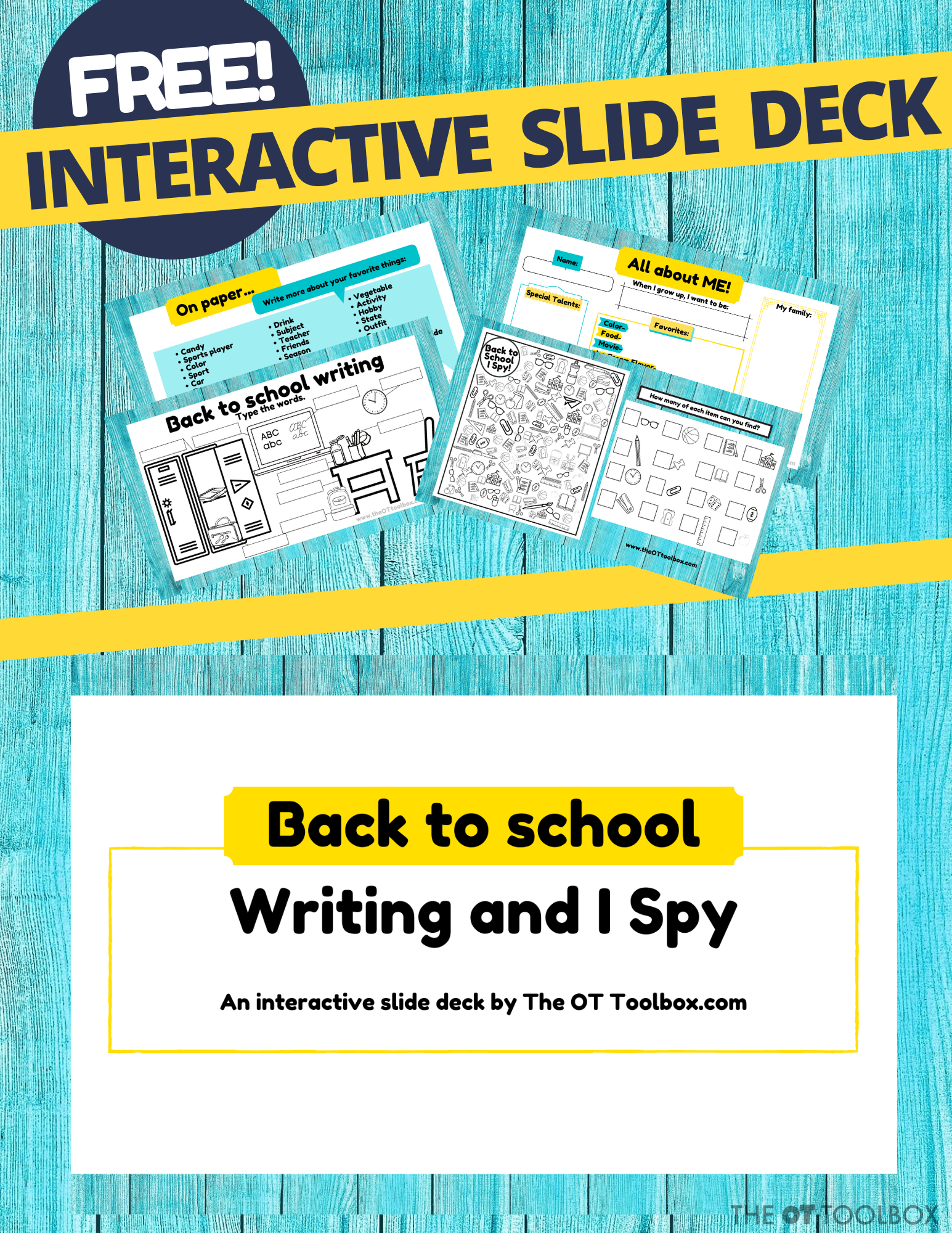
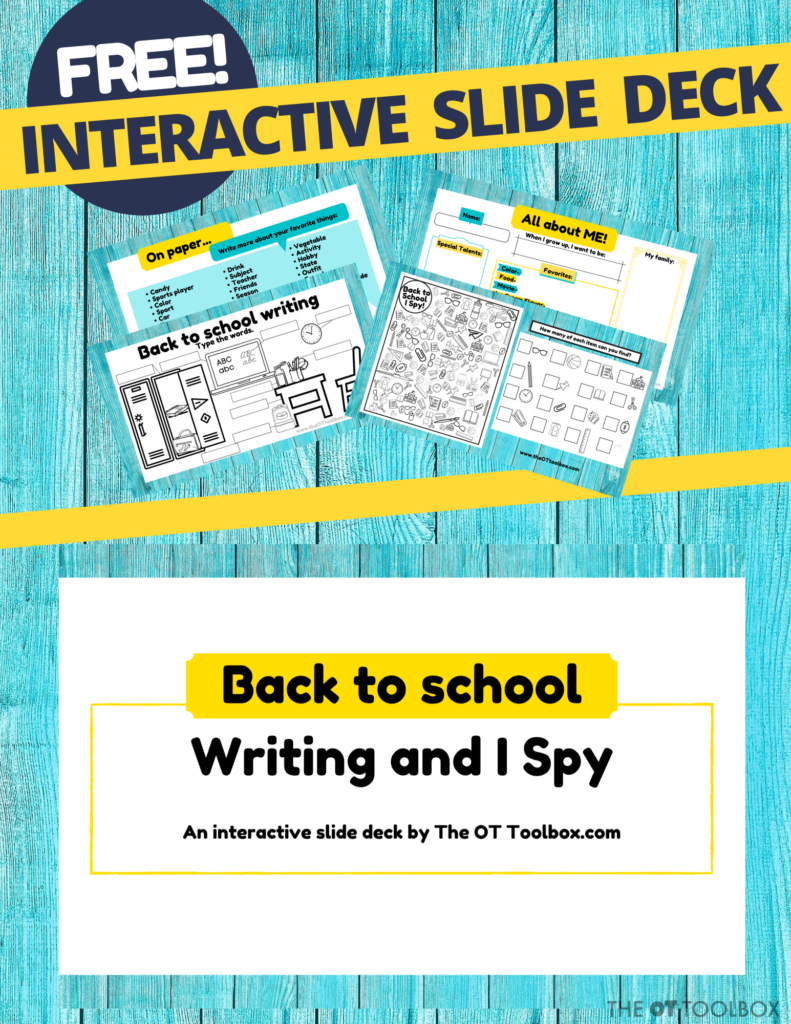
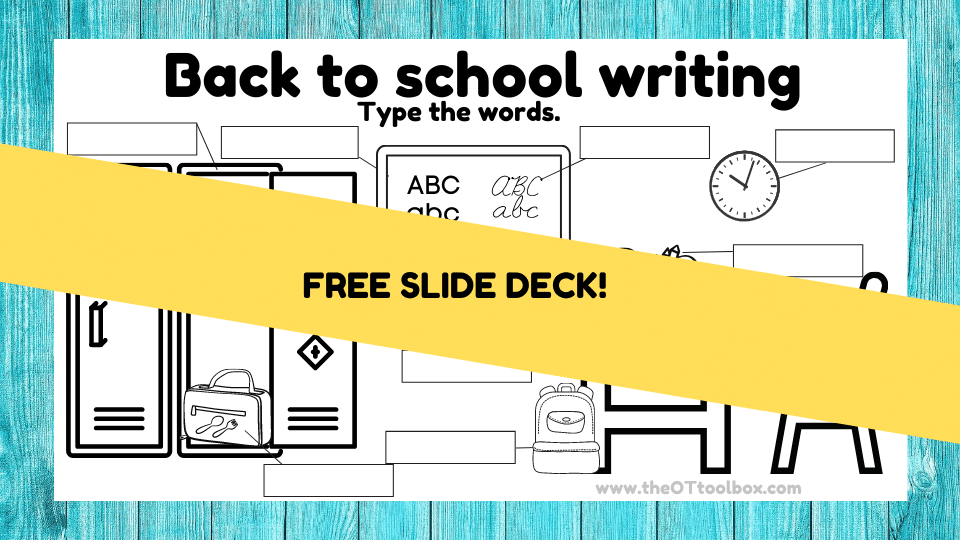
Heading back to school? The return of school looks a lot different this year than any other. That’s why I wanted to create this Back to School activity to use in virtual therapy or teletherapy services, or distance learning. In most cases, kids haven’t been writing with a paper and pencil since around March. This back-to-school activity provides a means to get those pencils moving and little hands writing again! Use this free therapy slide deck to get a baseline of where kids are in regards to writing a short list of words, and sentences. The bonus is that this back to school idea has a school I Spy activity, too that boosts visual perceptual skills. Read on to grab this freebie! And, don’t forget to grab this other back to school slide deck to work on more visual perceptual skills.
Back to School Activity
This interactive activity is great for getting to know students during the firsts week of school. It’s a fun icebreaker activity for students to do with teachers or therapists.
Students can complete these slide deck activities as part of distance learning, virtual days on hybrid learning options, and in teletherapy sessions.
When heading back into the school year, it’s a great idea to get a baseline snapshot of where a child is at with handwriting, especially after such a long break from school. In many cases, students have not been writing or putting pencil to paper during the last months.
With this back to school activity, kids can write a short list of words on paper, as well as use the interactive technology portion of the slides.
Here are some of the slides you will find in this icebreaker activity for returning to school:
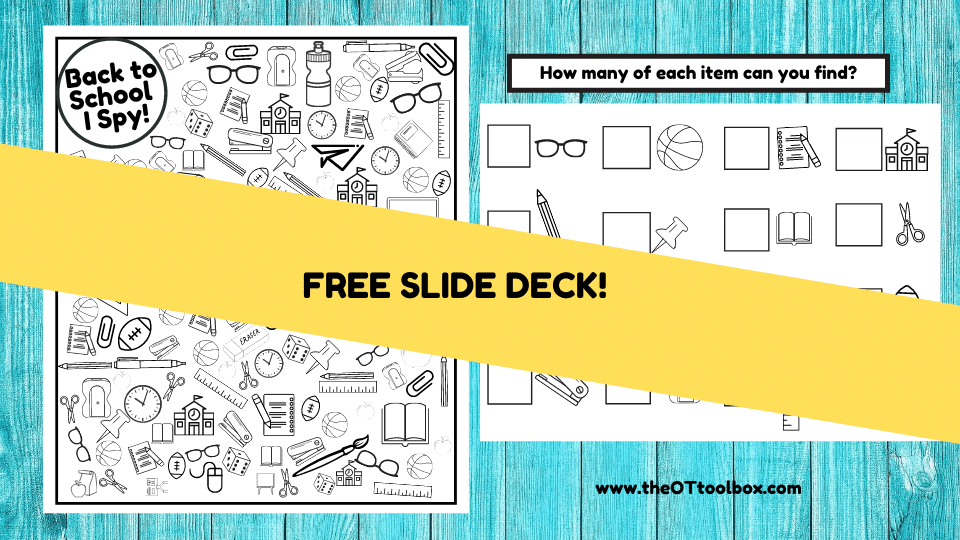
Start with an interactive slide deck I Spy game. Kids can search for school items and then type the number of items that they found into the boxes right on the slide.
Back to school handwriting baseline
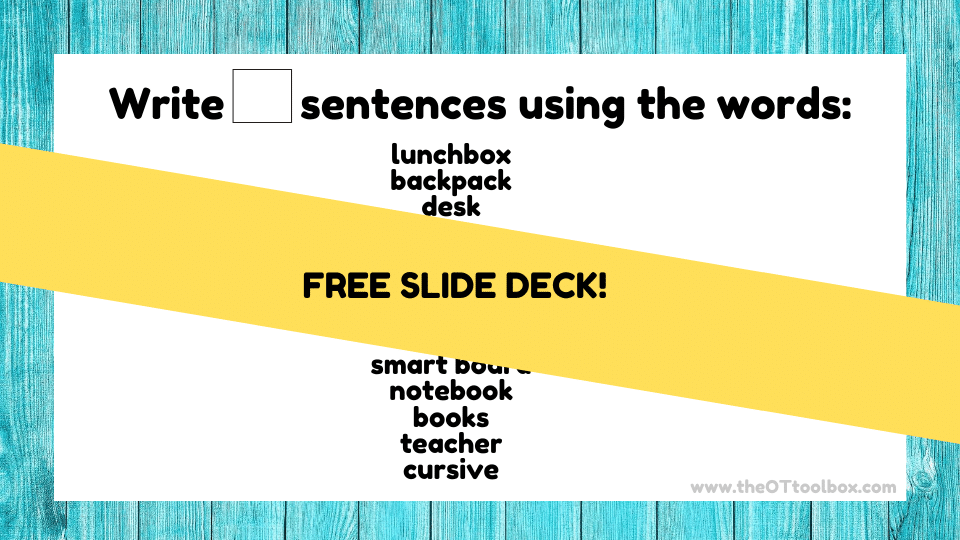
Use the handwriting slides to get a baseline snapshot of handwriting. Kids can type the words into the spaces on the slides. Then in the next slide, they can check their answers and use the written words to copy a short list of school related terms.
Use this list writing activity to check skills such as letter formation, letter size, line use, margins, accuracy, efficiency, and functional writing levels.
The same words can be used for sentence writing. Fill in the space showing the number of sentences the student should write. Using this writing task, check the handwriting baseline for word and letter spacing, margin use, and legibility.
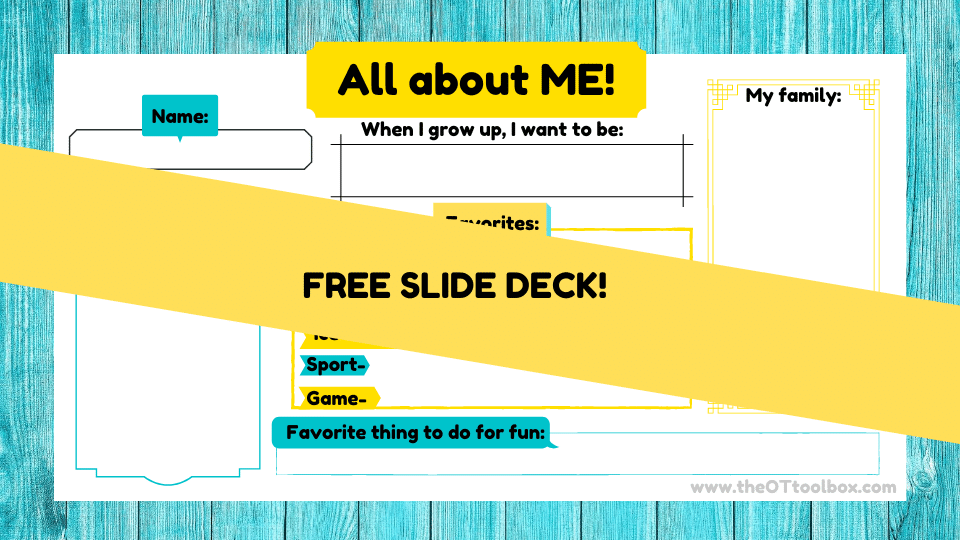
All about Me Activity
Use the next slide as an icebreaker activity. Students can fill in the spaces on the slide and type in their responses.
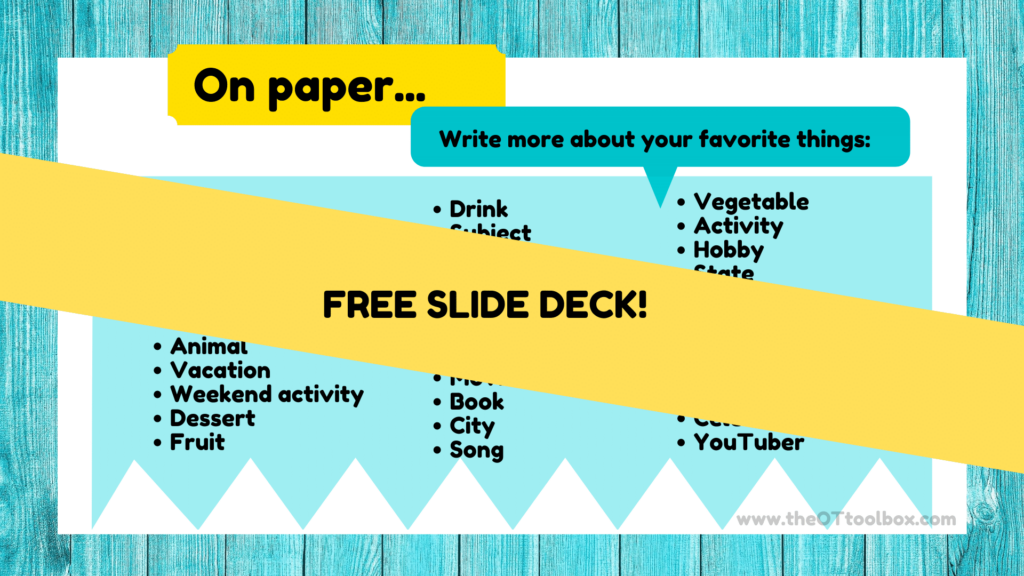
Continue on with the all about me activity and ask students to write on paper, more about themselves. Use these responses as a quick screening for handwriting and writing abilities.
There you have it! Want to grab this free slide deck?
This year, as we prepare for back-to-school, many therapists are asking how to create therapy kits. Many parents are wondering how to set their child up for success in hybrid schooling. Many with kiddos that will attend full or part-time online school are trying to figure out how prepare for the upcoming school year.
As a pediatric occupational therapist, I have always come up with small occupational therapy boxes or “kits” to use in practice. I love to create a themed box or bin of OT activities and use that to work on a certain set of skills.
THEMED THERAPY BOXES
In this upcoming school year, we will be using themed kits in our home to help my youngest learn and develop skills (handwriting, precision in cutting with scissors, reading, manipulatives and math). This was one way that I was able to hold her attention for schooling at home this past Spring, and we will continue with that strategy this school year.
Some ideas that help to hold a child’s attention and get them excited for therapy or learning include these therapy boxes based on a theme:
Each of these themed therapy bins takes a common theme and offers ways to build skills- fine motor skills, sensory exploration, and more- through play!
Having a boxed set of therapy materials allows children to explore tools that help them grow stronger as they explore and play. Kids love to “unbox” the materials and use them while they discover the therapy box materials.
It’s a great way to get kids excited about therapy this Fall when school and learning routines are out of the ordinary.
THERAPY BIN GIVEAWAY
The boxes are available as a single box purchase or in a monthly subscription model so that each month, you have a new therapy box arrive at your door. What a great way to get the kids excited about building developmental skills!
When you receive your box, you will be provided with activities for fine motor development, gross motor development, sensory play and family fun to enhance opportunities for growth & development.
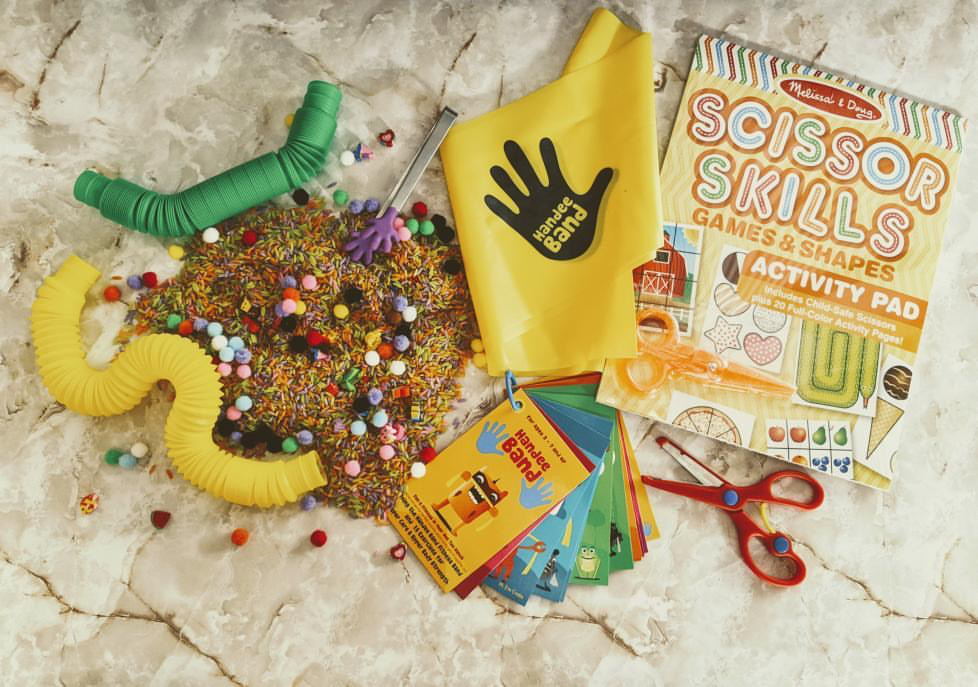
Check out the items in this giveaway box…add these tools to your OT sessions or at home activities:
OT for Me, is dedicated bringing families quality, hand-picked products and activities that have been tested and approved by the occupational therapy creators.
The therapy box aims to enhance kids’ individual skills and is cognizant that not all children develop at the same rate, so descriptions of the skills each product targets include strategies to make each activity harder or easier for that “just-right challenge”.
Each month, the therapy boxes are packed with new and exciting activities, meant to motivate children to “work” on developmental skills, all while having fun. Each box will always have an activity or product targeting the following 4 domains: Fine motor, Gross Motor, Sensory, & Academic/Family Fun- as well as other fun items!
Colleen Beck, OTR/L has been an occupational therapist since 2000, working in school-based, hand therapy, outpatient peds, EI, and SNF. Colleen created The OT Toolbox to inspire therapists, teachers, and parents with easy and fun tools to help children thrive. Read her story about going from an OT making $3/hour (after paying for kids’ childcare) to a full-time OT resource creator for millions of readers. Want to collaborate? Send an email to contact@theottoolbox.com.
Friends, I think if there is one thing to say about 2020, it’s that we all could use a break. A mental break, an emotional reprieve, and just rest. Because this has been such a stressful year, I wanted to bring you a week of giveaways for an occupational therapy Christmas in July event. This Christmas in July party is to celebrate YOU! It’s to honor all that OTs, teachers, and parents offer in the way of adapting to recent changes, managing balance, and providing support for our kids.
This giveaway offers a chance for you to win an item that will be useful in helping kids thrive. I’me excited to share with you a WEEK of giveaways on items that can be used in occupational therapy practice or in addressing the needs of children of all ages.
Christmas in July Giveaway!
You will want to bookmark this page, because here you will find each day’s giveaway item linked so that you can easily get to the giveaway page.
Here is what you need to know:
1. Each day from July 24th-August 1st, you’ll find a new giveaway item listed here. Feel free to enter one or all of the giveaways!
2. Participants are limited to US entrants only due to deliver-ability.
3. Each item has one winner. Winners will be randomly chosen. Winners will be notified through email. If your name is randomly chosen as the winner we will email you for shipping information. The giveaway item will then be shipped to you.
4. Giveaway is open July 24th-July 31st at 12:01 am PST. Each day, a new giveaway item will be announced here and in a new blog post. Enter to win by leaving a comment on the giveaway item’s blog post.
Without further ado, here are your giveaway items: