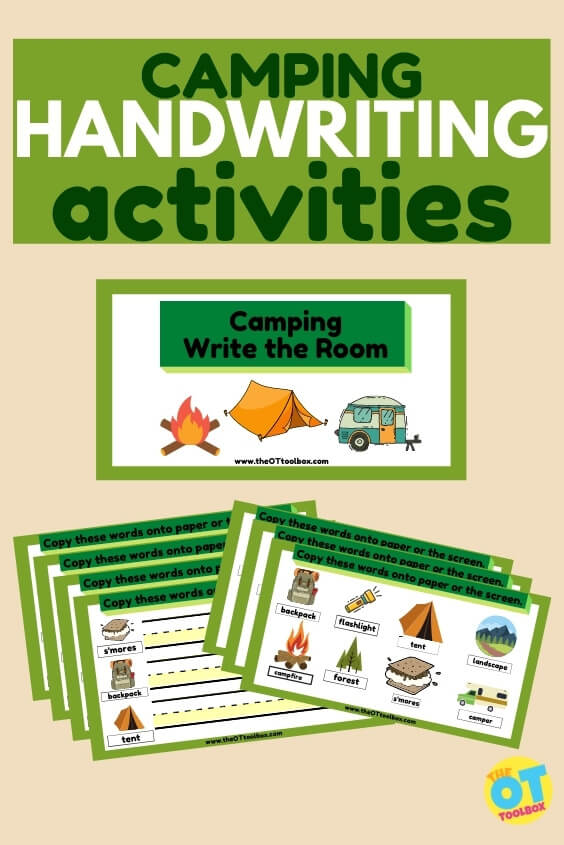
Going camping this summer? This free therapy slide deck is a camping writing activity that kids can use to work on handwriting skills this summer. Use the camping activity as a tool to work on handwriting skills in therapy sessions or at home this summer.
Camping Writing
When you think of camping and writing, you might think about writing letters home from a summer camp. Or, maybe you think of writing out packing lists before you head off to tent in the woods for the weekend.
Both are actually really great natural writing tasks that kids can use to put pencil to paper this summer and work on writing skills without the boring rote practice that thoughts of handwriting typically bring.
However, to expand on that theme a bit, this camping writing slide deck is great for building specific writing skills over the summer months.
You can use this slide deck in teletherapy sessions, in home programs, in extended school year, or at home to work on writing skills such as:
copying skills
letter formation
size awareness
line use
visual motor skills
The camping activities include visual forms that children can copy without admitting details so that they are working on visual perceptual skills such as form constancy, visual discrimination, visual closure, and other areas.
There are several simple camping images that build up to more complex camping images that kids can copy to build visual motor skills and attention to detail.
There’s also a part of the activity where kids can copy specific terms related to tenting and camping.
Kids can copy these words right onto the screen using an Google Jamboard or they can copy the words onto paper. Several slides have lined portions where kids can copy the words onto the screen. You’ll find a link to access this resource once you access the file in the form at the bottom of this post.
When kids copy words they need to work on they are using visual perceptual skills such as visual scanning, visual attention, visual memory, and visual shift. These tasks this skills are important for tasks such as copying written material from a chalkboard or smart board in the classroom.
This handwriting active activity can also be expanded to ask kids to copy the words into alphabetical order or to expand the activity by asking them to write a sentence including the words.
Free Camping Writing Slide Deck
Would you like to add this camping hand writing activity to your therapy tool box? Enter your email address into the form below to access this free therapy slide deck.
More Ideas for Summer
Want more ways to play and build skills while camping or with a camping theme in therapy sessions or at home? Check out these fun ideas:
Colleen Beck, OTR/L has been an occupational therapist since 2000, working in school-based, hand therapy, outpatient peds, EI, and SNF. Colleen created The OT Toolbox to inspire therapists, teachers, and parents with easy and fun tools to help children thrive. Read her story about going from an OT making $3/hour (after paying for kids’ childcare) to a full-time OT resource creator for millions of readers. Want to collaborate? Send an email to contact@theottoolbox.com.
Today I have a fun ice cream writing activity that gets kids excited about writing ice cream words and everything fun and motivating about ice cream. If your kids are anything like mine they love ice cream and the toppings ice cream cones sprinkles and the jingle of the ice cream truck.
Ice Cream Writing
In this ice cream writing activity kids can work on the skills they need for legible handwriting including letter formation sizing spacing and copying skills and the fine motor skills needed for a functional pencil grasp.
All of this happens in an interactive in a free Google slide that you can use in teletherapy face-to-face therapy home programs or in the classroom for with an ice cream theme.
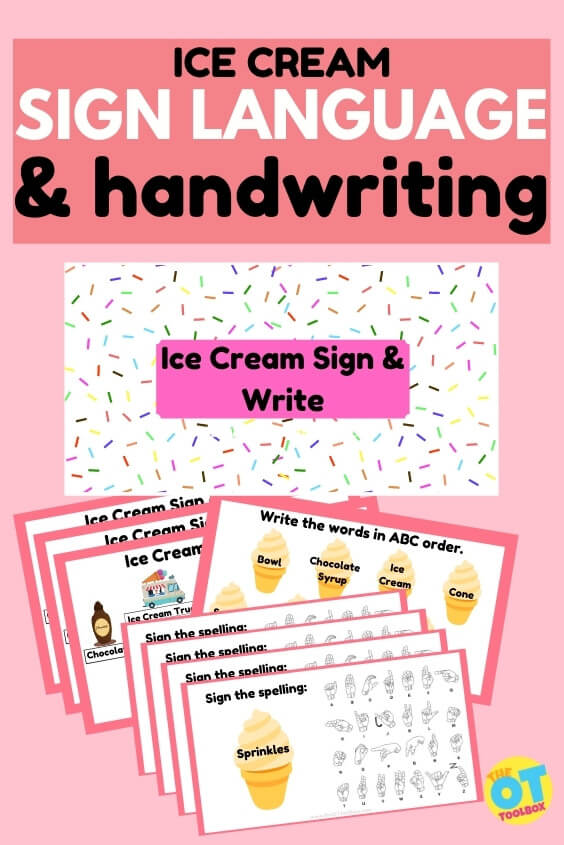
This ice cream writing activity begins with a several ice cream themed words including:
ice cream truck
chocolate syrup
ice cream scoop
cone
sprinkles
spoon
bowl
Ice Cream Writing Skills
Kids can copy the words from the slide deck and work on letter formation, sizing, spacing, and legibility.
You could expand the activity to ask kids to write the words in alphabetical order and address some visual perceptual skills such as visual scanning visual memory visual attention and visual discrimination and others.
Then the slides continue with a visual perceptual exercise that takes away one of the items on the previous slide.
This activity is much like one a hands-on “what’s missing” activity where you lay out several minute items on a table and then ask children to remember what they see in front of them and then after a few seconds you take away one of the items and ask them what’s missing.
“What’s Missing” games are such a great way to work on visual attention and visual memory skills. These skills are so needed for copying materials writing reading and recalling letter formation as well as hand writing rules like using spaces between words in pencil grasp rules.
The slides continue with several of these “what’s missing” activities with the ice cream theme where kids can write out the specific ice cream terms that are missing on each slide in further work on handwriting skills.
Write Ice Cream Words in ABC Order
The next ice cream handwriting activity asks kids to write in alphabetical order, several ice cream words scattered on ice cream cones.
Kids can work on copying those in order and work on the visual memory skills and visual perceptual skills needed for putting words into alphabetical order.
Ice Cream Sign Language Activity
The next several slides include several American Sign Language handwriting activities to spell out ice cream words.
There is an American Sign Language key on each slide so that kids can visually scan to copy the hand formations to spell out the words.
They will love using sign language to spell out ice cream words like sprinkles, scoop, ice cream, bowl, and spoon.
The benefits of asking children to use sign language to spell words is that if they do not know the sign language hand formations, that they need to visually attend to on the screen, using visual memory and visual attention skills to copy the formation.
However using sign language also develops working memory to recall and use the same letters in spelling. American sign language activities and spelling also benefits kids to work on fine motor skills such as:
finger isolation
separation of the sides of the hand
open thumb web space
arch development
dexterity
Ice Cream Writing Prompts
The last activity on this ice cream writing task is a open ended handwriting task which asks students to create sentences using the ice cream words.
You can expand this activity to meet the needs of various levels of children by asking them to copy more sentences or less sentences you can make the sentences very concrete and give them a specific sentence to write that contains the words or you can leave it open ended and ask students to write a silly sentence or a story using the words on the slide.
Use the ice cream writing prompts to meet the needs of your students!
You will also enjoy the other ice cream activities that we have here on the website including:
Would you like to add the slide deck to your therapy Toolbox? Enter your email address into the form below to access this ice cream writing activity.
Colleen Beck, OTR/L has been an occupational therapist since 2000, working in school-based, hand therapy, outpatient peds, EI, and SNF. Colleen created The OT Toolbox to inspire therapists, teachers, and parents with easy and fun tools to help children thrive. Read her story about going from an OT making $3/hour (after paying for kids’ childcare) to a full-time OT resource creator for millions of readers. Want to collaborate? Send an email to contact@theottoolbox.com.
This ice cream activity is also a working memory activity that combines the two themes into a hit of a therapy tool…a lot like combining ice cream and sprinkles! If building working memory skills this summer is on your to-do list, than this interactive ice cream ice cream activity is sure to be a hit! Add this to your summer OT activities and let’s build executive functioning skills!
Working Memory Activity
Working memory is a skill that can be difficult for many children but is used and needed for so many functional tasks. Working memory is an executive functioning skill that kids need for safety completing assignments reading participating in self-care tasks interacting with others and basically every task that we complete throughout the day.
We use working memory to complete school tasks, self-care tasks, and everyday living tasks!
Processing short term memories and using it allows us to respond in new situations. Working memory allows us to learn, play, and interact with the world around us. The skill allows us to self-regulate, and pull strategies that have worked (or didn’t work) for us in the past. Using working memory skills we can use past information in reading in order to read, spell, know math facts, phone numbers, faces, addresses, sight words…and so much more. We can remember our way back home, state capitals, mnemonics, phone numbers, addresses, and friends’ names. We can then use that information to answer questions based on what we know and apply that information in new situations. All of these abilities are working memory at work!
Ice Cream Working Memory Activity
That’s where this ice cream activity that address is working memory is comes in handy.
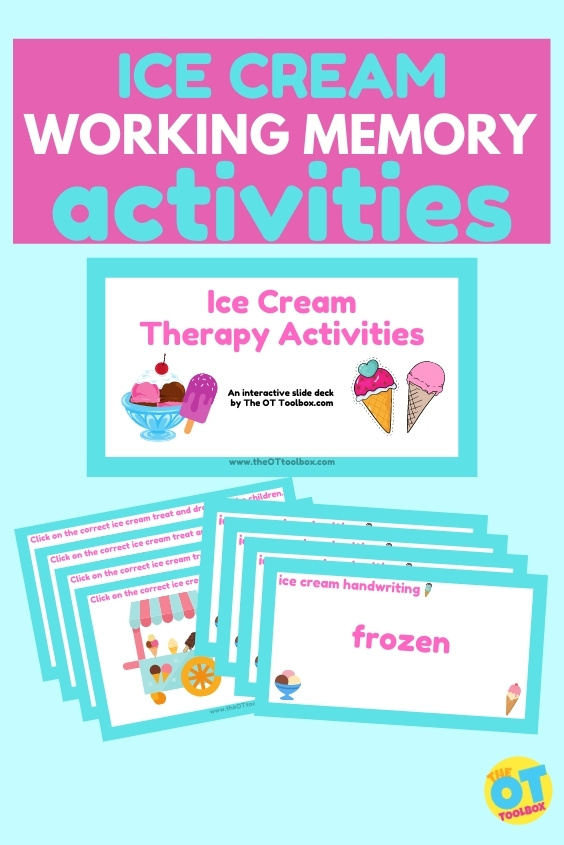
This ice cream working memory activity is a free virtual slide deck that can be used with teletherapy or to facilitate face-to-face therapy sessions as well as home programming or school activities.
In the ice cream working memory slide deck kids can move through the slides and work on various skills while they complete each slides instructions. The slide deck is designed to support and practice skills including:
working memory
visual attention
visual scanning
eye-hand coordination
direction following
sequencing
This slide deck is able to be graded to expand the activities and make them easier or harder for individual students based on their needs.
You can grade the activities by asking students to complete two or more tasks for each slide.
For example you can read the directions on the slide and then add additional steps or additional details that they need to remember and recall. Each ice cream ice cream on the slide deck is movable so this interactive slide deck is an interesting and fun way to work on specific skills for kids. When you open this slide deck in your Google Drive you can edit it in order to move the individual ice cream cones.
This is an engaging and motivating way for kids to work on listening sequencing motor planning and direction following. And this slide deck can be adjusted so that it addresses specifically different needs for kids you can for example move the ice cream cones to other areas on the slide that were give them to individual children based on descriptive colors or positions so that you’re working on other skills as well such as body awareness and position in space or other listening and comprehension skills.
Working Memory Activity for handwriting
When we write or copy material, we need to recall how to hold the pencil including verbal cues or physical cues we’ve experienced in the past. The ability to recall those cues during a similar task involved working memory. The ability to translate those cues to a muscle memory involves working memory as well.
You can see how working memory plays a role in letter formation, number formation, line use, spacing, sizing, pencil grasp, margin use, capitalization, punctuation, and overall legibility in handwriting.
Ice Cream Activity for Working Memory Skills
The slide deck with an ice cream theme is very engaging and fun for kids and it can be used to work on other areas to such as handwriting and visual motor skills.
There are several slides in the slide deck that work address on hand writing and copying skills kids can copy the different ice cream terms in and work on handwriting skills such as:
letter formation
letter size
line awareness
copying from a distant or near point
There are also drawing activities to address visual motor skills.
Kids can copy the simple and complex forms on the slide deck and work on details that are needed for copying work such as handwriting or lists in the classroom. When kids copy from a form they are working on visual motor skills in order to copy the form but they are also furthering their working memory skills by not missing any pieces of the drawing.
There are so many ways to use this engaging and motivating ice cream activity to work on working number memory skills!
Would you like to add this ice cream working memory activity to your therapy Toolbox? Enter your email address into the form below and you can access this therapy tour on your Google Drive. It’s able to be used in teletherapy sessions home programming face-to-face therapy sessions or in the home or classroom.
More Ice Cream Activities
Want more movement activities? Check out these fun ideas:
Colleen Beck, OTR/L has been an occupational therapist since 2000, working in school-based, hand therapy, outpatient peds, EI, and SNF. Colleen created The OT Toolbox to inspire therapists, teachers, and parents with easy and fun tools to help children thrive. Read her story about going from an OT making $3/hour (after paying for kids’ childcare) to a full-time OT resource creator for millions of readers. Want to collaborate? Send an email to contact@theottoolbox.com.
Today I have a fun baseball and softball activity to add to your therapy toolbox. This interactive therapy slide deck goes really well with our other baseball activity (perfect for softball themed fun, too!); this baseball matching game.
Baseball and softball activity
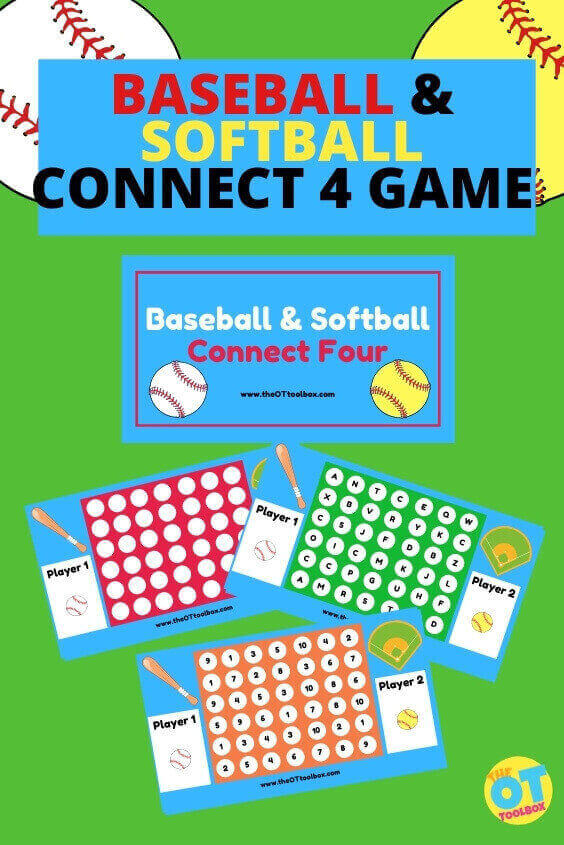
This baseball and softball activity is a digital connect four game is a lot like our other more recent digital connect four game with a space thing.
However this online connect four game has a baseball and softball theme that fits perfectly with the interest of many of the kids we work with.
Kids that love baseball or softball will love this Connect 4 game that actually addresses therapy goal areas and functional tasks, such as handwriting, letter formation, number formation, eye-hand coordination, visual scanning, visual memory, working memory, visual attention, and more.
Baseball & Softball Writing Activity
When you use it in Google slides the game is interactive, allowing kids to move the baseball and softball game pieces to play Connect Four.
This is just one of the many free slide decks available here on the site. Be sure to grab them all!
Because users can select the baseball or the softball game pieces, and then move them to cover spaces and play traditional Connect 4 games.
There is also a slide with letters on each space on the board. When players move their piece to cover that letter, they can write the letter focusing on letter formation. Expand the activity to ask kids to write a word that begins with that letter, or to write a sentence containing words that only begin with that letter. The game is very open-ended to meet the needs of all levels of students.
You’ll also find a game board containing numbers. Use this to work on number formation. OR, incorporate gross motor movement, balance, coordination, motor planning, and ask kids to do that number of a specific task, like jumping jacks, hops, skips, etc.
The online connect four game can be played with a therapist or another person and each participant can move the game pieces. Kids that love baseball or softball will love this virtual connect four game!
All of these are fun ways to address letter and number formation with an interactive and engaging activity.
Want to add this baseball themed activity or softball themed activity to your therapy Toolbox? Enter your email address into the form below to receive this interactive slide deck. It can be a great tool for a virtual therapy sessions teletherapy or face-to-face therapy activities. Consider even using this in-home or brain break activities in the classroom or at home.
To receive this free interactive connect four game enter your email address into the form below and it will be delivered to your email address via PDF.
Colleen Beck, OTR/L has been an occupational therapist since 2000, working in school-based, hand therapy, outpatient peds, EI, and SNF. Colleen created The OT Toolbox to inspire therapists, teachers, and parents with easy and fun tools to help children thrive. Read her story about going from an OT making $3/hour (after paying for kids’ childcare) to a full-time OT resource creator for millions of readers. Want to collaborate? Send an email to contact@theottoolbox.com.
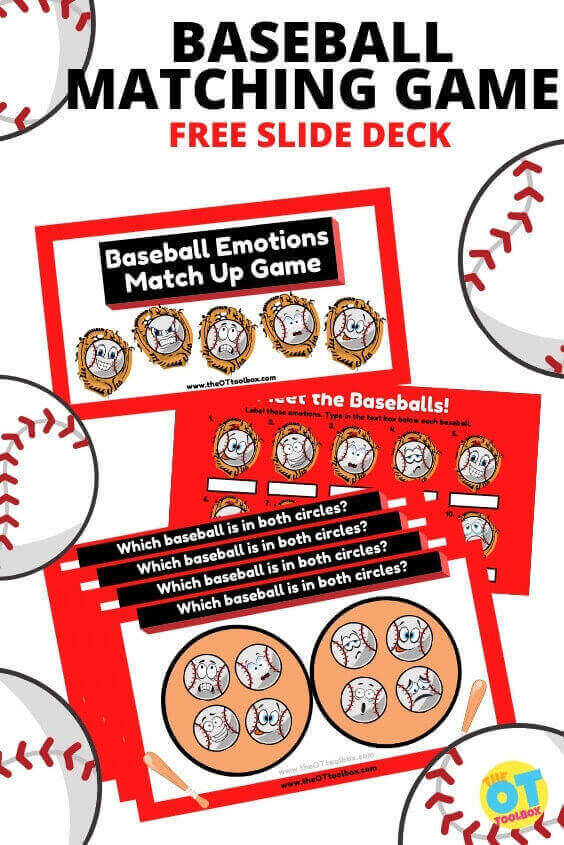
This Baseball matching game is another free slide deck to use in digital or face to face therapy sessions while working on a variety of occupational therapy skill areas. It’s a fun way to foster visual perceptual skills and social emotional learning through a baseball theme!
Today we have another social emotional resource for teaching emotions and showing children how to match facial expressions to meaning of emotions this baseball emotions game uses the spot it matching strategies to work on social emotional development as well as visual perceptual skills kids can.
This is a free therapy slide deck, so it can be used in teletherapy services or virtual sessions. However, now that more schools are moving to a face to face setting in the fall, this resource is still a great way to outline therapy sessions. Use the slides as activities with a baseball theme in therapy.
Kids can work on social emotional development skills that they need for communication playing with others and social participation by using the game as a tool for social emotional learning skills such as naming facial expressions.
Baseball matching Game
This baseball matching activity is great for a baseball theme or for kids that love all things sports and baseball.
On the slides kids will notice baseball gloves and baseball mitts that have different facial expressions.
When they play the game they can begin with the first slides that ask them to name and label emotions.
Kids can type right into the slide deck and name the emotions on different baseballs.
Then, the slide deck includes a matching component. Users can look at each circle on the slide and look for one matching pair. When they find the match, they can move the baseball bat to cover the matching baseballs.
These visual perceptual and visual motor skills are needed for hand writing and copying materials from a written source such as the chalkboard or dry race board.
If you were looking for baseball themed activities for therapy this slide deck is a great resource.
Access this slide deck in by entering your email into the form below and you can receive a free printable PDF which will lead you to the slide deck. This is a great activity for teletherapy or for using to facilitate face-to-face therapy sessions with children who love all things baseball or sports.
Colleen Beck, OTR/L has been an occupational therapist since 2000, working in school-based, hand therapy, outpatient peds, EI, and SNF. Colleen created The OT Toolbox to inspire therapists, teachers, and parents with easy and fun tools to help children thrive. Read her story about going from an OT making $3/hour (after paying for kids’ childcare) to a full-time OT resource creator for millions of readers. Want to collaborate? Send an email to contact@theottoolbox.com.
This frog emotions game slide deck is a tool for helping kids to identify emotions based on facial expression. It’s a social skills activity for young children that goes perfectly with this frog writing activity and our cute frog crafts. Use all frog games together as frog themed activities that develop skills.
Teaching emotions is an important part of social emotional development. That’s why this emotions game (with a cute frog theme) is so much fun, but also a great way to help kids learn to identify emotions, match up emotions by facial expression, and label different feelings. It’s just one of the many free slides here on the site, and one you’ll want to add to your toolbox.
Frog Emotions
You might be wondering “frog emotions? What does that mean?”
But we are not talking about the emotions of frogs here…we mean that you can use a fun theme like frogs and toads to talk to kids about emotions and emotional expressions! It’s an activity like this that uses frog emotions to help us explain to kids how they feel, how mood and affect impact their overall wellbeing, and how we all (even the cute frogs in this free slide deck activity) have feelings. It’s empathy skills through play!
Working with kids in occupational therapy sessions have shown me one thing…and that’s the fact that if we can make things fun and engaging (like the cute frogs in this activity) that we can help kids build skills!
This emotions game is modeled after several other similar emotions games we have here on the site. You can use all of these in sequence or to fit with different themes in therapy or in the classroom or home. Each emotions game includes a “spot it” type of matching game that allows kids to feel challenged, but also builds essential skills.
These other emotions games might fit with some of your themes you have planned:
The emotions games in these activities and in the one shown below, children can label different facial expressions and give a name to the visual emotions. The important thing here is to note that there is no right answer. Some children might have different names for emotions or the feelings that they experience.
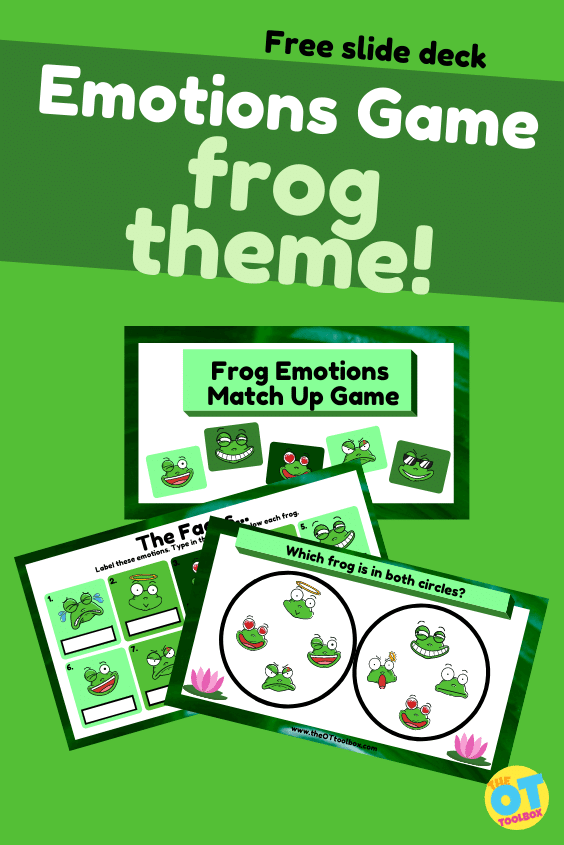
In the frog theme slide deck, there are different facial expressions for each frog’s face. Kids can type right into the slide deck and add a label for those expressions. You can extend this activity in several ways:
Ask kids to mimic the visual facial expression that they see on each frog’s face.
Ask the user to identify a time that they have experienced that particular emotion.
Ask the user to tell about a time that they have seen other’s experiencing that emotion. You can talk about what might lead up to another person experiencing a particular feeling or emotion. This task helps to build empathy for others.
Ask the child to identify ways to reach out to others when they might be feeling particular emotions. How can they help others who are feeling sad or angry? How would they like others to reach out to them when they themselves are feeling a particular feeling?
Ask the child to specify ways that they respond to particular emotions. What do they do when they feel upset, silly, or frustrated?
The next part of the slide deck includes matching activities in a “spot it” type of emotions game. The slide decks are interactive, meaning that kids can move the lily pads to cover the matching emotion on each slide.
Each slide has only one matching facial expression, and the player can look at each image and try to find the matching expression.
Frog Emotions Game
As an occupational therapist, I’ve found that incorporating themed activities like a frog emotions game can be incredibly beneficial for children. This type of activity not only targets emotional regulation skills but also adds an element of fun and engagement to therapy sessions.
Children are often drawn to themed activities because they provide a novel and exciting experience, making therapy feel less intimidating and more enjoyable. The frog theme adds a playful twist, allowing kids to explore and express their emotions in a lighthearted manner. By integrating games like this into therapy sessions, we can create a motivating environment that encourages active participation and enhances the overall effectiveness of treatment.
The frog theme activity is a social emotional learning game that kids can use to build awareness and strategies, too.
After playing the emotions matching on the slide, then focus more on building awareness of emotions and social development. After the child finds the match, they can identify the expression that is depicted on that frog’s face. T
hen, go back to what was covered in the beginning with some of the same questions: how do they think that frog feels? When did they experience that expression? If they felt angry (or frustrated, silly, sad, etc.) in school when they need to complete an assignment? How would they feel if they were playing a game and experienced feelings of frustration?
All of these questions allow the child to think in situational experiences so they can be ready to function. Situational awareness, empathy of others, and social emotional development are all learned skills, and having experience, the words to use, and tools in their back pocket will allow them to function in future tasks or situations.
After you are done playing, just go to the slide deck edit history and click “reset slides” to revert them to their original set-up. You can then play again…just click the lily pads and drag them to cover each matching frog face, and work on labelling emotions again and again!
Free emotions game slide deck
We have a free frog themed emotions activity in slide deck form.
To add this free emotions game to your therapy toolbox, enter your email address into the form below. You’ll receive a printable that you can use in therapy, the home, or the classroom.
NOTE- Email addresses on a school or work server may block the email delivering your file. Consider using a personal email address for better deliverability.
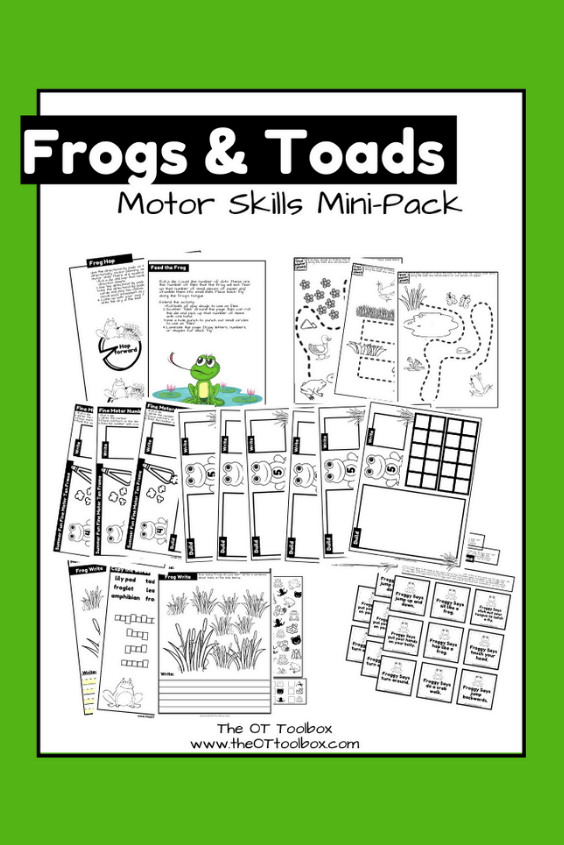
Done for you motor skills activities and FUN frog and toad themes combine in the Frogs and Toads Motor Skills Mini-Pack. Work on grasp, hand strength, eye-hand coordination, handwriting, scissor skills, heavy work, gross motor skills, coordination, and all things fine and gross motor skills in this 43 page printable packet.
Colleen Beck, OTR/L has been an occupational therapist since 2000, working in school-based, hand therapy, outpatient peds, EI, and SNF. Colleen created The OT Toolbox to inspire therapists, teachers, and parents with easy and fun tools to help children thrive. Read her story about going from an OT making $3/hour (after paying for kids’ childcare) to a full-time OT resource creator for millions of readers. Want to collaborate? Send an email to contact@theottoolbox.com.
Today we’re talking all about frog writing! These frog writing activities are part of a free slide deck to outline therapy sessions and to use to foster visual perceptual skills and handwriting skills. Add these frog writing activities to this list of cute frog crafts which are designed to develop and refine fine motor skills in kids.
You’ll also love our frog emotions activity as another tool to add to your frog theme of activities!
The frog writing prompts included in this therapy slide deck are perfect to add to your frog theme or use in a weekly occupational therapy theme (or at-home theme for learning, play, and building developmental skills!)
Frog Writing
The kids that I’ve worked with in OT sessions love this frog writing activity…and they don’t realize all of the work they are putting into the task because it’s a fun way to target OT goals.
In my experience as an occupational therapist working in schools, incorporating fun themes into handwriting sessions has been incredibly effective for improving skills that impact learning. A frog theme set of activities is one way to do that!
The frog writing activity supports fine motor skills, visual motor skills, pencil control and overall handwriting skills. Utilizing frog writing prompts and activities not only adds an element of fun for the children but also provides valuable opportunities to address fine motor and visual motor considerations essential for handwriting.
Sometimes, having a set of themed activities set-up for therapy sessions is a “must” to keep therapists sane. It’s not about using the same activities with each student; Using a theme in therapy activities allows the therapist to use the same materials. And having the skilled ability to adjust for each individual is just part of an OT’s skillset. To make your life much easier as a busy therapist, head over to this free slides library and grab all of the therapy themes that fit your interests and those on your caseload.
That’s where these frog writing activities come into play.
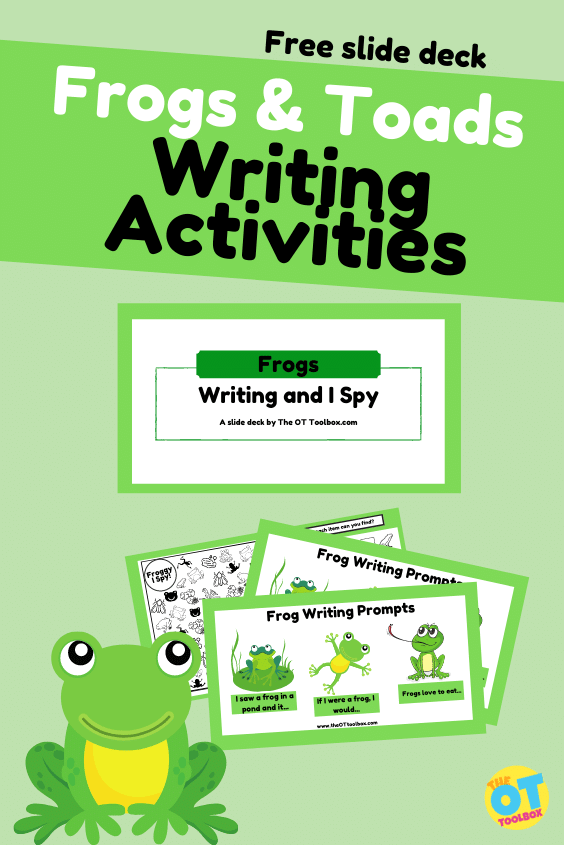
The free slide deck includes several frog writing activities for users to build specific skills, depending on their needs and goal areas.
You’ll find frog I Spy game and several frog writing slides to work on handwriting skills.
More Frog Writing Ideas
There are more ways to work on fine motor and visual motor skills with this frog writing activity.
Copy the words to work on letter formation and copying skills
Use tweezers in fine motor activities that mimic the movements involved in catching or feeding frogs, such as using tweezers to pick up frog-themed manipulatives. This further strengthens fine motor skills essential for precise handwriting.
Fold paper into origami frogs
Frog I Spy
The first activity is a warm-up of sorts. You’ll find a frog I Spy game where users can locate, count, and find individual frog and toad images. This is a great visual perceptual skills activity to build and develop skills in areas such as:
Visual discrimination (needed for identifying differences between letters)
Visual scanning (needed for scanning a writing piece for where you’ve left off in copying materials)
Form constancy (knowing that a form or letter is the same no matter the positioning. This skill is needed for recognizing letters in different fonts and sizes)
When kids find the individual frogs and toad images they can type the number into the interactive slide deck.
This frog I spy game is available as a printable worksheet in our Frogs and Toads Motor Skills Mini-Pack. Find the items, then write the numbers in the boxes. Kids can also color or circle the items to build pencil control and fine motor skills. The packet is 43 pages of fine and gross motor skill activities with a frogs and toads theme. Not bad for the cost of a cup of coffee!
Frog Writing Prompts
Next in the frog writing activities are a few writing prompts. I’ve included both frog word writing prompts and also sentences as an open-ended writing prompt to foster creative writing.
The frog words include things like froglet, pond, lily pad, and words that are easily read and recognized by younger children.
Pair this activity with frog lifecycle activities for handwriting practice of letter formation, letter size, legibility, and even cursive handwriting for the older elementary ages.
The next piece is a frog writing prompt slide. This slide includes three writing prompts that users can use for longer writing samples.
All of these writing prompts are open-ended so that you can easily adjust the therapy sessions or home programing to meet the needs of the child or individual.
Free Frog Writing Slide Deck
Want to add this free slide deck to your therapy toolbox and work on handwriting and visual perceptual skills in written work? Grab this resource and outline writing activities so the kids you serve can work on areas like letter formation, copying skills, and more. You’ll need to enter your email address into the form below and the file will be delivered to your inbox. (School email addresses/work email addresses may block this email as it contains a link to access a file. A personal email address may work better for deliverability.)
Colleen Beck, OTR/L has been an occupational therapist since 2000, working in school-based, hand therapy, outpatient peds, EI, and SNF. Colleen created The OT Toolbox to inspire therapists, teachers, and parents with easy and fun tools to help children thrive. Read her story about going from an OT making $3/hour (after paying for kids’ childcare) to a full-time OT resource creator for millions of readers. Want to collaborate? Send an email to contact@theottoolbox.com.
Done for you motor skills activities and FUN frog and toad themes combine in the Frogs and Toads Motor Skills Mini-Pack. Work on grasp, hand strength, eye-hand coordination, handwriting, scissor skills, heavy work, gross motor skills, coordination, and all things fine and gross motor skills in this 43 page printable packet.
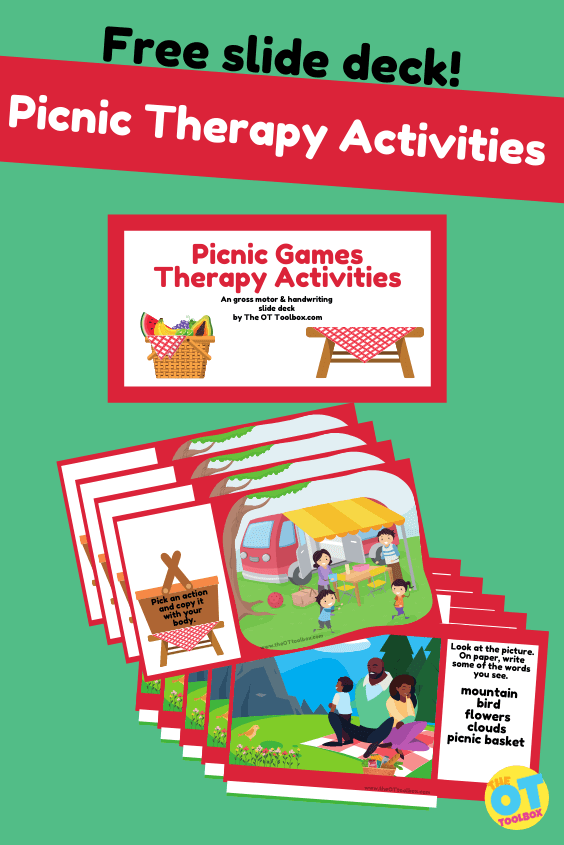
This week’s free slide decks are fun virtual picnic therapy activities that can be used to encourage motor skills in therapy sessions. I love the picnic theme for the upcoming warmer weather this summer, but also as a fun way to spend the last few weeks of the school year. Kids will love this virtual picnic in therapy or at home! Also be sure to grab this left right discrimination picnic theme slide deck.
Virtual Picnic
When you use this virtual picnic to facilitate gross motor skills, kids can move, strengthen core stability, work on bilateral coordination, crossing midline, motor planning, eye-hand coordination, body awareness, muscle memory, and many other skills.
Plus, the virtual picnic activities includes a visual perceptual skills activities, and picnic handwriting activities.
These virtual picnic activities go hand-in-hand with picnic crafts, fine motor activities, mindfulness activities, making a full week of camping themed or picnic themed fun for kids.
Combine the picnic therapy activities on this slide deck to some other, hands-on picnic themed activities to round out the therapy theme:
And, when you have a picnic, making picnic foods with kids is a must…further building fine motor skills, cognitive skills like planning, preparation, impulse control, and other executive functioning skills, and independence in daily tasks! Try these cooking with kids activities that help to build skills, but are GREAT picnic foods for kids to make:
Kids can participate in the virtual picnic by making one of these cooking activities (as long as they have a helper at home for their cooking activities) or, make pretend food and work on direction following, sequencing, planning, and task completion.
So, you can use these ideas to combine therapy recommendations for the home OR use these ideas in therapy sessions to create picnic themed therapy activities!
Want to add virtual picnic activities to your sessions or home programming? This week’s free slide deck covers several different occupational therapy intervention areas (and are great for physical therapy sessions, too.)
Picnic Gross Motor Activities
The first part of the slide deck includes picnic gross motor activities.
Kids can look at the image on the slide deck and pick out one piece of visual information in order to act out the picnic scene. Each picnic scene includes several people that are in various gross motor positions to challenge core strength, coordinatin, midline crossing, bilateral coordinaiton, motor planning, and more.
Kids can also work on visual perceptual skills such as visual discrimination, visual figure ground, visual closure, etc.
Children can then use this part of the slide deck to foster muscle memory, visual memory, and sequencing. You could go through this part of the slide deck several times and work on recalling physical motor sequences or play a memory game. The slides are pretty open-ended to facilitate a number of goal areas when it comes to gross motor skill, coordination, visual skills, etc.
Picnic Handwriting Activities
The next several slides in the slide deck are open-ended picnic writing prompts. There are more picnic scenes that include a variety of picnic items.
Children can scan the image and pull out words to write on paper, or they can use the list on the slide deck to copy and then find the hidden items in the picture.
To grade this activity, ask kids to compose a sentence using the picnic words on the slide. Or, ask children to circle the items on the slide using a shape feature on Google slides. These activities challenge the visual perceptual skills and visual motor skills needed for handwriting and copying written work.
Use these picnic handwriting activities to focus on letter formation, spacing, sizing, and overall neatness in handwriting skills.
Free Virtual Picnic Slide Deck
Want to add this virtual picnic slide deck to your therapy toolbox? Enter your email address into the form below to access this slide deck. Don’t forget to check out all of the Free Slides that we have available for teletherapy and for facilitating therapy sessions with kids!
Colleen Beck, OTR/L has been an occupational therapist since 2000, working in school-based, hand therapy, outpatient peds, EI, and SNF. Colleen created The OT Toolbox to inspire therapists, teachers, and parents with easy and fun tools to help children thrive. Read her story about going from an OT making $3/hour (after paying for kids’ childcare) to a full-time OT resource creator for millions of readers. Want to collaborate? Send an email to contact@theottoolbox.com.
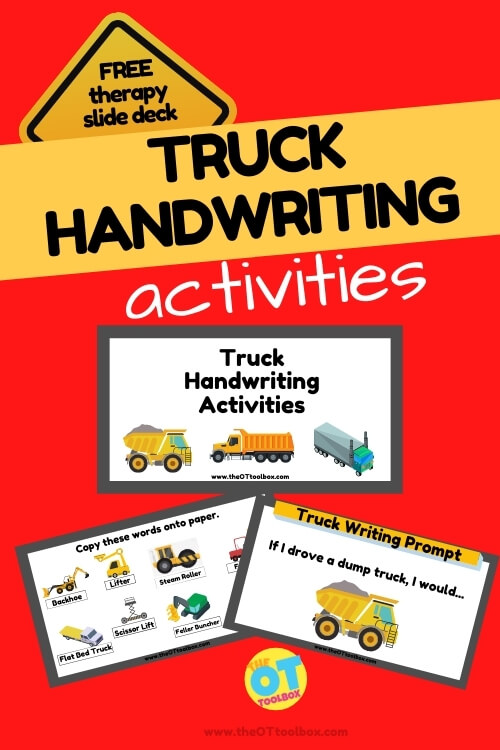
This truck handwriting activity is another free slide deck, but one that uses truck themes to help with writing, letter formation, and working on legible, functional handwriting. Perfect for kiddos that love all things construction vehicles, this truck handwriting activities go well with our recent construction vehicle brain breaks.
Truck Handwriting Activity
Use this truck handwriting activity is great for virtual therapy (one of the many free slide decks here on the site) but can be used to outline therapy sessions in a face-to-face manner as well.
In the handwriting slide deck, you’ll find truck words that kids can copy. There are different types of construction trucks. Users can visually scan to copy the words. Expand the activity in a few different ways to work on more handwriting skills:
Write the words in alphabetical order to work on visual scanning, visual memory, and visual scanning.
Write the words into sentences to work on spacing between letters and words, margin use, and size.
Describe a truck on the screen and ask students to write the word from memory to work on visual memory.
Work on cursive writing, uppercase letters, or lowercase letters to address letter formation.
Truck Writing Prompts
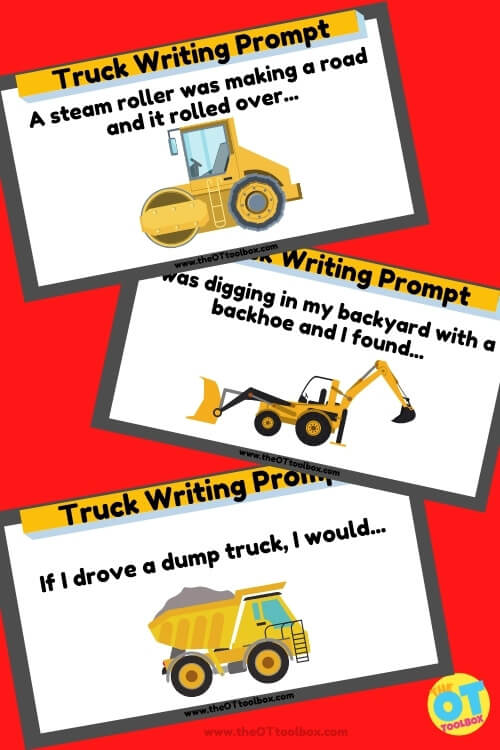
Also included in the truck handwriting activities are writing prompts. Kids can copy the writing prompt and then continue the writing task to finish the thought. This can be a great way to work on spatial awareness, writing speed, margin use, and functional handwriting.
There are four different truck writing prompts included in the slide deck:
If I drove a dump truck, I would…
I was digging in my backyard with a backhoe and I found…
A steam roller was making a road and it rolled over…
If I could drive any truck, it would be…and I would…
Kids that love construction vehicles will love these truck writing prompts. Working on handwriting skills doesn’t need to be boring, it’s all about meaningful handwriting to make handwriting motivating and fun that build skills!
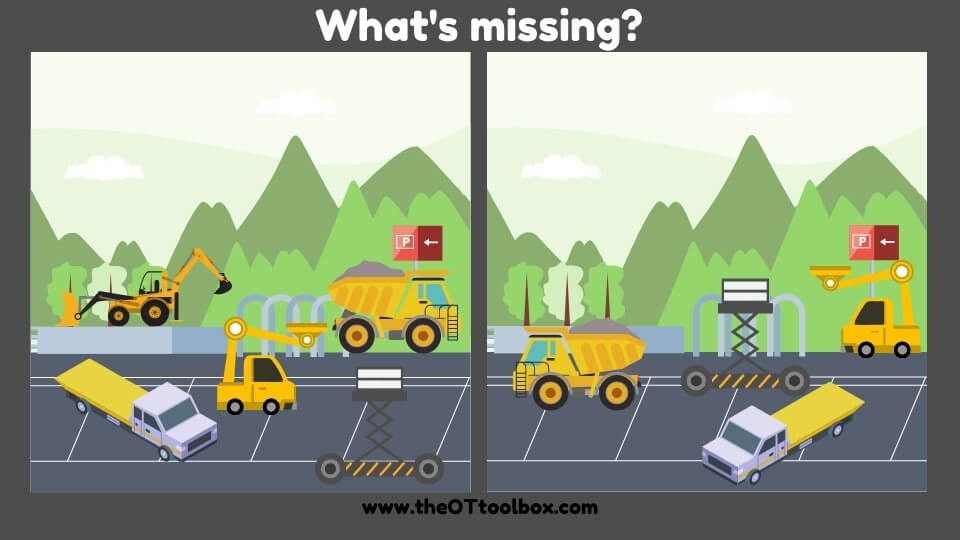
Truck “What’s Missing” Activities
Also included in this truck activity are different truck “What’s Missing” pages. These visual perceptual activities are challenges to help kids work on visual perceptual skills like:
visual discrimination
visual figure-ground
visual scanning
visual attention
visual memory
form constancy
Turn these what’s missing activities into a motivating handwriting activity by asking kids to write the names of the truck words that are missing from the image on the right.
Draw a Truck Activity
Finally, kids can work on visual motor skills, pencil control, size and spatial awareness to draw a truck! There are several truck drawing slides included that challenge kids to draw different forms.
Free truck handwriting activities slide deck
Know a kiddo that loves all things trucks and construction vehicles? Grab this free slide deck to work on handwriting skills.
Enter your email address into the form below and access these handwriting activities.
Note: Try to use a personal email address, as work email addresses have been blocking the email delivery due to increased security issues.
Colleen Beck, OTR/L has been an occupational therapist since 2000, working in school-based, hand therapy, outpatient peds, EI, and SNF. Colleen created The OT Toolbox to inspire therapists, teachers, and parents with easy and fun tools to help children thrive. Read her story about going from an OT making $3/hour (after paying for kids’ childcare) to a full-time OT resource creator for millions of readers. Want to collaborate? Send an email to contact@theottoolbox.com.
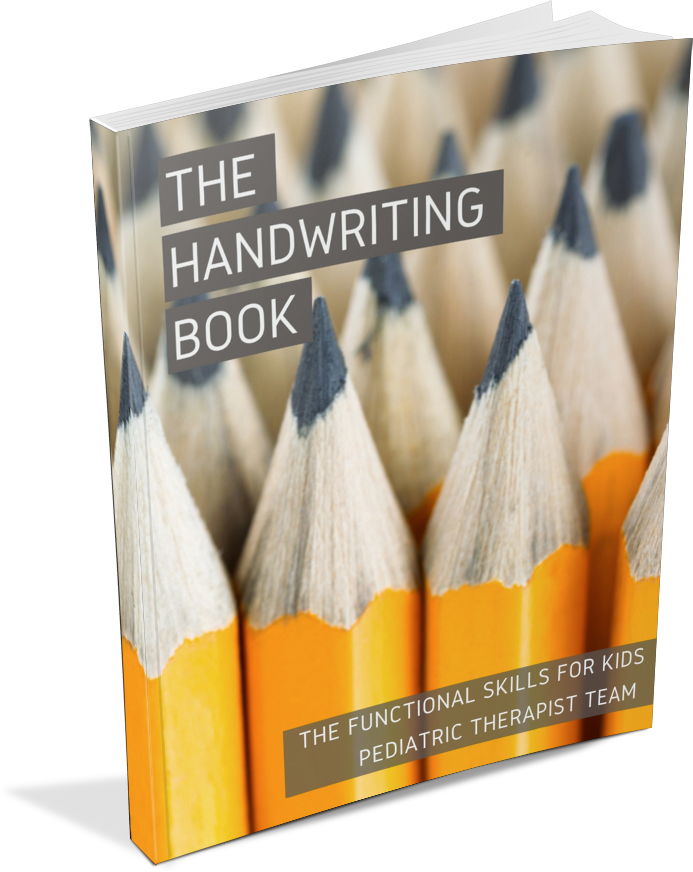
The Handwriting Book is a comprehensive resource created by experienced pediatric OTs and PTs.
The Handwriting Book covers everything you need to know about handwriting, guided by development and focused on function. This digital resource is is the ultimate resource for tips, strategies, suggestions, and information to support handwriting development in kids.
The Handwriting Book breaks down the functional skill of handwriting into developmental areas. These include developmental progression of pre-writing strokes, fine motor skills, gross motor development, sensory considerations, and visual perceptual skills. Each section includes strategies and tips to improve these underlying areas.
Strategies to address letter and number formation and reversals
Ideas for combining handwriting and play
Activities to practice handwriting skills at home
Tips and strategies for the reluctant writer
Tips to improve pencil grip
Tips for sizing, spacing, and alignment with overall improved legibility