Visual Efficiency and Vision Problems You Can Not “See”

Visual efficiency visual processing and other vision problems

This post describes visual efficiency, including visual problems such as convergence insufficiency or other visual processing issues impacting functional tasks. These visual processing problems may present in ways that are not obvious but do lead to trouble with reading and learning. As a related resource, check out our blog post on types of eye specialists and specifically, behavioral optometrists.

Visual Efficiency

A child struggles with handwriting.  They work hard in school and can verbalize answers to spelling tests or spout off vocabulary meanings and math facts.  But when it comes to reading assignments, creative writing tasks, or writing a list of words on a spelling test, you notice it.

This child seems distracted in the classroom.  They resist homework.  In-class assignments are not completed on time and when he needs to silently read a passage and recall the details, he seems distrait.

Sometimes, these learning problems are an indication of a vision problem. Sometimes, the child is not complaining of trouble seeing and they have passed vision tests, yet there might be a hidden vision problem.


Visual processing and visual efficiency are hidden eye problems that might not seem obvious when a child goes about his day. A child who needs glasses for acuity will squint his eyes of complain about headaches or blurry words on the page.  A child with visual processing or visual efficiency difficulties may slip through the fuzzy visual cracks.


Visual perceptual skills are needed for so many functional skills. You’ll find easy and fun ways to work on visual perceptual skills through play here. 

Visual processing, visual efficiency, and learning including how vision is related to reading and writing.

What is Visual Efficiency

Lets start by discussing the differences between visual processing and visual efficiency.

Visual Processing
Visual processing is a large way to describe many visual skills. When a child has a problems with visual processing, they have difficulty taking in information and processing that visual information in order to make sense of it. 

Visual processing includes visual tasks such as laterality, directionality, form perception, visual memory, visual closure, and visual motor integration. These are the kids who have trouble with letter reversals, difficulty learning the letters of the alphabet, has poor comprehension skills, has poor recall of visual information, has trouble with writing spelling words and vocabulary, or has sloppy handwriting.

Visual scanning can be one of these processing skills impacting the retrieval of visual information.

Taking in and processing that information can include visual efficiency.

Visual Efficiency
Visual efficiency refers to the ability to effectively view visual information.  While visual efficiency refers to nearsightedness and farsightedness, it also includes problems with how the eyes move in order to focus on visual information:

  • Visual focusing
  • Visual tracking
  • Visual tracking
  • Eye teaming
  • Convergence insufficiency

Visual efficiency problems may present as squinting, complaints of blurred vision, inattention, looses place when reading, poor reading comprehension, moving head when reading, or skipping lines when reading.

You can see how the ability to effectively track, focus, use the eyes together, and converge on information plays a huge role in processing that information for perceptual information so it can be used functionally, in conjunction with motor tasks (visual motor skills).

These are the types of problem areas that often times present later in the elementary school years or when students are required to read a significant amount of information.  
Visual processing, visual efficiency, and learning including how vision is related to reading and writing.


What to do about vision problems

If a child is suspected of having problems in these areas, it is important to have them tested by an optometrist who is qualified to treat learning related vision problems.  Kids can overcome problems with visual processing and visual efficiency through help, tutoring, adaptations, modifications, and corrected vision problems.

Here is more information about strategies to address visual perceptual skills and handwriting. Also check out our resource on handwriting problems.

Visual Efficiency Activities

Because the visual processing skills are so closely related (taking in information, visual perception, visual efficiency, and visual motor skills), activities are often combining all of these areas, and involve functional tasks as well.

Play is a favorite occupation of kids, so many of these activities incorporate play as a therapeutic activity to develop visual efficiency and visual processing skills.

Visual Motor Integration Bilateral Coordination Activity


Eye-hand coordination activity with letters


DIY Lacing Cards for Bilateral Coordination


Visual Closure Bug Worksheets


Scooping Eye-Hand Coordination Activity

Practice “b” and “d” with sensory writing

Color shape discrimination Sort

Coin discrimination

Real toy I Spy game  

You will find MANY more visual processing activities on our Visual Processing Page.

Here are some fun ways to help with visual efficiency concerns:  

Visual processing, visual efficiency, and learning including how vision is related to reading and writing.

These Visual Processing and Visual Efficiency tools are perfect for building skills that are needed in reading, writing, and learning tasks:

Visual Processing Bundle

Colleen Beck, OTR/L has been an occupational therapist since 2000, working in school-based, hand therapy, outpatient peds, EI, and SNF. Colleen created The OT Toolbox to inspire therapists, teachers, and parents with easy and fun tools to help children thrive. Read her story about going from an OT making $3/hour (after paying for kids’ childcare) to a full-time OT resource creator for millions of readers. Want to collaborate? Send an email to contact@theottoolbox.com.
Truck Handwriting activity Slide Deck

truck handwriting activities

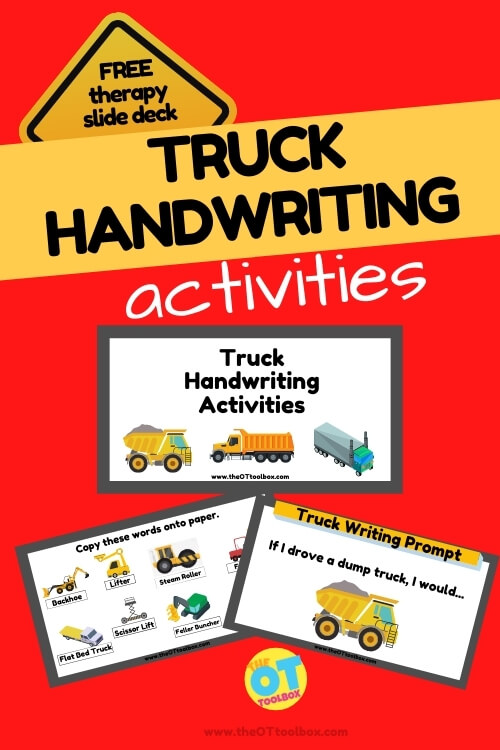
This truck handwriting activity is another free slide deck, but one that uses truck themes to help with writing, letter formation, and working on legible, functional handwriting. Perfect for kiddos that love all things construction vehicles, this truck handwriting activities go well with our recent construction vehicle brain breaks.

Truck handwriting activities and truck writing prompts in a free therapy slide deck for teaching handwriting virtually.

Truck Handwriting Activity

Use this truck handwriting activity is great for virtual therapy (one of the many free slide decks here on the site) but can be used to outline therapy sessions in a face-to-face manner as well.

In the handwriting slide deck, you’ll find truck words that kids can copy. There are different types of construction trucks. Users can visually scan to copy the words. Expand the activity in a few different ways to work on more handwriting skills:

  • Write the words in alphabetical order to work on visual scanning, visual memory, and visual scanning.
  • Write the words into sentences to work on spacing between letters and words, margin use, and size.
  • Describe a truck on the screen and ask students to write the word from memory to work on visual memory.
  • Work on cursive writing, uppercase letters, or lowercase letters to address letter formation.
Truck writing prompts to help kids with writing words and sentences in to practice handwriting.

Truck Writing Prompts

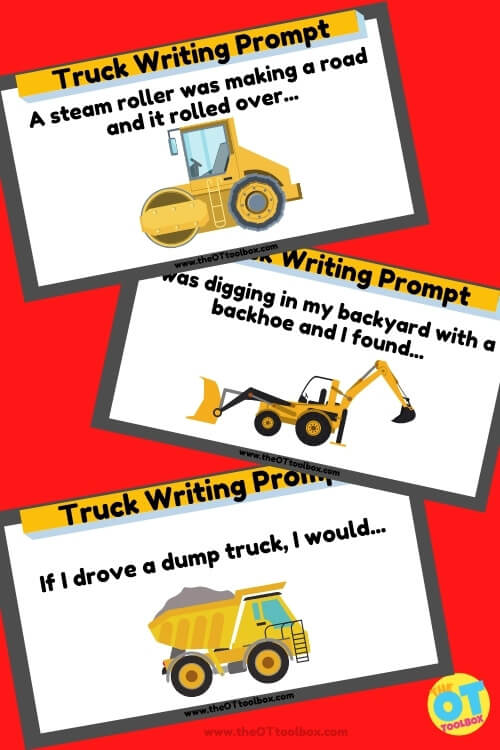
Also included in the truck handwriting activities are writing prompts. Kids can copy the writing prompt and then continue the writing task to finish the thought. This can be a great way to work on spatial awareness, writing speed, margin use, and functional handwriting.

There are four different truck writing prompts included in the slide deck:

  • If I drove a dump truck, I would…
  • I was digging in my backyard with a backhoe and I found…
  • A steam roller was making a road and it rolled over…
  • If I could drive any truck, it would be…and I would…

Kids that love construction vehicles will love these truck writing prompts. Working on handwriting skills doesn’t need to be boring, it’s all about meaningful handwriting to make handwriting motivating and fun that build skills!

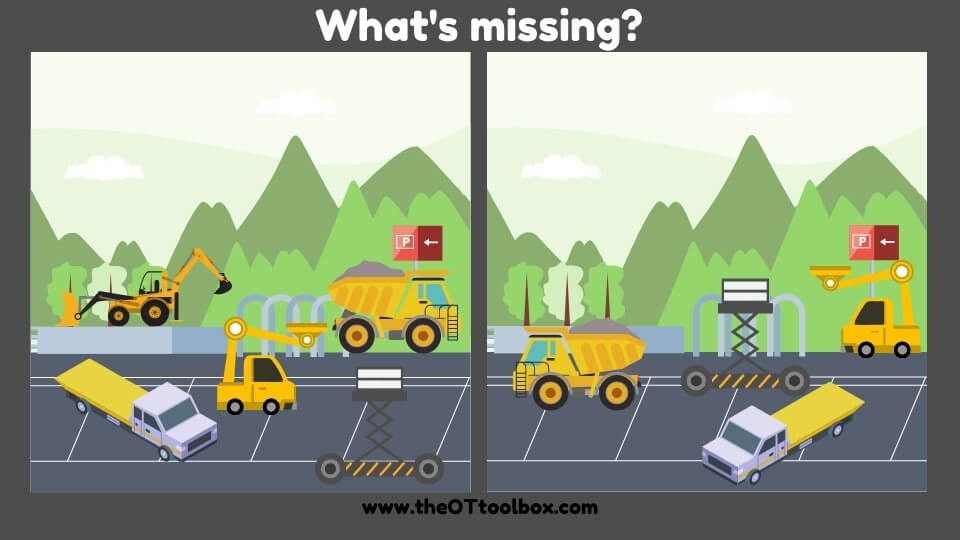
What's missing pictures like this truck "what's missing" picture help kids with visual perceptual skills like visual discrimination, figure-ground, visual scanning, form constancy, and other visual perceptual skills in handwriting.

Truck “What’s Missing” Activities

Also included in this truck activity are different truck “What’s Missing” pages. These visual perceptual activities are challenges to help kids work on visual perceptual skills like:

  • visual discrimination
  • visual figure-ground
  • visual scanning
  • visual attention
  • visual memory
  • form constancy

Turn these what’s missing activities into a motivating handwriting activity by asking kids to write the names of the truck words that are missing from the image on the right.

Draw a Truck Activity

Finally, kids can work on visual motor skills, pencil control, size and spatial awareness to draw a truck! There are several truck drawing slides included that challenge kids to draw different forms.

Free truck handwriting activities slide deck

Know a kiddo that loves all things trucks and construction vehicles? Grab this free slide deck to work on handwriting skills.

Enter your email address into the form below and access these handwriting activities.

Note: Try to use a personal email address, as work email addresses have been blocking the email delivery due to increased security issues.

Truck Handwriting Activities (free slide deck)!

    We respect your privacy. Unsubscribe at anytime.

    Colleen Beck, OTR/L has been an occupational therapist since 2000, working in school-based, hand therapy, outpatient peds, EI, and SNF. Colleen created The OT Toolbox to inspire therapists, teachers, and parents with easy and fun tools to help children thrive. Read her story about going from an OT making $3/hour (after paying for kids’ childcare) to a full-time OT resource creator for millions of readers. Want to collaborate? Send an email to contact@theottoolbox.com.
    The Handwriting Book is a comprehensive resource created by experienced pediatric OTs and PTs.

    The Handwriting Book covers everything you need to know about handwriting, guided by development and focused on function. This digital resource is is the ultimate resource for tips, strategies, suggestions, and information to support handwriting development in kids.

    The Handwriting Book breaks down the functional skill of handwriting into developmental areas. These include developmental progression of pre-writing strokes, fine motor skills, gross motor development, sensory considerations, and visual perceptual skills. Each section includes strategies and tips to improve these underlying areas.

    • Strategies to address letter and number formation and reversals
    • Ideas for combining handwriting and play
    • Activities to practice handwriting skills at home
    • Tips and strategies for the reluctant writer
    • Tips to improve pencil grip
    • Tips for sizing, spacing, and alignment with overall improved legibility

    Click here to grab your copy of The Handwriting Book today.

    play dough mat writing prompts

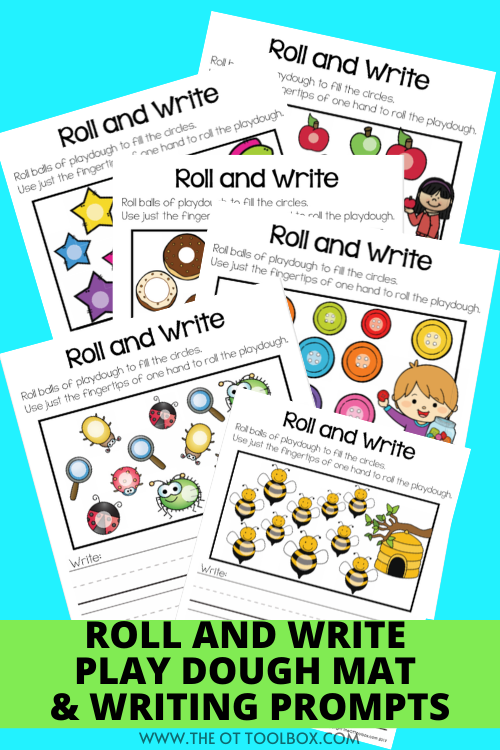
    Add the Roll and Write Play Dough Mat Writing Prompts to your therapy toolbox and build fine motor skills and handwriting in fun and engaging ways.

    Outer Space Visual Perception Worksheet #2

    Outer space visual perception worksheet

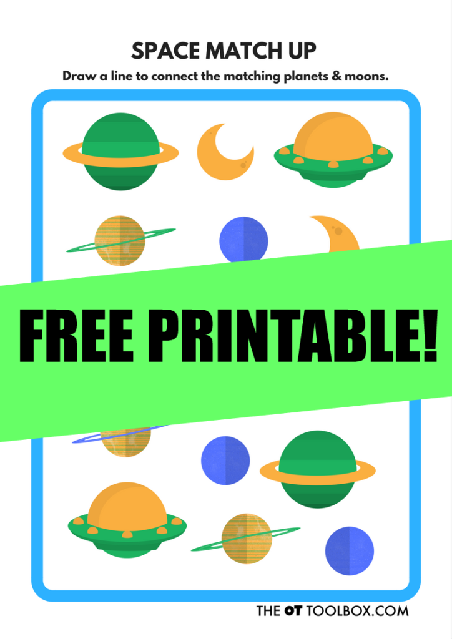
    This outer space visual perception worksheet is a fun printable page for kids who love all things outer space!  Sometimes a fun puzzle is just the way to make to therapy fun.  This Space Visual Perception Puzzle helps kids develop and build skills such as visual discrimination, spatial reasoning, visual motor skills, and motor planning.  It’s part of our free visual perception printable packet, full of resources to address visual scanning, visual discrimination, visual closure, and more.


    Kids can work on pencil control and motor planning to connect matching planets and shapes, but be sure to go around the planets that are in your way!  

    Outer space visual perception worksheet

    Outer Space Visual Perception Worksheet


    When completing this outer space worksheet, kids are working on several skills:


    Visual Discrimination– Noticing and identifying subtle differences in shapes, colors, direction, and forms is a necessary skill for functional tasks like matching socks or silverware.  Visual discrimination is a skill that is essential for handwriting, reading, and math.  Children who struggle with visual discrimination may not notice small details or may confuse letters or numbers that are similar like b, d, 2, and 5. 


    Spatial Reasoning– This skill is what allows us to walk around objects in our path with enough space.  Spatial reasoning is needed for handwriting when determining if a word will fit in a given space or if we need to write smaller or move to the next line at the end of the right margin.  Encourage kids to draw pencil strokes around the planets so they don’t touch the other planets with their pencil.  Visual spatial relations is a spatial reasoning skill. 


    Visual Motor Skills– Coordinating visual information with movements of the hands is a skill that is needed for handwriting.  Use a writing utensil to connect the matching planets and moons while working on visual motor skills needed for written work. 


    Visual Memory–  Children need visual memory for handwriting, reading, math, and many tasks during the school day.  Visual memory is a skill that allows us to store a visual piece of information or a form in our mind and recall the characteristics of that form.  


    This printable sheet can be used over and over again if you laminate it or slide it into a page protector.  Just use a dry erase marker to erase the lines and re-use the puzzle again. 


    The best news is that this space visual perception puzzle is FREE!  
    Grab your free worksheet by clicking the button below.  

    Free Outer Space Worksheet

    Click HERE to get this worksheet as well as 24 other printable worksheets in the free visual perception packet.

    There are a lot of other visual perception and visual motor activities on this site that you will love:

    More Outer Space Activities for Therapy

    Use the free visual perception worksheet along with these outer space activities to help kids develop skills in a variety of areas:

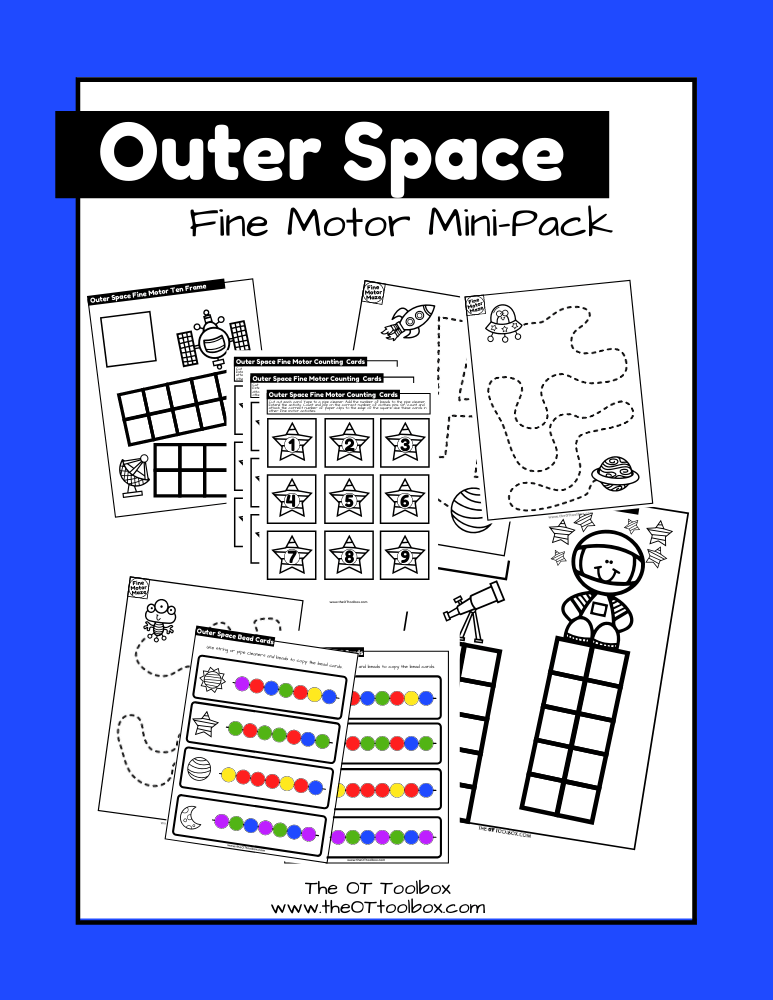
    Know a kiddo that loves all things space, astronauts, and planets? The Outer Space Fine Motor Kit is your chance to develop fine motor strength, dexterity, and coordination skills.

    Addressing hand strength, endurance, and precision is out of this world fun! The Outer Space Fine Motor Kit includes:

    • Fine Motor Mazes
    • Fine Motor Ten Frames for motor activities
    • 1-20 Star Counting Cards
    • Bead Copying Strips
    • Space Alien Directed Drawing Sheets

    This fine motor kit includes 24 pages of printable resources. Included in this printable pack are:

    1. Two pages of color coded bead copying strips
    2. Two pages of blank bead copying strips
    3. Four pages of “draw and write” directed drawing activities with a space theme (Includes 3 styles of handwriting lines: highlighted lines, single rule, and double rule)
    4. Nine pages of fine motor mazes
    5. 1-20 Outer Space Counting Cards
    6. Four pages of fine motor ten frames activities

    These printable activities extend to work on a variety of other functional areas, too: handwriting skills, numbers, math, adding, subtracting, one-to-one correspondence, scissor skills, coloring, and more.

    Click HERE to grab the Outer Space Fine Motor Mini-Kit.

    Outer Space Fine Motor Kit

    Colleen Beck, OTR/L has been an occupational therapist since 2000, working in school-based, hand therapy, outpatient peds, EI, and SNF. Colleen created The OT Toolbox to inspire therapists, teachers, and parents with easy and fun tools to help children thrive. Read her story about going from an OT making $3/hour (after paying for kids’ childcare) to a full-time OT resource creator for millions of readers. Want to collaborate? Send an email to contact@theottoolbox.com.
    Free Virtual Connect 4 Game

    Virtual Connect 4 Game

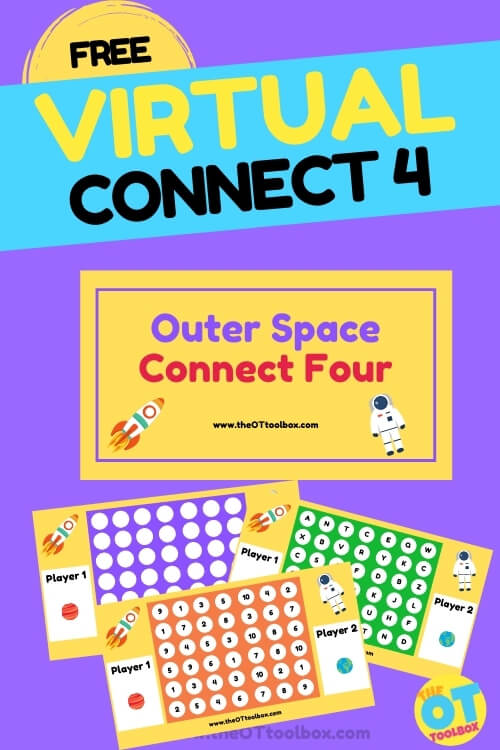
    Today I have another fun virtual therapy activity: A therapy board game Connect 4! This therapy slide deck is a free virtual Connect 4 game designed for occupational therapy services (or other therapy services) that combine motor skills with visual perception and eye hand coordination. Therapeutic games are nothing new; Occupational therapists use board games in therapy services all the time to address function and independence skills. This therapy game is a bit different: it builds skills in kids through game play, and is a fun game for teletherapy.

    Grab this free virtual Connect 4 game for building skills in occupational therapy, using a outer space connect 4 game!

    Therapy Board Game

    We’ve shared virtual games and board games to use in therapy previously on this site. Some games are great for helping kids develop specific skills:

    Today’s virtual Connect Four game is just as much fun, and it’s a great tool to add to your therapy toolbox!

    Virtual Connect 4

    When it comes to teletherapy services, it can be hard to incorporate game play into therapy sessions in a way that addresses functional goals like handwriting, motor skills, or self-regulation. This virtual Connect 4 game does just that!

    This game is a Google slide deck and one of our free slides that can compliment therapy services, both online or in face-to-face sessions.

    To play the game, you’ll add the free slide deck to your Google drive, pull up the slide deck during therapy sessions, and work on a variety of skills. To use this game in distance therapy situations, you can send the link to students and you’ll each play on your own computers, watching as the edits are made to the slide deck. (Be sure to make a copy and send that specific link to a student- this way your student has their own copy of the slide deck on their Google drive.)

    The game is just like the classic Connect 4 game: try to get four in a row and block the other player from getting four in a row.

    This particular Connect 4 game has an outer space theme. So, the game pieces are planets! Check out more space theme activities below.

    When suing the Connect 4 game in therapy, kids can work on the following skills:

    • Visual perception
    • Visual motor skills
    • Eye hand coordination
    • Fine motor skills
    • Mouse use/keyboard use
    • Finger isolation

    The virtual Connect 4 game includes handwriting slides, so that when users place the game pieces, they cover a letter or a number. These are designed to promote handwriting skills and number formation skills.

    Use the handwriting slide to work on letter formation, word writing, sentence writing, and copying skills.

    Use the number slide to work on forming numbers, writing number words, or even gross motor skills: kids can do a motor activity like jumping jacks to animal walks the same number of times as the number they covered with their game piece.

    To reset the game pieces:

    1. When you are done playing, just hit the EDIT HISTORY link.
    2. Look on the right side bar for “Version History”.
    3. Click the box that says “Reset Game”.
    4. Then go to the top left corner of the screen where there is an arrow pointing left. Click this arrow.
    5. All of the movable game pieces will be reset to their original spots. You can start the game over again.

    This Space Connect 4 game will be a hit in your therapy sessions (or at home and in the classroom!)

    More space activities for therapy

    You can add this virtual Connect 4 game to these other Space theme activities, to help with therapy planning:

    Free Virtual Connect 4 for Therapy

    Want to add this free slide deck to your therapy toolbox? Enter your email address into the form below and you’ll gain access to this slide deck on your Google drive.

    For those using school district, university, or organization emails- You may have trouble accessing the free slide deck due to increased security warnings. To get around this, try entering a personal email address.

    Free Virtual Connect 4 Game for Therapy!

      We respect your privacy. Unsubscribe at anytime.

      Colleen Beck, OTR/L has been an occupational therapist since 2000, working in school-based, hand therapy, outpatient peds, EI, and SNF. Colleen created The OT Toolbox to inspire therapists, teachers, and parents with easy and fun tools to help children thrive. Read her story about going from an OT making $3/hour (after paying for kids’ childcare) to a full-time OT resource creator for millions of readers. Want to collaborate? Send an email to contact@theottoolbox.com.
      Outer Space Fine Motor Kit

      NEW RESOURCE: Outer Space Fine Motor Mini-Pack!

      Working on fine motor skills? Know a child who loves all things outer space? This Outer Space Fine Motor Mini-Kit is for you!

      Work on grasp, hand strength, eye-hand coordination, handwriting, scissor skills, and all things fine motor with this Outer Space fine motor mini-kit.

      Addressing hand strength, endurance, and precision is out of this world fun!

      Includes:

      • Fine Motor Mazes
      • Fine Motor Ten Frames for motor activities
      • 1-20 Star Counting Cards
      • Bead Copying Strips
      • Space Alien Directed Drawing Sheets

      Grab your copy of this no-prep Outer Space fine motor worksheet set!

      Virtual Visual Motor Room

      Visual Motor Skills Virtual Therapy Room

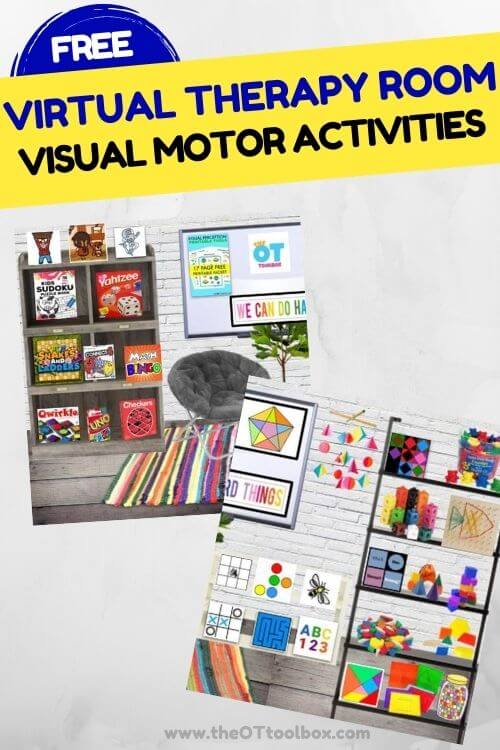
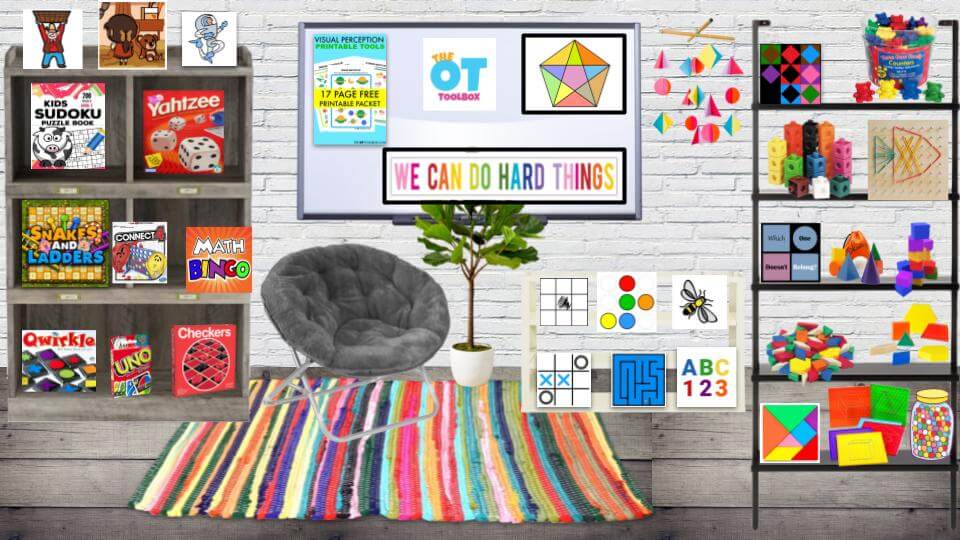
      If you are looking for online games to target visual perceptual skills, and ways to build visual motor skills when working virtually, then this virtual visual motor room (or virtual visual perceptual skills therapy room) is for you. This virtual therapy room is based on our virtual sensory room and is designed to develop and strengthen visual motor skills, visual perceptual skills, visual figure ground, and eye-hand coordination. Let’s play!

      This Visual Motor Skills Virtual Therapy Room is going to be a hit with your caseload.

      Free virtual visual motor activities for online occupational therapy activities

      Online Visual Motor Activities

      For therapists working in teletherapy, online puzzles, virtual games, and remote therapy games are one way to help kids build the skills they need for visual perception, visual motor, eye-hand coordination, and even executive functioning.

      That’s where this virtual visual motor room comes in.

      Therapists can access the free virtual therapy room from their Google drive and use the tools in teletherapy sessions.

      This slide deck is just one of the many free slide deck collections available here on The OT Toolbox.

      For more teletherapy games and tools that can be done remotely with kids on your therapy caseload, check out this resource on virtual therapy games.

      Virtual Visual Motor Activities

      There are so many awesome visual motor resources that can be used in occupational therapy teletherapy. In the virtual therapy room, you can find games and activities like these:

      • Online Sudoko
      • Virtual Connect 4 game
      • Online Snakes and Ladders
      • Virtual Bingo
      • Qwirkle
      • Uno
      • Yahtzee
      • Online Tic Tac Toe
      • Tangrams
      • Connect the dots
      • Geoforms
      • Shape building activities
      • Counting and graphing activities
      • Visual memory activities
      • Mazes
      • Word searches
      • What’s missing puzzles
      • MUCH more

      All of these virtual therapy activities can be used to challenge kids’ visual perceptual skills, visual motor skills, and motor skills.

      You’ll also see links to hands-on visual motor activities listed here on The OT Toolbox as well as a link to our free visual perception packet. Use these hands-on and printable therapy tools along with the virtual games and activities.

      Virtual therapy room for visual motor skills.

      When you click on the images in the virtual therapy room, you’ll be sent to links to videos, exercises, and resources to promote visual perception activiites and visual motor activities. T

      This therapy room is a great resource for kids of all ages. You’ll find therapy activities for all levels of visual perceptual skills and visual motor integration.

      Free virtual therapy room slide deck

      Want to add this therapy slide deck to your OT toolbox? Enter your email address into the form below and you can access this resource from your email.

      NOTE: Lately email addresses from school districts, organizations, and those with strict security walls have had our slide decks blocked. Consider using a personal email address to access this slide deck.

      Free Virtual Visual Motor Room!

        We respect your privacy. Unsubscribe at anytime.

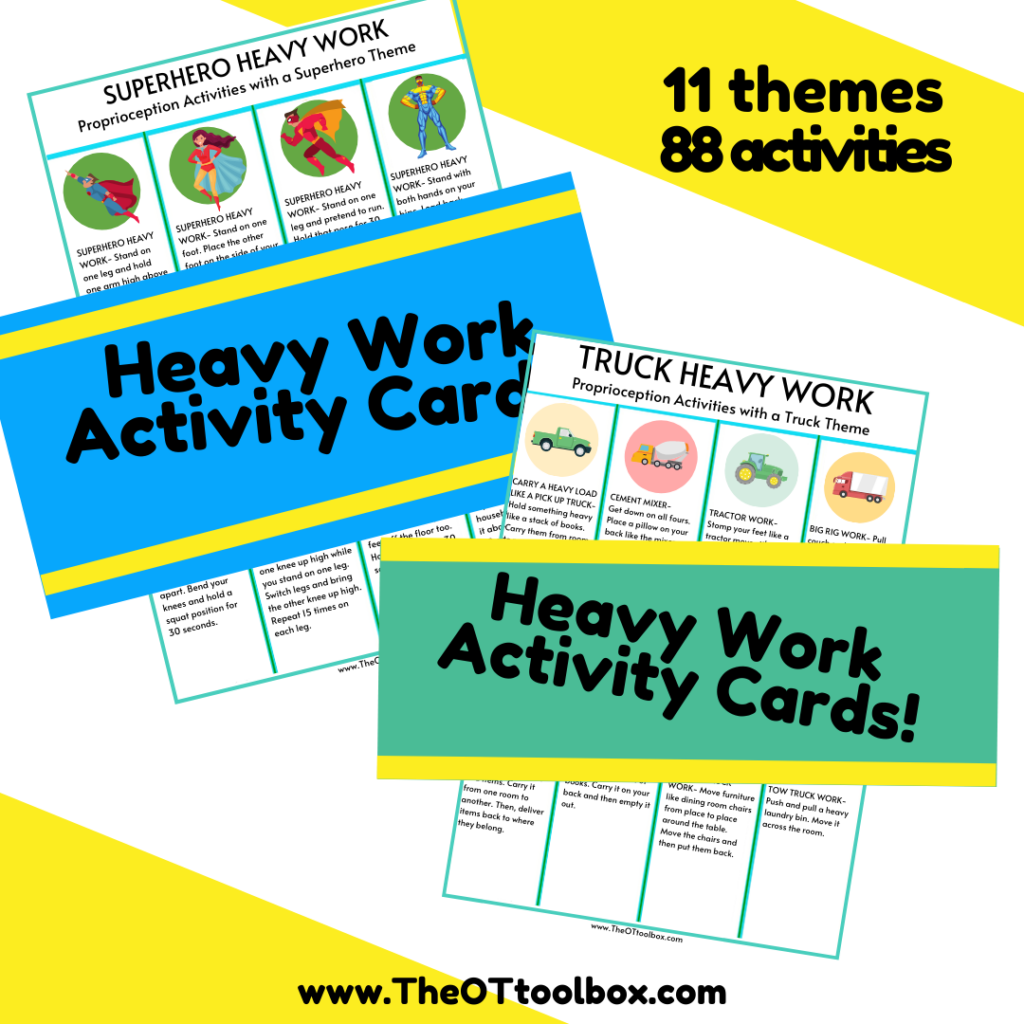
        Add heavy work with these heavy work exercises to incorporate many themes into therapy and play.

        heavy work cards for regulation, attention, and themed brain breaks

        Click here to grab these heavy work cards.

        Colleen Beck, OTR/L has been an occupational therapist since 2000, working in school-based, hand therapy, outpatient peds, EI, and SNF. Colleen created The OT Toolbox to inspire therapists, teachers, and parents with easy and fun tools to help children thrive. Read her story about going from an OT making $3/hour (after paying for kids’ childcare) to a full-time OT resource creator for millions of readers. Want to collaborate? Send an email to contact@theottoolbox.com.

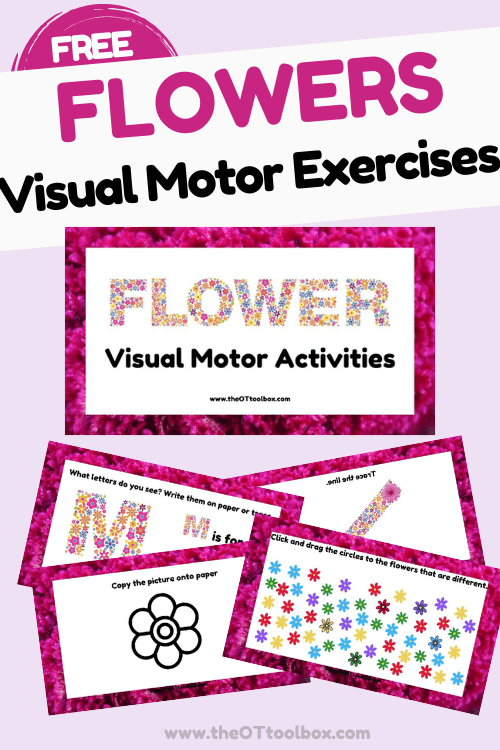
        Flower Visual Motor Therapy Slide Deck

        Flower visual motor exercises for therapy

        This week’s occupational therapy theme is flowers and so today, I have a free flower visual motor therapy slide deck for you. In this free Google slide deck, you’ll find various aspects of visual motor skill work. With the official start of Spring, flowers are starting to pop up all over, so if the daffodils, lilies, and tulips make you smile, these visual motor flower activities are sure to brighten your therapy session!

        Flower visual motor therapy exercises for therapy

        Flower visual motor therapy activities

        If you are looking for Spring occupational therapy activities to help kids develop skills, this flower visual motor slide deck is it. Add this virtual therapy activity to some hands on flower activities and you’ve got a therapy plan for the week. It’s a great way to make a weekly occupational therapy plan and use the same activities again and again all week, saving yourself time and planning hours. Simply adjust each activity to meet the needs of each child on your therapy caseload to work on their specific goals.

        Flower visual motor activities for occupational therapy teletherapy sessions with a free Google slide deck for therapy.

        As you know, visual processing breaks down into smaller components that all work together to allow us to take in visual information, process that input, and complete motor operations so we can complete functional tasks. Visual motor skills include eye-hand coordination, visual perception, and visual skills like tracing, convergence, and other skill areas. All of these aspects of visual processing are important parts of performing day to day occupations.

        That’s why I created this flower theme therapy slide deck that includes different vison exercises.

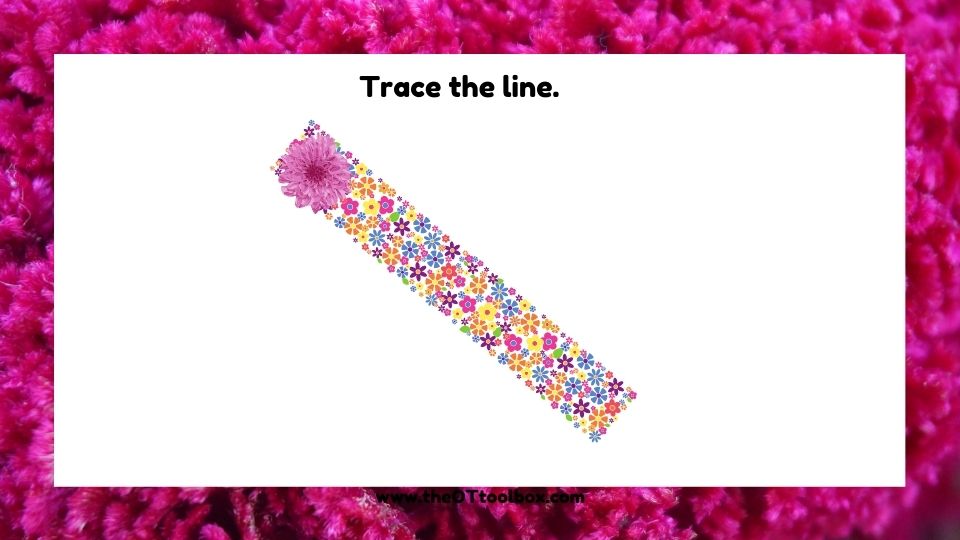
        In the slide deck, you’ll find pre-writing line activities that ask the user to trace along the forms using a movable flower icon. This eye-hand coordination task requires visual tracking, visual attention, and motor integration with visual input.

        Work on visual motor skills with this flower theme slide deck in occupational therapy.

        Also, the slide deck includes copying activities. Users can copy the simple and more complex flower forms as they challenge aspects of visual motor skills that are needed for handwriting and math tasks.

        There is a handwriting portion as well. Kids can trace the letters on the slide deck using the movable flower piece. This makes the slide deck interactive, as they can work on mouse work, use of a stylus, or finger isolation to trace the flower along the letter. Then, the slide asks them to write words or phrases so they can incorporate handwriting work.

        Then finally, the slide deck includes several visual perception activities. Kids can complete each slide, typing or writing out their responses as they work on skills like visual discrimination, form constancy, visual memory, figure-ground, etc. All of these visual perceptual skills play a role in visual motor tasks that we perform on a daily basis.

        Free Flower Therapy Slide Deck

        Want to add this free slide deck to your therapy toolbox? Use it in teletherapy sessions, home activities to work on visual motor skills and visual processing, and to make therapy planning easier!

        Enter your email address into the form below to add this slide deck to your Google drive account.

        NOTE- Due to an increase in security measures, many readers utilizing a work or school district email address have had difficulty accessing resources from the delivery email. Consider using a personal email address and forwarding the delivery email to your work account.

        Flower Visual Motor Activities Slide Deck!

          We respect your privacy. Unsubscribe at anytime.

          Spring Fine Motor Kit

          Score Fine Motor Tools and resources and help kids build the skills they need to thrive!

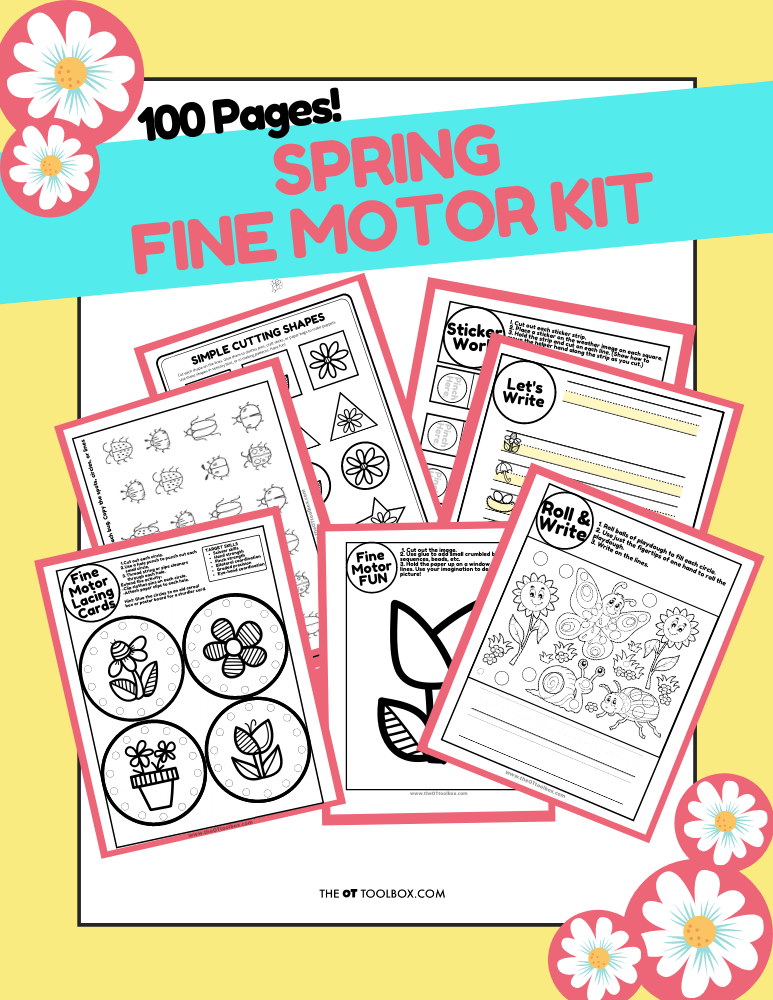
          Developing hand strength, dexterity, dexterity, precision skills, and eye-hand coordination skills that kids need for holding and writing with a pencil, coloring, and manipulating small objects in every day task doesn’t need to be difficult. The Spring Fine Motor Kit includes 100 pages of fine motor activities, worksheets, crafts, and more:

          Spring fine motor kit set of printable fine motor skills worksheets for kids.
          • Lacing cards
          • Sensory bin cards
          • Hole punch activities
          • Pencil control worksheets
          • Play dough mats
          • Write the Room cards
          • Modified paper
          • Sticker activities
          • MUCH MORE

          Click here to add this resource set to your therapy toolbox.

          Spring Fine Motor Kit
          Spring Fine Motor Kit: TONS of resources and tools to build stronger hands.

          Grab your copy of the Spring Fine Motor Kit and build coordination, strength, and endurance in fun and creative activities. Click here to add this resource set to your therapy toolbox.

          Colleen Beck, OTR/L has been an occupational therapist since 2000, working in school-based, hand therapy, outpatient peds, EI, and SNF. Colleen created The OT Toolbox to inspire therapists, teachers, and parents with easy and fun tools to help children thrive. Read her story about going from an OT making $3/hour (after paying for kids’ childcare) to a full-time OT resource creator for millions of readers. Want to collaborate? Send an email to contact@theottoolbox.com.
          Free Spring Memory Game

          Spring memory game

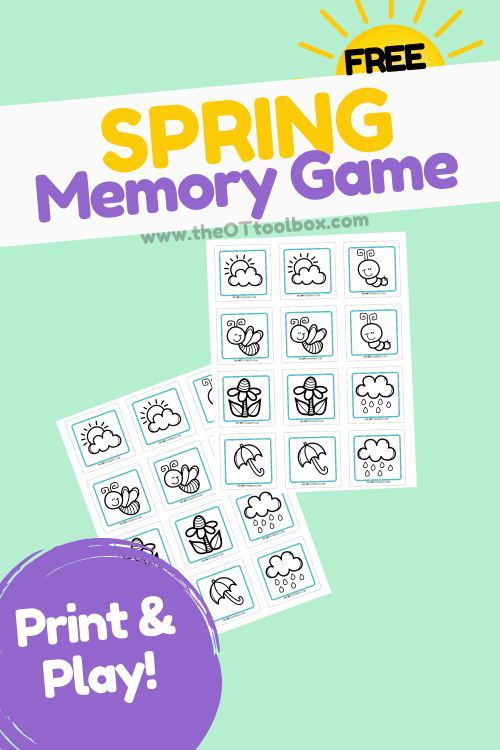
          Today, I’ve got a spring memory game that you can access for free. Fire up the printer because this printable game is a fun way to work on visual perceptual skills with kids. The bugs, butterflies, rain clouds, and other Spring images will keep the kiddos building visual memory, visual attention, and visual discrimination skills so they can learn and grow through play. And, check out our Spring visual perception activities for more fun.

          Spring memory game for kids is a free printable

          Benefits of playing Memory GameS

          Memory games are such a great way to help kids develop visual perceptual skills they use in reading, writing, and math. For another printable game, check out this Goodnight Moon memory game activity.

          Memory games boost skills in a lot of different ways:

          Visual discrimination- determining the difference between images uses visual discrimination skills. This translates to letter and number identification, reading sight words, and reading fluency and comprehension.

          Visual attention- Memory games require a lot of attention to keep those eyes on the game pieces. This ability to visually attend during game play then transfers over to attention during writing and reading tasks.

          Visual memory- a little different than actual memory of concepts and ideas, visual memory is the picture that the mind’s eye captures during situations or events. Visual memory allows us to file away information and recall it for future use, based on what we’ve seen. Visual memory plays a role in executive functioning skills and working memory.

          Executive functioning skills- speaking of executive functioning, visual skills have a large role in attention, focus, planning ahead, and other EF tasks. Read more about games to support and develop executive functioning skills, including the game of memory.

          Visual figure-ground– This visual perceptual skill allows us to pull out important information from a busy background. When playing memory, you need to see a specific image in a background of many other game cards. This skill can be developed in non-traditional game play. Turn all of the game cards over so the images are face up. Can you find the matches quickly when they are all showing? What if we turn on a timer? Can you beat the clock to find all of the matches? Visual figure ground skills play a role in reading fluency and comprehension.

          There are other skills that the game of memory develops as well: Skills like focus, attention, concentration, attention span, thinking skills, problem solving, self-confidence…these are just some of the ways that Memory assists with child development!

          Free Spring Memory Game

          In the printable, there are 12 different Spring images, so 24 total cards. You can adjust the number of cards to meet the needs of each child. Use it to play traditional memory, or adjust the activity with different memory and visual perception activities:

          • Play “what’s missing”
          • Match the cards on a dry erase board with a marker or string, like we did here.
          • Print them off, slide them into a page protector sheet and use them over and over again with a dry erase marker.
          • Work on pencil control and color in the images with colored pencils
          • Practice handwriting and write the names of the images.

          I’m adding this free printable to this week’s Spring occupational therapy activities. If you are looking for fun and easy ways to help kids develop skills in their therapy goals, or for ways to support child development in the home or classroom, be sure to check out the seasonal activity ideas.

          So? Want to print off this Spring game and add it to your therapy toolbox to help kids (and adults) play and build brain skills? Enter your email into the form below and you’ll receive the printable game pieces.

          The images on the Memory Game are similar and match a lot of the icons and graphics used in our NEW Spring Fine Motor Kit. Read more about this resource below.

          Free Spring Memory Game

            We respect your privacy. Unsubscribe at anytime.

            Spring Fine Motor Kit

            Score Fine Motor Tools and resources and help kids build the skills they need to thrive!

            Developing hand strength, dexterity, dexterity, precision skills, and eye-hand coordination skills that kids need for holding and writing with a pencil, coloring, and manipulating small objects in every day task doesn’t need to be difficult. The Spring Fine Motor Kit includes 100 pages of fine motor activities, worksheets, crafts, and more:

            Spring fine motor kit set of printable fine motor skills worksheets for kids.
            • Lacing cards
            • Sensory bin cards
            • Hole punch activities
            • Pencil control worksheets
            • Play dough mats
            • Write the Room cards
            • Modified paper
            • Sticker activities
            • MUCH MORE

            Click here to add this resource set to your therapy toolbox.

            Spring Fine Motor Kit
            Spring Fine Motor Kit: TONS of resources and tools to build stronger hands.

            Grab your copy of the Spring Fine Motor Kit and build coordination, strength, and endurance in fun and creative activities. Click here to add this resource set to your therapy toolbox.

            Colleen Beck, OTR/L has been an occupational therapist since 2000, working in school-based, hand therapy, outpatient peds, EI, and SNF. Colleen created The OT Toolbox to inspire therapists, teachers, and parents with easy and fun tools to help children thrive. Read her story about going from an OT making $3/hour (after paying for kids’ childcare) to a full-time OT resource creator for millions of readers. Want to collaborate? Send an email to contact@theottoolbox.com.
            Spring Emotions Matching Game Slide Deck

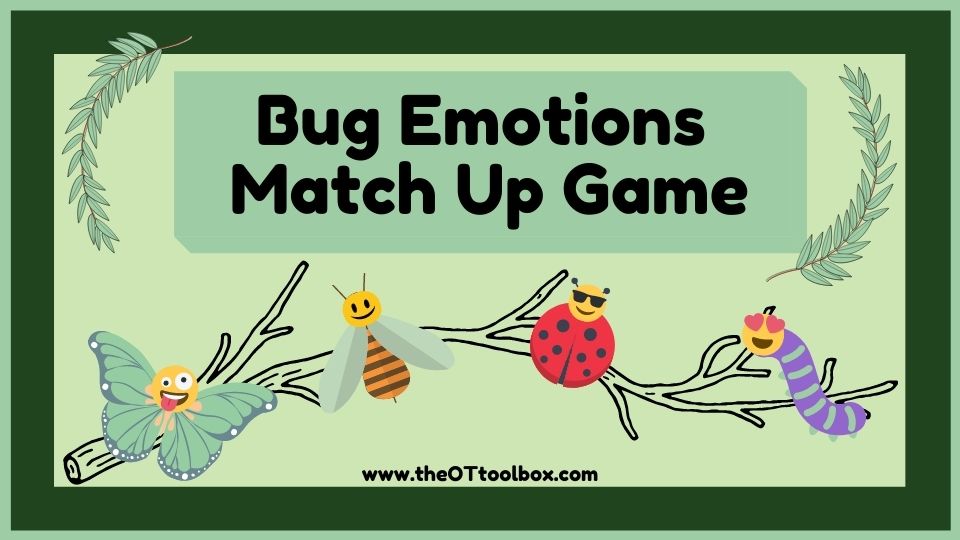
            Emotions Matching game with a bug theme for Spring

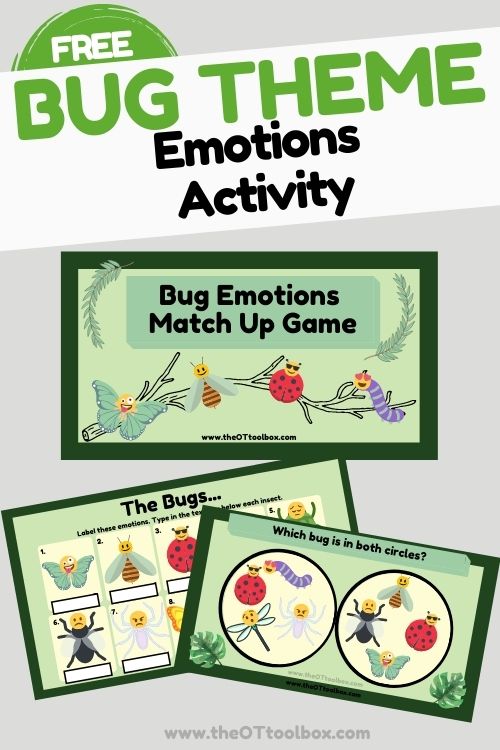
            Today, I have another free therapy slide deck for you to use in guiding teletherapy occupational therapy sessions. This activity is a Spring themed emotions matching game. The premise behind this emotions game is to help with teaching feelings to kids, as well as the social emotional learning involved in self-regulation. Because there are always other skill areas to work on, the occupational therapy activity addresses visual perceptual skills like visual discrimination and visual memory as well.

            This teletherapy slide deck is one of the many free slides we have here on the website. Use them in your teletherapy activities for occupational therapy.

            Emotions Matching game with a bug theme for Spring

            Emotions Matching Game

            This emotions matching game is a lot like our other spot it game activities. The idea is to work on teaching emotions by facial expression and to help kids with identifying different facial expressions that translate to feelings and emotions.

            Spring bugs emotions matching game for teaching feelings

            This slide deck has a bugs theme, making it a great activity for Spring (but anytime really…bugs are a fun theme to use in occupational therapy activities!)

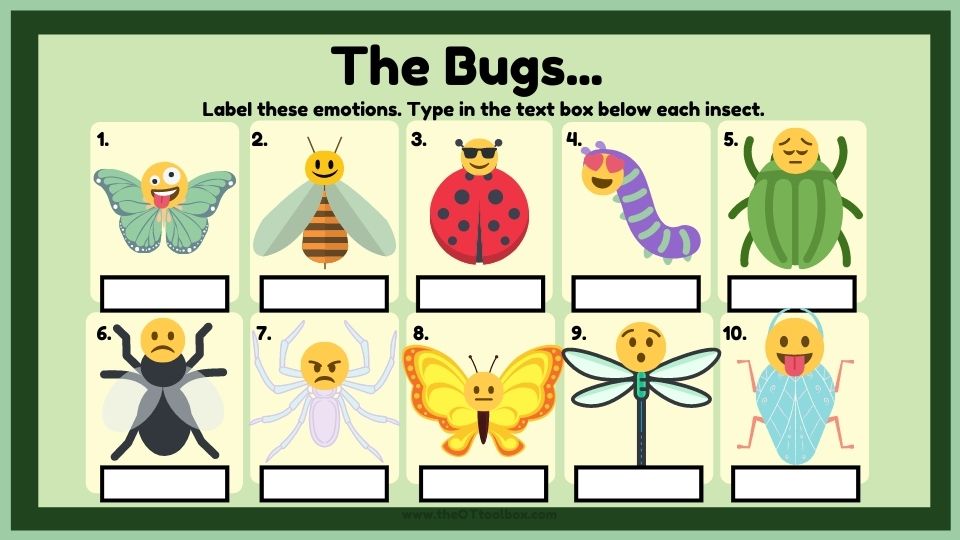
            When kids play this emotions matching activity, they can first, identify different emotions. On the slide deck children can actually type right into the space below each image.

            Teach feelings and emotions with this emotion matching game.

            The slides are set up so that kids can type the emotion they identify with each facial expression. Some kids might identify different emotions based on the images. Some of the bugs have silly expressions, and others have angry, worried, happy, or calm expressions. When kids go through this part of the emotional learning game, they can express the reasoning why they define each image as a specific feeling or emotion.

            When kids identify emotions, it goes a long way in teaching feelings to kids. This can help them with empathy for others and to better understand why and how they feel certain ways in specific situations.

            You can extend this part of the activity to further social emotional development and self evaluation. Help kids identify when they may feel that specific emotion, and what they have done about it in the past.

            Then, you can help them identify coping strategies if needed (for feelings of anxiousness, worry, or anger) and when feelings get “too big” or out of control. For example, as the child to describe how they might act when they feel that type of feeling. There are so many ways to extend this part of the emotions game that works on an individual basis; Make the social emotional learning online game work for the child you are treating.

            These kind of self-reflection strategies are addressed in the Impulse Control Journal, a printable resource for working on responses, coping mechanisms, and self-reflection that impacts our responses to specific situations in everyday situations. With the Impulse Control Journal, kids can journal their responses and identify ways they can respond and react differently in the future.

            Emotions Game for teletherapy

            Emotions Matching Activity

            The next part of the slide deck includes a spot it game with the emotions and facial expressions images.

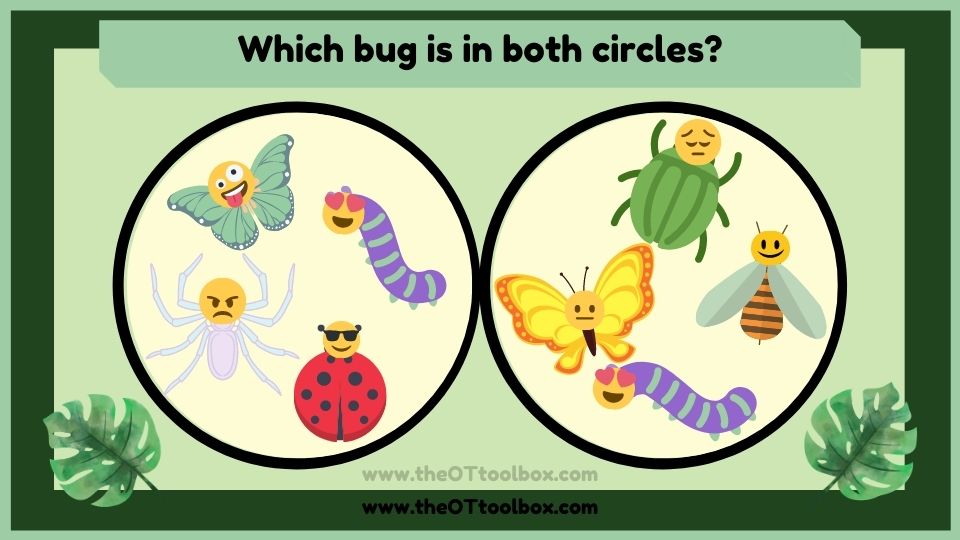
            Kids will go through each slide and find two matching facial expression bugs that share the same emotion.

            This visual discrimination activity helps with more social emotional skills (picturing the expression in different sizes or positioning) and working memory as it relates to emotional learning. They can recall the emotion that they defined for that particular expression and then go back and identify the self regulation strategies that they came up with in the precious part to the slide activity.

            This part of the free slide deck is also interactive- Kids can click on the leaves on the slide and drag them over to cover the matching bugs.

            This free social emotional worksheet goes well with this slide deck. Print it off and use it with kids to write in different facial expressions.

            Visual Perceptual Skills with Matching Games

            When kids play matching games like this spot it activity, they are developing and refining so many visual perceptual skills that carryover to reading, writing, math, handwriting, and other aspects of learning.

            These are the visual perceptual skills and visual processing skills that this virtual game addresses:

            • Visual memory
            • Visual attention
            • Visual discrimination
            • Form constancy
            • Visual figure ground,
            • Visual scanning

            There are different ways to extend this emotions game as well:

            1. Use it to teach empathy- Identify how others might feel when they have the visual expressions described in this slide deck.
            2. Work on coping strategies- Use the facial expressions to practice coping techniques.
            3. Work on handwriting- write down the emotions and work on letter formation, spacing, sizing, and legibility.
            4. Use the activity as a writing prompt- Kids can write about a time that they experienced one of the emotions on the slide deck. They can describe what led to those feelings and what they did about it if coping tools were needed.

            How would you use this emotions game in teletherapy or to guide therapy sessions?

            Emotions Slide Deck

            Want to add this teaching feelings game to your social emotional skills toolbox? Need easy teletherapy activities that don’t require a ton of materials?

            You’ve got it!

            Enter your email into the form below. You’ll receive a link to add this slide deck to your Google drive. Then, start using it right away in therapy sessions.

            Spring
            Emotions Game Slide Deck!

              We respect your privacy. Unsubscribe at anytime.

              More Social Emotional Tools

              Need strategies to work on self-regulation and coping mechanisms? Try the heavy work activity cards for proprioceptive input that calms and helps to regulate.

              Or, try the social emotional learning crafts, activities, and play ideas in the resource, Exploring Books Through Play, 50 Activities Based on Books About Friendship, Acceptance, and Empathy.

              Emotional Learning information– Use these social emotional learning activities to help children develop positive relationships, teach concepts of behaving ethically, and how to handle challenging emotions and behaviors.

              Zones of Regulation Activities– Strategies and hands-on activities to incorporate into self-reflection of feelingsemotions, and our response to situations is the ability to use emotional regulation. 

              Colleen Beck, OTR/L has been an occupational therapist since 2000, working in school-based, hand therapy, outpatient peds, EI, and SNF. Colleen created The OT Toolbox to inspire therapists, teachers, and parents with easy and fun tools to help children thrive. Read her story about going from an OT making $3/hour (after paying for kids’ childcare) to a full-time OT resource creator for millions of readers. Want to collaborate? Send an email to contact@theottoolbox.com.
              Shamrock Theme Visual Perception Slide Deck

              Shamrock theme visual perception

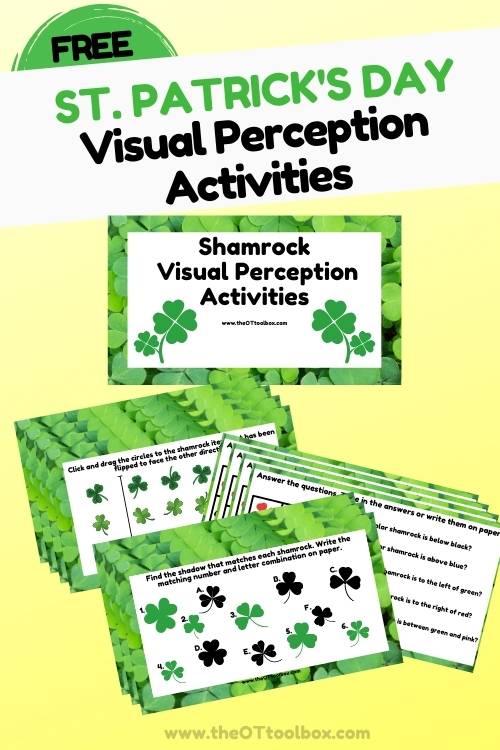
              This week’s free therapy slide decks are all about the shamrock theme! This visual perception slide deck covers all things shamrocks and is a fun way to help kids work on skills such as visual discrimination, figure ground, form constancy, visual memory, and visual spatial skills. So, grab this free slide deck and let’s get started!

              You’ll want to add the other shamrock themed activities to your therapy toolbox, too: Four leaf clover exercises and St. Patrick’s Day writing activities are sure to round out all of your therapy needs this time of year.

              Shamrock theme visual perception activities for vision therapy or OT teletherapy activities.

              These teletherapy activities are included in our massive collection of free slides, which is growing each week. Be sure to head over there to see the other therapy slide decks you’ve missed.

              Shamrock Theme

              This time of year, it’s fun to incorporate a shamrock theme into therapy and play. So, when I was thinking of therapy goal areas to address in this week’s slide decks, I knew visual perceptual skills was one of the essential areas.

              Visual perceptual skills are important to handwriting, hands-on play, math, reading, learning, and functioning. By visually scanning for differences in details, and being able to pull out visual discriminatory differences, children are building the skills they need for identifying words when reading…noticing different numbers in math problems, recognizing visual information they’ve read or seen before. All of this is connected to learning and functional participation in daily tasks. Read here on visual motor skills to see how all of these parts work together.

              So, the shamrock theme visual perception activities take what we know about visual processing, and make fun vision therapy exercises to work on these very skills.

              In the shamrock activities, you’ll find several different, but all equally effective vision activities…kind of like vision puzzles!

              Find the shamrock

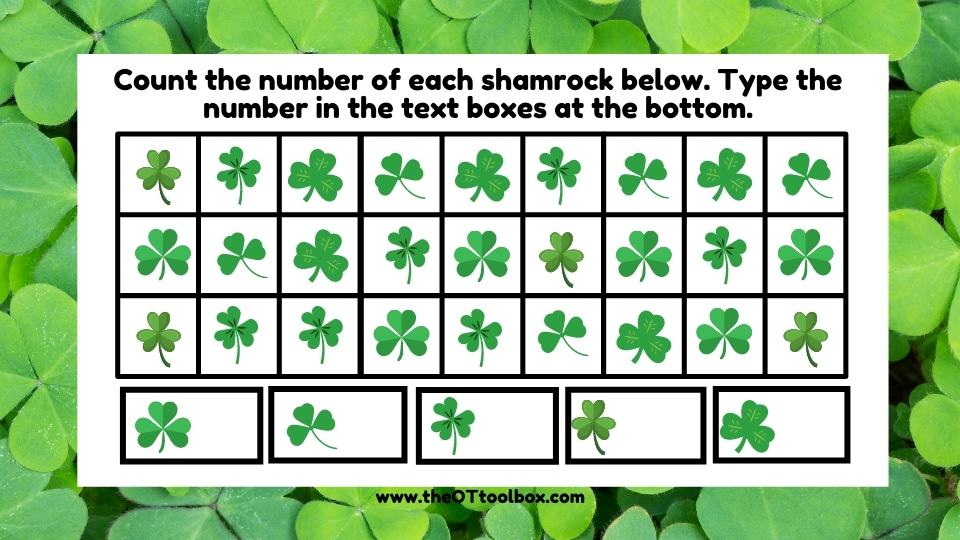
              On the first several slides of the therapy activities, you’ll see that users are challenged to count and identify matching shamrocks. These visual discrimination skills are powerful ways to work on form constancy, visual scanning, visual memory, and visual attention. When kids foster these skills, they work on the areas needed for reading and keeping their place in a reading passage. It’s a skill needed for reading fluency and comprehension.

              Shamrock visual perception exercise

              Users can count the number of each shamrock on the board and type that number into the slide deck. Students who are working on handwriting can write the number on paper.

              There are two different slides that work on these slills.

              You’ll also see a vision exercise where students can click and drag a circle to cover the shamrock that has been flipped. All of the other clovers in the row have been rotated. This form constancy skill is needed when reading so children know that letters are the same, not matter how they are written in different sizes or fonts.

              Shamrock activity to work on working memory, spatial relations, and directionality

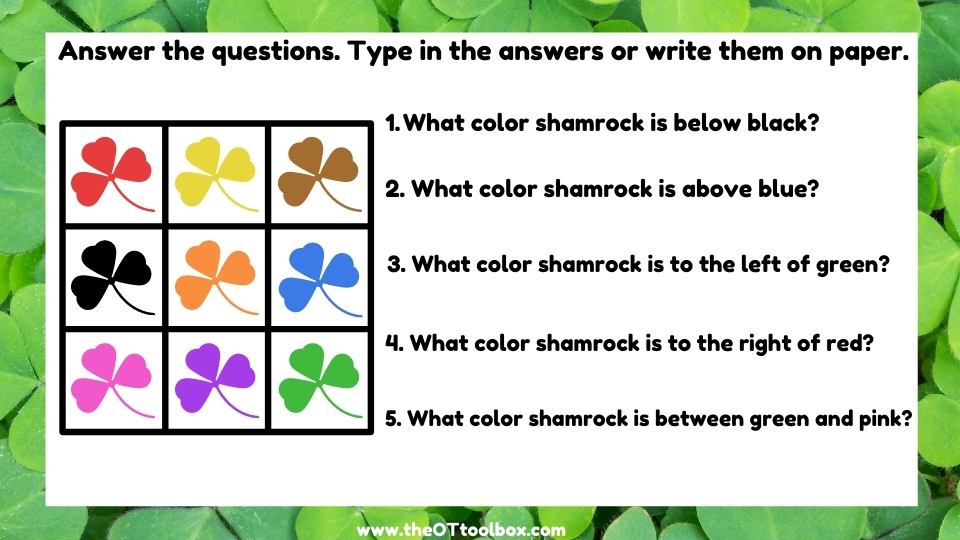
              There is another activity that might be my favorite. This one foster directionality and spatial awareness. Kids can identify the colors of shamrocks that are above, next to, or between others. This activity works on working memory and position in space skills. Teaching spatial relations with direction terms is an important way to help children with spatial awareness in handwriting, body awareness, and laterality.

              Other vision activities in the slide deck include a seek-and-find exercise that asks kids to find the four leaf clover hidden in a patch of shamrocks. This activity works on visual scanning, visual figure-ground skills, and visual attention. All of these skills are needed for a child to locate items in a busy background.

              Shamrock vision therapy exercise for visual discrimination

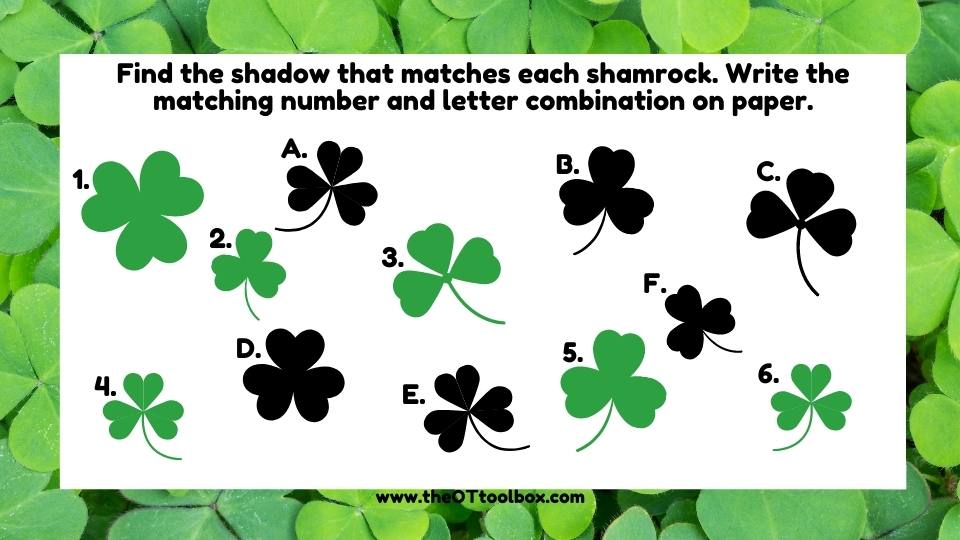
              There is a shadow matching activity that challenge kids to foster their visual discrimination and visual memory skills.

              Shamrock theme visual perception activity for visual scanning

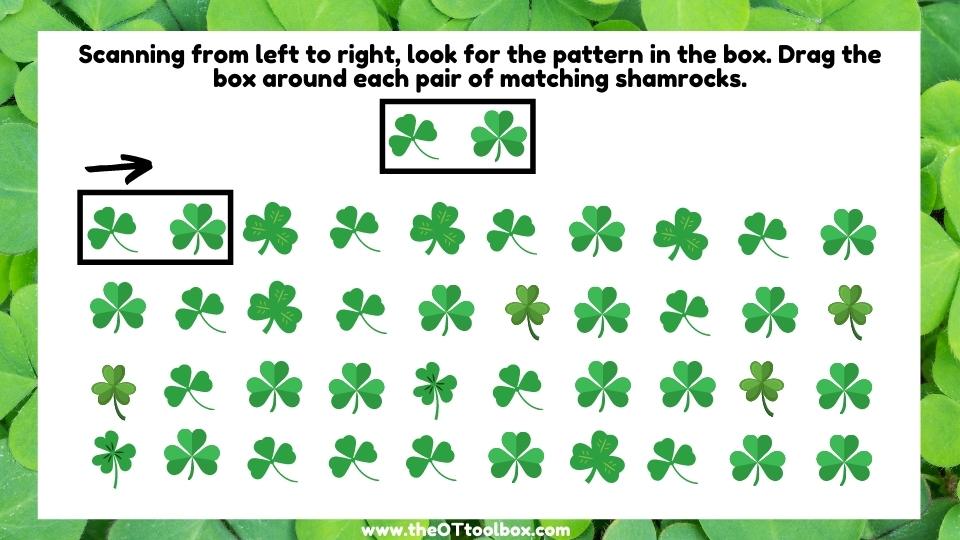
              Finally, there is a visual scanning and visual memory activity where kids can scan the shamrocks to find pairs that are the same, within a group. this is a powerful exercise to build skills needed for reading words and letters in a sentence or passage, and can build the skills needed for reading comprehension and fluency.

              Free Shamrock Therapy Slide Deck

              Want to add this shamrock theme activities to your therapy toolbox? Enter your email address into the form below and you can get a copy for yourself.

              Note: this free slide deck is interactive, so there are movable parts on the Google slides. You’ll need to use the slides in edit mode, as the parts won’t be moveable in present mode.

              Be sure to make a copy and NOT share the original slides. Other users will be moving the pieces, too so if you don’t make your own copy, you will have pieces that are not in the correct spaces.

              Finally, once you go through the slides and move items around, you can easily rest the slides to their original state and start over with another child on your caseload. Simply go to “history” and hit “reset slides” to get the movable pieces back.

              Shamrock Theme Visual Perception Exercises!

                We respect your privacy. Unsubscribe at anytime.
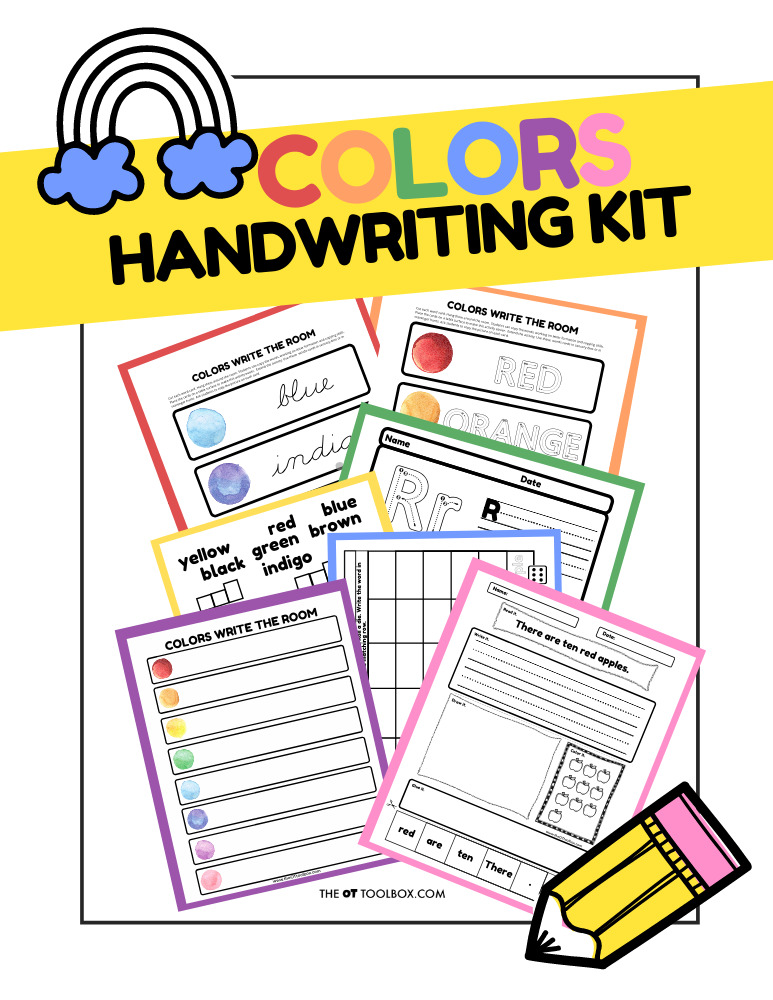
                Colors Handwriting Kit

                Rainbow Handwriting Kit– This resource pack includes handwriting sheets, write the room cards, color worksheets, visual motor activities, and so much more. The handwriting kit includes:

                • Write the Room, Color Names: Lowercase Letters
                • Write the Room, Color Names: Uppercase Letters
                • Write the Room, Color Names: Cursive Writing
                • Copy/Draw/Color/Cut Color Worksheets
                • Colors Roll & Write Page
                • Color Names Letter Size Puzzle Pages
                • Flip and Fill A-Z Letter Pages
                • Colors Pre-Writing Lines Pencil Control Mazes
                • This handwriting kit now includes a bonus pack of pencil control worksheets, 1-10 fine motor clip cards, visual discrimination maze for directionality, handwriting sheets, and working memory/direction following sheet! Valued at $5, this bonus kit triples the goal areas you can work on in each therapy session or home program.

                Click here to get your copy of the Colors Handwriting Kit.

                Colleen Beck, OTR/L has been an occupational therapist since 2000, working in school-based, hand therapy, outpatient peds, EI, and SNF. Colleen created The OT Toolbox to inspire therapists, teachers, and parents with easy and fun tools to help children thrive. Read her story about going from an OT making $3/hour (after paying for kids’ childcare) to a full-time OT resource creator for millions of readers. Want to collaborate? Send an email to contact@theottoolbox.com.